Here at PHS we often have
students write a paragraph called a
Concession.
   In your concession paragraph you “make
   concessions”.
What is a concession?
A concession is actually a persuasive
  technique.
Of the modes of persuasion we have studied,
  the concession would be an example of
  Logos.
A concession is when the writer takes time to
  explain the other side of the issue.
Students often make the mistake of arguing the
  other side of the issue.
              There is a difference!
What do you do in the concession?
Anticipating objections--When you anticipate objections to your
  argument or proposal, you are making an effort to see the
  others' viewpoints. You actually state other viewpoints. You are
  also troubleshooting problems that you must overcome to write
  a thorough proposal or position paper

Making concessions--When you make a concession, you
  actually give in to part of the other person's objections or views.
  You admit that he is half right, perhaps, or that he has a valid
  concern. Then you overcome that concern by logic and/or a
  solution.

  If you cannot find any objections or concessions, then you
        are probably not writing an argumentative paper.
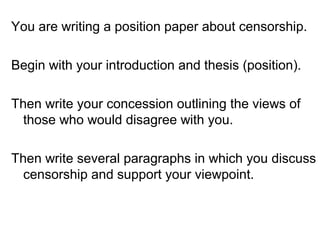
You are writing a position paper about censorship.

Begin with your introduction and thesis (position).

Then write your concession outlining the views of
  those who would disagree with you.

Then write several paragraphs in which you discuss
  censorship and support your viewpoint.
While censorship is dangerous to a free society, some of the
  concerned citizens who are in favor of censorship may have
  valid points when they object that children should not be
  exposed to television violence. [Here you have made a
  concession and anticipated an objection in one
  sentence.] Indeed, often there is too much violence on
  television [Again, a concession, a point of agreement.] Perhaps
  the answer is for all networks to establish the same guidelines of
  self-censorship [Here you offer a partial solution most can
  agree on.] If the networks were more responsible and tried to
avoid material that is in poor taste, governmental officials, religious
groups, and concerned parents might not feel the need to be
involved in their decisions at all.


   This example is general and has no CDs. Where would you
   insert CDs into this paragraph?
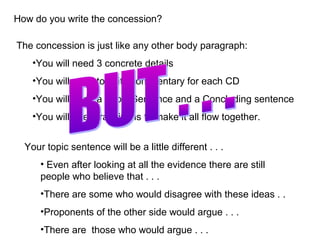
How do you write the concession?

The concession is just like any other body paragraph:
    •You will need 3 concrete details
    •You will need to write commentary for each CD
    •You will need a Topic Sentence and a Concluding sentence
    •You will need transitions to make it all flow together.


  Your topic sentence will be a little different . . .
      • Even after looking at all the evidence there are still
      people who believe that . . .
      •There are some who would disagree with these ideas . .
      •Proponents of the other side would argue . . .
      •There are those who would argue . . .
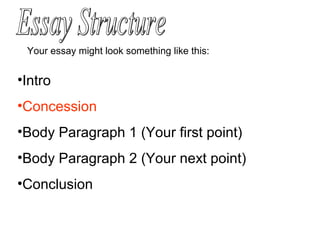
Your essay might look something like this:


•Intro
•Concession
•Body Paragraph 1 (Your first point)
•Body Paragraph 2 (Your next point)
•Conclusion
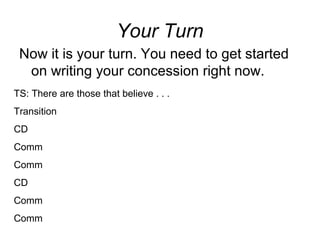
Your Turn
 Now it is your turn. You need to get started
  on writing your concession right now.
TS: There are those that believe . . .
Transition
CD
Comm
Comm
CD
Comm
Comm

Writing your concession

  • 1.
    Here at PHSwe often have students write a paragraph called a Concession. In your concession paragraph you “make concessions”.
  • 2.
    What is aconcession? A concession is actually a persuasive technique. Of the modes of persuasion we have studied, the concession would be an example of Logos. A concession is when the writer takes time to explain the other side of the issue. Students often make the mistake of arguing the other side of the issue. There is a difference!
  • 3.
    What do youdo in the concession? Anticipating objections--When you anticipate objections to your argument or proposal, you are making an effort to see the others' viewpoints. You actually state other viewpoints. You are also troubleshooting problems that you must overcome to write a thorough proposal or position paper Making concessions--When you make a concession, you actually give in to part of the other person's objections or views. You admit that he is half right, perhaps, or that he has a valid concern. Then you overcome that concern by logic and/or a solution. If you cannot find any objections or concessions, then you are probably not writing an argumentative paper.
  • 4.
    You are writinga position paper about censorship. Begin with your introduction and thesis (position). Then write your concession outlining the views of those who would disagree with you. Then write several paragraphs in which you discuss censorship and support your viewpoint.
  • 5.
    While censorship isdangerous to a free society, some of the concerned citizens who are in favor of censorship may have valid points when they object that children should not be exposed to television violence. [Here you have made a concession and anticipated an objection in one sentence.] Indeed, often there is too much violence on television [Again, a concession, a point of agreement.] Perhaps the answer is for all networks to establish the same guidelines of self-censorship [Here you offer a partial solution most can agree on.] If the networks were more responsible and tried to avoid material that is in poor taste, governmental officials, religious groups, and concerned parents might not feel the need to be involved in their decisions at all. This example is general and has no CDs. Where would you insert CDs into this paragraph?
  • 6.
    How do youwrite the concession? The concession is just like any other body paragraph: •You will need 3 concrete details •You will need to write commentary for each CD •You will need a Topic Sentence and a Concluding sentence •You will need transitions to make it all flow together. Your topic sentence will be a little different . . . • Even after looking at all the evidence there are still people who believe that . . . •There are some who would disagree with these ideas . . •Proponents of the other side would argue . . . •There are those who would argue . . .
  • 7.
    Your essay mightlook something like this: •Intro •Concession •Body Paragraph 1 (Your first point) •Body Paragraph 2 (Your next point) •Conclusion
  • 8.
    Your Turn Nowit is your turn. You need to get started on writing your concession right now. TS: There are those that believe . . . Transition CD Comm Comm CD Comm Comm