Etienne JULIOT [email_address] Conférence à l'Ecole des Mines de Nantes,  le 03/01/2011
 
Summary Definitions
Projects
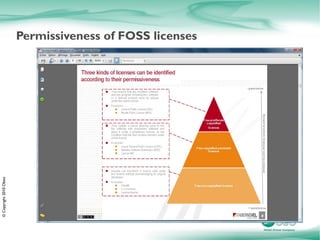
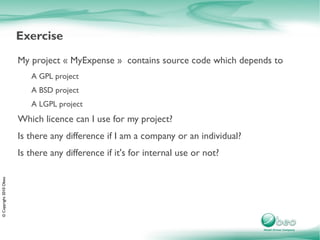
Licenses
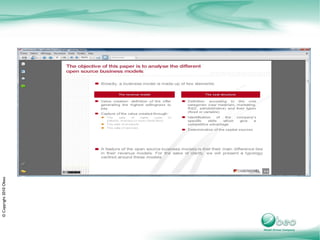
Business Models
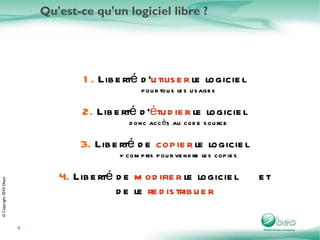
Qu'est-ce qu'un logiciel libre ? 1.  Liberté d' utiliser  le logiciel pour tous les usages 2.  Liberté d' étudier  le logiciel donc accès au code source 3.  Liberté de  copier  le logiciel y compris pour vendre les copies 4.  Liberté de  modifier   le logiciel  et de le  redistribuer
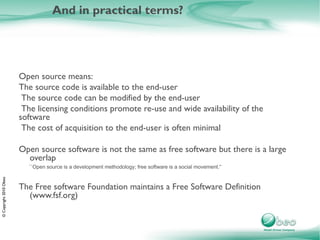
And in practical terms? Open source means: The source code is available to the end-user
The source code can be modified by the end-user
The licensing conditions promote re-use and wide availability of the software
The cost of acquisition to the end-user is often minimal Open source software is not the same as free software but there is a large overlap ``Open source is a development methodology; free software is a social movement.'’ The Free software Foundation maintains a Free Software Definition (www.fsf.org)
What about the word « free »? Free as in “freedom”
This usually implies “free as in free beer”
Questions Does the binary need to be available?
Is it allowed for an editor to sell a free software and not provide a free access to the binary and the source code?
Do I always need to redistribute my modification?
What about intellectual property and copyright?
So why is it better? You can use it and modify it freely, for any purpose
You are not tied to any company
Even though you might not be able to modify it, somebody can do it for you
Millions of developers watch the code
 
When and who
Richard M. Stallman 54 years-old
hacker (noble meaning)
free software activist
software patents destroyer
father of the GNU project (1983)
father of the Free Software Foundation (1985)
father of the Emacs text editor and other basic tools for operating systems
Eric S. Raymond 50 years-old
hacker (noble meaning)
founder of the “Open Source” movement
“The Cathedral and the Bazaar”, 1997
disputed member of the Community
Linus Torvalds 38 years-old
creator of the Linux kernel
self-proclaimed “benevolent dictator” of the Linux kernel development
rarely goes out of his modesty
(but when he does, the entire world knows it!)
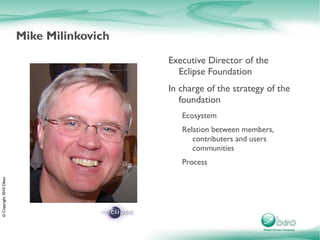
Mike Milinkovich Executive Director of the Eclipse Foundation
In charge of the strategy of the foundation Ecosystem
Relation between members,  contributers and users communities
Process
 
Logiciel libre : chiffres Tendances - Utilisateurs de Linux en entreprise prévus en 2008 :  +320%  par rapport à fin 2004 - Croissance du marché Linux dans le monde de 2004 à 2006 :  +36% -  49%  des collectivités régionales ou locales françaises ont installé des logiciels libres -  49%  des  plus grandes entreprises du monde auront une stratégie open source en 2008   Volumes -  35 milliards de dollars  : poids du marché mondial des logiciels libres estimé en 2008 -  146 millions d’euros  : poids du marché français des logiciels libres en 2004 -  450 millions d’euros  : poids du marché français des logiciels libres en 2006 Projections - Plus d’un milliard  d’euros en 2008,  plus de 2 milliards  d’euros à l’horizon 2010 -  900 millions  d’euros: part du marché des services informatiques consacrée aux projets de logiciels libres  Sources : Gartner, IDC
Summary Definitions
Projects
Licenses
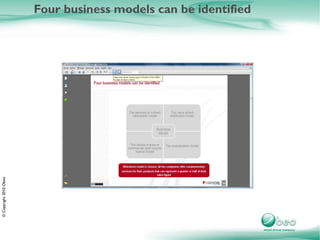
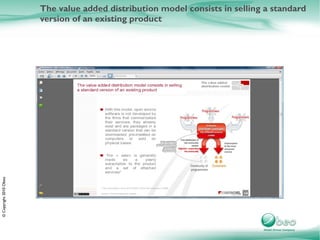
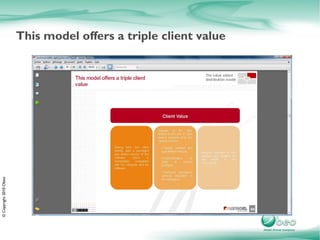
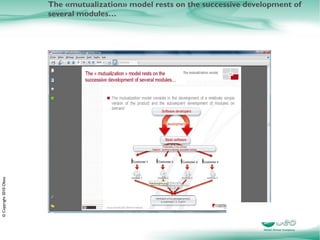
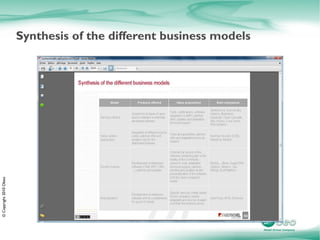
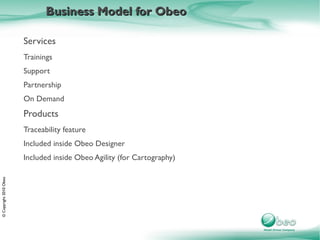
Business Models
Some exemples
Write text
Operating System
Do some computation
Development tools


FOSS == Linux ?
Fondations and organisations Tigris OPEES
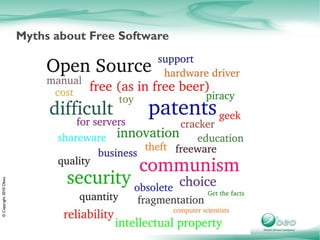
Myths about Free Software
To not  overestimated  the community
How to contribute? Infrastructure CVS, SVN, GIT
Bugzilla, newsgroup, mailing list
Hudson, Portal Listen the community Blog, Planet, Twitter
FAQ Ask before
Don't re-invent the wheel, improve it!
Find the process!


Organisation de la Fondation Contributors
Commiters
PMC

Introduction sur l'Open Source

Editor's Notes

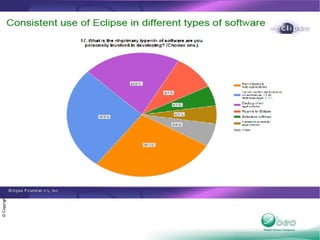
  • #17 [Resp: Marc]
  • #58 Page Page Choice, market driven approach : L’idée est d’indiquer une démarche de “choix” parmis les différentes technos ou approches possible, choix orienté par les besoins exprimés au travers des gdes “integrations” envisagées
  • #70 Itératif OSS / Propriétaire : différence dans le temps sur la collaboration Ecosystème
  • #71 Itératif OSS / Propriétaire : différence dans le temps sur la collaboration Ecosystème
  • #72 Itératif OSS / Propriétaire : différence dans le temps sur la collaboration Ecosystème
  • #73 Itératif OSS / Propriétaire : différence dans le temps sur la collaboration Ecosystème