Writing Pluggable Software Tatsuhiko Miyagawa   [email_address] Six Apart, Ltd. / Shibuya Perl Mongers YAPC::Asia 2007 Tokyo
For non-JP attendees … If you find \ in the code, Replace that with backslash. (This is MS' fault)
Plaggable Software
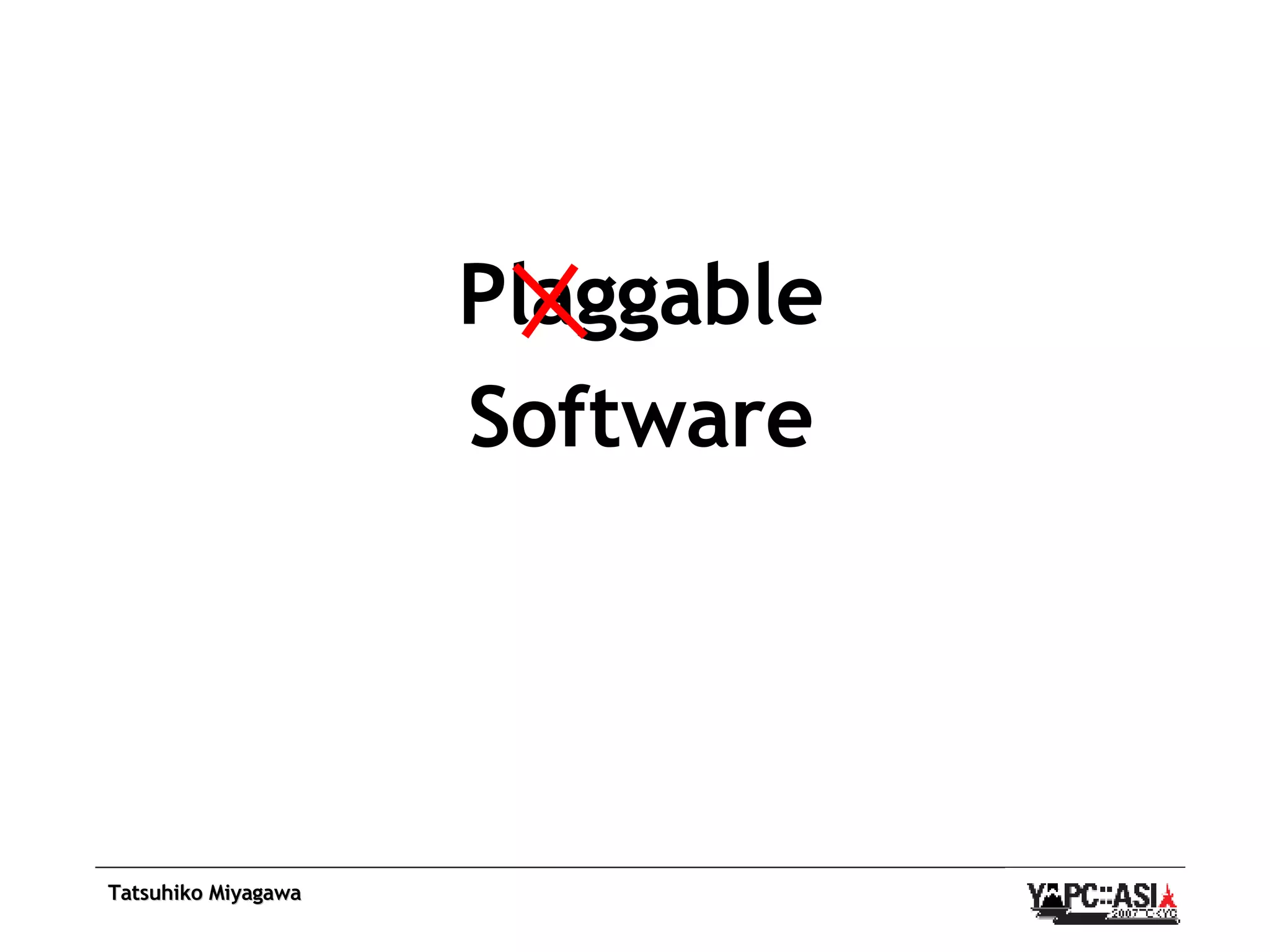
Plaggable Software
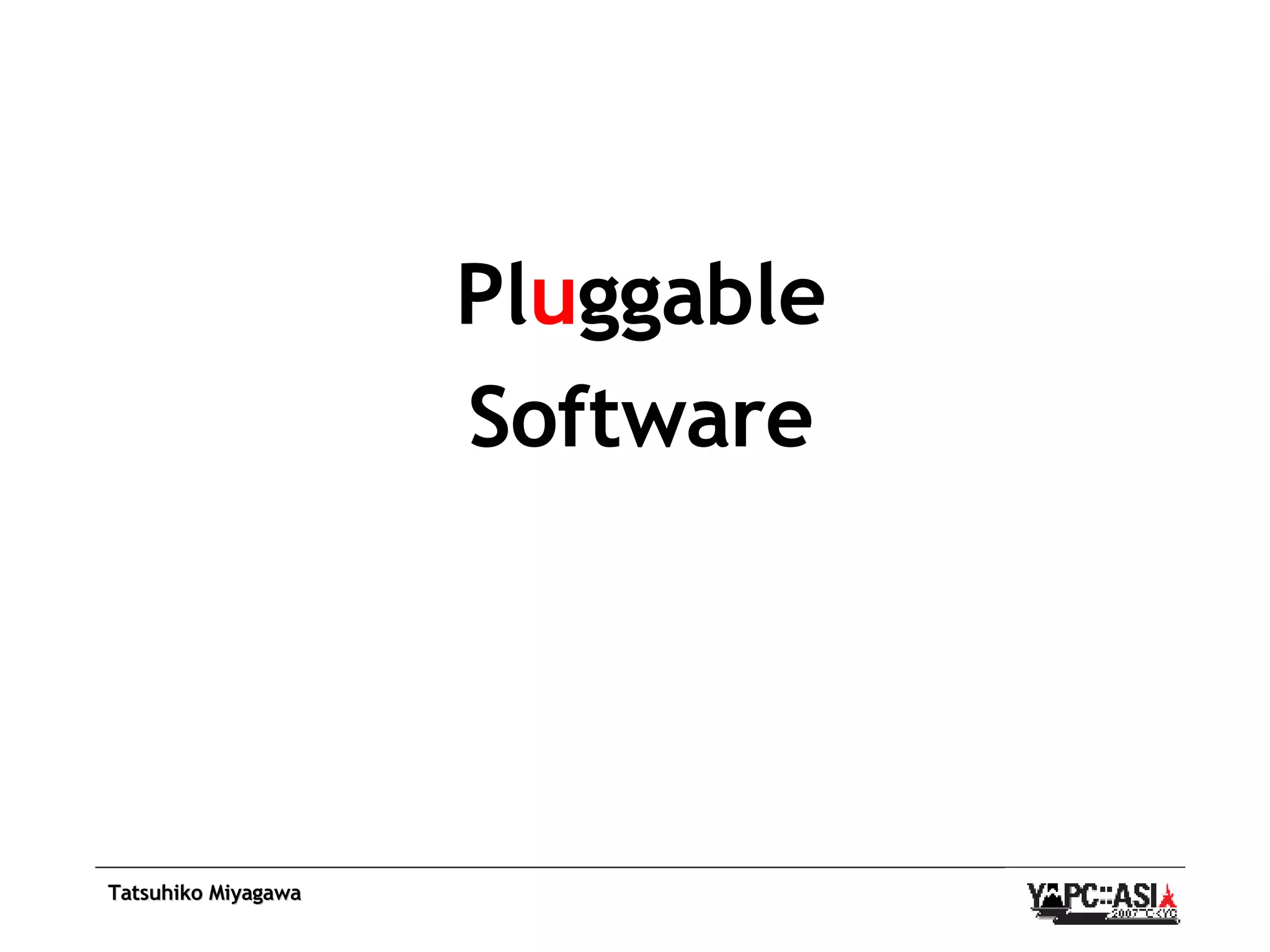
Pl u ggable Software
Agenda
#1 How to make your app pluggable
#2 TMTOWTDP There's More Than One Way To Deploy Plugins Pros/Cons by examples
First-of-all: Why pluggable?
Benefits
#1 Keep the app design and code simple
#2 Let the app users customize the behavior (without hacking the internals)
#3 It's  fun  to write plugins for most hackers (see: Plagger and Kwiki)
"Can your app do XXX?" "Yes, by plugins."
"Your app has a bug in YYY" "No, it's the bug in plugin YYY, Not my fault." (Chain Of Responsibilities)
Good Enough Reasons, huh?
#1 Make your app pluggable
Example
ack (App::Ack)
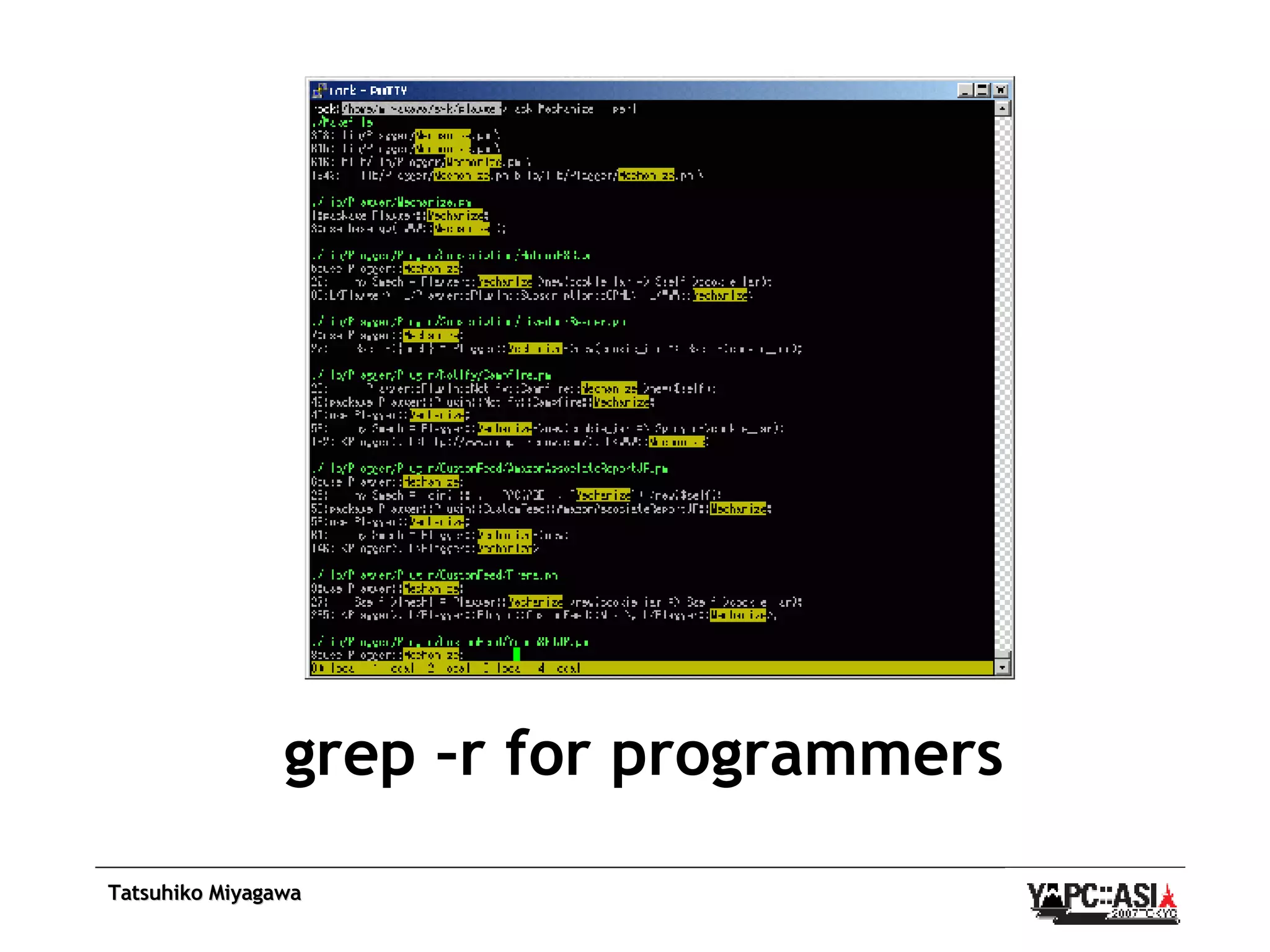
grep –r for programmers
Ack is a "full-stack" software now.
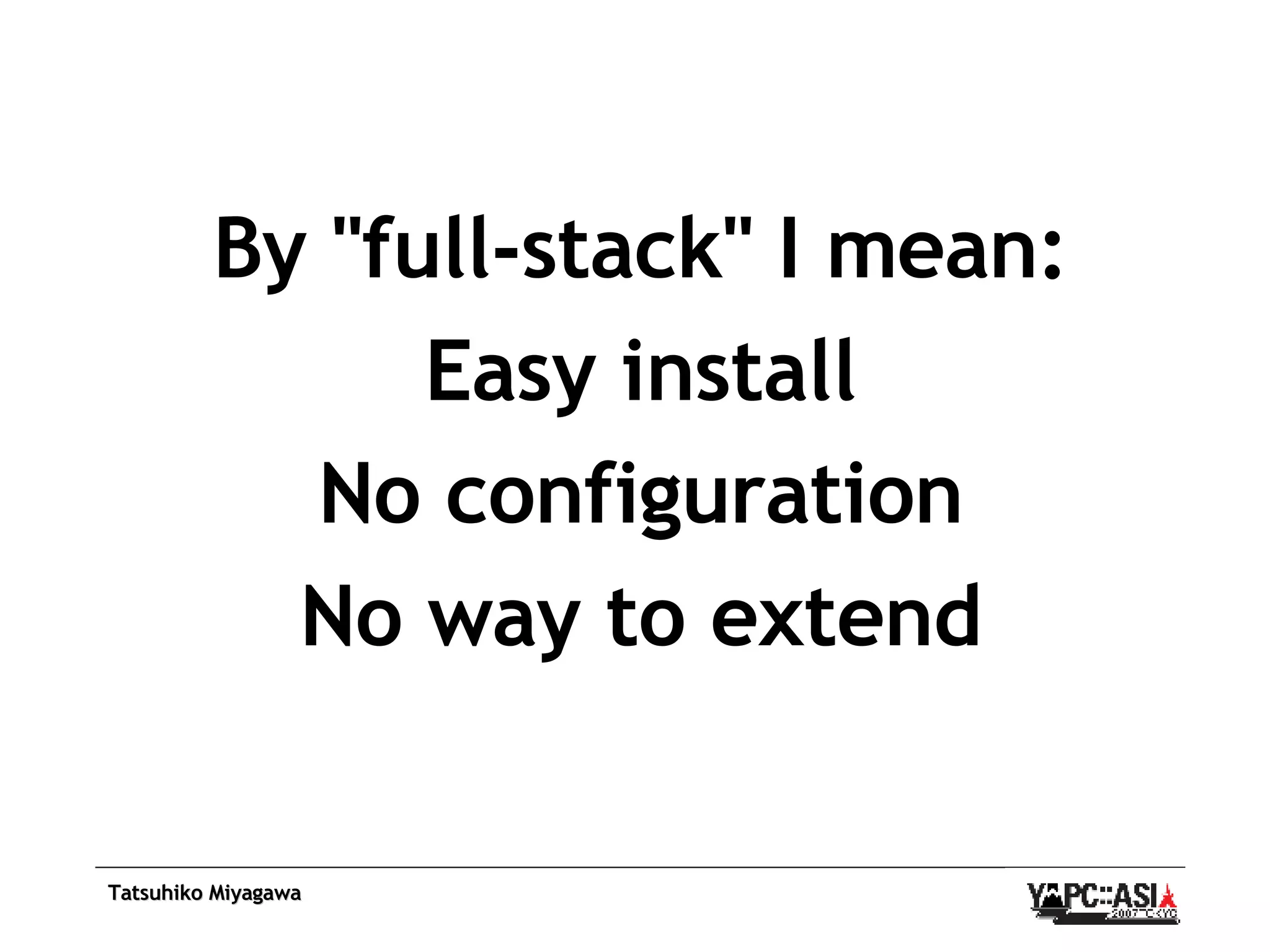
By "full-stack" I mean: Easy install No configuration No way to extend
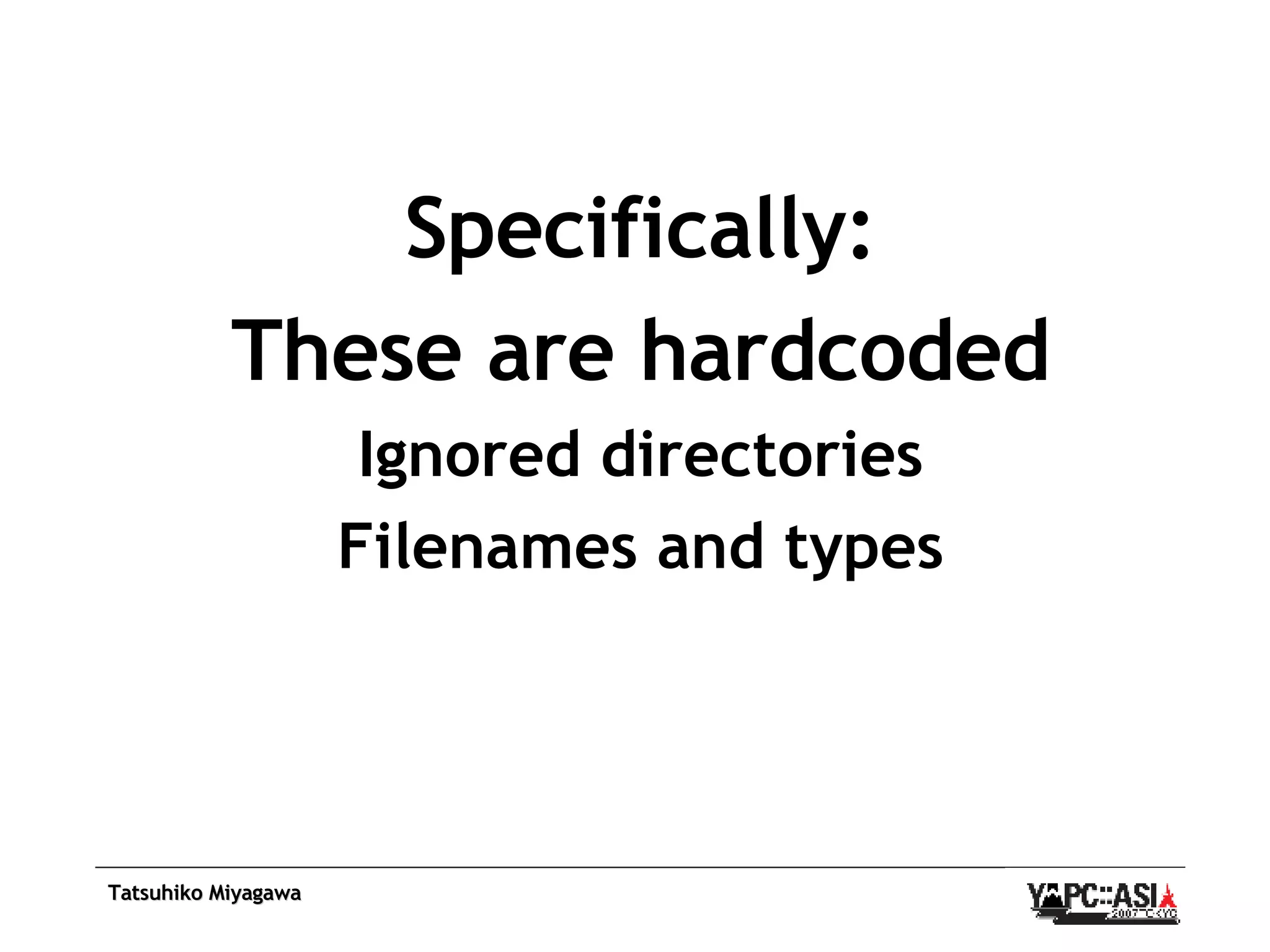
Specifically: These are hardcoded Ignored directories Filenames and types
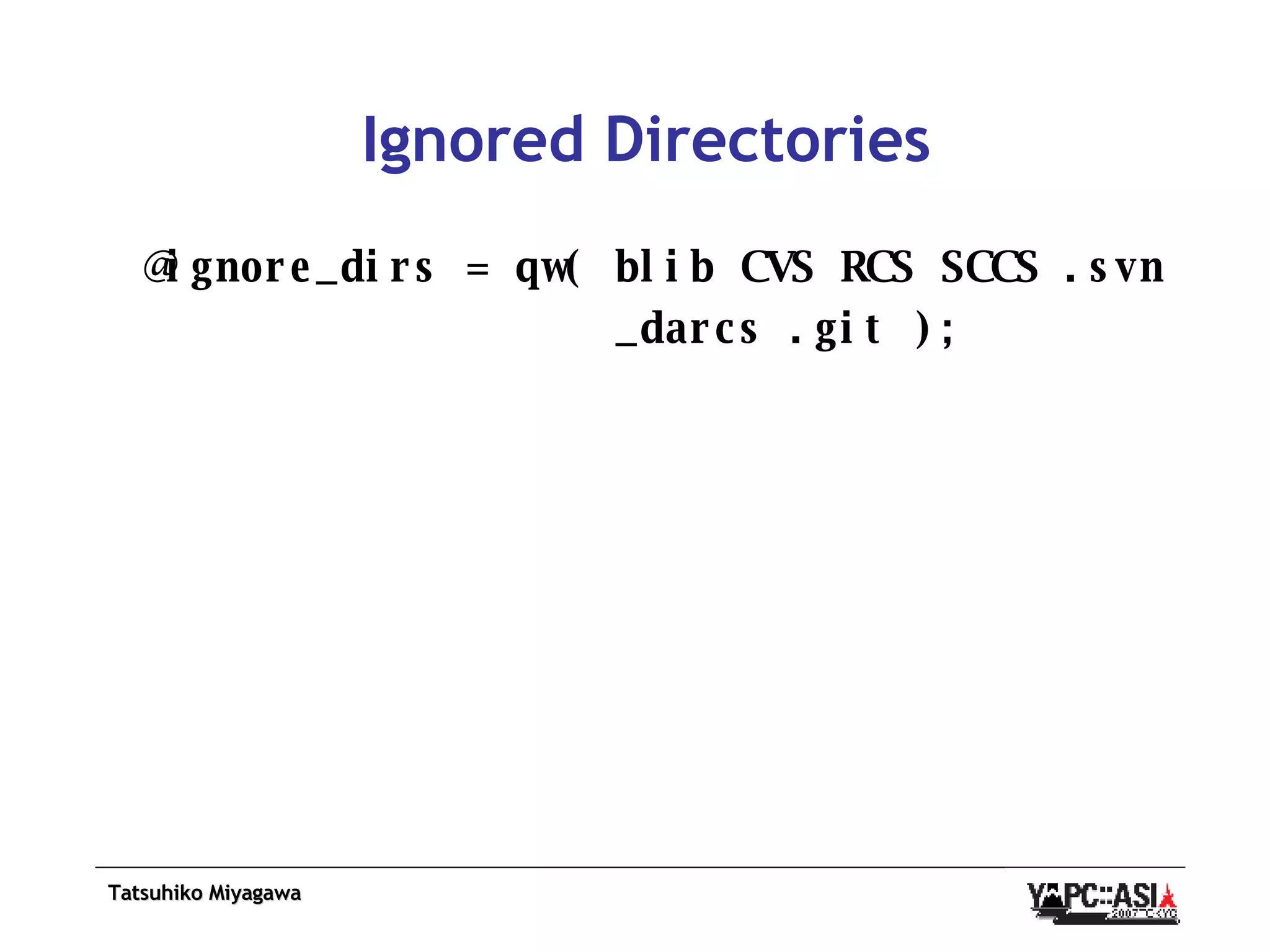
Ignored Directories @ignore_dirs = qw( blib CVS RCS SCCS .svn _darcs .git );
Filenames and languages mapping %mappings = ( asm  => [qw( s S )], binary  => …, cc  => [qw( c h xs )], cpp  => [qw( cpp m h C H )], csharp  => [qw( cs )], … perl  => [qw( pl pm pod tt ttml t )], … );
What if making these pluggable?
DISCLAIMER
Don't get me wrong Andy, I love ack the way it is… Just thought it can be a very good example for the tutorial.
Quickstart: Class::Trigger Module::Pluggable © Six Apart Ltd. Employees
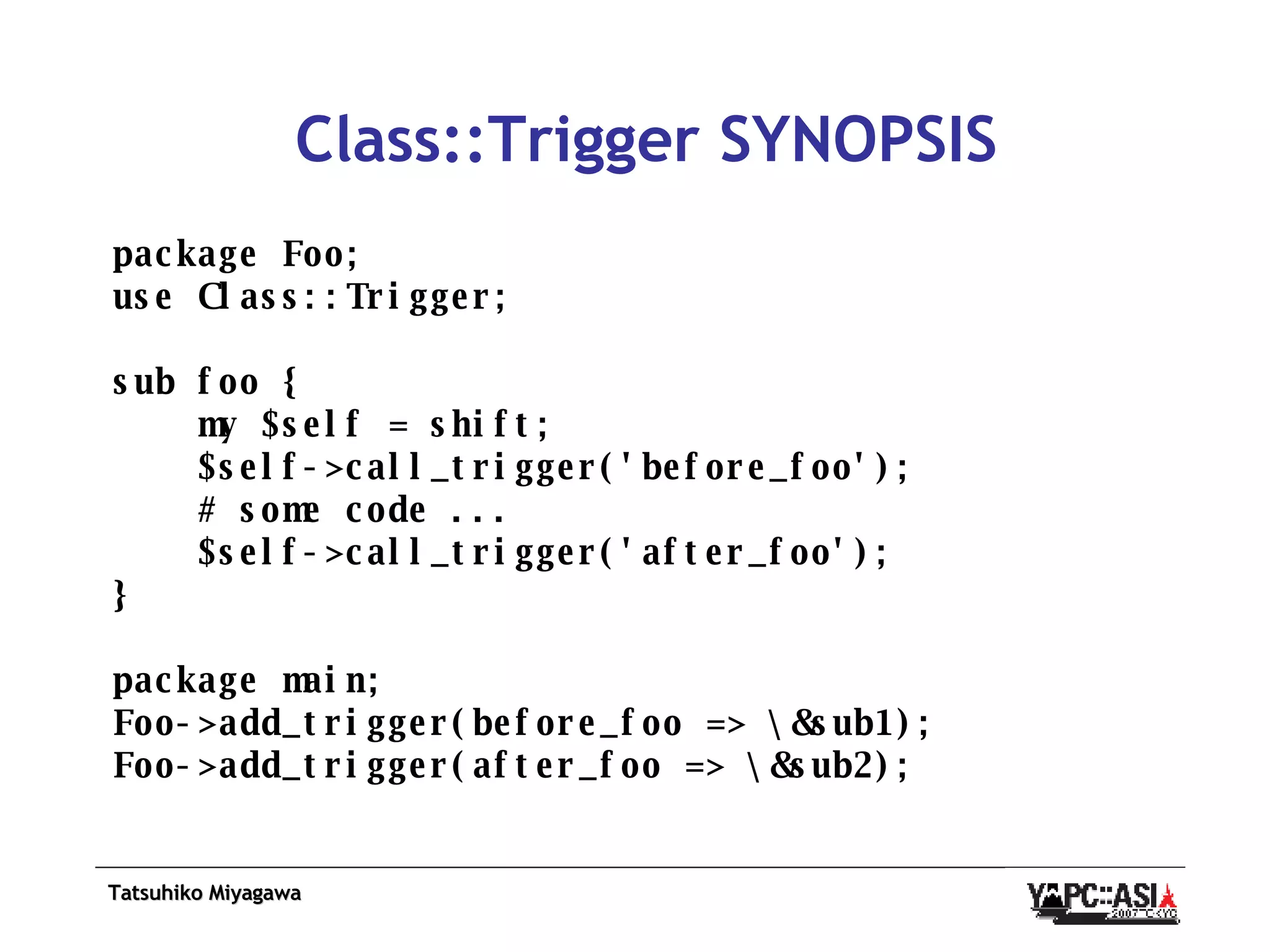
Class::Trigger SYNOPSIS package Foo; use Class::Trigger; sub foo { my $self = shift; $self->call_trigger('before_foo'); # some code ... $self->call_trigger('after_foo'); } package main; Foo->add_trigger(before_foo => \&sub1); Foo->add_trigger(after_foo => \&sub2);
Class::Trigger Helps you to implement Observer Pattern. (Rails calls this Observer)
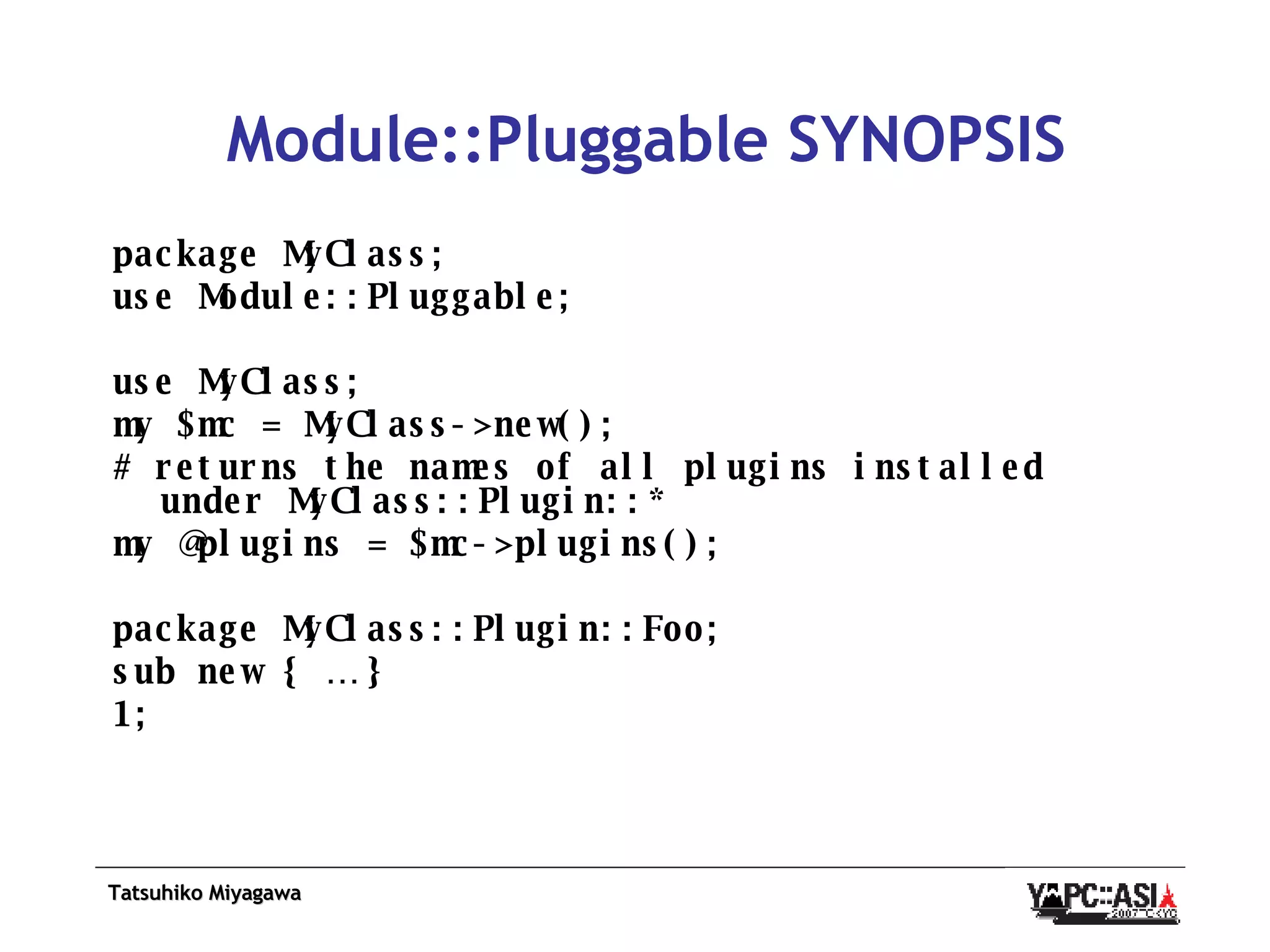
Module::Pluggable SYNOPSIS package MyClass; use Module::Pluggable; use MyClass; my $mc = MyClass->new(); # returns the names of all plugins installed under MyClass::Plugin::* my @plugins = $mc->plugins(); package MyClass::Plugin::Foo; sub new { … } 1;
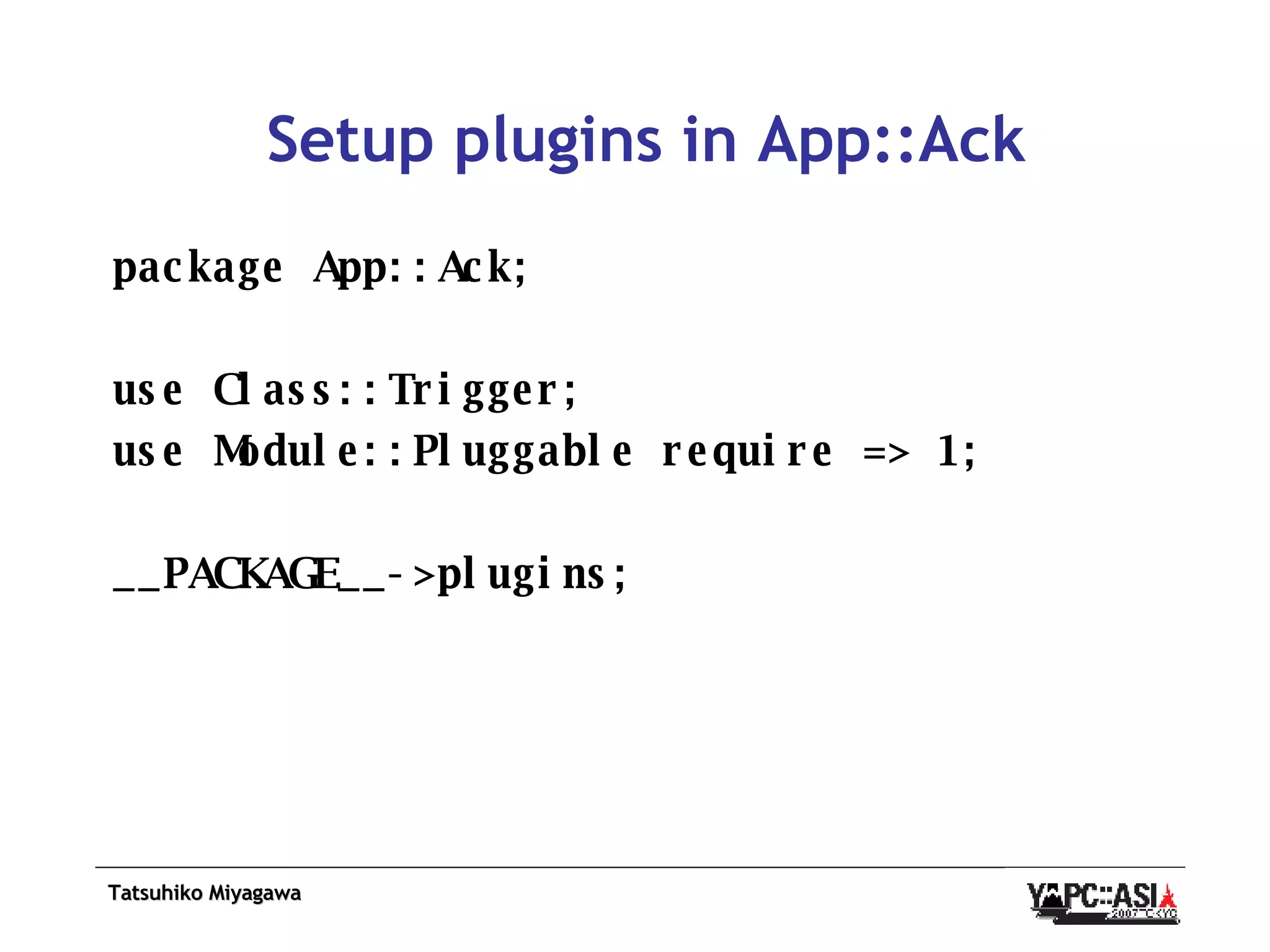
Setup plugins in App::Ack package App::Ack; use Class::Trigger; use Module::Pluggable require => 1; __PACKAGE__->plugins;
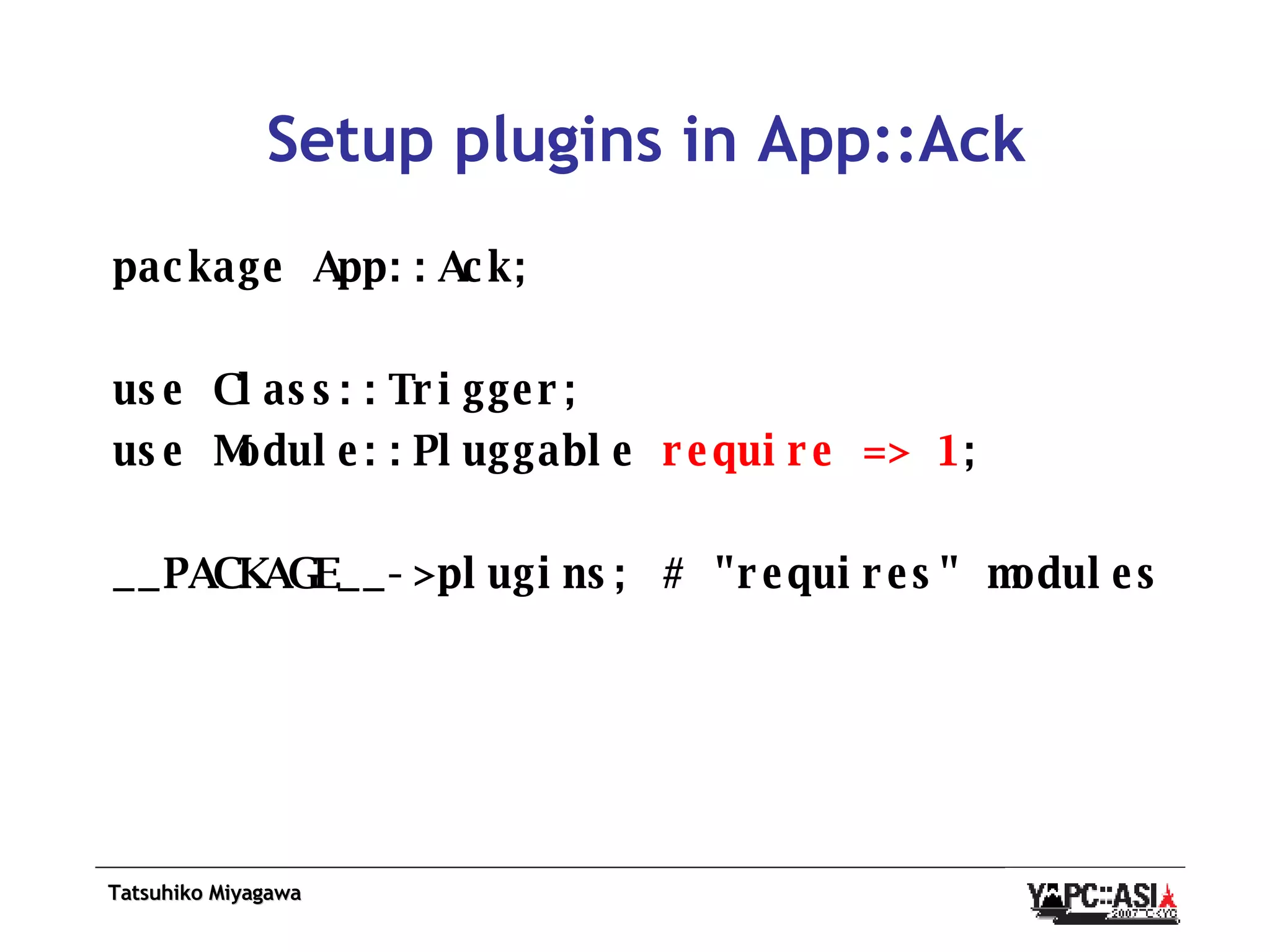
Setup plugins in App::Ack package App::Ack; use Class::Trigger; use Module::Pluggable  require => 1 ; __PACKAGE__->plugins; # "requires" modules
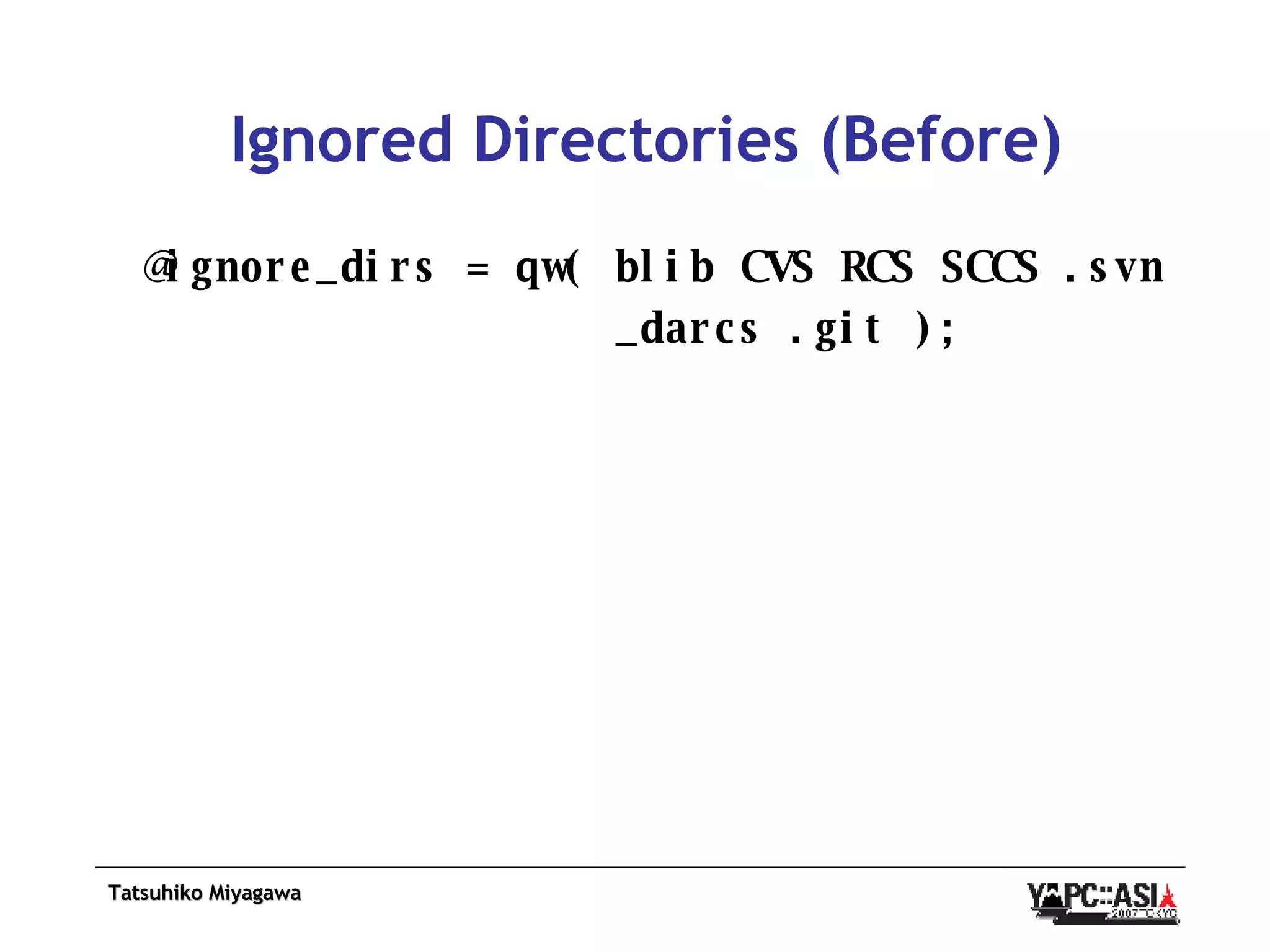
Ignored Directories (Before) @ignore_dirs = qw( blib CVS RCS SCCS .svn _darcs .git );
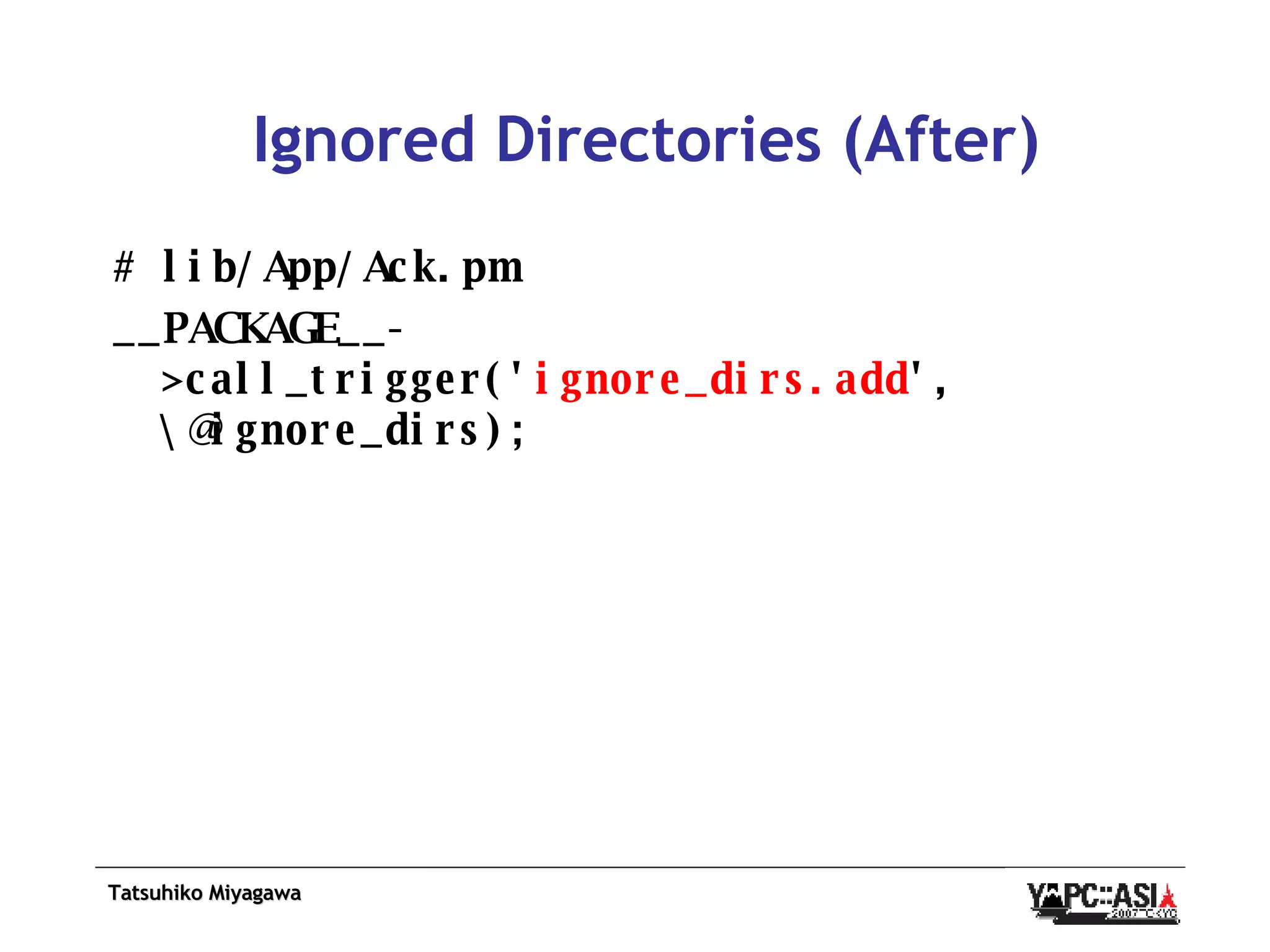
Ignored Directories (After) # lib/App/Ack.pm __PACKAGE__->call_trigger(' ignore_dirs.add ', \@ignore_dirs);
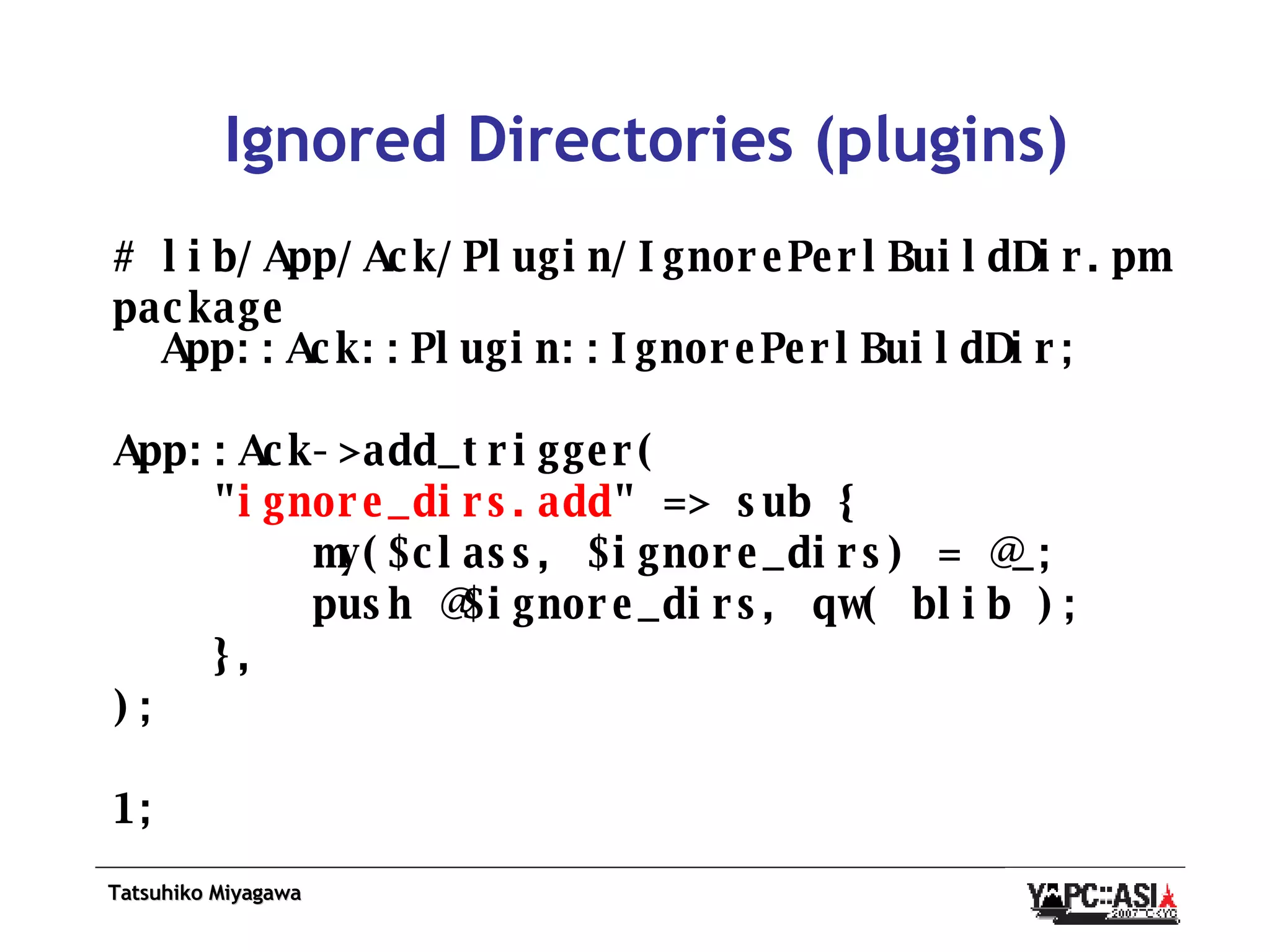
Ignored Directories (plugins) # lib/App/Ack/Plugin/IgnorePerlBuildDir.pm package App::Ack::Plugin::IgnorePerlBuildDir; App::Ack->add_trigger( " ignore_dirs.add " => sub { my($class, $ignore_dirs) = @_; push @$ignore_dirs, qw( blib ); }, ); 1;
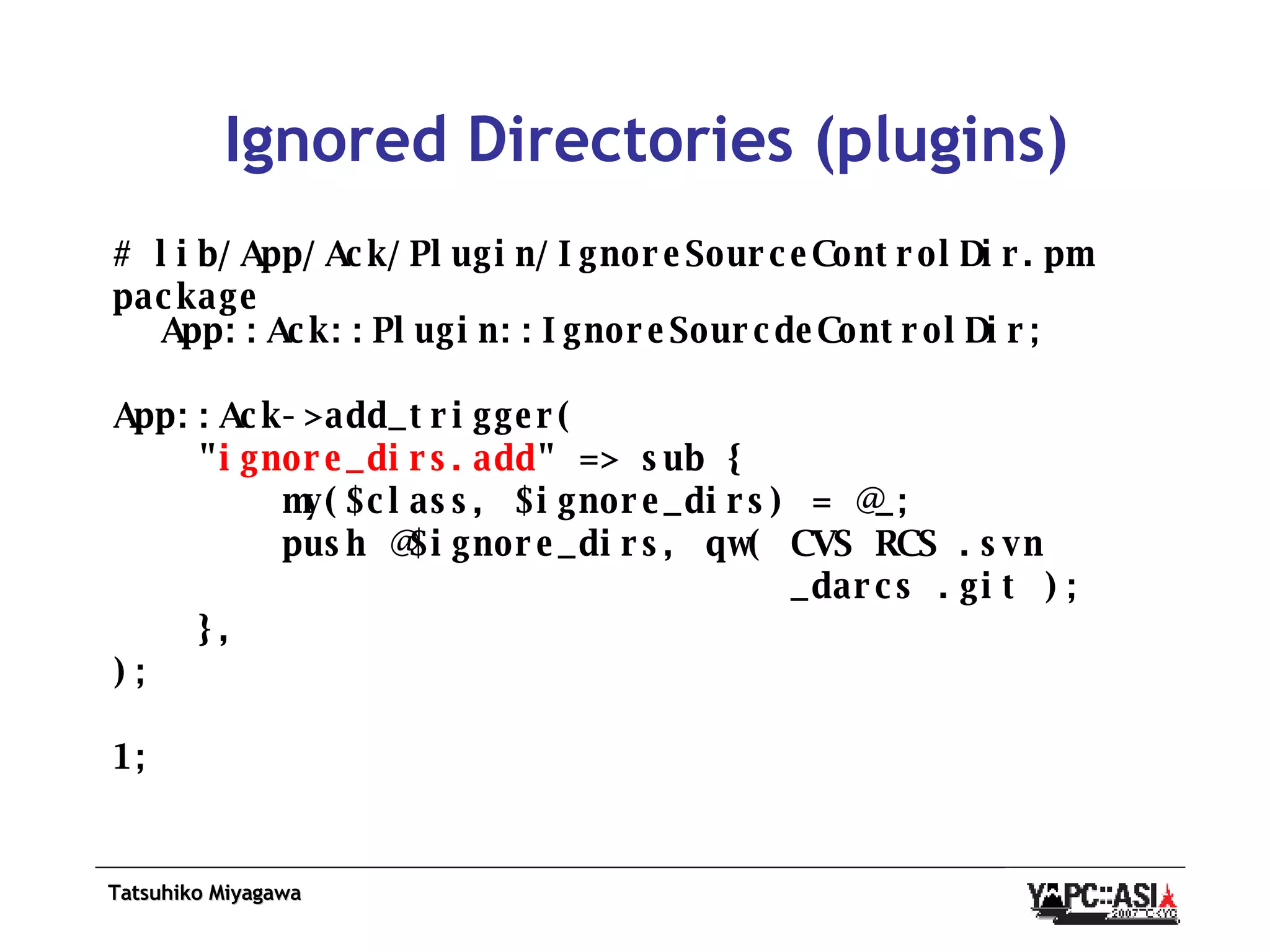
Ignored Directories (plugins) # lib/App/Ack/Plugin/IgnoreSourceControlDir.pm package App::Ack::Plugin::IgnoreSourcdeControlDir; App::Ack->add_trigger( " ignore_dirs.add " => sub { my($class, $ignore_dirs) = @_; push @$ignore_dirs, qw( CVS RCS .svn _darcs .git ); }, ); 1;
Filenames and languages (before) %mappings = ( asm  => [qw( s S )], binary  => …, cc  => [qw( c h xs )], cpp  => [qw( cpp m h C H )], csharp  => [qw( cs )], … perl  => [qw( pl pm pod tt ttml t )], … );
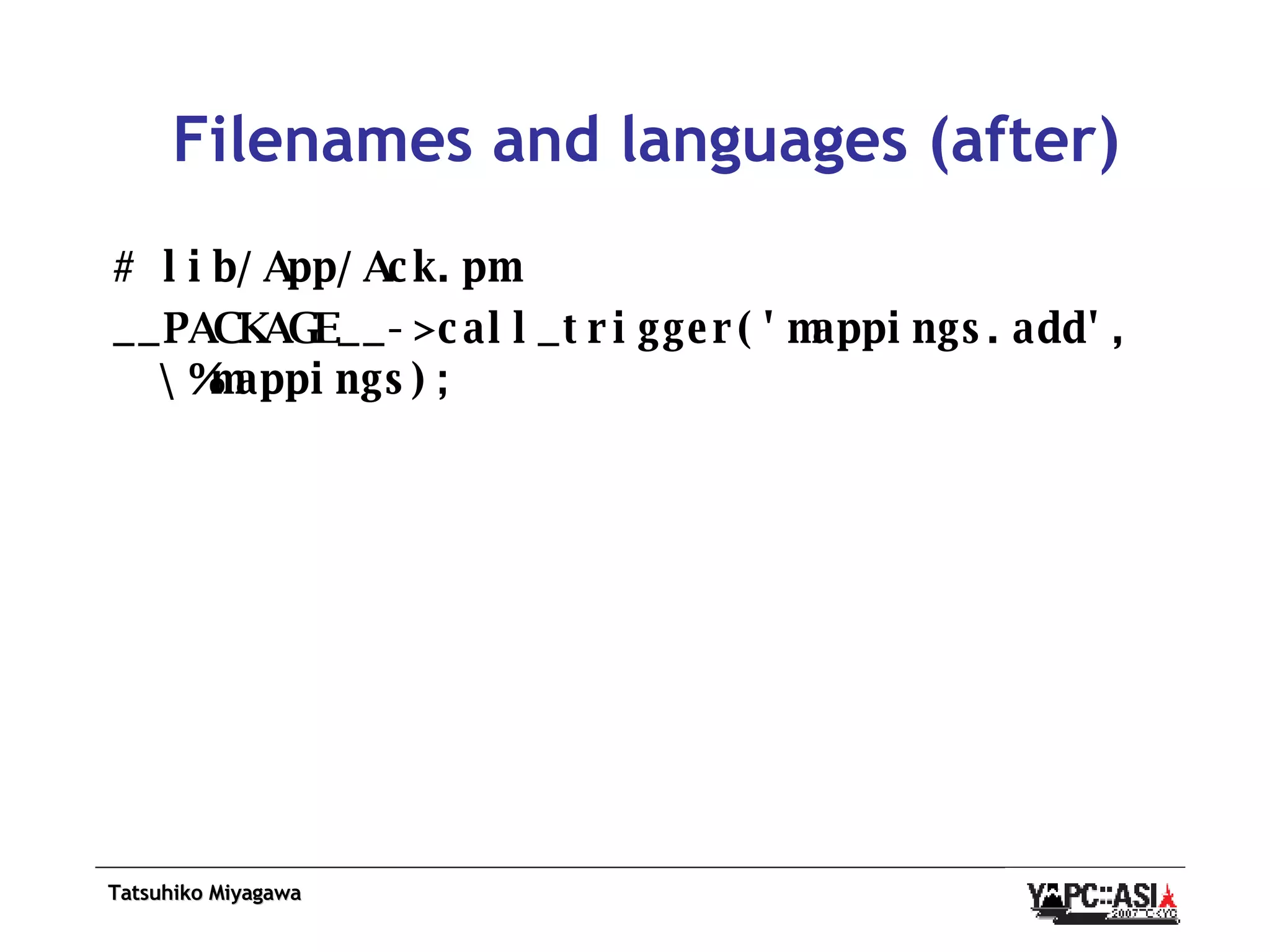
Filenames and languages (after) # lib/App/Ack.pm __PACKAGE__->call_trigger('mappings.add', \%mappings);
Filenames and languages (plugins) package App::Ack::Plugin::MappingCFamily; use strict; App::Ack->add_trigger( "mappings.add" => sub { my($class, $mappings) = @_; $mappings->{asm} = [qw( s S )]; $mappings->{cc}  = [qw( c h xs )]; $mappings->{cpp} = [qw( cpp m h C H )]; $mappings->{csharp} = [qw( cs )]; $mappings->{css} = [qw( css )]; }, ); 1;
Works great  with few lines of code!
Now it's time to add  Some useful stuff.
Example Plugin: Content Filter
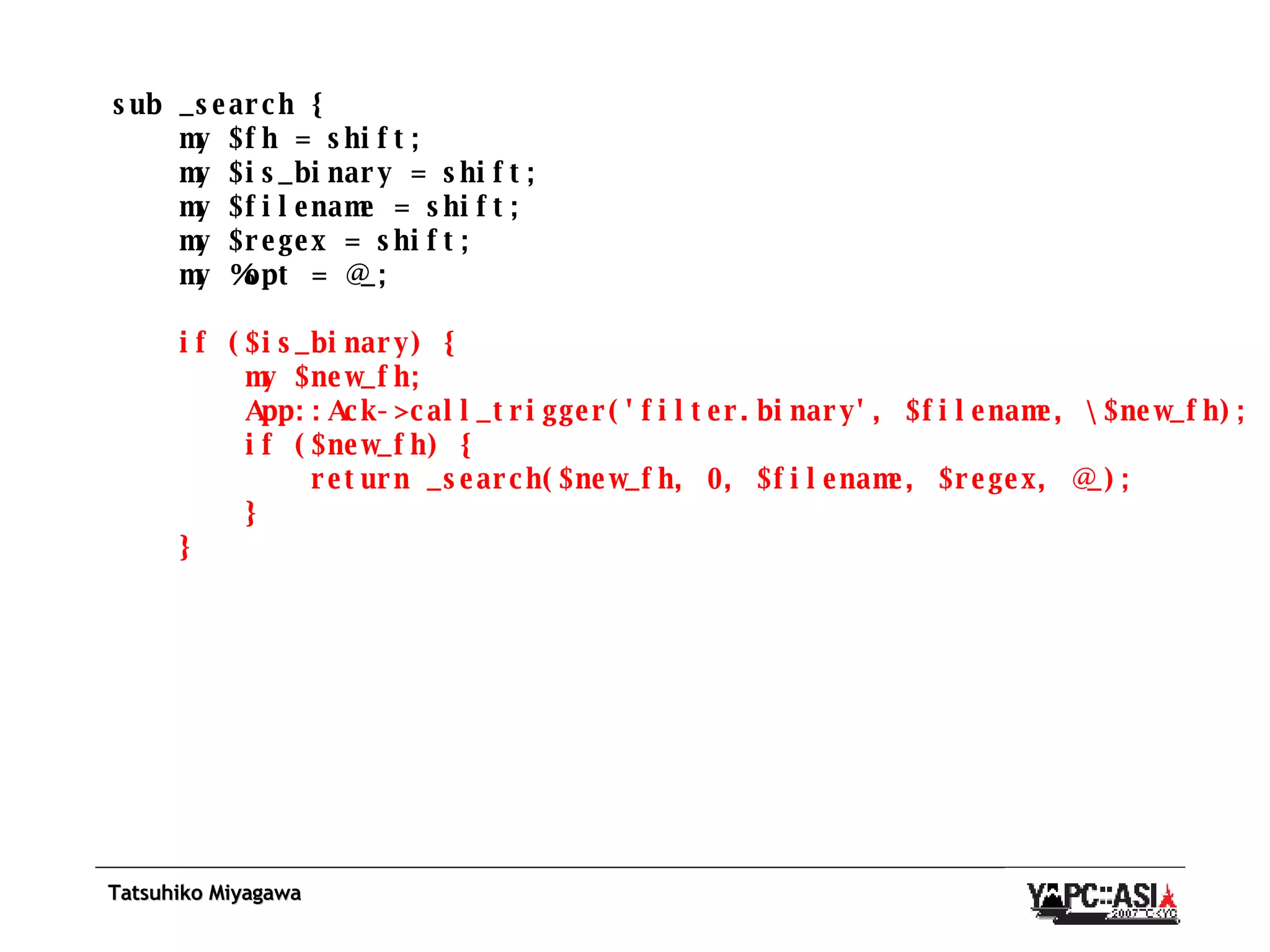
sub _search { my $fh = shift; my $is_binary = shift; my $filename = shift; my $regex = shift; my %opt = @_; if ($is_binary) { my $new_fh; App::Ack->call_trigger('filter.binary', $filename, \$new_fh); if ($new_fh) { return _search($new_fh, 0, $filename, $regex, @_); } }
Example: Search PDF content with ack
PDF filter plugin package App::Ack::Plugin::ExtractContentPDF; use strict; use CAM::PDF; use File::Temp; App::Ack->add_trigger( 'mappings.add' => sub { my($class, $mappings) = @_; $mappings->{pdf} = [qw(pdf)]; }, );
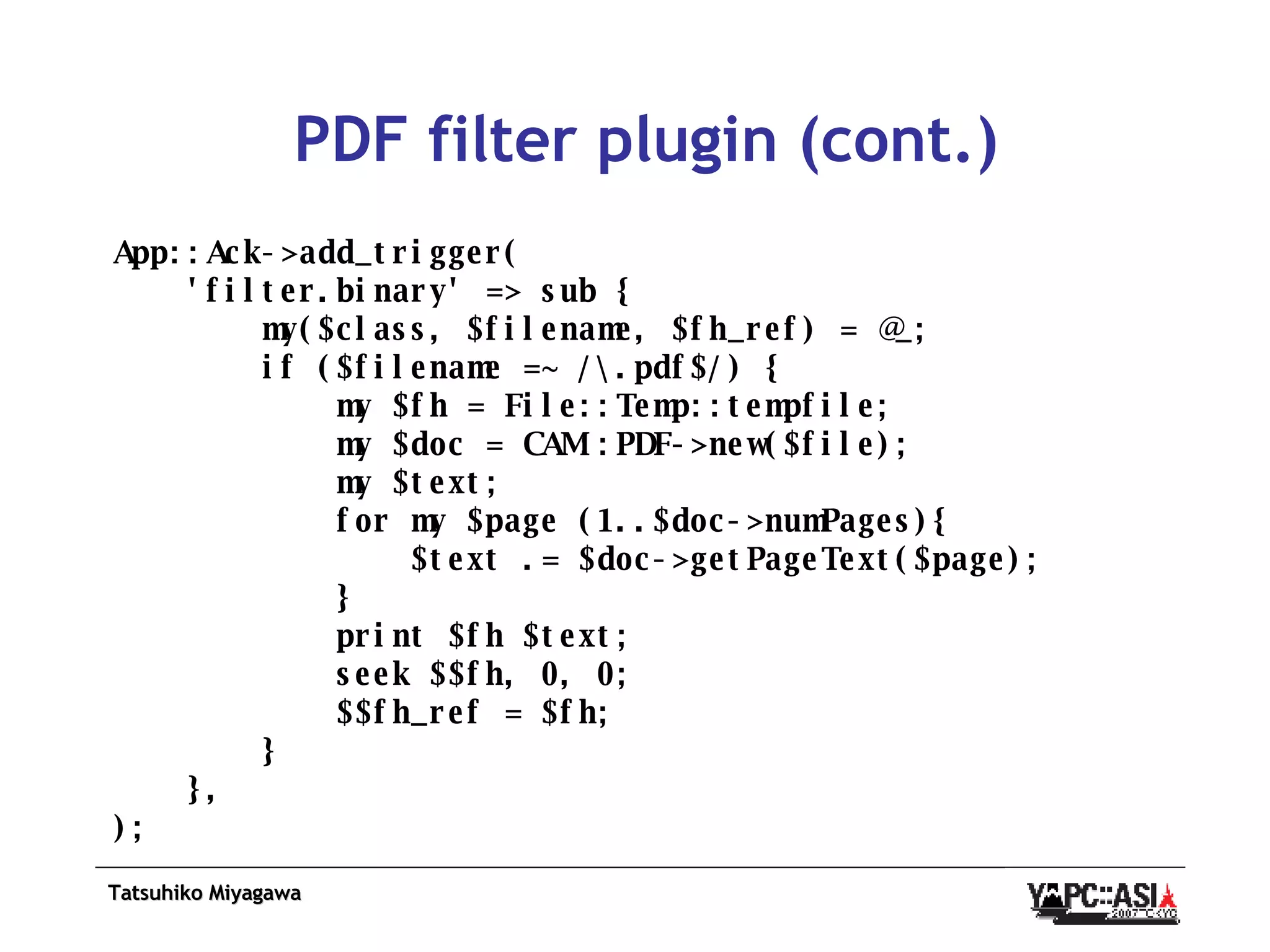
PDF filter plugin (cont.) App::Ack->add_trigger( 'filter.binary' => sub { my($class, $filename, $fh_ref) = @_; if ($filename =~ /\.pdf$/) { my $fh = File::Temp::tempfile; my $doc = CAM::PDF->new($file); my $text; for my $page (1..$doc->numPages){ $text .= $doc->getPageText($page); } print $fh $text; seek $$fh, 0, 0; $$fh_ref = $fh; } }, );
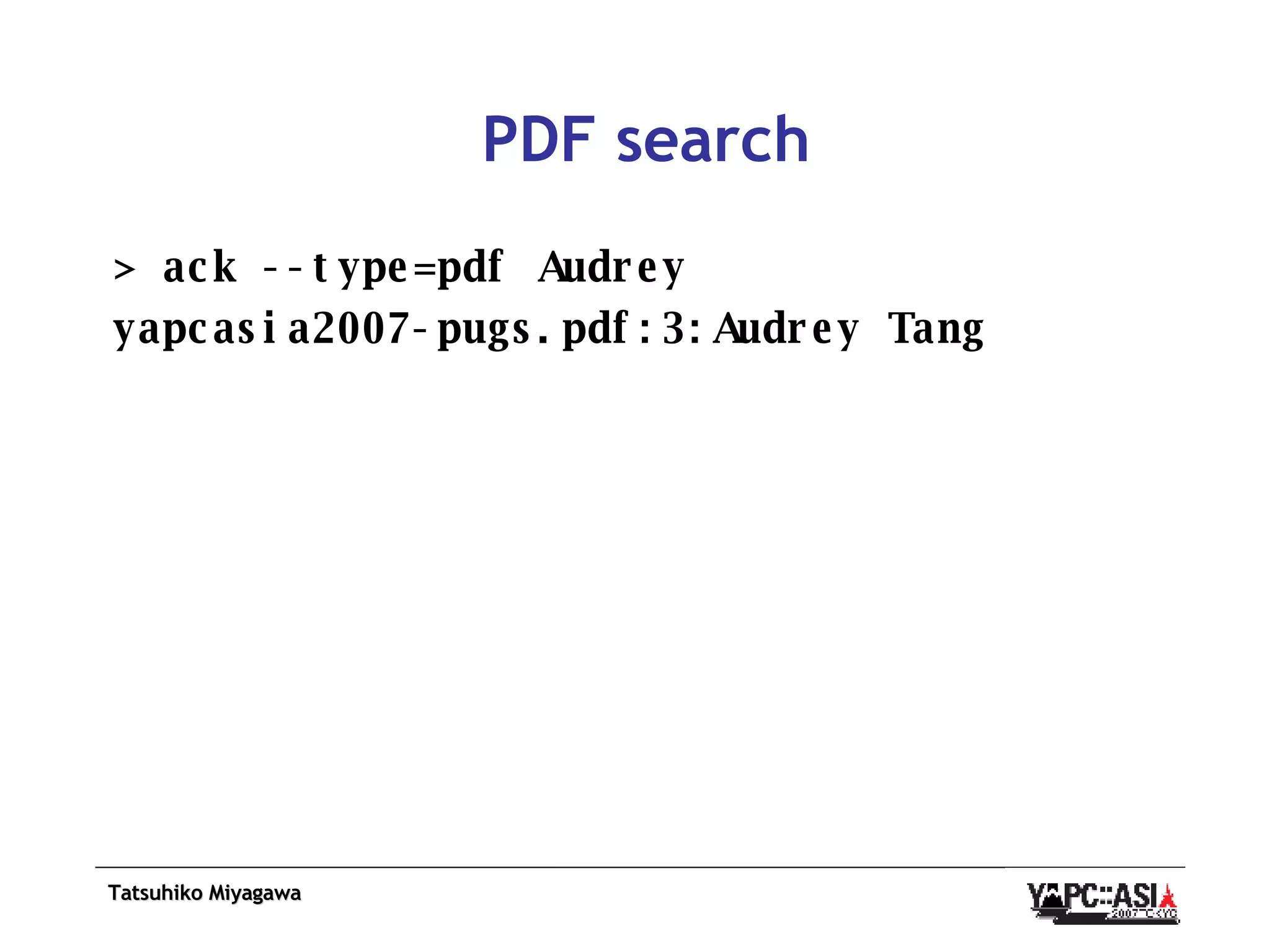
PDF search > ack --type=pdf Audrey yapcasia2007-pugs.pdf:3:Audrey Tang
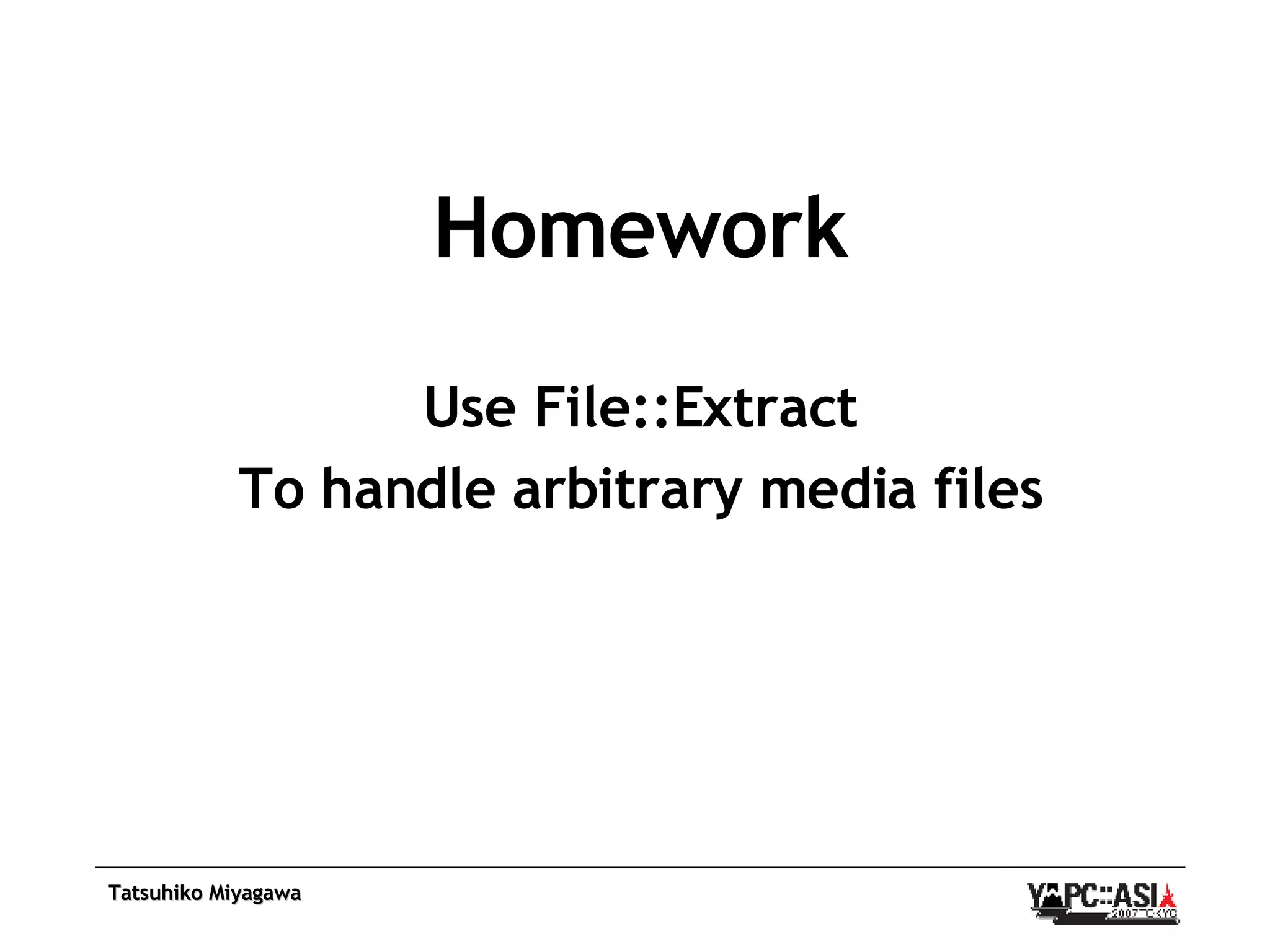
Homework Use File::Extract To handle arbitrary media files
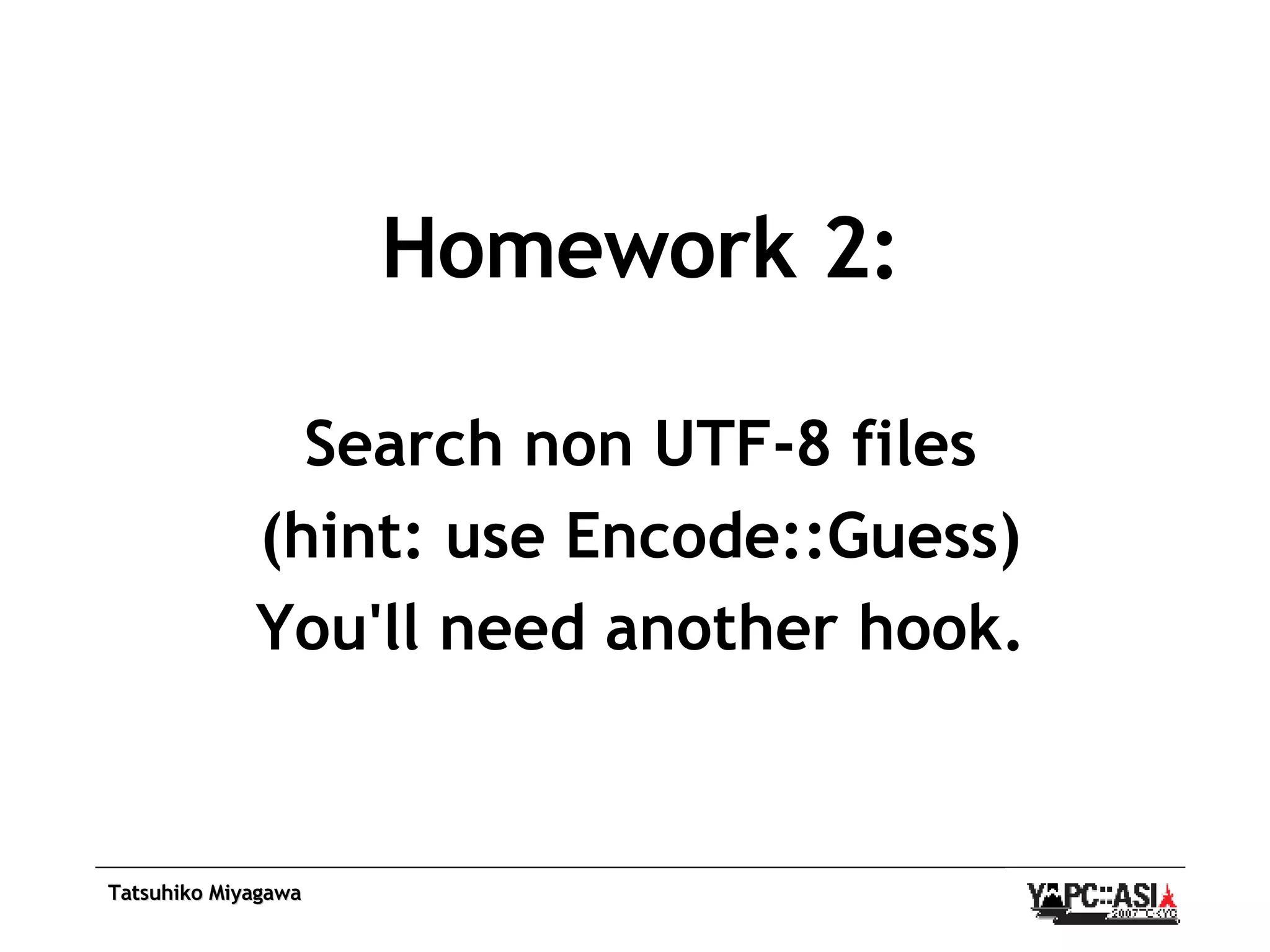
Homework 2: Search non UTF-8 files (hint: use Encode::Guess) You'll need another hook.
Summary Class::Trigger + Module::Pluggable = Pluggable app easy
#2 TMTOWTDP There's More Than One Way To Deploy Plugins
Module::Pluggable + Class::Trigger = Simple and Nice but has limitations
In Reality,  we need more control over how plugins behave
1) The order of  plugin executions
2) Per user configurations for plugins
3) Temporarily Disable plugins Should be easy
4) How to install & upgrade plugins
5) Let plugins  have storage area
Etc, etc.
Examples: Kwiki Plagger qpsmtpd Movable Type
I won't talk about Catalyst plugins (and other framework thingy)
Because they're  NOT "plug-ins"
Install plugins  And now you write  MORE CODE
95% of Catalyst plugins Are NOT "plugins" But "components" 95% of these statistics is made up by the speakers.
Kwiki 1.0
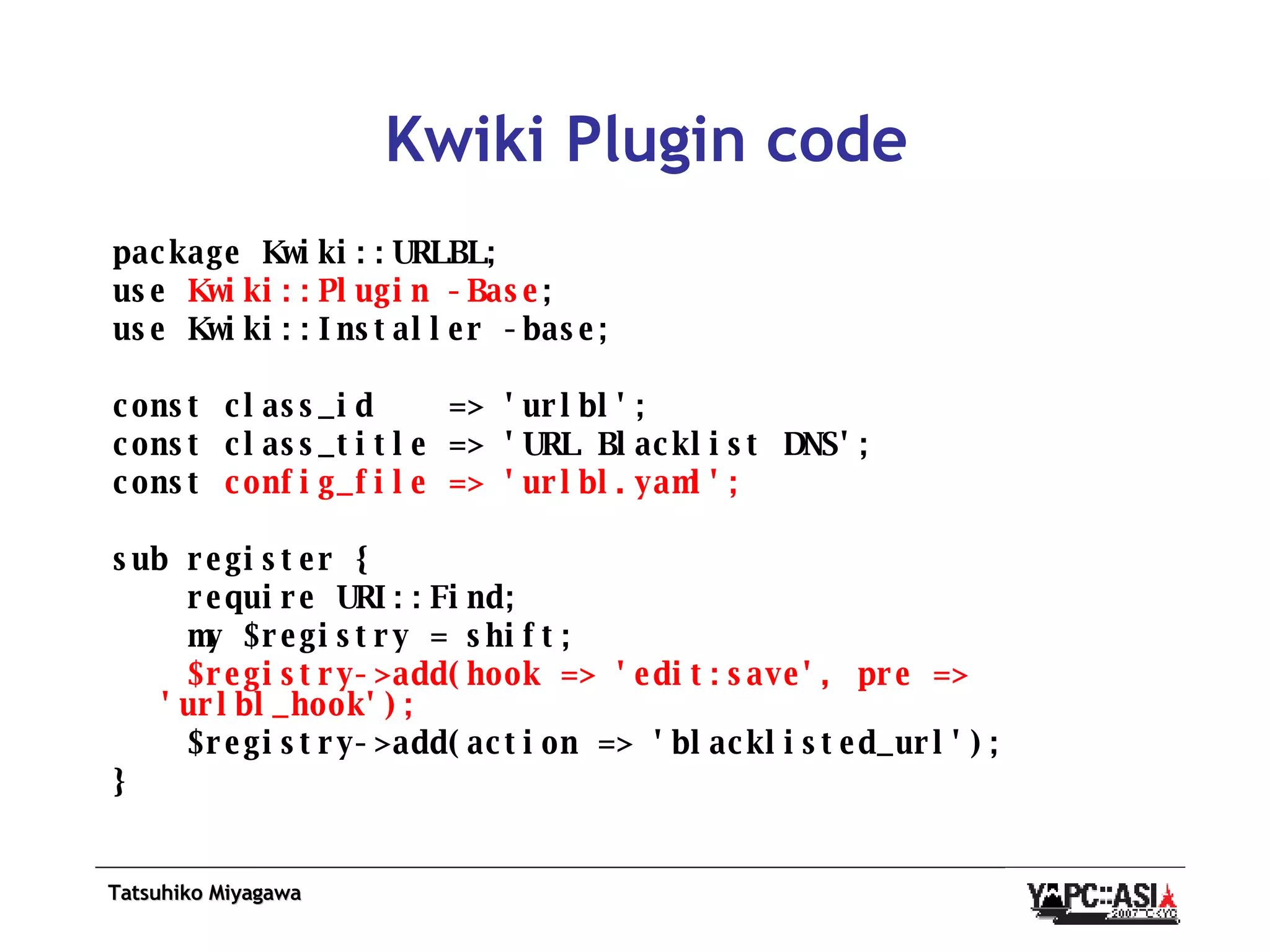
Kwiki Plugin code package Kwiki::URLBL; use  Kwiki::Plugin -Base ; use Kwiki::Installer -base; const class_id  => 'urlbl'; const class_title => 'URL Blacklist DNS'; const  config_file => 'urlbl.yaml'; sub register { require URI::Find; my $registry = shift; $registry->add(hook => 'edit:save', pre => 'urlbl_hook'); $registry->add(action => 'blacklisted_url'); }
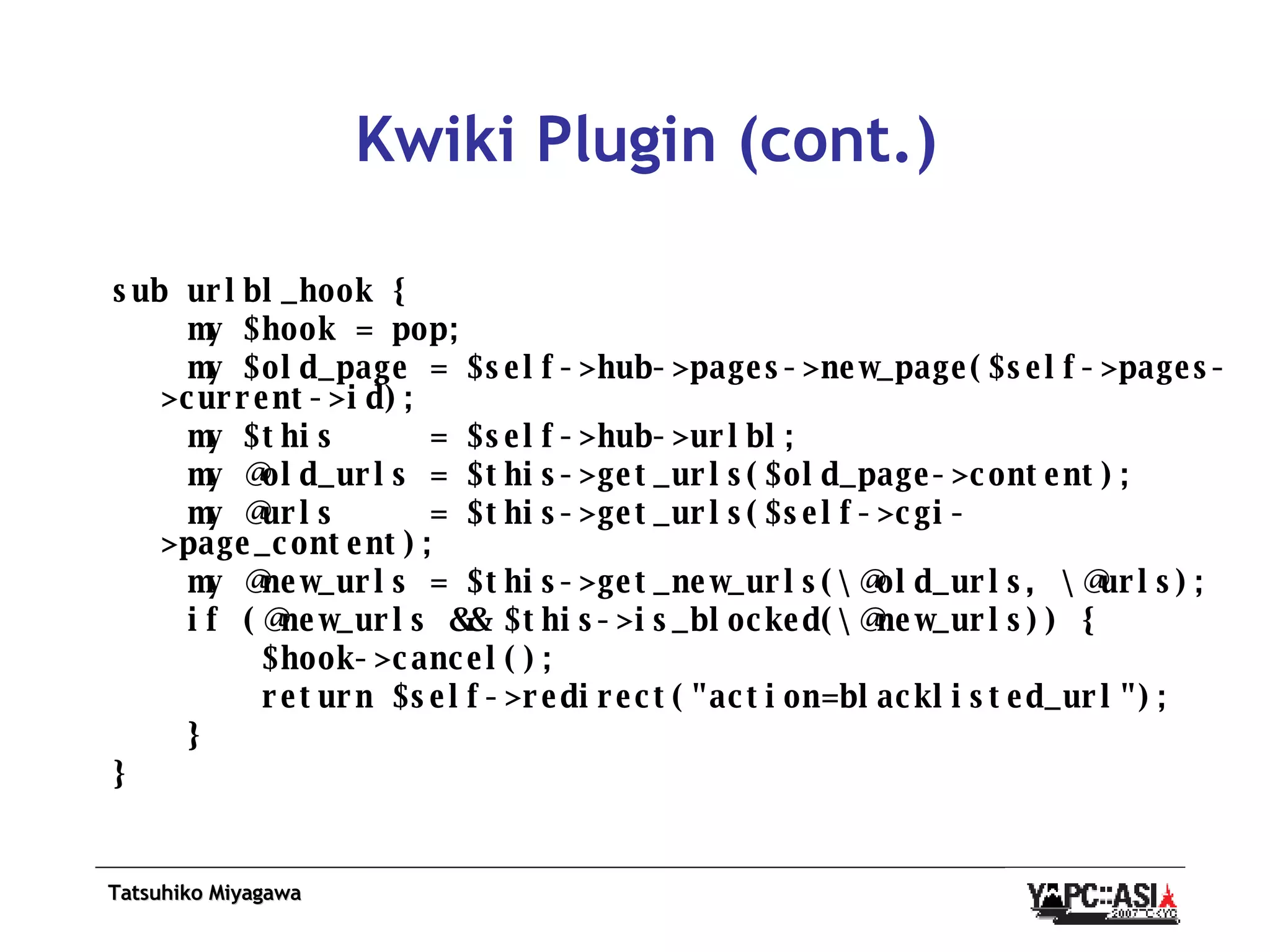
Kwiki Plugin (cont.) sub urlbl_hook { my $hook = pop; my $old_page = $self->hub->pages->new_page($self->pages->current->id); my $this  = $self->hub->urlbl; my @old_urls = $this->get_urls($old_page->content); my @urls  = $this->get_urls($self->cgi->page_content); my @new_urls = $this->get_new_urls(\@old_urls, \@urls); if (@new_urls && $this->is_blocked(\@new_urls)) { $hook->cancel(); return $self->redirect("action=blacklisted_url"); } }
Magic implemented in Spoon(::Hooks)
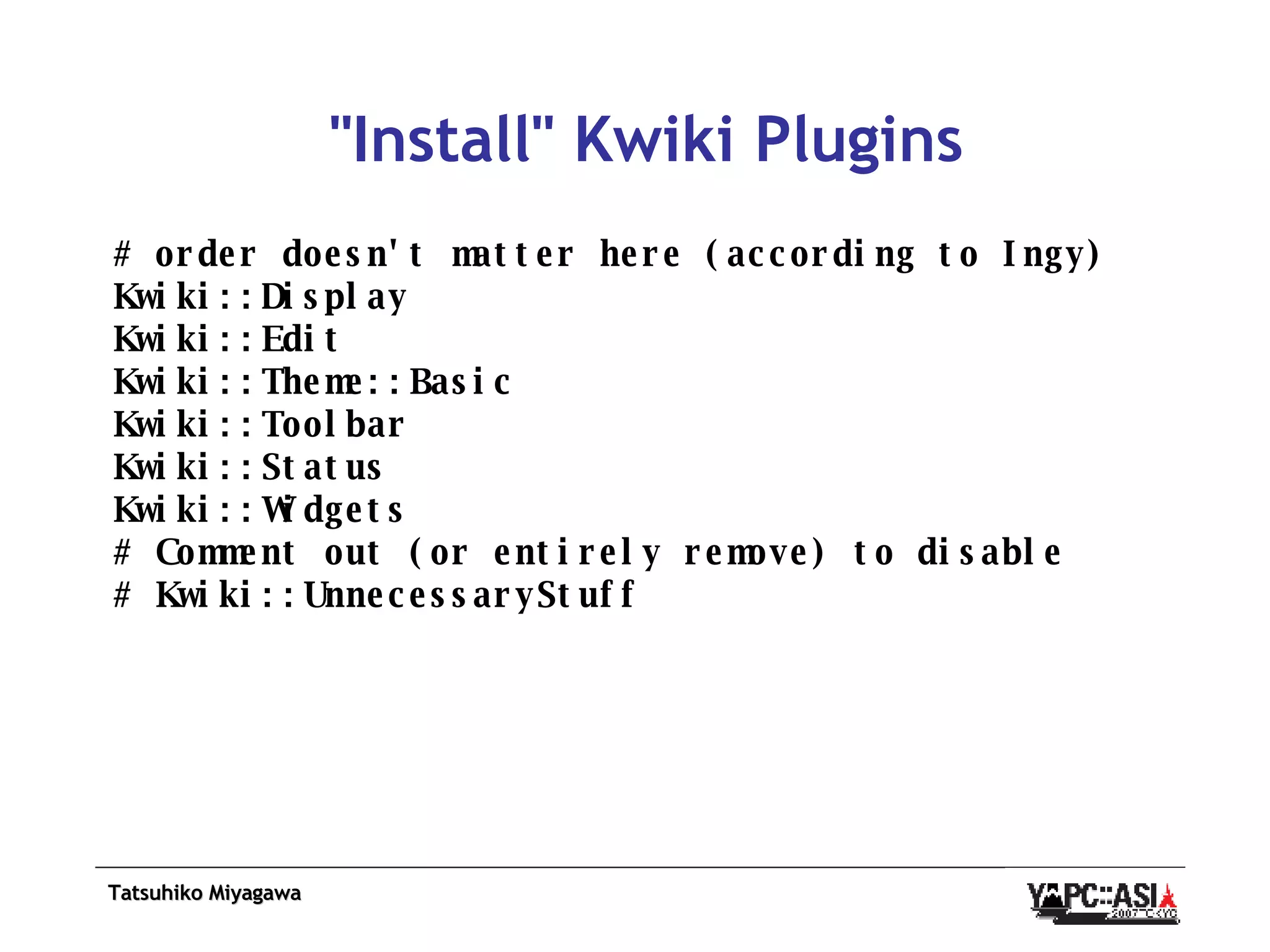
"Install" Kwiki Plugins # order doesn't matter here (according to Ingy) Kwiki::Display Kwiki::Edit Kwiki::Theme::Basic Kwiki::Toolbar Kwiki::Status Kwiki::Widgets # Comment out (or entirely remove) to disable # Kwiki::UnnecessaryStuff
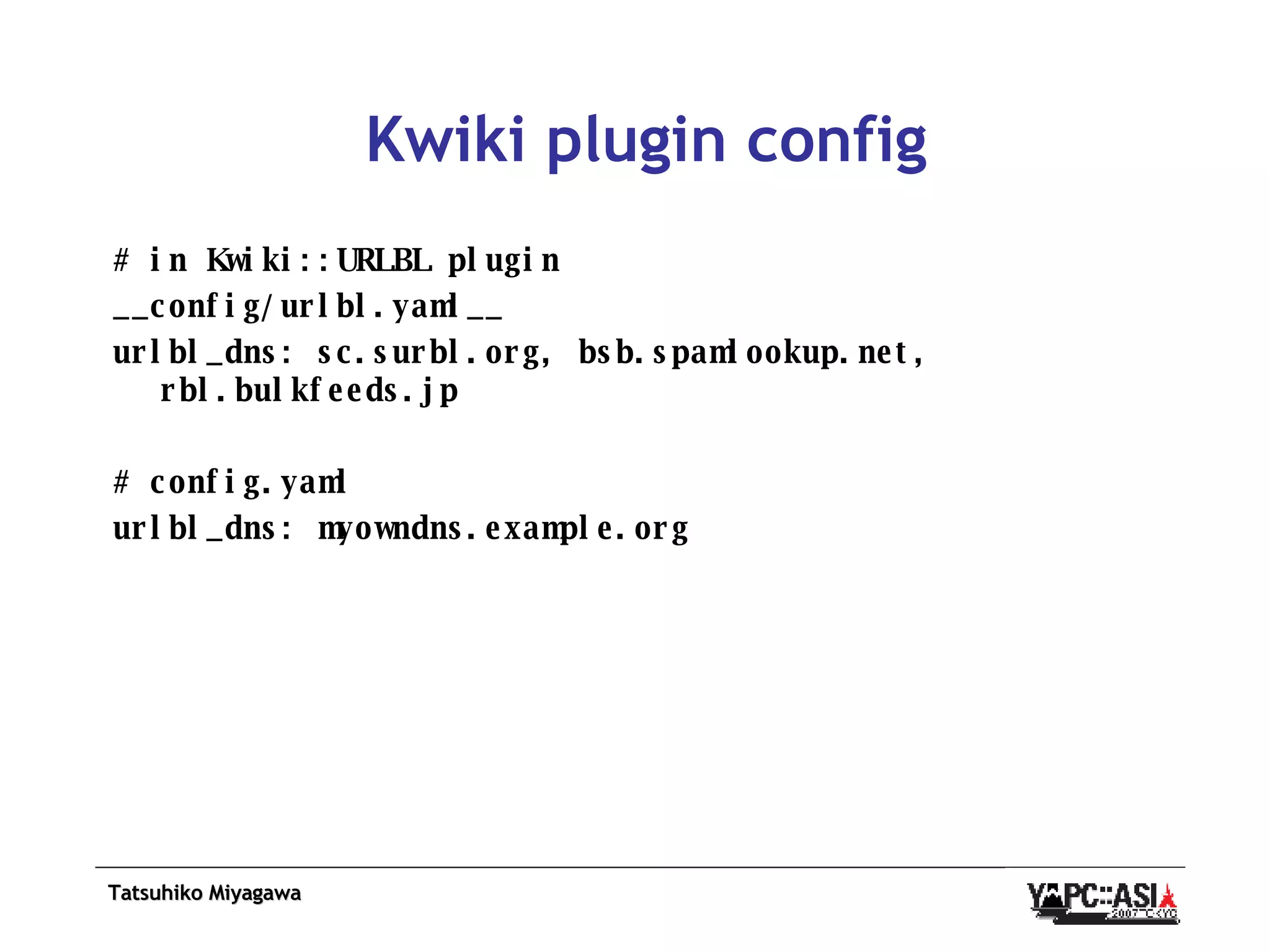
Kwiki plugin config # in Kwiki::URLBL plugin __config/urlbl.yaml__ urlbl_dns: sc.surbl.org, bsb.spamlookup.net, rbl.bulkfeeds.jp # config.yaml urlbl_dns: myowndns.example.org
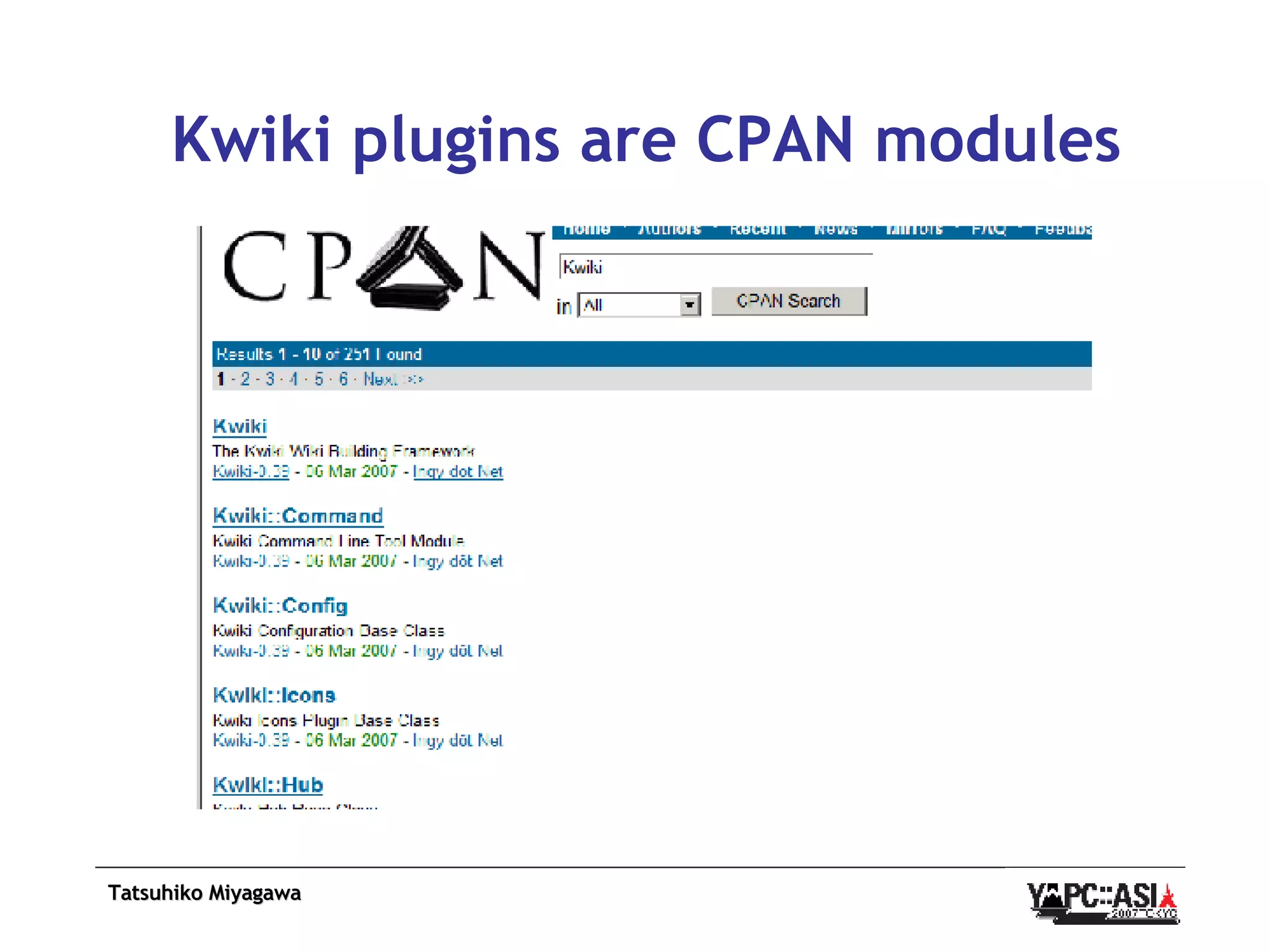
Kwiki plugins are CPAN modules
Install and Upgrade plugins cpan> install Kwiki::SomeStuff
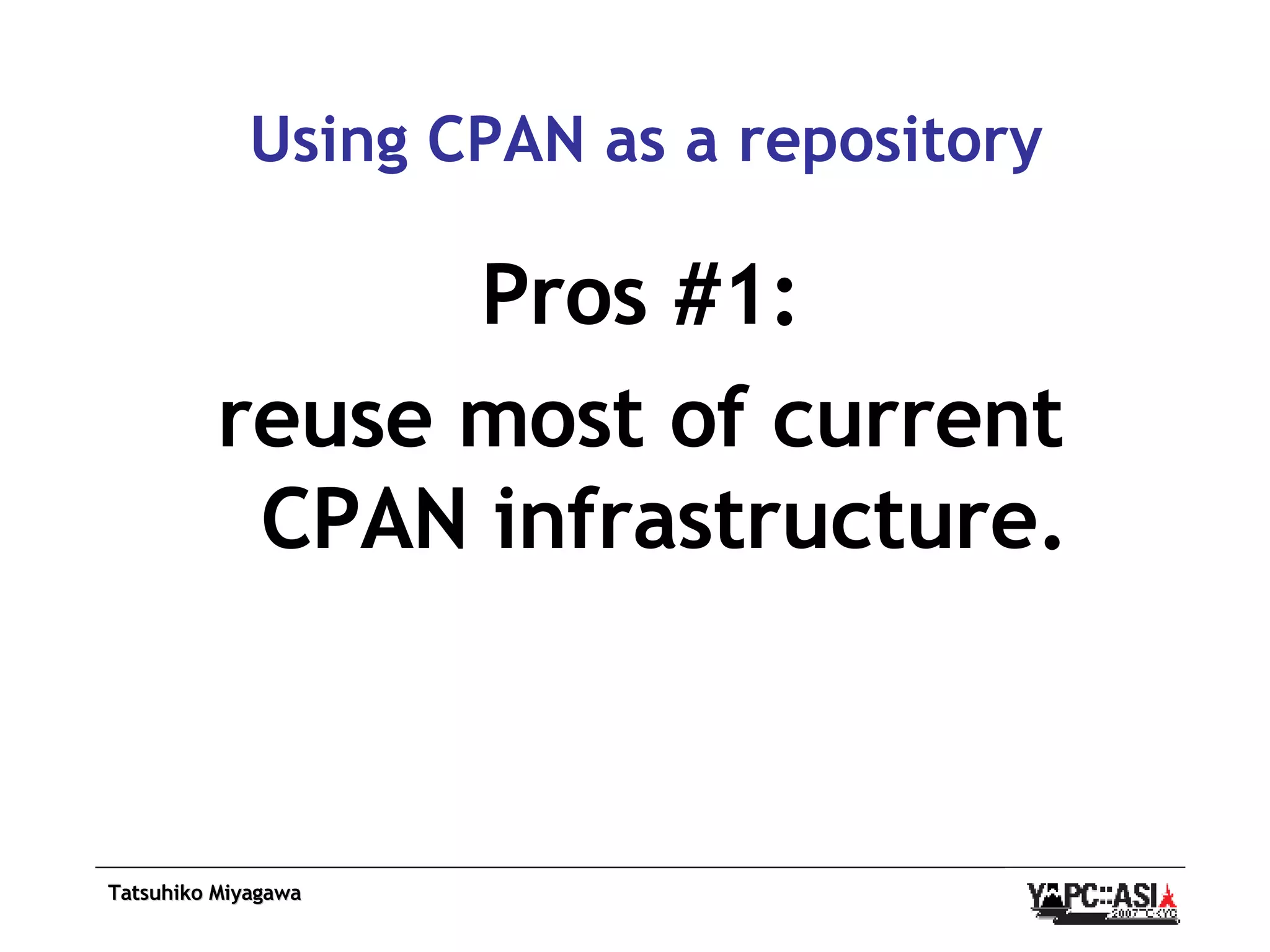
Using CPAN as a repository Pros #1: reuse most of current CPAN infrastructure.
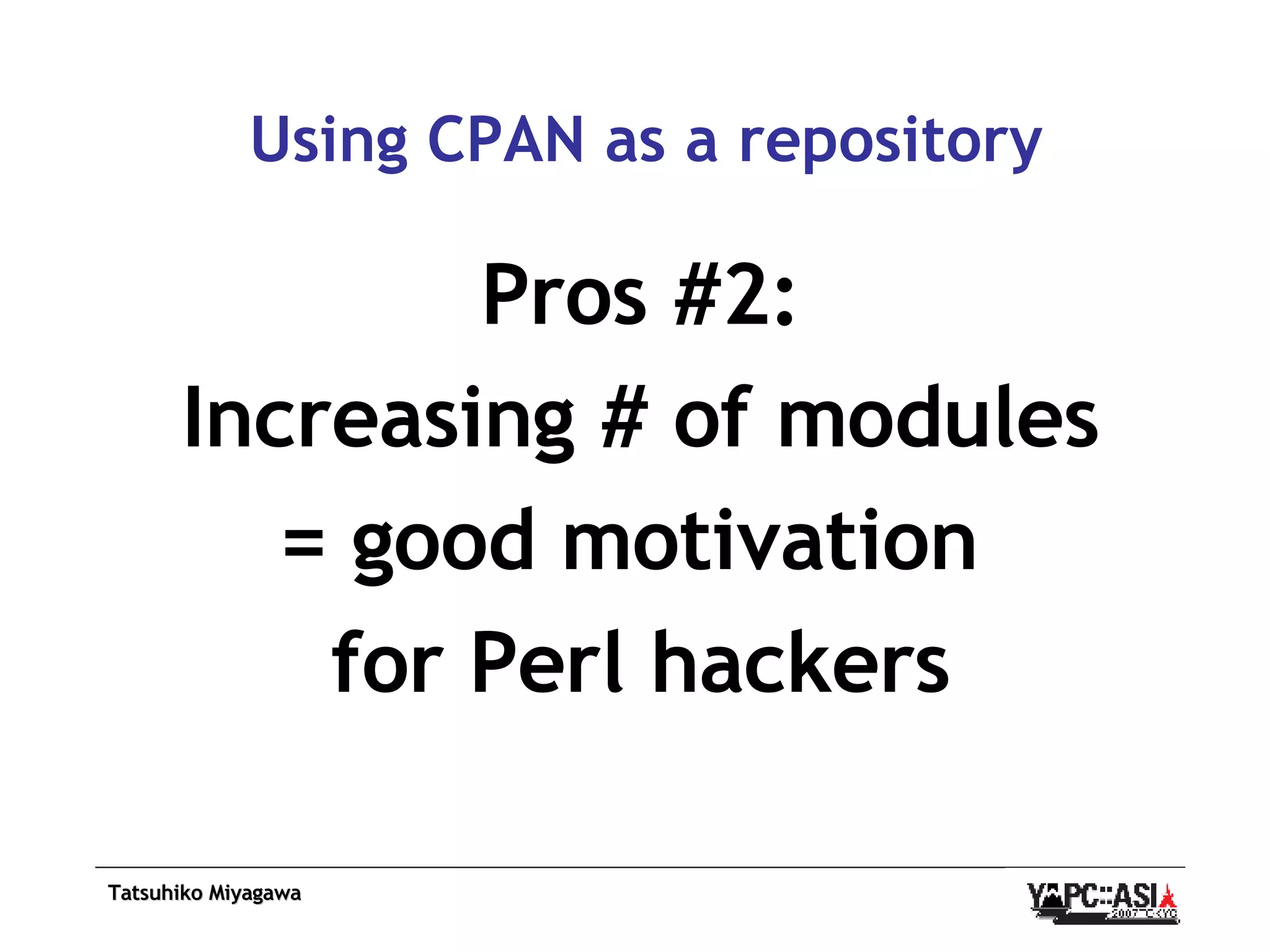
Using CPAN as a repository Pros #2: Increasing # of modules = good motivation  for Perl hackers
Cons #1: Installing CPAN deps could be a mess (especially for Win32)
Cons #2: Whenever Ingy releases new Kwiki, lots of plugins just break.
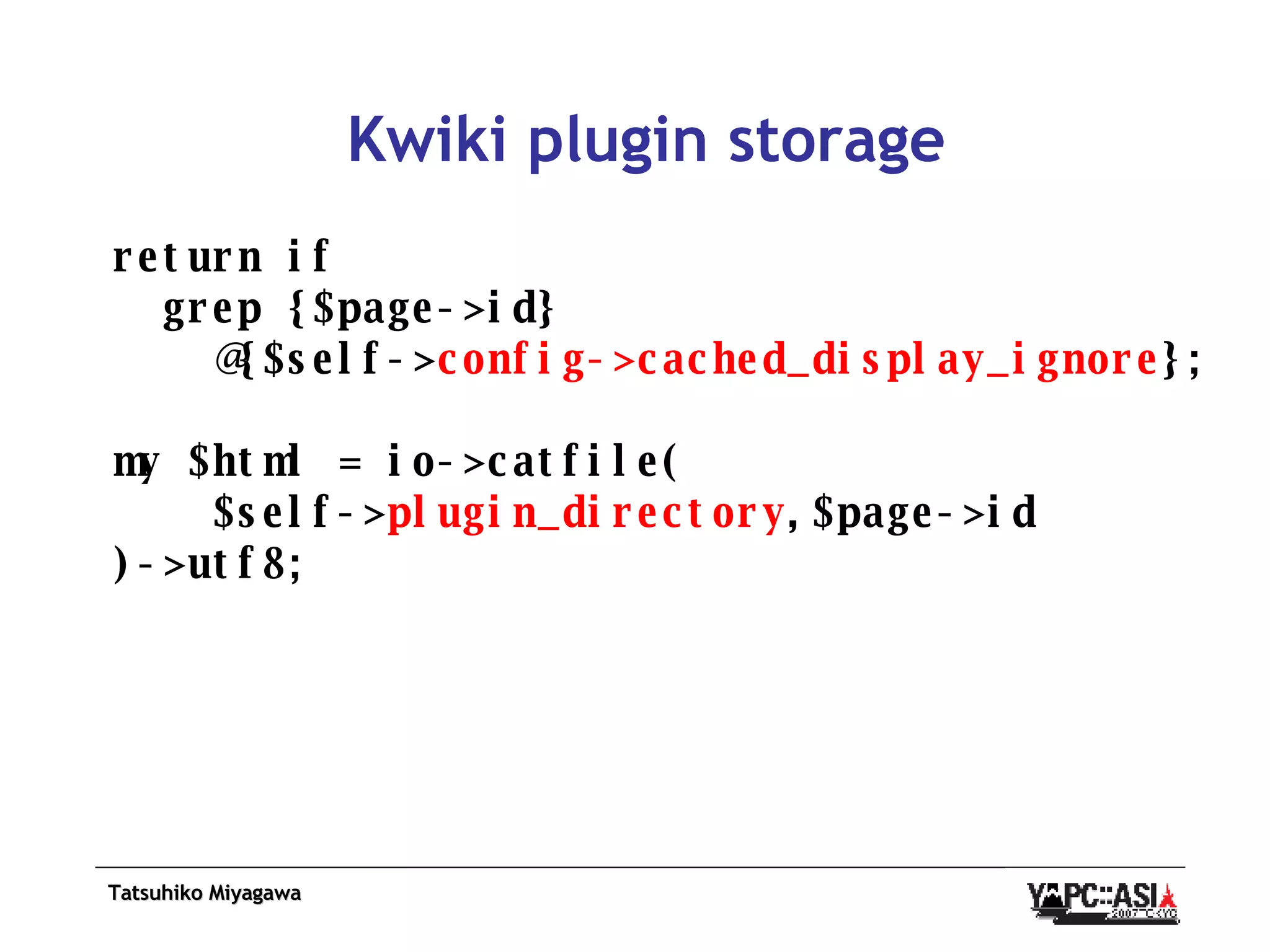
Kwiki plugin storage return if  grep {$page->id} @{$self-> config->cached_display_ignore }; my $html = io->catfile( $self-> plugin_directory ,$page->id )->utf8;
Kwiki 2.0
Same as Kwiki 1.0
Except: plugins are now in SVN repository
 
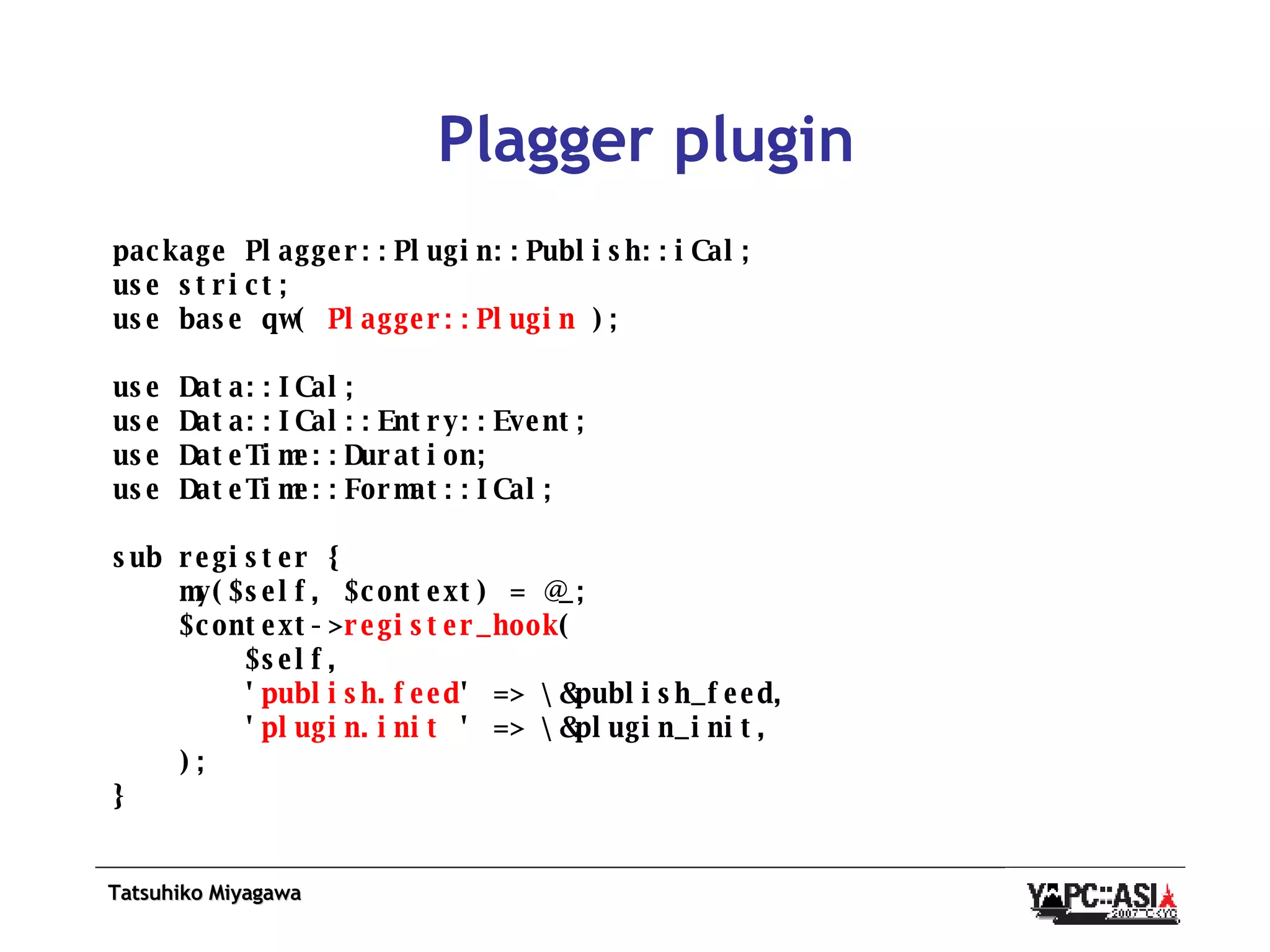
Plagger plugin package Plagger::Plugin::Publish::iCal; use strict; use base qw(  Plagger::Plugin  ); use Data::ICal; use Data::ICal::Entry::Event; use DateTime::Duration; use DateTime::Format::ICal; sub register { my($self, $context) = @_; $context-> register_hook ( $self, ' publish.feed ' => \&publish_feed, ' plugin.init  ' => \&plugin_init, ); }
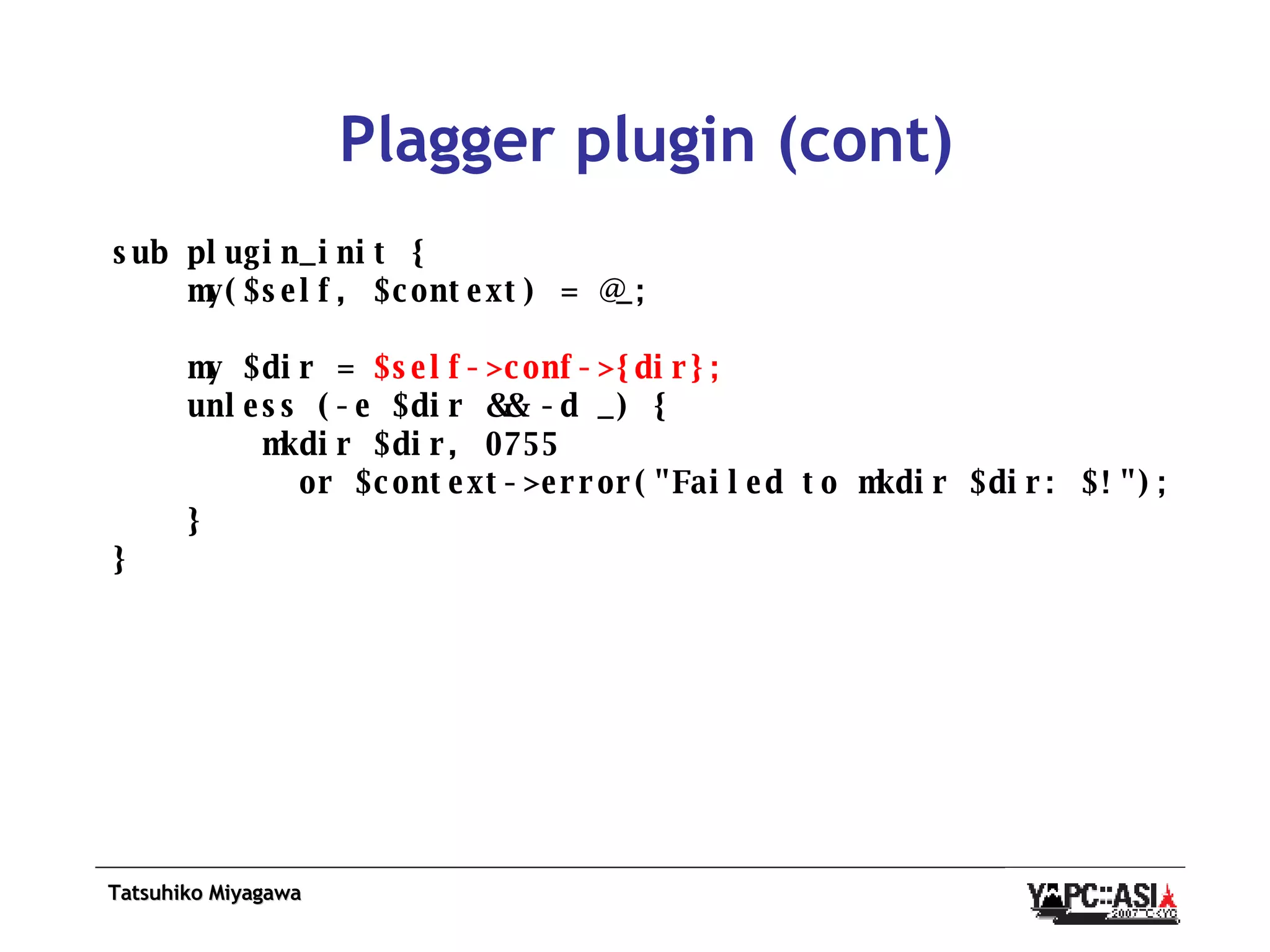
Plagger plugin (cont) sub plugin_init { my($self, $context) = @_; my $dir =  $self->conf->{dir}; unless (-e $dir && -d _) { mkdir $dir, 0755 or $context->error("Failed to mkdir $dir: $!"); } }
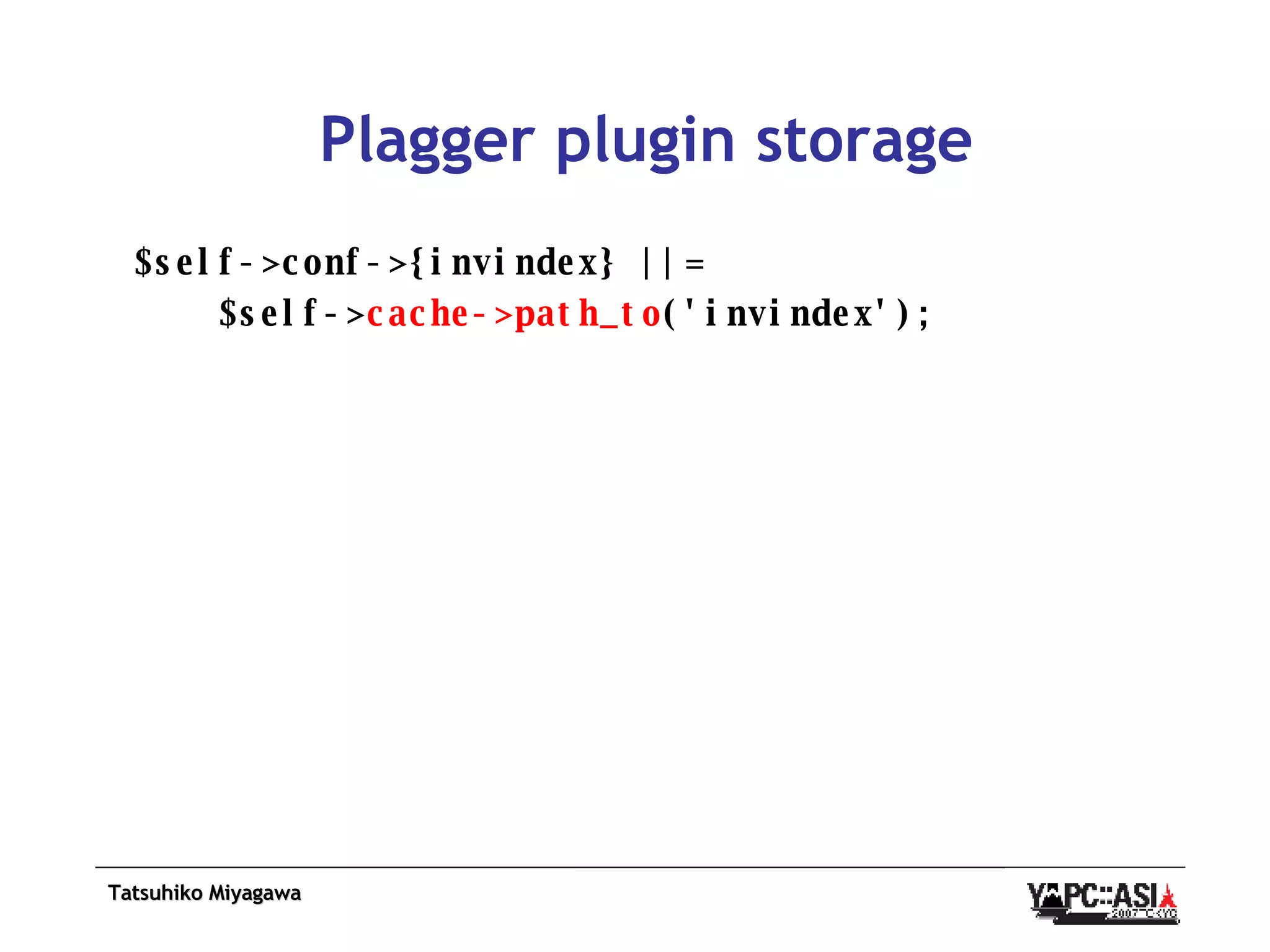
Plagger plugin storage $self->conf->{invindex} ||= $self-> cache->path_to ('invindex');
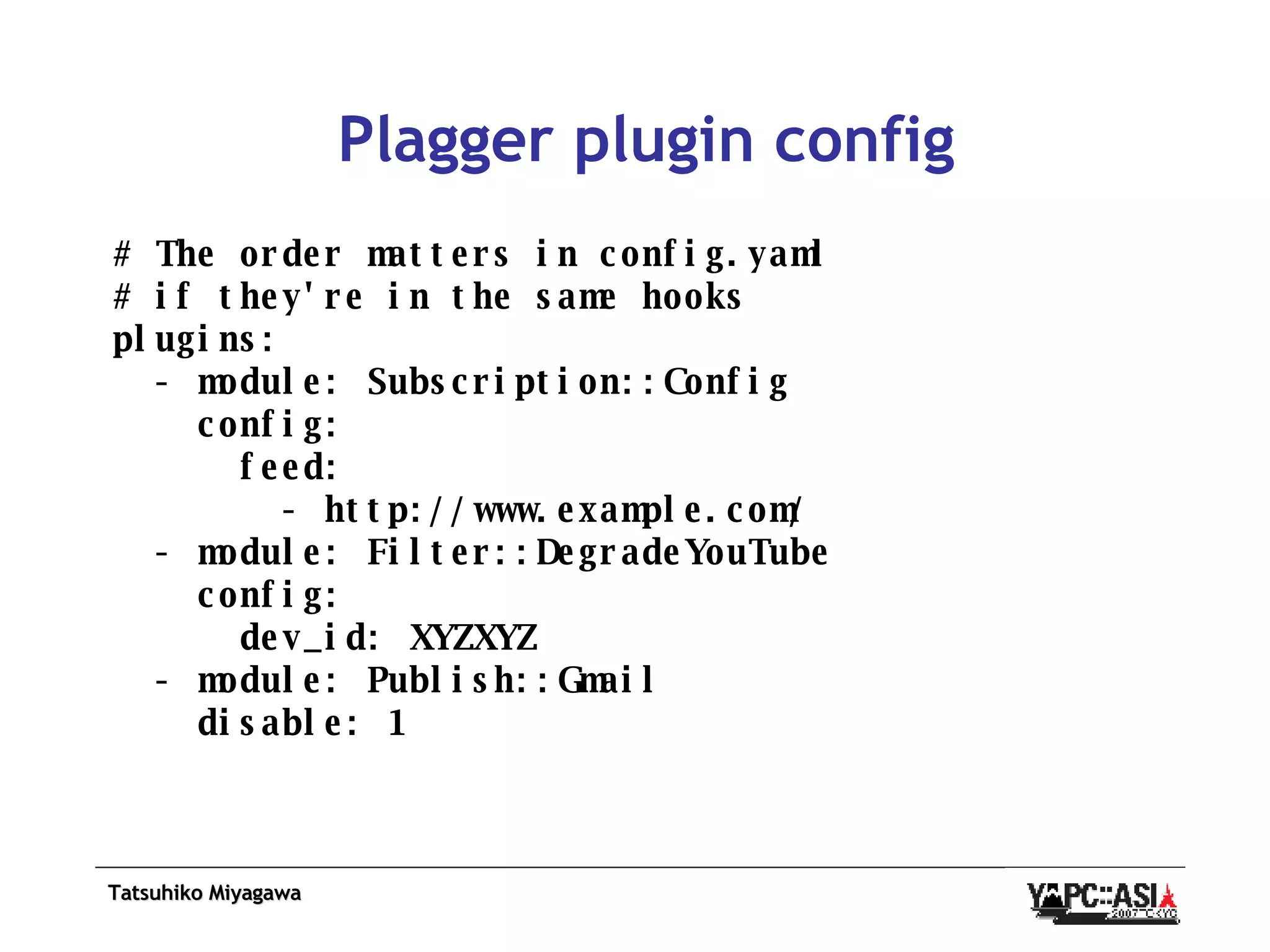
Plagger plugin config # The order matters in config.yaml # if they're in the same hooks plugins: - module: Subscription::Config config: feed: - http://www.example.com/ - module: Filter::DegradeYouTube config: dev_id: XYZXYZ - module: Publish::Gmail disable: 1
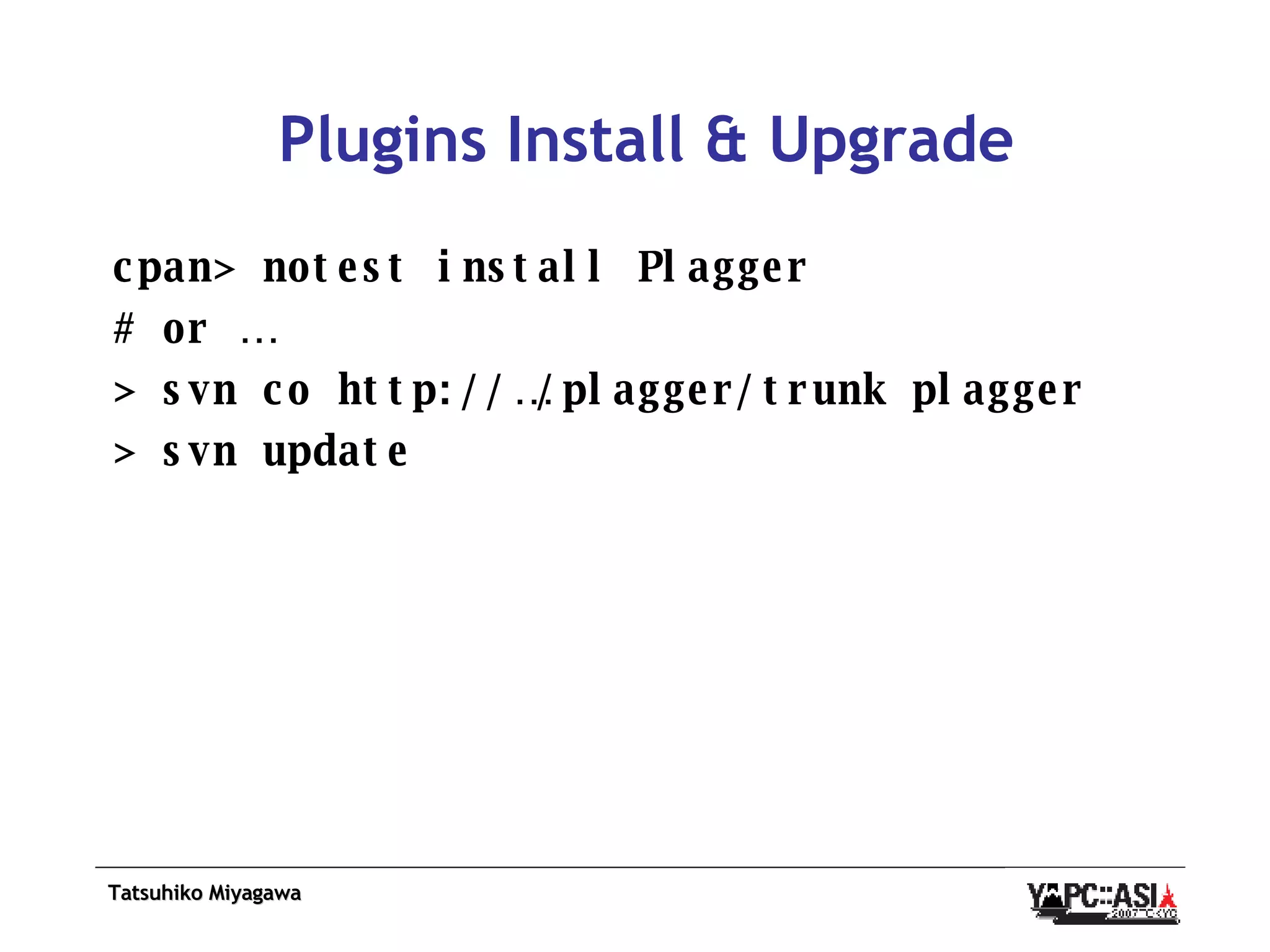
Plugins Install & Upgrade cpan> notest install Plagger # or … > svn co http://…/plagger/trunk plagger > svn update
Plagger impl. ripped off by many apps now
qpsmtpd
mod_perl for SMTP Runs with tcpserver, forkserver  or Danga::Socket standalone
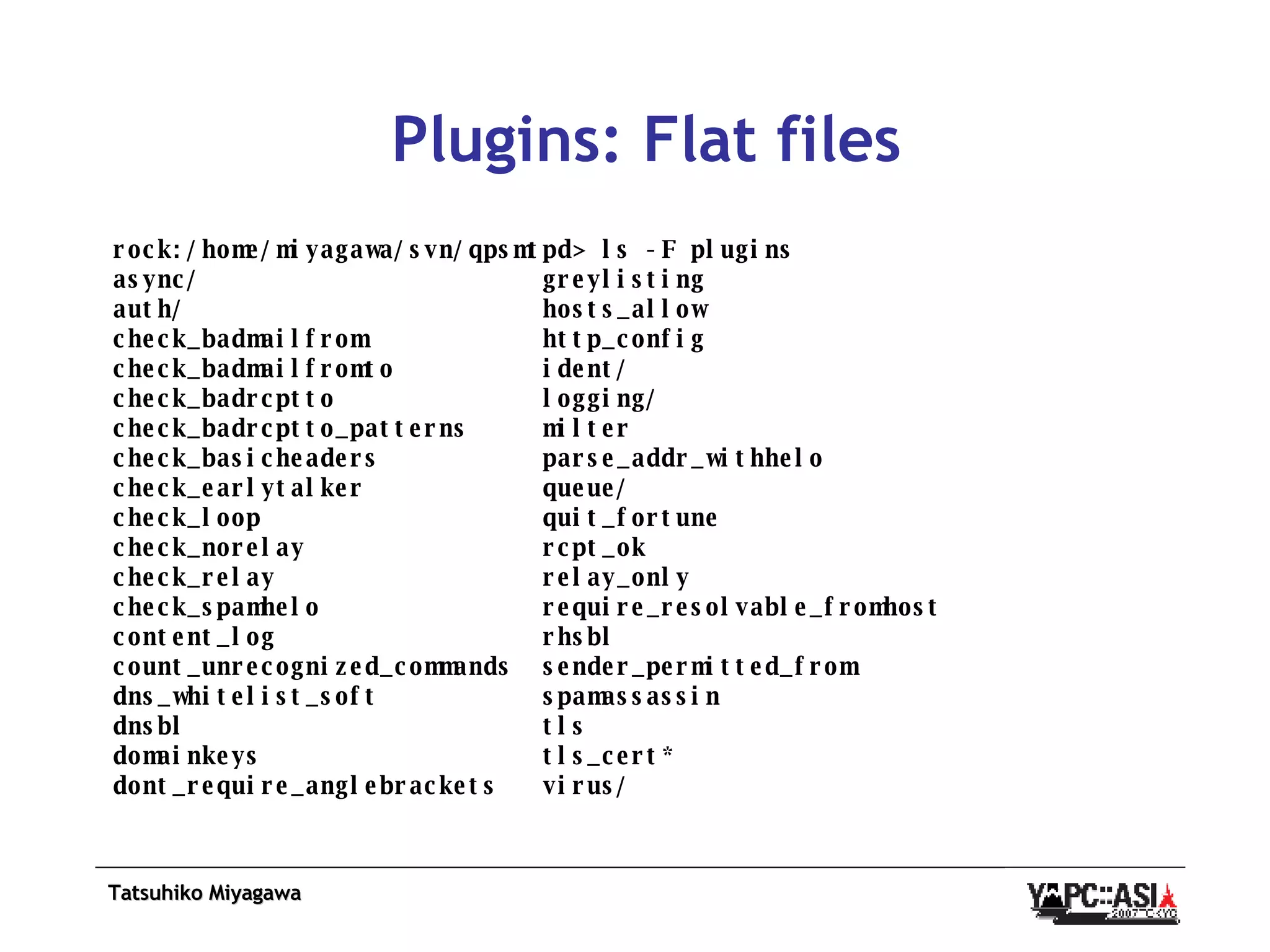
Plugins: Flat files rock:/home/miyagawa/svn/qpsmtpd> ls -F plugins async/  greylisting auth/  hosts_allow check_badmailfrom  http_config check_badmailfromto  ident/ check_badrcptto  logging/ check_badrcptto_patterns  milter check_basicheaders  parse_addr_withhelo check_earlytalker  queue/ check_loop  quit_fortune check_norelay  rcpt_ok check_relay  relay_only check_spamhelo  require_resolvable_fromhost content_log  rhsbl count_unrecognized_commands  sender_permitted_from dns_whitelist_soft  spamassassin dnsbl  tls domainkeys  tls_cert* dont_require_anglebrackets  virus/
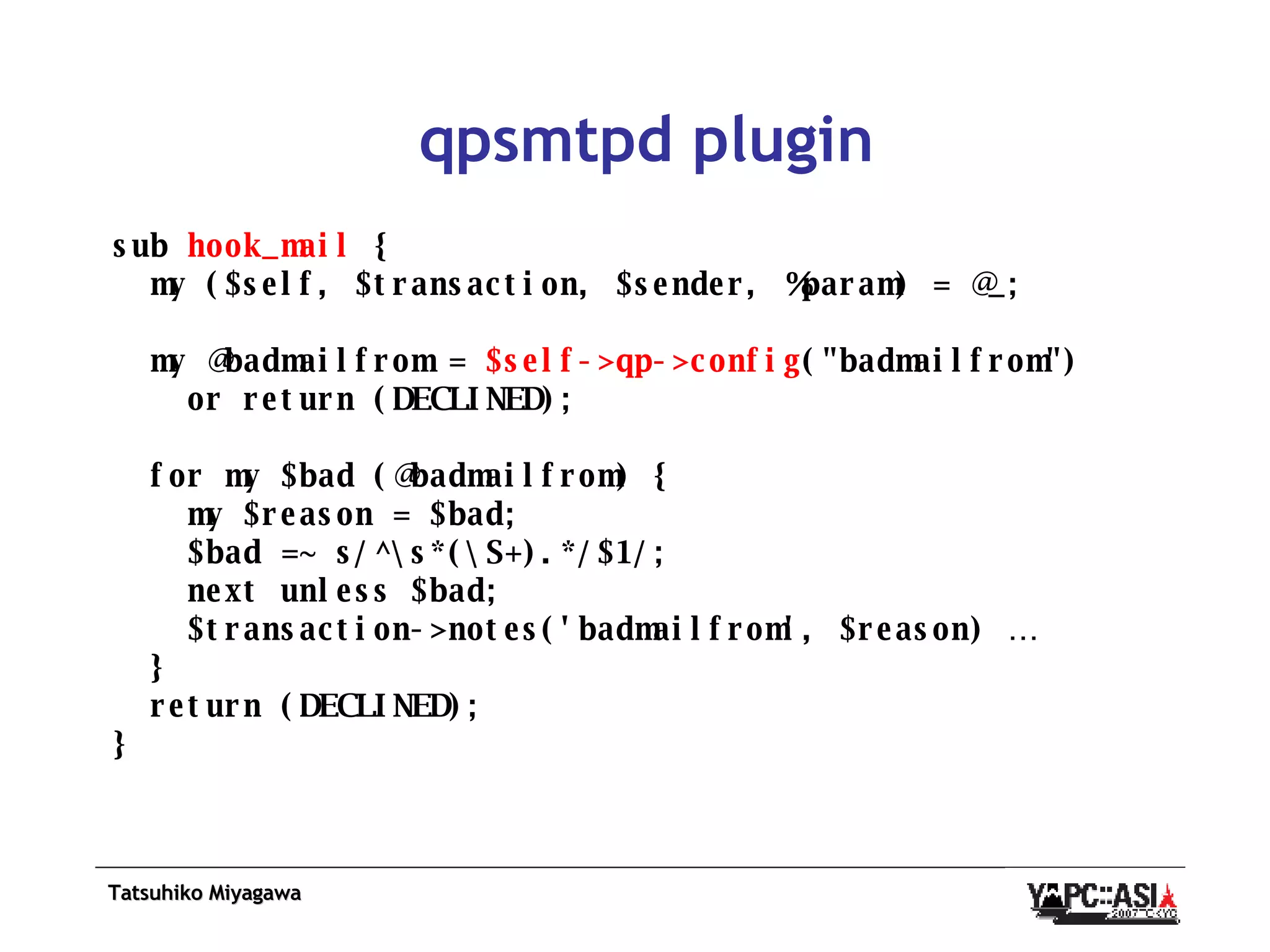
qpsmtpd plugin sub  hook_mail  { my ($self, $transaction, $sender, %param) = @_; my @badmailfrom =  $self->qp->config ("badmailfrom") or return (DECLINED); for my $bad (@badmailfrom) { my $reason = $bad; $bad =~ s/^\s*(\S+).*/$1/; next unless $bad; $transaction->notes('badmailfrom', $reason) … } return (DECLINED); }
Actually qpsmtpd Plugins are "compiled" to modules
my $eval = join("\n", "package $package;", 'use Qpsmtpd::Constants;', "require Qpsmtpd::Plugin;", 'use vars qw(@ISA);', 'use strict;', '@ISA = qw(Qpsmtpd::Plugin);', ($test_mode ? 'use Test::More;' : ''), "sub plugin_name { qq[$plugin] }", $line, $sub, "\n", # last line comment without newline? ); $eval =~ m/(.*)/s; $eval = $1; eval $eval; die "eval $@" if $@;
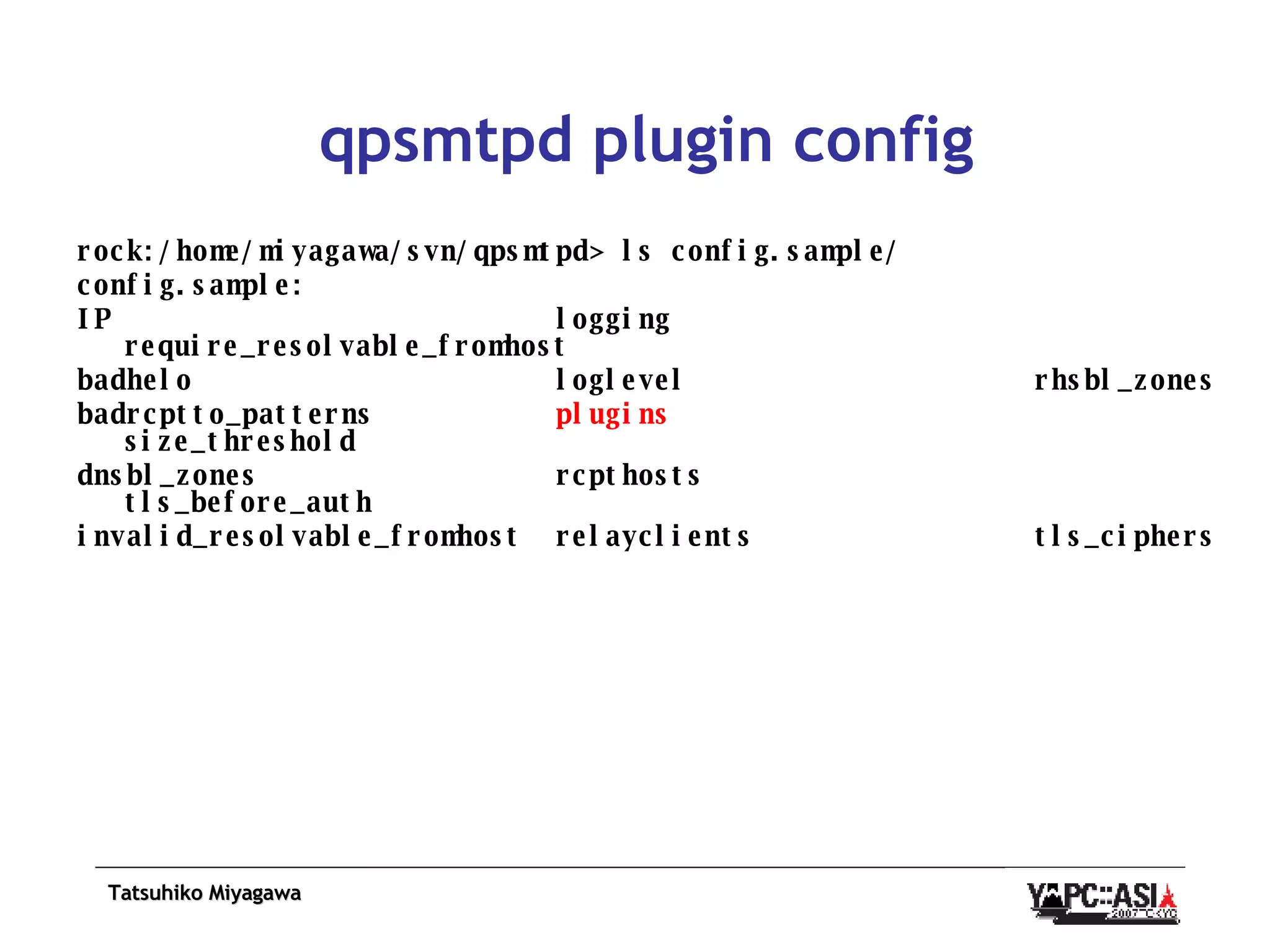
qpsmtpd plugin config rock:/home/miyagawa/svn/qpsmtpd> ls config.sample/ config.sample: IP  logging  require_resolvable_fromhost badhelo  loglevel  rhsbl_zones badrcptto_patterns  plugins   size_threshold dnsbl_zones  rcpthosts  tls_before_auth invalid_resolvable_fromhost  relayclients  tls_ciphers
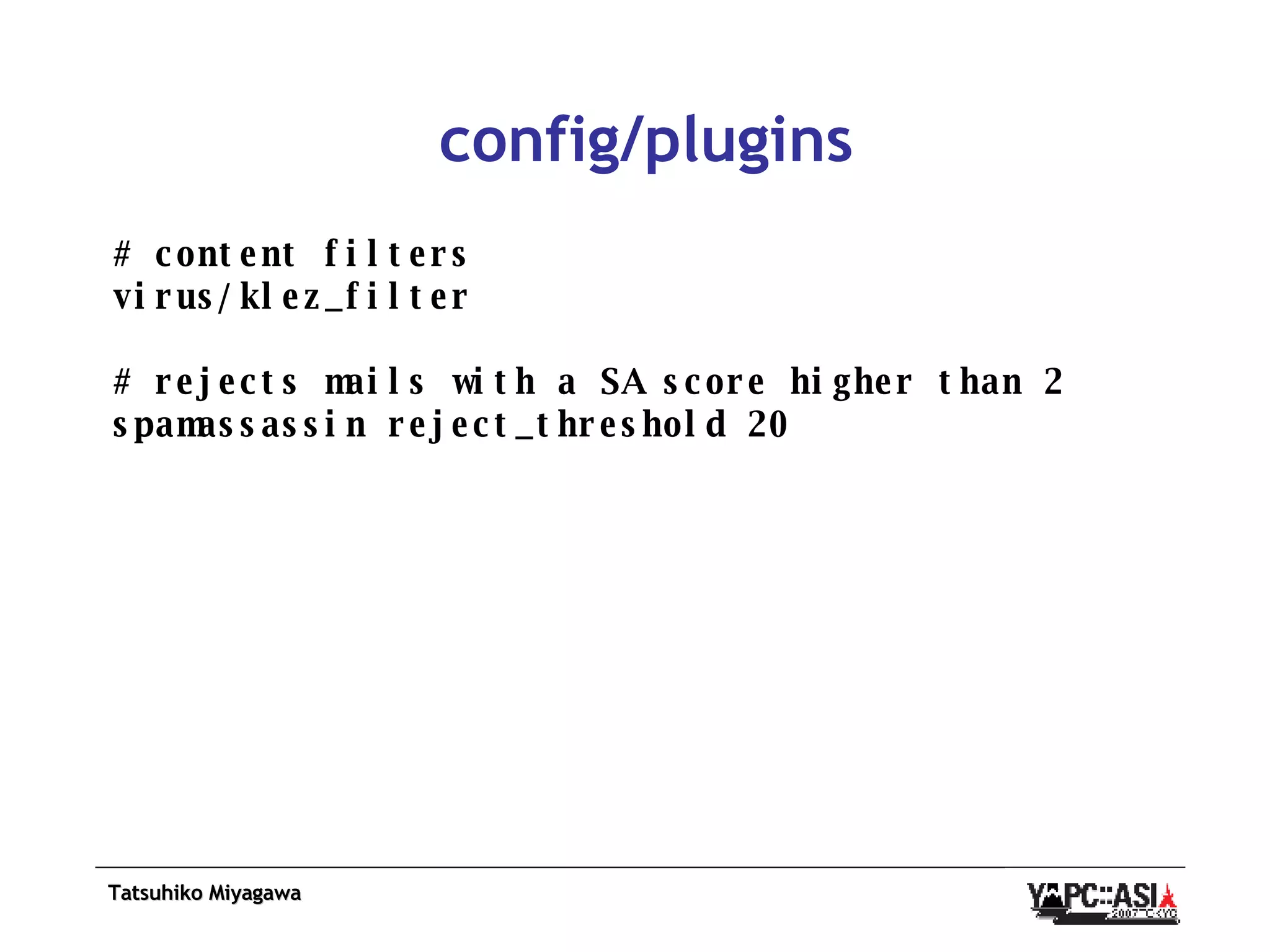
config/plugins # content filters virus/klez_filter # rejects mails with a SA score higher than 2 spamassassin reject_threshold 20
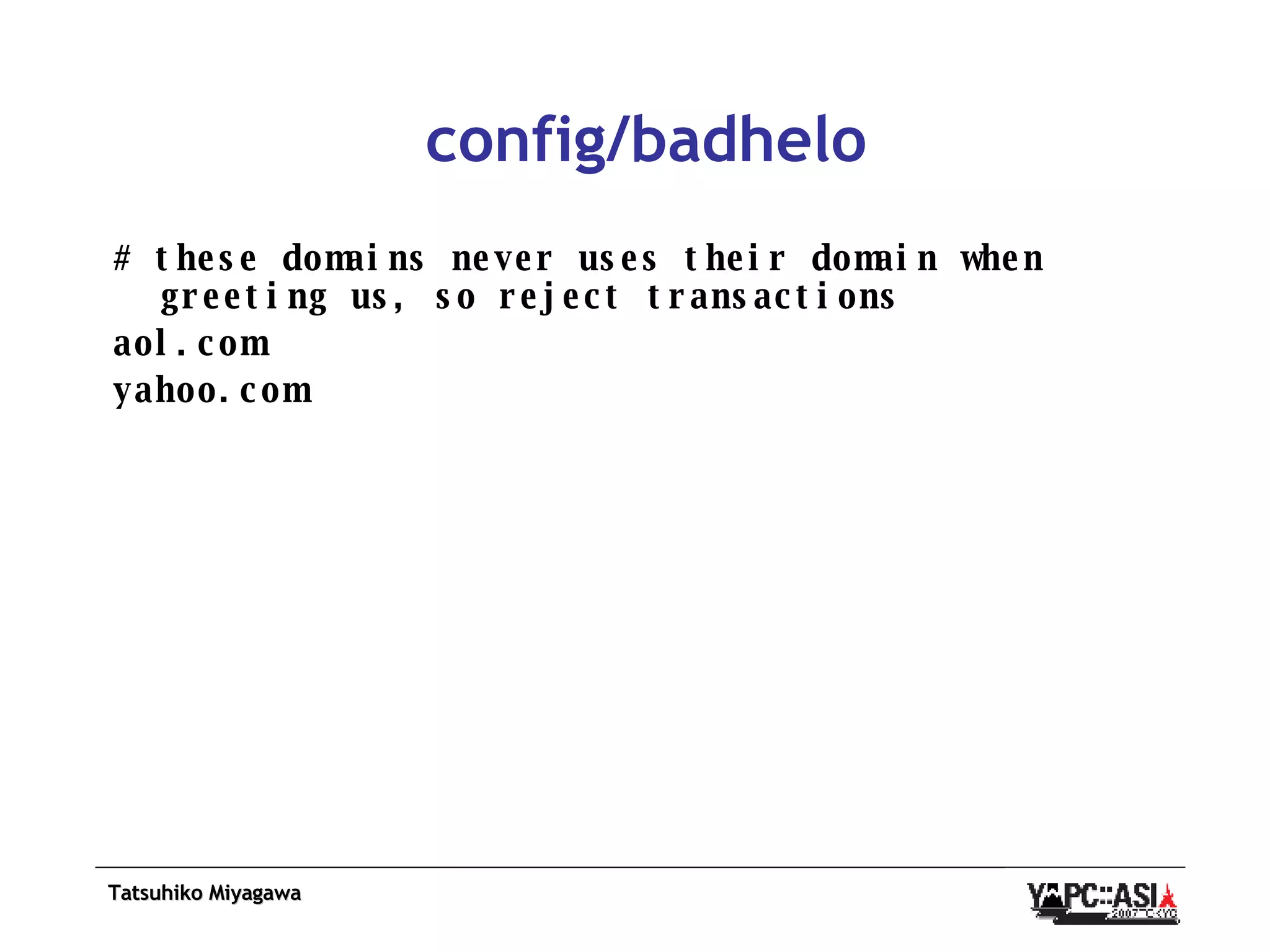
config/badhelo # these domains never uses their domain when greeting us, so reject transactions aol.com yahoo.com
Install & Upgrade plugins Just use subversion
 
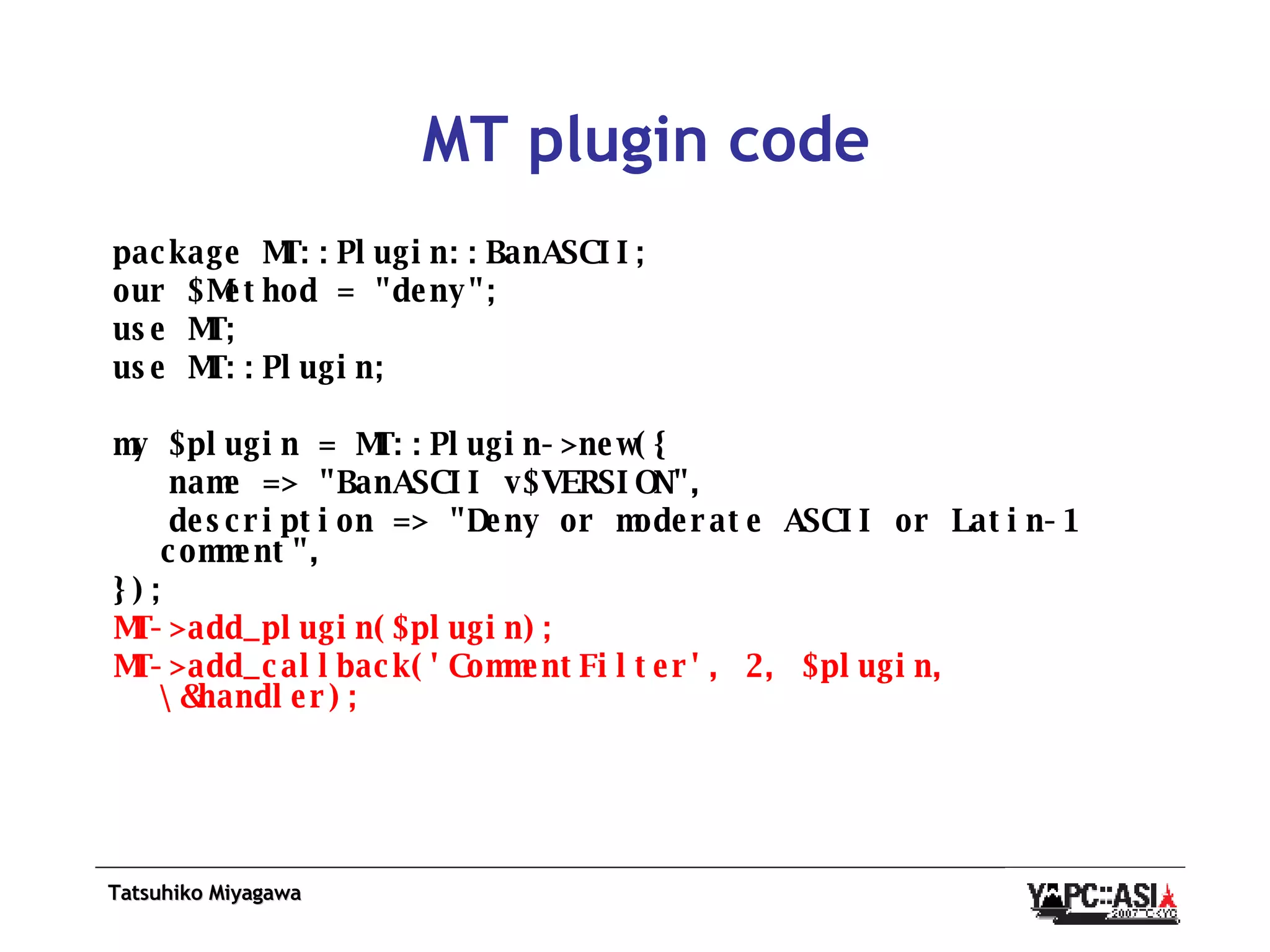
MT plugins are  flat-files (or scripts that call modules)
MT plugin code package MT::Plugin::BanASCII;  our $Method = "deny"; use MT;  use MT::Plugin;  my $plugin = MT::Plugin->new({ name => "BanASCII v$VERSION", description => "Deny or moderate ASCII or Latin-1 comment", });  MT->add_plugin($plugin); MT->add_callback('CommentFilter', 2, $plugin, \&handler);
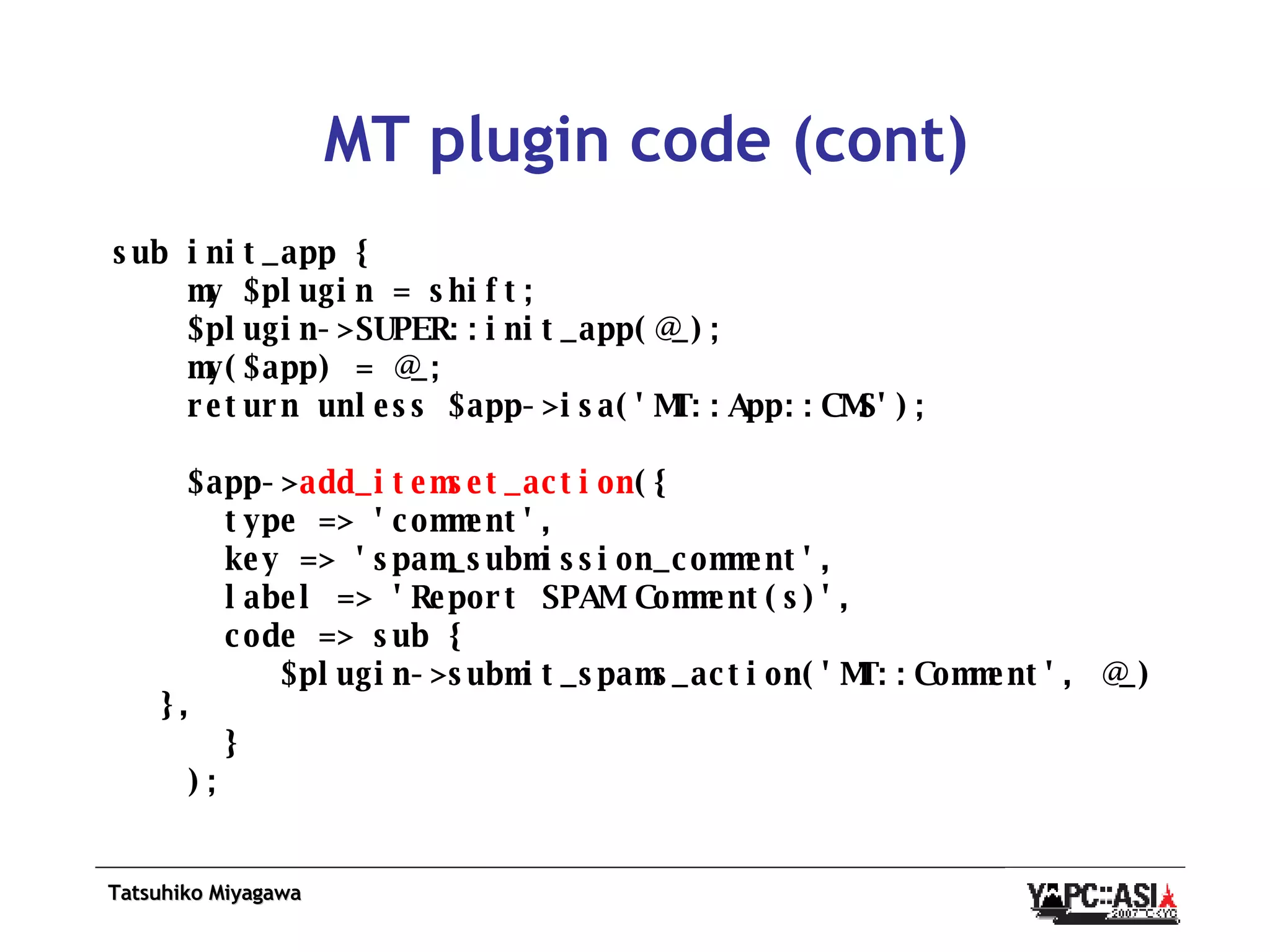
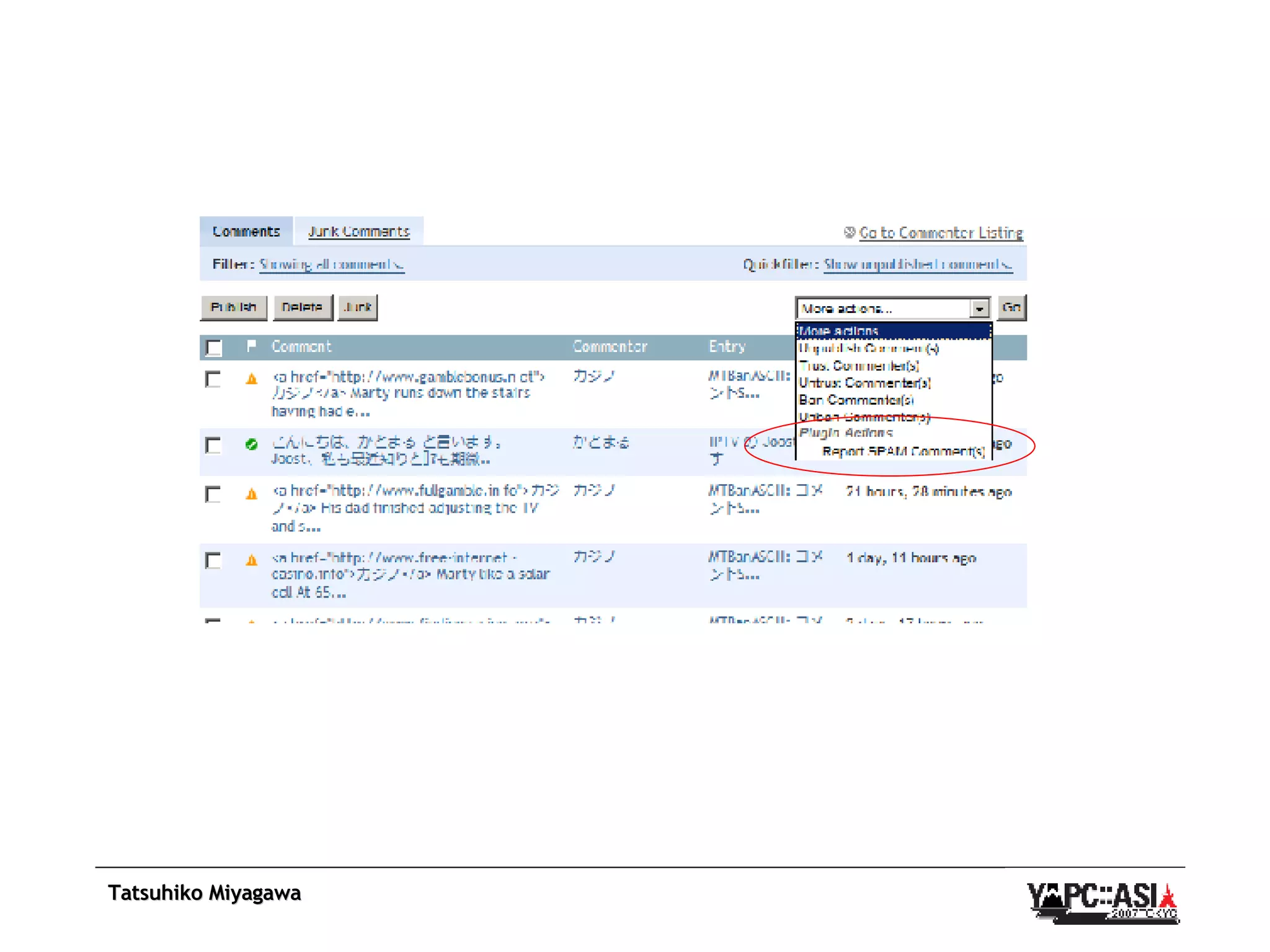
MT plugin code (cont) sub init_app {  my $plugin = shift; $plugin->SUPER::init_app(@_); my($app) = @_; return unless $app->isa('MT::App::CMS'); $app-> add_itemset_action ({  type => 'comment', key => 'spam_submission_comment', label => 'Report SPAM Comment(s)', code => sub {  $plugin->submit_spams_action('MT::Comment', @_) },  } );
 
 
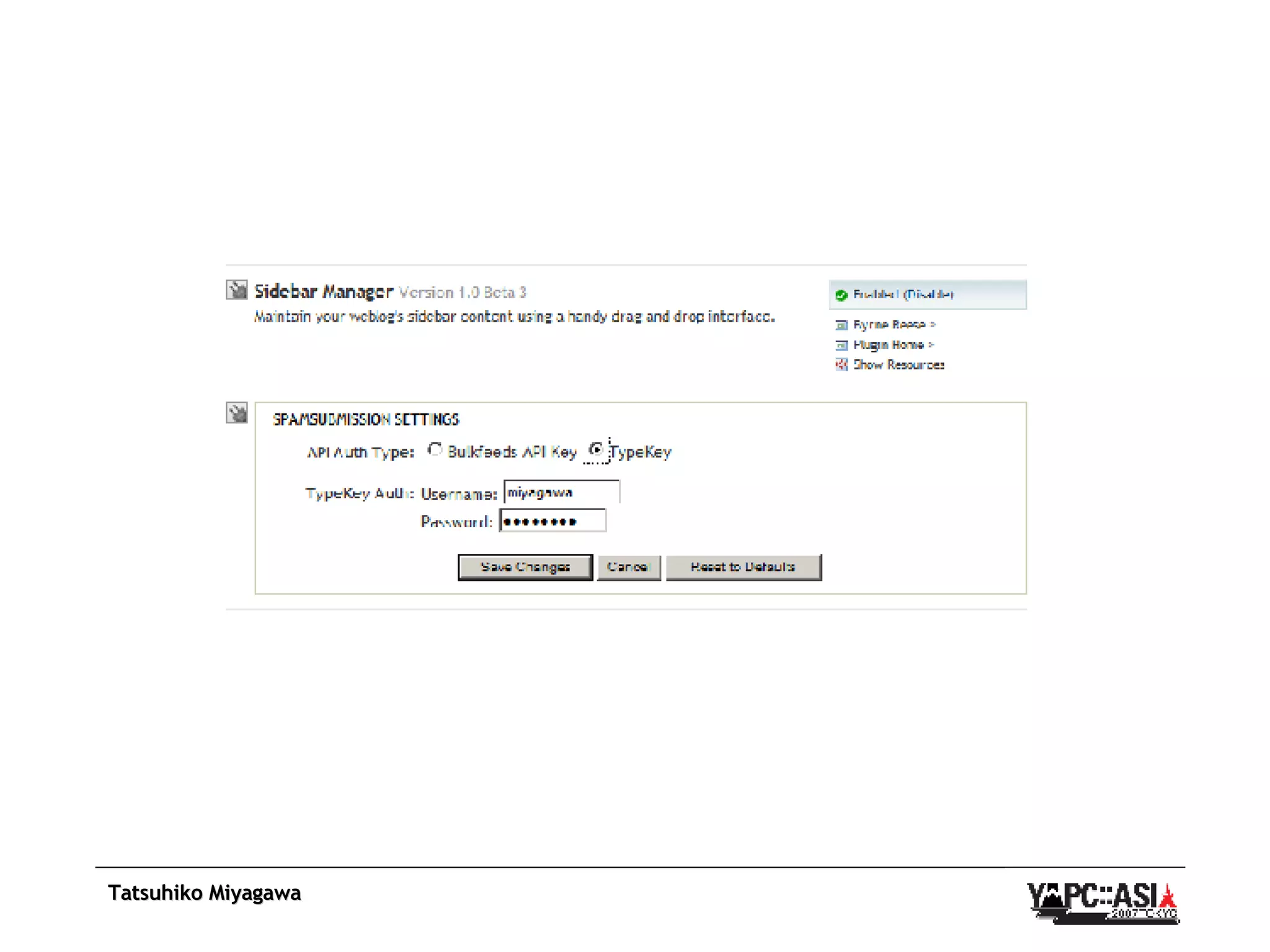
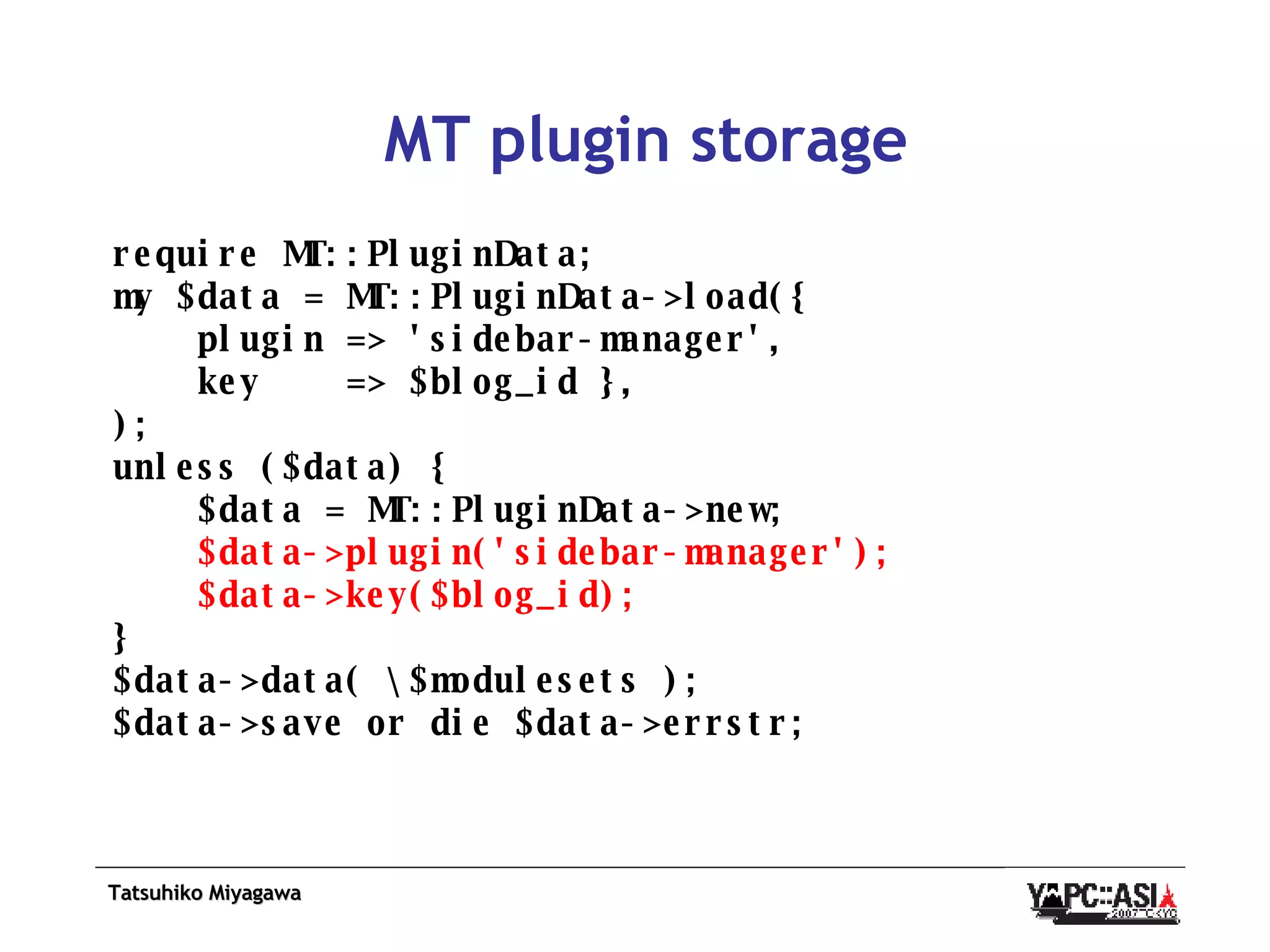
MT plugin storage require MT::PluginData; my $data = MT::PluginData->load({ plugin => 'sidebar-manager', key  => $blog_id }, ); unless ($data) { $data = MT::PluginData->new; $data->plugin('sidebar-manager'); $data->key($blog_id); } $data->data( \$modulesets ); $data->save or die $data->errstr;
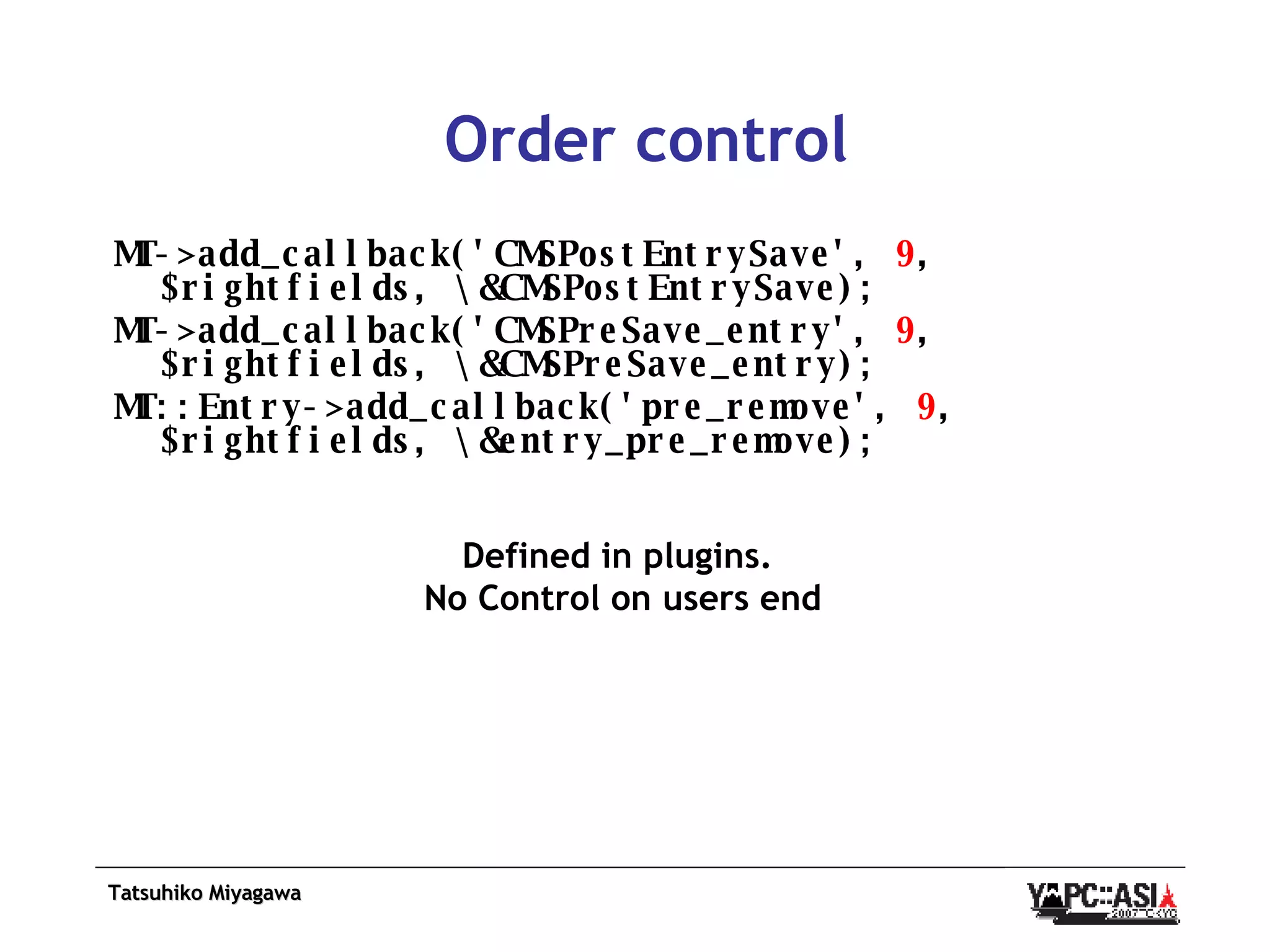
Order control MT->add_callback('CMSPostEntrySave',  9 , $rightfields, \&CMSPostEntrySave); MT->add_callback('CMSPreSave_entry',  9 , $rightfields, \&CMSPreSave_entry); MT::Entry->add_callback('pre_remove',  9 , $rightfields, \&entry_pre_remove); Defined in plugins.  No Control on users end
Conclusion Flat-files vs. Modules
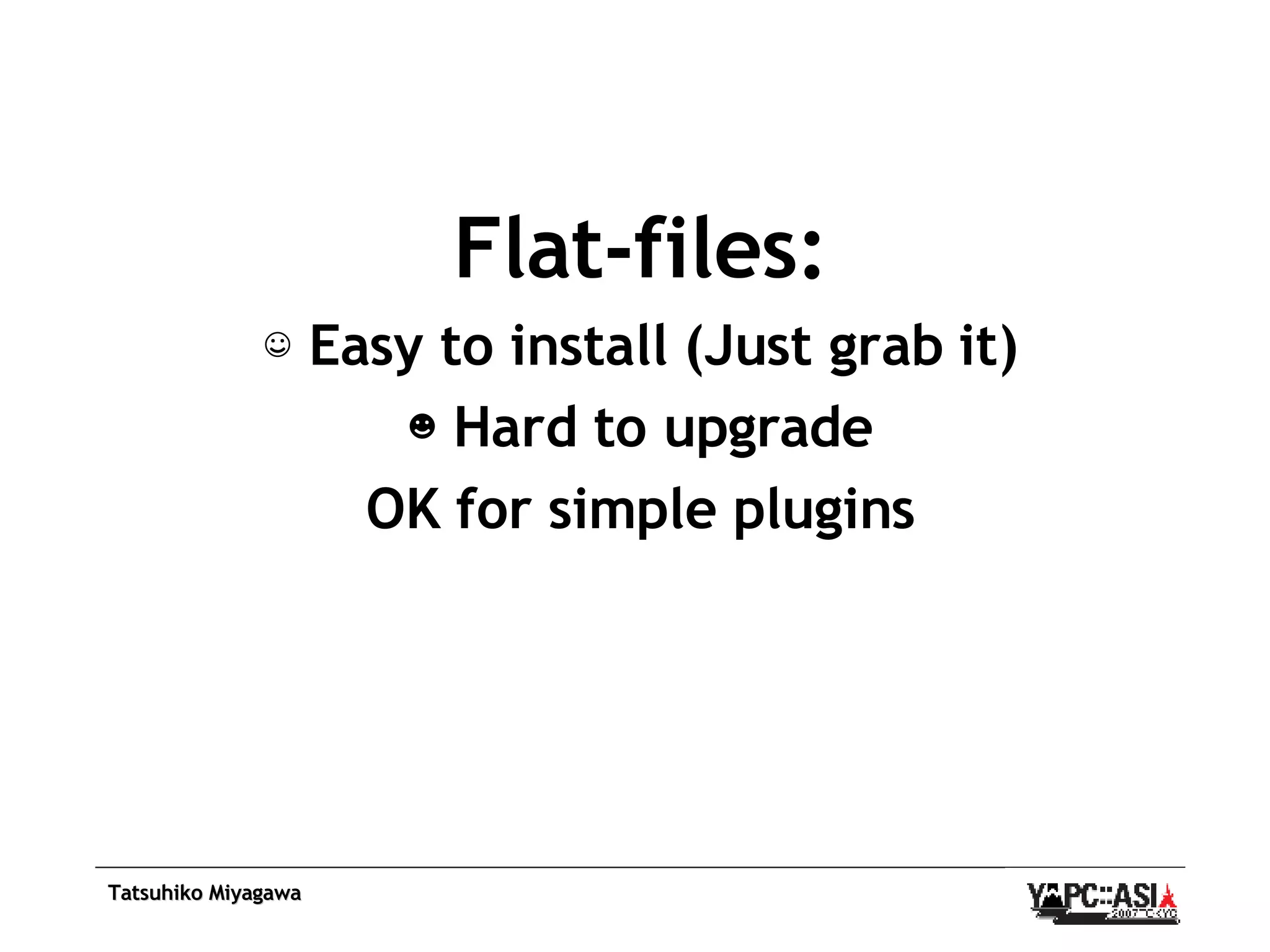
Flat-files: ☺  Easy to install (Just grab it) ☻  Hard to upgrade OK for simple plugins
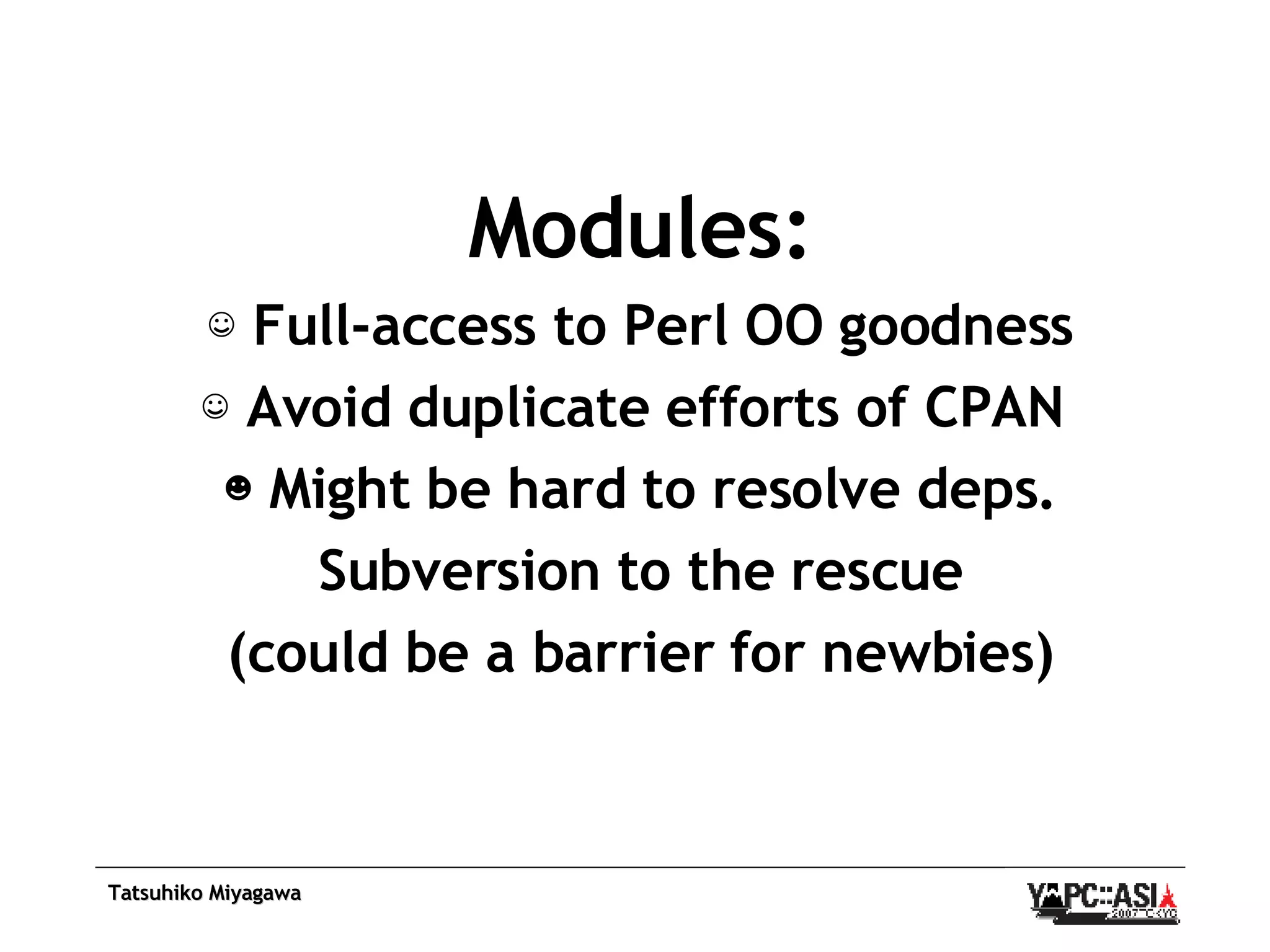
Modules: ☺  Full-access to Perl OO goodness ☺  Avoid duplicate efforts of CPAN  ☻  Might be hard to resolve deps. Subversion to the rescue (could be a barrier for newbies)
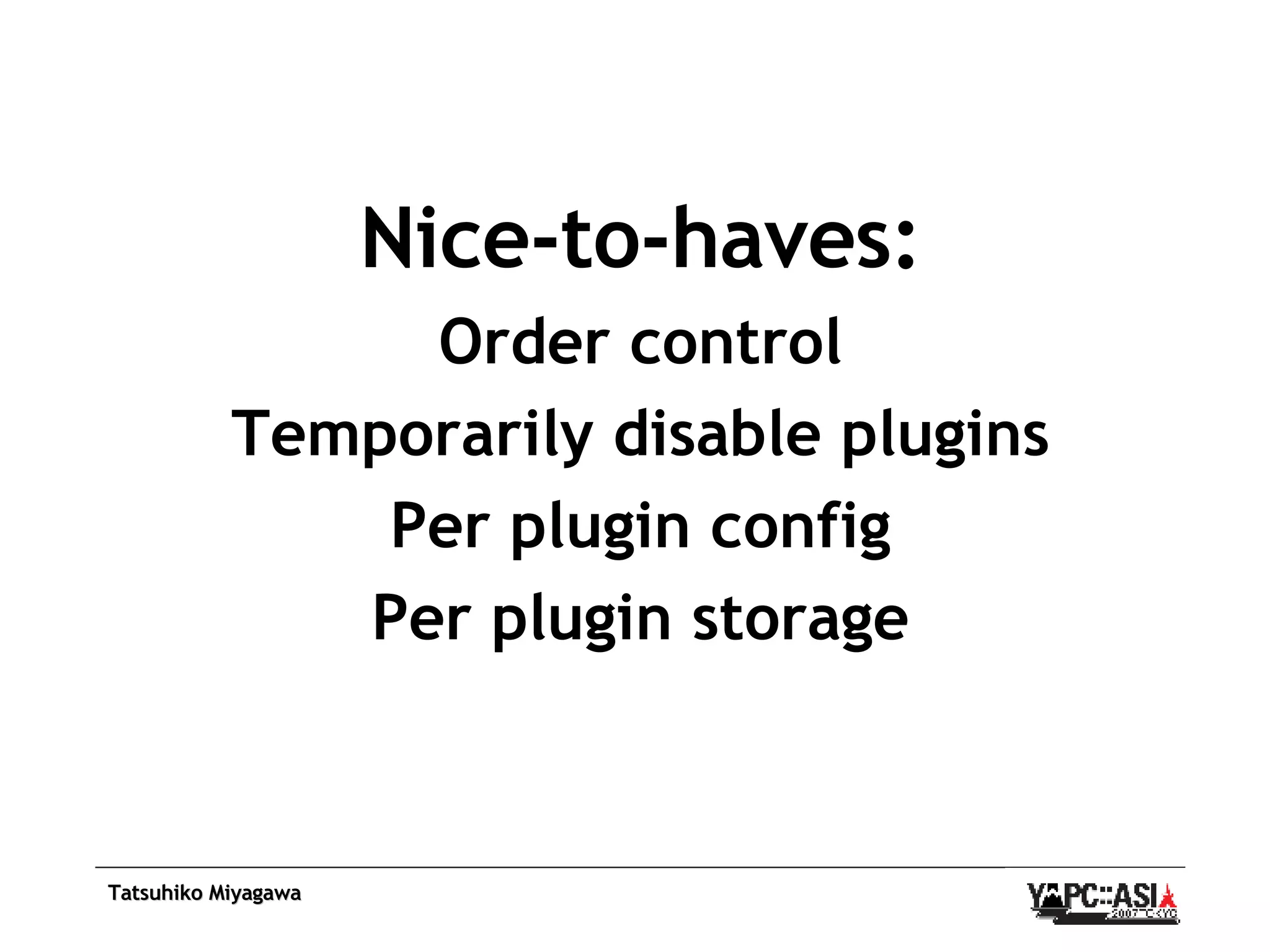
Nice-to-haves: Order control Temporarily disable plugins Per plugin config Per plugin storage
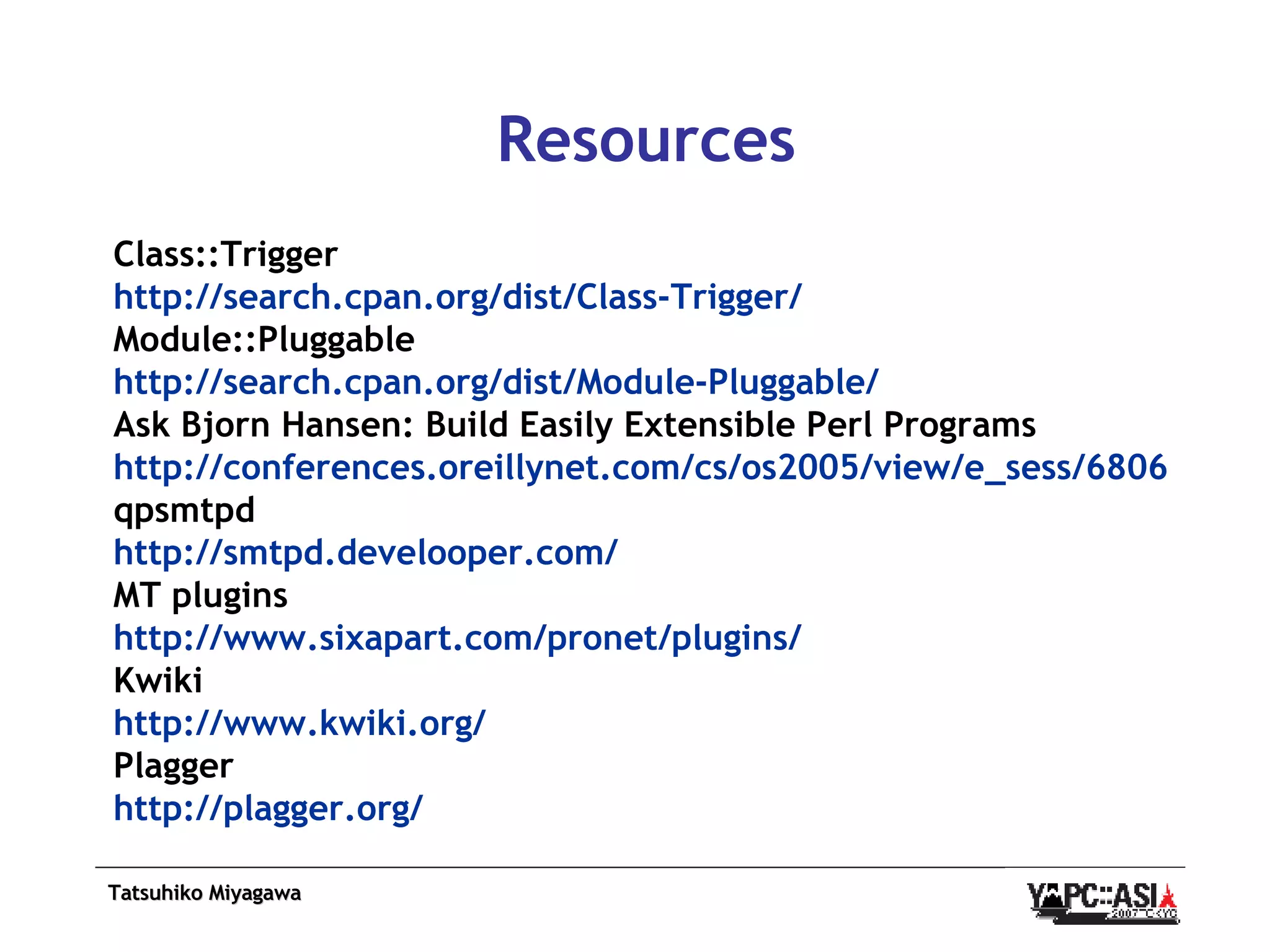
Resources Class::Trigger http:// search.cpan.org /dist/Class-Trigger/ Module::Pluggable http:// search.cpan.org /dist/Module-Pluggable/ Ask Bjorn Hansen: Build Easily Extensible Perl Programs http://conferences.oreillynet.com/cs/os2005/view/e_sess/6806 qpsmtpd http:// smtpd.develooper.com / MT plugins http:// www.sixapart.com/pronet/plugins / Kwiki http:// www.kwiki.org / Plagger http:// plagger.org /

Writing Pluggable Software

  • 1.
    Writing Pluggable SoftwareTatsuhiko Miyagawa [email_address] Six Apart, Ltd. / Shibuya Perl Mongers YAPC::Asia 2007 Tokyo
  • 2.
    For non-JP attendees… If you find \ in the code, Replace that with backslash. (This is MS' fault)
  • 3.
  • 4.
  • 5.
    Pl u ggableSoftware
  • 6.
  • 7.
    #1 How tomake your app pluggable
  • 8.
    #2 TMTOWTDP There'sMore Than One Way To Deploy Plugins Pros/Cons by examples
  • 9.
  • 10.
  • 11.
    #1 Keep theapp design and code simple
  • 12.
    #2 Let theapp users customize the behavior (without hacking the internals)
  • 13.
    #3 It's fun to write plugins for most hackers (see: Plagger and Kwiki)
  • 14.
    "Can your appdo XXX?" "Yes, by plugins."
  • 15.
    "Your app hasa bug in YYY" "No, it's the bug in plugin YYY, Not my fault." (Chain Of Responsibilities)
  • 16.
  • 17.
    #1 Make yourapp pluggable
  • 18.
  • 19.
  • 20.
    grep –r forprogrammers
  • 21.
    Ack is a"full-stack" software now.
  • 22.
    By "full-stack" Imean: Easy install No configuration No way to extend
  • 23.
    Specifically: These arehardcoded Ignored directories Filenames and types
  • 24.
    Ignored Directories @ignore_dirs= qw( blib CVS RCS SCCS .svn _darcs .git );
  • 25.
    Filenames and languagesmapping %mappings = ( asm => [qw( s S )], binary => …, cc => [qw( c h xs )], cpp => [qw( cpp m h C H )], csharp => [qw( cs )], … perl => [qw( pl pm pod tt ttml t )], … );
  • 26.
    What if makingthese pluggable?
  • 27.
  • 28.
    Don't get mewrong Andy, I love ack the way it is… Just thought it can be a very good example for the tutorial.
  • 29.
  • 30.
    Class::Trigger SYNOPSIS packageFoo; use Class::Trigger; sub foo { my $self = shift; $self->call_trigger('before_foo'); # some code ... $self->call_trigger('after_foo'); } package main; Foo->add_trigger(before_foo => \&sub1); Foo->add_trigger(after_foo => \&sub2);
  • 31.
    Class::Trigger Helps youto implement Observer Pattern. (Rails calls this Observer)
  • 32.
    Module::Pluggable SYNOPSIS packageMyClass; use Module::Pluggable; use MyClass; my $mc = MyClass->new(); # returns the names of all plugins installed under MyClass::Plugin::* my @plugins = $mc->plugins(); package MyClass::Plugin::Foo; sub new { … } 1;
  • 33.
    Setup plugins inApp::Ack package App::Ack; use Class::Trigger; use Module::Pluggable require => 1; __PACKAGE__->plugins;
  • 34.
    Setup plugins inApp::Ack package App::Ack; use Class::Trigger; use Module::Pluggable require => 1 ; __PACKAGE__->plugins; # "requires" modules
  • 35.
    Ignored Directories (Before)@ignore_dirs = qw( blib CVS RCS SCCS .svn _darcs .git );
  • 36.
    Ignored Directories (After)# lib/App/Ack.pm __PACKAGE__->call_trigger(' ignore_dirs.add ', \@ignore_dirs);
  • 37.
    Ignored Directories (plugins)# lib/App/Ack/Plugin/IgnorePerlBuildDir.pm package App::Ack::Plugin::IgnorePerlBuildDir; App::Ack->add_trigger( " ignore_dirs.add " => sub { my($class, $ignore_dirs) = @_; push @$ignore_dirs, qw( blib ); }, ); 1;
  • 38.
    Ignored Directories (plugins)# lib/App/Ack/Plugin/IgnoreSourceControlDir.pm package App::Ack::Plugin::IgnoreSourcdeControlDir; App::Ack->add_trigger( " ignore_dirs.add " => sub { my($class, $ignore_dirs) = @_; push @$ignore_dirs, qw( CVS RCS .svn _darcs .git ); }, ); 1;
  • 39.
    Filenames and languages(before) %mappings = ( asm => [qw( s S )], binary => …, cc => [qw( c h xs )], cpp => [qw( cpp m h C H )], csharp => [qw( cs )], … perl => [qw( pl pm pod tt ttml t )], … );
  • 40.
    Filenames and languages(after) # lib/App/Ack.pm __PACKAGE__->call_trigger('mappings.add', \%mappings);
  • 41.
    Filenames and languages(plugins) package App::Ack::Plugin::MappingCFamily; use strict; App::Ack->add_trigger( "mappings.add" => sub { my($class, $mappings) = @_; $mappings->{asm} = [qw( s S )]; $mappings->{cc} = [qw( c h xs )]; $mappings->{cpp} = [qw( cpp m h C H )]; $mappings->{csharp} = [qw( cs )]; $mappings->{css} = [qw( css )]; }, ); 1;
  • 42.
    Works great with few lines of code!
  • 43.
    Now it's timeto add Some useful stuff.
  • 44.
  • 45.
    sub _search {my $fh = shift; my $is_binary = shift; my $filename = shift; my $regex = shift; my %opt = @_; if ($is_binary) { my $new_fh; App::Ack->call_trigger('filter.binary', $filename, \$new_fh); if ($new_fh) { return _search($new_fh, 0, $filename, $regex, @_); } }
  • 46.
    Example: Search PDFcontent with ack
  • 47.
    PDF filter pluginpackage App::Ack::Plugin::ExtractContentPDF; use strict; use CAM::PDF; use File::Temp; App::Ack->add_trigger( 'mappings.add' => sub { my($class, $mappings) = @_; $mappings->{pdf} = [qw(pdf)]; }, );
  • 48.
    PDF filter plugin(cont.) App::Ack->add_trigger( 'filter.binary' => sub { my($class, $filename, $fh_ref) = @_; if ($filename =~ /\.pdf$/) { my $fh = File::Temp::tempfile; my $doc = CAM::PDF->new($file); my $text; for my $page (1..$doc->numPages){ $text .= $doc->getPageText($page); } print $fh $text; seek $$fh, 0, 0; $$fh_ref = $fh; } }, );
  • 49.
    PDF search >ack --type=pdf Audrey yapcasia2007-pugs.pdf:3:Audrey Tang
  • 50.
    Homework Use File::ExtractTo handle arbitrary media files
  • 51.
    Homework 2: Searchnon UTF-8 files (hint: use Encode::Guess) You'll need another hook.
  • 52.
    Summary Class::Trigger +Module::Pluggable = Pluggable app easy
  • 53.
    #2 TMTOWTDP There'sMore Than One Way To Deploy Plugins
  • 54.
    Module::Pluggable + Class::Trigger= Simple and Nice but has limitations
  • 55.
    In Reality, we need more control over how plugins behave
  • 56.
    1) The orderof plugin executions
  • 57.
    2) Per userconfigurations for plugins
  • 58.
    3) Temporarily Disableplugins Should be easy
  • 59.
    4) How toinstall & upgrade plugins
  • 60.
    5) Let plugins have storage area
  • 61.
  • 62.
    Examples: Kwiki Plaggerqpsmtpd Movable Type
  • 63.
    I won't talkabout Catalyst plugins (and other framework thingy)
  • 64.
    Because they're NOT "plug-ins"
  • 65.
    Install plugins And now you write MORE CODE
  • 66.
    95% of Catalystplugins Are NOT "plugins" But "components" 95% of these statistics is made up by the speakers.
  • 67.
  • 68.
    Kwiki Plugin codepackage Kwiki::URLBL; use Kwiki::Plugin -Base ; use Kwiki::Installer -base; const class_id => 'urlbl'; const class_title => 'URL Blacklist DNS'; const config_file => 'urlbl.yaml'; sub register { require URI::Find; my $registry = shift; $registry->add(hook => 'edit:save', pre => 'urlbl_hook'); $registry->add(action => 'blacklisted_url'); }
  • 69.
    Kwiki Plugin (cont.)sub urlbl_hook { my $hook = pop; my $old_page = $self->hub->pages->new_page($self->pages->current->id); my $this = $self->hub->urlbl; my @old_urls = $this->get_urls($old_page->content); my @urls = $this->get_urls($self->cgi->page_content); my @new_urls = $this->get_new_urls(\@old_urls, \@urls); if (@new_urls && $this->is_blocked(\@new_urls)) { $hook->cancel(); return $self->redirect("action=blacklisted_url"); } }
  • 70.
    Magic implemented inSpoon(::Hooks)
  • 71.
    "Install" Kwiki Plugins# order doesn't matter here (according to Ingy) Kwiki::Display Kwiki::Edit Kwiki::Theme::Basic Kwiki::Toolbar Kwiki::Status Kwiki::Widgets # Comment out (or entirely remove) to disable # Kwiki::UnnecessaryStuff
  • 72.
    Kwiki plugin config# in Kwiki::URLBL plugin __config/urlbl.yaml__ urlbl_dns: sc.surbl.org, bsb.spamlookup.net, rbl.bulkfeeds.jp # config.yaml urlbl_dns: myowndns.example.org
  • 73.
    Kwiki plugins areCPAN modules
  • 74.
    Install and Upgradeplugins cpan> install Kwiki::SomeStuff
  • 75.
    Using CPAN asa repository Pros #1: reuse most of current CPAN infrastructure.
  • 76.
    Using CPAN asa repository Pros #2: Increasing # of modules = good motivation for Perl hackers
  • 77.
    Cons #1: InstallingCPAN deps could be a mess (especially for Win32)
  • 78.
    Cons #2: WheneverIngy releases new Kwiki, lots of plugins just break.
  • 79.
    Kwiki plugin storagereturn if grep {$page->id} @{$self-> config->cached_display_ignore }; my $html = io->catfile( $self-> plugin_directory ,$page->id )->utf8;
  • 80.
  • 81.
  • 82.
    Except: plugins arenow in SVN repository
  • 83.
  • 84.
    Plagger plugin packagePlagger::Plugin::Publish::iCal; use strict; use base qw( Plagger::Plugin ); use Data::ICal; use Data::ICal::Entry::Event; use DateTime::Duration; use DateTime::Format::ICal; sub register { my($self, $context) = @_; $context-> register_hook ( $self, ' publish.feed ' => \&publish_feed, ' plugin.init ' => \&plugin_init, ); }
  • 85.
    Plagger plugin (cont)sub plugin_init { my($self, $context) = @_; my $dir = $self->conf->{dir}; unless (-e $dir && -d _) { mkdir $dir, 0755 or $context->error("Failed to mkdir $dir: $!"); } }
  • 86.
    Plagger plugin storage$self->conf->{invindex} ||= $self-> cache->path_to ('invindex');
  • 87.
    Plagger plugin config# The order matters in config.yaml # if they're in the same hooks plugins: - module: Subscription::Config config: feed: - http://www.example.com/ - module: Filter::DegradeYouTube config: dev_id: XYZXYZ - module: Publish::Gmail disable: 1
  • 88.
    Plugins Install &Upgrade cpan> notest install Plagger # or … > svn co http://…/plagger/trunk plagger > svn update
  • 89.
    Plagger impl. rippedoff by many apps now
  • 90.
  • 91.
    mod_perl for SMTPRuns with tcpserver, forkserver or Danga::Socket standalone
  • 92.
    Plugins: Flat filesrock:/home/miyagawa/svn/qpsmtpd> ls -F plugins async/ greylisting auth/ hosts_allow check_badmailfrom http_config check_badmailfromto ident/ check_badrcptto logging/ check_badrcptto_patterns milter check_basicheaders parse_addr_withhelo check_earlytalker queue/ check_loop quit_fortune check_norelay rcpt_ok check_relay relay_only check_spamhelo require_resolvable_fromhost content_log rhsbl count_unrecognized_commands sender_permitted_from dns_whitelist_soft spamassassin dnsbl tls domainkeys tls_cert* dont_require_anglebrackets virus/
  • 93.
    qpsmtpd plugin sub hook_mail { my ($self, $transaction, $sender, %param) = @_; my @badmailfrom = $self->qp->config ("badmailfrom") or return (DECLINED); for my $bad (@badmailfrom) { my $reason = $bad; $bad =~ s/^\s*(\S+).*/$1/; next unless $bad; $transaction->notes('badmailfrom', $reason) … } return (DECLINED); }
  • 94.
    Actually qpsmtpd Pluginsare "compiled" to modules
  • 95.
    my $eval =join("\n", "package $package;", 'use Qpsmtpd::Constants;', "require Qpsmtpd::Plugin;", 'use vars qw(@ISA);', 'use strict;', '@ISA = qw(Qpsmtpd::Plugin);', ($test_mode ? 'use Test::More;' : ''), "sub plugin_name { qq[$plugin] }", $line, $sub, "\n", # last line comment without newline? ); $eval =~ m/(.*)/s; $eval = $1; eval $eval; die "eval $@" if $@;
  • 96.
    qpsmtpd plugin configrock:/home/miyagawa/svn/qpsmtpd> ls config.sample/ config.sample: IP logging require_resolvable_fromhost badhelo loglevel rhsbl_zones badrcptto_patterns plugins size_threshold dnsbl_zones rcpthosts tls_before_auth invalid_resolvable_fromhost relayclients tls_ciphers
  • 97.
    config/plugins # contentfilters virus/klez_filter # rejects mails with a SA score higher than 2 spamassassin reject_threshold 20
  • 98.
    config/badhelo # thesedomains never uses their domain when greeting us, so reject transactions aol.com yahoo.com
  • 99.
    Install & Upgradeplugins Just use subversion
  • 100.
  • 101.
    MT plugins are flat-files (or scripts that call modules)
  • 102.
    MT plugin codepackage MT::Plugin::BanASCII; our $Method = "deny"; use MT; use MT::Plugin; my $plugin = MT::Plugin->new({ name => "BanASCII v$VERSION", description => "Deny or moderate ASCII or Latin-1 comment", }); MT->add_plugin($plugin); MT->add_callback('CommentFilter', 2, $plugin, \&handler);
  • 103.
    MT plugin code(cont) sub init_app { my $plugin = shift; $plugin->SUPER::init_app(@_); my($app) = @_; return unless $app->isa('MT::App::CMS'); $app-> add_itemset_action ({ type => 'comment', key => 'spam_submission_comment', label => 'Report SPAM Comment(s)', code => sub { $plugin->submit_spams_action('MT::Comment', @_) }, } );
  • 104.
  • 105.
  • 106.
    MT plugin storagerequire MT::PluginData; my $data = MT::PluginData->load({ plugin => 'sidebar-manager', key => $blog_id }, ); unless ($data) { $data = MT::PluginData->new; $data->plugin('sidebar-manager'); $data->key($blog_id); } $data->data( \$modulesets ); $data->save or die $data->errstr;
  • 107.
    Order control MT->add_callback('CMSPostEntrySave', 9 , $rightfields, \&CMSPostEntrySave); MT->add_callback('CMSPreSave_entry', 9 , $rightfields, \&CMSPreSave_entry); MT::Entry->add_callback('pre_remove', 9 , $rightfields, \&entry_pre_remove); Defined in plugins. No Control on users end
  • 108.
  • 109.
    Flat-files: ☺ Easy to install (Just grab it) ☻ Hard to upgrade OK for simple plugins
  • 110.
    Modules: ☺ Full-access to Perl OO goodness ☺ Avoid duplicate efforts of CPAN ☻ Might be hard to resolve deps. Subversion to the rescue (could be a barrier for newbies)
  • 111.
    Nice-to-haves: Order controlTemporarily disable plugins Per plugin config Per plugin storage
  • 112.
    Resources Class::Trigger http://search.cpan.org /dist/Class-Trigger/ Module::Pluggable http:// search.cpan.org /dist/Module-Pluggable/ Ask Bjorn Hansen: Build Easily Extensible Perl Programs http://conferences.oreillynet.com/cs/os2005/view/e_sess/6806 qpsmtpd http:// smtpd.develooper.com / MT plugins http:// www.sixapart.com/pronet/plugins / Kwiki http:// www.kwiki.org / Plagger http:// plagger.org /