Build the C link
          Nikhil Marathe
Introduction

 • V8 is a powerful, fast JavaScript engine
 • It is self contained and easy to embed
     JS is the new Lua?
 • node.js is a thin wrapper around V8 and evented I/O (libuv)
Follow along
Slides and code
   git clone git://github.com/nikhilm/jsfoo-pune-2012.git
We want to


Use C/C++ libraries in node.js
Exchange data between C++ ⇔ JS
Do asynchronous I/O
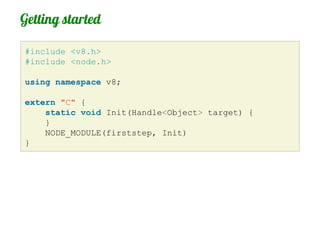
Getting started

#include <v8.h>
#include <node.h>

using namespace v8;

extern "C" {
    static void Init(Handle<Object> target) {
    }
    NODE_MODULE(firststep, Init)
}
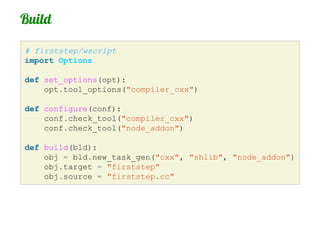
Build

# firststep/wscript
import Options

def set_options(opt):
    opt.tool_options("compiler_cxx")

def configure(conf):
    conf.check_tool("compiler_cxx")
    conf.check_tool("node_addon")

def build(bld):
    obj = bld.new_task_gen("cxx", "shlib", "node_addon")
    obj.target = "firststep"
    obj.source = "firststep.cc"
Run

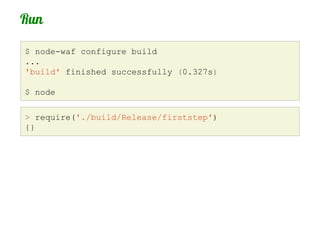
$ node-waf configure build
...
'build' finished successfully (0.327s)

$ node

> require('./build/Release/firststep')
{}
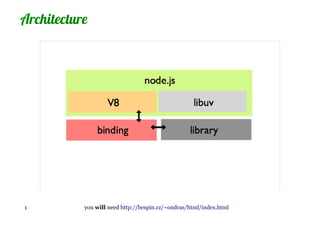
Architecture


1          you will need http://bespin.cz/~ondras/html/index.html
Handles

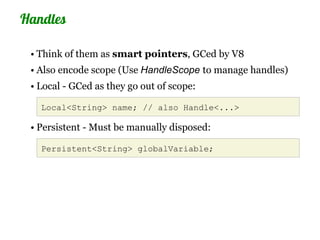
 • Think of them as smart pointers, GCed by V8
 • Also encode scope (Use HandleScope to manage handles)
 • Local - GCed as they go out of scope:

   Local<String> name; // also Handle<...>

 • Persistent - Must be manually disposed:

   Persistent<String> globalVariable;
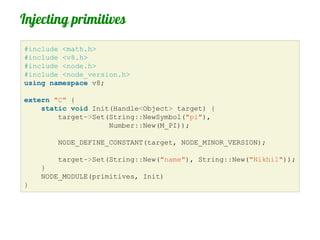
Injecting primitives
#include <math.h>
#include <v8.h>
#include <node.h>
#include <node_version.h>
using namespace v8;

extern "C" {
    static void Init(Handle<Object> target) {
        target->Set(String::NewSymbol("pi"),
                    Number::New(M_PI));

        NODE_DEFINE_CONSTANT(target, NODE_MINOR_VERSION);

        target->Set(String::New("name"), String::New("Nikhil"));
    }
    NODE_MODULE(primitives, Init)
}
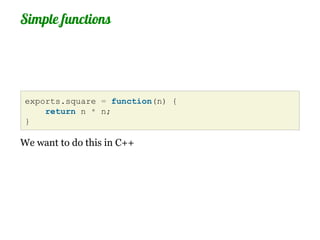
Simple functions


 exports.square = function(n) {
     return n * n;
 }

We want to do this in C++
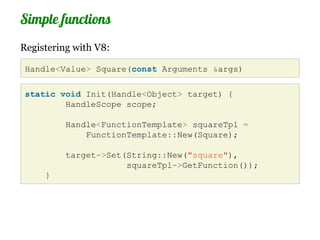
Simple functions
Registering with V8:

 Handle<Value> Square(const Arguments &args)

 static void Init(Handle<Object> target) {
         HandleScope scope;

          Handle<FunctionTemplate> squareTpl =
              FunctionTemplate::New(Square);

          target->Set(String::New("square"),
                      squareTpl->GetFunction());
     }
Simple functions
Implementation:

 Handle<Value> Square(const Arguments &args) {
     HandleScope scope;

     int a = args[0]->Int32Value();
     int sq = a * a;

     return scope.Close(Integer::New(sq));
 }

explain scope.Close
Templates
FunctionTemplate                        ???

FunctionTemplate::GetFunction           square [Function]

FunctionTemplate::InstanceTemplate()    What `this` would be in 'new square()'

FunctionTemplate::PrototypeTemplate()   square.prototype
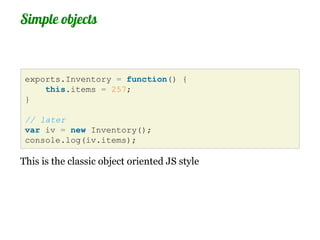
Simple objects


 exports.Inventory = function() {
     this.items = 257;
 }

 // later
 var iv = new Inventory();
 console.log(iv.items);

This is the classic object oriented JS style
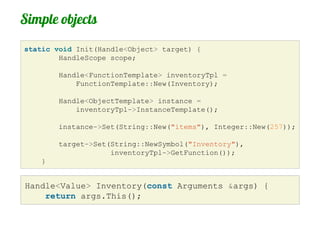
Simple objects
static void Init(Handle<Object> target) {
        HandleScope scope;

        Handle<FunctionTemplate> inventoryTpl =
            FunctionTemplate::New(Inventory);

        Handle<ObjectTemplate> instance =
            inventoryTpl->InstanceTemplate();

        instance->Set(String::New("items"), Integer::New(257));

        target->Set(String::NewSymbol("Inventory"),
                    inventoryTpl->GetFunction());
    }


Handle<Value> Inventory(const Arguments &args) {
    return args.This();
}
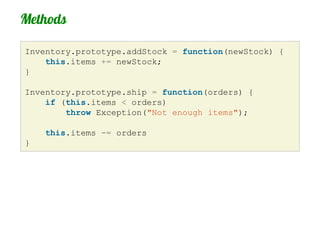
Methods

Inventory.prototype.addStock = function(newStock) {
    this.items += newStock;
}

Inventory.prototype.ship = function(orders) {
    if (this.items < orders)
        throw Exception("Not enough items");

    this.items -= orders
}
Methods
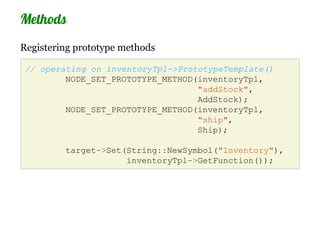
Registering prototype methods

 // operating on inventoryTpl->PrototypeTemplate()
         NODE_SET_PROTOTYPE_METHOD(inventoryTpl,
                                   "addStock",
                                   AddStock);
         NODE_SET_PROTOTYPE_METHOD(inventoryTpl,
                                   "ship",
                                   Ship);

         target->Set(String::NewSymbol("Inventory"),
                     inventoryTpl->GetFunction());
Methods
Accessing object properties
Handle<Value> AddStock(const Arguments &args) {
    HandleScope scope;

    Handle<Object> This = args.This();

    int items = This->Get(String::New("items"))->Uint32Value();

    items += args[0]->Uint32Value();

    This->Set(String::New("items"), Integer::New(items));

    return Undefined();
}
Methods
Throwing an exception
Handle<Value> Ship(const Arguments &args) {
    HandleScope scope;

    Handle<Object> This = args.This();
    int items = This->Get(String::New("items"))->Uint32Value();

    int orders = args[0]->Uint32Value();

    if (items < orders)
        return ThrowException(String::New("Not enough items"));

    This->Set(String::New("items"), Integer::New(items - orders));

    return Undefined();
}
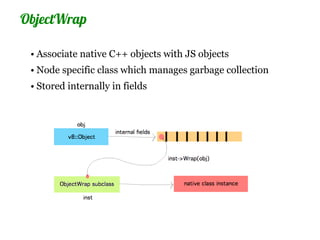
ObjectWrap

 • Associate native C++ objects with JS objects
 • Node specific class which manages garbage collection
 • Stored internally in fields
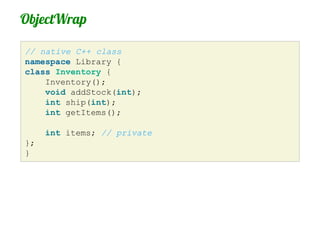
ObjectWrap

// native C++ class
namespace Library {
class Inventory {
    Inventory();
    void addStock(int);
    int ship(int);
    int getItems();

     int items; // private
};
}
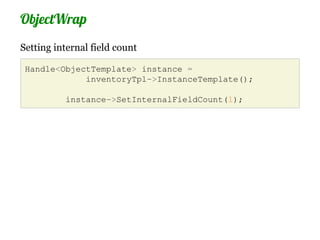
ObjectWrap
Setting internal field count

 Handle<ObjectTemplate> instance =
             inventoryTpl->InstanceTemplate();

          instance->SetInternalFieldCount(1);
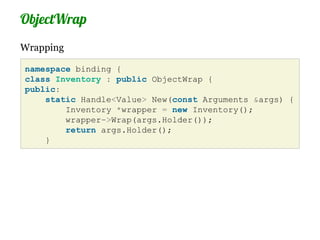
ObjectWrap
Wrapping

namespace binding {
class Inventory : public ObjectWrap {
public:
    static Handle<Value> New(const Arguments &args) {
        Inventory *wrapper = new Inventory();
        wrapper->Wrap(args.Holder());
        return args.Holder();
    }
ObjectWrap
Unwrapping
static Handle<Value> Ship(const Arguments &args) {
        // extract
        Inventory *wrapper = Unwrap<Inventory>(args.Holder());

        int orders = args[0]->Uint32Value();
        int result = wrapper->inv->ship(orders);

        if (result == -1)
            return ThrowException(String::New("Not enough items"));

        return Undefined();
    }
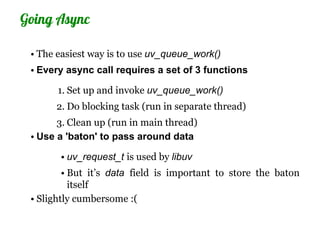
Going Async

 • The easiest way is to use uv_queue_work()
 • Every async call requires a set of 3 functions

       1. Set up and invoke uv_queue_work()
      2. Do blocking task (run in separate thread)
       3. Clean up (run in main thread)
 • Use a 'baton' to pass around data

       • uv_request_t is used by libuv
         • But it’s data field is important to store the baton
           itself
 • Slightly cumbersome :(
Going Async
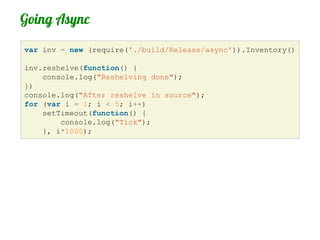
var inv = new (require('./build/Release/async')).Inventory()

inv.reshelve(function() {
    console.log("Reshelving done");
})
console.log("After reshelve in source");
for (var i = 1; i < 5; i++)
    setTimeout(function() {
        console.log("Tick");
    }, i*1000);
Going Async
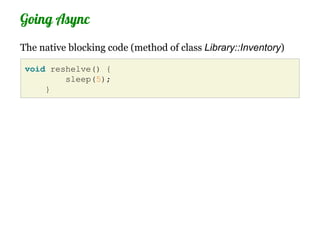
The native blocking code (method of class Library::Inventory)

 void reshelve() {
         sleep(5);
     }
Going Async
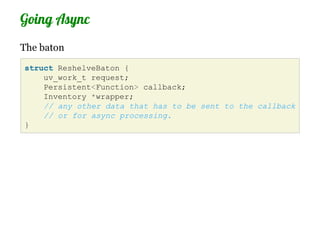
The baton
struct ReshelveBaton {
    uv_work_t request;
    Persistent<Function> callback;
    Inventory *wrapper;
    // any other data that has to be sent to the callback
    // or for async processing.
}
Going Async
JS callback
static Handle<Value> Reshelve(const Arguments &args) {
        Inventory *wrapper = Unwrap<Inventory>(args.Holder());

        Handle<Function> cb = Handle<Function>::Cast(args[0]);

        ReshelveBaton *baton = new ReshelveBaton();
        baton->request.data = baton;
        baton->callback = Persistent<Function>::New(cb);
        baton->wrapper = wrapper;

        uv_queue_work(Loop(), &baton->request,
                      ReshelveAsync, ReshelveAsyncAfter);

        return Undefined();
    }
Going Async
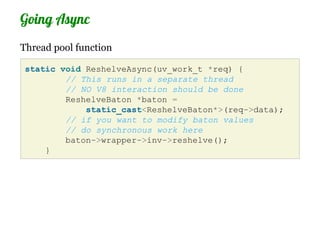
Thread pool function

 static void ReshelveAsync(uv_work_t *req) {
         // This runs in a separate thread
         // NO V8 interaction should be done
         ReshelveBaton *baton =
             static_cast<ReshelveBaton*>(req->data);
         // if you want to modify baton values
         // do synchronous work here
         baton->wrapper->inv->reshelve();
     }
Going Async
Clean up
static void ReshelveAsyncAfter(uv_work_t *req) {
        ReshelveBaton *baton =
            static_cast<ReshelveBaton*>(req->data);

           Handle<Value> argv[] = { Null() }; // no error
           baton->callback->Call(Context::GetCurrent()->Global(),
                                 1, argv);

           baton->callback.Dispose();
           delete baton;
    }
Going Async
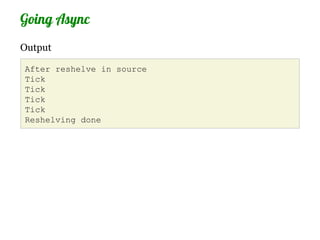
Output

After reshelve in source
Tick
Tick
Tick
Tick
Reshelving done
Linking your library
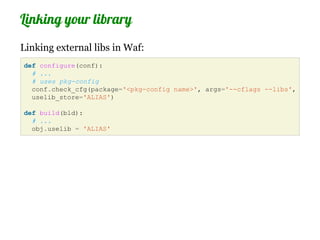
Linking external libs in Waf:
def configure(conf):
  # ...
  # uses pkg-config
  conf.check_cfg(package='<pkg-config name>', args='--cflags --libs',
  uselib_store='ALIAS')

def build(bld):
  # ...
  obj.uselib = 'ALIAS'
Holder vs This

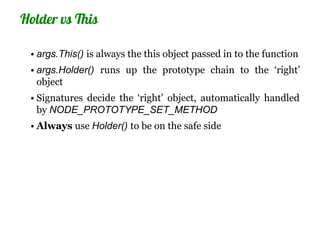
 • args.This() is always the this object passed in to the function
 • args.Holder() runs up the prototype chain to the ‘right’
   object
 • Signatures decide the ‘right’ object, automatically handled
   by NODE_PROTOTYPE_SET_METHOD
 • Always use Holder() to be on the safe side
Things I haven’t covered

 • Accessors

        • Per property accessors
        • Indexed accessors ( object[5] )
        • Named property accessors ( object.property )
 • Function Signatures and HasInstance for type safety
 • Emitting events using new JS only EventEmitter
 • Details of libuv
 • Using V8 on its own
You might want to look at

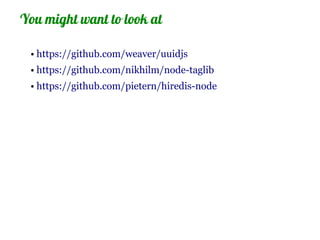
 • https://github.com/weaver/uuidjs
 • https://github.com/nikhilm/node-taglib
 • https://github.com/pietern/hiredis-node
End notes
Contact:
  • @nikhilcutshort
  • nsm.nikhil@gmail.com


Cover image by Munjal Savla (by-nc-sa)
Extra material below
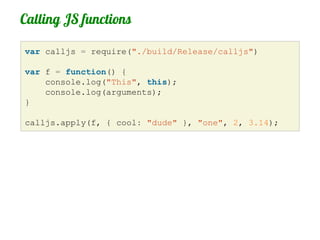
Calling JS functions

var calljs = require("./build/Release/calljs")

var f = function() {
    console.log("This", this);
    console.log(arguments);
}

calljs.apply(f, { cool: "dude" }, "one", 2, 3.14);
Calling JS functions
Handle<Value> Apply(const Arguments &args) {
    HandleScope scope;

    Handle<Function> func = Handle<Function>::Cast(args[0]);
    Handle<Object> receiver = args[1]->ToObject();

    Handle<Value> *argv = new Handle<Value>[args.Length() - 2];
    for (int i = 2; i < args.Length(); i++)
        argv[i-2] = args[i];

    func->Call(receiver, args.Length()-2, argv);

    delete argv;
    return Undefined();
}
Strings to-and-fro
v8::String -> C string

 Handle<Value> Print(const Arguments &args) {
     HandleScope scope;

     for (int i = 0; i < args.Length(); i++) {
         if (!args[i]->IsString())
             continue;

          // also String::AsciiValue
          String::Utf8Value val(args[i]);
          printf("%s ", *val); // <<<<<<
     }
     return Undefined();
 }
Strings to-and-fro
C string -> v8::String
Handle<Value> Read(const Arguments &args) {
    HandleScope scope;

     char str[1024];
     fgets(str, 1023, stdin);

     Local<String> v8String = String::New(str, strlen(str));
     return scope.Close(v8String);
}

Writing native bindings to node.js in C++

  • 1.
    Build the Clink Nikhil Marathe
  • 2.
    Introduction • V8is a powerful, fast JavaScript engine • It is self contained and easy to embed JS is the new Lua? • node.js is a thin wrapper around V8 and evented I/O (libuv)
  • 3.
    Follow along Slides andcode git clone git://github.com/nikhilm/jsfoo-pune-2012.git
  • 4.
    We want to UseC/C++ libraries in node.js Exchange data between C++ ⇔ JS Do asynchronous I/O
  • 5.
    Getting started #include <v8.h> #include<node.h> using namespace v8; extern "C" { static void Init(Handle<Object> target) { } NODE_MODULE(firststep, Init) }
  • 6.
    Build # firststep/wscript import Options defset_options(opt): opt.tool_options("compiler_cxx") def configure(conf): conf.check_tool("compiler_cxx") conf.check_tool("node_addon") def build(bld): obj = bld.new_task_gen("cxx", "shlib", "node_addon") obj.target = "firststep" obj.source = "firststep.cc"
  • 7.
    Run $ node-waf configurebuild ... 'build' finished successfully (0.327s) $ node > require('./build/Release/firststep') {}
  • 8.
    Architecture 1 you will need http://bespin.cz/~ondras/html/index.html
  • 10.
    Handles • Thinkof them as smart pointers, GCed by V8 • Also encode scope (Use HandleScope to manage handles) • Local - GCed as they go out of scope: Local<String> name; // also Handle<...> • Persistent - Must be manually disposed: Persistent<String> globalVariable;
  • 11.
    Injecting primitives #include <math.h> #include<v8.h> #include <node.h> #include <node_version.h> using namespace v8; extern "C" { static void Init(Handle<Object> target) { target->Set(String::NewSymbol("pi"), Number::New(M_PI)); NODE_DEFINE_CONSTANT(target, NODE_MINOR_VERSION); target->Set(String::New("name"), String::New("Nikhil")); } NODE_MODULE(primitives, Init) }
  • 12.
    Simple functions exports.square= function(n) { return n * n; } We want to do this in C++
  • 13.
    Simple functions Registering withV8: Handle<Value> Square(const Arguments &args) static void Init(Handle<Object> target) { HandleScope scope; Handle<FunctionTemplate> squareTpl = FunctionTemplate::New(Square); target->Set(String::New("square"), squareTpl->GetFunction()); }
  • 14.
    Simple functions Implementation: Handle<Value>Square(const Arguments &args) { HandleScope scope; int a = args[0]->Int32Value(); int sq = a * a; return scope.Close(Integer::New(sq)); } explain scope.Close
  • 15.
    Templates FunctionTemplate ??? FunctionTemplate::GetFunction square [Function] FunctionTemplate::InstanceTemplate() What `this` would be in 'new square()' FunctionTemplate::PrototypeTemplate() square.prototype
  • 16.
    Simple objects exports.Inventory= function() { this.items = 257; } // later var iv = new Inventory(); console.log(iv.items); This is the classic object oriented JS style
  • 17.
    Simple objects static voidInit(Handle<Object> target) { HandleScope scope; Handle<FunctionTemplate> inventoryTpl = FunctionTemplate::New(Inventory); Handle<ObjectTemplate> instance = inventoryTpl->InstanceTemplate(); instance->Set(String::New("items"), Integer::New(257)); target->Set(String::NewSymbol("Inventory"), inventoryTpl->GetFunction()); } Handle<Value> Inventory(const Arguments &args) { return args.This();
  • 18.
  • 19.
    Methods Inventory.prototype.addStock = function(newStock){ this.items += newStock; } Inventory.prototype.ship = function(orders) { if (this.items < orders) throw Exception("Not enough items"); this.items -= orders }
  • 20.
    Methods Registering prototype methods // operating on inventoryTpl->PrototypeTemplate() NODE_SET_PROTOTYPE_METHOD(inventoryTpl, "addStock", AddStock); NODE_SET_PROTOTYPE_METHOD(inventoryTpl, "ship", Ship); target->Set(String::NewSymbol("Inventory"), inventoryTpl->GetFunction());
  • 21.
    Methods Accessing object properties Handle<Value>AddStock(const Arguments &args) { HandleScope scope; Handle<Object> This = args.This(); int items = This->Get(String::New("items"))->Uint32Value(); items += args[0]->Uint32Value(); This->Set(String::New("items"), Integer::New(items)); return Undefined(); }
  • 22.
    Methods Throwing an exception Handle<Value>Ship(const Arguments &args) { HandleScope scope; Handle<Object> This = args.This(); int items = This->Get(String::New("items"))->Uint32Value(); int orders = args[0]->Uint32Value(); if (items < orders) return ThrowException(String::New("Not enough items")); This->Set(String::New("items"), Integer::New(items - orders)); return Undefined(); }
  • 23.
    ObjectWrap • Associatenative C++ objects with JS objects • Node specific class which manages garbage collection • Stored internally in fields
  • 24.
    ObjectWrap // native C++class namespace Library { class Inventory { Inventory(); void addStock(int); int ship(int); int getItems(); int items; // private }; }
  • 25.
    ObjectWrap Setting internal fieldcount Handle<ObjectTemplate> instance = inventoryTpl->InstanceTemplate(); instance->SetInternalFieldCount(1);
  • 26.
    ObjectWrap Wrapping namespace binding { classInventory : public ObjectWrap { public: static Handle<Value> New(const Arguments &args) { Inventory *wrapper = new Inventory(); wrapper->Wrap(args.Holder()); return args.Holder(); }
  • 27.
    ObjectWrap Unwrapping static Handle<Value> Ship(constArguments &args) { // extract Inventory *wrapper = Unwrap<Inventory>(args.Holder()); int orders = args[0]->Uint32Value(); int result = wrapper->inv->ship(orders); if (result == -1) return ThrowException(String::New("Not enough items")); return Undefined(); }
  • 28.
    Going Async •The easiest way is to use uv_queue_work() • Every async call requires a set of 3 functions 1. Set up and invoke uv_queue_work() 2. Do blocking task (run in separate thread) 3. Clean up (run in main thread) • Use a 'baton' to pass around data • uv_request_t is used by libuv • But it’s data field is important to store the baton itself • Slightly cumbersome :(
  • 29.
    Going Async var inv= new (require('./build/Release/async')).Inventory() inv.reshelve(function() { console.log("Reshelving done"); }) console.log("After reshelve in source"); for (var i = 1; i < 5; i++) setTimeout(function() { console.log("Tick"); }, i*1000);
  • 30.
    Going Async The nativeblocking code (method of class Library::Inventory) void reshelve() { sleep(5); }
  • 31.
    Going Async The baton structReshelveBaton { uv_work_t request; Persistent<Function> callback; Inventory *wrapper; // any other data that has to be sent to the callback // or for async processing. }
  • 32.
    Going Async JS callback staticHandle<Value> Reshelve(const Arguments &args) { Inventory *wrapper = Unwrap<Inventory>(args.Holder()); Handle<Function> cb = Handle<Function>::Cast(args[0]); ReshelveBaton *baton = new ReshelveBaton(); baton->request.data = baton; baton->callback = Persistent<Function>::New(cb); baton->wrapper = wrapper; uv_queue_work(Loop(), &baton->request, ReshelveAsync, ReshelveAsyncAfter); return Undefined(); }
  • 33.
    Going Async Thread poolfunction static void ReshelveAsync(uv_work_t *req) { // This runs in a separate thread // NO V8 interaction should be done ReshelveBaton *baton = static_cast<ReshelveBaton*>(req->data); // if you want to modify baton values // do synchronous work here baton->wrapper->inv->reshelve(); }
  • 34.
    Going Async Clean up staticvoid ReshelveAsyncAfter(uv_work_t *req) { ReshelveBaton *baton = static_cast<ReshelveBaton*>(req->data); Handle<Value> argv[] = { Null() }; // no error baton->callback->Call(Context::GetCurrent()->Global(), 1, argv); baton->callback.Dispose(); delete baton; }
  • 35.
    Going Async Output After reshelvein source Tick Tick Tick Tick Reshelving done
  • 36.
    Linking your library Linkingexternal libs in Waf: def configure(conf): # ... # uses pkg-config conf.check_cfg(package='<pkg-config name>', args='--cflags --libs', uselib_store='ALIAS') def build(bld): # ... obj.uselib = 'ALIAS'
  • 37.
    Holder vs This • args.This() is always the this object passed in to the function • args.Holder() runs up the prototype chain to the ‘right’ object • Signatures decide the ‘right’ object, automatically handled by NODE_PROTOTYPE_SET_METHOD • Always use Holder() to be on the safe side
  • 38.
    Things I haven’tcovered • Accessors • Per property accessors • Indexed accessors ( object[5] ) • Named property accessors ( object.property ) • Function Signatures and HasInstance for type safety • Emitting events using new JS only EventEmitter • Details of libuv • Using V8 on its own
  • 39.
    You might wantto look at • https://github.com/weaver/uuidjs • https://github.com/nikhilm/node-taglib • https://github.com/pietern/hiredis-node
  • 40.
    End notes Contact: • @nikhilcutshort • nsm.nikhil@gmail.com Cover image by Munjal Savla (by-nc-sa)
  • 41.
  • 42.
    Calling JS functions varcalljs = require("./build/Release/calljs") var f = function() { console.log("This", this); console.log(arguments); } calljs.apply(f, { cool: "dude" }, "one", 2, 3.14);
  • 43.
    Calling JS functions Handle<Value>Apply(const Arguments &args) { HandleScope scope; Handle<Function> func = Handle<Function>::Cast(args[0]); Handle<Object> receiver = args[1]->ToObject(); Handle<Value> *argv = new Handle<Value>[args.Length() - 2]; for (int i = 2; i < args.Length(); i++) argv[i-2] = args[i]; func->Call(receiver, args.Length()-2, argv); delete argv; return Undefined(); }
  • 44.
    Strings to-and-fro v8::String ->C string Handle<Value> Print(const Arguments &args) { HandleScope scope; for (int i = 0; i < args.Length(); i++) { if (!args[i]->IsString()) continue; // also String::AsciiValue String::Utf8Value val(args[i]); printf("%s ", *val); // <<<<<< } return Undefined(); }
  • 45.
    Strings to-and-fro C string-> v8::String Handle<Value> Read(const Arguments &args) { HandleScope scope; char str[1024]; fgets(str, 1023, stdin); Local<String> v8String = String::New(str, strlen(str)); return scope.Close(v8String); }