Why we worry
about all the
wrong things
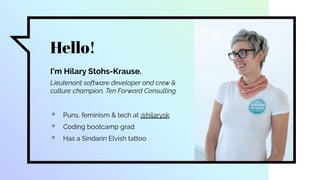
Hello!
I’m Hilary Stohs-Krause.
Lieutenant software developer and crew &
culture champion, Ten Forward Consulting
▫ Puns, feminism & tech at @hilarysk
▫ Coding bootcamp grad
▫ Has a Sindarin Elvish tattoo
Content warning
This talk touches on mental health,
including anxiety and depression;
several images of common fears are
included toward the beginning that may
be upsetting.
Disclaimers
1. I am not a therapist or a scientist.
2. I owe a debt of gratitude to these two books, in
particular:
▫ “Algorithms to Live By: The Computer Science of
Human Decisions”
▫ “Thinking in Bets: Making Smarter Decisions When
You Don’t Have All the Facts”
1.
Common
misplaced fears
Things many of us worry about unnecessarily
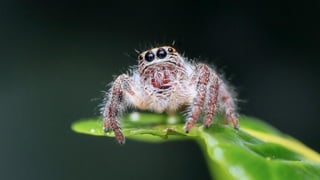
Spiders
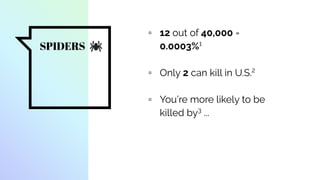
SPIDERS
▫ 12 out of 40,000 =
0.0003%1
▫ Only 2 can kill in U.S.2
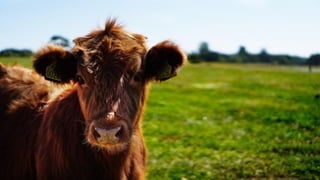
▫ You’re more likely to be
killed by3
...
Flying
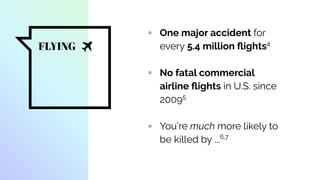
FLYING
▫ One major accident for
every 5.4 million flights4
▫ No fatal commercial
airline flights in U.S. since
20095
▫ You’re much more likely to
be killed by ...6,7
“ Some neuroscientists claim
that humans are the most
fearful creatures on the
planet because of our ability
to learn, think, and create
fear in our minds.11
Ok, fine.
So what?
2.
Implications for
your life
The harmful impact of those misplaced fears
Health concerns
▫ Weakened immune system, damage to our
hearts, ulcers, decreased fertility9
▫ Accelerated aging, even premature death9
▫ Impairs formation of long-term memories9
▫ Interrupts processes that help us act ethically9
Workplace issues
▫ Self-selecting out of opportunities19
▫ Tension between “perfect” and “done”20
▫ Gaslighting
3.
Where fear and
anxiety come from
We aren’t born afraid … are we?
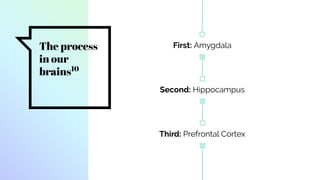
The process
in our
brains10
First: Amygdala
Second: Hippocampus
Third: Prefrontal Cortex
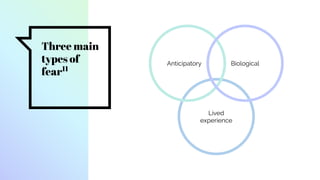
Three main
types of
fear11
Lived
experience
Anticipatory Biological
Fear
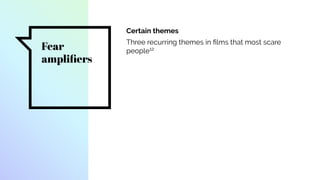
amplifiers
Certain themes
Three recurring themes in films that most scare
people12
Fear
amplifiers
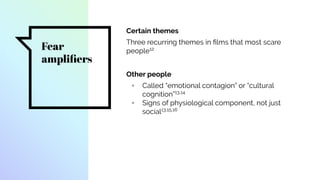
Certain themes
Three recurring themes in films that most scare
people12
Other people
▫ Called “emotional contagion” or “cultural
cognition”13,14
▫ Signs of physiological component, not just
social13,15,16
Fear
amplifiers
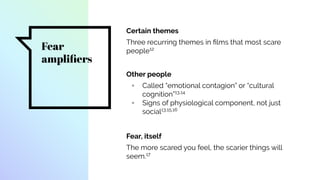
Certain themes
Three recurring themes in films that most scare
people12
Other people
▫ Called “emotional contagion” or “cultural
cognition”13,14
▫ Signs of physiological component, not just
social13,15,16
Fear, itself
The more scared you feel, the scarier things will
seem.17
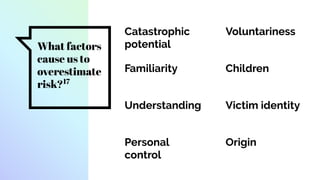
What factors
cause us to
overestimate
risk?17
Catastrophic
potential
Familiarity
Understanding
Personal
control
Voluntariness
Children
Victim identity
Origin
Our risk assessment
process is outdated.18
▫ Evolved in natural environment
▫ Concrete vs. abstract
▫ Vague rewards
4.
Strategies for
adapting
Tools to lessen fear & make better risk assessments
First things first22
▫ “Reflexive” vs. “deliberative” mind
▫ Not a matter of willpower
▫ Not a matter of using “analytical” part of brain
more
Don’t blame yourself22
▫ “We are uncomfortable with the idea that
luck plays a significant role in our lives.”
▫ Quality of outcome != quality of decision
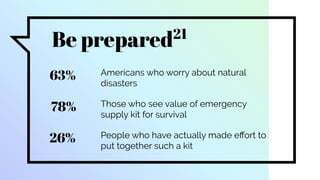
Be prepared21
Americans who worry about natural
disasters
63%
26%
78% Those who see value of emergency
supply kit for survival
People who have actually made effort to
put together such a kit
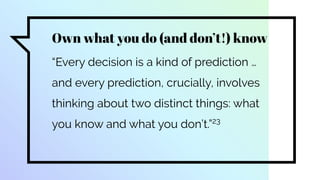
Own what you do (and don’t!) know
“Every decision is a kind of prediction …
and every prediction, crucially, involves
thinking about two distinct things: what
you know and what you don’t.”23
To the
algorithms!23
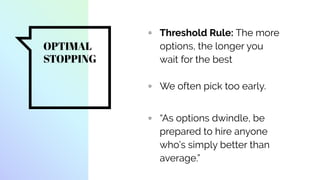
OPTIMAL
STOPPING
▫ Threshold Rule: The more
options, the longer you
wait for the best
▫ We often pick too early.
▫ “As options dwindle, be
prepared to hire anyone
who’s simply better than
average.”
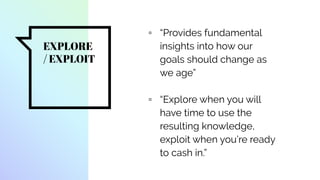
EXPLORE
/ EXPLOIT
▫ “Provides fundamental
insights into how our
goals should change as
we age”
▫ “Explore when you will
have time to use the
resulting knowledge,
exploit when you’re ready
to cash in.”
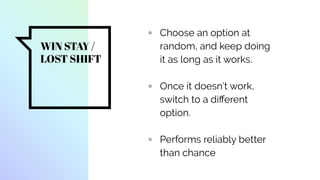
WIN STAY /
LOST SHIFT
▫ Choose an option at
random, and keep doing
it as long as it works.
▫ Once it doesn’t work,
switch to a different
option.
▫ Performs reliably better
than chance
LAST
RECENTLY
USED
▫ Junk drawers and piles
are actually “one of the
most well-designed and
efficient structures
available.”
▫ At library, the most likely
to be desired books are
the ones most recently
checked out.
CONSTRAINT
RELAXATION
▫ In an ideal world, what
would you do?
▫ Slowly add the
constraints back in
Ask for help.
▫ Sharing fear lessens it.
▫ Helps us gain perspective, and new
information.
▫ Can help pull us out of our bubble.
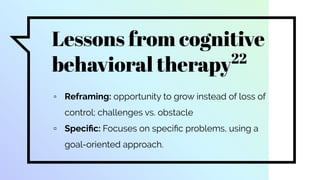
Lessons from cognitive
behavioral therapy22
▫ Reframing: opportunity to grow instead of loss of
control; challenges vs. obstacle
▫ Specific: Focuses on specific problems, using a
goal-oriented approach.
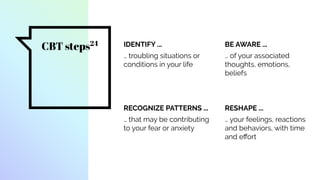
CBT steps24 IDENTIFY ...
… troubling situations or
conditions in your life
BE AWARE ...
… of your associated
thoughts, emotions,
beliefs
RECOGNIZE PATTERNS ...
… that may be contributing
to your fear or anxiety
RESHAPE ...
… your feelings, reactions
and behaviors, with time
and effort
“If we’re willing to accept
solutions that are close
enough, then even some
of the hairiest problems
can be tamed with the
right techniques.23
Thanks!
Any questions?
You can find me at @hilarysk and
hilarysk@tenforward.consulting
Citations
& Sources
1. “Spider Bites: How Dangerous Are They?”, OnHealth
2. “Venomous Spiders”, CDC
3. “The animals that are most likely to kill you this summer”, Washington Post
4. “2018 Airline Safety Performance”, International Air Transport Association
5. “The last fatal US airline crash was a decade ago. Here's why our skies are safer,” CNBC
6. “Opioids, Car Crashes and Falling: The Odds of Dying in the U.S.”, The New York Times
7. “U.S. pedestrian, bicyclist deaths rise in 2018: report”, Reuters
8. “Risk Perception: It’s Personal”, Environmental Health Perspectives
9. “Impact of Fear and Anxiety”, University of Minnesota
10. “What Happens in the Brain When We Feel Fear”, Smithsonian Magazine
11. “7 Things You Need to Know About Fear”, Psychology Today
12. “ The science of fear: what makes us afraid?”, BBC Science Focus Magazine
13. “Humans Smell Fear, and It's Contagious”, Live Science
14. “Risk Perception: It’s Personal”, Environmental Health Perspectives
15. "Is Fear Contagious?", PBS
16."Dentists can smell your fear – and it may put your teeth at risk", New Scientist
17. “Why we're awful at assessing risk”, USA Today
18."The science of fear: what makes us afraid?", BBC Science Focus Magazine
Citations
& Sources
19. "Why Women Don’t Apply for Jobs Unless They’re 100% Qualified", Harvard Business
Review
20. "Why Do Women Need To Be Perfect?", Time Magazine
21. "Motivating Disaster Preparedness", Chapman University
22. “Thinking in Bets: Making Smarter Decisions When You Don’t Have All the Facts”, by
Annie Duke, Penguin Random House
23. “Algorithms to Live By: The Computer Science of Human Decisions”, by Brian Christian
and Tom Griffiths, Picador
24."Cognitive behavioral therapy", Mayo Clinic

Write / Speak / Code 2019: "Why we worry about all the wrong things"

  • 1.
    Why we worry aboutall the wrong things
  • 2.
    Hello! I’m Hilary Stohs-Krause. Lieutenantsoftware developer and crew & culture champion, Ten Forward Consulting ▫ Puns, feminism & tech at @hilarysk ▫ Coding bootcamp grad ▫ Has a Sindarin Elvish tattoo
  • 3.
    Content warning This talktouches on mental health, including anxiety and depression; several images of common fears are included toward the beginning that may be upsetting.
  • 4.
    Disclaimers 1. I amnot a therapist or a scientist. 2. I owe a debt of gratitude to these two books, in particular: ▫ “Algorithms to Live By: The Computer Science of Human Decisions” ▫ “Thinking in Bets: Making Smarter Decisions When You Don’t Have All the Facts”
  • 5.
    1. Common misplaced fears Things manyof us worry about unnecessarily
  • 6.
  • 8.
    SPIDERS ▫ 12 outof 40,000 = 0.0003%1 ▫ Only 2 can kill in U.S.2 ▫ You’re more likely to be killed by3 ...
  • 10.
  • 12.
    FLYING ▫ One majoraccident for every 5.4 million flights4 ▫ No fatal commercial airline flights in U.S. since 20095 ▫ You’re much more likely to be killed by ...6,7
  • 14.
    “ Some neuroscientistsclaim that humans are the most fearful creatures on the planet because of our ability to learn, think, and create fear in our minds.11
  • 15.
  • 16.
    2. Implications for your life Theharmful impact of those misplaced fears
  • 17.
    Health concerns ▫ Weakenedimmune system, damage to our hearts, ulcers, decreased fertility9 ▫ Accelerated aging, even premature death9 ▫ Impairs formation of long-term memories9 ▫ Interrupts processes that help us act ethically9
  • 18.
    Workplace issues ▫ Self-selectingout of opportunities19 ▫ Tension between “perfect” and “done”20 ▫ Gaslighting
  • 19.
    3. Where fear and anxietycome from We aren’t born afraid … are we?
  • 20.
    The process in our brains10 First:Amygdala Second: Hippocampus Third: Prefrontal Cortex
  • 21.
  • 22.
    Fear amplifiers Certain themes Three recurringthemes in films that most scare people12
  • 23.
    Fear amplifiers Certain themes Three recurringthemes in films that most scare people12 Other people ▫ Called “emotional contagion” or “cultural cognition”13,14 ▫ Signs of physiological component, not just social13,15,16
  • 24.
    Fear amplifiers Certain themes Three recurringthemes in films that most scare people12 Other people ▫ Called “emotional contagion” or “cultural cognition”13,14 ▫ Signs of physiological component, not just social13,15,16 Fear, itself The more scared you feel, the scarier things will seem.17
  • 25.
    What factors cause usto overestimate risk?17 Catastrophic potential Familiarity Understanding Personal control Voluntariness Children Victim identity Origin
  • 26.
    Our risk assessment processis outdated.18 ▫ Evolved in natural environment ▫ Concrete vs. abstract ▫ Vague rewards
  • 27.
    4. Strategies for adapting Tools tolessen fear & make better risk assessments
  • 28.
    First things first22 ▫“Reflexive” vs. “deliberative” mind ▫ Not a matter of willpower ▫ Not a matter of using “analytical” part of brain more
  • 29.
    Don’t blame yourself22 ▫“We are uncomfortable with the idea that luck plays a significant role in our lives.” ▫ Quality of outcome != quality of decision
  • 30.
    Be prepared21 Americans whoworry about natural disasters 63% 26% 78% Those who see value of emergency supply kit for survival People who have actually made effort to put together such a kit
  • 31.
    Own what youdo (and don’t!) know “Every decision is a kind of prediction … and every prediction, crucially, involves thinking about two distinct things: what you know and what you don’t.”23
  • 32.
  • 33.
    OPTIMAL STOPPING ▫ Threshold Rule:The more options, the longer you wait for the best ▫ We often pick too early. ▫ “As options dwindle, be prepared to hire anyone who’s simply better than average.”
  • 34.
    EXPLORE / EXPLOIT ▫ “Providesfundamental insights into how our goals should change as we age” ▫ “Explore when you will have time to use the resulting knowledge, exploit when you’re ready to cash in.”
  • 35.
    WIN STAY / LOSTSHIFT ▫ Choose an option at random, and keep doing it as long as it works. ▫ Once it doesn’t work, switch to a different option. ▫ Performs reliably better than chance
  • 36.
    LAST RECENTLY USED ▫ Junk drawersand piles are actually “one of the most well-designed and efficient structures available.” ▫ At library, the most likely to be desired books are the ones most recently checked out.
  • 37.
    CONSTRAINT RELAXATION ▫ In anideal world, what would you do? ▫ Slowly add the constraints back in
  • 38.
    Ask for help. ▫Sharing fear lessens it. ▫ Helps us gain perspective, and new information. ▫ Can help pull us out of our bubble.
  • 39.
    Lessons from cognitive behavioraltherapy22 ▫ Reframing: opportunity to grow instead of loss of control; challenges vs. obstacle ▫ Specific: Focuses on specific problems, using a goal-oriented approach.
  • 40.
    CBT steps24 IDENTIFY... … troubling situations or conditions in your life BE AWARE ... … of your associated thoughts, emotions, beliefs RECOGNIZE PATTERNS ... … that may be contributing to your fear or anxiety RESHAPE ... … your feelings, reactions and behaviors, with time and effort
  • 41.
    “If we’re willingto accept solutions that are close enough, then even some of the hairiest problems can be tamed with the right techniques.23
  • 42.
    Thanks! Any questions? You canfind me at @hilarysk and hilarysk@tenforward.consulting
  • 43.
    Citations & Sources 1. “SpiderBites: How Dangerous Are They?”, OnHealth 2. “Venomous Spiders”, CDC 3. “The animals that are most likely to kill you this summer”, Washington Post 4. “2018 Airline Safety Performance”, International Air Transport Association 5. “The last fatal US airline crash was a decade ago. Here's why our skies are safer,” CNBC 6. “Opioids, Car Crashes and Falling: The Odds of Dying in the U.S.”, The New York Times 7. “U.S. pedestrian, bicyclist deaths rise in 2018: report”, Reuters 8. “Risk Perception: It’s Personal”, Environmental Health Perspectives 9. “Impact of Fear and Anxiety”, University of Minnesota 10. “What Happens in the Brain When We Feel Fear”, Smithsonian Magazine 11. “7 Things You Need to Know About Fear”, Psychology Today 12. “ The science of fear: what makes us afraid?”, BBC Science Focus Magazine 13. “Humans Smell Fear, and It's Contagious”, Live Science 14. “Risk Perception: It’s Personal”, Environmental Health Perspectives 15. "Is Fear Contagious?", PBS 16."Dentists can smell your fear – and it may put your teeth at risk", New Scientist 17. “Why we're awful at assessing risk”, USA Today 18."The science of fear: what makes us afraid?", BBC Science Focus Magazine
  • 44.
    Citations & Sources 19. "WhyWomen Don’t Apply for Jobs Unless They’re 100% Qualified", Harvard Business Review 20. "Why Do Women Need To Be Perfect?", Time Magazine 21. "Motivating Disaster Preparedness", Chapman University 22. “Thinking in Bets: Making Smarter Decisions When You Don’t Have All the Facts”, by Annie Duke, Penguin Random House 23. “Algorithms to Live By: The Computer Science of Human Decisions”, by Brian Christian and Tom Griffiths, Picador 24."Cognitive behavioral therapy", Mayo Clinic