THE CHICANO
MOVEMENT
BY HEATHER SMITH
THE LEGACY
• Almost four decades after it began, the Chicano Movement still has a visible impact. As a result
of activism at the grassroots level on the part of various communities of color, there has been a
fundamental change in how people talk about race, which is a lasting effect of the broader Civil
Rights Movement. The most visible results of the Chicano Movement are still primarily within
academia, with the establishment of numerous student centers at college campuses all over
the country that cater to students of color as well as the establishment of Chicano Studies
Departments, research centers, academic journals, and so on.
THE LEGACY
• The literary and art movements of the 1970s have also left an indelible mark on the
Chicano/Latino community. The production of art centered on issues such as racism, human
rights, and equal access to education and employment continues today. The discourse has also
expanded to include issues of class, gender, nationality, and cultural identity. Though the
Chicano art movement of the late 1960s and early 1970s has waned, the work these artists left
behind continues to inspire today’s Chicano youth and influence the discourse on Chicano
culture.
THR LEGACY
• The late 1990s witnessed renewed activist activity centered on opposition to I-200 on the UW
Campus. The initiative was voted into law in November of 1998, officially removing the
affirmative action policies instituted at the state level in the 1960s and 1970s. The opposition to
I-200 echoed the concerns of the previous generation of Chicano student activists as the issue
of access to education once again came to the forefront. An immediate impact was felt after the
initiative passed with the dramatic drop in students of color accepted into public universities. As
a result, MEChA joined forces with other organizations to organize and implement informational
events to assist prospective students in the process of applying to schools. UW MEChA has
organized theAdelante Con Educacion Conference every year for the last twelve years. The
conference is geared toward the outreach and recruitment of prospective Chicano students
from throughout Washington State
INTRODUCTION
• The Chicano Movement of the 1960s, also called the Chicano Civil Rights Movement, also
known as El Movimiento, is an extension of the Mexican American Civil RightsMovement which
began in the 1940s with the stated goal of achieving Mexican American empowerment. The civil
rights movement time was in the 1960s.
CHICANO
• A Mexican American
• A term of ethnic pride
• Developed out of the Hispanic Civil Rights Movement.
MEXICAN AMERICANS
• Included descendents of Mexicans living in territories ceded to US
• Mexican-American wave of immigration during the revolution in 1910s
• Bracero, or temporary workers, in US in 1940s and 1950s
• Immigration for economic opportunities and political openess
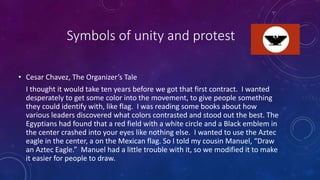
Symbols of unity and protest
• Cesar Chavez, The Organizer’s Tale
I thought it would take ten years before we got that first contract. I wanted
desperately to get some color into the movement, to give people something
they could identify with, like flag. I was reading some books about how
various leaders discovered what colors contrasted and stood out the best. The
Egyptians had found that a red field with a white circle and a Black emblem in
the center crashed into your eyes like nothing else. I wanted to use the Aztec
eagle in the center, a on the Mexican flag. So I told my cousin Manuel, “Draw
an Aztec Eagle.” Manuel had a little trouble with it, so we modified it to make
it easier for people to draw.
CHICANO MOVEMENT
• Focused on 3 main Points:
• Farm Workers
• Educational Rights
• Voting and Political Rights
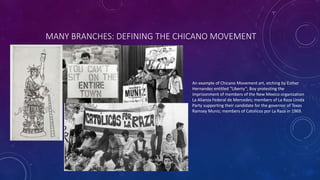
MANY BRANCHES: DEFINING THE CHICANO MOVEMENT
An example of Chicano Movement art, etching by Esther
Hernandez entitled “Liberty”; Boy protesting the
imprisonment of members of the New Mexico organization
La Alianza Federal de Mercedes; members of La Raza Unida
Party supporting their candidate for the governor of Texas
Ramsey Muniz; members of Catolicos por La Raza in 1969.
UNITED FARM WORKERS
• During the 1940’s and 1950’s landowners in the West, especially
California exploited their workers.
• The U.S. had allowed Mexicans to work in the U.S. during WWII.
However, after the war employers were suppose to give
preference to U.S. citizens.
UNITED FARM WORKERS
• Cesar Chavez and Dolores Huerta joined their two organizations to
create the United Farm Workers.
• The goal was to unionize for better wages, working conditions,
benefits.
• The group staged peaceful protests and boycotts.
• They organized workers which forced the employers to meet their
demands.
• Filipinos also joined the workers.
UNITED FARM WORKERS
• Benefits:
• Specific Hours and Pay
• Toilets and Water in fields
• Pension after retirement
• Protective gear against pesticides
• Amnesty for workers brought illegally.
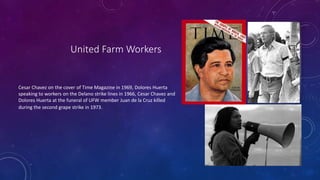
United Farm Workers
Cesar Chavez on the cover of Time Magazine in 1969, Dolores Huerta
speaking to workers on the Delano strike lines in 1966, Cesar Chavez and
Dolores Huerta at the funeral of UFW member Juan de la Cruz killed
during the second grape strike in 1973.
EDUCATIONAL RIGHTS
• Issues in education:
• Hispanic students were often placed in
segregated schools.
• Unfair practices against Hispanic students
• College and University students worked with
African Americans to established rights for both.
EDUCATIONAL RIGHTS
• Groups such as the Brown Berets and MAYO all formed to help
fight for the rights of students.
• Students led Walkouts, Protests, and sit-in through out the West
Coast.
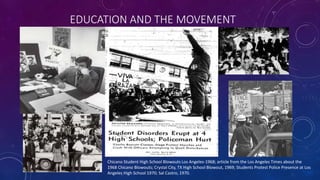
EDUCATION AND THE MOVEMENT
Chicano Student High School Blowouts Los Angeles-1968; article from the Los Angeles Times about the
1968 Chicano Blowouts; Crystal City, TX High School Blowout, 1969; Students Protest Police Presence at Los
Angeles High School 1970; Sal Castro, 1970.
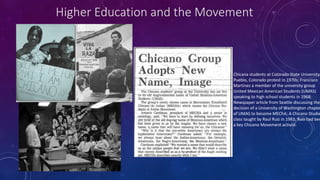
Chicana students at Colorado State University
Pueblo, Colorado protest in 1970s; Francisco
Martinez a member of the university group
United Mexican American Students (UMAS)
speaking to high school students in 1968;
Newspaper article from Seattle discussing the
decision of a University of Washington chapte
of UMAS to become MEChA; A Chicano Studie
class taught by Raul Ruiz in 1983, Ruiz had bee
a key Chicano Movement activist.
Higher Education and the Movement
VOTING AND POLITICAL RIGHTS
• Hispanic Americans were often segregated
and persecuted as African Americans had
been.
• La Raza Unida Political Party
• Fought for the rights of Hispanic Americans
VOTING AND POLITICAL RIGHTS
• 1975: The Voting Rights Act of 1965 is
extended to Hispanics.
• University of California v. Bakke
• Universities could not use Affirmative Action
to limit Hispanics in Universities.
Political activism of Chicanos
• “brown power” and Brown Berets
• School walkouts
• 1968 Congress passed Bilingual Education Act
• Election of Hispanic representatives to state and national government
• Struggles for social justice
Identity of Azlan
• Mythical homeland
• Images of Indians and Mestizos
• Posters as mass produced representations of identity
• Boycotts
• Creation of community and public spaces
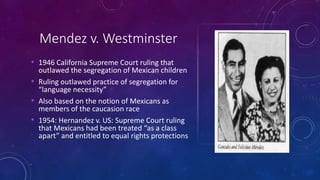
Mendez v. Westminster
• 1946 California Supreme Court ruling that
outlawed the segregation of Mexican children
• Ruling outlawed practice of segregation for
“language necessity”
• Also based on the notion of Mexicans as
members of the caucasion race
• 1954: Hernandez v. US: Supreme Court ruling
that Mexicans had been treated “as a class
apart” and entitled to equal rights protections
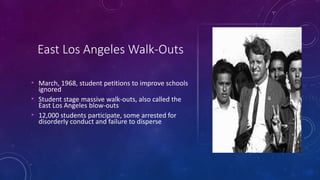
East Los Angeles Walk-Outs
• March, 1968, student petitions to improve schools
ignored
• Student stage massive walk-outs, also called the
East Los Angeles blow-outs
• 12,000 students participate, some arrested for
disorderly conduct and failure to disperse
The East Los Angeles 13
• 13 students and community leaders charged with “conspiracy to commit
misdemeanors” for conspiracy to disrupt the schools, elevated the complaint
to a felony
• Faced 66 year prison terms if convicted
• Included Sal Castro: major supporter of the student walk-outs
• Also included: Moctezuma Esparza, Raul Ruiz, Carlos Munoz Jr. and 10 others
• Charges dropped on civil rights issues: right to petition government agencies
for grievances, freedom of assembly and free speech
• Recognized as the first significant urban struggle of the Chicano Movement
MY FEELINGS ABOUT THE MOVEMENT
• The first type of oppression mentioned is due to ethnicity of the Chicana. The Chicano culture is
politically and economically exploited by Anglo society. Chicanos are considered subordinate, dependent
and have been subjected to numerous accounts of genocide. Another type of oppression is due to gender.
Women across the vast majority of cultures are considered subordinate and are universally oppressed by
her male counterpart. In addition, there is also an internal oppression caused by the Chicana heritage.
Some identify this as machismo and caused by the colonization of the Chicano. Whatever the origin, it
has a depreciating effect on the Chicana and must be addressed. I would have hated to go threw that.

World%20history

  • 1.
  • 2.
    THE LEGACY • Almostfour decades after it began, the Chicano Movement still has a visible impact. As a result of activism at the grassroots level on the part of various communities of color, there has been a fundamental change in how people talk about race, which is a lasting effect of the broader Civil Rights Movement. The most visible results of the Chicano Movement are still primarily within academia, with the establishment of numerous student centers at college campuses all over the country that cater to students of color as well as the establishment of Chicano Studies Departments, research centers, academic journals, and so on.
  • 3.
    THE LEGACY • Theliterary and art movements of the 1970s have also left an indelible mark on the Chicano/Latino community. The production of art centered on issues such as racism, human rights, and equal access to education and employment continues today. The discourse has also expanded to include issues of class, gender, nationality, and cultural identity. Though the Chicano art movement of the late 1960s and early 1970s has waned, the work these artists left behind continues to inspire today’s Chicano youth and influence the discourse on Chicano culture.
  • 4.
    THR LEGACY • Thelate 1990s witnessed renewed activist activity centered on opposition to I-200 on the UW Campus. The initiative was voted into law in November of 1998, officially removing the affirmative action policies instituted at the state level in the 1960s and 1970s. The opposition to I-200 echoed the concerns of the previous generation of Chicano student activists as the issue of access to education once again came to the forefront. An immediate impact was felt after the initiative passed with the dramatic drop in students of color accepted into public universities. As a result, MEChA joined forces with other organizations to organize and implement informational events to assist prospective students in the process of applying to schools. UW MEChA has organized theAdelante Con Educacion Conference every year for the last twelve years. The conference is geared toward the outreach and recruitment of prospective Chicano students from throughout Washington State
  • 5.
    INTRODUCTION • The ChicanoMovement of the 1960s, also called the Chicano Civil Rights Movement, also known as El Movimiento, is an extension of the Mexican American Civil RightsMovement which began in the 1940s with the stated goal of achieving Mexican American empowerment. The civil rights movement time was in the 1960s.
  • 6.
    CHICANO • A MexicanAmerican • A term of ethnic pride • Developed out of the Hispanic Civil Rights Movement.
  • 7.
    MEXICAN AMERICANS • Includeddescendents of Mexicans living in territories ceded to US • Mexican-American wave of immigration during the revolution in 1910s • Bracero, or temporary workers, in US in 1940s and 1950s • Immigration for economic opportunities and political openess
  • 8.
    Symbols of unityand protest • Cesar Chavez, The Organizer’s Tale I thought it would take ten years before we got that first contract. I wanted desperately to get some color into the movement, to give people something they could identify with, like flag. I was reading some books about how various leaders discovered what colors contrasted and stood out the best. The Egyptians had found that a red field with a white circle and a Black emblem in the center crashed into your eyes like nothing else. I wanted to use the Aztec eagle in the center, a on the Mexican flag. So I told my cousin Manuel, “Draw an Aztec Eagle.” Manuel had a little trouble with it, so we modified it to make it easier for people to draw.
  • 9.
    CHICANO MOVEMENT • Focusedon 3 main Points: • Farm Workers • Educational Rights • Voting and Political Rights
  • 10.
    MANY BRANCHES: DEFININGTHE CHICANO MOVEMENT An example of Chicano Movement art, etching by Esther Hernandez entitled “Liberty”; Boy protesting the imprisonment of members of the New Mexico organization La Alianza Federal de Mercedes; members of La Raza Unida Party supporting their candidate for the governor of Texas Ramsey Muniz; members of Catolicos por La Raza in 1969.
  • 11.
    UNITED FARM WORKERS •During the 1940’s and 1950’s landowners in the West, especially California exploited their workers. • The U.S. had allowed Mexicans to work in the U.S. during WWII. However, after the war employers were suppose to give preference to U.S. citizens.
  • 12.
    UNITED FARM WORKERS •Cesar Chavez and Dolores Huerta joined their two organizations to create the United Farm Workers. • The goal was to unionize for better wages, working conditions, benefits. • The group staged peaceful protests and boycotts. • They organized workers which forced the employers to meet their demands. • Filipinos also joined the workers.
  • 13.
    UNITED FARM WORKERS •Benefits: • Specific Hours and Pay • Toilets and Water in fields • Pension after retirement • Protective gear against pesticides • Amnesty for workers brought illegally.
  • 14.
    United Farm Workers CesarChavez on the cover of Time Magazine in 1969, Dolores Huerta speaking to workers on the Delano strike lines in 1966, Cesar Chavez and Dolores Huerta at the funeral of UFW member Juan de la Cruz killed during the second grape strike in 1973.
  • 15.
    EDUCATIONAL RIGHTS • Issuesin education: • Hispanic students were often placed in segregated schools. • Unfair practices against Hispanic students • College and University students worked with African Americans to established rights for both.
  • 16.
    EDUCATIONAL RIGHTS • Groupssuch as the Brown Berets and MAYO all formed to help fight for the rights of students. • Students led Walkouts, Protests, and sit-in through out the West Coast.
  • 17.
    EDUCATION AND THEMOVEMENT Chicano Student High School Blowouts Los Angeles-1968; article from the Los Angeles Times about the 1968 Chicano Blowouts; Crystal City, TX High School Blowout, 1969; Students Protest Police Presence at Los Angeles High School 1970; Sal Castro, 1970.
  • 18.
    Chicana students atColorado State University Pueblo, Colorado protest in 1970s; Francisco Martinez a member of the university group United Mexican American Students (UMAS) speaking to high school students in 1968; Newspaper article from Seattle discussing the decision of a University of Washington chapte of UMAS to become MEChA; A Chicano Studie class taught by Raul Ruiz in 1983, Ruiz had bee a key Chicano Movement activist. Higher Education and the Movement
  • 19.
    VOTING AND POLITICALRIGHTS • Hispanic Americans were often segregated and persecuted as African Americans had been. • La Raza Unida Political Party • Fought for the rights of Hispanic Americans
  • 20.
    VOTING AND POLITICALRIGHTS • 1975: The Voting Rights Act of 1965 is extended to Hispanics. • University of California v. Bakke • Universities could not use Affirmative Action to limit Hispanics in Universities.
  • 21.
    Political activism ofChicanos • “brown power” and Brown Berets • School walkouts • 1968 Congress passed Bilingual Education Act • Election of Hispanic representatives to state and national government • Struggles for social justice
  • 22.
    Identity of Azlan •Mythical homeland • Images of Indians and Mestizos • Posters as mass produced representations of identity • Boycotts • Creation of community and public spaces
  • 23.
    Mendez v. Westminster •1946 California Supreme Court ruling that outlawed the segregation of Mexican children • Ruling outlawed practice of segregation for “language necessity” • Also based on the notion of Mexicans as members of the caucasion race • 1954: Hernandez v. US: Supreme Court ruling that Mexicans had been treated “as a class apart” and entitled to equal rights protections
  • 24.
    East Los AngelesWalk-Outs • March, 1968, student petitions to improve schools ignored • Student stage massive walk-outs, also called the East Los Angeles blow-outs • 12,000 students participate, some arrested for disorderly conduct and failure to disperse
  • 25.
    The East LosAngeles 13 • 13 students and community leaders charged with “conspiracy to commit misdemeanors” for conspiracy to disrupt the schools, elevated the complaint to a felony • Faced 66 year prison terms if convicted • Included Sal Castro: major supporter of the student walk-outs • Also included: Moctezuma Esparza, Raul Ruiz, Carlos Munoz Jr. and 10 others • Charges dropped on civil rights issues: right to petition government agencies for grievances, freedom of assembly and free speech • Recognized as the first significant urban struggle of the Chicano Movement
  • 26.
    MY FEELINGS ABOUTTHE MOVEMENT • The first type of oppression mentioned is due to ethnicity of the Chicana. The Chicano culture is politically and economically exploited by Anglo society. Chicanos are considered subordinate, dependent and have been subjected to numerous accounts of genocide. Another type of oppression is due to gender. Women across the vast majority of cultures are considered subordinate and are universally oppressed by her male counterpart. In addition, there is also an internal oppression caused by the Chicana heritage. Some identify this as machismo and caused by the colonization of the Chicano. Whatever the origin, it has a depreciating effect on the Chicana and must be addressed. I would have hated to go threw that.