27.2
27-1
ARCHITECTURE
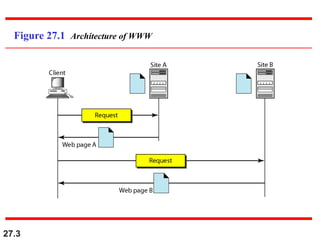
The WWW todayis a distributed client/server service,
in which a client using a browser can access a service
using a server. However, the service provided is
distributed over many locations called sites.
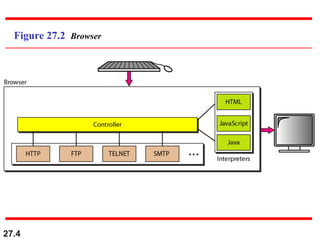
Client (Browser)
Server
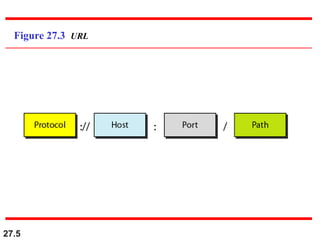
Uniform Resource Locator
Cookies
Topics discussed in this section:
27.6
27-2 WEB
DOCUMENTS
The documentsin the WWW can be grouped into three
broad categories: static, dynamic, and active. The
category is based on the time at which the contents of
the document are determined.
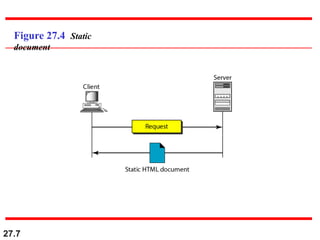
Static Documents
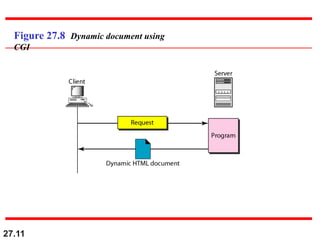
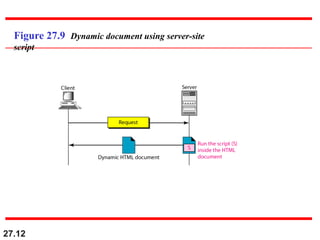
Dynamic Documents
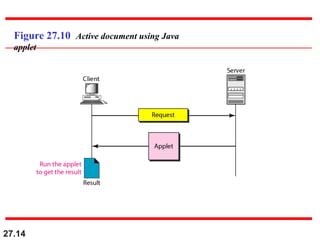
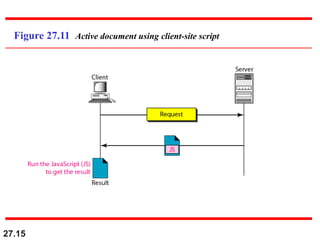
Active Documents
Topics discussed in this section:
27.17
27-3
HTTP
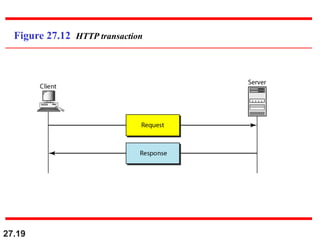
The Hypertext TransferProtocol (HTTP) is a protocol
used mainly to access data on the World Wide Web.
HTTP functions as a combination of FTP and SMTP.
HTTP Transaction
Persistent Versus Nonpersistent Connection
Topics discussed in this section:
27.30
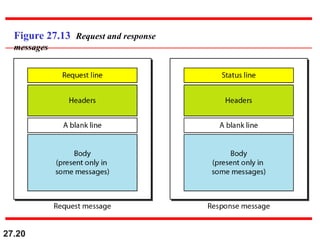
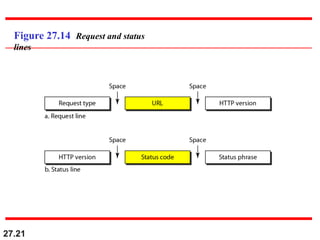
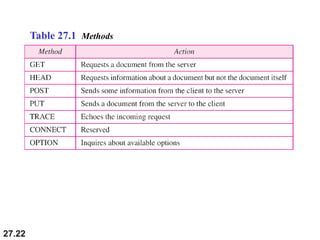
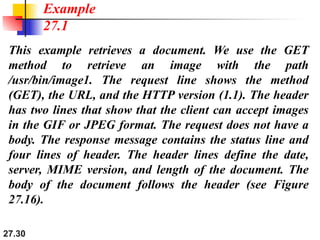
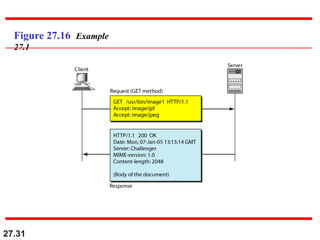
This example retrievesa document. We use the GET
method to retrieve an image with the path
/usr/bin/image1. The request line shows the method
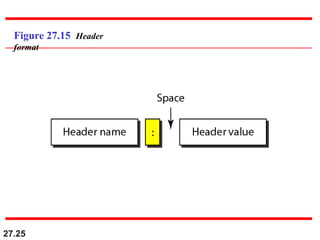
(GET), the URL, and the HTTP version (1.1). The header
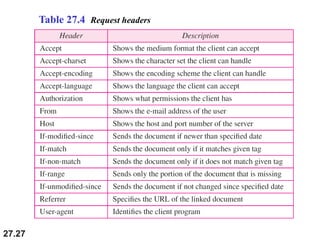
has two lines that show that the client can accept images
in the GIF or JPEG format. The request does not have a
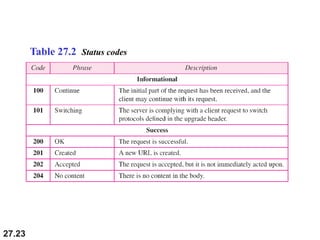
body. The response message contains the status line and
four lines of header. The header lines define the date,
server, MIME version, and length of the document. The
body of the document follows the header (see Figure
27.16).
Example
27.1
27.32
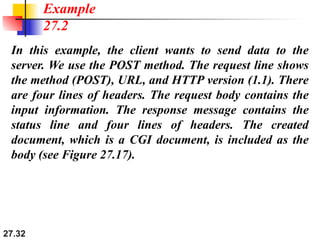
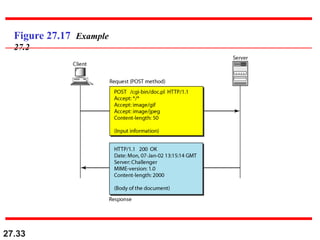
In this example,the client wants to send data to the
server. We use the POST method. The request line shows
the method (POST), URL, and HTTP version (1.1). There
are four lines of headers. The request body contains the
input information. The response message contains the
status line and four lines of headers. The created
document, which is a CGI document, is included as the
body (see Figure 27.17).
Example
27.2
27.34
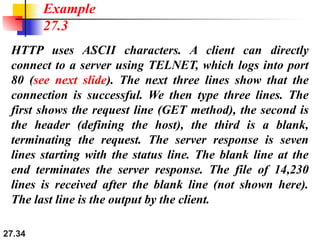
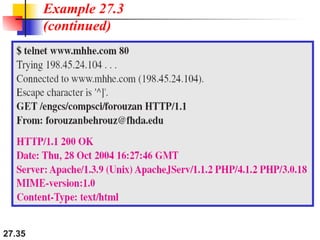
HTTP uses ASCIIcharacters. A client can directly
connect to a server using TELNET, which logs into port
80 (see next slide). The next three lines show that the
connection is successful. We then type three lines. The
first shows the request line (GET method), the second is
the header (defining the host), the third is a blank,
terminating the request. The server response is seven
lines starting with the status line. The blank line at the
end terminates the server response. The file of 14,230
lines is received after the blank line (not shown here).
The last line is the output by the client.
Example
27.3