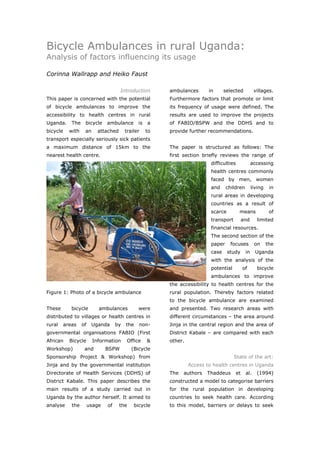
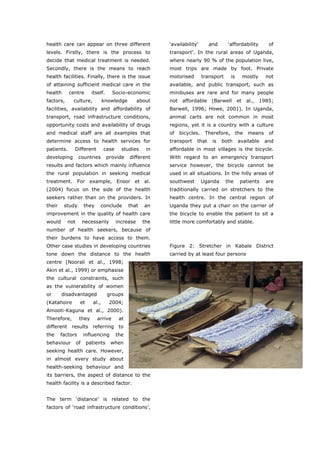
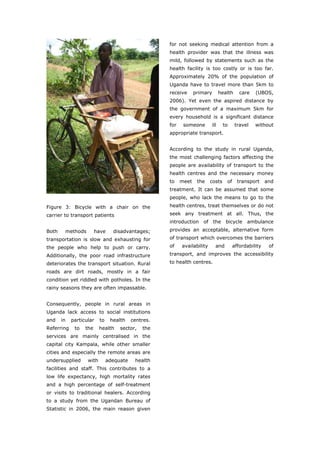
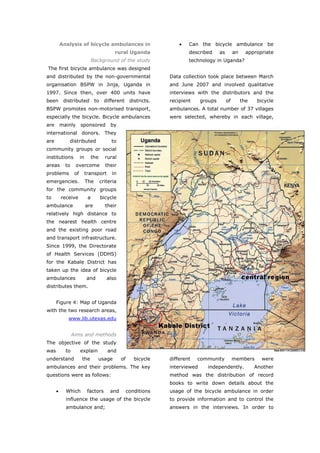
World Transport Policy & Practice                    Picture courtesy of: Millie Rooney
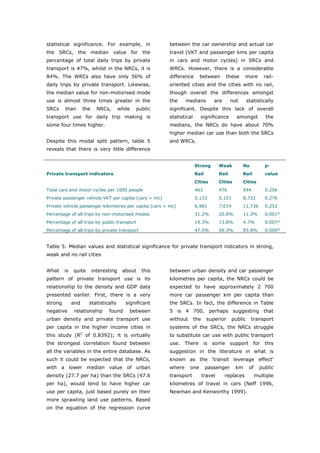
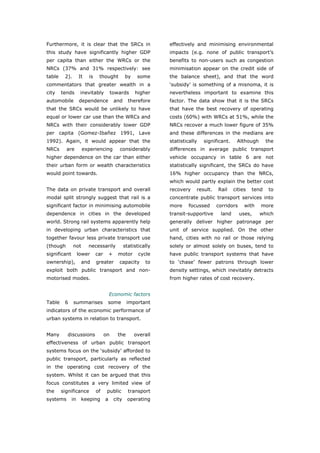
                                        Volume 14, Number 2


    Sustainable intermediate transport in West Africa


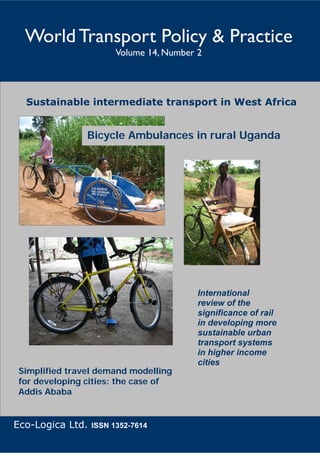
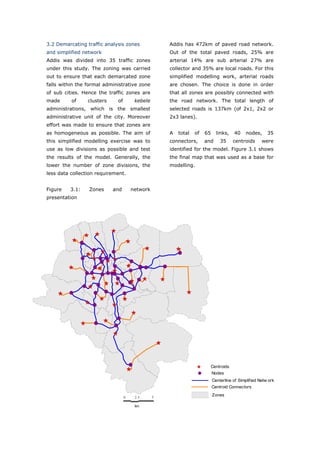
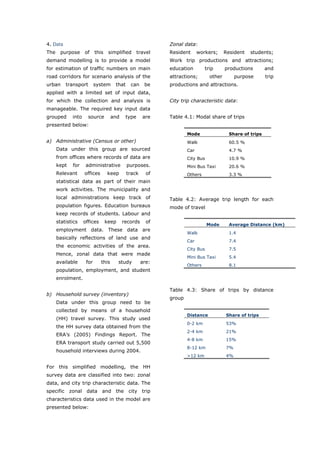
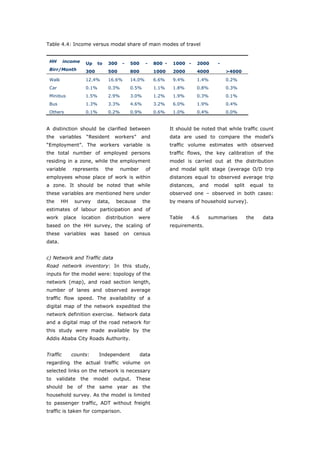
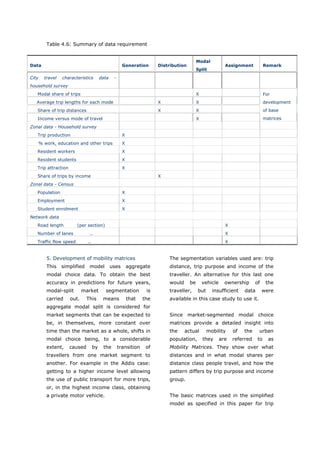
                            Bicycle Ambulances in rural Uganda


                                                                   International
                                                                   review of the
                                                                   significance of rail
                                                                   in developing more
                                                                   sustainable urban
                                                                   transport systems
                                                                   in higher income
                                                                   cities
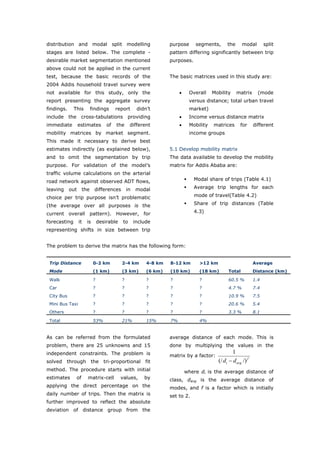
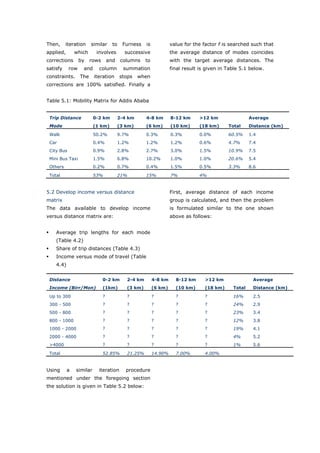
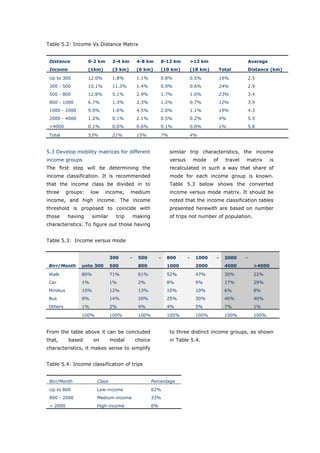
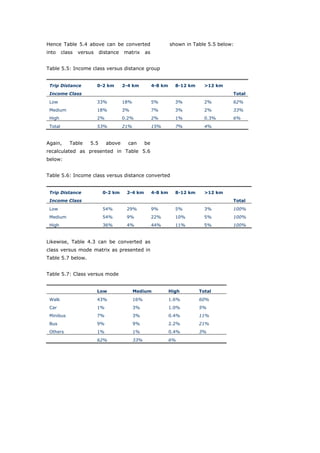
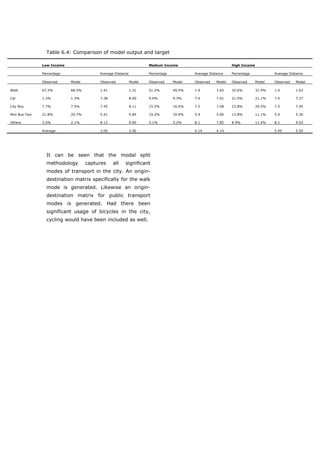
 Simplified travel demand modelling
 for developing cities: the case of
 Addis Ababa


Eco-Logica Ltd. ISSN 1352-7614
      World Transport Policy & Practice___________________________________________________   1
            Volume 14. Number 2. July 2008
World Transport Policy & Practice
                                        Volume 14, Number 2


© 2008 Eco-Logica Ltd.                                      Mikel Murga
Editor                                                      Leber Planificacion e Ingenieria, S.A., Apartado 79,
Professor John Whitelegg                                    48930- Las Arenas, Bizkaia, SPAIN
Stockholm Environment Institute at York, Department
of Biology, University of York, P.O. Box 373, York,         Paul Tranter
YO10 5YW, U.K                                               School of Physical Environmental & Mathematical
                                                            Sciences, University of New South Wales, Australian
Editorial Board                                             Defence Force Academy, Canberra ACT 2600,
Eric Britton                                                AUSTRALIA
Managing       Director,   EcoPlan   International,   The
Centre for Technology & Systems Studies, 8/10 rue           Publisher
Joseph Bara, F-75006 Paris, FRANCE                          Eco-Logica Ltd., 53 Derwent Road, Lancaster, LA1
                                                            3ES, U.K Telephone: +44 (0)1524 63175
Professor John Howe                                         E-mail: j.whitelegg@btinternet.com
Independent Transport Consultant, Oxford, U.K               http://www.eco-logica.co.uk


Contents
Editorial                                                                                                 3
John Whitelegg


Abstracts & Keywords                                                                                      6


Sustainable intermediate transport in West Africa:                                                        8
Quality before quantity
Bryan Dorsey


An International Review of The Significance of Rail in Developing                                         21
More Sustainable Urban Transport Systems in Higher Income Cities
Jeffrey Kenworthy


Bicycle Ambulances in rural Uganda:                                                                       38
Analysis of factors influencing its usage
Corinna Wallrapp and Heiko Faust


Simplified travel demand modelling for developing cities:                                                 47
The case of Addis Ababa
Binyam Bedelu & Marius de Langen


World Transport Policy & Practice___________________________________________________ 2
Volume 14. Number 2. July 2008
Editorial Introduction                                    pedestrian fatality risk and the impact
                                                          speed of a car.
If a residential area in the full sense of
the word (a collection of men, women,
children, teenagers, parents with
babies, those over the age of 70,
healthy, not healthy, worried,
over-confident) could select the
level of probability of death and
serious injury would they go for
a high risk or a low risk?


On June 17th 2008 a group of 20
elected       representatives              in
Lancashire (UK) encouraged by a
self-selected      group         of    local
residents chose the high risk
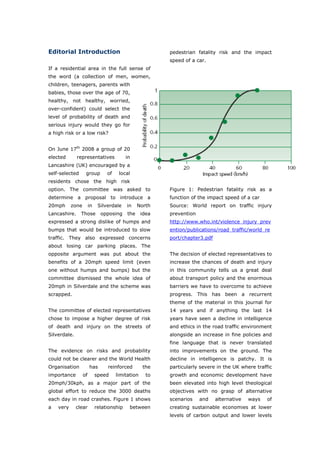
option. The committee was asked to                        Figure 1: Pedestrian fatality risk as a
determine a proposal to introduce a                       function of the impact speed of a car
20mph      zone        in    Silverdale    in    North    Source: World report on traffic injury
Lancashire.     Those         opposing     the     idea   prevention
expressed a strong dislike of humps and                   http://www.who.int/violence_injury_prev
bumps that would be introduced to slow                    ention/publications/road_traffic/world_re
traffic. They also expressed concerns                     port/chapter3.pdf
about losing car parking places. The
opposite argument was put about the                       The decision of elected representatives to
benefits of a 20mph speed limit (even                     increase the chances of death and injury
one without humps and bumps) but the                      in this community tells us a great deal
committee dismissed the whole idea of                     about transport policy and the enormous
20mph in Silverdale and the scheme was                    barriers we have to overcome to achieve
scrapped.                                                 progress. This has been a recurrent
                                                          theme of the material in this journal for
The committee of elected representatives                  14 years and if anything the last 14
chose to impose a higher degree of risk                   years have seen a decline in intelligence
of death and injury on the streets of                     and ethics in the road traffic environment
Silverdale.                                               alongside an increase in fine policies and
                                                          fine language that is never translated
The evidence on risks and probability                     into improvements on the ground. The
could not be clearer and the World Health                 decline in intelligence is patchy. It is
Organisation           has       reinforced        the    particularly severe in the UK where traffic
importance        of        speed     limitation     to   growth and economic development have
20mph/30kph, as a major part of the                       been elevated into high level theological
global effort to reduce the 3000 deaths                   objectives with no grasp of alternative
each day in road crashes. Figure 1 shows                  scenarios    and    alternative   ways   of
a   very      clear         relationship    between       creating sustainable economies at lower
                                                          levels of carbon output and lower levels

World Transport Policy & Practice___________________________________________________ 3
Volume 14. Number 2. July 2008
of    demand    for   transport   and    fewer
deaths and injuries in road crashes.                 Don’t change your light bulbs, change
Sweden is at the opposite end of the                 your politicians…
spectrum with high level policy objectives
that have been captured in the road                  History is full of major shifts in mindsets
safety policy known as “Vision Zero”                 and policy including:
(there will be zero deaths and serious
injuries in the road traffic environment)                     The abolition of slavery
and it’s oil-free by 2020 policy.                             Stopping children working down
                                                              coal mines and in factories
So what do we do next?                                        Providing clean drinking water to
                                                              working class homes in cities in
First of all we have to acknowledge that                      the 1850s and 1860s in the UK
the problem is a mindset problem. Large                       Introducing the National Health
amounts of science and research and                           Service (UK)
even best practice will not persuade                          Clean air legislation in the 1950s
policy makers who live in their cars and                      that got rid of yellow smog
enjoy a high carbon/high mobility life
style   to   visualise   a   different   world.      The task for all of us in transport is to
Science and rationality does not work.               identify the virtuous DNA or virus that
Secondly we have to find ways to work                brought about these enormous changes
from the bottom up. Every street and                 and infect the body politic with the same
every community should be empowered                  and do it now.
to articulate its own view of a desirable
future and then have the capacity to                 Are we up to the task?
deliver it. If this means inventing Utopia
then so be it. Thirdly we could all become
politicians. I don’t recommend this for
health reasons but someone once said in
a UK political broadcast when speaking
about how to sort out “the environment”:


Note:


The decision of elected representatives to abandon a 20mph scheme in Silverdale in North Lancashire
(UK) can be followed through the minutes of the relevant committee. The committee is “Lancashire
Locals, Lancaster” and it met at the Midland Hotel in Morecambe on 17th June 2008. The 20mph item
is Agenda item 6 “Emesgate Lane Area, Silverdale Proposed 20mph Zone”. Minutes and agendas for
this committee can be found on:


http://www3.lancashire.gov.uk/council/meetings/committees/locals/committee.asp?cid=1278&sysredi
r=y

World Transport Policy & Practice___________________________________________________ 4
Volume 14. Number 2. July 2008
Abstracts & Keywords

Sustainable intermediate transport in West Africa: Quality before quantity
Bryan Dorsey


This research provides a brief review of                      countries for development of the market
the   scant          previous     studies       of    non-    for quality bicycles, yet some important
motorised            modes         of         sustainable     secondary cities have been thus far,
transportation          in     Sub-Saharan           Africa   overlooked.      This    study       identifies      the
urban and peri-urban areas. Particular                        potential market for ITDP’s quality, yet
attention       is     given     to     the     need    to    affordable, “California Bike” in Togo’s
encourage bicycle transit in West African                     second largest city, Sokodé. It is argued
secondary cities.             Although the Institute          that ITDP’s strategy to focus on quality
for   Transportation             and     Development          rather      quantity    of     bicycles       is     well
Policy   (ITDP)         has     made      considerable        founded,        but     significant       marketing
progress in developing improved bicycle                       obstacles have yet to be overcome.
transportation, much work remains. In
their outstanding effort at decentralised                     Keywords: Sustainable transportation in
cooperation,          ITDP      has     identified     key    Sub-Saharan Africa, ITDP, bicycle transit.


An International Review of The Significance of Rail in Developing More
Sustainable Urban Transport Systems in Higher Income Cities
Jeffrey Kenworthy


The significance of urban rail systems in                     of cities and discusses the findings. The
cities, especially in comparison to buses,                    study finds generally that cities with
is a widely discussed topic. This study                       more        strongly     rail-oriented             public
examines 60 high-income cities in North                       transport systems experience a wide
America,      Australia,         Europe        and    Asia,   range of positive impacts at an urban
dividing the sample into strong rail, weak                    system level in all of the above important
rail and no rail cities using three criteria                  areas. Explanations are offered for these
related to the significance of rail within                    observations and the overall results are
the public transport system of each city                      found     to     be     in    line     with        other
and      the           rail      system’s            speed    comparative research on this topic that
competitiveness with cars. Trams, LRT,                        has focussed on European and US cities.
metro     and          suburban         rail    are     all   The     paper    suggests       that     urban       rail
considered. It then looks systematically                      systems are a critical element in building
at key comparative urban form, public                         effective      multi-modal      public    transport
transport operational features, transport                     systems that create a ‘virtuous circle’ in
infrastructure and performance, private                       public    transport      and     compete           more
transport patterns, economic features of                      successfully with the car.
the transport systems and environmental
factors in each of the three groups of                        Key words: Urban rail systems, urban
cities. It examines whether there are any                     form,       public      transport         operation,
statistically        significant       differences       in   infrastructure          and           performance,
these factors between the three groups                        economic        and    environmental          factors.


World Transport Policy & Practice___________________________________________________ 5
Volume 14. Number 2. July 2008
Bicycle Ambulances in rural Uganda: Analysis of factors influencing its usage
Corinna Wallrapp and Heiko Faust


Since          1997         about           400        bicycle      circumstances. However, factors were
ambulances were distributed to villages                             defined influencing its usage, such as the
in     rural     Uganda              to    improve          their   situation in the villages, the features of
accessibility         of        health      centres.         For    the bicycle ambulance, the system of
general         understanding,                   a     bicycle      distribution and the organisation of the
ambulance is a bicycle with an attached                             groups. The only significant influence on
trailer especially to transport seriously                           the     frequency        of    usage         could    be
sick     patients          to    the       nearest       health     observed         between             the       different
centre. This paper presents the main                                organisational structures of the bicycle
results of a study carried out to analyse                           ambulance       groups.        Furthermore,          high
the usage of the bicycle ambulances in                              distances, costs of repairs and other
Uganda. The research was undertaken                                 barriers could be overcome through the
mainly through guided interviews with                               positive attitude of group members.
receivers and the distributors of bicycle
ambulances            in        selected        villages.     In    Keywords: Bicycle ambulance, Uganda,
referring to the technology, the bicycle                            access to health centres, intermediate
ambulance         can           be    described        as     an    means of transport, rural development,
appropriate           technology                within       the    Sub-Saharan Africa.


Simplified travel demand modelling for developing cities: the case of Addis Ababa
Binyam Bedelu & Marius de Langen


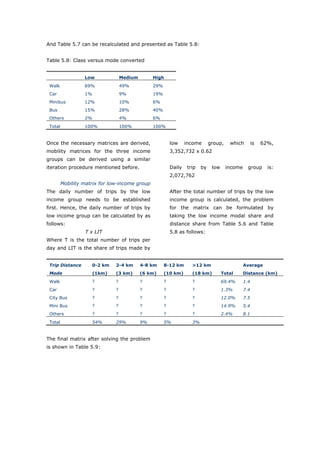
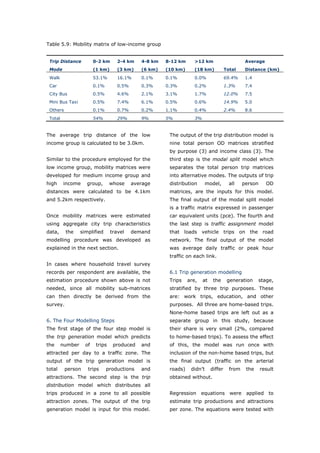
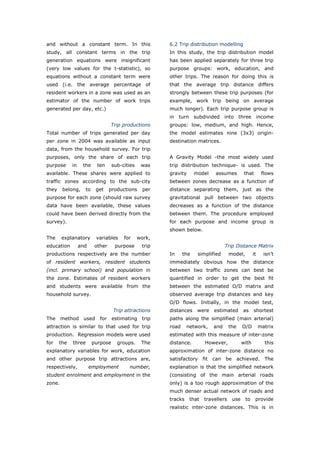
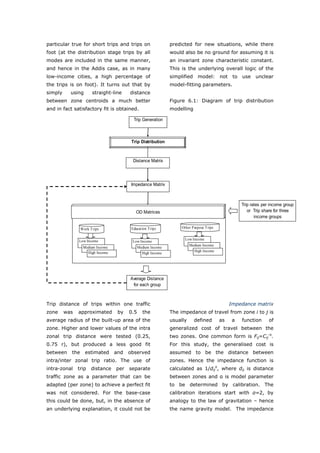
This paper presents a simplified travel                             The     key      difference          between         this
demand          model.               The     model          was     simplified     model          and     the     standard
developed as a tool to support long-term                            current travel demand model is that the
strategic       transport             system         planning,      modal-split is dealt with by means of so-
specifically for low-income cities with                             called mobility matrices. These mobility
limited data availability and the need for                          matrices show the shares of each mode
a transparent planning tool that can be                             of    travel     per     distinct          trip-distance
used easily and at a low cost. A study                              category, with a further segmentation by
was carried out to test the applicability of                        trip purpose and income of the trip
the model for strategic and sustainable                             maker. The mobility matrices can be
transport        planning             in    Addis        Ababa      estimated from a household travel survey
(Ethiopia).       The            model          consists      of    of      a      limited        size         (1400-2000
interlinked       spreadsheets                  with     open-      respondents).
source codes. It requires no specialized
licensed software, and is available free of                         The test-study divides the Addis Ababa
costs,     upon        request.            In     case      GIS     urban area into 35 traffic zones and
software is available this can be used to                           defines an arterial road network of 137
facilitate working with maps and for                                km. Data required for the model were
showing traffic flows on road network                               obtained from the municipality, largely
maps, but the model can equally be used                             from an earlier urban transport study,
without.                                                            which       included      a    household          travel


World Transport Policy & Practice___________________________________________________ 6
Volume 14. Number 2. July 2008
survey. Mobility matrices were estimated         manner       (correlation    coefficient      0.95,
from this household travel survey. The           RMSE 14%). The test shows that this
model applies the traditional four travel-       simplified    model    is    likely    to    be   a
demand       forecasting       steps:     trip   valuable, manageable and low-cost tool
generation, trip distribution, modal split,      in support of strategic and sustainable
and traffic assignment.                          transport policy and network planning for
                                                 low-income cities.
In   the   test,   the     simplified   model
estimates the observed average daily             Keywords:       simplified    travel        demand
traffic flows on the main arterial road          model, mobility matrix, urban transport
network of the city in a very satisfactory       planning.


World Transport Policy & Practice___________________________________________________ 7
Volume 14. Number 2. July 2008
Sustainable intermediate transport in West Africa:
Quality before quantity
Bryan Dorsey
Department of Geography, Weber State University; Ogden, Utah


                                         Introduction   22).     Some       of   these     same       factors,
Non-motorised transport (NMT) is central                particularly demographics and income,
to the issue of sustainable transportation.             influence choices in urban transport. Just
Among      the    more     arguably        important    as secondary African cities are often
aspects    of    NMT      that     are    sometimes     economically        linked    to   primary     cities,
overlooked       are     bicycle    transportation      there     is   close     interdependence          with
development       and accompanying policy               peripheral      rural      areas      that     supply
reform. Given the fact that the majority of             agricultural     goods,       thereby        ensuring
the world’s poor do not have access to                  regional food security. Combined with the
motorised transport, it has been well                   general weakness of rural transportation
noted that this should not be the only                  systems in Sub-Saharan Africa, it would
mode      considered      for    development       in   therefore seem essential to consider peri-
Africa,    the     world’s       poorest      region    urban NMT when discussing urban transit.
(Leinbach, 2000; Mozer, 2000; World                     Indeed, World Bank reports show a clear
Bank, 2002). Indeed, the last of ten                    link between NMT and the reduction of
major urban NMT strategy elements that                  poverty in both rural and urban settings
the World Bank reviews in Cities on the                 (Starkey et al, 2002; World Bank 2002).
Move provides some impetus for this
study: “development of small-scale credit               Among the more successful decentralised,
mechanisms for finance of bicycles in poor              cooperative projects focused on bicycle
countries”      (World     Bank,     2002,     134).    transport is the recent work conducted by
Although the emphasis herein lies not on                the     Institute    for     Transportation       and
internal credit mechanisms in particular,               Development         Policy    (ITDP).    ITDP     has
the market conditions for bicycle sales                 been active in Africa for over twenty
and promotion in two very different, yet                years, with particular success in Ghana
neighboring countries, Ghana and Togo,                  (Gauthier,     2005;       Gauthier     and    Hook,
are analysed and compared.                              2005). Gauthier and Hook (2005) present
                                                        compelling evidence that the market for
The World Bank has made some studies                    durable, yet affordable, quality bikes in
regarding non-motorised transport in the                Africa is primed for development.              Based
urban periphery in Sub-Saharan Africa                   on bicycle marketing studies by ITDP,
(Starkey et al, 2002), yet scant academic               there     may       be     similar     success      in
research has focused on the intermediate                developing and marketing bicycle trailers
technology of bicycles and bike trailers.               in selected countries, thereby expanding
World Bank researchers note that a wide                 transit mode shares in secondary cities
variety of factors influence differences in             where bicycle use for the movement of
rural transportation: “population density,              agricultural     goods       is    significant.    In
culture, income, topography, climate, or                countries       where        the     transport      of
crops and animals” (Starkey et al, 2002,                agricultural goods is critical to national


World Transport Policy & Practice___________________________________________________                        8
Volume 14. Number 2. July 2008
economic prosperity and food security,                             allowed     on       major        roadways         that     are
the     need            for       alternative            mode      increasingly dominated by vehicles. The
development becomes even more acute.                               cycling     mode           share     in    Shanghai         for
Given the fact that approximately 42                               example, has declined from an estimated
percent of Togo’s gross domestic product                           70 percent in 1990 to only 17 percent in
comes from agriculture (Bureau of African                          2003 (Summerville, 2005).
Affairs, 2005), the country provides an
appropriate           case    study        for    improving        The decrease in ridership within China has
intermediate transport.                                            signalled a shift in production trends. As
                                                                   the Chinese buy fewer bikes, bicycle
 Bicycle mode shares and transit oriented                          exports     from          China      are    expected         to
                                              development          continue       to         increase.        In     fact,     the
Before discussing the details of bicycle                           European Union recently endorsed an
transport development in Africa, it may be                         anti-dumping duty of 48.5 percent on all
of assistance to note changes occurring in                         Chinese built bicycles (begun in July,
other world regions. Data analysed by the                          2005) (European Union Council, 2005).
World Watch Institute (2001) show that                             The rippling effect of depressed demand
bicycle production increased from about                            in China also led the Economist magazine
10 million units in 1950 to 100 million                            to report that streamlined production in
units       in     2000,       whereas           automobile        China has led to a significant decrease in
production increased from about 8 million                          the cost of low-end mountain bikes in
units to only 40 million units during the                          Ghana where the price dropped from $67
same time period. Although Holland has                             in 2001 to $25 in 2003 (author unknown,
lead the world in per capita bike sales                            2003).
with almost 90 bicycles sold per 1000
people,       China         has   the      greatest       total    Despite     some           decline    in        ridership    in
bicycle ridership and production in the                            primary cities such as Shanghai, growing
world (Gauthier and Hook, 2005). While                             world wide bicycle production and sales
only 20 bikes per 1000 people are sold in                          noted above give proof to the viability of
China (op. cit.), approximately 52 percent                         bike transport. In cities where safe bicycle
of    the        estimated        100      million       bikes     transportation is encouraged, and where
produced           worldwide         in       2000        were     bicycle sales are high, it comes as no
manufactured            in    China        (World       Watch      surprise that a significant percentage of
Institute, 2001). In terms of urban NMT,                           the mode share is in bicycles. The city of
Chinese           cities      have         the        greatest     Groningen            in     the      Netherlands,           for
percentage             of     cyclists           per      total    example, has a bicycle mode share of
transportation mode shares. It has been                            about 50 percent, which is just ahead of
estimated that Tianjin has among the                               Beijing     at       48     percent         (International
highest bicycle mode share of any city in                          Bicycle Fund, 2005). In addition to strong
the world, with an estimated 77 percent.                           markets for bikes, Holland has some of
Close       behind         Tianjin    is      the      city   of   the      most         well         developed          bicycle
Shenyang with a 65 percent bicycle mode                            transportation             master         planning          and
share (International Bicycle Fund, 2005).                          supporting transit oriented development
However, bicycle ridership has begun to                            (TOD) in the world.
rapidly decline in some Chinese cities as
China moves toward free enterprise. In                             Certainly      the        prevailing       transportation
some        cities,     bicycles        are      no     longer     ethics    of     a        community,        its     level    of


World Transport Policy & Practice___________________________________________________                                             9
Volume 14. Number 2. July 2008
economic development, and local cultural                       community planning involving “walkable”
characteristics               will      influence        the   and “cycleable,” or “new urbanist” design
popularity of cycling and trailer use. Even                    elements must be integral to TOD. We
though these cultural characteristics, as                      cannot     assume         that        where           motorised
well as socioeconomic conditions vary                          transportation          infrastructure                has     been
dramatically           from          Europe,    to     North   developed,        non-motorised                  transit        will
America,          to     Africa,        there     is    one    follow.     In        fact,         some        “autocentric”
commonality:            regardless of dependency               planning      undermines              the        safety        and
on the singly occupied vehicle (SOV),                          encouragement                   of             non-motorised
many        people       are         re-evaluating     their   transportation. The lack of cyclist and
transportation                  choices,             seeking   pedestrian safety is endemic not only to
alternatives that may be counter to the                        more economically developed countries,
expanding          status       quo.     The    European       but developing countries in Africa face
Commission (2003) estimates that the                           similar challenges of modernisation. For
total kilometres travelled in the European                     further reading on best practices for
Union by SOV will increase by 40 percent                       pedestrian       and      bicycle          planning,           see
between 1995 and 2030. American SOV                            Litman,       Demopolous,                  Eddy,            Fritzel,
use         has         far          outpaced        bicycle   Laidlaw and Maddox (2000) with the
transportation with less than one percent                      Victoria Transportation Policy Institute in
of the mode share occupied by cyclists                         British    Columbia            (www.vtpi.org).                Velo
(American               Public            Transportation       Mondiale is another key decentralised
Administration, 2002; US Census Bureau,                        cooperative       organization                 that      provides
2000). Nevertheless, in some American                          valuable information on bicycle master
secondary cities where traffic conditions                      planning (www.velo.info). While countries
allow, bicycles are being used as a viable                     like China and the Netherlands have
alternative mode of transport.                                 significant percentages of their population
                                                               moving by bicycle, how do Sub-Saharan
In American primary and secondary cities                       African countries compare?
where TOD has integrated infrastructural
development to support bicyclists and                                                 Bicycle promotion in Africa
pedestrians (e.g., Portland, Oregon and                        While attitudes toward bicycling in African
Boulder, Colorado), some of the better                         cities vary from country to country, many
developed bicycle pathway systems in the                       view bikes as an antiquated form of
world are emerging. Frustrated by traffic                      transport,       and          far     prefer          motorised
congestion, degrading air quality, and the                     vehicles; yet the reality is that bicycles
lack of government initiatives to reduce                       are    a   sustainable              form       of     transport,
carbon            dioxide            emissions,        local   particularly      for     those           of    low       income
community planners and commuters are                           (Howe, 1997; Mozer, 2000; ITDP, 2005).
turning to the bicycle and, or mass                            Researchers have found that bicycle users
transit. Cyclists are increasingly prevalent                   in    Accra      and     Ouagadougou                   preferred
in    the    Front       Range          communities       of   motorised two-wheeled vehicles (mopeds,
Colorado where TOD includes cycling,                           scooters,        or     motorcycles)                to       bikes.
whereas Wasatch Front communities in                           Nevertheless, some found bicycles more
Utah have many recreational cyclists, but                      appealing than buses due to low cost,
far less development to support bicycle                        speed,      reliability,            and        more       flexible
commuting. If a revival of bike use is to                      routing (World Bank, 2002). In an effort
occur       that       ensures         safe    movement,       to improve non-motorised transportation,


World Transport Policy & Practice___________________________________________________                                            10
Volume 14. Number 2. July 2008
non-government      donor      agencies     and   9.5 bikes/1000 people in 2001 following a
individuals have generously donated used          reduction in bicycle import tariffs. As a
bicycles from the U.S. and Europe to              result, the CBC has identified a bicycle
Africa. Although well meaning, donations          marketing         strategy            targeting         those
are problematic in that used bikes are            countries with low import duties such as
often of low quality, and are therefore           Ghana and Kenya (op. cit.).
prone to mechanical failure. When these
foreign bicycles are introduced without           While     devising         a        strategy      for     the
proper marketing, there are few services          Coalition, ITDP also considered annual
developed for repairs and parts made              growth rates in gross domestic product
available to African cyclists. Gauthier and       (GDP), as well as the level of existing bike
Hook bluntly state the problem: “it was ‘a        use     and     sales      in         selected     African
race to the bottom’ in terms of the quality       countries. The CBC strategy to target
[of bicycles], and this undermined cycling        countries with low tariffs seems logical;
as a legitimate form of transport” (2005,         however, the reliance on GDP growth
9).                                               rates as an indicator of success for the
                                                  development of the California Bike market
Having experienced the drawbacks to               may be constraining. Kenya provides a
relying on used bikes, ITDP staff then            strong example with an annual growth in
decided to take a new approach to the             GDP from 2000-2004 of less than 1
bicycle    commuting        problem.      ITDP    percent, yet as previously noted, bicycle
technical team members worked with                sales almost doubled from 2001 to 2002.
bicycle manufacturers, Trek and Sram to           Indeed,     the      use       of     per   capita       GDP
develop the California Bike. The California       estimates and fluctuating growth rates as
Bike, a six-speed, low end mountain bike          indicators of actual prosperity is flawed.
is being produced by Giant Inc. (ironically,      GDP figures mask differences in wealth
in    Shanghai)   and   made    available    to   within countries, and do not account for
consumers in Senegal, Ghana, Tanzania             the     informal     sector.         Even    the     casual
and South Africa at an average price of           observer in Sub-Saharan Africa can attest
$100 (Gauthier and Hook, 2005).           Once    to the significance of the informal sector
ITDP identified bike dealers and formed           of      these      economies              where         much
the California Bike Coalition (CBC), the          commerce          goes         undocumented              and
bikes were sold at a rate many would not          untaxed.
have anticipated.
                                                  Though      the      correlation          between        GDP
In spite of low average per capita incomes        growth rate and per capita GDP is weak,
in most African countries, consumers in           bicycle ownership appears to be closely
Ghana, Kenya and Tanzania are buying              correlated with per capita income (Hook,
bikes at unprecedented rates. Indeed,             1995;      Gauthier            and        Hook,     2005).
bicycle sales in Ghana in 2002 were               However, bicycle sales and ownership do
estimated at almost 29 per thousand               not necessarily equate with bicycle use.
people, higher than bicycle consumption           Hook (1995) showed that the relationship
in China (Gauthier and Hook, 2005).               between per capita income and bicycle
Kenya had the second highest bike sales           commuting, or the total number of work
per 1000 people in Africa in 2002 (16.4           trips     by    bike,          is     not      statistically
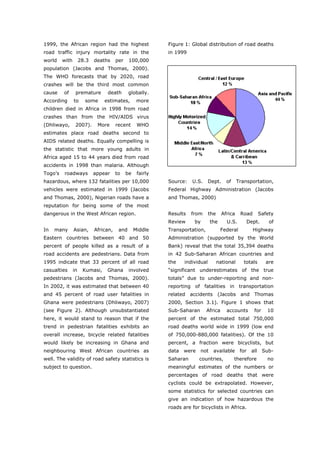
bikes/1000 population). It is important to        significant. Table 1 shows relationships
note that sales in Kenya increased from           between        GDP    and           the   prevalence       of


World Transport Policy & Practice___________________________________________________                        11
Volume 14. Number 2. July 2008
bicycle ownership and sales for selected                 GDP/capita. Unfortunately no data on
 countries, yet no definite conclusions can               bicycle ownership or sales are currently
 be drawn for actual bicycle use. Clearly,                available for Togo. Regarding Togo’s low
 there     is   positive     correlation    between       GDP growth rate, it should be noted that
 Ghana’s GDP and the number of bikes per                  Togolese     face      considerable       constraints
 thousand people (Table 1). One would                     given     political    unrest       and      economic
 expect to see low bicycle ownership and                  decline since the early 1990s.
 sales in Togo given the country’s low


 Table 1: Economic Indicators and Bicycle Prevalence, 2005 Estimates


                      Population       GDP/capita      GDP growth        # of bikes/            # bikes sold*
                      (million)        (PPP$)          (% increase)       1000 people*

 Ghana                20.9             2500            4.3                28.7                  588,048
 Kenya                33.8             1200            5.0                16.4                  517,302
 Senegal              11.1             1800            6.1                2.0                   20,253
 Togo                 5.7              1600            2.8                N.A.                  N.A.
 Uganda               26.9             1700            9.0                2.4                   60,675

 GDP = Gross Domestic Product
 N.A. = Not Available
 PPP = Purchasing Power Parity


 Sources: Bureau of African Affairs, US Dept. of State, 2005; *Gauthier and Hook, 2005.


Economic factors alone do not explain the                    Road safety and bicyclists in Sub-Saharan
lack of cycling in Africa, where most trips                                      Africa: reality and policy
are made on foot, yet the bicycle is                     The danger of promoting greater reliance
underutilised (Howe, 1997; Mozer, 2000;                  on bicycles in West Africa, and Sub-
World Bank, 2002). Although extensive                    Saharan Africa in general is inherent in the
pedestrian movement and some bicycle                     risks of death and injury of cyclists in the
use are widespread in most West African                  region.      Although       statistics        can     be
cities, little attention is given to safe                misleading,        and      in        some          cases
movement.        Indeed      some   villages    and      contradictory from one source to another,
cores of secondary cities are divided by                 it is important to consider safety issues
major     roadway      corridors,   e.g.,    Togo’s      and related policies that could assist to
Route Nationale runs through the centre of               reduce death and injury amongst this
towns where pedestrians and cyclists are                 vulnerable       group.         To     gain         some
at risk. Drawing again from World Bank                   perspective on the safety issues that
policy outlined in Cities on the Move,                   cyclists face in Africa, it may be helpful to
emphasis         must        be     placed       on      consider      overall      road-related          traffic
infrastructural       development      for     “safe     dangers, both world-wide and in particular
movement”        of   non-motorised        transport     African countries.
(World Bank, 2002, 134). Although some
African city governments are embracing                   According        to       the        World      Health
TOD with safe bike route development, the                Organisation (WHO), 23 percent of all
issue is generally neglected.                            injury related deaths world wide can be
                                                         attributed to road traffic accidents. In


 World Transport Policy & Practice___________________________________________________                          12
 Volume 14. Number 2. July 2008
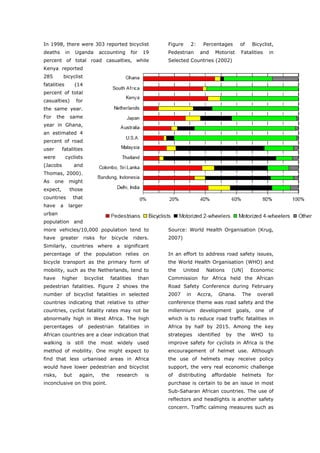
1999, the African region had the highest                    Figure 1: Global distribution of road deaths
road traffic injury mortality rate in the                   in 1999
world    with        28.3   deaths     per    100,000
population (Jacobs and Thomas, 2000).
The WHO forecasts that by 2020, road
crashes will be the third most common
cause    of      premature       death        globally.
According       to     some     estimates,         more
children died in Africa in 1998 from road
crashes than from the HIV/AIDS virus
(Dhliwayo,       2007).      More      recent      WHO
estimates place road deaths second to
AIDS related deaths. Equally compelling is
the statistic that more young adults in
Africa aged 15 to 44 years died from road
accidents in 1998 than malaria. Although
Togo’s   roadways           appear     to    be    fairly
hazardous, where 132 fatalities per 10,000                  Source:   U.S.      Dept.     of     Transportation,
vehicles were estimated in 1999 (Jacobs                     Federal Highway Administration (Jacobs
and Thomas, 2000), Nigerian roads have a                    and Thomas, 2000)
reputation for being some of the most
dangerous in the West African region.                       Results   from      the     Africa    Road        Safety
                                                            Review     by         the     U.S.       Dept.        of
In   many       Asian,      African,    and       Middle    Transportation,             Federal          Highway
Eastern countries between 40 and 50                         Administration (supported by the World
percent of people killed as a result of a                   Bank) reveal that the total 35,394 deaths
road accidents are pedestrians. Data from                   in 42 Sub-Saharan African countries and
1995 indicate that 33 percent of all road                   the    individual         national      totals      are
casualties      in    Kumasi,    Ghana        involved      “significant underestimates of the true
pedestrians (Jacobs and Thomas, 2000).                      totals” due to under-reporting and non-
In 2002, it was estimated that between 40                   reporting of fatalities in transportation
and 45 percent of road user fatalities in                   related accidents (Jacobs and Thomas
Ghana were pedestrians (Dhliwayo, 2007)                     2000, Section 3.1). Figure 1 shows that
(see Figure 2). Although unsubstantiated                    Sub-Saharan       Africa      accounts       for     10
here, it would stand to reason that if the                  percent of the estimated total 750,000
trend in pedestrian fatalities exhibits an                  road deaths world wide in 1999 (low end
overall increase, bicycle related fatalities                of 750,000-880,000 fatalities). Of the 10
would likely be increasing in Ghana and                     percent, a fraction were bicyclists, but
neighbouring West African countries as                      data   were     not    available      for   all    Sub-
well. The validity of road safety statistics is             Saharan       countries,           therefore         no
subject to question.                                        meaningful estimates of the numbers or
                                                            percentages of road deaths that were
                                                            cyclists could be extrapolated. However,
                                                            some statistics for selected countries can
                                                            give an indication of how hazardous the
                                                            roads are for bicyclists in Africa.


World Transport Policy & Practice___________________________________________________                             13
Volume 14. Number 2. July 2008
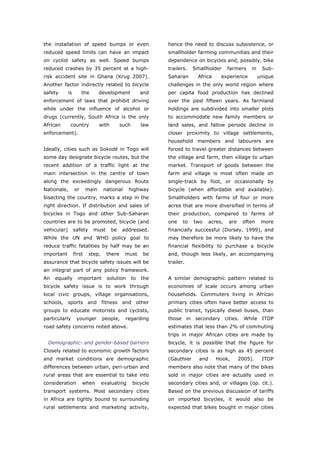
In 1998, there were 303 reported bicyclist                      Figure     2:     Percentages        of    Bicyclist,
deaths       in    Uganda         accounting       for    19    Pedestrian       and     Motorist    Fatalities    in
percent of total road casualties, while                         Selected Countries (2002)
Kenya reported
285          bicyclist
fatalities         (14
percent of total
casualties)         for
the same year.
For    the        same
year in Ghana,
an estimated 4
percent of road
user      fatalities
were         cyclists
(Jacobs            and
Thomas, 2000).
As     one     might
expect,        those
countries          that
have     a     larger
urban
population and
more vehicles/10,000 population tend to                         Source: World Health Organisation (Krug,
have     greater          risks   for    bicycle      riders.   2007)
Similarly, countries where a significant
percentage of the population relies on                          In an effort to address road safety issues,
bicycle transport as the primary form of                        the World Health Organisation (WHO) and
mobility, such as the Netherlands, tend to                      the     United       Nations    (UN)      Economic
have      higher          bicyclist      fatalities      than   Commission for Africa held the African
pedestrian fatalities. Figure 2 shows the                       Road Safety Conference during February
number of bicyclist fatalities in selected                      2007     in     Accra,    Ghana.     The     overall
countries indicating that relative to other                     conference theme was road safety and the
countries, cyclist fatality rates may not be                    millennium development goals, one of
abnormally high in West Africa. The high                        which is to reduce road traffic fatalities in
percentages          of     pedestrian       fatalities    in   Africa by half by 2015. Among the key
African countries are a clear indication that                   strategies      identified     by   the   WHO     to
walking is still the most widely used                           improve safety for cyclists in Africa is the
method of mobility. One might expect to                         encouragement of helmet use. Although
find that less urbanised areas in Africa                        the use of helmets may receive policy
would have lower pedestrian and bicyclist                       support, the very real economic challenge
risks,       but     again,        the      research       is   of    distributing     affordable    helmets      for
inconclusive on this point.                                     purchase is certain to be an issue in most
                                                                Sub-Saharan African countries. The use of
                                                                reflectors and headlights is another safety
                                                                concern. Traffic calming measures such as


World Transport Policy & Practice___________________________________________________                              14
Volume 14. Number 2. July 2008
the installation of speed bumps or even                        hence the need to discuss subsistence, or
reduced speed limits can have an impact                        smallholder farming communities and their
on cyclist safety as well. Speed bumps                         dependence on bicycles and, possibly, bike
reduced crashes by 35 percent at a high-                       trailers.   Smallholder      farmers    in    Sub-
risk accident site in Ghana (Krug 2007).                       Saharan      Africa      experience          unique
Another factor indirectly related to bicycle                   challenges in the only world region where
safety       is        the       development             and   per capita food production has declined
enforcement of laws that prohibit driving                      over the past fifteen years. As farmland
while under the influence of alcohol or                        holdings are subdivided into smaller plots
drugs (currently, South Africa is the only                     to accommodate new family members or
African       country            with        such        law   land sales, and fallow periods decline in
enforcement).                                                  closer proximity to village settlements,
                                                               household members and labourers are
Ideally, cities such as Sokodé in Togo will                    forced to travel greater distances between
some day designate bicycle routes, but the                     the village and farm, then village to urban
recent addition of a traffic light at the                      market. Transport of goods between the
main intersection in the centre of town                        farm and village is most often made on
along the exceedingly dangerous Route                          single-track by foot, or occasionally by
Nationale,        or      main     national     highway        bicycle (when affordable and available).
bisecting the country, marks a step in the                     Smallholders with farms of four or more
right direction. If distribution and sales of                  acres that are more diversified in terms of
bicycles in Togo and other Sub-Saharan                         their production, compared to farms of
countries are to be promoted, bicycle (and                     one    to   two     acres,   are    often     more
vehicular)        safety     must       be    addressed.       financially successful (Dorsey, 1999), and
While the UN and WHO policy goal to                            may therefore be more likely to have the
reduce traffic fatalities by half may be an                    financial flexibility to purchase a bicycle
important         first    step,     there     must       be   and, though less likely, an accompanying
assurance that bicycle safety issues will be                   trailer.
an integral part of any policy framework.
An   equally        important        solution       to   the   A similar demographic pattern related to
bicycle safety issue is to work through                        economies of scale occurs among urban
local civic groups, village organisations,                     households. Commuters living in African
schools, sports and fitness and other                          primary cities often have better access to
groups to educate motorists and cyclists,                      public transit, typically diesel buses, than
particularly       younger         people,     regarding       those in secondary cities. While ITDP
road safety concerns noted above.                              estimates that less than 2% of commuting
                                                               trips in major African cities are made by
  Demographic- and gender-based barriers                       bicycle, it is possible that the figure for
Closely related to economic growth factors                     secondary cities is as high as 45 percent
and market conditions are demographic                          (Gauthier     and      Hook,       2005).     ITDP
differences between urban, peri-urban and                      members also note that many of the bikes
rural areas that are essential to take into                    sold in major cities are actually used in
consideration          when        evaluating       bicycle    secondary cities and, or villages (op. cit.).
transport systems. Most secondary cities                       Based on the previous discussion of tariffs
in Africa are tightly bound to surrounding                     on imported bicycles, it would also be
rural settlements and marketing activity,                      expected that bikes bought in major cities


World Transport Policy & Practice___________________________________________________                           15
Volume 14. Number 2. July 2008
where there are low to no tariffs may be                        tariffs in Togo, ITDP staff members are
taken into adjoining countries with higher                      working       to      establish        a       bicycle
tariffs, e.g., from Ghana to Togo.                              manufacturing facility in Senegal.              Since
                                                                Togo is a member of the West African
Perhaps      one       of    the     more       challenging     Economic and Monetary Union, or Union
demographic issues influencing the use of                       économique et monétaire oust-africaine
bicycles is that of gender.                      Women in       (UEMOA),       bicycles        manufactured         in
many      Sub-Saharan              communities         often    Senegal could then be imported in Togo
carry     the     majority           of     goods      (farm    without    exceedingly      high    tariffs.     ITDP
products, tools, fuel wood, etc.) between                       representatives have been working with an
the     village    and       larger       urban      markets    independent bike dealer in the secondary
(Leinbach,          2000;             Mozer,          2000).    city of Tamale (Ghana’s third largest city)
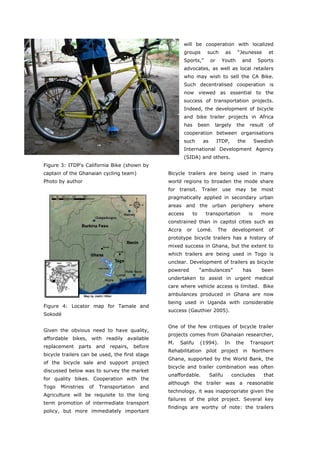
Development of policy and support for                           to    distribute   the    CA    Bike     in   Ghana.
bicycles and bike trailers offers a critically                  Tamale has a population of about 270,000
needed      alternative         to        the   burden    of    people, and is centrally located in a region
moving loads by foot, yet few African                           where bicycle use is expected to be high
women       ride       bikes.        Due        to   cultural   (Figure 4). If the CA Bike were to be
differences       in        western        Burkina     Faso,    introduced in a secondary city in Togo, the
women’s bicycles do not sell as well as in                      most closely comparable city would be
other regions (Sifa, 2001). One aspect of                       Sokodé, Togo’s second largest city with a
culture and gender effecting bicycle use is                     population of roughly 75,000. Although
dress. The traditional wrap of cloth, a                         Tamale is larger than Sokodé, both cities
“pagne” or sarong, worn by women in                             are    characterised      by    large,     sprawling
much of Africa is not conducive to bicycle                      residential   areas      with    relatively     weak
riding. An effort to break down the norm                        infrastructural development. Connections
of gender division in cycling was pursued                       to surrounding rural villages are strong,
during the “Tour des Femmes” in Senegal                         and intensified agricultural production is
and the “HIV/AIDS Education Bike Ride” in                       prevalent in both peri-urban areas.
Ghana. Both bike tours, initiated in 2002,
were bold attempts by local men and
mostly       women,            US          Peace       Corps
volunteers, and various non-government
organizations to raise awareness about
girl’s education and health issues. The
tours lasted from four days to three weeks
and inspired many Africa women to try
cycling even where traditionally only men
cycle (ITDP, 2005).


      Bicycles and trailers in Ghana and Togo
So as not to put the cart before the bike, it
should be noted that Togo has little to no
investment or policy support for bicycle
transport, nor has ITDP attempted to
introduce the California Bike (CA Bike) in
Togo (Figure 3). Discouraged by high


World Transport Policy & Practice___________________________________________________                               16
Volume 14. Number 2. July 2008
will be cooperation with localized
                                                           groups        such        as     “Jeunesse        et
                                                           Sports,”          or    Youth      and       Sports
                                                           advocates, as well as local retailers
                                                           who may wish to sell the CA Bike.
                                                           Such decentralised cooperation is
                                                           now viewed as essential to the
                                                           success of transportation projects.
                                                           Indeed, the development of bicycle
                                                           and bike trailer projects in Africa
                                                           has        been    largely       the   result     of
                                                           cooperation between organisations
                                                           such        as         ITDP,     the        Swedish
                                                           International Development Agency
                                                           (SIDA) and others.
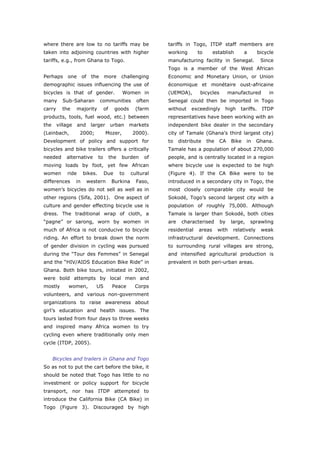
Figure 3: ITDP's California Bike (shown by
captain of the Ghanaian cycling team)              Bicycle trailers are being used in many
Photo by author                                    world regions to broaden the mode share
                                                   for transit. Trailer use may be most
                                                   pragmatically applied in secondary urban
                                                   areas and the urban periphery where
                                                   access        to     transportation            is     more
                                                   constrained than in capitol cities such as
                                                   Accra    or        Lomé.       The     development        of
                                                   prototype bicycle trailers has a history of
                                                   mixed success in Ghana, but the extent to
                                                   which trailers are being used in Togo is
                                                   unclear. Development of trailers as bicycle
                                                   powered            “ambulances”            has        been
                                                   undertaken to assist in urgent medical
                                                   care where vehicle access is limited. Bike
                                                   ambulances produced in Ghana are now
                                                   being used in Uganda with considerable
Figure 4: Locator map for Tamale and
                                                   success (Gauthier 2005).
Sokodé

                                                   One of the few critiques of bicycle trailer
Given the obvious need to have quality,
                                                   projects comes from Ghanaian researcher,
affordable bikes, with readily available
                                                   M.   Salifu        (1994).        In    the    Transport
replacement    parts     and   repairs,   before
                                                   Rehabilitation pilot project in Northern
bicycle trailers can be used, the first stage
                                                   Ghana, supported by the World Bank, the
of the bicycle sale and support project
                                                   bicycle and trailer combination was often
discussed below was to survey the market
                                                   unaffordable.            Salifu        concludes        that
for quality bikes. Cooperation with the
                                                   although the trailer was a reasonable
Togo   Ministries   of   Transportation     and
                                                   technology, it was inappropriate given the
Agriculture will be requisite to the long
                                                   failures of the pilot project. Several key
term promotion of intermediate transport
                                                   findings are worthy of note: the trailers
policy, but more immediately important


World Transport Policy & Practice___________________________________________________                        17
Volume 14. Number 2. July 2008
lacked the structural integrity to haul                                    if travel is made by bike, cost of
heavy       loads,        the      trailers    were         cost           bicycles remains an impediment
prohibitive, and as noted above, generally,                                for      subsistence               farmers,           but
women do not use bikes (Salifu, 1994).                                     remains affordable for many urban
Furthermore, the trailers did not perform                                  residents;
well on village footpaths (Starkey et al,                                  availability          of     “quality”          bicycle
2001). As a result, the Togo pilot project                                 repairs,        parts        and     accessories,
discussed below will target two different                                  including               trailers           remains
trailers.        First,    an       affordable,       locally              problematic in the region;
produced,          two-wheel          trailer       will     be            average income of bicycle owners
designed for urban areas, and at a later                                   varies from low to high (wide
date, a single-wheel trailer designed for                                  range, but fewer in upper income
use   on         single-track       footpaths        will    be            range use bicycles as primary form
developed          in      hopes       that     diversified                of transport).
smallholders will be able to afford a light-
weight, simply constructed vehicle.                                Currently,     avenues          for       funding        of    a
                                                                   shipment of the California Bikes is being
Where bicycle use is high, and/or markets                          explored      jointly        with    ITDP     and        other
offer promise, it would follow that the use                        interested         organisations.                  It          is
and sales of bicycle trailers might also                           hypothesised        that            not     only         urban
accelerate. Hence, the objectives of the                           household members, but also diversified
pilot project are two-fold: to identify urban                      smallholder farmers with more than 3
and urban periphery transport challenges                           hectares under production could benefit
related      to      the      movement          of     goods       from affordable bikes and trailers. As
between           villages,        farms      and      urban       prototype      two-wheel             and     single-wheel
centers; and to develop a sustainable                              bicycle trailers are developed, tested and
bicycle trailer construction program for                           introduced in Central Togo, attention can
improved           rural      to     urban       transport.        be shifted to larger scale production and
Administration of a brief survey of urban                          marketing of trailers in Togo, or perhaps
household          members,          smallholders,          and    Senegal where CA Bikes are produced. By
cyclists in the Sokodé urban and peri-                             surveying women and developing a trailer
urban area of Central Togo in June of 2006                         that may be converted to a hand cart, the
identified the following:                                          Bicycle Trailer Pilot Project (BTPP) in Togo
                                                                   will   take       issues            of     gender          into
            the most common means by which                         consideration           in      the        testing         and
            household members travel to work                       introduction of this appropriate technology
            is    still    by      foot,      followed       by    program. The BTPP will attempt to form a
            bicycles, but use of motor scooters                    partnership             between              researchers,
            is increasing rapidly;                                 smallholders,      the         Togo        Ministries          of
            average distances and travel times                     Agriculture and Transportation, ITDP, and
            for travel to work vary widely                         perhaps the U.S. Agency for International
            according to rural versus urban or                     Development.
            peri-urban settings;
            average cost of travel to work                                                                      Conclusions
            remains low, while increasing fuel                     Urban transportation planning is often
            prices favor cycling;                                  focused on mass transit and roadway


World Transport Policy & Practice___________________________________________________                                             18
Volume 14. Number 2. July 2008
improvements              that          inadvertently          bicycle use in countries such as Togo could
perpetuate       dependence        on      the        singly   also      expand        rapidly.       If         bicycle
occupied      vehicle.     As     transit     oriented         manufacturing within the West African
development becomes more widespread,                           Monetary and Economic Union can be
alternative modes of walking and bicycling                     achieved, perhaps marketing of quality,
may     be    revitalised     despite       trends        in   affordable      bike     trailers     will        follow.
primary cities such as Shanghai where                          Transportation survey data from West
bicycle ridership has begun to decline.                        African urban and peri-urban areas, as
Direct cooperation between organisations                       well   as    the      development           of    trailer
such as the Institute for Transportation                       prototypes will undoubtedly assist us in
and     Development         (ITDP)      and      cycling       meeting      the      demand        for      improved
advocates in secondary cities, such as                         movement of both agricultural goods and
Tamale in north central Ghana and Sokodé                       commuters.
in central Togo, are critical to providing
reliable intermediate transport to those                                                                 References
who cannot afford private vehicles. While                      American             Public          Transportation
some transportation specialists and many                       Administration.        2002.        APTA         Transit
elite   in   Sub-Saharan          Africa     anxiously         Ridership Report. www.apta.org
embrace motorised vehicles, some are                           Author unknown. 2003. Is the wakening
realizing the value of less polluting, more                    giant a monster? Economist magazine Feb.
dependable, efficient, quality bicycles for                    13, 2003
commuting to work, school, the market                          Bureau of African Affairs, US Department
place or other destinations.                                   of     State.        2005.         Togo          Profile.
                                                               www.state.gov
Development of the market for quality                          Dhliwayo, M. E.           2007.       Road Safety
bicycles such as the California Bike may be                    Development in Africa. Presentation at the
key to promoting non-motorised transport                       Economic Commission for Africa, African
in Africa. Currently, those countries with                     Road Safety Conference in Accra, Ghana,
growing GDP per capita are being targeted                      February 5-7, 2007.
for bicycle sales, yet countries plagued by                    Dorsey,         B.       1999.            Agricultural
political unrest and faltering economies                       intensification,        diversification,              and
may miss these marketing opportunities.                        commercial production among smallholder
In fact, countries such as Togo may be in                      coffee growers in central Kenya. Economic
greatest need of bicycles and trailers to                      Geography 75(2): 178-195.
perpetuate food security in the urban                          European Commission. 2003. Clean Urban
periphery. As less expensive, but adequate                     Transport. www.europa.eu.int
quality        bicycles          from            Chinese       European Union Council.             2005.        Records
manufacturers saturate the market outside                      from the Council of the EU. Official Journal
of China, countries with low import tariffs                    of the European Union no. L 183.
will capitalise on intermediate transport.                     Gauthier, A. & Hook, W.             2005. Tapping
Ghana’s recent per capita bicycle sales                        the market for quality bicycles in Africa.
that exceed those of China indicate that                       Sustainable Transport 19: 8-11, 30.
the African market should not be ignored                       Gauthier,    A.      2005.     Scaling           up   for
as it has been for decades. However, given                     healthcare mobility in Africa. Sustainable
that    actual     bicycle       ridership       is     not    Transport 19: 20-23, 25.
necessarily      correlated      with    bike         sales,   Hook, W. 1995. Economic Importance of


World Transport Policy & Practice___________________________________________________                                  19
Volume 14. Number 2. July 2008
Non-motorised Transportation.                                     Sifa (Société Industrielle du Faso). 2001.
Transportation Research Record #1487.                             Production et distribution de vélos en
Washington, DC: Transportation Research                           milieu   rural    cas    de     la    Sifa     (Société
Board, National Research Council.                                 Industrielle du Faso). Paper presented at a
Howe, J. 1997. Transport for the Poor or                          Group Forum National du Burkina seminar
Poor Transport? A General Review of Rural                         on    gender     and    transport,          3-5   April,
Transport Policy in Developing Countries                          Ouagadougou, Burkina Faso.
with    Emphasis            on     Low-Income          Areas.     Summerville, P. 2005. A Bicycle Built for
Geneva: International Labour Office. ISBN                         Two. Report on Canadian International
92-2-110473-7.                                                    Trade Tribunal.
Institute            for         Transportation             and   http://paulsummerville.ca/node/126
Development Policy (ITDP). 2005. Non-                             Starkey, P., Ellis, S., Hine, J., & Ternell, A.
motorised              transport             in        Africa.    2002. Improving Rural Mobility: Options
www.itdp.org                                                      for   Developing        Motorised           and     Non-
International Bicycle Fund.                  2005. Bicycle        motorised Transport in Rural Areas. World
Statistics. www.ibike.org                                         Bank Technical Paper No. 525.
Jacobs, G. and A. Aeron-Thomas.                        2000.      US    Census       Bureau.       2000.         Census.
Africa Road Safety Review Final Report.                           www.census.gov
Published        by        the    U.S.    Department         of   World Bank. 2002. Cities on the Move: A
Transportation               /      Federal          Highway      World    Bank     Urban       Transport       Strategy
Administration.                                                   Review. Washington D.C.: World Bank
Krug, E. 2007. Preventing Road Traffic                            Publications.
Injuries.        World           Health      Organization,        World Watch Institute. 2001. State of the
Department            of     Injuries       and      Violence     World    2001.     World       Watch         Institute:
Prevention.                                                       Washington DC.
Leinbach,        T.         R.     2000.         Mobility    in
development                      context:           changing                         Author contact information
perspectives, new interpretations, and the                        Bryan    Dorsey,       Associate          Professor   of
real     issues.            Journal         of     Transport      Geography,       Department          of    Geography,
Geography 8: 1-9.                                                 Weber State University, 1401 University
Litman, T., Blair, R., Demopolous, W.,                            Circle, Ogden, UT       84408-1401            USA
Eddy,      N.,    Fritzel,         A.,   Laidlaw,      D.,   &    Tel.: +1 801 626 6944
Maddox, H. 2000. Pedestrian and Bicycle                           Fax.: +1 801 626 7130
Planning:        A     Guide        to    Best     Practices.     E-mail: BDorsey@weber.edu
Victoria    Transportation               Policy     Institute,
Victoria BC, Canada. <www.vpti.org>.                              Bryan Dorsey holds a Ph.D. in geography
Mozer, D. 2000. Transportation, Bicycles                          from the University of Colorado-Boulder
and Development in Africa. International                          (1996). He specialises in environment and
Bicycle Fund: Seattle, WA.                                        society interactions, specifically, land use
Salifu, M. 1994. The cycle trailer in Ghana:                      planning    and     rural      development.           He
A       reasonable                 but       inappropriate        coordinates the interdisciplinary Urban and
technology.           African       Technology         Forum      Regional Planning Program at Weber State
7(3): 37-40.                                                      University in Ogden, Utah.


World Transport Policy & Practice___________________________________________________                                    20
Volume 14. Number 2. July 2008
An International Review of The Significance of Rail in
Developing More Sustainable Urban Transport Systems in
Higher Income Cities

Jeff Kenworthy

                                   Introduction      income cities where there appears to be
With growing attention being paid to                 less financial capacity to afford the extra
sustainability   issues,    most    cities     are   capital costs of rail systems (Badami
making efforts to restrain the growth in             2005). Others argue that rail systems in
automobile dependence. Many avenues                  general have greater intrinsic passenger
are available to cities in the pursuit of this       appeal and that they compete better with
goal. Physical planning policies can aim to          cars (Newman and Kenworthy 1991).
make development more compact with                   Hass-Klau       et       al     (2003)     have           made
mixed land uses, thus building in less               extensive studies of European cities with
auto-dependence at the start (Cervero                and without light rail systems and have
1998, Newman and Kenworthy 1999a).                   concluded strongly that those cities that
Economic policies towards the automobile             develop         LRT           systems         consistently
can seek to minimise car ownership and               outperform, across many criteria, those
use through higher prices that perhaps               cities that attempt to run their public
better reflect the car’s true social cost, as        transport systems only using buses.
has happened in Singapore for example
(Ang 1990, 1993). Amongst these efforts,             Likewise, a report from Litman (2004) of
there is a general recognition that the role         the   Victoria       Transport         Policy          Institute
of public transport needs to be enhanced,            called    ‘Rail          Transit         In        America:
along with its companion modes, walking              Comprehensive             Evaluation          of    Benefits’
and cycling, and the latter for reasons of           evaluates       rail’s        benefits   in        terms     of
health, not just transport (Pucher 2002,             transport system performance in 130 U.S.
Pucher and Dijkstra 2003).                           cities. It finds that cities with large, well-
                                                     established rail systems have a wide
Within this general recognition that public          range of system-wide benefits relative to
transport can play a much greater role in            those that have no urban rail (see later).
most cities, arguments exist about the
most appropriate modes to install to                 It is further argued that rail stations are
achieve enhanced public transport use                natural sites for dense residential and
and other desirable qualities, such as               mixed-use development which can help to
cost-effectiveness, integration with land            reshape the city into a more sustainable
uses and ability to shift people out of              urban form (Cervero 1995, Kenworthy
cars. In particular, there is considerable           1995,     Cervero             1998,      Newman             and
debate about buses versus rail               (e.g.   Kenworthy 1999a, Hass-Klau, et al 2004).
Henry 1989, Pickrell 1990). Some argue
that rail is very capital intensive and that         In    order        to         contribute           a      more
well-conceived bus systems can achieve               international perspective on the issue of
the same results at a fraction of the cost           the merits of rail in cities, this paper will
(Bonsall 1985, Kain and Liu 1999). This              explore     a     wide         range     of        transport,
argument    is   strongly    used    in      lower   economic and environmental features in


World Transport Policy & Practice___________________________________________________                              21
Volume 14. Number 2. July 2008
60 higher income metropolitan areas that            Rail in this study is defined as the
have strong urban rail systems compared             combined modes of trams, LRT, metro
to those that have weak rail systems or             and suburban rail. The strong rail cities
no rail systems at all. The term ‘cities’ in        (SRCs) have been defined using three
relation to data in this paper refers               criteria:
generally to whole metropolitan regions,
not the smaller administrative unit at the          •   To be classed as a SRC, cities were
heart of the region, which often bears the              required to have more than 50% of
same name (e.g. City of New York etc.).                 their total public transport task (public
Higher income cities were defined for the               transport passenger travel measured
purposes of this research as those with                 as passenger kilometres) on rail, the
annual GDPs per capita of $US10 000 or                  weak rail cities (WRCs) have rail
more (i.e. it embraced those cities that                systems that account for less than
are generally perceived as being part of                50% of their total public transport
the ‘developed world’, as opposed to cities             passenger kilometres and no rail cities
that are clearly in developing nations). It             (NRCs) have either no rail systems or
will examine the evidence for whether                   rail systems that are so negligible in
urban rail in a city’s public transport                 terms of extent and usage as to be
system appears to make any observable,                  tantamount to having no rail. Cities in
statistically significant difference to the             table 1 that fulfill this last criterion are
broad patterns of transport and related                 Tel Aviv, Denver, Los Angeles and
factors at a metropolitan scale.                        Taipei where rail usage in 1995 is
                                                        negligible due to the existence of only
                                         Method         very small rail systems.
This paper draws upon the Millennium
Cities Database for Sustainable Transport           •   SRCs also had to have no less than
developed     by    Kenworthy      and    Laube         40%           of     total     public        transport
(2001),    which    in   turn   built    on   and       boardings by rail modes.
extended earlier work by Newman and
Kenworthy (1989) and Kenworthy and                  •   Finally, for classification as a SRC,
Laube (1999). Some details about items                  cities        were       required     to     have    rail
in   the   Millennium    database,      including       systems that are competitive with the
definitions        of     indicators          and       car      in    speed         terms.    The     overall
methodologies behind the research can be                average speed of all rail modes in
found in Kenworthy and Laube (1999),                    each city was calculated, weighted by
Kenworthy and Laube et al (1999) and                    passenger hours, and expressed as a
Newman and Kenworthy (1999a). More                      ratio     of       the    average       road    traffic
specific details about other variables in               speed.         Only       those     cities    with   an
the Millennium database are available                   average rail speed that was equal to
from the author.                                        or greater than 0.90 of the road
                                                        speed were classed as SRCs. Most
The list of 24 ‘strong rail’, 28 ‘weak rail’            SRCs exceeded this criterion, often by
and 8 ‘no rail’ cities involved in the                  a considerable margin.
research in this paper, together with their
1995/6 populations, appears in table 1.


World Transport Policy & Practice___________________________________________________                          22
Volume 14. Number 2. July 2008
STRONG              POPULATION          WEAK RAIL      POPULATION       NO             POPULATION
RAIL                (1995/6)            CITIES         (1995/6)         RAIL           (1995/6)
CITIES                                                                  CITIES
Washington          3,739,330           Calgary        767,059          Ottawa         972,456

New York            19,227,361          Atlanta        2,897,178        Denver         1,984,578

Brisbane            1,488,883           Chicago        7,523,328        Houston        3,918,061

Sydney              3,741,290           S. Francisco   3,837,896        L. Angeles     9,077,853

Wellington          366,411             Montreal       3,224,130        Phoenix        2,526,113

Barcelona           2,780,342           San Diego      2,626,714        Bologna        448,744

Berlin              3,471,418           Toronto        4,628,883        Taipei         5,960,673

Berne               295,837             Vancouver      1,898,687        Tel Aviv       2,458,155

Brussels            948,122             Melbourne      3,138,147

Frankfurt           653,241             Perth          1,244,320

Hamburg             1,707,901           Amsterdam      831,499

London              7,007,100           Athens         3,464,866

Madrid              5,181,659           Copenhagen     1,739,458

Munich              1,324,208           Dusseldorf     571,064

Oslo                917,852             Graz           240,066

Paris               11,004,254          Helsinki       891,056

Ruhr                7,356,500           Lyon           1,152,259

Stockholm           1,725,756           Marseille      798,430

Stuttgart           585,604             Nantes         534,000

Vienna              1,592,596           Rome           2,654,187

Zürich              785,655             Geneva         399,081

Osaka               16,828,737          Glasgow        2,177,400

Sapporo             1,757,025           Newcastle      1,131,000

Tokyo               32,342,698          Manchester     2,578,300

                                        Milan          2,460,000

                                        Hong Kong      6,311,000

                                        Singapore      2,986,500

                                        Seoul          20,576,272


Table 1: Strong rail, weak rail and no rail cities in the study


The Millennium Cities Database contains                 are clearly located in ‘developing nations’.
complete data for 84 metropolitan areas                 However, Eastern European cities such as
worldwide, of which 24 can be considered                Prague in 1995 had low GDPs per capita
as lower income (i.e. with a GDP per                    but cannot be considered as ‘developing
capita      of   less   than    $US10   000     per     cities’, whilst South African cities present
annum). All of these cities, apart from                 a starkly mixed picture whose GDPs per
those in Eastern Europe and South Africa,               capita are low because of the huge


World Transport Policy & Practice___________________________________________________               23
Volume 14. Number 2. July 2008
majority    poorer     populations.        Attempts       these are shown in the last column of
were made to conduct the analysis of the                  each table, with significant results marked
role of urban rail in all these lower income              with an asterisk*.
cities as well, but by the criteria just
described, only three of these 24 cities                                                Urban form and GDP
could be considered as having strong rail                 Table 2 shows the differences in urban
systems. A larger sample of lower income                  form between the groups of cities, as
cities worldwide for which comprehensive                  reflected by density and centralisation of
and reliable data were available would                    jobs, as well as economic differences in
yield more SRCs so that the analysis                      the cities expressed through the GDP per
could be meaningfully conducted, but this                 capita of the urban regions.
was not possible for this paper. The focus
of this paper is therefore on cities in the               Although            urban        densities        are
‘developed world’, as shown in table 1                    systematically higher in the cities with rail
whose GDPs per capita range from $US10                    and lowest in the no rail cities, the result
305 up to $US54 692 per annum.                            is     not   statistically      significant.    Since
                                                          density      is a powerful determinant of
Tables 2 to 7 systematically examine how                  transport patterns, especially private car
the strong rail, weak rail and no rail cities             use (e.g. Kenworthy and Laube et al
perform on a wide range of factors using                  1999, Newman and Kenworthy 1999), it
1995/6 data. The values for each variable                 is useful for the purpose of this research
in the tables are the medians for the                     that differences in densities between the
three groups of cities, since the data in                 three groups of cities are not significant.
each    case        are    generally        skewed        On the other hand centralisation of the
distributions where the median value is a                 city, as measured by the proportion of
better representation than the mean. In                   metropolitan jobs in the CBD, is clearly
order to test the statistical significance of             highest in the SRCs (18.2%) and lowest
the difference amongst the medians, the                   in the NRCs (10.2%) and the differences
nonparametric Kruskal-Wallis test from                    are statistically significant. This might be
SPSS was used. The Kruskal-Wallis test is                 expected, given the link between radial
used for simultaneously testing multiple                  urban rail systems and the development
cases   and     eliminates         the     increased      of   strong       city   centres,     through   rail’s
probability    of    significant     results       that   capacity     to     deliver   large     numbers    of
occurs where, in this case, three separate                people into small areas (Thomson 1978).
pair-wise      tests      could      have         been
undertaken for each variable. Since the                   Amongst these high-income cities, the
samples are relatively small and the                      SRCs are clearly wealthier than both other
asymptotic     significance        value     is    not    groups of cities in a statistically significant
accurate      enough,      the      Monte         Carlo   way, and as the next section shows, they
simulation of the Kruskal-Wallis test was                 are also more public transport-oriented.
employed using 100 000 iterations, which                  This    undermines        the    idea    that   cities
gives a 99% confidence level for the p-                   inevitably become more auto-dependent
value (significance of the difference in the              and move inexorably away from public
medians for each variable). P-values of                   transport as they become wealthier. In
0.05 or less (95% confidence level) were                  this significant international sample of
considered     statistically      significant      and    higher income cities, the reverse would


World Transport Policy & Practice___________________________________________________                         24
Volume 14. Number 2. July 2008
appear to be true. We have argued                             The additional relevance of some of these
elsewhere      that        excessive    automobile            data to the arguments made in this paper
dependence drains the economy of cities                       will    become        more     apparent        in    later
and there is some tacit support for this in                   discussions.
the results in table 2 (e.g. see Kenworthy
et al 1997).


                                                        Strong           Weak Rail               No                 p-
Urban form and GDP                                     Rail Cities           Cities          Rail Cities          value


Urban density (persons per ha)                         47.6             36.6                 27.7                0.453
Job density (jobs per ha)                              27.4             16.1                 13.4                0.293
Proportion of jobs in the CBD (%)                      18.2%            14.6%                10.2%               0.008*
Metropolitan GDP per capita (US$1995)                  $35,747          $26,151              $27,247             0.014*


Table 2: Median values and statistical significance for urban form and GDP in strong, weak
and no rail cities (1995)


          Operational performance of public                   three to four times higher in the SRCs
                                          transport           than in the NRCs, depending on the
Table 3 examines differences in public                        measurement            used.    This     is   especially
transport       operational            performance            interesting in the light of the urban
(service and use). The first item reveals a                   density data in table 2, which show that
key basis for the formation of the groups                     there     is     no      statistically        significant
of cities. It shows how the SRCs clearly                      difference in the median population and
rely much more heavily on rail systems to                     job densities between the three groups of
deliver public transport mobility, with a                     cities.
median      value     of    74%    of    passenger
kilometers on rail modes, compared to                         Interestingly, however, despite these big
43% and 0.4% respectively for the other                       differences in the supply and use of public
two groups of cities.                                         transport,       per     capita       use     of    public
                                                              transport energy is only some 1.6 times
Looking     more      broadly     at    the   public          higher in the SRCs than in the NRCs,
transport operational measures, table 3                       though     the        difference        amongst       the
shows that the supply of public transport                     medians on this factor is statistically
service rises systematically from NRCs to                     significant.      This         demonstrates            the
SRCs for both vehicle and seat kilometres                     intrinsically     high     energy       efficiency         of
of service per capita. SRCs have over four                    public    transport       systems        in   providing
times higher seat kilometres of service                       mobility (i.e. service and use are four
per capita than the NRCs. In usage, there                     times higher in the SRCs compared to the
is the same ascending pattern from NRCs                       NRCs,     while       energy      use    to    run    the
to   SRCs      for     boardings,        passenger            systems is only 1.6 times higher).
kilometres and the proportion of total
motorised passenger kilometres on public
transport. Public transport use is some


World Transport Policy & Practice___________________________________________________                                 25
Volume 14. Number 2. July 2008
Strong         Weak     No        p        -
Public transport operational performance indicators                        Rail           Rail     Rail      value
                                                                           Cities         Cities   Cities
Percentage of pubic transport passenger kms on rail                        74%            43%      0.4%      0.000*
Annual public transport vehicle kilometres of service per capita           77             50       29        0.000*
Annual public transport seat kilometres of service per capita              4,086          2,704    969       0.000*
Annual public transport passenger trips per capita                         275            188      77        0.002*
Annual public transport passenger kms per capita                           1,628          975      496       0.000*
Percentage of total motorised passenger km on public transport             21.8%          12.3%    5.3%      0.004*
Annual public transport energy use per capita (megajoules: MJ)             1,107          880      675       0.019*


Table 3: Median values and statistical significance for operational performance of public
transport in strong, weak and no rail cities


Overall, each of the factors in table 3                  The SRCs have the lowest total per capita
varies in a strong, statistically significant            road supply and lowest per capita freeway
way in favour of greater rail-orientation of             provision of all three groups of cities and
the city. This suggests that for public                  the NRCs have the highest. For example,
transport to maximise its role within the                the NRCs have 71% greater per capita
passenger transport systems of cities in                 supply of freeways than the SRCs and
the developed world, it would appear                     65% greater road provision. Although in
necessary to move increasingly towards                   both cases the differences amongst the
urban rail as the backbone and mainstay                  median values between the groups are
of those systems.                                        not significant, the consistent direction of
                                                         the results suggests that higher income
Transport infrastructure and infrastructure              cities with more significant rail systems
                                   performance           appear to be able to function with fewer
Table 4 presents a range of public and                   roads and freeways.
private          transport        infrastructure
parameters for the three groups of cities.               Perhaps not surprisingly, the data show
                                                         that      SRCs   have     very     much   reduced
The data on the extent of transport                      parking supply in their CBDs (68% less
infrastructure        and         infrastructure         than the NRCs), as do WRCs (48% less
performance reveal, not unexpectedly,                    than NRCs). This is due to rail’s capacity
that the SRCs have very significantly                    for effectively delivering high volumes of
higher reserved public transport route on                people into constrained sites such as
a spatial and per capita basis. The vast                 CBDs and sub-centres, which eliminates
majority of reserved right-of-way (ROW)                  the need for the extensive CBD parking
in cities is rail; physically segregated                 areas found in cities that have no rail
busways are very rare (which can be                      systems. Thomson (1978) found similar
inferred from the fact that in the NRCs,                 results in his ‘strong-centre’ cities.
which     have    either     no   or   negligible
amounts of rail ROW, the quantity of
reserved public transport route in total is
indeed very small).


World Transport Policy & Practice___________________________________________________                        26
Volume 14. Number 2. July 2008
Strong        Weak            No          p-
Transport infrastructure and performance indicators                           Rail          Rail            Rail        value
                                                                              Cities        Cities          Cities
Total length of reserved public trans. routes per 1000 persons                172           78              7           0.000*
Total length of reserved public transport routes per urban ha                 9.0           3.0             0.4         0.000*
Length of road per capita (metres)                                            3.0           4.1             5.8         0.398
Length of freeway per capita (metres)                                         0.070         0.098           0.120       0.282
Parking spaces per 1000 CBD jobs                                              186           303             585         0.002*
Total private and collective passenger VKT per km of road                     2,026,433     1,461,402       1,615,749   0.708
Overall public transport system speed (km/h)                                  31.3          23.8            22.6        0.000*
Ratio of public transport system speed to road traffic speed                  0.86          0.70            0.49        0.000*


Table 4: Median values and statistical significance for transport infrastructure and
infrastructure performance in strong, weak and no rail cities


Finally, the data in table 4 show that in                     significant with p-values of 0.000 in each
the high-income cities, the intensity of                      case. It has been suggested elsewhere
road usage or congestion, as measured                         that it is this relative speed between
by     the   total        private     and        collective   public and private transport that is a
passenger VKT per kilometre of road, is                       critical factor in giving public transport a
highest in the SRCs, but the differences in                   competitive edge over private transport
the      medians          are      statistically      very    (Laube 1998, Newman and Kenworthy
insignificant. The more important point                       1999a, b).
here, however, is not so much the level of
congestion          as      the      competitiveness          Overall, it can be suggested that rail
between private and public transport. In                      systems help in minimising the amount of
this respect it is very clear that the more                   road, freeway and parking infrastructure
rail-oriented       the    city,     the    higher     the    required   in     cities    and     are   a   central
overall average public transport speed for                    ingredient in developing public transport
all modes (39% higher in SRCs compared                        systems that can successfully compete
to NRCs) and the higher the ratio between                     with cars in the critical area of travel
the overall speed of the public transport                     speed.
system and the speed of general road
traffic. The median value of this ratio for                                          Private transport patterns
SRCs is 0.86, while for the NRCs it is only                   Table 5 provides a core set of data related
0.49, which suggests that in speed terms                      to   patterns     of     private    transport      and
public transport will generally struggle                      broader modal split in the three groups of
against the car in wealthier cities with no                   cities.
rail systems, while in cities with strong
rail   systems,          public     transport       speed     The data reveal that in terms of modal
competitiveness will be much better.                          split, there is a systematic pattern in
                                                              these high-income cities of enhanced use
The results for both the overall speed of                     of both non-motorised modes and public
public    transport        and      the    speed      ratio   transport and reduced use of private
between      public transport              and    general     modes the more rail-oriented are the
road      traffic        are      statistically       very    cities, and the results have a high level of


World Transport Policy & Practice___________________________________________________                               27
Volume 14. Number 2. July 2008
statistical significance. For example, in                between the car ownership and actual car
the SRCs, the median value for the                       travel (VKT and passenger kms per capita
percentage of total daily trips by private               in cars and motor cycles) in SRCs and
transport is 47%, whilst in the NRCs, it is              WRCs. However, there is a considerable
84%. The WRCs also have only 56% of                      difference      between         these      more        rail-
daily trips by private transport. Likewise,              oriented cities and the cities with no rail,
the median value for non-motorised mode                  though overall the differences amongst
use is almost three times greater in the                 the     medians          are        not       statistically
SRCs     than       the     NRCs,       while   public   significant. Despite this lack of overall
transport use for daily trip making is                   statistical     significance           amongst          the
some four times higher.                                  medians, the NRCs do have about 70%
                                                         higher median car use than both the SRCs
Despite this modal split pattern, table 5                and WRCs.
reveals that there is very little difference


                                                                       Strong         Weak         No            p-
Private transport indicators                                           Rail           Rail         Rail          value
                                                                       Cities         Cities       Cities
Total cars and motor cycles per 1000 people                            463            476          544           0.256
Private passenger vehicle VKT per capita (cars + mc)                   5,133          5,151        8,732         0.276
Private vehicle passenger kilometres per capita (cars + mc)            6,981          7,014        11,736        0.252
Percentage of all trips by non-motorised modes                         31.2%          20.8%        11.3%         0.001*
Percentage of all trips by public transport                            19.3%          13.8%        4.7%          0.007*
Percentage of all trips by private transport                           47.5%          56.3%        83.8%         0.000*


Table 5: Median values and statistical significance for private transport indicators in strong,
weak and no rail cities


What     is   quite       interesting     about   this   between urban density and car passenger
pattern of private transport use is its                  kilometres per capita, the NRCs could be
relationship to the density and GDP data                 expected to have approximately 2 700
presented earlier. First, there is a very                more car passenger km per capita than
strong        and     statistically        significant   the SRCs. In fact, the difference in Table
negative      relationship       found      between      5 is 4 700, perhaps suggesting that
urban density and private transport use                  without       the     superior       public     transport
per capita in the higher income cities in                systems of the SRCs, the NRCs struggle
this study (R2 of 0.8392); it is virtually               to substitute car use with public transport
the strongest correlation found between                  use. There is some support for this
all the variables in the entire database. As             suggestion in the literature in what is
such it could be expected that the NRCs,                 known as the ‘transit leverage effect’
with a lower median value of urban                       where     one        passenger        km       of     public
density (27.7 per ha) than the SRCs (47.6                transport           travel     replaces             multiple
per ha), would tend to have higher car                   kilometres of travel in cars (Neff 1996,
use per capita, just based purely on their               Newman and Kenworthy 1999).
more sprawling land use patterns. Based
on the equation of the regression curve


World Transport Policy & Practice___________________________________________________                              28
Volume 14. Number 2. July 2008
Furthermore, it is clear that the SRCs in                         effectively and minimising environmental
this study have significantly higher GDP                          impacts (e.g. none of public transport’s
per capita than either the WRCs or the                            benefits to non-users such as congestion
NRCs (37% and 31% respectively: see                               minimisation appear on the credit side of
table    2).       It   is    thought             by    some      the balance sheet), and that the word
commentators that greater wealth in a                             ‘subsidy’ is something of a misnoma, it is
city    tends       inevitably          towards        higher     nevertheless important to examine this
automobile         dependence              and      therefore     factor. The data show that it is the SRCs
that the SRCs would be unlikely to have                           that have the best recovery of operating
equal or lower car use than the WRCs and                          costs (60%) with WRCs at 51%, while the
NRCs with their considerably lower GDP                            NRCs recover a much lower figure of 35%
per capita (Gomez-Ibañez 1991, Lave                               and these differences in the medians are
1992). Again, it would appear that the                            statistically   significant.    Although       the
NRCs      are        experiencing            considerably         differences in average public transport
higher dependence on the car than either                          vehicle occupancy in table 6 are not
their urban form or wealth characteristics                        statistically significant, the SRCs do have
would point towards.                                              16% higher occupancy than the NRCs,
                                                                  which would partly explain the better cost
The data on private transport and overall                         recovery    result.   Rail     cities   tend    to
modal split strongly suggest that rail is a                       concentrate public transport services into
significant factor in minimising automobile                       more     focussed     corridors     with   more
dependence in cities in the developed                             transit-supportive     land       uses,    which
world. Strong rail systems apparently help                        generally deliver higher patronage per
in developing urban characteristics that                          unit of service supplied. On the other
together favour less private transport use                        hand, cities with no rail or those relying
(though        not      necessarily               statistically   solely or almost solely on buses, tend to
significant        lower     car       +     motor       cycle    have public transport systems that have
ownership),         and      greater         capacity       to    to ‘chase’ fewer patrons through lower
exploit both public transport and non-                            density settings, which inevitably detracts
motorised modes.                                                  from higher rates of cost recovery.


                                       Economic factors
Table    6     summarises           some           important
indicators of the economic performance of
urban systems in relation to transport.


Many      discussions              on        the       overall
effectiveness of urban public transport
systems focus on the ‘subsidy’ afforded to
public transport, particularly as reflected
in the operating cost recovery of the
system. Whilst it can be argued that this
focus constitutes a very limited view of
the     significance         of     public          transport
systems       in    keeping        a       city    operating


World Transport Policy & Practice___________________________________________________                             29
Volume 14. Number 2. July 2008
Strong       Weak            No Rail    p-
Economic indicators                                                      Rail         Rail            Cities     value
                                                                         Cities       Cities
Public transport operating cost recovery (%)                             60%          51%             35%        0.037*
Overall public transport vehicle occupancy                               19.8         17.8            17.0       0.192
Percentage of metro GDP spent on public transport investment             0.42%        0.20%           0.10%      0.000*
Percentage of metro GDP spent on road investment                         0.73%        0.72%           0.88%      0.774
Total passenger transport cost as percentage of metro GDP                9.03%        9.27%           11.78%     0.018*


Table 6: Median values and statistical significance for economic indicators in strong, weak
and no rail cities


The other three economic items in table 6             therefore likely to be more competitive
refer to how much of the GDP of the cities            economically than cities which sink a
is spent on investing in their public                 higher proportion of their wealth into
transport and road systems and how                    transport functions.
much    of      their   GDP    they    spend    on
passenger transport as a whole (both                                              Environmental factors
public and private transport operating and            Transport systems produce a range of
investment costs from all sources). The               environmental impacts, taken here to
patterns are quite clear and statistically            include      energy            use        and       deaths
significant: the more rail-oriented the               attributable to transport accidents. Table
cities, the greater proportion of their GDP           7     highlights    the     relatively       favourable
goes back into investment in their public             position of the more strongly rail-based
transport systems, and the lower is the               cities in minimising these impacts.
overall cost to the society of running the
entire passenger transport system (9.0%               Per    capita      use    of    energy       in     private
of metro GDP in SRCs compared to 11.8%                passenger transport increases as cities
in NRCs). The cities with rail also spend             become less rail-oriented, with the NRCs
less of their GDP on road investment, but             being 144% higher in this factor than the
the overall differences in the median                 SRCs. Because the SRCs and the WRCs do
values between the groups of cities is not            not vary very much in their median
statistically    significant    on    this   factor   values, the overall differences in the
because of the virtually identical result             medians are not statistically significant,
between the SRCs and WRCs.                            even though there is this clear difference
                                                      in private transport energy use between
In summary, the economic data suggest                 cities that have rail and those that don’t
that in this sample of developed world                (as there was with car use in table 5).
cities, those where rail is a strong feature
have   greater      wealth     and    more   cost-    Per     capita     generation        of     local      smog
effective urban transport systems overall.            producing        emissions           from       transport
They are also investing more in the                   (nitrogen oxides, carbon monoxide, sulfur
quality of their public transport systems.            dioxide and volatile hydrocarbons) is also
Such cities would appear to be wasting                much higher in the NRCs than in the SRCs
less economic resources on passenger                  (100% higher). The pattern of decreasing
transport functions and on this factor are            per capita transport emissions is quite


World Transport Policy & Practice___________________________________________________                            30
Volume 14. Number 2. July 2008
systematic       as     the     strength      of      rail   statistically        significant           pattern      of
increases,   though           the   result    falls     a    increasing transport deaths as the cities
fraction short of statistical significance at                become less rail-oriented and of course
the 90% confidence level. The spatial                        less public transport-oriented as a whole.
intensity of smog emissions also rises                       This is true both for per capita transport
slightly the less rail-oriented the cities                   deaths, which are 129% higher in the
become, but the results fall far short of                    NRCs than in the SRCs, and also deaths
any statistical significance (the median                     per billion passenger kilometres, which
value for the NRCs is only 6% higher than                    are 58% higher. It would appear that the
the SRCs).                                                   more rail-oriented cities become, the less
                                                             exposure there is to the risk of death from
Finally,   the        costs    incurred       through        transport causes, even though the use of
transport-related accidents in cities are                    the   riskier      non-motorised           modes      also
significant, especially the loss of life. The                increases with greater rail orientation.
data in table 7 reveal a consistent and


                                                                                Strong         Weak       No         p-
Environmental indicators                                                        Rail           Rail       Rail       value
                                                                                Cities         Cities     Cities
Private passenger transport energy use per capita (MJ)                          16,381         17,197     39,951     0.317
Total transport emissions per capita (NOx, CO, SO2, VHC: kg)                    96             114        195        0.105
Total transport emissions per urban hectare (kg)                                3,538          3,663      3,753      0.692
Total transport deaths per 100,000 people                                       5.8            7.8        13.3       0.000*
Total transport deaths per billion passenger kms                                6.4            8.0        10.1       0.017*


Table 7: Median values and statistical significance for environmental indicators in strong,
weak and no rail cities


In summary rail systems, through their                       busways. These benefits include higher
capacity to reduce car use and enhance                       public transport patronage, which was
public transport and non-motorised mode                      also found in this international study, but
use, are associated with cities that use                     also a wide range of benefits in other
lower energy for passenger transport and                     factors, which were not examined in this
generate lower local emission loads and                      study,       but    which         help     perhaps      to
transport deaths, both on a per capita and                   understand the favourable results found
per passenger kilometre basis.                               for   rail    modes         in     this    international
                                                             comparison.         Even         though     their     work
                                          Discussion         refers specifically to LRT systems, some
The findings in this study are in line with                  of the findings are likely to be extendable
extensive and detailed work by Hass-Klau                     to rail systems in general. Some of their
et al (2003), Hass-Klau et al (2004) and                     key findings were:
Hass-Klau and Crampton (2002), which
has demonstrated the many system-wide                                 LRT requires the least width of
benefits in European cities of having Light                           corridors – busways require most
Rail Transit (LRT) systems compared to                                width.
only   having         bus     systems,       including                LRT       normally         transports       more


World Transport Policy & Practice___________________________________________________                                 31
Volume 14. Number 2. July 2008
passengers             per       hour      than     The study by Litman (2004) comparing
       standard buses.                                     130     US     cities     with        and    without       rail
       Noise and pollution are lowest                      concluded that those with significant rail
       with LRT                                            systems have:
       Running comfort is best with LRT
       LRT is better in overall urban                            Lower per-capita traffic congestion
       design terms                                              costs.
       LRT and busways are very similar                          Lower per-capita traffic fatalities.
       in cost                                                   Lower per capita consumer transport
       LRT vehicles cost much more but                           expenditures.
       have the longest life expectancy                          Higher per capita public transport
       LRT     is     slightly       cheaper      than           ridership.
       buses, on a whole-life basis for                          Higher        public      transport          commute
       similar levels of service.                                mode split.
       Complementary                 measures       are          Lower public transport operating costs
       critical to the success of public                         per passenger-mile.
       transport          (parking        cost     and           Higher public transport service cost
       availability,        land      use      policies,         recovery.
       pedestrianisation, urban design)
       Buses                need             stronger      Of the above factors that were examined
       complementary measures in order                     in this international study, the results
       to reach their maximum potential.                   were similar. The Litman study found that
       Complementary                 measures       are    residents      in     cities      with       large,       well-
       easier to implement with LRT and                    established rail systems enjoy about half
       important to do in all transport                    the per capita traffic congestion delay as
       projects to maximise the benefits                   people who live in comparable size cities
       of the investment.                                  that lack rail. The reason for this is in line
       Political and psychological factors                 with the findings in this international
       related       to       different      transport     study    that       people       in    cities      with    rail
       modes              modify             financial     systems enjoy lower per capita annual
       considerations            e.g.       successful     vehicle kilometres whilst also having an
       pedestrianisation             schemes        are    effective alternative when travelling on
       strongly linked to implementation                   the most congested corridors. Litman
       of LRT systems.                                     (2004) also found that US cities with large
       Under        equal      conditions        people    rail systems have about a third lower per
       prefer to use LRT than to use                       capita traffic fatality rates. Residents of
       buses.                                              the     strong          rail     cities       also        save
       There are a higher percentage of                    approximately $US450 annually per capita
       higher income groups using light                    in     transport         costs        compared            with
       rail than buses (e.g. in Calgary,                   residents      of    cities      that       have     no    rail
       Canada).                                            systems. The study concluded that rail
       LRT      has       a     strong       potential     system service costs are repaid several
       following among car users, even                     times over by reduced congestion, road
       in    cities           with      no       recent    and parking facility costs, reduced traffic
       experiences of LRT or trams.                        accident       costs,          and     consumer           cost
                                                           savings. Such findings are in line with the


World Transport Policy & Practice___________________________________________________                                   32
Volume 14. Number 2. July 2008
observed comparative differences in this                  The mechanisms for the advantages of
sample of high-income cities around the                   urban rail are complex. However, they
world that have rail systems (e.g. lower                  appear to relate at least in part to the
CBD parking, lower transport deaths, a                    legibility of rail systems and the greater
lower    proportion        of    metropolitan GDP         permanence of rail services, the positive
being    spent     on      passenger        transport,    image of rail in the mind of the public and
better cost recovery for public transport,                business      community          and        people’s
higher public transport use).                             willingness to use rail systems over buses
                                                          for a variety of reasons, including more
Rail also has important impacts on urban                  competitive     travel    speed       and   greater
form in terms of its capacity to increase                 reliability and quality of service.
densities and consolidate both residential
and     mixed      use     development         around     None of this, however, diminishes the
centres or nodes or along corridors. The                  critical role that buses play in public
positive land use impacts of urban rail and               transport systems. Buses are essential
their transport flow-on effects are partly                public transport providers to areas that
responsible for the urban system benefits                 simply cannot be served by rail and there
outlined      in    this        paper.     Nodes    of    are many such areas in most cities, and
development are easier to service with                    buses provide critical feeder systems into
public transport (including bus systems),                 major sub-centres and into rail systems.
walking and cycling are more viable for                   Well-patronised urban rail systems are
more trips and a polycentric city based                   usually associated with strong and healthy
around rail stations can help to minimise                 levels of bus use (Kenworthy and Laube
urban sprawl. These aspects of urban rail                 2001). Where network structures are well
and     its     city-shaping         capacity      are    devised and services well coordinated, rail
discussed in detail in other works (Vuchic                and bus are highly complementary and
1981, Bernick and Cervero 1997, Cervero                   are not in competition with each other,
1998,    Laube,         Kenworthy        and   Zeibots    but rather form an integrated, multi-
1999, Newman and Kenworthy 1999a).                        modal      public    transport        system     that
                                                          provides competition with the car.
                                          Conclusions
Any developed city wishing to build a                     Finally, the arguments and research put
better public transport system, to curb or                forward in this paper should not be read
reduce its automobile dependence and to                   or construed in terms putting one mode of
become        more         environmentally         and    public transport above another merely for
economically       sustainable,           should   not    the   sake    of    it.   This   is    clearly   not
ignore the potential benefits of building a               productive since the best public transport
strong rail backbone as the mainstay of                   systems emerge out of choosing the right
the city’s public transport system. The                   mode for the right task for the multitude
data in this paper point strongly to the                  of situations in any city. Public transport
idea that public transport systems based                  should be seen as a multi-modal system
on buses alone cannot achieve the same                    whose chief aim is to compete with and
positive urban system results across a                    reduce dependence on the car, building a
wide    range      of    factors     as    when    rail   ‘virtuous circle’ rather than a cycle of
systems assume a more significant role                    decline, which has tended to be the story
within the public transport system.                       of public transport in so many cities over


World Transport Policy & Practice___________________________________________________                        33
Volume 14. Number 2. July 2008
the last decade (Kaufmann 2000). Rather,          the world). Phoenix is building a LRT
what the paper has shown is that urban            system at this moment. Likewise Houston
systems,     whether    in     auto-dependent     declined slightly in transit use over the 10
North America or Australia, more transit-         year period and has finally voted to build
oriented Europe, or the wealthier parts of        an extensive LRT system. Los Angeles in
Asia, do seem to gain multiple benefits           the mean time has been aggressively
from developing public transport systems          growing its rail system (light rail, metro
that are anchored and shaped primarily            and commuter rail) and has achieved the
by fixed-track modes, the vast majority of        highest growth rate in transit use of all
which are rail systems, in one form or            the US cities studied (39%, up from 49.1
another. This then forms the basis for a          boardings per capita in 1995 to 68.3 in
superior overall public transport system,         2005). New York, the most rail-oriented
utilising rail modes, buses and in some           of the US cities, was the other big transit
cases ferries, which fills a much greater         winner with a 28% increase in transit use
role in the city’s transport system.              from 131.5 boardings per capita to 167.7
                                                  per capita, the bulk of which came from
Finally, it needs to be said that although        the NY underground. Thus more recent
the analysis in this paper is based on data       data   are tending in        the direction of
from    1995      or   1996,      the   overall   reinforcing the patterns observed in this
conclusions and patterns between the              paper, so that the ageing nature of the
three groups of cities are unlikely to be         data used do not undermine the policy
altered were the analysis to be conducted         value of the results and conclusions.
using later data. In other words, the
systematic     differences   in   the   various                                Acknowledgement
factors found between strong rail, weak           The author wishes to acknowledge the
rail and no rail cities are not ephemeral         very significant contribution of Dr Felix
observations, but are based on strong             Laube, co-author of the Millennium Cities
structural differences between the cities,        Database for Sustainable Transport, in
which reveal themselves repeatedly over           collecting and testing the data that lie
long periods of time. A similar analysis          behind the analyses in this paper. The
was carried out with 1990 data on a more          author      also    wishes       to    gratefully
limited set of cities listed in Newman and        acknowledge work of Mrs Monika Brunetti
Kenworthy (1999a). The same systematic            in the compilation of the 2005 US transit
patterns of variation between the rail            use data referred to in this paper.
cities and no rail cities emerged on the
same variables.                                                                         References
                                                  Ang,      B.W.,    1990,     Reducing       traffic
In addition, the author has begun the             congestion and its impact on transport
update of data on some cities, especially         energy use in Singapore. Energy Policy,
in the USA and the completed transit data         18 (9), 871-874.
for 2005 shows that the US cities with no
rail, such as Phoenix, continue to stagnate       Ang,      B.W.,    1993,    An     energy     and
in transit use with only an 11% increase          environmentally sound urban transport
in annual boardings per capita from an            system:      the     case     of      Singapore.
extremely low level of 15.1 trips per             International Journal of Vehicle Design,
capita up to 16.8 (virtually the lowest in        14 (4).


World Transport Policy & Practice___________________________________________________              34
Volume 14. Number 2. July 2008
Badami, M.G., 2005, The urban transport              light rail, guided buses, busways and bus
challenge      in      India:      Considerations,   lanes (Brighton, U.K.: Environmental and
implications and strategies. International           Transport Planning).
Development Planning Review. 27 (2),                 Henry, L., 1989, Ridership forecasting
169-194.                                             considerations in comparisons of light rail
                                                     and motor bus modes. In: Light Rail
Bernick, M. and Cervero, R., 1997, Transit           Transit:     New      system         successes       at
villages in the 21st century (New York,              affordable prices, Transportation Research
U.S.A.: McGraw Hill).                                Board, Special Report 221, (Washington
                                                     DC,    U.S.A.:      Transportation           Research
Bonsall, J., 1985, A bus for all seasons.            Board), pp. 163-189.
Presented to Seminar on The Canadian
Experience: Making Transit Work in the               Kain, J. and Liu, Z., 1999, Secrets of
Golden      Gate    Corridor,      San   Rafael,     success: Assessing the large increases in
California, U.S.A., October 3.                       transit ridership achieved by Houston and
                                                     San         Diego          transit           providers.
Cervero,     R.,    1995,       Sustainable   new    Transportation Research A 33, 601-624.
towns: Stockholm’s rail served satellites.
Cities, 12 (1), 41-51.                               Kaufmann, V., 2000, Modal practices:
                                                     From the rationales behind car and public
Cervero, R., 1998, The transit metropolis:           transport    use,     to     coherent        transport
A global inquiry (Washington DC, U.S.A.:             policies.   Case     studies        in   France    and
Island Press).                                       Switzerland. World Transport Policy and
                                                     Practice, 6 (4), 8-17.
Gomez-Ibañez, J. A., 1991, A global view
of automobile dependence. Journal of the             Kenworthy,       J.R.,       1995,          Automobile
American Planning Association, 57 (3),               dependence in Bangkok: An international
376-379.                                             comparison with implications for planning
                                                     policies.    World     Transport         Policy    and
Hass-Klau, C. and Crampton, G. (2002)                Practice 1 (3), 31-41.
Future of urban transport learning from
success      and     weakness:        Light   rail   Kenworthy, J.R. and Laube, F.B., 1999,
(Brighton,     U.K.:      Environmental       and    Patterns of automobile dependence in
Transport Planning).                                 cities: An international overview of key
                                                     physical and economic dimensions with
Hass-Klau, C., Crampton, G. and Benjari,             some    implications         for     urban     policy.
R., 2004, Economic impact of light rail:             Transportation Research A 33, 691-723.
The results of 15 urban areas in France,
Germany,       UK      and       North   America     Kenworthy J, and Laube F., 2001, The
(Brighton,     U.K.:      Environmental       and    Millennium          Cities         Database         for
Transport Planning).                                 Sustainable          Transport.              (Brussels,
                                                     Belgium: International Union of Public
Hass-Klau, C., Crampton, G., Biereth, C.             Transport,    UITP       and       Perth,    Australia:
and Deutsch, V., 2003, Bus or light rail:            Institute for Sustainability and Technology
Making the right choice            - A financial,    Policy, ISTP), CD ROM database.
operational and demand comparison of


World Transport Policy & Practice___________________________________________________                     35
Volume 14. Number 2. July 2008
Kenworthy, J., Laube, F., Newman, P. and                      Newman, P. and Kenworthy, J., 1989,
Barter, P.,1997, Indicators of transport                      Cities and automobile dependence: An
efficiency in 37 cities. Report to World                      international sourcebook (Aldershot, U.K.:
Bank,         Institute     for        Science        and     Gower).
Technology Policy, Murdoch University,
Western Australia.                                            Newman, P. and Kenworthy, J., 1991,
                                                              Towards a more sustainable Canberra: An
Kenworthy,        J.      and     Laube,       F.   [with     assessment           of    Canberra's         transport,
Newman, P., Barter, P., Raad, T., Poboon,                     energy and land use. Institute for Science
C.      and     Guia,      B.     (Jr)],     1999      An     and        Technology             Policy,      Murdoch
international sourcebook of automobile                        University, Perth.
dependence in cities 1960-1990 (Boulder,
U.S.A.: University Press of Colorado).                        Newman, P. and Kenworthy, J., 1999a,
                                                              Sustainability           and     cities:    Overcoming
Laube, F. B., 1998, Optimising urban                          automobile dependence (Washington DC,
passenger transport: Developing a least-                      U.S.A.: Island Press).
cost     model         based      on       international
comparison        of      urban     transport       cost,     Newman, P. and Kenworthy, J., 1999b,
transport          patterns,            land          use,    ‘Relative speed’ not ‘time savings’: A new
infrastructure,        environmental         and      best    indicator for sustainable transport. Papers
practice in public transport. PhD thesis,                     of      the    23rd       Australasian        Transport
Murdoch         University,        Perth,       Western       Research            Forum,         Perth,          Western
Australia.                                                    Australia, 29 September – 1 October,
                                                              Volume 23, Part 1. pp. 425-440.
Laube, F.B., Kenworthy, J.R. and Zeibots,
M.E., 1999, Towards a city science: City                      Pickrell, D. H., 1990, Urban rail transit
observation       and      formulation       of a      city   projects: Forecasts versus actual ridership
theory. In: Siedlungsstrukturen, räumliche                    costs (Cambridge, U.S.A.: US Department
Mobilität and Verkehr: Auf dem Weg zur                        of Transportation).
nachhaltigkeit in Stadtregionen, edited by
M. Hesse (Berlin, Germany: Institut für                       Pucher, J., 2002, Renaissance of public
Regionalentwicklung                                    und    transport           in     the      United         States?
Strukturplanung), pp. 99-118.                                 Transportation Quarterly 56 (1), 33-49.


Lave, C., 1992, Cars and demographics.                        Pucher,       J.     and       Dijkstra,     L.,     2003,
Access, 1, 4-11.                                              Promoting safe walking and cycling to
                                                              improve public health: Lessons from The
Litman,       T.A.,     2004,      Rail     transit     in    Netherlands          and       Germany.       American
America: Comprehensive evaluation of                          Journal of Public Health, 93, (9), 1509-
benefits. http://www.vtpi.org/railben.pdf                     1516.


Neff,    J.W.,     1996,        Substitution        rates     Thomson, J.M., 1978, Great cities and
between transit and automobile travel.                        their     traffic         (Harmondsworth,            U.K.:
Paper presented at the Association of                         Penguin).
American Geographers’ Annual Meeting,
Charlotte, North Carolina, April.


World Transport Policy & Practice___________________________________________________                                  36
Volume 14. Number 2. July 2008
Vuchic,     V.    R.,   1981,     Urban   public    Curtin University of Technology in Perth,
transportation: Systems and technology              Western Australia. He is co-author with
(Englewood Cliffs, New Jersey, U.S.A.:              Peter     Newman      of    Sustainability     and
Prentice-Hall).                                     Cities:        Overcoming             Automobile
                                                    Dependence        (Washington       DC:      Island
                   Author contact information       Press, 1999) and principal author with
Jeff     Kenworthy,     Curtin     Sustainability   Felix     Laube      of     An     International
Policy Institute (CUSP), Curtin University          Sourcebook of Automobile Dependence in
of Technology, Kent Street, Bentley, WA,            Cities,   1960-1990 (Boulder: University
6102.                                               Press     of   Colorado,      1999)    and     The
Current Tel No. in Frankfurt: 49 69 1533            Millennium         Cities      Database         for
2753                                                Sustainable       Transport      (Brussels     and
Email: J.Kenworthy@curtin.edu.au                    Perth: UITP and ISTP, 2001). He has
                                                    worked in the areas of urban transport
                                 Authors Bionote    systems and urban planning for 28 years
Jeff Kenworthy is Professor in Sustainable          and is author of some 200 publications in
Cities     in     the     Curtin      University    the field.
Sustainability Policy (CUSP) Institute at


World Transport Policy & Practice___________________________________________________                37
Volume 14. Number 2. July 2008
Bicycle Ambulances in rural Uganda:
Analysis of factors influencing its usage

Corinna Wallrapp and Heiko Faust

                                       Introduction       ambulances       in      selected            villages.
This paper is concerned with the potential                Furthermore factors that promote or limit
of bicycle ambulances to improve the                      its frequency of usage were defined. The
accessibility to health centres in rural                  results are used to improve the projects
Uganda.      The    bicycle     ambulance       is   a    of FABIO/BSPW and the DDHS and to
bicycle     with    an     attached       trailer    to   provide further recommendations.
transport especially seriously sick patients
a maximum distance of 15km to the                         The paper is structured as follows: The
nearest health centre.                                    first section briefly reviews the range of
                                                                            difficulties              accessing
                                                                            health centres commonly
                                                                            faced by men, women
                                                                            and     children          living    in
                                                                            rural areas in developing
                                                                            countries as a result of
                                                                            scarce          means               of
                                                                            transport           and     limited
                                                                            financial resources.
                                                                            The second section of the
                                                                            paper     focuses          on      the
                                                                            case     study       in     Uganda
                                                                            with the analysis of the
                                                                            potential           of       bicycle
                                                                            ambulances to improve
                                                          the accessibility to health centres for the
Figure 1: Photo of a bicycle ambulance                    rural population. Thereby factors related
                                                          to the bicycle ambulance are examined
These        bicycle        ambulances          were      and presented. Two research areas with
distributed to villages or health centres in              different circumstances – the area around
rural     areas    of    Uganda      by   the   non-      Jinja in the central region and the area of
governmental organisations FABIO (First                   District Kabale – are compared with each
African     Bicycle      Information      Office     &    other.
Workshop)           and         BSPW         (Bicycle
Sponsorship Project & Workshop) from                                                    State of the art:
Jinja and by the governmental institution                          Access to health centres in Uganda
Directorate of Health Services (DDHS) of                  The   authors   Thaddeus         et    al.    (1994)
District Kabale. This paper describes the                 constructed a model to categorise barriers
main results of a study carried out in                    for the rural population in developing
Uganda by the author herself. It aimed to                 countries to seek health care. According
analyse      the        usage   of    the     bicycle     to this model, barriers or delays to seek


World Transport Policy & Practice___________________________________________________                           38
Volume 14. Number 2. July 2008
health care can appear on three different                  ‘availability’      and       ‘affordability          of
levels. Firstly, there is the process to                   transport’. In the rural areas of Uganda,
decide that medical treatment is needed.                   where nearly 90 % of the population live,
Secondly, there is the means to reach                      most trips are made by foot. Private
health facilities. Finally, there is the issue             motorised         transport     is        mostly     not
of attaining sufficient medical care in the                available, and public transport, such as
health      centre       itself.      Socio-economic       minibuses are rare and for many people
factors,     culture,            knowledge         about   not    affordable     (Barwell       et    al.,    1985;
facilities, availability and affordability of              Barwell, 1996; Howe, 2001). In Uganda,
transport, road infrastructure conditions,                 animal carts are not common in most
opportunity costs and availability of drugs                regions, yet it is a country with a culture
and medical staff are all examples that                    of    bicycles.    Therefore,        the    means     of
determine access to health services for                    transport    that     is   both       available     and
patients.     Different          case     studies     in   affordable in most villages is the bicycle.
developing        countries        provide    different    With regard to an emergency transport
results and factors which mainly influence                 service however, the bicycle cannot be
the rural population in seeking medical                    used in all situations. In the hilly areas of
treatment. For example, Ensor et al.                       southwest         Uganda      the     patients       are
(2004) focus on the side of the health                     traditionally carried on stretchers to the
seekers rather than on the providers. In                   health centre. In the central region of
their    study        they    conclude        that   an    Uganda they put a chair on the carrier of
improvement in the quality of health care                  the bicycle to enable the patient to sit a
would      not        necessarily       increase     the   little more comfortably and stable.
number of health seekers, because of
their burdens to have access to them.
Other case studies in developing countries                 Figure 2: Stretcher in Kabale District
tone down the distance to the health                       carried by at least four persons
centre (Noorali et al., 1998;
Akin et al., 1999) or emphasise
the cultural constraints, such
as the vulnerability of women
or      disadvantaged              groups
(Katahoire        et      al.,      2004;
Amooti-Kaguna et al., 2000).
Therefore,        they       arrive      at
different results referring to
the     factors       influencing       the
behaviour        of    patients     when
seeking health care. However,
in almost every study about
health-seeking behaviour and
its barriers, the aspect of distance to the
health facility is a described factor.


The term ‘distance’ is related to the
factors of ‘road infrastructure conditions’,


World Transport Policy & Practice___________________________________________________                             39
Volume 14. Number 2. July 2008
for not seeking medical attention from a
                                                     health provider was that the illness was
                                                     mild, followed by statements such as the
                                                     health facility is too costly or is too far.
                                                     Approximately 20% of the population of
                                                     Uganda have to travel more than 5km to
                                                     receive      primary       health     care   (UBOS,
                                                     2006). Yet even the aspired distance by
                                                     the government of a maximum 5km for
                                                     every household is a significant distance
                                                     for    someone       ill     to     travel   without
                                                     appropriate transport.


                                                     According to the study in rural Uganda,
                                                     the most challenging factors affecting the
                                                     people are availability of transport to the
                                                     health centres and the necessary money
                                                     to    meet    the    costs    of     transport     and
                                                     treatment. It can be assumed that some
                                                     people, who lack the means to go to the
Figure 3: Bicycle with a chair on the                health centres, treat themselves or do not
carrier to transport patients                        seek any treatment at all. Thus, the
                                                     introduction of the bicycle ambulance
Both    methods         have     disadvantages;      provides an acceptable, alternative form
transportation is slow and exhausting for            of transport which overcomes the barriers
the people who help to push or carry.                of    availability     and         affordability    of
Additionally, the poor road infrastructure           transport, and improves the accessibility
deteriorates the transport situation. Rural          to health centres.
roads are dirt roads, mostly in a fair
condition yet riddled with potholes. In the
rainy seasons they are often impassable.


Consequently, people in rural areas in
Uganda lack access to social institutions
and    in   particular    to    health    centres.
Referring    to   the     health    sector,   the
services are mainly centralised in the
capital city Kampala, while other smaller
cities and especially the remote areas are
undersupplied      with        adequate    health
facilities and staff. This contributes to a
low life expectancy, high mortality rates
and a high percentage of self-treatment
or visits to traditional healers. According
to a study from the Ugandan Bureau of
Statistic in 2006, the main reason given


World Transport Policy & Practice___________________________________________________                     40
Volume 14. Number 2. July 2008
Analysis of bicycle ambulances in                              •   Can the bicycle ambulance be
                                              rural Uganda                   described      as        an     appropriate
                                 Background of the study                     technology in Uganda?
The first bicycle ambulance was designed
and distributed by the non-governmental                              Data collection took place between March
organisation BSPW in Jinja, Uganda in                                and June 2007 and involved qualitative
1997. Since then, over 400 units have                                interviews with the distributors and the
been       distributed            to     different      districts.   recipient     groups        of        the    bicycle
BSPW promotes non-motorised transport,                               ambulances. A total number of 37 villages
especially the bicycle. Bicycle ambulances                           were selected, whereby in each village,
are       mainly       sponsored            by
international donors. They
are          distributed                    to
community groups or social
institutions           in        the     rural
areas       to     overcome              their
problems          of        transport       in
emergencies.                The        criteria
for the community groups
to        receive            a         bicycle
ambulance                   are          their
relatively high distance to
the nearest health centre
and the existing poor road
and transport infrastructure.
Since 1999, the Directorate
of Health Services (DDHS)
for the Kabale District has
taken up the idea of bicycle
ambulances                  and           also
distributes them.


      Figure 4: Map of Uganda
with the two research areas,
             www.lib.utexas.edu


                 Aims and methods
The objective of the study
was         to         explain            and
understand              the        usage          of      bicycle    different   community            members       were
ambulances and their problems. The key                               interviewed     independently.              Another
questions were as follows:                                           method was the distribution of record
                                                                     books to write down details about the
      •     Which            factors        and        conditions    usage of the bicycle ambulance in order
            influence the usage of the bicycle                       to provide information and to control the
            ambulance and;                                           answers in the interviews. In order to


World Transport Policy & Practice___________________________________________________                                  41
Volume 14. Number 2. July 2008
compare the villages, the frequency of the                      to   so-called         stretcher/engozi    groups,
usage of the bicycle ambulance was used                         established in almost every village to
as the indicator to get an overview of the                      organise the transport of patients to
group’s performance.                                            hospital       with    a   stretcher.   The   local
                                                                government of Kabale were the distributor
                                       Research areas           of the bicycle ambulances through the
Two     research               areas        with        quite   DDHS in this area.
homogenous circumstances and a high
quantity      of     bicycle      ambulances            were                           Performance of the groups
identified:                                                     Before analysing the factors influencing
Research area one included the districts                        the usage of the bicycle ambulance, the
of Jinja, Bugiri and Kamuli in the central                      performance of the groups had to be
region of Uganda. The terrain is flat with                      determined. This was achieved by means
scattered      settlement          structures.           The    of a ‘frequency of usage’ indicator. The
selected villages were a mixture of those                       frequency of usage depended on the
with peri-urban or very remote characters                       frequency of sick persons. However, it
and    those       with     good       or    poor       road    was assumed that on average, there were
infrastructure access. Research area two                        more cases of sick persons in a village in
represents          District      Kabale           in    the    comparison to those making use of the
southwest of Uganda. There, the terrain is                      bicycle ambulance. As demonstrated in
very   hilly       with    a    more        concentrated        Table     1,    only    one   group     (Buwaiswa,
settlement structure than in the flatlands,                     Kitayunjwa Sub-county, District Kamuli)
although road and transport conditions                          out of 37 observed villages made use of
are also often poor. The main differences                       the bicycle ambulance on average more
between        the        two    areas        were       the    than two times per month. Approximately
community groups and the distributors. In                       two-thirds of the groups used the bicycle
area one, the bicycle ambulances were                           ambulance less than one time or on one
distributed mainly to women’s groups by                         occasion per month. Eight did not use it
the     non-governmental                    organisation        at all.
BSPW.         In      contrast,         the         bicycle
ambulances in area two were distributed


World Transport Policy & Practice___________________________________________________                            42
Volume 14. Number 2. July 2008
Table 1: Performance of groups in the observed villages


Performance                       No. of villages     Village names (central region: total 14, Kabale: total 23)
                                  (total 37)

1–    More than 2 times 1                             Central region: Buwaiswa
      per month
2–    2 times per month           3                   Central region: Bwase, Kitengesa
                                                      Kabale: Kyasano
3–    1 time/month                11                  Central region: Buwala, Nawaguma, Mafubira
                                                      Kabale: Mpalo 2, Nyakashebeya, Mpungo, Kabere, Nyaruhanga vill, Kagunga,
                                                      Mugyera, Kicumbi
4–    less than 1 time per 11                         Central region: Kalogoyi, Kasuku A, Kigingi, Nsekaseka, Iringa HC
      month                                           Kabale: Mpalo 1, Katokye 1, Katokye 2, Nyaruhanga TC, Buranga, Kasheregyenyi
5–    Not used                    8                   Central region: Kasangoile, Nakasita, Namuganza
                                                      Kabale: Kibanda vill, Kibanda TC, Bwindi, Nyamabare, Mwendo
Doubtful answers                  3                   Kabale: Rutegye, Muhanga, Kisaasa


           Results: Presenting the factors influencing                      However, motorised transport is scarce
                       the usage of the bicycle ambulance                   and, most likely, not affordable to the
          Subsequently, the factors influencing the                         rural population in the near future.
          usage        of   the       bicycle    ambulance,        as
          determined         through           interviews,       were       Features of the bicycle ambulance
          categorised        into       different     categories:           The frequency of the usage of the bicycle
          external factors, describing the situation                        ambulances was limited to a few cases in
          in     the    villages,      and      internal    factors,        a month or year, and the features and the
          describing the features of the bicycle                            construction of it were predominantly
          ambulance,         the       distributors        and    the       described as positive by the interviewees.
          organisation of the groups. The following                         Although     some    people    have    negative
          demonstrates the outcomes:                                        attitudes towards it, such as ‘the patient
                                                                            looks like a dead body lying down in the
          External factors                                                  bicycle ambulance’ or that ‘the costs of
          The      different          circumstances         in    the       maintenance are too high because repairs
          villages,         such         as       distance         to       are needed too often and spare parts are
          infrastructure, availability and costs of                         too expensive’, the majority of people in
          means of transport, did not provide a                             the villages appreciated the bicycle with
          clear picture of how, and to what extent                          the trailer in emergencies. The bicycle
          these factors influence the usage of the                          ambulance       construction     is    easy   to
          bicycle ambulances. Neither the distance                          maintain,    with    common      spare    parts.
          to the health centre, nor the distance to                         Additionally, almost every man can ride
          the main road and quality of the road                             the bicycle due to the bicycle culture.
          itself, significantly influenced the usage of                     Furthermore, it is available at any time
          the bicycle ambulance. The only factor                            with little cost, and in comparison to the
          that significantly limited the usage of the                       stretcher, it is more comfortable and less
          bicycle ambulance was the availability of                         people are needed to transport it. Out of
          motorised transport in the villages.                              the eight villages that did not use the


          World Transport Policy & Practice___________________________________________________                            43
          Volume 14. Number 2. July 2008
ambulance, only three of them reported                       Organisation of the groups
that it had broken down and could not be                     Bicycle ambulances in both areas were
repaired. Therefore, non-usage of the                        always distributed to community groups
bicycle     ambulance         in     the    other     five   or social institutions that were responsible
villages depended on factors other than                      for the management and maintenance.
repairs.
                                                             In almost every community in area two,
Perspective of distributors                                  there exists a stretcher/engozi group that
The    system           of    bicycle       ambulance        is responsible in the community for the
distribution differed in the two research                    transport of patients to health centres on
areas. In research area one, as access to                    a stretcher and to give additional support
the villages is difficult and distances are                  in funeral functions. They groups are
far,      BSPW          worked       with      partner-      long-established and at least one person
organisations in the areas of work, these                    from each household is a member of the
organisations having local knowledge of                      group. The bicycle ambulance provided an
the area and direct contact to the villages.                 additional activity. Maintenance of the
Before the distribution of the bicycle                       group is financed through membership
ambulance took place, BSPW carried out                       fees. Every household is therefore aware
‘capacity    building’        workshops         in    the    of the activities of the group and the
villages     to     facilitate        knowledge        of    bicycle     ambulance            and       makes        a
management and maintenance of the                            contribution towards its maintenance. As
bicycle ambulance to the community and                       a   consequence,        each      member         has    a
group members. BSPW saw it as their                          strong      feeling     of        ownership        and
responsibility to monitor and control the                    responsibility to the bicycle ambulance.
performance of their distributed bicycle                     In area one, most of the groups that
ambulances,        but       funds     were     limited.     received      bicycle        ambulances           were
Access to the areas is difficult and visits                  recently    established          women’s         groups
were rare due to financial and time                          working across several villages. Since the
constraints. The direct monitoring process                   members       are      spread       over     different
was therefore carried out by the partner-                    villages, the organisation and activities of
organisations           who         forwarded         the    the group depend a lot on the motivation
information to BSPW. In Kabale, research                     and   efforts    of    the       leader.    In    other
area two, the DDHS played a more                             villages,    specific        bicycle       ambulance
passive role. They neither carried out                       committees were founded to manage the
specific monitoring of the groups, nor                       ambulance.          However,           neither         the
provided      specific        ‘capacity        building’     women’s groups nor the committees were
workshops. However, their passive role                       as integrated into community life as the
did not influence the usage negatively.                      stretcher/engozi groups in Kabale, due to
Whether       ‘capacity            building’     and/or      the fact that only a few members live in
continuous        and        frequent       monitoring       the same village and/or the fact that the
influenced        the     usage       can      only    be    groups were only recently established.
assumed, but could not be observed in                        Consequently,       only     a    few      community
the villages.                                                members         were       involved        with        the
                                                             management and maintenance of the
                                                             bicycle ambulance and had knowledge
                                                             about it.


World Transport Policy & Practice___________________________________________________                                44
Volume 14. Number 2. July 2008
Another important point to consider is the             ambulance or not are based on different
necessity     of   the     bicycle   ambulance.        factors. On the one hand, the technology
Vulnerable people have a proportionally                itself may be in/appropriate to the local
higher need for an affordable means of                 conditions and on the other hand, the
transport, such as the bicycle ambulance,              attitudes     of        the     people     may         either
than       other    community            members.      promote the technology or refuse it.
Additionally, they may not have the self-              With regard to the bicycle ambulance’s
esteem to ask for the facility. Therefore,             technology,        it    is     appropriate        to        the
targeting and informing these vulnerable               circumstances           in     the    rural      areas        of
people is essential in the community and               Uganda when compared to the available
an     important    task     for     the     group.    and       affordable          alternatives       such        as
Consequently,       this     has     a      positive   motorised       transport,            stretchers         and
influence on the usage of the bicycle                  bicycles.
ambulance. For example, the children’s
home in Buwaiswa, District Kamuli, has                 As a consequence, usage or non-usage of
direct contact to vulnerable people in the             the bicycle ambulance depends on factors
neighbouring villages and, at the same                 other than the technology:
time, the most frequent usage of the
bicycle ambulance of all observed villages.                  •    Firstly,      the      situation       of         the
                                                                  villages and location has little or
Nevertheless, each location and region                            no influence on the usage.
has     its   particular     difficulties     when
transporting the bicycle ambulances. In                      •    Secondly, the influence of the
Kabale, steep climbs make usage difficult,                        distributor – BSPW or DDHS – can
and in the central region, area one, the                          be assumed, but could not be
scattered     settlement     structures       make                observed.
access difficult. Therefore, the attitudes of
people either supporting or hindering its                    •    Thirdly,      the      organisation          of    a
usage are essential for the decision to use                       group determines the usage of a
it.                                                               bicycle       ambulance         significantly.
                                                                  Awareness of the group and their
                                     Conclusion                   activities          from        within            the
This paper presents results from the study                        community, as well as the group’s
in Uganda about the usage of bicycle                              integration           into      the      village
ambulances. The study was based on a                              community              itself         positively
qualitative    research     analysis       involving              influence the usage of the bicycle
guided interviews with distributors and                           ambulance.
beneficiaries of the bicycle ambulance.
External and internal factors influencing              The principal problems encountered in
the usage of the bicycle ambulances were               usage of the bicycle ambulance in the
defined.                                               observed villages were the awareness of
As listed in Table 1, the bicycle ambulance            the bicycle ambulance and the support of
was only used more than two times in a                 the community members to make use of
month in one out of 37 selected villages.              it. Possible solutions to these problems
In eight villages the facility was not used            would be changes in the organisational
at all. The reasons for using the bicycle


World Transport Policy & Practice___________________________________________________                                45
Volume 14. Number 2. July 2008
structure           of     the       groups      and      the   Rural Travel and Transport Programme
distributors.                                                   2001,      Sub-Saharan      Africa    Transport
                                                                Policy          Programme              (SSATP),
In the author’s opinion, the situation of                       http://www4.worldbank.org/afr/ssatp/Res
the majority of rural people in developing                      ources/HTML/rural_transport/knowledge_
countries will not improve significantly in                     base/English/Module%201%5C1_1a%20V
the near future in terms of income and                          illage%20level%20travel.pdf (14/04/08).
transport             opportunities.            Therefore,
intermediate means of transport like the                        KATAHOIRE, A., SCHEUTZ, F., SABROE, S. and
bicycle are important facilities in order to                    WHYTE, S. (2004) ‘The importance of
access social and economic institutions.                        maternal schooling for child morbidity and
The bicycle ambulance is an example of                          mortality and maternal health behaviour
an   appropriate            mode        of    transport    in   in southeastern Uganda’ Journal of Health
emergencies in order to improve access to                       & Population in Developing Countries.
health centres.
                                                                NOORALL, R., LUBY, S. and RAHBAR, M.H.
                                                References      (1999) ‘Does use of a government service
AKIN, J.S. and HUTCHINSON, P. (1999)                            depend     on   distance    from     the   health
‘Health-care             facility     choice     and      the   facility?’ Health Policy and Planning Vol
phenomenon of bypassing’ Health Policy                          14, No 4, pp 191-197.
and Planning Vol 14, No 2, pp 135-151.
                                                                THADDEUS, S. and MAINE, D. (1994) ‘Too
AMOOTI-KAGUNA, B. and NUWAHA, F. (2000)                         Far   To    Walk:   Maternal       Mortality   in
‘Factors influencing choice of                      delivery    Context’ Social Science and Medicine Vol
sites in Rakai district of Uganda’ Social                       38, No 8, pp 1091-1110.
Science and Medicine Vol 50, pp 203-213.
                                                                UBOS UGANDA BUREAU         OF   STATISTIC (2006)
BARWELL, I. (1996) ‘Transport and the                           Uganda      National     Household         Survey
Village, Findings from African Village-                         2005/2006 Report on the socio-economic
Level Travel and Transport Surveys and                          module, Kampala.
Related Studies’ World Bank Discussion
Paper No 344, Washington.
                                                                                 Author contact information
BARWELL, I., EDMONDS, G., HOWE, J. and                    DE

VEEN,     J.        (1985):         Rural    Transport     in   Corinna Wallrapp, Heiko Faust
Developing                   Countries              London,     Human        Geography,         University     of
Intermediate Technology Publications.                           Goettingen, Germany
                                                                Email: corinna.wallrapp@gmx.de

ENSOR,         T.     and        COOPER,      St.    (2004)
‘Overcoming barriers to health service
access:        influencing           the     demand    side’
Health Policy and Planning Vol 19, No 2,
pp 69-79.


HOWE, J. (2001) ‘Village Level Transport’
Rural Transport Knowledge Base, of the


World Transport Policy & Practice___________________________________________________                           46
Volume 14. Number 2. July 2008
Simplified travel demand modelling for developing cities:
                   The case of Addis Ababa

Binyam Bedelu & Marius de Langen

1. Introduction                                            developing cities as a forecasting tool to
Low-income cities in developing countries                  assist    transport      network            planning?’       A
lack   sustainable          transport          network     special concern was that the model must,
planning tools. Their networks are often                   in a transparent way, include all modes of
planned      and      implemented         with      pure   travel    (walking,       where         relevant          two-
speculation. No rational explanation can                   wheelers, public transport modes and
be given to policy decisions affecting the                 private motor vehicles), and allow to
transport system, nor is there a rational                  investigate the implications of different
basis for urban transport network plans.                   modal       split     scenario’s            that     include
To transform this common practice into a                   pedestrian and bicycle traffic. The reason
more systematic approach, there is a                       for this concern is that these modes, and
need for strategic planning. It is the most                pedestrian traffic in particular, serve the
neglected     planning      dimension          in   low-   majority of travellers in many low-income
income cities. Strategic plans deal with                   cities, and that therefore the use of the
the overall structure and capacity of the                  standard travel demand model with a
main transport network, and also deal                      focus     on    private        car      travel       or     the
with the relationship between transport                    car/public transport modal choice is less
and land-use.                                              suitable.


Travel demand modelling can be used as                     The      four   steps          –     trip     generation,
a   strategic      planning       tool.       However,     distribution,        modal         split     and       traffic
application of the conventional modelling                  assignment - were modelled within a
system,      as       practiced     in    developed        spreadsheet          environment.             The         study
countries,         produced          unsatisfactory        addressed       only      passenger                transport.
results. Thomson (1983) has explained in                   Urban freight transport was not included
detail the apparent weaknesses of the                      in the modelling. The observed traffic
conventional        method        for     developing       flows,      derived       from          traffic       counts
countries. The focus should, then, be on                   specifying the share of freight vehicles,
applying simplified modelling techniques                   were corrected for freight traffic.
to developing cities.
                                                           2. Literature review
The main objective of this study was to                    According to Fischer (1987), the main
asses the applicability of one specific                    objective of travel demand analysis is to
simplified travel demand model as a tool                   provide an understanding of why people
for strategic transport network planning.                  travel, to identify the essential factors
In addition, an answer was sought to the                   influencing their travel decisions and to
question: ‘can a simplified model                    be    provide information for the evaluation of
developed       not     requiring       the    use    of   alternative         transportation           policies       by
licensed software, that can be utilised by                 predicting the travel                consequences            of
competent          municipal        engineers         in   alternative         policies       or      planning.         In


World Transport Policy & Practice___________________________________________________                                   47
Volume 14. Number 2. July 2008
practical terms, the ultimate purpose of                      procedures. Even, there are some who
urban travel demand modelling is to                           argue that developing countries should
provide     a     tool     with    which    one       may     only work on better traffic management
predict, or forecast, urban travel patterns                   and concentrate more on low-cost, short-
under       various           conditions.         These       term improvements (Thomson 1983).
conditions may represent the state of the
transportation network or, generally, that                    Even if it is true that low cost measures
of the urban area at a future time. The                       and    traffic     management          works     are
conditions         could          also     be        policy   essential to address some of the existing
alternatives under which different travel                     problems, Ortúzar and Willumsen (1998)
patterns can be analysed.                                     point out that weak transport planning,
                                                              emphasis on the short term and mistrust
Travel demand models have been in use                         in strategic transport planning in the past
since the late 1960’s and a lot of criticism                  had brought its own lessons. It was learnt
is thrown at them. This is mostly aimed at                    that ‘problems do not fade away under
the standard four stage aggregate model.                      the pressure of mild attempts to reduce
Different       authors      express      their      views    them through better traffic management;
relating     to     the      weaknesses         of     the    old problems reappear with even greater
conventional method. It is worthwhile to                      vigour, pervading wider areas, and in
mention      that    the      criticism    sometimes          their new forms they seem more complex
doesn’t concentrate only on the model as                      and difficult to handle.’
such, but on the planning and decision
making aspects as well. Bruton (1988)                         Furthermore, no adequate replacement
expressed that the conventional four step                     has    been      proposed     to    the     transport
model is criticised on the grounds that it                    planning      model    and    practitioners      still
is concerned more with simulating or                          extensively use it in part or in its entirety.
reproducing         known          situations,        than    The logic of the modelling process, and
predicting the way travellers behave now                      the representation of the ways in which
or will behave in the future. The main                        decisions are made has remained to be its
weakness of the conventional model is                         strength      (Banister      1994).       From   the
generally understood to be its failure to                     perspective of the state of the practice,
allow for consequences of change. Trip                        the choice of this approach is not because
rates are assumed to be independent of                        it is the best available but because it is
the transport changes being considered.                       often the only approach available, given
Land uses are assumed to remain equal in                      current      institutional   requirements        and
the analysis of alternative transportation                    financial     limitations     (McNally        2000).
improvements. Forecasting future travel                       Therefore, as the proponents of modelling
demand by using base-year correlations                        theory argue, some guide as to what the
makes the process non-causal, in the                          future might hold in terms of travel
sense that it is not based on any logical or                  patterns is better than pure speculation.
behavioural responses of travellers to new                    Yet,   the     conventional        travel    demand
conditions.                                                   models appear to be less suitable for the
                                                              developing        world,     and      hence      the
Looking at many of these criticisms, one                      emphasis should be on simplified models
wonders why developing cities should go                       geared to the urban travel conditions and
through     such         travel    demand       analysis


World Transport Policy & Practice___________________________________________________                            48
Volume 14. Number 2. July 2008
planning needs of developing countries                     has    revealed      many     socio-economic
(Bayliss 1992).                                            characteristics of the people of Addis
                                                           Ababa.     The average household size is
An important question that needs to be                     5.08. The people are young in age with
addressed at this juncture is: ‘what is                    the median value being 18-40 years.
simplified modelling’. Is there an accepted                Income is low, nearly 50% of the people
definition and procedure as to what the                    are below poverty line and about 23% are
term ‘simplified modelling’ encompasses?                   in absolute poverty (ERA 2005).
After all, there are a whole range of
modelling    approaches         in    between        the   ERA’s (2005) Findings Report provided
extremes of using no formal models at all                  the salient characteristics of the trip
and employing the most advanced and                        making behaviour of the people of Addis
complex simulation techniques. Literature                  Ababa. A total of 3.4 million trips per day
reviewed doesn’t seem to offer a specific                  are generated, on average, in the city.
global definition. Nevertheless, different                 The overall Per Capita Trip Rate (PCTR),
authors have put forth the idea and                        including persons of all age groups is
reported     about      the      application          of   1.08. Excluding the population in the age
simplified modelling to different cases.                   group 0-5, the PCTR is reported to be
                                                           1.14. Walking is the predominant mode,
The repeating theme that comes when                        accounting for a share of 60.5% of all
dealing with simplified modelling is data                  trips. The Minibus comes next with a
requirement. Collecting and processing                     share of 20.6%, followed by City Bus with
enormous amounts of data has been seen                     a 10.9% share. The average trip length
as a main setback to utilising conventional                including walking is 3.3km. According to
transport         modelling          methods          in   the   study,   the   total   travel   demand
developing        country     cities.        Hence    a    generated in Addis Ababa, on an average
simplified modelling approach is desirable                 day, is 11.05 million-passenger-km. The
that requires minimum data input, which                    Minibus takes the highest share of travel
can be obtained in a reliable manner, and                  demand with 34%, while the walking
that   utilises     available        data.    Another      share drops to 27.3%.
important aspect of simplification is the
need for a simple model structure. A                       It is important to note that the modal
procedure that is transparent and has a                    share of car trips is very low, with 4.7%.
simple analytical processes, i.e. without                  Vehicle ownership in Addis Ababa is very
‘black-box effects’, is confirmed to be the                low. Nearly 90% of households do not
basis for simplified modelling.                            own a vehicle. Another important finding
                                                           of the study is the very low interaction
3. Zonal and network definition                            between city households and the external
                                                           region. Of the total trips produced, almost
3.1 Addis Ababa profile                                    99.75% are intra city, i.e. they have their
Addis Ababa is the capital city of Ethiopia.               points of origin and destination within the
The city administration territory extends                  study area. However, it is also reported
over 540 km2. The 2004 population of the                   that the outer cordon survey revealed a
city is estimated to be 3 million. A                       reasonable     movement      of   people   and
household survey, conducted as part of                     goods into/out of the city from external
an Urban Transport Study during 2004                       regions.


World Transport Policy & Practice___________________________________________________                   49
Volume 14. Number 2. July 2008
3.2 Demarcating traffic analysis zones              Addis has 472km of paved road network.
and simplified network                              Out of the total paved roads, 25% are
Addis was divided into 35 traffic zones             arterial 14% are sub arterial 27% are
under this study. The zoning was carried            collector and 35% are local roads. For this
out to ensure that each demarcated zone             simplified modelling work, arterial roads
falls within the formal administrative zone         are chosen. The choice is done in order
of sub cities. Hence the traffic zones are          that all zones are possibly connected with
made      of     clusters    of        kebele       the road network. The total length of
administrations, which is the smallest              selected roads is 137km (of 2x1, 2x2 or
administrative unit of the city. Moreover           2x3 lanes).
effort was made to ensure that zones are
as homogeneous as possible. The aim of              A   total   of   65     links,    40   nodes,      35
this simplified modelling exercise was to           connectors,      and      35      centroids     were
use as low divisions as possible and test           identified for the model. Figure 3.1 shows
the results of the model. Generally, the            the final map that was used as a base for
lower the number of zone divisions, the             modelling.
less data collection requirement.


Figure   3.1:    Zones      and       network
presentation


                                                                          Centroids
                                                                          Nodes
                                                                          Centerline of Simplified Netw ork
                                                                          Centroid Connectors

                                  0    2.5      5
                                                                          Zones

                                       km


World Transport Policy & Practice___________________________________________________                   50
Volume 14. Number 2. July 2008
4. Data                                                     Zonal data:
The    purpose      of     this    simplified      travel   Resident      workers;     Resident   students;
demand modelling is to provide a model                      Work trip productions and attractions;
for estimation of traffic numbers on main                   education        trip      productions        and
road corridors for scenario analysis of the                 attractions;       other        purpose       trip
urban     transport        system     that    can     be    productions and attractions.
applied with a limited set of input data,
for which the collection and analysis is                    City trip characteristic data:
manageable. The required key input data
grouped      into     source         and    type     are    Table 4.1: Modal share of trips
presented below:
                                                                    Mode                 Share of trips
a) Administrative (Census or other)                                 Walk                 60.5 %
      Data under this group are sourced                             Car                  4.7 %
      from offices where records of data are                        City Bus             10.9 %
      kept   for     administrative          purposes.              Mini Bus Taxi        20.6 %
      Relevant      offices       keep       track     of           Others               3.3 %
      statistical data as part of their main
      work activities. The municipality and
      local administrations keep track of                   Table 4.2: Average trip length for each
      population figures. Education bureaus                 mode of travel
      keep records of students. Labour and
      statistics    offices       keep     records     of
                                                                               Mode      Average Distance (km)
      employment data. These data are
                                                                    Walk                 1.4
      basically reflections of land use and
                                                                    Car                  7.4
      the economic activities of the area.
                                                                    City Bus             7.5
      Hence, zonal data that were made
                                                                    Mini Bus Taxi        5.4
      available      for      this       study       are:
                                                                    Others               8.1
      population, employment, and student
      enrolment.

                                                            Table 4.3: Share of trips by distance
b) Household survey (inventory)
                                                            group
      Data under this group need to be
      collected by means of a household
                                                                    Distance           Share of trips
      (HH) travel survey. This study used
                                                                    0-2 km             53%
      the HH survey data obtained from the
                                                                    2-4 km             21%
      ERA’s (2005) Findings Report. The
                                                                    4-8 km             15%
      ERA transport study carried out 5,500
                                                                    8-12 km            7%
      household interviews during 2004.
                                                                    >12 km             4%

For this simplified modelling, the HH
survey data are classified into two: zonal
data, and city trip characteristic data. The
specific zonal data and the city trip
characteristics data used in the model are
presented below:


World Transport Policy & Practice___________________________________________________                       51
Volume 14. Number 2. July 2008
Table 4.4: Income versus modal share of main modes of travel


 HH       income     Up     to    300     -   500     -    800 -    1000 -      2000      -
 Birr/Month          300          500         800          1000     2000        4000          >4000
 Walk                12.4%        16.6%       14.0%        6.6%     9.4%        1.4%          0.2%
 Car                 0.1%         0.3%        0.5%         1.1%     1.8%        0.8%          0.3%
 Minibus             1.5%         2.9%        3.0%         1.2%     1.9%        0.3%          0.1%
 Bus                 1.3%         3.3%        4.6%         3.2%     6.0%        1.9%          0.4%
 Others              0.1%         0.2%        0.9%         0.6%     1.0%        0.4%          0.0%


A distinction should be clarified between                          It should be noted that while traffic count
the     variables     “Resident        workers”     and            data are used to compare the model’s
“Employment”. The workers variable is                              traffic volume estimates with observed
the total number of employed persons                               traffic flows, the key calibration of the
residing in a zone, while the employment                           model is carried out at the distribution
variable     represents          the     number       of           and modal split stage (average O/D trip
employees whose place of work is within                            distances equal to observed average trip
a zone. It should be noted that while                              distances,      and   modal   split    equal   to
these variables are mentioned here under                           observed one – observed in both cases:
the     HH    survey       data,        because      the           by means of household survey).
estimates of labour participation and of
work      place     location     distribution     were             Table     4.6     summarises          the   data
based on the HH survey, the scaling of                             requirements.
these variables was based on census
data.


c) Network and Traffic data
Road network inventory: In this study,
inputs for the model were: topology of the
network (map), and road section length,
number of lanes and observed average
traffic flow speed. The availability of a
digital map of the network expedited the
network definition exercise. Network data
and a digital map of the road network for
this study were made available by the
Addis Ababa City Roads Authority.


Traffic      counts:        Independent             data
regarding the actual traffic volume on
selected links on the network is necessary
to    validate     the    model        output.    These
should be of the same year as the
household survey. As the model is limited
to passenger traffic, ADT without freight
traffic is taken for comparison.


World Transport Policy & Practice___________________________________________________                              52
Volume 14. Number 2. July 2008
Table 4.6: Summary of data requirement


                                                                                           Modal
Data                                                  Generation       Distribution                        Assignment           Remark
                                                                                           Split
City   travel   characteristics         data    -
household survey
   Modal share of trips                                                                    X                                    For
   Average trip lengths for each mode                                  X                   X                                    development
   Share of trip distances                                             X                   X                                    of base
   Income versus mode of travel                                                            X                                    matrices
Zonal data - Household survey
   Trip production                                    X
   % work, education and other trips                  X
   Resident workers                                   X
   Resident students                                  X
   Trip attraction                                    X
   Share of trips by income                                            X
Zonal data - Census
   Population                                         X
   Employment                                         X
   Student enrolment                                  X
Network data
   Road length          (per section)                                                                      X
   Number of lanes             ..                                                                          X
   Traffic flow speed         ..                                                                           X


        5. Development of mobility matrices                                The segmentation variables used are: trip
        This    simplified     model           uses       aggregate        distance, trip purpose and income of the
        modal choice data. To obtain the best                              traveller. An alternative for this last one
        accuracy in predictions for future years,                          would      be       vehicle     ownership      of     the
        modal-split         market        segmentation            is       traveller,      but     insufficient     data       were
        carried      out.     This       means            that   the       available in this case study to use it.
        aggregate modal split is considered for
        market segments that can be expected to                            Since market-segmented modal choice
        be, in themselves, more constant over                              matrices provide a detailed insight into
        time than the market as a whole, shifts in                         the     actual        mobility      of   the    urban
        modal choice being, to a considerable                              population,         they      are   referred    to     as
        extent,      caused        by    the        transition    of       Mobility Matrices. They show over what
        travellers from one market segment to                              distances and in what modal shares per
        another. For example in the Addis case:                            distance class people travel, and how the
        getting to a higher income level allowing                          pattern differs by trip purpose and income
        the use of public transport for more trips,                        group.
        or, in the highest income class, obtaining
        a private motor vehicle.                                           The basic matrices used in the simplified
                                                                           model as specified in this paper for trip


        World Transport Policy & Practice___________________________________________________                                      53
        Volume 14. Number 2. July 2008
distribution and modal split modelling                             purpose      segments,       the      modal        split
stages are listed below. The complete -                            pattern differing significantly between trip
desirable market segmentation mentioned                            purposes.
above could not be applied in the current
test, because the basic records of the                             The basic matrices used in this study are:
2004 Addis household travel survey were
not available for this study, only the                                  •    Overall    Mobility      matrix      (mode
report presenting the aggregate survey                                       versus distance; total urban travel
findings.     This        findings       report       didn’t                 market)
include the cross-tabulations providing                                 •    Income versus distance matrix
immediate         estimates         of   the      different             •    Mobility   matrices        for     different
mobility matrices by market segment.                                         income groups
This made it necessary to derive best
estimates indirectly (as explained below),                         5.1 Develop mobility matrix
and to omit the segmentation by trip                               The data available to develop the mobility
purpose. For validation of the model’s                             matrix for Addis Ababa are:
traffic volume calculations on the arterial
road network against observed ADT flows,                                       Modal share of trips (Table 4.1)

leaving     out     the     differences         in   modal                     Average trip lengths for each

choice per trip purpose isn’t problematic                                      mode of travel(Table 4.2)

(the average over all purposes is the                                          Share of trip distances (Table

current overall pattern). However, for                                         4.3)

forecasting       it   is       desirable    to      include
representing shifts in size between trip


The problem to derive the matrix has the following form:


 Trip Distance              0-2 km          2-4 km        4-8 km   8-12 km        >12 km                        Average
 Mode                       (1 km)          (3 km)        (6 km)   (10 km)       (18 km)         Total          Distance (km)

 Walk                       ?               ?             ?        ?             ?               60.5 %         1.4
 Car                        ?               ?             ?        ?             ?               4.7 %          7.4
 City Bus                   ?               ?             ?        ?             ?               10.9 %         7.5
 Mini Bus Taxi              ?               ?             ?        ?             ?               20.6 %         5.4
 Others                     ?               ?             ?        ?             ?               3.3 %          8.1

 Total                      53%             21%           15%      7%            4%


As can be referred from the formulated                             average distance of each mode. This is
problem, there are 25 unknowns and 15                              done by multiplying the values in the
independent constraints. The problem is                                                           1
                                                                   matrix by a factor:
solved through the tri-proportional                       fit                              (/ di − d avg /) f
method. The procedure starts with initial                                   where di is the average distance of
estimates      of      matrix-cell          values,      by        class, davg is the average distance of
applying the direct percentage on the                              modes, and f is a factor which is initially
daily number of trips. Then the matrix is                          set to 2.
further improved to reflect the absolute
deviation of distance group from the


World Transport Policy & Practice___________________________________________________                                    54
Volume 14. Number 2. July 2008
Then,     iteration     similar      to    Furness   is            value for the factor f is searched such that
applied,       which      involves          successive             the average distance of modes coincides
corrections       by    rows       and    columns    to            with the target average distances. The
satisfy     row    and     column          summation               final result is given in Table 5.1 below.
constraints.      The    iteration        stops   when
corrections are 100% satisfied. Finally a


Table 5.1: Mobility Matrix for Addis Ababa


 Trip Distance           0-2 km          2-4 km      4-8 km        8-12 km     >12 km                 Average
 Mode                    (1 km)          (3 km)      (6 km)        (10 km)     (18 km)      Total     Distance (km)

 Walk                    50.2%           9.7%        0.3%          0.3%        0.0%         60.5%     1.4
 Car                     0.4%            1.2%        1.2%          1.2%        0.6%         4.7%      7.4
 City Bus                0.9%            2.8%        2.7%          3.0%        1.5%         10.9%     7.5
 Mini Bus Taxi           1.5%            6.8%        10.2%         1.0%        1.0%         20.6%     5.4
 Others                  0.2%            0.7%        0.4%          1.5%        0.5%         3.3%      8.6

 Total                   53%             21%         15%           7%          4%


5.2 Develop income versus distance                                 First, average distance of each income
matrix                                                             group is calculated, and then the problem
The data available to develop income                               is formulated similar to the one shown
versus distance matrix are:                                        above as follows:


    Average trip lengths for each mode
    (Table 4.2)
    Share of trip distances (Table 4.3)
    Income versus mode of travel (Table
    4.4)


 Distance                      0-2 km       2-4 km        4-8 km     8-12 km      >12 km               Average
 Income (Birr/Mon)             (1km)        (3 km)        (6 km)     (10 km)      (18 km)     Total    Distance (km)

 Up to 300                     ?            ?             ?          ?            ?           16%      2.5
 300 - 500                     ?            ?             ?          ?            ?           24%      2.9
 500 - 800                     ?            ?             ?          ?            ?           23%      3.4
 800 - 1000                    ?            ?             ?          ?            ?           12%      3.8
 1000 - 2000                   ?            ?             ?          ?            ?           19%      4.1
 2000 - 4000                   ?            ?             ?          ?            ?           4%       5.2
 >4000                         ?            ?             ?          ?            ?           1%       5.6

 Total                         52.85%       21.25%        14.90%     7.00%        4.00%


Using      a   similar     iteration        procedure
mentioned under the foregoing section
the solution is given in Table 5.2 below:


World Transport Policy & Practice___________________________________________________                           55
Volume 14. Number 2. July 2008
Table 5.2: Income Vs Distance Matrix


 Distance            0-2 km      2-4 km        4-8 km       8-12 km           >12 km                        Average
 Income              (1km)       (3 km)        (6 km)       (10 km)           (18 km)        Total          Distance (km)

 Up to 300           12.0%       1.8%          1.1%         0.8%              0.5%           16%            2.5
 300 - 500           10.1%       11.3%         1.4%         0.9%              0.6%           24%            2.9
 500 - 800           12.8%       5.1%          2.9%         1.7%              1.0%           23%            3.4
 800 - 1000          6.7%        1.3%          2.3%         1.2%              0.7%           12%            3.9
 1000 - 2000         9.9%        1.6%          4.5%         2.0%              1.1%           19%            4.3
 2000 - 4000         1.2%        0.1%          2.1%         0.5%              0.2%           4%             5.5
 >4000               0.1%        0.0%          0.6%         0.1%              0.0%           1%             5.8

 Total               53%         21%           15%          7%                4%


5.3 Develop mobility matrices for different                      similar trip characteristics, the income
income groups                                                    versus        mode     of     travel   matrix        is
The first step will be determining the                           recalculated in such a way that share of
income classification. It is recommended                         mode for each income group is known.
that the income class be divided in to                           Table 5.3 below shows the converted
three      groups:    low    income,      medium                 income versus mode matrix. It should be
income, and high income. The income                              noted that the income classification tables
threshold is proposed to coincide with                           presented herewith are based on number
those      having      similar     trip       making             of trips not number of population.
characteristics. To figure out those having


Table 5.3: Income versus mode


                                 300      -    500          -   800       -     1000     -     2000     -
 Birr/Month      unto 300        500           800              1000            2000           4000           >4000

 Walk            80%             71%           61%              52%             47%            30%            22%
 Car             1%              1%            2%               8%              9%             17%            29%
 Minibus         10%             12%           13%              10%             10%            6%             8%
 Bus             8%              14%           20%              25%             30%            40%            40%
 Others          1%              2%            4%               4%              5%             7%             1%

                 100%            100%          100%             100%            100%           100%           100%


From the table above it can be concluded                         to three distinct income groups, as shown
that,       based      on        modal        choice             in Table 5.4.
characteristics, it makes sense to simplify


Table 5.4: Income classification of trips


 Birr/Month              Class                         Percentage
 Up to 800               Low-income                    62%
 800 - 2000              Medium-income                 33%
 > 2000                  High-income                   6%


World Transport Policy & Practice___________________________________________________                                  56
Volume 14. Number 2. July 2008
Hence Table 5.4 above can be converted                           shown in Table 5.5 below:
into     class   versus    distance    matrix      as


Table 5.5: Income class versus distance group


 Trip Distance            0-2 km       2-4 km           4-8 km     8-12 km     >12 km
 Income Class                                                                            Total
 Low                      33%          18%              5%         3%          2%        62%
 Medium                   18%          3%               7%         3%          2%        33%
 High                     2%           0.2%             2%         1%          0.3%      6%
 Total                    53%          21%              15%        7%          4%


Again,      Table    5.5       above     can       be
recalculated as presented in Table 5.6
below:


Table 5.6: Income class versus distance converted


 Trip Distance              0-2 km      2-4 km          4-8 km     8-12 km     >12 km
 Income Class                                                                            Total
 Low                        54%         29%             9%         5%          3%        100%
 Medium                     54%         9%              22%        10%         5%        100%
 High                       36%         4%              44%        11%         5%        100%


Likewise, Table 4.3 can be converted as
class versus mode matrix as presented in
Table 5.7 below.


Table 5.7: Class versus mode


                          Low                Medium              High        Total
 Walk                     43%                16%                 1.6%        60%
 Car                      1%                 3%                  1.0%        5%
 Minibus                  7%                 3%                  0.4%        11%
 Bus                      9%                 9%                  2.2%        21%
 Others                   1%                 1%                  0.4%        3%
                          62%                33%                 6%


World Transport Policy & Practice___________________________________________________             57
Volume 14. Number 2. July 2008
And Table 5.7 can be recalculated and presented as Table 5.8:


Table 5.8: Class versus mode converted


                  Low               Medium        High
 Walk             69%               49%           29%
 Car              1%                9%            19%
 Minibus          12%               10%           6%
 Bus              15%               28%           40%
 Others           2%                4%            6%
 Total            100%              100%          100%


Once the necessary matrices are derived,                    low     income       group,    which         is   62%,
mobility matrices for the three income                      3,352,732 x 0.62
groups can be derived using a similar
iteration procedure mentioned before.                       Daily    trip   by    low     income     group      is:
                                                            2,072,762
         Mobility matrix for low-income group
The daily number of trips by the low                        After the total number of trips by the low
income group needs to be established                        income group is calculated, the problem
first. Hence, the daily number of trips by                  for the matrix can be formulated by
low income group can be calculated by as                    taking the low income modal share and
follows:                                                    distance share from Table 5.6 and Table
                  T x LIT                                   5.8 as follows:
Where T is the total number of trips per
day and LIT is the share of trips made by


 Trip Distance         0-2 km   2-4 km       4-8 km     8-12 km        >12 km                      Average
 Mode                  (1km)    (3 km)       (6 km)     (10 km)        (18 km)          Total      Distance (km)
 Walk                  ?        ?            ?          ?              ?                69.4%      1.4
 Car                   ?        ?            ?          ?              ?                1.3%       7.4
 City Bus              ?        ?            ?          ?              ?                12.0%      7.5
 Mini Bus              ?        ?            ?          ?              ?                14.9%      5.4
 Others                ?        ?            ?          ?              ?                2.4%       8.1
 Total                 54%      29%          9%         5%             3%


The final matrix after solving the problem
is shown in Table 5.9:


World Transport Policy & Practice___________________________________________________                            58
Volume 14. Number 2. July 2008
Table 5.9: Mobility matrix of low-income group


 Trip Distance           0-2 km      2-4 km    4-8 km   8-12 km      >12 km                       Average
 Mode                    (1 km)      (3 km)    (6 km)   (10 km)      (18 km)            Total     Distance (km)
 Walk                    53.1%       16.1%     0.1%     0.1%         0.0%               69.4%     1.4
 Car                     0.1%        0.5%      0.3%     0.3%         0.2%               1.3%      7.4
 City Bus                0.5%        4.6%      2.1%     3.1%         1.7%               12.0%     7.5
 Mini Bus Taxi           0.5%        7.4%      6.1%     0.5%         0.6%               14.9%     5.0
 Others                  0.1%        0.7%      0.2%     1.1%         0.4%               2.4%      8.6
 Total                   54%         29%       9%       5%           3%


The average trip distance of the low                     The output of the trip distribution model is
income group is calculated to be 3.0km.                  nine total person OD matrices stratified
                                                         by purpose (3) and income class (3). The
Similar to the procedure employed for the                third step is the modal split model which
low income group, mobility matrices were                 separates the total person trip matrices
developed for medium income group and                    into alternative modes. The outputs of trip
high     income     group,        whose     average      distribution     model,          all    person      OD
distances were calculated to be 4.1km                    matrices, are the inputs for this model.
and 5.2km respectively.                                  The final output of the modal split model
                                                         is a traffic matrix expressed in passenger
Once mobility matrices were estimated                    car equivalent units (pce). The fourth and
using aggregate city trip characteristics                the last step is traffic assignment model
data,     the     simplified      travel    demand       that loads vehicle trips on the road
modelling procedure was developed as                     network. The final output of the model
explained in the next section.                           was average daily traffic or peak hour
                                                         traffic on each link.
In cases where household travel survey
records per respondent are available, the                6.1 Trip generation modelling
estimation procedure shown above is not                  Trips    are,    at    the      generation       stage,
needed, since all mobility sub-matrices                  stratified by three trip purposes. These
can then directly be derived from the                    are: work trips, education, and other
survey.                                                  purposes. All three are home-based trips.
                                                         None-home based trips are left out as a
6. The Four Modelling Steps                              separate group in this study, because
The first stage of the four step model is                their share is very small (2%, compared
the trip generation model which predicts                 to home-based trips). To assess the effect
the      number     of    trips    produced    and       of this, the model was run once with
attracted per day to a traffic zone. The                 inclusion of the non-home based trips, but
output of the trip generation model is                   the final output (traffic on the arterial
total     person     trips      productions    and       roads)    didn’t      differ     from    the     result
attractions. The second step is the trip                 obtained without.
distribution model which distributes all
trips produced in a zone to all possible                 Regression      equations        were    applied     to
attraction zones. The output of the trip                 estimate trip productions and attractions
generation model is input for this model.                per zone. The equations were tested with


World Transport Policy & Practice___________________________________________________                         59
Volume 14. Number 2. July 2008
and without a constant term. In this                    6.2 Trip distribution modelling
study, all constant terms in the trip                   In this study, the trip distribution model
generation equations were insignificant                 has been applied separately for three trip
(very low values for the t-statistic), so               purpose groups: work, education, and
equations without a constant term were                  other trips. The reason for doing this is
used (i.e. the average percentage of                    that the average trip distance differs
resident workers in a zone was used as an               strongly between these trip purposes (for
estimator of the number of work trips                   example, work trip being on average
generated per day, etc.)                                much longer). Each trip purpose group is
                                                        in turn subdivided into three income
                                  Trip productions      groups: low, medium, and high. Hence,
Total number of trips generated per day                 the model estimates nine (3x3) origin-
per zone in 2004 was available as input                 destination matrices.
data, from the household survey. For trip
purposes, only the share of each trip                   A Gravity Model -the most widely used
purpose      in    the     ten     sub-cities    was    trip distribution technique- is used. The
available. These shares were applied to                 gravity      model      assumes          that        flows
traffic zones according to the sub-city                 between zones decrease as a function of
they    belong,     to    get     productions     per   distance separating them, just as the
purpose for each zone (should raw survey                gravitational pull between two objects
data have been available, these values                  decreases as a function of the distance
could have been derived directly from the               between them. The procedure employed
survey).                                                for each purpose and income group is
                                                        shown below.
The     explanatory       variables     for     work,
education         and    other      purpose      trip                                Trip Distance Matrix
productions respectively are the number                 In     the    simplified      model,           it     isn’t
of resident workers, resident students                  immediately obvious how the distance
(incl. primary school) and population in                between two traffic zones can best be
the zone. Estimates of resident workers                 quantified in order to get the best fit
and students were available from the                    between the estimated O/D matrix and
household survey.                                       observed average trip distances and key
                                                        O/D flows. Initially, in the model test,
                                   Trip attractions     distances     were     estimated        as     shortest
The     method     used     for    estimating    trip   paths along the simplified (main arterial)
attraction is similar to that used for trip             road     network,      and    the       O/D         matrix
production. Regression models were used                 estimated with this measure of inter-zone
for    the   three       purpose     groups.     The    distance.         However,              with          this
explanatory variables for work, education               approximation of inter-zone distance no
and other purpose trip attractions are,                 satisfactory     fit   can   be     achieved.         The
respectively,           employment        number,       explanation is that the simplified network
student enrolment and employment in the                 (consisting of the main arterial roads
zone.                                                   only) is a too rough approximation of the
                                                        much denser actual network of roads and
                                                        tracks    that   travellers       use    to     provide
                                                        realistic inter-zone distances. This is in


World Transport Policy & Practice___________________________________________________                            60
Volume 14. Number 2. July 2008
particular true for short trips and trips on                  predicted for new situations, while there
foot (at the distribution stage trips by all                  would also be no ground for assuming it is
modes are included in the same manner,                        an invariant zone characteristic constant.
and hence in the Addis case, as in many                       This is the underlying overall logic of the
low-income cities, a high percentage of                       simplified     model:       not    to   use    unclear
the trips is on foot). It turns out that by                   model-fitting parameters.
simply     using        straight-line   distance
between zone centroids a much better                          Figure 6.1: Diagram of trip distribution
and in fact satisfactory fit is obtained.                     modelling

                                          Trip Generation


                                         Trip Distribution


                                          Distance Matrix


                                         Impedance Matrix


                                                                                                      Trip rates per income group
                                            OD Matrices                                                  or Trip share for three
                                                                                                             income groups

                 Work T rips             Education T rips          Other Purpose T rips


               Low Income                                            Low Income
                                         Low Income
                                                                        Medium Income
                  Medium Income               Medium Income
                    High Income                                           High Income
                                                High Income


                                        Average Distance
                                         for each group


Trip distance of trips within one traffic                                                       Impedance matrix
zone     was   approximated        by   0.5     the           The impedance of travel from zone i to j is
average radius of the built-up area of the                    usually      defined        as     a    function      of
zone. Higher and lower values of the intra                    generalized cost of travel between the
zonal trip distance were tested (0.25,                        two zones. One common form is Fij=Cij-α.
0.75 r), but produced a less good fit                         For this study, the generalised cost is
between    the     estimated      and   observed              assumed to be the distance between
intra/inter zonal trip ratio. The use of                      zones. Hence the impedance function is
intra-zonal    trip    distance   per   separate              calculated as 1/dijα, where dij is distance
traffic zone as a parameter that can be                       between zones and α is model parameter
adapted (per zone) to achieve a perfect fit                   to be determined by calibration. The
was not considered. For the base-case                         calibration iterations start with α=2, by
this could be done, but, in the absence of                    analogy to the law of gravitation – hence
an underlying explanation, it could not be                    the name gravity model. The impedance


World Transport Policy & Practice___________________________________________________                               61
Volume 14. Number 2. July 2008
matrix     is    calculated    by     applying     the    is sought such that the average distance
impedance         function     on     the    distance     value of the matrix coincides with that of
matrix.                                                   the actual average trip distance of the
                                                          income          group              (/purpose).         As        shown
                Trip productions and attractions          during the development of base matrices,
The trip productions and attractions for                  the average trip distances of low, medium
each zone, sub-divided by purpose of the                  and high income groups are 3.0 km, 4.1
trip, calculated in the generation model                  km, and 5.2 km respectively. The average
are taken as input for the distribution                   distance of a matrix is calculated with the
model. Productions and attractions by trip                following equation:
purpose are then further sub-divided into
                                                                     n        n
low, medium, and high income groups
according to the trip rate per each income
                                                                    ∑∑ d T
                                                                     i         j
                                                                                       ij ij

                                                          davg =
class (more trips per day by higher-                                      n        n

income).                                                              ∑∑ Ti        j
                                                                                        ij


                   Doubly constrained iteration
                                                                     where               Tij    is     number         of    trips
Furness iteration is carried out separately
                                                          between zone i and zone j and dij is the
for the nine income group (3) and trip
                                                          distance between the two zones and n is
purpose (3) combinations. The iteration
                                                          the number of zones.
involves         consecutive        correction      of
columns and rows till the summations are
                                                          6.3 Modal split modelling
satisfactorily balanced.
                                                          The   simplified                   modal       split    procedure
                                                          applied in this study deviates significantly
At each iteration of the gravity model, the
                                                          from the conventional model.                              The now
total trips attracted to each zone is
                                                          commonly used travel demand forecasting
adjusted so that the next iteration of the
                                                          models uses disaggregate modal split
gravity model will send more or fewer
                                                          models, often on separate choice-based
trips to that attraction zone, depending on
                                                          samples,                     and           reflecting            choice
whether the immediately previous total
                                                          probabilities                of      individual        trip-makers
trips attracted to that zone was lower or
                                                          (McNally 2000), and often use combined
higher,     respectively,       than        the    trip
                                                          modal          split/              traffic     assignment            or
attractions        estimated        by      the    trip
                                                          combined modal split/distribution.
generation model. After several iterations
a final Origin-Destination (OD) matrix for
                                                          In    contrast,                    the       simplified          model
the particular purpose and income class is
                                                          presented here uses mobility matrices of
produced.
                                                          different           travel           market        segments,         as
                                                          explained                earlier.          Hence        the       data
                                    Calibrate matrix
                                                          requirement for the modal split model is
A   simplified       calibration      procedure      is
                                                          in fact the data required to develop
employed in this study. First, the average
                                                          mobility matrices.
distance of the O/D matrix is calculated to
compare it with the target (observed)
                                                          The modal split model is undertaken by
average trip distance of the income class
                                                          taking into consideration income classes
concerned        (calculated    from        the   base
                                                          and      trip        distances.              The    modal          split
mobility matrices). Second, the value of α


World Transport Policy & Practice___________________________________________________                                           62
Volume 14. Number 2. July 2008
matrices are calculated based on mobility                    inclusion of motorised two-wheelers or of
matrices of each income class, and the                       bicycles categories; the simplified model
distance group of each mode.               For each          can be adapted easily by using more or
OD matrix table, modal split matrices are                    less rows in the mobility matrices).
derived. The modes considered are: walk,                     An       example    showing   the     procedure
minibus, bus, car, and other types. From                     followed is presented below. Data from
the nine OD matrices, a total of 45 OD                       low income group is chosen for the
passenger travel matrices per travel mode                    purpose of explanation.
are calculated first (measure in passenger
trips). Per mode nine matrices are added                          •     OD Matrix
up, resulting in five matrices, one for each                            The OD matrix for low-income
mode, as shown in Figure 6.2.                 Finally,                  group under work trip is taken as
after leaving out the pedestrian traffic                                a case for explanation.
matrix, the four remaining mode-specific
traveller OD matrices are transformed                             •     Mobility matrix
into a single “passenger car equivalent”                                The mobility matrix of the low-
(pce)     OD    traffic    matrix,   by    applying                     income group will be used for this
occupancy and equivalency factors per                                   calculation, as the group under
modes of transport. Note that the choice                                investigation is low-income. Table
for five modes of travel is specific for the                            6.1 below presents the mobility
Addis case, and should be made in each                                  matrix of the low income group.
city on the basis of the actual traffic
composition        (for     example        requiring


Table 6.1: Mobility matrix of low income group, example


 Trip Distance            0-2 km       2-4 km       4-8 km     8-12 km          >12 km
 Mode                                                                                      Total
 Walk                     53.0%        13.9%        0.1%       0.1%             0.0%       67.2%
 Car                      0.1%         0.5%         0.2%       0.4%             0.2%       1.3%
 City Bus                 0.5%         2.7%         1.0%       2.3%             1.1%       7.7%
 Mini Bus Taxi            1.5%         11.0%        7.0%       1.3%             1.2%       21.8%
 Others                   0.1%         0.5%         0.1%       1.0%             0.3%       2.0%
 Total                    55.2%        28.5%        8.5%       5.1%             2.7%


          The    above      mobility      matrix    is                  matrix where modal shares are
          converted        into    the     following                    given per trip-distance class:


World Transport Policy & Practice___________________________________________________                      63
Volume 14. Number 2. July 2008
Table 6.2: Converted mobility matrix, example


 Trip Distance            0-2 km         2-4 km       4-8 km         8-12 km           >12 km
 Mode
 Walk                     96.0%          48.8%        1.6%           2.7%              0.0%
 Car                      0.2%           1.6%         2.3%           7.5%              6.7%
 City Bus                 1.0%           9.3%         12.3%          46.2%             39.7%
 Mini Bus Taxi            2.7%           38.4%        82.3%          24.7%             42.8%
 Others                   0.2%           1.8%         1.6%           18.9%             10.8%
 Total                    100.0%         100.0%       100.0%         100.0%            100.0%


    •     Calculate modal split matrices                            Tij, minibus = 0.428* Tij, others =
          Trips in each cell of the OD matrix                       0.108* Tij
          will be checked for the distance
          group they belong. Then the trip                          where dij is the distance from
          values in each cell will be split              zone i to zone j which would be picked
          into modes in accordance to the                from   the     distance       matrix,   and Tij    is
          share    of    mode    by    using    the      number of person trips between zone i
          proportion calculated in Table 6.2.            and zone j which would be picked from
          The     calculation    is   carried   out      the OD matrices.
          using    the   following     conditional
          clauses:                                       Hence at the end of the calculation, five
                                                         origin-destination matrices for the five
          If 0 km < dij < 2 km, then walk =              modes are produced for the low-income
          0.96*Tij, car = 0.002*Tij, city bus            group, for the work purpose trips. To
          =0.01* Tij, minibus = 0.027* Tij,              check the accuracy of the result, average
          others = 0.002* Tij                            distance of each mode and modal share
                                                         are calculated and checked against the
          If 2 km < dij < 4 km, then walk =              observed average distances of modes.
          0.49*Tij, car = 0.016*Tij, city bus            The average mode distances and modal
          =0.093* Tij, minibus = 0.38* Tij,              shares are used to calibrate the mode
          others = 0.018* Tij                            split matrices to get satisfactory result. If
                                                         the modal shares and distances are not
          If 4 km < dij < 8 km, then walk =              replicated well, an iterative procedure is
          0.016*Tij, car = 0.023*Tij, city               employed by slightly varying the distance
          bus =0.123* Tij, minibus = 0.82*               groupings. For example, for low income
          Tij, others = 0.016* Tij                       trips, a dij between 0 and 2km did not
                                                         give good result. Thus trials are made by
          If 8 km < dij < 12 km, then walk               varying group margins with values of
          = 0.027*Tij, car = 0.075*Tij, city             2.1km, 2.2km etc. till the model result
          bus =0.46* Tij, minibus = 0.247*               converges      with     the    observed    values.
          Tij, others = 0.19* Tij.                       These adjustments are needed because
                                                         the mobility matrices are prepared with
          If    dij > 12 km, then walk = 0*Tij,          discrete     distance     classes,      while     the
          car = 0.067*Tij, city bus =0.397*              impedance function in the gravity model
                                                         is continuous.


World Transport Policy & Practice___________________________________________________                       64
Volume 14. Number 2. July 2008
The generalised form of the methodology applied for the modal split model can be
represented as follows:


Table 6.3: A general form of mobility matrix


                          Trip Distance         G1       G2     … Gk     … Gm
                          Mode
                          m1                    S11      S12    …S1k     … S 1m
                          m2                    S 21     S 22   … S 2k   … S 2m
                          …


                          mf                    S f1     S f2   … S fk   … S fm
                          …


                          mn                    S n1     S n2   … S nk   … S nm
                          Total                 100%     100%   100%     100%


         For dij Є Gk,      then       Mf = Sfk×Tij


                 where         dij      is   distance
         between zone i and j, Gk is the
         distance group, Mf is the number
         of trips using mode mf, Sfk is
         share of mode mf               in distance
         group Gk , and Tij is the number
         of person trips between zone i
         and zone j .


Table 6.4 shows results of the model
output   against        observed       values    after
calibration        of          final         matrices.


World Transport Policy & Practice___________________________________________________   65
Volume 14. Number 2. July 2008
Table 6.4: Comparison of model output and target

                Low Income                                           Medium Income                            High Income

                Percentage                Average Distance           Percentage           Average Distance    Percentage                 Average Distance

                Observed     Model        Observed           Model   Observed     Model   Observed    Model   Observed      Model        Observed    Model

Walk            67.2%        68.5%        1.41               1.31    51.2%        49.5%   1.4         1.65    32.6%         31.9%        1.4         1.63

Car             1.3%         1.3%         7.38               8.00    9.0%         9.3%    7.4         7.01    21.0%         21.1%        7.4         7.27

City Bus        7.7%         7.5%         7.45               8.11    15.5%        16.0%   7.5         7.08    23.8%         24.5%        7.5        7.45

Mini Bus Taxi   21.8%        20.7%        5.41               5.84    19.2%        19.9%   5.4         5.66    13.8%         11.1%        5.4        5.30

Others          2.0%         2.1%         8.12               9.00    5.1%         5.2%    8.1         7.85    8.9%          11.4%        8.1        9.03

                Average                   3.00               3.00                         4.14        4.14                               5.49       5.50


                  It can be seen that the modal split
                  methodology        captures    all    significant
                  modes of transport in the city. An origin-
                  destination matrix specifically for the walk
                  mode is generated. Likewise an origin-
                  destination matrix for public transport
                  modes is generated. Had there been
                  significant usage of bicycles in the city,
                  cycling would have been included as well.


                  World Transport Policy & Practice___________________________________________________                              66
                  Volume 14. Number 2. July 2008
OD Matrices


                  Distance matrix                       Modal Split                          Mobility Matrices of Income Groups


              Work Trips                               Education Trips                                 Education Trips
Low income Medium income High income         Low income Medium income High income          Low income Medium income High income


  Walk           Walk        Walk             Walk          Walk          Walk              Walk         Walk           Walk
   Minibus         Minibus      Minibus        Minibus         Minibus       Minibus         Minibus         Minibus        Minibus
       Bus            Bus          Bus             Bus            Bus           Bus              Bus            Bus            Bus
          Car            Car          Car             Car            Car           Car              Car            Car            Car
            Others         Others       Others          Others         Others        Others           Others         Others         Others


              Walk Minib Bus        Car   Other            Walk Minib Bus     Car    Other                Walk Minib Bus    Car        Other


                                                       Walk     Minubu      Bus      Car      Others          Occupancy and
                                                                   s                                          Equivalency factors


                                                                         PCE
                                                                         Matrix


      Figure 6.2: Diagrammatic presentation of
      modal split model


      6.4 Traffic assignment modelling                                    All-or-nothing assignment
      Two assignment methods were employed:                               The         “all-or-nothing”             assignment
      all-or-nothing assignment and capacity                              procedure (AoN) loads the trips between
      restraint        assignment.           A     computer               each origin and destination pair on the
      program         using      VBA        language      was             shortest travel time path in the simplified
      developed to do both assignment models                              network connecting this pair. The problem
      within the spreadsheet set-up of the                                is thus that of finding the minimum travel
      model.                                                              time paths connecting each OD pair for a
                                                                          given set of link travel times (Sheffi
                                                                          1985).


      World Transport Policy & Practice___________________________________________________                                        67
      Volume 14. Number 2. July 2008
The     ADT’s       estimated       for
Box 4.1 : Floyd's all-pairs shortest path algorithm (Foster 1995)                      Addis by the AoN assignment
                                                                                       model show a good fit with
procedure sequential floyed
                                                                                       available         traffic     volume
begin
                                                                                       (ADT) counts. The correlation
I ij (o) = 0  if  i  = j
                                                                                       coefficient        between         the
I ij (o) = length ((v i  , v j )) if edge exists and i  ≠ j
                                                                                       counted       volume        and    the
I ij (o) = ∞ otherwise
                                                                                       assigned volume is 0.95. The
for k  = 0 to N ‐ 1
                                                                                       percent     RMSE       is   14%.     It
    for i  = 0 to N ‐ 1
                                                                                       should    be      underlined       that
          for j  = 0 to N ‐ 1
                                                                                       this fit is satisfactory indeed,
               I ij (k +1) = min(I ij (k ), I ik (k ) + I kj (k ))
                                                                                       since the estimates derived
          endfor
                                                                                       from the four step model are
     endfor
                                                                                       based     on      data      that   are
endfor
                                                                                       completely        independent        of
S  = I (N )
                                                                                       the traffic count data. The fit
end
                                                                                       with observed traffic flows
                                                                                       thus is a real validation of
                                                                        the simplified model’s capability to predict
         Two     algorithms            are   popular   for        the   traffic volumes on the main arterial road
         identification      of        shortest   paths      in    a    network well.
         network: Floyd’s, and Dijkstra’s. Floyd’s
         algorithm calculates the shortest path                         Table 6.1 shows the percent differences in
         from all nodes to all other nodes in a                         volume;    the       volumes       are      two-way
         given directed or undirected graph. In                         average    daily      traffic.     According        to
         comparison, the algorithm of Dijkstra only                     Wegmann        and      Everett      (2005)       the
         calculates the shortest path from one                          proposed standard correlation coefficient
         node to all others (Foster 1995). Floyd’s                      is greater than 0.88 and a suggested
         algorithm was chosen for this study (Box                       appropriate value of Percent RMSE is less
         4.1).                                                          than 30%. And a desirable error range for
                                                                        daily link volumes is 20% to 25% for an
         The       output         of      the     all-or-nothing        ADT    range     of     10,000        to    25,000.
         assignment is Average Daily Traffic (ADT)                      However, while commonly it is advised
         on the road network. The input data for                        that the comparison is made for at least
         the model are the traffic (PCE) matrix and                     around 60% of the network links, in the
         the attributes of links in the network. The                    current study traffic count data were only
         link attributes used for the model are:                        available for 14 links (23%, quite evenly
         length, number of lanes and speed.                             spread though).


         World Transport Policy & Practice___________________________________________________                              68
         Volume 14. Number 2. July 2008
Table 6.1: Comparison of counted traffic and assigned traffic


                                           Counted Traffic         Model               Deviation
                               Link        without freight         Output              of model
                                           (ADT)                   (ADT)
                               7-38        19991                   22905               15%
                               9-48        17082                   17099               0%
                               12-38       17445                   13524               -22%
                               27-70       15646                   15951               2%
                               36-37       16209                   16531               2%
                               36-49       9472                    9230                -3%
                               40-41       14581                   11758               -19%
                               41-74       15189                   14726               -3%
                               47-53       9293                    10383               12%
                               51-52       11904                   13962               17%
                               57-60       25250                   26317               4%
                               59-60       18635                   22448               20%
                               64-66       8544                    7163                -16%
                               68-69       5135                    4793                -7%
                                           204376                  206790              1.2%


Figure 6.3 shows the comparison between                                consisting of the actual routes only (and
the    assigned       traffic    and     the    counted                the assignment to use the number of
traffic. The AoN traffic assignment can                                buses    rather       than   pce).   The   AoN
also be carried out separately for specific                            assignment for public transport reflects its
modes of transport. For public transport                               normal practice of serving fixed routes.
modes this allows the use of the network


Figure 6.3: Comparison of assigned and counted traffic volumes


      Assigned Traffic (ADT)
            30000
            25000
            20000
            15000
            10000
              5000
                  0
                      0         5000       10000        15000     20000        25000        30000
                                               Counted Traffic (ADT)


                                Assigned / Counted Traffic


World Transport Policy & Practice___________________________________________________                               69
Volume 14. Number 2. July 2008
Applying the assignment procedure to                                                    Public Roads) formula presented by both
bicycle       traffic      on       the    simplified          road                     Bruton (1988) and Caliper (2001):
network cannot be expected to be very
                                                                                                          β
useful, since the actual routes used by                                                         ⎡      ⎛v⎞ ⎤
cyclists are likely to differ significantly                                             t = t f ⎢1 + α ⎜ ⎟ ⎥
from the ones included in the simplified                                                        ⎢
                                                                                                ⎣      ⎝c⎠ ⎥⎦
network.        Pedestrian             traffic       cannot                be
described at all with the simplified road
                                                                                                where t is congested link travel
network. In both cases, the output of the
                                                                                        time, tf is link free flow travel time, v is
mode split model step (OD matrices for
                                                                                        link volume, c is link capacity, and α and
pedestrian           and       for      bicycle           traffic              –
                                                                                        β are calibration parameters with 0.15
including          the        estimated               intra-zonal
                                                                                        and 4 commonly used values respectively.
volume) can best be used as the starting
                                                                                        However, it is questionable whether this
point for route infrastructure planning for
                                                                                        relationship is realistic for an urban road
these         modes           per       city     district,                     in
                                                                                        network such as Addis. A speed-flow
combination with the actual detailed road
                                                                                        curve derived by ERA (2005) shows a
network.
                                                                                        much stronger increase of travel times
                                                                                        with increasing congestion (V/C ratio), as
                   Capacity restraint assignment
                                                                                        is shown in Figure 6.3 below. For a
An      alternative            to      the       AoN          traffic
                                                                                        sensible    application     of    the     capacity
assignment procedure that is often used
                                                                                        restraint   traffic   assignment,       the   best
is      the     so-called              capacity            restraint
                                                                                        approach appears to be to measure the
assignment.               Among                the          various
                                                                                        actual average speed/flow relationship on
assignment approaches that take into
                                                                                        a number of important routes in the city
consideration the effect of congestion,
                                                                                        (longer routes along the same type of
incremental           assignment                is        generally
                                                                                        road, including several intersections).
considered a realistic approach (Ortúzar
and      Willumsen             1998).          This
                                                                               60
procedure            has        also         been
incorporated             in     the        model                               50
presented in this paper. In it,
                                                                Speed, km/hr


                                                                               40
step      by         step        a        certain
percentage (e.g. 25%) of the                                                   30

total     traffic       O/D          matrix          is                        20
assigned        to      the      network         in
batches, and in each step the                                                  10

link travel time is recalculated                                                0
as a function of the                       traffic                                  0     0.2        0.4          0.6       0.8             1     1.2
volume        on     the        link      already                                                             V/C ratio
assigned           (cumulatively)                in
preceding steps.                                                          Connector          Ring Road         Six lane         Four lane       Two Lane
Different relationships can still
be assumed for the increase in travel time
                                                                                        Figure 6.3: Speed flow relationship
with      increasing            traffic        density.               For
example the following BPR (US Bureau of
                                                                                        For the incremental capacity restraint
                                                                                        approach, peak hour traffic per traffic


World Transport Policy & Practice___________________________________________________                                                   70
Volume 14. Number 2. July 2008
direction of course has to be considered.                            available from the authors in addition
Unfortunately, reliable peak hour traffic                            to the simplified model code). Zonal
counts for Addis were not available to us                            data requirement is reduced by using
to check the accuracy of the capacity                                a   minimum          number            of     zones.
restraint      assignment.                    Assuming          a    Calibration is carried out by a simple
constant      peak-hour/ADT                   ratio,    the    fit   procedure using average trip distance
between       the      capacity          restraint        model      as the key parameter.
estimates and the “observed” peak flows
turned out to be considerably worse than                             The second dimension is the use of a
that of the AoN. However, this cannot be                             simple       and         transparent           model
considered         a     conclusive             test,       since    structure and calculation procedure,
according to ERA studies the peak/ADT                                modelled      within            a     spreadsheet
ratio in Addis appears to vary between                               structure,    with        all       calculus     and
7.5% and 13%. An application to a case                               algorithms         (and         source        codes)
where      such        counts           are     available       is   accessible –and adaptable- to the
required to pass a judgement on the                                  model    user.      It     is       expected     that
usefulness of applying this procedure in                             competent staff of a municipality in a
the simplified model.                                                developing city can utilise the model
                                                                     independently.
One       should       bear        in    mind        that     the
simplified travel demand model presented                             It is demonstrated by the application
here is not meant for traffic flow analysis                          to Addis Ababa that the simplified
or a study of traffic management options.                            model can predict passenger traffic on
The strength of the model lies in its                                the main arterial urban road network
capability to investigate the likely future                          with satisfactory accuracy. Hence, it
traffic    flows       along        the       main       arterial    can be utilised for strategic transport
corridors in a city depending on the type                            network planning.
of    urban    development                    scenario        that
materializes           (in     terms            of      activity     The simplified model presented in this
locations/land use, trip rate development                            paper provides an overview of the
and modal choice) , as a tool to support                             entire   urban       passenger              transport
long-term          strategic            urban          transport     system, covering all modes of travel:
planning.                                                            for car and public transport traffic it
                                                                     provides estimates of the traffic flows
7. Conclusions                                                       on the main arterial road network, for
     In the travel demand model presented                            pedestrian         traffic          (and       where
     in this paper, the simplification has                           applicable bicycle traffic) it provides
     two main dimensions. The first is the                           estimates of OD flows between traffic
     use of a limited amount of data, a                              zones. This is particularly important
     combination of administrative data                              for low-income cities where a high
     (such as population numbers) and                                percentage of all trips are pedestrian
     data that can be obtained relatively                            and two-wheeler traffic.
     easy with a modest scale and size
     household                     travel                survey      The simplified model can be used for
     (questionnaires                    and          surveying       strategic planning at corridor level. It
     procedures              and        instructions          are    will help in identifying future main


World Transport Policy & Practice___________________________________________________                                   71
Volume 14. Number 2. July 2008
urban       route         corridor          capacity   production and attraction values (the
   requirements. The model also allows                    estimates of average trip distance per
   analysing the consistency of different                 trip purpose and income group and of
   network         improvement           alternatives     the mobility matrices being rather
   with future activity locations/ land-use               robust).      Hence,     giving         detailed
   patterns. Not only is the model useful                 attention to the trip generation model
   for future planning, but is also useful                is recommended.
   for the present. It can be applied for
   prioritising current road investment                   The    model    test    on     Addis      Ababa
   proposals on the main network.                         showed that the use of straight-line
                                                          distances between traffic zones gave
   The simplified model is unable to                      the best output in the OD step (rather
   predict precise future traffic volumes                 than using shortest distances along
   on      specific       road      sections      (and    the simplified arterial road network).
   intersections) that could serve as an                  However, by introducing a detour
   input     to     detailed        road     designs.     factor on the arterial routes (based on
   However, in this respect there is no                   fitting estimated model OD flows to
   fundamental difference with the more                   large OD flows of which estimates can
   complex         standard        travel      demand     be derived from the travel survey), a
   model, which is equally unable to                      comparably good OD matrix estimate
   provide         such      accurate          detailed   can be achieved (not shown in this
   forecasts, given the error margins in                  paper). In view of the advantage of
   the input data and the uncertainty                     reflecting the impact of creating a
   about     the      stability     of   the     model    new arterial route (e.g. a new ring
   parameters over time.                                  road) at trip distribution stage it is
                                                          recommended to calibrate the OD
   The simplifications used increase the                  model with a factored arterial road
   transparency of the forecasts and                      distance.
   facilitate a clear comparison of long-
   term urban transport scenarios. The                    It is expected that in cities with
   mobility matrices              have   the     added    (unlike      Addis     Ababa)      significant
   advantage of allowing a direct robust                  physical barriers, such as rivers, the
   estimate         of      the     total       annual    use    of    factored     simplified       road
   operational costs and travel time cost                 network distances will be required
   of the transport system for all modes                  anyway to arrive at correct OD matrix
   of travel, including walking, likely to                estimates (to be tested in further
   result     in         future     from       specific   applications of the simplified model).
   development scenarios –combinations
   of land-use scenarios and transport                    By using aggregate mobility matrices
   policy choices.                                        per    travel    market       segment        the
                                                          simplified      model        sacrifices      the
   The test of the simplified model on                    analysis of underlying determinants of
   Addis Ababa indicates that the final fit               modal choice such as travel time and
   between         the      predicted       and    the    cost   differences,      fear     for     traffic
   measured traffic flows most of all                     accidents or violence affecting the use
   depended on utilising accurate trip                    of certain modes, comfort and status


World Transport Policy & Practice___________________________________________________                    72
Volume 14. Number 2. July 2008
considerations,         etc.    However,      for    Fischer, M. M. (1987). Travel Demand
   strategic       long-term        planning     the    Modelling: A State-of-the Art Review.
   sacrifice is considered to be small, in              Transportation Planning in a Changing
   view      of    the     likelihood     that   the    World. P. Nijkamp and S. Reichman.
   elasticity’s        (parameters)       concerned     England, Gower Publishing Company.
   will change over time in a non-
   predictable manner, and the fact that                Foster, I. (1995). Designing and Building
   reliable forecasts of some of the                    Parallel    Programs        :    Case    Study     of
   determining factors (the attitudinal                 Shortest-Path         Algorithms          [Online].
   ones in particular) cannot be made.                  http://www-
                                                        unix.mcs.anl.gov/dbpp/text/node35.html
   This argument doesn’t imply that the                 [Accessed Oct 3 2007].
   analysis of modal choice determinants
   is unimportant. On the contrary: it                  McNally, M. G. (2000). The Four-Step
   provides very useful indications of the              Model. Handbook of Transport Modelling.
   effectiveness that different policies to             D. A. Hensher and K. J. Button. New York,
   influence modal choice are likely to                 Elsevier Science Ltd.
   have. Yet, such analysis can more
   successfully and efficiently be carried              Ortúzar, J. d. D. and L. G. Willumsen
   out in its own right, without being                  (1998).     Modeling        Transport.     ,second
   incorporated in the travel demand                    edition, West Sussex, England, John Wiley
   model meant for long-term strategic                  & Sons Ltd.
   planning.
                                                        Sheffi, Y. (1985). Urban Transportation
References                                              Networks:      Equilibrium        Analysis       with
Banister, D. (1994). Transport Planning.                Mathematical         Programming          Method.
first edition, London, UK, E & FN Spon.                 U.S.A., Prentice-Hall, Inc.


Bayliss, B. (1992). Transport Policy and                Thomson, J. M. (1983). Toward Better
Planning:         An     Integrated       Analytical    Urban Transport Planning in Developing
Approach. Washington, D.C., U.S.A., The                 Countries. Staff Working Paper No. 600.
International Bank for Reconstruction and               Washington DC, USA, The World Bank.
Development / THE WORLD BANK.
                                                        Wegmann,      F. and J.          Everett (2005).
Bruton, M. J. (1988). Introduction to                   Minimum travel demand model calibraton
Transportation         Planning.   Great     Britain,   and validation guidelines for State of
Hutchinson & Co. (Publishers) Ltd.                      Tennessee [Online].
                                                        http://ctr.utk.edu/TNMUG/misc/valid.pdf .
Caliper (2001). Travel Demand Modelling                 [Acessed Mar 20 2007].
with      TransCAD.             U.S.A.,      Caliper
Corporation.                                                               Author contact information:
                                                        Binyam Bedelu
ERA (2005). Urban Transport Study and                   Addis      Ababa     City       Roads    Authority,
Preparation of Pilot Projects for Addis                 Ethiopia;
Ababa.    Addis        Ababa,    Ethiopian    Roads     Email: binyambedelu@gmail.com
Authority.


World Transport Policy & Practice___________________________________________________                      73
Volume 14. Number 2. July 2008
Marius de Langen
UNESCO-IHE, Delft, the Netherlands
Email: m.delangen@unesco-ihe.org


 Corrections to WTPP Number 14.1 May 2008


 Article: Sustainable happiness and the journey to school
 Author: Catherine O’Brien


 Pg 19: Indentation to indicate quote:


 … Sunday. He writes about this in the context of sustainable happiness.


         Ciclovia attracted over 1.5 million people every week to walk,
         run, bike or skate. Despite the multiple issues happening in the
         country, this was the safest and most enjoyable place. On
         average, people were doing 50 minutes of physical activity but
         stayed on the Ciclovia for over 4 hours, enjoying other people's
         company. Obviously this is very respectful of people, the
         environment and future generations (G. Peñalosa, 2007).


 Pg 16: “As adults, those journeys…” – “ours” should be “our”


 Pg 20: Indentation to indicate quote:


 … happiness and reinforce the ‘virtuous circle’ described by Martin (2005).


         Happiness and sociability go hand in hand…research has also
         shown that we have a higher quantity and quality of social
         interactions when we are happy…Happy people find social
         encounters more satisfying, they adopt a less cautious social
         style, and they are more inclined to be cooperative and generous.
         What is more, this link between sociability and happiness works
         both ways; sociable people, become happier and happy people
         become more sociable, creating a virtuous circle (p 30).


World Transport Policy & Practice___________________________________________________   74
Volume 14. Number 2. July 2008
World Transport Policy & Practice
                                     Volume 14, Number 2


       World Transport Policy & Practice___________________________________________________   75
Eco-LogicaNumber 2. July 20081352-7614
     Volume 14.
                Ltd. ISSN

World transport policy

  • 1.
    World Transport Policy& Practice Picture courtesy of: Millie Rooney Volume 14, Number 2 Sustainable intermediate transport in West Africa Bicycle Ambulances in rural Uganda International review of the significance of rail in developing more sustainable urban transport systems in higher income cities Simplified travel demand modelling for developing cities: the case of Addis Ababa Eco-Logica Ltd. ISSN 1352-7614 World Transport Policy & Practice___________________________________________________ 1 Volume 14. Number 2. July 2008
  • 2.
    World Transport Policy& Practice Volume 14, Number 2 © 2008 Eco-Logica Ltd. Mikel Murga Editor Leber Planificacion e Ingenieria, S.A., Apartado 79, Professor John Whitelegg 48930- Las Arenas, Bizkaia, SPAIN Stockholm Environment Institute at York, Department of Biology, University of York, P.O. Box 373, York, Paul Tranter YO10 5YW, U.K School of Physical Environmental & Mathematical Sciences, University of New South Wales, Australian Editorial Board Defence Force Academy, Canberra ACT 2600, Eric Britton AUSTRALIA Managing Director, EcoPlan International, The Centre for Technology & Systems Studies, 8/10 rue Publisher Joseph Bara, F-75006 Paris, FRANCE Eco-Logica Ltd., 53 Derwent Road, Lancaster, LA1 3ES, U.K Telephone: +44 (0)1524 63175 Professor John Howe E-mail: j.whitelegg@btinternet.com Independent Transport Consultant, Oxford, U.K http://www.eco-logica.co.uk Contents Editorial 3 John Whitelegg Abstracts & Keywords 6 Sustainable intermediate transport in West Africa: 8 Quality before quantity Bryan Dorsey An International Review of The Significance of Rail in Developing 21 More Sustainable Urban Transport Systems in Higher Income Cities Jeffrey Kenworthy Bicycle Ambulances in rural Uganda: 38 Analysis of factors influencing its usage Corinna Wallrapp and Heiko Faust Simplified travel demand modelling for developing cities: 47 The case of Addis Ababa Binyam Bedelu & Marius de Langen World Transport Policy & Practice___________________________________________________ 2 Volume 14. Number 2. July 2008
  • 3.
    Editorial Introduction pedestrian fatality risk and the impact speed of a car. If a residential area in the full sense of the word (a collection of men, women, children, teenagers, parents with babies, those over the age of 70, healthy, not healthy, worried, over-confident) could select the level of probability of death and serious injury would they go for a high risk or a low risk? On June 17th 2008 a group of 20 elected representatives in Lancashire (UK) encouraged by a self-selected group of local residents chose the high risk option. The committee was asked to Figure 1: Pedestrian fatality risk as a determine a proposal to introduce a function of the impact speed of a car 20mph zone in Silverdale in North Source: World report on traffic injury Lancashire. Those opposing the idea prevention expressed a strong dislike of humps and http://www.who.int/violence_injury_prev bumps that would be introduced to slow ention/publications/road_traffic/world_re traffic. They also expressed concerns port/chapter3.pdf about losing car parking places. The opposite argument was put about the The decision of elected representatives to benefits of a 20mph speed limit (even increase the chances of death and injury one without humps and bumps) but the in this community tells us a great deal committee dismissed the whole idea of about transport policy and the enormous 20mph in Silverdale and the scheme was barriers we have to overcome to achieve scrapped. progress. This has been a recurrent theme of the material in this journal for The committee of elected representatives 14 years and if anything the last 14 chose to impose a higher degree of risk years have seen a decline in intelligence of death and injury on the streets of and ethics in the road traffic environment Silverdale. alongside an increase in fine policies and fine language that is never translated The evidence on risks and probability into improvements on the ground. The could not be clearer and the World Health decline in intelligence is patchy. It is Organisation has reinforced the particularly severe in the UK where traffic importance of speed limitation to growth and economic development have 20mph/30kph, as a major part of the been elevated into high level theological global effort to reduce the 3000 deaths objectives with no grasp of alternative each day in road crashes. Figure 1 shows scenarios and alternative ways of a very clear relationship between creating sustainable economies at lower levels of carbon output and lower levels World Transport Policy & Practice___________________________________________________ 3 Volume 14. Number 2. July 2008
  • 4.
    of demand for transport and fewer deaths and injuries in road crashes. Don’t change your light bulbs, change Sweden is at the opposite end of the your politicians… spectrum with high level policy objectives that have been captured in the road History is full of major shifts in mindsets safety policy known as “Vision Zero” and policy including: (there will be zero deaths and serious injuries in the road traffic environment) The abolition of slavery and it’s oil-free by 2020 policy. Stopping children working down coal mines and in factories So what do we do next? Providing clean drinking water to working class homes in cities in First of all we have to acknowledge that the 1850s and 1860s in the UK the problem is a mindset problem. Large Introducing the National Health amounts of science and research and Service (UK) even best practice will not persuade Clean air legislation in the 1950s policy makers who live in their cars and that got rid of yellow smog enjoy a high carbon/high mobility life style to visualise a different world. The task for all of us in transport is to Science and rationality does not work. identify the virtuous DNA or virus that Secondly we have to find ways to work brought about these enormous changes from the bottom up. Every street and and infect the body politic with the same every community should be empowered and do it now. to articulate its own view of a desirable future and then have the capacity to Are we up to the task? deliver it. If this means inventing Utopia then so be it. Thirdly we could all become politicians. I don’t recommend this for health reasons but someone once said in a UK political broadcast when speaking about how to sort out “the environment”: Note: The decision of elected representatives to abandon a 20mph scheme in Silverdale in North Lancashire (UK) can be followed through the minutes of the relevant committee. The committee is “Lancashire Locals, Lancaster” and it met at the Midland Hotel in Morecambe on 17th June 2008. The 20mph item is Agenda item 6 “Emesgate Lane Area, Silverdale Proposed 20mph Zone”. Minutes and agendas for this committee can be found on: http://www3.lancashire.gov.uk/council/meetings/committees/locals/committee.asp?cid=1278&sysredi r=y World Transport Policy & Practice___________________________________________________ 4 Volume 14. Number 2. July 2008
  • 5.
    Abstracts & Keywords Sustainableintermediate transport in West Africa: Quality before quantity Bryan Dorsey This research provides a brief review of countries for development of the market the scant previous studies of non- for quality bicycles, yet some important motorised modes of sustainable secondary cities have been thus far, transportation in Sub-Saharan Africa overlooked. This study identifies the urban and peri-urban areas. Particular potential market for ITDP’s quality, yet attention is given to the need to affordable, “California Bike” in Togo’s encourage bicycle transit in West African second largest city, Sokodé. It is argued secondary cities. Although the Institute that ITDP’s strategy to focus on quality for Transportation and Development rather quantity of bicycles is well Policy (ITDP) has made considerable founded, but significant marketing progress in developing improved bicycle obstacles have yet to be overcome. transportation, much work remains. In their outstanding effort at decentralised Keywords: Sustainable transportation in cooperation, ITDP has identified key Sub-Saharan Africa, ITDP, bicycle transit. An International Review of The Significance of Rail in Developing More Sustainable Urban Transport Systems in Higher Income Cities Jeffrey Kenworthy The significance of urban rail systems in of cities and discusses the findings. The cities, especially in comparison to buses, study finds generally that cities with is a widely discussed topic. This study more strongly rail-oriented public examines 60 high-income cities in North transport systems experience a wide America, Australia, Europe and Asia, range of positive impacts at an urban dividing the sample into strong rail, weak system level in all of the above important rail and no rail cities using three criteria areas. Explanations are offered for these related to the significance of rail within observations and the overall results are the public transport system of each city found to be in line with other and the rail system’s speed comparative research on this topic that competitiveness with cars. Trams, LRT, has focussed on European and US cities. metro and suburban rail are all The paper suggests that urban rail considered. It then looks systematically systems are a critical element in building at key comparative urban form, public effective multi-modal public transport transport operational features, transport systems that create a ‘virtuous circle’ in infrastructure and performance, private public transport and compete more transport patterns, economic features of successfully with the car. the transport systems and environmental factors in each of the three groups of Key words: Urban rail systems, urban cities. It examines whether there are any form, public transport operation, statistically significant differences in infrastructure and performance, these factors between the three groups economic and environmental factors. World Transport Policy & Practice___________________________________________________ 5 Volume 14. Number 2. July 2008
  • 6.
    Bicycle Ambulances inrural Uganda: Analysis of factors influencing its usage Corinna Wallrapp and Heiko Faust Since 1997 about 400 bicycle circumstances. However, factors were ambulances were distributed to villages defined influencing its usage, such as the in rural Uganda to improve their situation in the villages, the features of accessibility of health centres. For the bicycle ambulance, the system of general understanding, a bicycle distribution and the organisation of the ambulance is a bicycle with an attached groups. The only significant influence on trailer especially to transport seriously the frequency of usage could be sick patients to the nearest health observed between the different centre. This paper presents the main organisational structures of the bicycle results of a study carried out to analyse ambulance groups. Furthermore, high the usage of the bicycle ambulances in distances, costs of repairs and other Uganda. The research was undertaken barriers could be overcome through the mainly through guided interviews with positive attitude of group members. receivers and the distributors of bicycle ambulances in selected villages. In Keywords: Bicycle ambulance, Uganda, referring to the technology, the bicycle access to health centres, intermediate ambulance can be described as an means of transport, rural development, appropriate technology within the Sub-Saharan Africa. Simplified travel demand modelling for developing cities: the case of Addis Ababa Binyam Bedelu & Marius de Langen This paper presents a simplified travel The key difference between this demand model. The model was simplified model and the standard developed as a tool to support long-term current travel demand model is that the strategic transport system planning, modal-split is dealt with by means of so- specifically for low-income cities with called mobility matrices. These mobility limited data availability and the need for matrices show the shares of each mode a transparent planning tool that can be of travel per distinct trip-distance used easily and at a low cost. A study category, with a further segmentation by was carried out to test the applicability of trip purpose and income of the trip the model for strategic and sustainable maker. The mobility matrices can be transport planning in Addis Ababa estimated from a household travel survey (Ethiopia). The model consists of of a limited size (1400-2000 interlinked spreadsheets with open- respondents). source codes. It requires no specialized licensed software, and is available free of The test-study divides the Addis Ababa costs, upon request. In case GIS urban area into 35 traffic zones and software is available this can be used to defines an arterial road network of 137 facilitate working with maps and for km. Data required for the model were showing traffic flows on road network obtained from the municipality, largely maps, but the model can equally be used from an earlier urban transport study, without. which included a household travel World Transport Policy & Practice___________________________________________________ 6 Volume 14. Number 2. July 2008
  • 7.
    survey. Mobility matriceswere estimated manner (correlation coefficient 0.95, from this household travel survey. The RMSE 14%). The test shows that this model applies the traditional four travel- simplified model is likely to be a demand forecasting steps: trip valuable, manageable and low-cost tool generation, trip distribution, modal split, in support of strategic and sustainable and traffic assignment. transport policy and network planning for low-income cities. In the test, the simplified model estimates the observed average daily Keywords: simplified travel demand traffic flows on the main arterial road model, mobility matrix, urban transport network of the city in a very satisfactory planning. World Transport Policy & Practice___________________________________________________ 7 Volume 14. Number 2. July 2008
  • 8.
    Sustainable intermediate transportin West Africa: Quality before quantity Bryan Dorsey Department of Geography, Weber State University; Ogden, Utah Introduction 22). Some of these same factors, Non-motorised transport (NMT) is central particularly demographics and income, to the issue of sustainable transportation. influence choices in urban transport. Just Among the more arguably important as secondary African cities are often aspects of NMT that are sometimes economically linked to primary cities, overlooked are bicycle transportation there is close interdependence with development and accompanying policy peripheral rural areas that supply reform. Given the fact that the majority of agricultural goods, thereby ensuring the world’s poor do not have access to regional food security. Combined with the motorised transport, it has been well general weakness of rural transportation noted that this should not be the only systems in Sub-Saharan Africa, it would mode considered for development in therefore seem essential to consider peri- Africa, the world’s poorest region urban NMT when discussing urban transit. (Leinbach, 2000; Mozer, 2000; World Indeed, World Bank reports show a clear Bank, 2002). Indeed, the last of ten link between NMT and the reduction of major urban NMT strategy elements that poverty in both rural and urban settings the World Bank reviews in Cities on the (Starkey et al, 2002; World Bank 2002). Move provides some impetus for this study: “development of small-scale credit Among the more successful decentralised, mechanisms for finance of bicycles in poor cooperative projects focused on bicycle countries” (World Bank, 2002, 134). transport is the recent work conducted by Although the emphasis herein lies not on the Institute for Transportation and internal credit mechanisms in particular, Development Policy (ITDP). ITDP has the market conditions for bicycle sales been active in Africa for over twenty and promotion in two very different, yet years, with particular success in Ghana neighboring countries, Ghana and Togo, (Gauthier, 2005; Gauthier and Hook, are analysed and compared. 2005). Gauthier and Hook (2005) present compelling evidence that the market for The World Bank has made some studies durable, yet affordable, quality bikes in regarding non-motorised transport in the Africa is primed for development. Based urban periphery in Sub-Saharan Africa on bicycle marketing studies by ITDP, (Starkey et al, 2002), yet scant academic there may be similar success in research has focused on the intermediate developing and marketing bicycle trailers technology of bicycles and bike trailers. in selected countries, thereby expanding World Bank researchers note that a wide transit mode shares in secondary cities variety of factors influence differences in where bicycle use for the movement of rural transportation: “population density, agricultural goods is significant. In culture, income, topography, climate, or countries where the transport of crops and animals” (Starkey et al, 2002, agricultural goods is critical to national World Transport Policy & Practice___________________________________________________ 8 Volume 14. Number 2. July 2008
  • 9.
    economic prosperity andfood security, allowed on major roadways that are the need for alternative mode increasingly dominated by vehicles. The development becomes even more acute. cycling mode share in Shanghai for Given the fact that approximately 42 example, has declined from an estimated percent of Togo’s gross domestic product 70 percent in 1990 to only 17 percent in comes from agriculture (Bureau of African 2003 (Summerville, 2005). Affairs, 2005), the country provides an appropriate case study for improving The decrease in ridership within China has intermediate transport. signalled a shift in production trends. As the Chinese buy fewer bikes, bicycle Bicycle mode shares and transit oriented exports from China are expected to development continue to increase. In fact, the Before discussing the details of bicycle European Union recently endorsed an transport development in Africa, it may be anti-dumping duty of 48.5 percent on all of assistance to note changes occurring in Chinese built bicycles (begun in July, other world regions. Data analysed by the 2005) (European Union Council, 2005). World Watch Institute (2001) show that The rippling effect of depressed demand bicycle production increased from about in China also led the Economist magazine 10 million units in 1950 to 100 million to report that streamlined production in units in 2000, whereas automobile China has led to a significant decrease in production increased from about 8 million the cost of low-end mountain bikes in units to only 40 million units during the Ghana where the price dropped from $67 same time period. Although Holland has in 2001 to $25 in 2003 (author unknown, lead the world in per capita bike sales 2003). with almost 90 bicycles sold per 1000 people, China has the greatest total Despite some decline in ridership in bicycle ridership and production in the primary cities such as Shanghai, growing world (Gauthier and Hook, 2005). While world wide bicycle production and sales only 20 bikes per 1000 people are sold in noted above give proof to the viability of China (op. cit.), approximately 52 percent bike transport. In cities where safe bicycle of the estimated 100 million bikes transportation is encouraged, and where produced worldwide in 2000 were bicycle sales are high, it comes as no manufactured in China (World Watch surprise that a significant percentage of Institute, 2001). In terms of urban NMT, the mode share is in bicycles. The city of Chinese cities have the greatest Groningen in the Netherlands, for percentage of cyclists per total example, has a bicycle mode share of transportation mode shares. It has been about 50 percent, which is just ahead of estimated that Tianjin has among the Beijing at 48 percent (International highest bicycle mode share of any city in Bicycle Fund, 2005). In addition to strong the world, with an estimated 77 percent. markets for bikes, Holland has some of Close behind Tianjin is the city of the most well developed bicycle Shenyang with a 65 percent bicycle mode transportation master planning and share (International Bicycle Fund, 2005). supporting transit oriented development However, bicycle ridership has begun to (TOD) in the world. rapidly decline in some Chinese cities as China moves toward free enterprise. In Certainly the prevailing transportation some cities, bicycles are no longer ethics of a community, its level of World Transport Policy & Practice___________________________________________________ 9 Volume 14. Number 2. July 2008
  • 10.
    economic development, andlocal cultural community planning involving “walkable” characteristics will influence the and “cycleable,” or “new urbanist” design popularity of cycling and trailer use. Even elements must be integral to TOD. We though these cultural characteristics, as cannot assume that where motorised well as socioeconomic conditions vary transportation infrastructure has been dramatically from Europe, to North developed, non-motorised transit will America, to Africa, there is one follow. In fact, some “autocentric” commonality: regardless of dependency planning undermines the safety and on the singly occupied vehicle (SOV), encouragement of non-motorised many people are re-evaluating their transportation. The lack of cyclist and transportation choices, seeking pedestrian safety is endemic not only to alternatives that may be counter to the more economically developed countries, expanding status quo. The European but developing countries in Africa face Commission (2003) estimates that the similar challenges of modernisation. For total kilometres travelled in the European further reading on best practices for Union by SOV will increase by 40 percent pedestrian and bicycle planning, see between 1995 and 2030. American SOV Litman, Demopolous, Eddy, Fritzel, use has far outpaced bicycle Laidlaw and Maddox (2000) with the transportation with less than one percent Victoria Transportation Policy Institute in of the mode share occupied by cyclists British Columbia (www.vtpi.org). Velo (American Public Transportation Mondiale is another key decentralised Administration, 2002; US Census Bureau, cooperative organization that provides 2000). Nevertheless, in some American valuable information on bicycle master secondary cities where traffic conditions planning (www.velo.info). While countries allow, bicycles are being used as a viable like China and the Netherlands have alternative mode of transport. significant percentages of their population moving by bicycle, how do Sub-Saharan In American primary and secondary cities African countries compare? where TOD has integrated infrastructural development to support bicyclists and Bicycle promotion in Africa pedestrians (e.g., Portland, Oregon and While attitudes toward bicycling in African Boulder, Colorado), some of the better cities vary from country to country, many developed bicycle pathway systems in the view bikes as an antiquated form of world are emerging. Frustrated by traffic transport, and far prefer motorised congestion, degrading air quality, and the vehicles; yet the reality is that bicycles lack of government initiatives to reduce are a sustainable form of transport, carbon dioxide emissions, local particularly for those of low income community planners and commuters are (Howe, 1997; Mozer, 2000; ITDP, 2005). turning to the bicycle and, or mass Researchers have found that bicycle users transit. Cyclists are increasingly prevalent in Accra and Ouagadougou preferred in the Front Range communities of motorised two-wheeled vehicles (mopeds, Colorado where TOD includes cycling, scooters, or motorcycles) to bikes. whereas Wasatch Front communities in Nevertheless, some found bicycles more Utah have many recreational cyclists, but appealing than buses due to low cost, far less development to support bicycle speed, reliability, and more flexible commuting. If a revival of bike use is to routing (World Bank, 2002). In an effort occur that ensures safe movement, to improve non-motorised transportation, World Transport Policy & Practice___________________________________________________ 10 Volume 14. Number 2. July 2008
  • 11.
    non-government donor agencies and 9.5 bikes/1000 people in 2001 following a individuals have generously donated used reduction in bicycle import tariffs. As a bicycles from the U.S. and Europe to result, the CBC has identified a bicycle Africa. Although well meaning, donations marketing strategy targeting those are problematic in that used bikes are countries with low import duties such as often of low quality, and are therefore Ghana and Kenya (op. cit.). prone to mechanical failure. When these foreign bicycles are introduced without While devising a strategy for the proper marketing, there are few services Coalition, ITDP also considered annual developed for repairs and parts made growth rates in gross domestic product available to African cyclists. Gauthier and (GDP), as well as the level of existing bike Hook bluntly state the problem: “it was ‘a use and sales in selected African race to the bottom’ in terms of the quality countries. The CBC strategy to target [of bicycles], and this undermined cycling countries with low tariffs seems logical; as a legitimate form of transport” (2005, however, the reliance on GDP growth 9). rates as an indicator of success for the development of the California Bike market Having experienced the drawbacks to may be constraining. Kenya provides a relying on used bikes, ITDP staff then strong example with an annual growth in decided to take a new approach to the GDP from 2000-2004 of less than 1 bicycle commuting problem. ITDP percent, yet as previously noted, bicycle technical team members worked with sales almost doubled from 2001 to 2002. bicycle manufacturers, Trek and Sram to Indeed, the use of per capita GDP develop the California Bike. The California estimates and fluctuating growth rates as Bike, a six-speed, low end mountain bike indicators of actual prosperity is flawed. is being produced by Giant Inc. (ironically, GDP figures mask differences in wealth in Shanghai) and made available to within countries, and do not account for consumers in Senegal, Ghana, Tanzania the informal sector. Even the casual and South Africa at an average price of observer in Sub-Saharan Africa can attest $100 (Gauthier and Hook, 2005). Once to the significance of the informal sector ITDP identified bike dealers and formed of these economies where much the California Bike Coalition (CBC), the commerce goes undocumented and bikes were sold at a rate many would not untaxed. have anticipated. Though the correlation between GDP In spite of low average per capita incomes growth rate and per capita GDP is weak, in most African countries, consumers in bicycle ownership appears to be closely Ghana, Kenya and Tanzania are buying correlated with per capita income (Hook, bikes at unprecedented rates. Indeed, 1995; Gauthier and Hook, 2005). bicycle sales in Ghana in 2002 were However, bicycle sales and ownership do estimated at almost 29 per thousand not necessarily equate with bicycle use. people, higher than bicycle consumption Hook (1995) showed that the relationship in China (Gauthier and Hook, 2005). between per capita income and bicycle Kenya had the second highest bike sales commuting, or the total number of work per 1000 people in Africa in 2002 (16.4 trips by bike, is not statistically bikes/1000 population). It is important to significant. Table 1 shows relationships note that sales in Kenya increased from between GDP and the prevalence of World Transport Policy & Practice___________________________________________________ 11 Volume 14. Number 2. July 2008
  • 12.
    bicycle ownership andsales for selected GDP/capita. Unfortunately no data on countries, yet no definite conclusions can bicycle ownership or sales are currently be drawn for actual bicycle use. Clearly, available for Togo. Regarding Togo’s low there is positive correlation between GDP growth rate, it should be noted that Ghana’s GDP and the number of bikes per Togolese face considerable constraints thousand people (Table 1). One would given political unrest and economic expect to see low bicycle ownership and decline since the early 1990s. sales in Togo given the country’s low Table 1: Economic Indicators and Bicycle Prevalence, 2005 Estimates Population GDP/capita GDP growth # of bikes/ # bikes sold* (million) (PPP$) (% increase) 1000 people* Ghana 20.9 2500 4.3 28.7 588,048 Kenya 33.8 1200 5.0 16.4 517,302 Senegal 11.1 1800 6.1 2.0 20,253 Togo 5.7 1600 2.8 N.A. N.A. Uganda 26.9 1700 9.0 2.4 60,675 GDP = Gross Domestic Product N.A. = Not Available PPP = Purchasing Power Parity Sources: Bureau of African Affairs, US Dept. of State, 2005; *Gauthier and Hook, 2005. Economic factors alone do not explain the Road safety and bicyclists in Sub-Saharan lack of cycling in Africa, where most trips Africa: reality and policy are made on foot, yet the bicycle is The danger of promoting greater reliance underutilised (Howe, 1997; Mozer, 2000; on bicycles in West Africa, and Sub- World Bank, 2002). Although extensive Saharan Africa in general is inherent in the pedestrian movement and some bicycle risks of death and injury of cyclists in the use are widespread in most West African region. Although statistics can be cities, little attention is given to safe misleading, and in some cases movement. Indeed some villages and contradictory from one source to another, cores of secondary cities are divided by it is important to consider safety issues major roadway corridors, e.g., Togo’s and related policies that could assist to Route Nationale runs through the centre of reduce death and injury amongst this towns where pedestrians and cyclists are vulnerable group. To gain some at risk. Drawing again from World Bank perspective on the safety issues that policy outlined in Cities on the Move, cyclists face in Africa, it may be helpful to emphasis must be placed on consider overall road-related traffic infrastructural development for “safe dangers, both world-wide and in particular movement” of non-motorised transport African countries. (World Bank, 2002, 134). Although some African city governments are embracing According to the World Health TOD with safe bike route development, the Organisation (WHO), 23 percent of all issue is generally neglected. injury related deaths world wide can be attributed to road traffic accidents. In World Transport Policy & Practice___________________________________________________ 12 Volume 14. Number 2. July 2008
  • 13.
    1999, the Africanregion had the highest Figure 1: Global distribution of road deaths road traffic injury mortality rate in the in 1999 world with 28.3 deaths per 100,000 population (Jacobs and Thomas, 2000). The WHO forecasts that by 2020, road crashes will be the third most common cause of premature death globally. According to some estimates, more children died in Africa in 1998 from road crashes than from the HIV/AIDS virus (Dhliwayo, 2007). More recent WHO estimates place road deaths second to AIDS related deaths. Equally compelling is the statistic that more young adults in Africa aged 15 to 44 years died from road accidents in 1998 than malaria. Although Togo’s roadways appear to be fairly hazardous, where 132 fatalities per 10,000 Source: U.S. Dept. of Transportation, vehicles were estimated in 1999 (Jacobs Federal Highway Administration (Jacobs and Thomas, 2000), Nigerian roads have a and Thomas, 2000) reputation for being some of the most dangerous in the West African region. Results from the Africa Road Safety Review by the U.S. Dept. of In many Asian, African, and Middle Transportation, Federal Highway Eastern countries between 40 and 50 Administration (supported by the World percent of people killed as a result of a Bank) reveal that the total 35,394 deaths road accidents are pedestrians. Data from in 42 Sub-Saharan African countries and 1995 indicate that 33 percent of all road the individual national totals are casualties in Kumasi, Ghana involved “significant underestimates of the true pedestrians (Jacobs and Thomas, 2000). totals” due to under-reporting and non- In 2002, it was estimated that between 40 reporting of fatalities in transportation and 45 percent of road user fatalities in related accidents (Jacobs and Thomas Ghana were pedestrians (Dhliwayo, 2007) 2000, Section 3.1). Figure 1 shows that (see Figure 2). Although unsubstantiated Sub-Saharan Africa accounts for 10 here, it would stand to reason that if the percent of the estimated total 750,000 trend in pedestrian fatalities exhibits an road deaths world wide in 1999 (low end overall increase, bicycle related fatalities of 750,000-880,000 fatalities). Of the 10 would likely be increasing in Ghana and percent, a fraction were bicyclists, but neighbouring West African countries as data were not available for all Sub- well. The validity of road safety statistics is Saharan countries, therefore no subject to question. meaningful estimates of the numbers or percentages of road deaths that were cyclists could be extrapolated. However, some statistics for selected countries can give an indication of how hazardous the roads are for bicyclists in Africa. World Transport Policy & Practice___________________________________________________ 13 Volume 14. Number 2. July 2008
  • 14.
    In 1998, therewere 303 reported bicyclist Figure 2: Percentages of Bicyclist, deaths in Uganda accounting for 19 Pedestrian and Motorist Fatalities in percent of total road casualties, while Selected Countries (2002) Kenya reported 285 bicyclist fatalities (14 percent of total casualties) for the same year. For the same year in Ghana, an estimated 4 percent of road user fatalities were cyclists (Jacobs and Thomas, 2000). As one might expect, those countries that have a larger urban population and more vehicles/10,000 population tend to Source: World Health Organisation (Krug, have greater risks for bicycle riders. 2007) Similarly, countries where a significant percentage of the population relies on In an effort to address road safety issues, bicycle transport as the primary form of the World Health Organisation (WHO) and mobility, such as the Netherlands, tend to the United Nations (UN) Economic have higher bicyclist fatalities than Commission for Africa held the African pedestrian fatalities. Figure 2 shows the Road Safety Conference during February number of bicyclist fatalities in selected 2007 in Accra, Ghana. The overall countries indicating that relative to other conference theme was road safety and the countries, cyclist fatality rates may not be millennium development goals, one of abnormally high in West Africa. The high which is to reduce road traffic fatalities in percentages of pedestrian fatalities in Africa by half by 2015. Among the key African countries are a clear indication that strategies identified by the WHO to walking is still the most widely used improve safety for cyclists in Africa is the method of mobility. One might expect to encouragement of helmet use. Although find that less urbanised areas in Africa the use of helmets may receive policy would have lower pedestrian and bicyclist support, the very real economic challenge risks, but again, the research is of distributing affordable helmets for inconclusive on this point. purchase is certain to be an issue in most Sub-Saharan African countries. The use of reflectors and headlights is another safety concern. Traffic calming measures such as World Transport Policy & Practice___________________________________________________ 14 Volume 14. Number 2. July 2008
  • 15.
    the installation ofspeed bumps or even hence the need to discuss subsistence, or reduced speed limits can have an impact smallholder farming communities and their on cyclist safety as well. Speed bumps dependence on bicycles and, possibly, bike reduced crashes by 35 percent at a high- trailers. Smallholder farmers in Sub- risk accident site in Ghana (Krug 2007). Saharan Africa experience unique Another factor indirectly related to bicycle challenges in the only world region where safety is the development and per capita food production has declined enforcement of laws that prohibit driving over the past fifteen years. As farmland while under the influence of alcohol or holdings are subdivided into smaller plots drugs (currently, South Africa is the only to accommodate new family members or African country with such law land sales, and fallow periods decline in enforcement). closer proximity to village settlements, household members and labourers are Ideally, cities such as Sokodé in Togo will forced to travel greater distances between some day designate bicycle routes, but the the village and farm, then village to urban recent addition of a traffic light at the market. Transport of goods between the main intersection in the centre of town farm and village is most often made on along the exceedingly dangerous Route single-track by foot, or occasionally by Nationale, or main national highway bicycle (when affordable and available). bisecting the country, marks a step in the Smallholders with farms of four or more right direction. If distribution and sales of acres that are more diversified in terms of bicycles in Togo and other Sub-Saharan their production, compared to farms of countries are to be promoted, bicycle (and one to two acres, are often more vehicular) safety must be addressed. financially successful (Dorsey, 1999), and While the UN and WHO policy goal to may therefore be more likely to have the reduce traffic fatalities by half may be an financial flexibility to purchase a bicycle important first step, there must be and, though less likely, an accompanying assurance that bicycle safety issues will be trailer. an integral part of any policy framework. An equally important solution to the A similar demographic pattern related to bicycle safety issue is to work through economies of scale occurs among urban local civic groups, village organisations, households. Commuters living in African schools, sports and fitness and other primary cities often have better access to groups to educate motorists and cyclists, public transit, typically diesel buses, than particularly younger people, regarding those in secondary cities. While ITDP road safety concerns noted above. estimates that less than 2% of commuting trips in major African cities are made by Demographic- and gender-based barriers bicycle, it is possible that the figure for Closely related to economic growth factors secondary cities is as high as 45 percent and market conditions are demographic (Gauthier and Hook, 2005). ITDP differences between urban, peri-urban and members also note that many of the bikes rural areas that are essential to take into sold in major cities are actually used in consideration when evaluating bicycle secondary cities and, or villages (op. cit.). transport systems. Most secondary cities Based on the previous discussion of tariffs in Africa are tightly bound to surrounding on imported bicycles, it would also be rural settlements and marketing activity, expected that bikes bought in major cities World Transport Policy & Practice___________________________________________________ 15 Volume 14. Number 2. July 2008
  • 16.
    where there arelow to no tariffs may be tariffs in Togo, ITDP staff members are taken into adjoining countries with higher working to establish a bicycle tariffs, e.g., from Ghana to Togo. manufacturing facility in Senegal. Since Togo is a member of the West African Perhaps one of the more challenging Economic and Monetary Union, or Union demographic issues influencing the use of économique et monétaire oust-africaine bicycles is that of gender. Women in (UEMOA), bicycles manufactured in many Sub-Saharan communities often Senegal could then be imported in Togo carry the majority of goods (farm without exceedingly high tariffs. ITDP products, tools, fuel wood, etc.) between representatives have been working with an the village and larger urban markets independent bike dealer in the secondary (Leinbach, 2000; Mozer, 2000). city of Tamale (Ghana’s third largest city) Development of policy and support for to distribute the CA Bike in Ghana. bicycles and bike trailers offers a critically Tamale has a population of about 270,000 needed alternative to the burden of people, and is centrally located in a region moving loads by foot, yet few African where bicycle use is expected to be high women ride bikes. Due to cultural (Figure 4). If the CA Bike were to be differences in western Burkina Faso, introduced in a secondary city in Togo, the women’s bicycles do not sell as well as in most closely comparable city would be other regions (Sifa, 2001). One aspect of Sokodé, Togo’s second largest city with a culture and gender effecting bicycle use is population of roughly 75,000. Although dress. The traditional wrap of cloth, a Tamale is larger than Sokodé, both cities “pagne” or sarong, worn by women in are characterised by large, sprawling much of Africa is not conducive to bicycle residential areas with relatively weak riding. An effort to break down the norm infrastructural development. Connections of gender division in cycling was pursued to surrounding rural villages are strong, during the “Tour des Femmes” in Senegal and intensified agricultural production is and the “HIV/AIDS Education Bike Ride” in prevalent in both peri-urban areas. Ghana. Both bike tours, initiated in 2002, were bold attempts by local men and mostly women, US Peace Corps volunteers, and various non-government organizations to raise awareness about girl’s education and health issues. The tours lasted from four days to three weeks and inspired many Africa women to try cycling even where traditionally only men cycle (ITDP, 2005). Bicycles and trailers in Ghana and Togo So as not to put the cart before the bike, it should be noted that Togo has little to no investment or policy support for bicycle transport, nor has ITDP attempted to introduce the California Bike (CA Bike) in Togo (Figure 3). Discouraged by high World Transport Policy & Practice___________________________________________________ 16 Volume 14. Number 2. July 2008
  • 17.
    will be cooperationwith localized groups such as “Jeunesse et Sports,” or Youth and Sports advocates, as well as local retailers who may wish to sell the CA Bike. Such decentralised cooperation is now viewed as essential to the success of transportation projects. Indeed, the development of bicycle and bike trailer projects in Africa has been largely the result of cooperation between organisations such as ITDP, the Swedish International Development Agency (SIDA) and others. Figure 3: ITDP's California Bike (shown by captain of the Ghanaian cycling team) Bicycle trailers are being used in many Photo by author world regions to broaden the mode share for transit. Trailer use may be most pragmatically applied in secondary urban areas and the urban periphery where access to transportation is more constrained than in capitol cities such as Accra or Lomé. The development of prototype bicycle trailers has a history of mixed success in Ghana, but the extent to which trailers are being used in Togo is unclear. Development of trailers as bicycle powered “ambulances” has been undertaken to assist in urgent medical care where vehicle access is limited. Bike ambulances produced in Ghana are now being used in Uganda with considerable Figure 4: Locator map for Tamale and success (Gauthier 2005). Sokodé One of the few critiques of bicycle trailer Given the obvious need to have quality, projects comes from Ghanaian researcher, affordable bikes, with readily available M. Salifu (1994). In the Transport replacement parts and repairs, before Rehabilitation pilot project in Northern bicycle trailers can be used, the first stage Ghana, supported by the World Bank, the of the bicycle sale and support project bicycle and trailer combination was often discussed below was to survey the market unaffordable. Salifu concludes that for quality bikes. Cooperation with the although the trailer was a reasonable Togo Ministries of Transportation and technology, it was inappropriate given the Agriculture will be requisite to the long failures of the pilot project. Several key term promotion of intermediate transport findings are worthy of note: the trailers policy, but more immediately important World Transport Policy & Practice___________________________________________________ 17 Volume 14. Number 2. July 2008
  • 18.
    lacked the structuralintegrity to haul if travel is made by bike, cost of heavy loads, the trailers were cost bicycles remains an impediment prohibitive, and as noted above, generally, for subsistence farmers, but women do not use bikes (Salifu, 1994). remains affordable for many urban Furthermore, the trailers did not perform residents; well on village footpaths (Starkey et al, availability of “quality” bicycle 2001). As a result, the Togo pilot project repairs, parts and accessories, discussed below will target two different including trailers remains trailers. First, an affordable, locally problematic in the region; produced, two-wheel trailer will be average income of bicycle owners designed for urban areas, and at a later varies from low to high (wide date, a single-wheel trailer designed for range, but fewer in upper income use on single-track footpaths will be range use bicycles as primary form developed in hopes that diversified of transport). smallholders will be able to afford a light- weight, simply constructed vehicle. Currently, avenues for funding of a shipment of the California Bikes is being Where bicycle use is high, and/or markets explored jointly with ITDP and other offer promise, it would follow that the use interested organisations. It is and sales of bicycle trailers might also hypothesised that not only urban accelerate. Hence, the objectives of the household members, but also diversified pilot project are two-fold: to identify urban smallholder farmers with more than 3 and urban periphery transport challenges hectares under production could benefit related to the movement of goods from affordable bikes and trailers. As between villages, farms and urban prototype two-wheel and single-wheel centers; and to develop a sustainable bicycle trailers are developed, tested and bicycle trailer construction program for introduced in Central Togo, attention can improved rural to urban transport. be shifted to larger scale production and Administration of a brief survey of urban marketing of trailers in Togo, or perhaps household members, smallholders, and Senegal where CA Bikes are produced. By cyclists in the Sokodé urban and peri- surveying women and developing a trailer urban area of Central Togo in June of 2006 that may be converted to a hand cart, the identified the following: Bicycle Trailer Pilot Project (BTPP) in Togo will take issues of gender into the most common means by which consideration in the testing and household members travel to work introduction of this appropriate technology is still by foot, followed by program. The BTPP will attempt to form a bicycles, but use of motor scooters partnership between researchers, is increasing rapidly; smallholders, the Togo Ministries of average distances and travel times Agriculture and Transportation, ITDP, and for travel to work vary widely perhaps the U.S. Agency for International according to rural versus urban or Development. peri-urban settings; average cost of travel to work Conclusions remains low, while increasing fuel Urban transportation planning is often prices favor cycling; focused on mass transit and roadway World Transport Policy & Practice___________________________________________________ 18 Volume 14. Number 2. July 2008
  • 19.
    improvements that inadvertently bicycle use in countries such as Togo could perpetuate dependence on the singly also expand rapidly. If bicycle occupied vehicle. As transit oriented manufacturing within the West African development becomes more widespread, Monetary and Economic Union can be alternative modes of walking and bicycling achieved, perhaps marketing of quality, may be revitalised despite trends in affordable bike trailers will follow. primary cities such as Shanghai where Transportation survey data from West bicycle ridership has begun to decline. African urban and peri-urban areas, as Direct cooperation between organisations well as the development of trailer such as the Institute for Transportation prototypes will undoubtedly assist us in and Development (ITDP) and cycling meeting the demand for improved advocates in secondary cities, such as movement of both agricultural goods and Tamale in north central Ghana and Sokodé commuters. in central Togo, are critical to providing reliable intermediate transport to those References who cannot afford private vehicles. While American Public Transportation some transportation specialists and many Administration. 2002. APTA Transit elite in Sub-Saharan Africa anxiously Ridership Report. www.apta.org embrace motorised vehicles, some are Author unknown. 2003. Is the wakening realizing the value of less polluting, more giant a monster? Economist magazine Feb. dependable, efficient, quality bicycles for 13, 2003 commuting to work, school, the market Bureau of African Affairs, US Department place or other destinations. of State. 2005. Togo Profile. www.state.gov Development of the market for quality Dhliwayo, M. E. 2007. Road Safety bicycles such as the California Bike may be Development in Africa. Presentation at the key to promoting non-motorised transport Economic Commission for Africa, African in Africa. Currently, those countries with Road Safety Conference in Accra, Ghana, growing GDP per capita are being targeted February 5-7, 2007. for bicycle sales, yet countries plagued by Dorsey, B. 1999. Agricultural political unrest and faltering economies intensification, diversification, and may miss these marketing opportunities. commercial production among smallholder In fact, countries such as Togo may be in coffee growers in central Kenya. Economic greatest need of bicycles and trailers to Geography 75(2): 178-195. perpetuate food security in the urban European Commission. 2003. Clean Urban periphery. As less expensive, but adequate Transport. www.europa.eu.int quality bicycles from Chinese European Union Council. 2005. Records manufacturers saturate the market outside from the Council of the EU. Official Journal of China, countries with low import tariffs of the European Union no. L 183. will capitalise on intermediate transport. Gauthier, A. & Hook, W. 2005. Tapping Ghana’s recent per capita bicycle sales the market for quality bicycles in Africa. that exceed those of China indicate that Sustainable Transport 19: 8-11, 30. the African market should not be ignored Gauthier, A. 2005. Scaling up for as it has been for decades. However, given healthcare mobility in Africa. Sustainable that actual bicycle ridership is not Transport 19: 20-23, 25. necessarily correlated with bike sales, Hook, W. 1995. Economic Importance of World Transport Policy & Practice___________________________________________________ 19 Volume 14. Number 2. July 2008
  • 20.
    Non-motorised Transportation. Sifa (Société Industrielle du Faso). 2001. Transportation Research Record #1487. Production et distribution de vélos en Washington, DC: Transportation Research milieu rural cas de la Sifa (Société Board, National Research Council. Industrielle du Faso). Paper presented at a Howe, J. 1997. Transport for the Poor or Group Forum National du Burkina seminar Poor Transport? A General Review of Rural on gender and transport, 3-5 April, Transport Policy in Developing Countries Ouagadougou, Burkina Faso. with Emphasis on Low-Income Areas. Summerville, P. 2005. A Bicycle Built for Geneva: International Labour Office. ISBN Two. Report on Canadian International 92-2-110473-7. Trade Tribunal. Institute for Transportation and http://paulsummerville.ca/node/126 Development Policy (ITDP). 2005. Non- Starkey, P., Ellis, S., Hine, J., & Ternell, A. motorised transport in Africa. 2002. Improving Rural Mobility: Options www.itdp.org for Developing Motorised and Non- International Bicycle Fund. 2005. Bicycle motorised Transport in Rural Areas. World Statistics. www.ibike.org Bank Technical Paper No. 525. Jacobs, G. and A. Aeron-Thomas. 2000. US Census Bureau. 2000. Census. Africa Road Safety Review Final Report. www.census.gov Published by the U.S. Department of World Bank. 2002. Cities on the Move: A Transportation / Federal Highway World Bank Urban Transport Strategy Administration. Review. Washington D.C.: World Bank Krug, E. 2007. Preventing Road Traffic Publications. Injuries. World Health Organization, World Watch Institute. 2001. State of the Department of Injuries and Violence World 2001. World Watch Institute: Prevention. Washington DC. Leinbach, T. R. 2000. Mobility in development context: changing Author contact information perspectives, new interpretations, and the Bryan Dorsey, Associate Professor of real issues. Journal of Transport Geography, Department of Geography, Geography 8: 1-9. Weber State University, 1401 University Litman, T., Blair, R., Demopolous, W., Circle, Ogden, UT 84408-1401 USA Eddy, N., Fritzel, A., Laidlaw, D., & Tel.: +1 801 626 6944 Maddox, H. 2000. Pedestrian and Bicycle Fax.: +1 801 626 7130 Planning: A Guide to Best Practices. E-mail: BDorsey@weber.edu Victoria Transportation Policy Institute, Victoria BC, Canada. <www.vpti.org>. Bryan Dorsey holds a Ph.D. in geography Mozer, D. 2000. Transportation, Bicycles from the University of Colorado-Boulder and Development in Africa. International (1996). He specialises in environment and Bicycle Fund: Seattle, WA. society interactions, specifically, land use Salifu, M. 1994. The cycle trailer in Ghana: planning and rural development. He A reasonable but inappropriate coordinates the interdisciplinary Urban and technology. African Technology Forum Regional Planning Program at Weber State 7(3): 37-40. University in Ogden, Utah. World Transport Policy & Practice___________________________________________________ 20 Volume 14. Number 2. July 2008
  • 21.
    An International Reviewof The Significance of Rail in Developing More Sustainable Urban Transport Systems in Higher Income Cities Jeff Kenworthy Introduction income cities where there appears to be With growing attention being paid to less financial capacity to afford the extra sustainability issues, most cities are capital costs of rail systems (Badami making efforts to restrain the growth in 2005). Others argue that rail systems in automobile dependence. Many avenues general have greater intrinsic passenger are available to cities in the pursuit of this appeal and that they compete better with goal. Physical planning policies can aim to cars (Newman and Kenworthy 1991). make development more compact with Hass-Klau et al (2003) have made mixed land uses, thus building in less extensive studies of European cities with auto-dependence at the start (Cervero and without light rail systems and have 1998, Newman and Kenworthy 1999a). concluded strongly that those cities that Economic policies towards the automobile develop LRT systems consistently can seek to minimise car ownership and outperform, across many criteria, those use through higher prices that perhaps cities that attempt to run their public better reflect the car’s true social cost, as transport systems only using buses. has happened in Singapore for example (Ang 1990, 1993). Amongst these efforts, Likewise, a report from Litman (2004) of there is a general recognition that the role the Victoria Transport Policy Institute of public transport needs to be enhanced, called ‘Rail Transit In America: along with its companion modes, walking Comprehensive Evaluation of Benefits’ and cycling, and the latter for reasons of evaluates rail’s benefits in terms of health, not just transport (Pucher 2002, transport system performance in 130 U.S. Pucher and Dijkstra 2003). cities. It finds that cities with large, well- established rail systems have a wide Within this general recognition that public range of system-wide benefits relative to transport can play a much greater role in those that have no urban rail (see later). most cities, arguments exist about the most appropriate modes to install to It is further argued that rail stations are achieve enhanced public transport use natural sites for dense residential and and other desirable qualities, such as mixed-use development which can help to cost-effectiveness, integration with land reshape the city into a more sustainable uses and ability to shift people out of urban form (Cervero 1995, Kenworthy cars. In particular, there is considerable 1995, Cervero 1998, Newman and debate about buses versus rail (e.g. Kenworthy 1999a, Hass-Klau, et al 2004). Henry 1989, Pickrell 1990). Some argue that rail is very capital intensive and that In order to contribute a more well-conceived bus systems can achieve international perspective on the issue of the same results at a fraction of the cost the merits of rail in cities, this paper will (Bonsall 1985, Kain and Liu 1999). This explore a wide range of transport, argument is strongly used in lower economic and environmental features in World Transport Policy & Practice___________________________________________________ 21 Volume 14. Number 2. July 2008
  • 22.
    60 higher incomemetropolitan areas that Rail in this study is defined as the have strong urban rail systems compared combined modes of trams, LRT, metro to those that have weak rail systems or and suburban rail. The strong rail cities no rail systems at all. The term ‘cities’ in (SRCs) have been defined using three relation to data in this paper refers criteria: generally to whole metropolitan regions, not the smaller administrative unit at the • To be classed as a SRC, cities were heart of the region, which often bears the required to have more than 50% of same name (e.g. City of New York etc.). their total public transport task (public Higher income cities were defined for the transport passenger travel measured purposes of this research as those with as passenger kilometres) on rail, the annual GDPs per capita of $US10 000 or weak rail cities (WRCs) have rail more (i.e. it embraced those cities that systems that account for less than are generally perceived as being part of 50% of their total public transport the ‘developed world’, as opposed to cities passenger kilometres and no rail cities that are clearly in developing nations). It (NRCs) have either no rail systems or will examine the evidence for whether rail systems that are so negligible in urban rail in a city’s public transport terms of extent and usage as to be system appears to make any observable, tantamount to having no rail. Cities in statistically significant difference to the table 1 that fulfill this last criterion are broad patterns of transport and related Tel Aviv, Denver, Los Angeles and factors at a metropolitan scale. Taipei where rail usage in 1995 is negligible due to the existence of only Method very small rail systems. This paper draws upon the Millennium Cities Database for Sustainable Transport • SRCs also had to have no less than developed by Kenworthy and Laube 40% of total public transport (2001), which in turn built on and boardings by rail modes. extended earlier work by Newman and Kenworthy (1989) and Kenworthy and • Finally, for classification as a SRC, Laube (1999). Some details about items cities were required to have rail in the Millennium database, including systems that are competitive with the definitions of indicators and car in speed terms. The overall methodologies behind the research can be average speed of all rail modes in found in Kenworthy and Laube (1999), each city was calculated, weighted by Kenworthy and Laube et al (1999) and passenger hours, and expressed as a Newman and Kenworthy (1999a). More ratio of the average road traffic specific details about other variables in speed. Only those cities with an the Millennium database are available average rail speed that was equal to from the author. or greater than 0.90 of the road speed were classed as SRCs. Most The list of 24 ‘strong rail’, 28 ‘weak rail’ SRCs exceeded this criterion, often by and 8 ‘no rail’ cities involved in the a considerable margin. research in this paper, together with their 1995/6 populations, appears in table 1. World Transport Policy & Practice___________________________________________________ 22 Volume 14. Number 2. July 2008
  • 23.
    STRONG POPULATION WEAK RAIL POPULATION NO POPULATION RAIL (1995/6) CITIES (1995/6) RAIL (1995/6) CITIES CITIES Washington 3,739,330 Calgary 767,059 Ottawa 972,456 New York 19,227,361 Atlanta 2,897,178 Denver 1,984,578 Brisbane 1,488,883 Chicago 7,523,328 Houston 3,918,061 Sydney 3,741,290 S. Francisco 3,837,896 L. Angeles 9,077,853 Wellington 366,411 Montreal 3,224,130 Phoenix 2,526,113 Barcelona 2,780,342 San Diego 2,626,714 Bologna 448,744 Berlin 3,471,418 Toronto 4,628,883 Taipei 5,960,673 Berne 295,837 Vancouver 1,898,687 Tel Aviv 2,458,155 Brussels 948,122 Melbourne 3,138,147 Frankfurt 653,241 Perth 1,244,320 Hamburg 1,707,901 Amsterdam 831,499 London 7,007,100 Athens 3,464,866 Madrid 5,181,659 Copenhagen 1,739,458 Munich 1,324,208 Dusseldorf 571,064 Oslo 917,852 Graz 240,066 Paris 11,004,254 Helsinki 891,056 Ruhr 7,356,500 Lyon 1,152,259 Stockholm 1,725,756 Marseille 798,430 Stuttgart 585,604 Nantes 534,000 Vienna 1,592,596 Rome 2,654,187 Zürich 785,655 Geneva 399,081 Osaka 16,828,737 Glasgow 2,177,400 Sapporo 1,757,025 Newcastle 1,131,000 Tokyo 32,342,698 Manchester 2,578,300 Milan 2,460,000 Hong Kong 6,311,000 Singapore 2,986,500 Seoul 20,576,272 Table 1: Strong rail, weak rail and no rail cities in the study The Millennium Cities Database contains are clearly located in ‘developing nations’. complete data for 84 metropolitan areas However, Eastern European cities such as worldwide, of which 24 can be considered Prague in 1995 had low GDPs per capita as lower income (i.e. with a GDP per but cannot be considered as ‘developing capita of less than $US10 000 per cities’, whilst South African cities present annum). All of these cities, apart from a starkly mixed picture whose GDPs per those in Eastern Europe and South Africa, capita are low because of the huge World Transport Policy & Practice___________________________________________________ 23 Volume 14. Number 2. July 2008
  • 24.
    majority poorer populations. Attempts these are shown in the last column of were made to conduct the analysis of the each table, with significant results marked role of urban rail in all these lower income with an asterisk*. cities as well, but by the criteria just described, only three of these 24 cities Urban form and GDP could be considered as having strong rail Table 2 shows the differences in urban systems. A larger sample of lower income form between the groups of cities, as cities worldwide for which comprehensive reflected by density and centralisation of and reliable data were available would jobs, as well as economic differences in yield more SRCs so that the analysis the cities expressed through the GDP per could be meaningfully conducted, but this capita of the urban regions. was not possible for this paper. The focus of this paper is therefore on cities in the Although urban densities are ‘developed world’, as shown in table 1 systematically higher in the cities with rail whose GDPs per capita range from $US10 and lowest in the no rail cities, the result 305 up to $US54 692 per annum. is not statistically significant. Since density is a powerful determinant of Tables 2 to 7 systematically examine how transport patterns, especially private car the strong rail, weak rail and no rail cities use (e.g. Kenworthy and Laube et al perform on a wide range of factors using 1999, Newman and Kenworthy 1999), it 1995/6 data. The values for each variable is useful for the purpose of this research in the tables are the medians for the that differences in densities between the three groups of cities, since the data in three groups of cities are not significant. each case are generally skewed On the other hand centralisation of the distributions where the median value is a city, as measured by the proportion of better representation than the mean. In metropolitan jobs in the CBD, is clearly order to test the statistical significance of highest in the SRCs (18.2%) and lowest the difference amongst the medians, the in the NRCs (10.2%) and the differences nonparametric Kruskal-Wallis test from are statistically significant. This might be SPSS was used. The Kruskal-Wallis test is expected, given the link between radial used for simultaneously testing multiple urban rail systems and the development cases and eliminates the increased of strong city centres, through rail’s probability of significant results that capacity to deliver large numbers of occurs where, in this case, three separate people into small areas (Thomson 1978). pair-wise tests could have been undertaken for each variable. Since the Amongst these high-income cities, the samples are relatively small and the SRCs are clearly wealthier than both other asymptotic significance value is not groups of cities in a statistically significant accurate enough, the Monte Carlo way, and as the next section shows, they simulation of the Kruskal-Wallis test was are also more public transport-oriented. employed using 100 000 iterations, which This undermines the idea that cities gives a 99% confidence level for the p- inevitably become more auto-dependent value (significance of the difference in the and move inexorably away from public medians for each variable). P-values of transport as they become wealthier. In 0.05 or less (95% confidence level) were this significant international sample of considered statistically significant and higher income cities, the reverse would World Transport Policy & Practice___________________________________________________ 24 Volume 14. Number 2. July 2008
  • 25.
    appear to betrue. We have argued The additional relevance of some of these elsewhere that excessive automobile data to the arguments made in this paper dependence drains the economy of cities will become more apparent in later and there is some tacit support for this in discussions. the results in table 2 (e.g. see Kenworthy et al 1997). Strong Weak Rail No p- Urban form and GDP Rail Cities Cities Rail Cities value Urban density (persons per ha) 47.6 36.6 27.7 0.453 Job density (jobs per ha) 27.4 16.1 13.4 0.293 Proportion of jobs in the CBD (%) 18.2% 14.6% 10.2% 0.008* Metropolitan GDP per capita (US$1995) $35,747 $26,151 $27,247 0.014* Table 2: Median values and statistical significance for urban form and GDP in strong, weak and no rail cities (1995) Operational performance of public three to four times higher in the SRCs transport than in the NRCs, depending on the Table 3 examines differences in public measurement used. This is especially transport operational performance interesting in the light of the urban (service and use). The first item reveals a density data in table 2, which show that key basis for the formation of the groups there is no statistically significant of cities. It shows how the SRCs clearly difference in the median population and rely much more heavily on rail systems to job densities between the three groups of deliver public transport mobility, with a cities. median value of 74% of passenger kilometers on rail modes, compared to Interestingly, however, despite these big 43% and 0.4% respectively for the other differences in the supply and use of public two groups of cities. transport, per capita use of public transport energy is only some 1.6 times Looking more broadly at the public higher in the SRCs than in the NRCs, transport operational measures, table 3 though the difference amongst the shows that the supply of public transport medians on this factor is statistically service rises systematically from NRCs to significant. This demonstrates the SRCs for both vehicle and seat kilometres intrinsically high energy efficiency of of service per capita. SRCs have over four public transport systems in providing times higher seat kilometres of service mobility (i.e. service and use are four per capita than the NRCs. In usage, there times higher in the SRCs compared to the is the same ascending pattern from NRCs NRCs, while energy use to run the to SRCs for boardings, passenger systems is only 1.6 times higher). kilometres and the proportion of total motorised passenger kilometres on public transport. Public transport use is some World Transport Policy & Practice___________________________________________________ 25 Volume 14. Number 2. July 2008
  • 26.
    Strong Weak No p - Public transport operational performance indicators Rail Rail Rail value Cities Cities Cities Percentage of pubic transport passenger kms on rail 74% 43% 0.4% 0.000* Annual public transport vehicle kilometres of service per capita 77 50 29 0.000* Annual public transport seat kilometres of service per capita 4,086 2,704 969 0.000* Annual public transport passenger trips per capita 275 188 77 0.002* Annual public transport passenger kms per capita 1,628 975 496 0.000* Percentage of total motorised passenger km on public transport 21.8% 12.3% 5.3% 0.004* Annual public transport energy use per capita (megajoules: MJ) 1,107 880 675 0.019* Table 3: Median values and statistical significance for operational performance of public transport in strong, weak and no rail cities Overall, each of the factors in table 3 The SRCs have the lowest total per capita varies in a strong, statistically significant road supply and lowest per capita freeway way in favour of greater rail-orientation of provision of all three groups of cities and the city. This suggests that for public the NRCs have the highest. For example, transport to maximise its role within the the NRCs have 71% greater per capita passenger transport systems of cities in supply of freeways than the SRCs and the developed world, it would appear 65% greater road provision. Although in necessary to move increasingly towards both cases the differences amongst the urban rail as the backbone and mainstay median values between the groups are of those systems. not significant, the consistent direction of the results suggests that higher income Transport infrastructure and infrastructure cities with more significant rail systems performance appear to be able to function with fewer Table 4 presents a range of public and roads and freeways. private transport infrastructure parameters for the three groups of cities. Perhaps not surprisingly, the data show that SRCs have very much reduced The data on the extent of transport parking supply in their CBDs (68% less infrastructure and infrastructure than the NRCs), as do WRCs (48% less performance reveal, not unexpectedly, than NRCs). This is due to rail’s capacity that the SRCs have very significantly for effectively delivering high volumes of higher reserved public transport route on people into constrained sites such as a spatial and per capita basis. The vast CBDs and sub-centres, which eliminates majority of reserved right-of-way (ROW) the need for the extensive CBD parking in cities is rail; physically segregated areas found in cities that have no rail busways are very rare (which can be systems. Thomson (1978) found similar inferred from the fact that in the NRCs, results in his ‘strong-centre’ cities. which have either no or negligible amounts of rail ROW, the quantity of reserved public transport route in total is indeed very small). World Transport Policy & Practice___________________________________________________ 26 Volume 14. Number 2. July 2008
  • 27.
    Strong Weak No p- Transport infrastructure and performance indicators Rail Rail Rail value Cities Cities Cities Total length of reserved public trans. routes per 1000 persons 172 78 7 0.000* Total length of reserved public transport routes per urban ha 9.0 3.0 0.4 0.000* Length of road per capita (metres) 3.0 4.1 5.8 0.398 Length of freeway per capita (metres) 0.070 0.098 0.120 0.282 Parking spaces per 1000 CBD jobs 186 303 585 0.002* Total private and collective passenger VKT per km of road 2,026,433 1,461,402 1,615,749 0.708 Overall public transport system speed (km/h) 31.3 23.8 22.6 0.000* Ratio of public transport system speed to road traffic speed 0.86 0.70 0.49 0.000* Table 4: Median values and statistical significance for transport infrastructure and infrastructure performance in strong, weak and no rail cities Finally, the data in table 4 show that in significant with p-values of 0.000 in each the high-income cities, the intensity of case. It has been suggested elsewhere road usage or congestion, as measured that it is this relative speed between by the total private and collective public and private transport that is a passenger VKT per kilometre of road, is critical factor in giving public transport a highest in the SRCs, but the differences in competitive edge over private transport the medians are statistically very (Laube 1998, Newman and Kenworthy insignificant. The more important point 1999a, b). here, however, is not so much the level of congestion as the competitiveness Overall, it can be suggested that rail between private and public transport. In systems help in minimising the amount of this respect it is very clear that the more road, freeway and parking infrastructure rail-oriented the city, the higher the required in cities and are a central overall average public transport speed for ingredient in developing public transport all modes (39% higher in SRCs compared systems that can successfully compete to NRCs) and the higher the ratio between with cars in the critical area of travel the overall speed of the public transport speed. system and the speed of general road traffic. The median value of this ratio for Private transport patterns SRCs is 0.86, while for the NRCs it is only Table 5 provides a core set of data related 0.49, which suggests that in speed terms to patterns of private transport and public transport will generally struggle broader modal split in the three groups of against the car in wealthier cities with no cities. rail systems, while in cities with strong rail systems, public transport speed The data reveal that in terms of modal competitiveness will be much better. split, there is a systematic pattern in these high-income cities of enhanced use The results for both the overall speed of of both non-motorised modes and public public transport and the speed ratio transport and reduced use of private between public transport and general modes the more rail-oriented are the road traffic are statistically very cities, and the results have a high level of World Transport Policy & Practice___________________________________________________ 27 Volume 14. Number 2. July 2008
  • 28.
    statistical significance. Forexample, in between the car ownership and actual car the SRCs, the median value for the travel (VKT and passenger kms per capita percentage of total daily trips by private in cars and motor cycles) in SRCs and transport is 47%, whilst in the NRCs, it is WRCs. However, there is a considerable 84%. The WRCs also have only 56% of difference between these more rail- daily trips by private transport. Likewise, oriented cities and the cities with no rail, the median value for non-motorised mode though overall the differences amongst use is almost three times greater in the the medians are not statistically SRCs than the NRCs, while public significant. Despite this lack of overall transport use for daily trip making is statistical significance amongst the some four times higher. medians, the NRCs do have about 70% higher median car use than both the SRCs Despite this modal split pattern, table 5 and WRCs. reveals that there is very little difference Strong Weak No p- Private transport indicators Rail Rail Rail value Cities Cities Cities Total cars and motor cycles per 1000 people 463 476 544 0.256 Private passenger vehicle VKT per capita (cars + mc) 5,133 5,151 8,732 0.276 Private vehicle passenger kilometres per capita (cars + mc) 6,981 7,014 11,736 0.252 Percentage of all trips by non-motorised modes 31.2% 20.8% 11.3% 0.001* Percentage of all trips by public transport 19.3% 13.8% 4.7% 0.007* Percentage of all trips by private transport 47.5% 56.3% 83.8% 0.000* Table 5: Median values and statistical significance for private transport indicators in strong, weak and no rail cities What is quite interesting about this between urban density and car passenger pattern of private transport use is its kilometres per capita, the NRCs could be relationship to the density and GDP data expected to have approximately 2 700 presented earlier. First, there is a very more car passenger km per capita than strong and statistically significant the SRCs. In fact, the difference in Table negative relationship found between 5 is 4 700, perhaps suggesting that urban density and private transport use without the superior public transport per capita in the higher income cities in systems of the SRCs, the NRCs struggle this study (R2 of 0.8392); it is virtually to substitute car use with public transport the strongest correlation found between use. There is some support for this all the variables in the entire database. As suggestion in the literature in what is such it could be expected that the NRCs, known as the ‘transit leverage effect’ with a lower median value of urban where one passenger km of public density (27.7 per ha) than the SRCs (47.6 transport travel replaces multiple per ha), would tend to have higher car kilometres of travel in cars (Neff 1996, use per capita, just based purely on their Newman and Kenworthy 1999). more sprawling land use patterns. Based on the equation of the regression curve World Transport Policy & Practice___________________________________________________ 28 Volume 14. Number 2. July 2008
  • 29.
    Furthermore, it isclear that the SRCs in effectively and minimising environmental this study have significantly higher GDP impacts (e.g. none of public transport’s per capita than either the WRCs or the benefits to non-users such as congestion NRCs (37% and 31% respectively: see minimisation appear on the credit side of table 2). It is thought by some the balance sheet), and that the word commentators that greater wealth in a ‘subsidy’ is something of a misnoma, it is city tends inevitably towards higher nevertheless important to examine this automobile dependence and therefore factor. The data show that it is the SRCs that the SRCs would be unlikely to have that have the best recovery of operating equal or lower car use than the WRCs and costs (60%) with WRCs at 51%, while the NRCs with their considerably lower GDP NRCs recover a much lower figure of 35% per capita (Gomez-Ibañez 1991, Lave and these differences in the medians are 1992). Again, it would appear that the statistically significant. Although the NRCs are experiencing considerably differences in average public transport higher dependence on the car than either vehicle occupancy in table 6 are not their urban form or wealth characteristics statistically significant, the SRCs do have would point towards. 16% higher occupancy than the NRCs, which would partly explain the better cost The data on private transport and overall recovery result. Rail cities tend to modal split strongly suggest that rail is a concentrate public transport services into significant factor in minimising automobile more focussed corridors with more dependence in cities in the developed transit-supportive land uses, which world. Strong rail systems apparently help generally deliver higher patronage per in developing urban characteristics that unit of service supplied. On the other together favour less private transport use hand, cities with no rail or those relying (though not necessarily statistically solely or almost solely on buses, tend to significant lower car + motor cycle have public transport systems that have ownership), and greater capacity to to ‘chase’ fewer patrons through lower exploit both public transport and non- density settings, which inevitably detracts motorised modes. from higher rates of cost recovery. Economic factors Table 6 summarises some important indicators of the economic performance of urban systems in relation to transport. Many discussions on the overall effectiveness of urban public transport systems focus on the ‘subsidy’ afforded to public transport, particularly as reflected in the operating cost recovery of the system. Whilst it can be argued that this focus constitutes a very limited view of the significance of public transport systems in keeping a city operating World Transport Policy & Practice___________________________________________________ 29 Volume 14. Number 2. July 2008
  • 30.
    Strong Weak No Rail p- Economic indicators Rail Rail Cities value Cities Cities Public transport operating cost recovery (%) 60% 51% 35% 0.037* Overall public transport vehicle occupancy 19.8 17.8 17.0 0.192 Percentage of metro GDP spent on public transport investment 0.42% 0.20% 0.10% 0.000* Percentage of metro GDP spent on road investment 0.73% 0.72% 0.88% 0.774 Total passenger transport cost as percentage of metro GDP 9.03% 9.27% 11.78% 0.018* Table 6: Median values and statistical significance for economic indicators in strong, weak and no rail cities The other three economic items in table 6 therefore likely to be more competitive refer to how much of the GDP of the cities economically than cities which sink a is spent on investing in their public higher proportion of their wealth into transport and road systems and how transport functions. much of their GDP they spend on passenger transport as a whole (both Environmental factors public and private transport operating and Transport systems produce a range of investment costs from all sources). The environmental impacts, taken here to patterns are quite clear and statistically include energy use and deaths significant: the more rail-oriented the attributable to transport accidents. Table cities, the greater proportion of their GDP 7 highlights the relatively favourable goes back into investment in their public position of the more strongly rail-based transport systems, and the lower is the cities in minimising these impacts. overall cost to the society of running the entire passenger transport system (9.0% Per capita use of energy in private of metro GDP in SRCs compared to 11.8% passenger transport increases as cities in NRCs). The cities with rail also spend become less rail-oriented, with the NRCs less of their GDP on road investment, but being 144% higher in this factor than the the overall differences in the median SRCs. Because the SRCs and the WRCs do values between the groups of cities is not not vary very much in their median statistically significant on this factor values, the overall differences in the because of the virtually identical result medians are not statistically significant, between the SRCs and WRCs. even though there is this clear difference in private transport energy use between In summary, the economic data suggest cities that have rail and those that don’t that in this sample of developed world (as there was with car use in table 5). cities, those where rail is a strong feature have greater wealth and more cost- Per capita generation of local smog effective urban transport systems overall. producing emissions from transport They are also investing more in the (nitrogen oxides, carbon monoxide, sulfur quality of their public transport systems. dioxide and volatile hydrocarbons) is also Such cities would appear to be wasting much higher in the NRCs than in the SRCs less economic resources on passenger (100% higher). The pattern of decreasing transport functions and on this factor are per capita transport emissions is quite World Transport Policy & Practice___________________________________________________ 30 Volume 14. Number 2. July 2008
  • 31.
    systematic as the strength of rail statistically significant pattern of increases, though the result falls a increasing transport deaths as the cities fraction short of statistical significance at become less rail-oriented and of course the 90% confidence level. The spatial less public transport-oriented as a whole. intensity of smog emissions also rises This is true both for per capita transport slightly the less rail-oriented the cities deaths, which are 129% higher in the become, but the results fall far short of NRCs than in the SRCs, and also deaths any statistical significance (the median per billion passenger kilometres, which value for the NRCs is only 6% higher than are 58% higher. It would appear that the the SRCs). more rail-oriented cities become, the less exposure there is to the risk of death from Finally, the costs incurred through transport causes, even though the use of transport-related accidents in cities are the riskier non-motorised modes also significant, especially the loss of life. The increases with greater rail orientation. data in table 7 reveal a consistent and Strong Weak No p- Environmental indicators Rail Rail Rail value Cities Cities Cities Private passenger transport energy use per capita (MJ) 16,381 17,197 39,951 0.317 Total transport emissions per capita (NOx, CO, SO2, VHC: kg) 96 114 195 0.105 Total transport emissions per urban hectare (kg) 3,538 3,663 3,753 0.692 Total transport deaths per 100,000 people 5.8 7.8 13.3 0.000* Total transport deaths per billion passenger kms 6.4 8.0 10.1 0.017* Table 7: Median values and statistical significance for environmental indicators in strong, weak and no rail cities In summary rail systems, through their busways. These benefits include higher capacity to reduce car use and enhance public transport patronage, which was public transport and non-motorised mode also found in this international study, but use, are associated with cities that use also a wide range of benefits in other lower energy for passenger transport and factors, which were not examined in this generate lower local emission loads and study, but which help perhaps to transport deaths, both on a per capita and understand the favourable results found per passenger kilometre basis. for rail modes in this international comparison. Even though their work Discussion refers specifically to LRT systems, some The findings in this study are in line with of the findings are likely to be extendable extensive and detailed work by Hass-Klau to rail systems in general. Some of their et al (2003), Hass-Klau et al (2004) and key findings were: Hass-Klau and Crampton (2002), which has demonstrated the many system-wide LRT requires the least width of benefits in European cities of having Light corridors – busways require most Rail Transit (LRT) systems compared to width. only having bus systems, including LRT normally transports more World Transport Policy & Practice___________________________________________________ 31 Volume 14. Number 2. July 2008
  • 32.
    passengers per hour than The study by Litman (2004) comparing standard buses. 130 US cities with and without rail Noise and pollution are lowest concluded that those with significant rail with LRT systems have: Running comfort is best with LRT LRT is better in overall urban Lower per-capita traffic congestion design terms costs. LRT and busways are very similar Lower per-capita traffic fatalities. in cost Lower per capita consumer transport LRT vehicles cost much more but expenditures. have the longest life expectancy Higher per capita public transport LRT is slightly cheaper than ridership. buses, on a whole-life basis for Higher public transport commute similar levels of service. mode split. Complementary measures are Lower public transport operating costs critical to the success of public per passenger-mile. transport (parking cost and Higher public transport service cost availability, land use policies, recovery. pedestrianisation, urban design) Buses need stronger Of the above factors that were examined complementary measures in order in this international study, the results to reach their maximum potential. were similar. The Litman study found that Complementary measures are residents in cities with large, well- easier to implement with LRT and established rail systems enjoy about half important to do in all transport the per capita traffic congestion delay as projects to maximise the benefits people who live in comparable size cities of the investment. that lack rail. The reason for this is in line Political and psychological factors with the findings in this international related to different transport study that people in cities with rail modes modify financial systems enjoy lower per capita annual considerations e.g. successful vehicle kilometres whilst also having an pedestrianisation schemes are effective alternative when travelling on strongly linked to implementation the most congested corridors. Litman of LRT systems. (2004) also found that US cities with large Under equal conditions people rail systems have about a third lower per prefer to use LRT than to use capita traffic fatality rates. Residents of buses. the strong rail cities also save There are a higher percentage of approximately $US450 annually per capita higher income groups using light in transport costs compared with rail than buses (e.g. in Calgary, residents of cities that have no rail Canada). systems. The study concluded that rail LRT has a strong potential system service costs are repaid several following among car users, even times over by reduced congestion, road in cities with no recent and parking facility costs, reduced traffic experiences of LRT or trams. accident costs, and consumer cost savings. Such findings are in line with the World Transport Policy & Practice___________________________________________________ 32 Volume 14. Number 2. July 2008
  • 33.
    observed comparative differencesin this The mechanisms for the advantages of sample of high-income cities around the urban rail are complex. However, they world that have rail systems (e.g. lower appear to relate at least in part to the CBD parking, lower transport deaths, a legibility of rail systems and the greater lower proportion of metropolitan GDP permanence of rail services, the positive being spent on passenger transport, image of rail in the mind of the public and better cost recovery for public transport, business community and people’s higher public transport use). willingness to use rail systems over buses for a variety of reasons, including more Rail also has important impacts on urban competitive travel speed and greater form in terms of its capacity to increase reliability and quality of service. densities and consolidate both residential and mixed use development around None of this, however, diminishes the centres or nodes or along corridors. The critical role that buses play in public positive land use impacts of urban rail and transport systems. Buses are essential their transport flow-on effects are partly public transport providers to areas that responsible for the urban system benefits simply cannot be served by rail and there outlined in this paper. Nodes of are many such areas in most cities, and development are easier to service with buses provide critical feeder systems into public transport (including bus systems), major sub-centres and into rail systems. walking and cycling are more viable for Well-patronised urban rail systems are more trips and a polycentric city based usually associated with strong and healthy around rail stations can help to minimise levels of bus use (Kenworthy and Laube urban sprawl. These aspects of urban rail 2001). Where network structures are well and its city-shaping capacity are devised and services well coordinated, rail discussed in detail in other works (Vuchic and bus are highly complementary and 1981, Bernick and Cervero 1997, Cervero are not in competition with each other, 1998, Laube, Kenworthy and Zeibots but rather form an integrated, multi- 1999, Newman and Kenworthy 1999a). modal public transport system that provides competition with the car. Conclusions Any developed city wishing to build a Finally, the arguments and research put better public transport system, to curb or forward in this paper should not be read reduce its automobile dependence and to or construed in terms putting one mode of become more environmentally and public transport above another merely for economically sustainable, should not the sake of it. This is clearly not ignore the potential benefits of building a productive since the best public transport strong rail backbone as the mainstay of systems emerge out of choosing the right the city’s public transport system. The mode for the right task for the multitude data in this paper point strongly to the of situations in any city. Public transport idea that public transport systems based should be seen as a multi-modal system on buses alone cannot achieve the same whose chief aim is to compete with and positive urban system results across a reduce dependence on the car, building a wide range of factors as when rail ‘virtuous circle’ rather than a cycle of systems assume a more significant role decline, which has tended to be the story within the public transport system. of public transport in so many cities over World Transport Policy & Practice___________________________________________________ 33 Volume 14. Number 2. July 2008
  • 34.
    the last decade(Kaufmann 2000). Rather, the world). Phoenix is building a LRT what the paper has shown is that urban system at this moment. Likewise Houston systems, whether in auto-dependent declined slightly in transit use over the 10 North America or Australia, more transit- year period and has finally voted to build oriented Europe, or the wealthier parts of an extensive LRT system. Los Angeles in Asia, do seem to gain multiple benefits the mean time has been aggressively from developing public transport systems growing its rail system (light rail, metro that are anchored and shaped primarily and commuter rail) and has achieved the by fixed-track modes, the vast majority of highest growth rate in transit use of all which are rail systems, in one form or the US cities studied (39%, up from 49.1 another. This then forms the basis for a boardings per capita in 1995 to 68.3 in superior overall public transport system, 2005). New York, the most rail-oriented utilising rail modes, buses and in some of the US cities, was the other big transit cases ferries, which fills a much greater winner with a 28% increase in transit use role in the city’s transport system. from 131.5 boardings per capita to 167.7 per capita, the bulk of which came from Finally, it needs to be said that although the NY underground. Thus more recent the analysis in this paper is based on data data are tending in the direction of from 1995 or 1996, the overall reinforcing the patterns observed in this conclusions and patterns between the paper, so that the ageing nature of the three groups of cities are unlikely to be data used do not undermine the policy altered were the analysis to be conducted value of the results and conclusions. using later data. In other words, the systematic differences in the various Acknowledgement factors found between strong rail, weak The author wishes to acknowledge the rail and no rail cities are not ephemeral very significant contribution of Dr Felix observations, but are based on strong Laube, co-author of the Millennium Cities structural differences between the cities, Database for Sustainable Transport, in which reveal themselves repeatedly over collecting and testing the data that lie long periods of time. A similar analysis behind the analyses in this paper. The was carried out with 1990 data on a more author also wishes to gratefully limited set of cities listed in Newman and acknowledge work of Mrs Monika Brunetti Kenworthy (1999a). The same systematic in the compilation of the 2005 US transit patterns of variation between the rail use data referred to in this paper. cities and no rail cities emerged on the same variables. References Ang, B.W., 1990, Reducing traffic In addition, the author has begun the congestion and its impact on transport update of data on some cities, especially energy use in Singapore. Energy Policy, in the USA and the completed transit data 18 (9), 871-874. for 2005 shows that the US cities with no rail, such as Phoenix, continue to stagnate Ang, B.W., 1993, An energy and in transit use with only an 11% increase environmentally sound urban transport in annual boardings per capita from an system: the case of Singapore. extremely low level of 15.1 trips per International Journal of Vehicle Design, capita up to 16.8 (virtually the lowest in 14 (4). World Transport Policy & Practice___________________________________________________ 34 Volume 14. Number 2. July 2008
  • 35.
    Badami, M.G., 2005,The urban transport light rail, guided buses, busways and bus challenge in India: Considerations, lanes (Brighton, U.K.: Environmental and implications and strategies. International Transport Planning). Development Planning Review. 27 (2), Henry, L., 1989, Ridership forecasting 169-194. considerations in comparisons of light rail and motor bus modes. In: Light Rail Bernick, M. and Cervero, R., 1997, Transit Transit: New system successes at villages in the 21st century (New York, affordable prices, Transportation Research U.S.A.: McGraw Hill). Board, Special Report 221, (Washington DC, U.S.A.: Transportation Research Bonsall, J., 1985, A bus for all seasons. Board), pp. 163-189. Presented to Seminar on The Canadian Experience: Making Transit Work in the Kain, J. and Liu, Z., 1999, Secrets of Golden Gate Corridor, San Rafael, success: Assessing the large increases in California, U.S.A., October 3. transit ridership achieved by Houston and San Diego transit providers. Cervero, R., 1995, Sustainable new Transportation Research A 33, 601-624. towns: Stockholm’s rail served satellites. Cities, 12 (1), 41-51. Kaufmann, V., 2000, Modal practices: From the rationales behind car and public Cervero, R., 1998, The transit metropolis: transport use, to coherent transport A global inquiry (Washington DC, U.S.A.: policies. Case studies in France and Island Press). Switzerland. World Transport Policy and Practice, 6 (4), 8-17. Gomez-Ibañez, J. A., 1991, A global view of automobile dependence. Journal of the Kenworthy, J.R., 1995, Automobile American Planning Association, 57 (3), dependence in Bangkok: An international 376-379. comparison with implications for planning policies. World Transport Policy and Hass-Klau, C. and Crampton, G. (2002) Practice 1 (3), 31-41. Future of urban transport learning from success and weakness: Light rail Kenworthy, J.R. and Laube, F.B., 1999, (Brighton, U.K.: Environmental and Patterns of automobile dependence in Transport Planning). cities: An international overview of key physical and economic dimensions with Hass-Klau, C., Crampton, G. and Benjari, some implications for urban policy. R., 2004, Economic impact of light rail: Transportation Research A 33, 691-723. The results of 15 urban areas in France, Germany, UK and North America Kenworthy J, and Laube F., 2001, The (Brighton, U.K.: Environmental and Millennium Cities Database for Transport Planning). Sustainable Transport. (Brussels, Belgium: International Union of Public Hass-Klau, C., Crampton, G., Biereth, C. Transport, UITP and Perth, Australia: and Deutsch, V., 2003, Bus or light rail: Institute for Sustainability and Technology Making the right choice - A financial, Policy, ISTP), CD ROM database. operational and demand comparison of World Transport Policy & Practice___________________________________________________ 35 Volume 14. Number 2. July 2008
  • 36.
    Kenworthy, J., Laube,F., Newman, P. and Newman, P. and Kenworthy, J., 1989, Barter, P.,1997, Indicators of transport Cities and automobile dependence: An efficiency in 37 cities. Report to World international sourcebook (Aldershot, U.K.: Bank, Institute for Science and Gower). Technology Policy, Murdoch University, Western Australia. Newman, P. and Kenworthy, J., 1991, Towards a more sustainable Canberra: An Kenworthy, J. and Laube, F. [with assessment of Canberra's transport, Newman, P., Barter, P., Raad, T., Poboon, energy and land use. Institute for Science C. and Guia, B. (Jr)], 1999 An and Technology Policy, Murdoch international sourcebook of automobile University, Perth. dependence in cities 1960-1990 (Boulder, U.S.A.: University Press of Colorado). Newman, P. and Kenworthy, J., 1999a, Sustainability and cities: Overcoming Laube, F. B., 1998, Optimising urban automobile dependence (Washington DC, passenger transport: Developing a least- U.S.A.: Island Press). cost model based on international comparison of urban transport cost, Newman, P. and Kenworthy, J., 1999b, transport patterns, land use, ‘Relative speed’ not ‘time savings’: A new infrastructure, environmental and best indicator for sustainable transport. Papers practice in public transport. PhD thesis, of the 23rd Australasian Transport Murdoch University, Perth, Western Research Forum, Perth, Western Australia. Australia, 29 September – 1 October, Volume 23, Part 1. pp. 425-440. Laube, F.B., Kenworthy, J.R. and Zeibots, M.E., 1999, Towards a city science: City Pickrell, D. H., 1990, Urban rail transit observation and formulation of a city projects: Forecasts versus actual ridership theory. In: Siedlungsstrukturen, räumliche costs (Cambridge, U.S.A.: US Department Mobilität and Verkehr: Auf dem Weg zur of Transportation). nachhaltigkeit in Stadtregionen, edited by M. Hesse (Berlin, Germany: Institut für Pucher, J., 2002, Renaissance of public Regionalentwicklung und transport in the United States? Strukturplanung), pp. 99-118. Transportation Quarterly 56 (1), 33-49. Lave, C., 1992, Cars and demographics. Pucher, J. and Dijkstra, L., 2003, Access, 1, 4-11. Promoting safe walking and cycling to improve public health: Lessons from The Litman, T.A., 2004, Rail transit in Netherlands and Germany. American America: Comprehensive evaluation of Journal of Public Health, 93, (9), 1509- benefits. http://www.vtpi.org/railben.pdf 1516. Neff, J.W., 1996, Substitution rates Thomson, J.M., 1978, Great cities and between transit and automobile travel. their traffic (Harmondsworth, U.K.: Paper presented at the Association of Penguin). American Geographers’ Annual Meeting, Charlotte, North Carolina, April. World Transport Policy & Practice___________________________________________________ 36 Volume 14. Number 2. July 2008
  • 37.
    Vuchic, V. R., 1981, Urban public Curtin University of Technology in Perth, transportation: Systems and technology Western Australia. He is co-author with (Englewood Cliffs, New Jersey, U.S.A.: Peter Newman of Sustainability and Prentice-Hall). Cities: Overcoming Automobile Dependence (Washington DC: Island Author contact information Press, 1999) and principal author with Jeff Kenworthy, Curtin Sustainability Felix Laube of An International Policy Institute (CUSP), Curtin University Sourcebook of Automobile Dependence in of Technology, Kent Street, Bentley, WA, Cities, 1960-1990 (Boulder: University 6102. Press of Colorado, 1999) and The Current Tel No. in Frankfurt: 49 69 1533 Millennium Cities Database for 2753 Sustainable Transport (Brussels and Email: J.Kenworthy@curtin.edu.au Perth: UITP and ISTP, 2001). He has worked in the areas of urban transport Authors Bionote systems and urban planning for 28 years Jeff Kenworthy is Professor in Sustainable and is author of some 200 publications in Cities in the Curtin University the field. Sustainability Policy (CUSP) Institute at World Transport Policy & Practice___________________________________________________ 37 Volume 14. Number 2. July 2008
  • 38.
    Bicycle Ambulances inrural Uganda: Analysis of factors influencing its usage Corinna Wallrapp and Heiko Faust Introduction ambulances in selected villages. This paper is concerned with the potential Furthermore factors that promote or limit of bicycle ambulances to improve the its frequency of usage were defined. The accessibility to health centres in rural results are used to improve the projects Uganda. The bicycle ambulance is a of FABIO/BSPW and the DDHS and to bicycle with an attached trailer to provide further recommendations. transport especially seriously sick patients a maximum distance of 15km to the The paper is structured as follows: The nearest health centre. first section briefly reviews the range of difficulties accessing health centres commonly faced by men, women and children living in rural areas in developing countries as a result of scarce means of transport and limited financial resources. The second section of the paper focuses on the case study in Uganda with the analysis of the potential of bicycle ambulances to improve the accessibility to health centres for the Figure 1: Photo of a bicycle ambulance rural population. Thereby factors related to the bicycle ambulance are examined These bicycle ambulances were and presented. Two research areas with distributed to villages or health centres in different circumstances – the area around rural areas of Uganda by the non- Jinja in the central region and the area of governmental organisations FABIO (First District Kabale – are compared with each African Bicycle Information Office & other. Workshop) and BSPW (Bicycle Sponsorship Project & Workshop) from State of the art: Jinja and by the governmental institution Access to health centres in Uganda Directorate of Health Services (DDHS) of The authors Thaddeus et al. (1994) District Kabale. This paper describes the constructed a model to categorise barriers main results of a study carried out in for the rural population in developing Uganda by the author herself. It aimed to countries to seek health care. According analyse the usage of the bicycle to this model, barriers or delays to seek World Transport Policy & Practice___________________________________________________ 38 Volume 14. Number 2. July 2008
  • 39.
    health care canappear on three different ‘availability’ and ‘affordability of levels. Firstly, there is the process to transport’. In the rural areas of Uganda, decide that medical treatment is needed. where nearly 90 % of the population live, Secondly, there is the means to reach most trips are made by foot. Private health facilities. Finally, there is the issue motorised transport is mostly not of attaining sufficient medical care in the available, and public transport, such as health centre itself. Socio-economic minibuses are rare and for many people factors, culture, knowledge about not affordable (Barwell et al., 1985; facilities, availability and affordability of Barwell, 1996; Howe, 2001). In Uganda, transport, road infrastructure conditions, animal carts are not common in most opportunity costs and availability of drugs regions, yet it is a country with a culture and medical staff are all examples that of bicycles. Therefore, the means of determine access to health services for transport that is both available and patients. Different case studies in affordable in most villages is the bicycle. developing countries provide different With regard to an emergency transport results and factors which mainly influence service however, the bicycle cannot be the rural population in seeking medical used in all situations. In the hilly areas of treatment. For example, Ensor et al. southwest Uganda the patients are (2004) focus on the side of the health traditionally carried on stretchers to the seekers rather than on the providers. In health centre. In the central region of their study they conclude that an Uganda they put a chair on the carrier of improvement in the quality of health care the bicycle to enable the patient to sit a would not necessarily increase the little more comfortably and stable. number of health seekers, because of their burdens to have access to them. Other case studies in developing countries Figure 2: Stretcher in Kabale District tone down the distance to the health carried by at least four persons centre (Noorali et al., 1998; Akin et al., 1999) or emphasise the cultural constraints, such as the vulnerability of women or disadvantaged groups (Katahoire et al., 2004; Amooti-Kaguna et al., 2000). Therefore, they arrive at different results referring to the factors influencing the behaviour of patients when seeking health care. However, in almost every study about health-seeking behaviour and its barriers, the aspect of distance to the health facility is a described factor. The term ‘distance’ is related to the factors of ‘road infrastructure conditions’, World Transport Policy & Practice___________________________________________________ 39 Volume 14. Number 2. July 2008
  • 40.
    for not seekingmedical attention from a health provider was that the illness was mild, followed by statements such as the health facility is too costly or is too far. Approximately 20% of the population of Uganda have to travel more than 5km to receive primary health care (UBOS, 2006). Yet even the aspired distance by the government of a maximum 5km for every household is a significant distance for someone ill to travel without appropriate transport. According to the study in rural Uganda, the most challenging factors affecting the people are availability of transport to the health centres and the necessary money to meet the costs of transport and treatment. It can be assumed that some people, who lack the means to go to the Figure 3: Bicycle with a chair on the health centres, treat themselves or do not carrier to transport patients seek any treatment at all. Thus, the introduction of the bicycle ambulance Both methods have disadvantages; provides an acceptable, alternative form transportation is slow and exhausting for of transport which overcomes the barriers the people who help to push or carry. of availability and affordability of Additionally, the poor road infrastructure transport, and improves the accessibility deteriorates the transport situation. Rural to health centres. roads are dirt roads, mostly in a fair condition yet riddled with potholes. In the rainy seasons they are often impassable. Consequently, people in rural areas in Uganda lack access to social institutions and in particular to health centres. Referring to the health sector, the services are mainly centralised in the capital city Kampala, while other smaller cities and especially the remote areas are undersupplied with adequate health facilities and staff. This contributes to a low life expectancy, high mortality rates and a high percentage of self-treatment or visits to traditional healers. According to a study from the Ugandan Bureau of Statistic in 2006, the main reason given World Transport Policy & Practice___________________________________________________ 40 Volume 14. Number 2. July 2008
  • 41.
    Analysis of bicycleambulances in • Can the bicycle ambulance be rural Uganda described as an appropriate Background of the study technology in Uganda? The first bicycle ambulance was designed and distributed by the non-governmental Data collection took place between March organisation BSPW in Jinja, Uganda in and June 2007 and involved qualitative 1997. Since then, over 400 units have interviews with the distributors and the been distributed to different districts. recipient groups of the bicycle BSPW promotes non-motorised transport, ambulances. A total number of 37 villages especially the bicycle. Bicycle ambulances were selected, whereby in each village, are mainly sponsored by international donors. They are distributed to community groups or social institutions in the rural areas to overcome their problems of transport in emergencies. The criteria for the community groups to receive a bicycle ambulance are their relatively high distance to the nearest health centre and the existing poor road and transport infrastructure. Since 1999, the Directorate of Health Services (DDHS) for the Kabale District has taken up the idea of bicycle ambulances and also distributes them. Figure 4: Map of Uganda with the two research areas, www.lib.utexas.edu Aims and methods The objective of the study was to explain and understand the usage of bicycle different community members were ambulances and their problems. The key interviewed independently. Another questions were as follows: method was the distribution of record books to write down details about the • Which factors and conditions usage of the bicycle ambulance in order influence the usage of the bicycle to provide information and to control the ambulance and; answers in the interviews. In order to World Transport Policy & Practice___________________________________________________ 41 Volume 14. Number 2. July 2008
  • 42.
    compare the villages,the frequency of the to so-called stretcher/engozi groups, usage of the bicycle ambulance was used established in almost every village to as the indicator to get an overview of the organise the transport of patients to group’s performance. hospital with a stretcher. The local government of Kabale were the distributor Research areas of the bicycle ambulances through the Two research areas with quite DDHS in this area. homogenous circumstances and a high quantity of bicycle ambulances were Performance of the groups identified: Before analysing the factors influencing Research area one included the districts the usage of the bicycle ambulance, the of Jinja, Bugiri and Kamuli in the central performance of the groups had to be region of Uganda. The terrain is flat with determined. This was achieved by means scattered settlement structures. The of a ‘frequency of usage’ indicator. The selected villages were a mixture of those frequency of usage depended on the with peri-urban or very remote characters frequency of sick persons. However, it and those with good or poor road was assumed that on average, there were infrastructure access. Research area two more cases of sick persons in a village in represents District Kabale in the comparison to those making use of the southwest of Uganda. There, the terrain is bicycle ambulance. As demonstrated in very hilly with a more concentrated Table 1, only one group (Buwaiswa, settlement structure than in the flatlands, Kitayunjwa Sub-county, District Kamuli) although road and transport conditions out of 37 observed villages made use of are also often poor. The main differences the bicycle ambulance on average more between the two areas were the than two times per month. Approximately community groups and the distributors. In two-thirds of the groups used the bicycle area one, the bicycle ambulances were ambulance less than one time or on one distributed mainly to women’s groups by occasion per month. Eight did not use it the non-governmental organisation at all. BSPW. In contrast, the bicycle ambulances in area two were distributed World Transport Policy & Practice___________________________________________________ 42 Volume 14. Number 2. July 2008
  • 43.
    Table 1: Performanceof groups in the observed villages Performance No. of villages Village names (central region: total 14, Kabale: total 23) (total 37) 1– More than 2 times 1 Central region: Buwaiswa per month 2– 2 times per month 3 Central region: Bwase, Kitengesa Kabale: Kyasano 3– 1 time/month 11 Central region: Buwala, Nawaguma, Mafubira Kabale: Mpalo 2, Nyakashebeya, Mpungo, Kabere, Nyaruhanga vill, Kagunga, Mugyera, Kicumbi 4– less than 1 time per 11 Central region: Kalogoyi, Kasuku A, Kigingi, Nsekaseka, Iringa HC month Kabale: Mpalo 1, Katokye 1, Katokye 2, Nyaruhanga TC, Buranga, Kasheregyenyi 5– Not used 8 Central region: Kasangoile, Nakasita, Namuganza Kabale: Kibanda vill, Kibanda TC, Bwindi, Nyamabare, Mwendo Doubtful answers 3 Kabale: Rutegye, Muhanga, Kisaasa Results: Presenting the factors influencing However, motorised transport is scarce the usage of the bicycle ambulance and, most likely, not affordable to the Subsequently, the factors influencing the rural population in the near future. usage of the bicycle ambulance, as determined through interviews, were Features of the bicycle ambulance categorised into different categories: The frequency of the usage of the bicycle external factors, describing the situation ambulances was limited to a few cases in in the villages, and internal factors, a month or year, and the features and the describing the features of the bicycle construction of it were predominantly ambulance, the distributors and the described as positive by the interviewees. organisation of the groups. The following Although some people have negative demonstrates the outcomes: attitudes towards it, such as ‘the patient looks like a dead body lying down in the External factors bicycle ambulance’ or that ‘the costs of The different circumstances in the maintenance are too high because repairs villages, such as distance to are needed too often and spare parts are infrastructure, availability and costs of too expensive’, the majority of people in means of transport, did not provide a the villages appreciated the bicycle with clear picture of how, and to what extent the trailer in emergencies. The bicycle these factors influence the usage of the ambulance construction is easy to bicycle ambulances. Neither the distance maintain, with common spare parts. to the health centre, nor the distance to Additionally, almost every man can ride the main road and quality of the road the bicycle due to the bicycle culture. itself, significantly influenced the usage of Furthermore, it is available at any time the bicycle ambulance. The only factor with little cost, and in comparison to the that significantly limited the usage of the stretcher, it is more comfortable and less bicycle ambulance was the availability of people are needed to transport it. Out of motorised transport in the villages. the eight villages that did not use the World Transport Policy & Practice___________________________________________________ 43 Volume 14. Number 2. July 2008
  • 44.
    ambulance, only threeof them reported Organisation of the groups that it had broken down and could not be Bicycle ambulances in both areas were repaired. Therefore, non-usage of the always distributed to community groups bicycle ambulance in the other five or social institutions that were responsible villages depended on factors other than for the management and maintenance. repairs. In almost every community in area two, Perspective of distributors there exists a stretcher/engozi group that The system of bicycle ambulance is responsible in the community for the distribution differed in the two research transport of patients to health centres on areas. In research area one, as access to a stretcher and to give additional support the villages is difficult and distances are in funeral functions. They groups are far, BSPW worked with partner- long-established and at least one person organisations in the areas of work, these from each household is a member of the organisations having local knowledge of group. The bicycle ambulance provided an the area and direct contact to the villages. additional activity. Maintenance of the Before the distribution of the bicycle group is financed through membership ambulance took place, BSPW carried out fees. Every household is therefore aware ‘capacity building’ workshops in the of the activities of the group and the villages to facilitate knowledge of bicycle ambulance and makes a management and maintenance of the contribution towards its maintenance. As bicycle ambulance to the community and a consequence, each member has a group members. BSPW saw it as their strong feeling of ownership and responsibility to monitor and control the responsibility to the bicycle ambulance. performance of their distributed bicycle In area one, most of the groups that ambulances, but funds were limited. received bicycle ambulances were Access to the areas is difficult and visits recently established women’s groups were rare due to financial and time working across several villages. Since the constraints. The direct monitoring process members are spread over different was therefore carried out by the partner- villages, the organisation and activities of organisations who forwarded the the group depend a lot on the motivation information to BSPW. In Kabale, research and efforts of the leader. In other area two, the DDHS played a more villages, specific bicycle ambulance passive role. They neither carried out committees were founded to manage the specific monitoring of the groups, nor ambulance. However, neither the provided specific ‘capacity building’ women’s groups nor the committees were workshops. However, their passive role as integrated into community life as the did not influence the usage negatively. stretcher/engozi groups in Kabale, due to Whether ‘capacity building’ and/or the fact that only a few members live in continuous and frequent monitoring the same village and/or the fact that the influenced the usage can only be groups were only recently established. assumed, but could not be observed in Consequently, only a few community the villages. members were involved with the management and maintenance of the bicycle ambulance and had knowledge about it. World Transport Policy & Practice___________________________________________________ 44 Volume 14. Number 2. July 2008
  • 45.
    Another important pointto consider is the ambulance or not are based on different necessity of the bicycle ambulance. factors. On the one hand, the technology Vulnerable people have a proportionally itself may be in/appropriate to the local higher need for an affordable means of conditions and on the other hand, the transport, such as the bicycle ambulance, attitudes of the people may either than other community members. promote the technology or refuse it. Additionally, they may not have the self- With regard to the bicycle ambulance’s esteem to ask for the facility. Therefore, technology, it is appropriate to the targeting and informing these vulnerable circumstances in the rural areas of people is essential in the community and Uganda when compared to the available an important task for the group. and affordable alternatives such as Consequently, this has a positive motorised transport, stretchers and influence on the usage of the bicycle bicycles. ambulance. For example, the children’s home in Buwaiswa, District Kamuli, has As a consequence, usage or non-usage of direct contact to vulnerable people in the the bicycle ambulance depends on factors neighbouring villages and, at the same other than the technology: time, the most frequent usage of the bicycle ambulance of all observed villages. • Firstly, the situation of the villages and location has little or Nevertheless, each location and region no influence on the usage. has its particular difficulties when transporting the bicycle ambulances. In • Secondly, the influence of the Kabale, steep climbs make usage difficult, distributor – BSPW or DDHS – can and in the central region, area one, the be assumed, but could not be scattered settlement structures make observed. access difficult. Therefore, the attitudes of people either supporting or hindering its • Thirdly, the organisation of a usage are essential for the decision to use group determines the usage of a it. bicycle ambulance significantly. Awareness of the group and their Conclusion activities from within the This paper presents results from the study community, as well as the group’s in Uganda about the usage of bicycle integration into the village ambulances. The study was based on a community itself positively qualitative research analysis involving influence the usage of the bicycle guided interviews with distributors and ambulance. beneficiaries of the bicycle ambulance. External and internal factors influencing The principal problems encountered in the usage of the bicycle ambulances were usage of the bicycle ambulance in the defined. observed villages were the awareness of As listed in Table 1, the bicycle ambulance the bicycle ambulance and the support of was only used more than two times in a the community members to make use of month in one out of 37 selected villages. it. Possible solutions to these problems In eight villages the facility was not used would be changes in the organisational at all. The reasons for using the bicycle World Transport Policy & Practice___________________________________________________ 45 Volume 14. Number 2. July 2008
  • 46.
    structure of the groups and the Rural Travel and Transport Programme distributors. 2001, Sub-Saharan Africa Transport Policy Programme (SSATP), In the author’s opinion, the situation of http://www4.worldbank.org/afr/ssatp/Res the majority of rural people in developing ources/HTML/rural_transport/knowledge_ countries will not improve significantly in base/English/Module%201%5C1_1a%20V the near future in terms of income and illage%20level%20travel.pdf (14/04/08). transport opportunities. Therefore, intermediate means of transport like the KATAHOIRE, A., SCHEUTZ, F., SABROE, S. and bicycle are important facilities in order to WHYTE, S. (2004) ‘The importance of access social and economic institutions. maternal schooling for child morbidity and The bicycle ambulance is an example of mortality and maternal health behaviour an appropriate mode of transport in in southeastern Uganda’ Journal of Health emergencies in order to improve access to & Population in Developing Countries. health centres. NOORALL, R., LUBY, S. and RAHBAR, M.H. References (1999) ‘Does use of a government service AKIN, J.S. and HUTCHINSON, P. (1999) depend on distance from the health ‘Health-care facility choice and the facility?’ Health Policy and Planning Vol phenomenon of bypassing’ Health Policy 14, No 4, pp 191-197. and Planning Vol 14, No 2, pp 135-151. THADDEUS, S. and MAINE, D. (1994) ‘Too AMOOTI-KAGUNA, B. and NUWAHA, F. (2000) Far To Walk: Maternal Mortality in ‘Factors influencing choice of delivery Context’ Social Science and Medicine Vol sites in Rakai district of Uganda’ Social 38, No 8, pp 1091-1110. Science and Medicine Vol 50, pp 203-213. UBOS UGANDA BUREAU OF STATISTIC (2006) BARWELL, I. (1996) ‘Transport and the Uganda National Household Survey Village, Findings from African Village- 2005/2006 Report on the socio-economic Level Travel and Transport Surveys and module, Kampala. Related Studies’ World Bank Discussion Paper No 344, Washington. Author contact information BARWELL, I., EDMONDS, G., HOWE, J. and DE VEEN, J. (1985): Rural Transport in Corinna Wallrapp, Heiko Faust Developing Countries London, Human Geography, University of Intermediate Technology Publications. Goettingen, Germany Email: corinna.wallrapp@gmx.de ENSOR, T. and COOPER, St. (2004) ‘Overcoming barriers to health service access: influencing the demand side’ Health Policy and Planning Vol 19, No 2, pp 69-79. HOWE, J. (2001) ‘Village Level Transport’ Rural Transport Knowledge Base, of the World Transport Policy & Practice___________________________________________________ 46 Volume 14. Number 2. July 2008
  • 47.
    Simplified travel demandmodelling for developing cities: The case of Addis Ababa Binyam Bedelu & Marius de Langen 1. Introduction developing cities as a forecasting tool to Low-income cities in developing countries assist transport network planning?’ A lack sustainable transport network special concern was that the model must, planning tools. Their networks are often in a transparent way, include all modes of planned and implemented with pure travel (walking, where relevant two- speculation. No rational explanation can wheelers, public transport modes and be given to policy decisions affecting the private motor vehicles), and allow to transport system, nor is there a rational investigate the implications of different basis for urban transport network plans. modal split scenario’s that include To transform this common practice into a pedestrian and bicycle traffic. The reason more systematic approach, there is a for this concern is that these modes, and need for strategic planning. It is the most pedestrian traffic in particular, serve the neglected planning dimension in low- majority of travellers in many low-income income cities. Strategic plans deal with cities, and that therefore the use of the the overall structure and capacity of the standard travel demand model with a main transport network, and also deal focus on private car travel or the with the relationship between transport car/public transport modal choice is less and land-use. suitable. Travel demand modelling can be used as The four steps – trip generation, a strategic planning tool. However, distribution, modal split and traffic application of the conventional modelling assignment - were modelled within a system, as practiced in developed spreadsheet environment. The study countries, produced unsatisfactory addressed only passenger transport. results. Thomson (1983) has explained in Urban freight transport was not included detail the apparent weaknesses of the in the modelling. The observed traffic conventional method for developing flows, derived from traffic counts countries. The focus should, then, be on specifying the share of freight vehicles, applying simplified modelling techniques were corrected for freight traffic. to developing cities. 2. Literature review The main objective of this study was to According to Fischer (1987), the main asses the applicability of one specific objective of travel demand analysis is to simplified travel demand model as a tool provide an understanding of why people for strategic transport network planning. travel, to identify the essential factors In addition, an answer was sought to the influencing their travel decisions and to question: ‘can a simplified model be provide information for the evaluation of developed not requiring the use of alternative transportation policies by licensed software, that can be utilised by predicting the travel consequences of competent municipal engineers in alternative policies or planning. In World Transport Policy & Practice___________________________________________________ 47 Volume 14. Number 2. July 2008
  • 48.
    practical terms, theultimate purpose of procedures. Even, there are some who urban travel demand modelling is to argue that developing countries should provide a tool with which one may only work on better traffic management predict, or forecast, urban travel patterns and concentrate more on low-cost, short- under various conditions. These term improvements (Thomson 1983). conditions may represent the state of the transportation network or, generally, that Even if it is true that low cost measures of the urban area at a future time. The and traffic management works are conditions could also be policy essential to address some of the existing alternatives under which different travel problems, Ortúzar and Willumsen (1998) patterns can be analysed. point out that weak transport planning, emphasis on the short term and mistrust Travel demand models have been in use in strategic transport planning in the past since the late 1960’s and a lot of criticism had brought its own lessons. It was learnt is thrown at them. This is mostly aimed at that ‘problems do not fade away under the standard four stage aggregate model. the pressure of mild attempts to reduce Different authors express their views them through better traffic management; relating to the weaknesses of the old problems reappear with even greater conventional method. It is worthwhile to vigour, pervading wider areas, and in mention that the criticism sometimes their new forms they seem more complex doesn’t concentrate only on the model as and difficult to handle.’ such, but on the planning and decision making aspects as well. Bruton (1988) Furthermore, no adequate replacement expressed that the conventional four step has been proposed to the transport model is criticised on the grounds that it planning model and practitioners still is concerned more with simulating or extensively use it in part or in its entirety. reproducing known situations, than The logic of the modelling process, and predicting the way travellers behave now the representation of the ways in which or will behave in the future. The main decisions are made has remained to be its weakness of the conventional model is strength (Banister 1994). From the generally understood to be its failure to perspective of the state of the practice, allow for consequences of change. Trip the choice of this approach is not because rates are assumed to be independent of it is the best available but because it is the transport changes being considered. often the only approach available, given Land uses are assumed to remain equal in current institutional requirements and the analysis of alternative transportation financial limitations (McNally 2000). improvements. Forecasting future travel Therefore, as the proponents of modelling demand by using base-year correlations theory argue, some guide as to what the makes the process non-causal, in the future might hold in terms of travel sense that it is not based on any logical or patterns is better than pure speculation. behavioural responses of travellers to new Yet, the conventional travel demand conditions. models appear to be less suitable for the developing world, and hence the Looking at many of these criticisms, one emphasis should be on simplified models wonders why developing cities should go geared to the urban travel conditions and through such travel demand analysis World Transport Policy & Practice___________________________________________________ 48 Volume 14. Number 2. July 2008
  • 49.
    planning needs ofdeveloping countries has revealed many socio-economic (Bayliss 1992). characteristics of the people of Addis Ababa. The average household size is An important question that needs to be 5.08. The people are young in age with addressed at this juncture is: ‘what is the median value being 18-40 years. simplified modelling’. Is there an accepted Income is low, nearly 50% of the people definition and procedure as to what the are below poverty line and about 23% are term ‘simplified modelling’ encompasses? in absolute poverty (ERA 2005). After all, there are a whole range of modelling approaches in between the ERA’s (2005) Findings Report provided extremes of using no formal models at all the salient characteristics of the trip and employing the most advanced and making behaviour of the people of Addis complex simulation techniques. Literature Ababa. A total of 3.4 million trips per day reviewed doesn’t seem to offer a specific are generated, on average, in the city. global definition. Nevertheless, different The overall Per Capita Trip Rate (PCTR), authors have put forth the idea and including persons of all age groups is reported about the application of 1.08. Excluding the population in the age simplified modelling to different cases. group 0-5, the PCTR is reported to be 1.14. Walking is the predominant mode, The repeating theme that comes when accounting for a share of 60.5% of all dealing with simplified modelling is data trips. The Minibus comes next with a requirement. Collecting and processing share of 20.6%, followed by City Bus with enormous amounts of data has been seen a 10.9% share. The average trip length as a main setback to utilising conventional including walking is 3.3km. According to transport modelling methods in the study, the total travel demand developing country cities. Hence a generated in Addis Ababa, on an average simplified modelling approach is desirable day, is 11.05 million-passenger-km. The that requires minimum data input, which Minibus takes the highest share of travel can be obtained in a reliable manner, and demand with 34%, while the walking that utilises available data. Another share drops to 27.3%. important aspect of simplification is the need for a simple model structure. A It is important to note that the modal procedure that is transparent and has a share of car trips is very low, with 4.7%. simple analytical processes, i.e. without Vehicle ownership in Addis Ababa is very ‘black-box effects’, is confirmed to be the low. Nearly 90% of households do not basis for simplified modelling. own a vehicle. Another important finding of the study is the very low interaction 3. Zonal and network definition between city households and the external region. Of the total trips produced, almost 3.1 Addis Ababa profile 99.75% are intra city, i.e. they have their Addis Ababa is the capital city of Ethiopia. points of origin and destination within the The city administration territory extends study area. However, it is also reported over 540 km2. The 2004 population of the that the outer cordon survey revealed a city is estimated to be 3 million. A reasonable movement of people and household survey, conducted as part of goods into/out of the city from external an Urban Transport Study during 2004 regions. World Transport Policy & Practice___________________________________________________ 49 Volume 14. Number 2. July 2008
  • 50.
    3.2 Demarcating trafficanalysis zones Addis has 472km of paved road network. and simplified network Out of the total paved roads, 25% are Addis was divided into 35 traffic zones arterial 14% are sub arterial 27% are under this study. The zoning was carried collector and 35% are local roads. For this out to ensure that each demarcated zone simplified modelling work, arterial roads falls within the formal administrative zone are chosen. The choice is done in order of sub cities. Hence the traffic zones are that all zones are possibly connected with made of clusters of kebele the road network. The total length of administrations, which is the smallest selected roads is 137km (of 2x1, 2x2 or administrative unit of the city. Moreover 2x3 lanes). effort was made to ensure that zones are as homogeneous as possible. The aim of A total of 65 links, 40 nodes, 35 this simplified modelling exercise was to connectors, and 35 centroids were use as low divisions as possible and test identified for the model. Figure 3.1 shows the results of the model. Generally, the the final map that was used as a base for lower the number of zone divisions, the modelling. less data collection requirement. Figure 3.1: Zones and network presentation Centroids Nodes Centerline of Simplified Netw ork Centroid Connectors 0 2.5 5 Zones km World Transport Policy & Practice___________________________________________________ 50 Volume 14. Number 2. July 2008
  • 51.
    4. Data Zonal data: The purpose of this simplified travel Resident workers; Resident students; demand modelling is to provide a model Work trip productions and attractions; for estimation of traffic numbers on main education trip productions and road corridors for scenario analysis of the attractions; other purpose trip urban transport system that can be productions and attractions. applied with a limited set of input data, for which the collection and analysis is City trip characteristic data: manageable. The required key input data grouped into source and type are Table 4.1: Modal share of trips presented below: Mode Share of trips a) Administrative (Census or other) Walk 60.5 % Data under this group are sourced Car 4.7 % from offices where records of data are City Bus 10.9 % kept for administrative purposes. Mini Bus Taxi 20.6 % Relevant offices keep track of Others 3.3 % statistical data as part of their main work activities. The municipality and local administrations keep track of Table 4.2: Average trip length for each population figures. Education bureaus mode of travel keep records of students. Labour and statistics offices keep records of Mode Average Distance (km) employment data. These data are Walk 1.4 basically reflections of land use and Car 7.4 the economic activities of the area. City Bus 7.5 Hence, zonal data that were made Mini Bus Taxi 5.4 available for this study are: Others 8.1 population, employment, and student enrolment. Table 4.3: Share of trips by distance b) Household survey (inventory) group Data under this group need to be collected by means of a household Distance Share of trips (HH) travel survey. This study used 0-2 km 53% the HH survey data obtained from the 2-4 km 21% ERA’s (2005) Findings Report. The 4-8 km 15% ERA transport study carried out 5,500 8-12 km 7% household interviews during 2004. >12 km 4% For this simplified modelling, the HH survey data are classified into two: zonal data, and city trip characteristic data. The specific zonal data and the city trip characteristics data used in the model are presented below: World Transport Policy & Practice___________________________________________________ 51 Volume 14. Number 2. July 2008
  • 52.
    Table 4.4: Incomeversus modal share of main modes of travel HH income Up to 300 - 500 - 800 - 1000 - 2000 - Birr/Month 300 500 800 1000 2000 4000 >4000 Walk 12.4% 16.6% 14.0% 6.6% 9.4% 1.4% 0.2% Car 0.1% 0.3% 0.5% 1.1% 1.8% 0.8% 0.3% Minibus 1.5% 2.9% 3.0% 1.2% 1.9% 0.3% 0.1% Bus 1.3% 3.3% 4.6% 3.2% 6.0% 1.9% 0.4% Others 0.1% 0.2% 0.9% 0.6% 1.0% 0.4% 0.0% A distinction should be clarified between It should be noted that while traffic count the variables “Resident workers” and data are used to compare the model’s “Employment”. The workers variable is traffic volume estimates with observed the total number of employed persons traffic flows, the key calibration of the residing in a zone, while the employment model is carried out at the distribution variable represents the number of and modal split stage (average O/D trip employees whose place of work is within distances equal to observed average trip a zone. It should be noted that while distances, and modal split equal to these variables are mentioned here under observed one – observed in both cases: the HH survey data, because the by means of household survey). estimates of labour participation and of work place location distribution were Table 4.6 summarises the data based on the HH survey, the scaling of requirements. these variables was based on census data. c) Network and Traffic data Road network inventory: In this study, inputs for the model were: topology of the network (map), and road section length, number of lanes and observed average traffic flow speed. The availability of a digital map of the network expedited the network definition exercise. Network data and a digital map of the road network for this study were made available by the Addis Ababa City Roads Authority. Traffic counts: Independent data regarding the actual traffic volume on selected links on the network is necessary to validate the model output. These should be of the same year as the household survey. As the model is limited to passenger traffic, ADT without freight traffic is taken for comparison. World Transport Policy & Practice___________________________________________________ 52 Volume 14. Number 2. July 2008
  • 53.
    Table 4.6: Summaryof data requirement Modal Data Generation Distribution Assignment Remark Split City travel characteristics data - household survey Modal share of trips X For Average trip lengths for each mode X X development Share of trip distances X X of base Income versus mode of travel X matrices Zonal data - Household survey Trip production X % work, education and other trips X Resident workers X Resident students X Trip attraction X Share of trips by income X Zonal data - Census Population X Employment X Student enrolment X Network data Road length (per section) X Number of lanes .. X Traffic flow speed .. X 5. Development of mobility matrices The segmentation variables used are: trip This simplified model uses aggregate distance, trip purpose and income of the modal choice data. To obtain the best traveller. An alternative for this last one accuracy in predictions for future years, would be vehicle ownership of the modal-split market segmentation is traveller, but insufficient data were carried out. This means that the available in this case study to use it. aggregate modal split is considered for market segments that can be expected to Since market-segmented modal choice be, in themselves, more constant over matrices provide a detailed insight into time than the market as a whole, shifts in the actual mobility of the urban modal choice being, to a considerable population, they are referred to as extent, caused by the transition of Mobility Matrices. They show over what travellers from one market segment to distances and in what modal shares per another. For example in the Addis case: distance class people travel, and how the getting to a higher income level allowing pattern differs by trip purpose and income the use of public transport for more trips, group. or, in the highest income class, obtaining a private motor vehicle. The basic matrices used in the simplified model as specified in this paper for trip World Transport Policy & Practice___________________________________________________ 53 Volume 14. Number 2. July 2008
  • 54.
    distribution and modalsplit modelling purpose segments, the modal split stages are listed below. The complete - pattern differing significantly between trip desirable market segmentation mentioned purposes. above could not be applied in the current test, because the basic records of the The basic matrices used in this study are: 2004 Addis household travel survey were not available for this study, only the • Overall Mobility matrix (mode report presenting the aggregate survey versus distance; total urban travel findings. This findings report didn’t market) include the cross-tabulations providing • Income versus distance matrix immediate estimates of the different • Mobility matrices for different mobility matrices by market segment. income groups This made it necessary to derive best estimates indirectly (as explained below), 5.1 Develop mobility matrix and to omit the segmentation by trip The data available to develop the mobility purpose. For validation of the model’s matrix for Addis Ababa are: traffic volume calculations on the arterial road network against observed ADT flows, Modal share of trips (Table 4.1) leaving out the differences in modal Average trip lengths for each choice per trip purpose isn’t problematic mode of travel(Table 4.2) (the average over all purposes is the Share of trip distances (Table current overall pattern). However, for 4.3) forecasting it is desirable to include representing shifts in size between trip The problem to derive the matrix has the following form: Trip Distance 0-2 km 2-4 km 4-8 km 8-12 km >12 km Average Mode (1 km) (3 km) (6 km) (10 km) (18 km) Total Distance (km) Walk ? ? ? ? ? 60.5 % 1.4 Car ? ? ? ? ? 4.7 % 7.4 City Bus ? ? ? ? ? 10.9 % 7.5 Mini Bus Taxi ? ? ? ? ? 20.6 % 5.4 Others ? ? ? ? ? 3.3 % 8.1 Total 53% 21% 15% 7% 4% As can be referred from the formulated average distance of each mode. This is problem, there are 25 unknowns and 15 done by multiplying the values in the independent constraints. The problem is 1 matrix by a factor: solved through the tri-proportional fit (/ di − d avg /) f method. The procedure starts with initial where di is the average distance of estimates of matrix-cell values, by class, davg is the average distance of applying the direct percentage on the modes, and f is a factor which is initially daily number of trips. Then the matrix is set to 2. further improved to reflect the absolute deviation of distance group from the World Transport Policy & Practice___________________________________________________ 54 Volume 14. Number 2. July 2008
  • 55.
    Then, iteration similar to Furness is value for the factor f is searched such that applied, which involves successive the average distance of modes coincides corrections by rows and columns to with the target average distances. The satisfy row and column summation final result is given in Table 5.1 below. constraints. The iteration stops when corrections are 100% satisfied. Finally a Table 5.1: Mobility Matrix for Addis Ababa Trip Distance 0-2 km 2-4 km 4-8 km 8-12 km >12 km Average Mode (1 km) (3 km) (6 km) (10 km) (18 km) Total Distance (km) Walk 50.2% 9.7% 0.3% 0.3% 0.0% 60.5% 1.4 Car 0.4% 1.2% 1.2% 1.2% 0.6% 4.7% 7.4 City Bus 0.9% 2.8% 2.7% 3.0% 1.5% 10.9% 7.5 Mini Bus Taxi 1.5% 6.8% 10.2% 1.0% 1.0% 20.6% 5.4 Others 0.2% 0.7% 0.4% 1.5% 0.5% 3.3% 8.6 Total 53% 21% 15% 7% 4% 5.2 Develop income versus distance First, average distance of each income matrix group is calculated, and then the problem The data available to develop income is formulated similar to the one shown versus distance matrix are: above as follows: Average trip lengths for each mode (Table 4.2) Share of trip distances (Table 4.3) Income versus mode of travel (Table 4.4) Distance 0-2 km 2-4 km 4-8 km 8-12 km >12 km Average Income (Birr/Mon) (1km) (3 km) (6 km) (10 km) (18 km) Total Distance (km) Up to 300 ? ? ? ? ? 16% 2.5 300 - 500 ? ? ? ? ? 24% 2.9 500 - 800 ? ? ? ? ? 23% 3.4 800 - 1000 ? ? ? ? ? 12% 3.8 1000 - 2000 ? ? ? ? ? 19% 4.1 2000 - 4000 ? ? ? ? ? 4% 5.2 >4000 ? ? ? ? ? 1% 5.6 Total 52.85% 21.25% 14.90% 7.00% 4.00% Using a similar iteration procedure mentioned under the foregoing section the solution is given in Table 5.2 below: World Transport Policy & Practice___________________________________________________ 55 Volume 14. Number 2. July 2008
  • 56.
    Table 5.2: IncomeVs Distance Matrix Distance 0-2 km 2-4 km 4-8 km 8-12 km >12 km Average Income (1km) (3 km) (6 km) (10 km) (18 km) Total Distance (km) Up to 300 12.0% 1.8% 1.1% 0.8% 0.5% 16% 2.5 300 - 500 10.1% 11.3% 1.4% 0.9% 0.6% 24% 2.9 500 - 800 12.8% 5.1% 2.9% 1.7% 1.0% 23% 3.4 800 - 1000 6.7% 1.3% 2.3% 1.2% 0.7% 12% 3.9 1000 - 2000 9.9% 1.6% 4.5% 2.0% 1.1% 19% 4.3 2000 - 4000 1.2% 0.1% 2.1% 0.5% 0.2% 4% 5.5 >4000 0.1% 0.0% 0.6% 0.1% 0.0% 1% 5.8 Total 53% 21% 15% 7% 4% 5.3 Develop mobility matrices for different similar trip characteristics, the income income groups versus mode of travel matrix is The first step will be determining the recalculated in such a way that share of income classification. It is recommended mode for each income group is known. that the income class be divided in to Table 5.3 below shows the converted three groups: low income, medium income versus mode matrix. It should be income, and high income. The income noted that the income classification tables threshold is proposed to coincide with presented herewith are based on number those having similar trip making of trips not number of population. characteristics. To figure out those having Table 5.3: Income versus mode 300 - 500 - 800 - 1000 - 2000 - Birr/Month unto 300 500 800 1000 2000 4000 >4000 Walk 80% 71% 61% 52% 47% 30% 22% Car 1% 1% 2% 8% 9% 17% 29% Minibus 10% 12% 13% 10% 10% 6% 8% Bus 8% 14% 20% 25% 30% 40% 40% Others 1% 2% 4% 4% 5% 7% 1% 100% 100% 100% 100% 100% 100% 100% From the table above it can be concluded to three distinct income groups, as shown that, based on modal choice in Table 5.4. characteristics, it makes sense to simplify Table 5.4: Income classification of trips Birr/Month Class Percentage Up to 800 Low-income 62% 800 - 2000 Medium-income 33% > 2000 High-income 6% World Transport Policy & Practice___________________________________________________ 56 Volume 14. Number 2. July 2008
  • 57.
    Hence Table 5.4above can be converted shown in Table 5.5 below: into class versus distance matrix as Table 5.5: Income class versus distance group Trip Distance 0-2 km 2-4 km 4-8 km 8-12 km >12 km Income Class Total Low 33% 18% 5% 3% 2% 62% Medium 18% 3% 7% 3% 2% 33% High 2% 0.2% 2% 1% 0.3% 6% Total 53% 21% 15% 7% 4% Again, Table 5.5 above can be recalculated as presented in Table 5.6 below: Table 5.6: Income class versus distance converted Trip Distance 0-2 km 2-4 km 4-8 km 8-12 km >12 km Income Class Total Low 54% 29% 9% 5% 3% 100% Medium 54% 9% 22% 10% 5% 100% High 36% 4% 44% 11% 5% 100% Likewise, Table 4.3 can be converted as class versus mode matrix as presented in Table 5.7 below. Table 5.7: Class versus mode Low Medium High Total Walk 43% 16% 1.6% 60% Car 1% 3% 1.0% 5% Minibus 7% 3% 0.4% 11% Bus 9% 9% 2.2% 21% Others 1% 1% 0.4% 3% 62% 33% 6% World Transport Policy & Practice___________________________________________________ 57 Volume 14. Number 2. July 2008
  • 58.
    And Table 5.7can be recalculated and presented as Table 5.8: Table 5.8: Class versus mode converted Low Medium High Walk 69% 49% 29% Car 1% 9% 19% Minibus 12% 10% 6% Bus 15% 28% 40% Others 2% 4% 6% Total 100% 100% 100% Once the necessary matrices are derived, low income group, which is 62%, mobility matrices for the three income 3,352,732 x 0.62 groups can be derived using a similar iteration procedure mentioned before. Daily trip by low income group is: 2,072,762 Mobility matrix for low-income group The daily number of trips by the low After the total number of trips by the low income group needs to be established income group is calculated, the problem first. Hence, the daily number of trips by for the matrix can be formulated by low income group can be calculated by as taking the low income modal share and follows: distance share from Table 5.6 and Table T x LIT 5.8 as follows: Where T is the total number of trips per day and LIT is the share of trips made by Trip Distance 0-2 km 2-4 km 4-8 km 8-12 km >12 km Average Mode (1km) (3 km) (6 km) (10 km) (18 km) Total Distance (km) Walk ? ? ? ? ? 69.4% 1.4 Car ? ? ? ? ? 1.3% 7.4 City Bus ? ? ? ? ? 12.0% 7.5 Mini Bus ? ? ? ? ? 14.9% 5.4 Others ? ? ? ? ? 2.4% 8.1 Total 54% 29% 9% 5% 3% The final matrix after solving the problem is shown in Table 5.9: World Transport Policy & Practice___________________________________________________ 58 Volume 14. Number 2. July 2008
  • 59.
    Table 5.9: Mobilitymatrix of low-income group Trip Distance 0-2 km 2-4 km 4-8 km 8-12 km >12 km Average Mode (1 km) (3 km) (6 km) (10 km) (18 km) Total Distance (km) Walk 53.1% 16.1% 0.1% 0.1% 0.0% 69.4% 1.4 Car 0.1% 0.5% 0.3% 0.3% 0.2% 1.3% 7.4 City Bus 0.5% 4.6% 2.1% 3.1% 1.7% 12.0% 7.5 Mini Bus Taxi 0.5% 7.4% 6.1% 0.5% 0.6% 14.9% 5.0 Others 0.1% 0.7% 0.2% 1.1% 0.4% 2.4% 8.6 Total 54% 29% 9% 5% 3% The average trip distance of the low The output of the trip distribution model is income group is calculated to be 3.0km. nine total person OD matrices stratified by purpose (3) and income class (3). The Similar to the procedure employed for the third step is the modal split model which low income group, mobility matrices were separates the total person trip matrices developed for medium income group and into alternative modes. The outputs of trip high income group, whose average distribution model, all person OD distances were calculated to be 4.1km matrices, are the inputs for this model. and 5.2km respectively. The final output of the modal split model is a traffic matrix expressed in passenger Once mobility matrices were estimated car equivalent units (pce). The fourth and using aggregate city trip characteristics the last step is traffic assignment model data, the simplified travel demand that loads vehicle trips on the road modelling procedure was developed as network. The final output of the model explained in the next section. was average daily traffic or peak hour traffic on each link. In cases where household travel survey records per respondent are available, the 6.1 Trip generation modelling estimation procedure shown above is not Trips are, at the generation stage, needed, since all mobility sub-matrices stratified by three trip purposes. These can then directly be derived from the are: work trips, education, and other survey. purposes. All three are home-based trips. None-home based trips are left out as a 6. The Four Modelling Steps separate group in this study, because The first stage of the four step model is their share is very small (2%, compared the trip generation model which predicts to home-based trips). To assess the effect the number of trips produced and of this, the model was run once with attracted per day to a traffic zone. The inclusion of the non-home based trips, but output of the trip generation model is the final output (traffic on the arterial total person trips productions and roads) didn’t differ from the result attractions. The second step is the trip obtained without. distribution model which distributes all trips produced in a zone to all possible Regression equations were applied to attraction zones. The output of the trip estimate trip productions and attractions generation model is input for this model. per zone. The equations were tested with World Transport Policy & Practice___________________________________________________ 59 Volume 14. Number 2. July 2008
  • 60.
    and without aconstant term. In this 6.2 Trip distribution modelling study, all constant terms in the trip In this study, the trip distribution model generation equations were insignificant has been applied separately for three trip (very low values for the t-statistic), so purpose groups: work, education, and equations without a constant term were other trips. The reason for doing this is used (i.e. the average percentage of that the average trip distance differs resident workers in a zone was used as an strongly between these trip purposes (for estimator of the number of work trips example, work trip being on average generated per day, etc.) much longer). Each trip purpose group is in turn subdivided into three income Trip productions groups: low, medium, and high. Hence, Total number of trips generated per day the model estimates nine (3x3) origin- per zone in 2004 was available as input destination matrices. data, from the household survey. For trip purposes, only the share of each trip A Gravity Model -the most widely used purpose in the ten sub-cities was trip distribution technique- is used. The available. These shares were applied to gravity model assumes that flows traffic zones according to the sub-city between zones decrease as a function of they belong, to get productions per distance separating them, just as the purpose for each zone (should raw survey gravitational pull between two objects data have been available, these values decreases as a function of the distance could have been derived directly from the between them. The procedure employed survey). for each purpose and income group is shown below. The explanatory variables for work, education and other purpose trip Trip Distance Matrix productions respectively are the number In the simplified model, it isn’t of resident workers, resident students immediately obvious how the distance (incl. primary school) and population in between two traffic zones can best be the zone. Estimates of resident workers quantified in order to get the best fit and students were available from the between the estimated O/D matrix and household survey. observed average trip distances and key O/D flows. Initially, in the model test, Trip attractions distances were estimated as shortest The method used for estimating trip paths along the simplified (main arterial) attraction is similar to that used for trip road network, and the O/D matrix production. Regression models were used estimated with this measure of inter-zone for the three purpose groups. The distance. However, with this explanatory variables for work, education approximation of inter-zone distance no and other purpose trip attractions are, satisfactory fit can be achieved. The respectively, employment number, explanation is that the simplified network student enrolment and employment in the (consisting of the main arterial roads zone. only) is a too rough approximation of the much denser actual network of roads and tracks that travellers use to provide realistic inter-zone distances. This is in World Transport Policy & Practice___________________________________________________ 60 Volume 14. Number 2. July 2008
  • 61.
    particular true forshort trips and trips on predicted for new situations, while there foot (at the distribution stage trips by all would also be no ground for assuming it is modes are included in the same manner, an invariant zone characteristic constant. and hence in the Addis case, as in many This is the underlying overall logic of the low-income cities, a high percentage of simplified model: not to use unclear the trips is on foot). It turns out that by model-fitting parameters. simply using straight-line distance between zone centroids a much better Figure 6.1: Diagram of trip distribution and in fact satisfactory fit is obtained. modelling Trip Generation Trip Distribution Distance Matrix Impedance Matrix Trip rates per income group OD Matrices or Trip share for three income groups Work T rips Education T rips Other Purpose T rips Low Income Low Income Low Income Medium Income Medium Income Medium Income High Income High Income High Income Average Distance for each group Trip distance of trips within one traffic Impedance matrix zone was approximated by 0.5 the The impedance of travel from zone i to j is average radius of the built-up area of the usually defined as a function of zone. Higher and lower values of the intra generalized cost of travel between the zonal trip distance were tested (0.25, two zones. One common form is Fij=Cij-α. 0.75 r), but produced a less good fit For this study, the generalised cost is between the estimated and observed assumed to be the distance between intra/inter zonal trip ratio. The use of zones. Hence the impedance function is intra-zonal trip distance per separate calculated as 1/dijα, where dij is distance traffic zone as a parameter that can be between zones and α is model parameter adapted (per zone) to achieve a perfect fit to be determined by calibration. The was not considered. For the base-case calibration iterations start with α=2, by this could be done, but, in the absence of analogy to the law of gravitation – hence an underlying explanation, it could not be the name gravity model. The impedance World Transport Policy & Practice___________________________________________________ 61 Volume 14. Number 2. July 2008
  • 62.
    matrix is calculated by applying the is sought such that the average distance impedance function on the distance value of the matrix coincides with that of matrix. the actual average trip distance of the income group (/purpose). As shown Trip productions and attractions during the development of base matrices, The trip productions and attractions for the average trip distances of low, medium each zone, sub-divided by purpose of the and high income groups are 3.0 km, 4.1 trip, calculated in the generation model km, and 5.2 km respectively. The average are taken as input for the distribution distance of a matrix is calculated with the model. Productions and attractions by trip following equation: purpose are then further sub-divided into n n low, medium, and high income groups according to the trip rate per each income ∑∑ d T i j ij ij davg = class (more trips per day by higher- n n income). ∑∑ Ti j ij Doubly constrained iteration where Tij is number of trips Furness iteration is carried out separately between zone i and zone j and dij is the for the nine income group (3) and trip distance between the two zones and n is purpose (3) combinations. The iteration the number of zones. involves consecutive correction of columns and rows till the summations are 6.3 Modal split modelling satisfactorily balanced. The simplified modal split procedure applied in this study deviates significantly At each iteration of the gravity model, the from the conventional model. The now total trips attracted to each zone is commonly used travel demand forecasting adjusted so that the next iteration of the models uses disaggregate modal split gravity model will send more or fewer models, often on separate choice-based trips to that attraction zone, depending on samples, and reflecting choice whether the immediately previous total probabilities of individual trip-makers trips attracted to that zone was lower or (McNally 2000), and often use combined higher, respectively, than the trip modal split/ traffic assignment or attractions estimated by the trip combined modal split/distribution. generation model. After several iterations a final Origin-Destination (OD) matrix for In contrast, the simplified model the particular purpose and income class is presented here uses mobility matrices of produced. different travel market segments, as explained earlier. Hence the data Calibrate matrix requirement for the modal split model is A simplified calibration procedure is in fact the data required to develop employed in this study. First, the average mobility matrices. distance of the O/D matrix is calculated to compare it with the target (observed) The modal split model is undertaken by average trip distance of the income class taking into consideration income classes concerned (calculated from the base and trip distances. The modal split mobility matrices). Second, the value of α World Transport Policy & Practice___________________________________________________ 62 Volume 14. Number 2. July 2008
  • 63.
    matrices are calculatedbased on mobility inclusion of motorised two-wheelers or of matrices of each income class, and the bicycles categories; the simplified model distance group of each mode. For each can be adapted easily by using more or OD matrix table, modal split matrices are less rows in the mobility matrices). derived. The modes considered are: walk, An example showing the procedure minibus, bus, car, and other types. From followed is presented below. Data from the nine OD matrices, a total of 45 OD low income group is chosen for the passenger travel matrices per travel mode purpose of explanation. are calculated first (measure in passenger trips). Per mode nine matrices are added • OD Matrix up, resulting in five matrices, one for each The OD matrix for low-income mode, as shown in Figure 6.2. Finally, group under work trip is taken as after leaving out the pedestrian traffic a case for explanation. matrix, the four remaining mode-specific traveller OD matrices are transformed • Mobility matrix into a single “passenger car equivalent” The mobility matrix of the low- (pce) OD traffic matrix, by applying income group will be used for this occupancy and equivalency factors per calculation, as the group under modes of transport. Note that the choice investigation is low-income. Table for five modes of travel is specific for the 6.1 below presents the mobility Addis case, and should be made in each matrix of the low income group. city on the basis of the actual traffic composition (for example requiring Table 6.1: Mobility matrix of low income group, example Trip Distance 0-2 km 2-4 km 4-8 km 8-12 km >12 km Mode Total Walk 53.0% 13.9% 0.1% 0.1% 0.0% 67.2% Car 0.1% 0.5% 0.2% 0.4% 0.2% 1.3% City Bus 0.5% 2.7% 1.0% 2.3% 1.1% 7.7% Mini Bus Taxi 1.5% 11.0% 7.0% 1.3% 1.2% 21.8% Others 0.1% 0.5% 0.1% 1.0% 0.3% 2.0% Total 55.2% 28.5% 8.5% 5.1% 2.7% The above mobility matrix is matrix where modal shares are converted into the following given per trip-distance class: World Transport Policy & Practice___________________________________________________ 63 Volume 14. Number 2. July 2008
  • 64.
    Table 6.2: Convertedmobility matrix, example Trip Distance 0-2 km 2-4 km 4-8 km 8-12 km >12 km Mode Walk 96.0% 48.8% 1.6% 2.7% 0.0% Car 0.2% 1.6% 2.3% 7.5% 6.7% City Bus 1.0% 9.3% 12.3% 46.2% 39.7% Mini Bus Taxi 2.7% 38.4% 82.3% 24.7% 42.8% Others 0.2% 1.8% 1.6% 18.9% 10.8% Total 100.0% 100.0% 100.0% 100.0% 100.0% • Calculate modal split matrices Tij, minibus = 0.428* Tij, others = Trips in each cell of the OD matrix 0.108* Tij will be checked for the distance group they belong. Then the trip where dij is the distance from values in each cell will be split zone i to zone j which would be picked into modes in accordance to the from the distance matrix, and Tij is share of mode by using the number of person trips between zone i proportion calculated in Table 6.2. and zone j which would be picked from The calculation is carried out the OD matrices. using the following conditional clauses: Hence at the end of the calculation, five origin-destination matrices for the five If 0 km < dij < 2 km, then walk = modes are produced for the low-income 0.96*Tij, car = 0.002*Tij, city bus group, for the work purpose trips. To =0.01* Tij, minibus = 0.027* Tij, check the accuracy of the result, average others = 0.002* Tij distance of each mode and modal share are calculated and checked against the If 2 km < dij < 4 km, then walk = observed average distances of modes. 0.49*Tij, car = 0.016*Tij, city bus The average mode distances and modal =0.093* Tij, minibus = 0.38* Tij, shares are used to calibrate the mode others = 0.018* Tij split matrices to get satisfactory result. If the modal shares and distances are not If 4 km < dij < 8 km, then walk = replicated well, an iterative procedure is 0.016*Tij, car = 0.023*Tij, city employed by slightly varying the distance bus =0.123* Tij, minibus = 0.82* groupings. For example, for low income Tij, others = 0.016* Tij trips, a dij between 0 and 2km did not give good result. Thus trials are made by If 8 km < dij < 12 km, then walk varying group margins with values of = 0.027*Tij, car = 0.075*Tij, city 2.1km, 2.2km etc. till the model result bus =0.46* Tij, minibus = 0.247* converges with the observed values. Tij, others = 0.19* Tij. These adjustments are needed because the mobility matrices are prepared with If dij > 12 km, then walk = 0*Tij, discrete distance classes, while the car = 0.067*Tij, city bus =0.397* impedance function in the gravity model is continuous. World Transport Policy & Practice___________________________________________________ 64 Volume 14. Number 2. July 2008
  • 65.
    The generalised formof the methodology applied for the modal split model can be represented as follows: Table 6.3: A general form of mobility matrix Trip Distance G1 G2 … Gk … Gm Mode m1 S11 S12 …S1k … S 1m m2 S 21 S 22 … S 2k … S 2m … mf S f1 S f2 … S fk … S fm … mn S n1 S n2 … S nk … S nm Total 100% 100% 100% 100% For dij Є Gk, then Mf = Sfk×Tij where dij is distance between zone i and j, Gk is the distance group, Mf is the number of trips using mode mf, Sfk is share of mode mf in distance group Gk , and Tij is the number of person trips between zone i and zone j . Table 6.4 shows results of the model output against observed values after calibration of final matrices. World Transport Policy & Practice___________________________________________________ 65 Volume 14. Number 2. July 2008
  • 66.
    Table 6.4: Comparisonof model output and target Low Income Medium Income High Income Percentage Average Distance Percentage Average Distance Percentage Average Distance Observed Model Observed Model Observed Model Observed Model Observed Model Observed Model Walk 67.2% 68.5% 1.41 1.31 51.2% 49.5% 1.4 1.65 32.6% 31.9% 1.4 1.63 Car 1.3% 1.3% 7.38 8.00 9.0% 9.3% 7.4 7.01 21.0% 21.1% 7.4 7.27 City Bus 7.7% 7.5% 7.45 8.11 15.5% 16.0% 7.5 7.08 23.8% 24.5% 7.5 7.45 Mini Bus Taxi 21.8% 20.7% 5.41 5.84 19.2% 19.9% 5.4 5.66 13.8% 11.1% 5.4 5.30 Others 2.0% 2.1% 8.12 9.00 5.1% 5.2% 8.1 7.85 8.9% 11.4% 8.1 9.03 Average 3.00 3.00 4.14 4.14 5.49 5.50 It can be seen that the modal split methodology captures all significant modes of transport in the city. An origin- destination matrix specifically for the walk mode is generated. Likewise an origin- destination matrix for public transport modes is generated. Had there been significant usage of bicycles in the city, cycling would have been included as well. World Transport Policy & Practice___________________________________________________ 66 Volume 14. Number 2. July 2008
  • 67.
    OD Matrices Distance matrix Modal Split Mobility Matrices of Income Groups Work Trips Education Trips Education Trips Low income Medium income High income Low income Medium income High income Low income Medium income High income Walk Walk Walk Walk Walk Walk Walk Walk Walk Minibus Minibus Minibus Minibus Minibus Minibus Minibus Minibus Minibus Bus Bus Bus Bus Bus Bus Bus Bus Bus Car Car Car Car Car Car Car Car Car Others Others Others Others Others Others Others Others Others Walk Minib Bus Car Other Walk Minib Bus Car Other Walk Minib Bus Car Other Walk Minubu Bus Car Others Occupancy and s Equivalency factors PCE Matrix Figure 6.2: Diagrammatic presentation of modal split model 6.4 Traffic assignment modelling All-or-nothing assignment Two assignment methods were employed: The “all-or-nothing” assignment all-or-nothing assignment and capacity procedure (AoN) loads the trips between restraint assignment. A computer each origin and destination pair on the program using VBA language was shortest travel time path in the simplified developed to do both assignment models network connecting this pair. The problem within the spreadsheet set-up of the is thus that of finding the minimum travel model. time paths connecting each OD pair for a given set of link travel times (Sheffi 1985). World Transport Policy & Practice___________________________________________________ 67 Volume 14. Number 2. July 2008
  • 68.
    The ADT’s estimated for Box 4.1 : Floyd's all-pairs shortest path algorithm (Foster 1995) Addis by the AoN assignment model show a good fit with procedure sequential floyed available traffic volume begin (ADT) counts. The correlation I ij (o) = 0  if  i  = j coefficient between the I ij (o) = length ((v i  , v j )) if edge exists and i  ≠ j counted volume and the I ij (o) = ∞ otherwise assigned volume is 0.95. The for k  = 0 to N ‐ 1 percent RMSE is 14%. It     for i  = 0 to N ‐ 1 should be underlined that           for j  = 0 to N ‐ 1 this fit is satisfactory indeed,                I ij (k +1) = min(I ij (k ), I ik (k ) + I kj (k )) since the estimates derived           endfor from the four step model are      endfor based on data that are endfor completely independent of S  = I (N ) the traffic count data. The fit end with observed traffic flows thus is a real validation of the simplified model’s capability to predict Two algorithms are popular for the traffic volumes on the main arterial road identification of shortest paths in a network well. network: Floyd’s, and Dijkstra’s. Floyd’s algorithm calculates the shortest path Table 6.1 shows the percent differences in from all nodes to all other nodes in a volume; the volumes are two-way given directed or undirected graph. In average daily traffic. According to comparison, the algorithm of Dijkstra only Wegmann and Everett (2005) the calculates the shortest path from one proposed standard correlation coefficient node to all others (Foster 1995). Floyd’s is greater than 0.88 and a suggested algorithm was chosen for this study (Box appropriate value of Percent RMSE is less 4.1). than 30%. And a desirable error range for daily link volumes is 20% to 25% for an The output of the all-or-nothing ADT range of 10,000 to 25,000. assignment is Average Daily Traffic (ADT) However, while commonly it is advised on the road network. The input data for that the comparison is made for at least the model are the traffic (PCE) matrix and around 60% of the network links, in the the attributes of links in the network. The current study traffic count data were only link attributes used for the model are: available for 14 links (23%, quite evenly length, number of lanes and speed. spread though). World Transport Policy & Practice___________________________________________________ 68 Volume 14. Number 2. July 2008
  • 69.
    Table 6.1: Comparisonof counted traffic and assigned traffic Counted Traffic Model Deviation Link without freight Output of model (ADT) (ADT) 7-38 19991 22905 15% 9-48 17082 17099 0% 12-38 17445 13524 -22% 27-70 15646 15951 2% 36-37 16209 16531 2% 36-49 9472 9230 -3% 40-41 14581 11758 -19% 41-74 15189 14726 -3% 47-53 9293 10383 12% 51-52 11904 13962 17% 57-60 25250 26317 4% 59-60 18635 22448 20% 64-66 8544 7163 -16% 68-69 5135 4793 -7% 204376 206790 1.2% Figure 6.3 shows the comparison between consisting of the actual routes only (and the assigned traffic and the counted the assignment to use the number of traffic. The AoN traffic assignment can buses rather than pce). The AoN also be carried out separately for specific assignment for public transport reflects its modes of transport. For public transport normal practice of serving fixed routes. modes this allows the use of the network Figure 6.3: Comparison of assigned and counted traffic volumes Assigned Traffic (ADT) 30000 25000 20000 15000 10000 5000 0 0 5000 10000 15000 20000 25000 30000 Counted Traffic (ADT) Assigned / Counted Traffic World Transport Policy & Practice___________________________________________________ 69 Volume 14. Number 2. July 2008
  • 70.
    Applying the assignmentprocedure to Public Roads) formula presented by both bicycle traffic on the simplified road Bruton (1988) and Caliper (2001): network cannot be expected to be very β useful, since the actual routes used by ⎡ ⎛v⎞ ⎤ cyclists are likely to differ significantly t = t f ⎢1 + α ⎜ ⎟ ⎥ from the ones included in the simplified ⎢ ⎣ ⎝c⎠ ⎥⎦ network. Pedestrian traffic cannot be described at all with the simplified road where t is congested link travel network. In both cases, the output of the time, tf is link free flow travel time, v is mode split model step (OD matrices for link volume, c is link capacity, and α and pedestrian and for bicycle traffic – β are calibration parameters with 0.15 including the estimated intra-zonal and 4 commonly used values respectively. volume) can best be used as the starting However, it is questionable whether this point for route infrastructure planning for relationship is realistic for an urban road these modes per city district, in network such as Addis. A speed-flow combination with the actual detailed road curve derived by ERA (2005) shows a network. much stronger increase of travel times with increasing congestion (V/C ratio), as Capacity restraint assignment is shown in Figure 6.3 below. For a An alternative to the AoN traffic sensible application of the capacity assignment procedure that is often used restraint traffic assignment, the best is the so-called capacity restraint approach appears to be to measure the assignment. Among the various actual average speed/flow relationship on assignment approaches that take into a number of important routes in the city consideration the effect of congestion, (longer routes along the same type of incremental assignment is generally road, including several intersections). considered a realistic approach (Ortúzar and Willumsen 1998). This 60 procedure has also been incorporated in the model 50 presented in this paper. In it, Speed, km/hr 40 step by step a certain percentage (e.g. 25%) of the 30 total traffic O/D matrix is 20 assigned to the network in batches, and in each step the 10 link travel time is recalculated 0 as a function of the traffic 0 0.2 0.4 0.6 0.8 1 1.2 volume on the link already V/C ratio assigned (cumulatively) in preceding steps. Connector Ring Road Six lane Four lane Two Lane Different relationships can still be assumed for the increase in travel time Figure 6.3: Speed flow relationship with increasing traffic density. For example the following BPR (US Bureau of For the incremental capacity restraint approach, peak hour traffic per traffic World Transport Policy & Practice___________________________________________________ 70 Volume 14. Number 2. July 2008
  • 71.
    direction of coursehas to be considered. available from the authors in addition Unfortunately, reliable peak hour traffic to the simplified model code). Zonal counts for Addis were not available to us data requirement is reduced by using to check the accuracy of the capacity a minimum number of zones. restraint assignment. Assuming a Calibration is carried out by a simple constant peak-hour/ADT ratio, the fit procedure using average trip distance between the capacity restraint model as the key parameter. estimates and the “observed” peak flows turned out to be considerably worse than The second dimension is the use of a that of the AoN. However, this cannot be simple and transparent model considered a conclusive test, since structure and calculation procedure, according to ERA studies the peak/ADT modelled within a spreadsheet ratio in Addis appears to vary between structure, with all calculus and 7.5% and 13%. An application to a case algorithms (and source codes) where such counts are available is accessible –and adaptable- to the required to pass a judgement on the model user. It is expected that usefulness of applying this procedure in competent staff of a municipality in a the simplified model. developing city can utilise the model independently. One should bear in mind that the simplified travel demand model presented It is demonstrated by the application here is not meant for traffic flow analysis to Addis Ababa that the simplified or a study of traffic management options. model can predict passenger traffic on The strength of the model lies in its the main arterial urban road network capability to investigate the likely future with satisfactory accuracy. Hence, it traffic flows along the main arterial can be utilised for strategic transport corridors in a city depending on the type network planning. of urban development scenario that materializes (in terms of activity The simplified model presented in this locations/land use, trip rate development paper provides an overview of the and modal choice) , as a tool to support entire urban passenger transport long-term strategic urban transport system, covering all modes of travel: planning. for car and public transport traffic it provides estimates of the traffic flows 7. Conclusions on the main arterial road network, for In the travel demand model presented pedestrian traffic (and where in this paper, the simplification has applicable bicycle traffic) it provides two main dimensions. The first is the estimates of OD flows between traffic use of a limited amount of data, a zones. This is particularly important combination of administrative data for low-income cities where a high (such as population numbers) and percentage of all trips are pedestrian data that can be obtained relatively and two-wheeler traffic. easy with a modest scale and size household travel survey The simplified model can be used for (questionnaires and surveying strategic planning at corridor level. It procedures and instructions are will help in identifying future main World Transport Policy & Practice___________________________________________________ 71 Volume 14. Number 2. July 2008
  • 72.
    urban route corridor capacity production and attraction values (the requirements. The model also allows estimates of average trip distance per analysing the consistency of different trip purpose and income group and of network improvement alternatives the mobility matrices being rather with future activity locations/ land-use robust). Hence, giving detailed patterns. Not only is the model useful attention to the trip generation model for future planning, but is also useful is recommended. for the present. It can be applied for prioritising current road investment The model test on Addis Ababa proposals on the main network. showed that the use of straight-line distances between traffic zones gave The simplified model is unable to the best output in the OD step (rather predict precise future traffic volumes than using shortest distances along on specific road sections (and the simplified arterial road network). intersections) that could serve as an However, by introducing a detour input to detailed road designs. factor on the arterial routes (based on However, in this respect there is no fitting estimated model OD flows to fundamental difference with the more large OD flows of which estimates can complex standard travel demand be derived from the travel survey), a model, which is equally unable to comparably good OD matrix estimate provide such accurate detailed can be achieved (not shown in this forecasts, given the error margins in paper). In view of the advantage of the input data and the uncertainty reflecting the impact of creating a about the stability of the model new arterial route (e.g. a new ring parameters over time. road) at trip distribution stage it is recommended to calibrate the OD The simplifications used increase the model with a factored arterial road transparency of the forecasts and distance. facilitate a clear comparison of long- term urban transport scenarios. The It is expected that in cities with mobility matrices have the added (unlike Addis Ababa) significant advantage of allowing a direct robust physical barriers, such as rivers, the estimate of the total annual use of factored simplified road operational costs and travel time cost network distances will be required of the transport system for all modes anyway to arrive at correct OD matrix of travel, including walking, likely to estimates (to be tested in further result in future from specific applications of the simplified model). development scenarios –combinations of land-use scenarios and transport By using aggregate mobility matrices policy choices. per travel market segment the simplified model sacrifices the The test of the simplified model on analysis of underlying determinants of Addis Ababa indicates that the final fit modal choice such as travel time and between the predicted and the cost differences, fear for traffic measured traffic flows most of all accidents or violence affecting the use depended on utilising accurate trip of certain modes, comfort and status World Transport Policy & Practice___________________________________________________ 72 Volume 14. Number 2. July 2008
  • 73.
    considerations, etc. However, for Fischer, M. M. (1987). Travel Demand strategic long-term planning the Modelling: A State-of-the Art Review. sacrifice is considered to be small, in Transportation Planning in a Changing view of the likelihood that the World. P. Nijkamp and S. Reichman. elasticity’s (parameters) concerned England, Gower Publishing Company. will change over time in a non- predictable manner, and the fact that Foster, I. (1995). Designing and Building reliable forecasts of some of the Parallel Programs : Case Study of determining factors (the attitudinal Shortest-Path Algorithms [Online]. ones in particular) cannot be made. http://www- unix.mcs.anl.gov/dbpp/text/node35.html This argument doesn’t imply that the [Accessed Oct 3 2007]. analysis of modal choice determinants is unimportant. On the contrary: it McNally, M. G. (2000). The Four-Step provides very useful indications of the Model. Handbook of Transport Modelling. effectiveness that different policies to D. A. Hensher and K. J. Button. New York, influence modal choice are likely to Elsevier Science Ltd. have. Yet, such analysis can more successfully and efficiently be carried Ortúzar, J. d. D. and L. G. Willumsen out in its own right, without being (1998). Modeling Transport. ,second incorporated in the travel demand edition, West Sussex, England, John Wiley model meant for long-term strategic & Sons Ltd. planning. Sheffi, Y. (1985). Urban Transportation References Networks: Equilibrium Analysis with Banister, D. (1994). Transport Planning. Mathematical Programming Method. first edition, London, UK, E & FN Spon. U.S.A., Prentice-Hall, Inc. Bayliss, B. (1992). Transport Policy and Thomson, J. M. (1983). Toward Better Planning: An Integrated Analytical Urban Transport Planning in Developing Approach. Washington, D.C., U.S.A., The Countries. Staff Working Paper No. 600. International Bank for Reconstruction and Washington DC, USA, The World Bank. Development / THE WORLD BANK. Wegmann, F. and J. Everett (2005). Bruton, M. J. (1988). Introduction to Minimum travel demand model calibraton Transportation Planning. Great Britain, and validation guidelines for State of Hutchinson & Co. (Publishers) Ltd. Tennessee [Online]. http://ctr.utk.edu/TNMUG/misc/valid.pdf . Caliper (2001). Travel Demand Modelling [Acessed Mar 20 2007]. with TransCAD. U.S.A., Caliper Corporation. Author contact information: Binyam Bedelu ERA (2005). Urban Transport Study and Addis Ababa City Roads Authority, Preparation of Pilot Projects for Addis Ethiopia; Ababa. Addis Ababa, Ethiopian Roads Email: binyambedelu@gmail.com Authority. World Transport Policy & Practice___________________________________________________ 73 Volume 14. Number 2. July 2008
  • 74.
    Marius de Langen UNESCO-IHE,Delft, the Netherlands Email: m.delangen@unesco-ihe.org Corrections to WTPP Number 14.1 May 2008 Article: Sustainable happiness and the journey to school Author: Catherine O’Brien Pg 19: Indentation to indicate quote: … Sunday. He writes about this in the context of sustainable happiness. Ciclovia attracted over 1.5 million people every week to walk, run, bike or skate. Despite the multiple issues happening in the country, this was the safest and most enjoyable place. On average, people were doing 50 minutes of physical activity but stayed on the Ciclovia for over 4 hours, enjoying other people's company. Obviously this is very respectful of people, the environment and future generations (G. Peñalosa, 2007). Pg 16: “As adults, those journeys…” – “ours” should be “our” Pg 20: Indentation to indicate quote: … happiness and reinforce the ‘virtuous circle’ described by Martin (2005). Happiness and sociability go hand in hand…research has also shown that we have a higher quantity and quality of social interactions when we are happy…Happy people find social encounters more satisfying, they adopt a less cautious social style, and they are more inclined to be cooperative and generous. What is more, this link between sociability and happiness works both ways; sociable people, become happier and happy people become more sociable, creating a virtuous circle (p 30). World Transport Policy & Practice___________________________________________________ 74 Volume 14. Number 2. July 2008
  • 75.
    World Transport Policy& Practice Volume 14, Number 2 World Transport Policy & Practice___________________________________________________ 75 Eco-LogicaNumber 2. July 20081352-7614 Volume 14. Ltd. ISSN