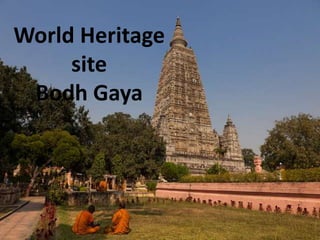
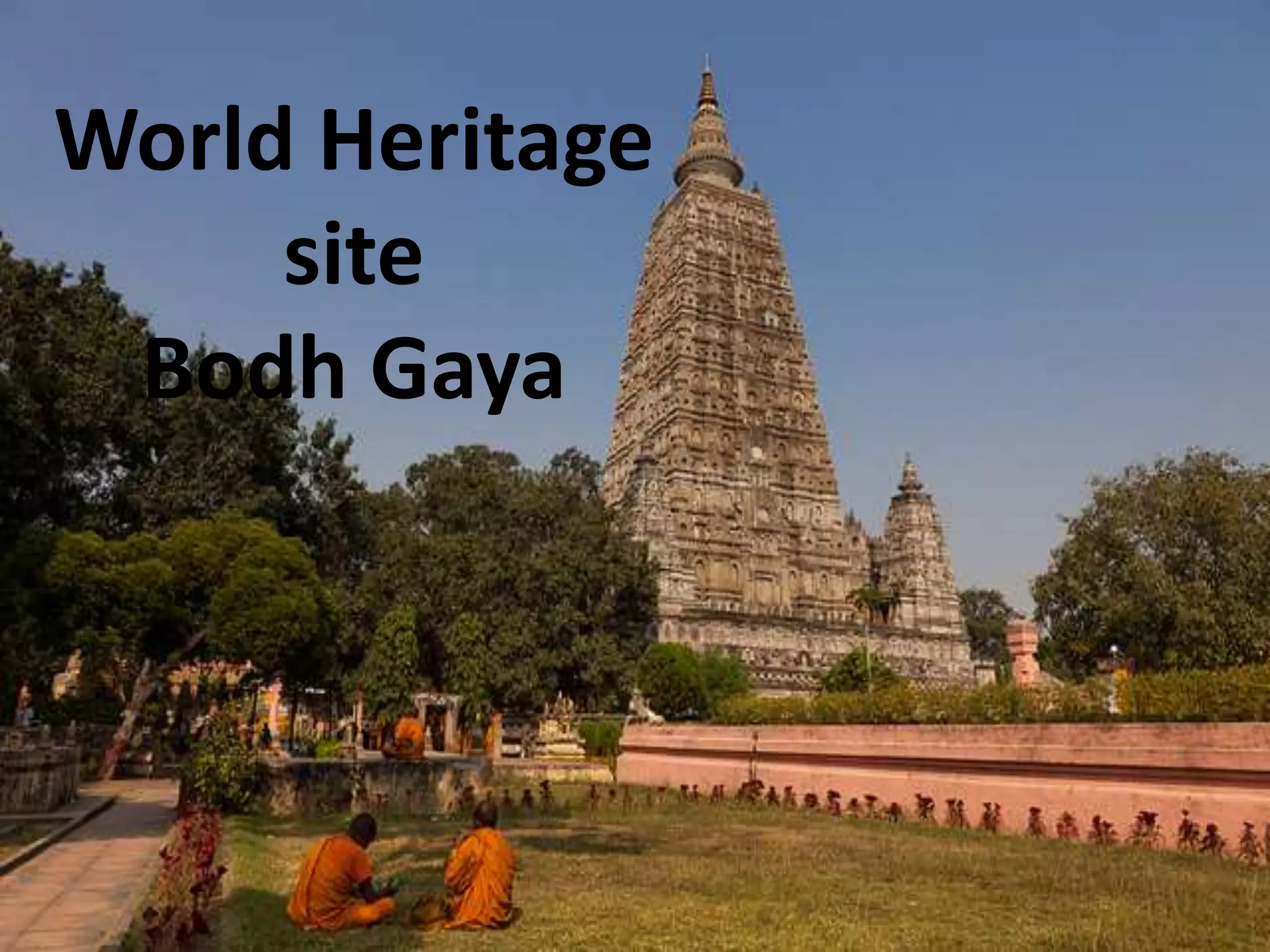
World Heritage
site
Bodh Gaya
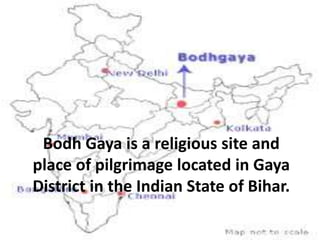
Bodh Gaya is a religious site and
place of pilgrimage located in Gaya
District in the Indian State of Bihar.
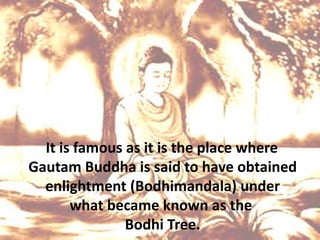
It is famous as it is the place where
Gautam Buddha is said to have obtained
enlightment (Bodhimandala) under
what became known as the
Bodhi Tree.
History
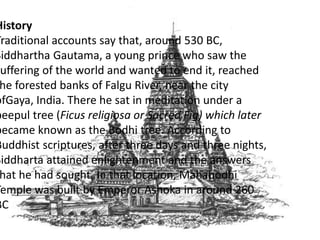
Traditional accounts say that, around 530 BC,
Siddhartha Gautama, a young prince who saw the
suffering of the world and wanted to end it, reached
he forested banks of Falgu River, near the city
ofGaya, India. There he sat in meditation under a
peepul tree (Ficus religiosa or Sacred Fig) which later
became known as the Bodhi tree. According to
Buddhist scriptures, after three days and three nights,
Siddharta attained enlightenment and the answers
hat he had sought. In that location, Mahabodhi
Temple was built by Emperor Ashoka in around 260
BC
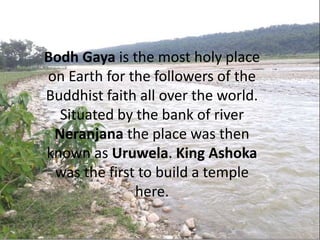
Bodh Gaya is the most holy place
on Earth for the followers of the
Buddhist faith all over the world.
Situated by the bank of river
Neranjana the place was then
known as Uruwela. King Ashoka
was the first to build a temple
here.
For Buddhists, Bodh Gaya is the most
important of the main four pilgrimage sites
related to the life of
Gautama Buddha,
the other three being
Kushinagar, Lumbini, and Saranath.
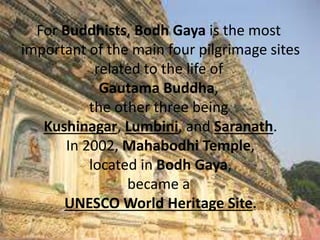
In 2002, Mahabodhi Temple,
located in Bodh Gaya,
became a
UNESCO World Heritage Site.
Architecture
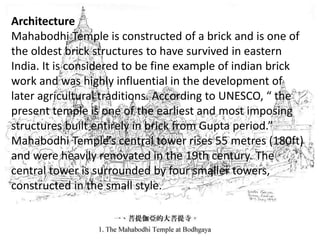
Mahabodhi Temple is constructed of a brick and is one of
the oldest brick structures to have survived in eastern
India. It is considered to be fine example of indian brick
work and was highly influential in the development of
later agricultural traditions. According to UNESCO, “ the
present temple is one of the earliest and most imposing
structures built entirely in brick from Gupta period.”
Mahabodhi Temple’s central tower rises 55 metres (180ft)
and were heavily renovated in the 19th century. The
central tower is surrounded by four smaller towers,
constructed in the small style.
Transportation
Air: The nearest airport is at Gaya 7 Kms and Patna 135 kms. Indian
Airlines and Sahara Airlines connect Patna to Calcutta, Bombay,
Delhi, Ranchi, Lucknow and various other cities.
Rail: The nearest railway station is Gaya (17km).
Road: Bodhgaya is well connected by road to Gaya (17km), Nalanda
(101 km), Rajgir (78 km), Patna (135km), Varanasi (252 km), Calcutta
(495km)
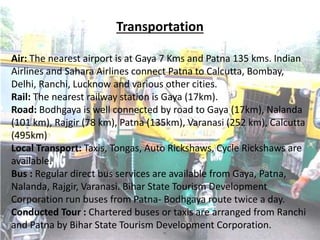
Local Transport: Taxis, Tongas, Auto Rickshaws, Cycle Rickshaws are
available.
Bus : Regular direct bus services are available from Gaya, Patna,
Nalanda, Rajgir, Varanasi. Bihar State Tourism Development
Corporation run buses from Patna- Bodhgaya route twice a day.
Conducted Tour : Chartered buses or taxis are arranged from Ranchi
and Patna by Bihar State Tourism Development Corporation.
Other Treasures of Bodhgaya:
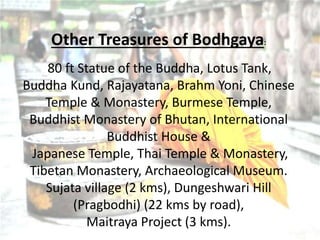
80 ft Statue of the Buddha, Lotus Tank,
Buddha Kund, Rajayatana, Brahm Yoni, Chinese
Temple & Monastery, Burmese Temple,
Buddhist Monastery of Bhutan, International
Buddhist House &
Japanese Temple, Thai Temple & Monastery,
Tibetan Monastery, Archaeological Museum.
Sujata village (2 kms), Dungeshwari Hill
(Pragbodhi) (22 kms by road),
Maitraya Project (3 kms).
General Information
Temperature (Max./Min.) Deg C: Summer
47/28 Winter-28/4
Rainfall:186 cms (Mid-June to Mid-September)
Altitude:113 Meters
Best Season: October to March.
THANK YOU

World heritage site Bodhgaya

  • 1.
  • 2.
    Bodh Gaya isa religious site and place of pilgrimage located in Gaya District in the Indian State of Bihar.
  • 3.
    It is famousas it is the place where Gautam Buddha is said to have obtained enlightment (Bodhimandala) under what became known as the Bodhi Tree.
  • 4.
    History Traditional accounts saythat, around 530 BC, Siddhartha Gautama, a young prince who saw the suffering of the world and wanted to end it, reached he forested banks of Falgu River, near the city ofGaya, India. There he sat in meditation under a peepul tree (Ficus religiosa or Sacred Fig) which later became known as the Bodhi tree. According to Buddhist scriptures, after three days and three nights, Siddharta attained enlightenment and the answers hat he had sought. In that location, Mahabodhi Temple was built by Emperor Ashoka in around 260 BC
  • 5.
    Bodh Gaya isthe most holy place on Earth for the followers of the Buddhist faith all over the world. Situated by the bank of river Neranjana the place was then known as Uruwela. King Ashoka was the first to build a temple here.
  • 6.
    For Buddhists, BodhGaya is the most important of the main four pilgrimage sites related to the life of Gautama Buddha, the other three being Kushinagar, Lumbini, and Saranath. In 2002, Mahabodhi Temple, located in Bodh Gaya, became a UNESCO World Heritage Site.
  • 7.
    Architecture Mahabodhi Temple isconstructed of a brick and is one of the oldest brick structures to have survived in eastern India. It is considered to be fine example of indian brick work and was highly influential in the development of later agricultural traditions. According to UNESCO, “ the present temple is one of the earliest and most imposing structures built entirely in brick from Gupta period.” Mahabodhi Temple’s central tower rises 55 metres (180ft) and were heavily renovated in the 19th century. The central tower is surrounded by four smaller towers, constructed in the small style.
  • 8.
    Transportation Air: The nearestairport is at Gaya 7 Kms and Patna 135 kms. Indian Airlines and Sahara Airlines connect Patna to Calcutta, Bombay, Delhi, Ranchi, Lucknow and various other cities. Rail: The nearest railway station is Gaya (17km). Road: Bodhgaya is well connected by road to Gaya (17km), Nalanda (101 km), Rajgir (78 km), Patna (135km), Varanasi (252 km), Calcutta (495km) Local Transport: Taxis, Tongas, Auto Rickshaws, Cycle Rickshaws are available. Bus : Regular direct bus services are available from Gaya, Patna, Nalanda, Rajgir, Varanasi. Bihar State Tourism Development Corporation run buses from Patna- Bodhgaya route twice a day. Conducted Tour : Chartered buses or taxis are arranged from Ranchi and Patna by Bihar State Tourism Development Corporation.
  • 9.
    Other Treasures ofBodhgaya: 80 ft Statue of the Buddha, Lotus Tank, Buddha Kund, Rajayatana, Brahm Yoni, Chinese Temple & Monastery, Burmese Temple, Buddhist Monastery of Bhutan, International Buddhist House & Japanese Temple, Thai Temple & Monastery, Tibetan Monastery, Archaeological Museum. Sujata village (2 kms), Dungeshwari Hill (Pragbodhi) (22 kms by road), Maitraya Project (3 kms).
  • 10.
    General Information Temperature (Max./Min.)Deg C: Summer 47/28 Winter-28/4 Rainfall:186 cms (Mid-June to Mid-September) Altitude:113 Meters Best Season: October to March.
  • 11.