Hospital Acquired Infections
Case scenario 1
25 .6.2019 Mr X admitted to MICU
Left subclavian CL and Foley catheter inserted
30.6.19 Fever 100.6 F
CL removed, PL inserted.
1.7.19 Urine culture – E Coli >100,000 CFU/ml
3.7.19 Blood culture – E coli
4.7.19 Foley catheter removed
Identify
1. Any HAI ? If yes identify.
2. Date of Event
3. Is this Primary CLABSI ?
Case scenario 1 - Modified
25 .6.2019 Mr X admitted to MICU
Left subclavian CL and Foley catheter inserted
30.6.19 Fever 100.6 F
CL removed, PL inserted.
1.7.19 Urine culture – E Coli >40 X 103
CFU/ml
3.7.19 Blood culture – E coli
4.7.19 Foley catheter removed
Identify
1. Any HAI ? If yes identify.
2. Date of Event
3. Is this Primary CLABSI ?
Case scenario 2
25 .6.2019 Ms Ria admitted to MICU with c/o dysuria &
Hematuria since 2 days.
26.6.19 Urine culture – Proteus mirabilis >10 5CFU/ml
Fever: 101 F
27.6.19 Fever:102 F
28.6.19 Foley catheter inserted due to gross hematuria
28.6.19 Fever:102 F
1.7.19 Urine culture - E Coli >40 X 105
CFU/ml
Identify
1. Any HAI ? If yes identify.
2. Date of Event
Case scenario 3
1. Name two exclusion criteria for CAUTI ?
2. Which all catheters are considered for CAUTI
surveillance ?
Case scenario 4
1. Identify the day of catheter use for Patient A
and B on April 4 if both were admitted on
27th
March 2019?
2. Which criteria?
31.3.19 1.4.19 2.4.19 3.4.19 4.4.19 5.4.19 6.4.19
Patient A FC FC Fc
removed
Fc
replaced
Fc Fc
removed
No FC
Patient B FC FC FC
removed
No FC FC
replaced
FC FC
Case scenario 5
Identify – The location of HAI
Case scenario 6
9.3.19 18 yr old patient with cystic fibrosis admitted to MICU.
Coarse breath sounds over Rt UL of lung, O2 saturation
86%, and patient started on oxygen therapy. CXR –
Diffuse B/L bronchiectasis, parenchymal opacities in Rt
UL , most likely pneumonia. WBC-16000 cells/mm3
10.3.19 Patient develops Fever 102 F, Pulmonary crackels
heard over Rt UL. Sputum, blood tinged is sent for
culture. Pt is tachypneic and patient is on Mechanical
ventilation.
11.3.19 Fever, crackles, tachypnea continues. Pt coughs out
green colored sputum. FiO2 ranges from 30-100%.
Triple lumen catheter is inserted in subclavian vein.
12.3.19 Sputum culture (10.3.19) positive for staph aureus
and Pseudo aeruginosa
13.3.19 CXR – Increased opacity in Rt UL. Patient remains
ventilated.
1. Which of the above is TRUE ?
1. Identify the infection and date of event ?
Case scenario 7
Case scenario 8
1. Identify the
infections?
Case scenario 9
1. Identify the
infections?
Case scenario 10
True or False
1. A non lumened IV catheter that terminates at or close to heart or in a
great vessel that is not used for infusion, withdrawal of blood or
hemodynamic monitoring is not considered a CL.
2. AV fistula is considered as a CL.
3. Two CL days will be counted for denominator purpose if patient having
subclavian CL and Femoral line.
Case scenario 11
Patient admitted on 29th March and CL inserted on 30th
March.
Identify the Days (Dates) when CL becomes Eligible CL and
rationale ?
Case scenario 12
Patient admitted on 29th March with CL in place.
Identify the Days (Dates) when CL becomes Eligible CL and
rationale ?
Case scenario 13
True or False
1. Enteropathogenic E coli and Enterohemorragic E coli are considered as
recognized pathogens in LCBI 1.
2. For LCBI 2 and 3, in case of common commensals, the organisms
should be identified to species level in both blood cultures.
3. Mr X grew Streptococcus viridans in one blood culture on hospital
admission day 3 and device day 3. He will be considered to have CLABSI
with LCBI 1 criteria.
4. A 4 day old neonate grew streptococcus agalactiae in blood. He will be
considered to have HAI-BSI.
Case scenario 14
Mr Y was admitted in ICU on 1st
July 2019.
CL and arterial line - inserted on 2nd
July 2019.
Sample from AL and CL on 6th
july grew Klebsiella pneumoniae.
Is It CLABSI ?
Case scenario 15
Mr Y was admitted in ICU on 1st
July 2019.
CL and arterial line - inserted on 2nd
July 2019.
Sample from AL and CL on 6th
July grew Klebsiella pneumoniae.
Central line tip culture sent on 6th
July is
Negative.
Is It CLABSI ?
Case scenario 16
Mr Y was admitted in ICU on 1st
July 2019.
CL and arterial line - inserted on 2nd
July 2019.
Sample from AL and CL on 6th
July grew Klebsiella pneumoniae.
Sample from AL came positive in 2 hours and
from CL came positive in 8 hours.
Is It CLABSI ?
Case scenario 17
Patient admitted on 31st
March with CL in place.
From Which day we will start considering the patient for
counting of CL days ?
Case scenario 18
True or False
1. Physician diagnosis of pneumonia is an acceptable criteria for VAP.
2. Candida isolated from lung tissue is considered as one of the criteria
for VAP.
3. Enterococcus identified from Pleural fluid is considered as one of the
criteria for VAP.
Case scenario 19
Will It be considered SSI ?
Case scenario 20
Will It be considered Superficial SSI ?
Case scenario 21
Will It be considered Superficial SSI ?
Case scenario 22
True or False
1. For Surgeries with implants, surgical site infection is monitored for 90
days.
2. Culture positivity is a mandatory criteria for any infection to be
considered SSI.
3. Stitch abscess is considered as SSI.
4. For Deep and Organ space infections surveillance is carried out for 90
days.
Calculation of HAIs
Calculation of HAIs – Monthly
Device associated Infections are calculated as per 1000 device
days
Device utilization ratio – Monthly
Calculated as device days per number of patient days
Surgical Site Infection – Monthly
Calculated as per 100 surgical procedures
Case Scenario
1. In SICU, there were 2 CLABSI cases and CL
device days were 230. Patient days were 1024.
Calculate the CLABSI rate and central line
utilization ratio.
2. In Cardiac surgery cases (n= 128)done in
month of March 2019, 2 were superficial
infections and 1 was deep infection. Calculate
the SSI.
How to
identify
Denominator ?
•Time ?
•Who will do?
•Patient
population or
Area
How to identify Numerator ?
• Case definitions
Data entry Forms :
• Simplify forms for compliance
• Include only relevant information which can
identify the case and factors which help in
analysis.
Patient ID:
Patient Name:
Gender: M/ F Date of Birth/ Age:
Event Type: CLABSI Date of Event:
Date of Procedure:
Date Admitted to Facility: Location:
Diagnosis
Location of Central Line Insertion:
________________
Date of Line Insertion: ___ /___ /________
Date of Line Removal : ___ /___ /________
Date of Line Reinsertion (if applicable): ___
/___ /____
Any hemodialysis catheter present: Yes/ No
Any other device: __________________________
Event Details
Specific Event: Laboratory-confirmed
Specify Criteria Used:
Signs & Symptoms (check all that apply)
□ Fever
□ Chills
□ Hypothermia
□ Hypotension
□ Bradycardia
Laboratory (check one)
□ Recognized pathogen from one or more blood
cultures
□ Common commensal from ≥ 2 blood cultures
Pathogens Identified: Yes/ No [If Yes, specify]
COMMENTS:
CLABSI Form – Simplified version
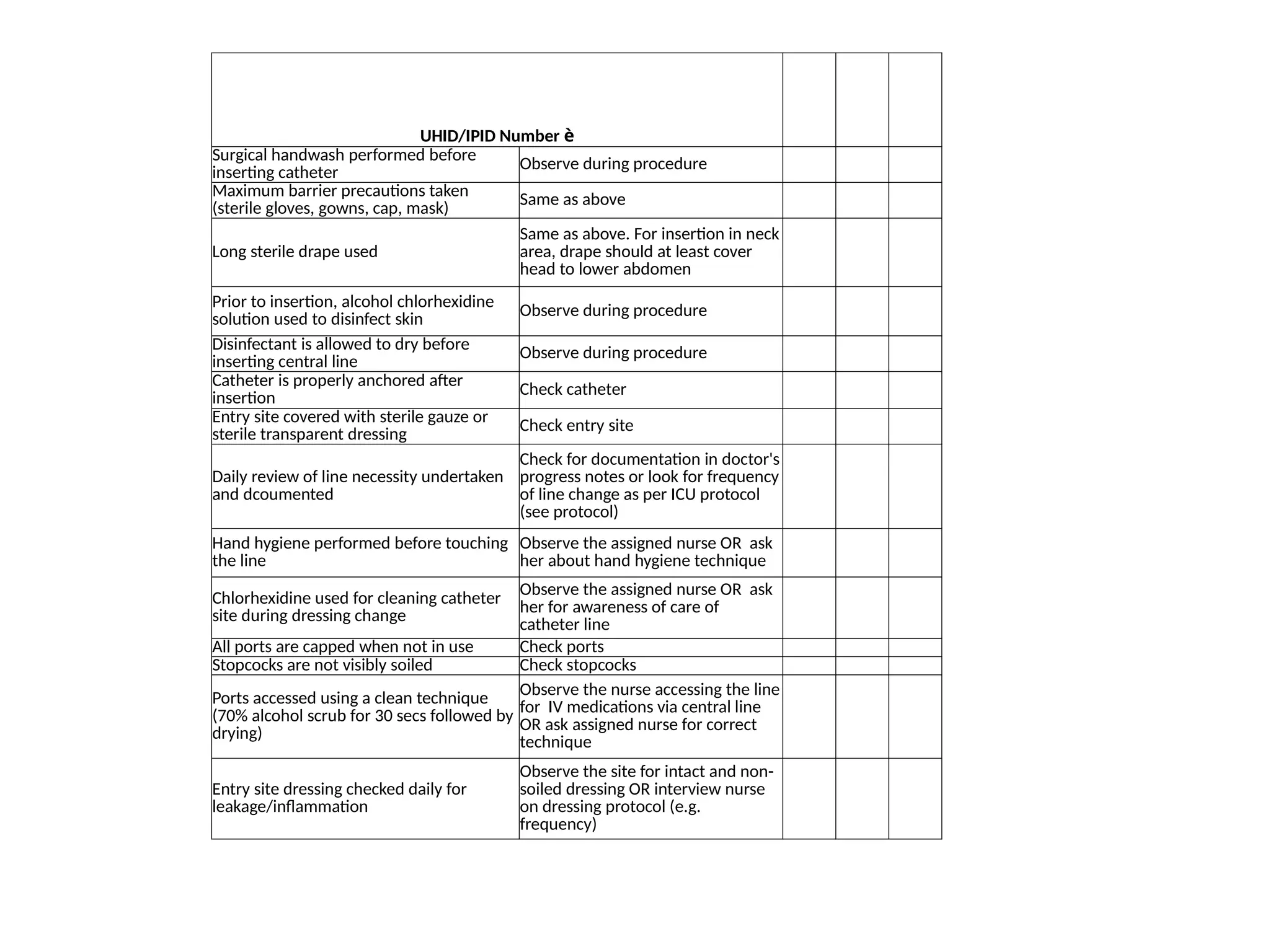
UHID/IPID Number è
Surgical handwash performed before
inserting catheter Observe during procedure
Maximum barrier precautions taken
(sterile gloves, gowns, cap, mask)
Same as above
Long sterile drape used
Same as above. For insertion in neck
area, drape should at least cover
head to lower abdomen
Prior to insertion, alcohol chlorhexidine
solution used to disinfect skin Observe during procedure
Disinfectant is allowed to dry before
inserting central line
Observe during procedure
Catheter is properly anchored after
insertion Check catheter
Entry site covered with sterile gauze or
sterile transparent dressing Check entry site
Daily review of line necessity undertaken
and dcoumented
Check for documentation in doctor's
progress notes or look for frequency
of line change as per ICU protocol
(see protocol)
Hand hygiene performed before touching
the line
Observe the assigned nurse OR ask
her about hand hygiene technique
Chlorhexidine used for cleaning catheter
site during dressing change
Observe the assigned nurse OR ask
her for awareness of care of
catheter line
All ports are capped when not in use Check ports
Stopcocks are not visibly soiled Check stopcocks
Ports accessed using a clean technique
(70% alcohol scrub for 30 secs followed by
drying)
Observe the nurse accessing the line
for IV medications via central line
OR ask assigned nurse for correct
technique
Entry site dressing checked daily for
leakage/inflammation
Observe the site for intact and non-
soiled dressing OR interview nurse
on dressing protocol (e.g.
frequency)
Validation of Data
• Frequency – quarterly/Half yearly?
Any Change in policy/person
• Person – Microbiologist/ quality ?
• Method
Benchmarking of HAI
• International : National Healthcare safety
network (NHSN)
INICC – International Nosocomial infection
control consortium
• What do you understand by 50th
percentile ??
HAIs - Analysis
May-18 Jun-18 Jul-18 Aug-18 Sep-18 Oct-18 Nov-18 Dec-18 Jan-19
0
1
2
3
4
5
6
2.58
4.8
3.8
2.3
3.7
0.8
1.92
0.740000000000001
2.23
1.47 1.47 1.47 1.47 1.47 1.47 1.47 1.47 1.47
Surgical site infection rate NNIS(50% percentile
RCA ???
• Patient factors analysis
• Practice processes
• Organism specific ( Stenotrophomonas
/Candida etc)
• Environmental factors
• Staff practices
Total (21) Oct Nov Dec Jan Total
Superficial:
deep
0:1 1:1 1:0 0:3 2:5
Male: Female 1:0 2:0 1:0 1:2 5:2
Diabetes 1 0 1 3 5
Obesity 0 0 0 0 0
Culture
positive
0 1 1 2 4
Organisms: Pantoea sp Enterococcus sp Kleb.pneumoni
ae
MSSA
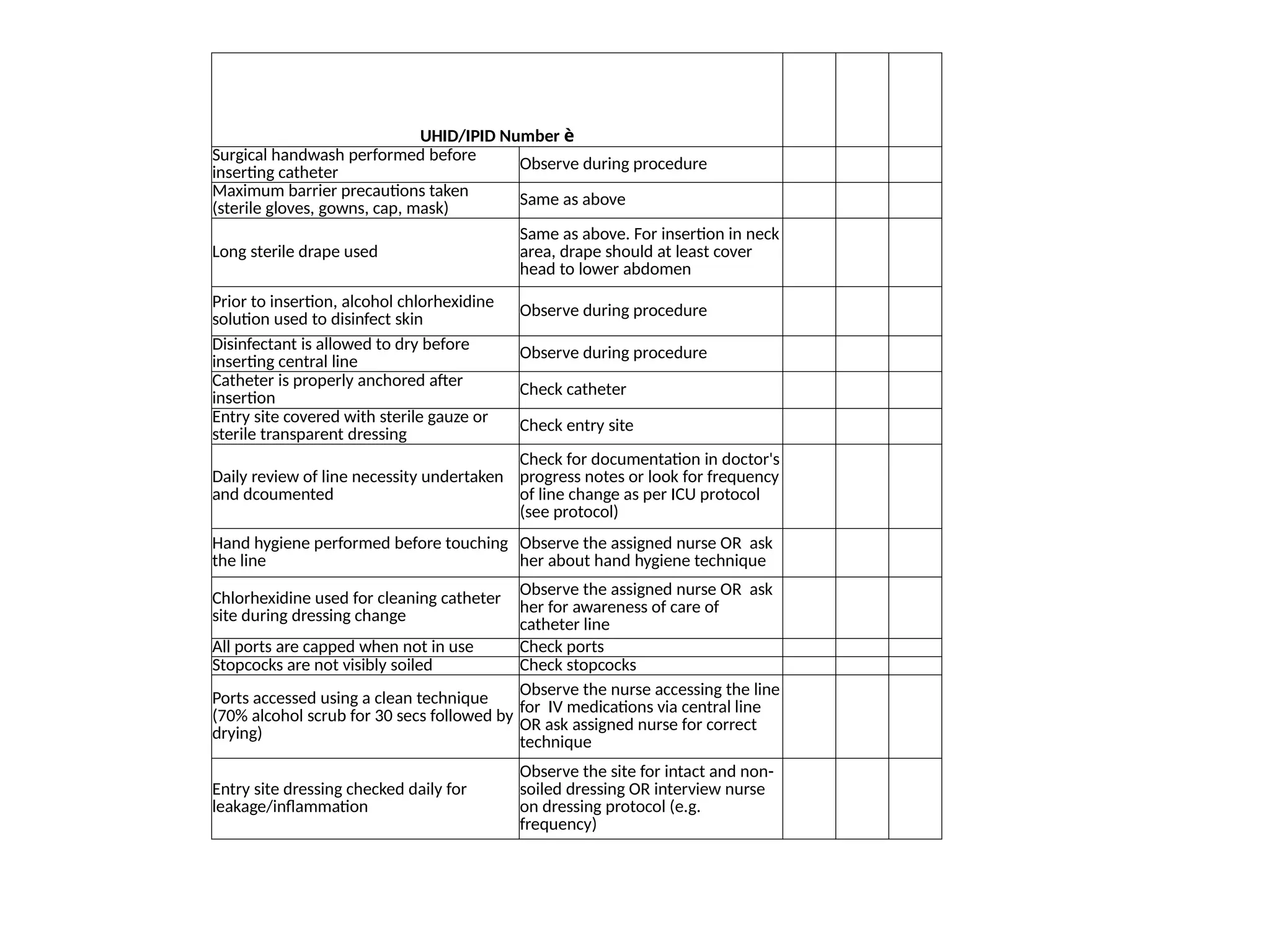
UHID/IPID Number è
Surgical handwash performed before
inserting catheter Observe during procedure
Maximum barrier precautions taken
(sterile gloves, gowns, cap, mask)
Same as above
Long sterile drape used
Same as above. For insertion in neck
area, drape should at least cover
head to lower abdomen
Prior to insertion, alcohol chlorhexidine
solution used to disinfect skin Observe during procedure
Disinfectant is allowed to dry before
inserting central line
Observe during procedure
Catheter is properly anchored after
insertion Check catheter
Entry site covered with sterile gauze or
sterile transparent dressing Check entry site
Daily review of line necessity undertaken
and dcoumented
Check for documentation in doctor's
progress notes or look for frequency
of line change as per ICU protocol
(see protocol)
Hand hygiene performed before touching
the line
Observe the assigned nurse OR ask
her about hand hygiene technique
Chlorhexidine used for cleaning catheter
site during dressing change
Observe the assigned nurse OR ask
her for awareness of care of
catheter line
All ports are capped when not in use Check ports
Stopcocks are not visibly soiled Check stopcocks
Ports accessed using a clean technique
(70% alcohol scrub for 30 secs followed by
drying)
Observe the nurse accessing the line
for IV medications via central line
OR ask assigned nurse for correct
technique
Entry site dressing checked daily for
leakage/inflammation
Observe the site for intact and non-
soiled dressing OR interview nurse
on dressing protocol (e.g.
frequency)
Thank You

Workshop on HOSPITAL ACQUIRED INFECTIONS(1).pptx

  • 1.
  • 2.
    Case scenario 1 25.6.2019 Mr X admitted to MICU Left subclavian CL and Foley catheter inserted 30.6.19 Fever 100.6 F CL removed, PL inserted. 1.7.19 Urine culture – E Coli >100,000 CFU/ml 3.7.19 Blood culture – E coli 4.7.19 Foley catheter removed Identify 1. Any HAI ? If yes identify. 2. Date of Event 3. Is this Primary CLABSI ?
  • 3.
    Case scenario 1- Modified 25 .6.2019 Mr X admitted to MICU Left subclavian CL and Foley catheter inserted 30.6.19 Fever 100.6 F CL removed, PL inserted. 1.7.19 Urine culture – E Coli >40 X 103 CFU/ml 3.7.19 Blood culture – E coli 4.7.19 Foley catheter removed Identify 1. Any HAI ? If yes identify. 2. Date of Event 3. Is this Primary CLABSI ?
  • 4.
    Case scenario 2 25.6.2019 Ms Ria admitted to MICU with c/o dysuria & Hematuria since 2 days. 26.6.19 Urine culture – Proteus mirabilis >10 5CFU/ml Fever: 101 F 27.6.19 Fever:102 F 28.6.19 Foley catheter inserted due to gross hematuria 28.6.19 Fever:102 F 1.7.19 Urine culture - E Coli >40 X 105 CFU/ml Identify 1. Any HAI ? If yes identify. 2. Date of Event
  • 5.
    Case scenario 3 1.Name two exclusion criteria for CAUTI ? 2. Which all catheters are considered for CAUTI surveillance ?
  • 6.
    Case scenario 4 1.Identify the day of catheter use for Patient A and B on April 4 if both were admitted on 27th March 2019? 2. Which criteria? 31.3.19 1.4.19 2.4.19 3.4.19 4.4.19 5.4.19 6.4.19 Patient A FC FC Fc removed Fc replaced Fc Fc removed No FC Patient B FC FC FC removed No FC FC replaced FC FC
  • 7.
    Case scenario 5 Identify– The location of HAI
  • 9.
    Case scenario 6 9.3.1918 yr old patient with cystic fibrosis admitted to MICU. Coarse breath sounds over Rt UL of lung, O2 saturation 86%, and patient started on oxygen therapy. CXR – Diffuse B/L bronchiectasis, parenchymal opacities in Rt UL , most likely pneumonia. WBC-16000 cells/mm3 10.3.19 Patient develops Fever 102 F, Pulmonary crackels heard over Rt UL. Sputum, blood tinged is sent for culture. Pt is tachypneic and patient is on Mechanical ventilation. 11.3.19 Fever, crackles, tachypnea continues. Pt coughs out green colored sputum. FiO2 ranges from 30-100%. Triple lumen catheter is inserted in subclavian vein. 12.3.19 Sputum culture (10.3.19) positive for staph aureus and Pseudo aeruginosa 13.3.19 CXR – Increased opacity in Rt UL. Patient remains ventilated.
  • 10.
    1. Which ofthe above is TRUE ?
  • 12.
    1. Identify theinfection and date of event ? Case scenario 7
  • 13.
    Case scenario 8 1.Identify the infections?
  • 15.
    Case scenario 9 1.Identify the infections?
  • 17.
    Case scenario 10 Trueor False 1. A non lumened IV catheter that terminates at or close to heart or in a great vessel that is not used for infusion, withdrawal of blood or hemodynamic monitoring is not considered a CL. 2. AV fistula is considered as a CL. 3. Two CL days will be counted for denominator purpose if patient having subclavian CL and Femoral line.
  • 18.
    Case scenario 11 Patientadmitted on 29th March and CL inserted on 30th March. Identify the Days (Dates) when CL becomes Eligible CL and rationale ?
  • 19.
    Case scenario 12 Patientadmitted on 29th March with CL in place. Identify the Days (Dates) when CL becomes Eligible CL and rationale ?
  • 20.
    Case scenario 13 Trueor False 1. Enteropathogenic E coli and Enterohemorragic E coli are considered as recognized pathogens in LCBI 1. 2. For LCBI 2 and 3, in case of common commensals, the organisms should be identified to species level in both blood cultures. 3. Mr X grew Streptococcus viridans in one blood culture on hospital admission day 3 and device day 3. He will be considered to have CLABSI with LCBI 1 criteria. 4. A 4 day old neonate grew streptococcus agalactiae in blood. He will be considered to have HAI-BSI.
  • 22.
    Case scenario 14 MrY was admitted in ICU on 1st July 2019. CL and arterial line - inserted on 2nd July 2019. Sample from AL and CL on 6th july grew Klebsiella pneumoniae. Is It CLABSI ?
  • 23.
    Case scenario 15 MrY was admitted in ICU on 1st July 2019. CL and arterial line - inserted on 2nd July 2019. Sample from AL and CL on 6th July grew Klebsiella pneumoniae. Central line tip culture sent on 6th July is Negative. Is It CLABSI ?
  • 24.
    Case scenario 16 MrY was admitted in ICU on 1st July 2019. CL and arterial line - inserted on 2nd July 2019. Sample from AL and CL on 6th July grew Klebsiella pneumoniae. Sample from AL came positive in 2 hours and from CL came positive in 8 hours. Is It CLABSI ?
  • 25.
    Case scenario 17 Patientadmitted on 31st March with CL in place. From Which day we will start considering the patient for counting of CL days ?
  • 26.
    Case scenario 18 Trueor False 1. Physician diagnosis of pneumonia is an acceptable criteria for VAP. 2. Candida isolated from lung tissue is considered as one of the criteria for VAP. 3. Enterococcus identified from Pleural fluid is considered as one of the criteria for VAP.
  • 28.
    Case scenario 19 WillIt be considered SSI ?
  • 29.
    Case scenario 20 WillIt be considered Superficial SSI ?
  • 30.
    Case scenario 21 WillIt be considered Superficial SSI ?
  • 31.
    Case scenario 22 Trueor False 1. For Surgeries with implants, surgical site infection is monitored for 90 days. 2. Culture positivity is a mandatory criteria for any infection to be considered SSI. 3. Stitch abscess is considered as SSI. 4. For Deep and Organ space infections surveillance is carried out for 90 days.
  • 32.
  • 33.
    Calculation of HAIs– Monthly Device associated Infections are calculated as per 1000 device days
  • 34.
    Device utilization ratio– Monthly Calculated as device days per number of patient days
  • 35.
    Surgical Site Infection– Monthly Calculated as per 100 surgical procedures
  • 36.
    Case Scenario 1. InSICU, there were 2 CLABSI cases and CL device days were 230. Patient days were 1024. Calculate the CLABSI rate and central line utilization ratio. 2. In Cardiac surgery cases (n= 128)done in month of March 2019, 2 were superficial infections and 1 was deep infection. Calculate the SSI.
  • 37.
    How to identify Denominator ? •Time? •Who will do? •Patient population or Area
  • 38.
    How to identifyNumerator ? • Case definitions Data entry Forms : • Simplify forms for compliance • Include only relevant information which can identify the case and factors which help in analysis.
  • 41.
    Patient ID: Patient Name: Gender:M/ F Date of Birth/ Age: Event Type: CLABSI Date of Event: Date of Procedure: Date Admitted to Facility: Location: Diagnosis Location of Central Line Insertion: ________________ Date of Line Insertion: ___ /___ /________ Date of Line Removal : ___ /___ /________ Date of Line Reinsertion (if applicable): ___ /___ /____ Any hemodialysis catheter present: Yes/ No Any other device: __________________________ Event Details Specific Event: Laboratory-confirmed Specify Criteria Used: Signs & Symptoms (check all that apply) □ Fever □ Chills □ Hypothermia □ Hypotension □ Bradycardia Laboratory (check one) □ Recognized pathogen from one or more blood cultures □ Common commensal from ≥ 2 blood cultures Pathogens Identified: Yes/ No [If Yes, specify] COMMENTS: CLABSI Form – Simplified version
  • 43.
    UHID/IPID Number è Surgicalhandwash performed before inserting catheter Observe during procedure Maximum barrier precautions taken (sterile gloves, gowns, cap, mask) Same as above Long sterile drape used Same as above. For insertion in neck area, drape should at least cover head to lower abdomen Prior to insertion, alcohol chlorhexidine solution used to disinfect skin Observe during procedure Disinfectant is allowed to dry before inserting central line Observe during procedure Catheter is properly anchored after insertion Check catheter Entry site covered with sterile gauze or sterile transparent dressing Check entry site Daily review of line necessity undertaken and dcoumented Check for documentation in doctor's progress notes or look for frequency of line change as per ICU protocol (see protocol) Hand hygiene performed before touching the line Observe the assigned nurse OR ask her about hand hygiene technique Chlorhexidine used for cleaning catheter site during dressing change Observe the assigned nurse OR ask her for awareness of care of catheter line All ports are capped when not in use Check ports Stopcocks are not visibly soiled Check stopcocks Ports accessed using a clean technique (70% alcohol scrub for 30 secs followed by drying) Observe the nurse accessing the line for IV medications via central line OR ask assigned nurse for correct technique Entry site dressing checked daily for leakage/inflammation Observe the site for intact and non- soiled dressing OR interview nurse on dressing protocol (e.g. frequency)
  • 48.
    Validation of Data •Frequency – quarterly/Half yearly? Any Change in policy/person • Person – Microbiologist/ quality ? • Method
  • 49.
    Benchmarking of HAI •International : National Healthcare safety network (NHSN) INICC – International Nosocomial infection control consortium • What do you understand by 50th percentile ??
  • 50.
  • 51.
    May-18 Jun-18 Jul-18Aug-18 Sep-18 Oct-18 Nov-18 Dec-18 Jan-19 0 1 2 3 4 5 6 2.58 4.8 3.8 2.3 3.7 0.8 1.92 0.740000000000001 2.23 1.47 1.47 1.47 1.47 1.47 1.47 1.47 1.47 1.47 Surgical site infection rate NNIS(50% percentile RCA ???
  • 52.
    • Patient factorsanalysis • Practice processes • Organism specific ( Stenotrophomonas /Candida etc) • Environmental factors • Staff practices
  • 53.
    Total (21) OctNov Dec Jan Total Superficial: deep 0:1 1:1 1:0 0:3 2:5 Male: Female 1:0 2:0 1:0 1:2 5:2 Diabetes 1 0 1 3 5 Obesity 0 0 0 0 0 Culture positive 0 1 1 2 4 Organisms: Pantoea sp Enterococcus sp Kleb.pneumoni ae MSSA
  • 54.
    UHID/IPID Number è Surgicalhandwash performed before inserting catheter Observe during procedure Maximum barrier precautions taken (sterile gloves, gowns, cap, mask) Same as above Long sterile drape used Same as above. For insertion in neck area, drape should at least cover head to lower abdomen Prior to insertion, alcohol chlorhexidine solution used to disinfect skin Observe during procedure Disinfectant is allowed to dry before inserting central line Observe during procedure Catheter is properly anchored after insertion Check catheter Entry site covered with sterile gauze or sterile transparent dressing Check entry site Daily review of line necessity undertaken and dcoumented Check for documentation in doctor's progress notes or look for frequency of line change as per ICU protocol (see protocol) Hand hygiene performed before touching the line Observe the assigned nurse OR ask her about hand hygiene technique Chlorhexidine used for cleaning catheter site during dressing change Observe the assigned nurse OR ask her for awareness of care of catheter line All ports are capped when not in use Check ports Stopcocks are not visibly soiled Check stopcocks Ports accessed using a clean technique (70% alcohol scrub for 30 secs followed by drying) Observe the nurse accessing the line for IV medications via central line OR ask assigned nurse for correct technique Entry site dressing checked daily for leakage/inflammation Observe the site for intact and non- soiled dressing OR interview nurse on dressing protocol (e.g. frequency)
  • 55.