Table of Contents 
William Hill Puppet Training v1.0.0 1 ©2014 Puppet Labs
Who am I? 
Good question! 
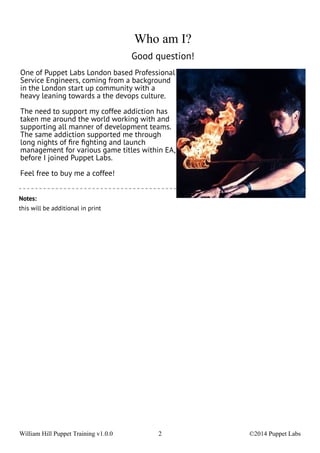
One of Puppet Labs London based Professional 
Service Engineers, coming from a background 
in the London start up community with a 
heavy leaning towards a the devops culture. 
The need to support my coffee addiction has 
taken me around the world working with and 
supporting all manner of development teams. 
The same addiction supported me through 
long nights of fire fighting and launch 
management for various game titles within EA, 
before I joined Puppet Labs. 
Feel free to buy me a coffee! 
Notes: 
this will be additional in print 
William Hill Puppet Training v1.0.0 2 ©2014 Puppet Labs
Know Before You Push 'Go' 
Using the Beaker Acceptance Test Framework to Test Your Puppet 
Module Infrastructure 
Beaker is an acceptance testing harness for Puppet PE and other Puppet Projects. A 
workshop to demonstrate Beaker usage and Beaker-rspec integration with module 
development. Demonstrating node environments, and quick start and reusability with 
module skeleton. 
The slide deck is available at https://github.com/abuxton/kbypg, you'll need Showoff 
to run it. 
William Hill Puppet Training v1.0.0 3 ©2014 Puppet Labs
Workshop Activities 
What are we going to do? 
• Demo, how hard can it be? 
• Beaker, well this is what your interested in. 
• Tools to make your lives easier, we hope! 
• Pulling all of these together. 
William Hill Puppet Training v1.0.0 4 ©2014 Puppet Labs
Our First Demo! 
How hard can it be? and what is involved? 
William Hill Puppet Training v1.0.0 5 ©2014 Puppet Labs
Objective of this Demo 
Demonstrating reusable components of Beaker and some valuable 
companion tool. 
• Puppetlabs/Beaker. 
• Testing environments, nodes and Vagrant. 
• rspec_beaker tests. 
• Reusability features. 
• A working demonstration, Puppetlabs-mysql. 
• Using supported modules. 
William Hill Puppet Training v1.0.0 6 ©2014 Puppet Labs
Installation 
Bundler makes it easy 
Bundler provides a consistent environment for Ruby projects 
by tracking and installing the exact gems and versions that 
are needed. - bundler 
You don't have to use it, but it does make your life easier, repeatable and more 
dependable. 
Notes: 
this will be additional in print 
William Hill Puppet Training v1.0.0 7 ©2014 Puppet Labs
Test Environment 
Vagrant for when you have to fake it, but fake it well. 
Beaker utilises the concept of Nodes for test environments, for the demo were using 
Vagrant. 
Repeatable, dependable and distributable environments. 
William Hill Puppet Training v1.0.0 8 ©2014 Puppet Labs
Demo 
Puppetlabs-mysql 
Puppetlabs-mysql is being used for the demo. 
• Puppetlabs supported module. 
• Built in Gemfile for Bundler. 
• Default use of centos-64 for nodesets/default.yaml using Vagrant. 
• Examples of classes, acceptance, and unit test. 
Notes: 
this will be additional in print 
William Hill Puppet Training v1.0.0 9 ©2014 Puppet Labs
Beaker 
Rspec testing and a whole lot more! 
Notes: 
this will be additional in print 
William Hill Puppet Training v1.0.0 10 ©2014 Puppet Labs
Objectives 
Lets discuss what makes up Beaker! 
• Test environments with nodesets. 
• Domain Spcecific language (DSL). 
• rspec-beaker. 
• Command line tool. 
William Hill Puppet Training v1.0.0 11 ©2014 Puppet Labs
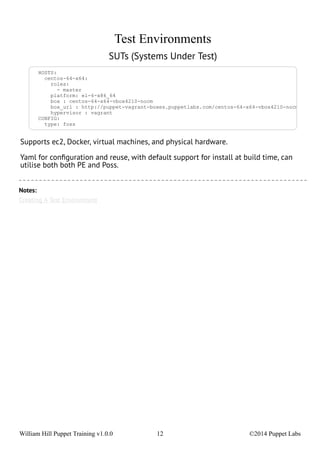
Test Environments 
SUTs (Systems Under Test) 
HOSTS: 
centos-64-x64: 
roles: 
- master 
platform: el-6-x86_64 
box : centos-64-x64-vbox4210-nocm 
box_url : http://puppet-vagrant-boxes.puppetlabs.com/centos-64-x64-vbox4210-nocm.box 
hypervisor : vagrant 
CONFIG: 
type: foss 
Supports ec2, Docker, virtual machines, and physical hardware. 
Yaml for configuration and reuse, with default support for install at build time, can 
utilise both both PE and Poss. 
Notes: 
Creating A Test Environment 
William Hill Puppet Training v1.0.0 12 ©2014 Puppet Labs
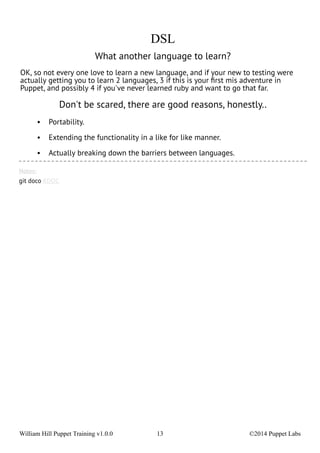
DSL 
What another language to learn? 
OK, so not every one love to learn a new language, and if your new to testing were 
actually getting you to learn 2 languages, 3 if this is your first mis adventure in 
Puppet, and possibly 4 if you've never learned ruby and want to go that far. 
Don't be scared, there are good reasons, honestly.. 
• Portability. 
• Extending the functionality in a like for like manner. 
• Actually breaking down the barriers between languages. 
Notes: 
git doco RDOC 
William Hill Puppet Training v1.0.0 13 ©2014 Puppet Labs
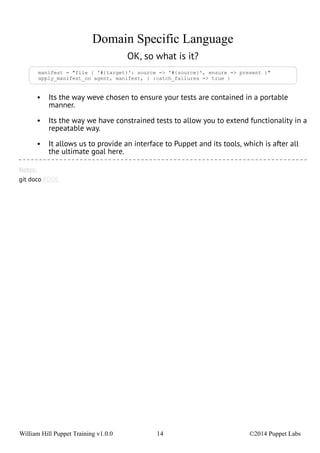
Domain Specific Language 
OK, so what is it? 
manifest = "file { '#{target}': source => '#{source}', ensure => present }" 
apply_manifest_on agent, manifest, { :catch_failures => true } 
• Its the way weve chosen to ensure your tests are contained in a portable 
manner. 
• Its the way we have constrained tests to allow you to extend functionality in a 
repeatable way. 
• It allows us to provide an interface to Puppet and its tools, which is after all 
the ultimate goal here. 
Notes: 
git doco RDOC 
William Hill Puppet Training v1.0.0 14 ©2014 Puppet Labs
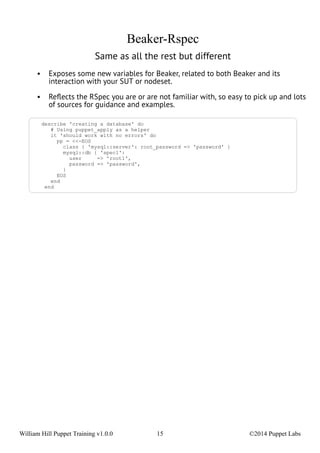
Beaker-Rspec 
Same as all the rest but different 
• Exposes some new variables for Beaker, related to both Beaker and its 
interaction with your SUT or nodeset. 
• Reflects the RSpec you are or are not familiar with, so easy to pick up and lots 
of sources for guidance and examples. 
describe 'creating a database' do 
# Using puppet_apply as a helper 
it 'should work with no errors' do 
pp = <<-EOS 
class { 'mysql::server': root_password => 'password' } 
mysql::db { 'spec1': 
user => 'root1', 
password => 'password', 
} 
EOS 
end 
end 
William Hill Puppet Training v1.0.0 15 ©2014 Puppet Labs
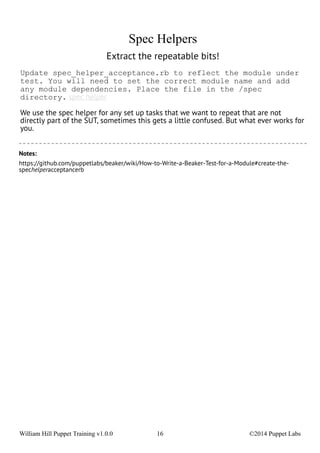
Spec Helpers 
Extract the repeatable bits! 
Update spec_helper_acceptance.rb to reflect the module under 
test. You will need to set the correct module name and add 
any module dependencies. Place the file in the /spec 
directory. spec helper 
We use the spec helper for any set up tasks that we want to repeat that are not 
directly part of the SUT, sometimes this gets a little confused. But what ever works for 
you. 
Notes: 
https://github.com/puppetlabs/beaker/wiki/How-to-Write-a-Beaker-Test-for-a-Module#create-the-spechelperacceptancerb 
William Hill Puppet Training v1.0.0 16 ©2014 Puppet Labs
Command Line Interface 
Some times you just want to run the test! 
I don't believe any thing ever turned up polished? 
Beaker is no exception and so you can choose to run your tests individually and 
increment them with out the overheads of all the set up. 
So the command line client is always available https://github.com/puppetlabs/beaker/ 
wiki/The-Command-Line. 
Notes: 
https://github.com/puppetlabs/beaker/wiki/The-Command-Line 
William Hill Puppet Training v1.0.0 17 ©2014 Puppet Labs
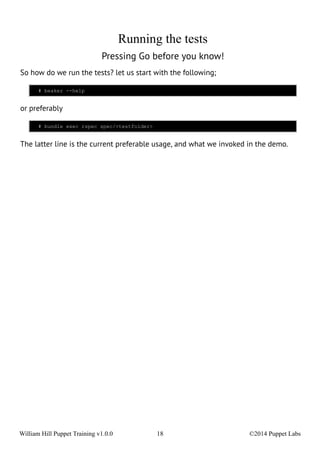
Running the tests 
Pressing Go before you know! 
So how do we run the tests? let us start with the following; 
# beaker --help 
or preferably 
# bundle exec rspec spec/<testfolder> 
The latter line is the current preferable usage, and what we invoked in the demo. 
William Hill Puppet Training v1.0.0 18 ©2014 Puppet Labs
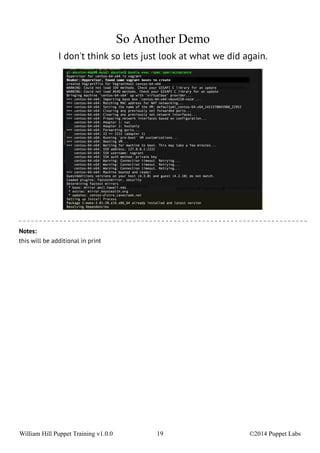
So Another Demo 
I don't think so lets just look at what we did again. 
Notes: 
this will be additional in print 
William Hill Puppet Training v1.0.0 19 ©2014 Puppet Labs
Tools & Reusability 
Lets just do it once ok 
Notes: 
this will be additional in print 
William Hill Puppet Training v1.0.0 20 ©2014 Puppet Labs
Objectives 
Lets introduce some useful things! 
• Bundler. 
• Rake. 
• Puppets Module Skeletons. 
Notes: 
this will be additional in print 
William Hill Puppet Training v1.0.0 21 ©2014 Puppet Labs
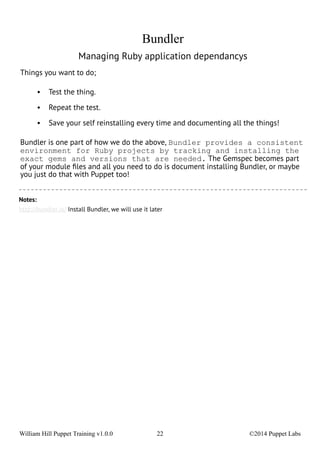
Bundler 
Managing Ruby application dependancys 
Things you want to do; 
• Test the thing. 
• Repeat the test. 
• Save your self reinstalling every time and documenting all the things! 
Bundler is one part of how we do the above, Bundler provides a consistent 
environment for Ruby projects by tracking and installing the 
exact gems and versions that are needed. The Gemspec becomes part 
of your module files and all you need to do is document installing Bundler, or maybe 
you just do that with Puppet too! 
Notes: 
http://bundler.io/ Install Bundler, we will use it later 
William Hill Puppet Training v1.0.0 22 ©2014 Puppet Labs
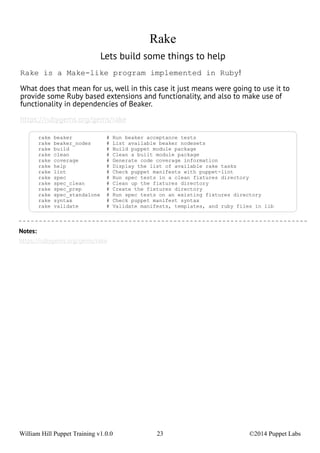
Rake 
Lets build some things to help 
Rake is a Make-like program implemented in Ruby! 
What does that mean for us, well in this case it just means were going to use it to 
provide some Ruby based extensions and functionality, and also to make use of 
functionality in dependencies of Beaker. 
https://rubygems.org/gems/rake 
rake beaker # Run beaker acceptance tests 
rake beaker_nodes # List available beaker nodesets 
rake build # Build puppet module package 
rake clean # Clean a built module package 
rake coverage # Generate code coverage information 
rake help # Display the list of available rake tasks 
rake lint # Check puppet manifests with puppet-lint 
rake spec # Run spec tests in a clean fixtures directory 
rake spec_clean # Clean up the fixtures directory 
rake spec_prep # Create the fixtures directory 
rake spec_standalone # Run spec tests on an existing fixtures directory 
rake syntax # Check puppet manifest syntax 
rake validate # Validate manifests, templates, and ruby files in lib 
Notes: 
https://rubygems.org/gems/rake 
William Hill Puppet Training v1.0.0 23 ©2014 Puppet Labs
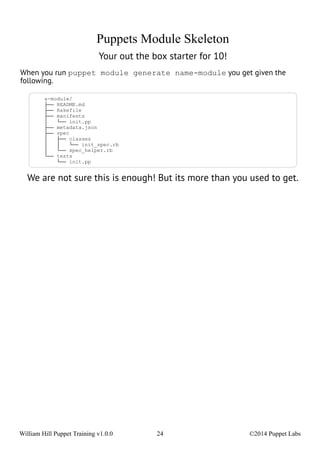
Puppets Module Skeleton 
Your out the box starter for 10! 
When you run puppet module generate name-module you get given the 
following. 
a-module/ 
├── README.md 
├── Rakefile 
├── manifests 
│ └── init.pp 
├── metadata.json 
├── spec 
│ ├── classes 
│ │ └── init_spec.rb 
│ └── spec_helper.rb 
└── tests 
└── init.pp 
We are not sure this is enough! But its more than you used to get. 
William Hill Puppet Training v1.0.0 24 ©2014 Puppet Labs
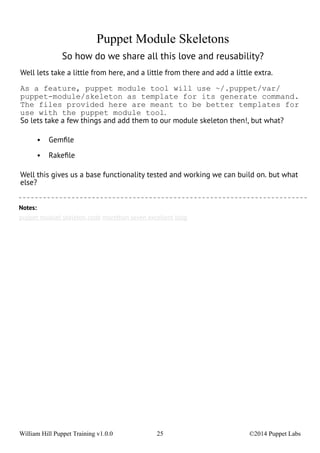
Puppet Module Skeletons 
So how do we share all this love and reusability? 
Well lets take a little from here, and a little from there and add a little extra. 
As a feature, puppet module tool will use ~/.puppet/var/ 
puppet-module/skeleton as template for its generate command. 
The files provided here are meant to be better templates for 
use with the puppet module tool. 
So lets take a few things and add them to our module skeleton then!, but what? 
• Gemfile 
• Rakefile 
Well this gives us a base functionality tested and working we can build on. but what 
else? 
Notes: 
puppet moduel skeleton code morethan seven excellent blog 
William Hill Puppet Training v1.0.0 25 ©2014 Puppet Labs
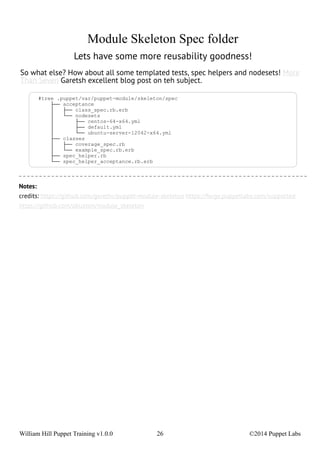
Module Skeleton Spec folder 
Lets have some more reusability goodness! 
So what else? How about all some templated tests, spec helpers and nodesets! More 
Than Seven Garetsh excellent blog post on teh subject. 
#tree .puppet/var/puppet-module/skeleton/spec 
├── acceptance 
│ ├── class_spec.rb.erb 
│ └── nodesets 
│ ├── centos-64-x64.yml 
│ ├── default.yml 
│ └── ubuntu-server-12042-x64.yml 
├── classes 
│ ├── coverage_spec.rb 
│ └── example_spec.rb.erb 
├── spec_helper.rb 
└── spec_helper_acceptance.rb.erb 
Notes: 
credits: https://github.com/garethr/puppet-module-skeleton https://forge.puppetlabs.com/supported 
https://github.com/abuxton/module_skeleton 
William Hill Puppet Training v1.0.0 26 ©2014 Puppet Labs
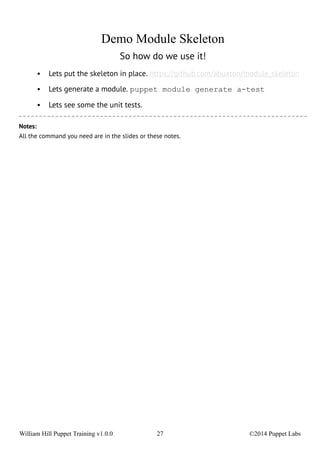
Demo Module Skeleton 
So how do we use it! 
• Lets put the skeleton in place. https://github.com/abuxton/module_skeleton 
• Lets generate a module. puppet module generate a-test 
• Lets see some the unit tests. 
Notes: 
All the command you need are in the slides or these notes. 
William Hill Puppet Training v1.0.0 27 ©2014 Puppet Labs
Putting it all together. 
How do we use this in anger? 
Notes: 
this will be additional in print 
William Hill Puppet Training v1.0.0 28 ©2014 Puppet Labs
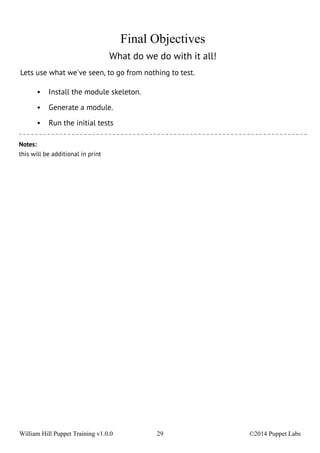
Final Objectives 
What do we do with it all! 
Lets use what we've seen, to go from nothing to test. 
• Install the module skeleton. 
• Generate a module. 
• Run the initial tests 
Notes: 
this will be additional in print 
William Hill Puppet Training v1.0.0 29 ©2014 Puppet Labs
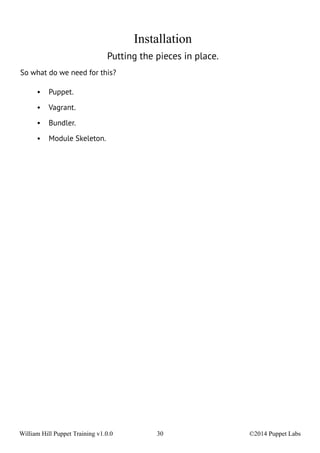
Installation 
Putting the pieces in place. 
So what do we need for this? 
• Puppet. 
• Vagrant. 
• Bundler. 
• Module Skeleton. 
William Hill Puppet Training v1.0.0 30 ©2014 Puppet Labs
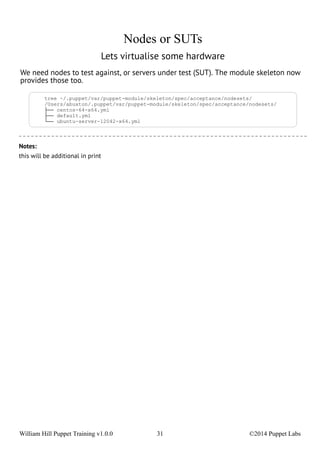
Nodes or SUTs 
Lets virtualise some hardware 
We need nodes to test against, or servers under test (SUT). The module skeleton now 
provides those too. 
tree ~/.puppet/var/puppet-module/skeleton/spec/acceptance/nodesets/ 
/Users/abuxton/.puppet/var/puppet-module/skeleton/spec/acceptance/nodesets/ 
├── centos-64-x64.yml 
├── default.yml 
└── ubuntu-server-12042-x64.yml 
Notes: 
this will be additional in print 
William Hill Puppet Training v1.0.0 31 ©2014 Puppet Labs
Module to test. 
What could go wrong! 
We all know live demos are so successful. So lets keep this simple. 
• Were going to generate a module (NTP). 
• Were going to take a look at the out put. 
• Were going to run the tests. 
Whats the worst that can go wrong! 
Notes: 
this will be additional in print 
William Hill Puppet Training v1.0.0 32 ©2014 Puppet Labs
Can I get a real Drink now 
Yes I mean Coffee. 
Notes: 
this will be additional in print 
William Hill Puppet Training v1.0.0 33 ©2014 Puppet Labs
So what did we do? 
What comes next? 
In summary, We actually managed 3 workshops in one. 
• How to test Puppets supported modules. 
• How to use and make use of the Puppet Module tool & Puppet module 
skeleton. 
• How to generate a module and test that code. 
What do we do with all this. 
• Read some more Beaker, https://github.com/puppetlabs/beaker/wiki 
• Run some tests https://forge.puppetlabs.com/ 
modules?endorsements=supported to forge supported list. 
• Run this at home and try extend it into your working day. 
• https://github.com/abuxton/kbypg my presentation on git 
William Hill Puppet Training v1.0.0 34 ©2014 Puppet Labs
Thank you 
I hope you learned a little something to take away. 
William Hill Puppet Training v1.0.0 35 ©2014 Puppet Labs
Credits 
Heres all the links. 
Beaker and useful links. 
• https://github.com/puppetlabs/beaker link to Beaker 
• http://www.morethanseven.net/2014/02/05/a-template-for-puppet-modules/ 
link to Gareths blog 
• https://forge.puppetlabs.com/modules?endorsements=supported link to Forge. 
• https://github.com/abuxton/kbypg this talk. 
Additional credits: 
• http://www.charlottemoss.co.uk/ profile image. 
• http://2014.puppetconf.com/ There is a threat you may be eventiually able to 
find audio of this session. 
William Hill Puppet Training v1.0.0 36 ©2014 Puppet Labs

Workshop: Know Before You Push 'Go': Using the Beaker Acceptance Test Framework to Test Your Puppet Module Infrastructure - PuppetConf 2014

  • 1.
    Table of Contents William Hill Puppet Training v1.0.0 1 ©2014 Puppet Labs
  • 2.
    Who am I? Good question! One of Puppet Labs London based Professional Service Engineers, coming from a background in the London start up community with a heavy leaning towards a the devops culture. The need to support my coffee addiction has taken me around the world working with and supporting all manner of development teams. The same addiction supported me through long nights of fire fighting and launch management for various game titles within EA, before I joined Puppet Labs. Feel free to buy me a coffee! Notes: this will be additional in print William Hill Puppet Training v1.0.0 2 ©2014 Puppet Labs
  • 3.
    Know Before YouPush 'Go' Using the Beaker Acceptance Test Framework to Test Your Puppet Module Infrastructure Beaker is an acceptance testing harness for Puppet PE and other Puppet Projects. A workshop to demonstrate Beaker usage and Beaker-rspec integration with module development. Demonstrating node environments, and quick start and reusability with module skeleton. The slide deck is available at https://github.com/abuxton/kbypg, you'll need Showoff to run it. William Hill Puppet Training v1.0.0 3 ©2014 Puppet Labs
  • 4.
    Workshop Activities Whatare we going to do? • Demo, how hard can it be? • Beaker, well this is what your interested in. • Tools to make your lives easier, we hope! • Pulling all of these together. William Hill Puppet Training v1.0.0 4 ©2014 Puppet Labs
  • 5.
    Our First Demo! How hard can it be? and what is involved? William Hill Puppet Training v1.0.0 5 ©2014 Puppet Labs
  • 6.
    Objective of thisDemo Demonstrating reusable components of Beaker and some valuable companion tool. • Puppetlabs/Beaker. • Testing environments, nodes and Vagrant. • rspec_beaker tests. • Reusability features. • A working demonstration, Puppetlabs-mysql. • Using supported modules. William Hill Puppet Training v1.0.0 6 ©2014 Puppet Labs
  • 7.
    Installation Bundler makesit easy Bundler provides a consistent environment for Ruby projects by tracking and installing the exact gems and versions that are needed. - bundler You don't have to use it, but it does make your life easier, repeatable and more dependable. Notes: this will be additional in print William Hill Puppet Training v1.0.0 7 ©2014 Puppet Labs
  • 8.
    Test Environment Vagrantfor when you have to fake it, but fake it well. Beaker utilises the concept of Nodes for test environments, for the demo were using Vagrant. Repeatable, dependable and distributable environments. William Hill Puppet Training v1.0.0 8 ©2014 Puppet Labs
  • 9.
    Demo Puppetlabs-mysql Puppetlabs-mysqlis being used for the demo. • Puppetlabs supported module. • Built in Gemfile for Bundler. • Default use of centos-64 for nodesets/default.yaml using Vagrant. • Examples of classes, acceptance, and unit test. Notes: this will be additional in print William Hill Puppet Training v1.0.0 9 ©2014 Puppet Labs
  • 10.
    Beaker Rspec testingand a whole lot more! Notes: this will be additional in print William Hill Puppet Training v1.0.0 10 ©2014 Puppet Labs
  • 11.
    Objectives Lets discusswhat makes up Beaker! • Test environments with nodesets. • Domain Spcecific language (DSL). • rspec-beaker. • Command line tool. William Hill Puppet Training v1.0.0 11 ©2014 Puppet Labs
  • 12.
    Test Environments SUTs(Systems Under Test) HOSTS: centos-64-x64: roles: - master platform: el-6-x86_64 box : centos-64-x64-vbox4210-nocm box_url : http://puppet-vagrant-boxes.puppetlabs.com/centos-64-x64-vbox4210-nocm.box hypervisor : vagrant CONFIG: type: foss Supports ec2, Docker, virtual machines, and physical hardware. Yaml for configuration and reuse, with default support for install at build time, can utilise both both PE and Poss. Notes: Creating A Test Environment William Hill Puppet Training v1.0.0 12 ©2014 Puppet Labs
  • 13.
    DSL What anotherlanguage to learn? OK, so not every one love to learn a new language, and if your new to testing were actually getting you to learn 2 languages, 3 if this is your first mis adventure in Puppet, and possibly 4 if you've never learned ruby and want to go that far. Don't be scared, there are good reasons, honestly.. • Portability. • Extending the functionality in a like for like manner. • Actually breaking down the barriers between languages. Notes: git doco RDOC William Hill Puppet Training v1.0.0 13 ©2014 Puppet Labs
  • 14.
    Domain Specific Language OK, so what is it? manifest = "file { '#{target}': source => '#{source}', ensure => present }" apply_manifest_on agent, manifest, { :catch_failures => true } • Its the way weve chosen to ensure your tests are contained in a portable manner. • Its the way we have constrained tests to allow you to extend functionality in a repeatable way. • It allows us to provide an interface to Puppet and its tools, which is after all the ultimate goal here. Notes: git doco RDOC William Hill Puppet Training v1.0.0 14 ©2014 Puppet Labs
  • 15.
    Beaker-Rspec Same asall the rest but different • Exposes some new variables for Beaker, related to both Beaker and its interaction with your SUT or nodeset. • Reflects the RSpec you are or are not familiar with, so easy to pick up and lots of sources for guidance and examples. describe 'creating a database' do # Using puppet_apply as a helper it 'should work with no errors' do pp = <<-EOS class { 'mysql::server': root_password => 'password' } mysql::db { 'spec1': user => 'root1', password => 'password', } EOS end end William Hill Puppet Training v1.0.0 15 ©2014 Puppet Labs
  • 16.
    Spec Helpers Extractthe repeatable bits! Update spec_helper_acceptance.rb to reflect the module under test. You will need to set the correct module name and add any module dependencies. Place the file in the /spec directory. spec helper We use the spec helper for any set up tasks that we want to repeat that are not directly part of the SUT, sometimes this gets a little confused. But what ever works for you. Notes: https://github.com/puppetlabs/beaker/wiki/How-to-Write-a-Beaker-Test-for-a-Module#create-the-spechelperacceptancerb William Hill Puppet Training v1.0.0 16 ©2014 Puppet Labs
  • 17.
    Command Line Interface Some times you just want to run the test! I don't believe any thing ever turned up polished? Beaker is no exception and so you can choose to run your tests individually and increment them with out the overheads of all the set up. So the command line client is always available https://github.com/puppetlabs/beaker/ wiki/The-Command-Line. Notes: https://github.com/puppetlabs/beaker/wiki/The-Command-Line William Hill Puppet Training v1.0.0 17 ©2014 Puppet Labs
  • 18.
    Running the tests Pressing Go before you know! So how do we run the tests? let us start with the following; # beaker --help or preferably # bundle exec rspec spec/<testfolder> The latter line is the current preferable usage, and what we invoked in the demo. William Hill Puppet Training v1.0.0 18 ©2014 Puppet Labs
  • 19.
    So Another Demo I don't think so lets just look at what we did again. Notes: this will be additional in print William Hill Puppet Training v1.0.0 19 ©2014 Puppet Labs
  • 20.
    Tools & Reusability Lets just do it once ok Notes: this will be additional in print William Hill Puppet Training v1.0.0 20 ©2014 Puppet Labs
  • 21.
    Objectives Lets introducesome useful things! • Bundler. • Rake. • Puppets Module Skeletons. Notes: this will be additional in print William Hill Puppet Training v1.0.0 21 ©2014 Puppet Labs
  • 22.
    Bundler Managing Rubyapplication dependancys Things you want to do; • Test the thing. • Repeat the test. • Save your self reinstalling every time and documenting all the things! Bundler is one part of how we do the above, Bundler provides a consistent environment for Ruby projects by tracking and installing the exact gems and versions that are needed. The Gemspec becomes part of your module files and all you need to do is document installing Bundler, or maybe you just do that with Puppet too! Notes: http://bundler.io/ Install Bundler, we will use it later William Hill Puppet Training v1.0.0 22 ©2014 Puppet Labs
  • 23.
    Rake Lets buildsome things to help Rake is a Make-like program implemented in Ruby! What does that mean for us, well in this case it just means were going to use it to provide some Ruby based extensions and functionality, and also to make use of functionality in dependencies of Beaker. https://rubygems.org/gems/rake rake beaker # Run beaker acceptance tests rake beaker_nodes # List available beaker nodesets rake build # Build puppet module package rake clean # Clean a built module package rake coverage # Generate code coverage information rake help # Display the list of available rake tasks rake lint # Check puppet manifests with puppet-lint rake spec # Run spec tests in a clean fixtures directory rake spec_clean # Clean up the fixtures directory rake spec_prep # Create the fixtures directory rake spec_standalone # Run spec tests on an existing fixtures directory rake syntax # Check puppet manifest syntax rake validate # Validate manifests, templates, and ruby files in lib Notes: https://rubygems.org/gems/rake William Hill Puppet Training v1.0.0 23 ©2014 Puppet Labs
  • 24.
    Puppets Module Skeleton Your out the box starter for 10! When you run puppet module generate name-module you get given the following. a-module/ ├── README.md ├── Rakefile ├── manifests │ └── init.pp ├── metadata.json ├── spec │ ├── classes │ │ └── init_spec.rb │ └── spec_helper.rb └── tests └── init.pp We are not sure this is enough! But its more than you used to get. William Hill Puppet Training v1.0.0 24 ©2014 Puppet Labs
  • 25.
    Puppet Module Skeletons So how do we share all this love and reusability? Well lets take a little from here, and a little from there and add a little extra. As a feature, puppet module tool will use ~/.puppet/var/ puppet-module/skeleton as template for its generate command. The files provided here are meant to be better templates for use with the puppet module tool. So lets take a few things and add them to our module skeleton then!, but what? • Gemfile • Rakefile Well this gives us a base functionality tested and working we can build on. but what else? Notes: puppet moduel skeleton code morethan seven excellent blog William Hill Puppet Training v1.0.0 25 ©2014 Puppet Labs
  • 26.
    Module Skeleton Specfolder Lets have some more reusability goodness! So what else? How about all some templated tests, spec helpers and nodesets! More Than Seven Garetsh excellent blog post on teh subject. #tree .puppet/var/puppet-module/skeleton/spec ├── acceptance │ ├── class_spec.rb.erb │ └── nodesets │ ├── centos-64-x64.yml │ ├── default.yml │ └── ubuntu-server-12042-x64.yml ├── classes │ ├── coverage_spec.rb │ └── example_spec.rb.erb ├── spec_helper.rb └── spec_helper_acceptance.rb.erb Notes: credits: https://github.com/garethr/puppet-module-skeleton https://forge.puppetlabs.com/supported https://github.com/abuxton/module_skeleton William Hill Puppet Training v1.0.0 26 ©2014 Puppet Labs
  • 27.
    Demo Module Skeleton So how do we use it! • Lets put the skeleton in place. https://github.com/abuxton/module_skeleton • Lets generate a module. puppet module generate a-test • Lets see some the unit tests. Notes: All the command you need are in the slides or these notes. William Hill Puppet Training v1.0.0 27 ©2014 Puppet Labs
  • 28.
    Putting it alltogether. How do we use this in anger? Notes: this will be additional in print William Hill Puppet Training v1.0.0 28 ©2014 Puppet Labs
  • 29.
    Final Objectives Whatdo we do with it all! Lets use what we've seen, to go from nothing to test. • Install the module skeleton. • Generate a module. • Run the initial tests Notes: this will be additional in print William Hill Puppet Training v1.0.0 29 ©2014 Puppet Labs
  • 30.
    Installation Putting thepieces in place. So what do we need for this? • Puppet. • Vagrant. • Bundler. • Module Skeleton. William Hill Puppet Training v1.0.0 30 ©2014 Puppet Labs
  • 31.
    Nodes or SUTs Lets virtualise some hardware We need nodes to test against, or servers under test (SUT). The module skeleton now provides those too. tree ~/.puppet/var/puppet-module/skeleton/spec/acceptance/nodesets/ /Users/abuxton/.puppet/var/puppet-module/skeleton/spec/acceptance/nodesets/ ├── centos-64-x64.yml ├── default.yml └── ubuntu-server-12042-x64.yml Notes: this will be additional in print William Hill Puppet Training v1.0.0 31 ©2014 Puppet Labs
  • 32.
    Module to test. What could go wrong! We all know live demos are so successful. So lets keep this simple. • Were going to generate a module (NTP). • Were going to take a look at the out put. • Were going to run the tests. Whats the worst that can go wrong! Notes: this will be additional in print William Hill Puppet Training v1.0.0 32 ©2014 Puppet Labs
  • 33.
    Can I geta real Drink now Yes I mean Coffee. Notes: this will be additional in print William Hill Puppet Training v1.0.0 33 ©2014 Puppet Labs
  • 34.
    So what didwe do? What comes next? In summary, We actually managed 3 workshops in one. • How to test Puppets supported modules. • How to use and make use of the Puppet Module tool & Puppet module skeleton. • How to generate a module and test that code. What do we do with all this. • Read some more Beaker, https://github.com/puppetlabs/beaker/wiki • Run some tests https://forge.puppetlabs.com/ modules?endorsements=supported to forge supported list. • Run this at home and try extend it into your working day. • https://github.com/abuxton/kbypg my presentation on git William Hill Puppet Training v1.0.0 34 ©2014 Puppet Labs
  • 35.
    Thank you Ihope you learned a little something to take away. William Hill Puppet Training v1.0.0 35 ©2014 Puppet Labs
  • 36.
    Credits Heres allthe links. Beaker and useful links. • https://github.com/puppetlabs/beaker link to Beaker • http://www.morethanseven.net/2014/02/05/a-template-for-puppet-modules/ link to Gareths blog • https://forge.puppetlabs.com/modules?endorsements=supported link to Forge. • https://github.com/abuxton/kbypg this talk. Additional credits: • http://www.charlottemoss.co.uk/ profile image. • http://2014.puppetconf.com/ There is a threat you may be eventiually able to find audio of this session. William Hill Puppet Training v1.0.0 36 ©2014 Puppet Labs