WORKSHEET 10.1A: Summary Questionnaire
Use the filled-out Worksheet 10.1B in the book as an example
to follow as you complete this questionnaire.
1. What is the indentify of your organization, and what is its
mission?
2. What is the proposed project (title, purpose, target
population)?
3. Why is the proposed project important?
4. What will be accomplished by this program or project during
the time period of the grant?
5. Why should your organization do the project (credibility
statement)?
6. How much will the project cost during the grant time period?
How much is being requested from this funder?
Winning Grants Step by Step,Fourth Edition. Copyright © 2013
by John Wiley & Sons, Inc. All rights reserved.
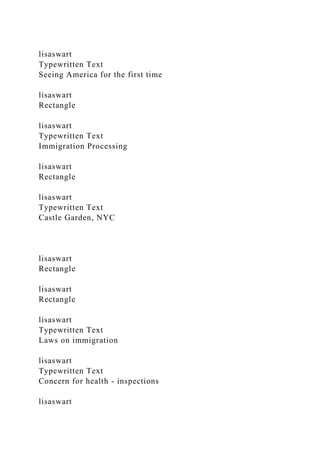
lisaswart
Typewritten Text
Kraut, Alan. The Huddled Masses: The Immigrant in American
Society, 1880-1921. Wheeling, Ill.: Harlan Davidson, c2001 –
Chapter 2, pp. 52 – 85.
lisaswart
Typewritten Text
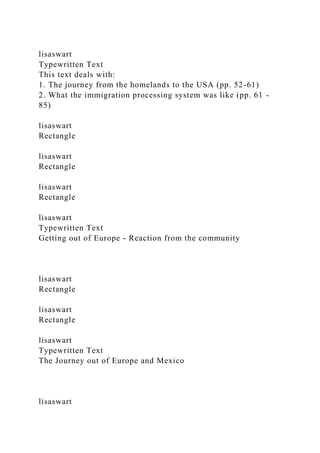
This text deals with:
1. The journey from the homelands to the USA (pp. 52-61)
2. What the immigration processing system was like (pp. 61 -
85)
lisaswart
Rectangle
lisaswart
Rectangle
lisaswart
Rectangle
lisaswart
Typewritten Text
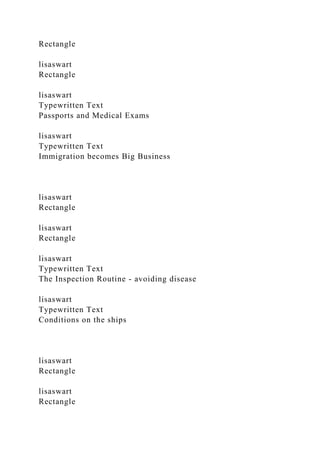
Getting out of Europe - Reaction from the community
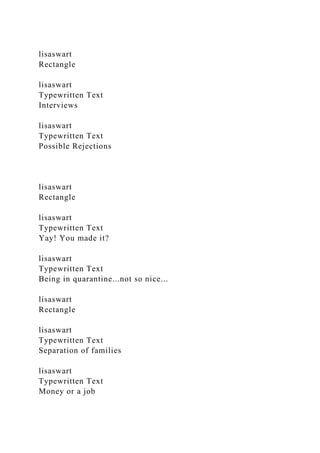
lisaswart
Rectangle
lisaswart
Rectangle
lisaswart
Typewritten Text
The Journey out of Europe and Mexico
lisaswart
Rectangle
lisaswart
Rectangle
lisaswart
Typewritten Text
Passports and Medical Exams
lisaswart
Typewritten Text
Immigration becomes Big Business
lisaswart
Rectangle
lisaswart
Rectangle
lisaswart
Typewritten Text
The Inspection Routine - avoiding disease
lisaswart
Typewritten Text
Conditions on the ships
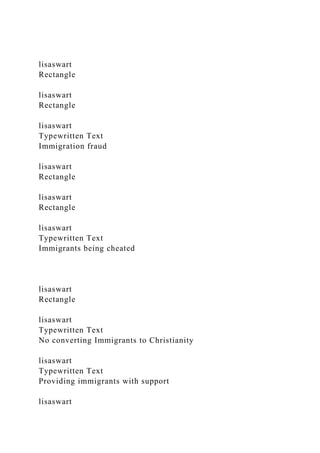
lisaswart
Rectangle
lisaswart
Rectangle
lisaswart
Typewritten Text
Seeing America for the first time
lisaswart
Rectangle
lisaswart
Typewritten Text
Immigration Processing
lisaswart
Rectangle
lisaswart
Typewritten Text
Castle Garden, NYC
lisaswart
Rectangle
lisaswart
Rectangle
lisaswart
Typewritten Text
Laws on immigration
lisaswart
Typewritten Text
Concern for health - inspections
lisaswart
Typewritten Text
- grounds for exclusion
lisaswart
Typewritten Text
Mexico
lisaswart
Rectangle
lisaswart
Typewritten Text
Ellis Island - 1892
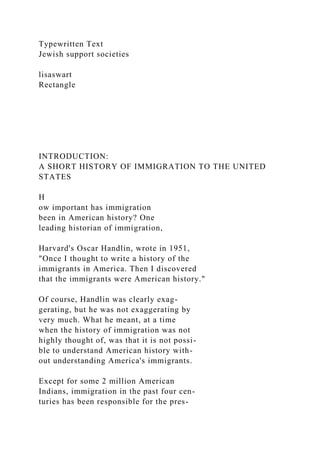
lisaswart
Rectangle
lisaswart
Typewritten Text
Food served at Ellis and Angel Islands
lisaswart
Rectangle
lisaswart
Rectangle
lisaswart
Typewritten Text
Health Inspections
lisaswart
Rectangle
lisaswart
Typewritten Text
Interviews
lisaswart
Typewritten Text
Possible Rejections
lisaswart
Rectangle
lisaswart
Typewritten Text
Yay! You made it?
lisaswart
Typewritten Text
Being in quarantine...not so nice...
lisaswart
Rectangle
lisaswart
Typewritten Text
Separation of families
lisaswart
Typewritten Text
Money or a job
lisaswart
Rectangle
lisaswart
Rectangle
lisaswart
Typewritten Text
Immigration fraud
lisaswart
Rectangle
lisaswart
Rectangle
lisaswart
Typewritten Text
Immigrants being cheated
lisaswart
Rectangle
lisaswart
Typewritten Text
No converting Immigrants to Christianity
lisaswart
Typewritten Text
Providing immigrants with support
lisaswart
Typewritten Text
Jewish support societies
lisaswart
Rectangle
INTRODUCTION:
A SHORT HISTORY OF IMMIGRATION TO THE UNITED
STATES
H
ow important has immigration
been in American history? One
leading historian of immigration,
Harvard's Oscar Handlin, wrote in 1951,
"Once I thought to write a history of the
immigrants in America. Then I discovered
that the immigrants were American history."
Of course, Handlin was clearly exag-
gerating, but he was not exaggerating by
very much. What he meant, at a time
when the history of immigration was not
highly thought of, was that it is not possi-
ble to understand American history with-
out understanding America's immigrants.
Except for some 2 million American
Indians, immigration in the past four cen-
turies has been responsible for the pres-
ence of the more than a quarter of a bil-
lion people who now populate the United
States. Immigrants and their descendants
are the authors of American diversity, of
what can be called the American mosaic.
They have created a culture that, despite
its largely European roots, is clearly not
European, any more than it is African,
or Amerindian, or Asian, or Caribbean,
or Latino. Americans are, as the French
sojourner Michel-Guillaume Jean de
Crevecoeur noted in 1782, new persons,
who, over time, have been transformed
by their new environment and ever
changing heredity. It is impossible to
imagine what America would be like if no
immigrants had come; nor is it possible to
imagine what it would have been like had
only Europeans come, or only British, and
so forth. The American people are a
product of what they have been, and
where they have come from, as well as of
what has happened to them in the United
States. When nativists—opponents of
immigration—rant and rave about the
dangers of being overrun by immigrants,
or about losing control of our borders, or
complain that immigrants and some of
their children do not speak English well,
they are denying the validity of an essen-
tial and enhancing part of the American
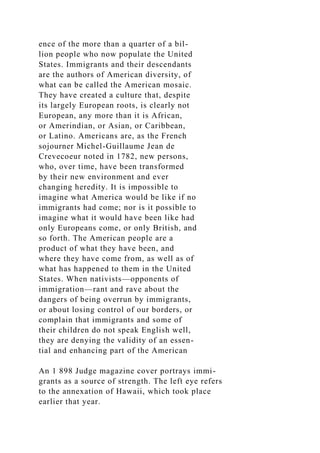
An 1 898 Judge magazine cover portrays immi-
grants as a source of strength. The left eye refers
to the annexation of Hawaii, which took place
earlier that year.
experience. They are denying the vitaliza-
tion that has come from the constant
enrichment and reenforcement of Ameri-
can society by the muscles, brains, and
hearts that every generation of immi-
grants has brought with them to America.
The history of immigration to the Unit-
ed States can be divided most conveniently
into four distinct periods: the formative era,
up to 1815; the so-called "long" 19th cen-
tury stretching from 1815 to 1924; the era
of restriction, 1924-1965; the era of
renewed immigration, since 1965.
The Formative Period (1565-1815)
During the formative period, which begins
with the settlement of St. Augustine, Flori-
da, by Spanish in 1565 and ends with the
conclusion of a series of wars between
Britain and France in which Americans
took part, the overwhelming majority of
7
Co
py
ri
gh
t
@
20
01
.
Ox
fo
rd
U
ni
ve
rs
it
y
Pr
es
s.
Al
l
ri
gh
ts
r
es
er
ve
d.
M
ay
n
ot
b
e
re
pr
od
uc
ed
i
n
an
y
fo
rm
w
it
ho
ut
p
er
mi
ss
io
n
fr
om
t
he
p
ub
li
sh
er
,
ex
ce
pt
f
ai
r
us
es
p
er
mi
tt
ed
u
nd
er
U
.S
.
or
a
pp
li
ca
bl
e
co
py
ri
gh
t
la
w.
EBSCO : eBook Academic Collection (EBSCOhost) - printed on
9/26/2018 5:45 PM via MIDDLE TENNESSEE STATE UNIV
AN: 181302 ; Daniels, Roger.; American Immigration : A
Student Companion
Account: s4672406.main.ehost
I N T R O D U C T I O N
immigrants came either from the British
Isles or from Africa. We must remember,
however, that the first permanent Euro-
pean settlements in what is now the United
States were made by Spanish people at St.
Augustine and in New Mexico in 1598,
and that immigrants from other European
countries, particularly France and Ger-
many, were in almost every colony. Of the
roughly 1 million people who came in this
period, more than half were not free. All of
the 350,000 Africans came in chains, and
perhaps half of the 650,000 Europeans
were indentured servants or convicts.
Most of the British who came were
from England, and most of them were
from the southern part of England. Smaller
but still substantial numbers of Scots and
Irish came, as did a yet smaller number of
Welsh. Even in modern times, immigration
statistics are often incomplete or unreli-
able, and they were less reliable in the 17th
and 18th centuries. The most useful esti-
mates come from the first United States
census, taken in 1790, which found some
3.15 million white Americans and 750,000
African Americans. The 1790 census did
not count most Native Americans, and the
census takers did not try to do so until
1880. Scholars have analyzed the informa-
tion contained in that first census and tried
to estimate the number and percentage of
the population represented by each ethnic
group. The vast majority of the 3.9 million
Americans had been born in what became
the United States, as there had been rela-
tively little immigration between the begin-
nings of the American Revolution in the
mid-1770s and 1790.
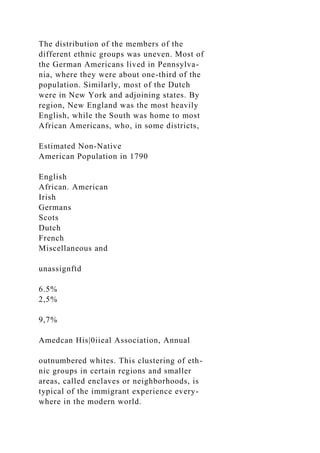
The distribution of the members of the
different ethnic groups was uneven. Most of
the German Americans lived in Pennsylva-
nia, where they were about one-third of the
population. Similarly, most of the Dutch
were in New York and adjoining states. By
region, New England was the most heavily
English, while the South was home to most
African Americans, who, in some districts,
Estimated Non-Native
American Population in 1790
English
African. American
Irish
Germans
Scots
Dutch
French
Miscellaneous and
unassignftd
6.5%
2,5%
9,7%
Amedcan His|0iieal Association, Annual
outnumbered whites. This clustering of eth-
nic groups in certain regions and smaller
areas, called enclaves or neighborhoods, is
typical of the immigrant experience every-
where in the modern world.
The United States Constitution,
which went into effect in 1789, required
that a census be taken every 10 years, but
it said very little about immigration: in
fact, the word immigration does not
appear anywhere in the document. But
the founding fathers clearly foresaw and
encouraged continued immigration, as
three separate provisions testify. In Article
1, Section 8, Congress was told to "estab-
lish a uniform Rule of Naturalization."
The following section provided that Con-
gress could not interfere with the African
slave trade before 1808, and Article 2,
Section 1 provided that the President—
and by extension the Vice President—
must be "a natural born Citizen." This
left immigrants eligible for all other
offices under the Constitution. From the
beginning of the United States immigrants
have filled these offices, serving in Con-
gress, in the cabinet, and on the Supreme
Court. For example, the first secretary of
the treasury, Alexander Hamilton, was an
immigrant from the island of Nevis in the
West Indies and Madeline Albright, Secre-
tary of State under Bill Clinton, was an
immigrant from Czechoslovakia.
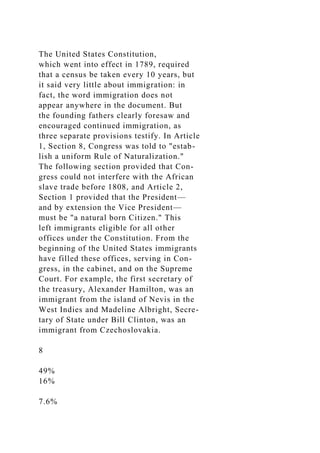
8
49%
16%
7.6%
6.9%
1.8%
Report, 1931
Co
py
ri
gh
t
@
20
01
.
Ox
fo
rd
U
ni
ve
rs
it
y
Pr
es
s.
Al
l
ri
gh
ts
r
es
er
ve
d.
M
ay
n
ot
b
e
re
pr
od
uc
ed
i
n
an
y
fo
rm
w
it
ho
ut
p
er
mi
ss
io
n
fr
om
t
he
p
ub
li
sh
er
,
ex
ce
pt
f
ai
r
us
es
p
er
mi
tt
ed
u
nd
er
U
.S
.
or
a
pp
li
ca
bl
e
co
py
ri
gh
t
la
w.
EBSCO : eBook Academic Collection (EBSCOhost) - printed on
9/26/2018 5:45 PM via MIDDLE TENNESSEE STATE UNIV
AN: 181302 ; Daniels, Roger.; American Immigration : A
Student Companion
Account: s4672406.main.ehost
I N T R O D U C T I O N *
In the second year of the American
republic, 1790, Congress passed a natural-
ization statute that provided for the natu-
ralization of "free white persons." The
law was intended to exclude Africans and
indentured servants: later interpretation by
the Supreme Court expanded the ban to
include Asians, but for much of the 19th
century some Chinese and Japanese were
naturalized. In 1798, Congress passed the
short-lived Aliens Act, which threatened to
deport aliens who were involved in poli-
tics, but no one was deported.
Only two other laws passed in the first
half of the 19th century affected immigra-
tion. In 1808, at the first legal opportunity,
Congress abolished the slave trade but not
slavery, and in 1819 it ordered that incom-
ing immigrants be counted, but not those
leaving the United States.
The "Long" 19th Century (1815-1924)
Historians sometimes define centuries not
by the calendar, but by events: for Ameri-
can immigration two events define the
19th century more effectively than do the
"normal" dates, 1801-1900. The first
date, 1815, marks the end of a series of
wars between Britain and France and our
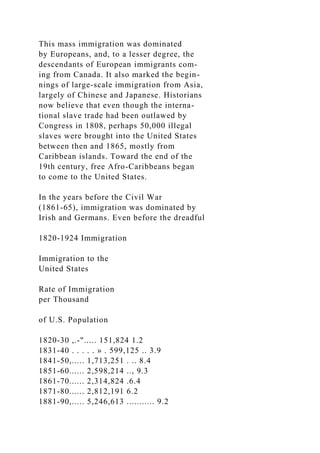
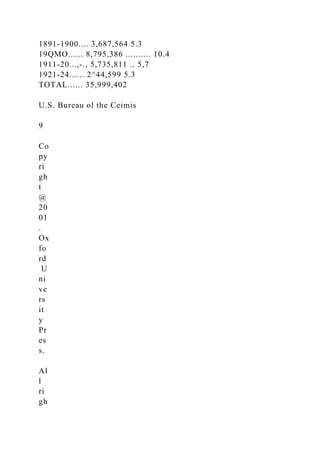
War of 1812 with Britain. The end of the
fighting signaled a renewal of immigration.
The second, 1924, denotes the enactment
of a "permanent" restrictive immigration
law by the United States. During that
"long" 19th century, more than 36 million
people immigrated to the United States.
This is an absolute majority of all the
immigrants who have ever come. The
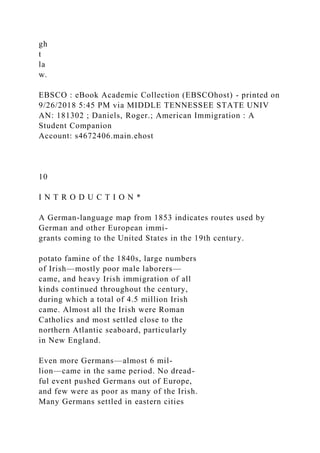
table on the right shows, by decade, how
many came after 1819 and the rate of
immigration in relation to the total U.S.
population.
The mere numbers of immigrants do
not tell the whole story. In the earlier part
of the "long" century of immigration, the
relative impact of immigration was higher
than the table on the left seems to indi-
cate because the population was much
smaller. The table below shows the rate of
immigration per thousand pre-existing
inhabitants. Thus, for example, the rate
for the 1850s is much higher than for the
1890s even though 42 percent more peo-
ple came in the latter period. Immigration
was discouraged in the 1860s by the Civil
War and in the 1870s and 1890s by hard
times in the United States.
This mass immigration was dominated
by Europeans, and, to a lesser degree, the
descendants of European immigrants com-
ing from Canada. It also marked the begin-
nings of large-scale immigration from Asia,
largely of Chinese and Japanese. Historians
now believe that even though the interna-
tional slave trade had been outlawed by
Congress in 1808, perhaps 50,000 illegal
slaves were brought into the United States
between then and 1865, mostly from
Caribbean islands. Toward the end of the
19th century, free Afro-Caribbeans began
to come to the United States.
In the years before the Civil War
(1861-65), immigration was dominated by
Irish and Germans. Even before the dreadful
1820-1924 Immigration
Immigration to the
United States
Rate of Immigration
per Thousand
of U.S. Population
1820-30 ,.-"..... 151,824 1.2
1831-40 . . . . . » . 599,125 .. 3.9
1841-50,..... 1,713,251 . .. 8.4
1851-60...... 2,598,214 .., 9.3
1861-70...... 2,314,824 .6.4
1871-80...... 2,812,191 6.2
1881-90,..... 5,246,613 ........... 9.2
1891-1900.... 3,687,564 5.3
19QMO...... 8,795,386 .......... 10.4
1911-20...,-., 5,735,811 .. 5,7
1921-24...... 2^44,599 5.3
TOTAL...... 35,999,402
U.S. Bureau ol the Ceimis
9
Co
py
ri
gh
t
@
20
01
.
Ox
fo
rd
U
ni
ve
rs
it
y
Pr
es
s.
Al
l
ri
gh
ts
r
es
er
ve
d.
M
ay
n
ot
b
e
re
pr
od
uc
ed
i
n
an
y
fo
rm
w
it
ho
ut
p
er
mi
ss
io
n
fr
om
t
he
p
ub
li
sh
er
,
ex
ce
pt
f
ai
r
us
es
p
er
mi
tt
ed
u
nd
er
U
.S
.
or
a
pp
li
ca
bl
e
co
py
ri
gh
t
la
w.
EBSCO : eBook Academic Collection (EBSCOhost) - printed on
9/26/2018 5:45 PM via MIDDLE TENNESSEE STATE UNIV
AN: 181302 ; Daniels, Roger.; American Immigration : A
Student Companion
Account: s4672406.main.ehost
10
I N T R O D U C T I O N *
A German-language map from 1853 indicates routes used by
German and other European immi-
grants coming to the United States in the 19th century.
potato famine of the 1840s, large numbers
of Irish—mostly poor male laborers—
came, and heavy Irish immigration of all
kinds continued throughout the century,
during which a total of 4.5 million Irish
came. Almost all the Irish were Roman
Catholics and most settled close to the
northern Atlantic seaboard, particularly
in New England.
Even more Germans—almost 6 mil-
lion—came in the same period. No dread-
ful event pushed Germans out of Europe,
and few were as poor as many of the Irish.
Many Germans settled in eastern cities
between New York and Baltimore but
even more went to interior cities and
farms, particularly in the so-called "Ger-
man triangle," the area bounded by
Cincinnati, St. Louis, and Milwaukee.
Most German immigrants were Protes-
tants, but there was a sizable Roman
Catholic minority and a smaller but sub-
stantial Jewish one.
Two other groups, Scandinavians and
Chinese, began their mass migration
before the Civil War. More than 2 million
Scandinavians—Swedes, Norwegians, and
Danes—came during the century. There
were more than a million Swedes,
700,000 Norwegians, and 300,000
Danes. This was largely a migration of
families, of whom an overwhelming
majority settled in the upper Middle
West, particularly in Nebraska, Iowa,Co
py
ri
gh
t
@
20
01
.
Ox
fo
rd
U
ni
ve
rs
it
y
Pr
es
s.
Al
l
ri
gh
ts
r
es
er
ve
d.
M
ay
n
ot
b
e
re
pr
od
uc
ed
i
n
an
y
fo
rm
w
it
ho
ut
p
er
mi
ss
io
n
fr
om
t
he
p
ub
li
sh
er
,
ex
ce
pt
f
ai
r
us
es
p
er
mi
tt
ed
u
nd
er
U
.S
.
or
a
pp
li
ca
bl
e
co
py
ri
gh
t
la
w.
EBSCO : eBook Academic Collection (EBSCOhost) - printed on
9/26/2018 5:45 PM via MIDDLE TENNESSEE STATE UNIV
AN: 181302 ; Daniels, Roger.; American Immigration : A
Student Companion
Account: s4672406.main.ehost
11
I N T R O D U C T I O N *
Minnesota, and the Dakotas. Most were
farmers and practiced Protestant religions,
chiefly variants of Lutheranism.
A smaller number of Chinese, per-
haps 350,000, were the first large group
of immigrants to cross the Pacific. They
were, at first, chiefly gold miners and rail-
road workers in California and other
western states and territories, and all but
a few were single males who practiced
Buddhism or Taoism. For both economic
and cultural reasons they suffered from
severe discrimination in both custom and
law: the Chinese Exclusion Act of 1882
stopped the further immigration of Chi-
nese laborers. This law began the system-
atic restriction of voluntary immigrants.
Before 1882 there was no effective restric-
tive immigration legislation. Anyone not a
slave who reached American shores or
crossed a land border could enter legally.
After the Civil War
the pace of migration
increased, and,
although British, Irish,
German and Scandina-
vian immigrants contin-
ued to come from
Europe, they were soon
outnumbered by eastern
and southern Euro-
peans—Poles, eastern
European Jews, Italians,
southern Slavs and
Greeks. The migration
of these latter groups
was aided by the
improvement of Euro-
pean steamship lines
and railroads. European
shipping companies,
such as the Cunard
Line, based in Liver-
pool, England, and the
German-based Ham-
burg-Amerika and
North German Lloyd lines, built special
ships for the immigrant trade and coordi-
An advertisement from about
1872 shows how Minnesota,
like California and other
states, competed for immi-
grants. As the ad states, they
got special reduced rates on
transportation.
nated their sailings with railroad sched-
ules. By the end of the century, a person
in Poland could buy one ticket that would
cover rail fare to Hamburg, an ocean pas-
sage, and a railroad ticket to an American
city. Or, as often happened, a recent
immigrant in an American city—Detroit,
for example—could buy a ticket for a
family member or friend in Krakow,
Poland, for example, and have it delivered
to that person in Poland. Similar condi-
tions prevailed in the Pacific, where
Japanese steamers, mostly of the NYK
line, brought perhaps 275,000 Japanese
to the United States. Historians call this
kind of migration "chain migration,"
because immigrants send for and follow
one another, like links in a chain.
Most of the members of these eastern
and southern European immigrant groups
had several things in common: almost all
worked at industrial and urban occupa-
tions, they lived in American cities rather
than in small towns or on farms, and very
few were Protestants. Except for the Jews,
and, after 1907, the Japanese, these popu-
lations were heavily male and large num-
bers of them, including Japanese, would
work in the United States for a time and
then return home. Such return migration
was important in this era, because for
every three immigrants, perhaps one went
home, although, to be sure, many came
back, sometimes more than once. Where-
as Italian men worked largely in construc-
tion of all kinds, Polish and eastern Euro-
pean men worked at the dirtiest jobs in
heavy industry, and Jewish and Italian
immigrant women worked in the garment
factories that clothed America. Large
numbers of these folks would have pre-
ferred to work on their own farms, as
many earlier immigrants had done, but
the era of free land was long past. And
even if free land had been available, few
of these immigrants had the capital neces-
sary to get started. The only immigrant
group in this era that settled largely onCo
py
ri
gh
t
@
20
01
.
Ox
fo
rd
U
ni
ve
rs
it
y
Pr
es
s.
Al
l
ri
gh
ts
r
es
er
ve
d.
M
ay
n
ot
b
e
re
pr
od
uc
ed
i
n
an
y
fo
rm
w
it
ho
ut
p
er
mi
ss
io
n
fr
om
t
he
p
ub
li
sh
er
,
ex
ce
pt
f
ai
r
us
es
p
er
mi
tt
ed
u
nd
er
U
.S
.
or
a
pp
li
ca
bl
e
co
py
ri
gh
t
la
w.
EBSCO : eBook Academic Collection (EBSCOhost) - printed on
9/26/2018 5:45 PM via MIDDLE TENNESSEE STATE UNIV
AN: 181302 ; Daniels, Roger.; American Immigration : A
Student Companion
Account: s4672406.main.ehost
12
I N T R O D U C T I O N
This cartoon from the 1860s attacks both
Irish and Chinese. The Irishman (left) and the
Chinese are devouring America, represented
by Uncle Sam in his striped trousers; then the
Chinese devours the Irishman.
the land was the Japanese, who did so in
the expanding agricultural economy of
the West Coast.
The restriction of immigration began
with the passage of the Chinese Exclusion
Act of 1882, which became the hinge on
which the "golden door" of immigration
began to swing closed. A whole succession
of laws between 1882 and 1924 narrowed
the opening through which immigrants
came, although only in the 1920s did the
total number of immigrants admitted begin
to fall as a result of legislation.
The reasons that large numbers of
Americans have supported immigration
restriction are various and complicated,
but two reasons stand out: fear of eco-
nomic and cultural competition, and
racial and ethnic prejudice. This was true
in the mid-18th century when Benjamin
Franklin and other English-speaking
Pennsylvanians expressed fear that Ger-
man immigrants and the German lan-
guage would "take over" their colony. It
was also true in the mid-19th century
when many in the Northeast opposed the
entry of Irish immigrants who were both
poor and Roman Catholic. It was true
again in the 1860s and in the following
decades, when many westerners insisted
that "the Chinese must GO!", both
because of their race and the fact that
they, like many immigrants, were willing
to work for very low wages. White work-
ers feared that this would depress their
own wages. And, in the late 19th and
early 20th centuries many—perhaps
most—Americans felt that too many east-
ern and southern Europeans were filling
up American cities and competing for
unskilled and semiskilled jobs.
These anti-immigrant notions were
greatly stimulated by an official govern-
ment commission, the U.S. Immigration
Commission, whose 1911 report put forth
many of the arguments used to justify dras-
tic immigration restriction in the following
decade. It argued that most of those then
coming to the United States—what it called
"new immigrants," people from eastern
and southern Europe—were essentially dif-
ferent from and inferior to most of those
who had come previously—what it called
"old immigrants," people from the British
Isles, Germany, and Scandinavia.
Similar kinds of arguments had been
raised against Irish and German immi-
grants early in the 19th century and
would be raised in the closing decades of
the 20th century against Asians and Latin
Americans.
These opponents of immigration, or
nativists, were and are largely motivated
by fears of all kinds, particularly fears
about their economic well-being and
about their culture being swamped by
incoming strangers. Few noted that,
although the number of immigrants rose
steadily from about 230,000 a year in the
1860s to about a million a year in the
early 20th century, the relative number of
foreign-born people living in the United
States remained remarkably constant. In
every census between 1860 and 1920—a
period of remarkable change in almost
every aspect of American life—one signifi-
cant social statistic remained constant:Co
py
ri
gh
t
@
20
01
.
Ox
fo
rd
U
ni
ve
rs
it
y
Pr
es
s.
Al
l
ri
gh
ts
r
es
er
ve
d.
M
ay
n
ot
b
e
re
pr
od
uc
ed
i
n
an
y
fo
rm
w
it
ho
ut
p
er
mi
ss
io
n
fr
om
t
he
p
ub
li
sh
er
,
ex
ce
pt
f
ai
r
us
es
p
er
mi
tt
ed
u
nd
er
U
.S
.
or
a
pp
li
ca
bl
e
co
py
ri
gh
t
la
w.
EBSCO : eBook Academic Collection (EBSCOhost) - printed on
9/26/2018 5:45 PM via MIDDLE TENNESSEE STATE UNIV
AN: 181302 ; Daniels, Roger.; American Immigration : A
Student Companion
Account: s4672406.main.ehost
13
I N T R O D U C T I O N *
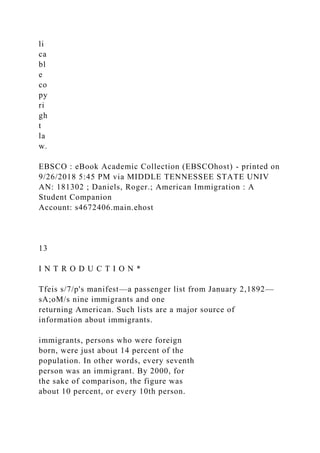
Tfeis s/7/p's manifest—a passenger list from January 2,1892—
sA;oM/s nine immigrants and one
returning American. Such lists are a major source of
information about immigrants.
immigrants, persons who were foreign
born, were just about 14 percent of the
population. In other words, every seventh
person was an immigrant. By 2000, for
the sake of comparison, the figure was
about 10 percent, or every 10th person.
The Era of Restriction, 1924-65
Although the beginning date of 1924 is
commonly assigned to the era of restric-
tion, the process had begun long before.
Before 1882 there was nothing in Ameri-
can law to stop a free immigrant from
entering the country. If you could get here,
you were in. To be sure, many countries
tried to prevent their inhabitants from
leaving, but that is a different matter. The
U.S. restriction of free immigration began
in 1882 with the passage of the Chinese
Exclusion Act, which barred the entry of
Chinese laborers who had not been here
before. Once that first restriction had been
made, more restrictions followed.
The restrictions came piecemeal, as
various categories of people were declared
ineligible for entrance. By the end of
World War I (1918), the once free and
unrestricted immigration policy of the
United States had been limited in seven
major ways as the following kinds of
immigrants were barred from immigrat-
ing: Chinese laborers and other Asians,
except for Japanese and Filipinos; certain
criminals; people who failed to meet cer-
tain moral standards, including prosti-
tutes and polygamists; people with vari-
ous diseases; paupers; certain radicals,
including anarchists and people advocat-
ing the overthrow of the government by
force and violence; and illiterates.
Only the test to keep out illiterates
caused significant political controversy. It
was vetoed four times over a 20-year peri-
od by presidents as diverse as the conserv-
ative Democrat Grover Cleveland in 1897,
the liberal Republican William Howard
Taft in 1913, and the progressive Democ-
rat Woodrow Wilson in 1915 and 1917. It
was enacted in 1917 over Wilson's second
veto. Unlike the 1901 Australian literacy
test, which allowed government inspectors
to choose the language or languages that
immigrants had to read, the American law
was reasonably fair. It allowed each immi-
grant to specify the language in which he
or she would be tested. It also exempted
close female relatives of any age and close
male relatives over 55 years old joiningC
op
yr
ig
ht
@
2
00
1.
O
xf
or
d
Un
iv
er
si
ty
P
re
ss
.
Al
l
ri
gh
ts
r
es
er
ve
d.
M
ay
n
ot
b
e
re
pr
od
uc
ed
i
n
an
y
fo
rm
w
it
ho
ut
p
er
mi
ss
io
n
fr
om
t
he
p
ub
li
sh
er
,
ex
ce
pt
f
ai
r
us
es
p
er
mi
tt
ed
u
nd
er
U
.S
.
or
a
pp
li
ca
bl
e
co
py
ri
gh
t
la
w.
EBSCO : eBook Academic Collection (EBSCOhost) - printed on
9/26/2018 5:45 PM via MIDDLE TENNESSEE STATE UNIV
AN: 181302 ; Daniels, Roger.; American Immigration : A
Student Companion
Account: s4672406.main.ehost
14
• I N T R O D U C T I O N
2674
Class No. 4 Serial Number French
Tu tires le fondement de ta puissance de la bouche des
petits enfants et de ceux qui tettent, a cause de tes adversaires.
afin de confondre 1'ennemi et celui qui veut se venger.
Out of the mouth of babes and sucklings hast thou ordained
strength because of thine enemies, that thou mightest still the
enemy and the avenger.
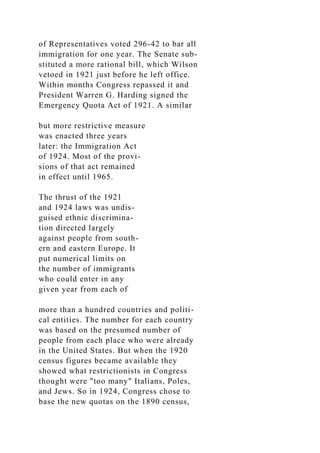
(Ps. 8:2) (French Ps. 8:3)
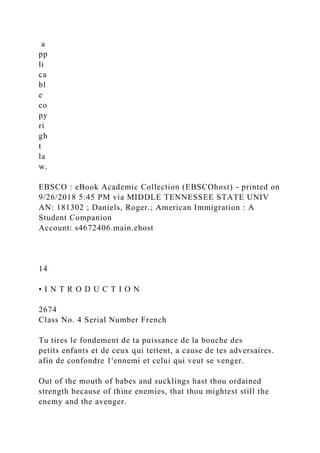
A number of the texts used for the literacy examinations of
immigrants were drawn
from the Bible. This one, from the eighth Psalm, is the copy the
examiner used,
which had the text in both French and English.
immigrants already in the United States,
and it provided that if any adult member
of an immigrating family was literate the
whole family could be admitted.
Despite this impressive list of restric-
tions, nothing was done before 1920-21
to place any kind of numerical cap on
immigration, and in no year before 1921
did the percentage of prospective immi-
grants turned away at Ellis Island and
other ports of entry reach 2 percent. The
fluctuations in the numbers of immigrants
were due to either economic conditions—
during hard times in the United States
fewer immigrants came—or political ones:
during the American Civil War (1861-65)
and World War I (1914-18) immigration
was significantly reduced.
Amid the political and social reaction
of post-World War I—a period one histo-
rian has called the "tribal twenties"
because of the many social and cultural
issues that divided the American people—
drastic immigration restriction became
politically expedient. In 1920 the House
of Representatives voted 296-42 to bar all
immigration for one year. The Senate sub-
stituted a more rational bill, which Wilson
vetoed in 1921 just before he left office.
Within months Congress repassed it and
President Warren G. Harding signed the
Emergency Quota Act of 1921. A similar
but more restrictive measure
was enacted three years
later: the Immigration Act
of 1924. Most of the provi-
sions of that act remained
in effect until 1965.
The thrust of the 1921
and 1924 laws was undis-
guised ethnic discrimina-
tion directed largely
against people from south-
ern and eastern Europe. It
put numerical limits on
the number of immigrants
who could enter in any
given year from each of
more than a hundred countries and politi-
cal entities. The number for each country
was based on the presumed number of
people from each place who were already
in the United States. But when the 1920
census figures became available they
showed what restrictionists in Congress
thought were "too many" Italians, Poles,
and Jews. So in 1924, Congress chose to
base the new quotas on the 1890 census,
taken nearly 35 years earlier, when fewer
southern and eastern Europeans had been
present. The quotas were relatively gener-
ous toward immigrants from the British
Isles, Germany, and Scandinavia—in fact
many of the "slots" for those countries
went unused year after year—and strin-
gent toward the rest of Europe. Asians
were not allowed to immigrate, except for
Filipinos, who were American nationals
as long as the United States owned the
Philippines, from 1898 until a law
promising independence for the islands
was enacted in 1934.
Yet it is an indication of how different
American concerns were then from what
they are today that the 1924 act placed no
limits at all on immigration from Mexico
or from any other independent country in
the New World. It also allowed a very lim-
ited kind of family reunification: an immi-
grant who was the minor child, or spouseCo
py
ri
gh
t
@
20
01
.
Ox
fo
rd
U
ni
ve
rs
it
y
Pr
es
s.
Al
l
ri
gh
ts
r
es
er
ve
d.
M
ay
n
ot
b
e
re
pr
od
uc
ed
i
n
an
y
fo
rm
w
it
ho
ut
p
er
mi
ss
io
n
fr
om
t
he
p
ub
li
sh
er
,
ex
ce
pt
f
ai
r
us
es
p
er
mi
tt
ed
u
nd
er
U
.S
.
or
a
pp
li
ca
bl
e
co
py
ri
gh
t
la
w.
EBSCO : eBook Academic Collection (EBSCOhost) - printed on
9/26/2018 5:45 PM via MIDDLE TENNESSEE STATE UNIV
AN: 181302 ; Daniels, Roger.; American Immigration : A
Student Companion
Account: s4672406.main.ehost
15
• I N T R O D U C T I O N
of a United States citizen could enter as a
"nonquota immigrant."
Textbooks often illustrate the 1924
act by reprinting contemporary cartoons
showing immigration reduced to a trickle.
Those cartoons overstate the effect of the
1924 law. The new law did reduce annual
immigration to about 300,000 annually.
This was far below the 1 million a year
that had been coming before World War I,
but was hardly a trickle. In the 1930s im-
migration was really reduced to a trickle—
an average of 50,000 a year. But it was
not Congress but the worldwide Great
Depression that slowed the traffic. Eco-
nomic conditions were so poor in the
United States that in two different years—
1932 and 1933—more people left or were
excluded from the United States than
immigrated to it. This had not happened
since the Loyalists (or Tories, as their
opponents called them) fled the country in
the 1780s after the successful American
Revolution, and it has not happened since.
Late in the 1930s large numbers of
refugees from Nazi Germany, most but
not all of them Jews, tried to enter the
United States, and, although eventually
some 250,000 did find a permanent or
temporary refuge in the United States,
large numbers were turned away by con-
sular and immigration officials, some of
whom were prejudiced against Jews. Con-
gress refused to pass a bill to let in several
thousand Jewish refugee children. Some
escaped elsewhere but others became part
of the millions who were later sent to the
death camps of the Holocaust. President
Franklin D. Roosevelt, although sympa-
thetic to the plight of the refugees, provid-
ed no significant leadership on this issue
until late in the war. In 1944 he estab-
lished, by executive order, the War
Refugee Board, which brought about a
thousand mostly Jewish refugees to the
United States and set up camps for many
others in Europe and Africa. Many years
later, in 1979, Vice President Walter Mon-
This cartoon, entitled "The Only Way to
Handle It," reflects what many people
thought would happen after the passage of
the Immigration Act of 1921. The restriction
was actually much less severe.
dale described the situation well: in regard
to the Jewish refugees from Nazism, he
judged that the United States and other
western democracies "failed the test of
civilization."
Many of the refugees who did get to
the United States made outstanding contri-
butions both to the war effort and to
American culture. Much of the research
that developed the atomic bomb was done
by refugee scientists such as the Italian
Enrico Fermi, the Hungarian Leo Szilard,
and the Austrian Lise Meitner. The moral
authority of the German-born Albert Ein-
stein, perhaps the greatest scientist of the
20th century, had been crucial in persuad-
ing President Roosevelt to consider estab-
lishing the project which led to the cre-
ation of the bomb. American culture was
enormously enriched by the temporary or
permanent residence of such composers as
the German Paul Hindemith and the Hun-
garian Bela Bartok, the Italian conductor
Arturo Toscanini, the German authorCo
py
ri
gh
t
@
20
01
.
Ox
fo
rd
U
ni
ve
rs
it
y
Pr
es
s.
Al
l
ri
gh
ts
r
es
er
ve
d.
M
ay
n
ot
b
e
re
pr
od
uc
ed
i
n
an
y
fo
rm
w
it
ho
ut
p
er
mi
ss
io
n
fr
om
t
he
p
ub
li
sh
er
,
ex
ce
pt
f
ai
r
us
es
p
er
mi
tt
ed
u
nd
er
U
.S
.
or
a
pp
li
ca
bl
e
co
py
ri
gh
t
la
w.
EBSCO : eBook Academic Collection (EBSCOhost) - printed on
9/26/2018 5:45 PM via MIDDLE TENNESSEE STATE UNIV
AN: 181302 ; Daniels, Roger.; American Immigration : A
Student Companion
Account: s4672406.main.ehost
16
• I N T R O D U C T I O N
Thomas Mann, and a great number of
painters, sculptors, and architects.
The years of World War U (1939-45)
were, historians now agree, years of great
social change in the United States. From the
special point of view of immigration history
a crucial turning point was reached in late
1943 when Congress, at the urging of Pres-
ident Roosevelt, repealed the Chinese
Exclusion Act and, even more important,
enabled Chinese, but not other Asians, to
be naturalized. After the war was over and
the United States began to exercise global
influence more powerfully than ever before,
it became apparent that U.S. naturalization
and immigration policies were not congru-
ent with American foreign policy. It was
difficult to be "the leader of the free world"
when much of the world's population was
ineligible to immigrate to the United States.
These peoples naturally resented the dis-
crimination. Following the pattern of Chi-
nese exclusion repeal, both Filipinos and
"natives of India" were made eligible for
naturalization and thus immigration in
1944, and in 1952 all ethnic and racial bars
to naturalization were dropped.
In contrast to its refusal to make
exceptions to the quota system for
refugees during the war, in 1948 and 1950
Congress passed two bills that allowed
some 450,000 "displaced persons" to
enter without reference to quotas. Dis-
placed persons were refugees in Europe
who were unable or unwilling to be set-
tled in their former homes, largely because
the Soviet army had occupied their home-
lands and installed totalitarian regimes in
them on the Russian model. Few of these
refugees were Jews: most European Jews
had perished in the Holocaust and most of
the relatively few survivors went to Israel,
not the United States.
In 1952 the McCarran-Walter Act, a
major modification of immigration law,
was passed over President Harry S. Tru-
man's veto. In addition to its broadening
of naturalization, it continued the quota
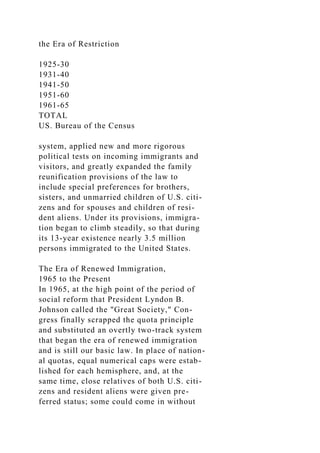
1,762,610
528,431
1,035-039
2,515,479
1,450,312
7,291,871
Immigration During
the Era of Restriction
1925-30
1931-40
1941-50
1951-60
1961-65
TOTAL
US. Bureau of the Census
system, applied new and more rigorous
political tests on incoming immigrants and
visitors, and greatly expanded the family
reunification provisions of the law to
include special preferences for brothers,
sisters, and unmarried children of U.S. citi-
zens and for spouses and children of resi-
dent aliens. Under its provisions, immigra-
tion began to climb steadily, so that during
its 13-year existence nearly 3.5 million
persons immigrated to the United States.
The Era of Renewed Immigration,
1965 to the Present
In 1965, at the high point of the period of
social reform that President Lyndon B.
Johnson called the "Great Society," Con-
gress finally scrapped the quota principle
and substituted an overtly two-track system
that began the era of renewed immigration
and is still our basic law. In place of nation-
al quotas, equal numerical caps were estab-
lished for each hemisphere, and, at the
same time, close relatives of both U.S. citi-
zens and resident aliens were given pre-
ferred status; some could come in without
regard to numerical restriction. The table
on the next page compares the preference
systems under the 1952 and 1965 acts.
The growth in the number of immi-
grants has increased sharply and steadily.
There were 2.5 million in the 1950s, 3.3
million in the 1960s, 4.5 million in the
1970s, more than 7 million in the 1980s,
and more than 8 million in the 1990s.
Even more important than the increas-
ing numbers were the changes in theCo
py
ri
gh
t
@
20
01
.
Ox
fo
rd
U
ni
ve
rs
it
y
Pr
es
s.
Al
l
ri
gh
ts
r
es
er
ve
d.
M
ay
n
ot
b
e
re
pr
od
uc
ed
i
n
an
y
fo
rm
w
it
ho
ut
p
er
mi
ss
io
n
fr
om
t
he
p
ub
li
sh
er
,
ex
ce
pt
f
ai
r
us
es
p
er
mi
tt
ed
u
nd
er
U
.S
.
or
a
pp
li
ca
bl
e
co
py
ri
gh
t
la
w.
EBSCO : eBook Academic Collection (EBSCOhost) - printed on
9/26/2018 5:45 PM via MIDDLE TENNESSEE STATE UNIV
AN: 181302 ; Daniels, Roger.; American Immigration : A
Student Companion
Account: s4672406.main.ehost
17
I N T R O D U C T I O N
sources of immigration and the kinds of
immigrants who were coming. Through the
1950s, Europe was the chief source of
immigration to the United States, although
the preponderance of Europeans was
diminishing. By the 1960s, Europeans were
only a third of all immigrants; in the 1970s
they were less than a fifth; and in the 1980s
and 1990s they were just over a tenth.
Replacing them were persons from Latin
America and Asia in roughly equal num-
bers. Between 1981 and 1996, about 13.5
million legal immigrants were admitted to
the United States. Of the top 10 countries
of origin, which accounted for 58 percent
of all immigrants, half were in or around
the Caribbean and half were in Asia.
In more recent years, partly because
of the collapse of the Soviet Union and
partly because of the diversity programs
enacted in 1988, there has been a signifi-
cantly wider distribution of immigrants.
In 1996, for example, the top 10 coun-
tries accounted for a little less than half of
all immigrants (49.5 percent) and two
European countries, Ukraine and Russia,
were numbers 8 and 9 of the top 10.
But it was not just the regional and
national origin of immigrants that
changed. Large numbers of recent immi-
grants have been very well educated and
possessed of valuable entrepreneurial and
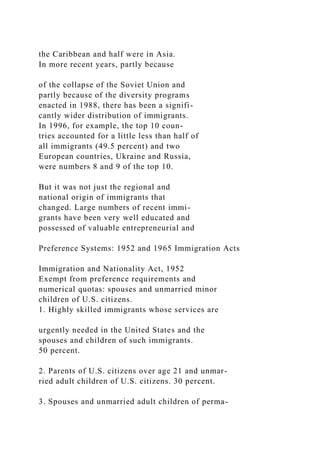
Preference Systems: 1952 and 1965 Immigration Acts
Immigration and Nationality Act, 1952
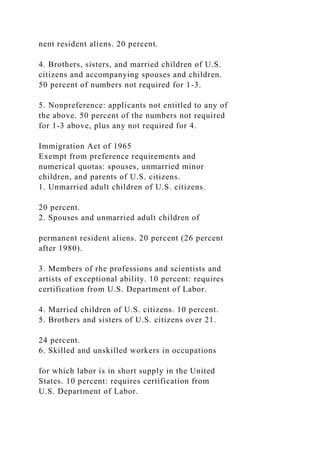
Exempt from preference requirements and
numerical quotas: spouses and unmarried minor
children of U.S. citizens.
1. Highly skilled immigrants whose services are
urgently needed in the United States and the
spouses and children of such immigrants.
50 percent.
2. Parents of U.S. citizens over age 21 and unmar-
ried adult children of U.S. citizens. 30 percent.
3. Spouses and unmarried adult children of perma-
nent resident aliens. 20 percent.
4. Brothers, sisters, and married children of U.S.
citizens and accompanying spouses and children.
50 percent of numbers not required for 1-3.
5. Nonpreference: applicants not entitled to any of
the above. 50 percent of the numbers not required
for 1-3 above, plus any not required for 4.
Immigration Act of 1965
Exempt from preference requirements and
numerical quotas: spouses, unmarried minor
children, and parents of U.S. citizens.
1. Unmarried adult children of U.S. citizens.
20 percent.
2. Spouses and unmarried adult children of
permanent resident aliens. 20 percent (26 percent
after 1980).
3. Members of rhe professions and scientists and
artists of exceptional ability. 10 percent: requires
certification from U.S. Department of Labor.
4. Married children of U.S. citizens. 10 percent.
5. Brothers and sisters of U.S. citizens over 21.
24 percent.
6. Skilled and unskilled workers in occupations
for which labor is in short supply in the United
States. 10 percent: requires certification from
U.S. Department of Labor.
7. Refugees from communist or communist-dominat-
ed countries, or the Middle East. 6 percent.
8. Nonpreference: applicants nor entitled to any of
the above. (Since there are more preference appli-
cants than can be accommodated, this has not
been used.)
Immigration and Naturalization Service, 1997 Statistical
yearbook
Co
py
ri
gh
t
@
20
01
.
Ox
fo
rd
U
ni
ve
rs
it
y
Pr
es
s.
Al
l
ri
gh
ts
r
es
er
ve
d.
M
ay
n
ot
b
e
re
pr
od
uc
ed
i
n
an
y
fo
rm
w
it
ho
ut
p
er
mi
ss
io
n
fr
om
t
he
p
ub
li
sh
er
,
ex
ce
pt
f
ai
r
us
es
p
er
mi
tt
ed
u
nd
er
U
.S
.
or
a
pp
li
ca
bl
e
co
py
ri
gh
t
la
w.
EBSCO : eBook Academic Collection (EBSCOhost) - printed on
9/26/2018 5:45 PM via MIDDLE TENNESSEE STATE UNIV
AN: 181302 ; Daniels, Roger.; American Immigration : A
Student Companion
Account: s4672406.main.ehost
I N T R O D U C T I O N
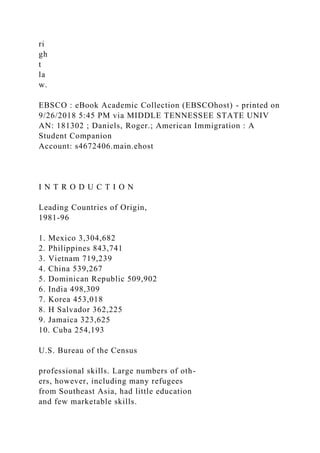
Leading Countries of Origin,
1981-96
1. Mexico 3,304,682
2. Philippines 843,741
3. Vietnam 719,239
4. China 539,267
5. Dominican Republic 509,902
6. India 498,309
7. Korea 453,018
8. H Salvador 362,225
9. Jamaica 323,625
10. Cuba 254,193
U.S. Bureau of the Census
professional skills. Large numbers of oth-
ers, however, including many refugees
from Southeast Asia, had little education
and few marketable skills.
The difference in treatment received
by immigrants from two adjacent
Caribbean islands, Cuba and Haiti,
demonstrates the wide gulf that has exist-
ed between contemporary groups. The
nearly 1 million Cubans who have been
admitted since 1959 from Fidel Castro's
Cuba as refugees from communism were
given special status and relatively gener-
ous financial support by the United States
government. The much smaller number of
Haitians, whom the government refused
to regard as refugees, were often rejected
and returned to Haiti; those admitted
received relatively little financial help.
By the 1980s, many Americans were
again becoming nervous about "so many
foreigners" coming to the United States.
Many advocates of restricting immigra-
tion pointed out, correctly, that the total
volume of immigration was approaching
that of the peak years before World War
I, when an average of about a million
immigrants entered annually. But they
rarely pointed out that the incidence of
foreign-born people in the population was
much lower than in those years. Despite
much debate and many laws enacted by
Congress since 1965, none has changed
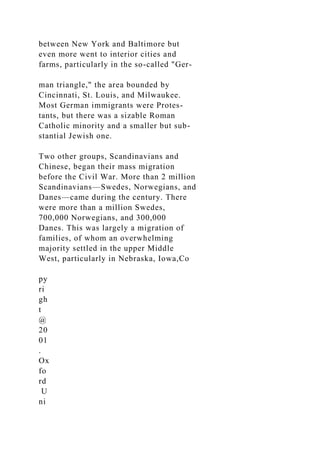
Spanish-speaking members of the International Ladies
Garment Workers Union proclaim their loyalty in two
languages at a New York City parade in 1985.
significantly the volume of immigration.
These laws have been aptly described as
"thunder without lightning"— that is,
laws without much effect. Although pub-
lic opinion polls showed that, when
asked, a majority of Americans was likely
to say that there were too many incoming
immigrants, when asked, in other polls
what issues concerned them most, few put
immigration high on the list. Many seri-
ous students of immigration believe that
as long as the American economy remains
reasonably prosperous, there is little like-
lihood that major bars against immigrants
will be raised. A major reason for this is
that immigrants in contemporary Ameri-
ca, like their predecessors in other eras,
come here to work. The work that they
do, whether unskilled, semiskilled, or
highly skilled, will continue to be a vital
element in American economic growth.
18
Co
py
ri
gh
t
@
20
01
.
Ox
fo
rd
U
ni
ve
rs
it
y
Pr
es
s.
Al
l
ri
gh
ts
r
es
er
ve
d.
M
ay
n
ot
b
e
re
pr
od
uc
ed
i
n
an
y
fo
rm
w
it
ho
ut
p
er
mi
ss
io
n
fr
om
t
he
p
ub
li
sh
er
,
ex
ce
pt
f
ai
r
us
es
p
er
mi
tt
ed
u
nd
er
U
.S
.
or
a
pp
li
ca
bl
e
co
py
ri
gh
t
la
w.
EBSCO : eBook Academic Collection (EBSCOhost) - printed on
9/26/2018 5:45 PM via MIDDLE TENNESSEE STATE UNIV
AN: 181302 ; Daniels, Roger.; American Immigration : A
Student Companion
Account: s4672406.main.ehost
25
Chapter 2
Regulation and exclusion
Anti-Chinese agitation
The path to regulation and exclusion began in the
extraordinary
melting pot that was California, newly admitted to the United
States after it was seized from Mexico in the Mexican-American
War (1846–48). Isolated though it was from the major
transatlantic shipping lanes and without rail links to the eastern
seaboard until 1868, at the time of the 1840s Gold Rush
California
had nonetheless attracted thousands of Americans and
Europeans, Chinese, and South American immigrants, whose
numbers added to the small populations of Native Americans
and
original Spanish and Mexican settlers.
The Chinese provided valued labor in the gold mines, on farms
that
provisioned the miners, and ultimately in the construction of the
railroad line that would connect the West and East coasts. But
in the
1870s, as California settled into a post-boom economy and
confronted a severe economic depression, white workers felt
their
living standards were threatened by the low wages acceptable to
many Chinese. A movement, inspired by a combination of
economic
insecurity, racial hostility, and political opportunism, took form
to
end Chinese immigration and force the Chinese to re-emigrate.
While
anti-Chinese politics had some eastern support, its epicenter
would
long reside in California. Its principal spokesman was Irish-
born
Co
py
ri
gh
t
@
20
11
.
Ox
fo
rd
U
ni
ve
rs
it
y
Pr
es
s.
Al
l
ri
gh
ts
r
es
er
ve
d.
M
ay
n
ot
b
e
re
pr
od
uc
ed
i
n
an
y
fo
rm
w
it
ho
ut
p
er
mi
ss
io
n
fr
om
t
he
p
ub
li
sh
er
,
ex
ce
pt
f
ai
r
us
es
p
er
mi
tt
ed
u
nd
er
U
.S
.
or
a
pp
li
ca
bl
e
co
py
ri
gh
t
la
w.
EBSCO : eBook Academic Collection (EBSCOhost) - printed on
10/1/2018 3:31 PM via MIDDLE
TENNESSEE STATE UNIV
AN: 365577 ; Gerber, David A..; American Immigration: A
Very Short Introduction
Account: s4672406.main.ehost
A
m
er
ic
an
Im
m
ig
ra
ti
o
n
26
Denis Kearney, founder of the Workingmen’s Party, under
whose
leadership the party did well in local and state elections. A
powerful
orator, Kearney ended every address with his signature
message:
“And whatever happens, the Chinese must go!”
Political representatives of the white working class, commonly
themselves the product of some recent immigration like
Kearney,
would be prominent in developing arguments against
immigration
in the service of defending the welfare of the ordinary
American.
Not all were demagogues, to be sure, for arguments that a
continual
inrush of cheap labor might have a downward effect on wage
scales
were plausible. But when fused with hatred for the Other , the
ugly
3. Alongside Mexicans, Irish, Americans, and others,
Chinese laborers
were a signifi cant part of the workforce that constructed and
maintained the fi rst railroads of the American Far West.
Co
py
ri
gh
t
@
20
11
.
Ox
fo
rd
U
ni
ve
rs
it
y
Pr
es
s.
Al
l
ri
gh
ts
r
es
er
ve
d.
M
ay
n
ot
b
e
re
pr
od
uc
ed
i
n
an
y
fo
rm
w
it
ho
ut
p
er
mi
ss
io
n
fr
om
t
he
p
ub
li
sh
er
,
ex
ce
pt
f
ai
r
us
es
p
er
mi
tt
ed
u
nd
er
U
.S
.
or
a
pp
li
ca
bl
e
co
py
ri
gh
t
la
w.
EBSCO : eBook Academic Collection (EBSCOhost) - printed on
10/1/2018 3:31 PM via MIDDLE
TENNESSEE STATE UNIV
AN: 365577 ; Gerber, David A..; American Immigration: A
Very Short Introduction
Account: s4672406.main.ehost
R
eg
u
latio
n
an
d
exclu
sio
n
27
face of class politics was racist. Evidence of such racism lay
most
evidently in the fact that neither Kearney nor the California
labor
unions advocated a class-based movement founded on the
organization of all workers, whatever their nativity or race.
4. The cartoonist seeks to capture the irony of an immigrant,
dressed in
typical Irish peasant garb and speaking with an Irish brogue,
ordering a
Chinese immigrant to leave the United States in the name of two
famous
American statesmen, George Washington and Daniel Webster.
Co
py
ri
gh
t
@
20
11
.
Ox
fo
rd
U
ni
ve
rs
it
y
Pr
es
s.
Al
l
ri
gh
ts
r
es
er
ve
d.
M
ay
n
ot
b
e
re
pr
od
uc
ed
i
n
an
y
fo
rm
w
it
ho
ut
p
er
mi
ss
io
n
fr
om
t
he
p
ub
li
sh
er
,
ex
ce
pt
f
ai
r
us
es
p
er
mi
tt
ed
u
nd
er
U
.S
.
or
a
pp
li
ca
bl
e
co
py
ri
gh
t
la
w.
EBSCO : eBook Academic Collection (EBSCOhost) - printed on
10/1/2018 3:31 PM via MIDDLE
TENNESSEE STATE UNIV
AN: 365577 ; Gerber, David A..; American Immigration: A
Very Short Introduction
Account: s4672406.main.ehost
A
m
er
ic
an
Im
m
ig
ra
ti
o
n
28
Throughout California, the anti-Chinese movement often
engaged in
violence and terror. The Chinese were an isolated, relatively
small
population. China lacked a government strong enough for
effective
diplomatic protests against such outrages. It was easy to gang
up on
the Chinese and convenient during election campaigns for
opportunistic politicians to champion the racist white majority.
But
there were limits to Kearney’s infl uence. He was not successful
in
convincing workers outside California that the Chinese were a
real
threat to them. In California itself union leaders eventually
concluded
that Kearney’s agenda was too narrow to benefi t their white
constituents, and they resented his power. But Kearney did
succeed
in impressing Washington politicians with the infl uence he had
attained by fusing race and immigration. The call for banning

the
Chinese gained widespread support, including among other
racial
minorities. African American newspapers, for example,
denounced
Chinese immigration as a threat to the precarious economic
status of
black workers. Congress responded, giving California’s white
population what the most vocal and violent within it desired: an
end
to most Chinese immigration; hence, the prospect the Chinese
would
eventually disappear. In 1882 Congress passed the Chinese
Exclusion
Act, which was periodically renewed until made permanent in
1904.
The law was not repealed until the Magnuson Act of 1943, when
China and the United States were allies in the struggle against
Japan,
and Chinese exclusion, an effective point in Japanese
propaganda,
had become a national embarrassment.
Chinese exclusion and subsequent efforts began the evolution
of
American immigration law and policy, as the historian Mae
Ngai
observes, into an engine “for massive racial engineering” that
sought to use state power to defi ne the demographic and
cultural
character of the nation. A force accelerating the process was the
particular nature of Chinese exclusion, as Congress crafted it.
The
law did not bar all Chinese immigration, only Chinese
laborers.
Merchants, students, the immediate family of American-born
Chinese citizens, and Chinese American citizens returning from
abroad were not barred.
Co
py
ri
gh
t
@
20
11
.
Ox
fo
rd
U
ni
ve
rs
it
y
Pr
es
s.
Al
l
ri
gh
ts
r
es
er
ve
d.
M
ay
n
ot
b
e
re
pr
od
uc
ed
i
n
an
y
fo
rm
w
it
ho
ut
p
er
mi
ss
io
n
fr
om
t
he
p
ub
li
sh
er
,
ex
ce
pt
f
ai
r
us
es
p
er
mi
tt
ed
u
nd
er
U
.S
.
or
a
pp
li
ca
bl
e
co
py
ri
gh
t
la
w.
EBSCO : eBook Academic Collection (EBSCOhost) - printed on
10/1/2018 3:31 PM via MIDDLE
TENNESSEE STATE UNIV
AN: 365577 ; Gerber, David A..; American Immigration: A
Very Short Introduction
Account: s4672406.main.ehost
R
eg
u
latio
n
an
d
exclu
sio
n
29
The problem for enforcement was sorting out those barred from
those eligible for admission. The effort was often carried out
with
a ham-fi sted brutality or cold formality, especially at the Angel
Island immigration station in San Francisco harbor, where the
large majority of Chinese arrivals was processed. The
presumption
of government immigration agents was that all Chinese seeking
entrance were lying about their status. To their minds, women
arriving at Angel Island were not the wives or daughters of
legal
residents they claimed to be, but prostitutes imported to work in
the brothels catering to whites and the large Chinese bachelor
population. The elaborate documentation and close interrogation
stood in sharp contrast to the perfunctory questioning of most
Europeans seeking entrance.
5. Angel Island interrogations were considerably more
formal than
those brief encounters between European immigrants and
inspectors
at Ellis Island. Asian immigrants usually faced one or more
inspectors
and a stenographer. A government interpreter translated.
Questions
and answers were typed out and placed in the fi le of applicants
seeking
admission.
Co
py
ri
gh
t
@
20
11
.
Ox
fo
rd
U
ni
ve
rs
it
y
Pr
es
s.
Al
l
ri
gh
ts
r
es
er
ve
d.
M
ay
n
ot
b
e
re
pr
od
uc
ed
i
n
an
y
fo
rm
w
it
ho
ut
p
er
mi
ss
io
n
fr
om
t
he
p
ub
li
sh
er
,
ex
ce
pt
f
ai
r
us
es
p
er
mi
tt
ed
u
nd
er
U
.S
.
or
a
pp
li
ca
bl
e
co
py
ri
gh
t
la
w.
EBSCO : eBook Academic Collection (EBSCOhost) - printed on
10/1/2018 3:31 PM via MIDDLE
TENNESSEE STATE UNIV
AN: 365577 ; Gerber, David A..; American Immigration: A
Very Short Introduction
Account: s4672406.main.ehost
A
m
er
ic
an
Im
m
ig
ra
ti
o
n
30
Chinese sought to evade the law by claiming false family
relationships through legally resident sponsors, or they
attempted
to enter the country illegally by crossing its northern or
southern
land-borders at a time when they were largely unpatrolled.
Chinese American citizens occasionally challenged the
operations
of the law in court and won some notable victories. One way or
another, within a decade of the Chinese Exclusion Act, the
government was facing a well-publicized challenge, and it was
often unsuccessful in the contest. The number of Chinese
testing
the law was never signifi cant enough to be a true threat to state
power, as opposed to an annoyance, but sensationalistic press
coverage created panic in the general public, and federal offi
cials
and enforcement offi cers felt their authority was compromised
and reacted aggressively.
The growth of national government activity
and power
Frustrated efforts to enforce Chinese exclusion joined other
sources of immigration-related anxiety: growing racial
consciousness among the white majority based on contemporary
science and popular attitudes; increasing concern, with a
resurgence of mass European immigration, about the need for
more effective regulation of immigration, borders, and
citizenship
processes; imperial conquest; and large numbers of mobile,
U.S.-bound non-white people from Asia, the Pacifi c, and the
Caribbean. Immigration policy moved from openness to
gatekeeping, though the precise application of policies
continued
to depend on the origin of the immigrants.
The 1891 Immigration Act was an unambiguous statement of
centralized power. It formally assigned responsibility for the
assessment of people seeking entrance to the national
government. Congress established the offi ce of Superintendent
of
Immigration within the Treasury Department to oversee all
immigration inspection, including new medical and intelligence
Co
py
ri
gh
t
@
20
11
.
Ox
fo
rd
U
ni
ve
rs
it
y
Pr
es
s.
Al
l
ri
gh
ts
r
es
er
ve
d.
M
ay
n
ot
b
e
re
pr
od
uc
ed
i
n
an
y
fo
rm
w
it
ho
ut
p
er
mi
ss
io
n
fr
om
t
he
p
ub
li
sh
er
,
ex
ce
pt
f
ai
r
us
es
p
er
mi
tt
ed
u
nd
er
U
.S
.
or
a
pp
li
ca
bl
e
co
py
ri
gh
t
la
w.
EBSCO : eBook Academic Collection (EBSCOhost) - printed on
10/1/2018 3:31 PM via MIDDLE
TENNESSEE STATE UNIV
AN: 365577 ; Gerber, David A..; American Immigration: A
Very Short Introduction
Account: s4672406.main.ehost
Guest User
Guest User
Creating the Immigration Department, 1891
R
eg
u
latio
n
an
d
exclu
sio
n
31
testing, such as took place at Angel Island and Ellis Island.
A bureaucracy, large for its time, took shape around processing
at entrance ports and, under the jurisdiction of the Customs
Service, enforcing border security along the northern and
southern borders, where energies were devoted principally to
rooting out small numbers of illegal Chinese entrants and the
shadowy criminal enterprises that smuggled them across the
Canadian and Mexican borders.
On the heels of the Chinese precedent, racially inspired
proscriptions increased. Additional discriminatory responses to
Asian immigration led ultimately to the exclusion of half the
world’s population. In 1907, during a decade in which the
Japanese immigrant population tripled in the mainland United
States from 24,000 to 72,000, quotas, rather than a policy of
exclusion, would be applied to Japanese laborers in response to
protests, especially in California. Japanese were considered less
a
threat to wage scales than to the monopoly of white people on
prime agricultural land, for they were successful in acquiring a
foothold in fruit and vegetable farming. But like the Chinese,
they
were deemed inassimilable. Having just won a war against
Russia,
however, Japan was an emerging world power, so rather than
unilateral action, as had been the case with the Chinese, a quota
system was negotiated between President Theodore Roosevelt
and
the Japanese government. Under the terms of the so-called
Gentlemen’s Agreement, Japanese immigration to the American
mainland fell in the next decade by a third. (The recently
annexed
U.S. possession of Hawaii, which desperately needed Japanese
sugar plantation labor, was excluded from the agreement.)
Immigrants from Korea, then under Japanese control, were also
limited.
Prompted by the ongoing controversy over Japanese
landholding,
in 1913, California and eight other western states as well as
Florida took action against all landholding by aliens ineligible
for
citizenship. The Supreme Court declared such laws
constitutional.
Co
py
ri
gh
t
@
20
11
.
Ox
fo
rd
U
ni
ve
rs
it
y
Pr
es
s.
Al
l
ri
gh
ts
r
es
er
ve
d.
M
ay
n
ot
b
e
re
pr
od
uc
ed
i
n
an
y
fo
rm
w
it
ho
ut
p
er
mi
ss
io
n
fr
om
t
he
p
ub
li
sh
er
,
ex
ce
pt
f
ai
r
us
es
p
er
mi
tt
ed
u
nd
er
U
.S
.
or
a
pp
li
ca
bl
e
co
py
ri
gh
t
la
w.
EBSCO : eBook Academic Collection (EBSCOhost) - printed on
10/1/2018 3:31 PM via MIDDLE
TENNESSEE STATE UNIV
AN: 365577 ; Gerber, David A..; American Immigration: A
Very Short Introduction
Account: s4672406.main.ehost
Guest User
Guest User
Guest User
The restriction of Japanese
Aliens owning land
A
m
er
ic
an
Im
m
ig
ra
ti
o
n
32
Because many Japanese immigrants had children born in the
United States, they circumvented the law by registering their
property in the names of their children. The frustrated efforts at
piecemeal proscription of Asian immigration and citizenship
ended in 1917, when Congress passed legislation declaring all
of
Asia, exclusive of the Philippines, a U.S. possession after the
Spanish-American War, “the barred Asiatic zone,” from which
immigration must cease completely.
In this racialized climate of opinion and state action,
confrontations about who was white inevitably arose when those
barred from citizenship under the 1795 Naturalization Law
contested their status. In the late nineteenth century, lower
courts
and state legislatures actually were confused about which
groups
fi t into the category of “white persons eligible for citizenship.”
The
federal courts sorted the matter out, though hardly on consistent
intellectual grounds. Judges never resolved whether the
recorded
history of the evolution of peoples, or contemporary racial
science,
with its increasingly elaborate categories of classifi cation of
peoples, or popular prejudices would govern the crucial
question
of who was white. They did rule that Japanese, South Asians,
Burmese, Malaysians, Thais, and Koreans were not white, while
Syrians and Armenians, whom the United States Census in 1910
had actually classifi ed as “Asiatics,” were white. The birthright
citizenship of the American-born children of aliens ineligible
for
citizenship was nonetheless affi rmed.
Federal courts also addressed the racial status of Mexicans,
who
originally became part of the American nation after the
annexation of southwestern territory conquered in the Mexican-
American War. Later the numbers of Mexicans tripled between
1910 and 1920 to 652,000 residents, as a consequence of
political
instability and economic modernization in Mexico. After
northern
Mexico was annexed into the United States in the early 1850s,
Mexicans were made citizens, and thus implicitly declared
white
persons. By a consensual fi ction, Mexican lineage was declared
Co
py
ri
gh
t
@
20
11
.
Ox
fo
rd
U
ni
ve
rs
it
y
Pr
es
s.
Al
l
ri
gh
ts
r
es
er
ve
d.
M
ay
n
ot
b
e
re
pr
od
uc
ed
i
n
an
y
fo
rm
w
it
ho
ut
p
er
mi
ss
io
n
fr
om
t
he
p
ub
li
sh
er
,
ex
ce
pt
f
ai
r
us
es
p
er
mi
tt
ed
u
nd
er
U
.S
.
or
a
pp
li
ca
bl
e
co
py
ri
gh
t
la
w.
EBSCO : eBook Academic Collection (EBSCOhost) - printed on
10/1/2018 3:31 PM via MIDDLE
TENNESSEE STATE UNIV
AN: 365577 ; Gerber, David A..; American Immigration: A
Very Short Introduction
Account: s4672406.main.ehost
Guest User
Guest User
Barring Asians
Courts deciding who is “white”
Racial status of Mexicans
R
eg
u
latio
n
an
d
exclu
sio
n
33
European, via Spain, and the Indian ancestry of Mexicans laid
aside. This had served the purpose of securing the citizenship
status, and hence loyalty, of numerous large landowners,
especially in California. Some were Spanish in origin, but many
were Mexican or descendents of Mexican and American
intermarriages. A federal district court in 1897 affi rmed the
citizenship, and hence the whiteness, of Mexicans for purposes
of
citizenship.
On the popular level, however, Mexican whiteness was
contested.
The new immigrants were widely seen as uneducated, dirty,
diseased, criminal, and lazy. Political agitation to drop them
from
the citizenship list failed, but in the 1920s the federal
government
worked to impede their entrance by increasing a head tax on
Mexicans entering the country and by denying visas on the
grounds that they were inassimilable and would become
dependent on public assistance. During the Great Depression,
large numbers of Mexicans, citizens and aliens alike, were
encouraged, often to the point of coercion and with the active
cooperation of diplomatic offi cials of the Mexican government
in
western cities, to leave the country. The same program of
massive
deportations and repatriations also befell Filipinos, who worked
extensively in West Coast agriculture and canneries. Another
group subject to strong racist pressures, their entrance into the
country had been secured, in contrast to other Asian groups,
when
their homeland became an American possession. (They too,
however, were barred from citizenship.) During World War II,
the
policy toward Mexicans was reversed, because of the shortage
of
agricultural labor and cannery workers. A bilateral agreement
with Mexico established the Bracero (Spanish: day-laborer or
fi eld
hand) program, which facilitated the recruitment of cheap
agricultural labor through temporary work permits.
Legislators, judges, and immigration offi cials increasingly
sorted
out peoples by their presumed suitability to be Americans, as
opposed to their desire to work. In consequence, Congress and
the
Co
py
ri
gh
t
@
20
11
.
Ox
fo
rd
U
ni
ve
rs
it
y
Pr
es
s.
Al
l
ri
gh
ts
r
es
er
ve
d.
M
ay
n
ot
b
e
re
pr
od
uc
ed
i
n
an
y
fo
rm
w
it
ho
ut
p
er
mi
ss
io
n
fr
om
t
he
p
ub
li
sh
er
,
ex
ce
pt
f
ai
r
us
es
p
er
mi
tt
ed
u
nd
er
U
.S
.
or
a
pp
li
ca
bl
e
co
py
ri
gh
t
la
w.
EBSCO : eBook Academic Collection (EBSCOhost) - printed on
10/1/2018 3:31 PM via MIDDLE
TENNESSEE STATE UNIV
AN: 365577 ; Gerber, David A..; American Immigration: A
Very Short Introduction
Account: s4672406.main.ehost
Guest User
Guest User
Women and Immigration based on marriage
A
m
er
ic
an
Im
m
ig
ra
ti
o
n
34
courts were faced with an endless array of challenges in the
name
of consistency. A particularly pressing issue was the
relationships
among citizens and aliens linked by marriage, which introduced
the complexities of gender to those mounting in the name of
race.
Originally, American legislation on naturalization did not limit
eligibility for citizenship by sex, but gradually the courts
determined that a women’s status was to be defi ned by that of
the
males to whom she was related. In 1855 Congress formally
adopted the principle of derivative citizenship, which held that
a
woman’s status was dependent on that of her husband or father.
A
woman who was not a citizen acquired citizenship when
marrying
an American citizen. The reverse of that situation, the status of
a
female citizen who married an alien ineligible for citizenship on
the basis of race, was addressed in 1907, when Congress
decided
that she lost her citizenship when she married. Legally these
women were no longer allowed to re-naturalize unless their
husbands were naturalized fi rst (as by an act of Congress
targeted
at an individual), furthering the link between a woman’s status
and her husband’s. The loss of citizenship to such women led to
much injustice and inconvenience, and caused bitter protests.
After the ratifi cation of the Nineteenth Amendment to the
Constitution enfranchising women and, in effect, creating a
political status for them independent of men, the Cable Act of
1922 and a series of amendments to it in the ensuing decade
were
passed to address the situation. Thereafter, marriage by a
woman
who was an American citizen at birth to an alien no longer
carried
with it the loss of citizenship. For women acquiring their
citizenship through marriage or by act of Congress, as was the
case for women in Hawaii, Puerto Rico (an American possession
since the Spanish-American War), and the Philippines, marriage
or remarriage to an alien ineligible for citizenship continued to
carry the penalty of denaturalization.
Such elaborate efforts to expand state power to classify people
by
gender, race and nationality stood in sharp contrast to most
Co
py
ri
gh
t
@
20
11
.
Ox
fo
rd
U
ni
ve
rs
it
y
Pr
es
s.
Al
l
ri
gh
ts
r
es
er
ve
d.
M
ay
n
ot
b
e
re
pr
od
uc
ed
i
n
an
y
fo
rm
w
it
ho
ut
p
er
mi
ss
io
n
fr
om
t
he
p
ub
li
sh
er
,
ex
ce
pt
f
ai
r
us
es
p
er
mi
tt
ed
u
nd
er
U
.S
.
or
a
pp
li
ca
bl
e
co
py
ri
gh
t
la
w.
EBSCO : eBook Academic Collection (EBSCOhost) - printed on
10/1/2018 3:31 PM via MIDDLE
TENNESSEE STATE UNIV
AN: 365577 ; Gerber, David A..; American Immigration: A
Very Short Introduction
Account: s4672406.main.ehost
Guest User
R
eg
u
latio
n
an
d
exclu
sio
n
35
Americans’ desire for a small, relatively weak central
government.
The situation suggests the seriousness with which the electorate
regarded immigration. However racist, arbitrary, and unjust,

these
efforts nonetheless touched a relatively small number of
voluntary
immigrants and their wives and children.
The massive wave of turn-of-the-century
European immigration
On the East Coast, European immigrants continued to enter the
country in enormous numbers. After the severe economic
depression of the 1890s, the tide of immigrants reached
unprecedented proportions. Between 1871 and 1900, 11.7
million
immigrants arrived; between 1901 and 1920 alone 14.5 million
did. The points of origin were changing dramatically. While in
the
nineteenth century, western and northern Europeans
predominated, now southern, central, and eastern Europeans
did.
The former never stopped arriving, but the latter overwhelmed
their numbers.
This change carried tremendous signifi cance for Americans
wary
of unlimited immigration, and demand grew to curb European
immigration. Behind this effort lay the transformation in both
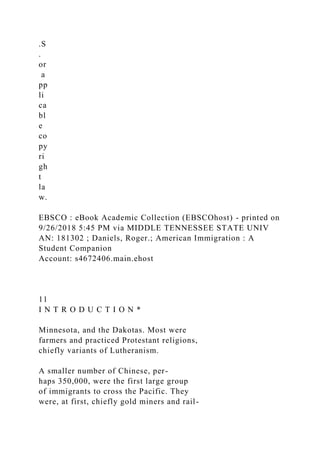
the
popular mind and contemporary science of differences of
culture
and appearance into inheritable racial dispositions that made
assimilation impossible.
The newer European immigrants were different in ways that
alarmed many Americans. Many fewer were Protestants than the
Germans, Scandinavians, British, Irish, and Dutch immigrants
of
the past. The majority were Jews, Orthodox of a variety of
sorts,
and Roman Catholic, whose presence activated long-standing
prejudices and suspicions. The physical appearances of eastern
European Jews, Slavs, and southern Italians and Greeks
suggested
a lack of racial kinship with Anglo-Americans, though these
differences were no doubt accentuated by the ill-fi tting peasant
Co
py
ri
gh
t
@
20
11
.
Ox
fo
rd
U
ni
ve
rs
it
y
Pr
es
s.
Al
l
ri
gh
ts
r
es
er
ve
d.
M
ay
n
ot
b
e
re
pr
od
uc
ed
i
n
an
y
fo
rm
w
it
ho
ut
p
er
mi
ss
io
n
fr
om
t
he
p
ub
li
sh
er
,
ex
ce
pt
f
ai
r
us
es
p
er
mi
tt
ed
u
nd
er
U
.S
.
or
a
pp
li
ca
bl
e
co
py
ri
gh
t
la
w.
EBSCO : eBook Academic Collection (EBSCOhost) - printed on
10/1/2018 3:31 PM via MIDDLE
TENNESSEE STATE UNIV
AN: 365577 ; Gerber, David A..; American Immigration: A
Very Short Introduction
Account: s4672406.main.ehost
Guest User
Guest User
Guest User
Growing fear of immigrants
A
m
er
ic
an
Im
m
ig
ra
ti
o
n
36
garb and poverty of most newcomers. The prominent sociologist
Edward A. Ross spelled out these suspicions about racial
difference and inferiority when he noted in 1914 that “the
physiognomy of certain groups unmistakably proclaims
inferiority
of type.” In every face, he noted “something wrong. . . . There
were
so many sugar-loaf heads, moon faces, slit mouths, lantern jaws,
and goose-bill noses that one might imagine a malicious jinn
[genie] had amused himself by creating human beings in a set of
skew-molds discarded by the Creator.”
Another difference was the new immigrants’ greater
traditionalism.
Even though they knew enough about the modern world to
develop
effective strategies for leaving their homelands and resettling
thousands of miles away, the eastern, central, and southern
Europeans were more anchored in traditional peasant social
arrangements than their contemporaries within the continuing fl
ow
of western Europeans. It was easy to forget that sixty years
earlier,
the Irish and Germans especially seemed outlandish and had
only
gradually given evidence of being successfully integrated into
American life. The perception of never being likely to
assimilate was
heightened, too, by the fact that many of the newer immigrants,
in
contrast to the more family-based, mid-nineteenth century
immigration, were single males wishing to make as much money
as
possible quickly and return to their homelands.
Racialization of these Europeans never approached the ferocity
seen in the popular response to such peoples as the Japanese or
Chinese. American nativists condemned the backwardness of
these
European peoples as much on the basis of culture as biology. It
was
possible for thoughtful people, on the one hand, to urge a
curtailing
of their entrance as a reform in the name of saving America,
and, on
the other hand, to be sympathetic to the immigrants’ aspirations
and respectful of their work ethic and family orientation.
But there could be no doubt about the consequences of such
racialized thinking: sharp quotas on the admission into the
Co
py
ri
gh
t
@
20
11
.
Ox
fo
rd
U
ni
ve
rs
it
y
Pr
es
s.
Al
l
ri
gh
ts
r
es
er
ve
d.
M
ay
n
ot
b
e
re
pr
od
uc
ed
i
n
an
y
fo
rm
w
it
ho
ut
p
er
mi
ss
io
n
fr
om
t
he
p
ub
li
sh
er
,
ex
ce
pt
f
ai
r
us
es
p
er
mi
tt
ed
u
nd
er
U
.S
.
or
a
pp
li
ca
bl
e
co
py
ri
gh
t
la
w.
EBSCO : eBook Academic Collection (EBSCOhost) - printed on
10/1/2018 3:31 PM via MIDDLE
TENNESSEE STATE UNIV
AN: 365577 ; Gerber, David A..; American Immigration: A
Very Short Introduction
Account: s4672406.main.ehost
Guest User
Guest User
Guest User
Guest User
Restricting immigration - the quota system
R
eg
u
latio
n
an
d
exclu
sio
n
37
country of a large number of these more recently arrived
European peoples that were enacted into law in 1921 and 1924.
In
expressing preference and disapproval, the intention was to
discriminate. Turn-of-the-century newcomers might have been
offi cially classifi ed as “white,” but as historians have
observed, they
were considered in-between people or provisional white
people ,
and by 1920, in the minds of many long-established Americans,
there were quite enough of them. Unlike the nativists of the
mid-nineteenth century, the new advocates of radical change in
immigration law and policy did not have much faith in
reforming
immigrants, but instead demanded reform of national policy.
The calls for restriction of these Europeans grew after 1890.
Emerging at various levels of society, they had multiple
sources,
three of which stand out. First, the anti-foreignism inspired by
mid-nineteenth century anti-Catholicism enjoyed resurgence in
1887 with the organization of the American Protective
Association
(APA), which gained adherents particularly in the rural and
small
town South and Middle West. The APA called for state control
of
Catholic sectarian schools in the belief they were havens of
subversion. It claimed 2.5 million members in the mid-1890s,
but this number soon declined because of rivalries among its
leaders. By the time of its eclipse in the second decade of the
twentieth century, the Ku Klux Klan, which was originally
established in the South to impede the political and civic
equality
of emancipated slaves, was reconfi guring itself as a national,
anti-Catholic, antisemitic, and anti-foreign as well as anti–
African
American organization. It became a major political force
throughout the country in the 1920s.
Second, labor union leaders, such as the longtime head of the
American Federation of Labor (AFL) Samuel Gompers, opposed
unrestricted immigration, refl ecting their members’ anxieties
about wage scales and the availability of work. Especially those
AFL-affi liated craft unions representing skilled workers that
were
the heart of the labor movement in size, employer recognition,
Co
py
ri
gh
t
@
20
11
.
Ox
fo
rd
U
ni
ve
rs
it
y
Pr
es
s.
Al
l
ri
gh
ts
r
es
er
ve
d.
M
ay
n
ot
b
e
re
pr
od
uc
ed
i
n
an
y
fo
rm
w
it
ho
ut
p
er
mi
ss
io
n
fr
om
t
he
p
ub
li
sh
er
,
ex
ce
pt
f
ai
r
us
es
p
er
mi
tt
ed
u
nd
er
U
.S
.
or
a
pp
li
ca
bl
e
co
py
ri
gh
t
la
w.
EBSCO : eBook Academic Collection (EBSCOhost) - printed on
10/1/2018 3:31 PM via MIDDLE
TENNESSEE STATE UNIV
AN: 365577 ; Gerber, David A..; American Immigration: A
Very Short Introduction
Account: s4672406.main.ehost
Guest User
Guest User
Guest User
Guest User
Anti-Immigrant Groups
Anti-Immigrant labor unions
A
m
er
ic
an
Im
m
ig
ra
ti
o
n
38
and political power held a restrictionist position. Many in such
unions did not believe the newer immigrants could be
organized,
because of cultural differences and the aspirations of many to
return to their homelands. To be sure, most of the immigrants
were not skilled workers, and instead worked as factory hands
and
outdoor laborers in construction or extractive industries such as
coal mining. This was the segment of the working class most
retarded in its progress toward unionization, largely because of
the diffi culties of organizing an easily replaced, mobile work
force
with a large immigrant cohort. The fact that recent immigrants,
often ignorant of the circumstances of their employment, were
occasionally used as strikebreakers highlighted for American
workers that the newcomers were poor material for
organizations
based on class solidarity.
Labor’s conclusions at this point in time about limiting
immigration actually broadly paralleled the thinking of
industrial
employers, among whom there was a growing consensus that for
the time being the manufacturing economy had a supply of labor
suffi cient to its needs. In addition, infl uential industrialists
like
automobile manufacturer Henry Ford had become more
concerned with the stability of their workforce and desirous of
encouraging settled habits through Americanization programs
and a variety of incentivized job and wage policies. Hence,
relative
to their past encouragement of high rates of immigration, the
period found them more or less indifferent to the debate about
immigration restriction.
Third, a respectable, intellectual bourgeois face of immigration
control appeared in the Immigration Restriction League (IRL),
which was organized in 1894 by a prestigious coalition of
northeastern academics, national political leaders, and urban
reformers. Alarmed at the growth of social problems and
pervasive political corruption in the rapidly growing industrial
cities, they blamed such conditions on the unchecked expansion
of
recent immigrant populations. Their thinking was also infl
uenced
Co
py
ri
gh
t
@
20
11
.
Ox
fo
rd
U
ni
ve
rs
it
y
Pr
es
s.
Al
l
ri
gh
ts
r
es
er
ve
d.
M
ay
n
ot
b
e
re
pr
od
uc
ed
i
n
an
y
fo
rm
w
it
ho
ut
p
er
mi
ss
io
n
fr
om
t
he
p
ub
li
sh
er
,
ex
ce
pt
f
ai
r
us
es
p
er
mi
tt
ed
u
nd
er
U
.S
.
or
a
pp
li
ca
bl
e
co
py
ri
gh
t
la
w.
EBSCO : eBook Academic Collection (EBSCOhost) - printed on
10/1/2018 3:31 PM via MIDDLE
TENNESSEE STATE UNIV
AN: 365577 ; Gerber, David A..; American Immigration: A
Very Short Introduction
Account: s4672406.main.ehost
Guest User
Guest User
Guest User
R
eg
u
latio
n
an
d
exclu
sio
n
39
by the emerging science of eugenics, which argued that states
should take active steps to protect and improve the human
genetic
stock within their borders. Eugenicists advanced such measures
as
immigration control, sterilization of the disabled, and laws
against
interracial marriage.
The IRL did not publicly engage in defamatory xenophobia.
Instead it offered a moderate, patriotic defense of the existing
social order and republican social institutions, both of which its
members believed to be anchored in Anglo-American culture.
The IRL was composed of men of cultural authority and
political
power, such as the patrician Massachusetts Republican senator
Henry Cabot Lodge; the Massachusetts Institute of Technology
president Francis Amasa Walker, who had headed the U.S.
Census
in 1870 and 1880; and A. Lawrence Lowell, the longtime
Harvard
University president. The IRL’s program was gradually enacted
into law over the course of the next quarter century: increase in
the head tax on immigrants to pay for expansion of inspection
services; an expanded list of excluded classes; a literacy test;
and
fi nally, the capstone of its goals, numerical limitation.
The quota system
The path to numerical limitation, which was ultimately
embodied
in the 1921 and 1924 quota laws, began in 1907 with
Congressional establishment of the Dillingham Commission.
Charged with undertaking a comprehensive fact-fi nding
investigation, it surveyed the entire fi eld of contemporary
immigration, and included reports on conditions in and
movement from a large number of immigrant homelands in
Europe and Asia. Consisting of thirty-nine volumes, the fi nal
report was issued in 1911. Based partly on the commissioners’
on-site inspection of conditions at emigration ports in Russia,
Germany, and southern Italy, the report dispelled long-held
notions that European nations were emptying their poor houses
and prisons and sending the inhabitants to the United States. It
Co
py
ri
gh
t
@
20
11
.
Ox
fo
rd
U
ni
ve
rs
it
y
Pr
es
s.
Al
l
ri
gh
ts
r
es
er
ve
d.
M
ay
n
ot
b
e
re
pr
od
uc
ed
i
n
an
y
fo
rm
w
it
ho
ut
p
er
mi
ss
io
n
fr
om
t
he
p
ub
li
sh
er
,
ex
ce
pt
f
ai
r
us
es
p
er
mi
tt
ed
u
nd
er
U
.S
.
or
a
pp
li
ca
bl
e
co
py
ri
gh
t
la
w.
EBSCO : eBook Academic Collection (EBSCOhost) - printed on
10/1/2018 3:31 PM via MIDDLE
TENNESSEE STATE UNIV
AN: 365577 ; Gerber, David A..; American Immigration: A
Very Short Introduction
Account: s4672406.main.ehost
Guest User
Guest User
Guest User
Guest User
A
m
er
ic
an
Im
m
ig
ra
ti
o
n
40
contained little explicit criticism of the immigrants, and
praised their capacity for work and many sacrifi ces to achieve
self-improvement.
But in generalizing about them, the report was nonetheless a
peculiar mixture of balanced, objective sociological analysis
and
racialist pseudo-science. It rejected the notion, for example,
that
the immigrants’ children were inherently stupid, in spite of
widely
circulated data about school failure, and it stated instead that
both
educational diffi culties and tendencies toward juvenile
delinquency were rooted in the social environment of city slums
and ghettoes. It acknowledged, too, that immigrants were less
likely to be criminals than were Americans. While it attributed
some responsibility for miserable working conditions in many
industries to immigrant workers’ willingness to put up with
employer abuses out of a desire to make money quickly and
return
home, it put more blame on employers than workers.
Both in biological and cultural terms, race pervaded the
commissioners’ fi ndings, especially but not exclusively in
regard to
Asian immigrants. Asians were also praised for their work ethic,
but exclusion was endorsed on the grounds of ineradicable
differences. It treated European people through racialist
frameworks. For example, the commission accepted the
widespread notion that southern and northern Italians were of
different races, which was said to help to explain the higher
social
and economic development of the north, among those whom
Commissioner Henry Cabot Lodge called “Teutonic Italians.”
Nor
did the commission necessarily embrace science when it confl
icted
with popular racialist notions. To study immigrant physiology
and
intellect, it employed the pioneering anthropologist Franz Boas,
who took the opportunity to test the ideas of pseudo-scientifi c
racialists such as the well-known writer and IRL member
Madison Grant. Boas’s skeptical conclusions were not
consistently
employed by the commission in evaluating the possibility of
innate differences.
Co
py
ri
gh
t
@
20
11
.
Ox
fo
rd
U
ni
ve
rs
it
y
Pr
es
s.
Al
l
ri
gh
ts
r
es
er
ve
d.
M
ay
n
ot
b
e
re
pr
od
uc
ed
i
n
an
y
fo
rm
w
it
ho
ut
p
er
mi
ss
io
n
fr
om
t
he
p
ub
li
sh
er
,
ex
ce
pt
f
ai
r
us
es
p
er
mi
tt
ed
u
nd
er
U
.S
.
or
a
pp
li
ca
bl
e
co
py
ri
gh
t
la
w.
EBSCO : eBook Academic Collection (EBSCOhost) - printed on
10/1/2018 3:31 PM via MIDDLE
TENNESSEE STATE UNIV
AN: 365577 ; Gerber, David A..; American Immigration: A
Very Short Introduction
Account: s4672406.main.ehost
Guest User
Guest User
R
eg
u
latio
n
an
d
exclu
sio
n
41
The commission’s report endorsed limitations on immigration,
recommending as its primary means to that end a literacy test,
which was approved by Congress in 1917 over the veto of
President
Woodrow Wilson. It also recommended the development of a
method for restriction based on numerical formulae. This
recommendation, combined with the elaborate classifi cation the
commission had done sorting out groups, awaited for a time
when
both the public and political leadership were ready to endorse
more radical solutions. That moment soon presented itself just
after World War I. During the war the national government
engaged in a massive propaganda campaign to inspire
immigrants
to enlist in the armed forces and to buy war bonds. But after the
armistice, a long-standing variety of cultural, social, economic,
and political concerns touching on the consequences of
European
immigration were then heightened by a panic about the loyalty
of
ethnic Americans brought about by the war; fears about
domestic
subversion prompted by the Bolshevik Revolution; a brief but
sharp postwar recession; race riots and anti–African American
pogroms in major cities; and a police labor strike in a major
city,
Boston, which briefl y seemed to invite anarchy.
Not all these concerns could be linked directly to immigration,
but
together they led the public and its political representatives to a
deeply apprehensive, conservative mood, and immigration
control
was one of its principal outlets, especially as immigration from
a
destitute, politically unstable postwar Europe recommenced.
Ethnic organizations and the political representatives of heavily
ethnic constituencies, especially in the big cities of the
northeast
and industrial Midwest, argued for continuing the liberal policy
toward Europeans, but proved no match for the pro-limitation
consensus building nationally. The title of the 1921 legislation,
Emergency Quota Act , mirrors contemporary attitudes. The
law
maintained the ban on Asians and imposed for three years a
quota
system that limited European immigration to 3 percent per year
for individual groups based on their presence in the population
revealed in the 1910 federal census. It limited entrances to
Co
py
ri
gh
t
@
20
11
.
Ox
fo
rd
U
ni
ve
rs
it
y
Pr
es
s.
Al
l
ri
gh
ts
r
es
er
ve
d.
M
ay
n
ot
b
e
re
pr
od
uc
ed
i
n
an
y
fo
rm
w
it
ho
ut
p
er
mi
ss
io
n
fr
om
t
he
p
ub
li
sh
er
,
ex
ce
pt
f
ai
r
us
es
p
er
mi
tt
ed
u
nd
er
U
.S
.
or
a
pp
li
ca
bl
e
co
py
ri
gh
t
la
w.
EBSCO : eBook Academic Collection (EBSCOhost) - printed on
10/1/2018 3:31 PM via MIDDLE
TENNESSEE STATE UNIV
AN: 365577 ; Gerber, David A..; American Immigration: A
Very Short Introduction
Account: s4672406.main.ehost
Guest User
Guest User
Guest User
6. Though questions about the loyalties of immigrants were
raised in
many local communities during World War I, the national
government
engaged in a vigorous campaign to enlist their support for the
war
effort.
Co
py
ri
gh
t
@
20
11
.
Ox
fo
rd
U
ni
ve
rs
it
y
Pr
es
s.
Al
l
ri
gh
ts
r
es
er
ve
d.
M
ay
n
ot
b
e
re
pr
od
uc
ed
i
n
an
y
fo
rm
w
it
ho
ut
p
er
mi
ss
io
n
fr
om
t
he
p
ub
li
sh
er
,
ex
ce
pt
f
ai
r
us
es
p
er
mi
tt
ed
u
nd
er
U
.S
.
or
a
pp
li
ca
bl
e
co
py
ri
gh
t
la
w.
EBSCO : eBook Academic Collection (EBSCOhost) - printed on
10/1/2018 3:31 PM via MIDDLE
TENNESSEE STATE UNIV
AN: 365577 ; Gerber, David A..; American Immigration: A
Very Short Introduction
Account: s4672406.main.ehost
R
eg
u
latio
n
an
d
exclu
sio
n
43
350,000 a year, 45 percent from southern and eastern Europe
and 55 percent from northern and western Europe, substituting
unlimited entrance with what Mae Ngai calls a “hierarchy of
desirability” among the Europeans instead of a complete ban.
When it was soon found that the law was not having the desired
effect of limiting numbers, the more radical 1924 Johnson-Reed
Act was passed. Beginning in 1927, immigration was to be
limited
to only 150,000 annually from the entire globe, exclusive of the
Western Hemisphere, which was exempted from limitation in
order to maintain good bilateral relations with neighbors and,
via
Canada and the Caribbean, with imperial Great Britain and in
anticipation of the need for Mexican agricultural labor in the
West
and Southwest. Now quotas were to be apportioned on the basis
of the 1890 census, before the vast bulk of the southern and
eastern Europeans had arrived. Each nationality could make a
claim to a proportion of the total based on 2 percent of its
population in the United States in 1890. A commission was
established to determine the exact numbers for the future, and it
mandated a quota system that, while preserving a low absolute
number of entrants, was based on the 1920 census, and thus
more
generous to the newer European groups. The new quotas went
into effect in 1929, just as voluntary international population
movements would begin a sharp decline because of the
worldwide
depression of the 1930s, totalitarian regimes in Europe that
impeded or banned emigration, and eventually World War II.
Between Chinese exclusion in 1882 and 1930, the United States
had evolved from an open immigration regime to a carefully
constructed system that controlled and prioritized potential
entrants, based largely on racialized conceptions of
acceptability.
The trend in this half-century may contradict much that
Americans want to believe about themselves and have others
believe about them, but it hardly made Americans uniquely
illiberal. While the United States was banning the entrance of
Japanese in 1907, Australia, New Zealand, South Africa, and
Co
py
ri
gh
t
@
20
11
.
Ox
fo
rd
U
ni
ve
rs
it
y
Pr
es
s.
Al
l
ri
gh
ts
r
es
er
ve
d.
M
ay
n
ot
b
e
re
pr
od
uc
ed
i
n
an
y
fo
rm
w
it
ho
ut
p
er
mi
ss
io
n
fr
om
t
he
p
ub
li
sh
er
,
ex
ce
pt
f
ai
r
us
es
p
er
mi
tt
ed
u
nd
er
U
.S
.
or
a
pp
li
ca
bl
e
co
py
ri
gh
t
la
w.
EBSCO : eBook Academic Collection (EBSCOhost) - printed on
10/1/2018 3:31 PM via MIDDLE
TENNESSEE STATE UNIV
AN: 365577 ; Gerber, David A..; American Immigration: A
Very Short Introduction
Account: s4672406.main.ehost
Guest User
Guest User
Guest User
A
m
er
ic
an
Im
m
ig
ra
ti
o
n
44
Canada were doing the same, and the Japanese themselves, fi
rmly
imbued with their own notions of racial superiority, banned
Chinese and Korean immigration. While the United States was
developing and imposing its quota system, other nations were
evolving their own systems of restriction. With the exception of
skilled workers, Canada would drop all immigration except that
originating in France and the United Kingdom, homelands of its
original European population groups. Argentina established a
system of preferences based on Germany and Switzerland, while
Brazil did so based on Italy, Portugal, and Spain. When Brazil
had
diffi culties attracting Europeans, its government resorted to the
recruitment of Japanese, and attempted to reconcile a need for
labor and an embrace of racialist science by classifying them
under a newly created category, “whites of Asia.” Australia
implemented a fi rmly “white Australia” policy, with
preferences
for immigrants from the United States and United Kingdom.
Behind the actions of these countries was the desire for greater
racial homogeneity, which was widely understood to be the key
to
cultural homogeneity and national progress. Through eugenics,
race increasingly became the basis of a program for improving a
population and protecting its gene pool against invasion by
those
deemed inferior, while encouraging the reproduction and
prosperity of those deemed worthy to be in the majority. When
fused to a nationalistic foreign policy by the German fascist and
Japanese imperial regimes, eugenics would become a basis for
ruthless war making and genocide against those peoples and
nations deemed inferior. Yet eugenics presented a powerful
enough vision of the path to the human future that bitter
adversaries, such as Japan and the United States, might
nonetheless share at some fundamental level an understanding
of how humanity might progress.
Co
py
ri
gh
t
@
20
11
.
Ox
fo
rd
U
ni
ve
rs
it
y
Pr
es
s.
Al
l
ri
gh
ts
r
es
er
ve
d.
M
ay
n
ot
b
e
re
pr
od
uc
ed
i
n
an
y
fo
rm
w
it
ho
ut
p
er
mi
ss
io
n
fr
om
t
he
p
ub
li
sh
er
,
ex
ce
pt
f
ai
r
us
es
p
er
mi
tt
ed
u
nd
er
U
.S
.
or
a
pp
li
ca
bl
e
co
py
ri
gh
t
la
w.
EBSCO : eBook Academic Collection (EBSCOhost) - printed on
10/1/2018 3:31 PM via MIDDLE
TENNESSEE STATE UNIV
AN: 365577 ; Gerber, David A..; American Immigration: A
Very Short Introduction
Account: s4672406.main.ehost
Guest User
105
Chapter 6
The widening mainstream
In the early twentieth century Henry Ford sponsored
citizenship
and language classes at his Michigan automobile factories,
which
depended heavily on immigrant labor. The climactic moment in
the graduation ceremony was when individual immigrants, with
placards around their necks or small fl ags in their hands that
identifi ed their homelands, mounted the stage and walked into
a
giant wooden kettle labeled “melting pot.” After emerging on
the
other side of the kettle, the placard or fl ag was gone, and each
held a small American fl ag in his hand. They were now
Americans.
Around the same time, the University of Chicago sociologists
William I. Thomas and Florian Znaniecki, who were pioneers
along with their Chicago colleagues in the academic study of
immigrants, offered an infl uential explanation for why such a
ceremony was based on simplistic wishful thinking. They found
that immigrants developed their own group life and identities,
and that all efforts, well-meaning or malign, to speed them
rapidly
into an assimilation that effaced their pasts were doomed to fail
because they were conceived outside the immigrants’ own
experiences and needs. They wrote in the midst of a political
climate in which large numbers of native-stock Americans
demanded immigrant political and cultural conformity in the
name of “Americanization.” Americanization might mean the
Co
py
ri
gh
t
@
20
11
.
Ox
fo
rd
U
ni
ve
rs
it
y
Pr
es
s.
Al
l
ri
gh
ts
r
es
er
ve
d.
M
ay
n
ot
b
e
re
pr
od
uc
ed
i
n
an
y
fo
rm
w
it
ho
ut
p
er
mi
ss
io
n
fr
om
t
he
p
ub
li
sh
er
,
ex
ce
pt
f
ai
r
us
es
p
er
mi
tt
ed
u
nd
er
U
.S
.
or
a
pp
li
ca
bl
e
co
py
ri
gh
t
la
w.
EBSCO : eBook Academic Collection (EBSCOhost) - printed on
10/1/2018 4:02 PM via MIDDLE
TENNESSEE STATE UNIV
AN: 365577 ; Gerber, David A..; American Immigration: A
Very Short Introduction
Account: s4672406.main.ehost
Guest User
Guest User
Great example of Americanization
A
m
er
ic
an
Im
m
ig
ra
ti
o
n
106
suppression of foreign language newspapers, as many local and
state governments demanded during World War I, or it might
mean the generally benign efforts of employers, school
teachers,
and social workers to teach what they deemed American
citizenship, manners, and beliefs alongside the English
language.
Whatever the form of such cultural instruction, the two
sociologists believed it would probably, at best, have only a
superfi cial infl uence on immigrant identities. At worst, if
insensitively enforced and accompanied by derision for the
immigrants’ cultures, it might create hostility to assimilation
and
animosity toward Americanizers.
Documented in what became a classic study of Polish
immigration
as well as a template for understanding the problems all modern
11. The graduation ceremony at the Ford automobile factory
English
School in which the graduates entered a simulated melting pot,
often
holding fl ags or having placards around their necks that identifi
ed
their native lands, and emerged holding American fl ags.
Co
py
ri
gh
t
@
20
11
.
Ox
fo
rd
U
ni
ve
rs
it
y
Pr
es
s.
Al
l
ri
gh
ts
r
es
er
ve
d.
M
ay
n
ot
b
e
re
pr
od
uc
ed
i
n
an
y
fo
rm
w
it
ho
ut
p
er
mi
ss
io
n
fr
om
t
he
p
ub
li
sh
er
,
ex
ce
pt
f
ai
r
us
es
p
er
mi
tt
ed
u
nd
er
U
.S
.
or
a
pp
li
ca
bl
e
co
py
ri
gh
t
la
w.
EBSCO : eBook Academic Collection (EBSCOhost) - printed on
10/1/2018 4:02 PM via MIDDLE
TENNESSEE STATE UNIV
AN: 365577 ; Gerber, David A..; American Immigration: A
Very Short Introduction
Account: s4672406.main.ehost
Guest User
Guest User
Use this description for all immigrants
Th
e w
id
en
in
g
m
ain
stream
107
voluntary immigrants faced in resettlement, their assumptions
were based on understandings of how human beings confront
all-encompassing transformations that shake the very
foundations
of their world. In the midst of the social disorganization and
individual demoralization that came with leaving the land,
emigrating, and resettling in the industrial cities of the United
States, these immigrants created “a new society,” neither
completely Polish nor completely American. Its purpose was
mutual support, consolation, and continuity in the midst of the
struggles to fulfi ll material aspirations. In other words, like the
immigrants of the past and those entering the country alongside
the Poles, they formed an ethnic group , with its own
institutions,
such as churches and mutual aid societies, informal social
networks based upon family, neighborhood, and community, and
an identity based on common experience, memory, language,
and
history.
In light of its elementary, sustaining functions, ethnicity has
been
a phenomenon common to all immigrant groups. While the most
racialized voluntary immigrant groups, such as the Chinese,
Japanese, and Mexicans, had their cultures disrupted by
prejudice, legal and social discrimination, and violence, within
the
enclave communities they created their ethnic groups had many
of
the same functions one might observe among peoples who were
more widely accepted. Efforts to interfere with the group and
individual processes of ethnicity are more or less futile. People
cannot live successfully, in comfort with themselves or with
others,
without some continuity of self-understanding, personal
relations,
and sources of self-worth. Would the result then be an America
where people could not know one another, and in which revered
institutions of government and society were destined to die?
Would Americans become strangers in their own land? Not
according to Thomas and Znaniecki and other University of
Chicago sociologists, for they were the original sources of the
crucial understanding of assimilation as not simply a process of
the immigrants becoming Americans, but ultimately of mutual
Co
py
ri
gh
t
@
20
11
.
Ox
fo
rd
U
ni
ve
rs
it
y
Pr
es
s.
Al
l
ri
gh
ts
r
es
er
ve
d.
M
ay
n
ot
b
e
re
pr
od
uc
ed
i
n
an
y
fo
rm
w
it
ho
ut
p
er
mi
ss
io
n
fr
om
t
he
p
ub
li
sh
er
,
ex
ce
pt
f
ai
r
us
es
p
er
mi
tt
ed
u
nd
er
U
.S
.
or
a
pp
li
ca
bl
e
co
py
ri
gh
t
la
w.
EBSCO : eBook Academic Collection (EBSCOhost) - printed on
10/1/2018 4:02 PM via MIDDLE
TENNESSEE STATE UNIV
AN: 365577 ; Gerber, David A..; American Immigration: A
Very Short Introduction
Account: s4672406.main.ehost
Guest User
A
m
er
ic
an
Im
m
ig
ra
ti
o
n
108
accommodation, in which society changes alongside the
changing
individuals and groups that compose it.
Immigrant accommodation has taken place at the individual,
group, and institutional levels. Little that immigrants do after
leaving their homelands can realistically be construed as
foreign.
Especially in the necessary daily acts of working, creating a
household, and functioning in the marketplace, immigrants must
learn new rules and new behaviors. Immigrant generation
parents
often struggle mightily to master these new ways; their self-
transformation is rendered more diffi cult because it must be
accomplished in adulthood. In contrast, their American-raised
children learn them more easily, though not without occasional
pain, both at school, which has been the central site for formal
socialization in modern society, and informally, on the streets
among peers. School teaches the offi cial version of American
society, and the streets, the rules for coexisting and gaining
advantage in ordinary interactions.
Ethnicity may mask this process of accommodation by
highlighting difference, but ethnicity has not only been about
preserving an old identity. It also has been a central agent of
assimilation, because the ethnic group is among the principal
sites
for absorbing the new rules and behaviors necessary for the
immigrants to fulfi ll their aspirations. Within the ethnic group,
learning American ways by taking instruction from fellow
ethnics
has occurred with less pressure, ridicule, and rejection, and
hence
fewer penalties and less humiliation for being an inadequate
student. Immigrants also have learned lessons from longer-
resident ethnic groups. In this role the Irish have loomed
especially large in oral tradition, because they were relatively
slow
to prosper, and lived longer in the proletarian neighborhoods
that
received recently arrived groups. Their length of American
residence made the Irish veterans in the processes of ethnicity
and
assimilation, and assisted them, along with their knowledge of
English, in obtaining political power at the neighborhood and
Co
py
ri
gh
t
@
20
11
.
Ox
fo
rd
U
ni
ve
rs
it
y
Pr
es
s.
Al
l
ri
gh
ts
r
es
er
ve
d.
M
ay
n
ot
b
e
re
pr
od
uc
ed
i
n
an
y
fo
rm
w
it
ho
ut
p
er
mi
ss
io
n
fr
om
t
he
p
ub
li
sh
er
,
ex
ce
pt
f
ai
r
us
es
p
er
mi
tt
ed
u
nd
er
U
.S
.
or
a
pp
li
ca
bl
e
co
py
ri
gh
t
la
w.
EBSCO : eBook Academic Collection (EBSCOhost) - printed on
10/1/2018 4:02 PM via MIDDLE
TENNESSEE STATE UNIV
AN: 365577 ; Gerber, David A..; American Immigration: A
Very Short Introduction
Account: s4672406.main.ehost
Guest User
Living in ethnic groups
Th
e w
id
en
in
g
m
ain
stream
109
municipal levels. In the eyes of newcomers, they possessed
authority about getting along in America. Ironically, the Irish
embodied America for many newcomers.
The lessons learned have not been the offi cial formulation of
American values and ways. They contain much practical realism
about class inequalities of power and wealth, and the ordinary
corruption of government. They constitute recognition that for
all
the bright promises America offers, one must never trust that it
is
everything patriots say about it.
Individuals seeking opportunity
Ethnic fi ction develops narratives that vividly portray these
painful transitions. In such stories of immigrant experience as
Mario Puzo’s The Fortunate Pilgrim (1964) , Pietro
DiDonato’s
Christ in Concrete (1939), Abraham Cahan’s The Rise of
David
Levinsky (1917), Anzia Yezierska’s Breadgivers (1925), and
Amy
Tan’s The Joy Luck Club (1989), the same themes reappear,
from
male and female perspectives and across group lines. Informed
by
the authors’ personal experiences as young immigrants or as the
American-born children of immigrants, these narratives relate to
a common theme: the aspirations for a liberated self, given hope
by American opportunities, but frustrated by the constraints of
poverty and Old World traditions rendered dysfunctional in a
new
land. Associated with the diffi culties in realizing this
aspiration is
often a confl ict between parents who defend tradition and
children who seek to embrace the future.
The fi ctional characters move painfully toward fi nding a place
for
themselves within America. It is not necessarily the place they
had
aspired to, as in the case of DiDonato’s Paul, a sensitive young
man with intellectual yearnings for truths beyond the
consolations
of his mother’s peasant Catholic piety. He must work a
construction job after his father’s death in a work accident. He
sees his hopes for attaining an education snatched from him by
Co
py
ri
gh
t
@
20
11
.
Ox
fo
rd
U
ni
ve
rs
it
y
Pr
es
s.
Al
l
ri
gh
ts
r
es
er
ve
d.
M
ay
n
ot
b
e
re
pr
od
uc
ed
i
n
an
y
fo
rm
w
it
ho
ut
p
er
mi
ss
io
n
fr
om
t
he
p
ub
li
sh
er
,
ex
ce
pt
f
ai
r
us
es
p
er
mi
tt
ed
u
nd
er
U
.S
.
or
a
pp
li
ca
bl
e
co
py
ri
gh
t
la
w.
EBSCO : eBook Academic Collection (EBSCOhost) - printed on
10/1/2018 4:02 PM via MIDDLE
TENNESSEE STATE UNIV
AN: 365577 ; Gerber, David A..; American Immigration: A
Very Short Introduction
Account: s4672406.main.ehost
Guest User
Learn to be skeptical of Americans
A
m
er
ic
an
Im
m
ig
ra
ti
o
n
110
the family burdens he must assume. Or, they fi nd that what
they
thought they aspired to turns out to be hollow, as in case of
Cahan’s David Levinsky, who wants to be rich, uses American
opportunities to become so, and is disappointed that it does not
make him happy. Or, as in the case of Yezierska’s Sarah and
Tan’s
Chinese daughters, they may transform themselves into
independent American women, only to fi nd that a complete
break
with the past is neither possible nor desirable. But to the extent
these fi ctional characters consider it their right to transform
themselves, they represent the energies born of American
opportunities.
Often lacking as a major plot element are struggles by the
major
characters against prejudice and discrimination. This is hardly
because prejudice and discrimination have been absent. For the
immigrants, social acceptance and a full range of opportunities
came more grudgingly than the chance to make a living at a
low-wage job and to set down roots. But strategies for dealing
with whatever forces limited opportunity, without having to
challenge them directly from a position of relative weakness,
seem
always to have been available to individuals, and were often
successful in providing at least partial relief. If barred from
skilled
building trades by antisemitic discrimination, as they were in a
number of cities, Jews had other avenues of opportunity in
small
business, owning corner grocery stores and discount clothing
stores. They had an ethnic niche in the garment industry, in
which
Jews owned fi rms that used Jewish subcontractors and hired
co-ethnics. All apparel-making businesses, independent of the
owner’s ethnic identity, looked for experienced, skilled
pressers,
sewing machine operators, and fancy stitch makers, who were
widely found among the immigrant Jews.
Enclave economies also provided opportunity for the Chinese,
who faced signifi cant employment discrimination. They, too,
developed their own niche in the apparel industry. They also
profi ted from the exoticization of American Chinatowns, in
which
Co
py
ri
gh
t
@
20
11
.
Ox
fo
rd
U
ni
ve
rs
it
y
Pr
es
s.
Al
l
ri
gh
ts
r
es
er
ve
d.
M
ay
n
ot
b
e
re
pr
od
uc
ed
i
n
an
y
fo
rm
w
it
ho
ut
p
er
mi
ss
io
n
fr
om
t
he
p
ub
li
sh
er
,
ex
ce
pt
f
ai
r
us
es
p
er
mi
tt
ed
u
nd
er
U
.S
.
or
a
pp
li
ca
bl
e
co
py
ri
gh
t
la
w.
EBSCO : eBook Academic Collection (EBSCOhost) - printed on
10/1/2018 4:02 PM via MIDDLE
TENNESSEE STATE UNIV
AN: 365577 ; Gerber, David A..; American Immigration: A
Very Short Introduction
Account: s4672406.main.ehost
Guest User
Working around discrimination
Th
e w
id
en
in
g
m
ain
stream
111
they opened restaurants, bars, nightclubs, and brothels for
non-Chinese consumers, and employed their own people to work
in them. In contrast to such urban employment niches, the
Japanese in western states created a space for themselves in
vegetable and fruit farming and landscaping, in which they
founded successful family enterprises, using family labor and
that
of wage labor from their own ethnic group. Barred from owning
land by discriminatory legislation, these immigrants often
arranged to have their property placed in the legal control of
their
American-born children. Their ownership might survive
internment during World War II, though local offi cials
sometimes
destroyed records proving ownership, and neighbors entrusted
with guardianship took advantage of the situation to seize
property.
A key question for understanding assimilation is whether such
ethnic niches might become a permanent trap. This did not
happen. Later generations have not wished to enter these
occupations, which seemed parochial, limiting, and
embodiments
of ethnic stereotypes they wished to shed in order to become
more
American. While they might provide security, they paid
relatively
poorly and offered fewer chances for advancement. In the
twentieth century, strategies were devised, often employing
education, to enter public employment, the professions, or
corporate business. When they encountered discrimination in
admissions to private higher educational institutions, they
turned
to public colleges, universities, and graduate schools. The
number
of these public institutions grew greatly after 1945 to
accommodate millions of World War II veterans, who took
advantage of generous government programs to obtain higher
education, and later the postwar baby boom generation. While
discrimination might be encountered in private sector job
markets, government served as a substitute, especially as the
role
in society of the state, at all levels, expanded in the immediate
postwar decades. Federal government programs subsidized the
acquisition of single-family housing and made it affordable for
Co
py
ri
gh
t
@
20
11
.
Ox
fo
rd
U
ni
ve
rs
it
y
Pr
es
s.
Al
l
ri
gh
ts
r
es
er
ve
d.
M
ay
n
ot
b
e
re
pr
od
uc
ed
i
n
an
y
fo
rm
w
it
ho
ut
p
er
mi
ss
io
n
fr
om
t
he
p
ub
li
sh
er
,
ex
ce
pt
f
ai
r
us
es
p
er
mi
tt
ed
u
nd
er
U
.S
.
or
a
pp
li
ca
bl
e
co
py
ri
gh
t
la
w.
EBSCO : eBook Academic Collection (EBSCOhost) - printed on
10/1/2018 4:02 PM via MIDDLE
TENNESSEE STATE UNIV
AN: 365577 ; Gerber, David A..; American Immigration: A
Very Short Introduction
Account: s4672406.main.ehost
Guest User
The Japanese - ethnic group
A
m
er
ic
an
Im
m
ig
ra
ti
o
n
112
many to leave crowded older neighborhoods for the emerging
urban fringe areas.
The barriers presented by discrimination also appeared
increasingly permeable in the private sector. The American
economy expanded so dramatically after 1945 that signifi cant
shortages of skilled, educated, and credentialed workers were
present everywhere. With enough opportunity available for
everyone, the old prejudices were gradually relaxed, and
alongside them the old barriers to mutual accommodation.
Indeed for millions of European ethnics the types of
discrimination they often encountered in the immediate postwar
decades, in private businessmen’s clubs, golf clubs, and resort
hotels and in suburban housing markets, were artifacts of their
growing prosperity. They were efforts to impede upwardly
mobile
people from making their presence felt in places where they had
been absent. Those barriers, too, eventually greatly declined,
and
where social acceptance lagged, individuals often chose not to
care, protected by ethnicity and by the force of their own
ambitions. They might also adopt such passing strategies as
name changes and false family histories.
Yet the American mainstream itself widened greatly in the
second
half of the twentieth century. Common enrollment in public
colleges and universities, and common residence in the suburbs
created new, shared patterns of life among diverse peoples. Of
key
importance, too, was a dramatic national self-examination
spurred by various civil rights movements based on race and
various liberation movements based on gender, sexual
orientation,
and disability. As it did, the circle of “We” in conceiving of the
identity of Americans widened signifi cantly. Passing soon
became
an embarrassing remnant of self-hatred. By the 1970s ethnic
origins were being widely celebrated and publicly asserted.
Immigrant peoples who had been read out of history were now
being credited with signifi cant contributions, such as the
critical
role Chinese railroad laborers played in building the
Co
py
ri
gh
t
@
20
11
.
Ox
fo
rd
U
ni
ve
rs
it
y
Pr
es
s.
Al
l
ri
gh
ts
r
es
er
ve
d.
M
ay
n
ot
b
e
re
pr
od
uc
ed
i
n
an
y
fo
rm
w
it
ho
ut
p
er
mi
ss
io
n
fr
om
t
he
p
ub
li
sh
er
,
ex
ce
pt
f
ai
r
us
es
p
er
mi
tt
ed
u
nd
er
U
.S
.
or
a
pp
li
ca
bl
e
co
py
ri
gh
t
la
w.
EBSCO : eBook Academic Collection (EBSCOhost) - printed on
10/1/2018 4:02 PM via MIDDLE
TENNESSEE STATE UNIV
AN: 365577 ; Gerber, David A..; American Immigration: A
Very Short Introduction
Account: s4672406.main.ehost
Th
e w
id
en
in
g
m
ain
stream
113
transcontinental railroad. Historic wrongs were admitted and
offi cial apologies rendered. In 1988 Congress passed and
President Ronald Reagan signed legislation apologizing for
Japanese internment and appropriating more than $1.6 billion in
reparations for those interned or their heirs. Some argued that
such actions were too little—done too late, but it is very diffi
cult to
argue that national denial of embarrassing facts and terrible
wrongs is a better course to follow.
Institutions come to embody diversity:
labor unions and electoral politics
The widening mainstream was also the result of processes
through
which ethnic groups as groups, and hence diversity itself,
came to
be integrated into American society. Without an ancient feudal
inheritance to guide its passage into modernity, the United
States
was invented from the ground up, especially when it came to the
relationship between its diverse peoples. This is evident in
electoral politics and the labor movement, both of which
highlight
the ways in which basic American social processes and
institutions
were shaped in the nineteenth and twentieth centuries around
the
necessity of accommodating difference.
The American labor movement has been a tentative
achievement.
It was slow historically to organize and win recognition. It is

vulnerable in the current age of globalization, because of the
erosion of employment among its members, as overseas and
domestic nonunion competition undercut the mighty mass
production industries of the mid-twentieth century. Organized
labor reached the height of its power around 1945, when the
federal government encouraged unionization for the sake of
effi cient war production, and approximately 36 percent
(14.5 million) American workers were unionized. While smaller
than the percentage of organized workers in other advanced
capitalist democracies at the time, organized labor nonetheless
had substantial infl uence and power in politics and the
industrial
Co
py
ri
gh
t
@
20
11
.
Ox
fo
rd
U
ni
ve
rs
it
y
Pr
es
s.
Al
l
ri
gh
ts
r
es
er
ve
d.
M
ay
n
ot
b
e
re
pr
od
uc
ed
i
n
an
y
fo
rm
w
it
ho
ut
p
er
mi
ss
io
n
fr
om
t
he
p
ub
li
sh
er
,
ex
ce
pt
f
ai
r
us
es
p
er
mi
tt
ed
u
nd
er
U
.S
.
or
a
pp
li
ca
bl
e
co
py
ri
gh
t
la
w.
EBSCO : eBook Academic Collection (EBSCOhost) - printed on
10/1/2018 4:02 PM via MIDDLE
TENNESSEE STATE UNIV
AN: 365577 ; Gerber, David A..; American Immigration: A
Very Short Introduction
Account: s4672406.main.ehost
A
m
er
ic
an
Im
m
ig
ra
ti
o
n
114
economy, especially in such key sectors as garments, consumer
electronics, household appliances, automobiles, steel, rubber,
and
chemicals. It was a dependable part of the Democratic coalition
that controlled national politics between the 1930s and the
1970s,
and successfully advanced a social democratic program for
government in society. With job losses in basic industries after
1980, as the fortunes of organized labor declined—about
14.7 million workers (11.9 percent) were unionized late in
2010—so, too, did the Democratic Party. The numbers belie
organized labor’s contemporary importance, for it is especially
prominent in the dynamic public employment sector.
The tentativeness of labor unionism’s achievements has many
causes, but one that looms especially large historically,
alongside
the great diversity of the economy and the size of the country, is
the cultural diversity of the workforce, especially its immigrant
character. The immigrants understood the virtues of solidarity.
Ethnic group formation was premised on collective action in
such
endeavors as forming burial societies, churches, and sectarian
school systems (for Catholics, Lutherans, and Orthodox Jews)
as
alternatives to state-funded schools. Large numbers of
immigrant
workers, especially the nineteenth-century English, Scots, and
Germans, had already experienced the class confl ict, radical
politics, and union organizational campaigns born of protests
against proletarianization during the industrial revolution in
Europe. But while many experiences taught the value of
solidarity,
immigration itself was ultimately based on individual initiative
and individual and family aspirations. During the most
sustained
drive to form mass production industries, immigrant workers
were enabled by the revolution in transoceanic transportation to
make money and quickly return home. Organizing campaigns
and
prolonged strikes were an impediment to these aspirations.
When
provoked by employer actions such as reneging on wage
agreements, even these birds of passage might react with a job
action, but these short, sudden spasms of militancy did not
create
a labor movement.
Co
py
ri
gh
t
@
20
11
.
Ox
fo
rd
U
ni
ve
rs
it
y
Pr
es
s.
Al
l
ri
gh
ts
r
es
er
ve
d.
M
ay
n
ot
b
e
re
pr
od
uc
ed
i
n
an
y
fo
rm
w
it
ho
ut
p
er
mi
ss
io
n
fr
om
t
he
p
ub
li
sh
er
,
ex
ce
pt
f
ai
r
us
es
p
er
mi
tt
ed
u
nd
er
U
.S
.
or
a
pp
li
ca
bl
e
co
py
ri
gh
t
la
w.
EBSCO : eBook Academic Collection (EBSCOhost) - printed on
10/1/2018 4:02 PM via MIDDLE
TENNESSEE STATE UNIV
AN: 365577 ; Gerber, David A..; American Immigration: A
Very Short Introduction
Account: s4672406.main.ehost
Th
e w
id
en
in
g
m
ain
stream
115
Thus, though voluntary immigration was entirely about
material
rewards, it did not necessarily inspire worker solidarity in
pursuit
of those rewards. Observing immigrant behavior, unions saw
most
immigrants as unorganizable and an impediment to labor’s
progress. Furthermore, most unions in the late nineteenth and
early twentieth centuries represented skilled craft workers. In
contrast, the immigrants were for the most part unskilled
workers,
merely machine tenders on assembly lines or outdoor
construction
laborers. If they worked in the same industries with skilled
unionized workers, they were not represented by their unions
and
did not share their wage scales. Unions of skilled workers also
were, by and large, made up of native-stock white workers and
the
northern and western European ethnics who were long settled in
America. A good deal of nativist contempt for foreigners
frequently informed their response to recent eastern, central,
and
southern European immigrants, people of dubious whiteness,
who
seemed willing to take any sort of abuse to make a dollar.
Asians,
Mexicans, blacks, and other non-whites inspired even greater
hostility. The occasional use of immigrant workers as
strikebreakers hardened the view that immigrants were poor
union material.
What was needed was a new union movement, which
simultaneously reached out to all workers and organized
workers
by industry, not by skill level, in the interests of both collective
power and countering the use of immigrants to break strikes and
wage scales. Skilled workers, too, knew that they could be
replaced
by a new machine worked by an unskilled immigrant, especially
if
the latter felt no sense of moral obligation to them and was not
bound by union discipline.
The impediments to the development of this sort of unionism
were many, not the least of them the distrust among ethnic
groups
and the power of employers when supported, as they frequently
were, by state power in the form of both court injunctions
against
striking unions and use of state militias and federal troops to
Co
py
ri
gh
t
@
20
11
.
Ox
fo
rd
U
ni
ve
rs
it
y
Pr
es
s.
Al
l
ri
gh
ts
r
es
er
ve
d.
M
ay
n
ot
b
e
re
pr
od
uc
ed
i
n
an
y
fo
rm
w
it
ho
ut
p
er
mi
ss
io
n
fr
om
t
he
p
ub
li
sh
er
,
ex
ce
pt
f
ai
r
us
es
p
er
mi
tt
ed
u
nd
er
U
.S
.
or
a
pp
li
ca
bl
e
co
py
ri
gh
t
la
w.
EBSCO : eBook Academic Collection (EBSCOhost) - printed on
10/1/2018 4:02 PM via MIDDLE
TENNESSEE STATE UNIV
AN: 365577 ; Gerber, David A..; American Immigration: A
Very Short Introduction
Account: s4672406.main.ehost
Guest User
Guest User
Immigrants involved in Unions as a form on Americanization
A
m
er
ic
an
Im
m
ig
ra
ti
o
n
116
protect strikebreakers and break picket lines. Yet gradually
during
the fi rst half of the twentieth century in one mass production
industry after another, unions with strong multi-ethnic, and
ultimately multiracial, foundations were formed. These unions
did
not deny cultural differences but respected them, and balanced
them off against a common commitment to American values of
fairness and equality and to class solidarity. While immigrant
and
ethnic workers, such as Mexican and Filipino agricultural
laborers
and Chinese, Jewish, and Italian garment workers, showed
considerable initiative in organization campaigns when
encouraged to participate, leadership in union organizing often
came from the more class-conscious elements of American and
older ethnic group workers, who were the veterans of past
struggles. Walter and Victor Reuther, the sons of German
immigrant socialists, spent their lives in the labor movement
and
were instrumental in the formation of the multi-ethnic,
multiracial United Auto Workers. A similar evolution toward
inclusiveness may be traced in the United Steelworkers of
America, whose founder and fi rst president, Philip Murray, was
born in Scotland, and in the United Rubber Workers, whose fi
rst
president, Sherman Dalrymple, a native-born Anglo-American,
was raised on a farm in West Virginia. Recognition in
apportioning union offi ces and leadership positions in the
workplace on negotiation committees or as shop stewards was
proof of the willingness of such union leaders to reach out to
immigrant workers. Thus, a vital element of American social
democracy emerged out of multicultural foundations. It
continues
to do so. After internal debates that closely resembled those of
the
past, sectors of the American labor movement have once again
become committed to organizing immigrant workers, such as the
large numbers of women employed in housekeeping by
corporate
hotel chains.
A similar societal evolution took place in electoral politics,
though
much more rapidly. The stakes in American elections, especially
at
local levels, have always been greater than the offi ces
contested,
Co
py
ri
gh
t
@
20
11
.
Ox
fo
rd
U
ni
ve
rs
it
y
Pr
es
s.
Al
l
ri
gh
ts
r
es
er
ve
d.
M
ay
n
ot
b
e
re
pr
od
uc
ed
i
n
an
y
fo
rm
w
it
ho
ut
p
er
mi
ss
io
n
fr
om
t
he
p
ub
li
sh
er
,
ex
ce
pt
f
ai
r
us
es
p
er
mi
tt
ed
u
nd
er
U
.S
.
or
a
pp
li
ca
bl
e
co
py
ri
gh
t
la
w.
EBSCO : eBook Academic Collection (EBSCOhost) - printed on
10/1/2018 4:02 PM via MIDDLE
TENNESSEE STATE UNIV
AN: 365577 ; Gerber, David A..; American Immigration: A
Very Short Introduction
Account: s4672406.main.ehost
Guest User
Th
e w
id
en
in
g
m
ain
stream
117
because the victor has taken control of public resources,
especially
government jobs, which might be apportioned to friends, family,
and electoral supporters. Proudly self-conscious heirs of the
Founding Fathers, native white Americans rarely saw it that
way,
believing elections were not about opportunity but about
principles and ideas. Early in the history of American elections,
however, as the electorate swelled beyond the narrow ranks of
substantial property holders through democratization of the
franchise by the individual states, politicians came to
understand
that political patronage in the form of jobs was a useful tool in
mobilizing plebian supporters.
They also came to understand that it was impossible to
mobilize
a mass electorate one voter at a time. What was needed was a
way
of approaching the voters as members of groups with their own
leaders, who might become simultaneously clients of politicians
and power brokers in their own right. From the arrival of the
Irish, Germans, and various groups of Scandinavians in the
mid-nineteenth century, political parties came to see the
advantage of mobilizing ethnic leadership and voters to form
electoral majorities. The numbers of immigrants seemed
endless,
and after only fi ve years of American residence, they were
entitled
to become citizens and hence to vote. For their part, ethnics
proved disciplined voters, if offered incentives. Solidarity in
electoral politics came easier to the immigrants and their
descendents than it did to Anglo-Americans, whose belief in
principled individualism made them slower to recognize group
interests. Ethnic groups voted undeviatingly for the party of
their
choice, often for many decades. Scandinavians were longtime
proud Republicans. Irish Americans were Democratic loyalists
and party leaders at every level for well over a century. Jews
have
been among the most solidly Democratic of the white ethnic
groups for decades. Superimposed on these ethnic preferences
has been a succession process, by which each new wave of
immigration has displaced the previous one in positions of party
leadership.
Co
py
ri
gh
t
@
20
11
.
Ox
fo
rd
U
ni
ve
rs
it
y
Pr
es
s.
Al
l
ri
gh
ts
r
es
er
ve
d.
M
ay
n
ot
b
e
re
pr
od
uc
ed
i
n
an
y
fo
rm
w
it
ho
ut
p
er
mi
ss
io
n
fr
om
t
he
p
ub
li
sh
er
,
ex
ce
pt
f
ai
r
us
es
p
er
mi
tt
ed
u
nd
er
U
.S
.
or
a
pp
li
ca
bl
e
co
py
ri
gh
t
la
w.
EBSCO : eBook Academic Collection (EBSCOhost) - printed on
10/1/2018 4:02 PM via MIDDLE
TENNESSEE STATE UNIV
AN: 365577 ; Gerber, David A..; American Immigration: A
Very Short Introduction
Account: s4672406.main.ehost
A
m
er
ic
an
Im
m
ig
ra
ti
o
n
118
In return for votes, politicians promised a variety of symbolic
recognitions and benefi ts, and the ethnic groups discovered a
new,
fortuitous path to fulfi lling their aspirations. In addition to
nominations to offi ce and public employment, there has been
assistance to communities in the form of such social services as
neighborhood public schools, police protection, public health
programs, and parks and recreational facilities. Also, there was
support on issues such as the long-abiding confl ict over the
social
control of alcohol, in which many immigrants, possessing
European standards of tolerance for drinking and ethnic cultures
that revolved around the social uses of alcohol, were aligned
against American Evangelical Protestants, who saw the use of
alcohol as sinful and a source of social disorder.
The gradual progress of civil service reform led to apportioning
most public employment through objective measures of fi tness
determined by job experience and performance on standardized
tests, and undercut patronage politics. Yet ethnic bases for
mobilizing the American electorate abide, because politics still
apportions a variety of resources and recognitions along
partisan
lines.
Another long-standing function of ethnic politics has concerned
homeland affairs, and because it is transnational in its reach, it
has always been especially controversial. As a source of
controversy, however, it, too, suggests the mutual
accommodations
by which American pluralism has been formed. Among these
homeland issues have been not only demands for changes in
immigration restrictions and support for increased numbers of
refugees, but also in matters directly involving American
foreign
policy, such as support for opposition to international
aggression
or for homeland liberation. There is a long list of instances in

which pressure has been exerted through the power of ethnic
votes. These efforts emerged fi rst with the nineteenth-century
Irish. Soon after attaining signifi cant numbers in politics in the
1850s, they organized a strong effort on behalf of American
Co
py
ri
gh
t
@
20
11
.
Ox
fo
rd
U
ni
ve
rs
it
y
Pr
es
s.
Al
l
ri
gh
ts
r
es
er
ve
d.
M
ay
n
ot
b
e
re
pr
od
uc
ed
i
n
an
y
fo
rm
w
it
ho
ut
p
er
mi
ss
io
n
fr
om
t
he
p
ub
li
sh
er
,
ex
ce
pt
f
ai
r
us
es
p
er
mi
tt
ed
u
nd
er
U
.S
.
or
a
pp
li
ca
bl
e
co
py
ri
gh
t
la
w.
EBSCO : eBook Academic Collection (EBSCOhost) - printed on
10/1/2018 4:02 PM via MIDDLE
TENNESSEE STATE UNIV
AN: 365577 ; Gerber, David A..; American Immigration: A
Very Short Introduction
Account: s4672406.main.ehost
Th
e w
id
en
in
g
m
ain
stream
119
support for liberation of Ireland from British rule. An Irish
campaign about homeland affairs continued through the creation
of the Irish Free State in 1921 and the independent Republic of
Ireland in 1949, and would ultimately include the question of
control of Northern Ireland and support for the Catholic rights
protests there in the late twentieth century.
The Irish have not been alone in using their vote and the
possession
of free speech as a wedge to infl uence American law and
policy.
Poles and Slovaks wanted support for independent homelands
before and during World War I. During the Cold War, a wide
variety
of Eastern and Central European ethnics pressured the American
government to free their homelands from Soviet control. Jews
hoped to infl uence American refugee policy in the 1930s, so
that
more visas were issued to those wishing to fl ee Germany and,
after
the creation of Israel in 1948, began a decades-long effort on
behalf
of government support for Israel’s security. To combat that
effort,
Arab Americans, whose numbers have grown since 1965,
mobilized
their votes behind politicians sympathetic to the Palestinians.
Italian Americans in the two decades after World War II
organized
to obtain increases in the admission of Italian immigrants and
refugees above quota levels. Since the Cuban Revolution of
1959,
Cuban Americans have used their large numbers in South
Florida
to infl uence American refugee policy and to support the
American
economic boycott of Cuba.
Such transnational ethnic political actions have been criticized
on
the grounds that the groups involved manifest disloyalty—or
sometimes, more generously stated, unresolved dual loyalties.
Yet
ethnic activism of this type actually has drawn ethnic groups
into
the American mainstream, while widening that mainstream to
legitimize their presence and concerns. The Irish, for example,
became more American in substantial measure through decades
of advocacy for their homeland, and the same dynamic process
can be seen in other American ethnic groups, from Europeans in
the past to contemporary Tibetans and Rwandans. When
Co
py
ri
gh
t
@
20
11
.
Ox
fo
rd
U
ni
ve
rs
it
y
Pr
es
s.
Al
l
ri
gh
ts
r
es
er
ve
d.
M
ay
n
ot
b
e
re
pr
od
uc
ed
i
n
an
y
fo
rm
w
it
ho
ut
p
er
mi
ss
io
n
fr
om
t
he
p
ub
li
sh
er
,
ex
ce
pt
f
ai
r
us
es
p
er
mi
tt
ed
u
nd
er
U
.S
.
or
a
pp
li
ca
bl
e
co
py
ri
gh
t
la
w.
EBSCO : eBook Academic Collection (EBSCOhost) - printed on
10/1/2018 4:02 PM via MIDDLE
TENNESSEE STATE UNIV
AN: 365577 ; Gerber, David A..; American Immigration: A
Very Short Introduction
Account: s4672406.main.ehost
A
m
er
ic
an
Im
m
ig
ra
ti
o
n
120
criticized by Americans for confl icted loyalties, Irish
Americans
justifi ed their activism saying they were demonstrating their
American patriotism. They explained that the ideal situation
for a
liberated Ireland would be for it to adopt the values and
institutional models of the American polity. Involvement in the
processes of politics, moreover, integrated the Irish into the
political party system and taught them to present their issues to
those outside their group and to lobby the American
government.
It was no contradiction in the minds of Irish Americans that
their
St. Patrick’s Day parades routinely gave representation
simultaneously to symbols of American loyalty and Irish
nationalism.
Across the continent, the same phenomenon manifested itself in
the San Francisco area in the 1930s and 1940s, as Chinese
Americans assumed a public role as advocates for China in its
struggle against Japanese aggression. Voting was of less
consequence than among the Irish, because there were far fewer
Chinese citizens, and they were concentrated in a small number
of
electoral districts. But through large, well-planned public
rallies,
parades, and demonstrations, they infl uenced American policy
and public opinion. Chinese American women worked through
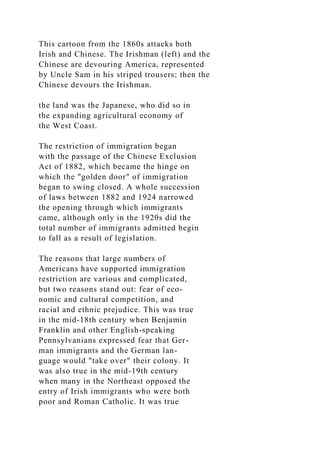
their labor union, the Independent Ladies Garment Workers
Union, to organize a boycott of Japanese goods. During the war,
they joined the American women’s armed forces in signifi cant
numbers in order to play a role in defeating Japan.
Such examples of cohesive pluralism demonstrate the power of
ethnicity simultaneously to strengthen the group and to assist it
in
speeding its way into the mainstream. America has not always
enthusiastically welcomed immigrants. But its homogenizing
social and political arrangements have created opportunities for
them to become a part of an American society that becomes
more
unifi ed and hence stronger because of the integration of diverse
peoples, who retain their differences, even as they come to act
and
think in common.
Co
py
ri
gh
t
@
20
11
.
Ox
fo
rd
U
ni
ve
rs
it
y
Pr
es
s.
Al
l
ri
gh
ts
r
es
er
ve
d.
M
ay
n
ot
b
e
re
pr
od
uc
ed
i
n
an
y
fo
rm
w
it
ho
ut
p
er
mi
ss
io
n
fr
om
t
he
p
ub
li
sh
er
,
ex
ce
pt
f
ai
r
us
es
p
er
mi
tt
ed
u
nd
er
U
.S
.
or
a
pp
li
ca
bl
e
co
py
ri
gh
t
la
w.
EBSCO : eBook Academic Collection (EBSCOhost) - printed on
10/1/2018 4:02 PM via MIDDLE
TENNESSEE STATE UNIV
AN: 365577 ; Gerber, David A..; American Immigration: A
Very Short Introduction
Account: s4672406.main.ehost
73
Chapter 4
Mass population movements
and resettlement,
1820–1924
The rise of modern international migration
Large-scale, transformative social processes framed boundaries
within which the age of mass international migration out of
Europe occurred after 1820. These processes produced the
historical context in which, within a century, the overlying
historical purpose of international migration could be realized:
societies with too many people and hence an excess of labor
exported their surplus population to emergent societies in the
Western Hemisphere and Australasia that needed labor. These
receiving societies were principally the United States (35
million),
Argentina (6 million), Canada (5 million), Brazil (4 million),
and
Australia (3.5 million), all rich in resources, especially arable
land,
but lacking population suffi cient to develop them. In 1800,
only 4
percent of Europeans were living outside Europe and Russian
Siberia; in 1914, by which time about 60 million people over a
century had left Europe, approximately 21 percent of Europeans
were living outside the continent. The population of the United
States would have been only 60 percent of the numbers achieved
by 1940 without international migration. It is impossible to
overestimate the extent to which that additional 40 percent
contributed to making the United States the world’s largest
economy.
Co
py
ri
gh
t
@
20
11
.
Ox
fo
rd
U
ni
ve
rs
it
y
Pr
es
s.
Al
l
ri
gh
ts
r
es
er
ve
d.
M
ay
n
ot
b
e
re
pr
od
uc
ed
i
n
an
y
fo
rm
w
it
ho
ut
p
er
mi
ss
io
n
fr
om
t
he
p
ub
li
sh
er
,
ex
ce
pt
f
ai
r
us
es
p
er
mi
tt
ed
u
nd
er
U
.S
.
or
a
pp
li
ca
bl
e
co
py
ri
gh
t
la
w.
EBSCO : eBook Academic Collection (EBSCOhost) - printed on
10/1/2018 3:54 PM via MIDDLE
TENNESSEE STATE UNIV
AN: 365577 ; Gerber, David A..; American Immigration: A
Very Short Introduction
Account: s4672406.main.ehost
A
m
er
ic
an
Im
m
ig
ra
ti
o
n
74
Colonialism also spread Europeans throughout the world. Some
colonial powers used settler colonies, such as Algeria or
Indonesia,
to create opportunities for hundreds of thousands of ordinary
people, while extending national power. Thus, colonial
migrations
might supplant voluntary immigration to other sovereign states
as
a way of dealing with excess population. But speaking for
continental Europe as a whole, nothing matched international
voluntary emigration as a process for shedding excess
population.
Possessing the largest empire in the world in the nineteenth
century, Great Britain sent millions of military personnel, civil
servants, colonial offi cials, and settlers to far-fl ung colonial
destinations. Nonetheless, it had the third largest cohort of
immigrants to the United States, after Germany and Italy,
between 1820 and 1970.
9. Emigrants at Bremerhaven waiting to board ship for
America.
Bremerhaven was the leading emigration port for Germans, the
largest
nineteenth-century group to immigrate to America. The port
also
collected people from all over central and Eastern Europe, who
traveled there to fi nd ships sailing to the United States.
Co
py
ri
gh
t
@
20
11
.
Ox
fo
rd
U
ni
ve
rs
it
y
Pr
es
s.
Al
l
ri
gh
ts
r
es
er
ve
d.
M
ay
n
ot
b
e
re
pr
od
uc
ed
i
n
an
y
fo
rm
w
it
ho
ut
p
er
mi
ss
io
n
fr
om
t
he
p
ub
li
sh
er
,
ex
ce
pt
f
ai
r
us
es
p
er
mi
tt
ed
u
nd
er
U
.S
.
or
a
pp
li
ca
bl
e
co
py
ri
gh
t
la
w.
EBSCO : eBook Academic Collection (EBSCOhost) - printed on
10/1/2018 3:54 PM via MIDDLE
TENNESSEE STATE UNIV
AN: 365577 ; Gerber, David A..; American Immigration: A
Very Short Introduction
Account: s4672406.main.ehost
Guest User
German port
M
ass p
o
p
u
latio
n
m
o
vem
en
ts an
d
resettlem
en
t, 1
8
2
0
–1
9
2
4
75
A fateful demographic transition that began in Europe and
would
reach the rest of the world in the twentieth century has been at
the
heart of the rise of modern immigration patterns. After 1750
Europe’s population began a very rapid ascent, fi rst in western
Europe and then, by the mid-nineteenth century, in central,
southern and eastern Europe. Much of this growth is explained
by
improvements in diet that were made possible, for example, by
the
cultivation of the potato, originally a New World crop. Until
catastrophic crop failures due to a fungus infection in the 1840s
in
France, the Netherlands, some of the German states, the
Scottish
Highlands, and especially Ireland, where a million died of
starvation and disease, and almost 2 million were forced to
emigrate, the potato was a principal staple of peasant diets.
In addition, long before the antibiotic revolution in medical
pharmacology in the mid-twentieth century, improvements in
sanitation that included more potable drinking water, better
waste
disposal, and aseptic child-birthing brought down morality
rates.
Typically there was no signifi cant expansion in the amount of
arable land, so population growth placed pressure on food
supplies for the peasant majority, which was engaged in a wide
variety of land-owning, leasing, or renting relationships
characteristic of European agriculture.
The consequences are seen in patterns of landholding. When
inheritance laws and customs favored the eldest son, younger
sons
found themselves unable to fi nd land at prices that provided
opportunity for an independent existence. But where there was
partible inheritance, with the passage of generations, many sons
found themselves in possession of smaller and smaller holdings
that could not sustain existence. The same situation also could
be
seen in leasing or renting relationships, in which expectations
of
generational continuity on a given piece of land were disrupted
by
growing numbers. Even land of no more than marginal value
was
for sale at escalating prices. Under the circumstances, leaving
the
land often seemed the only way to survive.
Co
py
ri
gh
t
@
20
11
.
Ox
fo
rd
U
ni
ve
rs
it
y
Pr
es
s.
Al
l
ri
gh
ts
r
es
er
ve
d.
M
ay
n
ot
b
e
re
pr
od
uc
ed
i
n
an
y
fo
rm
w
it
ho
ut
p
er
mi
ss
io
n
fr
om
t
he
p
ub
li
sh
er
,
ex
ce
pt
f
ai
r
us
es
p
er
mi
tt
ed
u
nd
er
U
.S
.
or
a
pp
li
ca
bl
e
co
py
ri
gh
t
la
w.
EBSCO : eBook Academic Collection (EBSCOhost) - printed on
10/1/2018 3:54 PM via MIDDLE
TENNESSEE STATE UNIV
AN: 365577 ; Gerber, David A..; American Immigration: A
Very Short Introduction
Account: s4672406.main.ehost
Guest User
Guest User
Guest User
Lower death rates: Increasing pressure for food resources
Less land available
A
m
er
ic
an
Im
m
ig
ra
ti
o
n
76
That was only one face of the crisis of agriculture. The growth
of
population and the related rise of people living in the industrial
cities encouraged the commercialization of agriculture, through
which the cultivation of both food and fi ber, using technology
and
scientifi c cultivation, was placed on an industrial footing.
Peasants
were reduced to wage laborers in rural areas, and their
customary
rights, including long-term lease arrangements, were destroyed.
Key to the process of commercialization was the consolidation
of
holdings. Extensive cultivation over vast acreage created the
basis
for signifi cant economies of scale and a vast potential for
production and profi t. The traditional patchwork pattern of
small
holdings, farmed by people often barely making a living for
themselves, and the ancient common lands that they shared for
grazing work-animals and livestock, were antithetical to
capitalist
agriculture. Consolidation might be accomplished by increasing
rents, outright evictions, or simply declaring that after the death
of the current renters, the property would be unavailable for
habitation and cultivation. Thus, peasants lost their access to
long-term arrangements by which they knew security, and they
were reduced to wage labor in the countryside or in the city.
Landlords easily grasped the logic of ending small leasing and
rental arrangements, increasing rents to new, commercially
minded tenants, consolidating arable lands, and enclosing the
common fi elds for use in the future of commercial herds.
Some large rural economies outside Europe experienced similar
developments in the mid- and late-nineteenth centuries. In Japan
after 1867 Emperor Meiji began a wholesale program of
industrialization and urban development that encouraged
wealthy
landowners to consolidate holdings and hence, to remove the
peasantry. In southeastern China change was initiated from
without, as the European economic penetration of the densely
populated valley and delta of the Pearl River placed tremendous
pressures on the peasant population. In central Mexico, change
came rapidly to the rural heartland of peasant agriculture after
Co
py
ri
gh
t
@
20
11
.
Ox
fo
rd
U
ni
ve
rs
it
y
Pr
es
s.
Al
l
ri
gh
ts
r
es
er
ve
d.
M
ay
n
ot
b
e
re
pr
od
uc
ed
i
n
an
y
fo
rm
w
it
ho
ut
p
er
mi
ss
io
n
fr
om
t
he
p
ub
li
sh
er
,
ex
ce
pt
f
ai
r
us
es
p
er
mi
tt
ed
u
nd
er
U
.S
.
or
a
pp
li
ca
bl
e
co
py
ri
gh
t
la
w.
EBSCO : eBook Academic Collection (EBSCOhost) - printed on
10/1/2018 3:54 PM via MIDDLE
TENNESSEE STATE UNIV
AN: 365577 ; Gerber, David A..; American Immigration: A
Very Short Introduction
Account: s4672406.main.ehost
Guest User
Guest User
Guest User
Guest User
Guest User
Guest User
Guest User
Guest User
Guest User
Commercialization of agriculture
Mexico
Japan
M
ass p
o
p
u
latio
n
m
o
vem
en
ts an
d
resettlem
en
t, 1
8
2
0
–1
9
2
4
77
the completion of railroad lines north to the border cities in the
1890s. In contemplation of the opening of the American and
Mexican urban markets to indigenous agriculture, Mexican
landholders began consolidating peasant holdings, and created
their own great estates of as many as forty thousand acres.
Some
landowners were content to sell off their increasingly valuable
holdings, but while the peasantry went landless, the government
of President Porfi rio Diaz sought European commercial farmers
to buy these lands, believing that they would achieve greater
crop
yields, and thus a heartier commercial agriculture, than the
sustenance-oriented peasantry.
The response of the peasants to the collapse of accustomed
ways
of rural life was complex. They might assume traditional forms
of
resistance, such as riots, arson, nighttime raids, and the murder
of
commercial herds of sheep or cattle displacing them. Or it might
take modern forms, such as rent strikes and law suits
orchestrated
by well-organized tenants’ unions. But political protests were a
diffi cult route, because the peasants were a declining class,
acting
in desperate circumstances against powerful modernizing social
classes that controlled state power in all its most brutal,
insidious
forms.
More common were nonpolitical, individualized strategies
undertaken within the framework of the family. The traditional
family, with its patriarchal authority, well-defi ned gender
roles,
and insistence on the practical contributions of children
effectively
mobilized for common endeavor and mutual support. Younger
children might be sent off to be laborers and servants. Marriage
might be postponed to later ages, as in Japan and Ireland, to
shorten the period of the young couple’s independence and
simultaneously lowering births by truncating the period of
marital
fertility. Family forms might be changed, too. In the European
countryside, more complicated family arrangements—for
example, stem families in which one son and his family might
live
with his parents, or joint families, in which all sons and their
Co
py
ri
gh
t
@
20
11
.
Ox
fo
rd
U
ni
ve
rs
it
y
Pr
es
s.
Al
l
ri
gh
ts
r
es
er
ve
d.
M
ay
n
ot
b
e
re
pr
od
uc
ed
i
n
an
y
fo
rm
w
it
ho
ut
p
er
mi
ss
io
n
fr
om
t
he
p
ub
li
sh
er
,
ex
ce
pt
f
ai
r
us
es
p
er
mi
tt
ed
u
nd
er
U
.S
.
or
a
pp
li
ca
bl
e
co
py
ri
gh
t
la
w.
EBSCO : eBook Academic Collection (EBSCOhost) - printed on
10/1/2018 3:54 PM via MIDDLE
TENNESSEE STATE UNIV
AN: 365577 ; Gerber, David A..; American Immigration: A
Very Short Introduction
Account: s4672406.main.ehost
Guest User
Guest User
Guest User
Guest User
Reaction and survival strategies
A
m
er
ic
an
Im
m
ig
ra
ti
o
n
78
families lived with parents—arose for the purpose of
consolidating
labor, living cheaply in a common household, and meeting the
challenge of paying higher rents.
Another option was migration, whether long-distance or
short-distance. A high degree of transiency, especially among
the
young, came to characterize the peasantry. In many places,
transiency had been a routine feature of the peasant economy
for
centuries. Younger men in particular traveled to get work, for
example, helping with harvests. But, as modernizing
transformations gathered force, many more people engaged in
short-distance migrations, which became less about
supplementing income and more about survival. Seasonal
transiency might expand to encompass a larger portion of the
year, as among those Scottish Highlanders who were in jeopardy
of losing their leases because of the massive extension of
commercial sheep farming. Some of these Scots or their sons
now
went to the fi sheries nearly the entire year: in the winter they
worked with white fi sh, in the spring herring in western waters,
and in the summer herring in eastern waters. Nearby migrations
in search of work as laborers in the new proletarianized,
commercial agriculture grew common.
Exerting a more powerful pull was the vast labor market of the
industrial economy in the growing cities, where technology and
entrepreneurship had merged, fi rst in textiles, to create mass
production on a scale previously unimaginable. The new factory
system, with its low-priced goods, simultaneously undercut the
competitive position of village and town artisans and craftsmen,
whose livelihoods were also imperiled by the problems that
plagued their largest market, the peasantry. In consequence,
traditional skilled workers joined the growing stream of
migrants
to cities.
It was bad enough, from his perspective, for the shoemaker to
tend a machine in a shoe factory. For many peasants, a
permanent
Co
py
ri
gh
t
@
20
11
.
Ox
fo
rd
U
ni
ve
rs
it
y
Pr
es
s.
Al
l
ri
gh
ts
r
es
er
ve
d.
M
ay
n
ot
b
e
re
pr
od
uc
ed
i
n
an
y
fo
rm
w
it
ho
ut
p
er
mi
ss
io
n
fr
om
t
he
p
ub
li
sh
er
,
ex
ce
pt
f
ai
r
us
es
p
er
mi
tt
ed
u
nd
er
U
.S
.
or
a
pp
li
ca
bl
e
co
py
ri
gh
t
la
w.
EBSCO : eBook Academic Collection (EBSCOhost) - printed on
10/1/2018 3:54 PM via MIDDLE
TENNESSEE STATE UNIV
AN: 365577 ; Gerber, David A..; American Immigration: A
Very Short Introduction
Account: s4672406.main.ehost
Guest User
Guest User
Guest User
Guest User
Guest User
Migration as survival strategy
“Pull” factor of cities
Making money in factories
M
ass p
o
p
u
latio
n
m
o
vem
en
ts an
d
resettlem
en
t, 1
8
2
0
–1
9
2
4
79
descent into wage earning could only be confronted with horror.
They measured value by the possession of land, whether as
owners
or renters, and strove to be as independent as possible in the
production of the means for their survival. For peasants and
traditional craftsmen to end up living the proletarian life of a
wage earner in the slums of industrial cities was a miserable
fate.
Many millions did end up that way; without them, there would
have been no European industrial revolution. Although it is
diffi cult to know the numbers involved, rural and village folk
who
came to regional industrial centers might well have been
engaged
in step-migrations, using the wages made in factory work to
fi nance international migration.
International migration was a strategy for avoiding
proletarianization and might fi ll multiple practical needs:
permanent resettlement; temporary work abroad while earning
money to be brought back to the homeland to ensure stability in
the new economy; and earning money to provide remittances
sent
to family at home. The extent of these remittances sent from the
United States was impressive. Between 1870 and 1914, in the
currency values of the day, Slovaks sent approximately
$200 million home, while between 1897 and 1902 Italians
sent $100 million, and between 1906 and 1930 Swedes sent
$192 million. The volume of Greek remittances grew annually
between 1910 and 1920 from $4.675 million to $110 million.
International migration was best considered not by the very
poor,
for whom it was prohibitively expensive, or by the affl uent,
who
did not have to emigrate, but by the middle and lower-middle
ranks of rural, village, and town society. They possessed the
material resources to emigrate, such as fare for ships’ passage
and
funds to aid in resettlement, but also the nonmaterial cultural
capital, chief among which was literacy. This is not to say the
very
poor were always absent from the ranks of emigrants. Though
not
the poorest of their singularly immiserated society, the
approximately 1.7 million Irish immigrants of the 1840s and
1850s
Co
py
ri
gh
t
@
20
11
.
Ox
fo
rd
U
ni
ve
rs
it
y
Pr
es
s.
Al
l
ri
gh
ts
r
es
er
ve
d.
M
ay
n
ot
b
e
re
pr
od
uc
ed
i
n
an
y
fo
rm
w
it
ho
ut
p
er
mi
ss
io
n
fr
om
t
he
p
ub
li
sh
er
,
ex
ce
pt
f
ai
r
us
es
p
er
mi
tt
ed
u
nd
er
U
.S
.
or
a
pp
li
ca
bl
e
co
py
ri
gh
t
la
w.
EBSCO : eBook Academic Collection (EBSCOhost) - printed on
10/1/2018 3:54 PM via MIDDLE
TENNESSEE STATE UNIV
AN: 365577 ; Gerber, David A..; American Immigration: A
Very Short Introduction
Account: s4672406.main.ehost
Guest User
Guest User
Guest User
Sending money back home
What socio-economic groups migrated?
A
m
er
ic
an
Im
m
ig
ra
ti
o
n
80
who were victims of the potato famine were uniquely
impoverished as a cohort among immigrants to the United
States.
Moreover, as the price of the cheapest passage declined with the
coming of steamships, it became economical for poorer people
to
emigrate.
But understanding of the consequences of poverty must be
further
contextualized in the later epoch. In contrast to the situation of
the resettlement of the Potato Famine Irish, who were the fi rst
generation of mass Irish Catholic emigration, by the later
nineteenth century many of these poorer immigrants were
members of transnational mutual support networks that bound
them to family and friends already in the United States.
Practical
support, which might include small sums of money as well as
lodging and a pre-arranged job, often compensated for lack of
funds on arrival.
In the nineteenth century, when cheap, accessible land was
plentiful, immigrants could dream of replicating the old way of
life in the newly emerging states of the Middle West and Great
Plains, where the fl at prairie lands were known for remarkable
fertility. Husbands and wives, with young children, in search of
farmsteads were especially prominent among mid-nineteenth
century Germans and Scandinavians. There were single male
migrants, too, both farmers and artisans, who hoped to stay for
a
year or two and make enough money to return home to start
families and be independent on their own land. They might
work
in mills, factories, or mines, even if they would not take such
work
in Europe. American wages were higher, and there was less
reason
to fear being trapped, if one had the means for returning home.
Others worked in American mills in the hope of raising the
capital
to start farms in the United States and achieve independence of
the wage economy.
Skilled workers in infant American industries were also
present
among the nineteenth-century immigrants, for capitalists could
Co
py
ri
gh
t
@
20
11
.
Ox
fo
rd
U
ni
ve
rs
it
y
Pr
es
s.
Al
l
ri
gh
ts
r
es
er
ve
d.
M
ay
n
ot
b
e
re
pr
od
uc
ed
i
n
an
y
fo
rm
w
it
ho
ut
p
er
mi
ss
io
n
fr
om
t
he
p
ub
li
sh
er
,
ex
ce
pt
f
ai
r
us
es
p
er
mi
tt
ed
u
nd
er
U
.S
.
or
a
pp
li
ca
bl
e
co
py
ri
gh
t
la
w.
EBSCO : eBook Academic Collection (EBSCOhost) - printed on
10/1/2018 3:54 PM via MIDDLE
TENNESSEE STATE UNIV
AN: 365577 ; Gerber, David A..; American Immigration: A
Very Short Introduction
Account: s4672406.main.ehost
Guest User
Guest User
Pull factor: Germans, Norwegians &Swedes before 1890
M
ass p
o
p
u
latio
n
m
o
vem
en
ts an
d
resettlem
en
t, 1
8
2
0
–1
9
2
4
81
not yet fi nd among Americans the knowledge needed to operate
new industrial technologies that had emerged in Europe. In the
pioneering phase of development in a number of industries,
the importation of skilled Europeans, lured by very high wages,
was essential to achieving progress. This was the case, for
example, in brewing throughout the northern states and in
winemaking in the Ohio Valley, both of which depended on
German craftsmen, and in pottery, textiles, and stone quarrying
and cutting in which British craftsmen proved essential.
Such migrations were targeted geographically, and, if
continued
over time, might lead to a virtual international integration of
local
labor forces. For many years, for example, the sandstone
quarrying and cutting industry in northwestern New York State
depended partly on the importation of skilled English workers
who had been employed in the same industry in Yorkshire’s
southern Pennine fringe. From the 1820s well into the twentieth
century, English cutters and quarrymen, who had been
workmates
10. Ole Myrvik’s Sod House, Milton, North Dakota, 1896.
Scandinavian immigrants and their American-born children
were
among the pioneers settling in the American Great Plains after
the
Civil War. Both Ole Myrvik and his unnamed wife were
children of
Norwegian immigrant parents.
Co
py
ri
gh
t
@
20
11
.
Ox
fo
rd
U
ni
ve
rs
it
y
Pr
es
s.
Al
l
ri
gh
ts
r
es
er
ve
d.
M
ay
n
ot
b
e
re
pr
od
uc
ed
i
n
an
y
fo
rm
w
it
ho
ut
p
er
mi
ss
io
n
fr
om
t
he
p
ub
li
sh
er
,
ex
ce
pt
f
ai
r
us
es
p
er
mi
tt
ed
u
nd
er
U
.S
.
or
a
pp
li
ca
bl
e
co
py
ri
gh
t
la
w.
EBSCO : eBook Academic Collection (EBSCOhost) - printed on
10/1/2018 3:54 PM via MIDDLE
TENNESSEE STATE UNIV
AN: 365577 ; Gerber, David A..; American Immigration: A
Very Short Introduction
Account: s4672406.main.ehost
Guest User
Guest User
Norwegian
A
m
er
ic
an
Im
m
ig
ra
ti
o
n
82
in their homelands and were introduced to their American
employers by those English workers who preceded them, were
migrating to work Medina sandstone in Niagara and Orleans
counties. They initiated transnational employment circuits,
which,
in effect, simultaneously embedded them in two societies. Even
in
the age of sailing vessels, some migrated seasonally. They
returned
to Britain to divide their time between attending to small farms
and quarrying and cutting at their old jobs. They might reappear
to take up jobs in New York State periodically after an absence
of a few years when they discovered that wages had become
advantageous. Some married American women, or brought
wives
from England. After 1900, new immigrant Italians and Poles
joined them in the quarries
The changing character of European immigration
The decline after 1890 in the reserves of arable American land
that might be conveniently approached from the principal East
Coast immigrant-receiving ports, the subsequent rise in the
price of farm making, and the tremendous growth of mass
production industries altered the character of the immigration.
The demographic balance of international migration
increasingly shifted from young families to single men in
search in urban employment. A significant percentage of them
aspired to work as long as it took in order to make enough
money to return to their homelands and achieve a greater
measure of independence. Men predominated two to one over
women, except among the Irish. While in the international
migrations of the nineteenth and early twentieth centuries
women were mostly wives, mothers, and daughters arriving in
family groups, the situation was different among the Irish. In
Ireland women had few opportunities. Marriage was being
postponed later and later, or had become impossible, as
available farm land declined. But Irish women did well in
American job markets, especially as domestics, because they
spoke English. By the 1870s, only some 15 percent of the Irish
Co
py
ri
gh
t
@
20
11
.
Ox
fo
rd
U
ni
ve
rs
it
y
Pr
es
s.
Al
l
ri
gh
ts
r
es
er
ve
d.
M
ay
n
ot
b
e
re
pr
od
uc
ed
i
n
an
y
fo
rm
w
it
ho
ut
p
er
mi
ss
io
n
fr
om
t
he
p
ub
li
sh
er
,
ex
ce
pt
f
ai
r
us
es
p
er
mi
tt
ed
u
nd
er
U
.S
.
or
a
pp
li
ca
bl
e
co
py
ri
gh
t
la
w.
EBSCO : eBook Academic Collection (EBSCOhost) - printed on
10/1/2018 3:54 PM via MIDDLE
TENNESSEE STATE UNIV
AN: 365577 ; Gerber, David A..; American Immigration: A
Very Short Introduction
Account: s4672406.main.ehost
Guest User
Guest User
Who the immigrants were
M
ass p
o
p
u
latio
n
m
o
vem
en
ts an
d
resettlem
en
t, 1
8
2
0
–1
9
2
4
83
emigration was composed of families. Irish men and women
were just about equal in immigration streams to the United
States between 1869 and 1920, although women outnumbered
men in approximately half of those years.
The decades after 1890 were peak years for the European
“birds
of passage”—male transients who took advantage of
transoceanic
steamships to commute between their homelands and the
United States. Italians were among the most transient
immigrant peoples. Italian construction and agricultural
laborers and railroad track maintenance workers moved
routinely among the United States, Argentina, or Brazil, and
their homelands. Among British workers, building artisans
regularly worked both sides of the Atlantic. The principal
infl uence of such immigrant workers was to integrate labor
markets on both sides of the Atlantic.
The birds of passage must be distinguished from those
noncommuting migrants who arrived with the intention of
making money and leaving once and for all to fulfi ll aspirations
in
their homelands. Perhaps a quarter of those entering the United
States re-emigrated. During 1908–23, approximately 89 percent
of Bulgarians, Serbians, and Montenegrins, 66 percent of
Romanians and Hungarians, and 60 percent of southern Italians
returned to Europe. Among peoples who had little to return to
because of a lack of opportunities, such as the Irish (11 percent)
or because of persecution, such as the eastern European Jews
(5 percent), re-emigrants were far fewer.
Nonetheless 75 percent stayed. Some men had always planned
to
send for their families, if they could fi nd a promising situation.
Others gradually came to the conclusion that they would be
better
off breaking with the past. Nonetheless, though a minority,
Europeans who re-emigrated had a strong infl uence on the
discourse of American immigration restrictionists. They sent
money home rather than spend it to the benefi t of American
Co
py
ri
gh
t
@
20
11
.
Ox
fo
rd
U
ni
ve
rs
it
y
Pr
es
s.
Al
l
ri
gh
ts
r
es
er
ve
d.
M
ay
n
ot
b
e
re
pr
od
uc
ed
i
n
an
y
fo
rm
w
it
ho
ut
p
er
mi
ss
io
n
fr
om
t
he
p
ub
li
sh
er
,
ex
ce
pt
f
ai
r
us
es
p
er
mi
tt
ed
u
nd
er
U
.S
.
or
a
pp
li
ca
bl
e
co
py
ri
gh
t
la
w.
EBSCO : eBook Academic Collection (EBSCOhost) - printed on
10/1/2018 3:54 PM via MIDDLE
TENNESSEE STATE UNIV
AN: 365577 ; Gerber, David A..; American Immigration: A
Very Short Introduction
Account: s4672406.main.ehost
Guest User
Guest User
Guest User
A
m
er
ic
an
Im
m
ig
ra
ti
o
n
84
commerce. They had no desire to assimilate. The labor unions
saw
them as willing tools of the employers, impossible to organize.
A different picture emerged on the Pacific Coast of the United
States. In these more recently settled states arable land was still
available. Young Japanese immigrant families sought farmland
in rural California, Washington, and Oregon. Young South
Asian men from the Punjab came to the Imperial Valley of
California, where large fruit and vegetable farms were being
carved out of the desert in consequence of massive irrigation
projects, to work as agricultural labor. Many hoped to get the
money to buy small farms and form families, as some did with
Mexican women, starting a unique Punjabi-Mexican hybrid
ethnicity. In contrast, Mexicans displaced by consolidation of
peasant landholdings by landlords first became a local agrarian
proletariat, or went to work in factories and mines in northern
Mexico where wages were higher than in agriculture. But
spurred by the promise of even higher wages and eventually
threatened by revolutionary violence, after 1900 they began
entering the United States in growing numbers, across an open
border, to find work in mining and agriculture in the American
West.
To the casual observer mass immigration and resettlement may
seem chaotic and even menacingly disorderly. But this is rarely
the
perception of immigrants, whose strategies for accomplishing
relocation across oceans and continents have been heavily
dependent on paths laid down by those often familiar
individuals
who came before them. Every immigration has its pioneers,
whose
narratives of exploration and discovery make compelling
reading.
But once these pioneers lay down tracks known to their
families,
friends, and former neighbors, even the most massive immigrant
fl ows take on a routine, predictable character. That is the mark
of
the immigrant’s creativity in living: in the midst of life-
changing
movements across vast distances, they have been guided by
strategies that minimize risks and extend the realm of the
familiar.
Co
py
ri
gh
t
@
20
11
.
Ox
fo
rd
U
ni
ve
rs
it
y
Pr
es
s.
Al
l
ri
gh
ts
r
es
er
ve
d.
M
ay
n
ot
b
e
re
pr
od
uc
ed
i
n
an
y
fo
rm
w
it
ho
ut
p
er
mi
ss
io
n
fr
om
t
he
p
ub
li
sh
er
,
ex
ce
pt
f
ai
r
us
es
p
er
mi
tt
ed
u
nd
er
U
.S
.
or
a
pp
li
ca
bl
e
co
py
ri
gh
t
la
w.
EBSCO : eBook Academic Collection (EBSCOhost) - printed on
10/1/2018 3:54 PM via MIDDLE
TENNESSEE STATE UNIV
AN: 365577 ; Gerber, David A..; American Immigration: A
Very Short Introduction
Account: s4672406.main.ehost
Guest User
Guest User
Guest User
Japanese
Mexican
M
ass p
o
p
u
latio
n
m
o
vem
en
ts an
d
resettlem
en
t, 1
8
2
0
–1
9
2
4
85
People hoping to improve themselves by pursuing work across
international space have always been a highly selective group.
Hard work, high aspirations, and family and group solidarity are
characteristic of immigrant groups, and provide substantial
resources in the struggle to make new homes.
Co
py
ri
gh
t
@
20
11
.
Ox
fo
rd
U
ni
ve
rs
it
y
Pr
es
s.
Al
l
ri
gh
ts
r
es
er
ve
d.
M
ay
n
ot
b
e
re
pr
od
uc
ed
i
n
an
y
fo
rm
w
it
ho
ut
p
er
mi
ss
io
n
fr
om
t
he
p
ub
li
sh
er
,
ex
ce
pt
f
ai
r
us
es
p
er
mi
tt
ed
u
nd
er
U
.S
.
or
a
pp
li
ca
bl
e
co
py
ri
gh
t
la
w.
EBSCO : eBook Academic Collection (EBSCOhost) - printed on
10/1/2018 3:54 PM via MIDDLE
TENNESSEE STATE UNIV
AN: 365577 ; Gerber, David A..; American Immigration: A
Very Short Introduction
Account: s4672406.main.ehost
Guest User
PAPER 2: IMMIGRATION TO THE USA (1880S -
1930)
All in all, it is estimated that between 1880 and 1930, around
28-30 million immigrants entered the United States.
Background:
“The 1880s marked a turning pointin the history
of American immigration, as well as the
American attitude toward it. In the first place,
the annual rate rose dramatically. The number of
arrivals from Europe went up more than 100%
from 1879 to 1881, and it more than tripled
during the next year…The shift from northeast to
southwest [and Eastern] Europe as a source for
immigration, which began about 1883,
and increased rapidly until the first decades of
the 20th century (the 1900s), brought unfamiliar
cultures in unprecedented numbers to the United
States”
(Wepman,160)
Global Context: “It was a period of
unprecedented migration throughout the world.
People were moving from one nation in Europe
to another, from Europe to Australia and South
America, from Asia to both Europe and the
Americas. In the first 2 decades of the 20th
century, Canada received nearly 3 million
people, Argentina admitted more than 2 million,
and Brazil about 1 million. Australia and
New Zealand admitted some900,000 European
immigrants during this period. However, the
United States remained the most popular
destination; from 1906 to 1915, it saw the
arrival of 9.4 million immigrants” (161).
Source: Wepman, “The New Immigrant: 1881 – 1918.”
Research Question:
Write the paper from the perspective of an immigrant during
this time period.
· Where did you come from, and what is your name? (make up
one that goes with your nationality)
· Why did you come to the United States (what were the “push
and pull” factors), and was your experience once you arrived in
the USA? How did Americans react to you?
· Lastly, do you think American views of immigrants today are
comparable with views and policies back then? Give a good
objective explanation.
GUIDELINES
· MLA format –
https://owl.purdue.edu/owl/research_and_citation/mla_style/mla
_formatting_and_ style_guide/mla_general_format.html
· 12-point font – Arial or Times New Roman
· Double spaced
· Length: 1000 – 1300 words
· DO use in-text citations when quoting (use at most 2 short
sentences, not blocks of text)
https://owl.purdue.edu/owl/research_and_citation/mla_style/mla
_formatting_and_
style_guide/mla_in_text_citations_the_basics.html
· You must include a Work Cited Page/Bibliography.
· You must use a minimum of 5 sources
· Create a title for your paper.
· Do not include a title page o Do not include section headers
· Do not use footnotes or end notes
BOOKS AND ARTICLES:
Chapters and excerpts from the following books and articles
will be posted on D2L/Content/Paper 2. Click on the titles to
open up the articles.
History of American Immigration
· Daniels, Roger, American Immigration: A Student Companion.
The Push and Pull Factors
• Gerber, David A. American Immigration: A Very Short
Introduction. 2011. Oxford University Press. – Chapter 3
The Journey to America and the Immigration Processing Centers
• Kraut, Alan. The Huddled Masses: The Immigrant in American
society, 18801921. Wheeling, Ill.: Harlan Davidson, c2001 –
Chapter 2, pp. 52 – 85.
Assimilation
• Gerber, David A. American Immigration: A Very Short
Introduction. 2011. Oxford University Press. – Chapter 6
• Nativism and Legal Restrictions
· Gerber, David A. American Immigration: A Very Short
Introduction. 2011. Oxford University Press. – Chapter 2
· Shrag, Peter. The Unwanted: Immigration and Nativism in
America. September 2010.
IMMIGRATION
POLICY
CENTER
A M E R I C A N I M M I G R A T I O N C O U N C I L
SEPTEMBER 2010
PERSPECTIVES
IMMIGRATION AND NATIVISM IN AMERICA
By Peter Schrag
UNWANTED
© Peter Schrag
THE UNWANTED:
IMMIGRATION AND NATIVISM IN AMERICA
BY PETER SCHRAG
SEPTEMBER 2010
ABOUT PERSPECTIVES ON IMMIGRATION
The Immigration Policy Center’s Perspectives are thoughtful na
rratives written by leading academics and researchers
who bring a wide range of multi‐disciplinary knowledge to the i
ssue of immigration policy.
ABOUT THE AUTHORS
Peter Schrag, for many years the editorial page editor and later
a weekly columnist for the Sacramento Bee, currently
contributes to The Nation, Harper's, The Los Angeles Times, an
d other publications. He is a visiting scholar at the
Institute for Governmental Studies at the University of Californi
a at Berkeley and the author of several books,
including Paradise Lost and California: America's High‐Stakes
Experiment and Final Test: The Battle for Adequacy in
America's Schools. This article is drawn from Peter Schrag’s No
t Fit for Our Society: Immigration and Nativism in
America, University of California Press, 2010. © Peter Schrag
ABOUT THE IMMIGRATION POLICY CENTER
The Immigration Policy Center, established in 2003, is the polic
y arm of the American Immigration Council. IPC's
mission is to shape a rational national conversation on immigrat
ion and immigrant integration. Through its research
and analysis, IPC provides policymakers, the media, and the gen
eral public with accurate information about the role
of immigrants and immigration policy on U.S. society. IPC repo
rts and materials are widely disseminated and relied
upon by press and policymakers. IPC staff regularly serves as e
xperts to leaders on Capitol Hill, opinion‐makers, and
the media. IPC is a non‐partisan organization that neither suppo
rts nor opposes any political party or candidate for
office. Visit our website at www.immigrationpolicy.org and our
blog at www.immigrationimpact.com.
PHOTO CREDIT
Cover photo featured in The Wasp, a San Francisco magazine, 1
888.
http://www.ucpress.edu/book.php?isbn=9780520259782
http://rs6.net/tn.jsp?e=0013sB3H4Ngeb8u23v8DTLYuHff5o3A9
Y7fC7wsO-
myYRJX8RIQtjCJU2lT5w5MoDBNruFtlQCCVis4BypKz358QS
nkHIGy4kZ3WjQGc9mhqFGdO-
75dEFf5V4SGNJr23Hf&id=preview&id=preview
http://www.immigrationimpact.com/
http://jimsbikeblog.files.wordpress.com/2010/01/1888-cartoon-
in-the-wasp-a-san-francisco-magazine-reflecting-anti-
immigrant-sentiment1.gif
Introduction
It’s hardly news that the complaints of our latter‐day nativists a
nd immigration restrictionists—
from Sam Huntington to Rush Limbaugh, from FAIR to
V‐DARE—resonate with the nativist
arguments of some three centuries of American history. Often,
as most of us should know, the
immigrants who were demeaned by one generation were the pare
nts and grandparents of the
successes of the next generation. Perhaps, not paradoxically, m
any of them, or their children
and grandchildren, later joined those who attacked and disparag
ed the next arrivals, or would‐
be arrivals, with the same vehemence that had been leveled agai
nst them or their forebears.
Similarly, the sweeps and detentions of immigrants during the e
arly decades of the last century
were not terribly different from the heavy‐handed federal, state,
and local raids of recent years
to round up, deport, and occasionally imprison illegal
immigrants, and sometimes legal
residents and U.S. citizens along with them. But it’s
also well to remember that nativism,
xenophobia, and racism are hardly uniquely American
phenomena. What makes them
significant in America is that they run counter to the nation’s fo
unding ideals. At least since the
enshrinement of Enlightenment ideas of equality and inclusiven
ess in the founding documents
of the new nation, to be a nativist in this country was to be
in conflict with its fundamental
tenets.
And from the start, we’ve fought about the same questions. Wh
o belongs here? What does
the economy need? What, indeed, is an American or who is fit t
o be one? In 1751 Benjamin
Franklin warned that Pennsylvania was becoming “a Colony of
Aliens, who will shortly be so
numerous as to Germanize us instead of our Anglifying them an
d will never adopt our Language
or Customs any more than they can acquire our Complexion.” L
ater Jefferson worried about
immigrants from foreign monarchies who “will infuse into Amer
ican legislation their spirit, warp
and bias its direction, and render it a heterogeneous,
incoherent, distracted mass.” Sound
familiar?
American nativism and our historic ambivalence about
immigration—at times vigorously
seeking newcomers from abroad, at other times shutting them ou
t and/or deporting them—is
deeply entangled both in economic cycles and in the uncertainti
es of our vision of ourselves as
a nation. A self‐proclaimed “city upon a hill,” a shining model
to the world, requires a certain
kind of people. But what kind?
Do they have to be pure Anglo‐Saxons, whatever that was,
which is what many reformers at the turn of the last
century believed, or could it include
“inferior” Southern
Italians, Greeks, Slavs, Jews, or Chinese of the 1800s, the “dirt
y Japs” of
1942, or the Central Americans of today? Can America take the
poor, the “tempest‐tost,” the
“wretched refuse” “yearning to breathe free” and make them a v
ital part of that city? If we
began in perfection, how could change ever be anything but for
the worse?
Tom Tancredo, briefly a presidential candidate in 2008 who, unt
il shortly before his retirement
from the House, was the leader of the Congressional Caucus on
Immigration Reform—meaning
immigrant exclusion—
liked to boast about his immigrant Sicilian grandfather, but con
veniently
2
forgot that his grandfather belonged to a generation
widely regarded by the WASP
establishment and many other Americans of the early 1900s, wh
en he arrived, as belonging to a
class that was genetically and culturally inassimilable—
ill‐educated, crime‐prone, and diseased.
Yet Tancredo, like many of today’s
immigration restrictionists, echoed the same animosities.
“What we’re doing here in this immigration battle,” he
said in one of the Republican
presidential debates in 2007, “is testing our willingness to actua
lly hold together as a nation or
split apart into a lot of Balkanized pieces.” Like other contemp
orary restrictionists, his portrayal
of Mexican immigrants was almost
identical to the characterization of the Italians, Jews, and
Slavs of a century before, and of the Irish and Germans before t
hem—people not fit for our
society.
It’s a long history: Know‐Nothingism and the anti‐Irish, anti‐Ca
tholic virulence that swept much
of the nation
in the 1850s, waned briefly during and after the Civil War and t
hen flourished
again in the half century after 1870: “No Irish Need
Apply” (later, “No Wops Need Apply”),
“Rum, Romanism and Rebellion,” and then “The Chinese Must
Go” and, as the ethnic Japanese
on the West Coast were interned after Pearl Harbor,
“Japs Keep Moving.” The magazine
cartoonists’ pirates coming off the immigrant ships in the
1880s and 1890s were labeled
“disease,” “socialism,” and “Mafia.” And always there was the
shadow of the Vatican, looming
over American democracy and, more ominously, seducing the na
tion’s schoolchildren.
New immigrants were not fit to become real Americans; they we
re too infected by Catholicism,
monarchism, anarchism, Islam, criminal tendencies,
defective genes, mongrel bloodlines, or
some other alien virus to become free men and women in our de
mocratic society. Again and
again, the new immigrants or their children and grandchildren p
roved the nativists wrong. The
list of great American scientists, engineers, writers, scholars, bu
siness and labor leaders, actors
and artists who were immigrants or their children, men
and women on whom the nation’s
greatness largely depended, is legion. Now add to that the story
of Barack Obama, who is not
just the nation’s first African‐American president, but also the f
irst American president whose
father was not a citizen, and the argument becomes even less pe
rsuasive. Yet through each
new wave of nativism and immigration restriction, the
opponents of immigration, legal and
illegal, tend to forget that history.
Forbearers of Restrictionism
The list of contributory factors to the surge of anger, xenophobi
a, and imperial ambition in the
two generations after 1880 is almost endless. It includes the off
icial “closing” of the frontier
and the western “safety‐valve” in the 1890s and industrial
expansion and depression‐driven
cycles of economic fear. It also includes urban corruption and t
he big city machines, most of
them Democratic, that patronized new immigrants more
interested in jobs, esteem and
protection—
and more comfortable with their values of personal and clan
loyalty—than with
the abstract WASP principles of good government and efficient
management that fueled the
Progressive movement and with which most of the
nation’s respectable small‐town middle
class grew up.
3
And along with those upheavals came the heightening fear, bord
ering on panic in some circles,
of our own immigrant‐driven racial degeneration.
That, too, presaged a lot of our latter‐day
hysteria. It resounded through Madison Grant’s influential
The Passing of the Great Race
(1916), through the writings of Alexander Graham Bell and cou
ntless others in the first decades
of the Twentieth Century, and in the hearings and debates
of Congress. In the face of the
inferior, low‐skill, low‐wage but high‐fecundity classes
from Southern and Eastern Europe,
demoralized Anglo‐Saxons would bring fewer children into
the world to face that new
competition.
Probably the most representative, and perhaps the most
influential, voice for immigration
restriction in the 1890s and the following decade was that of Re
p. (later Senator) Henry Cabot
Lodge of Massachusetts, the paradigmatic Boston Brahmin.
Lodge’s articles and speeches
warning of the perils of the rising tide of immigrants from Sout
hern and Eastern Europe—many
of them mere “birds of passage” who only came to make a little
money and then return to the
old country, many more bringing crime, disease,
anarchism, and filth and competing with
honest American workers—drove the debate and presaged
many of the later arguments
against immigration. The late Harvard political scientist

Samuel Huntington’s restrictionist
book, Who Are We?, published in 2004, is shot through with Lo
dge‐like fears.
There were reasons for the old patricians to be worried—
and they weren’t alone. The
overcrowded tenements of the nation’s big cities were incubator
s of disease and violence that
put ever more burdens on schools, the police, charities, and soci
al agencies, many of which
they helped fund. And so, in words and tones not so
different from today’s, members of
Congress heard increasingly loud warnings about the social strai
ns and dangers the immigrants
imposed. Checking the rising political participation of the new
urban immigrants and the power
of the big city machines that challenged the Anglo‐Saxon establ
ishment’s authority—and in the
view of a whole generation of muckraking reformers,
corrupted democracy itself—was an
obligation that couldn’t be escaped.
What’s striking is how many immigration restrictionists came, a
nd still come, from a Progressive
or conservationist background. Madison Grant was a trustee of
New York’s American Museum
of Natural History, and active in the American Bison
Society and the Save the Redwoods
League. David Starr Jordan, the first president of Stanford, a re
spected ichthyologist and peace
activist, along with a group of other leading scholars and clergy
men, was deeply involved in the
race betterment movement which aimed “To Create a New and S
uperior Race thru Euthenics,
or Personal and Public Hygiene and Eugenics, or Race Hygiene
…and create a race of HUMAN
THOROUGHBREDS such as the world has never seen.”
In California many progressives were
fierce battlers to forever exclude Asians from immigration and l
andownership. “Of all the races
ineligible to citizenship under our law,” said V.S. McClatchy, th
e publisher of the unabashedly
Progressive Sacramento Bee, in Senate testimony in 1924,
“the Japanese are the least
assimilable and the most dangerous to this country.”
4
Eugenics, Quotas and Immigration Policy
Beginning just after the turn of the twentieth century, theories a
bout the inferiority of the new
arrivals also began to be reinforced by the new eugenic “scienc
e” which seemed to prove that
virtually all the “new” immigrants—
Slavs, Jews, Italians, Asians, Turks, Greeks—who arrived in
the two generations after 1880 were intellectually, physically, a
nd morally inferior. Henry H.
Goddard, one of the American pioneers of testing, found
that 40 percent of Ellis Island
immigrants before World War I were feebleminded and that 60
percent of Jews there “classify
as morons.” Meanwhile, the eminent psychologists who
IQ‐tested Army recruits during the
War, convinced that intelligence was a fixed quantity, conclude
d that the average mental age of
young American men was thirteen, that a great many
were “morons,” and that those from
Nordic stocks—Brits, Dutch, Canadians, Scandinavians,
Scots—showed far higher intelligence
than Jews, Poles, Greeks, and the very inferior
immigrants, like grandfather Tancredo, from
Southern Italy. “The intellectual superiority of our
Nordic group over the Alpine,
Mediterranean and negro groups” wrote Princeton
psychologist Carl C. Brigham, who
popularized the Army data after the war (and later became a pri
ncipal author of the SAT college
admission tests) “has been demonstrated.” Only “negroes” were
less intelligent than southern
and eastern Europeans.
But in the long chain connecting this country’s historic nativism
, the eugenic “science” of the
1920s and 1930s, and the shifting immigration restriction
policies, past and present, it was
Harry Laughlin, who was (and in some ways remains) far and a
way the most prominent single
link both between eugenics and
immigration policy and between the nativist ideology in the
immigration policies of the 1920s and the present.
Laughlin, superintendent of the Eugenics Record Office (ERO)
at Cold Spring Harbor, N.Y., from
its founding in 1910 until 1939, was the author of such eugenic
treatises as the “Report of the
Committee to Study and to Report on the Best Practical Means t
o Cut Off the Defective Germ‐
Plasm in the American Population” (1914). He is the godfather
of eugenic sterilization in this
country and the legitimization it gave racist sterilization
in Nazi Germany, whose eugenic
policies he lavishly praised.
In 1921, Laughlin also became the “Expert Eugenics Agent” and
semi‐official scientific advisor to Rep. Albert Johnson’s House
Immigration Committee, which
wrote the race‐based National Origins Immigration Laws of 192
1 and 1924 that would be the
basis of U.S. policy for the next forty years and, in some respec
ts, well after.
Immigration from any particular country, excepting Asians,
who were already excluded, and
people from the Western Hemisphere,
including Mexico, who were exempt from the formal
quotas, was capped at two percent of its estimated share of the
U.S. population, not in 1910 or
1920, the most recent Census, but in 1890, when the descendant
s of northern Europeans still
dominated the population. Even when immigrants from
favored nations didn’t fill a given
year’s quota, the quotas for others would remain fixed. As late
as 1965, John B. Trevor, Jr., the
patrician New York lawyer who was the son of the man who dev
ised the national origins quota
5
formula, would testify against repeal of the quota, warning that
“a conglomeration of racial and
ethnic elements” would lead to “a serious culture decline.”
In 1937, while still at the ERO, Laughlin also became the co‐fo
under and first director of the
Pioneer Fund, whose prime research interest has been—
and to this day continues to be—race
and racial purity. Murray and Herrnstein’s The Bell Curve, whi
ch argued that group differences
in IQ between blacks and whites were primarily genetic,
and which included a sympathetic
discussion of “dysgenic pressures” in contemporary
America, some coming from inferior
immigrants, relied heavily on the work of researchers funded, ac
cording to one estimate, with
$3.5 million in Pioneer Fund money.
Through Laughlin and Pioneer particularly, the institutional, per
sonal, and ideological links and
parallels run almost directly from the eugenics and
nativism of the first decades of the last
century to the present. Between the mid‐1980s and the
mid‐1990s, the Pioneer Fund
contributed roughly $1.5 million to the Federation for American
Immigration Reform (FAIR)—
the organization started by the Michigan ophthalmologist John
Tanton in 1979. Tanton was
also a founder of the Center for Immigration Studies and
other influential anti‐immigration
groups. Tanton’s earnest writings echo with the nativism of 190
0: “Will the present majority
peaceably hand over its political power to a group that
is simply more fertile?” he wrote in
1986. FAIR and its sister organizations have been essential sou
rces of information for the radio
and TV talkers, the bloggers and the politicians leading the imm
igration restriction campaign.
Tanton’s organizations were also the primary generators of the
millions of faxes and e‐mails
that were major elements in the defeat of the comprehensive im
migration reform bill in 2007.
In Congress, both were accomplished with the threat of
filibusters, and by putting the
immigrants’ face on the often inchoate economic and
social anxieties—the flight of jobs
overseas, the crisis in health care, the tightening housing
market, the growing income gaps
between the very rich and the middle class, and the shrinking re
turn from rising productivity to
labor—
that might otherwise have been directed at their real causes.
Here also there was broad precedence in the economic and socia
l turmoil arising in the new
industrial, urban America at the turn of the twentieth century. T
he descriptions of Mexicans
taking
jobs away from American workers, renting houses meant for sm
all families, crowding
them with 12 or 14 people and jamming up their driveways with
junk cars, echoed the rhetoric
of 1900 about inferior people brought in as scabs, crowding tene
ments, bringing disease, crime
and anarchy, now become terrorism, who would endanger
the nation and lower living
standards to what the progressive sociologist Edward A. Ross a
century ago would have called
their own “pigsty mode of life.”
In the age of Obama, the overt, nearly ubiquitous racialism of th
e Victorian era, like eugenic
science, is largely passé and certainly no longer respectable. Eu
genic sterilization is gone. The
race‐based national origins immigration quotas of the 1924 John
son‐Reed immigration act have
been formally repealed. But the restrictionists’ arguments
echo, often to an astonishing
degree, the theories and warnings of their nativist forbears of th
e past century and a half.
6
Waves of Migration: Push‐Pull Factors
Economics and events abroad—
religious persecution in England, the Irish and German potato
famine, the failed revolutions of 1848, the Russian
pogroms, Stalin, Hitler and the two
European wars, the strong post‐World War II recovery of
Western Europe and Japan, the
creation of the state of Israel and, as ever, boom and
bust—have always influenced
immigration. But in the past half‐century, spiking Third World

birth rates, the rapidly growing
economic gaps between the booming developed world and the u
nderdeveloped world, have
brought great waves of new faces—yellow, black, brown—
to places that had never seen them
before. People who once wanted to come to America by
the millions, Western Europeans
especially, weren’t nearly as interested
in emigrating while tens of millions of others—Poles,
Chinese, Vietnamese, Indonesians, Indians, Iranians,
Pakistanis, Algerians, Moroccans, Turks,
Ethiopians, Kenyans, Sudanese moved north or toward the west.
For the United States, the new wave was overwhelmingly Latino
, Caribbean, and Asian. In a
process that segued smoothly and almost unnoticed from
the World War II‐era bracero
program to a system of increasingly organized illegal immigrati
on, the growing gap between the
booming post‐war U.S. economy and the
lagging, pre‐industrial Central American agricultural
economy sucked ever more Mexicans, Salvadorans,
Guatemalans, and Hondurans into
California and the Southwest. Those new immigrants and their
children began to show up in
growing numbers in schools, public clinics, and hospital emerge
ncy rooms and on the streets,
and thus they were soon regarded increasingly as nuisances, and
often a burden on established
residents, despite the fact that many of those established residen
ts were also their employers.
What right did they have to be here?
One major policy change driving increased immigration was NA
FTA, the North American Free
Trade Agreement which, after it went into effect in 1994, opene
d the Mexican and Canadian
borders to an increasingly free flow of goods and capital. But u
nlike the European Community,
on which NAFTA was partly modeled, it made no provisions for
the movement of labor, despite
the fact that it was likely to have a major impact on workers. O
ne of its original selling points
against warnings from people like Ross Perot, who
famously predicted it would produce a
“giant sucking sound” as jobs fled to Mexico, was that by creati
ng more economic opportunities
south of the border, it would reduce the pressure to
emigrate. But the result was almost
precisely the opposite. By allowing the import of cheap agricult
ural products from the highly
efficient U.S. farms, corn particularly, it drove tens of
thousands of Mexicans off their less
productive land to join the stream of migrants heading north. S
ome became part of the million‐
plus workforce at the maquiladoras, the multi‐national manufact
uring plants along the border,
crowding the growing border cities and the hovels around them.
Many more followed well‐
worn trails to join relatives and friends in the United States.
7
Anti‐Immigrant Restrictionism and Political Alignment
More and more in the years beginning in 1990, the letters, and l
ater the e‐mails, to politicians
and newspaper editors would be full of declarations from people
saying they’d be damned if
they’d ever pay one additional cent of taxes to educate a bunch
of illegals; without them the
schools wouldn’t be crowded and the other kids wouldn’t be hel
d back while teachers focused
on immigrants who came to school not even speaking English.
In 1994, the voters of California, at the time just coming out of
a recession, enacted Proposition
187, an
initiative that would have denied virtually all public services,
including schooling and
higher education, to illegal immigrants and their children.
It would also have required every
public employee, teacher, physician, and social worker to report
all illegal aliens to the head of
his or her agency, to the attorney general, and to
immigration authorities. Because the
initiative was drawn up by Harry Nelson, the former U.S. immig
ration commissioner, at the time
a paid adviser to FAIR, it was quickly targeted as part of the rac
ist agenda of the Pioneer Fund,
which had given FAIR more than $1 million
in the prior decade. In the days following, FAIR
withdrew its funding and went out of its way to prove that it wa
sn’t a cat’s paw of Pioneer and
that, in any case Pioneer wasn’t racist.
Proposition 187 nonetheless passed with 59 percent of the
vote. Although it was quickly
blocked by a federal judge, the campaign to pass it had long‐last
ing consequences, particularly
for Gov. Pete Wilson and the California Republican Party.
In 1986 Wilson, who, as a U.S.
senator with a big agricultural constituency, had been a major a
dvocate of a generous guest
worker program. But in 1994, running for a second gubernatori
al term, he rested much of his
campaign on his support of Proposition 187. His TV ads
featured a clip taken from grainy
Border Patrol infrared film footage showing shadowy figures ru
nning across the I‐5 freeway in
Southern California with the ominous line: “They keep coming.
”
Wilson easily won a second term.
But both his campaign and that for Proposition 187 with
which it was linked generated widespread fear even among
legal aliens that they might lose
public benefits if the measure passed. By the tens of thousands
they took out naturalization
papers and, as soon as they became citizens, marched
into the welcoming arms of the
Democrats, who just as quickly registered them as new voters. I
n 1990, in his first campaign for
governor, Wilson, at the time a moderate Republican, won 40 pe
rcent of the Latino vote. In
1998, his would‐be Republican successor got 22 percent of a no
w much larger Latino vote. In
Texas, where Gov. George W. Bush had developed a much frien
dlier relationship with Latinos
and with neighboring Mexico, he got nearly half the Hispanic v
ote. In California, the GOP has
not yet recovered.
8
The Politics of Immigration: Ambivalence and Uncertainty
Even before the defeat of comprehensive immigration
reform in 2007, state and local
governments had been rushing to fill the vacuum, producing thei
r own laws and regulations.
Some sought to protect illegal aliens to secure their
cooperation in reporting crimes and
encourage local business. Others imposed fines or loss of
licenses to businesses hiring
undocumented workers and/ or forbade
landlords from renting to them; still others created
programs to train local cops to work with what by then had beco
me ICE, the U.S. Immigration
and Customs Enforcement agency.
If there was any sense in this crazy pattern, it was the geograph
y of the immigrant dispersion
itself. As hundreds of thousands of immigrants, Latino immigra
nts particularly, either moved
from or by‐passed the traditional immigrant states and moved in
to the Midwest and Southeast,
the backlash spread with them. In many places, the new
immigrants, stretched to pay for
housing, occupied what someone called “backhouses” —
sheds or garages—or lived three or
four to a room, often a total of ten or twelve people or
more, with junk cars crowding
driveways, in houses or condos designed for families of
four. That, too, mirrored both the
patterns and the nativist backlash of a century before.
Arizona’s SB1070 and the other laws seeking to drive out illega
l immigrants in the first decade
of the twenty‐first century indicate that even a
long history of Latino immigration might not
necessarily make it immune to virulent anti‐immigrant politics i
n the future. But it reduces the
likelihood. California had what may well be it last nativist fit
with Proposition 187 in the early
1990s. Its population is now majority‐minority, making it
hard to imagine another similar
recurrence. In another generation
it will have an absolute Hispanic majority—assuming that
the state’s high rate of ethnic intermarriage will make any such
count still possible. Many parts
of Iowa, South Carolina, Wisconsin, Oklahoma, Virginia, Georg
ia, and Missouri are just starting
on that route.
More than anything else, however, the crazy quilt of
contradictory local responses—like
Washington’s failure to enact comprehensive immigration
reform—seemed to reflect the
nation’s own ambivalence and uncertainty about immigration.
The same states that granted
illegal aliens in‐state tuition deny them driver’s licenses.
In 2004, California Gov. Arnold
Schwarzenegger lauded the Minutemen, the self‐appointed
enforcers of a tight border, for
doing “a terrific job” and he’s demanded still more militarizatio
n of the border. But in the fall
of 2007, he signed a bill that prohibited cities from
requiring landlords to check whether
tenants are in the country legally.
The polls confirmed the ambivalence.
In 2007, 69 percent of U.S. adults said that the illegal
resident population should be reduced and (by 75 percent) shoul
d not be allowed to get drivers
licenses. But 55 percent also said that when illegal
aliens who’ve committed no crime
encounter local cops they shouldn’t be arrested. By a
margin of 58‐35 they supported “a
9
program giving illegal immigrants now living in the United Stat
es the right to live here legally if
they pay a fine and meet other requirements.” By 66‐33 they sa
id they’re not bothered when
they encounter Spanish speakers. Some 45 percent (in another p
oll) said immigration is a good
thing, 19 percent a bad thing; some 33 percent have no opinion.
But as with issues like gun control, the intensity of an oppositio
n fueled by economic insecurity
and fanned by radio and TV talkers tended to overwhelm the
immigrant rights groups. The
anti‐immigration activists drove the major Republican
presidential candidates who tilted
toward tolerance to abandon their position. John McCain had b
een among the original Senate
sponsors of comprehensive reform; Rudy Giuliani, as New York
’s mayor a decade before, had
been a strong defender—
for the sake of public safety and health—
of the necessity of providing
services for illegal immigrants; Mike Huckabee, as
governor of Arkansas, sponsored tuition
breaks for illegal immigrants. By the end of the 2008
presidential primary, they had all
embraced Tancredo’s stance—to the point where he said
he was no longer needed. Even
Democrat Hillary Clinton, also running for president,
flopped and waffled after her initial
support for allowing illegal aliens to get driver’s licenses.
(That, too, wasn’t new. In 1993,
during the California recession when Wilson was preparing his
anti‐immigrant campaign, Sen.
Barbara Boxer, among the most liberal members of the Senate,
wondered whether California
could afford to educate the children of illegal immigrants). In t
he 2008 general election itself
the issue vanished almost entirely.
Conclusion
What’s indisputable was that the failure of immigration
reform—not just in regularizing the
status of illegal aliens, developing less capricious and more pre
dictable employer sanctions and,
most of all, in creating economic conditions south of the border
to ease the pressure to migrate
north—
left a thousand questions unanswered. If your name is Hernand
ez, and you have dark
skin and speak
little English, can you risk reporting a crime to the
local police without being
ICEd? If you have a contagious disease or you’re a drug addict,
how willing will you be to seek
treatment, and how safe are your neighbors and families because
of that fear? And what about
those driver’s licenses? What happens when a car driven by an
American citizen collides with
one driven by an undocumented—and therefore uninsured—
immigrant? What will the nation
do for skilled workers when the boomers are gone? As the anti‐
immigrant groups, the TV and
radio talkers, and the bloggers fanned
anti‐immigrant anxieties, these unresolved questions,
which reinforced legitimate fears, got little airtime.
In another few years the nation may look back on the first decad
e of the twenty‐first century,
and especially the years after 9/11, as another of those xenopho
bic eras, like the Red Scare of
the twenties or the McCarthy years of the fifties, when the natio
n became unhinged, politicians
panicked, and scattershot federal, state, and local assaults led to
unfocused, albeit often cruel,
harassment of non‐Anglo foreigners. It may also be seen in retr
ospect as a desperate rearguard
attempt to freeze Anglo‐white places and power in a
mythic past. Much of today’s policy
10
11
vacuum stems from our collective uncertainty.
A new society with new kinds of people and
new voters is rapidly growing under and around us—
just as it grew under the old native Anglo‐
Saxons a century ago. By 2042, according to the
Census, a majority of Americans will be
something other than non‐Hispanic white.
America, to come full circle, is famously a nation of immigrants
. What’s Anglo‐European about
it are the institutions and ideals of equal rights, constitutionally
guaranteed due process, and
democratic government. But now all of us are also immigrants t
o the new cosmopolitan multi‐
ethnic—perhaps post‐ethnic—society that’s grown around
us, whether we’re Mayflower
descendants, Sons of the Golden West, or the most recent arriva
l from Kenya or El Salvador.
The diverse nation that those immigrants and their children and
grandchildren made, contra all
the warnings from the Know Nothings, the eugenicists, the Klan
, the Pioneer Fund, and our
latter‐day radio and TV talkers, refutes not only their dire predi
ctions but the very premises on
which they were based. The society whose immigration policy
now begs to be reformed, and
the history that made it, are not the society and history that mos
t of us, much less our parents,
imagined a generation or two ago. The more the nation and
its policymakers excavate that
history out of the myths of their imagination, the more rational,
humane, and productive the
debate will be, and the better the uniquely American future that
grows from it.
Immigration and Nativism in America 091310.pdfWaves of
Migration: Push-Pull Factors Anti-Immigrant Restrictionism
and Political AlignmentConclusion
MY POStS
Discussion I week oneWhy Foundations Fund
Every year, hundreds of billions of grant dollars are awarded. In
your response, identify three types of grant money sources and
summarize why foundations award grant monies. Evaluate the
motivations driving grant agencies to award grants. Analyze
how understanding these motivations help guide you as a grant
writer.
My POST for the Question
Generally, there are various types of sources for grant money
that are used to support different projects. These sources
provide financial support to fund seekers to run their project.
The primary purpose of this article is to identify and discuss
different types of grant money sources.
Corporate grant is one of the primary sources of grant money
available in the United States and other parts of the world.
Corporate donations are given by corporations that are
committed to supporting corporate social responsibility
(Maxwell & American Library Association, 2013). Corporate
organization donates funds to help in establishing community
development to improve the quality of life of the locals.
Besides, corporate sometimes give out grants money to assist
building industries in achieving corporate goals.
Secondly, government grants are other sources of grant money.
Usually, the United States governments provide grants under the
authority of the Congress or state legislature to support
different projects that aim at improving the quality of life of
Americans (O'Neal-McElrath, 2013). Such grants are primarily
given to achieve public goals by providing social services and
eliminating barriers from accessing public services.
Foundations award grant monies because agencies that seek
such funding have a common aim of meeting corporate social
responsibility objectives. Also, foundations give out grant
monies to help to solve social issues affecting members of the
society (O'Neal-McElrath, 2013). Typically, there are various
reasons why grant agencies give out grant awards to different
institution and individuals. Improving the quality of life of
members of society is one of the vital motivation why grant
agencies such as the government give out grants. In most
instances, the Federal government gives out donations to
organizations that aim at improving the quality of life in the
United States. Another critical motivation why grant agencies
provide grants is the content of grants request and the purpose
for seeking for support. Analyzing the motivation for grant
support is useful because it enables fund seekers to know how
to draft a grant request.
References
Maxwell, N. K., & American Library Association. (2013). The
ALA book of library grants money. Chicago: American Library
Association.
O'Neal-McElrath, T. (2013). Winning grants step by step: The
complete workbook for planning, developing and writing
successful proposals (4th ed.). San Francisco: Jossey-B
WEEK 2 DISCUSSION Networking
Successful grant writers know that it is not enough to have a
great idea and a well-crafted proposal. To get funded, it is
necessary to find funders whose needs and/or mission aligns
with your particular proposal idea. This requires getting to
know potential funders beyond what is provided on their
website.
In your response, list and evaluate at least two practical and
inventive ways in which you might network with representatives
of potential funders. How, specifically, would you go about
creating opportunities to learn more about the funding agency’s
needs, goals, and mission and to give its representatives
information on your organization?
My Post
Fund networking is the process by which individuals and
organization connect with funders to get financial support to run
their programs. Generally, fund seekers need to know the
various factors that donors consider before giving out grants.
The purpose of this paper is to evaluate practical and inventive
ways that fund seekers should network with potential funders.
Start-up launch platforms are inventive ways through which
fund seekers can network to connect with funders and their
representatives. Starting up a launching platform will enable
them to share their proposals with donors more efficiently.
Besides, such platforms are capable of creating convenient
channels for locating potential funders or their representatives
(Can, Özyer & Polat, 2014). Furthermore, creating launching
platforms is essential because it enables fund seekers to learn
ways of winning funders trust to get financial support for their
projects. Practically, fund seekers have been starting up launch
platform to meet many potential donors who can provide
financial assistance to their projects.
Angel network is another way of connecting with funders by
fund seekers. It involves various steps that comprise of different
activities. Angel networks enable fund seekers to meet with
many potential donors or their representatives and share their
project ideas. Before meeting potential funders, fund seekers
should have well broad goals, needs, and mission that can win
the trust of potential investors (O'Neal-McElrath, 2013).
Additionally, fund seekers should give relevant, accurate, and
non-contradicting information to convince funders about the
validity of the project. Currently, most fund seekers have angel
networks where they meet potential donors to support their
projects.
Crowdfunding sites is another way through which fund
seekers meet potential funders. These sites provide seekers with
access to many potential funders from different backgrounds. It
is a public platform which offers opportunities for all fund
seekers to meet potential donors (Can, Özyer & Polat, 2014).
Presently, most fund seekers use this way to connect with
potential funders because it is not expensive like other ways.
References
Can, F., Özyer, T., & Polat, F. (2014). State of the art
applications of social network analysis.
O'Neal-McElrath, T. (2013). Winning grants step by step: The
complete workbook for planning, developing, and writing
successful proposals (4th ed.). San Francisco: Jossey-Bass.
Week 2 - Discussion 1
Your HSO and Grant Proposal Idea
Share the HSO (including its web address/URL) and grant
proposal idea you outlined in your Week One writing
assignment with your classmates. Identify why you chose this
particular HSO and grant proposal idea. Discuss the process you
went through to identify your selected organization and describe
any challenges you encountered along the way.
MY POST
HSO Search
The human service organization selected to for the completion
of the final project is Fort Bend Women’s Center, Inc.
Established in 1980, Fort Bend Women’s Center is a human
service and non-profit organization that involves in offering
various programs that assist sexual assault and domestic
violence survivors escape abuse as well as become self-reliant
in the community (FBWC, 2019). The organization is located in
Richmond city, Texas State, in the United States. The
enterprise’s web address is https://www.fbwc.org/ (Links to an
external site.). Moreover, the mission of FBWC is to assist
survivors of sexual assault and domestic violence as well as
their children in attaining self-sufficiency and safety while
advocating against gender-based violence especially against
women (FBWC, 2019). In other words, the organization aims to
provide an alternative and better life to survivors of sexual
assault and domestic violence. The organization focuses on
achieving its mission through the provision of crisis
intervention services, non-residential services, and housing
programs to survivors of sexual assault and domestic violence.
Proposal Idea
The focus of the grant would be on expanding the homelessness
and housing services. The program will entail providing
permanent supportive housing, emergency shelter, transitional
housing, and supportive services to the community in Richmond
city. Focusing on this area will improve the ability of Fort Bend
Women’s Center to meet the needs of the community
efficiently. Typically, the proposed idea is to expand the
homelessness and housing services of FBWC to meet the needs
of the city.
Besides, the community needs that the idea or program will
address include homelessness and other supportive services. A
recent report by the U.S. Department of Housing and Urban
Development (DUD) indicated that homelessness is still a
critical issue in Richmond and Texas as a whole. It is estimated
that over 19,000 people were homeless in 2014 in Texas, which
equals to seven out of ten thousand persons in this state are
homeless (Frame, 2017). Moreover, domestic violence and
sexual assault are identified as among the significant factors
that contribute to this problem. Therefore, there is a need to
improve homelessness and housing services to address the
community needs more efficiently.
Following the improvement of the organization’s ability to
address homelessness, homeless individuals will be able to get
permanent housing, become self-sufficient, and attain emotional
stability (Woodhall-Melnik & Dunn, 2016). Also, survivors of
sexual assault and domestic violence will get shelter and other
supportive services such as legal representation in the court of
law. Violence against women will reduce, thus enhancing the
position of women in the community. Moreover, to achieve this
community situation, the organization will first research to
establish the need in the city through getting the statistics of
homeless persons, survivors of sexual assault and domestic
violence, and those at risk of being affected by these problems.
FBWC will also incorporate efficient leadership, efficient
financial procedures and management, and the establishment of
healthy relationships with the community to attain the set
goals.
Furthermore, to determine whether the organization’s program
is successful, the management will conduct a look-back analysis
where the actual outcomes will be compared against the set
goals and objectives. Typically, the program would be said to
be successful if the objectives would have been attained, and a
failure of the organization fails to achieve the targets of the
program. The implementation committee will be responsible for
this role.
References
FBWC (2019). About Us. Retrieved
from https://www.fbwc.org/ (Links to an external site.)Frame,
C. (2017). HUD: Homeless Population On Rise In Texas.
Retrieved from https://www.tpr.org/post/hud-homeless-
population-rise-texas (Links to an external site.)Woodhall-
Melnik, J. R., & Dunn, J. R. (2016). A systematic review of
outcomes associated with participation in Housing First
programs. Housing Studies, 31(3), 287-304.
Week 2 - Discussion 2
Types of Grants
Review the websites listed under the Required Readings section
of this week’s introduction. Discuss the various types of
government and private foundation grants that exist. Identify at
least three categories of private grants and three categories of
government grants. Briefly describe the purpose or intent of
each category.
MY POST:
ypically, government grants entail the funds that the federal
government provides to foundations or non-profit organizations
to help them to achieve their purposes (O'Neal-McElrath, 2013).
Private foundation grants comprise funds offered by private
foundations to non-profit or charitable organizations to enable
them to achieve their mission. Besides, the three types of
government grants include competitive funding, Pass-through
funding, and continuation funding. Competitive grants entail the
ones that are often up for grabs and funding is based on the
application merits of the recipients. The purpose of this grant is
to support organizations to achieve their mission. Pass-through
funding entails a kind of government grants that the federal
government offers to the states for further distribution to the
local governments (Islam et al., 2018). This funding aims to
make sure that organizations in the local government receive
adequate support to achieve their objectives. It also focuses on
enhancing the equal distribution of national resources. Lastly,
continuation funding is a type of grant that allows current
recipients the option to renew their awards for the following
year. This grant aims to continue supporting and strengthening
in-progress programs that are benefiting the community.
Moreover, regarding private foundation grants, the three known
types include funding for start-up costs, general support grants,
and capital grants. The funding for start-up costs comprises a
type of grant that is usually offered to cover the start-up
expenses for a new enterprise or program (Wisegeek, 2019).
The purpose of this funding is to enable organizations to rise
from their start-up costs to be in a better position of achieving
their goals. The general support grants are usually given to
charities that that share a similar purpose and mission. The aim
of the grant is often to provide additional funds to charities to
allow them to attain their objectives. Lastly, capital grants
comprise the type of funding that is offered to organizations
that need to remodel or construct new facilities.
References
Islam, M., Fremeth, A., & Marcus, A. (2018). Signaling by
early stage startups: US government research grants and venture
capital funding. Journal of Business Venturing, 33(1), 35-51.
O'Neal-McElrath, T. (2013). Winning grants step by step: The
complete workbook for planning, developing and writing
successful proposals (4th ed.). San Francisco: Jossey-Bass.
Wisegeek (2019). What are the Different Types of Private
Foundation Grants? Retrieved
from https://www.wisegeek.com/what-are-the-different-types-
of-private-foundation-grants.htm (Links to an external site.)
Week 3 - Discussion 1
Researching Goals and Objectives
For this discussion question, you will research and identify two
different organizations funded by grants. Make sure you select
organizations that serve a completely different purpose from the
organization you have selected for your final grant proposal.
Discuss the purpose or mission of each organization and
identify one goal and one related outcome objective applicable
to each organization. What does each organization seek to do in
order to reach its goals or achieve its mission (process
objectives)? Find, identify, and summarize one goal, one related
outcome objective, and one related process objective from the
organization’s program logic model or from a funding proposal.
(This may be from the donor page of the organization, and not
necessarily from a submitted grant proposal).
·
MY POST:
Manage Discussion Entry
The organizations selected for this discussion are the Texas
Inmate Families Association (TIFA) and Elijah Rising. The
mission of TIFA is to break the cycle of crime by strengthening
families through education, support, and advocacy (TIFA,
2019). One goal of this organization is to provide support to
families of incarcerated individuals in Texas State. The
organization believes that families left behind by jailed or
incarcerated individuals tend to undergo a lot of psychological
and economical problems because of the separation from their
loved ones. As a result, they require appropriate support, and
this is what TIFA seeks to fulfill. The related outcome objective
applicable to TIFA includes reduced emotional challenges
among the families of incarcerated individuals. Besides, TIFA
aims to do various things (process objectives) to accomplish its
goal or reach its mission. The organization provides updates
concerning the Texas Legislature. It also locates imamates that
have been transferred and inform the anxious families. TIFA
also facilitate the sending of holiday cards between inmates and
their families. Lastly, they provide counseling to inmate
families.
Moreover, Elijah Rising’s mission focuses on ending sex
trafficking through awareness, prayer, restoration, and
intervention in Houston (Elijah Rising, 2019). One goal of this
organization is to create awareness and education to individuals
about sex trafficking. Elijah Rising seeks to share more
information about sex trafficking to help in ending this practice.
Besides, the related outcome objective is increased
understanding of sex trafficking and its impacts among
individuals in Houston. Nevertheless, the organization seeks to
carry out various activities to attain its goal. One of such things
includes arranging van tours around Houston city. It also
arranges tours of the museum to reveal the brutal realities of
sexual slavery. The organization also shows documentaries
about global sex trade to expose the lies that hide behind sex
trafficking.
References
Elijah Rising (2019). About
Us. https://www.elijahrising.org/about (Links to an external
site.)
TiFA (2019). About Us. Retrieved from https://tifa.org/about/
Week 3 - Discussion 2
Theory of Change or Logic Model
Review Resource C: “Logic model resources,” in O’Neal-
McElrath (2013). Identify and post the theory of change or logic
model used by your organization. Include any graphic
representation of the model or theory. Summarize the theory or
model.
My POST:
A logic model is a tool that is used to visually and
systematically present a planned program or project with its
underlying theoretical framework and assumptions (Culclasure
et al., 2019). Its components comprise inputs, activities,
outputs, outcomes, and impact. Fort Bend Women’s Center uses
this logic model in its program to help sexual assault and
domestic violence survivors to attain security and self-
independence. Typically, the inputs entail the resources that the
organization requires to make an impact or achieve its mission.
In the case of FBWC, the inputs entail program participants,
funding, facilities, program partners, and staffing. The activities
involve what the organization or program does with the inputs
or resources. The events of FBWC include educational outreach
programs, domestic violence program, sexual and assault
program.
Besides, the outputs comprise the measurement indicators of the
program’s progress (O'Neal-McElrath, 2013). The outputs tend
to show that the inputs are put into use, and the activities are
being carried out efficiently. Fort Bend Women’s Center’s
outputs include the number of participants, educational
programs offered, training program provided, the community
served, sexual assault and domestic violence survivors helped,
and the number of interested partners. Moreover, the outcomes
entail the results of the program activities. FBWC’s outcomes
include increased self-reliance among sexual assault and
domestic violence survivors, reduced homelessness, and reduced
gender-based violence. Lastly, the impacts comprise the
proposed change that will result from the program activities
after seven to ten years. In this case, the impact of the FBWC
program entails the appreciation of women’s abilities in society.
I have attached a graphic representation of the logic model of
Fort Bend Women’s Center.
References
Culclasure, B. T., Daoust, C. J., Cote, S. M., & Zoll, S. (2019).
Designing a Logic Model to Inform Montessori
Research. Journal of Montessori Research, 5(1).
O'Neal-McElrath, T. (2013). Winning grants step by step: The
complete workbook for planning, developing and writing
successful proposals (4th ed.). San Francisco: Jossey-Bass.
Week 4 - Discussion 1
Organization Background
Step 9 in the text provides an overview of the organizational
background component. In 200-300 words, write up a
background on the organization you have selected for your
project, addressing some of the following components
(addressed on page 88 of the text):
a. A brief description of the organization and its mission and
vision, as well as a description of how it came to be (its
history).
b. The demographics of the community your organization
serves, followed by the ways in which both the board members
and the staff reflect those demographics. This information is
growing steadily in importance to funders, as they want to make
sure that the nonprofit is in the best position to truly understand
and connect with the community it strives to serve.
c. A description of the organization’s position and role in the
community. Who are the organization’s collaborating partners
in the community?
d. A discussion of the ways the organization is unique in
comparison to others providing similar services.
MY POST
Fort Bend Women’s Center, Inc. is a human service enterprise
located in Richmond City, Texas State. FBWC's mission focuses
on helping sexual assault and domestic violence survivors to
attain security and self-independence while fighting to eliminate
gender-based violence (FBWC, 2019). The vision of this
enterprise is to bring healing and hope to sexual assault and
domestic violence survivors. Founded in 1980, FBWC started as
a crisis hotline to address sexual assault and domestic violence
issues in Fort Bend County. The hotline offered referrals and
emergency counseling. As the organization continued to grow,
additional services such as educational programs and housing
programs were integrated to facilitate the achievement of the
mission and vision of FBWC. Today, FBWC is among the
prominent nonprofit enterprises in Texas and the U.S. as a
whole providing a range of services and programs to survivors
of domestic violence and sexual assault.
Regarding the demographics that the enterprise serves, FBWC
concentrates on women and children suffering from sexual
abuse and domestic violence as well as homeless residents
within Richmond City. Besides, the organization holds a vital
position in the community as it provides help to the hopeless
survivors of domestic violence and sexual assault. Through its
services and programs, these survivors can become self-reliant
in their lives. Besides, the collaborating partners of FBWC
include community members, donors, volunteers, and the
government (O'Neal-McElrath, 2013). Lastly, FBWC attains its
uniqueness from its ability to provide humane services since its
foundation in 1980. The organization has remained to its
mission of assisting domestic violence and sexual assault
survivors to become self-dependent. Impartiality in service
provision also makes FBWC stand out among its rivals in Fort
Bent County and Texas State.
References
FBWC (2019). About Us. Retrieved
from https://www.fbwc.org/ (Links to an external site.)
O'Neal-McElrath, T. (2013). Winning grants step by step: The
complete workbook for planning, developing and writing
successful proposals (4th ed.). San Francisco: Jossey-Bass.
Week 4 - Discussion 2
The Grant Writing Process
Search the Internet and/or the online library for articles on the
“how-to’s” of writing grants. Summarize the article you select
in 150-200 words. What key points should a grant writer keep in
mind in order to successfully persuade potential funders with a
well-formulated grant proposal?
MY POST
The article selected was “Top 5 Tips for Successful Grant
Proposal.” In this article, Neurbauer and Herbert (2014) focus
on the fundamental dos in writing grants. They highlight five
tips that can enhance the success of grant proposals. Firstly,
grant seekers should conduct extensive research to determine
the right funders to work with that can support the mission of
the organization. Secondly, in the statement of need section,
proving a solution to the problem or demonstrating an existing
opportunity can convince the funders to consider the grant
proposal. Including the outcomes and timelines are also critical.
Thirdly, the grant proposal should describe what the enterprise
is doing as well as its capability to address the problem
highlighted in the statement of need (Neurbauer & Herbert,
2014). Showing also how the organization understands the
needs of the community it serves as well as the skills and
experience of leaders is essential to convince the funders.
Fourthly, all the narratives should be reflected in the budget to
enhance credibility. The budget is the first thing that funders
look at, thus should be crafted excellently. Finally, grant
seekers should establish good relationships with funders to
make sure that their proposals are addressed promptly.
Reference
Neurbauer, S., & Herbert, C. (2014). Top 5 Tips for Successful
Grant Proposal. Retrieved
from https://grantspace.org/resources/blog/top-5-tips-for-
successful-grant-proposals/
Week 5 - Discussion
Evaluating the Evaluation Component
In Step 6 of the text, you learned about the importance of the
evaluation component to both the grant-seeking organization
and the funder. There is some debate as to whether the
evaluation function is better performed by the grant-seeking
organization (i.e., internal evaluation), or by an external
evaluator.
Search the Internet and/or the online library for articles about
the pros and cons of using internal versus external evaluators.
In your discussion response, share your thoughts on which you
think is more appropriate (internal or external evaluation), and
include an advantage and disadvantage for each. Be sure to
make reference(s) to the article(s) or website(s) you identify to
support your points. Identify which type of evaluation you
would recommend for your grant proposal and why
My POST;
The article selected for this discussion is “Choosing an
Evaluator: Matching Project Needs with Evaluator Skills and
Competencies.” In this article, Mercussen (2019) focuses on the
fundamental considerations for selecting an appropriate
evaluator for an organization. She notes that both internal and
external evaluators have advantages as well as disadvantages.
Based on the explanations of the author, internal evaluation has
specific pros for the entity to consider before deciding which
type to use. The first advantage is that internal evaluators
understand the structure and culture of the organization, thus
able to conduct the evaluation process efficiently. They know
the program and the program team which can ease their work.
As such, there will be no need for training and induction as in
the case when an enterprise decides to employ external
evaluators. Secondly, internal evaluation is cheap since
evaluators come from within, and the corporation does not need
to pay them a lot of money to carry out the assessment
processes (Mercussen, 2019). However, internal evaluators
might focus more on outcomes and fail to identify underlying
problems in the program, thus give misleading reports. Also,
internal evaluators are likely to be caught up in internal politics
which might affect the entire process adversely. Regarding the
external evaluation, one pro of this choice is that the evaluators
are usually objective and do no focus more on the program
outcomes but each of its details (Bryson, 2018). The approach
also avoids supervisory conflicts because the evaluator can
operate from home. However, external evaluators are expensive,
and the enterprise might not be able to afford their cost.
Therefore, from these analyses, I would recommend an external
evaluation because it is more objective and can give an
extensive assessment of the program. Using external evaluators
will also not interfere with the normal operations of the
organization, thus allowing the enterprise to remain on course
to achieve its targets.
References
Bryson, J. M. (2018). Strategic planning for public and
nonprofit organizations: A guide to strengthening and sustaining
organizational achievement. John Wiley & Sons.Mercussen, M.
(2019). Choosing an Evaluator: Matching Project Needs with
Evaluator Skills and Competencies. Retrieved
from https://www.informalscience.org/evaluation/pi-
guide/chapter-3 (Links to an external site.)

WORKSHEET 10.1A Summary QuestionnaireUse the filled-out W.docx

  • 1.
    WORKSHEET 10.1A: SummaryQuestionnaire Use the filled-out Worksheet 10.1B in the book as an example to follow as you complete this questionnaire. 1. What is the indentify of your organization, and what is its mission? 2. What is the proposed project (title, purpose, target population)? 3. Why is the proposed project important? 4. What will be accomplished by this program or project during the time period of the grant? 5. Why should your organization do the project (credibility statement)? 6. How much will the project cost during the grant time period? How much is being requested from this funder? Winning Grants Step by Step,Fourth Edition. Copyright © 2013 by John Wiley & Sons, Inc. All rights reserved. lisaswart Typewritten Text Kraut, Alan. The Huddled Masses: The Immigrant in American Society, 1880-1921. Wheeling, Ill.: Harlan Davidson, c2001 – Chapter 2, pp. 52 – 85.
  • 2.
    lisaswart Typewritten Text This textdeals with: 1. The journey from the homelands to the USA (pp. 52-61) 2. What the immigration processing system was like (pp. 61 - 85) lisaswart Rectangle lisaswart Rectangle lisaswart Rectangle lisaswart Typewritten Text Getting out of Europe - Reaction from the community lisaswart Rectangle lisaswart Rectangle lisaswart Typewritten Text The Journey out of Europe and Mexico lisaswart
  • 3.
    Rectangle lisaswart Rectangle lisaswart Typewritten Text Passports andMedical Exams lisaswart Typewritten Text Immigration becomes Big Business lisaswart Rectangle lisaswart Rectangle lisaswart Typewritten Text The Inspection Routine - avoiding disease lisaswart Typewritten Text Conditions on the ships lisaswart Rectangle lisaswart Rectangle
  • 4.
    lisaswart Typewritten Text Seeing Americafor the first time lisaswart Rectangle lisaswart Typewritten Text Immigration Processing lisaswart Rectangle lisaswart Typewritten Text Castle Garden, NYC lisaswart Rectangle lisaswart Rectangle lisaswart Typewritten Text Laws on immigration lisaswart Typewritten Text Concern for health - inspections lisaswart
  • 5.
    Typewritten Text - groundsfor exclusion lisaswart Typewritten Text Mexico lisaswart Rectangle lisaswart Typewritten Text Ellis Island - 1892 lisaswart Rectangle lisaswart Typewritten Text Food served at Ellis and Angel Islands lisaswart Rectangle lisaswart Rectangle lisaswart Typewritten Text Health Inspections
  • 6.
    lisaswart Rectangle lisaswart Typewritten Text Interviews lisaswart Typewritten Text PossibleRejections lisaswart Rectangle lisaswart Typewritten Text Yay! You made it? lisaswart Typewritten Text Being in quarantine...not so nice... lisaswart Rectangle lisaswart Typewritten Text Separation of families lisaswart Typewritten Text Money or a job
  • 7.
    lisaswart Rectangle lisaswart Rectangle lisaswart Typewritten Text Immigration fraud lisaswart Rectangle lisaswart Rectangle lisaswart TypewrittenText Immigrants being cheated lisaswart Rectangle lisaswart Typewritten Text No converting Immigrants to Christianity lisaswart Typewritten Text Providing immigrants with support lisaswart
  • 8.
    Typewritten Text Jewish supportsocieties lisaswart Rectangle INTRODUCTION: A SHORT HISTORY OF IMMIGRATION TO THE UNITED STATES H ow important has immigration been in American history? One leading historian of immigration, Harvard's Oscar Handlin, wrote in 1951, "Once I thought to write a history of the immigrants in America. Then I discovered that the immigrants were American history." Of course, Handlin was clearly exag- gerating, but he was not exaggerating by very much. What he meant, at a time when the history of immigration was not highly thought of, was that it is not possi- ble to understand American history with- out understanding America's immigrants. Except for some 2 million American Indians, immigration in the past four cen- turies has been responsible for the pres-
  • 9.
    ence of themore than a quarter of a bil- lion people who now populate the United States. Immigrants and their descendants are the authors of American diversity, of what can be called the American mosaic. They have created a culture that, despite its largely European roots, is clearly not European, any more than it is African, or Amerindian, or Asian, or Caribbean, or Latino. Americans are, as the French sojourner Michel-Guillaume Jean de Crevecoeur noted in 1782, new persons, who, over time, have been transformed by their new environment and ever changing heredity. It is impossible to imagine what America would be like if no immigrants had come; nor is it possible to imagine what it would have been like had only Europeans come, or only British, and so forth. The American people are a product of what they have been, and where they have come from, as well as of what has happened to them in the United States. When nativists—opponents of immigration—rant and rave about the dangers of being overrun by immigrants, or about losing control of our borders, or complain that immigrants and some of their children do not speak English well, they are denying the validity of an essen- tial and enhancing part of the American An 1 898 Judge magazine cover portrays immi- grants as a source of strength. The left eye refers to the annexation of Hawaii, which took place earlier that year.
  • 10.
    experience. They aredenying the vitaliza- tion that has come from the constant enrichment and reenforcement of Ameri- can society by the muscles, brains, and hearts that every generation of immi- grants has brought with them to America. The history of immigration to the Unit- ed States can be divided most conveniently into four distinct periods: the formative era, up to 1815; the so-called "long" 19th cen- tury stretching from 1815 to 1924; the era of restriction, 1924-1965; the era of renewed immigration, since 1965. The Formative Period (1565-1815) During the formative period, which begins with the settlement of St. Augustine, Flori- da, by Spanish in 1565 and ends with the conclusion of a series of wars between Britain and France in which Americans took part, the overwhelming majority of 7 Co py ri gh t @ 20 01 . Ox
  • 11.
  • 12.
  • 13.
    u nd er U .S . or a pp li ca bl e co py ri gh t la w. EBSCO : eBookAcademic Collection (EBSCOhost) - printed on 9/26/2018 5:45 PM via MIDDLE TENNESSEE STATE UNIV AN: 181302 ; Daniels, Roger.; American Immigration : A Student Companion Account: s4672406.main.ehost I N T R O D U C T I O N immigrants came either from the British Isles or from Africa. We must remember, however, that the first permanent Euro- pean settlements in what is now the United States were made by Spanish people at St.
  • 14.
    Augustine and inNew Mexico in 1598, and that immigrants from other European countries, particularly France and Ger- many, were in almost every colony. Of the roughly 1 million people who came in this period, more than half were not free. All of the 350,000 Africans came in chains, and perhaps half of the 650,000 Europeans were indentured servants or convicts. Most of the British who came were from England, and most of them were from the southern part of England. Smaller but still substantial numbers of Scots and Irish came, as did a yet smaller number of Welsh. Even in modern times, immigration statistics are often incomplete or unreli- able, and they were less reliable in the 17th and 18th centuries. The most useful esti- mates come from the first United States census, taken in 1790, which found some 3.15 million white Americans and 750,000 African Americans. The 1790 census did not count most Native Americans, and the census takers did not try to do so until 1880. Scholars have analyzed the informa- tion contained in that first census and tried to estimate the number and percentage of the population represented by each ethnic group. The vast majority of the 3.9 million Americans had been born in what became the United States, as there had been rela- tively little immigration between the begin- nings of the American Revolution in the mid-1770s and 1790.
  • 15.
    The distribution ofthe members of the different ethnic groups was uneven. Most of the German Americans lived in Pennsylva- nia, where they were about one-third of the population. Similarly, most of the Dutch were in New York and adjoining states. By region, New England was the most heavily English, while the South was home to most African Americans, who, in some districts, Estimated Non-Native American Population in 1790 English African. American Irish Germans Scots Dutch French Miscellaneous and unassignftd 6.5% 2,5% 9,7% Amedcan His|0iieal Association, Annual outnumbered whites. This clustering of eth- nic groups in certain regions and smaller areas, called enclaves or neighborhoods, is typical of the immigrant experience every- where in the modern world.
  • 16.
    The United StatesConstitution, which went into effect in 1789, required that a census be taken every 10 years, but it said very little about immigration: in fact, the word immigration does not appear anywhere in the document. But the founding fathers clearly foresaw and encouraged continued immigration, as three separate provisions testify. In Article 1, Section 8, Congress was told to "estab- lish a uniform Rule of Naturalization." The following section provided that Con- gress could not interfere with the African slave trade before 1808, and Article 2, Section 1 provided that the President— and by extension the Vice President— must be "a natural born Citizen." This left immigrants eligible for all other offices under the Constitution. From the beginning of the United States immigrants have filled these offices, serving in Con- gress, in the cabinet, and on the Supreme Court. For example, the first secretary of the treasury, Alexander Hamilton, was an immigrant from the island of Nevis in the West Indies and Madeline Albright, Secre- tary of State under Bill Clinton, was an immigrant from Czechoslovakia. 8 49% 16% 7.6%
  • 17.
  • 18.
  • 19.
  • 20.
    EBSCO : eBookAcademic Collection (EBSCOhost) - printed on 9/26/2018 5:45 PM via MIDDLE TENNESSEE STATE UNIV AN: 181302 ; Daniels, Roger.; American Immigration : A Student Companion Account: s4672406.main.ehost I N T R O D U C T I O N * In the second year of the American republic, 1790, Congress passed a natural- ization statute that provided for the natu- ralization of "free white persons." The law was intended to exclude Africans and indentured servants: later interpretation by the Supreme Court expanded the ban to include Asians, but for much of the 19th century some Chinese and Japanese were naturalized. In 1798, Congress passed the short-lived Aliens Act, which threatened to deport aliens who were involved in poli- tics, but no one was deported. Only two other laws passed in the first half of the 19th century affected immigra- tion. In 1808, at the first legal opportunity, Congress abolished the slave trade but not slavery, and in 1819 it ordered that incom- ing immigrants be counted, but not those leaving the United States. The "Long" 19th Century (1815-1924) Historians sometimes define centuries not by the calendar, but by events: for Ameri-
  • 21.
    can immigration twoevents define the 19th century more effectively than do the "normal" dates, 1801-1900. The first date, 1815, marks the end of a series of wars between Britain and France and our War of 1812 with Britain. The end of the fighting signaled a renewal of immigration. The second, 1924, denotes the enactment of a "permanent" restrictive immigration law by the United States. During that "long" 19th century, more than 36 million people immigrated to the United States. This is an absolute majority of all the immigrants who have ever come. The table on the right shows, by decade, how many came after 1819 and the rate of immigration in relation to the total U.S. population. The mere numbers of immigrants do not tell the whole story. In the earlier part of the "long" century of immigration, the relative impact of immigration was higher than the table on the left seems to indi- cate because the population was much smaller. The table below shows the rate of immigration per thousand pre-existing inhabitants. Thus, for example, the rate for the 1850s is much higher than for the 1890s even though 42 percent more peo- ple came in the latter period. Immigration was discouraged in the 1860s by the Civil War and in the 1870s and 1890s by hard times in the United States.
  • 22.
    This mass immigrationwas dominated by Europeans, and, to a lesser degree, the descendants of European immigrants com- ing from Canada. It also marked the begin- nings of large-scale immigration from Asia, largely of Chinese and Japanese. Historians now believe that even though the interna- tional slave trade had been outlawed by Congress in 1808, perhaps 50,000 illegal slaves were brought into the United States between then and 1865, mostly from Caribbean islands. Toward the end of the 19th century, free Afro-Caribbeans began to come to the United States. In the years before the Civil War (1861-65), immigration was dominated by Irish and Germans. Even before the dreadful 1820-1924 Immigration Immigration to the United States Rate of Immigration per Thousand of U.S. Population 1820-30 ,.-"..... 151,824 1.2 1831-40 . . . . . » . 599,125 .. 3.9 1841-50,..... 1,713,251 . .. 8.4 1851-60...... 2,598,214 .., 9.3 1861-70...... 2,314,824 .6.4 1871-80...... 2,812,191 6.2 1881-90,..... 5,246,613 ........... 9.2
  • 23.
    1891-1900.... 3,687,564 5.3 19QMO......8,795,386 .......... 10.4 1911-20...,-., 5,735,811 .. 5,7 1921-24...... 2^44,599 5.3 TOTAL...... 35,999,402 U.S. Bureau ol the Ceimis 9 Co py ri gh t @ 20 01 . Ox fo rd U ni ve rs it y Pr es s. Al l ri gh
  • 24.
  • 25.
  • 26.
    gh t la w. EBSCO : eBookAcademic Collection (EBSCOhost) - printed on 9/26/2018 5:45 PM via MIDDLE TENNESSEE STATE UNIV AN: 181302 ; Daniels, Roger.; American Immigration : A Student Companion Account: s4672406.main.ehost 10 I N T R O D U C T I O N * A German-language map from 1853 indicates routes used by German and other European immi- grants coming to the United States in the 19th century. potato famine of the 1840s, large numbers of Irish—mostly poor male laborers— came, and heavy Irish immigration of all kinds continued throughout the century, during which a total of 4.5 million Irish came. Almost all the Irish were Roman Catholics and most settled close to the northern Atlantic seaboard, particularly in New England. Even more Germans—almost 6 mil- lion—came in the same period. No dread- ful event pushed Germans out of Europe, and few were as poor as many of the Irish. Many Germans settled in eastern cities
  • 27.
    between New Yorkand Baltimore but even more went to interior cities and farms, particularly in the so-called "Ger- man triangle," the area bounded by Cincinnati, St. Louis, and Milwaukee. Most German immigrants were Protes- tants, but there was a sizable Roman Catholic minority and a smaller but sub- stantial Jewish one. Two other groups, Scandinavians and Chinese, began their mass migration before the Civil War. More than 2 million Scandinavians—Swedes, Norwegians, and Danes—came during the century. There were more than a million Swedes, 700,000 Norwegians, and 300,000 Danes. This was largely a migration of families, of whom an overwhelming majority settled in the upper Middle West, particularly in Nebraska, Iowa,Co py ri gh t @ 20 01 . Ox fo rd U ni
  • 28.
  • 29.
  • 30.
    .S . or a pp li ca bl e co py ri gh t la w. EBSCO : eBookAcademic Collection (EBSCOhost) - printed on 9/26/2018 5:45 PM via MIDDLE TENNESSEE STATE UNIV AN: 181302 ; Daniels, Roger.; American Immigration : A Student Companion Account: s4672406.main.ehost 11 I N T R O D U C T I O N * Minnesota, and the Dakotas. Most were farmers and practiced Protestant religions, chiefly variants of Lutheranism. A smaller number of Chinese, per- haps 350,000, were the first large group of immigrants to cross the Pacific. They were, at first, chiefly gold miners and rail-
  • 31.
    road workers inCalifornia and other western states and territories, and all but a few were single males who practiced Buddhism or Taoism. For both economic and cultural reasons they suffered from severe discrimination in both custom and law: the Chinese Exclusion Act of 1882 stopped the further immigration of Chi- nese laborers. This law began the system- atic restriction of voluntary immigrants. Before 1882 there was no effective restric- tive immigration legislation. Anyone not a slave who reached American shores or crossed a land border could enter legally. After the Civil War the pace of migration increased, and, although British, Irish, German and Scandina- vian immigrants contin- ued to come from Europe, they were soon outnumbered by eastern and southern Euro- peans—Poles, eastern European Jews, Italians, southern Slavs and Greeks. The migration of these latter groups was aided by the improvement of Euro- pean steamship lines and railroads. European shipping companies, such as the Cunard
  • 32.
    Line, based inLiver- pool, England, and the German-based Ham- burg-Amerika and North German Lloyd lines, built special ships for the immigrant trade and coordi- An advertisement from about 1872 shows how Minnesota, like California and other states, competed for immi- grants. As the ad states, they got special reduced rates on transportation. nated their sailings with railroad sched- ules. By the end of the century, a person in Poland could buy one ticket that would cover rail fare to Hamburg, an ocean pas- sage, and a railroad ticket to an American city. Or, as often happened, a recent immigrant in an American city—Detroit, for example—could buy a ticket for a family member or friend in Krakow, Poland, for example, and have it delivered to that person in Poland. Similar condi- tions prevailed in the Pacific, where Japanese steamers, mostly of the NYK line, brought perhaps 275,000 Japanese to the United States. Historians call this kind of migration "chain migration," because immigrants send for and follow one another, like links in a chain. Most of the members of these eastern
  • 33.
    and southern Europeanimmigrant groups had several things in common: almost all worked at industrial and urban occupa- tions, they lived in American cities rather than in small towns or on farms, and very few were Protestants. Except for the Jews, and, after 1907, the Japanese, these popu- lations were heavily male and large num- bers of them, including Japanese, would work in the United States for a time and then return home. Such return migration was important in this era, because for every three immigrants, perhaps one went home, although, to be sure, many came back, sometimes more than once. Where- as Italian men worked largely in construc- tion of all kinds, Polish and eastern Euro- pean men worked at the dirtiest jobs in heavy industry, and Jewish and Italian immigrant women worked in the garment factories that clothed America. Large numbers of these folks would have pre- ferred to work on their own farms, as many earlier immigrants had done, but the era of free land was long past. And even if free land had been available, few of these immigrants had the capital neces- sary to get started. The only immigrant group in this era that settled largely onCo py ri gh t @ 20
  • 34.
  • 35.
  • 36.
    mi tt ed u nd er U .S . or a pp li ca bl e co py ri gh t la w. EBSCO : eBookAcademic Collection (EBSCOhost) - printed on 9/26/2018 5:45 PM via MIDDLE TENNESSEE STATE UNIV AN: 181302 ; Daniels, Roger.; American Immigration : A Student Companion Account: s4672406.main.ehost 12 I N T R O D U C T I O N
  • 37.
    This cartoon fromthe 1860s attacks both Irish and Chinese. The Irishman (left) and the Chinese are devouring America, represented by Uncle Sam in his striped trousers; then the Chinese devours the Irishman. the land was the Japanese, who did so in the expanding agricultural economy of the West Coast. The restriction of immigration began with the passage of the Chinese Exclusion Act of 1882, which became the hinge on which the "golden door" of immigration began to swing closed. A whole succession of laws between 1882 and 1924 narrowed the opening through which immigrants came, although only in the 1920s did the total number of immigrants admitted begin to fall as a result of legislation. The reasons that large numbers of Americans have supported immigration restriction are various and complicated, but two reasons stand out: fear of eco- nomic and cultural competition, and racial and ethnic prejudice. This was true in the mid-18th century when Benjamin Franklin and other English-speaking Pennsylvanians expressed fear that Ger- man immigrants and the German lan- guage would "take over" their colony. It was also true in the mid-19th century when many in the Northeast opposed the entry of Irish immigrants who were both poor and Roman Catholic. It was true
  • 38.
    again in the1860s and in the following decades, when many westerners insisted that "the Chinese must GO!", both because of their race and the fact that they, like many immigrants, were willing to work for very low wages. White work- ers feared that this would depress their own wages. And, in the late 19th and early 20th centuries many—perhaps most—Americans felt that too many east- ern and southern Europeans were filling up American cities and competing for unskilled and semiskilled jobs. These anti-immigrant notions were greatly stimulated by an official govern- ment commission, the U.S. Immigration Commission, whose 1911 report put forth many of the arguments used to justify dras- tic immigration restriction in the following decade. It argued that most of those then coming to the United States—what it called "new immigrants," people from eastern and southern Europe—were essentially dif- ferent from and inferior to most of those who had come previously—what it called "old immigrants," people from the British Isles, Germany, and Scandinavia. Similar kinds of arguments had been raised against Irish and German immi- grants early in the 19th century and would be raised in the closing decades of the 20th century against Asians and Latin Americans.
  • 39.
    These opponents ofimmigration, or nativists, were and are largely motivated by fears of all kinds, particularly fears about their economic well-being and about their culture being swamped by incoming strangers. Few noted that, although the number of immigrants rose steadily from about 230,000 a year in the 1860s to about a million a year in the early 20th century, the relative number of foreign-born people living in the United States remained remarkably constant. In every census between 1860 and 1920—a period of remarkable change in almost every aspect of American life—one signifi- cant social statistic remained constant:Co py ri gh t @ 20 01 . Ox fo rd U ni ve rs it y Pr
  • 40.
  • 41.
  • 42.
    li ca bl e co py ri gh t la w. EBSCO : eBookAcademic Collection (EBSCOhost) - printed on 9/26/2018 5:45 PM via MIDDLE TENNESSEE STATE UNIV AN: 181302 ; Daniels, Roger.; American Immigration : A Student Companion Account: s4672406.main.ehost 13 I N T R O D U C T I O N * Tfeis s/7/p's manifest—a passenger list from January 2,1892— sA;oM/s nine immigrants and one returning American. Such lists are a major source of information about immigrants. immigrants, persons who were foreign born, were just about 14 percent of the population. In other words, every seventh person was an immigrant. By 2000, for the sake of comparison, the figure was about 10 percent, or every 10th person.
  • 43.
    The Era ofRestriction, 1924-65 Although the beginning date of 1924 is commonly assigned to the era of restric- tion, the process had begun long before. Before 1882 there was nothing in Ameri- can law to stop a free immigrant from entering the country. If you could get here, you were in. To be sure, many countries tried to prevent their inhabitants from leaving, but that is a different matter. The U.S. restriction of free immigration began in 1882 with the passage of the Chinese Exclusion Act, which barred the entry of Chinese laborers who had not been here before. Once that first restriction had been made, more restrictions followed. The restrictions came piecemeal, as various categories of people were declared ineligible for entrance. By the end of World War I (1918), the once free and unrestricted immigration policy of the United States had been limited in seven major ways as the following kinds of immigrants were barred from immigrat- ing: Chinese laborers and other Asians, except for Japanese and Filipinos; certain criminals; people who failed to meet cer- tain moral standards, including prosti- tutes and polygamists; people with vari- ous diseases; paupers; certain radicals, including anarchists and people advocat- ing the overthrow of the government by force and violence; and illiterates.
  • 44.
    Only the testto keep out illiterates caused significant political controversy. It was vetoed four times over a 20-year peri- od by presidents as diverse as the conserv- ative Democrat Grover Cleveland in 1897, the liberal Republican William Howard Taft in 1913, and the progressive Democ- rat Woodrow Wilson in 1915 and 1917. It was enacted in 1917 over Wilson's second veto. Unlike the 1901 Australian literacy test, which allowed government inspectors to choose the language or languages that immigrants had to read, the American law was reasonably fair. It allowed each immi- grant to specify the language in which he or she would be tested. It also exempted close female relatives of any age and close male relatives over 55 years old joiningC op yr ig ht @ 2 00 1. O xf or d Un iv er si ty
  • 45.
  • 46.
  • 47.
    a pp li ca bl e co py ri gh t la w. EBSCO : eBookAcademic Collection (EBSCOhost) - printed on 9/26/2018 5:45 PM via MIDDLE TENNESSEE STATE UNIV AN: 181302 ; Daniels, Roger.; American Immigration : A Student Companion Account: s4672406.main.ehost 14 • I N T R O D U C T I O N 2674 Class No. 4 Serial Number French Tu tires le fondement de ta puissance de la bouche des petits enfants et de ceux qui tettent, a cause de tes adversaires. afin de confondre 1'ennemi et celui qui veut se venger. Out of the mouth of babes and sucklings hast thou ordained strength because of thine enemies, that thou mightest still the enemy and the avenger.
  • 48.
    (Ps. 8:2) (FrenchPs. 8:3) A number of the texts used for the literacy examinations of immigrants were drawn from the Bible. This one, from the eighth Psalm, is the copy the examiner used, which had the text in both French and English. immigrants already in the United States, and it provided that if any adult member of an immigrating family was literate the whole family could be admitted. Despite this impressive list of restric- tions, nothing was done before 1920-21 to place any kind of numerical cap on immigration, and in no year before 1921 did the percentage of prospective immi- grants turned away at Ellis Island and other ports of entry reach 2 percent. The fluctuations in the numbers of immigrants were due to either economic conditions— during hard times in the United States fewer immigrants came—or political ones: during the American Civil War (1861-65) and World War I (1914-18) immigration was significantly reduced. Amid the political and social reaction of post-World War I—a period one histo- rian has called the "tribal twenties" because of the many social and cultural issues that divided the American people— drastic immigration restriction became politically expedient. In 1920 the House
  • 49.
    of Representatives voted296-42 to bar all immigration for one year. The Senate sub- stituted a more rational bill, which Wilson vetoed in 1921 just before he left office. Within months Congress repassed it and President Warren G. Harding signed the Emergency Quota Act of 1921. A similar but more restrictive measure was enacted three years later: the Immigration Act of 1924. Most of the provi- sions of that act remained in effect until 1965. The thrust of the 1921 and 1924 laws was undis- guised ethnic discrimina- tion directed largely against people from south- ern and eastern Europe. It put numerical limits on the number of immigrants who could enter in any given year from each of more than a hundred countries and politi- cal entities. The number for each country was based on the presumed number of people from each place who were already in the United States. But when the 1920 census figures became available they showed what restrictionists in Congress thought were "too many" Italians, Poles, and Jews. So in 1924, Congress chose to base the new quotas on the 1890 census,
  • 50.
    taken nearly 35years earlier, when fewer southern and eastern Europeans had been present. The quotas were relatively gener- ous toward immigrants from the British Isles, Germany, and Scandinavia—in fact many of the "slots" for those countries went unused year after year—and strin- gent toward the rest of Europe. Asians were not allowed to immigrate, except for Filipinos, who were American nationals as long as the United States owned the Philippines, from 1898 until a law promising independence for the islands was enacted in 1934. Yet it is an indication of how different American concerns were then from what they are today that the 1924 act placed no limits at all on immigration from Mexico or from any other independent country in the New World. It also allowed a very lim- ited kind of family reunification: an immi- grant who was the minor child, or spouseCo py ri gh t @ 20 01 . Ox fo rd U
  • 51.
  • 52.
  • 53.
    U .S . or a pp li ca bl e co py ri gh t la w. EBSCO : eBookAcademic Collection (EBSCOhost) - printed on 9/26/2018 5:45 PM via MIDDLE TENNESSEE STATE UNIV AN: 181302 ; Daniels, Roger.; American Immigration : A Student Companion Account: s4672406.main.ehost 15 • I N T R O D U C T I O N of a United States citizen could enter as a "nonquota immigrant." Textbooks often illustrate the 1924 act by reprinting contemporary cartoons showing immigration reduced to a trickle.
  • 54.
    Those cartoons overstatethe effect of the 1924 law. The new law did reduce annual immigration to about 300,000 annually. This was far below the 1 million a year that had been coming before World War I, but was hardly a trickle. In the 1930s im- migration was really reduced to a trickle— an average of 50,000 a year. But it was not Congress but the worldwide Great Depression that slowed the traffic. Eco- nomic conditions were so poor in the United States that in two different years— 1932 and 1933—more people left or were excluded from the United States than immigrated to it. This had not happened since the Loyalists (or Tories, as their opponents called them) fled the country in the 1780s after the successful American Revolution, and it has not happened since. Late in the 1930s large numbers of refugees from Nazi Germany, most but not all of them Jews, tried to enter the United States, and, although eventually some 250,000 did find a permanent or temporary refuge in the United States, large numbers were turned away by con- sular and immigration officials, some of whom were prejudiced against Jews. Con- gress refused to pass a bill to let in several thousand Jewish refugee children. Some escaped elsewhere but others became part of the millions who were later sent to the death camps of the Holocaust. President Franklin D. Roosevelt, although sympa- thetic to the plight of the refugees, provid-
  • 55.
    ed no significantleadership on this issue until late in the war. In 1944 he estab- lished, by executive order, the War Refugee Board, which brought about a thousand mostly Jewish refugees to the United States and set up camps for many others in Europe and Africa. Many years later, in 1979, Vice President Walter Mon- This cartoon, entitled "The Only Way to Handle It," reflects what many people thought would happen after the passage of the Immigration Act of 1921. The restriction was actually much less severe. dale described the situation well: in regard to the Jewish refugees from Nazism, he judged that the United States and other western democracies "failed the test of civilization." Many of the refugees who did get to the United States made outstanding contri- butions both to the war effort and to American culture. Much of the research that developed the atomic bomb was done by refugee scientists such as the Italian Enrico Fermi, the Hungarian Leo Szilard, and the Austrian Lise Meitner. The moral authority of the German-born Albert Ein- stein, perhaps the greatest scientist of the 20th century, had been crucial in persuad- ing President Roosevelt to consider estab- lishing the project which led to the cre- ation of the bomb. American culture was enormously enriched by the temporary or
  • 56.
    permanent residence ofsuch composers as the German Paul Hindemith and the Hun- garian Bela Bartok, the Italian conductor Arturo Toscanini, the German authorCo py ri gh t @ 20 01 . Ox fo rd U ni ve rs it y Pr es s. Al l ri gh ts r es er ve d.
  • 57.
  • 58.
  • 59.
    9/26/2018 5:45 PMvia MIDDLE TENNESSEE STATE UNIV AN: 181302 ; Daniels, Roger.; American Immigration : A Student Companion Account: s4672406.main.ehost 16 • I N T R O D U C T I O N Thomas Mann, and a great number of painters, sculptors, and architects. The years of World War U (1939-45) were, historians now agree, years of great social change in the United States. From the special point of view of immigration history a crucial turning point was reached in late 1943 when Congress, at the urging of Pres- ident Roosevelt, repealed the Chinese Exclusion Act and, even more important, enabled Chinese, but not other Asians, to be naturalized. After the war was over and the United States began to exercise global influence more powerfully than ever before, it became apparent that U.S. naturalization and immigration policies were not congru- ent with American foreign policy. It was difficult to be "the leader of the free world" when much of the world's population was ineligible to immigrate to the United States. These peoples naturally resented the dis- crimination. Following the pattern of Chi- nese exclusion repeal, both Filipinos and "natives of India" were made eligible for
  • 60.
    naturalization and thusimmigration in 1944, and in 1952 all ethnic and racial bars to naturalization were dropped. In contrast to its refusal to make exceptions to the quota system for refugees during the war, in 1948 and 1950 Congress passed two bills that allowed some 450,000 "displaced persons" to enter without reference to quotas. Dis- placed persons were refugees in Europe who were unable or unwilling to be set- tled in their former homes, largely because the Soviet army had occupied their home- lands and installed totalitarian regimes in them on the Russian model. Few of these refugees were Jews: most European Jews had perished in the Holocaust and most of the relatively few survivors went to Israel, not the United States. In 1952 the McCarran-Walter Act, a major modification of immigration law, was passed over President Harry S. Tru- man's veto. In addition to its broadening of naturalization, it continued the quota 1,762,610 528,431 1,035-039 2,515,479 1,450,312 7,291,871 Immigration During
  • 61.
    the Era ofRestriction 1925-30 1931-40 1941-50 1951-60 1961-65 TOTAL US. Bureau of the Census system, applied new and more rigorous political tests on incoming immigrants and visitors, and greatly expanded the family reunification provisions of the law to include special preferences for brothers, sisters, and unmarried children of U.S. citi- zens and for spouses and children of resi- dent aliens. Under its provisions, immigra- tion began to climb steadily, so that during its 13-year existence nearly 3.5 million persons immigrated to the United States. The Era of Renewed Immigration, 1965 to the Present In 1965, at the high point of the period of social reform that President Lyndon B. Johnson called the "Great Society," Con- gress finally scrapped the quota principle and substituted an overtly two-track system that began the era of renewed immigration and is still our basic law. In place of nation- al quotas, equal numerical caps were estab- lished for each hemisphere, and, at the same time, close relatives of both U.S. citi- zens and resident aliens were given pre- ferred status; some could come in without
  • 62.
    regard to numericalrestriction. The table on the next page compares the preference systems under the 1952 and 1965 acts. The growth in the number of immi- grants has increased sharply and steadily. There were 2.5 million in the 1950s, 3.3 million in the 1960s, 4.5 million in the 1970s, more than 7 million in the 1980s, and more than 8 million in the 1990s. Even more important than the increas- ing numbers were the changes in theCo py ri gh t @ 20 01 . Ox fo rd U ni ve rs it y Pr es s. Al
  • 63.
  • 64.
  • 65.
    co py ri gh t la w. EBSCO : eBookAcademic Collection (EBSCOhost) - printed on 9/26/2018 5:45 PM via MIDDLE TENNESSEE STATE UNIV AN: 181302 ; Daniels, Roger.; American Immigration : A Student Companion Account: s4672406.main.ehost 17 I N T R O D U C T I O N sources of immigration and the kinds of immigrants who were coming. Through the 1950s, Europe was the chief source of immigration to the United States, although the preponderance of Europeans was diminishing. By the 1960s, Europeans were only a third of all immigrants; in the 1970s they were less than a fifth; and in the 1980s and 1990s they were just over a tenth. Replacing them were persons from Latin America and Asia in roughly equal num- bers. Between 1981 and 1996, about 13.5 million legal immigrants were admitted to the United States. Of the top 10 countries of origin, which accounted for 58 percent of all immigrants, half were in or around
  • 66.
    the Caribbean andhalf were in Asia. In more recent years, partly because of the collapse of the Soviet Union and partly because of the diversity programs enacted in 1988, there has been a signifi- cantly wider distribution of immigrants. In 1996, for example, the top 10 coun- tries accounted for a little less than half of all immigrants (49.5 percent) and two European countries, Ukraine and Russia, were numbers 8 and 9 of the top 10. But it was not just the regional and national origin of immigrants that changed. Large numbers of recent immi- grants have been very well educated and possessed of valuable entrepreneurial and Preference Systems: 1952 and 1965 Immigration Acts Immigration and Nationality Act, 1952 Exempt from preference requirements and numerical quotas: spouses and unmarried minor children of U.S. citizens. 1. Highly skilled immigrants whose services are urgently needed in the United States and the spouses and children of such immigrants. 50 percent. 2. Parents of U.S. citizens over age 21 and unmar- ried adult children of U.S. citizens. 30 percent. 3. Spouses and unmarried adult children of perma-
  • 67.
    nent resident aliens.20 percent. 4. Brothers, sisters, and married children of U.S. citizens and accompanying spouses and children. 50 percent of numbers not required for 1-3. 5. Nonpreference: applicants not entitled to any of the above. 50 percent of the numbers not required for 1-3 above, plus any not required for 4. Immigration Act of 1965 Exempt from preference requirements and numerical quotas: spouses, unmarried minor children, and parents of U.S. citizens. 1. Unmarried adult children of U.S. citizens. 20 percent. 2. Spouses and unmarried adult children of permanent resident aliens. 20 percent (26 percent after 1980). 3. Members of rhe professions and scientists and artists of exceptional ability. 10 percent: requires certification from U.S. Department of Labor. 4. Married children of U.S. citizens. 10 percent. 5. Brothers and sisters of U.S. citizens over 21. 24 percent. 6. Skilled and unskilled workers in occupations for which labor is in short supply in the United States. 10 percent: requires certification from U.S. Department of Labor.
  • 68.
    7. Refugees fromcommunist or communist-dominat- ed countries, or the Middle East. 6 percent. 8. Nonpreference: applicants nor entitled to any of the above. (Since there are more preference appli- cants than can be accommodated, this has not been used.) Immigration and Naturalization Service, 1997 Statistical yearbook Co py ri gh t @ 20 01 . Ox fo rd U ni ve rs it y Pr es s. Al l ri
  • 69.
  • 70.
  • 71.
    ri gh t la w. EBSCO : eBookAcademic Collection (EBSCOhost) - printed on 9/26/2018 5:45 PM via MIDDLE TENNESSEE STATE UNIV AN: 181302 ; Daniels, Roger.; American Immigration : A Student Companion Account: s4672406.main.ehost I N T R O D U C T I O N Leading Countries of Origin, 1981-96 1. Mexico 3,304,682 2. Philippines 843,741 3. Vietnam 719,239 4. China 539,267 5. Dominican Republic 509,902 6. India 498,309 7. Korea 453,018 8. H Salvador 362,225 9. Jamaica 323,625 10. Cuba 254,193 U.S. Bureau of the Census professional skills. Large numbers of oth- ers, however, including many refugees from Southeast Asia, had little education and few marketable skills.
  • 72.
    The difference intreatment received by immigrants from two adjacent Caribbean islands, Cuba and Haiti, demonstrates the wide gulf that has exist- ed between contemporary groups. The nearly 1 million Cubans who have been admitted since 1959 from Fidel Castro's Cuba as refugees from communism were given special status and relatively gener- ous financial support by the United States government. The much smaller number of Haitians, whom the government refused to regard as refugees, were often rejected and returned to Haiti; those admitted received relatively little financial help. By the 1980s, many Americans were again becoming nervous about "so many foreigners" coming to the United States. Many advocates of restricting immigra- tion pointed out, correctly, that the total volume of immigration was approaching that of the peak years before World War I, when an average of about a million immigrants entered annually. But they rarely pointed out that the incidence of foreign-born people in the population was much lower than in those years. Despite much debate and many laws enacted by Congress since 1965, none has changed Spanish-speaking members of the International Ladies Garment Workers Union proclaim their loyalty in two languages at a New York City parade in 1985.
  • 73.
    significantly the volumeof immigration. These laws have been aptly described as "thunder without lightning"— that is, laws without much effect. Although pub- lic opinion polls showed that, when asked, a majority of Americans was likely to say that there were too many incoming immigrants, when asked, in other polls what issues concerned them most, few put immigration high on the list. Many seri- ous students of immigration believe that as long as the American economy remains reasonably prosperous, there is little like- lihood that major bars against immigrants will be raised. A major reason for this is that immigrants in contemporary Ameri- ca, like their predecessors in other eras, come here to work. The work that they do, whether unskilled, semiskilled, or highly skilled, will continue to be a vital element in American economic growth. 18 Co py ri gh t @ 20 01 . Ox fo rd
  • 74.
  • 75.
  • 76.
    er U .S . or a pp li ca bl e co py ri gh t la w. EBSCO : eBookAcademic Collection (EBSCOhost) - printed on 9/26/2018 5:45 PM via MIDDLE TENNESSEE STATE UNIV AN: 181302 ; Daniels, Roger.; American Immigration : A Student Companion Account: s4672406.main.ehost 25 Chapter 2 Regulation and exclusion Anti-Chinese agitation The path to regulation and exclusion began in the
  • 77.
    extraordinary melting pot thatwas California, newly admitted to the United States after it was seized from Mexico in the Mexican-American War (1846–48). Isolated though it was from the major transatlantic shipping lanes and without rail links to the eastern seaboard until 1868, at the time of the 1840s Gold Rush California had nonetheless attracted thousands of Americans and Europeans, Chinese, and South American immigrants, whose numbers added to the small populations of Native Americans and original Spanish and Mexican settlers. The Chinese provided valued labor in the gold mines, on farms that provisioned the miners, and ultimately in the construction of the railroad line that would connect the West and East coasts. But in the 1870s, as California settled into a post-boom economy and confronted a severe economic depression, white workers felt their living standards were threatened by the low wages acceptable to many Chinese. A movement, inspired by a combination of economic insecurity, racial hostility, and political opportunism, took form to end Chinese immigration and force the Chinese to re-emigrate. While anti-Chinese politics had some eastern support, its epicenter would long reside in California. Its principal spokesman was Irish- born Co py ri
  • 78.
  • 79.
  • 80.
    ai r us es p er mi tt ed u nd er U .S . or a pp li ca bl e co py ri gh t la w. EBSCO : eBookAcademic Collection (EBSCOhost) - printed on 10/1/2018 3:31 PM via MIDDLE TENNESSEE STATE UNIV AN: 365577 ; Gerber, David A..; American Immigration: A Very Short Introduction Account: s4672406.main.ehost
  • 81.
    A m er ic an Im m ig ra ti o n 26 Denis Kearney, founderof the Workingmen’s Party, under whose leadership the party did well in local and state elections. A powerful orator, Kearney ended every address with his signature message: “And whatever happens, the Chinese must go!” Political representatives of the white working class, commonly themselves the product of some recent immigration like Kearney, would be prominent in developing arguments against immigration
  • 82.
    in the serviceof defending the welfare of the ordinary American. Not all were demagogues, to be sure, for arguments that a continual inrush of cheap labor might have a downward effect on wage scales were plausible. But when fused with hatred for the Other , the ugly 3. Alongside Mexicans, Irish, Americans, and others, Chinese laborers were a signifi cant part of the workforce that constructed and maintained the fi rst railroads of the American Far West. Co py ri gh t @ 20 11 . Ox fo rd U ni ve rs it y Pr es s.
  • 83.
  • 84.
  • 85.
    ca bl e co py ri gh t la w. EBSCO : eBookAcademic Collection (EBSCOhost) - printed on 10/1/2018 3:31 PM via MIDDLE TENNESSEE STATE UNIV AN: 365577 ; Gerber, David A..; American Immigration: A Very Short Introduction Account: s4672406.main.ehost R eg u latio n an d exclu sio n 27
  • 86.
    face of classpolitics was racist. Evidence of such racism lay most evidently in the fact that neither Kearney nor the California labor unions advocated a class-based movement founded on the organization of all workers, whatever their nativity or race. 4. The cartoonist seeks to capture the irony of an immigrant, dressed in typical Irish peasant garb and speaking with an Irish brogue, ordering a Chinese immigrant to leave the United States in the name of two famous American statesmen, George Washington and Daniel Webster. Co py ri gh t @ 20 11 . Ox fo rd U ni ve rs it y Pr
  • 87.
  • 88.
  • 89.
    pp li ca bl e co py ri gh t la w. EBSCO : eBookAcademic Collection (EBSCOhost) - printed on 10/1/2018 3:31 PM via MIDDLE TENNESSEE STATE UNIV AN: 365577 ; Gerber, David A..; American Immigration: A Very Short Introduction Account: s4672406.main.ehost A m er ic an Im m ig ra ti
  • 90.
    o n 28 Throughout California, theanti-Chinese movement often engaged in violence and terror. The Chinese were an isolated, relatively small population. China lacked a government strong enough for effective diplomatic protests against such outrages. It was easy to gang up on the Chinese and convenient during election campaigns for opportunistic politicians to champion the racist white majority. But there were limits to Kearney’s infl uence. He was not successful in convincing workers outside California that the Chinese were a real threat to them. In California itself union leaders eventually concluded that Kearney’s agenda was too narrow to benefi t their white constituents, and they resented his power. But Kearney did succeed in impressing Washington politicians with the infl uence he had attained by fusing race and immigration. The call for banning the Chinese gained widespread support, including among other racial minorities. African American newspapers, for example, denounced Chinese immigration as a threat to the precarious economic status of black workers. Congress responded, giving California’s white

  • 91.
    population what themost vocal and violent within it desired: an end to most Chinese immigration; hence, the prospect the Chinese would eventually disappear. In 1882 Congress passed the Chinese Exclusion Act, which was periodically renewed until made permanent in 1904. The law was not repealed until the Magnuson Act of 1943, when China and the United States were allies in the struggle against Japan, and Chinese exclusion, an effective point in Japanese propaganda, had become a national embarrassment. Chinese exclusion and subsequent efforts began the evolution of American immigration law and policy, as the historian Mae Ngai observes, into an engine “for massive racial engineering” that sought to use state power to defi ne the demographic and cultural character of the nation. A force accelerating the process was the particular nature of Chinese exclusion, as Congress crafted it. The law did not bar all Chinese immigration, only Chinese laborers. Merchants, students, the immediate family of American-born Chinese citizens, and Chinese American citizens returning from abroad were not barred. Co py ri gh t

  • 92.
  • 93.
  • 94.
    us es p er mi tt ed u nd er U .S . or a pp li ca bl e co py ri gh t la w. EBSCO : eBookAcademic Collection (EBSCOhost) - printed on 10/1/2018 3:31 PM via MIDDLE TENNESSEE STATE UNIV AN: 365577 ; Gerber, David A..; American Immigration: A Very Short Introduction Account: s4672406.main.ehost
  • 95.
    R eg u latio n an d exclu sio n 29 The problem forenforcement was sorting out those barred from those eligible for admission. The effort was often carried out with a ham-fi sted brutality or cold formality, especially at the Angel Island immigration station in San Francisco harbor, where the large majority of Chinese arrivals was processed. The presumption of government immigration agents was that all Chinese seeking entrance were lying about their status. To their minds, women arriving at Angel Island were not the wives or daughters of legal residents they claimed to be, but prostitutes imported to work in the brothels catering to whites and the large Chinese bachelor population. The elaborate documentation and close interrogation stood in sharp contrast to the perfunctory questioning of most Europeans seeking entrance. 5. Angel Island interrogations were considerably more
  • 96.
    formal than those briefencounters between European immigrants and inspectors at Ellis Island. Asian immigrants usually faced one or more inspectors and a stenographer. A government interpreter translated. Questions and answers were typed out and placed in the fi le of applicants seeking admission. Co py ri gh t @ 20 11 . Ox fo rd U ni ve rs it y Pr es s. Al l
  • 97.
  • 98.
  • 99.
    co py ri gh t la w. EBSCO : eBookAcademic Collection (EBSCOhost) - printed on 10/1/2018 3:31 PM via MIDDLE TENNESSEE STATE UNIV AN: 365577 ; Gerber, David A..; American Immigration: A Very Short Introduction Account: s4672406.main.ehost A m er ic an Im m ig ra ti o n 30
  • 100.
    Chinese sought toevade the law by claiming false family relationships through legally resident sponsors, or they attempted to enter the country illegally by crossing its northern or southern land-borders at a time when they were largely unpatrolled. Chinese American citizens occasionally challenged the operations of the law in court and won some notable victories. One way or another, within a decade of the Chinese Exclusion Act, the government was facing a well-publicized challenge, and it was often unsuccessful in the contest. The number of Chinese testing the law was never signifi cant enough to be a true threat to state power, as opposed to an annoyance, but sensationalistic press coverage created panic in the general public, and federal offi cials and enforcement offi cers felt their authority was compromised and reacted aggressively. The growth of national government activity and power Frustrated efforts to enforce Chinese exclusion joined other sources of immigration-related anxiety: growing racial consciousness among the white majority based on contemporary science and popular attitudes; increasing concern, with a resurgence of mass European immigration, about the need for more effective regulation of immigration, borders, and citizenship processes; imperial conquest; and large numbers of mobile, U.S.-bound non-white people from Asia, the Pacifi c, and the Caribbean. Immigration policy moved from openness to gatekeeping, though the precise application of policies continued
  • 101.
    to depend onthe origin of the immigrants. The 1891 Immigration Act was an unambiguous statement of centralized power. It formally assigned responsibility for the assessment of people seeking entrance to the national government. Congress established the offi ce of Superintendent of Immigration within the Treasury Department to oversee all immigration inspection, including new medical and intelligence Co py ri gh t @ 20 11 . Ox fo rd U ni ve rs it y Pr es s. Al l ri
  • 102.
  • 103.
  • 104.
    py ri gh t la w. EBSCO : eBookAcademic Collection (EBSCOhost) - printed on 10/1/2018 3:31 PM via MIDDLE TENNESSEE STATE UNIV AN: 365577 ; Gerber, David A..; American Immigration: A Very Short Introduction Account: s4672406.main.ehost Guest User Guest User Creating the Immigration Department, 1891 R eg u latio n an d exclu
  • 105.
    sio n 31 testing, such astook place at Angel Island and Ellis Island. A bureaucracy, large for its time, took shape around processing at entrance ports and, under the jurisdiction of the Customs Service, enforcing border security along the northern and southern borders, where energies were devoted principally to rooting out small numbers of illegal Chinese entrants and the shadowy criminal enterprises that smuggled them across the Canadian and Mexican borders. On the heels of the Chinese precedent, racially inspired proscriptions increased. Additional discriminatory responses to Asian immigration led ultimately to the exclusion of half the world’s population. In 1907, during a decade in which the Japanese immigrant population tripled in the mainland United States from 24,000 to 72,000, quotas, rather than a policy of exclusion, would be applied to Japanese laborers in response to protests, especially in California. Japanese were considered less a threat to wage scales than to the monopoly of white people on prime agricultural land, for they were successful in acquiring a foothold in fruit and vegetable farming. But like the Chinese, they were deemed inassimilable. Having just won a war against Russia, however, Japan was an emerging world power, so rather than unilateral action, as had been the case with the Chinese, a quota system was negotiated between President Theodore Roosevelt and the Japanese government. Under the terms of the so-called Gentlemen’s Agreement, Japanese immigration to the American mainland fell in the next decade by a third. (The recently
  • 106.
    annexed U.S. possession ofHawaii, which desperately needed Japanese sugar plantation labor, was excluded from the agreement.) Immigrants from Korea, then under Japanese control, were also limited. Prompted by the ongoing controversy over Japanese landholding, in 1913, California and eight other western states as well as Florida took action against all landholding by aliens ineligible for citizenship. The Supreme Court declared such laws constitutional. Co py ri gh t @ 20 11 . Ox fo rd U ni ve rs it y Pr es s.
  • 107.
  • 108.
  • 109.
    ca bl e co py ri gh t la w. EBSCO : eBookAcademic Collection (EBSCOhost) - printed on 10/1/2018 3:31 PM via MIDDLE TENNESSEE STATE UNIV AN: 365577 ; Gerber, David A..; American Immigration: A Very Short Introduction Account: s4672406.main.ehost Guest User Guest User Guest User The restriction of Japanese Aliens owning land A m
  • 110.
    er ic an Im m ig ra ti o n 32 Because many Japaneseimmigrants had children born in the United States, they circumvented the law by registering their property in the names of their children. The frustrated efforts at piecemeal proscription of Asian immigration and citizenship ended in 1917, when Congress passed legislation declaring all of Asia, exclusive of the Philippines, a U.S. possession after the Spanish-American War, “the barred Asiatic zone,” from which immigration must cease completely. In this racialized climate of opinion and state action, confrontations about who was white inevitably arose when those barred from citizenship under the 1795 Naturalization Law contested their status. In the late nineteenth century, lower courts and state legislatures actually were confused about which groups fi t into the category of “white persons eligible for citizenship.” The


  • 111.
    federal courts sortedthe matter out, though hardly on consistent intellectual grounds. Judges never resolved whether the recorded history of the evolution of peoples, or contemporary racial science, with its increasingly elaborate categories of classifi cation of peoples, or popular prejudices would govern the crucial question of who was white. They did rule that Japanese, South Asians, Burmese, Malaysians, Thais, and Koreans were not white, while Syrians and Armenians, whom the United States Census in 1910 had actually classifi ed as “Asiatics,” were white. The birthright citizenship of the American-born children of aliens ineligible for citizenship was nonetheless affi rmed. Federal courts also addressed the racial status of Mexicans, who originally became part of the American nation after the annexation of southwestern territory conquered in the Mexican- American War. Later the numbers of Mexicans tripled between 1910 and 1920 to 652,000 residents, as a consequence of political instability and economic modernization in Mexico. After northern Mexico was annexed into the United States in the early 1850s, Mexicans were made citizens, and thus implicitly declared white persons. By a consensual fi ction, Mexican lineage was declared Co py ri gh t @
  • 112.
  • 113.
  • 114.
    es p er mi tt ed u nd er U .S . or a pp li ca bl e co py ri gh t la w. EBSCO : eBookAcademic Collection (EBSCOhost) - printed on 10/1/2018 3:31 PM via MIDDLE TENNESSEE STATE UNIV AN: 365577 ; Gerber, David A..; American Immigration: A Very Short Introduction Account: s4672406.main.ehost Guest User
  • 115.
    Guest User Barring Asians Courtsdeciding who is “white” Racial status of Mexicans R eg u latio n an d exclu sio n 33 European, via Spain, and the Indian ancestry of Mexicans laid aside. This had served the purpose of securing the citizenship status, and hence loyalty, of numerous large landowners, especially in California. Some were Spanish in origin, but many were Mexican or descendents of Mexican and American intermarriages. A federal district court in 1897 affi rmed the citizenship, and hence the whiteness, of Mexicans for purposes
  • 116.
    of citizenship. On the popularlevel, however, Mexican whiteness was contested. The new immigrants were widely seen as uneducated, dirty, diseased, criminal, and lazy. Political agitation to drop them from the citizenship list failed, but in the 1920s the federal government worked to impede their entrance by increasing a head tax on Mexicans entering the country and by denying visas on the grounds that they were inassimilable and would become dependent on public assistance. During the Great Depression, large numbers of Mexicans, citizens and aliens alike, were encouraged, often to the point of coercion and with the active cooperation of diplomatic offi cials of the Mexican government in western cities, to leave the country. The same program of massive deportations and repatriations also befell Filipinos, who worked extensively in West Coast agriculture and canneries. Another group subject to strong racist pressures, their entrance into the country had been secured, in contrast to other Asian groups, when their homeland became an American possession. (They too, however, were barred from citizenship.) During World War II, the policy toward Mexicans was reversed, because of the shortage of agricultural labor and cannery workers. A bilateral agreement with Mexico established the Bracero (Spanish: day-laborer or fi eld hand) program, which facilitated the recruitment of cheap agricultural labor through temporary work permits.
  • 117.
    Legislators, judges, andimmigration offi cials increasingly sorted out peoples by their presumed suitability to be Americans, as opposed to their desire to work. In consequence, Congress and the Co py ri gh t @ 20 11 . Ox fo rd U ni ve rs it y Pr es s. Al l ri gh ts r es
  • 118.
  • 119.
  • 120.
    la w. EBSCO : eBookAcademic Collection (EBSCOhost) - printed on 10/1/2018 3:31 PM via MIDDLE TENNESSEE STATE UNIV AN: 365577 ; Gerber, David A..; American Immigration: A Very Short Introduction Account: s4672406.main.ehost Guest User Guest User Women and Immigration based on marriage A m er ic an Im m ig ra ti o
  • 121.
    n 34 courts were facedwith an endless array of challenges in the name of consistency. A particularly pressing issue was the relationships among citizens and aliens linked by marriage, which introduced the complexities of gender to those mounting in the name of race. Originally, American legislation on naturalization did not limit eligibility for citizenship by sex, but gradually the courts determined that a women’s status was to be defi ned by that of the males to whom she was related. In 1855 Congress formally adopted the principle of derivative citizenship, which held that a woman’s status was dependent on that of her husband or father. A woman who was not a citizen acquired citizenship when marrying an American citizen. The reverse of that situation, the status of a female citizen who married an alien ineligible for citizenship on the basis of race, was addressed in 1907, when Congress decided that she lost her citizenship when she married. Legally these women were no longer allowed to re-naturalize unless their husbands were naturalized fi rst (as by an act of Congress targeted at an individual), furthering the link between a woman’s status and her husband’s. The loss of citizenship to such women led to much injustice and inconvenience, and caused bitter protests. After the ratifi cation of the Nineteenth Amendment to the
  • 122.
    Constitution enfranchising womenand, in effect, creating a political status for them independent of men, the Cable Act of 1922 and a series of amendments to it in the ensuing decade were passed to address the situation. Thereafter, marriage by a woman who was an American citizen at birth to an alien no longer carried with it the loss of citizenship. For women acquiring their citizenship through marriage or by act of Congress, as was the case for women in Hawaii, Puerto Rico (an American possession since the Spanish-American War), and the Philippines, marriage or remarriage to an alien ineligible for citizenship continued to carry the penalty of denaturalization. Such elaborate efforts to expand state power to classify people by gender, race and nationality stood in sharp contrast to most Co py ri gh t @ 20 11 . Ox fo rd U ni ve rs it
  • 123.
  • 124.
  • 125.
    . or a pp li ca bl e co py ri gh t la w. EBSCO : eBookAcademic Collection (EBSCOhost) - printed on 10/1/2018 3:31 PM via MIDDLE TENNESSEE STATE UNIV AN: 365577 ; Gerber, David A..; American Immigration: A Very Short Introduction Account: s4672406.main.ehost Guest User R eg u latio n an
  • 126.
    d exclu sio n 35 Americans’ desire fora small, relatively weak central government. The situation suggests the seriousness with which the electorate regarded immigration. However racist, arbitrary, and unjust, these efforts nonetheless touched a relatively small number of voluntary immigrants and their wives and children. The massive wave of turn-of-the-century European immigration On the East Coast, European immigrants continued to enter the country in enormous numbers. After the severe economic depression of the 1890s, the tide of immigrants reached unprecedented proportions. Between 1871 and 1900, 11.7 million immigrants arrived; between 1901 and 1920 alone 14.5 million did. The points of origin were changing dramatically. While in the nineteenth century, western and northern Europeans predominated, now southern, central, and eastern Europeans did. The former never stopped arriving, but the latter overwhelmed their numbers. This change carried tremendous signifi cance for Americans
  • 127.
    wary of unlimited immigration,and demand grew to curb European immigration. Behind this effort lay the transformation in both the popular mind and contemporary science of differences of culture and appearance into inheritable racial dispositions that made assimilation impossible. The newer European immigrants were different in ways that alarmed many Americans. Many fewer were Protestants than the Germans, Scandinavians, British, Irish, and Dutch immigrants of the past. The majority were Jews, Orthodox of a variety of sorts, and Roman Catholic, whose presence activated long-standing prejudices and suspicions. The physical appearances of eastern European Jews, Slavs, and southern Italians and Greeks suggested a lack of racial kinship with Anglo-Americans, though these differences were no doubt accentuated by the ill-fi tting peasant Co py ri gh t @ 20 11 . Ox fo rd U ni
  • 128.
  • 129.
  • 130.
    er U .S . or a pp li ca bl e co py ri gh t la w. EBSCO : eBookAcademic Collection (EBSCOhost) - printed on 10/1/2018 3:31 PM via MIDDLE TENNESSEE STATE UNIV AN: 365577 ; Gerber, David A..; American Immigration: A Very Short Introduction Account: s4672406.main.ehost Guest User Guest User Guest User
  • 131.
    Growing fear ofimmigrants A m er ic an Im m ig ra ti o n 36 garb and poverty of most newcomers. The prominent sociologist Edward A. Ross spelled out these suspicions about racial difference and inferiority when he noted in 1914 that “the physiognomy of certain groups unmistakably proclaims inferiority of type.” In every face, he noted “something wrong. . . . There were so many sugar-loaf heads, moon faces, slit mouths, lantern jaws, and goose-bill noses that one might imagine a malicious jinn [genie] had amused himself by creating human beings in a set of skew-molds discarded by the Creator.” Another difference was the new immigrants’ greater
  • 132.
    traditionalism. Even though theyknew enough about the modern world to develop effective strategies for leaving their homelands and resettling thousands of miles away, the eastern, central, and southern Europeans were more anchored in traditional peasant social arrangements than their contemporaries within the continuing fl ow of western Europeans. It was easy to forget that sixty years earlier, the Irish and Germans especially seemed outlandish and had only gradually given evidence of being successfully integrated into American life. The perception of never being likely to assimilate was heightened, too, by the fact that many of the newer immigrants, in contrast to the more family-based, mid-nineteenth century immigration, were single males wishing to make as much money as possible quickly and return to their homelands. Racialization of these Europeans never approached the ferocity seen in the popular response to such peoples as the Japanese or Chinese. American nativists condemned the backwardness of these European peoples as much on the basis of culture as biology. It was possible for thoughtful people, on the one hand, to urge a curtailing of their entrance as a reform in the name of saving America, and, on the other hand, to be sympathetic to the immigrants’ aspirations and respectful of their work ethic and family orientation. But there could be no doubt about the consequences of such
  • 133.
    racialized thinking: sharpquotas on the admission into the Co py ri gh t @ 20 11 . Ox fo rd U ni ve rs it y Pr es s. Al l ri gh ts r es er ve d. M
  • 134.
  • 135.
  • 136.
    10/1/2018 3:31 PMvia MIDDLE TENNESSEE STATE UNIV AN: 365577 ; Gerber, David A..; American Immigration: A Very Short Introduction Account: s4672406.main.ehost Guest User Guest User Guest User Guest User Restricting immigration - the quota system R eg u latio n an d exclu sio n
  • 137.
    37 country of alarge number of these more recently arrived European peoples that were enacted into law in 1921 and 1924. In expressing preference and disapproval, the intention was to discriminate. Turn-of-the-century newcomers might have been offi cially classifi ed as “white,” but as historians have observed, they were considered in-between people or provisional white people , and by 1920, in the minds of many long-established Americans, there were quite enough of them. Unlike the nativists of the mid-nineteenth century, the new advocates of radical change in immigration law and policy did not have much faith in reforming immigrants, but instead demanded reform of national policy. The calls for restriction of these Europeans grew after 1890. Emerging at various levels of society, they had multiple sources, three of which stand out. First, the anti-foreignism inspired by mid-nineteenth century anti-Catholicism enjoyed resurgence in 1887 with the organization of the American Protective Association (APA), which gained adherents particularly in the rural and small town South and Middle West. The APA called for state control of Catholic sectarian schools in the belief they were havens of subversion. It claimed 2.5 million members in the mid-1890s, but this number soon declined because of rivalries among its leaders. By the time of its eclipse in the second decade of the twentieth century, the Ku Klux Klan, which was originally established in the South to impede the political and civic
  • 138.
    equality of emancipated slaves,was reconfi guring itself as a national, anti-Catholic, antisemitic, and anti-foreign as well as anti– African American organization. It became a major political force throughout the country in the 1920s. Second, labor union leaders, such as the longtime head of the American Federation of Labor (AFL) Samuel Gompers, opposed unrestricted immigration, refl ecting their members’ anxieties about wage scales and the availability of work. Especially those AFL-affi liated craft unions representing skilled workers that were the heart of the labor movement in size, employer recognition, Co py ri gh t @ 20 11 . Ox fo rd U ni ve rs it y Pr es
  • 139.
  • 140.
  • 141.
    li ca bl e co py ri gh t la w. EBSCO : eBookAcademic Collection (EBSCOhost) - printed on 10/1/2018 3:31 PM via MIDDLE TENNESSEE STATE UNIV AN: 365577 ; Gerber, David A..; American Immigration: A Very Short Introduction Account: s4672406.main.ehost Guest User Guest User Guest User Guest User Anti-Immigrant Groups Anti-Immigrant labor unions
  • 142.
    A m er ic an Im m ig ra ti o n 38 and political powerheld a restrictionist position. Many in such unions did not believe the newer immigrants could be organized, because of cultural differences and the aspirations of many to return to their homelands. To be sure, most of the immigrants were not skilled workers, and instead worked as factory hands and outdoor laborers in construction or extractive industries such as coal mining. This was the segment of the working class most retarded in its progress toward unionization, largely because of the diffi culties of organizing an easily replaced, mobile work force with a large immigrant cohort. The fact that recent immigrants, often ignorant of the circumstances of their employment, were occasionally used as strikebreakers highlighted for American
  • 143.
    workers that thenewcomers were poor material for organizations based on class solidarity. Labor’s conclusions at this point in time about limiting immigration actually broadly paralleled the thinking of industrial employers, among whom there was a growing consensus that for the time being the manufacturing economy had a supply of labor suffi cient to its needs. In addition, infl uential industrialists like automobile manufacturer Henry Ford had become more concerned with the stability of their workforce and desirous of encouraging settled habits through Americanization programs and a variety of incentivized job and wage policies. Hence, relative to their past encouragement of high rates of immigration, the period found them more or less indifferent to the debate about immigration restriction. Third, a respectable, intellectual bourgeois face of immigration control appeared in the Immigration Restriction League (IRL), which was organized in 1894 by a prestigious coalition of northeastern academics, national political leaders, and urban reformers. Alarmed at the growth of social problems and pervasive political corruption in the rapidly growing industrial cities, they blamed such conditions on the unchecked expansion of recent immigrant populations. Their thinking was also infl uenced Co py ri gh t
  • 144.
  • 145.
  • 146.
    us es p er mi tt ed u nd er U .S . or a pp li ca bl e co py ri gh t la w. EBSCO : eBookAcademic Collection (EBSCOhost) - printed on 10/1/2018 3:31 PM via MIDDLE TENNESSEE STATE UNIV AN: 365577 ; Gerber, David A..; American Immigration: A Very Short Introduction Account: s4672406.main.ehost
  • 147.
    Guest User Guest User GuestUser R eg u latio n an d exclu sio n 39 by the emerging science of eugenics, which argued that states should take active steps to protect and improve the human genetic stock within their borders. Eugenicists advanced such measures as immigration control, sterilization of the disabled, and laws against interracial marriage.
  • 148.
    The IRL didnot publicly engage in defamatory xenophobia. Instead it offered a moderate, patriotic defense of the existing social order and republican social institutions, both of which its members believed to be anchored in Anglo-American culture. The IRL was composed of men of cultural authority and political power, such as the patrician Massachusetts Republican senator Henry Cabot Lodge; the Massachusetts Institute of Technology president Francis Amasa Walker, who had headed the U.S. Census in 1870 and 1880; and A. Lawrence Lowell, the longtime Harvard University president. The IRL’s program was gradually enacted into law over the course of the next quarter century: increase in the head tax on immigrants to pay for expansion of inspection services; an expanded list of excluded classes; a literacy test; and fi nally, the capstone of its goals, numerical limitation. The quota system The path to numerical limitation, which was ultimately embodied in the 1921 and 1924 quota laws, began in 1907 with Congressional establishment of the Dillingham Commission. Charged with undertaking a comprehensive fact-fi nding investigation, it surveyed the entire fi eld of contemporary immigration, and included reports on conditions in and movement from a large number of immigrant homelands in Europe and Asia. Consisting of thirty-nine volumes, the fi nal report was issued in 1911. Based partly on the commissioners’ on-site inspection of conditions at emigration ports in Russia, Germany, and southern Italy, the report dispelled long-held notions that European nations were emptying their poor houses and prisons and sending the inhabitants to the United States. It
  • 149.
  • 150.
  • 151.
    ce pt f ai r us es p er mi tt ed u nd er U .S . or a pp li ca bl e co py ri gh t la w. EBSCO : eBookAcademic Collection (EBSCOhost) - printed on 10/1/2018 3:31 PM via MIDDLE TENNESSEE STATE UNIV
  • 152.
    AN: 365577 ;Gerber, David A..; American Immigration: A Very Short Introduction Account: s4672406.main.ehost Guest User Guest User Guest User Guest User A m er ic an Im m ig ra ti o n
  • 153.
    40 contained little explicitcriticism of the immigrants, and praised their capacity for work and many sacrifi ces to achieve self-improvement. But in generalizing about them, the report was nonetheless a peculiar mixture of balanced, objective sociological analysis and racialist pseudo-science. It rejected the notion, for example, that the immigrants’ children were inherently stupid, in spite of widely circulated data about school failure, and it stated instead that both educational diffi culties and tendencies toward juvenile delinquency were rooted in the social environment of city slums and ghettoes. It acknowledged, too, that immigrants were less likely to be criminals than were Americans. While it attributed some responsibility for miserable working conditions in many industries to immigrant workers’ willingness to put up with employer abuses out of a desire to make money quickly and return home, it put more blame on employers than workers. Both in biological and cultural terms, race pervaded the commissioners’ fi ndings, especially but not exclusively in regard to Asian immigrants. Asians were also praised for their work ethic, but exclusion was endorsed on the grounds of ineradicable differences. It treated European people through racialist frameworks. For example, the commission accepted the widespread notion that southern and northern Italians were of different races, which was said to help to explain the higher social and economic development of the north, among those whom
  • 154.
    Commissioner Henry CabotLodge called “Teutonic Italians.” Nor did the commission necessarily embrace science when it confl icted with popular racialist notions. To study immigrant physiology and intellect, it employed the pioneering anthropologist Franz Boas, who took the opportunity to test the ideas of pseudo-scientifi c racialists such as the well-known writer and IRL member Madison Grant. Boas’s skeptical conclusions were not consistently employed by the commission in evaluating the possibility of innate differences. Co py ri gh t @ 20 11 . Ox fo rd U ni ve rs it y Pr es s.
  • 155.
  • 156.
  • 157.
    ca bl e co py ri gh t la w. EBSCO : eBookAcademic Collection (EBSCOhost) - printed on 10/1/2018 3:31 PM via MIDDLE TENNESSEE STATE UNIV AN: 365577 ; Gerber, David A..; American Immigration: A Very Short Introduction Account: s4672406.main.ehost Guest User Guest User R eg u latio n an d
  • 158.
    exclu sio n 41 The commission’s reportendorsed limitations on immigration, recommending as its primary means to that end a literacy test, which was approved by Congress in 1917 over the veto of President Woodrow Wilson. It also recommended the development of a method for restriction based on numerical formulae. This recommendation, combined with the elaborate classifi cation the commission had done sorting out groups, awaited for a time when both the public and political leadership were ready to endorse more radical solutions. That moment soon presented itself just after World War I. During the war the national government engaged in a massive propaganda campaign to inspire immigrants to enlist in the armed forces and to buy war bonds. But after the armistice, a long-standing variety of cultural, social, economic, and political concerns touching on the consequences of European immigration were then heightened by a panic about the loyalty of ethnic Americans brought about by the war; fears about domestic subversion prompted by the Bolshevik Revolution; a brief but sharp postwar recession; race riots and anti–African American pogroms in major cities; and a police labor strike in a major city, Boston, which briefl y seemed to invite anarchy. Not all these concerns could be linked directly to immigration,
  • 159.
    but together they ledthe public and its political representatives to a deeply apprehensive, conservative mood, and immigration control was one of its principal outlets, especially as immigration from a destitute, politically unstable postwar Europe recommenced. Ethnic organizations and the political representatives of heavily ethnic constituencies, especially in the big cities of the northeast and industrial Midwest, argued for continuing the liberal policy toward Europeans, but proved no match for the pro-limitation consensus building nationally. The title of the 1921 legislation, Emergency Quota Act , mirrors contemporary attitudes. The law maintained the ban on Asians and imposed for three years a quota system that limited European immigration to 3 percent per year for individual groups based on their presence in the population revealed in the 1910 federal census. It limited entrances to Co py ri gh t @ 20 11 . Ox fo rd U ni ve
  • 160.
  • 161.
  • 162.
    U .S . or a pp li ca bl e co py ri gh t la w. EBSCO : eBookAcademic Collection (EBSCOhost) - printed on 10/1/2018 3:31 PM via MIDDLE TENNESSEE STATE UNIV AN: 365577 ; Gerber, David A..; American Immigration: A Very Short Introduction Account: s4672406.main.ehost Guest User Guest User Guest User
  • 163.
    6. Though questionsabout the loyalties of immigrants were raised in many local communities during World War I, the national government engaged in a vigorous campaign to enlist their support for the war effort. Co py ri gh t @ 20 11 . Ox fo rd U ni ve rs it y Pr es s. Al l ri gh ts
  • 164.
  • 165.
  • 166.
    gh t la w. EBSCO : eBookAcademic Collection (EBSCOhost) - printed on 10/1/2018 3:31 PM via MIDDLE TENNESSEE STATE UNIV AN: 365577 ; Gerber, David A..; American Immigration: A Very Short Introduction Account: s4672406.main.ehost R eg u latio n an d exclu sio n 43 350,000 a year, 45 percent from southern and eastern Europe and 55 percent from northern and western Europe, substituting unlimited entrance with what Mae Ngai calls a “hierarchy of desirability” among the Europeans instead of a complete ban.
  • 167.
    When it wassoon found that the law was not having the desired effect of limiting numbers, the more radical 1924 Johnson-Reed Act was passed. Beginning in 1927, immigration was to be limited to only 150,000 annually from the entire globe, exclusive of the Western Hemisphere, which was exempted from limitation in order to maintain good bilateral relations with neighbors and, via Canada and the Caribbean, with imperial Great Britain and in anticipation of the need for Mexican agricultural labor in the West and Southwest. Now quotas were to be apportioned on the basis of the 1890 census, before the vast bulk of the southern and eastern Europeans had arrived. Each nationality could make a claim to a proportion of the total based on 2 percent of its population in the United States in 1890. A commission was established to determine the exact numbers for the future, and it mandated a quota system that, while preserving a low absolute number of entrants, was based on the 1920 census, and thus more generous to the newer European groups. The new quotas went into effect in 1929, just as voluntary international population movements would begin a sharp decline because of the worldwide depression of the 1930s, totalitarian regimes in Europe that impeded or banned emigration, and eventually World War II. Between Chinese exclusion in 1882 and 1930, the United States had evolved from an open immigration regime to a carefully constructed system that controlled and prioritized potential entrants, based largely on racialized conceptions of acceptability. The trend in this half-century may contradict much that Americans want to believe about themselves and have others believe about them, but it hardly made Americans uniquely illiberal. While the United States was banning the entrance of
  • 168.
    Japanese in 1907,Australia, New Zealand, South Africa, and Co py ri gh t @ 20 11 . Ox fo rd U ni ve rs it y Pr es s. Al l ri gh ts r es er ve d. M
  • 169.
  • 170.
  • 171.
    10/1/2018 3:31 PMvia MIDDLE TENNESSEE STATE UNIV AN: 365577 ; Gerber, David A..; American Immigration: A Very Short Introduction Account: s4672406.main.ehost Guest User Guest User Guest User A m er ic an Im m ig ra ti o n 44
  • 172.
    Canada were doingthe same, and the Japanese themselves, fi rmly imbued with their own notions of racial superiority, banned Chinese and Korean immigration. While the United States was developing and imposing its quota system, other nations were evolving their own systems of restriction. With the exception of skilled workers, Canada would drop all immigration except that originating in France and the United Kingdom, homelands of its original European population groups. Argentina established a system of preferences based on Germany and Switzerland, while Brazil did so based on Italy, Portugal, and Spain. When Brazil had diffi culties attracting Europeans, its government resorted to the recruitment of Japanese, and attempted to reconcile a need for labor and an embrace of racialist science by classifying them under a newly created category, “whites of Asia.” Australia implemented a fi rmly “white Australia” policy, with preferences for immigrants from the United States and United Kingdom. Behind the actions of these countries was the desire for greater racial homogeneity, which was widely understood to be the key to cultural homogeneity and national progress. Through eugenics, race increasingly became the basis of a program for improving a population and protecting its gene pool against invasion by those deemed inferior, while encouraging the reproduction and prosperity of those deemed worthy to be in the majority. When fused to a nationalistic foreign policy by the German fascist and Japanese imperial regimes, eugenics would become a basis for ruthless war making and genocide against those peoples and nations deemed inferior. Yet eugenics presented a powerful enough vision of the path to the human future that bitter adversaries, such as Japan and the United States, might
  • 173.
    nonetheless share atsome fundamental level an understanding of how humanity might progress. Co py ri gh t @ 20 11 . Ox fo rd U ni ve rs it y Pr es s. Al l ri gh ts r es er ve d.
  • 174.
  • 175.
  • 176.
    EBSCO : eBookAcademic Collection (EBSCOhost) - printed on 10/1/2018 3:31 PM via MIDDLE TENNESSEE STATE UNIV AN: 365577 ; Gerber, David A..; American Immigration: A Very Short Introduction Account: s4672406.main.ehost Guest User 105 Chapter 6 The widening mainstream In the early twentieth century Henry Ford sponsored citizenship and language classes at his Michigan automobile factories, which depended heavily on immigrant labor. The climactic moment in the graduation ceremony was when individual immigrants, with placards around their necks or small fl ags in their hands that identifi ed their homelands, mounted the stage and walked into a giant wooden kettle labeled “melting pot.” After emerging on the other side of the kettle, the placard or fl ag was gone, and each held a small American fl ag in his hand. They were now Americans. Around the same time, the University of Chicago sociologists William I. Thomas and Florian Znaniecki, who were pioneers along with their Chicago colleagues in the academic study of
  • 177.
    immigrants, offered aninfl uential explanation for why such a ceremony was based on simplistic wishful thinking. They found that immigrants developed their own group life and identities, and that all efforts, well-meaning or malign, to speed them rapidly into an assimilation that effaced their pasts were doomed to fail because they were conceived outside the immigrants’ own experiences and needs. They wrote in the midst of a political climate in which large numbers of native-stock Americans demanded immigrant political and cultural conformity in the name of “Americanization.” Americanization might mean the Co py ri gh t @ 20 11 . Ox fo rd U ni ve rs it y Pr es s. Al
  • 178.
  • 179.
  • 180.
    e co py ri gh t la w. EBSCO : eBookAcademic Collection (EBSCOhost) - printed on 10/1/2018 4:02 PM via MIDDLE TENNESSEE STATE UNIV AN: 365577 ; Gerber, David A..; American Immigration: A Very Short Introduction Account: s4672406.main.ehost Guest User Guest User Great example of Americanization A m er ic an Im m
  • 181.
    ig ra ti o n 106 suppression of foreignlanguage newspapers, as many local and state governments demanded during World War I, or it might mean the generally benign efforts of employers, school teachers, and social workers to teach what they deemed American citizenship, manners, and beliefs alongside the English language. Whatever the form of such cultural instruction, the two sociologists believed it would probably, at best, have only a superfi cial infl uence on immigrant identities. At worst, if insensitively enforced and accompanied by derision for the immigrants’ cultures, it might create hostility to assimilation and animosity toward Americanizers. Documented in what became a classic study of Polish immigration as well as a template for understanding the problems all modern 11. The graduation ceremony at the Ford automobile factory English School in which the graduates entered a simulated melting pot, often holding fl ags or having placards around their necks that identifi ed their native lands, and emerged holding American fl ags.
  • 182.
  • 183.
  • 184.
    ex ce pt f ai r us es p er mi tt ed u nd er U .S . or a pp li ca bl e co py ri gh t la w. EBSCO : eBookAcademic Collection (EBSCOhost) - printed on 10/1/2018 4:02 PM via MIDDLE
  • 185.
    TENNESSEE STATE UNIV AN:365577 ; Gerber, David A..; American Immigration: A Very Short Introduction Account: s4672406.main.ehost Guest User Guest User Use this description for all immigrants Th e w id en in g m ain stream 107 voluntary immigrants faced in resettlement, their assumptions were based on understandings of how human beings confront all-encompassing transformations that shake the very foundations of their world. In the midst of the social disorganization and
  • 186.
    individual demoralization thatcame with leaving the land, emigrating, and resettling in the industrial cities of the United States, these immigrants created “a new society,” neither completely Polish nor completely American. Its purpose was mutual support, consolation, and continuity in the midst of the struggles to fulfi ll material aspirations. In other words, like the immigrants of the past and those entering the country alongside the Poles, they formed an ethnic group , with its own institutions, such as churches and mutual aid societies, informal social networks based upon family, neighborhood, and community, and an identity based on common experience, memory, language, and history. In light of its elementary, sustaining functions, ethnicity has been a phenomenon common to all immigrant groups. While the most racialized voluntary immigrant groups, such as the Chinese, Japanese, and Mexicans, had their cultures disrupted by prejudice, legal and social discrimination, and violence, within the enclave communities they created their ethnic groups had many of the same functions one might observe among peoples who were more widely accepted. Efforts to interfere with the group and individual processes of ethnicity are more or less futile. People cannot live successfully, in comfort with themselves or with others, without some continuity of self-understanding, personal relations, and sources of self-worth. Would the result then be an America where people could not know one another, and in which revered institutions of government and society were destined to die? Would Americans become strangers in their own land? Not according to Thomas and Znaniecki and other University of
  • 187.
    Chicago sociologists, forthey were the original sources of the crucial understanding of assimilation as not simply a process of the immigrants becoming Americans, but ultimately of mutual Co py ri gh t @ 20 11 . Ox fo rd U ni ve rs it y Pr es s. Al l ri gh ts r es er ve
  • 188.
  • 189.
  • 190.
    EBSCO : eBookAcademic Collection (EBSCOhost) - printed on 10/1/2018 4:02 PM via MIDDLE TENNESSEE STATE UNIV AN: 365577 ; Gerber, David A..; American Immigration: A Very Short Introduction Account: s4672406.main.ehost Guest User A m er ic an Im m ig ra ti o n 108 accommodation, in which society changes alongside the changing individuals and groups that compose it.
  • 191.
    Immigrant accommodation hastaken place at the individual, group, and institutional levels. Little that immigrants do after leaving their homelands can realistically be construed as foreign. Especially in the necessary daily acts of working, creating a household, and functioning in the marketplace, immigrants must learn new rules and new behaviors. Immigrant generation parents often struggle mightily to master these new ways; their self- transformation is rendered more diffi cult because it must be accomplished in adulthood. In contrast, their American-raised children learn them more easily, though not without occasional pain, both at school, which has been the central site for formal socialization in modern society, and informally, on the streets among peers. School teaches the offi cial version of American society, and the streets, the rules for coexisting and gaining advantage in ordinary interactions. Ethnicity may mask this process of accommodation by highlighting difference, but ethnicity has not only been about preserving an old identity. It also has been a central agent of assimilation, because the ethnic group is among the principal sites for absorbing the new rules and behaviors necessary for the immigrants to fulfi ll their aspirations. Within the ethnic group, learning American ways by taking instruction from fellow ethnics has occurred with less pressure, ridicule, and rejection, and hence fewer penalties and less humiliation for being an inadequate student. Immigrants also have learned lessons from longer- resident ethnic groups. In this role the Irish have loomed especially large in oral tradition, because they were relatively slow to prosper, and lived longer in the proletarian neighborhoods
  • 192.
    that received recently arrivedgroups. Their length of American residence made the Irish veterans in the processes of ethnicity and assimilation, and assisted them, along with their knowledge of English, in obtaining political power at the neighborhood and Co py ri gh t @ 20 11 . Ox fo rd U ni ve rs it y Pr es s. Al l ri gh ts r
  • 193.
  • 194.
  • 195.
    t la w. EBSCO : eBookAcademic Collection (EBSCOhost) - printed on 10/1/2018 4:02 PM via MIDDLE TENNESSEE STATE UNIV AN: 365577 ; Gerber, David A..; American Immigration: A Very Short Introduction Account: s4672406.main.ehost Guest User Living in ethnic groups Th e w id en in g m ain stream 109 municipal levels. In the eyes of newcomers, they possessed authority about getting along in America. Ironically, the Irish
  • 196.
    embodied America formany newcomers. The lessons learned have not been the offi cial formulation of American values and ways. They contain much practical realism about class inequalities of power and wealth, and the ordinary corruption of government. They constitute recognition that for all the bright promises America offers, one must never trust that it is everything patriots say about it. Individuals seeking opportunity Ethnic fi ction develops narratives that vividly portray these painful transitions. In such stories of immigrant experience as Mario Puzo’s The Fortunate Pilgrim (1964) , Pietro DiDonato’s Christ in Concrete (1939), Abraham Cahan’s The Rise of David Levinsky (1917), Anzia Yezierska’s Breadgivers (1925), and Amy Tan’s The Joy Luck Club (1989), the same themes reappear, from male and female perspectives and across group lines. Informed by the authors’ personal experiences as young immigrants or as the American-born children of immigrants, these narratives relate to a common theme: the aspirations for a liberated self, given hope by American opportunities, but frustrated by the constraints of poverty and Old World traditions rendered dysfunctional in a new land. Associated with the diffi culties in realizing this aspiration is often a confl ict between parents who defend tradition and children who seek to embrace the future.
  • 197.
    The fi ctionalcharacters move painfully toward fi nding a place for themselves within America. It is not necessarily the place they had aspired to, as in the case of DiDonato’s Paul, a sensitive young man with intellectual yearnings for truths beyond the consolations of his mother’s peasant Catholic piety. He must work a construction job after his father’s death in a work accident. He sees his hopes for attaining an education snatched from him by Co py ri gh t @ 20 11 . Ox fo rd U ni ve rs it y Pr es s. Al l
  • 198.
  • 199.
  • 200.
    co py ri gh t la w. EBSCO : eBookAcademic Collection (EBSCOhost) - printed on 10/1/2018 4:02 PM via MIDDLE TENNESSEE STATE UNIV AN: 365577 ; Gerber, David A..; American Immigration: A Very Short Introduction Account: s4672406.main.ehost Guest User Learn to be skeptical of Americans A m er ic an Im m ig ra ti
  • 201.
    o n 110 the family burdenshe must assume. Or, they fi nd that what they thought they aspired to turns out to be hollow, as in case of Cahan’s David Levinsky, who wants to be rich, uses American opportunities to become so, and is disappointed that it does not make him happy. Or, as in the case of Yezierska’s Sarah and Tan’s Chinese daughters, they may transform themselves into independent American women, only to fi nd that a complete break with the past is neither possible nor desirable. But to the extent these fi ctional characters consider it their right to transform themselves, they represent the energies born of American opportunities. Often lacking as a major plot element are struggles by the major characters against prejudice and discrimination. This is hardly because prejudice and discrimination have been absent. For the immigrants, social acceptance and a full range of opportunities came more grudgingly than the chance to make a living at a low-wage job and to set down roots. But strategies for dealing with whatever forces limited opportunity, without having to challenge them directly from a position of relative weakness, seem always to have been available to individuals, and were often successful in providing at least partial relief. If barred from skilled building trades by antisemitic discrimination, as they were in a number of cities, Jews had other avenues of opportunity in
  • 202.
    small business, owning cornergrocery stores and discount clothing stores. They had an ethnic niche in the garment industry, in which Jews owned fi rms that used Jewish subcontractors and hired co-ethnics. All apparel-making businesses, independent of the owner’s ethnic identity, looked for experienced, skilled pressers, sewing machine operators, and fancy stitch makers, who were widely found among the immigrant Jews. Enclave economies also provided opportunity for the Chinese, who faced signifi cant employment discrimination. They, too, developed their own niche in the apparel industry. They also profi ted from the exoticization of American Chinatowns, in which Co py ri gh t @ 20 11 . Ox fo rd U ni ve rs it y
  • 203.
  • 204.
  • 205.
    a pp li ca bl e co py ri gh t la w. EBSCO : eBookAcademic Collection (EBSCOhost) - printed on 10/1/2018 4:02 PM via MIDDLE TENNESSEE STATE UNIV AN: 365577 ; Gerber, David A..; American Immigration: A Very Short Introduction Account: s4672406.main.ehost Guest User Working around discrimination Th e w id en in g
  • 206.
    m ain stream 111 they opened restaurants,bars, nightclubs, and brothels for non-Chinese consumers, and employed their own people to work in them. In contrast to such urban employment niches, the Japanese in western states created a space for themselves in vegetable and fruit farming and landscaping, in which they founded successful family enterprises, using family labor and that of wage labor from their own ethnic group. Barred from owning land by discriminatory legislation, these immigrants often arranged to have their property placed in the legal control of their American-born children. Their ownership might survive internment during World War II, though local offi cials sometimes destroyed records proving ownership, and neighbors entrusted with guardianship took advantage of the situation to seize property. A key question for understanding assimilation is whether such ethnic niches might become a permanent trap. This did not happen. Later generations have not wished to enter these occupations, which seemed parochial, limiting, and embodiments of ethnic stereotypes they wished to shed in order to become more American. While they might provide security, they paid relatively poorly and offered fewer chances for advancement. In the
  • 207.
    twentieth century, strategieswere devised, often employing education, to enter public employment, the professions, or corporate business. When they encountered discrimination in admissions to private higher educational institutions, they turned to public colleges, universities, and graduate schools. The number of these public institutions grew greatly after 1945 to accommodate millions of World War II veterans, who took advantage of generous government programs to obtain higher education, and later the postwar baby boom generation. While discrimination might be encountered in private sector job markets, government served as a substitute, especially as the role in society of the state, at all levels, expanded in the immediate postwar decades. Federal government programs subsidized the acquisition of single-family housing and made it affordable for Co py ri gh t @ 20 11 . Ox fo rd U ni ve rs it
  • 208.
  • 209.
  • 210.
    or a pp li ca bl e co py ri gh t la w. EBSCO : eBookAcademic Collection (EBSCOhost) - printed on 10/1/2018 4:02 PM via MIDDLE TENNESSEE STATE UNIV AN: 365577 ; Gerber, David A..; American Immigration: A Very Short Introduction Account: s4672406.main.ehost Guest User The Japanese - ethnic group A m er ic an
  • 211.
    Im m ig ra ti o n 112 many to leavecrowded older neighborhoods for the emerging urban fringe areas. The barriers presented by discrimination also appeared increasingly permeable in the private sector. The American economy expanded so dramatically after 1945 that signifi cant shortages of skilled, educated, and credentialed workers were present everywhere. With enough opportunity available for everyone, the old prejudices were gradually relaxed, and alongside them the old barriers to mutual accommodation. Indeed for millions of European ethnics the types of discrimination they often encountered in the immediate postwar decades, in private businessmen’s clubs, golf clubs, and resort hotels and in suburban housing markets, were artifacts of their growing prosperity. They were efforts to impede upwardly mobile people from making their presence felt in places where they had been absent. Those barriers, too, eventually greatly declined, and where social acceptance lagged, individuals often chose not to care, protected by ethnicity and by the force of their own ambitions. They might also adopt such passing strategies as name changes and false family histories.
  • 212.
    Yet the Americanmainstream itself widened greatly in the second half of the twentieth century. Common enrollment in public colleges and universities, and common residence in the suburbs created new, shared patterns of life among diverse peoples. Of key importance, too, was a dramatic national self-examination spurred by various civil rights movements based on race and various liberation movements based on gender, sexual orientation, and disability. As it did, the circle of “We” in conceiving of the identity of Americans widened signifi cantly. Passing soon became an embarrassing remnant of self-hatred. By the 1970s ethnic origins were being widely celebrated and publicly asserted. Immigrant peoples who had been read out of history were now being credited with signifi cant contributions, such as the critical role Chinese railroad laborers played in building the Co py ri gh t @ 20 11 . Ox fo rd U ni ve
  • 213.
  • 214.
  • 215.
    U .S . or a pp li ca bl e co py ri gh t la w. EBSCO : eBookAcademic Collection (EBSCOhost) - printed on 10/1/2018 4:02 PM via MIDDLE TENNESSEE STATE UNIV AN: 365577 ; Gerber, David A..; American Immigration: A Very Short Introduction Account: s4672406.main.ehost Th e w id en in g
  • 216.
    m ain stream 113 transcontinental railroad. Historicwrongs were admitted and offi cial apologies rendered. In 1988 Congress passed and President Ronald Reagan signed legislation apologizing for Japanese internment and appropriating more than $1.6 billion in reparations for those interned or their heirs. Some argued that such actions were too little—done too late, but it is very diffi cult to argue that national denial of embarrassing facts and terrible wrongs is a better course to follow. Institutions come to embody diversity: labor unions and electoral politics The widening mainstream was also the result of processes through which ethnic groups as groups, and hence diversity itself, came to be integrated into American society. Without an ancient feudal inheritance to guide its passage into modernity, the United States was invented from the ground up, especially when it came to the relationship between its diverse peoples. This is evident in electoral politics and the labor movement, both of which highlight the ways in which basic American social processes and institutions were shaped in the nineteenth and twentieth centuries around the necessity of accommodating difference.
  • 217.
    The American labormovement has been a tentative achievement. It was slow historically to organize and win recognition. It is vulnerable in the current age of globalization, because of the erosion of employment among its members, as overseas and domestic nonunion competition undercut the mighty mass production industries of the mid-twentieth century. Organized labor reached the height of its power around 1945, when the federal government encouraged unionization for the sake of effi cient war production, and approximately 36 percent (14.5 million) American workers were unionized. While smaller than the percentage of organized workers in other advanced capitalist democracies at the time, organized labor nonetheless had substantial infl uence and power in politics and the industrial Co py ri gh t @ 20 11 . Ox fo rd U ni ve rs it y
  • 218.
  • 219.
  • 220.
    a pp li ca bl e co py ri gh t la w. EBSCO : eBookAcademic Collection (EBSCOhost) - printed on 10/1/2018 4:02 PM via MIDDLE TENNESSEE STATE UNIV AN: 365577 ; Gerber, David A..; American Immigration: A Very Short Introduction Account: s4672406.main.ehost A m er ic an Im m ig ra
  • 221.
    ti o n 114 economy, especially insuch key sectors as garments, consumer electronics, household appliances, automobiles, steel, rubber, and chemicals. It was a dependable part of the Democratic coalition that controlled national politics between the 1930s and the 1970s, and successfully advanced a social democratic program for government in society. With job losses in basic industries after 1980, as the fortunes of organized labor declined—about 14.7 million workers (11.9 percent) were unionized late in 2010—so, too, did the Democratic Party. The numbers belie organized labor’s contemporary importance, for it is especially prominent in the dynamic public employment sector. The tentativeness of labor unionism’s achievements has many causes, but one that looms especially large historically, alongside the great diversity of the economy and the size of the country, is the cultural diversity of the workforce, especially its immigrant character. The immigrants understood the virtues of solidarity. Ethnic group formation was premised on collective action in such endeavors as forming burial societies, churches, and sectarian school systems (for Catholics, Lutherans, and Orthodox Jews) as alternatives to state-funded schools. Large numbers of immigrant workers, especially the nineteenth-century English, Scots, and Germans, had already experienced the class confl ict, radical
  • 222.
    politics, and unionorganizational campaigns born of protests against proletarianization during the industrial revolution in Europe. But while many experiences taught the value of solidarity, immigration itself was ultimately based on individual initiative and individual and family aspirations. During the most sustained drive to form mass production industries, immigrant workers were enabled by the revolution in transoceanic transportation to make money and quickly return home. Organizing campaigns and prolonged strikes were an impediment to these aspirations. When provoked by employer actions such as reneging on wage agreements, even these birds of passage might react with a job action, but these short, sudden spasms of militancy did not create a labor movement. Co py ri gh t @ 20 11 . Ox fo rd U ni ve rs it
  • 223.
  • 224.
  • 225.
    . or a pp li ca bl e co py ri gh t la w. EBSCO : eBookAcademic Collection (EBSCOhost) - printed on 10/1/2018 4:02 PM via MIDDLE TENNESSEE STATE UNIV AN: 365577 ; Gerber, David A..; American Immigration: A Very Short Introduction Account: s4672406.main.ehost Th e w id en in g m ain
  • 226.
    stream 115 Thus, though voluntaryimmigration was entirely about material rewards, it did not necessarily inspire worker solidarity in pursuit of those rewards. Observing immigrant behavior, unions saw most immigrants as unorganizable and an impediment to labor’s progress. Furthermore, most unions in the late nineteenth and early twentieth centuries represented skilled craft workers. In contrast, the immigrants were for the most part unskilled workers, merely machine tenders on assembly lines or outdoor construction laborers. If they worked in the same industries with skilled unionized workers, they were not represented by their unions and did not share their wage scales. Unions of skilled workers also were, by and large, made up of native-stock white workers and the northern and western European ethnics who were long settled in America. A good deal of nativist contempt for foreigners frequently informed their response to recent eastern, central, and southern European immigrants, people of dubious whiteness, who seemed willing to take any sort of abuse to make a dollar. Asians, Mexicans, blacks, and other non-whites inspired even greater hostility. The occasional use of immigrant workers as strikebreakers hardened the view that immigrants were poor union material.
  • 227.
    What was neededwas a new union movement, which simultaneously reached out to all workers and organized workers by industry, not by skill level, in the interests of both collective power and countering the use of immigrants to break strikes and wage scales. Skilled workers, too, knew that they could be replaced by a new machine worked by an unskilled immigrant, especially if the latter felt no sense of moral obligation to them and was not bound by union discipline. The impediments to the development of this sort of unionism were many, not the least of them the distrust among ethnic groups and the power of employers when supported, as they frequently were, by state power in the form of both court injunctions against striking unions and use of state militias and federal troops to Co py ri gh t @ 20 11 . Ox fo rd U ni ve
  • 228.
  • 229.
  • 230.
    U .S . or a pp li ca bl e co py ri gh t la w. EBSCO : eBookAcademic Collection (EBSCOhost) - printed on 10/1/2018 4:02 PM via MIDDLE TENNESSEE STATE UNIV AN: 365577 ; Gerber, David A..; American Immigration: A Very Short Introduction Account: s4672406.main.ehost Guest User Guest User Immigrants involved in Unions as a form on Americanization A
  • 231.
    m er ic an Im m ig ra ti o n 116 protect strikebreakers andbreak picket lines. Yet gradually during the fi rst half of the twentieth century in one mass production industry after another, unions with strong multi-ethnic, and ultimately multiracial, foundations were formed. These unions did not deny cultural differences but respected them, and balanced them off against a common commitment to American values of fairness and equality and to class solidarity. While immigrant and ethnic workers, such as Mexican and Filipino agricultural laborers and Chinese, Jewish, and Italian garment workers, showed considerable initiative in organization campaigns when encouraged to participate, leadership in union organizing often came from the more class-conscious elements of American and older ethnic group workers, who were the veterans of past
  • 232.
    struggles. Walter andVictor Reuther, the sons of German immigrant socialists, spent their lives in the labor movement and were instrumental in the formation of the multi-ethnic, multiracial United Auto Workers. A similar evolution toward inclusiveness may be traced in the United Steelworkers of America, whose founder and fi rst president, Philip Murray, was born in Scotland, and in the United Rubber Workers, whose fi rst president, Sherman Dalrymple, a native-born Anglo-American, was raised on a farm in West Virginia. Recognition in apportioning union offi ces and leadership positions in the workplace on negotiation committees or as shop stewards was proof of the willingness of such union leaders to reach out to immigrant workers. Thus, a vital element of American social democracy emerged out of multicultural foundations. It continues to do so. After internal debates that closely resembled those of the past, sectors of the American labor movement have once again become committed to organizing immigrant workers, such as the large numbers of women employed in housekeeping by corporate hotel chains. A similar societal evolution took place in electoral politics, though much more rapidly. The stakes in American elections, especially at local levels, have always been greater than the offi ces contested, Co py ri gh
  • 233.
  • 234.
  • 235.
    r us es p er mi tt ed u nd er U .S . or a pp li ca bl e co py ri gh t la w. EBSCO : eBookAcademic Collection (EBSCOhost) - printed on 10/1/2018 4:02 PM via MIDDLE TENNESSEE STATE UNIV AN: 365577 ; Gerber, David A..; American Immigration: A Very Short Introduction Account: s4672406.main.ehost
  • 236.
    Guest User Th e w id en in g m ain stream 117 becausethe victor has taken control of public resources, especially government jobs, which might be apportioned to friends, family, and electoral supporters. Proudly self-conscious heirs of the Founding Fathers, native white Americans rarely saw it that way, believing elections were not about opportunity but about principles and ideas. Early in the history of American elections, however, as the electorate swelled beyond the narrow ranks of substantial property holders through democratization of the franchise by the individual states, politicians came to understand that political patronage in the form of jobs was a useful tool in mobilizing plebian supporters.
  • 237.
    They also cameto understand that it was impossible to mobilize a mass electorate one voter at a time. What was needed was a way of approaching the voters as members of groups with their own leaders, who might become simultaneously clients of politicians and power brokers in their own right. From the arrival of the Irish, Germans, and various groups of Scandinavians in the mid-nineteenth century, political parties came to see the advantage of mobilizing ethnic leadership and voters to form electoral majorities. The numbers of immigrants seemed endless, and after only fi ve years of American residence, they were entitled to become citizens and hence to vote. For their part, ethnics proved disciplined voters, if offered incentives. Solidarity in electoral politics came easier to the immigrants and their descendents than it did to Anglo-Americans, whose belief in principled individualism made them slower to recognize group interests. Ethnic groups voted undeviatingly for the party of their choice, often for many decades. Scandinavians were longtime proud Republicans. Irish Americans were Democratic loyalists and party leaders at every level for well over a century. Jews have been among the most solidly Democratic of the white ethnic groups for decades. Superimposed on these ethnic preferences has been a succession process, by which each new wave of immigration has displaced the previous one in positions of party leadership. Co py ri gh t
  • 238.
  • 239.
  • 240.
    us es p er mi tt ed u nd er U .S . or a pp li ca bl e co py ri gh t la w. EBSCO : eBookAcademic Collection (EBSCOhost) - printed on 10/1/2018 4:02 PM via MIDDLE TENNESSEE STATE UNIV AN: 365577 ; Gerber, David A..; American Immigration: A Very Short Introduction Account: s4672406.main.ehost
  • 241.
    A m er ic an Im m ig ra ti o n 118 In return forvotes, politicians promised a variety of symbolic recognitions and benefi ts, and the ethnic groups discovered a new, fortuitous path to fulfi lling their aspirations. In addition to nominations to offi ce and public employment, there has been assistance to communities in the form of such social services as neighborhood public schools, police protection, public health programs, and parks and recreational facilities. Also, there was support on issues such as the long-abiding confl ict over the social control of alcohol, in which many immigrants, possessing European standards of tolerance for drinking and ethnic cultures that revolved around the social uses of alcohol, were aligned against American Evangelical Protestants, who saw the use of alcohol as sinful and a source of social disorder.
  • 242.
    The gradual progressof civil service reform led to apportioning most public employment through objective measures of fi tness determined by job experience and performance on standardized tests, and undercut patronage politics. Yet ethnic bases for mobilizing the American electorate abide, because politics still apportions a variety of resources and recognitions along partisan lines. Another long-standing function of ethnic politics has concerned homeland affairs, and because it is transnational in its reach, it has always been especially controversial. As a source of controversy, however, it, too, suggests the mutual accommodations by which American pluralism has been formed. Among these homeland issues have been not only demands for changes in immigration restrictions and support for increased numbers of refugees, but also in matters directly involving American foreign policy, such as support for opposition to international aggression or for homeland liberation. There is a long list of instances in which pressure has been exerted through the power of ethnic votes. These efforts emerged fi rst with the nineteenth-century Irish. Soon after attaining signifi cant numbers in politics in the 1850s, they organized a strong effort on behalf of American Co py ri gh t @ 20 11
  • 243.
  • 244.
  • 245.
    er mi tt ed u nd er U .S . or a pp li ca bl e co py ri gh t la w. EBSCO : eBookAcademic Collection (EBSCOhost) - printed on 10/1/2018 4:02 PM via MIDDLE TENNESSEE STATE UNIV AN: 365577 ; Gerber, David A..; American Immigration: A Very Short Introduction Account: s4672406.main.ehost Th e w
  • 246.
    id en in g m ain stream 119 support for liberationof Ireland from British rule. An Irish campaign about homeland affairs continued through the creation of the Irish Free State in 1921 and the independent Republic of Ireland in 1949, and would ultimately include the question of control of Northern Ireland and support for the Catholic rights protests there in the late twentieth century. The Irish have not been alone in using their vote and the possession of free speech as a wedge to infl uence American law and policy. Poles and Slovaks wanted support for independent homelands before and during World War I. During the Cold War, a wide variety of Eastern and Central European ethnics pressured the American government to free their homelands from Soviet control. Jews hoped to infl uence American refugee policy in the 1930s, so that more visas were issued to those wishing to fl ee Germany and, after the creation of Israel in 1948, began a decades-long effort on behalf
  • 247.
    of government supportfor Israel’s security. To combat that effort, Arab Americans, whose numbers have grown since 1965, mobilized their votes behind politicians sympathetic to the Palestinians. Italian Americans in the two decades after World War II organized to obtain increases in the admission of Italian immigrants and refugees above quota levels. Since the Cuban Revolution of 1959, Cuban Americans have used their large numbers in South Florida to infl uence American refugee policy and to support the American economic boycott of Cuba. Such transnational ethnic political actions have been criticized on the grounds that the groups involved manifest disloyalty—or sometimes, more generously stated, unresolved dual loyalties. Yet ethnic activism of this type actually has drawn ethnic groups into the American mainstream, while widening that mainstream to legitimize their presence and concerns. The Irish, for example, became more American in substantial measure through decades of advocacy for their homeland, and the same dynamic process can be seen in other American ethnic groups, from Europeans in the past to contemporary Tibetans and Rwandans. When Co py ri gh t @
  • 248.
  • 249.
  • 250.
    es p er mi tt ed u nd er U .S . or a pp li ca bl e co py ri gh t la w. EBSCO : eBookAcademic Collection (EBSCOhost) - printed on 10/1/2018 4:02 PM via MIDDLE TENNESSEE STATE UNIV AN: 365577 ; Gerber, David A..; American Immigration: A Very Short Introduction Account: s4672406.main.ehost
  • 251.
    A m er ic an Im m ig ra ti o n 120 criticized by Americansfor confl icted loyalties, Irish Americans justifi ed their activism saying they were demonstrating their American patriotism. They explained that the ideal situation for a liberated Ireland would be for it to adopt the values and institutional models of the American polity. Involvement in the processes of politics, moreover, integrated the Irish into the political party system and taught them to present their issues to those outside their group and to lobby the American government. It was no contradiction in the minds of Irish Americans that their St. Patrick’s Day parades routinely gave representation simultaneously to symbols of American loyalty and Irish nationalism.
  • 252.
    Across the continent,the same phenomenon manifested itself in the San Francisco area in the 1930s and 1940s, as Chinese Americans assumed a public role as advocates for China in its struggle against Japanese aggression. Voting was of less consequence than among the Irish, because there were far fewer Chinese citizens, and they were concentrated in a small number of electoral districts. But through large, well-planned public rallies, parades, and demonstrations, they infl uenced American policy and public opinion. Chinese American women worked through their labor union, the Independent Ladies Garment Workers Union, to organize a boycott of Japanese goods. During the war, they joined the American women’s armed forces in signifi cant numbers in order to play a role in defeating Japan. Such examples of cohesive pluralism demonstrate the power of ethnicity simultaneously to strengthen the group and to assist it in speeding its way into the mainstream. America has not always enthusiastically welcomed immigrants. But its homogenizing social and political arrangements have created opportunities for them to become a part of an American society that becomes more unifi ed and hence stronger because of the integration of diverse peoples, who retain their differences, even as they come to act and think in common. Co py ri gh t @
  • 253.
  • 254.
  • 255.
    es p er mi tt ed u nd er U .S . or a pp li ca bl e co py ri gh t la w. EBSCO : eBookAcademic Collection (EBSCOhost) - printed on 10/1/2018 4:02 PM via MIDDLE TENNESSEE STATE UNIV AN: 365577 ; Gerber, David A..; American Immigration: A Very Short Introduction Account: s4672406.main.ehost
  • 256.
    73 Chapter 4 Mass populationmovements and resettlement, 1820–1924 The rise of modern international migration Large-scale, transformative social processes framed boundaries within which the age of mass international migration out of Europe occurred after 1820. These processes produced the historical context in which, within a century, the overlying historical purpose of international migration could be realized: societies with too many people and hence an excess of labor exported their surplus population to emergent societies in the Western Hemisphere and Australasia that needed labor. These receiving societies were principally the United States (35 million), Argentina (6 million), Canada (5 million), Brazil (4 million), and Australia (3.5 million), all rich in resources, especially arable land, but lacking population suffi cient to develop them. In 1800, only 4 percent of Europeans were living outside Europe and Russian Siberia; in 1914, by which time about 60 million people over a century had left Europe, approximately 21 percent of Europeans were living outside the continent. The population of the United States would have been only 60 percent of the numbers achieved by 1940 without international migration. It is impossible to overestimate the extent to which that additional 40 percent contributed to making the United States the world’s largest economy.
  • 257.
  • 258.
  • 259.
    ce pt f ai r us es p er mi tt ed u nd er U .S . or a pp li ca bl e co py ri gh t la w. EBSCO : eBookAcademic Collection (EBSCOhost) - printed on 10/1/2018 3:54 PM via MIDDLE TENNESSEE STATE UNIV
  • 260.
    AN: 365577 ;Gerber, David A..; American Immigration: A Very Short Introduction Account: s4672406.main.ehost A m er ic an Im m ig ra ti o n 74 Colonialism also spread Europeans throughout the world. Some colonial powers used settler colonies, such as Algeria or Indonesia, to create opportunities for hundreds of thousands of ordinary people, while extending national power. Thus, colonial migrations might supplant voluntary immigration to other sovereign states as a way of dealing with excess population. But speaking for continental Europe as a whole, nothing matched international
  • 261.
    voluntary emigration asa process for shedding excess population. Possessing the largest empire in the world in the nineteenth century, Great Britain sent millions of military personnel, civil servants, colonial offi cials, and settlers to far-fl ung colonial destinations. Nonetheless, it had the third largest cohort of immigrants to the United States, after Germany and Italy, between 1820 and 1970. 9. Emigrants at Bremerhaven waiting to board ship for America. Bremerhaven was the leading emigration port for Germans, the largest nineteenth-century group to immigrate to America. The port also collected people from all over central and Eastern Europe, who traveled there to fi nd ships sailing to the United States. Co py ri gh t @ 20 11 . Ox fo rd U ni ve rs it
  • 262.
  • 263.
  • 264.
    or a pp li ca bl e co py ri gh t la w. EBSCO : eBookAcademic Collection (EBSCOhost) - printed on 10/1/2018 3:54 PM via MIDDLE TENNESSEE STATE UNIV AN: 365577 ; Gerber, David A..; American Immigration: A Very Short Introduction Account: s4672406.main.ehost Guest User German port M ass p o p u
  • 265.
    latio n m o vem en ts an d resettlem en t, 1 8 2 0 –1 9 2 4 75 Afateful demographic transition that began in Europe and would reach the rest of the world in the twentieth century has been at the heart of the rise of modern immigration patterns. After 1750 Europe’s population began a very rapid ascent, fi rst in western
  • 266.
    Europe and then,by the mid-nineteenth century, in central, southern and eastern Europe. Much of this growth is explained by improvements in diet that were made possible, for example, by the cultivation of the potato, originally a New World crop. Until catastrophic crop failures due to a fungus infection in the 1840s in France, the Netherlands, some of the German states, the Scottish Highlands, and especially Ireland, where a million died of starvation and disease, and almost 2 million were forced to emigrate, the potato was a principal staple of peasant diets. In addition, long before the antibiotic revolution in medical pharmacology in the mid-twentieth century, improvements in sanitation that included more potable drinking water, better waste disposal, and aseptic child-birthing brought down morality rates. Typically there was no signifi cant expansion in the amount of arable land, so population growth placed pressure on food supplies for the peasant majority, which was engaged in a wide variety of land-owning, leasing, or renting relationships characteristic of European agriculture. The consequences are seen in patterns of landholding. When inheritance laws and customs favored the eldest son, younger sons found themselves unable to fi nd land at prices that provided opportunity for an independent existence. But where there was partible inheritance, with the passage of generations, many sons found themselves in possession of smaller and smaller holdings that could not sustain existence. The same situation also could be seen in leasing or renting relationships, in which expectations
  • 267.
    of generational continuity ona given piece of land were disrupted by growing numbers. Even land of no more than marginal value was for sale at escalating prices. Under the circumstances, leaving the land often seemed the only way to survive. Co py ri gh t @ 20 11 . Ox fo rd U ni ve rs it y Pr es s. Al l ri gh
  • 268.
  • 269.
  • 270.
    ri gh t la w. EBSCO : eBookAcademic Collection (EBSCOhost) - printed on 10/1/2018 3:54 PM via MIDDLE TENNESSEE STATE UNIV AN: 365577 ; Gerber, David A..; American Immigration: A Very Short Introduction Account: s4672406.main.ehost Guest User Guest User Guest User Lower death rates: Increasing pressure for food resources Less land available A m er ic an Im
  • 271.
    m ig ra ti o n 76 That was onlyone face of the crisis of agriculture. The growth of population and the related rise of people living in the industrial cities encouraged the commercialization of agriculture, through which the cultivation of both food and fi ber, using technology and scientifi c cultivation, was placed on an industrial footing. Peasants were reduced to wage laborers in rural areas, and their customary rights, including long-term lease arrangements, were destroyed. Key to the process of commercialization was the consolidation of holdings. Extensive cultivation over vast acreage created the basis for signifi cant economies of scale and a vast potential for production and profi t. The traditional patchwork pattern of small holdings, farmed by people often barely making a living for themselves, and the ancient common lands that they shared for grazing work-animals and livestock, were antithetical to capitalist agriculture. Consolidation might be accomplished by increasing
  • 272.
    rents, outright evictions,or simply declaring that after the death of the current renters, the property would be unavailable for habitation and cultivation. Thus, peasants lost their access to long-term arrangements by which they knew security, and they were reduced to wage labor in the countryside or in the city. Landlords easily grasped the logic of ending small leasing and rental arrangements, increasing rents to new, commercially minded tenants, consolidating arable lands, and enclosing the common fi elds for use in the future of commercial herds. Some large rural economies outside Europe experienced similar developments in the mid- and late-nineteenth centuries. In Japan after 1867 Emperor Meiji began a wholesale program of industrialization and urban development that encouraged wealthy landowners to consolidate holdings and hence, to remove the peasantry. In southeastern China change was initiated from without, as the European economic penetration of the densely populated valley and delta of the Pearl River placed tremendous pressures on the peasant population. In central Mexico, change came rapidly to the rural heartland of peasant agriculture after Co py ri gh t @ 20 11 . Ox fo rd U ni
  • 273.
  • 274.
  • 275.
    er U .S . or a pp li ca bl e co py ri gh t la w. EBSCO : eBookAcademic Collection (EBSCOhost) - printed on 10/1/2018 3:54 PM via MIDDLE TENNESSEE STATE UNIV AN: 365577 ; Gerber, David A..; American Immigration: A Very Short Introduction Account: s4672406.main.ehost Guest User Guest User Guest User
  • 276.
    Guest User Guest User GuestUser Guest User Guest User Guest User Commercialization of agriculture Mexico Japan M ass p o p u latio n m
  • 277.
    o vem en ts an d resettlem en t, 1 8 2 0 –1 9 2 4 77 thecompletion of railroad lines north to the border cities in the 1890s. In contemplation of the opening of the American and Mexican urban markets to indigenous agriculture, Mexican landholders began consolidating peasant holdings, and created their own great estates of as many as forty thousand acres. Some landowners were content to sell off their increasingly valuable holdings, but while the peasantry went landless, the government of President Porfi rio Diaz sought European commercial farmers to buy these lands, believing that they would achieve greater
  • 278.
    crop yields, and thusa heartier commercial agriculture, than the sustenance-oriented peasantry. The response of the peasants to the collapse of accustomed ways of rural life was complex. They might assume traditional forms of resistance, such as riots, arson, nighttime raids, and the murder of commercial herds of sheep or cattle displacing them. Or it might take modern forms, such as rent strikes and law suits orchestrated by well-organized tenants’ unions. But political protests were a diffi cult route, because the peasants were a declining class, acting in desperate circumstances against powerful modernizing social classes that controlled state power in all its most brutal, insidious forms. More common were nonpolitical, individualized strategies undertaken within the framework of the family. The traditional family, with its patriarchal authority, well-defi ned gender roles, and insistence on the practical contributions of children effectively mobilized for common endeavor and mutual support. Younger children might be sent off to be laborers and servants. Marriage might be postponed to later ages, as in Japan and Ireland, to shorten the period of the young couple’s independence and simultaneously lowering births by truncating the period of marital fertility. Family forms might be changed, too. In the European countryside, more complicated family arrangements—for example, stem families in which one son and his family might
  • 279.
    live with his parents,or joint families, in which all sons and their Co py ri gh t @ 20 11 . Ox fo rd U ni ve rs it y Pr es s. Al l ri gh ts r es er ve d.
  • 280.
  • 281.
  • 282.
    EBSCO : eBookAcademic Collection (EBSCOhost) - printed on 10/1/2018 3:54 PM via MIDDLE TENNESSEE STATE UNIV AN: 365577 ; Gerber, David A..; American Immigration: A Very Short Introduction Account: s4672406.main.ehost Guest User Guest User Guest User Guest User Reaction and survival strategies A m er ic an Im m ig ra
  • 283.
    ti o n 78 families lived withparents—arose for the purpose of consolidating labor, living cheaply in a common household, and meeting the challenge of paying higher rents. Another option was migration, whether long-distance or short-distance. A high degree of transiency, especially among the young, came to characterize the peasantry. In many places, transiency had been a routine feature of the peasant economy for centuries. Younger men in particular traveled to get work, for example, helping with harvests. But, as modernizing transformations gathered force, many more people engaged in short-distance migrations, which became less about supplementing income and more about survival. Seasonal transiency might expand to encompass a larger portion of the year, as among those Scottish Highlanders who were in jeopardy of losing their leases because of the massive extension of commercial sheep farming. Some of these Scots or their sons now went to the fi sheries nearly the entire year: in the winter they worked with white fi sh, in the spring herring in western waters, and in the summer herring in eastern waters. Nearby migrations in search of work as laborers in the new proletarianized, commercial agriculture grew common. Exerting a more powerful pull was the vast labor market of the industrial economy in the growing cities, where technology and
  • 284.
    entrepreneurship had merged,fi rst in textiles, to create mass production on a scale previously unimaginable. The new factory system, with its low-priced goods, simultaneously undercut the competitive position of village and town artisans and craftsmen, whose livelihoods were also imperiled by the problems that plagued their largest market, the peasantry. In consequence, traditional skilled workers joined the growing stream of migrants to cities. It was bad enough, from his perspective, for the shoemaker to tend a machine in a shoe factory. For many peasants, a permanent Co py ri gh t @ 20 11 . Ox fo rd U ni ve rs it y Pr es s.
  • 285.
  • 286.
  • 287.
    ca bl e co py ri gh t la w. EBSCO : eBookAcademic Collection (EBSCOhost) - printed on 10/1/2018 3:54 PM via MIDDLE TENNESSEE STATE UNIV AN: 365577 ; Gerber, David A..; American Immigration: A Very Short Introduction Account: s4672406.main.ehost Guest User Guest User Guest User Guest User Guest User Migration as survival strategy
  • 288.
    “Pull” factor ofcities Making money in factories M ass p o p u latio n m o vem en ts an d resettlem en t, 1 8 2 0 –1 9
  • 289.
    2 4 79 descent into wageearning could only be confronted with horror. They measured value by the possession of land, whether as owners or renters, and strove to be as independent as possible in the production of the means for their survival. For peasants and traditional craftsmen to end up living the proletarian life of a wage earner in the slums of industrial cities was a miserable fate. Many millions did end up that way; without them, there would have been no European industrial revolution. Although it is diffi cult to know the numbers involved, rural and village folk who came to regional industrial centers might well have been engaged in step-migrations, using the wages made in factory work to fi nance international migration. International migration was a strategy for avoiding proletarianization and might fi ll multiple practical needs: permanent resettlement; temporary work abroad while earning money to be brought back to the homeland to ensure stability in the new economy; and earning money to provide remittances sent to family at home. The extent of these remittances sent from the United States was impressive. Between 1870 and 1914, in the currency values of the day, Slovaks sent approximately $200 million home, while between 1897 and 1902 Italians sent $100 million, and between 1906 and 1930 Swedes sent $192 million. The volume of Greek remittances grew annually between 1910 and 1920 from $4.675 million to $110 million.
  • 290.
    International migration wasbest considered not by the very poor, for whom it was prohibitively expensive, or by the affl uent, who did not have to emigrate, but by the middle and lower-middle ranks of rural, village, and town society. They possessed the material resources to emigrate, such as fare for ships’ passage and funds to aid in resettlement, but also the nonmaterial cultural capital, chief among which was literacy. This is not to say the very poor were always absent from the ranks of emigrants. Though not the poorest of their singularly immiserated society, the approximately 1.7 million Irish immigrants of the 1840s and 1850s Co py ri gh t @ 20 11 . Ox fo rd U ni ve rs it
  • 291.
  • 292.
  • 293.
    or a pp li ca bl e co py ri gh t la w. EBSCO : eBookAcademic Collection (EBSCOhost) - printed on 10/1/2018 3:54 PM via MIDDLE TENNESSEE STATE UNIV AN: 365577 ; Gerber, David A..; American Immigration: A Very Short Introduction Account: s4672406.main.ehost Guest User Guest User Guest User Sending money back home What socio-economic groups migrated?
  • 294.
    A m er ic an Im m ig ra ti o n 80 who were victimsof the potato famine were uniquely impoverished as a cohort among immigrants to the United States. Moreover, as the price of the cheapest passage declined with the coming of steamships, it became economical for poorer people to emigrate. But understanding of the consequences of poverty must be further contextualized in the later epoch. In contrast to the situation of the resettlement of the Potato Famine Irish, who were the fi rst generation of mass Irish Catholic emigration, by the later nineteenth century many of these poorer immigrants were members of transnational mutual support networks that bound
  • 295.
    them to familyand friends already in the United States. Practical support, which might include small sums of money as well as lodging and a pre-arranged job, often compensated for lack of funds on arrival. In the nineteenth century, when cheap, accessible land was plentiful, immigrants could dream of replicating the old way of life in the newly emerging states of the Middle West and Great Plains, where the fl at prairie lands were known for remarkable fertility. Husbands and wives, with young children, in search of farmsteads were especially prominent among mid-nineteenth century Germans and Scandinavians. There were single male migrants, too, both farmers and artisans, who hoped to stay for a year or two and make enough money to return home to start families and be independent on their own land. They might work in mills, factories, or mines, even if they would not take such work in Europe. American wages were higher, and there was less reason to fear being trapped, if one had the means for returning home. Others worked in American mills in the hope of raising the capital to start farms in the United States and achieve independence of the wage economy. Skilled workers in infant American industries were also present among the nineteenth-century immigrants, for capitalists could Co py ri gh
  • 296.
  • 297.
  • 298.
    r us es p er mi tt ed u nd er U .S . or a pp li ca bl e co py ri gh t la w. EBSCO : eBookAcademic Collection (EBSCOhost) - printed on 10/1/2018 3:54 PM via MIDDLE TENNESSEE STATE UNIV AN: 365577 ; Gerber, David A..; American Immigration: A Very Short Introduction Account: s4672406.main.ehost
  • 299.
    Guest User Guest User Pullfactor: Germans, Norwegians &Swedes before 1890 M ass p o p u latio n m o vem en ts an d resettlem en t, 1 8 2
  • 300.
    0 –1 9 2 4 81 not yet find among Americans the knowledge needed to operate new industrial technologies that had emerged in Europe. In the pioneering phase of development in a number of industries, the importation of skilled Europeans, lured by very high wages, was essential to achieving progress. This was the case, for example, in brewing throughout the northern states and in winemaking in the Ohio Valley, both of which depended on German craftsmen, and in pottery, textiles, and stone quarrying and cutting in which British craftsmen proved essential. Such migrations were targeted geographically, and, if continued over time, might lead to a virtual international integration of local labor forces. For many years, for example, the sandstone quarrying and cutting industry in northwestern New York State depended partly on the importation of skilled English workers who had been employed in the same industry in Yorkshire’s southern Pennine fringe. From the 1820s well into the twentieth century, English cutters and quarrymen, who had been workmates 10. Ole Myrvik’s Sod House, Milton, North Dakota, 1896. Scandinavian immigrants and their American-born children were
  • 301.
    among the pioneerssettling in the American Great Plains after the Civil War. Both Ole Myrvik and his unnamed wife were children of Norwegian immigrant parents. Co py ri gh t @ 20 11 . Ox fo rd U ni ve rs it y Pr es s. Al l ri gh ts r es
  • 302.
  • 303.
  • 304.
    la w. EBSCO : eBookAcademic Collection (EBSCOhost) - printed on 10/1/2018 3:54 PM via MIDDLE TENNESSEE STATE UNIV AN: 365577 ; Gerber, David A..; American Immigration: A Very Short Introduction Account: s4672406.main.ehost Guest User Guest User Norwegian A m er ic an Im m ig ra ti o
  • 305.
    n 82 in their homelandsand were introduced to their American employers by those English workers who preceded them, were migrating to work Medina sandstone in Niagara and Orleans counties. They initiated transnational employment circuits, which, in effect, simultaneously embedded them in two societies. Even in the age of sailing vessels, some migrated seasonally. They returned to Britain to divide their time between attending to small farms and quarrying and cutting at their old jobs. They might reappear to take up jobs in New York State periodically after an absence of a few years when they discovered that wages had become advantageous. Some married American women, or brought wives from England. After 1900, new immigrant Italians and Poles joined them in the quarries The changing character of European immigration The decline after 1890 in the reserves of arable American land that might be conveniently approached from the principal East Coast immigrant-receiving ports, the subsequent rise in the price of farm making, and the tremendous growth of mass production industries altered the character of the immigration. The demographic balance of international migration increasingly shifted from young families to single men in search in urban employment. A significant percentage of them aspired to work as long as it took in order to make enough money to return to their homelands and achieve a greater measure of independence. Men predominated two to one over women, except among the Irish. While in the international
  • 306.
    migrations of thenineteenth and early twentieth centuries women were mostly wives, mothers, and daughters arriving in family groups, the situation was different among the Irish. In Ireland women had few opportunities. Marriage was being postponed later and later, or had become impossible, as available farm land declined. But Irish women did well in American job markets, especially as domestics, because they spoke English. By the 1870s, only some 15 percent of the Irish Co py ri gh t @ 20 11 . Ox fo rd U ni ve rs it y Pr es s. Al l ri gh
  • 307.
  • 308.
  • 309.
    ri gh t la w. EBSCO : eBookAcademic Collection (EBSCOhost) - printed on 10/1/2018 3:54 PM via MIDDLE TENNESSEE STATE UNIV AN: 365577 ; Gerber, David A..; American Immigration: A Very Short Introduction Account: s4672406.main.ehost Guest User Guest User Who the immigrants were M ass p o p u latio n m o
  • 310.
    vem en ts an d resettlem en t, 1 8 2 0 –1 9 2 4 83 emigrationwas composed of families. Irish men and women were just about equal in immigration streams to the United States between 1869 and 1920, although women outnumbered men in approximately half of those years. The decades after 1890 were peak years for the European “birds of passage”—male transients who took advantage of transoceanic steamships to commute between their homelands and the United States. Italians were among the most transient immigrant peoples. Italian construction and agricultural
  • 311.
    laborers and railroadtrack maintenance workers moved routinely among the United States, Argentina, or Brazil, and their homelands. Among British workers, building artisans regularly worked both sides of the Atlantic. The principal infl uence of such immigrant workers was to integrate labor markets on both sides of the Atlantic. The birds of passage must be distinguished from those noncommuting migrants who arrived with the intention of making money and leaving once and for all to fulfi ll aspirations in their homelands. Perhaps a quarter of those entering the United States re-emigrated. During 1908–23, approximately 89 percent of Bulgarians, Serbians, and Montenegrins, 66 percent of Romanians and Hungarians, and 60 percent of southern Italians returned to Europe. Among peoples who had little to return to because of a lack of opportunities, such as the Irish (11 percent) or because of persecution, such as the eastern European Jews (5 percent), re-emigrants were far fewer. Nonetheless 75 percent stayed. Some men had always planned to send for their families, if they could fi nd a promising situation. Others gradually came to the conclusion that they would be better off breaking with the past. Nonetheless, though a minority, Europeans who re-emigrated had a strong infl uence on the discourse of American immigration restrictionists. They sent money home rather than spend it to the benefi t of American Co py ri gh t @
  • 312.
  • 313.
  • 314.
    es p er mi tt ed u nd er U .S . or a pp li ca bl e co py ri gh t la w. EBSCO : eBookAcademic Collection (EBSCOhost) - printed on 10/1/2018 3:54 PM via MIDDLE TENNESSEE STATE UNIV AN: 365577 ; Gerber, David A..; American Immigration: A Very Short Introduction Account: s4672406.main.ehost Guest User
  • 315.
    Guest User Guest User A m er ic an Im m ig ra ti o n 84 commerce.They had no desire to assimilate. The labor unions saw them as willing tools of the employers, impossible to organize. A different picture emerged on the Pacific Coast of the United States. In these more recently settled states arable land was still available. Young Japanese immigrant families sought farmland
  • 316.
    in rural California,Washington, and Oregon. Young South Asian men from the Punjab came to the Imperial Valley of California, where large fruit and vegetable farms were being carved out of the desert in consequence of massive irrigation projects, to work as agricultural labor. Many hoped to get the money to buy small farms and form families, as some did with Mexican women, starting a unique Punjabi-Mexican hybrid ethnicity. In contrast, Mexicans displaced by consolidation of peasant landholdings by landlords first became a local agrarian proletariat, or went to work in factories and mines in northern Mexico where wages were higher than in agriculture. But spurred by the promise of even higher wages and eventually threatened by revolutionary violence, after 1900 they began entering the United States in growing numbers, across an open border, to find work in mining and agriculture in the American West. To the casual observer mass immigration and resettlement may seem chaotic and even menacingly disorderly. But this is rarely the perception of immigrants, whose strategies for accomplishing relocation across oceans and continents have been heavily dependent on paths laid down by those often familiar individuals who came before them. Every immigration has its pioneers, whose narratives of exploration and discovery make compelling reading. But once these pioneers lay down tracks known to their families, friends, and former neighbors, even the most massive immigrant fl ows take on a routine, predictable character. That is the mark of the immigrant’s creativity in living: in the midst of life- changing movements across vast distances, they have been guided by
  • 317.
    strategies that minimizerisks and extend the realm of the familiar. Co py ri gh t @ 20 11 . Ox fo rd U ni ve rs it y Pr es s. Al l ri gh ts r es er ve d.
  • 318.
  • 319.
  • 320.
    EBSCO : eBookAcademic Collection (EBSCOhost) - printed on 10/1/2018 3:54 PM via MIDDLE TENNESSEE STATE UNIV AN: 365577 ; Gerber, David A..; American Immigration: A Very Short Introduction Account: s4672406.main.ehost Guest User Guest User Guest User Japanese Mexican M ass p o p u latio n m o vem
  • 321.
    en ts an d resettlem en t, 1 8 2 0 –1 9 2 4 85 Peoplehoping to improve themselves by pursuing work across international space have always been a highly selective group. Hard work, high aspirations, and family and group solidarity are characteristic of immigrant groups, and provide substantial resources in the struggle to make new homes. Co py ri gh t @ 20
  • 322.
  • 323.
  • 324.
    p er mi tt ed u nd er U .S . or a pp li ca bl e co py ri gh t la w. EBSCO : eBookAcademic Collection (EBSCOhost) - printed on 10/1/2018 3:54 PM via MIDDLE TENNESSEE STATE UNIV AN: 365577 ; Gerber, David A..; American Immigration: A Very Short Introduction Account: s4672406.main.ehost Guest User
  • 325.
    PAPER 2: IMMIGRATIONTO THE USA (1880S - 1930) All in all, it is estimated that between 1880 and 1930, around 28-30 million immigrants entered the United States. Background: “The 1880s marked a turning pointin the history of American immigration, as well as the American attitude toward it. In the first place, the annual rate rose dramatically. The number of arrivals from Europe went up more than 100% from 1879 to 1881, and it more than tripled during the next year…The shift from northeast to southwest [and Eastern] Europe as a source for immigration, which began about 1883, and increased rapidly until the first decades of the 20th century (the 1900s), brought unfamiliar cultures in unprecedented numbers to the United States” (Wepman,160) Global Context: “It was a period of unprecedented migration throughout the world. People were moving from one nation in Europe to another, from Europe to Australia and South America, from Asia to both Europe and the Americas. In the first 2 decades of the 20th century, Canada received nearly 3 million people, Argentina admitted more than 2 million, and Brazil about 1 million. Australia and New Zealand admitted some900,000 European immigrants during this period. However, the United States remained the most popular
  • 326.
    destination; from 1906to 1915, it saw the arrival of 9.4 million immigrants” (161). Source: Wepman, “The New Immigrant: 1881 – 1918.” Research Question: Write the paper from the perspective of an immigrant during this time period. · Where did you come from, and what is your name? (make up one that goes with your nationality) · Why did you come to the United States (what were the “push and pull” factors), and was your experience once you arrived in the USA? How did Americans react to you? · Lastly, do you think American views of immigrants today are comparable with views and policies back then? Give a good objective explanation. GUIDELINES · MLA format – https://owl.purdue.edu/owl/research_and_citation/mla_style/mla _formatting_and_ style_guide/mla_general_format.html · 12-point font – Arial or Times New Roman · Double spaced · Length: 1000 – 1300 words · DO use in-text citations when quoting (use at most 2 short sentences, not blocks of text) https://owl.purdue.edu/owl/research_and_citation/mla_style/mla _formatting_and_ style_guide/mla_in_text_citations_the_basics.html · You must include a Work Cited Page/Bibliography. · You must use a minimum of 5 sources · Create a title for your paper. · Do not include a title page o Do not include section headers · Do not use footnotes or end notes
  • 327.
    BOOKS AND ARTICLES: Chaptersand excerpts from the following books and articles will be posted on D2L/Content/Paper 2. Click on the titles to open up the articles. History of American Immigration · Daniels, Roger, American Immigration: A Student Companion. The Push and Pull Factors • Gerber, David A. American Immigration: A Very Short Introduction. 2011. Oxford University Press. – Chapter 3 The Journey to America and the Immigration Processing Centers • Kraut, Alan. The Huddled Masses: The Immigrant in American society, 18801921. Wheeling, Ill.: Harlan Davidson, c2001 – Chapter 2, pp. 52 – 85. Assimilation • Gerber, David A. American Immigration: A Very Short Introduction. 2011. Oxford University Press. – Chapter 6 • Nativism and Legal Restrictions · Gerber, David A. American Immigration: A Very Short Introduction. 2011. Oxford University Press. – Chapter 2 · Shrag, Peter. The Unwanted: Immigration and Nativism in America. September 2010. IMMIGRATION POLICY CENTER A M E R I C A N I M M I G R A T I O N C O U N C I L SEPTEMBER 2010 PERSPECTIVES IMMIGRATION AND NATIVISM IN AMERICA
  • 328.
    By Peter Schrag UNWANTED ©Peter Schrag THE UNWANTED: IMMIGRATION AND NATIVISM IN AMERICA BY PETER SCHRAG SEPTEMBER 2010 ABOUT PERSPECTIVES ON IMMIGRATION The Immigration Policy Center’s Perspectives are thoughtful na rratives written by leading academics and researchers who bring a wide range of multi‐disciplinary knowledge to the i ssue of immigration policy. ABOUT THE AUTHORS Peter Schrag, for many years the editorial page editor and later a weekly columnist for the Sacramento Bee, currently contributes to The Nation, Harper's, The Los Angeles Times, an d other publications. He is a visiting scholar at the
  • 329.
    Institute for GovernmentalStudies at the University of Californi a at Berkeley and the author of several books, including Paradise Lost and California: America's High‐Stakes Experiment and Final Test: The Battle for Adequacy in America's Schools. This article is drawn from Peter Schrag’s No t Fit for Our Society: Immigration and Nativism in America, University of California Press, 2010. © Peter Schrag ABOUT THE IMMIGRATION POLICY CENTER The Immigration Policy Center, established in 2003, is the polic y arm of the American Immigration Council. IPC's mission is to shape a rational national conversation on immigrat ion and immigrant integration. Through its research and analysis, IPC provides policymakers, the media, and the gen eral public with accurate information about the role of immigrants and immigration policy on U.S. society. IPC repo rts and materials are widely disseminated and relied upon by press and policymakers. IPC staff regularly serves as e xperts to leaders on Capitol Hill, opinion‐makers, and the media. IPC is a non‐partisan organization that neither suppo rts nor opposes any political party or candidate for office. Visit our website at www.immigrationpolicy.org and our blog at www.immigrationimpact.com. PHOTO CREDIT Cover photo featured in The Wasp, a San Francisco magazine, 1 888. http://www.ucpress.edu/book.php?isbn=9780520259782 http://www.ucpress.edu/book.php?isbn=9780520259782 http://rs6.net/tn.jsp?e=0013sB3H4Ngeb8u23v8DTLYuHff5o3A9 Y7fC7wsO- myYRJX8RIQtjCJU2lT5w5MoDBNruFtlQCCVis4BypKz358QS nkHIGy4kZ3WjQGc9mhqFGdO- 75dEFf5V4SGNJr23Hf&id=preview&id=preview http://www.immigrationimpact.com/
  • 330.
    http://jimsbikeblog.files.wordpress.com/2010/01/1888-cartoon- in-the-wasp-a-san-francisco-magazine-reflecting-anti- immigrant-sentiment1.gif Introduction It’s hardly newsthat the complaints of our latter‐day nativists a nd immigration restrictionists— from Sam Huntington to Rush Limbaugh, from FAIR to V‐DARE—resonate with the nativist arguments of some three centuries of American history. Often, as most of us should know, the immigrants who were demeaned by one generation were the pare nts and grandparents of the successes of the next generation. Perhaps, not paradoxically, m any of them, or their children and grandchildren, later joined those who attacked and disparag ed the next arrivals, or would‐ be arrivals, with the same vehemence that had been leveled agai nst them or their forebears. Similarly, the sweeps and detentions of immigrants during the e arly decades of the last century were not terribly different from the heavy‐handed federal, state, and local raids of recent years to round up, deport, and occasionally imprison illegal immigrants, and sometimes legal residents and U.S. citizens along with them. But it’s also well to remember that nativism, xenophobia, and racism are hardly uniquely American phenomena. What makes them significant in America is that they run counter to the nation’s fo unding ideals. At least since the enshrinement of Enlightenment ideas of equality and inclusiven ess in the founding documents
  • 331.
    of the newnation, to be a nativist in this country was to be in conflict with its fundamental tenets. And from the start, we’ve fought about the same questions. Wh o belongs here? What does the economy need? What, indeed, is an American or who is fit t o be one? In 1751 Benjamin Franklin warned that Pennsylvania was becoming “a Colony of Aliens, who will shortly be so numerous as to Germanize us instead of our Anglifying them an d will never adopt our Language or Customs any more than they can acquire our Complexion.” L ater Jefferson worried about immigrants from foreign monarchies who “will infuse into Amer ican legislation their spirit, warp and bias its direction, and render it a heterogeneous, incoherent, distracted mass.” Sound familiar? American nativism and our historic ambivalence about immigration—at times vigorously seeking newcomers from abroad, at other times shutting them ou t and/or deporting them—is deeply entangled both in economic cycles and in the uncertainti es of our vision of ourselves as a nation. A self‐proclaimed “city upon a hill,” a shining model to the world, requires a certain kind of people. But what kind? Do they have to be pure Anglo‐Saxons, whatever that was, which is what many reformers at the turn of the last century believed, or could it include “inferior” Southern Italians, Greeks, Slavs, Jews, or Chinese of the 1800s, the “dirt y Japs” of 1942, or the Central Americans of today? Can America take the
  • 332.
    poor, the “tempest‐tost,”the “wretched refuse” “yearning to breathe free” and make them a v ital part of that city? If we began in perfection, how could change ever be anything but for the worse? Tom Tancredo, briefly a presidential candidate in 2008 who, unt il shortly before his retirement from the House, was the leader of the Congressional Caucus on Immigration Reform—meaning immigrant exclusion— liked to boast about his immigrant Sicilian grandfather, but con veniently 2 forgot that his grandfather belonged to a generation widely regarded by the WASP establishment and many other Americans of the early 1900s, wh en he arrived, as belonging to a class that was genetically and culturally inassimilable— ill‐educated, crime‐prone, and diseased. Yet Tancredo, like many of today’s immigration restrictionists, echoed the same animosities. “What we’re doing here in this immigration battle,” he said in one of the Republican presidential debates in 2007, “is testing our willingness to actua lly hold together as a nation or split apart into a lot of Balkanized pieces.” Like other contemp orary restrictionists, his portrayal of Mexican immigrants was almost identical to the characterization of the Italians, Jews, and Slavs of a century before, and of the Irish and Germans before t hem—people not fit for our
  • 333.
    society. It’s a longhistory: Know‐Nothingism and the anti‐Irish, anti‐Ca tholic virulence that swept much of the nation in the 1850s, waned briefly during and after the Civil War and t hen flourished again in the half century after 1870: “No Irish Need Apply” (later, “No Wops Need Apply”), “Rum, Romanism and Rebellion,” and then “The Chinese Must Go” and, as the ethnic Japanese on the West Coast were interned after Pearl Harbor, “Japs Keep Moving.” The magazine cartoonists’ pirates coming off the immigrant ships in the 1880s and 1890s were labeled “disease,” “socialism,” and “Mafia.” And always there was the shadow of the Vatican, looming over American democracy and, more ominously, seducing the na tion’s schoolchildren. New immigrants were not fit to become real Americans; they we re too infected by Catholicism, monarchism, anarchism, Islam, criminal tendencies, defective genes, mongrel bloodlines, or some other alien virus to become free men and women in our de mocratic society. Again and again, the new immigrants or their children and grandchildren p roved the nativists wrong. The list of great American scientists, engineers, writers, scholars, bu siness and labor leaders, actors and artists who were immigrants or their children, men and women on whom the nation’s greatness largely depended, is legion. Now add to that the story of Barack Obama, who is not just the nation’s first African‐American president, but also the f irst American president whose father was not a citizen, and the argument becomes even less pe
  • 334.
    rsuasive. Yet througheach new wave of nativism and immigration restriction, the opponents of immigration, legal and illegal, tend to forget that history. Forbearers of Restrictionism The list of contributory factors to the surge of anger, xenophobi a, and imperial ambition in the two generations after 1880 is almost endless. It includes the off icial “closing” of the frontier and the western “safety‐valve” in the 1890s and industrial expansion and depression‐driven cycles of economic fear. It also includes urban corruption and t he big city machines, most of them Democratic, that patronized new immigrants more interested in jobs, esteem and protection— and more comfortable with their values of personal and clan loyalty—than with the abstract WASP principles of good government and efficient management that fueled the Progressive movement and with which most of the nation’s respectable small‐town middle class grew up. 3 And along with those upheavals came the heightening fear, bord ering on panic in some circles, of our own immigrant‐driven racial degeneration. That, too, presaged a lot of our latter‐day hysteria. It resounded through Madison Grant’s influential
  • 335.
    The Passing ofthe Great Race (1916), through the writings of Alexander Graham Bell and cou ntless others in the first decades of the Twentieth Century, and in the hearings and debates of Congress. In the face of the inferior, low‐skill, low‐wage but high‐fecundity classes from Southern and Eastern Europe, demoralized Anglo‐Saxons would bring fewer children into the world to face that new competition. Probably the most representative, and perhaps the most influential, voice for immigration restriction in the 1890s and the following decade was that of Re p. (later Senator) Henry Cabot Lodge of Massachusetts, the paradigmatic Boston Brahmin. Lodge’s articles and speeches warning of the perils of the rising tide of immigrants from Sout hern and Eastern Europe—many of them mere “birds of passage” who only came to make a little money and then return to the old country, many more bringing crime, disease, anarchism, and filth and competing with honest American workers—drove the debate and presaged many of the later arguments against immigration. The late Harvard political scientist Samuel Huntington’s restrictionist book, Who Are We?, published in 2004, is shot through with Lo dge‐like fears. There were reasons for the old patricians to be worried— and they weren’t alone. The overcrowded tenements of the nation’s big cities were incubator s of disease and violence that put ever more burdens on schools, the police, charities, and soci al agencies, many of which
  • 336.
    they helped fund.And so, in words and tones not so different from today’s, members of Congress heard increasingly loud warnings about the social strai ns and dangers the immigrants imposed. Checking the rising political participation of the new urban immigrants and the power of the big city machines that challenged the Anglo‐Saxon establ ishment’s authority—and in the view of a whole generation of muckraking reformers, corrupted democracy itself—was an obligation that couldn’t be escaped. What’s striking is how many immigration restrictionists came, a nd still come, from a Progressive or conservationist background. Madison Grant was a trustee of New York’s American Museum of Natural History, and active in the American Bison Society and the Save the Redwoods League. David Starr Jordan, the first president of Stanford, a re spected ichthyologist and peace activist, along with a group of other leading scholars and clergy men, was deeply involved in the race betterment movement which aimed “To Create a New and S uperior Race thru Euthenics, or Personal and Public Hygiene and Eugenics, or Race Hygiene …and create a race of HUMAN THOROUGHBREDS such as the world has never seen.” In California many progressives were fierce battlers to forever exclude Asians from immigration and l andownership. “Of all the races ineligible to citizenship under our law,” said V.S. McClatchy, th e publisher of the unabashedly Progressive Sacramento Bee, in Senate testimony in 1924, “the Japanese are the least assimilable and the most dangerous to this country.”
  • 337.
    4 Eugenics, Quotas andImmigration Policy Beginning just after the turn of the twentieth century, theories a bout the inferiority of the new arrivals also began to be reinforced by the new eugenic “scienc e” which seemed to prove that virtually all the “new” immigrants— Slavs, Jews, Italians, Asians, Turks, Greeks—who arrived in the two generations after 1880 were intellectually, physically, a nd morally inferior. Henry H. Goddard, one of the American pioneers of testing, found that 40 percent of Ellis Island immigrants before World War I were feebleminded and that 60 percent of Jews there “classify as morons.” Meanwhile, the eminent psychologists who IQ‐tested Army recruits during the War, convinced that intelligence was a fixed quantity, conclude d that the average mental age of young American men was thirteen, that a great many were “morons,” and that those from Nordic stocks—Brits, Dutch, Canadians, Scandinavians, Scots—showed far higher intelligence than Jews, Poles, Greeks, and the very inferior immigrants, like grandfather Tancredo, from Southern Italy. “The intellectual superiority of our Nordic group over the Alpine, Mediterranean and negro groups” wrote Princeton psychologist Carl C. Brigham, who popularized the Army data after the war (and later became a pri ncipal author of the SAT college
  • 338.
    admission tests) “hasbeen demonstrated.” Only “negroes” were less intelligent than southern and eastern Europeans. But in the long chain connecting this country’s historic nativism , the eugenic “science” of the 1920s and 1930s, and the shifting immigration restriction policies, past and present, it was Harry Laughlin, who was (and in some ways remains) far and a way the most prominent single link both between eugenics and immigration policy and between the nativist ideology in the immigration policies of the 1920s and the present. Laughlin, superintendent of the Eugenics Record Office (ERO) at Cold Spring Harbor, N.Y., from its founding in 1910 until 1939, was the author of such eugenic treatises as the “Report of the Committee to Study and to Report on the Best Practical Means t o Cut Off the Defective Germ‐ Plasm in the American Population” (1914). He is the godfather of eugenic sterilization in this country and the legitimization it gave racist sterilization in Nazi Germany, whose eugenic policies he lavishly praised. In 1921, Laughlin also became the “Expert Eugenics Agent” and semi‐official scientific advisor to Rep. Albert Johnson’s House Immigration Committee, which wrote the race‐based National Origins Immigration Laws of 192 1 and 1924 that would be the basis of U.S. policy for the next forty years and, in some respec ts, well after. Immigration from any particular country, excepting Asians, who were already excluded, and
  • 339.
    people from theWestern Hemisphere, including Mexico, who were exempt from the formal quotas, was capped at two percent of its estimated share of the U.S. population, not in 1910 or 1920, the most recent Census, but in 1890, when the descendant s of northern Europeans still dominated the population. Even when immigrants from favored nations didn’t fill a given year’s quota, the quotas for others would remain fixed. As late as 1965, John B. Trevor, Jr., the patrician New York lawyer who was the son of the man who dev ised the national origins quota 5 formula, would testify against repeal of the quota, warning that “a conglomeration of racial and ethnic elements” would lead to “a serious culture decline.” In 1937, while still at the ERO, Laughlin also became the co‐fo under and first director of the Pioneer Fund, whose prime research interest has been— and to this day continues to be—race and racial purity. Murray and Herrnstein’s The Bell Curve, whi ch argued that group differences in IQ between blacks and whites were primarily genetic, and which included a sympathetic discussion of “dysgenic pressures” in contemporary America, some coming from inferior immigrants, relied heavily on the work of researchers funded, ac cording to one estimate, with $3.5 million in Pioneer Fund money. Through Laughlin and Pioneer particularly, the institutional, per
  • 340.
    sonal, and ideologicallinks and parallels run almost directly from the eugenics and nativism of the first decades of the last century to the present. Between the mid‐1980s and the mid‐1990s, the Pioneer Fund contributed roughly $1.5 million to the Federation for American Immigration Reform (FAIR)— the organization started by the Michigan ophthalmologist John Tanton in 1979. Tanton was also a founder of the Center for Immigration Studies and other influential anti‐immigration groups. Tanton’s earnest writings echo with the nativism of 190 0: “Will the present majority peaceably hand over its political power to a group that is simply more fertile?” he wrote in 1986. FAIR and its sister organizations have been essential sou rces of information for the radio and TV talkers, the bloggers and the politicians leading the imm igration restriction campaign. Tanton’s organizations were also the primary generators of the millions of faxes and e‐mails that were major elements in the defeat of the comprehensive im migration reform bill in 2007. In Congress, both were accomplished with the threat of filibusters, and by putting the immigrants’ face on the often inchoate economic and social anxieties—the flight of jobs overseas, the crisis in health care, the tightening housing market, the growing income gaps between the very rich and the middle class, and the shrinking re turn from rising productivity to labor— that might otherwise have been directed at their real causes. Here also there was broad precedence in the economic and socia
  • 341.
    l turmoil arisingin the new industrial, urban America at the turn of the twentieth century. T he descriptions of Mexicans taking jobs away from American workers, renting houses meant for sm all families, crowding them with 12 or 14 people and jamming up their driveways with junk cars, echoed the rhetoric of 1900 about inferior people brought in as scabs, crowding tene ments, bringing disease, crime and anarchy, now become terrorism, who would endanger the nation and lower living standards to what the progressive sociologist Edward A. Ross a century ago would have called their own “pigsty mode of life.” In the age of Obama, the overt, nearly ubiquitous racialism of th e Victorian era, like eugenic science, is largely passé and certainly no longer respectable. Eu genic sterilization is gone. The race‐based national origins immigration quotas of the 1924 John son‐Reed immigration act have been formally repealed. But the restrictionists’ arguments echo, often to an astonishing degree, the theories and warnings of their nativist forbears of th e past century and a half. 6 Waves of Migration: Push‐Pull Factors Economics and events abroad— religious persecution in England, the Irish and German potato famine, the failed revolutions of 1848, the Russian
  • 342.
    pogroms, Stalin, Hitlerand the two European wars, the strong post‐World War II recovery of Western Europe and Japan, the creation of the state of Israel and, as ever, boom and bust—have always influenced immigration. But in the past half‐century, spiking Third World birth rates, the rapidly growing economic gaps between the booming developed world and the u nderdeveloped world, have brought great waves of new faces—yellow, black, brown— to places that had never seen them before. People who once wanted to come to America by the millions, Western Europeans especially, weren’t nearly as interested in emigrating while tens of millions of others—Poles, Chinese, Vietnamese, Indonesians, Indians, Iranians, Pakistanis, Algerians, Moroccans, Turks, Ethiopians, Kenyans, Sudanese moved north or toward the west. For the United States, the new wave was overwhelmingly Latino , Caribbean, and Asian. In a process that segued smoothly and almost unnoticed from the World War II‐era bracero program to a system of increasingly organized illegal immigrati on, the growing gap between the booming post‐war U.S. economy and the lagging, pre‐industrial Central American agricultural economy sucked ever more Mexicans, Salvadorans, Guatemalans, and Hondurans into California and the Southwest. Those new immigrants and their children began to show up in growing numbers in schools, public clinics, and hospital emerge ncy rooms and on the streets, and thus they were soon regarded increasingly as nuisances, and often a burden on established
  • 343.
    residents, despite thefact that many of those established residen ts were also their employers. What right did they have to be here? One major policy change driving increased immigration was NA FTA, the North American Free Trade Agreement which, after it went into effect in 1994, opene d the Mexican and Canadian borders to an increasingly free flow of goods and capital. But u nlike the European Community, on which NAFTA was partly modeled, it made no provisions for the movement of labor, despite the fact that it was likely to have a major impact on workers. O ne of its original selling points against warnings from people like Ross Perot, who famously predicted it would produce a “giant sucking sound” as jobs fled to Mexico, was that by creati ng more economic opportunities south of the border, it would reduce the pressure to emigrate. But the result was almost precisely the opposite. By allowing the import of cheap agricult ural products from the highly efficient U.S. farms, corn particularly, it drove tens of thousands of Mexicans off their less productive land to join the stream of migrants heading north. S ome became part of the million‐ plus workforce at the maquiladoras, the multi‐national manufact uring plants along the border, crowding the growing border cities and the hovels around them. Many more followed well‐ worn trails to join relatives and friends in the United States. 7
  • 344.
    Anti‐Immigrant Restrictionism andPolitical Alignment More and more in the years beginning in 1990, the letters, and l ater the e‐mails, to politicians and newspaper editors would be full of declarations from people saying they’d be damned if they’d ever pay one additional cent of taxes to educate a bunch of illegals; without them the schools wouldn’t be crowded and the other kids wouldn’t be hel d back while teachers focused on immigrants who came to school not even speaking English. In 1994, the voters of California, at the time just coming out of a recession, enacted Proposition 187, an initiative that would have denied virtually all public services, including schooling and higher education, to illegal immigrants and their children. It would also have required every public employee, teacher, physician, and social worker to report all illegal aliens to the head of his or her agency, to the attorney general, and to immigration authorities. Because the initiative was drawn up by Harry Nelson, the former U.S. immig ration commissioner, at the time a paid adviser to FAIR, it was quickly targeted as part of the rac ist agenda of the Pioneer Fund, which had given FAIR more than $1 million in the prior decade. In the days following, FAIR withdrew its funding and went out of its way to prove that it wa sn’t a cat’s paw of Pioneer and that, in any case Pioneer wasn’t racist. Proposition 187 nonetheless passed with 59 percent of the vote. Although it was quickly
  • 345.
    blocked by afederal judge, the campaign to pass it had long‐last ing consequences, particularly for Gov. Pete Wilson and the California Republican Party. In 1986 Wilson, who, as a U.S. senator with a big agricultural constituency, had been a major a dvocate of a generous guest worker program. But in 1994, running for a second gubernatori al term, he rested much of his campaign on his support of Proposition 187. His TV ads featured a clip taken from grainy Border Patrol infrared film footage showing shadowy figures ru nning across the I‐5 freeway in Southern California with the ominous line: “They keep coming. ” Wilson easily won a second term. But both his campaign and that for Proposition 187 with which it was linked generated widespread fear even among legal aliens that they might lose public benefits if the measure passed. By the tens of thousands they took out naturalization papers and, as soon as they became citizens, marched into the welcoming arms of the Democrats, who just as quickly registered them as new voters. I n 1990, in his first campaign for governor, Wilson, at the time a moderate Republican, won 40 pe rcent of the Latino vote. In 1998, his would‐be Republican successor got 22 percent of a no w much larger Latino vote. In Texas, where Gov. George W. Bush had developed a much frien dlier relationship with Latinos and with neighboring Mexico, he got nearly half the Hispanic v ote. In California, the GOP has not yet recovered.
  • 346.
    8 The Politics ofImmigration: Ambivalence and Uncertainty Even before the defeat of comprehensive immigration reform in 2007, state and local governments had been rushing to fill the vacuum, producing thei r own laws and regulations. Some sought to protect illegal aliens to secure their cooperation in reporting crimes and encourage local business. Others imposed fines or loss of licenses to businesses hiring undocumented workers and/ or forbade landlords from renting to them; still others created programs to train local cops to work with what by then had beco me ICE, the U.S. Immigration and Customs Enforcement agency. If there was any sense in this crazy pattern, it was the geograph y of the immigrant dispersion itself. As hundreds of thousands of immigrants, Latino immigra nts particularly, either moved from or by‐passed the traditional immigrant states and moved in to the Midwest and Southeast, the backlash spread with them. In many places, the new immigrants, stretched to pay for housing, occupied what someone called “backhouses” — sheds or garages—or lived three or four to a room, often a total of ten or twelve people or more, with junk cars crowding driveways, in houses or condos designed for families of four. That, too, mirrored both the patterns and the nativist backlash of a century before.
  • 347.
    Arizona’s SB1070 andthe other laws seeking to drive out illega l immigrants in the first decade of the twenty‐first century indicate that even a long history of Latino immigration might not necessarily make it immune to virulent anti‐immigrant politics i n the future. But it reduces the likelihood. California had what may well be it last nativist fit with Proposition 187 in the early 1990s. Its population is now majority‐minority, making it hard to imagine another similar recurrence. In another generation it will have an absolute Hispanic majority—assuming that the state’s high rate of ethnic intermarriage will make any such count still possible. Many parts of Iowa, South Carolina, Wisconsin, Oklahoma, Virginia, Georg ia, and Missouri are just starting on that route. More than anything else, however, the crazy quilt of contradictory local responses—like Washington’s failure to enact comprehensive immigration reform—seemed to reflect the nation’s own ambivalence and uncertainty about immigration. The same states that granted illegal aliens in‐state tuition deny them driver’s licenses. In 2004, California Gov. Arnold Schwarzenegger lauded the Minutemen, the self‐appointed enforcers of a tight border, for doing “a terrific job” and he’s demanded still more militarizatio n of the border. But in the fall of 2007, he signed a bill that prohibited cities from requiring landlords to check whether tenants are in the country legally. The polls confirmed the ambivalence. In 2007, 69 percent of U.S. adults said that the illegal
  • 348.
    resident population shouldbe reduced and (by 75 percent) shoul d not be allowed to get drivers licenses. But 55 percent also said that when illegal aliens who’ve committed no crime encounter local cops they shouldn’t be arrested. By a margin of 58‐35 they supported “a 9 program giving illegal immigrants now living in the United Stat es the right to live here legally if they pay a fine and meet other requirements.” By 66‐33 they sa id they’re not bothered when they encounter Spanish speakers. Some 45 percent (in another p oll) said immigration is a good thing, 19 percent a bad thing; some 33 percent have no opinion. But as with issues like gun control, the intensity of an oppositio n fueled by economic insecurity and fanned by radio and TV talkers tended to overwhelm the immigrant rights groups. The anti‐immigration activists drove the major Republican presidential candidates who tilted toward tolerance to abandon their position. John McCain had b een among the original Senate sponsors of comprehensive reform; Rudy Giuliani, as New York ’s mayor a decade before, had been a strong defender— for the sake of public safety and health— of the necessity of providing services for illegal immigrants; Mike Huckabee, as governor of Arkansas, sponsored tuition breaks for illegal immigrants. By the end of the 2008 presidential primary, they had all
  • 349.
    embraced Tancredo’s stance—tothe point where he said he was no longer needed. Even Democrat Hillary Clinton, also running for president, flopped and waffled after her initial support for allowing illegal aliens to get driver’s licenses. (That, too, wasn’t new. In 1993, during the California recession when Wilson was preparing his anti‐immigrant campaign, Sen. Barbara Boxer, among the most liberal members of the Senate, wondered whether California could afford to educate the children of illegal immigrants). In t he 2008 general election itself the issue vanished almost entirely. Conclusion What’s indisputable was that the failure of immigration reform—not just in regularizing the status of illegal aliens, developing less capricious and more pre dictable employer sanctions and, most of all, in creating economic conditions south of the border to ease the pressure to migrate north— left a thousand questions unanswered. If your name is Hernand ez, and you have dark skin and speak little English, can you risk reporting a crime to the local police without being ICEd? If you have a contagious disease or you’re a drug addict, how willing will you be to seek treatment, and how safe are your neighbors and families because of that fear? And what about those driver’s licenses? What happens when a car driven by an American citizen collides with one driven by an undocumented—and therefore uninsured—
  • 350.
    immigrant? What willthe nation do for skilled workers when the boomers are gone? As the anti‐ immigrant groups, the TV and radio talkers, and the bloggers fanned anti‐immigrant anxieties, these unresolved questions, which reinforced legitimate fears, got little airtime. In another few years the nation may look back on the first decad e of the twenty‐first century, and especially the years after 9/11, as another of those xenopho bic eras, like the Red Scare of the twenties or the McCarthy years of the fifties, when the natio n became unhinged, politicians panicked, and scattershot federal, state, and local assaults led to unfocused, albeit often cruel, harassment of non‐Anglo foreigners. It may also be seen in retr ospect as a desperate rearguard attempt to freeze Anglo‐white places and power in a mythic past. Much of today’s policy 10 11 vacuum stems from our collective uncertainty. A new society with new kinds of people and new voters is rapidly growing under and around us— just as it grew under the old native Anglo‐ Saxons a century ago. By 2042, according to the Census, a majority of Americans will be something other than non‐Hispanic white. America, to come full circle, is famously a nation of immigrants . What’s Anglo‐European about
  • 351.
    it are theinstitutions and ideals of equal rights, constitutionally guaranteed due process, and democratic government. But now all of us are also immigrants t o the new cosmopolitan multi‐ ethnic—perhaps post‐ethnic—society that’s grown around us, whether we’re Mayflower descendants, Sons of the Golden West, or the most recent arriva l from Kenya or El Salvador. The diverse nation that those immigrants and their children and grandchildren made, contra all the warnings from the Know Nothings, the eugenicists, the Klan , the Pioneer Fund, and our latter‐day radio and TV talkers, refutes not only their dire predi ctions but the very premises on which they were based. The society whose immigration policy now begs to be reformed, and the history that made it, are not the society and history that mos t of us, much less our parents, imagined a generation or two ago. The more the nation and its policymakers excavate that history out of the myths of their imagination, the more rational, humane, and productive the debate will be, and the better the uniquely American future that grows from it. Immigration and Nativism in America 091310.pdfWaves of Migration: Push-Pull Factors Anti-Immigrant Restrictionism and Political AlignmentConclusion MY POStS Discussion I week oneWhy Foundations Fund Every year, hundreds of billions of grant dollars are awarded. In your response, identify three types of grant money sources and summarize why foundations award grant monies. Evaluate the
  • 352.
    motivations driving grantagencies to award grants. Analyze how understanding these motivations help guide you as a grant writer. My POST for the Question Generally, there are various types of sources for grant money that are used to support different projects. These sources provide financial support to fund seekers to run their project. The primary purpose of this article is to identify and discuss different types of grant money sources. Corporate grant is one of the primary sources of grant money available in the United States and other parts of the world. Corporate donations are given by corporations that are committed to supporting corporate social responsibility (Maxwell & American Library Association, 2013). Corporate organization donates funds to help in establishing community development to improve the quality of life of the locals. Besides, corporate sometimes give out grants money to assist building industries in achieving corporate goals. Secondly, government grants are other sources of grant money. Usually, the United States governments provide grants under the authority of the Congress or state legislature to support different projects that aim at improving the quality of life of Americans (O'Neal-McElrath, 2013). Such grants are primarily given to achieve public goals by providing social services and eliminating barriers from accessing public services. Foundations award grant monies because agencies that seek such funding have a common aim of meeting corporate social responsibility objectives. Also, foundations give out grant monies to help to solve social issues affecting members of the society (O'Neal-McElrath, 2013). Typically, there are various reasons why grant agencies give out grant awards to different institution and individuals. Improving the quality of life of members of society is one of the vital motivation why grant agencies such as the government give out grants. In most instances, the Federal government gives out donations to organizations that aim at improving the quality of life in the
  • 353.
    United States. Anothercritical motivation why grant agencies provide grants is the content of grants request and the purpose for seeking for support. Analyzing the motivation for grant support is useful because it enables fund seekers to know how to draft a grant request. References Maxwell, N. K., & American Library Association. (2013). The ALA book of library grants money. Chicago: American Library Association. O'Neal-McElrath, T. (2013). Winning grants step by step: The complete workbook for planning, developing and writing successful proposals (4th ed.). San Francisco: Jossey-B WEEK 2 DISCUSSION Networking Successful grant writers know that it is not enough to have a great idea and a well-crafted proposal. To get funded, it is necessary to find funders whose needs and/or mission aligns with your particular proposal idea. This requires getting to know potential funders beyond what is provided on their website. In your response, list and evaluate at least two practical and inventive ways in which you might network with representatives of potential funders. How, specifically, would you go about creating opportunities to learn more about the funding agency’s needs, goals, and mission and to give its representatives information on your organization? My Post Fund networking is the process by which individuals and organization connect with funders to get financial support to run their programs. Generally, fund seekers need to know the various factors that donors consider before giving out grants. The purpose of this paper is to evaluate practical and inventive ways that fund seekers should network with potential funders. Start-up launch platforms are inventive ways through which fund seekers can network to connect with funders and their
  • 354.
    representatives. Starting upa launching platform will enable them to share their proposals with donors more efficiently. Besides, such platforms are capable of creating convenient channels for locating potential funders or their representatives (Can, Özyer & Polat, 2014). Furthermore, creating launching platforms is essential because it enables fund seekers to learn ways of winning funders trust to get financial support for their projects. Practically, fund seekers have been starting up launch platform to meet many potential donors who can provide financial assistance to their projects. Angel network is another way of connecting with funders by fund seekers. It involves various steps that comprise of different activities. Angel networks enable fund seekers to meet with many potential donors or their representatives and share their project ideas. Before meeting potential funders, fund seekers should have well broad goals, needs, and mission that can win the trust of potential investors (O'Neal-McElrath, 2013). Additionally, fund seekers should give relevant, accurate, and non-contradicting information to convince funders about the validity of the project. Currently, most fund seekers have angel networks where they meet potential donors to support their projects. Crowdfunding sites is another way through which fund seekers meet potential funders. These sites provide seekers with access to many potential funders from different backgrounds. It is a public platform which offers opportunities for all fund seekers to meet potential donors (Can, Özyer & Polat, 2014). Presently, most fund seekers use this way to connect with potential funders because it is not expensive like other ways. References Can, F., Özyer, T., & Polat, F. (2014). State of the art applications of social network analysis. O'Neal-McElrath, T. (2013). Winning grants step by step: The complete workbook for planning, developing, and writing successful proposals (4th ed.). San Francisco: Jossey-Bass.
  • 355.
    Week 2 -Discussion 1 Your HSO and Grant Proposal Idea Share the HSO (including its web address/URL) and grant proposal idea you outlined in your Week One writing assignment with your classmates. Identify why you chose this particular HSO and grant proposal idea. Discuss the process you went through to identify your selected organization and describe any challenges you encountered along the way. MY POST HSO Search The human service organization selected to for the completion of the final project is Fort Bend Women’s Center, Inc. Established in 1980, Fort Bend Women’s Center is a human service and non-profit organization that involves in offering various programs that assist sexual assault and domestic violence survivors escape abuse as well as become self-reliant in the community (FBWC, 2019). The organization is located in Richmond city, Texas State, in the United States. The enterprise’s web address is https://www.fbwc.org/ (Links to an external site.). Moreover, the mission of FBWC is to assist survivors of sexual assault and domestic violence as well as their children in attaining self-sufficiency and safety while advocating against gender-based violence especially against women (FBWC, 2019). In other words, the organization aims to provide an alternative and better life to survivors of sexual assault and domestic violence. The organization focuses on achieving its mission through the provision of crisis intervention services, non-residential services, and housing programs to survivors of sexual assault and domestic violence. Proposal Idea The focus of the grant would be on expanding the homelessness and housing services. The program will entail providing permanent supportive housing, emergency shelter, transitional housing, and supportive services to the community in Richmond city. Focusing on this area will improve the ability of Fort Bend
  • 356.
    Women’s Center tomeet the needs of the community efficiently. Typically, the proposed idea is to expand the homelessness and housing services of FBWC to meet the needs of the city. Besides, the community needs that the idea or program will address include homelessness and other supportive services. A recent report by the U.S. Department of Housing and Urban Development (DUD) indicated that homelessness is still a critical issue in Richmond and Texas as a whole. It is estimated that over 19,000 people were homeless in 2014 in Texas, which equals to seven out of ten thousand persons in this state are homeless (Frame, 2017). Moreover, domestic violence and sexual assault are identified as among the significant factors that contribute to this problem. Therefore, there is a need to improve homelessness and housing services to address the community needs more efficiently. Following the improvement of the organization’s ability to address homelessness, homeless individuals will be able to get permanent housing, become self-sufficient, and attain emotional stability (Woodhall-Melnik & Dunn, 2016). Also, survivors of sexual assault and domestic violence will get shelter and other supportive services such as legal representation in the court of law. Violence against women will reduce, thus enhancing the position of women in the community. Moreover, to achieve this community situation, the organization will first research to establish the need in the city through getting the statistics of homeless persons, survivors of sexual assault and domestic violence, and those at risk of being affected by these problems. FBWC will also incorporate efficient leadership, efficient financial procedures and management, and the establishment of healthy relationships with the community to attain the set goals. Furthermore, to determine whether the organization’s program is successful, the management will conduct a look-back analysis where the actual outcomes will be compared against the set goals and objectives. Typically, the program would be said to
  • 357.
    be successful ifthe objectives would have been attained, and a failure of the organization fails to achieve the targets of the program. The implementation committee will be responsible for this role. References FBWC (2019). About Us. Retrieved from https://www.fbwc.org/ (Links to an external site.)Frame, C. (2017). HUD: Homeless Population On Rise In Texas. Retrieved from https://www.tpr.org/post/hud-homeless- population-rise-texas (Links to an external site.)Woodhall- Melnik, J. R., & Dunn, J. R. (2016). A systematic review of outcomes associated with participation in Housing First programs. Housing Studies, 31(3), 287-304. Week 2 - Discussion 2 Types of Grants Review the websites listed under the Required Readings section of this week’s introduction. Discuss the various types of government and private foundation grants that exist. Identify at least three categories of private grants and three categories of government grants. Briefly describe the purpose or intent of each category. MY POST: ypically, government grants entail the funds that the federal government provides to foundations or non-profit organizations to help them to achieve their purposes (O'Neal-McElrath, 2013). Private foundation grants comprise funds offered by private foundations to non-profit or charitable organizations to enable them to achieve their mission. Besides, the three types of government grants include competitive funding, Pass-through funding, and continuation funding. Competitive grants entail the ones that are often up for grabs and funding is based on the application merits of the recipients. The purpose of this grant is to support organizations to achieve their mission. Pass-through
  • 358.
    funding entails akind of government grants that the federal government offers to the states for further distribution to the local governments (Islam et al., 2018). This funding aims to make sure that organizations in the local government receive adequate support to achieve their objectives. It also focuses on enhancing the equal distribution of national resources. Lastly, continuation funding is a type of grant that allows current recipients the option to renew their awards for the following year. This grant aims to continue supporting and strengthening in-progress programs that are benefiting the community. Moreover, regarding private foundation grants, the three known types include funding for start-up costs, general support grants, and capital grants. The funding for start-up costs comprises a type of grant that is usually offered to cover the start-up expenses for a new enterprise or program (Wisegeek, 2019). The purpose of this funding is to enable organizations to rise from their start-up costs to be in a better position of achieving their goals. The general support grants are usually given to charities that that share a similar purpose and mission. The aim of the grant is often to provide additional funds to charities to allow them to attain their objectives. Lastly, capital grants comprise the type of funding that is offered to organizations that need to remodel or construct new facilities. References Islam, M., Fremeth, A., & Marcus, A. (2018). Signaling by early stage startups: US government research grants and venture capital funding. Journal of Business Venturing, 33(1), 35-51. O'Neal-McElrath, T. (2013). Winning grants step by step: The complete workbook for planning, developing and writing successful proposals (4th ed.). San Francisco: Jossey-Bass. Wisegeek (2019). What are the Different Types of Private Foundation Grants? Retrieved from https://www.wisegeek.com/what-are-the-different-types- of-private-foundation-grants.htm (Links to an external site.) Week 3 - Discussion 1 Researching Goals and Objectives
  • 359.
    For this discussionquestion, you will research and identify two different organizations funded by grants. Make sure you select organizations that serve a completely different purpose from the organization you have selected for your final grant proposal. Discuss the purpose or mission of each organization and identify one goal and one related outcome objective applicable to each organization. What does each organization seek to do in order to reach its goals or achieve its mission (process objectives)? Find, identify, and summarize one goal, one related outcome objective, and one related process objective from the organization’s program logic model or from a funding proposal. (This may be from the donor page of the organization, and not necessarily from a submitted grant proposal). · MY POST: Manage Discussion Entry The organizations selected for this discussion are the Texas Inmate Families Association (TIFA) and Elijah Rising. The mission of TIFA is to break the cycle of crime by strengthening families through education, support, and advocacy (TIFA, 2019). One goal of this organization is to provide support to families of incarcerated individuals in Texas State. The organization believes that families left behind by jailed or incarcerated individuals tend to undergo a lot of psychological and economical problems because of the separation from their loved ones. As a result, they require appropriate support, and this is what TIFA seeks to fulfill. The related outcome objective applicable to TIFA includes reduced emotional challenges among the families of incarcerated individuals. Besides, TIFA aims to do various things (process objectives) to accomplish its goal or reach its mission. The organization provides updates concerning the Texas Legislature. It also locates imamates that have been transferred and inform the anxious families. TIFA also facilitate the sending of holiday cards between inmates and their families. Lastly, they provide counseling to inmate families.
  • 360.
    Moreover, Elijah Rising’smission focuses on ending sex trafficking through awareness, prayer, restoration, and intervention in Houston (Elijah Rising, 2019). One goal of this organization is to create awareness and education to individuals about sex trafficking. Elijah Rising seeks to share more information about sex trafficking to help in ending this practice. Besides, the related outcome objective is increased understanding of sex trafficking and its impacts among individuals in Houston. Nevertheless, the organization seeks to carry out various activities to attain its goal. One of such things includes arranging van tours around Houston city. It also arranges tours of the museum to reveal the brutal realities of sexual slavery. The organization also shows documentaries about global sex trade to expose the lies that hide behind sex trafficking. References Elijah Rising (2019). About Us. https://www.elijahrising.org/about (Links to an external site.) TiFA (2019). About Us. Retrieved from https://tifa.org/about/ Week 3 - Discussion 2 Theory of Change or Logic Model Review Resource C: “Logic model resources,” in O’Neal- McElrath (2013). Identify and post the theory of change or logic model used by your organization. Include any graphic representation of the model or theory. Summarize the theory or model. My POST: A logic model is a tool that is used to visually and systematically present a planned program or project with its underlying theoretical framework and assumptions (Culclasure et al., 2019). Its components comprise inputs, activities, outputs, outcomes, and impact. Fort Bend Women’s Center uses this logic model in its program to help sexual assault and domestic violence survivors to attain security and self- independence. Typically, the inputs entail the resources that the
  • 361.
    organization requires tomake an impact or achieve its mission. In the case of FBWC, the inputs entail program participants, funding, facilities, program partners, and staffing. The activities involve what the organization or program does with the inputs or resources. The events of FBWC include educational outreach programs, domestic violence program, sexual and assault program. Besides, the outputs comprise the measurement indicators of the program’s progress (O'Neal-McElrath, 2013). The outputs tend to show that the inputs are put into use, and the activities are being carried out efficiently. Fort Bend Women’s Center’s outputs include the number of participants, educational programs offered, training program provided, the community served, sexual assault and domestic violence survivors helped, and the number of interested partners. Moreover, the outcomes entail the results of the program activities. FBWC’s outcomes include increased self-reliance among sexual assault and domestic violence survivors, reduced homelessness, and reduced gender-based violence. Lastly, the impacts comprise the proposed change that will result from the program activities after seven to ten years. In this case, the impact of the FBWC program entails the appreciation of women’s abilities in society. I have attached a graphic representation of the logic model of Fort Bend Women’s Center. References Culclasure, B. T., Daoust, C. J., Cote, S. M., & Zoll, S. (2019). Designing a Logic Model to Inform Montessori Research. Journal of Montessori Research, 5(1). O'Neal-McElrath, T. (2013). Winning grants step by step: The complete workbook for planning, developing and writing successful proposals (4th ed.). San Francisco: Jossey-Bass. Week 4 - Discussion 1 Organization Background Step 9 in the text provides an overview of the organizational background component. In 200-300 words, write up a background on the organization you have selected for your
  • 362.
    project, addressing someof the following components (addressed on page 88 of the text): a. A brief description of the organization and its mission and vision, as well as a description of how it came to be (its history). b. The demographics of the community your organization serves, followed by the ways in which both the board members and the staff reflect those demographics. This information is growing steadily in importance to funders, as they want to make sure that the nonprofit is in the best position to truly understand and connect with the community it strives to serve. c. A description of the organization’s position and role in the community. Who are the organization’s collaborating partners in the community? d. A discussion of the ways the organization is unique in comparison to others providing similar services. MY POST Fort Bend Women’s Center, Inc. is a human service enterprise located in Richmond City, Texas State. FBWC's mission focuses on helping sexual assault and domestic violence survivors to attain security and self-independence while fighting to eliminate gender-based violence (FBWC, 2019). The vision of this enterprise is to bring healing and hope to sexual assault and domestic violence survivors. Founded in 1980, FBWC started as a crisis hotline to address sexual assault and domestic violence issues in Fort Bend County. The hotline offered referrals and emergency counseling. As the organization continued to grow, additional services such as educational programs and housing programs were integrated to facilitate the achievement of the mission and vision of FBWC. Today, FBWC is among the prominent nonprofit enterprises in Texas and the U.S. as a whole providing a range of services and programs to survivors of domestic violence and sexual assault. Regarding the demographics that the enterprise serves, FBWC concentrates on women and children suffering from sexual
  • 363.
    abuse and domesticviolence as well as homeless residents within Richmond City. Besides, the organization holds a vital position in the community as it provides help to the hopeless survivors of domestic violence and sexual assault. Through its services and programs, these survivors can become self-reliant in their lives. Besides, the collaborating partners of FBWC include community members, donors, volunteers, and the government (O'Neal-McElrath, 2013). Lastly, FBWC attains its uniqueness from its ability to provide humane services since its foundation in 1980. The organization has remained to its mission of assisting domestic violence and sexual assault survivors to become self-dependent. Impartiality in service provision also makes FBWC stand out among its rivals in Fort Bent County and Texas State. References FBWC (2019). About Us. Retrieved from https://www.fbwc.org/ (Links to an external site.) O'Neal-McElrath, T. (2013). Winning grants step by step: The complete workbook for planning, developing and writing successful proposals (4th ed.). San Francisco: Jossey-Bass. Week 4 - Discussion 2 The Grant Writing Process Search the Internet and/or the online library for articles on the “how-to’s” of writing grants. Summarize the article you select in 150-200 words. What key points should a grant writer keep in mind in order to successfully persuade potential funders with a well-formulated grant proposal? MY POST The article selected was “Top 5 Tips for Successful Grant Proposal.” In this article, Neurbauer and Herbert (2014) focus on the fundamental dos in writing grants. They highlight five tips that can enhance the success of grant proposals. Firstly, grant seekers should conduct extensive research to determine the right funders to work with that can support the mission of
  • 364.
    the organization. Secondly,in the statement of need section, proving a solution to the problem or demonstrating an existing opportunity can convince the funders to consider the grant proposal. Including the outcomes and timelines are also critical. Thirdly, the grant proposal should describe what the enterprise is doing as well as its capability to address the problem highlighted in the statement of need (Neurbauer & Herbert, 2014). Showing also how the organization understands the needs of the community it serves as well as the skills and experience of leaders is essential to convince the funders. Fourthly, all the narratives should be reflected in the budget to enhance credibility. The budget is the first thing that funders look at, thus should be crafted excellently. Finally, grant seekers should establish good relationships with funders to make sure that their proposals are addressed promptly. Reference Neurbauer, S., & Herbert, C. (2014). Top 5 Tips for Successful Grant Proposal. Retrieved from https://grantspace.org/resources/blog/top-5-tips-for- successful-grant-proposals/ Week 5 - Discussion Evaluating the Evaluation Component In Step 6 of the text, you learned about the importance of the evaluation component to both the grant-seeking organization and the funder. There is some debate as to whether the evaluation function is better performed by the grant-seeking organization (i.e., internal evaluation), or by an external evaluator. Search the Internet and/or the online library for articles about the pros and cons of using internal versus external evaluators. In your discussion response, share your thoughts on which you think is more appropriate (internal or external evaluation), and include an advantage and disadvantage for each. Be sure to
  • 365.
    make reference(s) tothe article(s) or website(s) you identify to support your points. Identify which type of evaluation you would recommend for your grant proposal and why My POST; The article selected for this discussion is “Choosing an Evaluator: Matching Project Needs with Evaluator Skills and Competencies.” In this article, Mercussen (2019) focuses on the fundamental considerations for selecting an appropriate evaluator for an organization. She notes that both internal and external evaluators have advantages as well as disadvantages. Based on the explanations of the author, internal evaluation has specific pros for the entity to consider before deciding which type to use. The first advantage is that internal evaluators understand the structure and culture of the organization, thus able to conduct the evaluation process efficiently. They know the program and the program team which can ease their work. As such, there will be no need for training and induction as in the case when an enterprise decides to employ external evaluators. Secondly, internal evaluation is cheap since evaluators come from within, and the corporation does not need to pay them a lot of money to carry out the assessment processes (Mercussen, 2019). However, internal evaluators might focus more on outcomes and fail to identify underlying problems in the program, thus give misleading reports. Also, internal evaluators are likely to be caught up in internal politics which might affect the entire process adversely. Regarding the external evaluation, one pro of this choice is that the evaluators are usually objective and do no focus more on the program outcomes but each of its details (Bryson, 2018). The approach also avoids supervisory conflicts because the evaluator can operate from home. However, external evaluators are expensive, and the enterprise might not be able to afford their cost. Therefore, from these analyses, I would recommend an external evaluation because it is more objective and can give an extensive assessment of the program. Using external evaluators will also not interfere with the normal operations of the
  • 366.
    organization, thus allowingthe enterprise to remain on course to achieve its targets. References Bryson, J. M. (2018). Strategic planning for public and nonprofit organizations: A guide to strengthening and sustaining organizational achievement. John Wiley & Sons.Mercussen, M. (2019). Choosing an Evaluator: Matching Project Needs with Evaluator Skills and Competencies. Retrieved from https://www.informalscience.org/evaluation/pi- guide/chapter-3 (Links to an external site.)