WORKMAN
COMPENSATION
INTRODUCTION
The Workmen's Compensation Act, 1923 is one of the
important social security legislations. It aims at providing financial protection
to workmen and their dependants in case of accidental injury by means of
payment of compensation by the employers.
• There must be a casual connection between the injury/accident and the
work done in the course of employment
• The onus is upon the applicant to show that it was the work and the
resulting strain which contributed to or aggravated the injury
• It is not necessary that the workman must be actually working at the time
of his death or that death must occur while he was working or had just
ceased to work.
OBJECTIVE
The Workmen's
Compensation Act, 1923, aims to provide
workmen and/or their dependents some relief in
case of accidents arising out of and in the course
of employment and causing either death or
disablement of workmen.
SCOPES & COVERAGE
• The Act extends to the whole of India.
• The workmen whose occupation is hazardous should be included within the scope of this Act.
• It applies to workmen employed in factories, mines, plantations, transport establishments, construction
work, railways, ships, circuses, & other hazardous occupations & employments specified in Schedule
II to the Act.
• The Act does not apply to members of Armed Forces of the Union & those workers who are insured
under the Employees State Insurance Act 1948.
• The coverage of this act is also to cooks employed in hotels and restaurants.
CALCULATION OF COMPENSATION
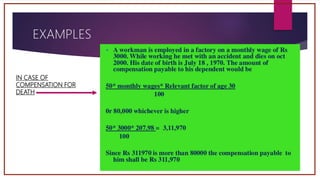
• In the case of Death Amount of compensation = 50% of monthly wages ×Relevant factor/Rs.80000
which ever is more..
• Permanent Total Disablement Amount of compensation = 60% of monthly wages ×Relevant
factor/Rs.90000 which ever is more..
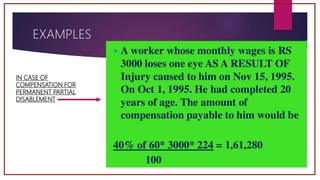
• Permanent Partial Disablement Amount of compensation = 60% of monthly wages ×Relevant
factor.
• Temporary Disablement Amount of compensation = 25% of monthly wages.
EXAMPLES
IN CASE OF
COMPENSATION FOR
DEATH
EXAMPLES
IN CASE OF
COMPENSATION FOR
PERMANENT PARTIAL
DISABLEMENT
Conclusion
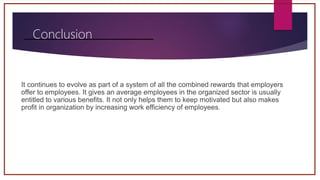
It continues to evolve as part of a system of all the combined rewards that employers
offer to employees. It gives an average employees in the organized sector is usually
entitled to various benefits. It not only helps them to keep motivated but also makes
profit in organization by increasing work efficiency of employees.
References
D. G. Collings and G. Wood, “Human Resource Management, a Critical Approach,” Routledge,
London, 2009.
D. Torrington, L. Hall and S. Taylor, “Human Resource Management,” 6th Edition, Financial Times
Prentice Hall, Harlow, 2005.
3. A. Mehlmann, “An Approach to Optimal Recruitment and Transition Strategies for Manpower
Systems Using Dynamic Programming,” Journal of the Operational Research Society, Vol. 31, No.
11, 1980, pp. 1009-1015.
4. R. Poornachandra, “A Dynamic Programming Approach to Determine Optimal Manpower
Recruitment Policies,” Journal of the Operational Research Society, Vol. 41, No. 10, 1990, pp. 983-
988.
Thank You

Workmen Compensation Act 1923

  • 1.
  • 2.
    INTRODUCTION The Workmen's CompensationAct, 1923 is one of the important social security legislations. It aims at providing financial protection to workmen and their dependants in case of accidental injury by means of payment of compensation by the employers. • There must be a casual connection between the injury/accident and the work done in the course of employment • The onus is upon the applicant to show that it was the work and the resulting strain which contributed to or aggravated the injury • It is not necessary that the workman must be actually working at the time of his death or that death must occur while he was working or had just ceased to work.
  • 3.
    OBJECTIVE The Workmen's Compensation Act,1923, aims to provide workmen and/or their dependents some relief in case of accidents arising out of and in the course of employment and causing either death or disablement of workmen.
  • 4.
    SCOPES & COVERAGE •The Act extends to the whole of India. • The workmen whose occupation is hazardous should be included within the scope of this Act. • It applies to workmen employed in factories, mines, plantations, transport establishments, construction work, railways, ships, circuses, & other hazardous occupations & employments specified in Schedule II to the Act. • The Act does not apply to members of Armed Forces of the Union & those workers who are insured under the Employees State Insurance Act 1948. • The coverage of this act is also to cooks employed in hotels and restaurants.
  • 5.
    CALCULATION OF COMPENSATION •In the case of Death Amount of compensation = 50% of monthly wages ×Relevant factor/Rs.80000 which ever is more.. • Permanent Total Disablement Amount of compensation = 60% of monthly wages ×Relevant factor/Rs.90000 which ever is more.. • Permanent Partial Disablement Amount of compensation = 60% of monthly wages ×Relevant factor. • Temporary Disablement Amount of compensation = 25% of monthly wages.
  • 6.
  • 7.
    EXAMPLES IN CASE OF COMPENSATIONFOR PERMANENT PARTIAL DISABLEMENT
  • 8.
    Conclusion It continues toevolve as part of a system of all the combined rewards that employers offer to employees. It gives an average employees in the organized sector is usually entitled to various benefits. It not only helps them to keep motivated but also makes profit in organization by increasing work efficiency of employees.
  • 9.
    References D. G. Collingsand G. Wood, “Human Resource Management, a Critical Approach,” Routledge, London, 2009. D. Torrington, L. Hall and S. Taylor, “Human Resource Management,” 6th Edition, Financial Times Prentice Hall, Harlow, 2005. 3. A. Mehlmann, “An Approach to Optimal Recruitment and Transition Strategies for Manpower Systems Using Dynamic Programming,” Journal of the Operational Research Society, Vol. 31, No. 11, 1980, pp. 1009-1015. 4. R. Poornachandra, “A Dynamic Programming Approach to Determine Optimal Manpower Recruitment Policies,” Journal of the Operational Research Society, Vol. 41, No. 10, 1990, pp. 983- 988.
  • 10.