WORKING WITH GROUPS
TOPİCS
• GROUP WORK
• GROUP WORK IN LARGE CLASSES
• TIPS HOW TO MANAGE GROUP WORK IN
LARGE CLASSES
The aim of group work is
• to produce better (more effective, more
detailed, more comprehensive) presentations
and reports. This is achieved through the
combined talents of group members,
contributing knowledge and ideas.
GROUP WORK
Groups vary depending on how they deal with
the following:
• Task in hand
• Organisation of the group
• The purpose of this site is to make you aware
of why you are doing work in groups and also
to help group processes run more effectively
Why do group work?
• Graduates with good team working skills are valued
highly by employers
• Group work promotes critical thinking by discussion
• Information is retained for longer than it would be if
working alone
• Group work enhances and develops the ability to
learn
• Many subjects are mastered trough dialogue and
discussion
How does it work?
• The informal setting facilities discussion and
interaction
• Critical thinking is promoted by the discussion,
clarification and evaluation of your own and
others ideas
• Good team-working skills such as the
production and sharing of ideas are stimulated
through real-world problems
How do we make sure our group
functions effectively?
Some issues that must be addressed in order for
a group to function effectively:
1. Aims and objectives
2. Allocation of Roles and Tasks
3. Conflict
4. Criticism
5. Responsibilities
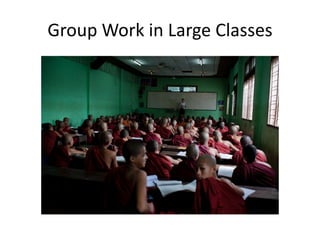
Group Work in Large Classes
Why are teachers worried about using small
group activities in large classes?
The reasons:
• Noisy classes and crowd control
• Students using the first language instead of
English
• Assesing students’ performance in the second
language
• Time constraints
Managing Large Classes
There are many problems with large
classes (40-75), including:
• Managing large classes requires good
planning, but teachers often don’t have time
for the kind of planning needed.
• Ts find it difficult to establish rapport with
students
• Ts find it difficult to monitor st work, so
learners may get little individual attention or
feedback to help them improve
and
• Proficiency and ability level vary a good deal
within the class. Weaker sts often get left
behind
• Maintaining control and providing effective
dicipline may be difficult
• Sts may get little opportunity for actual
language production and practice
Tips how to manage large classes
• Teach the class in groups of 15 to 20 instead of
trying to teach the whole class all at once
• Small groups of 5 to 7
• Establishing simple rules of acceptable
behavior
• Train all the pupils how to lead a group
• Have them sit aroun a circle
And also
• Sit the pupils who have more help closer to
you
• Group response to yes-no types of questions
• Train your pupils how to routinise classroom
chores
THANK YOU FOR
YOUR ATTENTION


Working with groups

  • 1.
  • 2.
    TOPİCS • GROUP WORK •GROUP WORK IN LARGE CLASSES • TIPS HOW TO MANAGE GROUP WORK IN LARGE CLASSES
  • 3.
    The aim ofgroup work is • to produce better (more effective, more detailed, more comprehensive) presentations and reports. This is achieved through the combined talents of group members, contributing knowledge and ideas.
  • 4.
    GROUP WORK Groups varydepending on how they deal with the following: • Task in hand • Organisation of the group • The purpose of this site is to make you aware of why you are doing work in groups and also to help group processes run more effectively
  • 5.
    Why do groupwork? • Graduates with good team working skills are valued highly by employers • Group work promotes critical thinking by discussion • Information is retained for longer than it would be if working alone • Group work enhances and develops the ability to learn • Many subjects are mastered trough dialogue and discussion
  • 6.
    How does itwork? • The informal setting facilities discussion and interaction • Critical thinking is promoted by the discussion, clarification and evaluation of your own and others ideas • Good team-working skills such as the production and sharing of ideas are stimulated through real-world problems
  • 7.
    How do wemake sure our group functions effectively? Some issues that must be addressed in order for a group to function effectively: 1. Aims and objectives 2. Allocation of Roles and Tasks 3. Conflict 4. Criticism 5. Responsibilities
  • 8.
    Group Work inLarge Classes
  • 9.
    Why are teachersworried about using small group activities in large classes?
  • 10.
    The reasons: • Noisyclasses and crowd control • Students using the first language instead of English • Assesing students’ performance in the second language • Time constraints
  • 11.
  • 12.
    There are manyproblems with large classes (40-75), including: • Managing large classes requires good planning, but teachers often don’t have time for the kind of planning needed. • Ts find it difficult to establish rapport with students • Ts find it difficult to monitor st work, so learners may get little individual attention or feedback to help them improve
  • 13.
    and • Proficiency andability level vary a good deal within the class. Weaker sts often get left behind • Maintaining control and providing effective dicipline may be difficult • Sts may get little opportunity for actual language production and practice
  • 14.
    Tips how tomanage large classes • Teach the class in groups of 15 to 20 instead of trying to teach the whole class all at once • Small groups of 5 to 7 • Establishing simple rules of acceptable behavior • Train all the pupils how to lead a group • Have them sit aroun a circle
  • 15.
    And also • Sitthe pupils who have more help closer to you • Group response to yes-no types of questions • Train your pupils how to routinise classroom chores
  • 16.
    THANK YOU FOR YOURATTENTION 