Working With Family Businesses:
What to Look For &
What to Look Out For
Presented by:
William (Chip) Valutis, PhD
thebusinesstherapist.com
Family-Owned Businesses
—  Impact on the U.S. Economy
—  Number more than 13 million
—  Produce over 60% of the GDP (Gross
Domestic Product)
—  80 - 90% of all proprietorships,
partnerships, private and public
corporations are family-owned or family-
influenced
—  Employ approximately 1/5 of the working
population (50 million people)
catalystconsultingpartners.com
Family-Owned Businesses (cont’d)
— Odds of successful succession:
— Average life span is 24 years
— 2 out of 3 FOBs fail to successfully pass
the business through to the 2nd generation
— Of those who succeed, 1 in 7 make it to the
3rd generation
— Of those, 1 in 10 make is past the 3rd
generation
— “From rags to riches to rags”
witzkeberry.com
Positive Characteristics of FOBs
t  Quality focus: pride, high service, high-quality
product or service
t  Paternalistic: good benefits, care for employees,
few layoffs, long tenure
t  Stability: long-term focus, care for employees,
few layoffs, stable work force
t  Family-like: feelings of community, commitment
and loyalty
t  Personal: owner/operator maintains close
relationship with employees; accessible to
questions or comments
Negative Characteristics of FOBs
t  Resistant: slow to change; suspicious of outsiders, new
ideas and/or new methods
t  Autocratic: owner/operator can be controlling,
dictatorial, secretive, and foster a dependent work force
t  Nepotism: may be too tolerant of inept family members
as managers; fail to find competent non-family
professionals
t  Dramatic: openly fight and argue (particularly during
periods of succession)
t  Confusing: lack clear division of structure, tasks and
accountabilities
t  Poorly managed: founder often has technical expertise
but little management experience
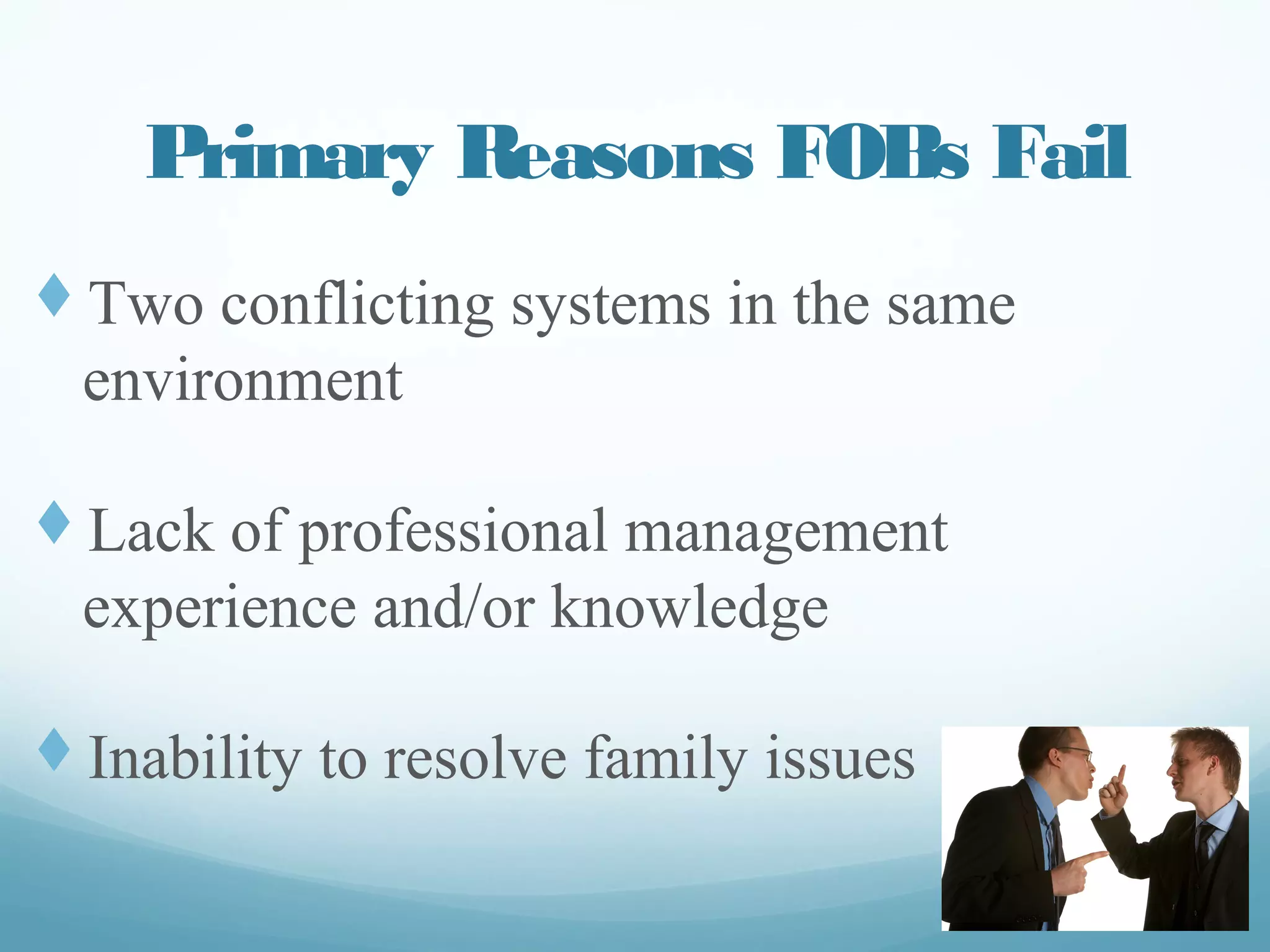
Primary Reasons FOBs Fail
t Two conflicting systems in the same
environment
t Lack of professional management
experience and/or knowledge
t Inability to resolve family issues
blog.grantham.edu
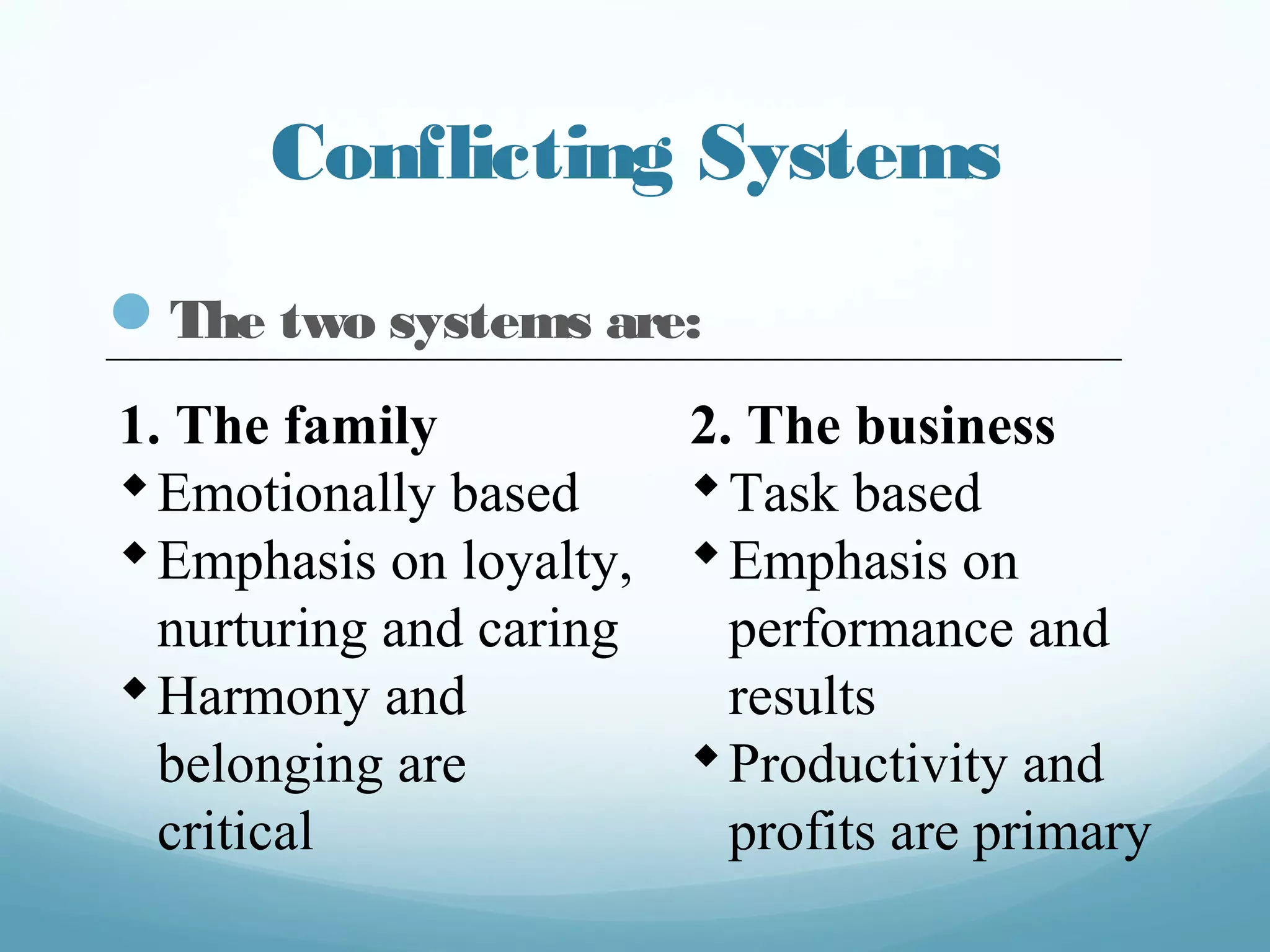
Conflicting Systems
— The two systems are:
1. The family
w Emotionally based
w Emphasis on
loyalty, nurturing
and caring
w Harmony and
belonging are
critical
2. The business
w Task based
w Emphasis on
performance and
results
w Productivity and
profits are primary
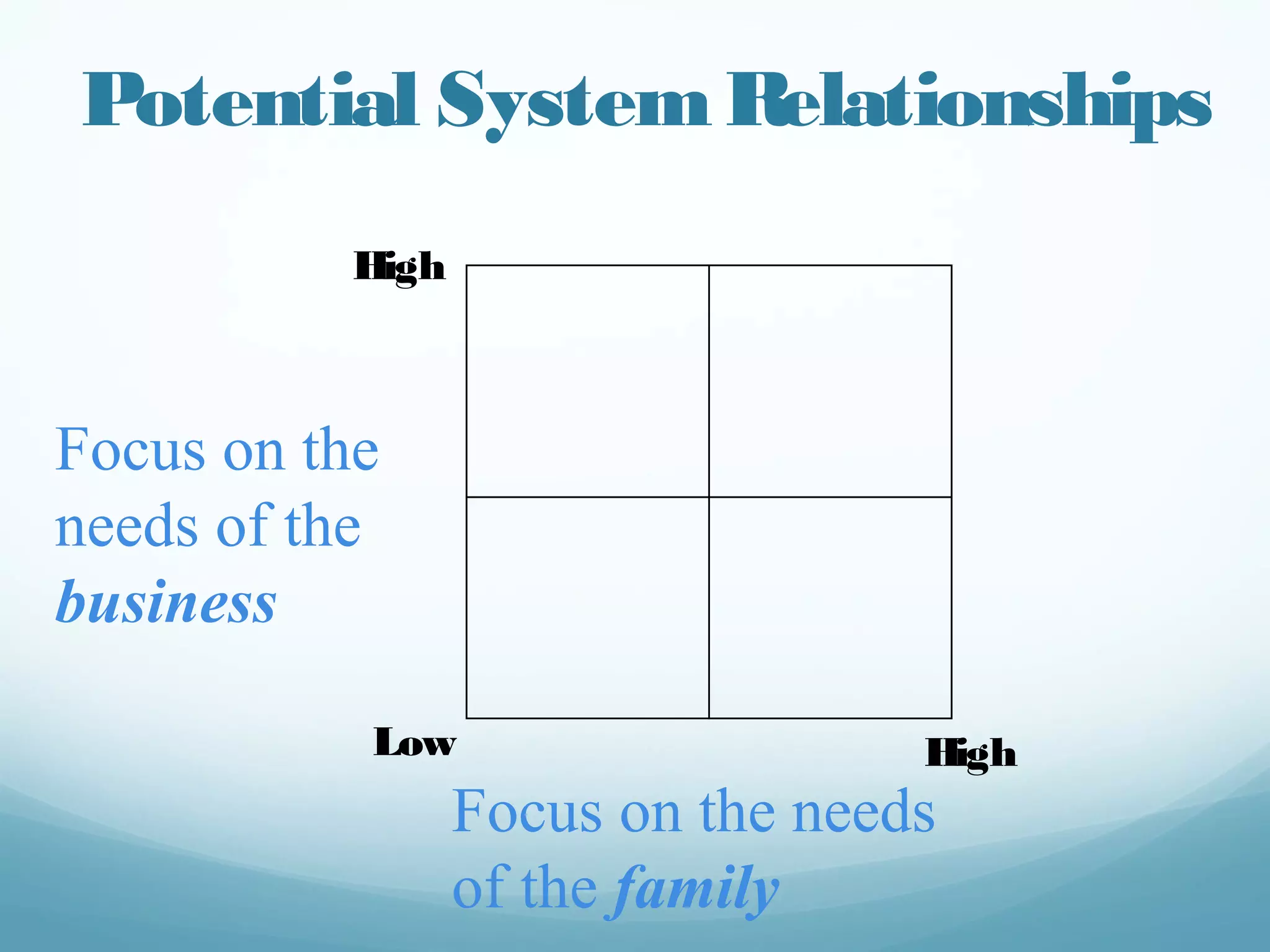
Potential System Relationships
High
Focus on the
needs of the
business
Low High
Focus on the needs
of the family
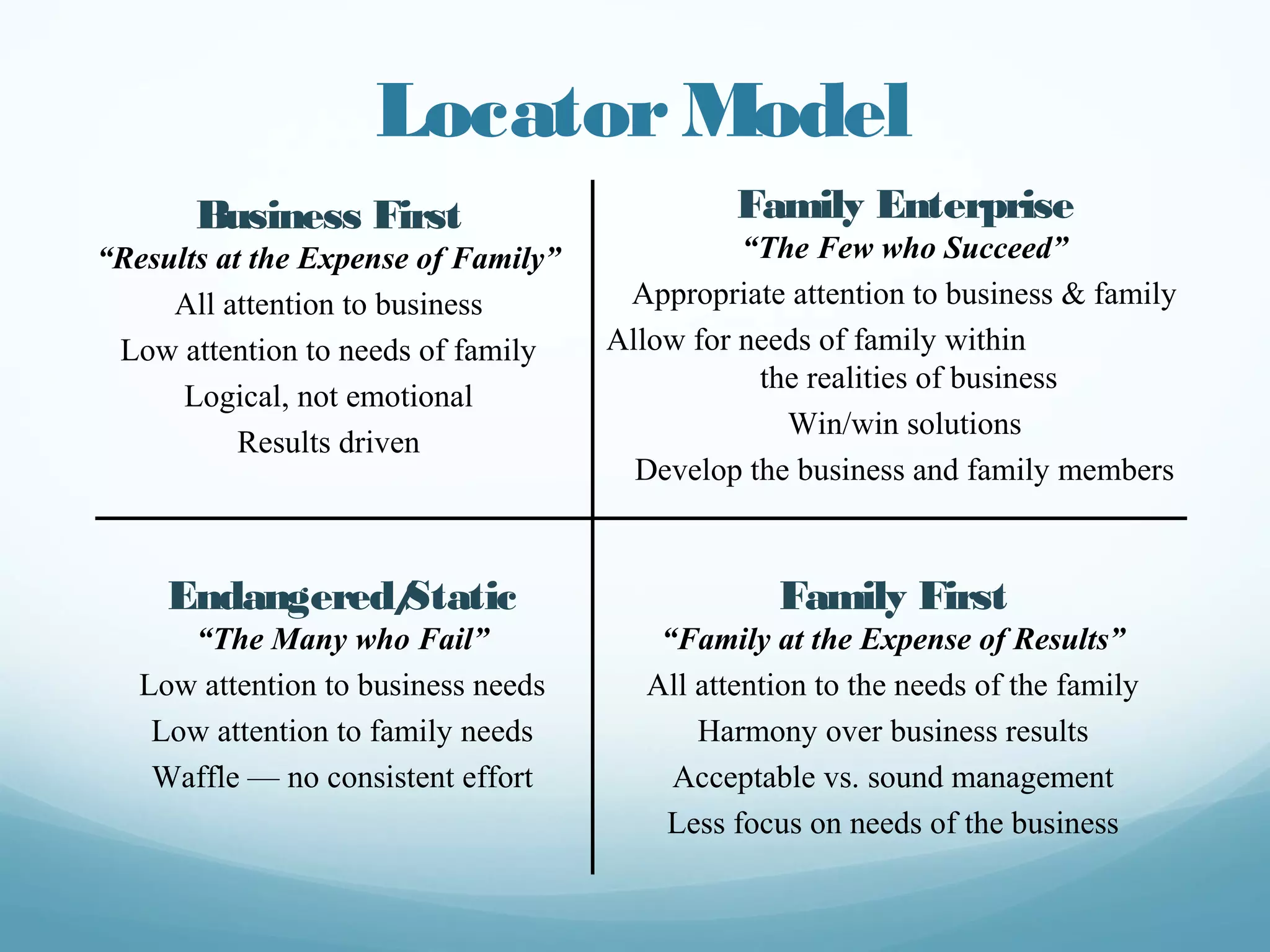
Endangered/Static
“The Many who Fail”
Low attention to business needs
Low attention to family needs
Waffle — no consistent effort
Family First
“Family at the Expense of Results”
All attention to the needs of the family
Harmony over business results
Acceptable vs. sound management
Less focus on needs of the business
Locator Model
Business First
“Results at the Expense of Family”
All attention to business
Low attention to needs of family
Logical, not emotional
Results driven
Family Enterprise
“The Few who Succeed”
Appropriate attention to business & family
Allow for needs of family within
the realities of business
Win/win solutions
Develop the business and family members
Critical Issues for FOBs
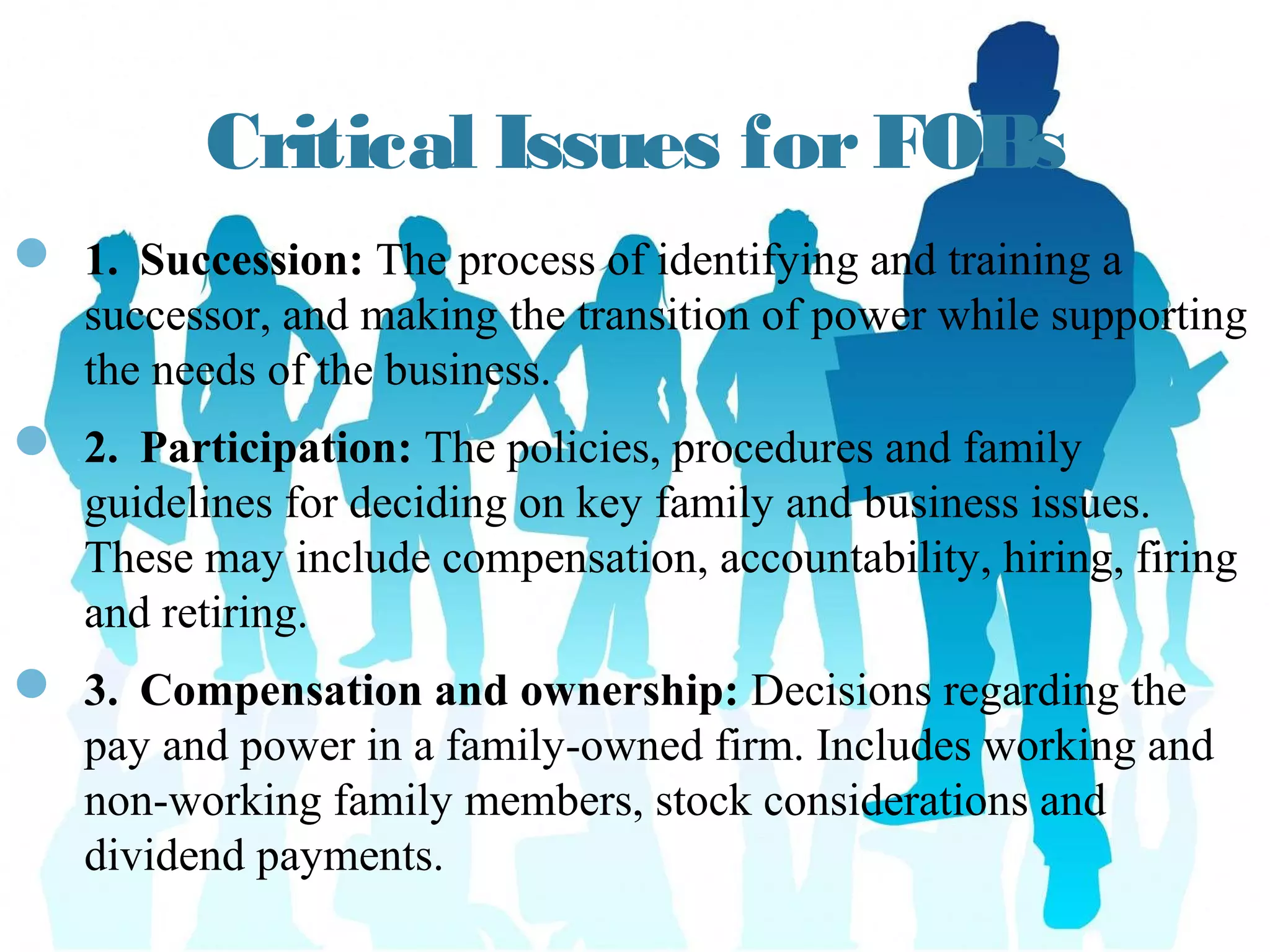
—  1. Succession: The process of identifying and
training a successor, and making the transition of
power while supporting the needs of the business.
—  2. Participation: The policies, procedures and family
guidelines for deciding on key family and business
issues. These may include compensation,
accountability, hiring, firing and retiring.
—  3. Compensation and ownership: Decisions regarding
the pay and power in a family-owned firm. Includes
working and non-working family members, stock
considerations and dividend payments.
myitforum.com
Critical Issues for FOBs (cont’d)
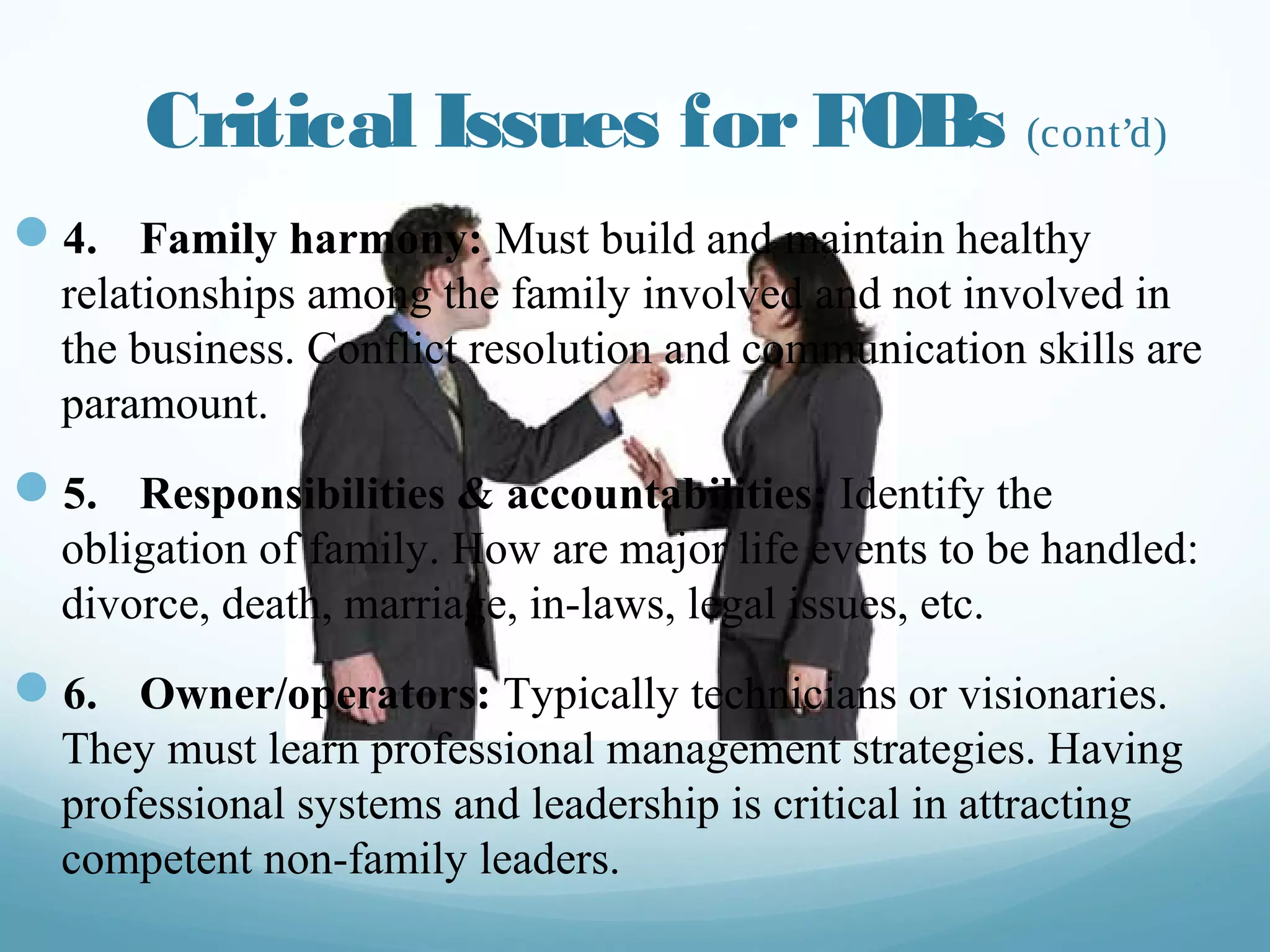
—  4. Family harmony: Must build and maintain healthy
relationships among the family involved and not involved
in the business. Conflict resolution and communication
skills are paramount.
—  5. Responsibilities & accountabilities: Identify the
obligation of family. How are major life events to be
handled: divorce, death, marriage, in-laws, legal issues,
etc.
—  6. Owner/operators: Typically technicians or visionaries.
They must learn professional management strategies.
Having professional systems and leadership is critical in
attracting competent non-family leaders.
couriermail.com.au
Strategies: What to Look For...
— The Business
1. Clear responsibilities and appropriate
authority
2. Accountability and consequences for
performance
3. Constructive contention
4. Sound decision making and problem solving
5. Professional but appropriate business
systems
6. Clear boundaries
Strategies: What to Look For...
— The Family
1. A common philosophy
2. Family councils and creed
3. Open communication and ability to resolve conflict
4. Support and encouragement
5. Non-family mentoring
6. Outside experience
What to Look Out For...
— 1. Secrets
— 2. Triangulation
— 3. Chronic conflict
— 4. Monarchs dreamstime.com
What to Look Out For... (cont’d)
— 5. Isolation
— 6. “Stuffing”
— 7. Mystery guests
— 8. Family dynamics
www.thrillist.com
Recommendations for
Helping FOBs
—  Here and Now vs. There and Then
—  Visionary vs. Pathology
—  Learning Environment vs. Evaluative Environments
—  Self-Focus vs. Other Focus
Keys to Success
t  Is there a common goal toward
which they can work?
t  What criteria should be used in
decision making and problem
solving?
t  How to balance the needs of the
business with the needs of the
owner?
Help Pick a Common Philosophy
Keys to Success
t  Identify the different roles
t  Define expectations for each
t  Keep appropriate roles in the
interactions; monitor
t  Remember your roles and
boundaries as well
Clarify Roles & Boundaries
Keys to Success
t  Candor builds respect
t  Be a reality test - call it the way you see it
t  Talk about what no one else will talk about
t  Don’t be “yes men” advisors
Challenge & Deliver Bad News
(when needed)
Keys to Success
t  Know your limits
t  Build a network of trusted advisors to
help with clients
t  Communicate with the other
professionals involved
t  Ensure no one is working at cross
purposes
Encourage Multi-Discipline
Interactions

Working With Family-Owned Businesses

  • 1.
    Working With FamilyBusinesses: What to Look For & What to Look Out For Presented by: William (Chip) Valutis, PhD thebusinesstherapist.com
  • 2.
    Family-Owned Businesses —  Impacton the U.S. Economy —  Number more than 13 million —  Produce over 60% of the GDP (Gross Domestic Product) —  80 - 90% of all proprietorships, partnerships, private and public corporations are family-owned or family- influenced —  Employ approximately 1/5 of the working population (50 million people) catalystconsultingpartners.com
  • 3.
    Family-Owned Businesses (cont’d) — Oddsof successful succession: — Average life span is 24 years — 2 out of 3 FOBs fail to successfully pass the business through to the 2nd generation — Of those who succeed, 1 in 7 make it to the 3rd generation — Of those, 1 in 10 make is past the 3rd generation — “From rags to riches to rags” witzkeberry.com
  • 4.
    Positive Characteristics ofFOBs t  Quality focus: pride, high service, high-quality product or service t  Paternalistic: good benefits, care for employees, few layoffs, long tenure t  Stability: long-term focus, care for employees, few layoffs, stable work force t  Family-like: feelings of community, commitment and loyalty t  Personal: owner/operator maintains close relationship with employees; accessible to questions or comments
  • 5.
    Negative Characteristics ofFOBs t  Resistant: slow to change; suspicious of outsiders, new ideas and/or new methods t  Autocratic: owner/operator can be controlling, dictatorial, secretive, and foster a dependent work force t  Nepotism: may be too tolerant of inept family members as managers; fail to find competent non-family professionals t  Dramatic: openly fight and argue (particularly during periods of succession) t  Confusing: lack clear division of structure, tasks and accountabilities t  Poorly managed: founder often has technical expertise but little management experience
  • 6.
    Primary Reasons FOBsFail t Two conflicting systems in the same environment t Lack of professional management experience and/or knowledge t Inability to resolve family issues blog.grantham.edu
  • 7.
    Conflicting Systems — The twosystems are: 1. The family w Emotionally based w Emphasis on loyalty, nurturing and caring w Harmony and belonging are critical 2. The business w Task based w Emphasis on performance and results w Productivity and profits are primary
  • 8.
    Potential System Relationships High Focuson the needs of the business Low High Focus on the needs of the family
  • 9.
    Endangered/Static “The Many whoFail” Low attention to business needs Low attention to family needs Waffle — no consistent effort Family First “Family at the Expense of Results” All attention to the needs of the family Harmony over business results Acceptable vs. sound management Less focus on needs of the business Locator Model Business First “Results at the Expense of Family” All attention to business Low attention to needs of family Logical, not emotional Results driven Family Enterprise “The Few who Succeed” Appropriate attention to business & family Allow for needs of family within the realities of business Win/win solutions Develop the business and family members
  • 10.
    Critical Issues forFOBs —  1. Succession: The process of identifying and training a successor, and making the transition of power while supporting the needs of the business. —  2. Participation: The policies, procedures and family guidelines for deciding on key family and business issues. These may include compensation, accountability, hiring, firing and retiring. —  3. Compensation and ownership: Decisions regarding the pay and power in a family-owned firm. Includes working and non-working family members, stock considerations and dividend payments. myitforum.com
  • 11.
    Critical Issues forFOBs (cont’d) —  4. Family harmony: Must build and maintain healthy relationships among the family involved and not involved in the business. Conflict resolution and communication skills are paramount. —  5. Responsibilities & accountabilities: Identify the obligation of family. How are major life events to be handled: divorce, death, marriage, in-laws, legal issues, etc. —  6. Owner/operators: Typically technicians or visionaries. They must learn professional management strategies. Having professional systems and leadership is critical in attracting competent non-family leaders. couriermail.com.au
  • 12.
    Strategies: What toLook For... — The Business 1. Clear responsibilities and appropriate authority 2. Accountability and consequences for performance 3. Constructive contention 4. Sound decision making and problem solving 5. Professional but appropriate business systems 6. Clear boundaries
  • 13.
    Strategies: What toLook For... — The Family 1. A common philosophy 2. Family councils and creed 3. Open communication and ability to resolve conflict 4. Support and encouragement 5. Non-family mentoring 6. Outside experience
  • 14.
    What to LookOut For... — 1. Secrets — 2. Triangulation — 3. Chronic conflict — 4. Monarchs dreamstime.com
  • 15.
    What to LookOut For... (cont’d) — 5. Isolation — 6. “Stuffing” — 7. Mystery guests — 8. Family dynamics www.thrillist.com
  • 16.
    Recommendations for Helping FOBs — Here and Now vs. There and Then —  Visionary vs. Pathology —  Learning Environment vs. Evaluative Environments —  Self-Focus vs. Other Focus
  • 17.
    Keys to Success t Is there a common goal toward which they can work? t  What criteria should be used in decision making and problem solving? t  How to balance the needs of the business with the needs of the owner? Help Pick a Common Philosophy
  • 18.
    Keys to Success t Identify the different roles t  Define expectations for each t  Keep appropriate roles in the interactions; monitor t  Remember your roles and boundaries as well Clarify Roles & Boundaries
  • 19.
    Keys to Success t Candor builds respect t  Be a reality test - call it the way you see it t  Talk about what no one else will talk about t  Don’t be “yes men” advisors Challenge & Deliver Bad News (when needed)
  • 20.
    Keys to Success t Know your limits t  Build a network of trusted advisors to help with clients t  Communicate with the other professionals involved t  Ensure no one is working at cross purposes Encourage Multi-Discipline Interactions