Working with Clients
         Phil Berenz
Technical Knowledge
      This comes easily for most of us.
      We can improve our technical skills
      whenever we want to. And even a
      difficult client can’t take our
      technical abilities away.
Communication
     This can be harder. Different people
     require us to use different
     communication skills. And a difficult
     person can make you temporarily lose
     the skills you have!
The Great Divide
You like computers and feel
comfortable with them. Our
average client does not.
      Learning to bridge this gap is key to
      providing an exceptional experience
      for each client.
                Translating and communicating your
                technical know-how to the client is
                one of the biggest challenges.
                   Example: TCP/IP - USPS
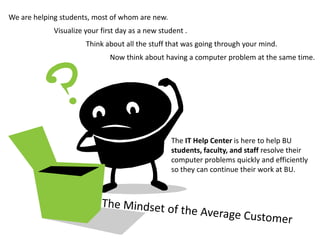
We are helping students, most of whom are new.
             Visualize your first day as a new student .
                       Think about all the stuff that was going through your mind.
                               Now think about having a computer problem at the same time.


                                                  The IT Help Center is here to help BU
                                                  students, faculty, and staff resolve their
                                                  computer problems quickly and efficiently
                                                  so they can continue their work at BU.
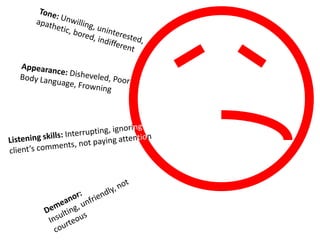
Mindset of the Average Customer
Before they even sit down with you.
Bad Customer Service
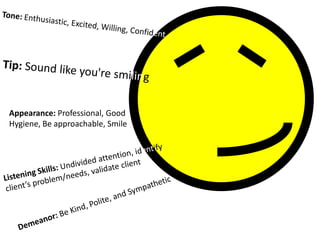
Appearance: Professional, Good
Hygiene, Be approachable, Smile
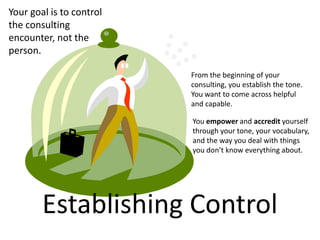
Your goal is to control
the consulting
encounter, not the
person.

                          From the beginning of your
                          consulting, you establish the tone.
                          You want to come across helpful
                          and capable.

                          You empower and accredit yourself
                          through your tone, your vocabulary,
                          and the way you deal with things
                          you don’t know everything about.


        Establishing Control
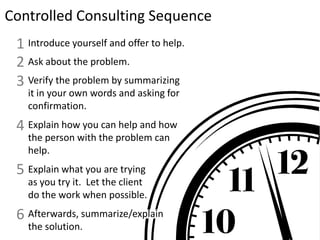
Controlled Consulting Sequence
 1 Introduce yourself and offer to help.
 2 Ask about the problem.
 3 Verify the problem by summarizing
   it in your own words and asking for
   confirmation.
 4 Explain how you can help and how
   the person with the problem can
   help.
 5 Explain what you are trying
   as you try it. Let the client
   do the work when possible.
 6 Afterwards, summarize/explain
   the solution.
Good Customer Service
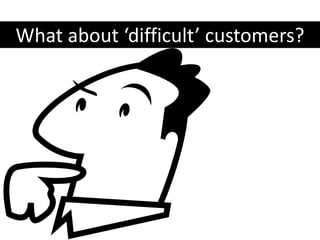
What about ‘difficult’ customers?
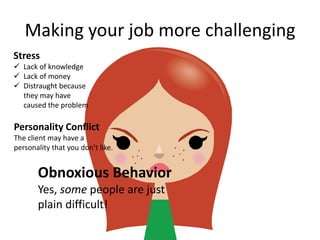
Making your job more challenging
Stress
 Lack of knowledge
 Lack of money
 Distraught because
  they may have
  caused the problem

Personality Conflict
The client may have a
personality that you don’t like.


       Obnoxious Behavior
       Yes, some people are just
       plain difficult!
Difficult Customers
Blackbelt Customer Service
Exceptional Customer Service
(stick to the basics)
      This instantly diffuses the client.
      Never ignore the client’s problem.
      Understand where they are coming
        from.

Ask for help when you need it.
      Don’t wait until it’s too late.
      Senior staff are always available
        to help.

  Keep your cool.
  What would you want to hear?
Keeping your Cool

                                     If something or someone really stressed you
                                     out or upset you – tell one of the staff.

    Don’t over-do it. If other things in your life are
    making you too anxious to work well, talk to
    your managers so we can figure out a way to
    reduce your work stress.


                          Keep learning – The more you
                          learn, the more relaxed you will feel.
Conclusion

Working with Clients

  • 1.
  • 3.
    Technical Knowledge This comes easily for most of us. We can improve our technical skills whenever we want to. And even a difficult client can’t take our technical abilities away.
  • 4.
    Communication This can be harder. Different people require us to use different communication skills. And a difficult person can make you temporarily lose the skills you have!
  • 5.
    The Great Divide Youlike computers and feel comfortable with them. Our average client does not. Learning to bridge this gap is key to providing an exceptional experience for each client. Translating and communicating your technical know-how to the client is one of the biggest challenges. Example: TCP/IP - USPS
  • 6.
    We are helpingstudents, most of whom are new. Visualize your first day as a new student . Think about all the stuff that was going through your mind. Now think about having a computer problem at the same time. The IT Help Center is here to help BU students, faculty, and staff resolve their computer problems quickly and efficiently so they can continue their work at BU.
  • 7.
    Mindset of theAverage Customer Before they even sit down with you.
  • 9.
  • 10.
  • 11.
    Your goal isto control the consulting encounter, not the person. From the beginning of your consulting, you establish the tone. You want to come across helpful and capable. You empower and accredit yourself through your tone, your vocabulary, and the way you deal with things you don’t know everything about. Establishing Control
  • 12.
    Controlled Consulting Sequence 1 Introduce yourself and offer to help. 2 Ask about the problem. 3 Verify the problem by summarizing it in your own words and asking for confirmation. 4 Explain how you can help and how the person with the problem can help. 5 Explain what you are trying as you try it. Let the client do the work when possible. 6 Afterwards, summarize/explain the solution.
  • 13.
  • 14.
  • 15.
    Making your jobmore challenging Stress  Lack of knowledge  Lack of money  Distraught because they may have caused the problem Personality Conflict The client may have a personality that you don’t like. Obnoxious Behavior Yes, some people are just plain difficult!
  • 16.
  • 17.
    Blackbelt Customer Service ExceptionalCustomer Service (stick to the basics)  This instantly diffuses the client.  Never ignore the client’s problem.  Understand where they are coming from. Ask for help when you need it.  Don’t wait until it’s too late.  Senior staff are always available to help. Keep your cool. What would you want to hear?
  • 18.
    Keeping your Cool If something or someone really stressed you out or upset you – tell one of the staff. Don’t over-do it. If other things in your life are making you too anxious to work well, talk to your managers so we can figure out a way to reduce your work stress. Keep learning – The more you learn, the more relaxed you will feel.
  • 19.

Editor's Notes

  • #2 Welcome, how is everyone doing? My name is Phil Berenz and I am one of the CSS staff at the BU IT Help Center.Today I am going to be discussing how to work with clients, the do’s and don’t when working with clients, some of the challenges you will face. This PowerPoint will give you the vital information for you need to succeed in every client interaction that you part take in.
  • #3 This will be a quick introduction which will touch upon some key points when working with clients.Then we are going to take a journey into the mindset of the average client.Next we will discuss what is considered bad customer service. The things you should not do while working with clients and why this behavior will make your job more challenging. Once you’ve seen the ugly side of customer service, I will discuss what you should do.It is inevitable that you may encounter a “difficult” client or two so we will discuss how you should handle these encountersLastly, we will discuss briefly on how it is important to deal with your own stress.
  • #4 As Linda mentioned in her PowerPoint, we as a group are providing technical services to Boston University students and staff. We consult over the phone, e-mail, and face to face.Our value is based upon our technical know-how and it is our job to use this knowledge to help students and staff with their computer questions and issues. Once you know how to install Office, this is something no other individual can take away from you.
  • #5 Our technical knowledge is useless if we are not able to know communicate and translate it properly to the client.
  • #7 When working with clients, it is good to practice compassion and sympathy. Compassion and sympathy are great tools when working with any clientA great technique is to visualize yourself in their place. I’d like for all of you to take a moment and visualize your first day. Think about all of the things that were going through your head.