WORKING OF TOUCHSCREENS
AND LATEST ADVANCEMENTS
KAUSHIK BARO
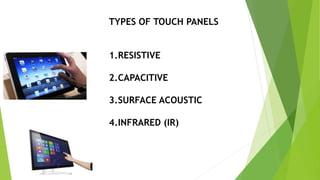
TYPES OF TOUCH PANELS
1.RESISTIVE
2.CAPACITIVE
3.SURFACE ACOUSTIC
4.INFRARED (IR)
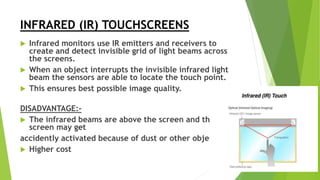
INFRARED (IR) TOUCHSCREENS
 Infrared monitors use IR emitters and receivers to
create and detect invisible grid of light beams across
the screens.
 When an object interrupts the invisible infrared light
beam the sensors are able to locate the touch point.
 This ensures best possible image quality.
DISADVANTAGE:-
 The infrared beams are above the screen and the
screen may get
accidently activated because of dust or other object.
 Higher cost
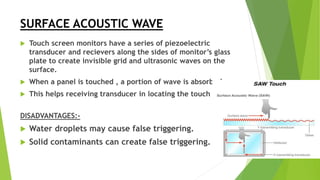
SURFACE ACOUSTIC WAVE
 Touch screen monitors have a series of piezoelectric
transducer and recievers along the sides of monitor’s glass
plate to create invisible grid and ultrasonic waves on the
surface.
 When a panel is touched , a portion of wave is absorbed .
 This helps receiving transducer in locating the touch point.
DISADVANTAGES:-
 Water droplets may cause false triggering.
 Solid contaminants can create false triggering.
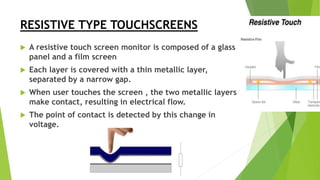
RESISTIVE TYPE TOUCHSCREENS
 A resistive touch screen monitor is composed of a glass
panel and a film screen
 Each layer is covered with a thin metallic layer,
separated by a narrow gap.
 When user touches the screen , the two metallic layers
make contact, resulting in electrical flow.
 The point of contact is detected by this change in
voltage.
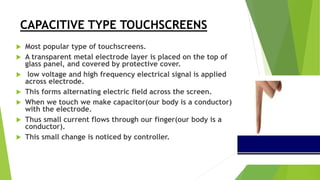
CAPACITIVE TYPE TOUCHSCREENS
 Most popular type of touchscreens.
 A transparent metal electrode layer is placed on the top of
glass panel, and covered by protective cover.
 low voltage and high frequency electrical signal is applied
across electrode.
 This forms alternating electric field across the screen.
 When we touch we make capacitor(our body is a conductor)
with the electrode.
 Thus small current flows through our finger(our body is a
conductor).
 This small change is noticed by controller.
Electrode Material Used
 Indium Tin oxide(ITO) is used as electrode(thin film).
 It is ceramic and hence brittle, but making it nano-meter level thin
gives it a bit of flexibility.
 Made by D.C Magnetron sputtering.
CHALLENGES:-
 ITO is becoming costly.
 Works well on glass.
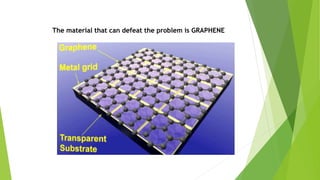
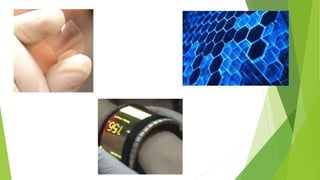
The material that can defeat the problem is GRAPHENE
CHALLENGES
• Mass production.
• Making of graphene sheet is costly(epitaxial growth
on SiC, CVD).
• Defects are unavoidable.
• Transfer of graphene sheet to other substrate is a
difficult process.(why can’t we grow on that substrate
itself? (misfit)).
• Metal act as catalyst in CVD, therefore insulators are
avoided.
THE END
THANK YOU !!

WORKING OF TOUCHSCREENS

  • 1.
    WORKING OF TOUCHSCREENS ANDLATEST ADVANCEMENTS KAUSHIK BARO
  • 2.
    TYPES OF TOUCHPANELS 1.RESISTIVE 2.CAPACITIVE 3.SURFACE ACOUSTIC 4.INFRARED (IR)
  • 3.
    INFRARED (IR) TOUCHSCREENS Infrared monitors use IR emitters and receivers to create and detect invisible grid of light beams across the screens.  When an object interrupts the invisible infrared light beam the sensors are able to locate the touch point.  This ensures best possible image quality. DISADVANTAGE:-  The infrared beams are above the screen and the screen may get accidently activated because of dust or other object.  Higher cost
  • 4.
    SURFACE ACOUSTIC WAVE Touch screen monitors have a series of piezoelectric transducer and recievers along the sides of monitor’s glass plate to create invisible grid and ultrasonic waves on the surface.  When a panel is touched , a portion of wave is absorbed .  This helps receiving transducer in locating the touch point. DISADVANTAGES:-  Water droplets may cause false triggering.  Solid contaminants can create false triggering.
  • 5.
    RESISTIVE TYPE TOUCHSCREENS A resistive touch screen monitor is composed of a glass panel and a film screen  Each layer is covered with a thin metallic layer, separated by a narrow gap.  When user touches the screen , the two metallic layers make contact, resulting in electrical flow.  The point of contact is detected by this change in voltage.
  • 6.
    CAPACITIVE TYPE TOUCHSCREENS Most popular type of touchscreens.  A transparent metal electrode layer is placed on the top of glass panel, and covered by protective cover.  low voltage and high frequency electrical signal is applied across electrode.  This forms alternating electric field across the screen.  When we touch we make capacitor(our body is a conductor) with the electrode.  Thus small current flows through our finger(our body is a conductor).  This small change is noticed by controller.
  • 7.
    Electrode Material Used Indium Tin oxide(ITO) is used as electrode(thin film).  It is ceramic and hence brittle, but making it nano-meter level thin gives it a bit of flexibility.  Made by D.C Magnetron sputtering. CHALLENGES:-  ITO is becoming costly.  Works well on glass.
  • 8.
    The material thatcan defeat the problem is GRAPHENE
  • 10.
    CHALLENGES • Mass production. •Making of graphene sheet is costly(epitaxial growth on SiC, CVD). • Defects are unavoidable. • Transfer of graphene sheet to other substrate is a difficult process.(why can’t we grow on that substrate itself? (misfit)). • Metal act as catalyst in CVD, therefore insulators are avoided. THE END
  • 11.