‭
RORBits - Top Ruby on Rails Development Company‬
‭
Is Ruby on Rails Object Oriented? A‬
‭
Comprehensive Exploration‬
‭
In the vast realm of programming languages and web development frameworks, Ruby‬
‭
on Rails has carved a niche for itself.‬
‭
While many developers praise its efficiency and versatility, one question looms large –‬
‭
Is Ruby on Rails truly object-oriented?‬
‭
In this comprehensive exploration, we will delve into the fundamentals of Ruby on‬
‭
Rails to uncover its object-oriented nature.‬
‭
Let’s Start!‬
‭
Defining Object-Oriented Programming‬
‭
Before we can dissect Ruby on Rails, let’s establish a solid understanding of‬
‭
Object-Oriented Programming.‬
‭
The OOP paradigm for programming is based on the idea of objects, which are‬
‭
instances of classes.‬
‭
Developers identified that as applications become large in size and complexity level,‬
‭
they generate difficulties to maintain. A small change in an application can easily‬
‭
develop errors in the entire program due to dependencies.‬
‭
Developers needed a solution for data that could be updated and manipulated without‬
‭
affecting the whole coding of the program.‬
‭
The solution of developing interdependence of data is to section off areas of code. And‬
‭
Object-Oriented Programming helps in that.‬
‭
OOP promotes the organization of code into discrete, reusable components, making it‬
‭
easier to develop and maintain complex software systems.‬
‭
Let’s know all the key principles on which Object-Oriented Programming Languages‬
‭
RORBits - Top Ruby on Rails Development Company‬
‭
works!‬
‭
Key Principles of OOP (Object-Oriented Programming)‬
‭
To determine if Ruby on Rails aligns with OOP principles, we need to grasp the key‬
‭
tenets of this programming paradigm:‬
‭
1. Encapsulation‬
‭
OOP encourages encapsulation, where data and methods that manipulate the data are‬
‭
bundled together into classes. This helps in hiding internal complexities and ensures‬
‭
clean interfaces.‬
‭
In simple terms we can say, Encapsulation is meant to hide functionality parts and‬
‭
make it disabled to the rest of the code base. It’s a type of data protection, due to the‬
‭
fact that data can’t be updated or manipulated without a clear purpose.‬
‭
It is what establishes the limits of your application and enables your code to grow‬
‭
more sophisticated. Like many other OO languages, Ruby achieves this goal by‬
‭
generating objects and making interfaces (i.e., methods) available for interacting with‬
‭
them.‬
‭
Another advantage of developing objects is that they permit developers to think on a‬
‭
new abstraction level. Objects can be given methods that define the behaviour the‬
‭
programmer is attempting to convey and are represented as real-world nouns.‬
‭
2. Inheritance‬
‭
Inheritance is a vital OOP concept. It allows new classes to be created based on‬
‭
existing classes, promoting code reuse and hierarchy.‬
‭
In Ruby, a class inherits the behaviours of another class, known as the‬‭
superclass‬
‭
,‬
‭
using the idea of inheritance. As a result, Ruby programmers now have the flexibility to‬
‭
create fundamental classes with high levels of reuse and smaller‬‭
subclasses‬‭
for more‬
‭
intricate, granular behaviours.‬
‭
RORBits - Top Ruby on Rails Development Company‬
‭
3. Polymorphism‬
‭
Polymorphism enables the same method or function to exhibit different behaviour‬
‭
based on the context in which it is used. This fosters flexibility and extensibility in code.‬
‭
For Example, As long as the argument has a move method that is compatible, we can‬
‭
provide any kind of argument to a method that invokes the move method on its‬
‭
argument. It’s possible that the object could symbolize a person, a cat, a jellyfish, or‬
‭
even a vehicle like a car or train. In other words, it enables objects of various types to‬
‭
react to the same method call.‬
‭
The prefix “poly” means “many,” and the suffix “morph” means “forms.” OOP allows us‬
‭
the freedom to use previously created code for brand-new uses.‬
‭
4. Abstraction‬
‭
Abstraction is about simplifying complex reality by modelling classes based on their‬
‭
essential features. It reduces complexity and focuses on the necessary details.‬
‭
Ruby on Rails: An Overview‬
‭
What is Ruby on Rails?‬
‭
An open-source web application framework created in the Ruby programming‬
‭
language is known as Rails or Ruby on Rails. Created by David Heinemeier Hansson in‬
‭
2004, Rails has gained immense popularity for its ease of use and rapid development‬
‭
capabilities.‬
‭
Rails is a full-stack framework and accessible in several operating systems like‬
‭
Windows, Mac OS X, and Linux. You can‬‭
install Ruby on Rails like a pro‬‭
with proper‬
‭
guidance and a few simple steps in your system. As Rails is an open source framework,‬
‭
you can access all its features.‬
‭
This framework follows the model-view-controller (MVC) architecture and it has a‬
‭
large community of core features for frontend and backend requirements.‬
‭
Ruby on Rails is known as developers’ choice because it is built on a set of predefined‬
‭
RORBits - Top Ruby on Rails Development Company‬
‭
patterns and libraries which quickly implement various functionality like email sending‬
‭
or data reading from SQL databases.‬
‭
For instance, Active Record is implemented by Rails as an object–relational mapper‬
‭
(ORM) pattern that allows programmers to interact with databases by using Ruby‬
‭
objects.‬
‭
Active Record in Ruby on Rails is a core part of MVC architecture, and it’s responsible‬
‭
for managing Model behaviour. For example, Ruby on Rails Active Record works on‬
‭
four operations: Create, Read, Update, and Delete.‬
‭
One more Rails functionality is known as app preloader usually called Spring. It‬
‭
assures that programmers can perform modifications and necessary updates to the‬
‭
app and can see the changes without starting background processes.‬
‭
Developers also extend the framework with Ruby gems (managed by Bundler) in Ruby‬
‭
on Rails web development. A Gemfile file, which specifies the download source and‬
‭
the particular Ruby gems for the application, can be used to set up Bundler.‬
‭
What Is The Major Use Of Ruby on Rails?‬
‭
Ruby is a flexible programming language utilized in numerous branches of the‬
‭
software industry. The most notable Ruby use cases are listed below.‬
‭
Web Development‬
‭
Ruby’s popularity as a programming language is largely due to the Ruby on Rails‬
‭
framework, which transformed web development. Before the Rails framework‬
‭
appeared in 2005, programmers wasted too much time developing boilerplate code‬
‭
that was the same everywhere.‬
‭
Due to its inclusion of all the tools a developer needs to create a scalable website, the‬
‭
Rails framework altered this. You can provide a straightforward command to create‬
‭
boilerplate code, a database model, or a suitable file structure.‬
‭
These kinds of automations free developers from performing time-consuming,‬
‭
low-value tasks so they can concentrate more on writing the logic of a web app.‬
‭
RORBits - Top Ruby on Rails Development Company‬
‭
Static Site Generation‬
‭
The website employs server-side code to create the HTML content it serves to your‬
‭
browser when you visit a regular web page. This indicates that the URL you visit has‬
‭
no HTML files attached.‬
‭
Typically, serving web files to clients using this form of HTML production is not the‬
‭
fastest method. Use a static website generator like Ruby-based Jekyll, one of the most‬
‭
well-liked static site generators, as it is more efficient.‬
‭
All of the web pages are created simultaneously by a static website generator using‬
‭
code. When you access the website, you will receive a static HTML file as a result of‬
‭
those pages living on a server.‬
‭
Websites are now effective, safe, and simple to launch because of this. A static website‬
‭
generator is perfect for websites with rarely changing content.‬
‭
Devops and Automation‬
‭
Ruby is a well-liked programming language for website deployment, automation, and‬
‭
DevOps.‬
‭
Think about the well-known Heroku web app deployment platform. Because it enables‬
‭
testing, deploying, and staging web apps without DevOps engineers, this platform has‬
‭
grown in popularity. Heroku used to exclusively support Ruby as a programming‬
‭
language.‬
‭
Ruby is also used to create the well-known virtual machine management program‬
‭
Vagrant. Developers can run software designed for one operating system on another‬
‭
using Vagrant. A developer might convert a Linux-only service into a Mac-compatible‬
‭
format, for instance.‬
‭
If you want to‬‭
Hire Ruby on Rails Developers‬‭
for better outcomes of your Rails project,‬
‭
then you should consider RORBits as your ROR development partner.‬
‭
RORBits - Top Ruby on Rails Development Company‬
‭
Web Services‬
‭
Web servers are frequently built using the popular programming language Ruby. Ruby‬
‭
is supported by the well-known web application servers Passenger and Puma. These‬
‭
web application servers handle HTTP requests, control workflows and resources, and‬
‭
enable troubleshooting and monitoring.‬
‭
Data Processing‬
‭
Because of its accessible syntax, Ruby is a fantastic language for data processing.‬
‭
Other strong built-in features of Ruby include select, reduce, and map. These features‬
‭
make it simple to process, clean, and filter data.‬
‭
Web Scraping‬
‭
Ruby includes packages like Vessel that make it simple to parse web data. You may‬
‭
easily create Ruby programs using Vessel that crawl and download web pages.‬
‭
You may then use Nokogiri, a well-liked Ruby library, to parse the scraped HTML‬
‭
information. With the help of this library, you can execute data analysis, such as‬
‭
creating a machine learning model based on crawled data, or prepare the collected‬
‭
data into new HTML or XML objects.‬
‭
Ruby – A Pure Object-Oriented Language‬
‭
Before we dive into Rails, it’s important to note that Ruby, the underlying programming‬
‭
language, is considered a pure object-oriented language. In Ruby, everything is an‬
‭
object, and it adheres strictly to OOP principles.‬
‭
Does Rails Follow Suit?‬
‭
Now, the critical question arises: Does Ruby on Rails, which is built on the Ruby‬
‭
language, maintain the same level of object-oriented purity?‬
‭
1. MVC Architecture‬
‭
Ruby on Rails adheres to the Model-View-Controller (MVC) architecture, a classic OOP‬
‭
pattern. Models represent data, views handle the presentation, and controllers manage‬
‭
RORBits - Top Ruby on Rails Development Company‬
‭
user interactions. This clear separation of concerns aligns with OOP’s principles of‬
‭
abstraction and encapsulation.‬
‭
2. ActiveRecord‬
‭
Rails employs ActiveRecord, an Object-Relational Mapping (ORM) system. It allows‬
‭
developers to interact with databases using objects instead of SQL queries. This‬
‭
approach encapsulates database logic within objects, making it a prime example of‬
‭
encapsulation in action.‬
‭
3. Gems and Modules‬
‭
Rails is enriched with an extensive library of gems and modules. These are‬
‭
self-contained, reusable code units that embody OOP’s core idea of code reusability.‬
‭
By adding gems, developers can extend the functionality of their applications with‬
‭
ease.‬
‭
To access all the features and benefits of Ruby on Rails framework in your Rails‬
‭
application, you can connect with any leading‬‭
Ruby on Rails Development Company‬
‭
like RORBits. They will give you full assistance as per your needs.‬
‭
Now, we will see key factors of Object-Oriented Programming Language with Ruby‬
‭
Programming.‬
‭
Classes and Objects in Ruby‬
‭
In Ruby Programming Language, Classes are defined as the ‘class’ keyword. Check out‬
‭
an example mentioned below:‬
‭
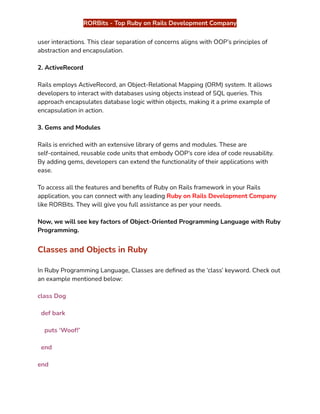
class Dog‬
‭
def bark‬
‭
puts ‘Woof!’‬
‭
end‬
‭
end‬
‭
RORBits - Top Ruby on Rails Development Company‬
‭
fido = Dog.new‬
‭
fido.bark # Outputs: ‘Woof!’‬
‭
In the above example,‬‭
‘‬
‭
Dog‬
‭
’‬‭
is defined as the class, and ‘‬
‭
fido‬
‭
’ is an object of that class.‬
‭
The ‘‬
‭
Dog‬
‭
’ class has a method called ‘‬
‭
bark‬
‭
’. When ‘fido.bark’ is called, it performs the‬
‭
‘bark’ method and outputs ‘‬
‭
Woof‬
‭
!’.‬
‭
Encapsulation in Ruby‬
‭
Ruby uses instance variables and methods to accomplish encapsulation. Instance‬
‭
variables can only be accessed from within the class and are specified with the ‘‬
‭
@‬
‭
’‬
‭
sign. Here is an illustration of Ruby encapsulation:‬
‭
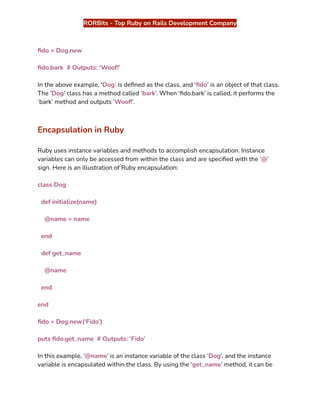
class Dog‬
‭
def initialize(name)‬
‭
@name = name‬
‭
end‬
‭
def get_name‬
‭
@name‬
‭
end‬
‭
end‬
‭
fido = Dog.new(‘Fido’)‬
‭
puts fido.get_name # Outputs: ‘Fido’‬
‭
In this example, ‘‬
‭
@name‬
‭
’ is an instance variable of the class ‘‬
‭
Dog‬
‭
’, and the instance‬
‭
variable is encapsulated within the class. By using the ‘‬
‭
get_name‬
‭
’ method, it can be‬
‭
RORBits - Top Ruby on Rails Development Company‬
‭
accessed.‬
‭
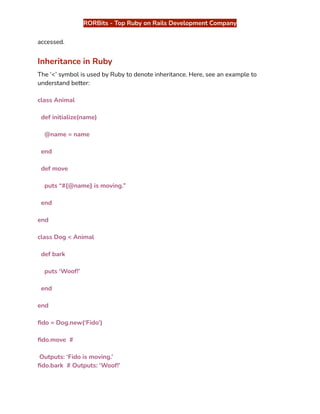
Inheritance in Ruby‬
‭
The ‘<’ symbol is used by Ruby to denote inheritance. Here, see an example to‬
‭
understand better:‬
‭
class Animal‬
‭
def initialize(name)‬
‭
@name = name‬
‭
end‬
‭
def move‬
‭
puts “#{@name} is moving.”‬
‭
end‬
‭
end‬
‭
class Dog < Animal‬
‭
def bark‬
‭
puts ‘Woof!’‬
‭
end‬
‭
end‬
‭
fido = Dog.new(‘Fido’)‬
‭
fido.move #‬
‭
Outputs: ‘Fido is moving.’‬
‭
fido.bark # Outputs: ‘Woof!’‬
‭
RORBits - Top Ruby on Rails Development Company‬
‭
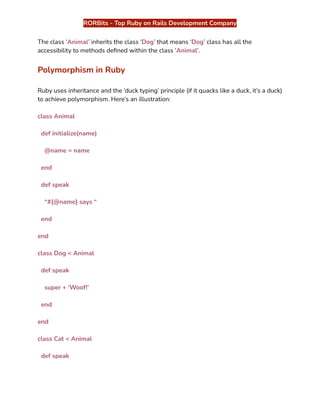
The class ‘‬
‭
Animal‬
‭
’ inherits the class ‘‬
‭
Dog‬
‭
’ that means ‘‬
‭
Dog‬
‭
’ class has all the‬
‭
accessibility to methods defined within the class ‘‬
‭
Animal’‬
‭
.‬
‭
Polymorphism in Ruby‬
‭
Ruby uses inheritance and the ‘duck typing’ principle (if it quacks like a duck, it’s a duck)‬
‭
to achieve polymorphism. Here’s an illustration:‬
‭
class Animal‬
‭
def initialize(name)‬
‭
@name = name‬
‭
end‬
‭
def speak‬
‭
“#{@name} says “‬
‭
end‬
‭
end‬
‭
class Dog < Animal‬
‭
def speak‬
‭
super + ‘Woof!’‬
‭
end‬
‭
end‬
‭
class Cat < Animal‬
‭
def speak‬
‭
RORBits - Top Ruby on Rails Development Company‬
‭
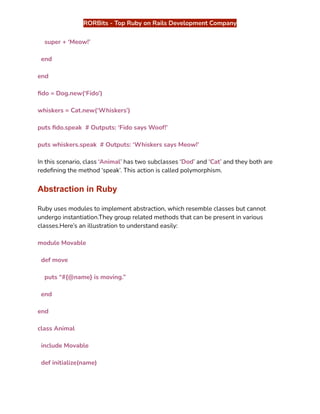
super + ‘Meow!’‬
‭
end‬
‭
end‬
‭
fido = Dog.new(‘Fido’)‬
‭
whiskers = Cat.new(‘Whiskers’)‬
‭
puts fido.speak # Outputs: ‘Fido says Woof!’‬
‭
puts whiskers.speak # Outputs: ‘Whiskers says Meow!’‬
‭
In this scenario, class‬‭
‘Animal‬
‭
’ has two subclasses ‘‬
‭
Dod‬
‭
’ and ‘‬
‭
Cat‬
‭
’ and they both are‬
‭
redefining the method ‘speak’. This action is called polymorphism.‬
‭
Abstraction in Ruby‬
‭
Ruby uses modules to implement abstraction, which resemble classes but cannot‬
‭
undergo instantiation.They group related methods that can be present in various‬
‭
classes.Here’s an illustration to understand easily:‬
‭
module Movable‬
‭
def move‬
‭
puts “#{@name} is moving.”‬
‭
end‬
‭
end‬
‭
class Animal‬
‭
include Movable‬
‭
def initialize(name)‬
‭
RORBits - Top Ruby on Rails Development Company‬
‭
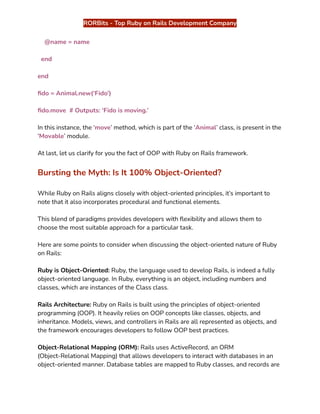
@name = name‬
‭
end‬
‭
end‬
‭
fido = Animal.new(‘Fido’)‬
‭
fido.move # Outputs: ‘Fido is moving.’‬
‭
In this instance, the ‘‬
‭
move‬
‭
’ method, which is part of the ‘‬
‭
Animal‬
‭
’ class, is present in the‬
‭
‘‬
‭
Movable‬
‭
’ module.‬
‭
At last, let us clarify for you the fact of OOP with Ruby on Rails framework.‬
‭
Bursting the Myth: Is It 100% Object-Oriented?‬
‭
While Ruby on Rails aligns closely with object-oriented principles, it’s important to‬
‭
note that it also incorporates procedural and functional elements.‬
‭
This blend of paradigms provides developers with flexibility and allows them to‬
‭
choose the most suitable approach for a particular task.‬
‭
Here are some points to consider when discussing the object-oriented nature of Ruby‬
‭
on Rails:‬
‭
Ruby is Object-Oriented:‬‭
Ruby, the language used to develop Rails, is indeed a fully‬
‭
object-oriented language. In Ruby, everything is an object, including numbers and‬
‭
classes, which are instances of the Class class.‬
‭
Rails Architecture:‬‭
Ruby on Rails is built using the principles of object-oriented‬
‭
programming (OOP). It heavily relies on OOP concepts like classes, objects, and‬
‭
inheritance. Models, views, and controllers in Rails are all represented as objects, and‬
‭
the framework encourages developers to follow OOP best practices.‬
‭
Object-Relational Mapping (ORM):‬‭
Rails uses ActiveRecord, an ORM‬
‭
(Object-Relational Mapping) that allows developers to interact with databases in an‬
‭
object-oriented manner. Database tables are mapped to Ruby classes, and records are‬
‭
RORBits - Top Ruby on Rails Development Company‬
‭
treated as objects, making it easier to work with relational data.‬
‭
Convention over Configuration:‬‭
Rails promotes the DRY (Don’t Repeat Yourself)‬
‭
principle and uses a convention-over-configuration approach. This encourages‬
‭
developers to structure their code in an object-oriented way by following Rails‬
‭
conventions, which reduces the need for redundant code.‬
‭
However, it’s important to acknowledge that not every aspect of a Rails application‬
‭
adheres strictly to object-oriented principles. Here are some factors that may challenge‬
‭
the idea of Rails being 100% object-oriented:‬
‭
SQL Queries:‬‭
While ActiveRecord abstracts away much of the database interaction,‬
‭
developers may still write SQL queries or use features like joins and aggregations that‬
‭
involve a more relational database approach.‬
‭
Third-Party Libraries‬
‭
: Rails applications often incorporate third-party libraries and‬
‭
gems that may not strictly follow object-oriented principles. These libraries could‬
‭
introduce non-OOP code into the application.‬
‭
Views:‬‭
Rails views, which deal with the presentation layer, may include elements like‬
‭
HTML, JavaScript, and CSS, which are not inherently object-oriented.‬
‭
Ruby on Rails is firmly rooted in object-oriented programming and encourages‬
‭
developers to follow OOP principles. However, it operates in a real-world ecosystem‬
‭
where some non-OOP elements, such as database queries and external libraries, may‬
‭
be necessary.‬
‭
You can describe Rails as primarily object-oriented, but external factors sometimes‬
‭
prevent it from being 100% object-oriented in practice.‬
‭
Conclusion‬
‭
In this comprehensive exploration, we’ve delved into the heart of Ruby on Rails and its‬
‭
adherence to object-oriented principles. Although not purely object-oriented, Rails‬
‭
captures the essence of OOP and combines it with other paradigms to create a flexible‬
‭
and efficient web development framework.‬
‭
So, the next time someone asks, “Is Ruby on Rails object-oriented?” you can‬
‭
confidently say that it merges the best of multiple worlds, providing a versatile and‬
‭
RORBits - Top Ruby on Rails Development Company‬
‭
powerful approach to web development.‬
‭
If you want to develop your app with Ruby on Rails and want great guidance to‬
‭
execute! Then you should connect with the‬‭
Ruby on Rails Consulting Services‬
‭
Provider like RORBits. They will support you and guide you throughout the‬
‭
development process.‬
‭
HAPPY RUBY ON RAILS!!!‬
‭
Source:‬‭
https://www.rorbits.com/is-ruby-on-rails-object-oriented/‬
‭
Visit us:‬
‭
239th street, Queens Country, New York 11426, USA‬
‭
Mail:‬‭
hello@rorbits.com‬ ‭
|‬ ‭
Contact no:‬‭
+1-347-708-0071‬

Is Ruby on Rails Object Oriented? A Comprehensive Exploration

  • 1.
    ‭ RORBits - TopRuby on Rails Development Company‬ ‭ Is Ruby on Rails Object Oriented? A‬ ‭ Comprehensive Exploration‬ ‭ In the vast realm of programming languages and web development frameworks, Ruby‬ ‭ on Rails has carved a niche for itself.‬ ‭ While many developers praise its efficiency and versatility, one question looms large –‬ ‭ Is Ruby on Rails truly object-oriented?‬ ‭ In this comprehensive exploration, we will delve into the fundamentals of Ruby on‬ ‭ Rails to uncover its object-oriented nature.‬ ‭ Let’s Start!‬ ‭ Defining Object-Oriented Programming‬ ‭ Before we can dissect Ruby on Rails, let’s establish a solid understanding of‬ ‭ Object-Oriented Programming.‬ ‭ The OOP paradigm for programming is based on the idea of objects, which are‬ ‭ instances of classes.‬ ‭ Developers identified that as applications become large in size and complexity level,‬ ‭ they generate difficulties to maintain. A small change in an application can easily‬ ‭ develop errors in the entire program due to dependencies.‬ ‭ Developers needed a solution for data that could be updated and manipulated without‬ ‭ affecting the whole coding of the program.‬ ‭ The solution of developing interdependence of data is to section off areas of code. And‬ ‭ Object-Oriented Programming helps in that.‬ ‭ OOP promotes the organization of code into discrete, reusable components, making it‬ ‭ easier to develop and maintain complex software systems.‬ ‭ Let’s know all the key principles on which Object-Oriented Programming Languages‬
  • 2.
    ‭ RORBits - TopRuby on Rails Development Company‬ ‭ works!‬ ‭ Key Principles of OOP (Object-Oriented Programming)‬ ‭ To determine if Ruby on Rails aligns with OOP principles, we need to grasp the key‬ ‭ tenets of this programming paradigm:‬ ‭ 1. Encapsulation‬ ‭ OOP encourages encapsulation, where data and methods that manipulate the data are‬ ‭ bundled together into classes. This helps in hiding internal complexities and ensures‬ ‭ clean interfaces.‬ ‭ In simple terms we can say, Encapsulation is meant to hide functionality parts and‬ ‭ make it disabled to the rest of the code base. It’s a type of data protection, due to the‬ ‭ fact that data can’t be updated or manipulated without a clear purpose.‬ ‭ It is what establishes the limits of your application and enables your code to grow‬ ‭ more sophisticated. Like many other OO languages, Ruby achieves this goal by‬ ‭ generating objects and making interfaces (i.e., methods) available for interacting with‬ ‭ them.‬ ‭ Another advantage of developing objects is that they permit developers to think on a‬ ‭ new abstraction level. Objects can be given methods that define the behaviour the‬ ‭ programmer is attempting to convey and are represented as real-world nouns.‬ ‭ 2. Inheritance‬ ‭ Inheritance is a vital OOP concept. It allows new classes to be created based on‬ ‭ existing classes, promoting code reuse and hierarchy.‬ ‭ In Ruby, a class inherits the behaviours of another class, known as the‬‭ superclass‬ ‭ ,‬ ‭ using the idea of inheritance. As a result, Ruby programmers now have the flexibility to‬ ‭ create fundamental classes with high levels of reuse and smaller‬‭ subclasses‬‭ for more‬ ‭ intricate, granular behaviours.‬
  • 3.
    ‭ RORBits - TopRuby on Rails Development Company‬ ‭ 3. Polymorphism‬ ‭ Polymorphism enables the same method or function to exhibit different behaviour‬ ‭ based on the context in which it is used. This fosters flexibility and extensibility in code.‬ ‭ For Example, As long as the argument has a move method that is compatible, we can‬ ‭ provide any kind of argument to a method that invokes the move method on its‬ ‭ argument. It’s possible that the object could symbolize a person, a cat, a jellyfish, or‬ ‭ even a vehicle like a car or train. In other words, it enables objects of various types to‬ ‭ react to the same method call.‬ ‭ The prefix “poly” means “many,” and the suffix “morph” means “forms.” OOP allows us‬ ‭ the freedom to use previously created code for brand-new uses.‬ ‭ 4. Abstraction‬ ‭ Abstraction is about simplifying complex reality by modelling classes based on their‬ ‭ essential features. It reduces complexity and focuses on the necessary details.‬ ‭ Ruby on Rails: An Overview‬ ‭ What is Ruby on Rails?‬ ‭ An open-source web application framework created in the Ruby programming‬ ‭ language is known as Rails or Ruby on Rails. Created by David Heinemeier Hansson in‬ ‭ 2004, Rails has gained immense popularity for its ease of use and rapid development‬ ‭ capabilities.‬ ‭ Rails is a full-stack framework and accessible in several operating systems like‬ ‭ Windows, Mac OS X, and Linux. You can‬‭ install Ruby on Rails like a pro‬‭ with proper‬ ‭ guidance and a few simple steps in your system. As Rails is an open source framework,‬ ‭ you can access all its features.‬ ‭ This framework follows the model-view-controller (MVC) architecture and it has a‬ ‭ large community of core features for frontend and backend requirements.‬ ‭ Ruby on Rails is known as developers’ choice because it is built on a set of predefined‬
  • 4.
    ‭ RORBits - TopRuby on Rails Development Company‬ ‭ patterns and libraries which quickly implement various functionality like email sending‬ ‭ or data reading from SQL databases.‬ ‭ For instance, Active Record is implemented by Rails as an object–relational mapper‬ ‭ (ORM) pattern that allows programmers to interact with databases by using Ruby‬ ‭ objects.‬ ‭ Active Record in Ruby on Rails is a core part of MVC architecture, and it’s responsible‬ ‭ for managing Model behaviour. For example, Ruby on Rails Active Record works on‬ ‭ four operations: Create, Read, Update, and Delete.‬ ‭ One more Rails functionality is known as app preloader usually called Spring. It‬ ‭ assures that programmers can perform modifications and necessary updates to the‬ ‭ app and can see the changes without starting background processes.‬ ‭ Developers also extend the framework with Ruby gems (managed by Bundler) in Ruby‬ ‭ on Rails web development. A Gemfile file, which specifies the download source and‬ ‭ the particular Ruby gems for the application, can be used to set up Bundler.‬ ‭ What Is The Major Use Of Ruby on Rails?‬ ‭ Ruby is a flexible programming language utilized in numerous branches of the‬ ‭ software industry. The most notable Ruby use cases are listed below.‬ ‭ Web Development‬ ‭ Ruby’s popularity as a programming language is largely due to the Ruby on Rails‬ ‭ framework, which transformed web development. Before the Rails framework‬ ‭ appeared in 2005, programmers wasted too much time developing boilerplate code‬ ‭ that was the same everywhere.‬ ‭ Due to its inclusion of all the tools a developer needs to create a scalable website, the‬ ‭ Rails framework altered this. You can provide a straightforward command to create‬ ‭ boilerplate code, a database model, or a suitable file structure.‬ ‭ These kinds of automations free developers from performing time-consuming,‬ ‭ low-value tasks so they can concentrate more on writing the logic of a web app.‬
  • 5.
    ‭ RORBits - TopRuby on Rails Development Company‬ ‭ Static Site Generation‬ ‭ The website employs server-side code to create the HTML content it serves to your‬ ‭ browser when you visit a regular web page. This indicates that the URL you visit has‬ ‭ no HTML files attached.‬ ‭ Typically, serving web files to clients using this form of HTML production is not the‬ ‭ fastest method. Use a static website generator like Ruby-based Jekyll, one of the most‬ ‭ well-liked static site generators, as it is more efficient.‬ ‭ All of the web pages are created simultaneously by a static website generator using‬ ‭ code. When you access the website, you will receive a static HTML file as a result of‬ ‭ those pages living on a server.‬ ‭ Websites are now effective, safe, and simple to launch because of this. A static website‬ ‭ generator is perfect for websites with rarely changing content.‬ ‭ Devops and Automation‬ ‭ Ruby is a well-liked programming language for website deployment, automation, and‬ ‭ DevOps.‬ ‭ Think about the well-known Heroku web app deployment platform. Because it enables‬ ‭ testing, deploying, and staging web apps without DevOps engineers, this platform has‬ ‭ grown in popularity. Heroku used to exclusively support Ruby as a programming‬ ‭ language.‬ ‭ Ruby is also used to create the well-known virtual machine management program‬ ‭ Vagrant. Developers can run software designed for one operating system on another‬ ‭ using Vagrant. A developer might convert a Linux-only service into a Mac-compatible‬ ‭ format, for instance.‬ ‭ If you want to‬‭ Hire Ruby on Rails Developers‬‭ for better outcomes of your Rails project,‬ ‭ then you should consider RORBits as your ROR development partner.‬
  • 6.
    ‭ RORBits - TopRuby on Rails Development Company‬ ‭ Web Services‬ ‭ Web servers are frequently built using the popular programming language Ruby. Ruby‬ ‭ is supported by the well-known web application servers Passenger and Puma. These‬ ‭ web application servers handle HTTP requests, control workflows and resources, and‬ ‭ enable troubleshooting and monitoring.‬ ‭ Data Processing‬ ‭ Because of its accessible syntax, Ruby is a fantastic language for data processing.‬ ‭ Other strong built-in features of Ruby include select, reduce, and map. These features‬ ‭ make it simple to process, clean, and filter data.‬ ‭ Web Scraping‬ ‭ Ruby includes packages like Vessel that make it simple to parse web data. You may‬ ‭ easily create Ruby programs using Vessel that crawl and download web pages.‬ ‭ You may then use Nokogiri, a well-liked Ruby library, to parse the scraped HTML‬ ‭ information. With the help of this library, you can execute data analysis, such as‬ ‭ creating a machine learning model based on crawled data, or prepare the collected‬ ‭ data into new HTML or XML objects.‬ ‭ Ruby – A Pure Object-Oriented Language‬ ‭ Before we dive into Rails, it’s important to note that Ruby, the underlying programming‬ ‭ language, is considered a pure object-oriented language. In Ruby, everything is an‬ ‭ object, and it adheres strictly to OOP principles.‬ ‭ Does Rails Follow Suit?‬ ‭ Now, the critical question arises: Does Ruby on Rails, which is built on the Ruby‬ ‭ language, maintain the same level of object-oriented purity?‬ ‭ 1. MVC Architecture‬ ‭ Ruby on Rails adheres to the Model-View-Controller (MVC) architecture, a classic OOP‬ ‭ pattern. Models represent data, views handle the presentation, and controllers manage‬
  • 7.
    ‭ RORBits - TopRuby on Rails Development Company‬ ‭ user interactions. This clear separation of concerns aligns with OOP’s principles of‬ ‭ abstraction and encapsulation.‬ ‭ 2. ActiveRecord‬ ‭ Rails employs ActiveRecord, an Object-Relational Mapping (ORM) system. It allows‬ ‭ developers to interact with databases using objects instead of SQL queries. This‬ ‭ approach encapsulates database logic within objects, making it a prime example of‬ ‭ encapsulation in action.‬ ‭ 3. Gems and Modules‬ ‭ Rails is enriched with an extensive library of gems and modules. These are‬ ‭ self-contained, reusable code units that embody OOP’s core idea of code reusability.‬ ‭ By adding gems, developers can extend the functionality of their applications with‬ ‭ ease.‬ ‭ To access all the features and benefits of Ruby on Rails framework in your Rails‬ ‭ application, you can connect with any leading‬‭ Ruby on Rails Development Company‬ ‭ like RORBits. They will give you full assistance as per your needs.‬ ‭ Now, we will see key factors of Object-Oriented Programming Language with Ruby‬ ‭ Programming.‬ ‭ Classes and Objects in Ruby‬ ‭ In Ruby Programming Language, Classes are defined as the ‘class’ keyword. Check out‬ ‭ an example mentioned below:‬ ‭ class Dog‬ ‭ def bark‬ ‭ puts ‘Woof!’‬ ‭ end‬ ‭ end‬
  • 8.
    ‭ RORBits - TopRuby on Rails Development Company‬ ‭ fido = Dog.new‬ ‭ fido.bark # Outputs: ‘Woof!’‬ ‭ In the above example,‬‭ ‘‬ ‭ Dog‬ ‭ ’‬‭ is defined as the class, and ‘‬ ‭ fido‬ ‭ ’ is an object of that class.‬ ‭ The ‘‬ ‭ Dog‬ ‭ ’ class has a method called ‘‬ ‭ bark‬ ‭ ’. When ‘fido.bark’ is called, it performs the‬ ‭ ‘bark’ method and outputs ‘‬ ‭ Woof‬ ‭ !’.‬ ‭ Encapsulation in Ruby‬ ‭ Ruby uses instance variables and methods to accomplish encapsulation. Instance‬ ‭ variables can only be accessed from within the class and are specified with the ‘‬ ‭ @‬ ‭ ’‬ ‭ sign. Here is an illustration of Ruby encapsulation:‬ ‭ class Dog‬ ‭ def initialize(name)‬ ‭ @name = name‬ ‭ end‬ ‭ def get_name‬ ‭ @name‬ ‭ end‬ ‭ end‬ ‭ fido = Dog.new(‘Fido’)‬ ‭ puts fido.get_name # Outputs: ‘Fido’‬ ‭ In this example, ‘‬ ‭ @name‬ ‭ ’ is an instance variable of the class ‘‬ ‭ Dog‬ ‭ ’, and the instance‬ ‭ variable is encapsulated within the class. By using the ‘‬ ‭ get_name‬ ‭ ’ method, it can be‬
  • 9.
    ‭ RORBits - TopRuby on Rails Development Company‬ ‭ accessed.‬ ‭ Inheritance in Ruby‬ ‭ The ‘<’ symbol is used by Ruby to denote inheritance. Here, see an example to‬ ‭ understand better:‬ ‭ class Animal‬ ‭ def initialize(name)‬ ‭ @name = name‬ ‭ end‬ ‭ def move‬ ‭ puts “#{@name} is moving.”‬ ‭ end‬ ‭ end‬ ‭ class Dog < Animal‬ ‭ def bark‬ ‭ puts ‘Woof!’‬ ‭ end‬ ‭ end‬ ‭ fido = Dog.new(‘Fido’)‬ ‭ fido.move #‬ ‭ Outputs: ‘Fido is moving.’‬ ‭ fido.bark # Outputs: ‘Woof!’‬
  • 10.
    ‭ RORBits - TopRuby on Rails Development Company‬ ‭ The class ‘‬ ‭ Animal‬ ‭ ’ inherits the class ‘‬ ‭ Dog‬ ‭ ’ that means ‘‬ ‭ Dog‬ ‭ ’ class has all the‬ ‭ accessibility to methods defined within the class ‘‬ ‭ Animal’‬ ‭ .‬ ‭ Polymorphism in Ruby‬ ‭ Ruby uses inheritance and the ‘duck typing’ principle (if it quacks like a duck, it’s a duck)‬ ‭ to achieve polymorphism. Here’s an illustration:‬ ‭ class Animal‬ ‭ def initialize(name)‬ ‭ @name = name‬ ‭ end‬ ‭ def speak‬ ‭ “#{@name} says “‬ ‭ end‬ ‭ end‬ ‭ class Dog < Animal‬ ‭ def speak‬ ‭ super + ‘Woof!’‬ ‭ end‬ ‭ end‬ ‭ class Cat < Animal‬ ‭ def speak‬
  • 11.
    ‭ RORBits - TopRuby on Rails Development Company‬ ‭ super + ‘Meow!’‬ ‭ end‬ ‭ end‬ ‭ fido = Dog.new(‘Fido’)‬ ‭ whiskers = Cat.new(‘Whiskers’)‬ ‭ puts fido.speak # Outputs: ‘Fido says Woof!’‬ ‭ puts whiskers.speak # Outputs: ‘Whiskers says Meow!’‬ ‭ In this scenario, class‬‭ ‘Animal‬ ‭ ’ has two subclasses ‘‬ ‭ Dod‬ ‭ ’ and ‘‬ ‭ Cat‬ ‭ ’ and they both are‬ ‭ redefining the method ‘speak’. This action is called polymorphism.‬ ‭ Abstraction in Ruby‬ ‭ Ruby uses modules to implement abstraction, which resemble classes but cannot‬ ‭ undergo instantiation.They group related methods that can be present in various‬ ‭ classes.Here’s an illustration to understand easily:‬ ‭ module Movable‬ ‭ def move‬ ‭ puts “#{@name} is moving.”‬ ‭ end‬ ‭ end‬ ‭ class Animal‬ ‭ include Movable‬ ‭ def initialize(name)‬
  • 12.
    ‭ RORBits - TopRuby on Rails Development Company‬ ‭ @name = name‬ ‭ end‬ ‭ end‬ ‭ fido = Animal.new(‘Fido’)‬ ‭ fido.move # Outputs: ‘Fido is moving.’‬ ‭ In this instance, the ‘‬ ‭ move‬ ‭ ’ method, which is part of the ‘‬ ‭ Animal‬ ‭ ’ class, is present in the‬ ‭ ‘‬ ‭ Movable‬ ‭ ’ module.‬ ‭ At last, let us clarify for you the fact of OOP with Ruby on Rails framework.‬ ‭ Bursting the Myth: Is It 100% Object-Oriented?‬ ‭ While Ruby on Rails aligns closely with object-oriented principles, it’s important to‬ ‭ note that it also incorporates procedural and functional elements.‬ ‭ This blend of paradigms provides developers with flexibility and allows them to‬ ‭ choose the most suitable approach for a particular task.‬ ‭ Here are some points to consider when discussing the object-oriented nature of Ruby‬ ‭ on Rails:‬ ‭ Ruby is Object-Oriented:‬‭ Ruby, the language used to develop Rails, is indeed a fully‬ ‭ object-oriented language. In Ruby, everything is an object, including numbers and‬ ‭ classes, which are instances of the Class class.‬ ‭ Rails Architecture:‬‭ Ruby on Rails is built using the principles of object-oriented‬ ‭ programming (OOP). It heavily relies on OOP concepts like classes, objects, and‬ ‭ inheritance. Models, views, and controllers in Rails are all represented as objects, and‬ ‭ the framework encourages developers to follow OOP best practices.‬ ‭ Object-Relational Mapping (ORM):‬‭ Rails uses ActiveRecord, an ORM‬ ‭ (Object-Relational Mapping) that allows developers to interact with databases in an‬ ‭ object-oriented manner. Database tables are mapped to Ruby classes, and records are‬
  • 13.
    ‭ RORBits - TopRuby on Rails Development Company‬ ‭ treated as objects, making it easier to work with relational data.‬ ‭ Convention over Configuration:‬‭ Rails promotes the DRY (Don’t Repeat Yourself)‬ ‭ principle and uses a convention-over-configuration approach. This encourages‬ ‭ developers to structure their code in an object-oriented way by following Rails‬ ‭ conventions, which reduces the need for redundant code.‬ ‭ However, it’s important to acknowledge that not every aspect of a Rails application‬ ‭ adheres strictly to object-oriented principles. Here are some factors that may challenge‬ ‭ the idea of Rails being 100% object-oriented:‬ ‭ SQL Queries:‬‭ While ActiveRecord abstracts away much of the database interaction,‬ ‭ developers may still write SQL queries or use features like joins and aggregations that‬ ‭ involve a more relational database approach.‬ ‭ Third-Party Libraries‬ ‭ : Rails applications often incorporate third-party libraries and‬ ‭ gems that may not strictly follow object-oriented principles. These libraries could‬ ‭ introduce non-OOP code into the application.‬ ‭ Views:‬‭ Rails views, which deal with the presentation layer, may include elements like‬ ‭ HTML, JavaScript, and CSS, which are not inherently object-oriented.‬ ‭ Ruby on Rails is firmly rooted in object-oriented programming and encourages‬ ‭ developers to follow OOP principles. However, it operates in a real-world ecosystem‬ ‭ where some non-OOP elements, such as database queries and external libraries, may‬ ‭ be necessary.‬ ‭ You can describe Rails as primarily object-oriented, but external factors sometimes‬ ‭ prevent it from being 100% object-oriented in practice.‬ ‭ Conclusion‬ ‭ In this comprehensive exploration, we’ve delved into the heart of Ruby on Rails and its‬ ‭ adherence to object-oriented principles. Although not purely object-oriented, Rails‬ ‭ captures the essence of OOP and combines it with other paradigms to create a flexible‬ ‭ and efficient web development framework.‬ ‭ So, the next time someone asks, “Is Ruby on Rails object-oriented?” you can‬ ‭ confidently say that it merges the best of multiple worlds, providing a versatile and‬
  • 14.
    ‭ RORBits - TopRuby on Rails Development Company‬ ‭ powerful approach to web development.‬ ‭ If you want to develop your app with Ruby on Rails and want great guidance to‬ ‭ execute! Then you should connect with the‬‭ Ruby on Rails Consulting Services‬ ‭ Provider like RORBits. They will support you and guide you throughout the‬ ‭ development process.‬ ‭ HAPPY RUBY ON RAILS!!!‬ ‭ Source:‬‭ https://www.rorbits.com/is-ruby-on-rails-object-oriented/‬ ‭ Visit us:‬ ‭ 239th street, Queens Country, New York 11426, USA‬ ‭ Mail:‬‭ hello@rorbits.com‬ ‭ |‬ ‭ Contact no:‬‭ +1-347-708-0071‬