openprof.euProject No. 2014-1-LT01-KA202-000562
Work based learning in the
context of diversity
Auxilium pro Regionibus
Europae in Rebus Culturalibus
(Auxilium)
Open Professional Collaboration
for Innovation
openprof.euProject No. 2014-1-LT01-KA202-000562
Work based learning
Mindmap
openprof.euProject No. 2014-1-LT01-KA202-000562
Work based learningGeneral
Competencies
Mindmap
openprof.euProject No. 2014-1-LT01-KA202-000562
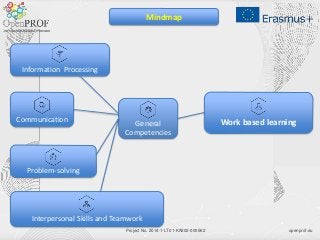
Work based learningGeneral
Competencies
Information Processing
Communication
Interpersonal Skills and Teamwork
Problem-solving
Mindmap
openprof.euProject No. 2014-1-LT01-KA202-000562
Work based learningGeneral
Competencies
Information Processing
Communication
Interpersonal Skills and Teamwork
Problem-solving
Mindmap
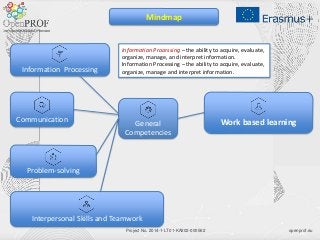
Information Processing – the ability to acquire, evaluate,
organize, manage, and interpret information.
Information Processing – the ability to acquire, evaluate,
organize, manage and interpret information.interpret
openprof.euProject No. 2014-1-LT01-KA202-000562
Work based learningGeneral
Competencies
Information Processing
Communication
Interpersonal Skills and Teamwork
Problem-solving
Mindmap
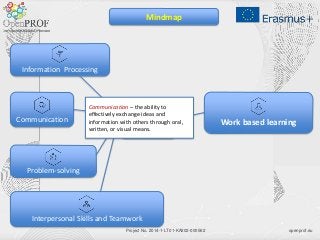
Communication – the ability to
effectively exchange ideas and
information with others through oral,
written, or visual means.
openprof.euProject No. 2014-1-LT01-KA202-000562
Work based learningGeneral
Competencies
Information Processing
Communication
Interpersonal Skills and Teamwork
Problem-solving
Mindmap
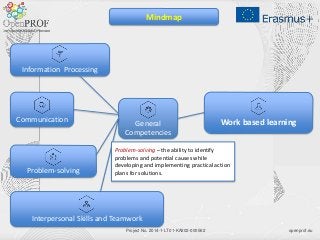
Problem-solving – the ability to identify
problems and potential causes while
developing and implementing practical action
plans for solutions.
openprof.euProject No. 2014-1-LT01-KA202-000562
Work based learningGeneral
Competencies
Information Processing
Communication
Interpersonal Skills and Teamwork
Problem-solving
Mindmap
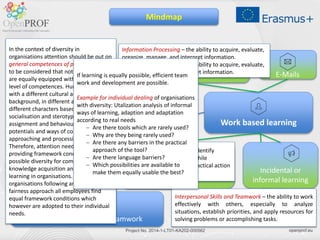
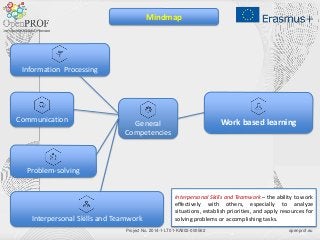
Interpersonal Skills and Teamwork – the ability to work
effectively with others, especially to analyze
situations, establish priorities, and apply resources for
solving problems or accomplishing tasks.
openprof.euProject No. 2014-1-LT01-KA202-000562
Work based learning
Mindmap
Search the Social Web E-Mails
Professional development
programmes
Blogeinträge, Onlineartikel
Incidental or
informal learning
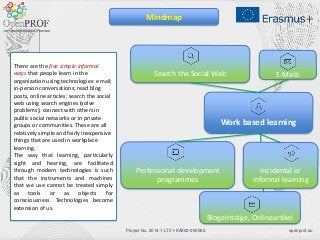
There are the five simple informal
ways that people learn in the
organization using technologies: email;
in-person conversations; read blog
posts, online articles; search the social
web using search engines (solve
problems); connect with others in
public social networks or in private
groups or communities. These are all
relatively simple and fairly inexpensive
things that are used in workplace
learning.
The way that learning, particularly
sight and hearing, are facilitated
through modern technologies is such
that the instruments and machines
that we use cannot be treated simply
as tools or as objects for
consciousness. Technologies become
extension of us.
openprof.euProject No. 2014-1-LT01-KA202-000562
Work based learning
Mindmap
Search the Social Web E-Mails
Professional development
programmes
Blogeinträge, Onlineartikel
Incidental or
informal learning
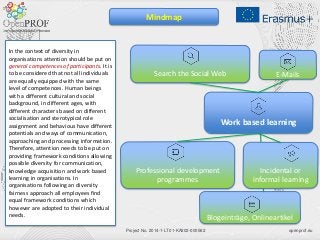
In the context of diversity in
organisations attention should be put on
general competences of participants. It is
to be considered that not all individuals
are equally equipped with the same
level of competences. Human beings
with a different cultural and social
background, in different ages, with
different characters based on different
socialisation and sterotypical role
assignment and behavious have different
potentials and ways of communication,
approaching and processing information.
Therefore, attention needs to be put on
providing framework conditions allowing
possible diversity for communication,
knowledge acquisition and work based
learning in organisations. In
organisations following an diversity
fairness approach all employees find
equal framework conditions which
however are adopted to their individual
needs.
openprof.euProject No. 2014-1-LT01-KA202-000562
Work based learning
If learning is equally possible, efficient team
work and development are possible.
Example for individual dealing of organisations
with diversity: Utalization analysis of informal
ways of learning, adaption and adaptation
according to real needs
 Are there tools which are rarely used?
 Why are they being rarely used?
 Are there any barriers in the practical
approach of the tool?
 Are there language barriers?
 Which possibilities are available to
make them equally usable the best?
openprof.euProject No. 2014-1-LT01-KA202-000562
Produced by Auxilium in the framework
of Erasmus+ project
“Open Professional Collaboration for
Innovation”
This project has been funded by Erasmus + programme
of the European Union. This OER reflects the views only
of the authors, and the Commission cannot be held
responsible for any use which may be made of the
information contained therein.
Project No. 2014-1-LT01-KA202-000562

Work based learning - context diversity

  • 1.
    openprof.euProject No. 2014-1-LT01-KA202-000562 Workbased learning in the context of diversity Auxilium pro Regionibus Europae in Rebus Culturalibus (Auxilium) Open Professional Collaboration for Innovation
  • 2.
  • 3.
    openprof.euProject No. 2014-1-LT01-KA202-000562 Workbased learningGeneral Competencies Mindmap
  • 4.
    openprof.euProject No. 2014-1-LT01-KA202-000562 Workbased learningGeneral Competencies Information Processing Communication Interpersonal Skills and Teamwork Problem-solving Mindmap
  • 5.
    openprof.euProject No. 2014-1-LT01-KA202-000562 Workbased learningGeneral Competencies Information Processing Communication Interpersonal Skills and Teamwork Problem-solving Mindmap Information Processing – the ability to acquire, evaluate, organize, manage, and interpret information. Information Processing – the ability to acquire, evaluate, organize, manage and interpret information.interpret
  • 6.
    openprof.euProject No. 2014-1-LT01-KA202-000562 Workbased learningGeneral Competencies Information Processing Communication Interpersonal Skills and Teamwork Problem-solving Mindmap Communication – the ability to effectively exchange ideas and information with others through oral, written, or visual means.
  • 7.
    openprof.euProject No. 2014-1-LT01-KA202-000562 Workbased learningGeneral Competencies Information Processing Communication Interpersonal Skills and Teamwork Problem-solving Mindmap Problem-solving – the ability to identify problems and potential causes while developing and implementing practical action plans for solutions.
  • 8.
    openprof.euProject No. 2014-1-LT01-KA202-000562 Workbased learningGeneral Competencies Information Processing Communication Interpersonal Skills and Teamwork Problem-solving Mindmap Interpersonal Skills and Teamwork – the ability to work effectively with others, especially to analyze situations, establish priorities, and apply resources for solving problems or accomplishing tasks.
  • 9.
    openprof.euProject No. 2014-1-LT01-KA202-000562 Workbased learning Mindmap Search the Social Web E-Mails Professional development programmes Blogeinträge, Onlineartikel Incidental or informal learning There are the five simple informal ways that people learn in the organization using technologies: email; in-person conversations; read blog posts, online articles; search the social web using search engines (solve problems); connect with others in public social networks or in private groups or communities. These are all relatively simple and fairly inexpensive things that are used in workplace learning. The way that learning, particularly sight and hearing, are facilitated through modern technologies is such that the instruments and machines that we use cannot be treated simply as tools or as objects for consciousness. Technologies become extension of us.
  • 10.
    openprof.euProject No. 2014-1-LT01-KA202-000562 Workbased learning Mindmap Search the Social Web E-Mails Professional development programmes Blogeinträge, Onlineartikel Incidental or informal learning In the context of diversity in organisations attention should be put on general competences of participants. It is to be considered that not all individuals are equally equipped with the same level of competences. Human beings with a different cultural and social background, in different ages, with different characters based on different socialisation and sterotypical role assignment and behavious have different potentials and ways of communication, approaching and processing information. Therefore, attention needs to be put on providing framework conditions allowing possible diversity for communication, knowledge acquisition and work based learning in organisations. In organisations following an diversity fairness approach all employees find equal framework conditions which however are adopted to their individual needs.
  • 11.
    openprof.euProject No. 2014-1-LT01-KA202-000562 Workbased learning If learning is equally possible, efficient team work and development are possible. Example for individual dealing of organisations with diversity: Utalization analysis of informal ways of learning, adaption and adaptation according to real needs  Are there tools which are rarely used?  Why are they being rarely used?  Are there any barriers in the practical approach of the tool?  Are there language barriers?  Which possibilities are available to make them equally usable the best?
  • 12.
    openprof.euProject No. 2014-1-LT01-KA202-000562 Producedby Auxilium in the framework of Erasmus+ project “Open Professional Collaboration for Innovation” This project has been funded by Erasmus + programme of the European Union. This OER reflects the views only of the authors, and the Commission cannot be held responsible for any use which may be made of the information contained therein. Project No. 2014-1-LT01-KA202-000562