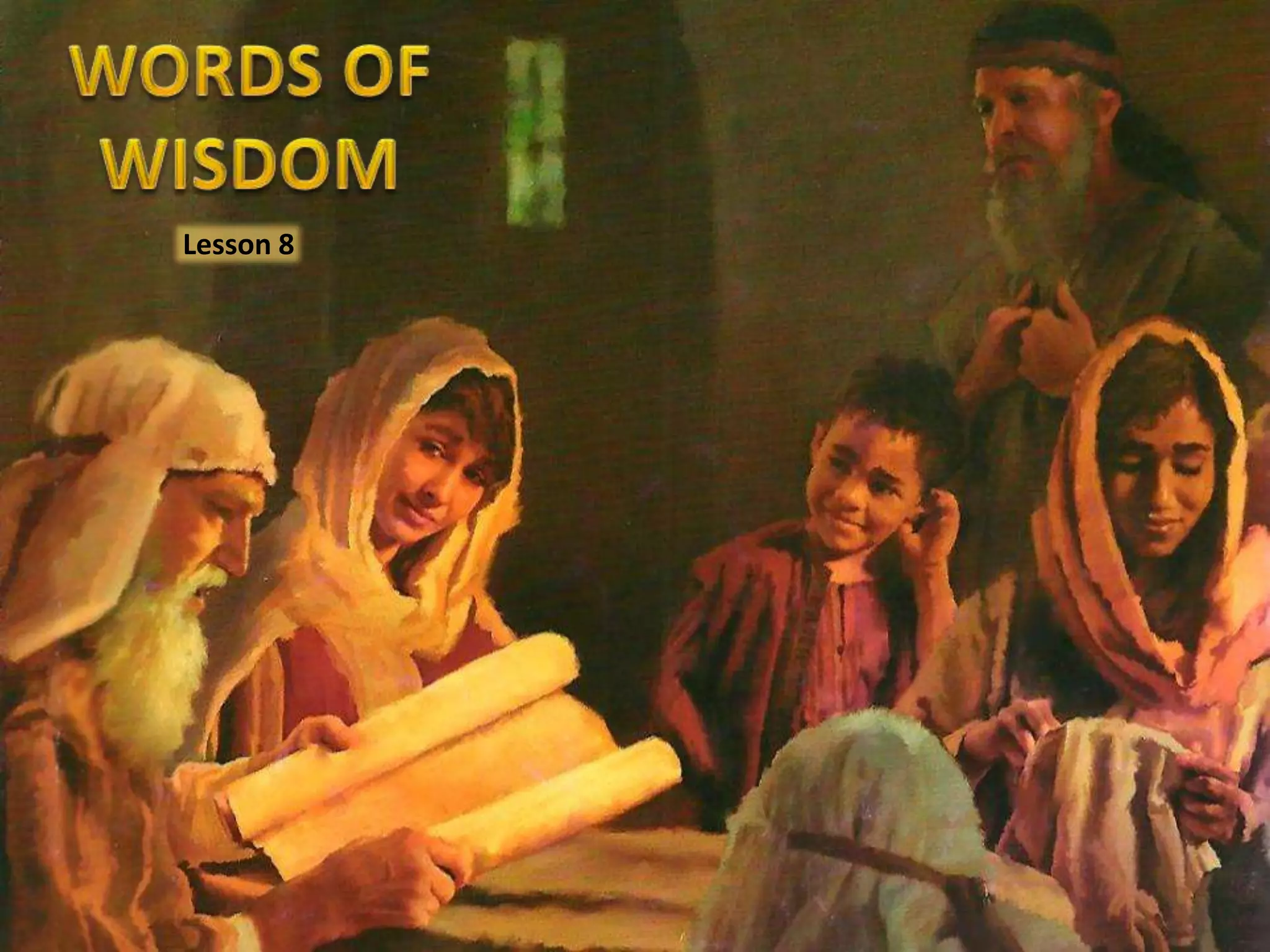
Lesson 8
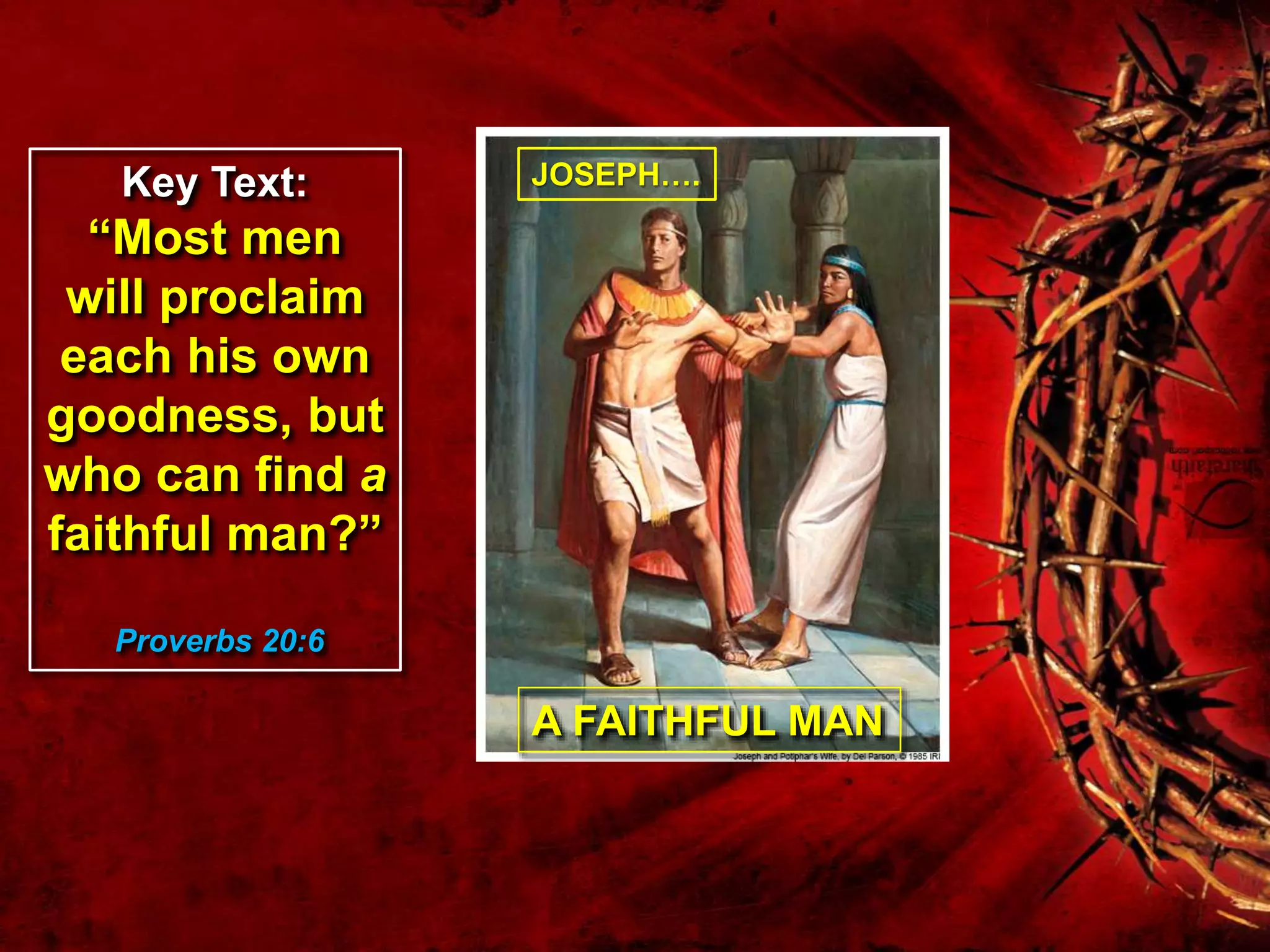
Key Text:
“Most men
will proclaim
each his own
goodness, but
who can find a
faithful man?”
Proverbs 20:6
JOSEPH….
A FAITHFUL MAN
To some degree (a great degree,
actually), we are all products of
our environment. Though
heredity plays a big role, the
values we hold come to us from
what is around us—our home,
our education, our culture. From
infancy we are impacted by what
we see and hear.
Unfortunately, what we see
and hear isn’t always the
best for us; the world around
us is fallen in every way, and
it cannot help impacting us
negatively.
Nevertheless, we have been
given the promise of the Holy
Spirit, and we have God’s
Word, which points us to
something higher and better
than the world does.
This lesson we will look at various
proverbs and the practical truths they
express, truths that, if taken to heart
and followed, can, indeed, help us to
overcome the negativity of this fallen
world and prepare us for a better one.
The equality of all humans
(Proverbs 20:9, 12)
Being perseverant
(Proverbs 20:6)
Waiting for the Lord
(Proverbs 20:17, 20-22;
21:5-6)
Compassion
(Proverbs 21:13; 22:16)
Proper education
(Proverbs 22:6, 8, 15)
The words of wisdom in
Proverbs 20, 21 and 22:1-16 set
the parameters that should
guide our daily life.
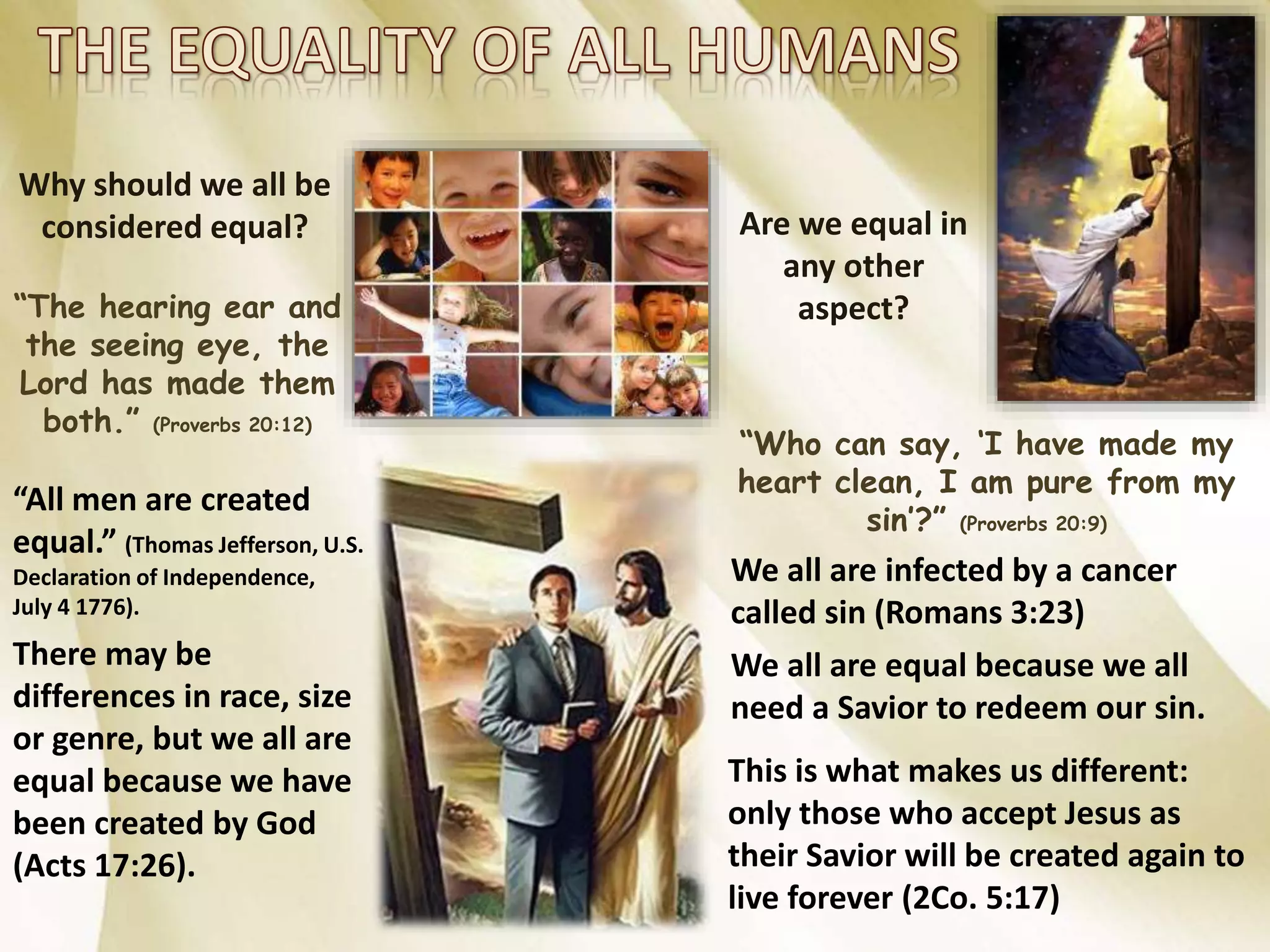
Why should we all be
considered equal?
“The hearing ear and
the seeing eye, the
Lord has made them
both.” (Proverbs 20:12)
“All men are created
equal.” (Thomas Jefferson, U.S.
Declaration of Independence,
July 4 1776).
There may be
differences in race, size
or genre, but we all are
equal because we have
been created by God
(Acts 17:26).
Are we equal in
any other
aspect?
“Who can say, ‘I have made my
heart clean, I am pure from my
sin’?” (Proverbs 20:9)
We all are infected by a cancer
called sin (Romans 3:23)
We all are equal because we all
need a Savior to redeem our sin.
This is what makes us different:
only those who accept Jesus as
their Savior will be created again to
live forever (2Co. 5:17)
Now, though we all
have the same Maker,
this doesn’t mean we
are all the same.
Even identical twins
don’t wind up beha-
ving exactly alike.
In Corinthians, Paul
talks about our diffe-
rences and stresses that they should not lead to a sense
of superiority but should, instead, help us to see our need
for one another. “The eye cannot say to the hand, ‘I have
no need of you’; nor again the head to the feet, ‘I have no
need of you’ ” (1 Cor. 12:21).
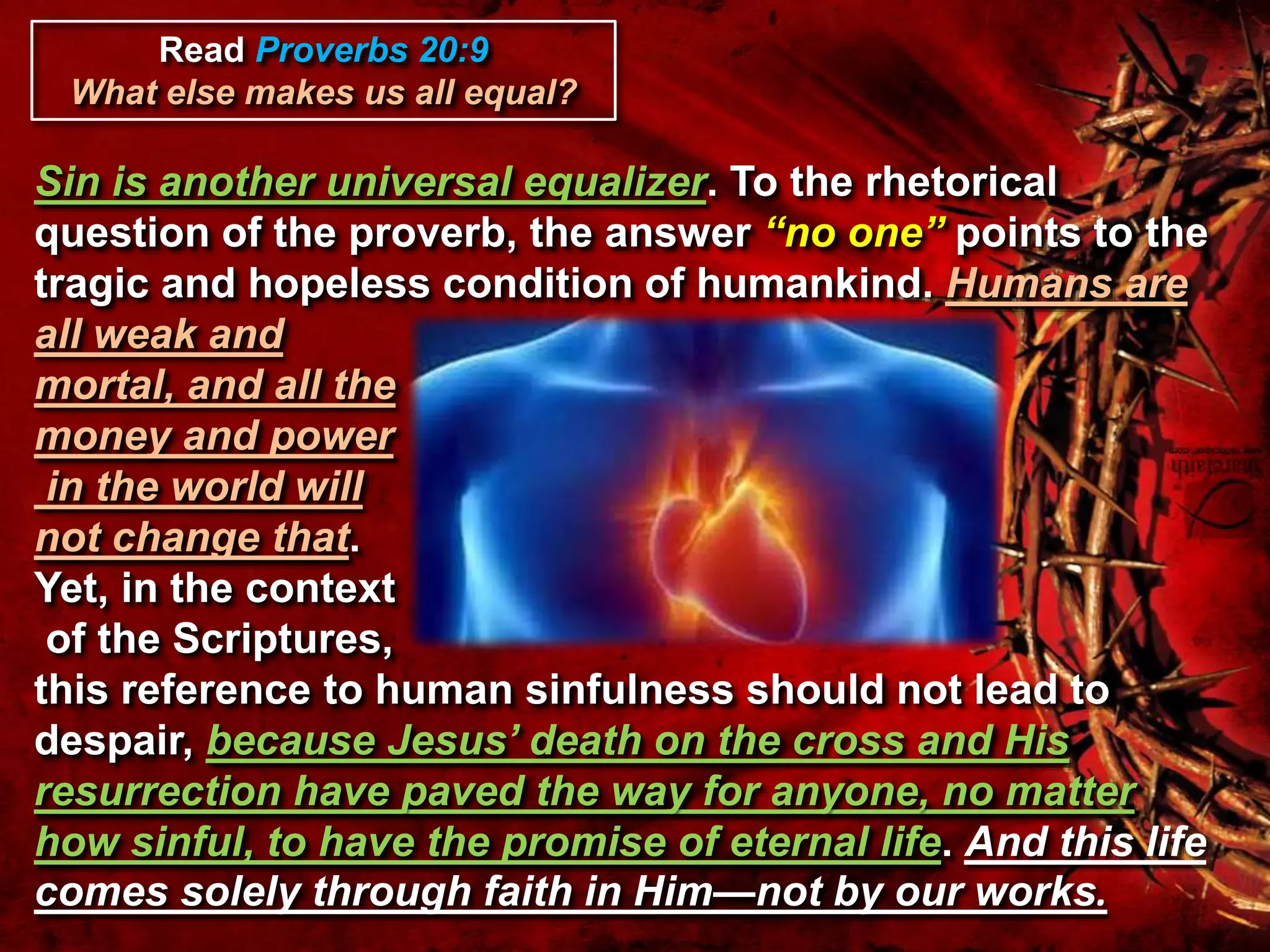
Read Proverbs 20:9
What else makes us all equal?
Sin is another universal equalizer. To the rhetorical
question of the proverb, the answer “no one” points to the
tragic and hopeless condition of humankind. Humans are
all weak and
mortal, and all the
money and power
in the world will
not change that.
Yet, in the context
of the Scriptures,
this reference to human sinfulness should not lead to
despair, because Jesus’ death on the cross and His
resurrection have paved the way for anyone, no matter
how sinful, to have the promise of eternal life. And this life
comes solely through faith in Him—not by our works.
Do you ever find yourself feeling
superior (or inferior) to other
people?
(You shouldn’t be comparing
yourself to others anyway.)
If so, what should the Cross tell
you about the equality of us all?
REFLECTION
“Most men will proclaim each his own goodness, but who can
find a faithful man?” (Proverbs 20:6)
It is OK to be praised for a good deed.
Nevertheless, what about the other deeds
you do? Should you be praised for them?
It is not the single sensational act of love
or sacrifice that will demonstrate the high
quality of our relationships, but the long
and regular series of small actions that we
perform day by day, patiently and surely.
Should I tell others
how good I am? Quite
the opposite! “Let
another man praise you, and not your
own mouth; a stranger, and not your
own lips.” (Proverbs 27:2)
“Oh, how many are waiting for
opportunity to do some great work of
self-sacrifice, and are overlooking the
little daily test which God gives to
prove them. It is the little things of life
that develop the spirit in men and
women and determine that character.
These trifles cannot be neglected and
yet the man be prepared to endure the
severe tests, when they are brought to
bear upon him.”
E.G.W. (This day with God, May 15)
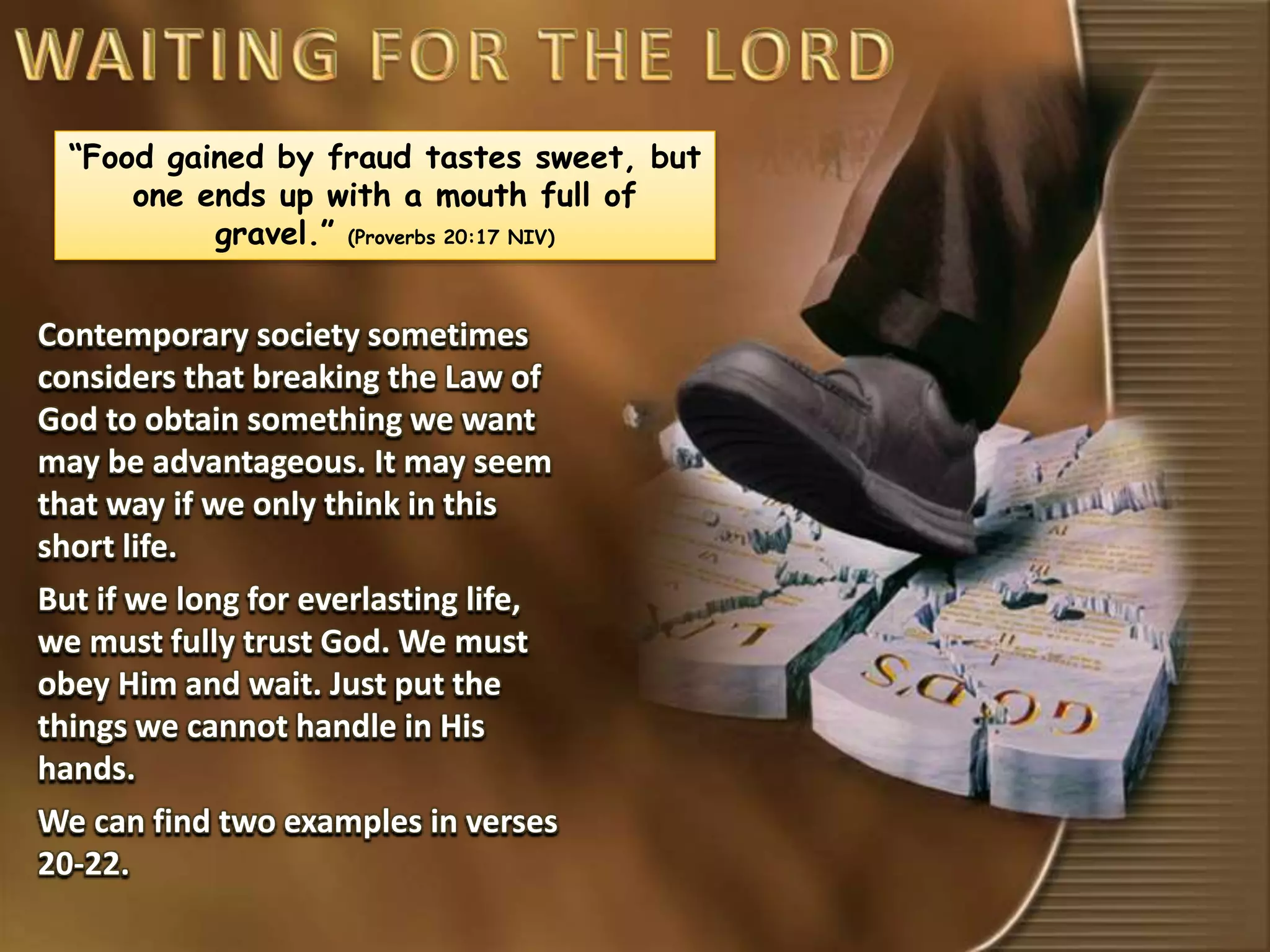
“Food gained by fraud tastes sweet, but
one ends up with a mouth full of
gravel.” (Proverbs 20:17 NIV)
Contemporary society sometimes
considers that breaking the Law of
God to obtain something we want
may be advantageous. It may seem
that way if we only think in this
short life.
But if we long for everlasting life,
we must fully trust God. We must
obey Him and wait. Just put the
things we cannot handle in His
hands.
We can find two examples in verses
20-22.
“If you insult your father or mother,
your light will be snuffed out in total
darkness. An inheritance obtained
too early in life is not a blessing in
the end.”
(Proverbs 20:20-21)
Are you waiting for your rich parents to
die so you finally get your inheritance?
That’s just an example. Solomon
wanted us to think on the foolishness
of trying to get goods in a fraudulent
and quick way. God cannot bless them.
Just trust God. He will give us
everything we need at the right
moment.
INHERITANCE
“Don’t say, ‘I will get
even for this wrong.’
Wait for the Lord to
handle the matter.”
(Proverbs 20:22)
Let’s trust God if we are done wrong
and we deserve justice. He will avenge
us.
We are told to be merciful as we trust
God. That way, we will “heap burning
coals of shame on their heads.” (Pr.
25:22). Maybe we could bring salvation
to that person; conquering evil by doing
good (Rom. 12:21).
REVENGE
“Those who shut their ears to the cries of the poor
will be ignored in their own time of need.”
(Proverbs 21:13)
“A person who gets ahead by oppressing the poor or
by showering gifts on the rich will end in poverty.”
(Proverbs 22:16)
1. Because of God.
Because God receives
every act of kindness to
the poor as if it was
done to Him (Pr. 19:17;
Mt. 25:35-40).
Our character is measured by the compassion we
show in our relationships (Luke 10:26-37)
2. Because of the poor. Because both the poor
and the rich were created by God (Pr. 22:2).
Therefore, the poor deserve all the care the
rich do (and they need it more).
Why must we be merciful?
For God’s sake: The first reason to make this a priority
lies in God Himself, who prefers human compassion for
the poor over our religious zeal (Prov. 19:17, 21:13). Your
sensitivity to the poor
and your concrete
deeds on their behalf
will count more with
God than will any of
your pious acts.
In fact, God is perso-
nally invested in that
work, so much so that
when we give to the
poor, it is as if we are
giving to God Himself
(Matt. 25:35–40).
Read Matthew 25:35–40. What does this tell us about how
Jesus identifies so closely with those in need? How
should this truth impact how we relate to such people?
For the sake of the poor: The second reason lies within the
poor person, whom God has created just as He has created the
rich person (Prov. 22:2). The equality between humans, based
on the fact that God has created them all, makes the poor as
worthy of attention as the rich person. We should love our
neighbors for who they are: beings made in the image of God.
At the same time, think about how much good it does you
to help those in need. Our basic natures are selfish; by
default we tend to look out for ourselves over and above
others. By giving of ourselves, we learn to die to self
and to better reflect Christ’s character, and what is of
more value to us than that?
In what ways do you
get a greater sense of
personal satisfaction
from helping others in
need than only doing
things for yourself?
REFLECTION
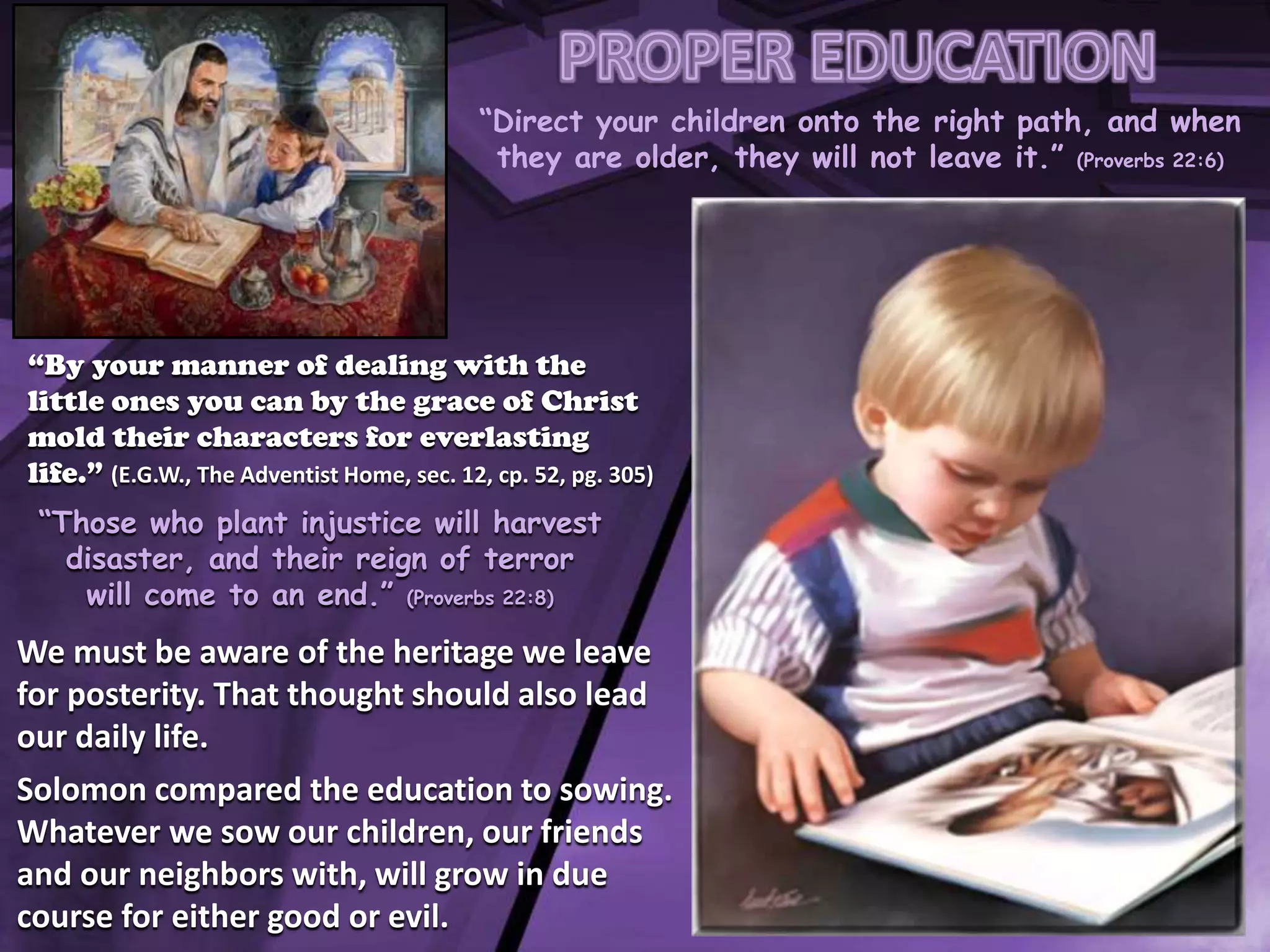
“Direct your children onto the right path, and when
they are older, they will not leave it.” (Proverbs 22:6)
“By your manner of dealing with the
little ones you can by the grace of Christ
mold their characters for everlasting
life.” (E.G.W., The Adventist Home, sec. 12, cp. 52, pg. 305)
“Those who plant injustice will harvest
disaster, and their reign of terror
will come to an end.” (Proverbs 22:8)
We must be aware of the heritage we leave
for posterity. That thought should also lead
our daily life.
Solomon compared the education to sowing.
Whatever we sow our children, our friends
and our neighbors with, will grow in due
course for either good or evil.
“As the seed sown produces a
harvest, and this in turn is sown,
the harvest is multiplied. In our
relation to others, this law holds
true. Every act, every word, is a
seed that will bear fruit. Every
deed of thoughtful kindness, of
obedience, or of self-denial, will
reproduce itself in others, and
through them in still others…
Thus the sowing of good and evil
goes on for time and for eternity.”
E.G.W. (Christ’s Object Lessons, cp.6, pg. 85)
Slideshare.net/chucho1943
PROVERBS * The Call of Wisdom
THIS SERVICE IS
FREE AND YOU
CAN USE IT
We invite you to download and study each one of the 13
lessons about this serie

Words of wisdom 08

  • 1.
  • 2.
    Key Text: “Most men willproclaim each his own goodness, but who can find a faithful man?” Proverbs 20:6 JOSEPH…. A FAITHFUL MAN
  • 3.
    To some degree(a great degree, actually), we are all products of our environment. Though heredity plays a big role, the values we hold come to us from what is around us—our home, our education, our culture. From infancy we are impacted by what we see and hear.
  • 4.
    Unfortunately, what wesee and hear isn’t always the best for us; the world around us is fallen in every way, and it cannot help impacting us negatively. Nevertheless, we have been given the promise of the Holy Spirit, and we have God’s Word, which points us to something higher and better than the world does.
  • 5.
    This lesson wewill look at various proverbs and the practical truths they express, truths that, if taken to heart and followed, can, indeed, help us to overcome the negativity of this fallen world and prepare us for a better one.
  • 6.
    The equality ofall humans (Proverbs 20:9, 12) Being perseverant (Proverbs 20:6) Waiting for the Lord (Proverbs 20:17, 20-22; 21:5-6) Compassion (Proverbs 21:13; 22:16) Proper education (Proverbs 22:6, 8, 15) The words of wisdom in Proverbs 20, 21 and 22:1-16 set the parameters that should guide our daily life.
  • 7.
    Why should weall be considered equal? “The hearing ear and the seeing eye, the Lord has made them both.” (Proverbs 20:12) “All men are created equal.” (Thomas Jefferson, U.S. Declaration of Independence, July 4 1776). There may be differences in race, size or genre, but we all are equal because we have been created by God (Acts 17:26). Are we equal in any other aspect? “Who can say, ‘I have made my heart clean, I am pure from my sin’?” (Proverbs 20:9) We all are infected by a cancer called sin (Romans 3:23) We all are equal because we all need a Savior to redeem our sin. This is what makes us different: only those who accept Jesus as their Savior will be created again to live forever (2Co. 5:17)
  • 8.
    Now, though weall have the same Maker, this doesn’t mean we are all the same. Even identical twins don’t wind up beha- ving exactly alike. In Corinthians, Paul talks about our diffe- rences and stresses that they should not lead to a sense of superiority but should, instead, help us to see our need for one another. “The eye cannot say to the hand, ‘I have no need of you’; nor again the head to the feet, ‘I have no need of you’ ” (1 Cor. 12:21).
  • 9.
    Read Proverbs 20:9 Whatelse makes us all equal? Sin is another universal equalizer. To the rhetorical question of the proverb, the answer “no one” points to the tragic and hopeless condition of humankind. Humans are all weak and mortal, and all the money and power in the world will not change that. Yet, in the context of the Scriptures, this reference to human sinfulness should not lead to despair, because Jesus’ death on the cross and His resurrection have paved the way for anyone, no matter how sinful, to have the promise of eternal life. And this life comes solely through faith in Him—not by our works.
  • 10.
    Do you everfind yourself feeling superior (or inferior) to other people? (You shouldn’t be comparing yourself to others anyway.) If so, what should the Cross tell you about the equality of us all? REFLECTION
  • 11.
    “Most men willproclaim each his own goodness, but who can find a faithful man?” (Proverbs 20:6) It is OK to be praised for a good deed. Nevertheless, what about the other deeds you do? Should you be praised for them? It is not the single sensational act of love or sacrifice that will demonstrate the high quality of our relationships, but the long and regular series of small actions that we perform day by day, patiently and surely. Should I tell others how good I am? Quite the opposite! “Let another man praise you, and not your own mouth; a stranger, and not your own lips.” (Proverbs 27:2)
  • 12.
    “Oh, how manyare waiting for opportunity to do some great work of self-sacrifice, and are overlooking the little daily test which God gives to prove them. It is the little things of life that develop the spirit in men and women and determine that character. These trifles cannot be neglected and yet the man be prepared to endure the severe tests, when they are brought to bear upon him.” E.G.W. (This day with God, May 15)
  • 13.
    “Food gained byfraud tastes sweet, but one ends up with a mouth full of gravel.” (Proverbs 20:17 NIV) Contemporary society sometimes considers that breaking the Law of God to obtain something we want may be advantageous. It may seem that way if we only think in this short life. But if we long for everlasting life, we must fully trust God. We must obey Him and wait. Just put the things we cannot handle in His hands. We can find two examples in verses 20-22.
  • 14.
    “If you insultyour father or mother, your light will be snuffed out in total darkness. An inheritance obtained too early in life is not a blessing in the end.” (Proverbs 20:20-21) Are you waiting for your rich parents to die so you finally get your inheritance? That’s just an example. Solomon wanted us to think on the foolishness of trying to get goods in a fraudulent and quick way. God cannot bless them. Just trust God. He will give us everything we need at the right moment. INHERITANCE “Don’t say, ‘I will get even for this wrong.’ Wait for the Lord to handle the matter.” (Proverbs 20:22) Let’s trust God if we are done wrong and we deserve justice. He will avenge us. We are told to be merciful as we trust God. That way, we will “heap burning coals of shame on their heads.” (Pr. 25:22). Maybe we could bring salvation to that person; conquering evil by doing good (Rom. 12:21). REVENGE
  • 15.
    “Those who shuttheir ears to the cries of the poor will be ignored in their own time of need.” (Proverbs 21:13) “A person who gets ahead by oppressing the poor or by showering gifts on the rich will end in poverty.” (Proverbs 22:16) 1. Because of God. Because God receives every act of kindness to the poor as if it was done to Him (Pr. 19:17; Mt. 25:35-40). Our character is measured by the compassion we show in our relationships (Luke 10:26-37) 2. Because of the poor. Because both the poor and the rich were created by God (Pr. 22:2). Therefore, the poor deserve all the care the rich do (and they need it more). Why must we be merciful?
  • 16.
    For God’s sake:The first reason to make this a priority lies in God Himself, who prefers human compassion for the poor over our religious zeal (Prov. 19:17, 21:13). Your sensitivity to the poor and your concrete deeds on their behalf will count more with God than will any of your pious acts. In fact, God is perso- nally invested in that work, so much so that when we give to the poor, it is as if we are giving to God Himself (Matt. 25:35–40).
  • 17.
    Read Matthew 25:35–40.What does this tell us about how Jesus identifies so closely with those in need? How should this truth impact how we relate to such people?
  • 18.
    For the sakeof the poor: The second reason lies within the poor person, whom God has created just as He has created the rich person (Prov. 22:2). The equality between humans, based on the fact that God has created them all, makes the poor as worthy of attention as the rich person. We should love our neighbors for who they are: beings made in the image of God.
  • 19.
    At the sametime, think about how much good it does you to help those in need. Our basic natures are selfish; by default we tend to look out for ourselves over and above others. By giving of ourselves, we learn to die to self and to better reflect Christ’s character, and what is of more value to us than that?
  • 20.
    In what waysdo you get a greater sense of personal satisfaction from helping others in need than only doing things for yourself? REFLECTION
  • 21.
    “Direct your childrenonto the right path, and when they are older, they will not leave it.” (Proverbs 22:6) “By your manner of dealing with the little ones you can by the grace of Christ mold their characters for everlasting life.” (E.G.W., The Adventist Home, sec. 12, cp. 52, pg. 305) “Those who plant injustice will harvest disaster, and their reign of terror will come to an end.” (Proverbs 22:8) We must be aware of the heritage we leave for posterity. That thought should also lead our daily life. Solomon compared the education to sowing. Whatever we sow our children, our friends and our neighbors with, will grow in due course for either good or evil.
  • 22.
    “As the seedsown produces a harvest, and this in turn is sown, the harvest is multiplied. In our relation to others, this law holds true. Every act, every word, is a seed that will bear fruit. Every deed of thoughtful kindness, of obedience, or of self-denial, will reproduce itself in others, and through them in still others… Thus the sowing of good and evil goes on for time and for eternity.” E.G.W. (Christ’s Object Lessons, cp.6, pg. 85)
  • 23.
    Slideshare.net/chucho1943 PROVERBS * TheCall of Wisdom THIS SERVICE IS FREE AND YOU CAN USE IT We invite you to download and study each one of the 13 lessons about this serie

Editor's Notes

  • #8 Proverbs 20:9, 12
  • #12 Proverbs 20:6
  • #14 Proverbs 20:17, 21-22; 21:5-6
  • #15 Proverbs 20:17, 21-22; 21:5-6
  • #16 Proverbs 21:13; 22:16
  • #22 Proverbs 22:6, 8, 15