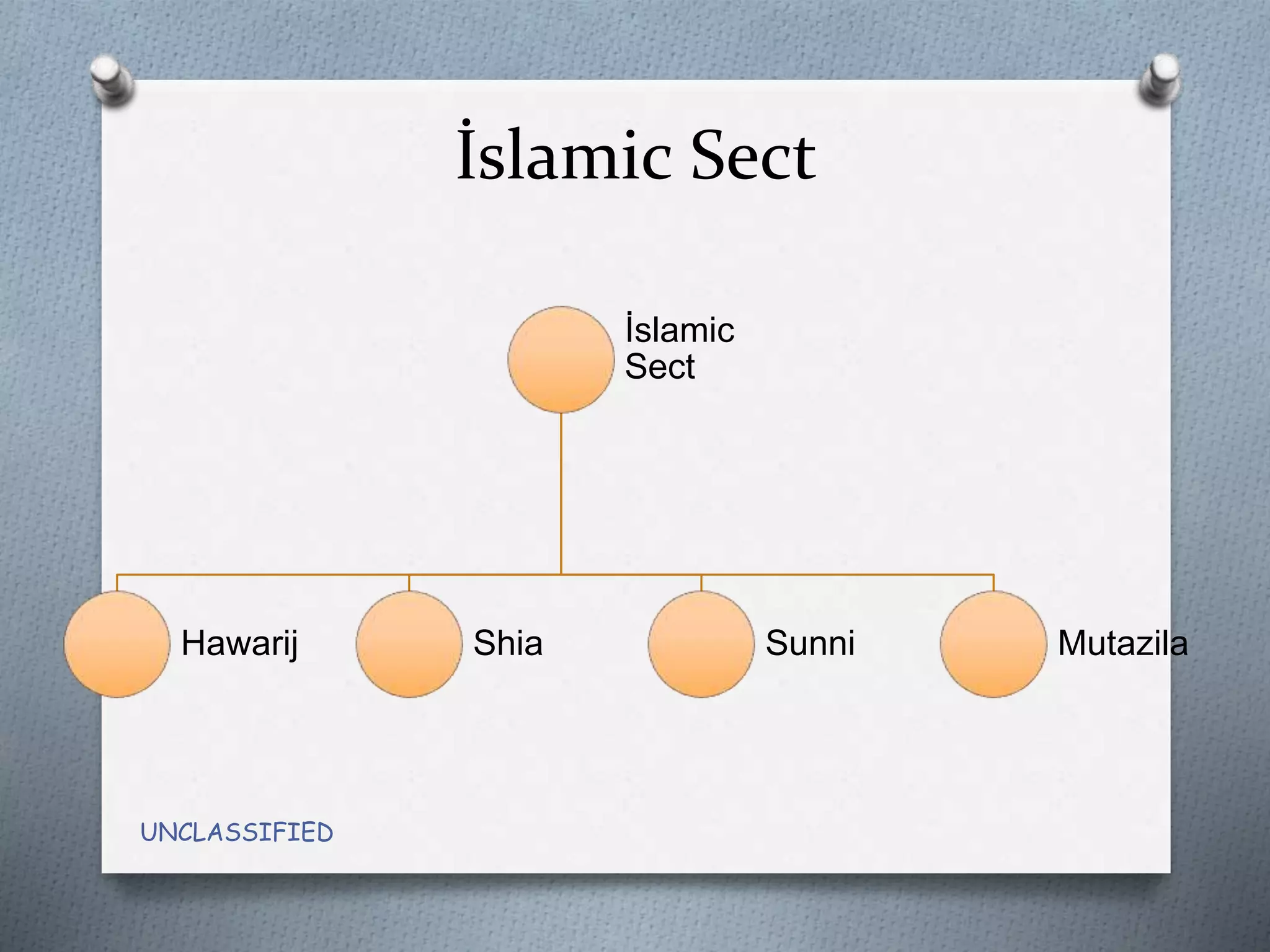
İslamic Sect
UNCLASSIFIED
İslamic
Sect
Hawarij Shia Sunni Mutazila
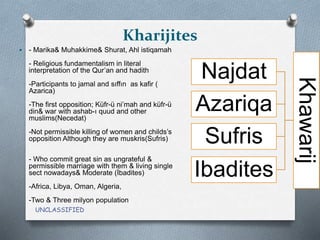
Kharijites
UNCLASSIFIED
 - Marika& Muhakkime& Shurat, Ahl istiqamah
- Religious fundamentalism in literal
interpretation of the Qur’an and hadith
-Participants to jamal and sıffın as kafir (
Azarica)
-The first opposition; Küfr-ü ni’mah and küfr-ü
din& war with ashab-ı quud and other
muslims(Necedat)
-Not permissible killing of women and childs’s
opposition Although they are muskris(Sufris)
- Who commit great sin as ungrateful &
permissible marriage with them & living single
sect nowadays& Moderate (İbadites)
-Africa, Libya, Oman, Algeria,
-Two & Three milyon population
Khawarij
Najdat
Azariqa
Sufris
Ibadites
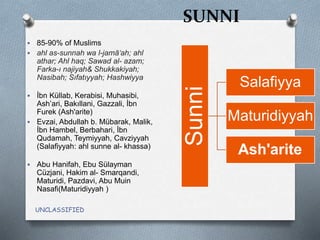
SUNNI
UNCLASSIFIED
 85-90% of Muslims
 ahl as-sunnah wa l-jamāʻah; ahl
athar; Ahl haq; Sawad al- azam;
Farka-ı najiyah& Shukkakiyah;
Nasibah; Sıfatıyyah; Hashwiyya
 İbn Küllab, Kerabisi, Muhasibi,
Ash’ari, Bakıllani, Gazzali, İbn
Furek (Ash'arite)
 Evzai, Abdullah b. Mübarak, Malik,
İbn Hambel, Berbahari, İbn
Qudamah, Teymiyyah, Cavziyyah
(Salafiyyah: ahl sunne al- khassa)
 Abu Hanifah, Ebu Sülayman
Cüzjani, Hakim al- Smarqandi,
Maturidi, Pazdavi, Abu Muin
Nasafi(Maturidiyyah )
Sunni
Salafiyya
Maturidiyyah
Ash'arite
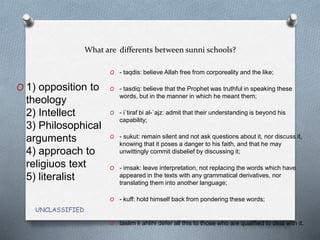
What are differents between sunni schools?
UNCLASSIFIED
O 1) opposition to
theology
2) Intellect
3) Philosophical
arguments
4) approach to
religiuos text
5) literalist
O - taqdis: believe Allah free from corporeality and the like;
O - tasdiq: believe that the Prophet was truthful in speaking these
words, but in the manner in which he meant them;
O - i`tiraf bi al-`ajz: admit that their understanding is beyond his
capability;
O - sukut: remain silent and not ask questions about it, nor discuss it,
knowing that it poses a danger to his faith, and that he may
unwittingly commit disbelief by discussing it;
O - imsak: leave interpretation, not replacing the words which have
appeared in the texts with any grammatical derivatives, nor
translating them into another language;
O - kuff: hold himself back from pondering these words;
O taslim li ahlihi defer all this to those who are qualified to deal with it.
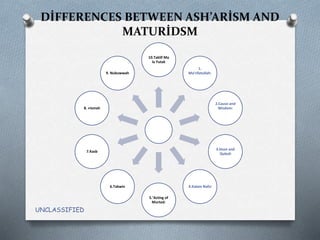
DİFFERENCES BETWEEN ASH’ARİSM AND
MATURİDSM
UNCLASSIFIED
10.Taklif Ma
la Yutak
1.
Ma’rifatullah:
2.Cause and
Wisdom:
3.Husn and
Qubuh
4.Kalam Nafsi
5.’Acting of
Murted:
6.Takwin
7.Kasb
8. «Ismah
9. Nubuwwah
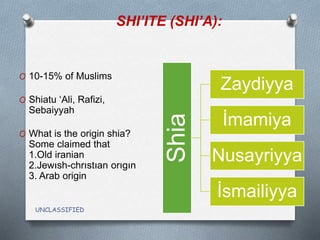
SHI’ITE (SHI’A):
UNCLASSIFIED
O 10-15% of Muslims
O Shiatu ‘Ali, Rafizi,
Sebaiyyah
O What is the origin shia?
Some claimed that
1.Old iranian
2.Jewısh-chrıstıan orıgın
3. Arab origin
Shia
Zaydiyya
İmamiya
Nusayriyya
İsmailiyya
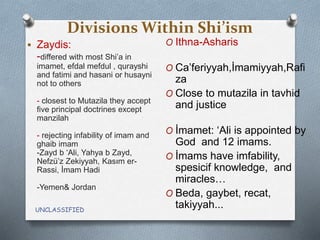
Divisions Within Shi’ism
UNCLASSIFIED
 Zaydis:
-differed with most Shi’a in
imamet, efdal mefdul , qurayshi
and fatimi and hasani or husayni
not to others
- closest to Mutazila they accept
five principal doctrines except
manzilah
- rejecting infability of imam and
ghaib imam
-Zayd b ‘Ali, Yahya b Zayd,
Nefzü’z Zekiyyah, Kasım er-
Rassi, İmam Hadi
-Yemen& Jordan
O Ithna-Asharis
O Ca’feriyyah,İmamiyyah,Rafi
za
O Close to mutazila in tavhid
and justice
O İmamet: ‘Ali is appointed by
God and 12 imams.
O İmams have imfability,
spesicif knowledge, and
miracles…
O Beda, gaybet, recat,
takiyyah...
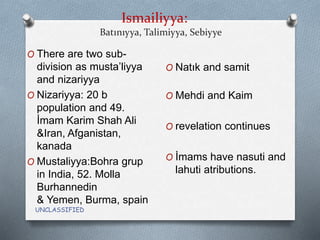
Ismailiyya:
Batınıyya, Talimiyya, Sebiyye
UNCLASSIFIED
O There are two sub-
division as musta’liyya
and nizariyya
O Nizariyya: 20 b
population and 49.
İmam Karim Shah Ali
&Iran, Afganistan,
kanada
O Mustaliyya:Bohra grup
in India, 52. Molla
Burhannedin
& Yemen, Burma, spain
O Natık and samit
O Mehdi and Kaim
O revelation continues
O İmams have nasuti and
lahuti atributions.
Nusayriyya
UNCLASSIFIED
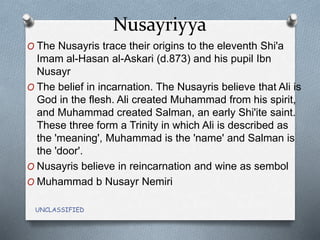
O The Nusayris trace their origins to the eleventh Shi'a
Imam al-Hasan al-Askari (d.873) and his pupil Ibn
Nusayr
O The belief in incarnation. The Nusayris believe that Ali is
God in the flesh. Ali created Muhammad from his spirit,
and Muhammad created Salman, an early Shi'ite saint.
These three form a Trinity in which Ali is described as
the 'meaning', Muhammad is the 'name' and Salman is
the 'door'.
O Nusayris believe in reincarnation and wine as sembol
O Muhammad b Nusayr Nemiri
Mu’tazila
UNCLASSIFIED
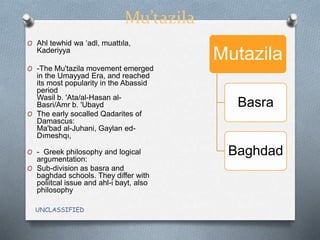
O Ahl tewhid wa ‘adl, muattıla,
Kaderiyya
O -The Mu'tazila movement emerged
in the Umayyad Era, and reached
its most popularity in the Abassid
period
Wasil b. 'Ata/al-Hasan al-
Basri/Amr b. 'Ubayd
O The early socalled Qadarites of
Damascus:
Ma'bad al-Juhani, Gaylan ed-
Dımeshqı,
O - Greek philosophy and logical
argumentation:
O Sub-division as basra and
baghdad schools. They differ with
poliitcal issue and ahl-i bayt, also
philosophy
Mutazila
Basra
Baghdad
The five principal doctrines
al-'Usul al-khamsah
O (i) Tawhid, i.e. absence of plurality and attributes.
O (ii) Justice ('adl), i.e. God is just and that He does not oppress His
creatures.
O (iii) Divine retribution (at-wa'd wa al-wa'id), i.e. God has determined a
reward for the obedient and a punishment for the disobedient, and there
can be no uncertainty about it.
O (iv) Manzilah bayna al-manzilatayn (a position between the two
positions). A fasiq is neither a mu'min, nor a kafir
O (v) al-'amr bil ma'ruf wa al-nahy 'an al-munkar [bidding to do what is
right and lawful, and forbidding what is wrong and unlawful].
UNCLASSIFIED
What are the problems of islamic schools?
OA)God
Discussion of divine attributes: Khalq al-Quran
'Adl (Divine Justice) and wisdom
OB)Prophethood:
1. Infallibility 2. Husn and Qubuh 3. Ahl-ı
Fatrah& responsibility 4. To be women and man
OC) Hereafter:
İntercession; Ruyetullah; the punishment of the
grave;UNCLASSIFIED
What are the problems of islamic schools?
O D) Human:
1. free will &Destnity 2. Khalq’al- afali ‘İbad& Kasb theory & İstita’at 4.
Guidance and going astray
5. What is the relationship between faith & works? 6. al-taklif bima la
yutaq)
O E) Leadership:
1. Appointment by nass & shura 2.qurash tribe 3. al-'amr bi al-ma'ruf wa
al-nahy 'an al-munkar
UNCLASSIFIED
Ahmadiya
 - messianic movement founded in British India in
1889 by Mirza Ghulam Ahmad
- core belief is prophetology, which postulates an
uninterrupted succession of non-legislative prophets
following Muhammad
- Ahmad claimed both messianic and prophetic
status
- has aroused the fierce opposition of Sunni
Muslims, especially in Pakistan and India
UNCLASSIFIED

Schools of islamic thought

  • 1.
  • 2.
    Kharijites UNCLASSIFIED  - Marika&Muhakkime& Shurat, Ahl istiqamah - Religious fundamentalism in literal interpretation of the Qur’an and hadith -Participants to jamal and sıffın as kafir ( Azarica) -The first opposition; Küfr-ü ni’mah and küfr-ü din& war with ashab-ı quud and other muslims(Necedat) -Not permissible killing of women and childs’s opposition Although they are muskris(Sufris) - Who commit great sin as ungrateful & permissible marriage with them & living single sect nowadays& Moderate (İbadites) -Africa, Libya, Oman, Algeria, -Two & Three milyon population Khawarij Najdat Azariqa Sufris Ibadites
  • 3.
    SUNNI UNCLASSIFIED  85-90% ofMuslims  ahl as-sunnah wa l-jamāʻah; ahl athar; Ahl haq; Sawad al- azam; Farka-ı najiyah& Shukkakiyah; Nasibah; Sıfatıyyah; Hashwiyya  İbn Küllab, Kerabisi, Muhasibi, Ash’ari, Bakıllani, Gazzali, İbn Furek (Ash'arite)  Evzai, Abdullah b. Mübarak, Malik, İbn Hambel, Berbahari, İbn Qudamah, Teymiyyah, Cavziyyah (Salafiyyah: ahl sunne al- khassa)  Abu Hanifah, Ebu Sülayman Cüzjani, Hakim al- Smarqandi, Maturidi, Pazdavi, Abu Muin Nasafi(Maturidiyyah ) Sunni Salafiyya Maturidiyyah Ash'arite
  • 4.
    What are differentsbetween sunni schools? UNCLASSIFIED O 1) opposition to theology 2) Intellect 3) Philosophical arguments 4) approach to religiuos text 5) literalist O - taqdis: believe Allah free from corporeality and the like; O - tasdiq: believe that the Prophet was truthful in speaking these words, but in the manner in which he meant them; O - i`tiraf bi al-`ajz: admit that their understanding is beyond his capability; O - sukut: remain silent and not ask questions about it, nor discuss it, knowing that it poses a danger to his faith, and that he may unwittingly commit disbelief by discussing it; O - imsak: leave interpretation, not replacing the words which have appeared in the texts with any grammatical derivatives, nor translating them into another language; O - kuff: hold himself back from pondering these words; O taslim li ahlihi defer all this to those who are qualified to deal with it.
  • 5.
    DİFFERENCES BETWEEN ASH’ARİSMAND MATURİDSM UNCLASSIFIED 10.Taklif Ma la Yutak 1. Ma’rifatullah: 2.Cause and Wisdom: 3.Husn and Qubuh 4.Kalam Nafsi 5.’Acting of Murted: 6.Takwin 7.Kasb 8. «Ismah 9. Nubuwwah
  • 6.
    SHI’ITE (SHI’A): UNCLASSIFIED O 10-15%of Muslims O Shiatu ‘Ali, Rafizi, Sebaiyyah O What is the origin shia? Some claimed that 1.Old iranian 2.Jewısh-chrıstıan orıgın 3. Arab origin Shia Zaydiyya İmamiya Nusayriyya İsmailiyya
  • 7.
    Divisions Within Shi’ism UNCLASSIFIED Zaydis: -differed with most Shi’a in imamet, efdal mefdul , qurayshi and fatimi and hasani or husayni not to others - closest to Mutazila they accept five principal doctrines except manzilah - rejecting infability of imam and ghaib imam -Zayd b ‘Ali, Yahya b Zayd, Nefzü’z Zekiyyah, Kasım er- Rassi, İmam Hadi -Yemen& Jordan O Ithna-Asharis O Ca’feriyyah,İmamiyyah,Rafi za O Close to mutazila in tavhid and justice O İmamet: ‘Ali is appointed by God and 12 imams. O İmams have imfability, spesicif knowledge, and miracles… O Beda, gaybet, recat, takiyyah...
  • 8.
    Ismailiyya: Batınıyya, Talimiyya, Sebiyye UNCLASSIFIED OThere are two sub- division as musta’liyya and nizariyya O Nizariyya: 20 b population and 49. İmam Karim Shah Ali &Iran, Afganistan, kanada O Mustaliyya:Bohra grup in India, 52. Molla Burhannedin & Yemen, Burma, spain O Natık and samit O Mehdi and Kaim O revelation continues O İmams have nasuti and lahuti atributions.
  • 9.
    Nusayriyya UNCLASSIFIED O The Nusayristrace their origins to the eleventh Shi'a Imam al-Hasan al-Askari (d.873) and his pupil Ibn Nusayr O The belief in incarnation. The Nusayris believe that Ali is God in the flesh. Ali created Muhammad from his spirit, and Muhammad created Salman, an early Shi'ite saint. These three form a Trinity in which Ali is described as the 'meaning', Muhammad is the 'name' and Salman is the 'door'. O Nusayris believe in reincarnation and wine as sembol O Muhammad b Nusayr Nemiri
  • 10.
    Mu’tazila UNCLASSIFIED O Ahl tewhidwa ‘adl, muattıla, Kaderiyya O -The Mu'tazila movement emerged in the Umayyad Era, and reached its most popularity in the Abassid period Wasil b. 'Ata/al-Hasan al- Basri/Amr b. 'Ubayd O The early socalled Qadarites of Damascus: Ma'bad al-Juhani, Gaylan ed- Dımeshqı, O - Greek philosophy and logical argumentation: O Sub-division as basra and baghdad schools. They differ with poliitcal issue and ahl-i bayt, also philosophy Mutazila Basra Baghdad
  • 11.
    The five principaldoctrines al-'Usul al-khamsah O (i) Tawhid, i.e. absence of plurality and attributes. O (ii) Justice ('adl), i.e. God is just and that He does not oppress His creatures. O (iii) Divine retribution (at-wa'd wa al-wa'id), i.e. God has determined a reward for the obedient and a punishment for the disobedient, and there can be no uncertainty about it. O (iv) Manzilah bayna al-manzilatayn (a position between the two positions). A fasiq is neither a mu'min, nor a kafir O (v) al-'amr bil ma'ruf wa al-nahy 'an al-munkar [bidding to do what is right and lawful, and forbidding what is wrong and unlawful]. UNCLASSIFIED
  • 12.
    What are theproblems of islamic schools? OA)God Discussion of divine attributes: Khalq al-Quran 'Adl (Divine Justice) and wisdom OB)Prophethood: 1. Infallibility 2. Husn and Qubuh 3. Ahl-ı Fatrah& responsibility 4. To be women and man OC) Hereafter: İntercession; Ruyetullah; the punishment of the grave;UNCLASSIFIED
  • 13.
    What are theproblems of islamic schools? O D) Human: 1. free will &Destnity 2. Khalq’al- afali ‘İbad& Kasb theory & İstita’at 4. Guidance and going astray 5. What is the relationship between faith & works? 6. al-taklif bima la yutaq) O E) Leadership: 1. Appointment by nass & shura 2.qurash tribe 3. al-'amr bi al-ma'ruf wa al-nahy 'an al-munkar UNCLASSIFIED
  • 14.
    Ahmadiya  - messianicmovement founded in British India in 1889 by Mirza Ghulam Ahmad - core belief is prophetology, which postulates an uninterrupted succession of non-legislative prophets following Muhammad - Ahmad claimed both messianic and prophetic status - has aroused the fierce opposition of Sunni Muslims, especially in Pakistan and India UNCLASSIFIED