Women as constituency
By : Rabia Tanveer (1800)
What is constituency
A body of voters in a specified area who elect a
representative to legislative body.
A body of voters represented by a legislator or elected
official.
A group of supporters or patrons.
Historical review
Western women
• Western women demands for their improved social
status and equality in political rights.
• Wanted freedom to participate in legislative body.
• “American resolution in 1776” and
• “French resolution in 1789” provided the
movement for their rights.
• They had resort to strikes, processions and
demonstrations.
• They were abused, tear gassed and imprisoned.
Cont..
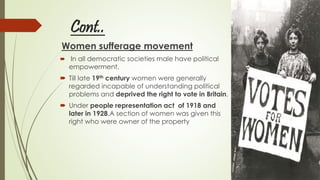
Women sufferage movement
 In all democratic societies male have political
empowerment.
 Till late 19th century women were generally
regarded incapable of understanding political
problems and deprived the right to vote in Britain.
 Under people representation act of 1918 and
later in 1928.A section of women was given this
right who were owner of the property
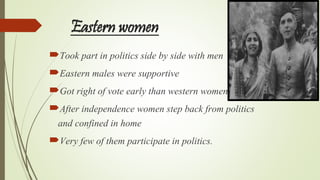
Eastern women
Took part in politics side by side with men
Eastern males were supportive
Got right of vote early than western women
After independence women step back from politics
and confined in home
Very few of them participate in politics.
Women Representation(1947-1973)
 Under the 1935 act of British-India
Shaista Ikramullah and Jahanara Shahnawaz were only two women
members on seats based on women suffrage in the Constituent
Assembly.
 The constitution of 1956, the first constitution of Pakistan, maintained
women suffrage election of female member and improved the
number of reserved seats for women to 15.
 Gen. Ayub Khan in his 1962 Constitution, introduced reserved seats
women, i.e. 8 at the national level and 5 in each provincial assembly.
 Bhutto in 1973 constitution increased the reserved seats at national
level that is 10.
 Zia-ul-Haq introduced Islamization and restricted women to their
domestic life. Caused women under representation in political sphere.
Women as constituency
It gradually engaging in the country because of the several breaks in the
pattern mostly over recent years
Recent changes occurs like
a) More being registered as voter than before
b) Increased participation of women in electoral and political
processes(Mariyam Nawaz, Hina Rabbani, sharmila faruqi)
c) More women coming as candidate
d) Securing votes in local as well as provincial elections
e) Increased mobilization of women voters by political parties ( Andleb Abas)
Governmental support
Electoral reforms 2002
 It provided the opportunity path for women to be politically active at
national and provincial level,
 started their political tenure in a politically insulated environment with
heavy responsibility for the cause of women’s political empowerment to
(a)promote and facilitate encouraging environment for their sisterhood
(b)(b) playing a positive role in national level issues and policies.
The legal framework order(LFO) carried positive provisions
I. Increased women representation in legislature bodies
II. Highest reservation for women in senate
III. Reservation of seats for non-Muslims in NA and PA’s
IV. Lowering the voting age to 18years
Barriers in the way of women constituency
Women own limited autonomy
Lack of education of political or gender issues
Isolation from active women’s groups
Lack of encouragement
Dependency (Herman finer )
Patriarchal political structure
Thank-you

Women as constituency

  • 2.
    Women as constituency By: Rabia Tanveer (1800)
  • 3.
    What is constituency Abody of voters in a specified area who elect a representative to legislative body. A body of voters represented by a legislator or elected official. A group of supporters or patrons.
  • 4.
    Historical review Western women •Western women demands for their improved social status and equality in political rights. • Wanted freedom to participate in legislative body. • “American resolution in 1776” and • “French resolution in 1789” provided the movement for their rights. • They had resort to strikes, processions and demonstrations. • They were abused, tear gassed and imprisoned.
  • 5.
    Cont.. Women sufferage movement In all democratic societies male have political empowerment.  Till late 19th century women were generally regarded incapable of understanding political problems and deprived the right to vote in Britain.  Under people representation act of 1918 and later in 1928.A section of women was given this right who were owner of the property
  • 6.
    Eastern women Took partin politics side by side with men Eastern males were supportive Got right of vote early than western women After independence women step back from politics and confined in home Very few of them participate in politics.
  • 7.
    Women Representation(1947-1973)  Underthe 1935 act of British-India Shaista Ikramullah and Jahanara Shahnawaz were only two women members on seats based on women suffrage in the Constituent Assembly.  The constitution of 1956, the first constitution of Pakistan, maintained women suffrage election of female member and improved the number of reserved seats for women to 15.  Gen. Ayub Khan in his 1962 Constitution, introduced reserved seats women, i.e. 8 at the national level and 5 in each provincial assembly.  Bhutto in 1973 constitution increased the reserved seats at national level that is 10.  Zia-ul-Haq introduced Islamization and restricted women to their domestic life. Caused women under representation in political sphere.
  • 8.
    Women as constituency Itgradually engaging in the country because of the several breaks in the pattern mostly over recent years Recent changes occurs like a) More being registered as voter than before b) Increased participation of women in electoral and political processes(Mariyam Nawaz, Hina Rabbani, sharmila faruqi) c) More women coming as candidate d) Securing votes in local as well as provincial elections e) Increased mobilization of women voters by political parties ( Andleb Abas)
  • 9.
    Governmental support Electoral reforms2002  It provided the opportunity path for women to be politically active at national and provincial level,  started their political tenure in a politically insulated environment with heavy responsibility for the cause of women’s political empowerment to (a)promote and facilitate encouraging environment for their sisterhood (b)(b) playing a positive role in national level issues and policies. The legal framework order(LFO) carried positive provisions I. Increased women representation in legislature bodies II. Highest reservation for women in senate III. Reservation of seats for non-Muslims in NA and PA’s IV. Lowering the voting age to 18years
  • 10.
    Barriers in theway of women constituency Women own limited autonomy Lack of education of political or gender issues Isolation from active women’s groups Lack of encouragement Dependency (Herman finer ) Patriarchal political structure
  • 11.