This document meets standard of accessibility of the Government
of Québec (SGQRI 008-02) to be readable by anyone with disabili-
ties or not.
ender • Women • Fundamentalism
olvement • Ideology • Propaganda
uth • Protest • Jihad • Radicalization
amentalism • Agency • Extremism •
gy • Propaganda • Identity • Victims
d • Revolution • Violence • Gender •
Youth • Involvement • Participants
ender • Women • Fundamentalism
olvement • Ideology • Propaganda
uth • Protest • Jihad • Radicalization
amentalism • Agency • Extremism •
gy • Propaganda • Identity • Victims
d • Revolution • Violence • Gender •
Youth • Involvement • Participants
ender • Women • Fundamentalism
olvement • Ideology • Propaganda
uth • Protest • Jihad • Radicalization
amentalism • Agency • Extremism •
gy • Propaganda • Identity • Victims
d • Revolution • Violence • Gender •
Youth • Involvement • Participants
ender • Women • Fundamentalism
olvement • Ideology • Propaganda
ender • Women • Fundamentalism
olvement • Ideology • Propaganda
uth • Protest • Jihad • Radicalization
amentalism • Agency • Extremism •
gy • Propaganda • Identity • Victims
d • Revolution • Violence • Gender •
Youth • Involvement • Participants
ender • Women • Fundamentalism
olvement • Ideology • Propaganda
uth • Protest • Jihad • Radicalization
amentalism • Agency • Extremism •
gy • Propaganda • Identity • Victims
d • Revolution • Violence • Gender •
Youth • Involvement • Participants
ender • Women • Fundamentalism
olvement • Ideology • Propaganda
uth • Protest • Jihad • Radicalization
amentalism • Agency • Extremism •
gy • Propaganda • Identity • Victims
d • Revolution • Violence • Gender •
Youth • Involvement • Participants
Women
and Violent
Radicalization
Research Report
Women
and Violent
Radicalization
Research Report
This study was produced in accordance with the 2015-2018 Government Action Plan, Radicalization in
Québec: Act, Prevent, Detect and Live Together, under which the Secrétariat à la condition féminine (SCF)
and the Conseil du statut de la femme (CSF) were asked to collaborate in documenting the differentiated
radicalization factors among women and men in Québec.
Research and writing
Conseil du statut de la femme
Centre for the Prevention of Radicalization Leading to Violence
Publishing
Conseil du statut de la femme
Linguistic revision
Hélène Dumais
Translation
Rod Willmot
Publication date
October 2016
Any total or partial reproduction must be approved by the Government of Québec’s copyright department:
droit.auteur@cspq.gouv.qc.ca
Publisher
Conseil du statut de la femme
800, place D’Youville, 3rd
floor
Québec (Québec) G1R 6E2
Telephone: (418) 643-4326
Toll free: 1-800-463-2851
Web site: www.placealegalite.gouv.qc.ca
Email: publication@csf.gouv.qc.ca
Legal deposit
Bibliothèque et Archives nationales du Québec, 2016
ISBN: 	 978-2-550-77025-1 (print version)
	 978-2-550-77026-8 (PDF version)
© Government of Québec
Inside pages of this document were printed on 100%
recycled paper, containing 100% post-consumption
fiber and produced without chlorine.
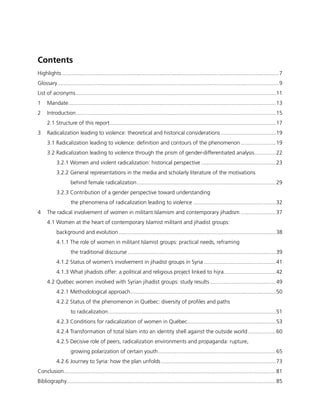
Contents
Highlights...............................................................................................................................................7
Glossary..................................................................................................................................................9
List of acronyms....................................................................................................................................11
1	Mandate.........................................................................................................................................13
2	Introduction....................................................................................................................................15
2.1 Structure of this report.............................................................................................................17
3	 Radicalization leading to violence: theoretical and historical considerations.....................................19
3.1 Radicalization leading to violence: definition and contours of the phenomenon........................19
3.2 Radicalization leading to violence through the prism of gender-differentiated analysis...............22
3.2.1 Women and violent radicalization: historical perspective..................................................23
3.2.2 General representations in the media and scholarly literature of the motivations
behind female radicalization............................................................................................29
3.2.3 Contribution of a gender perspective toward understanding
the phenomena of radicalization leading to violence.......................................................32
4	 The radical involvement of women in militant Islamism and contemporary jihadism........................37
4.1 Women at the heart of contemporary Islamist militant and jihadist groups:
background and evolution........................................................................................................38
4.1.1 The role of women in militant Islamist groups: practical needs, reframing
the traditional discourse..................................................................................................39
4.1.2 Status of women’s involvement in jihadist groups in Syria................................................41
4.1.3 What jihadists offer: a political and religious project linked to hijra...................................42
4.2 Québec women involved with Syrian jihadist groups: study results............................................49
4.2.1 Methodological approach................................................................................................50
4.2.2 Status of the phenomenon in Québec: diversity of profiles and paths
to radicalization...............................................................................................................51
4.2.3 Conditions for radicalization of women in Québec...........................................................53
4.2.4 Transformation of total Islam into an identity shell against the outside world...................60
4.2.5 Decisive role of peers, radicalization environments and propaganda: rupture,
growing polarization of certain youth..............................................................................65
4.2.6 Journey to Syria: how the plan unfolds............................................................................73
Conclusion............................................................................................................................................81
Bibliography..........................................................................................................................................85
7
Highlights
•	 Women are victims of all forms of violent radicalism, but can also be participants, or active
accomplices, of violence in the name of an ideology.
•	 Pursuant to the mandate in the 2015-2018 Government Action Plan, Radicalization in Québec:
Act, Prevent, Detect and Live Together, the Secrétariat à la condition féminine (SCF) and the
Conseil du statut de la femme (CSF) were asked to collaborate in defining the angle and scope
of the present study, whose purpose is to document the differentiated radicalization factors
among women and men in Québec. The CSF and SCF also drew on the expertise of the Centre
for the Prevention of Radicalization Leading to Violence (CPRLV) for empirical information.
•	 Radicalization leading to violence is a complex process whereby people adopt a system of
extreme beliefs and a willingness to use, encourage or facilitate violence, to promote an ideo-
logy, political project or cause as a means of social transformation.
•	 Throughout history, women have been involved in violent radicalism, whether during the French
Revolution, in extreme left-wing or right-wing movements, nationalist groups like the Tamil
Tigers, or revolutionary groups like the FARC in Colombia. The violent radicalization of women
is not a new phenomenon.
•	 Despite the historical presence of women in violent extremist movements, and episodes of poli-
tical violence perpetrated by them, violent radicalism is a marginal phenomenon among women
in comparison to men.
•	 Often viewed through the distorting lens of gender stereotypes and a presumption of passivity,
women who join radical groups, or who engage directly in political violence, should not be
thought of exclusively as victims, since they are also active participants. To understand their
choices, we must explore the particular paths they have taken. The scholarly literature and most
media reports have long seen radical women as manipulated and subservient to men, who are
seen as the “true” drivers and actors of violent radical movements.
•	 The current phenomenon of women involved with jihadist groups in Syria rarely escapes the
interpretive grid by which radicalized young Western women become little more than stereo-
types, naive, manipulated, controlled by romantic urges, dependent on the men who have
indoctrinated them. That approach reduces a complex phenomenon to a caricatural explana-
tion, denying women any form of agency. It also contributes to the belief that women who are
recent immigrants are by definition more submissive toward men than women who are not. In
contrast, a postcolonial approach avoids this simplistic, erroneous view of immigrant women by
considering the perspective of those directly concerned.
8
•	 Beyond the diversity of forms of violent radicalism, the problem of jihadist groups in Syria is the
central issue today. Though there are no official numbers, our study leads us to believe that from
three to seven Québec women have gone to Syria since 2013. This estimate does not include
those who tried to do so but were stopped along the way or eventually gave up on the idea.
•	 To explore the radicalization trajectories of young women who have gone or wished to go to
Syria, the present report draws upon field research conducted in Québec. For that research, we
met with young radicalized women, their families and friends to gain a better understanding
of the paths they had taken, their motivations and the building blocks of their radicalization.
•	 It is important to underline the strongly juvenile dimension of this phenomenon: all the young
women began their radicalization in late adolescence.
•	 Different elements combined to make fertile ground for the radicalization of these young
women. They include individual factors (such as traumatic life experiences), identity problems
common among youth, and other vulnerable areas. In that situation, “total Islam” offers an
answer to needs and vulnerabilities. For some young women, the adoption of a “total Islam”
results in the formation of a “shell identity” that is generally at odds with their family and Wes-
tern society as a whole. And that is the beginning of their radicalization.
•	 The logic of withdrawal into religious identity, a form of identitarian closure, is reinforced by the
presence of a peer group sharing the same politico-religious framework, and by the rhetoric of
charismatic personalities.
•	 To these young women in search of meaning and reference points, the jihadist discourse out
of Syria offers the prospect of an alternative life, despite the extreme brutality of the conflict
awaiting them. Though addressed to both men and women, the jihadist discourse highlights
particular elements for Western women.
•	 Materializing the idea of going to Syria involves preparations, usually made within a small group
of youth, that include certain actions that make it very difficult to turn back.
9
Glossary
Agency: The capacity to define oneself as an active player, and to act on one’s environment to
change it.
Gender: Social process producing differences and hierarchy between women and men, femi-
nine and masculine. This historical, dynamic, cross-cutting process operates in all social spaces
and combines with other power relations (based on class, race, age, etc.) to produce and repro-
duce social inequalities.
Hijra: Arabic term referring to the exile of Mohammed and his followers from Mecca to Yathrib
(later called Medina). This sacred emigration is seen as the birth of the ummah, the community
of Muslim believers. Also translated as “departure”, “rupture” and “separation”, today the
term “hijra” refers to the choice of some Muslims to abandon Western countries for the “land
of Islam”, there to practise what they believe is the “true” Islam. Some jihadist groups use the
notion of hijra to convince potential recruits of the authenticity and religious obligation of going
to Syria, Iraq and other areas where they are active.
Identity-based shell or “shell identity”: Logic by which a person adopts an identity that, in
her eyes, provides her with meaning as well as protection from a social environment that gene-
rates identity anxiety.
Islamic State of Iraq and Syria (ISIS): Armed jihadist group active over large stretches of
territory, primarily in Syria and Iraq, but also Libya. Also known as “Islamic State of Iraq and
the Levant” (ISIL), or simply Islamic State (IS). In summer 2014 the leader of ISIS, Abou Bakr
al-Baghdadi, proclaimed the establishment of a caliphate.
Jihad: Arabic term referring first to a religious duty for all Muslims, to engage in an “effort”
(internal and spiritual) to become a better believer, or to engage in a “struggle” (spiritual or
physical) to be closer to God. Also used in reference to war or rebellion in the Muslim world
(especially in the historical period of Islamic expansion, and the more recent context of anticolo-
nial wars), where it can become a religious obligation. Today it is widely used by jihadist groups
in the sense of “obligatory armed struggle”, to mobilize potential recruits and incite them to
join their armed struggle.
Jihadism: Polymorphic politico-religious revolutionary movement in the form of a violent
radicalism infused with Islamism. Also called “radical Islamism” or “militant Islamism”, this
ultraconservative ideological movement uses armed combat to defend Islam and the ummah
from external threats. The term encompasses a variety of violent clandestine groups, including
Al-Qaeda, Islamic State and their satellite movements.
10
Jilbab: Arabic term designating a feminine Islamic garment in the form of a long robe, often of
plain, dark colours, covering the hair and entire body except the feet, hands and face.
Muhajirat: Honorific Arabic term designating a “migrant woman”, meaning one who has
performed the hijra to an area considered a “true land of Islam”.
Mujahideen: Honorific term of Arabic origin designating those who engage in jihad. In Arabic,
mujahid is the singular form of the term, while mujahideen corresponds to the plural. The latter
form is often used in English for both singular and plural.
Niqab: Arabic term designating the veil and the black Islamic garment covering all of the body
and part of the face, worn by some Muslim women. Associated with conservative religious
groups, including Salafism, the niqab and its variants differ from the hijab and jilbab in that the
niqab almost entirely conceals the face.
Salafism: Fundamentalist Sunni movement that advocates a return to Islamic practice puri-
fied of the innovations attributed to modernity. It claims to follow the practice of the prophet
Mohammed and his companions, referred to as the “devout ancestors” (salaf salih, whence the
term “Salafist”).
Sharia: Arabic term meaning “way to respect the law [of Allah]”. Though often translated
restrictively as “Islamic law”, sharia designates an ensemble of normative and legal principles
(social, cultural and interpersonal) based on the interpretation of prophetic revelation. Sharia
organizes and codifies both public and private aspects of the life of a Muslim believer, including
interactions in society.
Total Islam: A religiosity of rupture born of a desire to make Islam the complete, totalizing and
virtually exclusive foundation of one’s identity and relations in the social world, which is seen
as “impure”. More a matter of identity than spirituality, it is characterized by a rejection of any
social or religious practice that deviates from a supposedly “pure” Islam.
Ummah: Arabic term designating the “community of Muslim believers”, independent of natio-
nal borders, cultures and local contexts, with the implication of international solidarity.
11
List of acronyms
CPRLV	 Centre for the Prevention of Radicalization Leading to Violence
CSF	 Conseil du statut de la femme
ISIS	 Islamic State of Iraq and Syria
SCF	 Secrétariat à la condition féminine
13
1	 Mandate
In June 2015 the Government of Québec adopted a plan to address the problem of radicaliza-
tion leading to violence. Pursuant to the mandate in the 2015-2018 Government Action Plan,
Radicalization in Québec: Act, Prevent, Detect and Live Together, the Secrétariat à la condition
féminine and the Conseil du statut de la femme were asked to collaborate in defining the angle
and scope of the research behind the present report, and to document the differentiated radi-
calization factors among women and men in Québec:
Document the factors that differentiate the process of radicalization leading
to violence among girls and women from that among boys and men. To
enhance the effectiveness of measures put in place, this study will document
and analyze the factors and conditions involved in radicalization leading to
violence, and their influence among girls and women as compared to boys
and men.
To complete this research, the Conseil and the Secrétariat drew upon the services of the Centre
for the Prevention of Radicalization Leading to Violence (CPRLV)1
. The latter’s expertise on the
issues and phenomena of radicalization leading to violence complemented that of the Conseil
on gender-related issues. Additionally, the Centre’s access to unpublished field data provided a
factual and empirical basis for our analysis, whose ultimate purpose is not only understanding,
but prevention. The present report attempts to improve our understanding of radicalization
leading to violence, and its gender dimension, particularly in Québec.
1	 Created in March 2015 by the City of Montréal with support from the Government of Québec, the CPRLV is a non-profit organization devoted to the
prevention of violent radicalization throughout Québec. Structured around three poles (Research, Prevention and Skills Development, and Intervention),
the CPRLV has a research team whose reports and summaries document this phenomenon.
15
2	 Introduction
In spring 2015, several young Quebecers who had set out join a jihadist group in Syria were
arrested at Montréal’s Pierre-Elliott-Trudeau airport. Among them were a few young women.
Months earlier, two other young Québec women had succeeded in reaching Syria along with
other Québec youths.
While many publications have discussed young Western men going to Syria, young women
doing the same have largely been ignored. In Québec, the attempted or successful departures
of youth toward Syria reflect an international trend, a trend with a remarkable feature: the
unprecedented numbers of women who have linked up with militant Islamist groups in Syria
and Iraq, including Islamic State (ISIS), since the beginning of the conflict.
To understand this phenomenon in its Québec strain, specifically with regard to women, we
must answer a number of questions:
•	 Who are these young women?
•	 Why and how were they radicalized to the point of wanting to leave Québec for a country
at war?
•	 What could motivate them to join organizations that are highly inegalitarian (with respect
to gender) and that assign them subordinate social roles?
•	 Should they be seen as victims, or are they active participants in the violent radicalism
of militant Islamist groups in Syria and Iraq?
The present study aims to cast new light on the motivations and trajectories of these young
women, based on interviews with the women themselves, close friends and acquaintances, and
family members.
However, we cannot address this contemporary phenomenon without placing it in the broader
context of women’s historical involvement in violent radicalism, and recognizing the failings of
conventional discourse on the matter. This detour will help us avoid simplistic interpretations,
preventing any lapse into caricature or Manichaeism.
Despite their participation in various forms of radical violence, women are often the first targets
of violent radicalism. Particularly common, virulent and disturbing are hateful statements about
women. The assassination in June 2016 of British Labour MP Jo Cox, by a right-wing extremist
(Trilling, 2016), illustrates the violent hatred that can target women, especially when they are
16
in public office2
. At a global level, sexual violence (rape, forced marriage, sexual slavery) and
gender-based violence by violent extremist groups (Atwell, 2014) illustrate the brutality and sys-
tematic targeting of which women can be victims (Poloni-Staudinger and Ortbals, 2013b). The
plight of Yazidi women systematically raped by ISIS in Iraq, and of Nigerian women kidnapped
by Boko Haram, illustrates the ideological violence exercised against women. In Québec, on
multiple occasions women have between the targets of anti-feminist terrorist violence, such
as the massacre at École Polytechnique on December 6, 1989 (Perreault, 2011; Blais, 2009).
This anti-feminist violence driven by ideological discourse is still relatively unstudied in Québec
(Lamoureux and Dupuis-Déri, 2015).
Nonetheless, women’s involvement in violent radicalism and violent extremist movements is
a key issue, particularly in the current world context. At a time when hundreds of Western
women, since 2013, have left home to join jihadist groups in Syria or Iraq, the question of their
motivations and how they became radicalized has never been more important.
While radicalization associated with jihadism or militant Islamism3
is today the most visible and
most publicized form of violent radicalism, women’s radicalism cannot be reduced to that one
form. On the contrary, historically women have been involved in a variety of causes (nationalist,
political, religious, etc., including the fight for their rights and emancipation), sometimes using
violent means (Bearman, 2005) or directly participating in armed clandestine groups. Women’s
involvement as social actors of ideological violence has long been swept under the rug, because
it threatens our preference for the illusion that violent radicalism is exclusive to men (Autcher,
2012, p. 125; Felices-Luna, 2008, p. 164).
That approach to the radical involvement of women in violent extremist groups is still present
today. Witness public and media discourse on the “exceptional” nature of Western women
joining ISIS and similar groups. In reality, women’s participation in jihadism is disconcerting pre-
cisely because it calls into question the old notions about femininity, which should of course be
non-violent (Cardi and Pruvost, 2011, p. 3).
Why some Québec women choose to engage in violent radicalism is both a social and a scho-
larly issue. As Cardi and Pruvost point out (2012, p. 56), focusing on women means setting
aside the supposition behind much research on violence, which only discusses violence in the
masculine, never questioning its gendered dimension, taking masculine violence as the standard
and only mentioning the minority participation of women as an aside.
2	 In a similar vein, after Richard Baine attempted to assassinate Pauline Marois (then Premier of Québec) in September 2012, he referred to her as “the
bitch” (Desjardins, 2016).
3	 Here we define “militant Islamism” as a violent form of Islamist activism that seeks to impose a literalist interpretation of the Koran while defending Islam
and the ummah from perceived threats against them. Unlike other Islamist movements, such as the Muslim Brotherhood and some salafist movements,
militant Islamism is predisposed toward armed violence. In the present report we use the expression ”militant Islamism” as a synonym for “jihadism”.
On this point, see Benichou, Khosrokhavar and Migaux (2015), Khosrokhavar (2009) and Brachman (2008).
17
As myths, stereotypes and media representations circulate about the several hundred Western
women who have gone to Syria and joined the jihadists, it seems to us essential to try to unders-
tand the motives and explanatory factors behind the radicalization of these girls and women.
What mechanisms and processes lead them to become radicalized and to join such groups?
Who are these women who radicalize to the point of risking their safety and well-being? Above
all, how shall we understand the gender dimensions of the current phenomena of violent radi-
calization?
Until now, documentation of the radicalization of girls and women in Québec, with a gen-
der-differentiated perspective, has been non-existent. We therefore decided that it was essential
to do more than offer a summary document, by exploring empirically, across Québec, the radi-
calization of women who have joined, or tried to join, jihadist groups in Syria and Iraq.
2.1	 Structure of this report
The present report has two main sections, each containing two chapters. The purpose of the
first section is to better define the composition and contours of “radicalization leading to vio-
lence”. Its first chapter (3.1) clarifies the concepts and definitional issues around such radicaliza-
tion. Its second chapter (3.2) demonstrates the value of approaching the topic from the angle of
gender and gender-differentiated analysis. After a historical review of feminine involvement in
violent radicalism, it outlines how the phenomenon is generally treated in the media and scho-
larly research, and shows the nuances to be gained from a postcolonial perspective on gender.
The second section, containing the third and fourth chapters, deals more precisely with women’s
involvement today in radical Islamism and certain jihadist groups. Based on a comprehensive
review of the literature on radicalization leading to violence from a gender perspective, the third
chapter (4.1) offers a status report on what is known internationally about women’s involve-
ment in radicalization leading to violence. Pointing out the strengths and limitations of existing
knowledge, the literature review suggests the theoretical and empirical contributions that femi-
nist research can make to this subject.
The fourth and last chapter (4.2) presents a description and analysis of the radical involvement
of Québec women in Islamism. Based on unpublished empirical data from a field study conduc-
ted in Québec, this chapter draws connections between the empirical reality in Québec and the
theoretical elements discussed earlier, for a better understanding of why some Québec women
have wanted to join jihadist groups in Syria.
Two points must be clarified before we proceed to the heart of this report. First, while radica-
lization leading to violence can occur for many reasons (politico-religious conflicts, right-wing
extremism, antifeminism, homophobia, etc.) and in a variety of geographic and political spaces,
the unprecedented involvement of European and North American women with militant Islamist
18
groups in the Levant raises questions about the dynamics behind it. The second section of this
report is therefore focused on that precise phenomenon. We do not however mean to minimize
the involvement of Québec women in other forms of violent radicalism (extreme right, extreme
left, specific causes, and so on), but simply to focus on this form as a case study.
Next, our study focuses on women, as opposed to being a comparative analysis, due to time
restrictions and the limitations of our field study, i.e. the fact that we did not have the means
to obtain sufficient empirical material to compare the radicalization paths of men and women.
It must be said that the smaller amount of work on women and radicalization may justify devo-
ting some research entirely to women. Our analysis does however take a gender perspective,
viewing gender categories as mutually dependent and organized hierarchically. Nevertheless, a
genuinely comparative approach is definitely needed, as part of a deeper exploration of radica-
lization leading to violence, in all its forms.
19
3	 Radicalization leading to violence: theoretical
and historical considerations
3.1	 Radicalization leading to violence: definition and contours of
the phenomenon
There is no universally accepted definition of radicalization leading to violence (Gemmerli,
2015). As with other terms and concepts circulating in the public space (“terrorism”, “demo-
cracy”, “crime”, etc.), “radicalization” is vague and prone to definitions that are sometimes
convergent, sometimes contradictory (Schmid, 2013; Neuman, 2013; Kundnani, 2012;
Githens-Mazer, 2012; Sedgwick, 2010). At once a secular and a scholarly concept (Brie and
Rambourg, 2015, p. 10), radicalization leading to violence is today used to mean the process
of people who become “radically” engaged in a violent logic in the name of a cause, ideology
or militant line of action.
The CPRLV defines “radicalization leading to violence” as a process whereby “people adopt
extremist belief systems – including the willingness to use, encourage or facilitate violence
– with the aim of promoting an ideology, political project or cause as a means of social trans-
formation4
”.
It is important to distinguish “radicalization” from “radicalization leading to violence”. In some
contexts, “radicalization” can have a positive connotation (Neumann, 2013). On its own, it desi-
gnates a rejection of the status quo and a shift from moderate points of view to less consensual
opinions, without necessarily leading to violence (Bartlett and Miller, 2012). In contrast, at the
heart of the process of radicalization leading to violence there is a logic of rupture and radical
ideological drift that can lead a person to consider the use of violence against others – hateful
acts, physical or verbal aggression, terrorist acts, etc. (Mandel, 2010).
As for “radicalization leading to violence”, it refers to the concomitance of two phenomena:
•	 the adoption of an ideologized reading of the world whose logic becomes a framework
for life, action and meaning (Crettiez, 2015). Radicalization is then a process of with-
drawal into ideological certainties, accompanied by a totalizing and exclusive way of
interpreting the world (Bronner, 2009);
•	 a belief in the use of violence to promote that vision of the world (Crettiez, 2015).
Violent radicalization is in effect the moral legitimation of violence for the sake of an
ideology, political project or cause as a means of social transformation (Atran, 2006).
4	 Centre for the Prevention of Radicalization Leading to Violence: http://bit.ly/2eEq2Fs.
20
While violence is not necessarily used by all radicalized people, the latter see violence
as a legitimate means by which to defend their cause or ideological view of the world
(Hafez and Mullins, 2015, p. 960), whether they use it themselves or justify its use by
others (Fiske and Rai, 2015, p. 104).
Thus, radicalization leading to violence refers to the fusion between a radical commitment to
an ideologized reading of the world and the moral belief that violence is a legitimate mode
of action to defend it. Individuals engaged in a process of radicalization leading to violence
become radically convinced that the ideology, cause or belief system they have embraced is
exclusive and total, and therefore they may encourage, facilitate or exercise violence in its name.
Here we must emphasize that radicalization leading to violence cannot be reduced to a problem
of mental health. While mental health may be one of many factors in certain radicalization pro-
cesses, published studies provide ample evidence of the psychological “normality” of people
on radicalization trajectories (Horgan, 2004, p. 59; Silke, 2008, p. 30). On the other hand, we
cannot ignore the psychological vulnerabilities (distress, depression, identity anxiety, etc.) that
can provide fertile ground for the dynamics of radicalization. Similarly, it would be a mistake to
confuse radicalization leading to violence with the things that can happen in cults. While there
are common elements between the two, not all radicalization has to do with manipulation, the
mental stranglehold (Benslama, 2016) by which a person is controlled and deprived of free will.
To reduce violent radicalization to an effect of manipulation would depoliticize and individualize
a phenomenon that is, by definition, political and social (Crone, 2016).
For over a decade, studies on radicalization have shown that it is impossible to establish stan-
dard profiles of individuals or groups that would be more vulnerable or more inclined to the
logic of potentially violent radicalization (Rae, 2012; Horgan, 2008; Borum, 2007). This raises
the question of how ordinary people come to be mobilized in this way, whether to join violent
extremist groups or to perpetrate violence directly in the name of a cause, ideology or set of
beliefs.
Based on the foregoing, we believe that the process of radicalization leading to violence should
be thought of as complex, emergent, nonlinear and dynamic:
•	 A complex process: no single factor can explain radicalization among young Quebe-
cers. Nor are there any deterministic causes, whether economic, cultural, political or
social (Campana and Lapointe, 2012; Crettiez, 2011, p. 48; Amghar, Boubakeur and
Emerson, 2007, p. 55; Bjørgo, 2004, p. 257), any more than there is one explanatory
factor for all, whether social insecurity, family problems, discrimination, marginalization,
exposure to extremist ideologies, and so on. In sum, there is simply no homogeneity
in the paths of radicalization leading to violence (Klausen et al. 2015). To understand
this phenomenon, we must take into consideration an array of factors, mechanisms
21
and contexts that produce, by convergence and cumulativity, what some refer to as the
perfect storm (Dawson, 2013) causing some individuals to embark on the process. A
contributing factor in one person’s radicalization – being socially marginalized or having
gone through a traumatic period, for example – would not necessarily be present in
someone else’s trajectory. So there is no general explanatory model for the processes of
radicalization leading to violence, but rather a variety of models for describing, docu-
menting and explaining them;
•	 An emergent process: radicalization leading to violence cannot be reduced to a per-
son or context, but rather emerges from the intersection of both elements. Radicaliza-
tion cannot be considered a stable essence: it is instead an emergent process in which
contingency plays a major role, in both the individual and the environment (Bouhana
and Wikström, 2011). So there are no personal characteristics or specific contexts that
predetermine the gradual slide of a person or group into a logic of violent radicalization;
•	 A nonlinear, dynamic process: it is important to note that the process of radicali-
zation leading to violence is not linear, but dynamic (Davis and Cragin, 2009, p. 467;
Horgan, 2008). A given person’s radicalization trajectory does not necessarily consist
of the same steps or the same conclusions as that of another person. With this in
mind, it is crucial to distinguish the radicalization process from the transition to vio-
lence (Horgan, 2008, p. 84). A person may very well be radicalized, and believe in the
legitimacy of violent action, without ever committing or participating in violence (Hafez
and Mullins, 2015, p. 961; Khalil, 2014). In short, the elements involved in processes of
radicalization are not necessarily the same as those that lead to engaging in violence or
concrete action with violent extremist groups. This distinction is all the more important
in the case of women, who are rarely directly involved in perpetrating violent acts, yet
can be stakeholders in the objectives of violent extremist groups.
22
3.2	 Radicalization leading to violence through the prism
of gender-differentiated analysis
Why approach this subject from the angle of gender and gender-differentiated analysis? As Sjoberg
and Gentry point out (2011, p. 2), violent women are violent people, and like all people, they live in
a gendered world. By studying the phenomena of violent radicalization through the prism of gen-
der, we have a better chance of understanding how they develop in a social world that is different
for men and women.
Gender designates the social process by which differences and hierarchy are produced between
women and men, feminine and masculine. This historical, dynamic, cross-cutting process is
present in all social spaces and combines with other power relations (based on class, race, age,
etc.) to produce and reproduce social inequalities. Examining radicalization leading to violence
from a gender perspective, using gender-differentiated analysis, means paying closer attention
to its gendered dimension and to the social logics that produce gender-differentiated radica-
lization paths.
Examining the radicalization of women toward violence raises the taboo issue of the use of
violence by women. Because of this taboo, violent acts by women are either exaggerated or
euphemized. On one hand, defining women as non-violent has the effect of removing violence
as a resource they can use. On the other hand, accepting the use of violence by women as pos-
sible and desirable would mean saying that access to violence is a social progress, validating the
idea of women becoming aligned with masculine stereotypes (Cardi and Pruvost, 2011, p. 6).
Regardless of the nature of the act, violent political radicalism by women is generally considered
exceptional:
Social organization is based on the material and symbolic presentation of
a bipolarity that distributes tasks and stereotypes, opposing nature/culture,
private space/public space, life-giving/death-giving, strength/weakness,
virility/femininity, masculine/feminine. This sexual division of roles, stereotypes
and symbols restricts women to being peacemakers, not warriors. (Cardi and
Pruvost, 2011, p. 4) [Trans.]
Consequently, women’s participation in terrorist activities or in various forms of violent radica-
lism is associated with disorder, a situation of abnormality. While women terrorists are deemed
“abnormal” relative to female sexual stereotypes, men are not evaluated the same way relative
to masculinity (Bugnon, 2015, p. 19). Violent radical involvement by women contradicts the
gendered perception of a sexual division of violence, which is traditionally seen as the preserve
of men (Bugnon, 2015, p. 24-27). And yet, from the vandalism of suffragettes to suicide bom-
bings by women, the spectrum of female political violence is in reality large and diverse.
23
To avoid reviving reductive preconceptions, the result of stereotyped representations by which
women are naturally less violent than men or only use violence in self-defence, we begin by
showing the historical depth of women’s involvement in radical, at times violent, forms of mobi-
lization. We then examine how violent female radicalization is presented in the media and
scholarly literature, before discussing the contribution of a gender perspective and gender-diffe-
rentiated analysis. By choosing an analytical framework that makes room for women’s agency
and a postcolonial perspective on gender, this shift of focus offers a fresh perspective on the
phenomena under study.
3.2.1	 Women and violent radicalization: historical perspective
Though not to the same extent as men, women have long been involved in violent action, in
the name of a great variety of causes and ideologies. Examples include the role of women
in anarchist groups throughout the 19th
and 20th
centuries, their involvement in Palestinian and
left-wing terrorist groups from the 1960s to 80s, and their presence in nationalist groups that
have resorted to violence, such as Basque Homeland and Liberty (Euskadi ta Askatasuna or ETA)
in Spain, the Kurdistan Workers Party (Partiya Karkerên Kurdistan or PKK), and the Tamil Tigers in
Sri Lanka. To put to rest the belief that women have not been active in violent radical groups, we
offer below a historical review to provide context for a phenomenon that too often is presented
as solely contemporary.
3.2.1.1	 Revolutionary women (from the 18th
to the 20th
century)
Historically, the presence of women in violent radical groups has often been limited to subor-
dinate or peripheral roles rather than direct involvement in violent action. The few attempts at
independent organization by women in the revolutionary movements of the 18th
to 20th
centuries
generally ended with the women concerned being called to order or marginalized. In the French
Revolution for example, some women initially took part in the fighting and political delibera-
tions, before being relegated to roles like laundress and canteen-worker by a decree of 1793
(Godineau, 2004, p. 5). The exclusion of women revolutionaries from the military was followed
the same year by a ban on women in political clubs.
The violent anarchist radicalism that developed in the 19th
century, radical in discourse as in
action, soon considered violence the only way to overthrow the European and Russian monar-
chies and the nascent capitalist model, seen as a synonym for oppression of the lower classes.
Initially playing a support role in these anarchist movements, especially in the Russian country-
side where they focused on peasant education, some women also joined in terrorist activities,
including the assassination of dignitaries and heads of state such as Tsar Alexander II.
In England at the beginning of the 20th
century, suffragettes demanding the right to vote orga-
nized actions that were at times spectacular and often illegal. They demonstrated by marching
in formation (echoing masculine military culture), chaining themselves to monuments and the
24
gates of Parliament, breaking windows in the streets of London. Often their demonstrations
were violently repressed. According to Bard (2014, p. 216), media attention increased as the
suffragettes showed their ability to defend themselves against the forces of order. In 1913-
1914, a more radical wing conducted a campaign of vandalism. For Bard (2014, p. 222), the
increasingly brutal repression led to public opinion progressively aligning with the suffragettes.
Their violence seemed modest compared to that of men in those days. The violence of the mili-
tants was directed against property, not against people, yet it deeply shocked Victorian society,
which saw women as fundamentally different from men and naturally non-violent.
As Bugnon points out (2015, p. 61), it is not the legality or illegality of violence that determines
the reaction to it, but rather the legitimacy or non-legitimacy of violence in the sexual hierarchy:
for a woman to claim the right to use violence remains controversial.
After the reaffirmation of sexual division in the 19th
century, it was difficult for women to enter
trades involving coercion. Progressive openings appeared in the 20th
century for women who
wished to join the police or the army. In France, the first women began working for the police
in 1934, but in roles closer to social work than maintaining public order. In Québec, the first
policewoman was hired in 1975, in an office job, before the National Assembly repealed the
regulation restricting police work to men (Beauchesne, 2009, p. 29-32). In France, not until
1983 were women present in all police services (Bugnon, 2015, p. 57-59). Trades involving the
exercise of legitimate violence were thus among the last to be opened to women, in large part
because of the taboo against female violence. The integration of women into radical political
groups underwent a similarly slow evolution, over the course of the 20th
century.
3.2.1.2	 Post-war movements: liberation, revolution and ethno-separatism
After World War II, the colonies of the great powers began to demand self-determination and
independence, which sometimes resulted in national liberation struggles. Some parts of the
world experienced separatist conflicts and anti-colonial movements. These new forms of radica-
lism often gave rise to radical groups and violent actions in which women increasingly took part,
demonstrating the historical reality of their involvement in violent radical groups.
In Algeria, though men comprised the majority of combatants in the National Liberation Front
(Front de Libération Nationale – FLN), women not only provided logistical support (caring for the
wounded, cooking, supplying the troops, sheltering combatants), but also engaged in guerrilla
activities (notably as field cooks), while also participating in combat, whether by transporting
weapons or planting bombs. As noted by Prazan (2012, p. 72-73), in 1957 the FLN began
training schoolgirls in intelligence gathering. This type of work was considered ideal for young
women, since they were less likely to be searched or monitored by colonial forces.
25
Amidst long-standing tensions and conflicts between the British colonial power and the Irish
population, the Irish Republican Army (IRA) arose, together with its feminine counterpart,
Cumann na mBan, which provided logistical and tactical support (Bloom, Gill and Horgan,
2012, p. 60). Women have always played a role in this conflict, to a greater or lesser extent in
different periods. They were particularly important in the 1970s and 80s, when a scarcity of
male militants led to an increase in the presence of women in IRA activities (Bloom, 2011b,
p. 88). The women of Cumann na mBan have on average represented just 4.9% of the IRA, but
they have performed a great many support tasks, supplying and feeding their male comrades,
carrying out intelligence missions, serving as sentinels or decoys (Bloom, 2011b, p. 86). Howe-
ver, only a small minority of IRA women were directly involved in violent action. A few were
snipers, assembled and planted bombs, and carried out assassinations.
In the 1950s, Colombia underwent a period of civil war known as “La Violencia”. The conflict
lasted a decade, at the end of which the rebel fighters were driven into the depths of the jungle.
There, as the armed branch of the Colombian Communist Party, they became the Revolutionary
Armed Forces of Colombia (Fuerzas armadas revolucionarias de Colombia, or FARC). Starting
in 1982, leader Jacob Arenas transformed and expanded FARC, in part by extending recruiting
to women. Herrera and Porch (2008, p. 612-613) state that women came to represent 20% to
40% of FARC’s total strength, the largest female contingent in any such group. The decision
to extend recruiting to women was based on multiple factors. The presence of women legiti-
mized the communist and revolutionary doctrine of gender and class equality; strengthened
and stimulated the courage and commitment of the male contingent; softened the image of
the rebels; and ensured a constant influx of both male and female combatants. The presence
of women also represented a practical and propaganda tool that was essential to the group’s
cohesion and the legitimation of the struggle (Herrera and Porch, 2008, 613-614).
Shining Path, a revolutionary Peruvian movement, developed along analogous lines. Essentially
masculine at first, it saw women playing an ever greater role as male fighters died in combat.
Women were also involved in propaganda and recruiting, besides taking part in violent action
(Gausvik, 2010, p. 2; Felices-Luna, 2008).
The role of women in separatist and nationalist groups has undergone transformations conco-
mitant with those affecting women generally in the countries concerned. In the Basque Country,
ETA arose in 1959 under the Franco dictatorship, its goals being to preserve the Basque identity,
threatened by a prohibition against the Basque language, and to protect the traditional, rural
way of life. It was initially a peaceful organization, painting protest graffiti and flying the Basque
nationalist flag (Hamilton, 2007, p. 134-135). Up until the 1960s, women in Basque society were
essentially limited to domestic functions. Their absence from higher education and the intellectual
professions was reflected in ETA, which primarily recruited from university circles. Not until the late
70s and 80s, with the end of the dictatorship, would women gain access to all social spaces in
26
Spain, including the political sphere. In parallel, increasing numbers of women began to join ETA,
though Hamilton (2007, p. 135) estimates that they were never more than 10%. Women also
rose in the organizational hierarchy, and were increasingly involved in violent action. In counterpo-
int, the 80s and 90s saw growing numbers of ETA women being killed or imprisoned.
In Asia, the conflict opposing the government of Sri Lanka and the Tamil Tigers, an ethno-
separatist group, caused over a hundred thousand deaths over three decades, ending in 2009.
Not only was this conflict particularly lethal, it was striking in the extent to which women were
directly involved in violent action (Wang, 2011, p. 101). The Liberation Tigers of Tamil Eelam
(LTTE, or Tamil Tigers) arose in 1976 in a climate of ethnic tensions. Initially their objectives did
not include the emancipation of women, but practical considerations changed this. According
to Wang (2011, p. 102), at first women were limited to administrative and support tasks. They
began to play a greater role after a series of setbacks in the mid-1980s.
Beyond their desire for political independence, Tamil women were motivated to fight by the
sexual abuse they suffered at the hands of the Indian and Sri Lankan military. This led to many
women joining the Tigers, counter-balancing the extensive losses of male fighters to death or
imprisonment. Many women also volunteered for the Black Tigers, an elite unit charged with
suicide missions. Though women represented 15% to 20% of the total fighting strength of
LTTE, they comprised 33% of the Black Tigers and carried out 30% of their suicide attacks
(Stack-O’Connor, 2007, p. 53).
3.2.1.3	 Left-wing terrorism (from 1970 to 1990)
In parallel to the forms of terrorism discussed above, during the 1970s and 80s Europe
underwent a period of Marxist-Leninist revolutionary fervour, particularly in France, Germany
and Italy. Initially expressed through demonstrations and protests, this left-wing radicalism was
quickly viewed by the authorities as a form of terrorism. Rooted in an ideological universe
that was strongly inspired by gender equality and emancipation from patriarchal models, these
groups attracted a significant proportion of women.
Also known as the Baader-Meinhof Gang, the Red Army Faction (Rote Armee Fraktion or RAF)
was emblematic of the reformist and revolutionary fervour that arose in response to the difficult
economic conditions in West Germany at the end of the 60s (Stefanik, 2009). Gudrun Ensslin,
a militant student, with her partner Andreas Baader, created the RAF in 1970, supported later
by another woman, Ulrike Meinhof, a left-wing journalist with considerable influence in West
Germany. The presence of women at the group’s creation is one of the unique facets of the New
Left in Europe. According to Stack-O’Connor (2007, p. 47), women played a crucial role in both
formulating ideology and perpetrating acts of violence. Thus, Ensslin, Meinhof and their many
female collaborators (estimated at 33% of total members) were behind numerous terrorist
attacks and other violent actions (Stefanik, 2009, p. 72-73).
27
In Italy, the Red Brigades (Brigate Rosse) arose in a context analogous to that of the RAF. From
the very beginning, the Red Brigades included a significant number of women and gained a
reputation for extreme violence due to the frequency and effectiveness of their attacks. Accor-
ding to Stack-O’Connor (2007), over the ten first years of its existence the group carried out
some 14,000 attacks. Women in the Red Brigades took part in direct violent action and held
positions of political and administrative leadership. As Gray notes (2015, p. 48), from 1970 to
1984 a quarter of all left-wing terrorists were women. She further specifies that from 1969 to
1989, out of 4087 individuals investigated in connection with left-wing terrorist crimes, 945
were women.
3.2.1.4	 Women involved in right-wing extremist violence
A variety of right-wing extremist groups are present in a certain number of Western countries.
They constitute another category of extremist movement, at times violent, in which women
are sometimes involved. Despite their misogynist and conservative ideological universe, radical
right-wing movements do include women, though generally to a lesser extent than comparable
left-wing groups.
In the United States, the birth of the far right is generally associated with that of the Ku Klux
Klan (KKK) after the American Civil War, in reaction to the emancipation of slaves. Women
were at first excluded from the group. In the 1920s the KKK, whose popularity had fallen by the
turn of the century, grew again to become a mass movement. It even had regional antennae
in Canada, notably in Québec and the West during the same period (Bérubé and Campana,
2015, p. 217). Female branches of the KKK, called the Women’s Ku Klux Klan (WKKK), grew
to the point of having a chapter in nearly every American state. Unlike their male counterparts
however, women only served as activists, organizers and militants, being chiefly involved in pro-
tests, propaganda and the organization of community events. Violent action was the exclusive
domain of KKK men (Blee, 1991, p. 63).
American right-wing extremist groups5
entered a new golden age after 2008, in the midst of
a serious economic crisis, with the election of Barack Obama, the first Afro-American to reach
the presidency. The Southern Poverty Law Center, an independent body that tracks hate groups
in the United States, estimates that hate activity peaked in 2011, with over 1000 active groups.
Since then, a slight decline in the number of groups has been noted each year, with a gradual
shift toward solitary or online extremist activities outside of the framework of any organized
5	 Bérubé and Campana (2015, p. 216) speak of right-wing extremist groups, an expression encompassing an array of disparate currents: neofascists,
neonazis, vigilance groups such as patriotic militia, racist and supremacist groups, millenarians, Christian groups of the Christian Identity Movement,
ultranationalists, survivalists, skinheads, anti-government groups, and so on.
28
group. At the same time, some of the demands of right-wing extremist groups have lost popu-
lar support, such as opposition to same-sex marriage, which is becoming less and less divisive.
However, more recently a resurgence of racist groups has been observed, channelled by groups
opposed to the movement Black Lives Matter (BLM) (Potok, 2014).
In Europe, right-wing extremist groups reappeared in the 1960s in reaction to the social protest
movements of the previous decades and the gains they had made. Those gains, in particular
the emancipation of women, were seen as a threat to male power and the traditional values
associated with it. In Germany, France and Italy especially, Europe saw the rise of a right-wing
extremism that was violent in both words and actions. However, Mushaben (1996, p. 251)
considers that women played a minimal role in such movements, 95.5% of the violence being
committed by men.
In sum, women’s involvement in right-wing extremism has been relatively slight compared to
other forms of violent radicalism. The negative perception of women’s emancipation, seen as
incompatible with traditional values and the gender hierarchy, necessarily limits feminine enga-
gement. Nevertheless, some extreme right-wing groups do manage to attract feminine support
through a discourse designed to stir up fears that women and their families are under threat
from the bugbears of the day: immigrants, Muslims, and so on. Thus, if some women become
involved with right-wing extremist movements, it is more often out of fear (through a logic of
closure) than the ideological motivations seen with men. This is reflected in the roles they are
given within such groups, involving reproductive and support tasks (Blee, 1991, p. 71-72).
3.2.1.5	 Historical overview of women’s presence in militant Islamist groups
Among the militant Islamist groups that began to appear in the 1990s, the role of women has
evolved considerably over the last two decades, depending on the contexts and movements
concerned. Though virtually invisible in militant Islamist and jihadist groups in Afghanistan,
Algeria and the Persian Gulf states, women are increasingly present in militant Islamist groups
of the nationalist type, as in Palestine or Chechnya, though they are not considered equal to the
men. Characterized by an ultraconservative vision of the world, the militant Islamist groups that
arose in the 90s accord no particular place to women, using religious arguments to justify their
exclusion from armed combat or full participation in activities other than domestic.
The classic texts on the legitimacy of armed struggle from an Islamic point of view say little
about the role of women, or about the place they should be given in militant Islamist groups
(Cook, 2005, p. 376). However, due to the growing involvement of women in certain groups,
the justifications for women engaging in this type of activism are undergoing a transformation.
In reality, feminine mobilization explicitly oriented toward violent action tends to follow from
the practical needs of Islamist groups involved in the fighting, including pressure on the male
contingent (arrests, profiling, etc.). Since women arouse less suspicion, they become tactical
29
assets for violent groups, which are generally weaker and have less popular support than the
regime they are fighting (Bloom, 2011a, p.11). But while the logic of mobilizing women initially
derives from pragmatic needs, it is quickly accompanied by theological and ideological justifica-
tions of Islamist inspiration (Cunningham, 2007, p. 85 ; Segran, 2013).
Though often very present in Islamist movements in Palestine, such as Hamas and Islamic Jihad,
women play only a supporting role, coming to the fore solely when strategic necessity so requires.
Indeed, militant Palestinian Islamist groups are careful to avoid giving women important roles,
so as not to put their male combatants in a situation of shame or competition. This tendency
is even stronger in Chechnya, where women have played a significant role in militant Islamist
groups as actors of violence (committing 43% of the suicide attacks, according to Vogel, Porter
and Kebbell (2014)), but are kept nonetheless in positions of inferiority (Speckhard, 2008, p.
999). In Palestine as in Chechnya, while women’s involvement in violent radicalism often has
practical dimensions, the justifications for their direct involvement in violent action are drawn
from a specific cultural and religious framework that differs from that of the jihadist groups we
will discuss further on. As we will show in section 4.1, women do not initially play a meaningful
role in the jihadist movement. Their presence evolves in tandem with the contexts and practical
needs of specific groups that then set out to mobilize them actively.
Women’s involvement in violent radicalism, then, is not just a contemporary phenomenon
(Schraut and Weinhauer, 2014). And yet, whereas men’s involvement has been not only socially
visible, but the subject of extensive scholarly interest, the political violence of women6
does not
seem to have received comparable attention (Cardi and Pruvost, 2012; Regina, 2011). As with
female criminal offenders (Bertrand, 1979, 2003), women engaged in violent radicalism have
long been considered a non-object, a marginal phenomenon of little importance from either a
social or a scholarly point of view (Crelinsten, 2007, p. 229). At odds with this historical logic,
for nearly a decade there has been an awakening of interest in questions concerning the poli-
tical violence of women, the feminine presence in violent radical groups, and violent radicaliza-
tion through the prism of gender (Herschinger, 2014; Schraut and Weinhauer, 2014).
3.2.2	 General representations in the media and scholarly literature
of the motivations behind female radicalization
Despite the persistent presence of women in violent radical groups throughout history, as shown
by the historical panorama above, the dominant social representations of that presence, in both
the media and scholarly research, still tend to be simplistic (Bloom, 2011b, p. 33; Laster and
Erez, 2015, p. 91). For Cardi and Pruvost (2011), the standard discourse about violent female
radicalization consists of a few, often contradictory, explanatory archetypes:
6	 By “political violence of women” we mean violence exercised by women in the name of an ideology, cause or political view of the world.
30
•	 biological elements (a disruption of nature or the expression of a physiological
abnormality);
•	 psychological elements (emotional instability, individual malaise);
•	 cultural elements (practices specific to a culture, an ethnocentric response to an exoge-
nous group);
•	 feminist elements (victims of a greater (patriarchal) system, sign of emancipation,
appropriation of power).
To illustrate, discussion of women in contemporary jihadist groups, whether ISIS today or
Al-Qaeda previously, tends to essentialize the phenomenon on the basis of gender stereotypes,
as shown by Navest, De Koning and Moors (2016, p. 22). Women who choose to go to Syria
and Iraq are quickly labelled “jihadist brides” performing “sexual jihad”. This last expression,
repeated by a series of newspaper articles, particularly regarding Tunisian women who had
gone to Syria, reduces all young women who voluntarily join jihadist groups to the status of sex
slaves or naive young girls (Navest, De Koning and Moors, 2016, p. 22). Denying any agency to
women, concealing the diversity of radicalization trajectories among women who join jihadist
groups in Syria and Iraq, this public and media discourse is also tinged with a form of orientalism
that essentializes women in the Arabo-Muslim world. When not described by stereotypes, they
are still reduced to naive women, followers and fangirls (Huey and Witmer, 2016).
Despite its persistence in the media, that simplistic reading is now being critiqued in university
research (Huey and Witmer, 2016, p. 2; Saltman and Smith, 2015, p. 42 ; Navest, De Koning
and Moors, 2016, p. 22) that refutes its veracity, and above all its capacity to throw light on the
underlying mechanisms of the logics of radicalization associated with jihadist groups in Syria.
Nowadays, the debate is more about the motivations and processes of women’s involvement in
this violent radicalism. Researchers working to understand the phenomenon are unanimous in
underlining the central role of women as militants, propagandists and recruiters for the jihadist
cause (Al-Tabaa, 2013; Cragin and Daly, 2009; Von Knop, 2007).
The gendered dimension of the process of radicalization leading to violence has still received
relatively little attention. Thus, the literature on radicalized women is often limited to the ques-
tion of terrorism, direct participation in armed struggle or violent action, without examining the
less spectacular types of involvement that women may accept in extremist groups. Research
on radicalized women, or on women involved in violent extremist organizations, often tries to
establish their intrinsic motives and to determine whether they are different from those of men
(Noor and Hussain, 2010, p. 1-4; Saltman and Smith, 2015, p. 8-13). A few texts, mostly by
women, have been devoted to these questions in the last few years.
31
According to Speckhard (2008, p. 1002), men and women share most of the motivations that
lead them to engage in violent radicalism. The principal differences are more between women
in conflict zones and women in areas at peace. In most cases, women’s involvement in violent
radicalization is not due to coercion, particularly when they live in pacified areas. Various factors
can explain the radicalization paths of such women: alienation from the host society, margina-
lization, lack of a positive identity, desire for adventure, or a need to purify a self perceived as
corrupted.
Conversely, those factors would not be the most important for women living in a context of
war, or who are in situations where they may themselves suffer violence, whether directly (rape,
torture, etc.) or indirectly (death or disappearance of a loved one). Speckhard notes that in some
contexts, female suicide bombers often act in revenge, to punish people who are seen as their
direct enemies. In conflict zones, the motivations of female suicide bombers sometimes stem
from a traumatic experience, or are fed by a desire for revenge after suffering direct violence or
a humiliation. The traumas of armed conflict would thus represent an important factor in the
violent radical involvement of both women and men in the context of war or violent conflict.
Author of several academic works on this question, Mia Bloom (2011b) summarizes the reasons
for women’s radicalization by what she calls the 4 Rs: revenge, redemption, relationship and
respect. She also adds a fifth: rape. In some morally conservative societies, violent extremist
groups take advantage of the rigid concept of “honour” to recruit women, often so as to have
them commit a suicide attack. Thus a woman who is a social outcast, for having been raped for
example, is offered redemption by becoming a martyr. Her death in a suicide attack will not only
allow her to restore her honour (and that of her family), but even to become a local heroine.
In a manner of speaking, she will have more value dead than alive (Bloom, 2011b, p. 8). These
ideas offer a relatively good explanation of the violent radicalization of women during war or
in areas where violence is a part of daily life. But they do not work as well when it comes to
women living in societies that are at peace, particularly when they are democratic and liberal.
Another idea proposed by Bloom (2011b, p. 10): the fact that some women live in contexts
where they are relegated to the domestic space, their only contacts being with family members.
They cannot become politically radicalized in the same manner as men. Accordingly, such
women would initially join extremist or terrorist groups through entrainment, by following a
family member, subsequently progressing to political radicalization and ideological justification
after coming into contact with other women in such groups, or after being imprisoned. This
idea too offers only a partial explanation of radicalization trajectories in which women are not
just followers.
More recently, a series of studies has tried to shed light on female radicalization in terms of
the more specific context of the hundreds of Western women who have set out for Syria and
the jihadist groups awaiting them. Among the girls that have been brought to the Centre de
32
prévention contre les dérives sectaires liées à l’Islam (Centre for the prevention of sectarian
violence related to Islam) in France, a common point emerges from interviews: a strong desire
for social involvement, with a hint of altruism, that is a common thread in their paths to radica-
lization. A number of them had been approached by recruiters for terrorist organizations that
took advantage of their desire for citizen engagement. According to the authors of a report on
the topic, they had also been approached by young men, older than them, who played the role
of mentor and initiated them into radical Islam (Bouzar, Caupenne and Valsan, 2014, p. 16).
Other reports published by the Institute for Strategic Dialogue (Saltman and Smith, 2015; Hoyle,
Bradford and Frenett, 2015), also dealing with the radicalization of the hundreds of European
women who have joined jihadist groups in Syria since 2012, illustrate the heterogeneity of
their motivations and radicalization paths. The conclusions offered agree with authors like Mia
Bloom who emphasize that radicalization trajectories, whether they lead to joining an extremist
group or committing a suicide attack, are not necessarily the same from one woman to another
(Bloom, 2011b, p. 11). Clearly, the motivations and underlying causes of radicalization are diffe-
rent for each woman, even if they are influenced by gender dynamics and gender-differentiated
factors. So far, they have still received too little scholarly attention.
3.2.3	 Contribution of a gender perspective toward understanding
the phenomena of radicalization leading to violence
Gender-differentiated analysis reintroduces a finer reading of radicalization leading to violence,
recognizing the points of view of both women and men, and highlighting the power relations
inherent in the situations studied, whether between the sexes or among women themselves. It
offers a way of reading radicalization phenomena in a social space in which, too often, gender
and inequalities between the sexes are naturalized and unquestioned.
Thus, the political, ideological or religious motivations of women engaged in radicalization
paths are often obscured by a personal narrative emphasizing the mechanisms of subordination
to men. As Cardi and Pruvost put it (2011, p. 8), women do not become subjects in their own
right, capable of demanding full possession and mastery of the ends and means of their acts.
This is why the gender perspective sheds more light on women’s radicalization paths, because it
takes into consideration this inherent tension between, on one hand, the sexist mechanisms of
subordination, and on the other, certain logics of agency that cannot be denied.
Additionally, women’s participation in radical groups is usually treated as an exception. As such,
the violent radical involvement of women, when recognized, is considered an “exception that
proves the rule” – the rule that it is an exception. In parallel, radicalization leading to violence by
women is often considered in only its most spectacular manifestations. This is illustrated by the
vast literature on female suicide bombers (Campana, 2014; Speckhard, 2008; Bloom, 2011a;
33
Von Knop, 2007; Laster and Erez, 2015), despite the fact that suicide attacks are a minor phe-
nomenon7
in the full spectrum of violent radicalization. Consequently, women’s involvement in
less spectacular forms of violent radicalism are inadequately documented and too little explored.
Finally, it is important not to underplay the diversity of positions occupied by women in violent
organizations and militant networks, whether jihadist, extreme left-wing or extreme right-wing.
Even when voluntarily involved in radical militancy alongside men, women do not necessarily
have equal standing or receive equivalent consideration. Thus the interest in examining the
involvement of girls and women in radicalization leading to violence, with a gender perspective
that deals with both differences and inequalities.
3.2.3.1	 A postcolonial feminist approach
While public discourse today affords broader recognition to women’s involvement in violent
radicalism, that does not mean broader recognition of their agency, their ability to be actors in
their own right, participants in the political community, despite being in a position of legal and
social subordination (Auchter, 2012, p. 121), acknowledging their ability to act in a context of
social restraint (Guilhaumou, 2012, p. 27). In this light, clearly a shift of focus is needed to get
around certain stumbling blocks. To that end, postcolonial feminist literature offers a better
description of women’s paths to violent radicalization by deconstructing the notion that they are
total victims of a patriarchal order, and taking into consideration their capacity to act (Dechau-
four, 2008, p. 102; Auchter, 2012, p. 122), including in a logic of violent radicalism.
The question of the agency of radicalized women who have joined violent extremist groups is
delicate however. It is not a matter of exonerating systems, groups or individuals that victimize
women, nor of withdrawing victim status from women to give them the role of actors. Nor is it
a matter of defining women who engage in violent radicalism as being exclusively victims, nor
exclusively actors, but rather actors who are influenced by an environment specific to them.
The postcolonial feminist perspective rejects the imposition of a homogenizing interpretive grid
created by Western intellectuals to read the situation of women in the former European colonies
and women who have an ethnocultural minority background. It gives more consideration to
the cultural and social nuances that structure feminine trajectories in immigrant or ethnocul-
tural minority situations, adding complexity to our understanding of the social marginalization
processes they experience. Sometimes, these same nuances and processes can contribute to
processes of radicalization leading to violence.
7	 The Global Terrorism Index estimates that from 2000 to 2013, 5% of terrorist acts were suicide attacks. If the estimate by Laster and Erez (2015, p. 84)
is correct, that 30% of the latter were by women, suicide attacks by women would represent just 1.5% of all terrorist attacks (Institute for Economics
and Peace, 2015, p. 29).
34
The postcolonial feminist perspective encourages a less simplistic view of women from immi-
grant or ethnocultural minority backgrounds in the West, according them the capacity to act,
reflect and reject the emancipation models proposed by host societies, and not defining them
as necessarily alienated. This perspective acknowledges the diversity of their positions, the com-
plexity of their identity reconstruction, and the different ways in which they resist inequality,
which are not always the ways expected (Maillé, 2014, p. 51). When it fails to consider the
findings of postcolonial feminist work, research on the phenomena of radicalization leading to
violence tends to fall into the trap of abusive generalization: using grand explanatory categories
without grasping the particular elements specific to each social position, obscuring the pheno-
menon in its complexity.
Some of the debate in Québec (Bilge, 2006, p. 93) and elsewhere in the West (Rashid, 2014,
p. 590) about gender equality in the context of immigration or ethnocultural minorization,
has given rise to simplistic, caricatural discourse. Statements pretending that Québec culture
is necessarily gender-equal while Muslim and other cultures are fundamentally patriarchal are
typical of this abusive simplification. Such discourse has a stigmatizing effect that can have
repercussions, as it did on the lives of the young women we met for our research.
In sum, the category “radicalized women” cannot be thought of as monolithic, giving no consi-
deration to each woman’s individuality, her environment and the context in which she became
radicalized. In an authoritarian country, or in the context of war, radicalization leading to vio-
lence does not involve the same mechanisms as radicalization in peacetime or in a democratic
society. This makes it difficult to speak of “the violent radicalization of women” in a way that
would encompass such different situations as a Québec woman joining a jihadist group in Syria
and a Syrian woman joining the same group. We must avoid a careless uniformization of the
motivations and processes that lead some women to join violent radical groups or to use vio-
lence themselves in support of a cause.
3.2.3.2	 Masculinity and radicalization leading to violence
A gender-differentiated analysis of radicalization leading to violence would be incomplete wit-
hout some consideration of the violent radical involvement of men. There is much to be gained
from examining the issues surrounding masculinity and the identity models that men are offe-
red, which shape the dynamics of their radicalization.
Gender-differentiated analysis calls into question the masculine referent that is implicit in studies
on violent radicalism and terrorism. When the literature discusses women engaged in processes
of violent radicalization, their involvement is almost systematically addressed from the angle of
gender. Conversely, the more numerous studies on men engaged in various forms of violent
political radicalism never examine the masculine character of their subject, as if the gender fac-
tor were only of interest where radicalized women are concerned.
35
For example, Gartenstein-Ross and Grossman (2009) studied the radicalization factors of 117
individuals, using variables such as education, income, conversion and international contacts,
but paid no attention to gender and the overrepresentation of men in the sample. Same pro-
blem with Bhatt and Silber (2007), who tried to establish a process of radicalization without ever
raising the question of gender, even though all of the terrorist acts studied were perpetrated
by men. Similarly, the comprehensive analysis conducted by Schmid (2013) of the literature
on radicalization presents an array of political, socioeconomic and personal factors in paths of
radicalization leading to violence, without ever considering the gender dimension. Many more
examples could be cited to illustrate the blindness (involuntary or not) of the literature on radi-
calization leading to violence.
There seems then to be an absence of gendered analysis on the majority involvement of men in
all forms of violent radicalism (politico-religious, right-wing, left-wing and so on). But we think
it is essential to raise the question of gender for both radicalized men and radicalized women.
At present, gender analyses only address women’s involvement in violent radical organizations
or their participation in violence. There is a certain confusion between “gender” and “woman”
in some authors, as with Chowdhury, Barakat and Shetret (2013, p. 2), for whom the two terms
seem interchangeable.
Yet men constitute the majority of radicalized people involved with violent extremist groups
or who commit hate crimes and violent acts8
. What dimensions of masculinity lead some men
to adopt violent ideologies? Why is masculinity so rarely considered an important element in
explanatory grids of radicalization leading to violence? Are there explanations that would avoid
naturalizing violence in men the way women are considered “naturally” inclined toward care
and caring?
There are few studies of violent radicalization among men specifically, though different expla-
natory avenues can be found in the literature. For one, Kimmel (2013) devoted an exploratory
study to the problems of white American males who see themselves as having to compete with
women and immigrants for jobs that they think should go to them. Generally from disadvan-
taged socioeconomic backgrounds, poorly educated, often of rural origin, such men see indus-
trial relocations, the decline of the primary and secondary sectors, and the rise of the service
economy, as an attack on their rights, personal power and the stable jobs that used to let them
play provider. These disaffected men, says Kimmel (2013, p. 23), direct their anger not only at
the economic and political system that has dispossessed them, but at women, immigrants and
all historically subordinate social groups, which they see as responsible for their real and sym-
bolic decline.
8	 Based on American statistics, white men comprise 30% of the population of the United States, but are responsible for nearly two thirds of mass killings:
http://cnn.it/1FNb9ML.
36
The actions of “angry white men” can include violence as an attempt to take back their mas-
culinity: killings in schools, killings in workplaces from which they have been fired, attacks on
symbols of government (as in Oklahoma City in 1995), and conjugal violence. Kimmel (2013,
p. 74) sees these violent men as clinging tenaciously to a rigid definition of traditional masculi-
nity. At the margins of social institutions, they try to (re)gain power through the standard spec-
trum of hegemonic masculinity, that of control, force, violence. Gendered and masculine, their
anger and violence are a reflexive reaction to a loss of privilege, for they have been socialized to
violence as an acceptable means of conflict resolution.
While Kimmel focuses on white American men, Khosrokhavar (2014), a Franco-Iranian socio-
logist, touches on the same issues in his work on violent radicalization among young men in
France. He does not address the fact that his entire sample is composed of men, but some of
his conclusions resemble Kimmel’s.
Khosrokhavar (2014, p. 19) states that radicalization in Europe occurs in a particular context,
which he calls deinstitutionalization: a prolonged weakening of institutions that has caused the
decline of broad segments of society: unions, labour-oriented political parties, the social net
of the welfare state. The result is a curtailment of upward social mobility for the poor, the less
educated, immigrants and ethnocultural minorities. In France, this has created fertile ground for
a two-headed radicalization, with right-wing extremists on one side and jihadists on the other.
According to Khosrokhavar, the extreme right primarily attracts white men from weakened
social and cultural classes, swelling the ranks of skinhead groups and those opposed to Euro-
pean integration and Muslim immigration. This first form of violent radicalization is paralle-
led by jihadist radicalization among marginalized youth, often of immigrant background. For
Khosrokhavar (2014, p. 103), young men drawn to violent jihadist radicalism are driven by
despair, bitterness and resentment. They have an accumulation of grievances against Western
societies and see violent Islamism as a means of restoring their social position, notably as men.
In a similar vein, Speckhard (2008, p. 1007) suggests that a drive to prove their masculinity,
threatened in the context of migration, would explain the radicalization of some young men in
the West.
As an angle from which to interpret phenomena of radicalization leading to violence, mascu-
linity has not been adequately studied. Ideally, a gendered analysis would take into account
both male and female empirical realities; however, though the present report takes a gender
perspective, it must focus more precisely on the radicalization of young women, on whom so
little research has been done. Further analysis specifically focused on masculinity and radicali-
zation would be welcome, but for reasons of space and methodology it cannot be done here.
In any case, the most important thing in empirical studies on either women or men, is that the
analysis take a gender perspective, taking into account the inequality that continues to structure
relations between the sexes.
37
4	 The radical involvement of women in militant Islamism
and contemporary jihadism
Rooted in a radicalization of political Islamism (Khosrokhavar, 2014, p. 49-61), militant Islamism
encompasses an array of sociorevolutionary movements that appeared in the Middle East in
the 1960s and 70s (Kepel, 2000). Advocating a return to a pure Islam, initially these violent
extremist groups fought Middle Eastern regimes that they saw as corrupt, such as Egypt, but
in the 1980s the movement became increasingly global. The Soviet War in Afghanistan (1979-
1989) and the participation of hundreds of Arab combatants from radical Islamist movements
(Hegghammer, 2010) would form the crucible for the violent political project that today is called
jihadism (Bénichou, Khosrokhavar and Migaux, 2015; Khosrokavar, 2009) or salafism-jihadism
(Maher, 2016).
Rising out of its Afghan matrix, jihadism, as an ideology and a militant political movement,
progressively adopted a global logic, led by Al-Qaeda and its founder, Osama Ben Laden, along
with a series of jihadist organizations that arose in the Middle East (Hegghammer, 2009),
Europe (Nesser, 2016), Asia and North America, in the 1990s and from 2000 on (Gerges,
2009). In the 2000s, the jihadist movement became fully international, crystallizing around
conflicts and areas of instability in the Middle East (particularly the Iraq War in 2003), and
through clandestine networks in Europe and North America (Hoffman and Reinares, 2014;
Gerges, 2009; Hegghammer, 2006).
“Jihadism” actually refers to an array of groups, extremist movements and individuals adhering
to an ideological vision of the world, derived from a literalist, purified, political reading of Islam,
with violent action seen as the best way to achieve the triumph of that vision (Maher, 2016,
p. 31; Benichou, Khosrokhavar and Migaux, 2015, p. 7). It is an ideologized and strongly patriar-
chal reading of the social world, based on the idea of a traditional, natural hierarchy between
the sexes, where women are relegated to private space and excluded from political and social
power. The jihadist galaxy today is a vast ideological movement with complex contours, inclu-
ding groups like Al-Qaeda and its affiliated branches, ISIS and its associated groups, together
with more or less structured clandestine militant networks, and lastly, isolated individuals who
identify with the ideology.
Section 4.1 presents the historical and ideological contours of the legitimation of women’s
presence in jihadist groups, and describes the characteristics of the propaganda addressed to
women to draw them into the jihadist project. Section 4.2 presents the results of a field study
of young women who have sought to leave Québec to go to Syria and ultimately join jihadists
there, augmented by interviews with some of their friends and family members.
38
4.1	 Women at the heart of contemporary Islamist militant
and jihadist groups: background and evolution
Imbued with a literalist, conservative reading of Islam, militant Islamist groups have historically
excluded women from active participation in armed struggle or violent action (Cook, 2005,
p. 378). Due to the ideological and theological elements of which jihadist doctrine is comprised,
(Lahoud, 2014, p. 780), women have traditionally been kept away from any direct participation
in the violence deployed by these groups.
That initial exclusion from armed struggle has not meant the total exclusion of women from
contemporary militant Islamist movements. On the contrary, though they have been and conti-
nue to be relegated to menial tasks or supporting roles, in reality women take part in certain
actions (especially propaganda and recruiting) whose purpose is to support and perpetuate
these violent extremist groups.
The exclusion of women from armed struggle has evolved considerably over the last twenty
years (Cunningham, 2007). This is demonstrated by the significant number of women who,
since 2013, have joined the ranks of various jihadist groups active in Syria and Iraq, including
ISIS, a phenomenon of unprecedented scale (Saltman and Smith, 2015, p. 4). At present, ISIS
stands out not only for its power of attraction to women from both the West and the Middle
East, but also for its growing use of women for violent actions in the West9
.
Because jihadism proclaims an ultraconservative, politico-religious reading of the world, the
question of women’s involvement in armed struggle is a permanent point of tension. Militant
Islamist groups are caught between excluding women from armed struggle for theological
reasons and the pragmatic need to attract them to their political project. This dilemma has
been a continual subject of debate and discussion within and without the jihadist move-
ment for nearly two decades. Though rarely discussed at first, gradually the role of women
has come to occupy numerous discussions by radical Islamist ideologues and other authors
in jihadist circles (Cook, 2005, p. 376-377; Lahoud, 2014, p. 781). Starting from the legal
concept of “jihad10
“, considerable effort has gone into justifying armed struggle, its context
and implementation, and that effort has formed the basis for thinking on the role and place
of women in these groups.
9	 Several recent episodes indicate a logic of ISIS mobilizing women for armed action in the West. In December, Tashfeen Malik, a woman of 27, and her hus-
band killed fourteen people in a social centre in San Bernardino, California, where a Christmas party was being held for public health workers. A few hours
prior to the attack, Tashfeen Malik published her oath of allegiance to Abou Bakr Al-Baghdadi, the self-proclaimed caliph of ISIS, on a Facebook page she
had opened under an assumed name. In September 2016, French authorities arrested three women involved in a failed attack in Paris on behalf of ISIS.
10	 The term “jihad” has two meanings in Arabic, at once “effort” (on oneself) and “struggle” (against the enemies of Islam). In its normative sense, “jihad”
has come to mean the framework for the justification of armed struggle and violent acts by militant Islamist groups. For a more comprehensive discussion
of the concept and its evolution in militant Islamism, see Cook (2005) and Dejvi (2005).
39
Traditionally, the concept of jihad is subdivided between defensive jihad, which legitimates
armed struggle in response to external attack against the ummah, and offensive jihad, which
evokes the violence of conquest. This is fundamental for militant Islamist groups, since it is the
second that provides the basis for defining and legitimizing their actions. Originally a collective
duty, jihad as used by jihadist groups has been transformed to designate an individual obligation
(fard’ayn) to defend the ummah from threats against it.
In the classic jihadist doctrine of groups like Al-Qaeda and ISIS, women cannot participate in
offensive jihad (nor, therefore, in armed struggle) as do men (Lahoud, 2014, p. 783). But that
does not apply to defensive jihad, when a Muslim territory is under attack, since commitment
to jihad must then be total, an obligation for both men and women. The latter may then take
up arms to join the combat.
In this ultraconservative interpretation of the notion of jihad, as seen in radical Islamist move-
ments, women have been excluded from armed combat by ideologues like Abdallah Azzam, who
deem that they would distract the male fighters or compromise religious obligations, so their pre-
sence at the front would be an infraction of Islamic law and a great evil (Lahoud, 2014, p. 785).
But there is a tension evident in jihadist literature, a tension described by Lahoud (2014, p. 784).
When jihadist ideologues call upon “true Muslims” to conduct defensive jihad, women should
be able to take part in the fighting without having to ask their parents’ permission or being
accompanied by a male member of the family. But jihadist writings describe the role of women
as primarily one of support, even in a defensive context. They cannot join the fighting, since
they must be accompanied by a chaperone and their place is at home (McGregor, 2006). Thus,
jihadist ideologues are trapped in their contradictions: if the situation of Muslims is sufficiently
endangered to declare defensive jihad, it is contradictory to turn around and claim that it is not
sufficiently endangered for women to enter the field of battle.
4.1.1	 The role of women in militant Islamist groups: practical needs, reframing
the traditional discourse
The classical texts on jihad are vague on the role of women in combatant groups. Their growing
presence has brought a transformation in the justifications for their involvement. The mobiliza-
tion of women for explicit participation in violent action has followed from practical constraints
on militant Islamist organizations, whose masculine ranks have faced increasing pressure
(arrests, profiling, etc.). Frustrated by operational failures, Al-Qaeda for example was not enti-
rely closed to the opportunistic use of women for suicide attacks, notably in Iraq in 2003-2004
(Von Knop, 2007, p. 405)11
.
11	 In 2006 Muriel Degauque, a Belgian converted to Islam, became the first female suicide bomber of European origin to commit such an attack for a
jihadist group (Von Knop, 2007, p. 404).
40
The specialized literature has underlined the strategic role of women in terrorist operations and
the symbolic dimension of their presence. First, less attention is paid to women in geopolitical
hotspots, so they are less likely to be intercepted by security forces, particularly when veiled
or manifestly pregnant. Second, the symbolic dimension of attacks by women results in them
receiving greater publicity: Bloom (2011b, p. 7) estimates that an attack by a woman receives
eight times more media coverage, because it sends a message of unforeseeable danger. Attacks
by women also serve to incite men to take up arms or commit further attacks, to prove their
masculinity (Laster and Erez, 2015, p. 88). The initially pragmatic nature of the mobilization of
women is quickly joined by theological and ideological justifications that manipulate the Islamic
psyche and cultural framework.
Even in militant Islamist movements of the nationalist type, like Hamas and Islamic Jihad where
the presence of women is significant, women remain behind the scenes, only moving to the
foreground when strategic necessity prevails. Militant Islamist groups take care not to comple-
tely legitimize women’s presence at centre stage, so as not to put their male combatants in a
situation of shame or competition (Speckhard, 2008, p. 998).
Faced with the dilemma of needing women but needing also to avoid giving them a central role,
jihadist groups have deployed a discourse of mobilization and justification addressed precisely
to women (Lahoud, 2014, p. 797-798). Instead of the notion of jihad, which refers explicitly to
armed struggle, in the 2000s the notion of hijra (migration) came to be widely exploited in jiha-
dist discourse addressed to women. Though also used to mobilize men in the jihadist struggle,
hijra is central to mobilizing women. It gets around the active dimension of jihad by focusing on
a more passive dimension in tune with jihadists’ conservative reading of the world.
Behind the term “hijra” is a religious notion associated with the prophetic period, when the
prophet Mohammed travelled to Medina with his companions, abandoning Mecca and the hos-
tility they had suffered there (Eickleman and Piscatori, 1990). In the traditional interpretation,
the companions of the prophet Mohammed undertook the migration to a more welcoming
area for the nascent ummah, breaking all ties with those who did not follow.
In the jihadist discourse and psyche, hijra refers to the duty of every true Muslim, man or
woman, to leave non-Islamic lands and go to what are considered, in jihadist ideology, the
true lands of Islam. Exploited since the beginning of the jihadist movement, this idea incites
volunteers to join the battle and go to areas where jihadist groups are establishing Islamic law
(sharia), to create what they consider a true Islamic state.
The idea of hijra is especially important in jihadist discourse addressed to women, because it
enables the construction of a justification just for them. Though not authorized to fight (to
engage in jihad), women have a duty to emigrate to a “land of jihad” to support the efforts
of jihadists there. With this skillful recuperation and manipulation of the idea of hijra, jihadist
groups progressively forge a discourse designed to arouse women’s commitment toward the
41
areas where they are active. The same discourse unlocks certain theological shackles on Muslim
women, such as the obligation to obtain parental consent to travel or join a jihadist group
(Aaron, 2008, p. 99). While lowering the barriers to women entering jihadist groups, this use of
hijra upholds a highly patriarchal, conservative reading of relations between the sexes, keeping
women in subordinate roles and confined to the domestic sphere.
4.1.2	 Status of women’s involvement in jihadist groups in Syria
While the number of foreign citizens currently engaged in the Syrian conflict is without prece-
dent, the same must be said of the number of women who have joined the ranks of jihadist
groups there. While some estimate that over 20,000 foreign citizens, including 4,000 from the
West, have gone to Syria since 2012, the number of women among them is estimated at over
2,000, including 550 from the West. As with men, the number of women who have joined
jihadist groups in Syria is unprecedented (Saltman and Smith, 2015), compared to previous
episodes of transnational jihadist mobilization (Afghanistan, Yemen, Somalia, Iraq, Bosnia, etc.).
Despite the absence of reliable information, it is estimated that women represent 10% to 15%
of all Westerners who have gone to Syria (Perešin and Cervone, 2015, p. 499; Institute for
Economics and Peace, 2015). Based on the latest European numbers, women represent up to
17% of Europeans who have joined jihadist groups in Syria (Van Ginkel and Entenmann, 2016,
p. 4). ISIS seems to have attracted a great many foreign women, though some have gone ins-
tead to other groups like Jabhat al-Nosra (JAN) or Ahrar al-Sham (ASH) (Abouzeid, 2014).
Unlike other jihadist groups in the past, ISIS strives to occupy the territory it claims. In proclai-
ming a caliphate, ISIS means to administer that territory, necessitating not only a functional
state structure but a migratory influx sufficient to populate it. Accordingly, the image ISIS
projects is not just that of a militant Islamist group, but also that of an organization building
a political utopia, requiring a more than military occupation of the land. This makes women
particularly important for the establishment of a viable, lasting Islamic State (Perešin and
Cervone, 2015, p. 499).
Though some authors speak of “female foreign fighters” (Bakker and De Leede, 2015) to
underline the combatant aspect of women who have joined the Syrian jihad, it does not seem
representative of the overall situation. On the contrary, women’s role in ISIS is much more that of
action in the wings than a presence in battle, in line with what they are told in jihadist discourse.
What is offered to women is not so much involvement in combat, but rather the consolidation
of a political project to restore the caliphate, as put forward by ISIS. In reality, women who have
joined jihadist groups in Syria, including ISIS, justify their involvement through the notion of hijra,
and have no hesitation in collectively calling themselves “migrants” (muhajirat12
) (Perešin and
Cervone, 2015; Perešin, 2015).
12	 This Koranic term originally meant “one who avoids or abandons bad things” (Perešin and Cervone, 2015, p. 495).
42
Gender hierarchy is still very present then in jihadist organizations. Though the latter have come
to justify and encourage women’s involvement through the idea of hijra, they must still be able
to clarify women’s roles in daily life, in the context of jihad and in accordance with their conser-
vative societal vision. In the jihadist discourse and psyche, women are primarily seen as auxi-
liaries of jihad. Ideologues insist on the importance of women raising their children in the way
of jihad, looking after financial and logistical matters, recruiting new fighters and female com-
panions, collecting and disseminating information, providing medical assistance, glorifying the
struggle and spreading the ideology across the Internet (Perešin and Cervone, 2015, p. 498).
In sum, the functions reserved for women in jihadist groups are gendered: mother of future
mujahideen (in the sense of fighters), wife of existing mujahideen. These gendered roles, widely
discussed in jihadist literature and among the women themselves, offer women a “meaningful”
role in the struggle, while not making them equal to men as armed combatants (Aaron, 2008,
p. 93; Perešin and Cervone, 2015, p. 499).
The domestic role attributed to women in ISIS is amply discussed in the social media by some of
the young women who have joined (Saltman and Smith, 2015). For example, Hoyle, Bradford
and Frenett (2015) report the words of Umm Ubaydah, a European who joined ISIS. Addressing
her Twitter followers, she wrote: “the best thing a man can do is jihad, and the best thing for a
woman is to be a righteous wife and to raise righteous children” (Hoyle, Bradford and Frenett,
2015, p. 31).
To maintain its territorial control, ISIS also expects women to facilitate the application of its
vision of the world, notably as agents of social control (Magnien, 2015, p. 2). For example,
the Al-Khansaa brigade, a sort of morality police composed solely of women, was created to
enforce sharia among women living under the ISIS regime (Winter 2015).
Apart from the minority of women who serve in the morality police, most are still assigned
to the domestic space. Whether as wife, mother or widow, the women of ISIS are essentially
limited to supporting male combatants. Whether giving birth to children or raising them to be
future fighters, preparing meals or managing the home, women with jihadist groups in Syria
are for the most part confined to what has traditionally been considered women’s work (Hoyle,
Bradford and Frenett, 2015, p. 31).
4.1.3	 What jihadists offer: a political and religious project linked to hijra
Jihadist propaganda has played a major role in mobilizing young Westerners. For this reason, we
think it essential, before we present our study of young Québec women who have undergone
radicalization, to describe at greater length what jihadists currently offers to girls and women.
It is in part comparable to what is offered to young men, but includes a series of specificities
around gender, which we will reduce to three for the purposes of our study.
43
First off, what jihadists offer is a vision of the world whose objective is to arouse indignation over
the plight of Muslims around the world, especially in Syria. The jihadist discourse spotlights Muslim
deaths in Syria under the Bachar al-Assad regime, underlining the inaction of the West and much
of the Muslim world. It is hammered home that any real Muslim should feel deeply indignant, and
recognize the obligation to defend this victimized community of believers.
Secondly, what jihadists offer is a set of simplistic answers to the situation of embattled Muslims,
with justifications and “good reasons” for going to Syria and getting involved with jihadists on
the ground. This is where jihadist discourse becomes gender specific, for the motifs, “good
reasons” and justifications invoked are different depending on whether they are addressed to
men or to women. For the latter, the propaganda insists particularly on the idea of humanitarian
engagement by young women who want to help the victims of the Syrian conflict. While men
are offered armed combat, women are offered actions associated with care.
Thirdly, what jihadists offer women is an online jihadist counterculture (Hemmingsen, 2015;
Ramsay, 2013) that has a particularly feminine tonality, and in which women can participate
actively, consuming it, augmenting it, and helping to spread it.
4.1.3.1	 The indignation of a “persecuted Muslim community”
As with the global jihadist movement that has developed over the last twenty years, ISIS has
placed Syria at the focal point of its discourse, as an example of the humiliation of the Muslim
community and the persecutions suffered by Muslims around the world (Ingram, 2014).
In spotlighting the atrocities of the Bachar Al-Assad regime, and evoking the injustices to
Muslims in Palestine and elsewhere, ISIS propaganda insists on the necessity of mobilization by
true Muslims to come to the aid of co-religionists, in a war against unbelievers (Zelin, 2015).
Particularly in jihadist propaganda from Syria, there is an imagery of indignation that is subtly
oriented toward women. Photographs, montages and videos portray the unbearable fate of
Syrian women and children. Bloody photographs and videos, sometimes difficult to watch, are
shown of Muslim civilians killed or tortured by the Syrian regime. The objective is not just to
arouse sympathy for the victims, but to get people to buy into ISIS’s political project. The West’s
failure to end this tragedy is presented as a further example of a double standard when it comes
to imperiled Muslims. The effect this has on some young people is a deep frustration about the
plight of Muslims around the world (CPRLV, 2016, p. 21; Saltman and Smith, 2015, p. 12).
4.1.3.2	 The ambivalence of jihadist propaganda: emancipation and justification
of traditional roles for women
While the discourse of danger to the ummah is heard by both men and women, there is a
distinction in the differentiated roles proposed by ISIS. Men hear a discourse of mobiliza-
tion toward action and combat, but women, targeted through an emphasis on their Islamic
44
identity, hear a discourse on coming to the aid of victims,
supporting the jihadist cause, and above all, performing the
migration.
As underlined by Saltman and Smith (2015, p. 13-14), women
joining ISIS do not just reject the culture and foreign policy of
the West, which they leave behind. They embrace a new vision
of the world based on the promise of a utopian society. ISIS
promises that women will be among the builders of its project,
yet is careful to insist on roles that comply with strict sharia
law. Besides supporting the combatants, they will fulfill social
roles that conform to sexual segregation, as nurses or teachers
for example (Saltman and Smith, 2015, p. 14).
Because ISIS propaganda plays up the importance of women
in its utopian caliphate, women who are drawn to this see
the possibility not only of going to the aid of local popula-
tions, but living their religious identity in a way they consider
impossible in any Western country. Note however that this
attention to women in the propaganda emanating from jiha-
dists in Syria is a new departure. It should be qualified and put
in perspective. Compared to their male counterparts, women
are still less present in propaganda from jihadists in Syria. In
a study comparing the place and representation of women in
the two most widely-disseminated online jihadist magazines
(Dabiq for ISIS and Inspire for Al-Qaeda), Huey (2015a) notes
that the authors are rarely women and the intended audience
is primarily masculine (Huey, 2015a, p. 14).
Women in these publications are presented more as victims of
persecution against Muslims, subjected to arrests, harassment
or abuse because of their devotion to their faith (Huey, 2015a,
p. 8). Designed to arouse moral indignation, this discourse
emphasizes the victimization of Muslim women, in the Middle East but also in the West, where
the veil and niqab are seen as contrary to the principles of secularism.
In general, the official propaganda in these publications seems to comfort the gendered assign-
ment of women’s roles, including when women are interviewed or write the articles. The unifor-
mity of their discourse, fully compliant with the dominant doctrine and discourse of ISIS, raises
the question of who controls their voices (Huey, 2015a, p. 14).
Figure 1 – Jihadist propaganda image presenting an
ISIS combatant on a horse (Source: Tumblr)
Figure 2 – Jihadist propaganda image with the slogan,
“Go and find us that Jannah [paradise]” (Source: Twitter)
45
Mobilizing a series of themes, jihadist propaganda
offers a powerful Islamic ideal combining, on one
hand, an emphasis on adventure and a utopian poli-
tico-religious project, and on the other, portrayals of
the potential rewards to be derived from pursuing
that ideal.
For women, the Islamic ideal in ISIS propaganda is lar-
gely romantic, based on the glorification of a brave yet
pious masculine partner, capable of sacrificing himself
for a greater cause (Bakker and De Leede, 2015, p. 6).
This romantic ideal is also expressed through rhe-
toric on the respect that women are due, with a
refusal to sexualize them, in explicit opposition to
the Western feminine model (Saltman and Smith,
2015, p. 18). The discourse of ISIS and other jihadist
groups in Syria emphasizes women’s “purity” and
the centrality of their role as mother, spouse or sis-
ter of the men who fight with ISIS. Underlining the
purity and nobility of women’s traditional, domes-
tic role (versus physical appearance and sexuality,
all-important to the superficial, immoral Western
woman), the same discourse returns over and over
in countless items of propaganda, such as the pam-
phlet Women in the Islamic State: Manifesto and
Case Study (Winter, 2015; Magnien, 2015, p. 4).
As illustrated by the image above, which can be
found on numerous blogs as well as Instagram and
Tumblr, the opposition between Western women
and muhajirat is a constant. While young women in the West focus on makeup, alcohol and
men, the young jihadist thinks about Allah and paradise. The jihadist girl is morally superior
because of her piety, unlike superficial Western girls. The image emphasizes the incompatibility
of the two systems. The use of Internet memes in propaganda enables the use of a generational
language requiring a familiarity with Web culture. It makes jihadist discourse visual, tangible
through a medium that connects instantly with Western youth.
The motif of protection was another constant in jihadist imagery on the Tumblr and Facebook
sites we examined. To persuade young women to leave home and travel to a country at war,
propaganda must be able to offer them security. This is done through the promise of marriage
Figure 3 – Montage circulating on social networks tar-
geting young female sympathizers of jihadist groups
(Source: Facebook)
Figure 4 – Internet meme opposing “other girls [by
implication in the West]” and “me [jihadist sympa-
thizer]” (Source: Facebook)
46
with a jihadist combatant, along with the reassuring accounts
of women who have already settled in Syria. A specific icono-
graphy is used to create a sense that the journey will be safe
and calm: lions, flowers and peaceful landscapes.
The lion has deep symbolic value in jihadist propaganda.
Echoing Islamic imagery since the time of Mohammed, it
reflects doctrinal references to important figures in radical Isla-
mism. The lion also symbolizes the male, evoking combatants
and heroic figures in the jihadist movement, such as Osama
ben Laden, whose first name means “lion” (Combating Terro-
rism Center, 2006). Lions appear often in propaganda images
produced by ISIS and its sympathizers. Jihadist combatants are
referred to as “lions”, while children born under ISIS are called
“lion cubs”. A virile symbol, the lion is a synonym of male
heroism and protection.
In the course of our study, one girl we interviewed revealed
that the lion images in the propaganda she had consumed
gave her feelings associated with security and the protective
role that men, she believed, should assume toward women.
The lion represents the man, the husband who protects his
wife: dangerous and impressive with his enemies, yet majestic
and gentle with his companion.
The lion comes up frequently in jihadist imagery and evokes
a nostalgic time, an idealized period when Islam truly ruled,
without being “polluted” by the West. Images of flowers and
landscapes are also common in blogs and Tumblr sites promo-
ting hijra. One of our respondents had an Instagram account on which all she did was share
photos of flowers, evoking, in Muslim symbolism, paradise (jannah) and femininity as something
fragile and needing protection. Also used is poetry expressing emotions about leaving home
and finding a new life in the group.
Along with poetry, humour is frequently used on sites promoting hijra. Surfing on the codes of
youth culture, this “jihadi cool” (Huey, 2015b) serves to wrap a profoundly traditional discourse
with a trendy, countercultural cachet for an audience of women and men who are immersed in
Western cultural codes.
Figure 5 – Photo of a young woman, symbolizing the
peaceful life and romantic fantasy associated with hijra
(Source: Twitter)
Figure 6 – Iconographic lion montage, symbol of the
jihadist cause and combatants (Source: Twitter)
47
4.1.3.3	The muhajirat online: “virtual sisterhood”
The recruiting discourse is disseminated not only
through the propaganda of ISIS itself, but by
women sympathetic to the organization, whether
in Syria or in the West (Cragin and Daly, 2009, p.
108). In a new departure, Western women who are
ISIS sympathizers are highly visible online, on social
media, as both creators and distributors of propa-
ganda (Huey, 2015b, p. 2). This goes a long way
toward explaining why the discourse of jihadism has
become so effective with some women in the West.
The collective discourse of ISIS is not just the for-
matted product of a jihadist core, but also that of a
community of women who take part voluntarily in
propagating that discourse individually and through
social media.
While a few jihadist forums strictly for women
existed in the past, the advent of social media ope-
ned the way for the emergence of women and
women’s networks that openly express their sym-
pathy with, or support for, the jihadist cause. Web
2.0 has in effect encouraged the involvement of
these women in the jihadist movement, giving them
a space for participation, even if only in the digital
sphere. Feminine support for the jihadist movement
has multiplied to the point where it can be found on
a wide variety of platforms and social media, inclu-
ding Facebook, Twitter, Tumblr, Ask.fm, Snapchat,
Kik and Telegram.
On countless Facebook, Twitter and Instagram accounts, female sympathizers of the ISIS pro-
ject, sometimes described as fangirls (Huey and Witmer, 2016), participate in promoting (to
the undecided or simply curious) the dream of living a pure, true Islam in the land controlled
by ISIS, emphasizing the ready welcome for those wishing to join the community of “sisters”
already in Syria (Saltman and Smith, 2015, p. 14).
Through its presence online, the jihadist discourse has become more than that of an organiza-
tion; it is now the voice of a community of women, giving the movement a face, an identity and
a concrete reality. As Magnien says (2015, p. 6), the importance of Western female sympathizers
Figure 7 – Montage displaying the jihadist symbolism
of the lion and the mujahid (combatant) with the
following phrase: “Heart of a mujahid is like a heart
of a lion” (Source: Tumblr)
Figure 8 – Humorous propaganda montage on the
Facebook page of ISIS sympathizers Al-Dawla Islamiya
Media, playing on the names of various armed fac-
tions in Syria (Source: Facebook)
48
should not be ignored. They are more enthu-
siastic because they come voluntarily, making
better supporters of jihad than local women
enrolled by force.
The perception that there is a community of
sisters, women who share the same social and
religious identity, is a decisive factor in the
identification of some women with the project
of hijra (Hoyle, Bradford and Frenett, 2015,
p. 13). The emphasis placed on the sincerity
and veracity of relations between these sisters
in religion (Huey, 2015b, p. 5; Saltman and
Smith, 2015, p. 15) further strengthens the
draw of Syria. To perform the hijra is to join
a community of belonging, to be among Muslim women who also chosen to live their religion
fully, in a unique context, with profound community solidarity. Having left the West to endure
the Syrian conflict, these muhajirat embody the power of example, making tangible the moral
superiority of hijra for women in the West.
Digital platforms are thus used to portray
the day-to-day lives of women in Syria,
and the cities or regions administered by
ISIS, to convey not only the “normality”
of their situation there, but their central
role in implementing an effective Islamic
State (Klausen, 2015, p. 17). In parallel,
the muhajirat participate in perpetuating a
gendered discourse that obscures the hie-
rarchical gender relations that characterize
the political and social project of ISIS. Far
from being defined as subordinate, their
role is portrayed as enticing and rewarding.
ISIS’s media projection has significant
drawing power. For women who are
vulnerable or in search of identity or spiri-
tual meaning, the sense of alienation from
their own society, and the feeling of being
part of a real community that accepts them
Figure 9 – Photograph taken from the Facebook page of a young Franco-
phone woman who joined a jihadist group in Syria, with congratulatory
comments by other young women. (Source: Facebook)
Figure 10 – Facebook message published on the account
of a group of young Francophone women sympathetic
to the jihadist movement and to Syrian jihadist groups
(Source: Facebook)
49
as they are, combine to make a powerful identification factor (Klausen, 2015, p. 17). Beyond
their nationalities and personal stories, the great diversity of demographic characteristics among
women involved online demonstrates the importance of social media in forging a community
of collective beliefs that transcends borders and individual trajectories (Perešin, 2015, p. 26).
4.2	 Québec women involved with Syrian jihadist groups:
study results
The involvement of Western women in jihadist groups is not new in itself, but the number who
have gone to Syria or Iraq since 2013 is without precedent. Although numerous recent studies
have focused on young Westerners leaving for Syria (Reed, Van Zuijdewijn and Bakker, 2015;
Coolsaet, 2016; Bakker and Grol, 2015; Schmid and Tinnes, 2015; Weggemans, Bakker and
Grol, 2014; Vidino, 2014; Barrett, 2014), few have approached the subject from the angle of
gender (Bakker and De Leede, 2015; Saltman and Smith, 2015; Hoyle, Bradford and Frenett,
2015; Perešin and Cervone, 2015; Perešin, 2015), especially not in the French-speaking world.
This is partly due to the recent nature of the phenomenon, and more concretely, the difficulties
of empirical documentation (Bakker and De Leede, 2015, p. 9). By its essence clandestine and
limited to a tiny minority, women’s radicalization and their setting out to join jihadist groups, as
a field of inquiry, is unusual, hard to access and fraught with methodological obstacles.
No matter how complex the investigation of such a phenomenon, it is essential to document
and analyze the trajectories of the women concerned – in the present case, those who have
sought to leave Québec to go to Syria or Iraq. This will give us a better understanding of their
motivations and the factors and mechanisms, common and personal, behind their individual
stories. Though generalization is always a perilous exercise demanding prudence and modesty,
the present section will propose a series of keys to understanding the phenomenon.
Though based on an exploratory empirical study, our report offers an analysis that is suffi-
ciently documented across Québec to set aside simplistic or “essentializing” interpretations.
Contrary to the stereotypes often advanced to explain women’s involvement in violent clandes-
tine groups, the information we gathered strongly indicates that such involvement is rarely the
result of constraint or passivity. Contrary to media discourse, which tends to reduce Western
women involved with jihadists to jihadi brides (Jacoby, 2015; Saltman and Smith, 2015, p. 5),
or young, naive, reckless girls beguiled by love and youthful ideals, we think that the fact that
such women have agency should be taken seriously.
Our analysis explores the complexity of the individual, relational and contextual factors behind
the radicalization paths of certain women, in comparison to others in comparable situations
or contexts. We hope thereby to deconstruct the highly sexist, orientalist reading of women’s
involvement with jihadist groups (Gentri, 2009), without falling into cultural or moral relativism.
50
4.2.1	 Methodological approach
As mentioned earlier, there are few studies on Western women involved with jihadist groups in
Syria and Iraq. Those that do exist are generally based on secondary empirical data, most often
collected on the Internet from the traces or writings they have left: blogs, Instagram pages,
Facebook pages, Twitter conversations (Huey, 2015b; Hoyle, Bradford and Frenett, 2015; Salt-
man and Smith, 2015). More rarely, scholarly reports and publications on this subject are based
on interviews with the women themselves or their family and friends (Navest, De Koning and
Moors, 2016). Compared to direct interviews, the Internet is a swift and generous source of
words by women who have left the West to join jihadist groups, but the empirical material so
collected is not exempt from methodological limitations. Anonymity, credibility, the conditions
in which the material was created, and the potential for digital content to be manipulated, are
so many pitfalls inherent to the Internet that demand prudence and critical distance. Additio-
nally, online sources only give access to those inside the radicalization process, not to women
who have gone through it and developed a reflective distance.
To overcome these methodological limitations, our analysis is based on a field study conduc-
ted from January to June 2016. The empirical material so gathered consists of a dozen semi-
directed interviews. The objective of each interview was to address a series of topics (life history,
identity, religion, adolescence, hijra, relations with family and peers, etc.), while making sure to
leave ample room for what our participants wished to say.
Due to the methodological difficulties specific to this phenomenon (clandestinity, wariness, judi-
cial proceedings, etc.), the selection of our sample was pragmatic rather than probabilistic. In
other words, the people we interviewed were not chosen on the basis of predefined criteria, but
because they had been directly affected by radicalization in connection with the Syrian conflict.
Depending on availability, we met with some of them several times, such that our time with
them varied from two to seven hours. The interviews were conducted by a female researcher,
sometimes accompanied by a male researcher. Some participants were initially seen alone, then
seen together with others. All were interviewed in Québec.
Our sample was composed of three groups. The first consisted of young women who had gone
to Syria or attempted to do so. The second consisted of young women who at some point were
tempted to go to Syria, or began the process of radicalization, but not to the point of planning
the journey concretely. Lastly, for a comparative perspective on certain radicalization paths, the
third group consisted of the families and friends of these young women. Our sample makes no
claim at being representative, as would be the case with a quantitative analysis. Instead, we set
out to explore the qualitative aspects (the “how” and the “why”, as well as symbolic dimen-
sions and the meanings of certain acts) of the radicalization paths we examined.
51
We did not make sound recordings; however, for each interview we took notes and transcribed
our subjects’ statements in accordance with their wishes. The research ethic guiding our work
was comparable to the standard in the social sciences. We obtained our subjects’ informed
consent to use their words and observations. To ensure total confidentiality and anonymity, we
chose not to make public any nominative information, since it could be used to identify the
participants. For the same reason, names and indications of place or origin, as well as personal
information, are modified in the excerpts presented here.
Based on the transcribed interviews, our analysis consisted of identifying a series of themes and
then highlighting common elements, motivations and cross-cutting reasons for certain acts, as
well as the unique elements of individual trajectories. Our initial corpus of interviews was aug-
mented by the more extensive data generated in the day-to-day work of the CPRLV, which helps
women and men affected by radicalization. This privileged access allowed us to complete our
study of radicalization paths on the basis of a broader palette of situations.
4.2.2	 Status of the phenomenon in Québec: diversity of profiles and paths
to radicalization
It is estimated that women represent from 10% to 15% of Western nationals who have gone to
Syria in the context under discussion (Zakaria, 2015, p. 118; Perešin and Cervone, 2015, p. 499;
Institute for Economics and Peace, 2015). As of yet there are no official numbers for Québec or
Canada. Various accounts indicate the presence of at least a dozen Canadian and Québec women
in Syria (Stone, 2016), of whom several are in areas controlled by Islamic State (Roberts, 2014).
From estimates based on our interviews, the proportion of Québec women who have left for Syria
is comparable to that of European countries, i.e. from 10% to 18% of those who have voluntarily
joined the ranks of jihadist groups (Barrett, 2014).
Estimated number of Western women who have gone to ISIS territories
(excluding Québec)
Country Number of women
Germany 70
France From 63 to 70
Great Britain 60
Netherlands 30
Austria 14
Belgium 55
Canada 10
Québec From 3 to 7 (CPRLV estimate)
Source: Bakker and De Leede (2015, p. 3).
52
While the estimate for Québec is relatively modest (three to seven), it does not include the much
greater numbers who have expressed a desire to go to Syria or actually planned the journey, as
confirmed by our interviews. Due to the clandestine nature of the phenomenon, it is impossible
to say precisely how many Québec women have gone or tried to go to Syria since the beginning
of the conflict.
The distribution of Québec women in jihadist groups in Syria is hard to determine. Reality on the
ground being dynamic and complex, it is difficult to establish which groups have been joined
by young Quebecers. The choice of group, on arrival, is often influenced by prior contacts with
people already there or with recruiters who facilitated the journey (Holman, 2016). As well,
since ideological allegiances are highly constrained by reality on the ground, an initial associa-
tion with a given group can change after a person has crossed into Syria or Iraq.
As with men involved with jihadist groups, there is no typical profile or progression in the radi-
calization of women who become involved with militant Islamists in Syria or Iraq (Saltman and
Smith, 2015; Bakker and De Leede, 2015).
On the contrary, the literature shows that such women have highly diverse sociodemographic
characteristics (Perešin, 2015, p. 22). While some may have had problems in school, or career
setbacks, others were model students in elite programs, or professionals with rewarding and
respected jobs. While some women have experienced difficult family situations, many others
are from families with no particular problems at all. Consequently, each radicalization pathway
should be seen as an emergent, contingent phenomenon, the product of personal dispositions,
contexts and relational structures that affect individuals as they gradually slide toward radical
engagement.
The data gathered in our field study confirm the heterogeneity of the sociodemographic profiles
of Québec women who have gone or tried to go to Syria, or are being followed by the CPRLV
because of their radicalization. The diversity of profiles, in terms of individual characteristics
(education, life history, psychosocial antecedents, etc.) as well as environmental characteristics
(family history and environment, relations with parents, social integration, etc.), illustrates the
fact that radicalization is not inherent in any specific profile.
Nevertheless, one element that has been noted internationally keeps coming up: the highly
juvenile dimension of the phenomenon. It is one of the constants of contemporary radicaliza-
tion trajectories (Roy, 2015, p. 3). Though age is not in itself an explanatory variable, it is indi-
cative of a population category that is more available, more vulnerable to this type of process
(CPRLV, 2016; Koomen and Van Der Pligt, 2016, p. 106). Echoing this observation, a study
by the Canadian Security Intelligence Service (CSIS) concluded in 2011: “The data appears to
match what has been claimed in the literature: i.e. that radicalisation and terrorism is largely a
53
young person’s game (18-35)” (CSIS, 2011, p. 4). Most of the statistics on Western women who
have headed to Syria since 2013 confirm an overrepresentation of the 15-25 age group (Bakker
and De Leede, 2015, p. 3; Perešin and Cervone, 2015, p. 499).
In the case of Québec, our ability to gauge systematically the age of women who have gone to
Syria is limited by the phenomenon’s clandestine nature. Nevertheless, the women observed for
our study were basically in the 17-19 age bracket. They were mostly unattached, though some
had been involved in temporary relationships or intended to marry a predetermined suitor after
reaching Syria. Most did not have children, unlike some of the older Western women who have
gone to Syria, alone or accompanied by their husband.
4.2.3	 Conditions for radicalization of women in Québec
In our field study, some of the elements that offer insight into women’s radical involvement
with jihadists are comparable to those for men, though modulated by gender. For women as
for men, conditions that are propitious for radicalization are in categories: on one hand, periods
or episodes of vulnerability (adolescence, transition to adulthood), whether personal (traumatic
events, difficult life experiences) or interpersonal (disaffiliation or family crisis, social isolation),
that cause some individuals to feel a strong need for identification and belonging; and on
the other, a questioning of social identity (identity malaise, perceived stigmatization, etc.) that
contributes to the creation of vulnerable zones (Dejean et al., 2016).
In some cases, the two categories intertwine, since a period of vulnerability can be heightened
by, for example, a pre-existing or emergent questioning of social identity. When they converge,
these elements produce an identity confusion that creates a “cognitive opening” (Wiktorowicz,
2005, p. 20) to a discourse offering a response to the need to affirm an identity: a “protective
identity” or “shell identity”. We will see that very often, the young women we met were trying
to find a meaning to life, sometimes after a difficult period or traumatic event, and were also
searching for bearings, identity reference points, as often happens during adolescence. These
common elements came together in a particular minority context, due to our subjects’ ethno-
cultural origin and their assigned or claimed Muslim identity.
4.2.3.1	 Traumatic episodes, difficult period of life: the quest for meaning
The lives of some young women are littered with traumatic episodes or difficult periods of life.
Some things can have a profound impact, particularly on the need for meaning. A traumatic
episode in adolescence can have significant consequences on a person’s developing identity.
The cognitive upheaval and identity turmoil that can follow the death of a family member,
friend or acquaintance can provoke the “cognitive openings” described by Wiktorowicz (2005,
p. 20). They create the conditions for a quest for meaning, the first step in certain radicalization
paths (Kruglanski et al., 2014). A participant in our study said:
54
After graduation, we heard that a girl in my school who I knew had died
over the weekend after being beaten by her boyfriend. The next Monday we
had an English exam, and it was the class I took with her. It was a provincial
exam and I think we all failed, but the profs understood. I went to the fune-
ral home, it was the first time I’d seen a dead body. In fact it was the first
time somebody died that I knew. It was really shocking. She had a twin sister
who was at the graduation dance. I really didn’t feel like going to the dance
because that girl was dead, it made me think about life.13
(Young woman who tried to leave Québec to go to Syria)
Experiencing the death of someone close is a frequent theme in the trajectories we studied. For
several of our participants, the sudden death of a mutual friend (in a fire) seems to have been a
key element in their progressive identification with Islam:
A friend of Amina’s [fictitious name] died in high school. She had decided
to wear the veil with her, but she died. Amina told herself: “I have to find
someone to wear the veil with, because if I die, this or that will happen to
me.” So she started wearing the veil with Samia [fictitious name].
(Girl with several friends who have gone to Syria)
After the death of a mutual friend, several decided to “mend their ways” to avoid the conse-
quences of dying without religion (such as going to hell). According to the friends we inter-
viewed, mourning seems to be key in the quest for some form of existential certainty (Lord
and Grambling, 2014). Though not all women who left or tried to leave Québec for Syria had
necessarily experienced a mourning episode, we noticed the presence of traumatic events that
had left them feeling bewildered (Bouzar, 2014, p. 87).
4.2.3.2	 Adolescence: a period fraught with questions about identity
For most young people, adolescence is a period of deep uncertainty about existence and iden-
tity. In many cultures, it is also a time of contestation or negotiation over the norms and genera-
tional models of parents and social institutions (Steinberg, 2001, p. 7). It is not surprising then to
find that almost all the radicalization trajectories seen in our study involve adolescents or young
adults. This is the time when nothing is certain and everything is questioned, making it a crucial
phase in the reconfiguring of identity in teenagers and young adults (Bidart, 2006, p. 52).
For some of the girls we met, the search for identity reference points (Kroge, Martinussen and
Marcia, 2010; Kroger, 2004, 2007) led to the adoption of a singular form of Islam that gave them
13	 This and all subsequent passages cited from the words of those we interviewed have been translated from the original French.
55
an identity-based shell, offering both affirmation and protection. Against identity uncertainty
(Hogg, 2007), the adoption of a religious identity that produces meaning and offers certainties
serves to reduce anxiety (Hogg, Adelman and Blagg, 2010), resolving questions about one’s
social role, position in society and in the family.
For several of the young women we met, the recommitment to a religious identity happened in
adolescence. A good number admitted that in their early teens, religion was more of a family
habit than a pillar of their personal identity:
Up until the middle of high school, she wasn’t really Muslim... a practising
Muslim. She didn’t wear the veil, either. Religion for her, it wasn’t really
important outside of her family. At some point, it seemed like she had started
becoming more and more interested in religion. She began spending a lot of
time with other girls who had started wearing the veil like her.
(Friend of a young woman who left Québec to go to Syria)
For most of the young women we met, interest in religion seems to have come in mid-
adolescence, often between the third and fourth years of high school, when they were 13 to 16.
An identity dilemma and a distance toward Québec identity
and parental heritage
While questions about identity are the stuff of adolescence, sometimes they are joined by an
identity dilemma that can burden girls from an ethnocultural minority background. In their
quest for identity they have to juggle multiple systems of values and multiple identity models
(Halstead, 1994). While we should not overestimate or pathologize the existence of this iden-
tity dilemma (Gallant, 2008; Meintel and Kahn, 2005), it should be seen as fertile ground for
the questioning and vulnerability about identity that open the way to some radicalization
paths.
Trapped between two universes and their contradictory demands – family and society, with their
different identity models – some young women, in adolescence and early adulthood, may feel a
strong sense of having to find some kind of identity balance (Zoghlami, 2015, p. 66).
As with existing work on these questions (Eid, 2015), our field study suggests that in some
young women from immigrant families or ethnocultural minority backgrounds, there is a com-
plex relationship with, on the one hand, the identity of their ethnic origin, traditionally associated
with the family, and on the other, the collective Québec identity, which often feels foreign to
them. This observation is not unique to Québec, and has been made in other countries as well
(Verkuyten and Reijerse, 2008). For a few of our subjects, Québec identity is a source of malaise,
56
because it feels like more of a quasi-ethnic identity than a civic identity. Some seem to have found
it hard, early in their radicalization, to feel that they were Québécoises (Quebecers)14
and to refer
to themselves as such.
This difficulty is all the greater in families where one parent was not born in Québec. Some of
the young women we interviewed, with an immigrant father but a mother born in Québec,
identified primarily with their father’s country and culture of origin, as opposed to their mother’s
Québec culture.
Since all but one of the young women we met had gone to the Francophone school system,
and for the most part had had little or no contact with Anglophones, their alienation from the
Québec identity may seem counter-intuitive. It was accompanied by a conviction that Engli-
sh-speaking Quebecers and Canadians would be more open and welcoming toward their ethnic
and religious identities than French-speaking Québécois (Zoghlami, 2015, p. 73-74).
In this situation of identity negotiation and hybridization, gradual identification with a total
Islam15
, often cobbled together, offers a way to find coherence between community demands
and personal aspirations, as illustrated by the words of one of our participants:
Sometimes I feel lost, I feel sort of foreign here and it’s the same in my country.
I’m too Québécoise for my country of origin, because I don’t have the same
accent or customs. Here, I feel sort of foreign too... I focus on my religion, it’s
what I am.
(Girl who wanted to leave Québec to go to Syria)
For this young woman as for others, an identity dilemma cuts her off from both Québec identity
and the identity of the country of origin, explaining in part the motivation to overinvest in iden-
tifying with a total Islam that can quickly become the dominant pillar of their identity.
In some cases, the process of adopting total Islam as an identity marker constitutes both a
means of expression and a means of rupture, separation from society as a whole and from
family heritage (Bakker and De Leede, 2015, p. 7). ​Among the young women in our study, the
progressive commitment to a religious interpretation perceived as more true and pure often
came in contrast to the religious practice of their parents, especially the mother.
14	 We reiterate that the sample in our study does not purport to be representative, neither of the Muslim community in Québec nor of the immigrant
population. The statements reported here come exclusively from people with whom we have met.
15	 Here we borrow the concept of total Islam from Kepel (2000) to designate a religiosity of rupture based on the desire of some individuals to make Islam
the complete, totalizing and virtually exclusive foundation of their identity and relations with the social world.
57
Many of the young women in our study seemed to feel a need to part ways with their parents’
religious practice, which they often saw as more cultural than religious. For example, one
was opposed to her family’s cultural approach to Islam, which included celebrating Mouloud
(mawlid), a holiday marking the birth of the prophet Mohammed. Though customary in many
Muslim countries, the celebration of Mouloud is controversial, because some Muslim theolo-
gians consider it illegitimate, as expressed here:
My mother wanted to celebrate Mouloud. I told her that Muslims don’t cele-
brate Mouloud. For her, Mouloud is a Muslim holiday, but it isn’t. I told her:
“The Prophet never celebrated his birthday, so why do it? There are only two
holidays in Islam, Mouloud isn’t a Muslim holiday.”
(Girl who tried to leave Québec to go to Syria)
This process of parting ways with the parents’ religious practice creates tensions that grow as
the desire to go further evolves (Bouzar, 2015).
A complex identification with contemporary models of womanhood:
need for reference points
The young women we met seemed to be struggling with a series of identity dilemmas that were
accentuated by a complex view of the models of womanhood proposed in the West today.
Some young women of Arabo-Muslim origin are faced with two great models of womanhood
between which they must negotiate (Laurie et al., 2014). The first, Western and liberal, obliges
young women to make choices (which they will have to live with), but does not guarantee them
social integration: they may be stigmatized for wearing the veil, experience prejudice for their
claimed or ascribed Arabo-Muslim origin, or run up against the sexism that still exists in Western
societies. The second corresponds to the traditional reference points of a gendered division of
the world, perhaps less egalitarian, but more reassuring, because this model of womanhood
is less fraught with uncertainty and individual responsibility. Faced with these contradictory
models, the adoption of a total Islam offers a way to satisfy the need for points of reference,
with a model of womanhood that provides a form of guidance and a reassuring basic identity,
within a naturalist conception of the sexes (McGinty, 2007). Thus, implicit in the words of one
young woman we interviewed, there is a natural order between women and men:
I don’t like the fact that women are put down. Religion [i.e. Islam] has given
rights to women, and you should respect them. I don’t want to go beyond
what God has given, if you do it’s because you want to be a man.
(Radicalized girl being followed by the CPRLV)
58
On the other hand, another of those we interviewed for our study expressed her opposition to
the “values” of her country of origin, which place women under the control of the men in the
family. Yet those values are not so different, in their conservatism and naturalization of gender,
than those promoted by jihadist ideology:
I don’t agree with the values in my country of origin. For example, I have a
cousin there who was forced to wear the veil. I’m against that. I’m against
this type of traditional value. My brother’s not going to control my life.
(Girl who tried to leave Québec to go to Syria)
In parallel, the question of Western womanhood is reduced (in the minds of these young
women) to questions of appearance rather than freedom of choice, unlike the “moral” ques-
tions that concern Muslim women:
I do things that I know aren’t right. For example, plucking my eyebrows and
using nail polish. When I was in “my phase”, I felt really good because I wasn’t
doing those things and didn’t even want to. Now I do them, but I know it’s
wrong. I feel bad, I know my faith has weakened.
(Girl who tried to leave Québec to go to Syria)
Nevertheless, while the adoption of a total Islam has allowed some to embrace a model
of womanhood that is more structured, and consequently less fraught with anxiety and iden-
tity dilemmas, the same rigid identity framework can end up repelling others who were initially
drawn to it. Here then we see a distinction between one group of young women who have left
or tried to leave Québec for Syria or Iraq, and another group who were also drawn by a strong
commitment to a total Islam as vector of meaning and identity, but whose adherence to that
logic was only temporary.
Total Islam as a source of esteem: “It’s hip”
In the young women we met, having an identity defined by total Islam seemed to be a source
of esteem or self-affirmation, in a peer group where popularity has much to do with conformity.
The same observation has been made in other recent field research in Québec (Dejean et al.,
2016, p. 17). It is striking to note that the reinvestment in religious identification often happens
through friends or acquaintances, whether at school or in the community.
Some young women underline the respect and recognition that adopting a form of total Islam
can bring in certain peer groups. In some contexts then, affirming a “pure” Islamic identity,
and making it visible to all, brings status, based on a transgressive logic relative to parents and
society (Dejean et al., 2016, p. 17). For example:
59
You had to wear the jilbab16
, have a Facebook account with Islamic remin-
ders, that was the trend. Everyone had become so intense for religion. You
had to show you were on the right path. It was almost a fashion.
(Radicalized girl being followed by the CPRLV)
Some of the excerpts from our interviews show that because adherence to a total Islam is
highly considered in their circles, some young women can be strongly motivated to adopt an
identity displaying such adherence:
For some girls from non-practising families, it becomes the fashion to be like
that, veiled and everything. They take photos, but they put on make-up, etc.
There’s an obsession with photos. They’re still young, hip girls, they want to
be part of a group, but they don’t have an ideology as such.
(Mother whose daughter tried to leave Québec to go to Syria)
In a logic comparable to a fashion effect, several young women in our study mentioned being
drawn further and further into identifying with total Islam, because of its high valuation in their
peer group. In our interviews, several spoke of the crucial role of social media in this fashion
effect. In a logic common to social media platforms (whether Facebook, Twitter or Tumblr), the
perception that others were better, more pious, more disciplined in their religion, drew some of
them into the vicious circle.
The practice of Islamic reminders, for example, plays an important role in reinforcing the pull
toward a purified Islamic identity. Islamic reminders between individuals (often through social
media) serve to inculcate and ensure respect for certain norms of daily behaviour. They allow
those who send them to display a deeper knowledge of Islamic practices, exercising leadership
in a peer group that accepts the legitimacy of such messages. Showing that one follows Islamic
principles demonstrates a knowledge of the codes in fashion:
It was fashionable, the jilbab and everything. The niqab17
, black, all that, that
too was a fashion at a certain point.
(Girl who tried to leave Québec to go to Syria)
This wearing of the jilbab also illustrates how an item of clothing can become a symbol of group
identity, a means of expressing one’s belonging to a peer group.
16	The jilbab is an Islamic garment in the form of a long robe, covering the hair and entire body except the feet and hands. Because it is long and baggy, it
conceals the shapes of the female body.
17	 The niqab is an Islamic garment that is different from the hijab and jilbab in that it completely conceals the face, except for the eyes. The niqab is worn
by practitioners of a rigorist Islam, such as Salafism.
60
It is essential to underline here that these logics of identity distinction, while derived from reli-
gion, are not entirely separate from more properly adolescent logics of seduction. Wearing the
niqab then becomes both a symbol of distinctness (having an identity distinct from parents and
society) and a means of distinction (gaining the admiration of a peer group):
One day, I was at the mosque, and my big brother called me. He told me to
go home right away. He was angry, because he said that outside the door of
the mosque there were five girls wearing niqabs. He was mad because they
were there to attract attention from the boys inside. You see, it’s a thing for
some girls to put on a niqab to attract the “good” boys, the most pious boys.
It’s for cruising, really.
(Girl who tried to leave Québec to go to Syria)
The excerpt above shows that the adoption of certain dress codes may not be solely for poli-
tical and religious reasons, but also a way of entering the mating game, which in these circles
requires conformity with an Islam of rupture (Roy and Amghar, 2006). In sum, for some young
women the gradual adoption of a total Islam that is more about identity than spirituality pro-
vides a solution to the identity questioning intrinsic to adolescence, when not provoked by a
traumatic event. The transition to an Islam of rupture and an identity of rupture does not hap-
pen smoothly however, particularly in the family space.
4.2.4	 Transformation of total Islam into an identity shell against
the outside world
The intensity of the conflicts caused by adopting a total Islam varied from case to case, but
we noted that for those who had left the country or tried to do so, such conflicts could have
serious consequences. The interviews brought out the frictions produced by the new identity
and how they contributed to a progressive withdrawal and rigidification of identity. Each inci-
dent or confrontation with the family reinforced their feelings of being on the right path, of
having chosen the right group compared to parents, adults and the society that seems to reject
them.
4.2.4.1	 Family frictions: when total Islam enters the home
Frictions first occur in the family sphere, where the newly assumed identity makes visible the
belief in total Islam and a rupture with the cultural and family heritage. The mothers of some
of the young women we met were worried about the increasingly ostentatious religiosity of
their daughters. The desire to wear clothing associated with conservative, indeed ultraconser-
vative religious movements, such as the jilbab or niqab, becomes a source of constant conflict
between mother and daughter. For example, the secret conversion of a young woman, revealed
61
accidentally when her mother found out that for weeks her daughter had been wearing a full
veil when out of the house, provoked an immediate conflict. All of the parents seemed opposed
to their children’s choice of clothing and proclaimed identity, which to them were provocations:
My mother was really angry. She told me to go back home and take off that
“terrorist clothing” and wear pants instead.
(Girl who tried to leave Québec to go to Syria)
In many cases, the mothers were concerned by the perception that others could have of their
daughters’ choice of clothing. “Take off that terrorist clothing” illustrates the anxiety felt by
some parents in the Arabo-Muslim community, the fear of being thought responsible for their
children’s lack of integration:
For my mother, it takes a jilbab to make a terrorist, it’s part of the equation, sure.
(Girl who tried to leave Québec to go to Syria)
Fear of the potential consequences of an ostentatious statement of identity partially explains
why many Muslim parents refuse to accept their daughters’ choices. For example, one mother
urged her daughter to wear a more “Western” veil, like her sister. The daughter refused to
comply because to her, the veil is more than just a piece of cloth and cannot be “Westernized”:
If you wear a fashionable hijab, you have a greater risk of deviating [from
religion]. If you don’t respect everything, there’s no point in doing it. The
hijab has to respect several things: it has to conceal the shape of your body,
it can’t be transparent, it can’t be perfumed, it can’t have signs on it like a
cross or death’s head [...] It can’t look like something a man would wear, it
can’t look like something a non-Muslim would wear, the colours can’t be too
bright. The jilbab, actually, is more practical because it’s one-piece, it covers
everything and respects all the rules. Plus, in summer it’s really good because
you can wear nothing underneath, so it’s not as hot.
(Girl who wanted to leave Québec to go to Syria)
Some mothers who wear the veil do not understand how it could become so important for their
daughters:
I couldn’t understand her obsession with the veil. I wear it and it’s part of me,
but it’s not the centre of my identity. Whereas for her, it was really the centre
of everything. It was so important for her to wear it in public.
(Mother whose daughter wanted to leave Québec to go to Syria)
62
These family frictions play an important role in the gradual rupture of some girls with their
family. Though tensions with parents cannot alone explain the girls’ decision to go to Syria, they
contribute to a progressive detachment from the family circle and the quest for a substitute
community, as we will see further on. For some girls, when the idea of departure becomes a
reality, frictions with family represent an additional argument for going to Syria.
4.2.4.2	 Alienation and perceived stigmatization
Beyond family tensions, the adoption of an identity based on total Islam leads some young
women to undergo a series of frictions with others around them, and to some degree with the
rest of society. In reaction to daily events and a certain public discourse, some young women
become alienated from Québec society and feel stigmatized for their identity. This feeling of
being singled out legitimizes an even greater investment in religious identity, which becomes a
refuge from society.
While alienation and stigmatization are explanatory factors in the radicalization of both men and
women, for the young women in our study they seem to have been exacerbated by the visibility
of Islamic clothing, placing them on the front line of societal debates about Islam (Saltman and
Smith, 2015, p. 9). For nearly a decade, Muslim women have been the focus of endless atten-
tion, particularly with respect to secularism and the religious neutrality of the state. Some of the
debate around the place of the veil, niqab or other such garments in the public space, like the
controversy around reasonable accommodations in Québec, affects women directly – especially
Muslim women (Bilge, 2012).
Because their religion is more visible on veiled Muslim women than in the case of men, women
who wear such garments are more likely to be the object of Islamophobic statements and acts,
and to feel more strongly that they are being stigmatized (Saltman and Smith, 2015, p. 10).
A number of those we interviewed expressed a strong sense of alienation due to events they
had experienced, either directly (being challenged in the street or rapid transit, being insulted or
aggressed, etc.), or through the media or the Internet:
The mother of one of my close friends had her veil pulled when she was at
the grocery store. She had attached it tightly, so it didn’t come off, but that
kind of story often goes around, I’m lucky because it hasn’t happened much
to me, but there are lots of horror stories. Last week when I was walking
with a friend beside the water, someone opened his car window and said:
“Go back where you came from!” It doesn’t happen all the time, but still it
happened to me twice last week.
(Girl who tried to leave Québec to go to Syria)
63
Such experiences make it all the more difficult for these girls to relate to Québec society, which
they see as secular and intolerant toward Islam in the public space:
Religion for them isn’t spirituality anymore, it’s a sort of identity. I am Muslim,
but I don’t focus on just the veil or prayers, because I have other things in my
life and I can step back from certain things. But some young women, they
tell themselves: “You don’t want to see the woman in me, so I’m going to
be just veil and religion.” It’s like a way for them to get back at how they’re
perceived.
(Mother whose daughter wanted to leave Québec to go to Syria)
The perception that Islam is not considered legitimate, and the frictions caused by adopting an
Islamic identity of rupture with the rest of society, result in a myriad of daily microconflicts, ran-
ging from hateful acts to school requirements that are at odds with religious clothing:
In one of my courses, I had to do a practicum. The practicum teacher said:
“I tolerate the veil, but not long sleeves.” I said to myself: “It’s not up to her to
tolerate the veil”, and furthermore, it makes no sense to wear the veil if I don’t
wear long sleeves. Plus, I wasn’t allowed to wear skirts. It was impossible for
me to take the course. In the end, I quit and changed programs.
(Young woman who wanted to leave Québec to go to Syria)
The young women we met felt restricted in their legitimate choice to live their religion as they
saw fit, and to wear the religious signs of their choice. All in all, religion and the question of
religious identity seem to play a greater role in the radicalization paths of women than those
of men (Ranstorp et al., 2015). As one of our subjects reported about a friend:
She left [for Syria], because she felt she couldn’t be herself here. She
couldn’t wear the veil the way she wanted. What she wanted was to live
in a place where she knew she could wear the veil without fear of being
attacked, whatever.
(Young woman with several friends who have left Québec to go to Syria)
Several of the young women we met expressed their rejection of a Western model of woman-
hood that they see as a product of capitalist materialism. They aspire to an alternative model
that they consider feminist, even though it is based on conformity with Islamic principles that
exclude women from the public and political space:
64
For my parents, the most important thing above all is career, even before
religion, but that doesn’t work for me [...] For example, my mother told me her
greatest regret was getting married too young, when she was 24. Me, I wanted
to get married last year in Syria [at 18] to respect my religion.
(Young woman who wanted to leave Québec to go to Syria)
Far from rejecting the feminist label, these young women lay claim to it, but in a way that breaks
with the West and Western feminism, affirming a womanhood whose value is redefined by a
rigorist and conservative religious logic:
Religion [i.e. Islam] has given rights to women, and you should respect them. I
don’t want to go beyond what God has given, if you do it’s because you want
to be a man. But I can’t say that openly because if someone wearing the veil
says it, of course people will say she’s submissive. The veil is in the religion, it’s
not just a personal choice.
(Young woman who tried to leave Québec to go to Syria)
Based on our interviews, there is a malaise about Western feminism, which is reduced to a sort
of caricature in the eyes of some. This sense of alienation from the Western model is widely
exploited in jihadist propaganda, particularly when aimed at women. The value placed on what
these young women see as Islamic neofeminism, based on a naturalized and differentialist
vision of the places and roles of women and men, is set against their reductive and incomplete
understanding of Western feminism.
4.2.4.3	 Identification with a persecuted Muslim community: junction of individual
experience and international context
As a counterpoint to this sense of stigmatization and alienation from Québec society, some
women identify intensely with an imagined supranational Muslim community. Encouraged by
Islamic doctrine on the existence of an ummah, a global community of Muslim believers stan-
ding together across national borders (Roy, 2004), some individuals feel a deep sense of res-
ponsibility when other Muslims suffer around the world (CPRLV, 2016, p. 21).
Thus, some of those who have left or tried to leave Québec for Syria see the plight of Muslims
in that country, and in the Middle East generally, as a direct call for them to help, because of
the supposed obligation of community solidarity among Muslim believers (Hoyle, Bradford and
Frenett, 2015, p. 10-14; Bakker and De Leede, 2015, p. 5). We noted this feeling among the
young women we met as well as their family and friends:
65
She went, because she said she would feel complicit in the massacres and
humiliations of our Muslim sisters and brothers around the world. For her it
was like a religious duty, a question of solidarity, as a Muslim, to go to Syria
to help other Muslims who are suffering.
(Friend of a young woman who left Québec to go to Syria)
Among many young women, the identification with a persecuted Muslim community reflects a
more daily experience of identification with their own, stigmatized, Muslim community. In other
words, some girls seem to see a parallel between the plight of Muslims in the Middle East and
their own experience of stigmatization in Québec.
Because the situation in Syria is interpreted as one of other Muslims suffering, young women
who make total Islam fundamental to their identity are more open to a jihadist appeal that plays
on the theme of community solidarity and the obligation for true Muslims to join in fighting the
regime of Bachar el-Assad, and to help their coreligionists:
I couldn’t bear to think that there were women and children [in Syria] who
were dying, who had nothing to eat. I wanted to go there and live like them.
(Young woman who wanted to leave Québec to go to Syria)
Among our subjects then, the gradual slide into radicalization was experienced through the ten-
sion around a new identity at odds with the rest of society, in terms of both models of woman-
hood and the marginalization of the Muslim community. The debate around the place of Islam,
microconflicts over the wearing of visible religious symbols, and the fate of Muslims around the
world, were all invoked by the young women in our study. Yet these externals are not all the
pieces in the puzzle of their radicalization. The decisive role of peers must be added, along with
certain relational dynamics, both aspects having played a crucial role.
4.2.5	 Decisive role of peers, radicalization environments and propaganda:
rupture, growing polarization of certain youth
Beyond the elements already mentioned, camaraderie and being drawn into a peer group seem
to have played a major role in the radicalization of the young women we interviewed. As Mink
points out (2015, p. 63), people who join extremist groups are often motivated by social (inter-
personal) satisfactions as well as by their belief in a political cause or an ideology. This is why
exposure to certain circles and peer groups can play a decisive role in the dynamics of rupture
and polarization seen in the radicalization process.
66
4.2.5.1	 A place of cohesion and identification with peers
The interviews we conducted revealed that many young women who had gone or tried to go
to Syria belonged to the same extended network of friends, all of whom frequented the same
places. That context and the connections that some maintained with each other or other young
women formed the matrix for a progressive dynamic of radicalization. Already engaged in a
logic of rupture with family and society, they turned to alternative meeting spaces where they
could live out their adherence to total Islam and enjoy a cohesion and identification with peers
that fulfilled their needs and expectations:
Some friends took me there, I thought it was really great. I had the impression
of having found a place that was actually kind of interesting. What was really
good was that we made our own choices for talks or certain activities.
(Young woman who tried to leave Québec to go to Syria)
One place in particular stood out as having been an important meeting space for several young
women. At once a religious and a community centre, it was described by our subjects as a mee-
ting place that was fundamental in building their identity and putting some people in contact
with others. It was in this environment, which some began to attend assiduously, that peer
groups formed and interest grew in a discourse advocating a total Islam.
Quickly, it became more than just a gathering place: it transformed into a genuine socialization
space for youth, where they could get answers to questions about religion and identity, or listen
to talks on current events, politics or the international situation:
We went there more to be together than to listen. Sometimes, during the
sermons, there would be boys on the screen and the girls would nudge
each other.
(Young woman who wanted to leave Québec to go to Syria)
Their progressive and increasingly intensive attendance there seems to have had a dual impact.
First, it gradually became a substitute environment where the young women could express their
identity without having to deal with the tensions and frictions at home or in school. Unders-
tandably, it became an attractive space for many young women. It also enabled the birth of
friendships and even love relationships. Described by many as like a “big family”, for some
of them this environment brought an accentuation of the process of identitarian closure, a
progressive attraction to the discourse of jihadist groups in Syria, and the gradual emergence of
the idea of hijra. One of our subjects recounted her feeling of belonging to a group and being
able to grow her faith:
67
When we were all together, that was really when my faith was at its highest level.
(Young woman who wanted to leave Québec to go to Syria)
For some, it was also a place to meet people, including boys of their age who shared their vision
of the world:
There were cool people there. Guys we thought were cool. When we saw
them, we girls would nudge each other.
(Young woman who wanted to leave Québec to go to Syria)
In sum, the meeting place concerned provided an identity reinforcement that largely operated
through interpersonal relations. For some, the idea of forming a couple was always implicit: the
possibility of meeting and marrying a man with the same view of the world contributed to their
increasing alignment with the moral and behavioural standards (notably in terms of clothing)
promoted by the authority figures and peers they met there.
4.2.5.2	 The powerful feeling of having found a “big family”
Many researchers have noted that the process of radicalization leading to violence is kept in
motion not only through ideology but also through the logic of relationship. That is, people may
be drawn in by both an ideological discourse and the opportunity to be part of a peer group
(Mink, 2015; Horgan, 2004; Atran, 2006; Sageman, 2004). The importance of social ties and
contact networks should not be underestimated. Very often, radicalization is determined by
both ideological engagement and a person’s insertion in a small network of people with shared
beliefs who pull each other ever further toward a radical (and potentially violent) rupture with
society.
All the girls we met expressed a desire to belong, which is common in adolescence and not in
itself a predictor of radicalization. Their experience in this peer group was described as trans-
cendental, unique, extraordinary. Several directly linked the time they spent with this “big
family” with a slide into a logic of withdrawal and rupture with the outside world:
That period, it was one of the most beautiful times of my life. I was at ease. I
smiled, I had finally found my place. I was really happy. And even with others,
people will tell you, I was nice, I gave advice, I was really happy... except when
I went back home.
(Young woman who tried to leave Québec to go to Syria)
To those who were part of it, the peer group seemed like a tight-knit community that offered a
space for freedom, belonging, where it seemed possible to live to the full their chosen identity:
68
That place, it was really like a big family. I would really like to find that again,
that feeling.
(Young woman who tried to leave Québec to go to Syria)
We were really happy. When you went there, you were home. It was a big
family.
(Young woman who wanted to leave Québec to go to Syria)
In contrast to the gratifications offered by this environment, it is important to note the effect of
parental restrictions and controls, which from their point of view reinforced their sense that it
was the only place where they could be themselves and socialize with others of their age who
shared their concerns about identity and religion. Another factor was the provocative nature of
the place itself and of some of the people they met there, including those who kept it going.
This provocative dimension strengthened its attraction, since for some young women simply
going there was a transgression against their family and society:
The fact that we weren’t allowed, of course that came into it. It was our little
adrenaline for the week.
(Young woman who tried to leave Québec to go to Syria)
From forming ties with other youth who were also questioning their social identity and who
shared their interest in total Islam, several went on to become interested in the Syrian context,
thus becoming exposed to jihadist propaganda and the emphasis on hijra.
4.2.5.3	 Hijra as escape: the alternative elsewhere in jihadist propaganda
Among the young women we met, the idea of going to Syria gradually took shape as a way
to escape the tensions that their adoption of total Islam caused in their daily environment. The
jihadist dream offered by armed clandestine groups in Syria became an alternative solution that
resonated with their own point of view, bringing them closer to their identity ideal (to live as a
true Muslim) and offering participation in a humanitarian adventure: to go to the aid of their
Muslim sisters and brothers in Syria. The mobilizing potential of the idea of hijra became extre-
mely strong for some of our subjects:
Here, I felt useless. I wanted to give of myself. I wanted to have a garden
there, grow things to feed the world.
(Young woman who wanted to leave Québec to go to Syria)
I saw myself in an orphanage helping children.
(Young woman who wanted to leave Québec to go to Syria)
69
Online propaganda cannot be considered the only
cause of radicalization processes (Ducol, 2015), but for
some young people, exposure to certain online mate-
rial heightens their paranoia and sense of alienation
while offering simplistic and often binary alternative
solutions. This is exactly what jihadist propaganda tries
to do, opposing the West and the Muslim world, “true
Muslims” who perform hijra (by going to Syria) versus
“hypocritical Muslims” who do nothing to help or who
live by Western standards (secularism, democracy, etc.)
that are incompatible with pure Islam.
Several of the young women we interviewed said they
had been attracted by some of the jihadist propaganda
they saw online. Amid the great variety of such materials
related to Syria, one series of videos played a key role in
their decision to go to Syria: the “19 HH18
“ videos by
the Franco-Senegalese jihadist Omar Omsen (Thomson,
2014, p. 99):
I watched the videos [in the series “19 HH”: Destination… Terre Sainte], but
at first I didn’t know it was Omar Omsen.
(Young woman who tried to leave Québec to go to Syria)
Readily available on YouTube, this series of around ten videos has numerous visual effects and
uses narrative elements generally found in conspiracy videos (Audureau, 2014).
18	 In the title “19 HH”, “19” refers to the nineteen terrorists who committed the World Trade Center attack of September 11, 2001, while “HH” is a
graphic allusion to the twin towers. See Audureau (2014).
Figure 12 – Screen captures of the video 19 HH LE FILM by Omar Omsen (Source: YouTube)
Figure 11 – Screen capture of a Facebook message
from the radical preacher Omar Omsen, announ-
cing a new video in the “19 HH” series (Source:
Facebook)
70
The videos produced by jihadist recruiter Omar
Omsen use the type of rhetoric that tries to
convince the viewer that lived reality is just lies and
trickery, that a community of chosen people knows
the “truth” and the right action to take (Bouzar,
Caupenne and Valsan, 2014).
Such propaganda videos and other jihadist materials
try to instill a distrust of society and anyone who dis-
counts the claims they make. Scholarly research on
conspiracy theories and their social consequences is
still embryonic, but it tends to show that belief in such discourse leads to high levels of mistrust,
hostility and aggression (Abalakina-Paap et al., 1999; Grzesiak-Feldman, 2015). A clear, repeti-
tive message runs through all the videos in the “19 HH” series: that there is a global conspiracy
against Muslims, orchestrated by the West, which is alone responsible for the conflicts in the
Middle East and is systematically stigmatizing Muslims (e.g. through secularism).
According to this conspiracy theory, the West is not attempting to crush Islam and Muslims,
but to assimilate them through various stratagems. The videos offer abundant “supporting
evidence” from current events in France and around the world. An example is the statement
by Nicolas Sarkozy, former president of France, that “Il ne faut pas un Islam en France, mais un
Islam de France [There must not be an Islam in France, but an Islam of France]”. Repeated over
and over, the clip is used to support the idea of a conspiracy to turn Muslims away from the true
path of Islam, to make them docile, dependent and Westernized. Those who consume this type
of propaganda have the impression of discovering a side of reality that was hidden before, and
it is all the more appealing because it echoes personal experience, a sense of alienation from
public events and the way things are usually presented:
It gets to us because in the media they don’t talk about the things in those
videos.
(Young woman who tried to leave Québec to go to Syria)
Several segments of videos in the “19 HH” series refer to certain imams as puppets, because they
are too moderate or willing to adjust the Koran to Western sensibilities. They are accused of com-
plicity in sedating Muslims by preaching an Islam that has been adapted and is therefore false.
Lastly, the “19 HH” videos advocate a radical solution: to abandon the enemy Western coun-
tries and perform hijra to Syria, a land presented as genuinely Islamic. They imply that as long
as Muslims live in the West, they are in the land of the hypocritical and impure, and thus unable
to live their religion properly. This is accompanied by guilt-inducing messages on the situation
of Muslim women in Syria:
Figure 13 – Screen capture from 19 HH LE FILM by Omar
Omsen (Source: YouTube)
71
You feel like you’re not helping the community over there. You feel bad in
fact, because you’re not doing anything, whereas we should try to be good
Muslims and stand beside our brothers and sisters.
(Young woman who tried to leave Québec to go to Syria)
At one point in the video 19 HH LE FILM, French subtitles appear as we hear the following
in English: “Our community is superior [...] Wake up! [...] Stop humiliating yourself [...] Find
dignity”. The propaganda discussed by the young women in our study was made relevant in
their eyes by a combination of personal circumstances and the social and political environment
in Québec. It gave them a sense of having at last found the words to describe and explain cer-
tain events, both in Québec and internationally, and of finding the solution to their questions
and dilemmas: perform hijra, go to Syria, the one true land of Islam, where they could live.
Another idea that comes up often in jihadist propaganda is the protection that a jihadist hus-
band would offer his wife. On the other hand, some of the women with whom we spoke,
even if they already had a suitor before making the journey, did not exclude the possibility of
choosing another after reaching Syria. They seemed concerned by certain risks, such as being
married by force or even sexually assaulted if they were not accompanied by a man:
We were afraid of being used as a “whore” over there. Temporary marriages,
sexual jihad, all that.
(Young woman who tried to leave Québec to go to Syria)
I decided to pair up with another guy in the group who wanted to go, for
safety. I was afraid of groups where there was prostitution. I was afraid of
being raped.
(Young woman who tried to leave Québec to go to Syria)
Figure 14 – Screen captures from the video 19 HH LE FILM by Omar Omsen (Source: YouTube)
72
We asked, they assured us that it wasn’t the case. But it was better for me to
be in a couple. They suggested someone and I said yes.
(Young woman who tried to leave Québec to go to Syria)
As we saw in section 4.1.3.2, the physical characteristics of Islamic State combatants are often
embellished: warriors with obvious physical attractions, but who are also pious and would treat
their wife like a princess. This discourse was appealing to some of the young women in our
study, especially one for whom marriage, domestic life and having children were important
goals that she felt were inadequately valued in the West. One young woman, asked whether
she was afraid of being married by force to a Syrian combatant or someone she didn’t like, said:
They’re all handsome. It shows on the photos. They’re really handsome.
When you do jihad, it’s physical, of course you’re in shape.
(Young woman who tried to leave Québec to go to Syria)
As their interest grew in Syria and hijra, their plan to go was implicitly authorized by the charis-
matic figures at the centre they attended. Without explicitly urging them to go to Syria and join
a jihadist group, they seem to have contributed to legitimizing hijra:
He never directly told us to go to Syria, but he inspired us to go there with all
the things he told us about religion. For example, he gave a series of 30 talks
on the life of the Prophet based on a book. I bought the book, and when
you read it it’s just a biography of the Prophet. But with him, the way he pre-
sented things, there was really a focus on Muslims being in a battle against
the enemies of Islam, the conflict and the sword.
(Young woman who tried to leave Québec to go to Syria)
The centrality of hijra gradually increased in the small group of young people hanging out
together at school and other meeting places. They convinced each other of the legitimacy of
the project:
I met a girl, and we started talking about it [going to Syria]. We talked about
it several times, and at a certain point, I said we should do it together.
(Young woman who tried to leave Québec to go to Syria)
73
For other young women in our study, the feelings associated with being part of a little group
making plans to go to Syria were very intense:
I felt like I was drugged.
(Young woman who tried to leave Québec to go to Syria)
A close female friend of a small group who had planned a trip to Syria thought about going, but
changed her mind. Her fear of being rejected exemplifies the group effect, the degree to which
friendship bonds can be a powerful entrainment factor in radicalization:
I wanted to tell them that really, it wasn’t a good idea, but I was afraid they
wouldn’t accept me anymore, would exclude me, call me a kuffr [unbeliever].
At that point, they could have done that, they were really into it.
(Young woman who wanted to leave Québec to go to Syria)
Promoted in jihadist propaganda, by authority figures and in certain peer networks, hijra gra-
dually came to seem like the perfect solution for some of the young women we interviewed.
Emigration was a way they could live their identity freely, start a family, live a “normal” life, even
in a country at war.
4.2.6	 Journey to Syria: how the plan unfolds
For the young women we met, the idea of leaving Canada to go to Syria took shape at the inter-
face of their exposure to jihadist propaganda online, the rhetoric of charismatic figures and the
interpersonal dynamics of a small network of contacts. The project was made fully concrete by the
example set by those who had already gone, and by the power of entrainment in a small group.
4.2.6.1	 The role of models and the group as catalyst
Several young women who attempted to leave Québec for Syria underlined the role of “models”
who had already gone, as an important element in their decision to perform hijra. Generally
in the same age group, and from the same community, they made the idea seem real and
concrete, and were a crucial factor in the radicalization process (Koomen and Van Der Pligt,
2016, p. 193). For one young woman, the decision to go came after she discovered that a rela-
tive had left for Syria. She first felt the desire to go in September 2014, but when her relative
left in January 2015 it was a turning point:
One Sunday in January, I was wakened by the cries of my mother in the house.
She told me that [my cousin] had been gone since Friday night. He was sup-
posed to sleep at a friend’s place, but he never went. At first I wasn’t wor-
ried, because I thought he was at his friend’s place [...] As the day wore on,
it became clear that he had left for Syria. And then I was really like “Wow”.
74
I was like really impressed and I said to myself: “He really did it!!!” [...] [My
cousin’s] departure was really a catalyst. I saw that it was possible to do it. I
was already thinking about it, I wanted to do it one day, but when I saw that
they had done it (her cousin and other young Quebecers who had already left
for Syria), it definitely became more real for me.
(Young woman who tried to leave Québec to go to Syria)
Beyond this particular case, a good number of the young women we met mentioned the spe-
cific case of a young man who was seen as a role model, who had left for Syria in 2014. His
departure seems to have affected several of them, adding to their motivation to do the same:
Even though the idea was there, when I heard that he had gone to Syria, it
really gave me the impression that it was possible and was the right thing to do.
(Young woman who tried to leave Québec to go to Syria)
Some of the qualities seen in those who go to Syria (piety, knowledge, mastery of religion,
modesty, benevolence, etc.) further reinforce the desire of some to imitate them:
He was someone who was highly respected: when I saw that he had gone, I
thought that it was the right choice, he really knew about it, he was a highly
educated person.
(Young woman who tried to leave Québec to go to Syria)
He was really an example, when I found out, I was convinced that it was the
right thing to do. He didn’t fool around, he was very religious, he knew a lot
of things. If he had done it, of course it seemed the right thing for me to do.
(Young woman who tried to leave Québec to go to Syria)
The progressive homogenization of a small group can be another important radicalization cata-
lyst. Closeted in their small-group logic, the group’s members are constantly comforted in their
beliefs and ideas, leading to an escalation that would not have happened in the same individuals
on their own. A well-known phenomenon in the scholarly literature on sects, radical groups and
terrorists (Koomen and Van Der Pligt, 2016, p. 174-189), the mutual encouragement of a small
core of people becoming progressively more radicalized seems to have occurred with some of
the young women who have gone or tried to go to Syria. Would they have gone alone19
? None
of those we met said she would have:
19	 The groups that formed to plan their departure Syria were mixed.
75
I would never have gone alone.
(Young woman who tried to leave Québec to go to Syria)
I wanted to go with other girls, but not by myself. Of course I don’t think I
would have had the courage to do that.
(Young woman who tried to leave Québec to go to Syria)
In reality, being in a small core of people who seriously plan to go is a decisive element in
whether a person goes through with it or changes her mind:
At first I wanted to go with another girl. I looked for another girl to go with. I
asked around to see if I could raise the subject with some of my friends. Then
I finally found someone who was interested.
(Young woman who tried to leave Québec to go to Syria)
Group dynamics enable phenomena and individual decisions that otherwise would be hard
to imagine (Borum, 2007). This characteristic polarization in radicalization dynamics has been
mentioned by many researchers (Sageman, 2004; Wiktorowicz, 2005). Rallying around an iden-
tity, a system of beliefs or a vision of the world, a small group can become so cohesive that
groupthink takes over (Janis, 1972): discourse within the group becomes overvalued, while
contradictory or divergent external discourse is rejected.
As the group closes in on itself, it becomes isolated from the reality of the outside world. When
a small group feels threatened in its world view or its projects, it can become increasingly
homogeneous and determined in its convictions (Loza, 2007). In the case of radicalization pro-
cesses, these dynamics are often accompanied by feelings of superiority and paranoia toward
the outside world (McCormick, 2003), as we noticed among our subjects:
Before leaving, the guys told us: “We’re at war against the West, they’re all
enemies, unbelievers.” At that point, it was everyone, even people I passed
in the street. It was like an action film, you see. Like a conspiracy where eve-
rybody was against us. There was even another guy, he wasn’t one of the
ones who were going with us, but he really had a hatred for “unbelievers”.
He didn’t even want to be in the same room with them, it was really intense.
(Young woman who tried to leave Québec to go to Syria)
76
Individual aspirations become merged with group aspirations:
Meanwhile, with [him] it became more concrete. His plans were already set,
so his plans became my plans. He said: “We’re going to do it in August.”
That was soon, but I told myself that I still had five months, so I had time to
prepare and everything.
(Young woman who tried to leave Québec to go to Syria)
Despite a personal decision to perform hijra, for some young women their plans became har-
monized with those of a real or potential boyfriend who was also eager to go. They described
events happening too quickly, an agenda they couldn’t always control. While some were in
genuine love relationships, others had paired off for utilitarian reasons, primarily so as not to be
married off to just anyone when they reached Syria.
4.2.6.2	 Departure for Syria: doubts, preparations and point of no return
The project of departure seems to have been punctuated with doubts. Despite their commit-
ment to the radical dream created by jihadist groups, the young women reported experiencing
doubts, not so much about the legitimacy of their plan as about the details of the journey and
living conditions once they arrived.
One girls recounted using the Internet to explore various ways of going to Syria, and strategies
for evading the surveillance of parents and the authorities:
My parents and brothers are very paranoid. I could never go out, it was like
mission impossible to go out on Saturday night, even to go to the mosque.
(Young woman who tried to leave Québec to go to Syria)
Such surveillance by family members was not reported by all. Some had great freedom of move-
ment. Nonetheless, there seems to have been a constant perception that they could be moni-
tored or controlled, regardless of their freedom of movement. This possibility weighed more on
the young women than on the young men.
In seeking answers to their questions about living conditions in Syria, our subjects started out
with the general information available online. Through articles on news sites, then the Twitter
and Facebook accounts of Western women already in Syria, they learned about the realities of
life on the ground, illustrating the importance of the virtual sisterhood. When they could not
find answers to more specific questions, some entered into contact with women who were
actually there in Syria with jihadist groups. In their discussions, the women in Syria gave them
77
a realistic portrait of the situation locally. Paradoxically, the perception of an honest discourse
that made no attempt to minimize the brutal reality of the conflict helped to convince them of
the necessity of going:
They didn’t sell me a dream, on the contrary, they told me it was difficult and
there were bombings. But even so, at the end of the day, they were together
and they were living their religion fully, without restrictions.
(Young woman who tried to leave Québec to go to Syria)
Nevertheless, conviction as to the rightness of hijra did not prevent the young women from
raising practical questions about their future life in Syria, notably restrictions related to their sex:
whether they had to be married, access to basic necessities, activities they could do without
transgressing religious obligations, and so on.
One young woman said that she was put in contact with a young Belgo-Moroccan in a jihadist
group in Syria. Their discussions over the Internet became a crucial element in making their
plans more real:
She told us everything about life over there. She didn’t lie to us, she told it like
it is: it’s poor, they don’t eat like before, but it isn’t to eat or live in luxury that
you go there, otherwise I would go to Dubai. You go there to follow religion,
to practise properly. In spite of everything, according to what she told us, the
ones who were there were living well. I wanted calm, to get married, have a
child and maybe teach Islam to children.
(Young woman who tried to leave Québec to go to Syria)
This idea of getting married, having a child and building a family in ISIS territory contrasts
with the general perception of radicalization and involvement with jihadist groups. The young
women in our study made it clear that virtually none wanted to fight20
, unlike the boys in their
circle, but rather to start a family. In a mixture of realism (the poverty) and idealism (the ability to
live normally), ultimately what they wanted was to live out a deeply traditional vision of gender
roles, which they did not think they could do in Québec without being judged.
Apart from providing an overview of the situation on the ground, the Belgo-Moroccan woman
also offered practical tips on travel logistics, luggage, what clothing to bring:
20	 It is important to note here that motivations and restrictions on young women can evolve after they reach Syria. For example, while armed combat is
not generally a motivation before they leave, it could become one once they are there, though jihadist groups rarely accept having women take part in
violent action.
78
We asked her if we had to wear the niqab there, she said no. We could wear
veils, even coloured veils, but she also said that people would see that we
were foreigners if we did that [...] By talking with her, that’s how I learned
what to take with me to Syria. For example, she told us that the quality of
the niqabs there was really not good, so that’s why I decided to buy certain
things beforehand.
(Young woman who tried to leave Québec to go to Syria)
Still more concretely, online discussion with women already in Syria gave them the knowledge
necessary to plan their journey. They mentioned certain fundamental elements in their prepa-
rations, including logistical strategies to make their route harder to detect by family members
and the authorities. Having a telephone number other than their usual one, finding a good
place (and eventually smugglers) to cross the Turkish-Syrian border, and selecting an air route to
Turkey, were among the preparations mentioned:
Actually, the goal is to get there as quickly as possible. When you take a
flight to Syria, you can be there in one night, so you can tell your parents that
you’re sleeping at a friend’s place. By the time they get worried and report
you missing, you’ll be there already. So it’s less suspicious to take a flight to
Greece and then buy a train ticket, once you’re in Greece, to get to Turkey.
On the other hand, that takes several days so there’s more chance of your
parents reporting you before you cross the border into Syria.
(Young woman who tried to leave Québec to go to Syria)
One key element that several mentioned was hiding their passport so that parents or friends
would be unable to confiscate it.
Their preparations primarily concerned arrangements before leaving and the route to Syria.
Though they had questions about life in Syria, they did not seem overly worried about who
would look after them once they got there.
Once the decision was taken and planning begun for the trip to Syria, the girls said they had
a feeling of fulfilment and serenity. Several said that going ahead with the project seemed to
eliminate the unbearable tensions over identity and the guilt around their obligation as true
Muslims to help the Syrians. Taking precedence over school, social activities and ties with loved
ones, departure became the sole horizon of interest:
Near the end, we didn’t go to school anymore. I got up every morning at
6 and left the house at 7:30, but I didn’t go to school. We hung around
here and there. We went for walks. We went to cafés. We talked. We went
79
shopping… It was really a beautiful period. I was gentle and serene, I gave
advice, I felt good. As long as I wasn’t at home. If you ask people what I was
like then, they’ll say the same thing.
(Young woman who tried to leave Québec to go to Syria)
Making their plans concrete made it very difficult to back out, not only because their imminent
departure gave them a sense of fulfilment, but also because it led to a series of actions with
serious consequences. These included spending large amounts of money with readily obtained
credit cards, and dropping courses at school. The pressure and interdependence among members
of the group also contributed to cutting off any escape:
At a certain point it was impossible to turn back, everything was going too
fast, I was like on automatic pilot.
(Young woman who tried to leave Québec to go to Syria)
The decision to leave Québec for a country at war had gradually become imperative, a decision
influenced by national and international events, charismatic authority figures, and especially
their peers. Their radicalization created a rupture with their environment: school abandoned,
friends dropped, family relations disturbed. The attempt to go to Syria was built around an
idealized perception of what life might be: marriage, children, a family life structured by a
traditional conception of gender roles. For these young women, going to Syria had nothing to
do with fighting, but rather with meeting expectations specifically addressed to women: to be
a wife and mother, to provide support for the men doing jihad. They rejected Western society
and what they saw as women’s role in it, but in so doing cast themselves loose, adding to the
turmoil of their search for identity. Total Islam, with its rigid and total framework, entered their
lives by offering the reference points they were seeking.
81
Conclusion
As in other parts of the world, in recent years Québec has witnessed a number of events invol-
ving violent radicalization. Examples include the Métropolis attack in September 2012 against
the Premier of Québec, by Richard Bain; the attack at Saint-Jean-sur-Richelieu in October 2014
against members of the Canadian Armed Forces, by Martin Couture-Rouleau; and the suspec-
ted departure since 2013 of several dozen Quebecers to join jihadist groups in Syria. In response
to this important issue, the Government of Québec, with its 2015-2018 Government Action
Plan, Radicalization in Québec: Act, Prevent, Detect and Live Together, set out to gain a better
understanding of these phenomena, to ensure that preventive measures would be based on
documented knowledge and would be appropriate to the context of Québec.
Under the Government Action Plan, the CSF and SCF were asked to collaborate in studying
radicalization leading to violence, based on a gender-differentiated analysis, to better unders-
tand the radicalization paths of women and to measure elements that are different, similar or
comparable to the trajectories of men. Complementing their expertise on matters of gender
equality and defending women’s rights, the CSF and SCF joined forces with the CPRLV to take
advantage of the latter’s expertise on radicalization in Québec and internationally.
Despite the considerable attention that radicalization has received, few studies have explored
the matter from a gender perspective. Yet there are numerous cases of women whose involve-
ment in radical logics call into question the often stereotyped vision of violent female radicalism.
Radicalization is a complex process that does not lead solely to violence. It can include a process
of legitimizing violence to further a cause. And the nature of the involvement depends on the
person: with some it may mean perpetrating terrorist acts, while with others it may mean simply
belonging, officially or unofficially, to a violent extremist group or movement.
Since 2013, the departure of a number of adolescents and young adults from Québec for Syria
has led to considerable concern, but little explanation. The presence of women among those
who have gone or wished to go to Syria, though relatively minor, is a reality that has been little
explored. The general perception of this phenomenon is largely determined by media coverage,
which tends to focus on the psychology, supposedly passive, of women who become involved in
radicalism. This reductive and often sexist reading obscures the complexity of the radicalization
paths of women, including those drawn to jihadist groups in Syria.
Despite being a numerical minority among jihadists in Syria, women play a role that is far from
negligible. Unlike earlier jihadist groups, ISIS offers a political project that is not just based on
armed struggle, but also on the establishment of a politico-religious order embodied in the cali-
phate. Traditionally women were ignored by jihadist groups, but ISIS has consistently promoted
a political project in which women would play a genuine role. Far from being urged to become
jihadist combatants, they are invited to become the vital forces of the caliphate. Accordingly,
82
the radical engagement proposed by ISIS to women revolves around promotion of the hijra. It
is a discourse in which migrating to Syria and territories that are under Islamic law is a religious
obligation for every woman who is a true Muslim. Though women are invited to play what
is merely a supporting role behind the combatants, along with that of wife and mother, this
contrasts with the modest attention paid to women by previous jihadist groups.
While the radicalization paths of women may be partly comparable to men’s, they also have
certain specificities. At present there are few empirical studies on the violent radicalization of
women. Those that are available are primarily based on online materials – profiles and mes-
sages on social media – or on incomplete files from intelligence agencies. The present report, in
contrast, is based on interviews conducted with a dozen people who have personal experience
of radicalization: young women with direct involvement in plans to go to Syria, others who have
gone through the radicalization process, and their family and friends. Why did they choose to
leave Québec to go to Syria? What were their motivations? Why were they drawn to particular
jihadist groups there? What factors can explain their radicalization and their gradual slide into a
logic of rupture and departure for Syria?
The young women encountered in our study are not from families that could be called pro-
blematic or dysfunctional. Middle class, educated in Québec’s majority Francophone system,
they are generally in the 17-19 age group. For the most part their school careers were crowned
with success, several having aimed for a career in health. They do not fit the profile of irrational
people mesmerized by extremist discourse or with nothing to lose in a jihadist adventure.
Certain elements gathered in the course of our study suggest a portrait of “vulnerable zones”
that for some young women created the conditions for radicalization. First and foremost, the
radicalization of the young women we met seemed above all to be a phenomenon of adoles-
cence, of generational revolt against parents and society, expressed as a desire for a meaningful
collective experience with a peer group. While not denying the religious and ideological dimen-
sions, we must emphasize that often they are a screen obscuring the day-to-day realities of
identity building that are intrinsic to youth.
For some young women, adolescence is particularly fraught with questions about identity.
Whether provoked by traumatic experience or simply by a need to resolve identity confusion,
this questioning is sometimes expressed as a disconnect from the québécois identity, particularly
since for them the latter may be associated with feelings of stigmatization and marginalization.
Amidst this identity questioning, the adoption of a total Islam may provide some young women
with an identity-based shell, while also offering them tangible reference points. And yet, adop-
ting a rigorist and highly visible religious identity means engaging in practices that generate
conflicts with family members and the rest of society. Fuelled by these conflicts, the radicalization
process may begin with a sense of rejection, a perception that their chosen Islamic identity
83
cannot be lived to the full. Statements by some of the young women in our study about women’s
rights and emancipation lead us to believe that the feminine models proposed by Québec society
are felt to be incompatible with their chosen religious identity, leading to an additional identity
dilemma.
In opposition to these dilemmas and frictions, the jihadist proposition appears to provide,
through its clear prescriptions, a set of responses to people who are in a period of vulnerability
or on a quest for meaning and bearings. By offering an Islamic way of life corresponding to their
aspirations, a way out of the tensions and conflicts of day-to-day life in Québec, and the possi-
bility of adventure, the discourse of Islamic State and other jihadist groups in Syria strikes some,
including certain young Québec women, as a positive alternative solution, a way of resolving
their identity problems.
Accelerating the radicalization paths observed in our report, peer relations and a gradual wit-
hdrawal into a small group of people with convergent beliefs lead to a rupture with family,
school, occasionally even friends. Caught in a self-reinforcing group logic, convinced that the
outside world is viscerally corrupt and bad, the young women we interviewed spoke of their
progressive identification with Muslim women in Syria and their adoption of the discourse of
hijra: migration to a land under Islamic law, as propounded by ISIS and other jihadist groups in
Syria. They become certain that there they could live their faith without restriction, marry and
start a family. They are willing to set aside their doubts, in some cases even the risks of going to
Syria unaccompanied by a man: being sexually assaulted or married by force.
Fed by the ambiguous discourse of charismatic personalities and authority figures, and by the
example set by friends or role models who have left already, the project of going to Syria
slowly grows in the minds of a small group of youth who frequent the same places and social
networks. Interpersonal dynamics, and a perception of being unable to back out for a whole
series of reasons, finally transform what at first was just a plan into a journey of no return.
The present report shows the complexity of the radicalization paths that led some young Qué-
bec women to go, or try to go, to Syria. Emerging at the junction of individual factors and
societal logics, their radicalization paths reveal a number of factors that could have contributed
to their gradual withdrawal into a particular form of radicalism. The radicalization process,
though extreme, did not seem irrational in their eyes, for it consisted of a sequence of decisions
influenced by propaganda, and by acquaintances and figures of authority, that led to a justi-
fication of violence for a cause. Though the departures or intended departures of our young
women were not driven by a desire for combat or an intention to commit violence in Syria, they
do illustrate the dynamics of radicalization.
84
Based on the observations in our report, we believe that it is important to continue to explore
these phenomena from a gender perspective, and to study other forms of violent radicalism
where women are present. As we have pointed out, violent radicalism among women is not
limited to jihadist groups. Women’s involvement in other violent extremist movements, whether
on the right or the left, should also be explored and better understood.
At the same time, prevention programs that take into consideration these gender dimensions
should be put in place to intervene proactively to prevent young women from sliding into any
form of radicalization, whether or not it involves jihadism. Though a minority phenomenon,
violent radicalism among women should not be ignored, and there is a need for collective pre-
vention to deal with the problem in a lasting manner throughout Québec.
Continued research is needed on this phenomenon, for there are numerous issues that could
not be addressed here in sufficient depth. For example, the rejection of Western models of
womanhood by some of the young women we met deserve further reflection. Further study is
needed of how they could develop the impression that it is impossible to fulfill their life project
(conjugal, maternal, domestic) in Québec. Similarly, the question of conflicts between young
women and their mothers may well be a promising avenue of intervention, though it should not
overshadow the father’s role in paths to radicalization. The perception of social marginalization,
which seems to have played a major role as radicalization catalyst, should also be explored more
fully, from a perspective that recognizes, first, the capacity of young women to demonstrate
agency, and second, the value of their points of view in building an inclusive and egalitarian
Québec society.
85
Bibliography
AARON, David (2008). In Their Own Words: Voices of Jihad: Compilation and Commentary, Santa Monica,
Rand Corporation, 348 p.
ABALAKINA PAAP, Marina, et al. (1999). “Beliefs in Conspiracies”, Political Psychology, vol. 20, issue 3,
p. 637-647.
ABOUZEID, Rania (2014). “The Jihad Next Door: the Syrian roots of Iraq’s newest civil war”, Politico,
June 23, [online], http://politi.co/2dt6q9f (accessed September 22, 2016).
AL-TABAA, Esther Solis (2013). “Targeting a Female Audience: American Muslim Women’s Perceptions of
al-Qaida Propaganda”, Journal of Strategic Security, vol. 6, issue 5, p. 10.
AMGHAR, Samir, Amel BOUBEKEUR and Michael EMERSON (2007). European Islam: Challenges for Public
Policy and Society, Brussels, Centre for European Policy Studies, 227 p.
ATRAN, Scott (2006). “The Moral Logic and Growth of Suicide Terrorism”, Washington Quarterly, vol. 29,
issue 2, p. 127-147.
ATWELL, Mary Welek (2014). “Gender-Based Violence”, in J. Mitchell Miller (dir.), The Encyclopedia of
Theoretical Criminology, Chichester, West Sussex, John Wiley & Sons, vol. 1.
AUCHTER, Jessica (2012). “Gendering Terror: Discourses of Terrorism and Writing Woman-as-Agent”,
International Feminist Journal of Politics, vol. 14, issue 1, p. 121-139.
AUDUREAU, William (2014). “Plongée dans la folie de ‘19HH’, principal canal français d’embrigadement
djihadist [Into the madness of ‘19HH’, the main French channel for jihadist recruiting]”, Le Monde,
December 5, 2014 [online], http://bit.ly/1u86Qjs (accessed September 22, 2016).
BAKKER, Edwin and Seran DE LEEDE (2015). European Female Jihadists in Syria: Exploring an Under-
Researched Topic, La Haye, International Centre for Counter-Terrorism, “Note, ICCT Background”.
BAKKER, Edwin and Peter GROL (2015). Motives and Considerations of Potential Foreign Fighters from the
Netherlands, La Haye, International Centre for Counter-Terrorism, “ICCT Policy Brief”.
BARD, Christine (2014). “‘Mon corps est une arme’ : des suffragettes aux Femen [My body is a weapon:
from the suffragettes to Femen]”, Les Temps modernes, no. 2, p. 213-240.
BARRETT, Richard (2014). Foreign Fighters in Syria, New York, The Soufan Group.
BARTLETT, Jamie and Carl MILLER (2012). “The Edge of Violence: Towards Telling the Difference Between
Violent and Non-Violent Radicalization”, Terrorism and Political Violence, vol. 24, issue 1, p. 1-21.
BBC NEWS (2010). “MP Stephen Timms stabbed ‘in revenge for Iraq war’“, BBC News, [online],
http://bbc.in/2dfbw5T (accessed September 7, 2016).
BEARMAN, CJ (2005). “An Examination of Suffragette Violence”, The English Historical Review, vol. 120,
issue 486, p. 365-397.
86
BEAUCHESNE, Line (2009). Être policière : une profession masculine [Being a policewoman: a male profes-
sion], Nouv. éd. rev. et augm., Montréal, Bayard Canada, 227 p.
BENICHOU, David, Farhad KHOSROKHAVAR and Philippe MIGAUX (2015). Le Jihadisme : le comprendre
pour mieux le combattre [Jihadism: understand it to fight it better], Paris, Plon, 300 p.
BENSLAMA, Fethi (2016). “Assimiler la radicalisation islamiste à un phénomène sectaire pose problème
[Considering Islamist radicalization a sectarian phenomenon poses problems]”, Le Monde, [online],
http://bit.ly/1T9sdTn (accessed September 7, 2016).
BERKO, Anat and Edna EREZ (2006). “Women in Terrorism: A Palestinian Feminist Revolution or Gender
Oppression?”, Intelligence, p. 1-14.
BERTRAND, Marie-Andrée (2003). Les femmes et la criminalité [Women and criminality], Outremont,
Athena, 214 p.
BERTRAND, Marie-Andrée (1979). La femme et le crime [Women and crime], Montréal, L’Aurore, 245 p.
BÉRUBÉ, Maxime and Aurélie CAMPANA (2015). “Les violences motivées par la haine : idéologies et modes
d’action des extrémistes de droite au Canada [Violence motivated by hate: ideologies and modes of
action of right-wing extremists in Canada]”, Criminologie, vol. 48, no. 1, p. 215-234.
BHATT, Arvin and Mitchell SILBER (2007). Radicalization in the West: The Homegrown Threat, [online], New
York City, NYPD Intelligence Division, 90 p., http://bit.ly/2dKETOt (accessed September 7, 2016).
BIDART, Claire (2006). “Crises, décisions et temporalités : autour des bifurcations biographiques [Crises,
decisions and temporalities: around biographical bifurcations]”, Cahiers internationaux de socio-
logie, no. 1, p. 29-57.
BILGE, Sirma (2012). “Mapping Québécois Sexual Nationalism in Times of ‘Crisis of Reasonable Accom-
modations’”, Journal of Intercultural Studies, vol. 33, no. 3, p. 303-318.
BILGE, Sirma (2006). “Le dilemme genre/culture ou comment penser la citoyenneté des femmes mino-
ritaires au-delà de la doxa feminisme/multiculturalisme? [The gender/culture dilemma or how to
think the citizenship of minority women beyond the feminism/culturalism doxa?]”, in Diversité
de foi - Égalité de droits (Montréal, March 23-24, 2006), Québec, Conseil du statut de la femme,
[online], http://bit.ly/2dKD0jX (accessed September 7, 2016).
BJØRGO, Tore (2004). Root Causes of Terrorism: Myths, Reality and Ways Forward, New York, Routledge, 288 p.
BLAISIS, Mélissa (2009). J’haïs les féministes! : le 6 décembre 1989 et ses suites [I hate feminists!
December 6, 1989 and its aftermath], Montréal, Éditions du remue-ménage, 220 p.
BLEE, Kathleen M. (1991). “Women in the 1920s’ Ku Klux Klan Movement”, Feminist Studies, vol. 17,
no. 1, p. 57-77.
BLOOM, Mia (2013). “In Defense of Honor: Women and Terrorist Recruitment on the Internet”, Journal
of Postcolonial Studies, vol. 4, issue 1, p. 150-195.
BLOOM, Mia (2011a). Bombshell: The Many Faces of Women Terrorists, Toronto, Penguin Canada, 320 p.
87
BLOOM, Mia (2011b). “Bombshells: Women and Terror”, Gender Issues, vol. 28, issue 1-2, p. 1-21.
BLOOM, Mia (2009). “From Freedom Fighters to Terrorists: Women and Political Violence”, Political
Science Quarterly, vol. 124, issue 2, p. 356-358.
BLOOM, Mia, Paul GILL and John HORGAN (2012). “Tiocfaidh ar Mna: Women in the Provisional Irish Repu-
blican Army”, Behavioral Sciences of Terrorism and Political Aggression, vol. 4, issue 1, p. 60-76.
BORUM, Randy (2007). Psychology of Terrorism, [online], Tampa, University of South Florida, p. 78,
http://bit.ly/2dKrGEr (accessed September 7, 2016).
BOUHANA, Noémie and Per-Olof H. WIKSTROM (2011). Al Qai’da-Influenced Radicalisation: A Rapid
Evidence Assessment Guided by Situational Action Theory, [online], London, Home Office, 98 p.,
“Occasional Paper”, 97, http://bit.ly/2cSSXbR (accessed September 7, 2016).
BOUZAR, Dounia (2015). La vie après Daesh [Life after Daech], Ivry-sur-Seine, Éditions de l’Atelier, 184 p.
BOUZAR, Dounia (2014). Désamorcer l’islam radical : ces dérives sectaires qui défigurent l’islam [Defusing
radical Islam: sectarian aberrations that disfigure Islam], Ivry-sur-Seine, Éditions de l’Atelier, 224 p.
BOUZAR, Dounia, Christophe CAUPENNE and Suleyman VALSAN (2014). La métamorphose opérée chez
le jeune par les nouveaux discours terroristes : recherche-action sur la mutation du processus
d’endoctrinement et d’embrigadement dans l’islam radical [The metamorphosis of youth by the
new terrorist discourse: research-action on the mutation of the process of endoctrination and
recruitment into radical Islam], [online], Centre de prévention contre les dérives sectaires liées à
l’Islam, 91 p., http://bit.ly/15qA5Ix (accessed September 12, 2016).
BRACHMAN, Jarret M. (2008). Global Jihadism: Theory and Practice, New York, Routledge, 224 p.
BRIE, Guillaume and Cécile RAMBOURG (2015). Radicalisation : analyses scientifiques versus usage poli-
tique : synthèse analytique [Radicalization: scholarly analysis versus political use: summary analysis],
Agen, Centre interdisciplinaire de recherche appliquée au champ pénitentiaire, 66 p.
BRONNER, Gérald (2009). La pensée extrême : comment des hommes ordinaires deviennent des fana-
tiques [Extremist thinking: how ordinary men become fanatics], Paris, Denoël, 348 p.
BROWN, Katherine E. (2015). “Marginality as a Feminist Research Method in Terrorism and Counter-
Terrorism Studies”, Critical Methods in Terrorism Studies, no. 137.
BROWN, Katherine E. (2013). “Gender and Counter-Radicalization: Women and Emerging Counter-Terror
Measures”, in Margaret L. Satterthwaite and Jayne C. Huckerby (dir.), Gender, National Security
and Counter-Terrorism, Abingdon, Routledge, p. 36-59.
BROWN, Katherine E. (2011). “Muriel’s Wedding: News Media Representations of Europe’s First Female
Suicide Terrorist”, European Journal of Cultural Studies, vol. 14, issue 6, p. 705-726.
BROWN, Katherine E. and Tania SAEED (2015). “Radicalization and Counter-Radicalization at British Universi-
ties: Muslim Encounters and Alternatives”, Ethnic and Racial Studies, vol. 38, issue 11, p. 1952-1968.
88
BUGNON, Fanny (2015). Les “Amazones de la terreur” : sur la violence politique des femmes, de la
Fraction armée rouge à Action directe [The ‘Amazons of terror’: on the political violence of women,
from the Red Army Faction to Direct Action], Paris, Payot, 234 p.
CALLIMACHI, Rukmini (2016). “To Maintain Supply of Sex Slaves, ISIS Pushes Birth Control: Modern
methods allow the Islamic State to keep up its systematic rape of captives under medieval codes”,
New York Times, March 12, 2016.
CALLIMACHI, Rukmini (2015). “ISIS Enshrines a Theology of Rape”, New York Times, August 13, 2015
[online], http://nyti.ms/1HIhVx7 (accessed September 20, 2016).
CAMPANA, Aurélie (2014). “Victimes ou bourreaux? Étude comparée des représentations média-
tiques des femmes kamikazes dans onze médias francophones et anglophones de 1985 à 2010
[Victims or executioners? Comparative study of media representations of female suicide bom-
bers in 11 Francophone and Anglophone media from 1985 to 2010]”, in Anne-Marie Gingras
(dir.), Genre et politique dans la presse en France et au Canada, Québec, Presses de l’Université du
Québec, p. 145-168.
CAMPANA, Aurélie and Luc LAPOINTE (2012). “The Structural ‘Root’ Causes of Non-Suicide Terrorism:
A Systematic Scoping Review”, Terrorism and Political Violence, vol. 24, issue 1, p. 79-104.
CANADIAN SECURITY INTELLIGENCE SERVICE (2011). A Study of Radicalization: The Making of Islamist Extre-
mists in Canada Today, Ottawa, Canadian Security Intelligence Service, 16 p., CSIS IA 2010-11116.
CARDI, Coline and Geneviève PRUVOST (2012). Penser la violence des femmes [Thinking about women’s
violence], Paris, Découverte, 441 p.
CARDI, Coline and Geneviève PRUVOST (2011). “La violence des femmes : occultations et mises en récit
[The violence of women: concealments and narratives]”, Champ Pénal/Penal Field, vol. 8.
CARON, Roxane and Dominique DAMANT (2014). “Le féminisme postcolonial à l’épreuve : comment
échapper au ‘piège binaire’? [Postcolonial feminism under test: how to escape the ‘binary trap’?]”,
Nouvelles pratiques sociales, vol. 26, no. 2, p. 142.
CENTRE DE PRÉVENTION DE LA RADICALISATION MENANT À LA VIOLENCE (2016). Rapport d’analyse :
enjeux et perspectives de la radicalisation menant à la violence en milieu scolaire au Québec [Analy-
sis report: radicalization leading to violence in Quebec schools: issues and perspectives], Montréal,
Centre de prévention de la radicalisation menant à la violence, 83 p., [online], http://bit.ly/2dstx6f
(accessed September 22, 2016).
CHOWDHURY FINK, Naureen, Rafia BARAKAT and Liat SHETRET (2013). The Roles of Women in Terrorism,
Conflict, and Violent Extremism: Lessons for the United Nations and International Actors, Goshen,
Center on Global Counterterrorism Cooperation, 14 p., “Policy Brief”, http://bit.ly/2eGgvkb (accessed
September 12, 2016).
CHOWDHURY FINK, Naureen et al. (2014). Addressing the Foreign Terrorist Fighters Phenomenon from a
European Union Perspective, La Haye, Global Center on Cooperative Security, 18 p., “Policy Brief”.
89
COMBATTING TERRORISISM CENTER (2006). The Islamic Imagery Project: Visual Motifs in Jihadi Inter-
net Propaganda, West Point, Combating Terrorism Center, 132 p., [online], http://bit.ly/2dSjgja
(accessed September 22, 2016).
COOK, David (2005). “Women Fighting in Jihad?”, Studies in Conflict & Terrorism, vol. 28, issue 5, p. 375-384.
COOLSAET, Rik (2016). Jihadi Terrorism and the Radicalisation Challenge: European and American
Experiences, New York, Routledge, 344 p.
CRAGIN, Kim and Sara A. DALY (2009). Women as Terrorists: Mothers, Recruiters, and Martyrs, Santa
Barbara, Calif, Praeger Security International, 142 p.
CRELINSTEN, Ronald (2007). “Counterterrorism as Global Governance: A Research Inventory”, in Magnus
Ranstorp (dir.), Mapping Terrorism Research: State of the Art, Gaps and Future Direction, New
York, Routledge, p. 210-236.
CRENSHAW, Martha (1981). “The Causes of Terrorism”, Comparative Politics, vol. 13, issue 4, p. 379-399.
CRETTIEZ, Xavier (2015). “Comprendre le processus et les ‘routes’ de la radicalisation [Understanding the
process and the ‘routes’ of radicalization]”, Le Courrier des maires et des élus locaux : cahier pra-
tique document, October, p. 12, Paris, Groupe Moniteur, [online], http://bit.ly/2e2F5vy (accessed
September 19, 2016).
CRETTIEZ, Xavier (2011). “‘High Risk Activism’ : essai sur le processus de radicalisation violente [‘High Risk
Activism’: understanding the process of violent radicalization]”, Pôle sud, no. 2, p. 97-112.
CRONE, Manni (2016). “Radicalization Revisited: Violence, Politics and the Skills of the Body”, International
Affairs, vol. 92, issue 3, p. 587-604.
CRUICKSHANK, Paul (2009). “Love in the Time of Terror”, Marie-Claire, May 15, [online], http://bit.ly/2dSckT7
(accessed May 15, 2009).
CUNNINGHAM, Karla J. (2007). “Countering Female Terrorism”, Studies in Conflict & Terrorism, vol. 30,
issue 2, p. 113-129.
CUNNINGHAM, Karla J. (2003). “Cross-Regional Trends in Female Terrorism”, Studies in Conflict & Terro-
rism, vol. 26, issue 3, p. 171-195.
DAUPHIN, Cécile and Arlette FARGE (1997). De la violence et des femmes [On violence and women], Paris,
Albin Michel.
DAVIS, Jessica (2006). Women and Terrorism in Radical Islam: Planners, Perpetrators, Patrons?, Toronto,
Canadian Institute of Strategic Studies.
DAVIS, Paul K. and Kim CRAGIN (2009). Social Science for Counterterrorism: Putting the Pieces Together,
Santa Monica, Rand Corporation, 486 p.
DAWSON, Lorne (2015). No Sandwiches Here: Representations of Women in Dabiq and Inspire Maga-
zines, Waterloo, The Canadian Network for Research on Terrorism, Security, and Society, “Working
Paper Series”, WP 15-04.
90
DE GOEDE, Marieke and Stephanie SIMON (2013). “Governing Future Radicals in Europe”, Antipode,
vol. 45, issue 2, p. 315-335.
DECHAUFOUR, Laetitia (2008). “Introduction au féminisme postcolonial [Introduction to postcolonial
feminism]”, Nouvelles Questions féministes, vol. 27, no. 2, p. 99-110.
DEJEAN, Frédéric et al. (2016). Les étudiants face à la radicalisation religieuse conduisant à la violence : mieux
les connaître pour mieux prévenir [Students and religious radicalization leading to violence: better
understanding for better prevention], [online], Montréal, Institut de recherche sur l’intégration pro-
fessionnelle des immigrants, 83 p., http://bit.ly/2cUGXGR (accessed September 20, 2016).
DELLA PORTA, Donatella (2012). “Guest Editorial: Processes of Radicalization and De-radicalization”,
International Journal of Conflict and Violence, vol. 6, issue 1, p. 4-10.
DESJARDINS, Christiane (2016). “’Contre la bitch’», a lancé Richard Bain après son arrestation [‘Against
the bitch’, Richard Bain shouted after his arrest]”, La Presse, June 16.
DEVJI, Faisal (2005). Landscapes of the Jihad, Ithaca, Cornell University Press, 208 p.
DUCOL, Benjamin (2015). Devenir jihadiste à l’ère numérique : une approche processuelle et situationnelle
de l’engagement jihadiste au regard du Web [Becoming jihadist in the digital era: a processual and
situational approach to jihadist engagement and the Web], doctoral thesis, Québec, Université
Laval, 348 p.
EICKELMAN, Dale F. and James PISISCATORI (1990). Muslim Travellers: Pilgrimage, Migration, and the
Religious Imagination, Oakland, University of California Press, 281 p., “Comparative Studies on
Muslim Societies”.
EID, Paul (2015). “Balancing Agency, Gender and Race: How do Muslim Female Teenagers in Quebec
Negotiate the Social Meanings Embedded in the Hijab?”, Ethnic and Racial Studies, vol. 38,
issue 11, p. 1902-1917.
ÉTIENNE, Bruno (2006). “Essai sur une thanatocratie islamique : le cas des combattants suicidaires arabo-
musulmans [Essay on an Islamic thanatocracy: the case of Arabo-Muslim suicide fighters]”, Cultures
& Conflits, no. 63, p. 47-61.
FELICES-LUNA, Maritza (2008). “Déviance et politique : la carrière des femmes au sein de groupes armés
contestataires [Deviance and politics: the career of women in armed opposition groups]”, Déviance
et Société, vol. 32, no. 2, p. 163-185.
FISISKE, Alan Page and Tage Shakti RAI (2014). Virtuous Violence: Hurting and Killing to Create, Sustain,
End, and Honor Social Relationships, Cambridge, Cambridge University Press, 384 p.
FREDETTE, Chantal and Stéphanie BÉLIVEAU (2014). “Les filles et les gangs : un rapport complexe entre
délinquance et exploitation [Girls and gangs: a complex relation between delinquency and exploi-
tation]”, in Jean-Pierre Guay and Chantal Fredette (dir.), Le phénomène des gangs de rue : théories,
évaluations, interventions, Montréal, Presses de l’Université de Montréal, p. 255-266.
91
GALLANT, Nicole (2008). “Comment les réseaux sociaux contribuent à attirer, à intégrer et à retenir les
immigrants [How social networks contribute to attracting, integrating and retaining immigrants]”,
Nos diverses cités : Région de l’Atlantique. Metropolis, p. 83-86.
GARTENSTEIN-ROSS, Daveed and Laura GROSSMAN (2009). Homegrown Terrorists in the US and the
UK: An Empirical Examination of the Radicalization Process, Washington, DC, Foundation for the
Defense of Democracy’s Center for Terrorism Research.
GAUSVIK, Kjersti (2010). Sacrifice and devotion among women in the Communist Party of Peru, Tromsø,
University of Tromsø, 63 p.
GEMMERLI, Tobias (2015). Radicalisation: A Politically Contrived Concept, Copenhague, Danish Institute
for International Studies, “DIIS Policy Brief”.
GENTRY, Caron (2009). “Twisted Maternalism: From Peace to Violence”, International Feminist Journal of
Politics, vol. 11, issue 2, p. 235-252.
GERGES, Fawaz A. (2009). The Far Enemy: Why Jihad Went Global, Cambridge, Cambridge University
Press, 345 p.
GIBLIN, Béatrice (2012). “Extrême droite en Europe : une analyse géopolitique [Extreme right in Europe:
a geopolitical analysis]”, in Béatrice Giblin (dir.), Extrême droite en Europe, Paris, La Découverte,
“La Découverte Poche / essais”, chap. 1.
GINGRAS, Anne-Marie (2014). Genre et politique dans la presse en France et au Canada [Gender and
politics in the press in France and Canada], Québec, Presses de l’Université du Québec, 196 p.
GINKEL, Bibi Van and Eva ENTENMANN (2016). The Foreign Fighters Phenomenon in the European Union:
Profiles, Threats & Policies, The Hague, The International Centre for Counter-Terrorism, 54 p.,
[online], http://bit.ly/2cSVgf1 (accessed September 22, 2016).
GITHENS-MAZER, Jonathan (2012). “The Rhetoric and Reality: Radicalization and Political Discourse”,
International Political Science Review, vol. 33, issue 5, p. 556-567.
GODINEAU, Dominique (2004). “De la guerrière à la citoyenne : porter les armes pendant l’Ancien Régime
et la Révolution française [From warrior to citizen: bearing arms during the Ancien Régime and the
French Revolution]”, Clio, vol. 20, p. 43-69.
GONZÁLEZ, Alessandra L., Joshua D. FREILICH and Steven M. CHERMAK (2014). “How Women Engage
Homegrown Terrorism”, Feminist Criminology, vol. 9, issue 4, p. 344-366.
GOUVERNEMENT DU QUÉBEC (2015). La radicalisation au Québec : agir, prévenir, détecter et vivre
ensemble : plan d’action gouvernemental 2015-2018 [Radicalization in Québec: act, prevent, detect
and live together: 2015-2018 government action plan], Québec, Gouvernement du Québec, 35 p.
GRAY, Ayana Lilllian (2015). Female Integration in Secular Terrorist Groups, Fayetteville, The University of
Arkansas, 69 p.
92
GRZESIAK-FELDMAN, Monika (2015). “Are the High Authoritarians More Prone to Adopt Conspiracy
Theories?”, in Michal Bilewicz, Aleksandra Cichocka and Wiktor Soral (dir.), The Psychology of
Conspiracy: A Festchrift for Miroslaw Kofta, New York, Routledge, p. 99-117.
GUILHAUMOU, Jacques (2012). “Autour du concept d’agentivité [On the concept of agency]”, Rives
méditerranéennes, no. 1, p. 25-34.
HAFEZ, Mohammed and Creighton MULLINS (2015). “The Radicalization Puzzle: A Theoretical Synthe-
sis of Empirical Approaches to Homegrown Extremism”, Studies in Conflict & Terrorism, vol. 38,
issue 11, p. 958-975.
HALSTEAD, Mark (1994). “Between Two Cultures? Muslim Children in a Western Liberal Society”, Children
& Society, vol. 8, issue 4, p. 312-326.
HAMILTON, Carrie (2007). “The Gender Politics of Political Violence: Women Armed Activists in ETA”,
Feminist Review, vol. 86, issue 1, p. 132-148.
HEGGHAMMER, Thomas (2010). Jihad in Saudi Arabia: Violence and Pan-Islamism Since 1979, Cambridge,
Cambridge University Press, 304 p.
HEGGHAMMER, Thomas (2009). “Jihadi-Salafis or Revolutionaries? On Religion and Politics in the Study
of Militant Islamism”, in Roel Meijer (dir.), Global Salafism: Islam’s New Religious Movement,
New York, Columbia University Press, p. 244-266.
HEGGHAMMER, Thomas (2006). “Global Jihadism after the Iraq War”, The Middle East Journal, vol. 60,
issue 1, p. 11-32.
HEMMINGSEN, Ann-Sophie (2015). “Viewing Jihadism as a Counterculture: Potential and Limitations”,
Behavioral Sciences of Terrorism and Political Aggression, vol. 7, issue 1, p. 3-17.
HERRERA, Natalia and Douglas PORCH (2008). “‘Like Going to a Fiesta’: The Role of Female Fighters in
Colombia’s FARC”, Small Wars & Insurgencies, vol. 19, issue 4, p. 609-634.
HERSCHINGER, Eva (2014). “Political Science, Terrorism and Gender”, Historical Social Research/
Historische Sozialforschung, p. 46-66.
HOFFMAN, Bruce and Fernando REINARES (2014). The Evolution of the Global Terrorist Threat: From 9/11 to
Osama Bin Laden’s Death, New York, Columbia University Press, 696 p.
HOGG, Michael A. (2007). “Uncertainty-Identity Theory”, Advances in Experimental Social Psychology,
vol. 39, p. 69-126.
HOGG, Michael A., Janice R. ADELMAN and Robert D. BLAGG (2010). “Religion in the Face of Uncertainty:
An Uncertainty-Identity Theory Account of Religiousness”, Personality and Social Psychology Review,
vol. 14, issue 1, p. 72-83.
HOLMAN, Timothy (2016). “‘Gonna Get Myself Connected’: The Role of Facilitation in Foreign Fighter
Mobilizations”, Perspectives on Terrorism, vol. 10, issue 2.
93
HORGAN, John (2008). “From Profiles to Pathways and Roots to Routes: Perspectives from Psychology
on Radicalization into Terrorism”, The ANNALS of the American Academy of Political and Social
Science, vol. 618, issue 1, p. 80-94.
HORGAN, John (2004). The Psychology of Terrorism, New York, Routledge.
HOYLE, Carolyn, Alexandra BRADFORD and Ross FRENETT (2015). Becoming Mulan? Female Western
Migrants to ISIS, London, Institute for Strategic Dialogue, 48 p.
HUEY, Laura (2015a). No Sandwiches Here: Representations of Women in Dabiq and Inspire Maga-
zines, [online], [Vancouver], Canadian Network for Research on Terrorism, Security and Society,
17 p., “TSAS Working Paper Series”, No. 15-04 http://bit.ly/2dnmlHz (accessed October 19, 2016).
HUEY, Laura (2015b). “This is Not Your Mother’s Terrorism: Social Media, Online Radicalization and the
Practice of Political Jamming”, Journal of Terrorism Research, vol. 6, issue 2.
HUEY, Laura and Eric WITMER (2016). “#IS_Fangirl: Exploring a New Role for Women in Terrorism”, Journal
of Terrorism Research, vol. 7, issue 1.
INGRAM, Haroro J. (2014). “Three Traits of the Islamic State’s Information Warfare”, The RUSI Journal,
vol. 159, issue 6, p. 4-11.
INSTITUTE FOR ECONOMICS & PEACE (2015). Global Terrorism Index 2015: Measuring and Understanding
the Impact of Terrorism, Sydney, Institute for Economics & Peace, 111 p., [online], http://bit.ly/2dKwCZS
(accessed September 13, 2016). IEP Report 36.
JACOBY, Tami Amanda (2015). “Jihadi Brides at the Intersections of Contemporary Feminism”, New Political
Science, vol. 37, issue 4, p. 525-542.
JACQUES, Karen and Paul J. TAYLOR (2013). “Myths and Realities of Female-Perpetrated Terrorism”, Law
and Human Behavior, vol. 37, issue 1, p. 35.
JACQUES, Karen and Paul J. TAYLOR (2009). “Female Terrorism: A Review”, Terrorism and Political Violence,
vol. 21, issue 3, p. 499-515.
JANIS, Irving (1972). Victims of Groupthink: A Psychological Study of Foreign-Policy Decisions and Fiascoes,
Boston, Houghton Mifflin, 277 p.
KEPEL, Gilles (2000). Jihad : expansion et déclin de l’islamisme [Jihad: expansion and decline of Islamism],
Paris, Éditions Gallimard, 452 p.
KHALIL, James (2014). “Radical Beliefs and Violent Actions Are Not Synonymous: How to Place the Key
Disjuncture Between Attitudes and Behaviors at the Heart of Our Research into Political Violence”,
Studies in Conflict & Terrorism, vol. 37, issue 2, p. 198-211.
KHOSROKHAVAR, Farhad (2014). Radicalisation [Radicalization], Paris, Éditions de la Maison des sciences
de l’homme, 191 p., “Interventions”.
KHOSROKHAVAR, Farhad (2009). Inside Jihadism: Understanding Jihadi Movements Worldwide,
New York, Routledge, 304 p.
94
KIMMEL, Michael S. (2013). Angry White Men: American Masculinity at the End of an Era, New York,
Nation Books, 314 p.
KLAUSEN, Jytte (2015). “Tweeting the Jihad: Social Media Networks of Western Foreign Fighters in Syria
and Iraq”, Studies in Conflict & Terrorism, vol. 38, issue 1, p. 1-22.
KOLLÁROVÁ, Marta (2015). Good or Bad Agents? Western Fascination with Women and the Construction
of Female Objects During the ISIS Crisis, Budapest, Central European University, 70 p.
KOOMEN, Willem and Joop VAN DER PLIGT (2016). The Psychology of Radicalisation and Terrorism,
New York, Routledge, 284 p.
KROGER, Jane (2007). Identity Development: Adolescence Through Adulthood, 2nd
ed., Thousand Oaks,
Sage, 305 p.
KROGER, Jane (2004). Identity in Adolescence: The Balance Between Self and Other, 3rd
ed., New York,
Routledge, 348 p., “Adolescence and Society Series”.
KROGER, Jane, Monica MARTINUSSEN and James E MARCIA (2010). “Identity Status Change During
Adolescence and Young Adulthood: A Meta-Analysis”, Journal of Adolescence, vol. 33, issue 5,
p. 683-698.
KRUEGER, Alan B. and Jitka MALECKOVA (2002). Education, Poverty, Political Violence and Terrorism: Is
There a Causal Connection?, Cambridge, National Bureau of Economic Research, 36 p., “NBER
Working Paper Series”, 9074, [online], http://bit.ly/1MVUK5K (accessed September 13, 2016).
KRUGLANSKI, Arie W. et al. (2014). “The Psychology of Radicalization and Deradicalization: How Signifi-
cance Quest Impacts Violent Extremism”, Political Psychology, vol. 35, S1, p. 69-93.
KUNDNANI, Arun (2012). “Radicalisation: The Journey of a Concept”, Race & Class, vol. 54, issue 2, p. 3-25.
LAHOUD, Nelly (2014). “The Neglected Sex: The Jihadis’ Exclusion of Women from Jihad”, Terrorism and
Political Violence, vol. 26, issue 5, p. 780-802.
LAMOUREUX, Diane and Francis DUPUIS-DÉRI (2015). Les Antiféministes : analyse d’un discours réaction-
naire [Antifeminists: analysis of a reactionary discourse], Montréal, Éditions du remue-ménage, 179 p.
LASTER, Kathy and Edna EREZ (2015). “Sisters in Terrorism? Exploding Stereotypes”, Women & Criminal
Justice, vol. 25, issue 1-2, p. 83-99.
LAURIE, Nina et al. (2014). Geographies of New Femininities, New York, Routledge.
LORD, Benjamin D. and Sandra E. GRAMLING (2014). “Patterns of Religious Coping Among Bereaved
College Students”, Journal of Religion and Health, vol. 53, issue 1, p. 157-177.
LOZA, Wagdy (2007). “The Psychology of Extremism and Terrorism: A Middle-Eastern Perspective”,
Aggression and Violent Behavior, vol. 12, no. 2, p. 141-155.
MAGNIEN, Sarah (2015). “État islamique : les femmes, avenir des hommes ? [Islamic State: women, the
future of men?]”, Perspective sécurité : le bulletin du Centre sur la sécurité internationale, vol. 1,
no. 2, [online], http://bit.ly/2dujOci (accessed September 22, 2016).
95
MAHER, Shiraz (2016). Salafi-Jihadism, the History of an Idea, New York, Oxford University Press, 256 p.
MAILLÉ, Chantal (2014). “Approche intersectionnelle, théorie postcoloniale et questions de différence
dans les féminismes anglo-saxons et francophones [Intersectional approach, postcolonial theory
and questions of difference in Anglo-Saxon and Francophone feminisms]”, Politique et Sociétés,
vol. 33, no. 1, p. 41-60.
MAILLÉ, Chantal (2007). “Réception de la théorie postcoloniale dans le féminisme québécois [Reception
of postcolonial theory in Québec feminism]”, Recherches féministes, vol. 20, no. 2, p. 91-111.
MALEČKOVÁ, Jitka and Dragana STANIŠIČ (2014). “Gender, Education and Terrorism”, International Journal
of Education Economics and Development, vol. 5, issue 1, p. 40-65.
MANDEL, David R. (2010). “Radicalization: What Does it Mean?”, in Thomas M. Pick, Anne Speckhard
and Beatrice Jacuch (dir.), Home-Grown Terrorism: Understanding and Addressing the Root Causes
of Radicalisation Among Groups With an Immigrant Heritage in Europe, Amsterdam, IOS Press,
“NATO Science for Peace and Security Series”, p. 101-113.
MANENTI, Boris (2015). “Les terroristes sont tous islamistes ? Des chiffres pour relativiser [Are all the terro-
rists Islamists? Some numbers for perspective]”, Le Nouvel Observateur, [online], http://bit.ly/18l6EK4
(accessed September 13, 2016).
MASTAROM, Tuty Raihanah and Nur Azlin Mohamed YASIN (2010). The Internet: Avenue for Women
Jihadi “Participation”, Singapour, S.Rajaratnam School of International Studies, 2 p., “RSIS Com-
mentaries”, [online], http://bit.ly/2dSMJpn (accessed September 13, 2016).
MCCORMICK, Gordon H. (2003). “Terrorist Decision”, Annual Review of Political Science, vol. 6, no. 1,
p. 473-507.
MCGINTY, Anna Mansson (2007). “Formation of Alternative Femininities Through Islam: Feminist
Approaches Among Muslim Converts in Sweden”, Women’s Studies International Forum, vol. 30,
issue 6, p. 474-485.
MCGREGOR, Andrew (2006). “’Jihad and the Rifle Alone’: 'Abdullah'Azzam and the Islamist Revolution”,
Journal of Conflict Studies, vol. 23, issue 2.
MEINTEL, Deirdre and Emmanuel KAHN (2005). “De génération en génération : identités et projets iden-
titaires de Montréalais de la ‘deuxième génération’ [From generation to generation: identities and
identity projects of ‘second-generation’ Montrealers]“, Ethnologies, vol. 27, no
1, p. 131-163.
MÉLISISSA, Blais (2012). “Y a-t-il un ‘cycle de la violence antiféministe’ ? [Is there a ‘cycle of antifeminist
violence’?]”, Cahiers du genre, no. 52, p. 167-196.
MELOY, J. Reid et al. (2015). “Investigating the Individual Terrorist in EUROPE”, Journal of Threat Assessment
and Management, vol. 2, issue 3-4, p. 140.
MINK, Charles (2015). “It’s About the Group, Not God: Social Causes and Cures for Terrorism”, Journal
for Deradicalization, issue 5, p. 63-91.
96
MOHANTY, Chandra Talpade (2009). “Sous le regard de l’Occident : recherche féministe et discours colo-
niaux [Under western eyes: feminist scholarship and colonial discourses]”, in Elsa Dorlin (ed.), Sexe,
race, classe, pour une épistémologie de la domination, p. 149-182.
MOHANTY, Chandra Talpade (1988). “Under Western Eyes: Feminist Scholarship and Colonial Discourses”,
Feminist Review, issue 30, p. 61-88.
MOSSIÈRE, Géraldine (2013). Converties à l’islam : parcours de femmes au Québec et en France [Converted
to Islam: trajectories of women in Québec and France], Montréal, Presses de l’Université de Mon-
tréal, 264 p.
MUSHABEN, Joyce Marie (1996). “The Rise of Femi-Nazis? Female Participation in Right-Extremist Move-
ments in Unified Germany”, German Politics, vol. 5, issue 2, p. 240-261.
NACOS, Brigitte L. (2015). “Young Western Women, Fandom, and ISIS”, E-International Relations, vol. 5.
NAVEST, Aysha, Martijn DE KONING and Annelies MOORS (2016). “Chatting about marriage with female
migrants to Syria”, Anthropology Today, vol. 32, issue 2, p. 22-25.
NESS, Cindy D. (2008). Female Terrorism and Militancy: Agency, Utility, and Organization, London, Rout-
ledge, 242 p., “Contemporary Security Studies”.
NESS, Cindy D. (2005). “In the Name of the Cause: Women’s Work in Secular and Religious Terrorism”,
Studies in Conflict & Terrorism, vol. 28, issue 5, p. 353-373.
NESSER, Petter (2016). Islamist Terrorism in Europe: A History, New York, Oxford University Press, 288 p.
NESSER, Petter (2010). “Joining Jihadi Terrorist Cells in Europe: Exploring Motivational Aspects of Recruit-
ment and Radicalization”, Understanding Violent Radicalisation: Terrorist and Jihadist Movements
in Europe, p. 87-114.
NEUMANN, Peter. R. (2015). Foreign fighter total in Syria/Iraq now exceeds 20,000; surpasses Afghanistan
conflict in the 1980s, [online], http://bit.ly/1JPbSsG (accessed September 13, 2016)
NEUMANN, Peter R. (2013). “The Trouble with Radicalization”, International Affairs, vol. 89, issue 4,
p. 873-893.
NOOR, Saba and Daniela Hussain (2010). “Women Radicalization: An Empirical Study”, PIPS Research
Journal Conflict and Peace Studies, vol. 3, issue 2.
OLIVER, J. Eric and Thomas J. WOOD (2014). “Conspiracy Theories and the Paranoid Style(s) of Mass
Opinion”, American Journal of Political Science, vol. 58, issue 4, p. 952-966.
ORGANIZATION FOR SECURITY AND CO-OPERATION IN EUROPE (2013). Women and Terrorist Radicaliza-
tion: Final Report, Vienna, Organization for Security and Co-Operation in Europe, 19 p., [online],
http://bit.ly/2cW7luX (accessed September 20, 2016).
ORIOLA, Temitope B. (2016). “’Unwilling Cocoons’: Boko Haram’s War Against Women”, Studies in
Conflict & Terrorism, p. 1-23.
97
PAGÉ, Geneviève (2014). “Sur l’indivisibilité de la justice social ou Pourquoi le mouvement féministe qué-
bécois ne peut faire l’économie d’une analyse intersectionnelle [On the indivisibility of social justice
or Why the Québec feminist movement cannot do without intersectional analysis]”, Nouvelles
pratiques sociales, vol. 26, no. 2, p. 200-217.
PEREŠIN, Anita (2015). “Fatal Attraction: Western Muslimas and ISIS”, Perspectives on Terrorism, vol. 9,
no. 3.
PEREŠIN, Anita and Alberto CERVONE (2015). “The Western Muhajirat of ISIS”, Studies in Conflict & Terro-
rism, vol. 38, issue 7, p. 495-509.
PERREAULT, Julie (2011). “Retour sur un attentat antiféministe : École polytechnique 6 décembre 1989
[Looking back at an antifeminist attack: École polytechnique December 6, 1989]”, Canadian
Journal of Political Science, vol. 44, issue 3, p. 737-739.
PIERREBOURG, Fabrice de and Vincent LAROUCHE (2015). Djihad.ca : loups solitaires, cellules dormantes
et combattants [Jihad.ca: lone wolves, sleeper cells and combatants], Montréal, Éditions La Presse,
301 p.
POLONI-STAUDINGER, Lori and Candice D. ORTBALS (2013a). Terrorism and Violent Conflict: Women’s
Agency, Leadership, and Responses, Springer Science & Business Media, 185 p., “Springer Briefs
in Political Sciences”, 8.
POLONI-STAUDINGER, Lori and Candice D. ORTBALS (2013b). “Women Engaged in Violent Political Acti-
vity”, in Lori Poloni-Staudinger (dir.), Terrorism and Violent Conflict: Women’s Agency, Leadership,
and Responses, New York, Springer, p. 33-50.
POTOK, Mark (2014). The Year in Hate and Extremism, Montgomery, Southern Poverty Law Center, “Intel-
ligence Report”, 153.
PRAZAN, Michaël and Christiane RATINEY (2012). Une histoire du terrorisme [A history of terrorism], Paris,
Flammarion, 523 p., “Flammarion enquête”.
RAE, Jonathan (2012). “Will it Ever be Possible to Profile the Terrorist?”, Journal of Terrorism Research,
vol. 3, issue 2.
RAMSAY, Gilbert (2013). Jihadi Culture on the World Wide Web, New York, Bloomsbury Publishing.
RANSTORP, Magnus (2006). Mapping Terrorism Research: State of the Art, Gaps and Future Direction,
New York, Routledge.
RANSTORP, Magnus and Magnus NORMARK (2015). Understanding Terrorism Innovation and Learning:
Al-Qaeda and Beyond, New York, Routledge, 291 p., “Cass Series on Political Violence”.
RASHID, Naaz (2014). “Giving the silent majority a stronger voice? Initiatives to empower Muslim women
as part of the UK’s ‘War on Terror’“, Ethnic and Racial Studies, vol. 37, issue 4, p. 589-604.
REED, Alastair, Jeanine de Roy VAN ZUIJDEWIJN and Edwin BAKKER (2015). Pathways of Foreign Fighters:
Policy Options and Their (Un)Intended Consequences, La Haye, International Centre for Counter-
Terrorism, 19 p., “Brief Policy”, [online], http://bit.ly/2cSYqiV (accessed September 20, 2016).
98
REGINA, Christophe (2011). La violence des femmes : histoire d’un tabou social [The violence of women:
history of a social taboo], Paris, Max Milo, 316 p., “Collection L’Inconnu”.
RICHARDS, Anthony (2011). “The problem with ‘radicalization’: The remit of ‘Prevent’ and the need to
refocus on terrorism in the UK”, International Affairs, vol. 87, issue 1, p. 143-152.
ROBERTS, Nadim (2014). “The life of a jihadi wife: Why one Canadian woman joined ISIS’s Islamic state:
Canadian married an ISIS fighter who later died”, CBC News, July 7, [online], http://bit.ly/1n0sq4x
(accessed September 22, 2016).
ROY, Olivier (2015). “What is the driving force behind jihadist terrorism?”, Inside Story, [online],
http://bit.ly/2e2GzpG (accessed December 18, 2015).
ROY, Olivier (2004). L’Islam mondialisé [Globalized Islam], Paris, Seuil, 240 p.
ROY, Olivier and Samir AMGHAR (2006). “L’islam de France [The Islam of France]”, Confluences Méditer-
ranée, no. 2, p. 49-55.
SAGEMAN, Marc (2008). Leaderless Jihad: Terror Networks in the Twenty-First Century, Philadelphia, Uni-
versity of Pennsylvania Press, 208 p.
SAGEMAN, Marc (2004). Understanding Terror Networks, Philadelphia, University of Pennsylvania Press,
220 p.
SAID, Edward W. (2001). Orientalism: Western Conceptions of the Orient, London, Penguin.
SALMAN, Aneela (2015). “Green Houses for Terrorism: Measuring the Impact of Gender Equality
Attitudes and Outcomes as Deterrents of Terrorism”, International Journal of Comparative and
Applied Criminal Justice, vol. 39, issue 4, p. 281-306.
SALTMAN, Erin Marie and Melanie SMITH (2015). “Till Martyrdom Do Us Part”: Gender and the ISIS
Phenomenon, London, The Institute for Strategic Dialogue, 75 p., [online], http://bit.ly/1TrVKT3
(accessed September 20, 2016).
SANCHEZ, Sergio E. (2014). “The Internet and the Radicalization of Muslim Women”, in Western Political
Science Association (Seattle, April 2014), [online], http://bit.ly/2d6mwF9 (accessed September 13, 2016).
SATTERTHWAITE, Margaret L. and Jayne C. HUCKERBY (2013). Gender, National Security and Counter-
Terrorism: Human Rights Perspectives, New York, Routledge, 272 p.
SCHMID, Alex P. (2013). Radicalisation, De-Radicalisation, Counter-Radicalisation: A Conceptual Discussion
and Literature Review, La Haye, International Centre for Counter-Terrorism, 91 p., “ICCT Research
Paper”, [online], http://bit.ly/2dOp7WY (accessed September 20, 2016).
SCHMID, Alex P. and Judith TINNES (2015). Foreign (Terrorist) Fighters with ISIS: A European Perspective,
La Haye, International Centre for Counter-Terrorism, 68 p., [online], http://bit.ly/2d5FUCa (accessed
September 13, 2016).
99
SCHRAUT, Sylvia and Klaus WEINHAUER (2014). “Terrorism, Gender, and History – Introduction”, Historical
Social Research/Historische Sozialforschung, vol. 39, 3 (149), p. 7-45.
SCHWEITZER, Yoram (2006). Female Suicide Bombers: Dying For Equality?, Tel-Aviv, Jaffee Center for
Strategic Studies, Tel Aviv University, [online], http://bit.ly/2dh8VII (accessed September 13, 2016).
SEDGWICK, Mark (2010). “The Concept of Radicalization as a Source of Confusion”, Terrorism and
Political Violence, vol. 22, issue 4, p. 479-494.
SEGRAN, Elizabeth (2013). “The Rise of the Islamic Feminists: Muslim women are fighting for their
rights from within Islamic tradition, rather than against it”, The Nation, December 4, [online],
http://bit.ly/28VwzrV (accessed September 13, 2016).
SIECKELINCK, Stijn, Femke KAULINGFREKS and Micha DE WINTER (2015). “Neither Villains Nor Victims:
Towards an Educational Perspective on Radicalisation”, British Journal of Educational Studies,
vol. 63, issue 3, p. 329-343.
SILKE, Andrew (2008). “Holy Warriors: Exploring the Psychological Processes of Jihadi Radicalization”,
European Journal of Criminology, vol. 5, issue 1, p. 99-123.
SJOBERG, Laura and Caron E. GENTRY (2011). Women, Gender, and Terrorism, Athens, University of
Georgia Press, 250 p.
SPECKHARD, Anne (2008). “The Emergence of Female Suicide Terrorists”, Studies in Conflict & Terrorism,
vol. 31, issue 11, p. 995-1023.
ST. CLAIRE, Pat, Greg BOTHELO and Ralph ELLIS (2015). “San Bernardino shooter Tashfeen Malik: Who
was she?”, CNN, [online], http://cnn.it/1jIUAqK (accessed December 8, 2015).
STACK-O’CONNOR, Alisa (2007). “Lions, Tigers, and Freedom Birds: How and Why the Liberation Tigers
of Tamil Eelam Employs Women”, Terrorism and Political Violence, vol. 19, issue 1, p. 43-63.
STEFANIK, Christina L. (2009). West German Terror: The Lasting Legacy of the Red Army Faction, Bowling
Green, Bowling Green State University, 93 p.
STEINBERG, Laurence (2001). “We Know Some Things: Parent-Adolescent Relationships in Retrospect and
Prospect”, Journal of Research on Adolescence, vol. 11, issue 1, p. 1-19.
STONE, Laura (2016). “Canadian women in IS territory having children with fighters: researchers”, The
Globe and Mail, Febuary 16, [online], http://bit.ly/1onWpvT (accessed September 22, 2016).
THOMSON, David (2014). Les Français jihadistes [French jihadists], Paris, Les Arènes, 227 p.
TOROK, Robyn (2011). “Facebook jihad: A case study of recruiting discourses and strategies targeting a
Western female”, in Proceedings 2nd
International Cyber Resilience Conference, (Perth, 1st
-2nd
August
2011), Perth, Edith Cowan University, [online], http://bit.ly/2cTQ8SY (accessed September 13, 2016).
TRILLING, Daniel (2016). “Jo Cox, Brexit and the Politics of Hate”, The New York Times, June 17, [online],
http://nyti.ms/2eMzGXF (accessed September 22, 2016).
100
VAN DER LINDEN, Sander (2015). “The Conspiracy-Effect: Exposure to Conspiracy Theories (about
Global Warming) Decreases Pro-Social Behavior and Science Acceptance”, Personality and Indivi-
dual Differences, vol. 87, p. 171-173.
VERKUYTEN, Maykel and Arjan REIJERSE (2008). “Intergroup structure and identity management among
ethnic minority and majority groups: The interactive effects of perceived stability, legitimacy, and
permeability”, European Journal of Social Psychology, vol. 38, issue 1, p. 106-127.
VIDINO, Lorenzo (2014). “European Foreign Fighters in Syria: Dynamics and Responses”, European View,
vol. 13, issue 2, p. 217-224.
VOGEL, Lauren, Louise PORTER and Mark KEBBELL (2014). “The Roles of Women in Contemporary
Political and Revolutionary Conflict: A Thematic Model”, Studies in Conflict & Terrorism, vol. 37,
issue 1, p. 91-114.
VON KNOP, Katharina (2007). “The Female Jihad: Al Qaeda’s Women”, Studies in Conflict & Terrorism,
vol. 30, issue 5, p. 397-414.
WANG, Peng (2011). “Women in the LTTE: Birds of Freedom or Cogs in the Wheel?”, Journal of Politics
and Law, vol. 4, issue 1, p. 100.
WEGGEMANS, Daan, Edwin BAKKER and Peter GROL (2014). “Who Are They and Why Do They Go?
The Radicalization and Preparatory Processes of Dutch Jihadist Foreign Fighters”, Perspectives on
Terrorism, vol. 8, issue 4.
WIKTOROWICZ, Quintan (2005). Radical Islam Rising: Muslim Extremism in the West, Lanham, Rowman
& Littlefield, 248 p.
WINTER, Charlie (2015). Women of the Islamic State: A manifesto on women by the Al-Khanssaa
Brigade, London, Quilliam Foundation, 41 p., [online], http://bit.ly/1UYQbRE (accessed Sep-
tember 13, 2016).
ZAKARIA, Rafia (2015). “Women and Islamic Militancy”, Dissent, vol. 62, issue 1, p. 118-125.
ZELIN, Aaron Y. (2015). “Picture Or It Didn’t Happen: A Snapshot of the Islamic State’s Official Media
Output”, Perspectives on Terrorism, vol. 9, issue 4.
ZENN, Jacob and Elizabeth PEARSON (2014). “Women, Gender and the Evolving Tactics of Boko Haram”,
Journal of Terrorism Research, vol. 5, issue 1.
ZOGHLAMI, Khaoula (2015). La lutte pour la reconnaisance des Québécoises de 2e
génération por-
tant le voile [The struggle for recognition of 2nd
-generation Québec women who wear the veil],
Master’s thesis, Montréal, Université de Montréal, 143 p., [online], http://bit.ly/2dOnKI5 (accessed
September 13, 2016).
www.placealegalite.gouv.qc.ca
info-radical.org
Gender • Women • Fundamentalis
Involvement • Ideology • Propagan
Radicalization • Youth • Protest • Jih
• Participants • Agency • Extremism
Ideology • Propaganda • Identity •
Jihad • Revolution • Violence • Gen
• Victims • Youth • Involvement • Pa
Gender • Women • Fundamentalis
Involvement • Ideology • Propagan
Radicalization • Youth • Protest • Jih
• Participants • Agency • Extremism
Ideology • Propaganda • Identity •
Jihad • Revolution • Violence • Gen
• Victims • Youth • Involvement • Pa
Gender • Women • Fundamentalis
Involvement • Ideology • Propagan
Radicalization • Youth • Protest • Jih
• Participants • Agency • Extremism
Ideology • Propaganda • Identity •
Jihad • Revolution • Violence • Gen
• Victims • Youth • Involvement • Pa
Gender • Women • Fundamentalis
Involvement • Ideology • Propagan
Gender • Women • Fundamentalis
Involvement • Ideology • Propagan
Radicalization • Youth • Protest • Jih
• Participants • Agency • Extremism
Ideology • Propaganda • Identity •
Jihad • Revolution • Violence • Gen
• Victims • Youth • Involvement • Pa
Gender • Women • Fundamentalis
Involvement • Ideology • Propagan
Radicalization • Youth • Protest • Jih
• Participants • Agency • Extremism
Ideology • Propaganda • Identity •
Jihad • Revolution • Violence • Gen
• Victims • Youth • Involvement • Pa
Gender • Women • Fundamentalis
Involvement • Ideology • Propagan
Radicalization • Youth • Protest • Jih
• Participants • Agency • Extremism
Ideology • Propaganda • Identity •
Jihad • Revolution • Violence • Gen
• Victims • Youth • Involvement • Pa

Women and Violent radicalization

  • 1.
    This document meetsstandard of accessibility of the Government of Québec (SGQRI 008-02) to be readable by anyone with disabili- ties or not. ender • Women • Fundamentalism olvement • Ideology • Propaganda uth • Protest • Jihad • Radicalization amentalism • Agency • Extremism • gy • Propaganda • Identity • Victims d • Revolution • Violence • Gender • Youth • Involvement • Participants ender • Women • Fundamentalism olvement • Ideology • Propaganda uth • Protest • Jihad • Radicalization amentalism • Agency • Extremism • gy • Propaganda • Identity • Victims d • Revolution • Violence • Gender • Youth • Involvement • Participants ender • Women • Fundamentalism olvement • Ideology • Propaganda uth • Protest • Jihad • Radicalization amentalism • Agency • Extremism • gy • Propaganda • Identity • Victims d • Revolution • Violence • Gender • Youth • Involvement • Participants ender • Women • Fundamentalism olvement • Ideology • Propaganda ender • Women • Fundamentalism olvement • Ideology • Propaganda uth • Protest • Jihad • Radicalization amentalism • Agency • Extremism • gy • Propaganda • Identity • Victims d • Revolution • Violence • Gender • Youth • Involvement • Participants ender • Women • Fundamentalism olvement • Ideology • Propaganda uth • Protest • Jihad • Radicalization amentalism • Agency • Extremism • gy • Propaganda • Identity • Victims d • Revolution • Violence • Gender • Youth • Involvement • Participants ender • Women • Fundamentalism olvement • Ideology • Propaganda uth • Protest • Jihad • Radicalization amentalism • Agency • Extremism • gy • Propaganda • Identity • Victims d • Revolution • Violence • Gender • Youth • Involvement • Participants Women and Violent Radicalization Research Report
  • 3.
  • 4.
    This study wasproduced in accordance with the 2015-2018 Government Action Plan, Radicalization in Québec: Act, Prevent, Detect and Live Together, under which the Secrétariat à la condition féminine (SCF) and the Conseil du statut de la femme (CSF) were asked to collaborate in documenting the differentiated radicalization factors among women and men in Québec. Research and writing Conseil du statut de la femme Centre for the Prevention of Radicalization Leading to Violence Publishing Conseil du statut de la femme Linguistic revision Hélène Dumais Translation Rod Willmot Publication date October 2016 Any total or partial reproduction must be approved by the Government of Québec’s copyright department: droit.auteur@cspq.gouv.qc.ca Publisher Conseil du statut de la femme 800, place D’Youville, 3rd floor Québec (Québec) G1R 6E2 Telephone: (418) 643-4326 Toll free: 1-800-463-2851 Web site: www.placealegalite.gouv.qc.ca Email: publication@csf.gouv.qc.ca Legal deposit Bibliothèque et Archives nationales du Québec, 2016 ISBN: 978-2-550-77025-1 (print version) 978-2-550-77026-8 (PDF version) © Government of Québec Inside pages of this document were printed on 100% recycled paper, containing 100% post-consumption fiber and produced without chlorine.
  • 5.
    Contents Highlights...............................................................................................................................................7 Glossary..................................................................................................................................................9 List of acronyms....................................................................................................................................11 1 Mandate.........................................................................................................................................13 2 Introduction....................................................................................................................................15 2.1Structure of this report.............................................................................................................17 3 Radicalization leading to violence: theoretical and historical considerations.....................................19 3.1 Radicalization leading to violence: definition and contours of the phenomenon........................19 3.2 Radicalization leading to violence through the prism of gender-differentiated analysis...............22 3.2.1 Women and violent radicalization: historical perspective..................................................23 3.2.2 General representations in the media and scholarly literature of the motivations behind female radicalization............................................................................................29 3.2.3 Contribution of a gender perspective toward understanding the phenomena of radicalization leading to violence.......................................................32 4 The radical involvement of women in militant Islamism and contemporary jihadism........................37 4.1 Women at the heart of contemporary Islamist militant and jihadist groups: background and evolution........................................................................................................38 4.1.1 The role of women in militant Islamist groups: practical needs, reframing the traditional discourse..................................................................................................39 4.1.2 Status of women’s involvement in jihadist groups in Syria................................................41 4.1.3 What jihadists offer: a political and religious project linked to hijra...................................42 4.2 Québec women involved with Syrian jihadist groups: study results............................................49 4.2.1 Methodological approach................................................................................................50 4.2.2 Status of the phenomenon in Québec: diversity of profiles and paths to radicalization...............................................................................................................51 4.2.3 Conditions for radicalization of women in Québec...........................................................53 4.2.4 Transformation of total Islam into an identity shell against the outside world...................60 4.2.5 Decisive role of peers, radicalization environments and propaganda: rupture, growing polarization of certain youth..............................................................................65 4.2.6 Journey to Syria: how the plan unfolds............................................................................73 Conclusion............................................................................................................................................81 Bibliography..........................................................................................................................................85
  • 7.
    7 Highlights • Women arevictims of all forms of violent radicalism, but can also be participants, or active accomplices, of violence in the name of an ideology. • Pursuant to the mandate in the 2015-2018 Government Action Plan, Radicalization in Québec: Act, Prevent, Detect and Live Together, the Secrétariat à la condition féminine (SCF) and the Conseil du statut de la femme (CSF) were asked to collaborate in defining the angle and scope of the present study, whose purpose is to document the differentiated radicalization factors among women and men in Québec. The CSF and SCF also drew on the expertise of the Centre for the Prevention of Radicalization Leading to Violence (CPRLV) for empirical information. • Radicalization leading to violence is a complex process whereby people adopt a system of extreme beliefs and a willingness to use, encourage or facilitate violence, to promote an ideo- logy, political project or cause as a means of social transformation. • Throughout history, women have been involved in violent radicalism, whether during the French Revolution, in extreme left-wing or right-wing movements, nationalist groups like the Tamil Tigers, or revolutionary groups like the FARC in Colombia. The violent radicalization of women is not a new phenomenon. • Despite the historical presence of women in violent extremist movements, and episodes of poli- tical violence perpetrated by them, violent radicalism is a marginal phenomenon among women in comparison to men. • Often viewed through the distorting lens of gender stereotypes and a presumption of passivity, women who join radical groups, or who engage directly in political violence, should not be thought of exclusively as victims, since they are also active participants. To understand their choices, we must explore the particular paths they have taken. The scholarly literature and most media reports have long seen radical women as manipulated and subservient to men, who are seen as the “true” drivers and actors of violent radical movements. • The current phenomenon of women involved with jihadist groups in Syria rarely escapes the interpretive grid by which radicalized young Western women become little more than stereo- types, naive, manipulated, controlled by romantic urges, dependent on the men who have indoctrinated them. That approach reduces a complex phenomenon to a caricatural explana- tion, denying women any form of agency. It also contributes to the belief that women who are recent immigrants are by definition more submissive toward men than women who are not. In contrast, a postcolonial approach avoids this simplistic, erroneous view of immigrant women by considering the perspective of those directly concerned.
  • 8.
    8 • Beyond thediversity of forms of violent radicalism, the problem of jihadist groups in Syria is the central issue today. Though there are no official numbers, our study leads us to believe that from three to seven Québec women have gone to Syria since 2013. This estimate does not include those who tried to do so but were stopped along the way or eventually gave up on the idea. • To explore the radicalization trajectories of young women who have gone or wished to go to Syria, the present report draws upon field research conducted in Québec. For that research, we met with young radicalized women, their families and friends to gain a better understanding of the paths they had taken, their motivations and the building blocks of their radicalization. • It is important to underline the strongly juvenile dimension of this phenomenon: all the young women began their radicalization in late adolescence. • Different elements combined to make fertile ground for the radicalization of these young women. They include individual factors (such as traumatic life experiences), identity problems common among youth, and other vulnerable areas. In that situation, “total Islam” offers an answer to needs and vulnerabilities. For some young women, the adoption of a “total Islam” results in the formation of a “shell identity” that is generally at odds with their family and Wes- tern society as a whole. And that is the beginning of their radicalization. • The logic of withdrawal into religious identity, a form of identitarian closure, is reinforced by the presence of a peer group sharing the same politico-religious framework, and by the rhetoric of charismatic personalities. • To these young women in search of meaning and reference points, the jihadist discourse out of Syria offers the prospect of an alternative life, despite the extreme brutality of the conflict awaiting them. Though addressed to both men and women, the jihadist discourse highlights particular elements for Western women. • Materializing the idea of going to Syria involves preparations, usually made within a small group of youth, that include certain actions that make it very difficult to turn back.
  • 9.
    9 Glossary Agency: The capacityto define oneself as an active player, and to act on one’s environment to change it. Gender: Social process producing differences and hierarchy between women and men, femi- nine and masculine. This historical, dynamic, cross-cutting process operates in all social spaces and combines with other power relations (based on class, race, age, etc.) to produce and repro- duce social inequalities. Hijra: Arabic term referring to the exile of Mohammed and his followers from Mecca to Yathrib (later called Medina). This sacred emigration is seen as the birth of the ummah, the community of Muslim believers. Also translated as “departure”, “rupture” and “separation”, today the term “hijra” refers to the choice of some Muslims to abandon Western countries for the “land of Islam”, there to practise what they believe is the “true” Islam. Some jihadist groups use the notion of hijra to convince potential recruits of the authenticity and religious obligation of going to Syria, Iraq and other areas where they are active. Identity-based shell or “shell identity”: Logic by which a person adopts an identity that, in her eyes, provides her with meaning as well as protection from a social environment that gene- rates identity anxiety. Islamic State of Iraq and Syria (ISIS): Armed jihadist group active over large stretches of territory, primarily in Syria and Iraq, but also Libya. Also known as “Islamic State of Iraq and the Levant” (ISIL), or simply Islamic State (IS). In summer 2014 the leader of ISIS, Abou Bakr al-Baghdadi, proclaimed the establishment of a caliphate. Jihad: Arabic term referring first to a religious duty for all Muslims, to engage in an “effort” (internal and spiritual) to become a better believer, or to engage in a “struggle” (spiritual or physical) to be closer to God. Also used in reference to war or rebellion in the Muslim world (especially in the historical period of Islamic expansion, and the more recent context of anticolo- nial wars), where it can become a religious obligation. Today it is widely used by jihadist groups in the sense of “obligatory armed struggle”, to mobilize potential recruits and incite them to join their armed struggle. Jihadism: Polymorphic politico-religious revolutionary movement in the form of a violent radicalism infused with Islamism. Also called “radical Islamism” or “militant Islamism”, this ultraconservative ideological movement uses armed combat to defend Islam and the ummah from external threats. The term encompasses a variety of violent clandestine groups, including Al-Qaeda, Islamic State and their satellite movements.
  • 10.
    10 Jilbab: Arabic termdesignating a feminine Islamic garment in the form of a long robe, often of plain, dark colours, covering the hair and entire body except the feet, hands and face. Muhajirat: Honorific Arabic term designating a “migrant woman”, meaning one who has performed the hijra to an area considered a “true land of Islam”. Mujahideen: Honorific term of Arabic origin designating those who engage in jihad. In Arabic, mujahid is the singular form of the term, while mujahideen corresponds to the plural. The latter form is often used in English for both singular and plural. Niqab: Arabic term designating the veil and the black Islamic garment covering all of the body and part of the face, worn by some Muslim women. Associated with conservative religious groups, including Salafism, the niqab and its variants differ from the hijab and jilbab in that the niqab almost entirely conceals the face. Salafism: Fundamentalist Sunni movement that advocates a return to Islamic practice puri- fied of the innovations attributed to modernity. It claims to follow the practice of the prophet Mohammed and his companions, referred to as the “devout ancestors” (salaf salih, whence the term “Salafist”). Sharia: Arabic term meaning “way to respect the law [of Allah]”. Though often translated restrictively as “Islamic law”, sharia designates an ensemble of normative and legal principles (social, cultural and interpersonal) based on the interpretation of prophetic revelation. Sharia organizes and codifies both public and private aspects of the life of a Muslim believer, including interactions in society. Total Islam: A religiosity of rupture born of a desire to make Islam the complete, totalizing and virtually exclusive foundation of one’s identity and relations in the social world, which is seen as “impure”. More a matter of identity than spirituality, it is characterized by a rejection of any social or religious practice that deviates from a supposedly “pure” Islam. Ummah: Arabic term designating the “community of Muslim believers”, independent of natio- nal borders, cultures and local contexts, with the implication of international solidarity.
  • 11.
    11 List of acronyms CPRLV Centre for the Prevention of Radicalization Leading to Violence CSF Conseil du statut de la femme ISIS Islamic State of Iraq and Syria SCF Secrétariat à la condition féminine
  • 13.
    13 1 Mandate In June2015 the Government of Québec adopted a plan to address the problem of radicaliza- tion leading to violence. Pursuant to the mandate in the 2015-2018 Government Action Plan, Radicalization in Québec: Act, Prevent, Detect and Live Together, the Secrétariat à la condition féminine and the Conseil du statut de la femme were asked to collaborate in defining the angle and scope of the research behind the present report, and to document the differentiated radi- calization factors among women and men in Québec: Document the factors that differentiate the process of radicalization leading to violence among girls and women from that among boys and men. To enhance the effectiveness of measures put in place, this study will document and analyze the factors and conditions involved in radicalization leading to violence, and their influence among girls and women as compared to boys and men. To complete this research, the Conseil and the Secrétariat drew upon the services of the Centre for the Prevention of Radicalization Leading to Violence (CPRLV)1 . The latter’s expertise on the issues and phenomena of radicalization leading to violence complemented that of the Conseil on gender-related issues. Additionally, the Centre’s access to unpublished field data provided a factual and empirical basis for our analysis, whose ultimate purpose is not only understanding, but prevention. The present report attempts to improve our understanding of radicalization leading to violence, and its gender dimension, particularly in Québec. 1 Created in March 2015 by the City of Montréal with support from the Government of Québec, the CPRLV is a non-profit organization devoted to the prevention of violent radicalization throughout Québec. Structured around three poles (Research, Prevention and Skills Development, and Intervention), the CPRLV has a research team whose reports and summaries document this phenomenon.
  • 15.
    15 2 Introduction In spring2015, several young Quebecers who had set out join a jihadist group in Syria were arrested at Montréal’s Pierre-Elliott-Trudeau airport. Among them were a few young women. Months earlier, two other young Québec women had succeeded in reaching Syria along with other Québec youths. While many publications have discussed young Western men going to Syria, young women doing the same have largely been ignored. In Québec, the attempted or successful departures of youth toward Syria reflect an international trend, a trend with a remarkable feature: the unprecedented numbers of women who have linked up with militant Islamist groups in Syria and Iraq, including Islamic State (ISIS), since the beginning of the conflict. To understand this phenomenon in its Québec strain, specifically with regard to women, we must answer a number of questions: • Who are these young women? • Why and how were they radicalized to the point of wanting to leave Québec for a country at war? • What could motivate them to join organizations that are highly inegalitarian (with respect to gender) and that assign them subordinate social roles? • Should they be seen as victims, or are they active participants in the violent radicalism of militant Islamist groups in Syria and Iraq? The present study aims to cast new light on the motivations and trajectories of these young women, based on interviews with the women themselves, close friends and acquaintances, and family members. However, we cannot address this contemporary phenomenon without placing it in the broader context of women’s historical involvement in violent radicalism, and recognizing the failings of conventional discourse on the matter. This detour will help us avoid simplistic interpretations, preventing any lapse into caricature or Manichaeism. Despite their participation in various forms of radical violence, women are often the first targets of violent radicalism. Particularly common, virulent and disturbing are hateful statements about women. The assassination in June 2016 of British Labour MP Jo Cox, by a right-wing extremist (Trilling, 2016), illustrates the violent hatred that can target women, especially when they are
  • 16.
    16 in public office2 .At a global level, sexual violence (rape, forced marriage, sexual slavery) and gender-based violence by violent extremist groups (Atwell, 2014) illustrate the brutality and sys- tematic targeting of which women can be victims (Poloni-Staudinger and Ortbals, 2013b). The plight of Yazidi women systematically raped by ISIS in Iraq, and of Nigerian women kidnapped by Boko Haram, illustrates the ideological violence exercised against women. In Québec, on multiple occasions women have between the targets of anti-feminist terrorist violence, such as the massacre at École Polytechnique on December 6, 1989 (Perreault, 2011; Blais, 2009). This anti-feminist violence driven by ideological discourse is still relatively unstudied in Québec (Lamoureux and Dupuis-Déri, 2015). Nonetheless, women’s involvement in violent radicalism and violent extremist movements is a key issue, particularly in the current world context. At a time when hundreds of Western women, since 2013, have left home to join jihadist groups in Syria or Iraq, the question of their motivations and how they became radicalized has never been more important. While radicalization associated with jihadism or militant Islamism3 is today the most visible and most publicized form of violent radicalism, women’s radicalism cannot be reduced to that one form. On the contrary, historically women have been involved in a variety of causes (nationalist, political, religious, etc., including the fight for their rights and emancipation), sometimes using violent means (Bearman, 2005) or directly participating in armed clandestine groups. Women’s involvement as social actors of ideological violence has long been swept under the rug, because it threatens our preference for the illusion that violent radicalism is exclusive to men (Autcher, 2012, p. 125; Felices-Luna, 2008, p. 164). That approach to the radical involvement of women in violent extremist groups is still present today. Witness public and media discourse on the “exceptional” nature of Western women joining ISIS and similar groups. In reality, women’s participation in jihadism is disconcerting pre- cisely because it calls into question the old notions about femininity, which should of course be non-violent (Cardi and Pruvost, 2011, p. 3). Why some Québec women choose to engage in violent radicalism is both a social and a scho- larly issue. As Cardi and Pruvost point out (2012, p. 56), focusing on women means setting aside the supposition behind much research on violence, which only discusses violence in the masculine, never questioning its gendered dimension, taking masculine violence as the standard and only mentioning the minority participation of women as an aside. 2 In a similar vein, after Richard Baine attempted to assassinate Pauline Marois (then Premier of Québec) in September 2012, he referred to her as “the bitch” (Desjardins, 2016). 3 Here we define “militant Islamism” as a violent form of Islamist activism that seeks to impose a literalist interpretation of the Koran while defending Islam and the ummah from perceived threats against them. Unlike other Islamist movements, such as the Muslim Brotherhood and some salafist movements, militant Islamism is predisposed toward armed violence. In the present report we use the expression ”militant Islamism” as a synonym for “jihadism”. On this point, see Benichou, Khosrokhavar and Migaux (2015), Khosrokhavar (2009) and Brachman (2008).
  • 17.
    17 As myths, stereotypesand media representations circulate about the several hundred Western women who have gone to Syria and joined the jihadists, it seems to us essential to try to unders- tand the motives and explanatory factors behind the radicalization of these girls and women. What mechanisms and processes lead them to become radicalized and to join such groups? Who are these women who radicalize to the point of risking their safety and well-being? Above all, how shall we understand the gender dimensions of the current phenomena of violent radi- calization? Until now, documentation of the radicalization of girls and women in Québec, with a gen- der-differentiated perspective, has been non-existent. We therefore decided that it was essential to do more than offer a summary document, by exploring empirically, across Québec, the radi- calization of women who have joined, or tried to join, jihadist groups in Syria and Iraq. 2.1 Structure of this report The present report has two main sections, each containing two chapters. The purpose of the first section is to better define the composition and contours of “radicalization leading to vio- lence”. Its first chapter (3.1) clarifies the concepts and definitional issues around such radicaliza- tion. Its second chapter (3.2) demonstrates the value of approaching the topic from the angle of gender and gender-differentiated analysis. After a historical review of feminine involvement in violent radicalism, it outlines how the phenomenon is generally treated in the media and scho- larly research, and shows the nuances to be gained from a postcolonial perspective on gender. The second section, containing the third and fourth chapters, deals more precisely with women’s involvement today in radical Islamism and certain jihadist groups. Based on a comprehensive review of the literature on radicalization leading to violence from a gender perspective, the third chapter (4.1) offers a status report on what is known internationally about women’s involve- ment in radicalization leading to violence. Pointing out the strengths and limitations of existing knowledge, the literature review suggests the theoretical and empirical contributions that femi- nist research can make to this subject. The fourth and last chapter (4.2) presents a description and analysis of the radical involvement of Québec women in Islamism. Based on unpublished empirical data from a field study conduc- ted in Québec, this chapter draws connections between the empirical reality in Québec and the theoretical elements discussed earlier, for a better understanding of why some Québec women have wanted to join jihadist groups in Syria. Two points must be clarified before we proceed to the heart of this report. First, while radica- lization leading to violence can occur for many reasons (politico-religious conflicts, right-wing extremism, antifeminism, homophobia, etc.) and in a variety of geographic and political spaces, the unprecedented involvement of European and North American women with militant Islamist
  • 18.
    18 groups in theLevant raises questions about the dynamics behind it. The second section of this report is therefore focused on that precise phenomenon. We do not however mean to minimize the involvement of Québec women in other forms of violent radicalism (extreme right, extreme left, specific causes, and so on), but simply to focus on this form as a case study. Next, our study focuses on women, as opposed to being a comparative analysis, due to time restrictions and the limitations of our field study, i.e. the fact that we did not have the means to obtain sufficient empirical material to compare the radicalization paths of men and women. It must be said that the smaller amount of work on women and radicalization may justify devo- ting some research entirely to women. Our analysis does however take a gender perspective, viewing gender categories as mutually dependent and organized hierarchically. Nevertheless, a genuinely comparative approach is definitely needed, as part of a deeper exploration of radica- lization leading to violence, in all its forms.
  • 19.
    19 3 Radicalization leadingto violence: theoretical and historical considerations 3.1 Radicalization leading to violence: definition and contours of the phenomenon There is no universally accepted definition of radicalization leading to violence (Gemmerli, 2015). As with other terms and concepts circulating in the public space (“terrorism”, “demo- cracy”, “crime”, etc.), “radicalization” is vague and prone to definitions that are sometimes convergent, sometimes contradictory (Schmid, 2013; Neuman, 2013; Kundnani, 2012; Githens-Mazer, 2012; Sedgwick, 2010). At once a secular and a scholarly concept (Brie and Rambourg, 2015, p. 10), radicalization leading to violence is today used to mean the process of people who become “radically” engaged in a violent logic in the name of a cause, ideology or militant line of action. The CPRLV defines “radicalization leading to violence” as a process whereby “people adopt extremist belief systems – including the willingness to use, encourage or facilitate violence – with the aim of promoting an ideology, political project or cause as a means of social trans- formation4 ”. It is important to distinguish “radicalization” from “radicalization leading to violence”. In some contexts, “radicalization” can have a positive connotation (Neumann, 2013). On its own, it desi- gnates a rejection of the status quo and a shift from moderate points of view to less consensual opinions, without necessarily leading to violence (Bartlett and Miller, 2012). In contrast, at the heart of the process of radicalization leading to violence there is a logic of rupture and radical ideological drift that can lead a person to consider the use of violence against others – hateful acts, physical or verbal aggression, terrorist acts, etc. (Mandel, 2010). As for “radicalization leading to violence”, it refers to the concomitance of two phenomena: • the adoption of an ideologized reading of the world whose logic becomes a framework for life, action and meaning (Crettiez, 2015). Radicalization is then a process of with- drawal into ideological certainties, accompanied by a totalizing and exclusive way of interpreting the world (Bronner, 2009); • a belief in the use of violence to promote that vision of the world (Crettiez, 2015). Violent radicalization is in effect the moral legitimation of violence for the sake of an ideology, political project or cause as a means of social transformation (Atran, 2006). 4 Centre for the Prevention of Radicalization Leading to Violence: http://bit.ly/2eEq2Fs.
  • 20.
    20 While violence isnot necessarily used by all radicalized people, the latter see violence as a legitimate means by which to defend their cause or ideological view of the world (Hafez and Mullins, 2015, p. 960), whether they use it themselves or justify its use by others (Fiske and Rai, 2015, p. 104). Thus, radicalization leading to violence refers to the fusion between a radical commitment to an ideologized reading of the world and the moral belief that violence is a legitimate mode of action to defend it. Individuals engaged in a process of radicalization leading to violence become radically convinced that the ideology, cause or belief system they have embraced is exclusive and total, and therefore they may encourage, facilitate or exercise violence in its name. Here we must emphasize that radicalization leading to violence cannot be reduced to a problem of mental health. While mental health may be one of many factors in certain radicalization pro- cesses, published studies provide ample evidence of the psychological “normality” of people on radicalization trajectories (Horgan, 2004, p. 59; Silke, 2008, p. 30). On the other hand, we cannot ignore the psychological vulnerabilities (distress, depression, identity anxiety, etc.) that can provide fertile ground for the dynamics of radicalization. Similarly, it would be a mistake to confuse radicalization leading to violence with the things that can happen in cults. While there are common elements between the two, not all radicalization has to do with manipulation, the mental stranglehold (Benslama, 2016) by which a person is controlled and deprived of free will. To reduce violent radicalization to an effect of manipulation would depoliticize and individualize a phenomenon that is, by definition, political and social (Crone, 2016). For over a decade, studies on radicalization have shown that it is impossible to establish stan- dard profiles of individuals or groups that would be more vulnerable or more inclined to the logic of potentially violent radicalization (Rae, 2012; Horgan, 2008; Borum, 2007). This raises the question of how ordinary people come to be mobilized in this way, whether to join violent extremist groups or to perpetrate violence directly in the name of a cause, ideology or set of beliefs. Based on the foregoing, we believe that the process of radicalization leading to violence should be thought of as complex, emergent, nonlinear and dynamic: • A complex process: no single factor can explain radicalization among young Quebe- cers. Nor are there any deterministic causes, whether economic, cultural, political or social (Campana and Lapointe, 2012; Crettiez, 2011, p. 48; Amghar, Boubakeur and Emerson, 2007, p. 55; Bjørgo, 2004, p. 257), any more than there is one explanatory factor for all, whether social insecurity, family problems, discrimination, marginalization, exposure to extremist ideologies, and so on. In sum, there is simply no homogeneity in the paths of radicalization leading to violence (Klausen et al. 2015). To understand this phenomenon, we must take into consideration an array of factors, mechanisms
  • 21.
    21 and contexts thatproduce, by convergence and cumulativity, what some refer to as the perfect storm (Dawson, 2013) causing some individuals to embark on the process. A contributing factor in one person’s radicalization – being socially marginalized or having gone through a traumatic period, for example – would not necessarily be present in someone else’s trajectory. So there is no general explanatory model for the processes of radicalization leading to violence, but rather a variety of models for describing, docu- menting and explaining them; • An emergent process: radicalization leading to violence cannot be reduced to a per- son or context, but rather emerges from the intersection of both elements. Radicaliza- tion cannot be considered a stable essence: it is instead an emergent process in which contingency plays a major role, in both the individual and the environment (Bouhana and Wikström, 2011). So there are no personal characteristics or specific contexts that predetermine the gradual slide of a person or group into a logic of violent radicalization; • A nonlinear, dynamic process: it is important to note that the process of radicali- zation leading to violence is not linear, but dynamic (Davis and Cragin, 2009, p. 467; Horgan, 2008). A given person’s radicalization trajectory does not necessarily consist of the same steps or the same conclusions as that of another person. With this in mind, it is crucial to distinguish the radicalization process from the transition to vio- lence (Horgan, 2008, p. 84). A person may very well be radicalized, and believe in the legitimacy of violent action, without ever committing or participating in violence (Hafez and Mullins, 2015, p. 961; Khalil, 2014). In short, the elements involved in processes of radicalization are not necessarily the same as those that lead to engaging in violence or concrete action with violent extremist groups. This distinction is all the more important in the case of women, who are rarely directly involved in perpetrating violent acts, yet can be stakeholders in the objectives of violent extremist groups.
  • 22.
    22 3.2 Radicalization leadingto violence through the prism of gender-differentiated analysis Why approach this subject from the angle of gender and gender-differentiated analysis? As Sjoberg and Gentry point out (2011, p. 2), violent women are violent people, and like all people, they live in a gendered world. By studying the phenomena of violent radicalization through the prism of gen- der, we have a better chance of understanding how they develop in a social world that is different for men and women. Gender designates the social process by which differences and hierarchy are produced between women and men, feminine and masculine. This historical, dynamic, cross-cutting process is present in all social spaces and combines with other power relations (based on class, race, age, etc.) to produce and reproduce social inequalities. Examining radicalization leading to violence from a gender perspective, using gender-differentiated analysis, means paying closer attention to its gendered dimension and to the social logics that produce gender-differentiated radica- lization paths. Examining the radicalization of women toward violence raises the taboo issue of the use of violence by women. Because of this taboo, violent acts by women are either exaggerated or euphemized. On one hand, defining women as non-violent has the effect of removing violence as a resource they can use. On the other hand, accepting the use of violence by women as pos- sible and desirable would mean saying that access to violence is a social progress, validating the idea of women becoming aligned with masculine stereotypes (Cardi and Pruvost, 2011, p. 6). Regardless of the nature of the act, violent political radicalism by women is generally considered exceptional: Social organization is based on the material and symbolic presentation of a bipolarity that distributes tasks and stereotypes, opposing nature/culture, private space/public space, life-giving/death-giving, strength/weakness, virility/femininity, masculine/feminine. This sexual division of roles, stereotypes and symbols restricts women to being peacemakers, not warriors. (Cardi and Pruvost, 2011, p. 4) [Trans.] Consequently, women’s participation in terrorist activities or in various forms of violent radica- lism is associated with disorder, a situation of abnormality. While women terrorists are deemed “abnormal” relative to female sexual stereotypes, men are not evaluated the same way relative to masculinity (Bugnon, 2015, p. 19). Violent radical involvement by women contradicts the gendered perception of a sexual division of violence, which is traditionally seen as the preserve of men (Bugnon, 2015, p. 24-27). And yet, from the vandalism of suffragettes to suicide bom- bings by women, the spectrum of female political violence is in reality large and diverse.
  • 23.
    23 To avoid revivingreductive preconceptions, the result of stereotyped representations by which women are naturally less violent than men or only use violence in self-defence, we begin by showing the historical depth of women’s involvement in radical, at times violent, forms of mobi- lization. We then examine how violent female radicalization is presented in the media and scholarly literature, before discussing the contribution of a gender perspective and gender-diffe- rentiated analysis. By choosing an analytical framework that makes room for women’s agency and a postcolonial perspective on gender, this shift of focus offers a fresh perspective on the phenomena under study. 3.2.1 Women and violent radicalization: historical perspective Though not to the same extent as men, women have long been involved in violent action, in the name of a great variety of causes and ideologies. Examples include the role of women in anarchist groups throughout the 19th and 20th centuries, their involvement in Palestinian and left-wing terrorist groups from the 1960s to 80s, and their presence in nationalist groups that have resorted to violence, such as Basque Homeland and Liberty (Euskadi ta Askatasuna or ETA) in Spain, the Kurdistan Workers Party (Partiya Karkerên Kurdistan or PKK), and the Tamil Tigers in Sri Lanka. To put to rest the belief that women have not been active in violent radical groups, we offer below a historical review to provide context for a phenomenon that too often is presented as solely contemporary. 3.2.1.1 Revolutionary women (from the 18th to the 20th century) Historically, the presence of women in violent radical groups has often been limited to subor- dinate or peripheral roles rather than direct involvement in violent action. The few attempts at independent organization by women in the revolutionary movements of the 18th to 20th centuries generally ended with the women concerned being called to order or marginalized. In the French Revolution for example, some women initially took part in the fighting and political delibera- tions, before being relegated to roles like laundress and canteen-worker by a decree of 1793 (Godineau, 2004, p. 5). The exclusion of women revolutionaries from the military was followed the same year by a ban on women in political clubs. The violent anarchist radicalism that developed in the 19th century, radical in discourse as in action, soon considered violence the only way to overthrow the European and Russian monar- chies and the nascent capitalist model, seen as a synonym for oppression of the lower classes. Initially playing a support role in these anarchist movements, especially in the Russian country- side where they focused on peasant education, some women also joined in terrorist activities, including the assassination of dignitaries and heads of state such as Tsar Alexander II. In England at the beginning of the 20th century, suffragettes demanding the right to vote orga- nized actions that were at times spectacular and often illegal. They demonstrated by marching in formation (echoing masculine military culture), chaining themselves to monuments and the
  • 24.
    24 gates of Parliament,breaking windows in the streets of London. Often their demonstrations were violently repressed. According to Bard (2014, p. 216), media attention increased as the suffragettes showed their ability to defend themselves against the forces of order. In 1913- 1914, a more radical wing conducted a campaign of vandalism. For Bard (2014, p. 222), the increasingly brutal repression led to public opinion progressively aligning with the suffragettes. Their violence seemed modest compared to that of men in those days. The violence of the mili- tants was directed against property, not against people, yet it deeply shocked Victorian society, which saw women as fundamentally different from men and naturally non-violent. As Bugnon points out (2015, p. 61), it is not the legality or illegality of violence that determines the reaction to it, but rather the legitimacy or non-legitimacy of violence in the sexual hierarchy: for a woman to claim the right to use violence remains controversial. After the reaffirmation of sexual division in the 19th century, it was difficult for women to enter trades involving coercion. Progressive openings appeared in the 20th century for women who wished to join the police or the army. In France, the first women began working for the police in 1934, but in roles closer to social work than maintaining public order. In Québec, the first policewoman was hired in 1975, in an office job, before the National Assembly repealed the regulation restricting police work to men (Beauchesne, 2009, p. 29-32). In France, not until 1983 were women present in all police services (Bugnon, 2015, p. 57-59). Trades involving the exercise of legitimate violence were thus among the last to be opened to women, in large part because of the taboo against female violence. The integration of women into radical political groups underwent a similarly slow evolution, over the course of the 20th century. 3.2.1.2 Post-war movements: liberation, revolution and ethno-separatism After World War II, the colonies of the great powers began to demand self-determination and independence, which sometimes resulted in national liberation struggles. Some parts of the world experienced separatist conflicts and anti-colonial movements. These new forms of radica- lism often gave rise to radical groups and violent actions in which women increasingly took part, demonstrating the historical reality of their involvement in violent radical groups. In Algeria, though men comprised the majority of combatants in the National Liberation Front (Front de Libération Nationale – FLN), women not only provided logistical support (caring for the wounded, cooking, supplying the troops, sheltering combatants), but also engaged in guerrilla activities (notably as field cooks), while also participating in combat, whether by transporting weapons or planting bombs. As noted by Prazan (2012, p. 72-73), in 1957 the FLN began training schoolgirls in intelligence gathering. This type of work was considered ideal for young women, since they were less likely to be searched or monitored by colonial forces.
  • 25.
    25 Amidst long-standing tensionsand conflicts between the British colonial power and the Irish population, the Irish Republican Army (IRA) arose, together with its feminine counterpart, Cumann na mBan, which provided logistical and tactical support (Bloom, Gill and Horgan, 2012, p. 60). Women have always played a role in this conflict, to a greater or lesser extent in different periods. They were particularly important in the 1970s and 80s, when a scarcity of male militants led to an increase in the presence of women in IRA activities (Bloom, 2011b, p. 88). The women of Cumann na mBan have on average represented just 4.9% of the IRA, but they have performed a great many support tasks, supplying and feeding their male comrades, carrying out intelligence missions, serving as sentinels or decoys (Bloom, 2011b, p. 86). Howe- ver, only a small minority of IRA women were directly involved in violent action. A few were snipers, assembled and planted bombs, and carried out assassinations. In the 1950s, Colombia underwent a period of civil war known as “La Violencia”. The conflict lasted a decade, at the end of which the rebel fighters were driven into the depths of the jungle. There, as the armed branch of the Colombian Communist Party, they became the Revolutionary Armed Forces of Colombia (Fuerzas armadas revolucionarias de Colombia, or FARC). Starting in 1982, leader Jacob Arenas transformed and expanded FARC, in part by extending recruiting to women. Herrera and Porch (2008, p. 612-613) state that women came to represent 20% to 40% of FARC’s total strength, the largest female contingent in any such group. The decision to extend recruiting to women was based on multiple factors. The presence of women legiti- mized the communist and revolutionary doctrine of gender and class equality; strengthened and stimulated the courage and commitment of the male contingent; softened the image of the rebels; and ensured a constant influx of both male and female combatants. The presence of women also represented a practical and propaganda tool that was essential to the group’s cohesion and the legitimation of the struggle (Herrera and Porch, 2008, 613-614). Shining Path, a revolutionary Peruvian movement, developed along analogous lines. Essentially masculine at first, it saw women playing an ever greater role as male fighters died in combat. Women were also involved in propaganda and recruiting, besides taking part in violent action (Gausvik, 2010, p. 2; Felices-Luna, 2008). The role of women in separatist and nationalist groups has undergone transformations conco- mitant with those affecting women generally in the countries concerned. In the Basque Country, ETA arose in 1959 under the Franco dictatorship, its goals being to preserve the Basque identity, threatened by a prohibition against the Basque language, and to protect the traditional, rural way of life. It was initially a peaceful organization, painting protest graffiti and flying the Basque nationalist flag (Hamilton, 2007, p. 134-135). Up until the 1960s, women in Basque society were essentially limited to domestic functions. Their absence from higher education and the intellectual professions was reflected in ETA, which primarily recruited from university circles. Not until the late 70s and 80s, with the end of the dictatorship, would women gain access to all social spaces in
  • 26.
    26 Spain, including thepolitical sphere. In parallel, increasing numbers of women began to join ETA, though Hamilton (2007, p. 135) estimates that they were never more than 10%. Women also rose in the organizational hierarchy, and were increasingly involved in violent action. In counterpo- int, the 80s and 90s saw growing numbers of ETA women being killed or imprisoned. In Asia, the conflict opposing the government of Sri Lanka and the Tamil Tigers, an ethno- separatist group, caused over a hundred thousand deaths over three decades, ending in 2009. Not only was this conflict particularly lethal, it was striking in the extent to which women were directly involved in violent action (Wang, 2011, p. 101). The Liberation Tigers of Tamil Eelam (LTTE, or Tamil Tigers) arose in 1976 in a climate of ethnic tensions. Initially their objectives did not include the emancipation of women, but practical considerations changed this. According to Wang (2011, p. 102), at first women were limited to administrative and support tasks. They began to play a greater role after a series of setbacks in the mid-1980s. Beyond their desire for political independence, Tamil women were motivated to fight by the sexual abuse they suffered at the hands of the Indian and Sri Lankan military. This led to many women joining the Tigers, counter-balancing the extensive losses of male fighters to death or imprisonment. Many women also volunteered for the Black Tigers, an elite unit charged with suicide missions. Though women represented 15% to 20% of the total fighting strength of LTTE, they comprised 33% of the Black Tigers and carried out 30% of their suicide attacks (Stack-O’Connor, 2007, p. 53). 3.2.1.3 Left-wing terrorism (from 1970 to 1990) In parallel to the forms of terrorism discussed above, during the 1970s and 80s Europe underwent a period of Marxist-Leninist revolutionary fervour, particularly in France, Germany and Italy. Initially expressed through demonstrations and protests, this left-wing radicalism was quickly viewed by the authorities as a form of terrorism. Rooted in an ideological universe that was strongly inspired by gender equality and emancipation from patriarchal models, these groups attracted a significant proportion of women. Also known as the Baader-Meinhof Gang, the Red Army Faction (Rote Armee Fraktion or RAF) was emblematic of the reformist and revolutionary fervour that arose in response to the difficult economic conditions in West Germany at the end of the 60s (Stefanik, 2009). Gudrun Ensslin, a militant student, with her partner Andreas Baader, created the RAF in 1970, supported later by another woman, Ulrike Meinhof, a left-wing journalist with considerable influence in West Germany. The presence of women at the group’s creation is one of the unique facets of the New Left in Europe. According to Stack-O’Connor (2007, p. 47), women played a crucial role in both formulating ideology and perpetrating acts of violence. Thus, Ensslin, Meinhof and their many female collaborators (estimated at 33% of total members) were behind numerous terrorist attacks and other violent actions (Stefanik, 2009, p. 72-73).
  • 27.
    27 In Italy, theRed Brigades (Brigate Rosse) arose in a context analogous to that of the RAF. From the very beginning, the Red Brigades included a significant number of women and gained a reputation for extreme violence due to the frequency and effectiveness of their attacks. Accor- ding to Stack-O’Connor (2007), over the ten first years of its existence the group carried out some 14,000 attacks. Women in the Red Brigades took part in direct violent action and held positions of political and administrative leadership. As Gray notes (2015, p. 48), from 1970 to 1984 a quarter of all left-wing terrorists were women. She further specifies that from 1969 to 1989, out of 4087 individuals investigated in connection with left-wing terrorist crimes, 945 were women. 3.2.1.4 Women involved in right-wing extremist violence A variety of right-wing extremist groups are present in a certain number of Western countries. They constitute another category of extremist movement, at times violent, in which women are sometimes involved. Despite their misogynist and conservative ideological universe, radical right-wing movements do include women, though generally to a lesser extent than comparable left-wing groups. In the United States, the birth of the far right is generally associated with that of the Ku Klux Klan (KKK) after the American Civil War, in reaction to the emancipation of slaves. Women were at first excluded from the group. In the 1920s the KKK, whose popularity had fallen by the turn of the century, grew again to become a mass movement. It even had regional antennae in Canada, notably in Québec and the West during the same period (Bérubé and Campana, 2015, p. 217). Female branches of the KKK, called the Women’s Ku Klux Klan (WKKK), grew to the point of having a chapter in nearly every American state. Unlike their male counterparts however, women only served as activists, organizers and militants, being chiefly involved in pro- tests, propaganda and the organization of community events. Violent action was the exclusive domain of KKK men (Blee, 1991, p. 63). American right-wing extremist groups5 entered a new golden age after 2008, in the midst of a serious economic crisis, with the election of Barack Obama, the first Afro-American to reach the presidency. The Southern Poverty Law Center, an independent body that tracks hate groups in the United States, estimates that hate activity peaked in 2011, with over 1000 active groups. Since then, a slight decline in the number of groups has been noted each year, with a gradual shift toward solitary or online extremist activities outside of the framework of any organized 5 Bérubé and Campana (2015, p. 216) speak of right-wing extremist groups, an expression encompassing an array of disparate currents: neofascists, neonazis, vigilance groups such as patriotic militia, racist and supremacist groups, millenarians, Christian groups of the Christian Identity Movement, ultranationalists, survivalists, skinheads, anti-government groups, and so on.
  • 28.
    28 group. At thesame time, some of the demands of right-wing extremist groups have lost popu- lar support, such as opposition to same-sex marriage, which is becoming less and less divisive. However, more recently a resurgence of racist groups has been observed, channelled by groups opposed to the movement Black Lives Matter (BLM) (Potok, 2014). In Europe, right-wing extremist groups reappeared in the 1960s in reaction to the social protest movements of the previous decades and the gains they had made. Those gains, in particular the emancipation of women, were seen as a threat to male power and the traditional values associated with it. In Germany, France and Italy especially, Europe saw the rise of a right-wing extremism that was violent in both words and actions. However, Mushaben (1996, p. 251) considers that women played a minimal role in such movements, 95.5% of the violence being committed by men. In sum, women’s involvement in right-wing extremism has been relatively slight compared to other forms of violent radicalism. The negative perception of women’s emancipation, seen as incompatible with traditional values and the gender hierarchy, necessarily limits feminine enga- gement. Nevertheless, some extreme right-wing groups do manage to attract feminine support through a discourse designed to stir up fears that women and their families are under threat from the bugbears of the day: immigrants, Muslims, and so on. Thus, if some women become involved with right-wing extremist movements, it is more often out of fear (through a logic of closure) than the ideological motivations seen with men. This is reflected in the roles they are given within such groups, involving reproductive and support tasks (Blee, 1991, p. 71-72). 3.2.1.5 Historical overview of women’s presence in militant Islamist groups Among the militant Islamist groups that began to appear in the 1990s, the role of women has evolved considerably over the last two decades, depending on the contexts and movements concerned. Though virtually invisible in militant Islamist and jihadist groups in Afghanistan, Algeria and the Persian Gulf states, women are increasingly present in militant Islamist groups of the nationalist type, as in Palestine or Chechnya, though they are not considered equal to the men. Characterized by an ultraconservative vision of the world, the militant Islamist groups that arose in the 90s accord no particular place to women, using religious arguments to justify their exclusion from armed combat or full participation in activities other than domestic. The classic texts on the legitimacy of armed struggle from an Islamic point of view say little about the role of women, or about the place they should be given in militant Islamist groups (Cook, 2005, p. 376). However, due to the growing involvement of women in certain groups, the justifications for women engaging in this type of activism are undergoing a transformation. In reality, feminine mobilization explicitly oriented toward violent action tends to follow from the practical needs of Islamist groups involved in the fighting, including pressure on the male contingent (arrests, profiling, etc.). Since women arouse less suspicion, they become tactical
  • 29.
    29 assets for violentgroups, which are generally weaker and have less popular support than the regime they are fighting (Bloom, 2011a, p.11). But while the logic of mobilizing women initially derives from pragmatic needs, it is quickly accompanied by theological and ideological justifica- tions of Islamist inspiration (Cunningham, 2007, p. 85 ; Segran, 2013). Though often very present in Islamist movements in Palestine, such as Hamas and Islamic Jihad, women play only a supporting role, coming to the fore solely when strategic necessity so requires. Indeed, militant Palestinian Islamist groups are careful to avoid giving women important roles, so as not to put their male combatants in a situation of shame or competition. This tendency is even stronger in Chechnya, where women have played a significant role in militant Islamist groups as actors of violence (committing 43% of the suicide attacks, according to Vogel, Porter and Kebbell (2014)), but are kept nonetheless in positions of inferiority (Speckhard, 2008, p. 999). In Palestine as in Chechnya, while women’s involvement in violent radicalism often has practical dimensions, the justifications for their direct involvement in violent action are drawn from a specific cultural and religious framework that differs from that of the jihadist groups we will discuss further on. As we will show in section 4.1, women do not initially play a meaningful role in the jihadist movement. Their presence evolves in tandem with the contexts and practical needs of specific groups that then set out to mobilize them actively. Women’s involvement in violent radicalism, then, is not just a contemporary phenomenon (Schraut and Weinhauer, 2014). And yet, whereas men’s involvement has been not only socially visible, but the subject of extensive scholarly interest, the political violence of women6 does not seem to have received comparable attention (Cardi and Pruvost, 2012; Regina, 2011). As with female criminal offenders (Bertrand, 1979, 2003), women engaged in violent radicalism have long been considered a non-object, a marginal phenomenon of little importance from either a social or a scholarly point of view (Crelinsten, 2007, p. 229). At odds with this historical logic, for nearly a decade there has been an awakening of interest in questions concerning the poli- tical violence of women, the feminine presence in violent radical groups, and violent radicaliza- tion through the prism of gender (Herschinger, 2014; Schraut and Weinhauer, 2014). 3.2.2 General representations in the media and scholarly literature of the motivations behind female radicalization Despite the persistent presence of women in violent radical groups throughout history, as shown by the historical panorama above, the dominant social representations of that presence, in both the media and scholarly research, still tend to be simplistic (Bloom, 2011b, p. 33; Laster and Erez, 2015, p. 91). For Cardi and Pruvost (2011), the standard discourse about violent female radicalization consists of a few, often contradictory, explanatory archetypes: 6 By “political violence of women” we mean violence exercised by women in the name of an ideology, cause or political view of the world.
  • 30.
    30 • biological elements(a disruption of nature or the expression of a physiological abnormality); • psychological elements (emotional instability, individual malaise); • cultural elements (practices specific to a culture, an ethnocentric response to an exoge- nous group); • feminist elements (victims of a greater (patriarchal) system, sign of emancipation, appropriation of power). To illustrate, discussion of women in contemporary jihadist groups, whether ISIS today or Al-Qaeda previously, tends to essentialize the phenomenon on the basis of gender stereotypes, as shown by Navest, De Koning and Moors (2016, p. 22). Women who choose to go to Syria and Iraq are quickly labelled “jihadist brides” performing “sexual jihad”. This last expression, repeated by a series of newspaper articles, particularly regarding Tunisian women who had gone to Syria, reduces all young women who voluntarily join jihadist groups to the status of sex slaves or naive young girls (Navest, De Koning and Moors, 2016, p. 22). Denying any agency to women, concealing the diversity of radicalization trajectories among women who join jihadist groups in Syria and Iraq, this public and media discourse is also tinged with a form of orientalism that essentializes women in the Arabo-Muslim world. When not described by stereotypes, they are still reduced to naive women, followers and fangirls (Huey and Witmer, 2016). Despite its persistence in the media, that simplistic reading is now being critiqued in university research (Huey and Witmer, 2016, p. 2; Saltman and Smith, 2015, p. 42 ; Navest, De Koning and Moors, 2016, p. 22) that refutes its veracity, and above all its capacity to throw light on the underlying mechanisms of the logics of radicalization associated with jihadist groups in Syria. Nowadays, the debate is more about the motivations and processes of women’s involvement in this violent radicalism. Researchers working to understand the phenomenon are unanimous in underlining the central role of women as militants, propagandists and recruiters for the jihadist cause (Al-Tabaa, 2013; Cragin and Daly, 2009; Von Knop, 2007). The gendered dimension of the process of radicalization leading to violence has still received relatively little attention. Thus, the literature on radicalized women is often limited to the ques- tion of terrorism, direct participation in armed struggle or violent action, without examining the less spectacular types of involvement that women may accept in extremist groups. Research on radicalized women, or on women involved in violent extremist organizations, often tries to establish their intrinsic motives and to determine whether they are different from those of men (Noor and Hussain, 2010, p. 1-4; Saltman and Smith, 2015, p. 8-13). A few texts, mostly by women, have been devoted to these questions in the last few years.
  • 31.
    31 According to Speckhard(2008, p. 1002), men and women share most of the motivations that lead them to engage in violent radicalism. The principal differences are more between women in conflict zones and women in areas at peace. In most cases, women’s involvement in violent radicalization is not due to coercion, particularly when they live in pacified areas. Various factors can explain the radicalization paths of such women: alienation from the host society, margina- lization, lack of a positive identity, desire for adventure, or a need to purify a self perceived as corrupted. Conversely, those factors would not be the most important for women living in a context of war, or who are in situations where they may themselves suffer violence, whether directly (rape, torture, etc.) or indirectly (death or disappearance of a loved one). Speckhard notes that in some contexts, female suicide bombers often act in revenge, to punish people who are seen as their direct enemies. In conflict zones, the motivations of female suicide bombers sometimes stem from a traumatic experience, or are fed by a desire for revenge after suffering direct violence or a humiliation. The traumas of armed conflict would thus represent an important factor in the violent radical involvement of both women and men in the context of war or violent conflict. Author of several academic works on this question, Mia Bloom (2011b) summarizes the reasons for women’s radicalization by what she calls the 4 Rs: revenge, redemption, relationship and respect. She also adds a fifth: rape. In some morally conservative societies, violent extremist groups take advantage of the rigid concept of “honour” to recruit women, often so as to have them commit a suicide attack. Thus a woman who is a social outcast, for having been raped for example, is offered redemption by becoming a martyr. Her death in a suicide attack will not only allow her to restore her honour (and that of her family), but even to become a local heroine. In a manner of speaking, she will have more value dead than alive (Bloom, 2011b, p. 8). These ideas offer a relatively good explanation of the violent radicalization of women during war or in areas where violence is a part of daily life. But they do not work as well when it comes to women living in societies that are at peace, particularly when they are democratic and liberal. Another idea proposed by Bloom (2011b, p. 10): the fact that some women live in contexts where they are relegated to the domestic space, their only contacts being with family members. They cannot become politically radicalized in the same manner as men. Accordingly, such women would initially join extremist or terrorist groups through entrainment, by following a family member, subsequently progressing to political radicalization and ideological justification after coming into contact with other women in such groups, or after being imprisoned. This idea too offers only a partial explanation of radicalization trajectories in which women are not just followers. More recently, a series of studies has tried to shed light on female radicalization in terms of the more specific context of the hundreds of Western women who have set out for Syria and the jihadist groups awaiting them. Among the girls that have been brought to the Centre de
  • 32.
    32 prévention contre lesdérives sectaires liées à l’Islam (Centre for the prevention of sectarian violence related to Islam) in France, a common point emerges from interviews: a strong desire for social involvement, with a hint of altruism, that is a common thread in their paths to radica- lization. A number of them had been approached by recruiters for terrorist organizations that took advantage of their desire for citizen engagement. According to the authors of a report on the topic, they had also been approached by young men, older than them, who played the role of mentor and initiated them into radical Islam (Bouzar, Caupenne and Valsan, 2014, p. 16). Other reports published by the Institute for Strategic Dialogue (Saltman and Smith, 2015; Hoyle, Bradford and Frenett, 2015), also dealing with the radicalization of the hundreds of European women who have joined jihadist groups in Syria since 2012, illustrate the heterogeneity of their motivations and radicalization paths. The conclusions offered agree with authors like Mia Bloom who emphasize that radicalization trajectories, whether they lead to joining an extremist group or committing a suicide attack, are not necessarily the same from one woman to another (Bloom, 2011b, p. 11). Clearly, the motivations and underlying causes of radicalization are diffe- rent for each woman, even if they are influenced by gender dynamics and gender-differentiated factors. So far, they have still received too little scholarly attention. 3.2.3 Contribution of a gender perspective toward understanding the phenomena of radicalization leading to violence Gender-differentiated analysis reintroduces a finer reading of radicalization leading to violence, recognizing the points of view of both women and men, and highlighting the power relations inherent in the situations studied, whether between the sexes or among women themselves. It offers a way of reading radicalization phenomena in a social space in which, too often, gender and inequalities between the sexes are naturalized and unquestioned. Thus, the political, ideological or religious motivations of women engaged in radicalization paths are often obscured by a personal narrative emphasizing the mechanisms of subordination to men. As Cardi and Pruvost put it (2011, p. 8), women do not become subjects in their own right, capable of demanding full possession and mastery of the ends and means of their acts. This is why the gender perspective sheds more light on women’s radicalization paths, because it takes into consideration this inherent tension between, on one hand, the sexist mechanisms of subordination, and on the other, certain logics of agency that cannot be denied. Additionally, women’s participation in radical groups is usually treated as an exception. As such, the violent radical involvement of women, when recognized, is considered an “exception that proves the rule” – the rule that it is an exception. In parallel, radicalization leading to violence by women is often considered in only its most spectacular manifestations. This is illustrated by the vast literature on female suicide bombers (Campana, 2014; Speckhard, 2008; Bloom, 2011a;
  • 33.
    33 Von Knop, 2007;Laster and Erez, 2015), despite the fact that suicide attacks are a minor phe- nomenon7 in the full spectrum of violent radicalization. Consequently, women’s involvement in less spectacular forms of violent radicalism are inadequately documented and too little explored. Finally, it is important not to underplay the diversity of positions occupied by women in violent organizations and militant networks, whether jihadist, extreme left-wing or extreme right-wing. Even when voluntarily involved in radical militancy alongside men, women do not necessarily have equal standing or receive equivalent consideration. Thus the interest in examining the involvement of girls and women in radicalization leading to violence, with a gender perspective that deals with both differences and inequalities. 3.2.3.1 A postcolonial feminist approach While public discourse today affords broader recognition to women’s involvement in violent radicalism, that does not mean broader recognition of their agency, their ability to be actors in their own right, participants in the political community, despite being in a position of legal and social subordination (Auchter, 2012, p. 121), acknowledging their ability to act in a context of social restraint (Guilhaumou, 2012, p. 27). In this light, clearly a shift of focus is needed to get around certain stumbling blocks. To that end, postcolonial feminist literature offers a better description of women’s paths to violent radicalization by deconstructing the notion that they are total victims of a patriarchal order, and taking into consideration their capacity to act (Dechau- four, 2008, p. 102; Auchter, 2012, p. 122), including in a logic of violent radicalism. The question of the agency of radicalized women who have joined violent extremist groups is delicate however. It is not a matter of exonerating systems, groups or individuals that victimize women, nor of withdrawing victim status from women to give them the role of actors. Nor is it a matter of defining women who engage in violent radicalism as being exclusively victims, nor exclusively actors, but rather actors who are influenced by an environment specific to them. The postcolonial feminist perspective rejects the imposition of a homogenizing interpretive grid created by Western intellectuals to read the situation of women in the former European colonies and women who have an ethnocultural minority background. It gives more consideration to the cultural and social nuances that structure feminine trajectories in immigrant or ethnocul- tural minority situations, adding complexity to our understanding of the social marginalization processes they experience. Sometimes, these same nuances and processes can contribute to processes of radicalization leading to violence. 7 The Global Terrorism Index estimates that from 2000 to 2013, 5% of terrorist acts were suicide attacks. If the estimate by Laster and Erez (2015, p. 84) is correct, that 30% of the latter were by women, suicide attacks by women would represent just 1.5% of all terrorist attacks (Institute for Economics and Peace, 2015, p. 29).
  • 34.
    34 The postcolonial feministperspective encourages a less simplistic view of women from immi- grant or ethnocultural minority backgrounds in the West, according them the capacity to act, reflect and reject the emancipation models proposed by host societies, and not defining them as necessarily alienated. This perspective acknowledges the diversity of their positions, the com- plexity of their identity reconstruction, and the different ways in which they resist inequality, which are not always the ways expected (Maillé, 2014, p. 51). When it fails to consider the findings of postcolonial feminist work, research on the phenomena of radicalization leading to violence tends to fall into the trap of abusive generalization: using grand explanatory categories without grasping the particular elements specific to each social position, obscuring the pheno- menon in its complexity. Some of the debate in Québec (Bilge, 2006, p. 93) and elsewhere in the West (Rashid, 2014, p. 590) about gender equality in the context of immigration or ethnocultural minorization, has given rise to simplistic, caricatural discourse. Statements pretending that Québec culture is necessarily gender-equal while Muslim and other cultures are fundamentally patriarchal are typical of this abusive simplification. Such discourse has a stigmatizing effect that can have repercussions, as it did on the lives of the young women we met for our research. In sum, the category “radicalized women” cannot be thought of as monolithic, giving no consi- deration to each woman’s individuality, her environment and the context in which she became radicalized. In an authoritarian country, or in the context of war, radicalization leading to vio- lence does not involve the same mechanisms as radicalization in peacetime or in a democratic society. This makes it difficult to speak of “the violent radicalization of women” in a way that would encompass such different situations as a Québec woman joining a jihadist group in Syria and a Syrian woman joining the same group. We must avoid a careless uniformization of the motivations and processes that lead some women to join violent radical groups or to use vio- lence themselves in support of a cause. 3.2.3.2 Masculinity and radicalization leading to violence A gender-differentiated analysis of radicalization leading to violence would be incomplete wit- hout some consideration of the violent radical involvement of men. There is much to be gained from examining the issues surrounding masculinity and the identity models that men are offe- red, which shape the dynamics of their radicalization. Gender-differentiated analysis calls into question the masculine referent that is implicit in studies on violent radicalism and terrorism. When the literature discusses women engaged in processes of violent radicalization, their involvement is almost systematically addressed from the angle of gender. Conversely, the more numerous studies on men engaged in various forms of violent political radicalism never examine the masculine character of their subject, as if the gender fac- tor were only of interest where radicalized women are concerned.
  • 35.
    35 For example, Gartenstein-Rossand Grossman (2009) studied the radicalization factors of 117 individuals, using variables such as education, income, conversion and international contacts, but paid no attention to gender and the overrepresentation of men in the sample. Same pro- blem with Bhatt and Silber (2007), who tried to establish a process of radicalization without ever raising the question of gender, even though all of the terrorist acts studied were perpetrated by men. Similarly, the comprehensive analysis conducted by Schmid (2013) of the literature on radicalization presents an array of political, socioeconomic and personal factors in paths of radicalization leading to violence, without ever considering the gender dimension. Many more examples could be cited to illustrate the blindness (involuntary or not) of the literature on radi- calization leading to violence. There seems then to be an absence of gendered analysis on the majority involvement of men in all forms of violent radicalism (politico-religious, right-wing, left-wing and so on). But we think it is essential to raise the question of gender for both radicalized men and radicalized women. At present, gender analyses only address women’s involvement in violent radical organizations or their participation in violence. There is a certain confusion between “gender” and “woman” in some authors, as with Chowdhury, Barakat and Shetret (2013, p. 2), for whom the two terms seem interchangeable. Yet men constitute the majority of radicalized people involved with violent extremist groups or who commit hate crimes and violent acts8 . What dimensions of masculinity lead some men to adopt violent ideologies? Why is masculinity so rarely considered an important element in explanatory grids of radicalization leading to violence? Are there explanations that would avoid naturalizing violence in men the way women are considered “naturally” inclined toward care and caring? There are few studies of violent radicalization among men specifically, though different expla- natory avenues can be found in the literature. For one, Kimmel (2013) devoted an exploratory study to the problems of white American males who see themselves as having to compete with women and immigrants for jobs that they think should go to them. Generally from disadvan- taged socioeconomic backgrounds, poorly educated, often of rural origin, such men see indus- trial relocations, the decline of the primary and secondary sectors, and the rise of the service economy, as an attack on their rights, personal power and the stable jobs that used to let them play provider. These disaffected men, says Kimmel (2013, p. 23), direct their anger not only at the economic and political system that has dispossessed them, but at women, immigrants and all historically subordinate social groups, which they see as responsible for their real and sym- bolic decline. 8 Based on American statistics, white men comprise 30% of the population of the United States, but are responsible for nearly two thirds of mass killings: http://cnn.it/1FNb9ML.
  • 36.
    36 The actions of“angry white men” can include violence as an attempt to take back their mas- culinity: killings in schools, killings in workplaces from which they have been fired, attacks on symbols of government (as in Oklahoma City in 1995), and conjugal violence. Kimmel (2013, p. 74) sees these violent men as clinging tenaciously to a rigid definition of traditional masculi- nity. At the margins of social institutions, they try to (re)gain power through the standard spec- trum of hegemonic masculinity, that of control, force, violence. Gendered and masculine, their anger and violence are a reflexive reaction to a loss of privilege, for they have been socialized to violence as an acceptable means of conflict resolution. While Kimmel focuses on white American men, Khosrokhavar (2014), a Franco-Iranian socio- logist, touches on the same issues in his work on violent radicalization among young men in France. He does not address the fact that his entire sample is composed of men, but some of his conclusions resemble Kimmel’s. Khosrokhavar (2014, p. 19) states that radicalization in Europe occurs in a particular context, which he calls deinstitutionalization: a prolonged weakening of institutions that has caused the decline of broad segments of society: unions, labour-oriented political parties, the social net of the welfare state. The result is a curtailment of upward social mobility for the poor, the less educated, immigrants and ethnocultural minorities. In France, this has created fertile ground for a two-headed radicalization, with right-wing extremists on one side and jihadists on the other. According to Khosrokhavar, the extreme right primarily attracts white men from weakened social and cultural classes, swelling the ranks of skinhead groups and those opposed to Euro- pean integration and Muslim immigration. This first form of violent radicalization is paralle- led by jihadist radicalization among marginalized youth, often of immigrant background. For Khosrokhavar (2014, p. 103), young men drawn to violent jihadist radicalism are driven by despair, bitterness and resentment. They have an accumulation of grievances against Western societies and see violent Islamism as a means of restoring their social position, notably as men. In a similar vein, Speckhard (2008, p. 1007) suggests that a drive to prove their masculinity, threatened in the context of migration, would explain the radicalization of some young men in the West. As an angle from which to interpret phenomena of radicalization leading to violence, mascu- linity has not been adequately studied. Ideally, a gendered analysis would take into account both male and female empirical realities; however, though the present report takes a gender perspective, it must focus more precisely on the radicalization of young women, on whom so little research has been done. Further analysis specifically focused on masculinity and radicali- zation would be welcome, but for reasons of space and methodology it cannot be done here. In any case, the most important thing in empirical studies on either women or men, is that the analysis take a gender perspective, taking into account the inequality that continues to structure relations between the sexes.
  • 37.
    37 4 The radicalinvolvement of women in militant Islamism and contemporary jihadism Rooted in a radicalization of political Islamism (Khosrokhavar, 2014, p. 49-61), militant Islamism encompasses an array of sociorevolutionary movements that appeared in the Middle East in the 1960s and 70s (Kepel, 2000). Advocating a return to a pure Islam, initially these violent extremist groups fought Middle Eastern regimes that they saw as corrupt, such as Egypt, but in the 1980s the movement became increasingly global. The Soviet War in Afghanistan (1979- 1989) and the participation of hundreds of Arab combatants from radical Islamist movements (Hegghammer, 2010) would form the crucible for the violent political project that today is called jihadism (Bénichou, Khosrokhavar and Migaux, 2015; Khosrokavar, 2009) or salafism-jihadism (Maher, 2016). Rising out of its Afghan matrix, jihadism, as an ideology and a militant political movement, progressively adopted a global logic, led by Al-Qaeda and its founder, Osama Ben Laden, along with a series of jihadist organizations that arose in the Middle East (Hegghammer, 2009), Europe (Nesser, 2016), Asia and North America, in the 1990s and from 2000 on (Gerges, 2009). In the 2000s, the jihadist movement became fully international, crystallizing around conflicts and areas of instability in the Middle East (particularly the Iraq War in 2003), and through clandestine networks in Europe and North America (Hoffman and Reinares, 2014; Gerges, 2009; Hegghammer, 2006). “Jihadism” actually refers to an array of groups, extremist movements and individuals adhering to an ideological vision of the world, derived from a literalist, purified, political reading of Islam, with violent action seen as the best way to achieve the triumph of that vision (Maher, 2016, p. 31; Benichou, Khosrokhavar and Migaux, 2015, p. 7). It is an ideologized and strongly patriar- chal reading of the social world, based on the idea of a traditional, natural hierarchy between the sexes, where women are relegated to private space and excluded from political and social power. The jihadist galaxy today is a vast ideological movement with complex contours, inclu- ding groups like Al-Qaeda and its affiliated branches, ISIS and its associated groups, together with more or less structured clandestine militant networks, and lastly, isolated individuals who identify with the ideology. Section 4.1 presents the historical and ideological contours of the legitimation of women’s presence in jihadist groups, and describes the characteristics of the propaganda addressed to women to draw them into the jihadist project. Section 4.2 presents the results of a field study of young women who have sought to leave Québec to go to Syria and ultimately join jihadists there, augmented by interviews with some of their friends and family members.
  • 38.
    38 4.1 Women atthe heart of contemporary Islamist militant and jihadist groups: background and evolution Imbued with a literalist, conservative reading of Islam, militant Islamist groups have historically excluded women from active participation in armed struggle or violent action (Cook, 2005, p. 378). Due to the ideological and theological elements of which jihadist doctrine is comprised, (Lahoud, 2014, p. 780), women have traditionally been kept away from any direct participation in the violence deployed by these groups. That initial exclusion from armed struggle has not meant the total exclusion of women from contemporary militant Islamist movements. On the contrary, though they have been and conti- nue to be relegated to menial tasks or supporting roles, in reality women take part in certain actions (especially propaganda and recruiting) whose purpose is to support and perpetuate these violent extremist groups. The exclusion of women from armed struggle has evolved considerably over the last twenty years (Cunningham, 2007). This is demonstrated by the significant number of women who, since 2013, have joined the ranks of various jihadist groups active in Syria and Iraq, including ISIS, a phenomenon of unprecedented scale (Saltman and Smith, 2015, p. 4). At present, ISIS stands out not only for its power of attraction to women from both the West and the Middle East, but also for its growing use of women for violent actions in the West9 . Because jihadism proclaims an ultraconservative, politico-religious reading of the world, the question of women’s involvement in armed struggle is a permanent point of tension. Militant Islamist groups are caught between excluding women from armed struggle for theological reasons and the pragmatic need to attract them to their political project. This dilemma has been a continual subject of debate and discussion within and without the jihadist move- ment for nearly two decades. Though rarely discussed at first, gradually the role of women has come to occupy numerous discussions by radical Islamist ideologues and other authors in jihadist circles (Cook, 2005, p. 376-377; Lahoud, 2014, p. 781). Starting from the legal concept of “jihad10 “, considerable effort has gone into justifying armed struggle, its context and implementation, and that effort has formed the basis for thinking on the role and place of women in these groups. 9 Several recent episodes indicate a logic of ISIS mobilizing women for armed action in the West. In December, Tashfeen Malik, a woman of 27, and her hus- band killed fourteen people in a social centre in San Bernardino, California, where a Christmas party was being held for public health workers. A few hours prior to the attack, Tashfeen Malik published her oath of allegiance to Abou Bakr Al-Baghdadi, the self-proclaimed caliph of ISIS, on a Facebook page she had opened under an assumed name. In September 2016, French authorities arrested three women involved in a failed attack in Paris on behalf of ISIS. 10 The term “jihad” has two meanings in Arabic, at once “effort” (on oneself) and “struggle” (against the enemies of Islam). In its normative sense, “jihad” has come to mean the framework for the justification of armed struggle and violent acts by militant Islamist groups. For a more comprehensive discussion of the concept and its evolution in militant Islamism, see Cook (2005) and Dejvi (2005).
  • 39.
    39 Traditionally, the conceptof jihad is subdivided between defensive jihad, which legitimates armed struggle in response to external attack against the ummah, and offensive jihad, which evokes the violence of conquest. This is fundamental for militant Islamist groups, since it is the second that provides the basis for defining and legitimizing their actions. Originally a collective duty, jihad as used by jihadist groups has been transformed to designate an individual obligation (fard’ayn) to defend the ummah from threats against it. In the classic jihadist doctrine of groups like Al-Qaeda and ISIS, women cannot participate in offensive jihad (nor, therefore, in armed struggle) as do men (Lahoud, 2014, p. 783). But that does not apply to defensive jihad, when a Muslim territory is under attack, since commitment to jihad must then be total, an obligation for both men and women. The latter may then take up arms to join the combat. In this ultraconservative interpretation of the notion of jihad, as seen in radical Islamist move- ments, women have been excluded from armed combat by ideologues like Abdallah Azzam, who deem that they would distract the male fighters or compromise religious obligations, so their pre- sence at the front would be an infraction of Islamic law and a great evil (Lahoud, 2014, p. 785). But there is a tension evident in jihadist literature, a tension described by Lahoud (2014, p. 784). When jihadist ideologues call upon “true Muslims” to conduct defensive jihad, women should be able to take part in the fighting without having to ask their parents’ permission or being accompanied by a male member of the family. But jihadist writings describe the role of women as primarily one of support, even in a defensive context. They cannot join the fighting, since they must be accompanied by a chaperone and their place is at home (McGregor, 2006). Thus, jihadist ideologues are trapped in their contradictions: if the situation of Muslims is sufficiently endangered to declare defensive jihad, it is contradictory to turn around and claim that it is not sufficiently endangered for women to enter the field of battle. 4.1.1 The role of women in militant Islamist groups: practical needs, reframing the traditional discourse The classical texts on jihad are vague on the role of women in combatant groups. Their growing presence has brought a transformation in the justifications for their involvement. The mobiliza- tion of women for explicit participation in violent action has followed from practical constraints on militant Islamist organizations, whose masculine ranks have faced increasing pressure (arrests, profiling, etc.). Frustrated by operational failures, Al-Qaeda for example was not enti- rely closed to the opportunistic use of women for suicide attacks, notably in Iraq in 2003-2004 (Von Knop, 2007, p. 405)11 . 11 In 2006 Muriel Degauque, a Belgian converted to Islam, became the first female suicide bomber of European origin to commit such an attack for a jihadist group (Von Knop, 2007, p. 404).
  • 40.
    40 The specialized literaturehas underlined the strategic role of women in terrorist operations and the symbolic dimension of their presence. First, less attention is paid to women in geopolitical hotspots, so they are less likely to be intercepted by security forces, particularly when veiled or manifestly pregnant. Second, the symbolic dimension of attacks by women results in them receiving greater publicity: Bloom (2011b, p. 7) estimates that an attack by a woman receives eight times more media coverage, because it sends a message of unforeseeable danger. Attacks by women also serve to incite men to take up arms or commit further attacks, to prove their masculinity (Laster and Erez, 2015, p. 88). The initially pragmatic nature of the mobilization of women is quickly joined by theological and ideological justifications that manipulate the Islamic psyche and cultural framework. Even in militant Islamist movements of the nationalist type, like Hamas and Islamic Jihad where the presence of women is significant, women remain behind the scenes, only moving to the foreground when strategic necessity prevails. Militant Islamist groups take care not to comple- tely legitimize women’s presence at centre stage, so as not to put their male combatants in a situation of shame or competition (Speckhard, 2008, p. 998). Faced with the dilemma of needing women but needing also to avoid giving them a central role, jihadist groups have deployed a discourse of mobilization and justification addressed precisely to women (Lahoud, 2014, p. 797-798). Instead of the notion of jihad, which refers explicitly to armed struggle, in the 2000s the notion of hijra (migration) came to be widely exploited in jiha- dist discourse addressed to women. Though also used to mobilize men in the jihadist struggle, hijra is central to mobilizing women. It gets around the active dimension of jihad by focusing on a more passive dimension in tune with jihadists’ conservative reading of the world. Behind the term “hijra” is a religious notion associated with the prophetic period, when the prophet Mohammed travelled to Medina with his companions, abandoning Mecca and the hos- tility they had suffered there (Eickleman and Piscatori, 1990). In the traditional interpretation, the companions of the prophet Mohammed undertook the migration to a more welcoming area for the nascent ummah, breaking all ties with those who did not follow. In the jihadist discourse and psyche, hijra refers to the duty of every true Muslim, man or woman, to leave non-Islamic lands and go to what are considered, in jihadist ideology, the true lands of Islam. Exploited since the beginning of the jihadist movement, this idea incites volunteers to join the battle and go to areas where jihadist groups are establishing Islamic law (sharia), to create what they consider a true Islamic state. The idea of hijra is especially important in jihadist discourse addressed to women, because it enables the construction of a justification just for them. Though not authorized to fight (to engage in jihad), women have a duty to emigrate to a “land of jihad” to support the efforts of jihadists there. With this skillful recuperation and manipulation of the idea of hijra, jihadist groups progressively forge a discourse designed to arouse women’s commitment toward the
  • 41.
    41 areas where theyare active. The same discourse unlocks certain theological shackles on Muslim women, such as the obligation to obtain parental consent to travel or join a jihadist group (Aaron, 2008, p. 99). While lowering the barriers to women entering jihadist groups, this use of hijra upholds a highly patriarchal, conservative reading of relations between the sexes, keeping women in subordinate roles and confined to the domestic sphere. 4.1.2 Status of women’s involvement in jihadist groups in Syria While the number of foreign citizens currently engaged in the Syrian conflict is without prece- dent, the same must be said of the number of women who have joined the ranks of jihadist groups there. While some estimate that over 20,000 foreign citizens, including 4,000 from the West, have gone to Syria since 2012, the number of women among them is estimated at over 2,000, including 550 from the West. As with men, the number of women who have joined jihadist groups in Syria is unprecedented (Saltman and Smith, 2015), compared to previous episodes of transnational jihadist mobilization (Afghanistan, Yemen, Somalia, Iraq, Bosnia, etc.). Despite the absence of reliable information, it is estimated that women represent 10% to 15% of all Westerners who have gone to Syria (Perešin and Cervone, 2015, p. 499; Institute for Economics and Peace, 2015). Based on the latest European numbers, women represent up to 17% of Europeans who have joined jihadist groups in Syria (Van Ginkel and Entenmann, 2016, p. 4). ISIS seems to have attracted a great many foreign women, though some have gone ins- tead to other groups like Jabhat al-Nosra (JAN) or Ahrar al-Sham (ASH) (Abouzeid, 2014). Unlike other jihadist groups in the past, ISIS strives to occupy the territory it claims. In proclai- ming a caliphate, ISIS means to administer that territory, necessitating not only a functional state structure but a migratory influx sufficient to populate it. Accordingly, the image ISIS projects is not just that of a militant Islamist group, but also that of an organization building a political utopia, requiring a more than military occupation of the land. This makes women particularly important for the establishment of a viable, lasting Islamic State (Perešin and Cervone, 2015, p. 499). Though some authors speak of “female foreign fighters” (Bakker and De Leede, 2015) to underline the combatant aspect of women who have joined the Syrian jihad, it does not seem representative of the overall situation. On the contrary, women’s role in ISIS is much more that of action in the wings than a presence in battle, in line with what they are told in jihadist discourse. What is offered to women is not so much involvement in combat, but rather the consolidation of a political project to restore the caliphate, as put forward by ISIS. In reality, women who have joined jihadist groups in Syria, including ISIS, justify their involvement through the notion of hijra, and have no hesitation in collectively calling themselves “migrants” (muhajirat12 ) (Perešin and Cervone, 2015; Perešin, 2015). 12 This Koranic term originally meant “one who avoids or abandons bad things” (Perešin and Cervone, 2015, p. 495).
  • 42.
    42 Gender hierarchy isstill very present then in jihadist organizations. Though the latter have come to justify and encourage women’s involvement through the idea of hijra, they must still be able to clarify women’s roles in daily life, in the context of jihad and in accordance with their conser- vative societal vision. In the jihadist discourse and psyche, women are primarily seen as auxi- liaries of jihad. Ideologues insist on the importance of women raising their children in the way of jihad, looking after financial and logistical matters, recruiting new fighters and female com- panions, collecting and disseminating information, providing medical assistance, glorifying the struggle and spreading the ideology across the Internet (Perešin and Cervone, 2015, p. 498). In sum, the functions reserved for women in jihadist groups are gendered: mother of future mujahideen (in the sense of fighters), wife of existing mujahideen. These gendered roles, widely discussed in jihadist literature and among the women themselves, offer women a “meaningful” role in the struggle, while not making them equal to men as armed combatants (Aaron, 2008, p. 93; Perešin and Cervone, 2015, p. 499). The domestic role attributed to women in ISIS is amply discussed in the social media by some of the young women who have joined (Saltman and Smith, 2015). For example, Hoyle, Bradford and Frenett (2015) report the words of Umm Ubaydah, a European who joined ISIS. Addressing her Twitter followers, she wrote: “the best thing a man can do is jihad, and the best thing for a woman is to be a righteous wife and to raise righteous children” (Hoyle, Bradford and Frenett, 2015, p. 31). To maintain its territorial control, ISIS also expects women to facilitate the application of its vision of the world, notably as agents of social control (Magnien, 2015, p. 2). For example, the Al-Khansaa brigade, a sort of morality police composed solely of women, was created to enforce sharia among women living under the ISIS regime (Winter 2015). Apart from the minority of women who serve in the morality police, most are still assigned to the domestic space. Whether as wife, mother or widow, the women of ISIS are essentially limited to supporting male combatants. Whether giving birth to children or raising them to be future fighters, preparing meals or managing the home, women with jihadist groups in Syria are for the most part confined to what has traditionally been considered women’s work (Hoyle, Bradford and Frenett, 2015, p. 31). 4.1.3 What jihadists offer: a political and religious project linked to hijra Jihadist propaganda has played a major role in mobilizing young Westerners. For this reason, we think it essential, before we present our study of young Québec women who have undergone radicalization, to describe at greater length what jihadists currently offers to girls and women. It is in part comparable to what is offered to young men, but includes a series of specificities around gender, which we will reduce to three for the purposes of our study.
  • 43.
    43 First off, whatjihadists offer is a vision of the world whose objective is to arouse indignation over the plight of Muslims around the world, especially in Syria. The jihadist discourse spotlights Muslim deaths in Syria under the Bachar al-Assad regime, underlining the inaction of the West and much of the Muslim world. It is hammered home that any real Muslim should feel deeply indignant, and recognize the obligation to defend this victimized community of believers. Secondly, what jihadists offer is a set of simplistic answers to the situation of embattled Muslims, with justifications and “good reasons” for going to Syria and getting involved with jihadists on the ground. This is where jihadist discourse becomes gender specific, for the motifs, “good reasons” and justifications invoked are different depending on whether they are addressed to men or to women. For the latter, the propaganda insists particularly on the idea of humanitarian engagement by young women who want to help the victims of the Syrian conflict. While men are offered armed combat, women are offered actions associated with care. Thirdly, what jihadists offer women is an online jihadist counterculture (Hemmingsen, 2015; Ramsay, 2013) that has a particularly feminine tonality, and in which women can participate actively, consuming it, augmenting it, and helping to spread it. 4.1.3.1 The indignation of a “persecuted Muslim community” As with the global jihadist movement that has developed over the last twenty years, ISIS has placed Syria at the focal point of its discourse, as an example of the humiliation of the Muslim community and the persecutions suffered by Muslims around the world (Ingram, 2014). In spotlighting the atrocities of the Bachar Al-Assad regime, and evoking the injustices to Muslims in Palestine and elsewhere, ISIS propaganda insists on the necessity of mobilization by true Muslims to come to the aid of co-religionists, in a war against unbelievers (Zelin, 2015). Particularly in jihadist propaganda from Syria, there is an imagery of indignation that is subtly oriented toward women. Photographs, montages and videos portray the unbearable fate of Syrian women and children. Bloody photographs and videos, sometimes difficult to watch, are shown of Muslim civilians killed or tortured by the Syrian regime. The objective is not just to arouse sympathy for the victims, but to get people to buy into ISIS’s political project. The West’s failure to end this tragedy is presented as a further example of a double standard when it comes to imperiled Muslims. The effect this has on some young people is a deep frustration about the plight of Muslims around the world (CPRLV, 2016, p. 21; Saltman and Smith, 2015, p. 12). 4.1.3.2 The ambivalence of jihadist propaganda: emancipation and justification of traditional roles for women While the discourse of danger to the ummah is heard by both men and women, there is a distinction in the differentiated roles proposed by ISIS. Men hear a discourse of mobiliza- tion toward action and combat, but women, targeted through an emphasis on their Islamic
  • 44.
    44 identity, hear adiscourse on coming to the aid of victims, supporting the jihadist cause, and above all, performing the migration. As underlined by Saltman and Smith (2015, p. 13-14), women joining ISIS do not just reject the culture and foreign policy of the West, which they leave behind. They embrace a new vision of the world based on the promise of a utopian society. ISIS promises that women will be among the builders of its project, yet is careful to insist on roles that comply with strict sharia law. Besides supporting the combatants, they will fulfill social roles that conform to sexual segregation, as nurses or teachers for example (Saltman and Smith, 2015, p. 14). Because ISIS propaganda plays up the importance of women in its utopian caliphate, women who are drawn to this see the possibility not only of going to the aid of local popula- tions, but living their religious identity in a way they consider impossible in any Western country. Note however that this attention to women in the propaganda emanating from jiha- dists in Syria is a new departure. It should be qualified and put in perspective. Compared to their male counterparts, women are still less present in propaganda from jihadists in Syria. In a study comparing the place and representation of women in the two most widely-disseminated online jihadist magazines (Dabiq for ISIS and Inspire for Al-Qaeda), Huey (2015a) notes that the authors are rarely women and the intended audience is primarily masculine (Huey, 2015a, p. 14). Women in these publications are presented more as victims of persecution against Muslims, subjected to arrests, harassment or abuse because of their devotion to their faith (Huey, 2015a, p. 8). Designed to arouse moral indignation, this discourse emphasizes the victimization of Muslim women, in the Middle East but also in the West, where the veil and niqab are seen as contrary to the principles of secularism. In general, the official propaganda in these publications seems to comfort the gendered assign- ment of women’s roles, including when women are interviewed or write the articles. The unifor- mity of their discourse, fully compliant with the dominant doctrine and discourse of ISIS, raises the question of who controls their voices (Huey, 2015a, p. 14). Figure 1 – Jihadist propaganda image presenting an ISIS combatant on a horse (Source: Tumblr) Figure 2 – Jihadist propaganda image with the slogan, “Go and find us that Jannah [paradise]” (Source: Twitter)
  • 45.
    45 Mobilizing a seriesof themes, jihadist propaganda offers a powerful Islamic ideal combining, on one hand, an emphasis on adventure and a utopian poli- tico-religious project, and on the other, portrayals of the potential rewards to be derived from pursuing that ideal. For women, the Islamic ideal in ISIS propaganda is lar- gely romantic, based on the glorification of a brave yet pious masculine partner, capable of sacrificing himself for a greater cause (Bakker and De Leede, 2015, p. 6). This romantic ideal is also expressed through rhe- toric on the respect that women are due, with a refusal to sexualize them, in explicit opposition to the Western feminine model (Saltman and Smith, 2015, p. 18). The discourse of ISIS and other jihadist groups in Syria emphasizes women’s “purity” and the centrality of their role as mother, spouse or sis- ter of the men who fight with ISIS. Underlining the purity and nobility of women’s traditional, domes- tic role (versus physical appearance and sexuality, all-important to the superficial, immoral Western woman), the same discourse returns over and over in countless items of propaganda, such as the pam- phlet Women in the Islamic State: Manifesto and Case Study (Winter, 2015; Magnien, 2015, p. 4). As illustrated by the image above, which can be found on numerous blogs as well as Instagram and Tumblr, the opposition between Western women and muhajirat is a constant. While young women in the West focus on makeup, alcohol and men, the young jihadist thinks about Allah and paradise. The jihadist girl is morally superior because of her piety, unlike superficial Western girls. The image emphasizes the incompatibility of the two systems. The use of Internet memes in propaganda enables the use of a generational language requiring a familiarity with Web culture. It makes jihadist discourse visual, tangible through a medium that connects instantly with Western youth. The motif of protection was another constant in jihadist imagery on the Tumblr and Facebook sites we examined. To persuade young women to leave home and travel to a country at war, propaganda must be able to offer them security. This is done through the promise of marriage Figure 3 – Montage circulating on social networks tar- geting young female sympathizers of jihadist groups (Source: Facebook) Figure 4 – Internet meme opposing “other girls [by implication in the West]” and “me [jihadist sympa- thizer]” (Source: Facebook)
  • 46.
    46 with a jihadistcombatant, along with the reassuring accounts of women who have already settled in Syria. A specific icono- graphy is used to create a sense that the journey will be safe and calm: lions, flowers and peaceful landscapes. The lion has deep symbolic value in jihadist propaganda. Echoing Islamic imagery since the time of Mohammed, it reflects doctrinal references to important figures in radical Isla- mism. The lion also symbolizes the male, evoking combatants and heroic figures in the jihadist movement, such as Osama ben Laden, whose first name means “lion” (Combating Terro- rism Center, 2006). Lions appear often in propaganda images produced by ISIS and its sympathizers. Jihadist combatants are referred to as “lions”, while children born under ISIS are called “lion cubs”. A virile symbol, the lion is a synonym of male heroism and protection. In the course of our study, one girl we interviewed revealed that the lion images in the propaganda she had consumed gave her feelings associated with security and the protective role that men, she believed, should assume toward women. The lion represents the man, the husband who protects his wife: dangerous and impressive with his enemies, yet majestic and gentle with his companion. The lion comes up frequently in jihadist imagery and evokes a nostalgic time, an idealized period when Islam truly ruled, without being “polluted” by the West. Images of flowers and landscapes are also common in blogs and Tumblr sites promo- ting hijra. One of our respondents had an Instagram account on which all she did was share photos of flowers, evoking, in Muslim symbolism, paradise (jannah) and femininity as something fragile and needing protection. Also used is poetry expressing emotions about leaving home and finding a new life in the group. Along with poetry, humour is frequently used on sites promoting hijra. Surfing on the codes of youth culture, this “jihadi cool” (Huey, 2015b) serves to wrap a profoundly traditional discourse with a trendy, countercultural cachet for an audience of women and men who are immersed in Western cultural codes. Figure 5 – Photo of a young woman, symbolizing the peaceful life and romantic fantasy associated with hijra (Source: Twitter) Figure 6 – Iconographic lion montage, symbol of the jihadist cause and combatants (Source: Twitter)
  • 47.
    47 4.1.3.3 The muhajirat online:“virtual sisterhood” The recruiting discourse is disseminated not only through the propaganda of ISIS itself, but by women sympathetic to the organization, whether in Syria or in the West (Cragin and Daly, 2009, p. 108). In a new departure, Western women who are ISIS sympathizers are highly visible online, on social media, as both creators and distributors of propa- ganda (Huey, 2015b, p. 2). This goes a long way toward explaining why the discourse of jihadism has become so effective with some women in the West. The collective discourse of ISIS is not just the for- matted product of a jihadist core, but also that of a community of women who take part voluntarily in propagating that discourse individually and through social media. While a few jihadist forums strictly for women existed in the past, the advent of social media ope- ned the way for the emergence of women and women’s networks that openly express their sym- pathy with, or support for, the jihadist cause. Web 2.0 has in effect encouraged the involvement of these women in the jihadist movement, giving them a space for participation, even if only in the digital sphere. Feminine support for the jihadist movement has multiplied to the point where it can be found on a wide variety of platforms and social media, inclu- ding Facebook, Twitter, Tumblr, Ask.fm, Snapchat, Kik and Telegram. On countless Facebook, Twitter and Instagram accounts, female sympathizers of the ISIS pro- ject, sometimes described as fangirls (Huey and Witmer, 2016), participate in promoting (to the undecided or simply curious) the dream of living a pure, true Islam in the land controlled by ISIS, emphasizing the ready welcome for those wishing to join the community of “sisters” already in Syria (Saltman and Smith, 2015, p. 14). Through its presence online, the jihadist discourse has become more than that of an organiza- tion; it is now the voice of a community of women, giving the movement a face, an identity and a concrete reality. As Magnien says (2015, p. 6), the importance of Western female sympathizers Figure 7 – Montage displaying the jihadist symbolism of the lion and the mujahid (combatant) with the following phrase: “Heart of a mujahid is like a heart of a lion” (Source: Tumblr) Figure 8 – Humorous propaganda montage on the Facebook page of ISIS sympathizers Al-Dawla Islamiya Media, playing on the names of various armed fac- tions in Syria (Source: Facebook)
  • 48.
    48 should not beignored. They are more enthu- siastic because they come voluntarily, making better supporters of jihad than local women enrolled by force. The perception that there is a community of sisters, women who share the same social and religious identity, is a decisive factor in the identification of some women with the project of hijra (Hoyle, Bradford and Frenett, 2015, p. 13). The emphasis placed on the sincerity and veracity of relations between these sisters in religion (Huey, 2015b, p. 5; Saltman and Smith, 2015, p. 15) further strengthens the draw of Syria. To perform the hijra is to join a community of belonging, to be among Muslim women who also chosen to live their religion fully, in a unique context, with profound community solidarity. Having left the West to endure the Syrian conflict, these muhajirat embody the power of example, making tangible the moral superiority of hijra for women in the West. Digital platforms are thus used to portray the day-to-day lives of women in Syria, and the cities or regions administered by ISIS, to convey not only the “normality” of their situation there, but their central role in implementing an effective Islamic State (Klausen, 2015, p. 17). In parallel, the muhajirat participate in perpetuating a gendered discourse that obscures the hie- rarchical gender relations that characterize the political and social project of ISIS. Far from being defined as subordinate, their role is portrayed as enticing and rewarding. ISIS’s media projection has significant drawing power. For women who are vulnerable or in search of identity or spiri- tual meaning, the sense of alienation from their own society, and the feeling of being part of a real community that accepts them Figure 9 – Photograph taken from the Facebook page of a young Franco- phone woman who joined a jihadist group in Syria, with congratulatory comments by other young women. (Source: Facebook) Figure 10 – Facebook message published on the account of a group of young Francophone women sympathetic to the jihadist movement and to Syrian jihadist groups (Source: Facebook)
  • 49.
    49 as they are,combine to make a powerful identification factor (Klausen, 2015, p. 17). Beyond their nationalities and personal stories, the great diversity of demographic characteristics among women involved online demonstrates the importance of social media in forging a community of collective beliefs that transcends borders and individual trajectories (Perešin, 2015, p. 26). 4.2 Québec women involved with Syrian jihadist groups: study results The involvement of Western women in jihadist groups is not new in itself, but the number who have gone to Syria or Iraq since 2013 is without precedent. Although numerous recent studies have focused on young Westerners leaving for Syria (Reed, Van Zuijdewijn and Bakker, 2015; Coolsaet, 2016; Bakker and Grol, 2015; Schmid and Tinnes, 2015; Weggemans, Bakker and Grol, 2014; Vidino, 2014; Barrett, 2014), few have approached the subject from the angle of gender (Bakker and De Leede, 2015; Saltman and Smith, 2015; Hoyle, Bradford and Frenett, 2015; Perešin and Cervone, 2015; Perešin, 2015), especially not in the French-speaking world. This is partly due to the recent nature of the phenomenon, and more concretely, the difficulties of empirical documentation (Bakker and De Leede, 2015, p. 9). By its essence clandestine and limited to a tiny minority, women’s radicalization and their setting out to join jihadist groups, as a field of inquiry, is unusual, hard to access and fraught with methodological obstacles. No matter how complex the investigation of such a phenomenon, it is essential to document and analyze the trajectories of the women concerned – in the present case, those who have sought to leave Québec to go to Syria or Iraq. This will give us a better understanding of their motivations and the factors and mechanisms, common and personal, behind their individual stories. Though generalization is always a perilous exercise demanding prudence and modesty, the present section will propose a series of keys to understanding the phenomenon. Though based on an exploratory empirical study, our report offers an analysis that is suffi- ciently documented across Québec to set aside simplistic or “essentializing” interpretations. Contrary to the stereotypes often advanced to explain women’s involvement in violent clandes- tine groups, the information we gathered strongly indicates that such involvement is rarely the result of constraint or passivity. Contrary to media discourse, which tends to reduce Western women involved with jihadists to jihadi brides (Jacoby, 2015; Saltman and Smith, 2015, p. 5), or young, naive, reckless girls beguiled by love and youthful ideals, we think that the fact that such women have agency should be taken seriously. Our analysis explores the complexity of the individual, relational and contextual factors behind the radicalization paths of certain women, in comparison to others in comparable situations or contexts. We hope thereby to deconstruct the highly sexist, orientalist reading of women’s involvement with jihadist groups (Gentri, 2009), without falling into cultural or moral relativism.
  • 50.
    50 4.2.1 Methodological approach Asmentioned earlier, there are few studies on Western women involved with jihadist groups in Syria and Iraq. Those that do exist are generally based on secondary empirical data, most often collected on the Internet from the traces or writings they have left: blogs, Instagram pages, Facebook pages, Twitter conversations (Huey, 2015b; Hoyle, Bradford and Frenett, 2015; Salt- man and Smith, 2015). More rarely, scholarly reports and publications on this subject are based on interviews with the women themselves or their family and friends (Navest, De Koning and Moors, 2016). Compared to direct interviews, the Internet is a swift and generous source of words by women who have left the West to join jihadist groups, but the empirical material so collected is not exempt from methodological limitations. Anonymity, credibility, the conditions in which the material was created, and the potential for digital content to be manipulated, are so many pitfalls inherent to the Internet that demand prudence and critical distance. Additio- nally, online sources only give access to those inside the radicalization process, not to women who have gone through it and developed a reflective distance. To overcome these methodological limitations, our analysis is based on a field study conduc- ted from January to June 2016. The empirical material so gathered consists of a dozen semi- directed interviews. The objective of each interview was to address a series of topics (life history, identity, religion, adolescence, hijra, relations with family and peers, etc.), while making sure to leave ample room for what our participants wished to say. Due to the methodological difficulties specific to this phenomenon (clandestinity, wariness, judi- cial proceedings, etc.), the selection of our sample was pragmatic rather than probabilistic. In other words, the people we interviewed were not chosen on the basis of predefined criteria, but because they had been directly affected by radicalization in connection with the Syrian conflict. Depending on availability, we met with some of them several times, such that our time with them varied from two to seven hours. The interviews were conducted by a female researcher, sometimes accompanied by a male researcher. Some participants were initially seen alone, then seen together with others. All were interviewed in Québec. Our sample was composed of three groups. The first consisted of young women who had gone to Syria or attempted to do so. The second consisted of young women who at some point were tempted to go to Syria, or began the process of radicalization, but not to the point of planning the journey concretely. Lastly, for a comparative perspective on certain radicalization paths, the third group consisted of the families and friends of these young women. Our sample makes no claim at being representative, as would be the case with a quantitative analysis. Instead, we set out to explore the qualitative aspects (the “how” and the “why”, as well as symbolic dimen- sions and the meanings of certain acts) of the radicalization paths we examined.
  • 51.
    51 We did notmake sound recordings; however, for each interview we took notes and transcribed our subjects’ statements in accordance with their wishes. The research ethic guiding our work was comparable to the standard in the social sciences. We obtained our subjects’ informed consent to use their words and observations. To ensure total confidentiality and anonymity, we chose not to make public any nominative information, since it could be used to identify the participants. For the same reason, names and indications of place or origin, as well as personal information, are modified in the excerpts presented here. Based on the transcribed interviews, our analysis consisted of identifying a series of themes and then highlighting common elements, motivations and cross-cutting reasons for certain acts, as well as the unique elements of individual trajectories. Our initial corpus of interviews was aug- mented by the more extensive data generated in the day-to-day work of the CPRLV, which helps women and men affected by radicalization. This privileged access allowed us to complete our study of radicalization paths on the basis of a broader palette of situations. 4.2.2 Status of the phenomenon in Québec: diversity of profiles and paths to radicalization It is estimated that women represent from 10% to 15% of Western nationals who have gone to Syria in the context under discussion (Zakaria, 2015, p. 118; Perešin and Cervone, 2015, p. 499; Institute for Economics and Peace, 2015). As of yet there are no official numbers for Québec or Canada. Various accounts indicate the presence of at least a dozen Canadian and Québec women in Syria (Stone, 2016), of whom several are in areas controlled by Islamic State (Roberts, 2014). From estimates based on our interviews, the proportion of Québec women who have left for Syria is comparable to that of European countries, i.e. from 10% to 18% of those who have voluntarily joined the ranks of jihadist groups (Barrett, 2014). Estimated number of Western women who have gone to ISIS territories (excluding Québec) Country Number of women Germany 70 France From 63 to 70 Great Britain 60 Netherlands 30 Austria 14 Belgium 55 Canada 10 Québec From 3 to 7 (CPRLV estimate) Source: Bakker and De Leede (2015, p. 3).
  • 52.
    52 While the estimatefor Québec is relatively modest (three to seven), it does not include the much greater numbers who have expressed a desire to go to Syria or actually planned the journey, as confirmed by our interviews. Due to the clandestine nature of the phenomenon, it is impossible to say precisely how many Québec women have gone or tried to go to Syria since the beginning of the conflict. The distribution of Québec women in jihadist groups in Syria is hard to determine. Reality on the ground being dynamic and complex, it is difficult to establish which groups have been joined by young Quebecers. The choice of group, on arrival, is often influenced by prior contacts with people already there or with recruiters who facilitated the journey (Holman, 2016). As well, since ideological allegiances are highly constrained by reality on the ground, an initial associa- tion with a given group can change after a person has crossed into Syria or Iraq. As with men involved with jihadist groups, there is no typical profile or progression in the radi- calization of women who become involved with militant Islamists in Syria or Iraq (Saltman and Smith, 2015; Bakker and De Leede, 2015). On the contrary, the literature shows that such women have highly diverse sociodemographic characteristics (Perešin, 2015, p. 22). While some may have had problems in school, or career setbacks, others were model students in elite programs, or professionals with rewarding and respected jobs. While some women have experienced difficult family situations, many others are from families with no particular problems at all. Consequently, each radicalization pathway should be seen as an emergent, contingent phenomenon, the product of personal dispositions, contexts and relational structures that affect individuals as they gradually slide toward radical engagement. The data gathered in our field study confirm the heterogeneity of the sociodemographic profiles of Québec women who have gone or tried to go to Syria, or are being followed by the CPRLV because of their radicalization. The diversity of profiles, in terms of individual characteristics (education, life history, psychosocial antecedents, etc.) as well as environmental characteristics (family history and environment, relations with parents, social integration, etc.), illustrates the fact that radicalization is not inherent in any specific profile. Nevertheless, one element that has been noted internationally keeps coming up: the highly juvenile dimension of the phenomenon. It is one of the constants of contemporary radicaliza- tion trajectories (Roy, 2015, p. 3). Though age is not in itself an explanatory variable, it is indi- cative of a population category that is more available, more vulnerable to this type of process (CPRLV, 2016; Koomen and Van Der Pligt, 2016, p. 106). Echoing this observation, a study by the Canadian Security Intelligence Service (CSIS) concluded in 2011: “The data appears to match what has been claimed in the literature: i.e. that radicalisation and terrorism is largely a
  • 53.
    53 young person’s game(18-35)” (CSIS, 2011, p. 4). Most of the statistics on Western women who have headed to Syria since 2013 confirm an overrepresentation of the 15-25 age group (Bakker and De Leede, 2015, p. 3; Perešin and Cervone, 2015, p. 499). In the case of Québec, our ability to gauge systematically the age of women who have gone to Syria is limited by the phenomenon’s clandestine nature. Nevertheless, the women observed for our study were basically in the 17-19 age bracket. They were mostly unattached, though some had been involved in temporary relationships or intended to marry a predetermined suitor after reaching Syria. Most did not have children, unlike some of the older Western women who have gone to Syria, alone or accompanied by their husband. 4.2.3 Conditions for radicalization of women in Québec In our field study, some of the elements that offer insight into women’s radical involvement with jihadists are comparable to those for men, though modulated by gender. For women as for men, conditions that are propitious for radicalization are in categories: on one hand, periods or episodes of vulnerability (adolescence, transition to adulthood), whether personal (traumatic events, difficult life experiences) or interpersonal (disaffiliation or family crisis, social isolation), that cause some individuals to feel a strong need for identification and belonging; and on the other, a questioning of social identity (identity malaise, perceived stigmatization, etc.) that contributes to the creation of vulnerable zones (Dejean et al., 2016). In some cases, the two categories intertwine, since a period of vulnerability can be heightened by, for example, a pre-existing or emergent questioning of social identity. When they converge, these elements produce an identity confusion that creates a “cognitive opening” (Wiktorowicz, 2005, p. 20) to a discourse offering a response to the need to affirm an identity: a “protective identity” or “shell identity”. We will see that very often, the young women we met were trying to find a meaning to life, sometimes after a difficult period or traumatic event, and were also searching for bearings, identity reference points, as often happens during adolescence. These common elements came together in a particular minority context, due to our subjects’ ethno- cultural origin and their assigned or claimed Muslim identity. 4.2.3.1 Traumatic episodes, difficult period of life: the quest for meaning The lives of some young women are littered with traumatic episodes or difficult periods of life. Some things can have a profound impact, particularly on the need for meaning. A traumatic episode in adolescence can have significant consequences on a person’s developing identity. The cognitive upheaval and identity turmoil that can follow the death of a family member, friend or acquaintance can provoke the “cognitive openings” described by Wiktorowicz (2005, p. 20). They create the conditions for a quest for meaning, the first step in certain radicalization paths (Kruglanski et al., 2014). A participant in our study said:
  • 54.
    54 After graduation, weheard that a girl in my school who I knew had died over the weekend after being beaten by her boyfriend. The next Monday we had an English exam, and it was the class I took with her. It was a provincial exam and I think we all failed, but the profs understood. I went to the fune- ral home, it was the first time I’d seen a dead body. In fact it was the first time somebody died that I knew. It was really shocking. She had a twin sister who was at the graduation dance. I really didn’t feel like going to the dance because that girl was dead, it made me think about life.13 (Young woman who tried to leave Québec to go to Syria) Experiencing the death of someone close is a frequent theme in the trajectories we studied. For several of our participants, the sudden death of a mutual friend (in a fire) seems to have been a key element in their progressive identification with Islam: A friend of Amina’s [fictitious name] died in high school. She had decided to wear the veil with her, but she died. Amina told herself: “I have to find someone to wear the veil with, because if I die, this or that will happen to me.” So she started wearing the veil with Samia [fictitious name]. (Girl with several friends who have gone to Syria) After the death of a mutual friend, several decided to “mend their ways” to avoid the conse- quences of dying without religion (such as going to hell). According to the friends we inter- viewed, mourning seems to be key in the quest for some form of existential certainty (Lord and Grambling, 2014). Though not all women who left or tried to leave Québec for Syria had necessarily experienced a mourning episode, we noticed the presence of traumatic events that had left them feeling bewildered (Bouzar, 2014, p. 87). 4.2.3.2 Adolescence: a period fraught with questions about identity For most young people, adolescence is a period of deep uncertainty about existence and iden- tity. In many cultures, it is also a time of contestation or negotiation over the norms and genera- tional models of parents and social institutions (Steinberg, 2001, p. 7). It is not surprising then to find that almost all the radicalization trajectories seen in our study involve adolescents or young adults. This is the time when nothing is certain and everything is questioned, making it a crucial phase in the reconfiguring of identity in teenagers and young adults (Bidart, 2006, p. 52). For some of the girls we met, the search for identity reference points (Kroge, Martinussen and Marcia, 2010; Kroger, 2004, 2007) led to the adoption of a singular form of Islam that gave them 13 This and all subsequent passages cited from the words of those we interviewed have been translated from the original French.
  • 55.
    55 an identity-based shell,offering both affirmation and protection. Against identity uncertainty (Hogg, 2007), the adoption of a religious identity that produces meaning and offers certainties serves to reduce anxiety (Hogg, Adelman and Blagg, 2010), resolving questions about one’s social role, position in society and in the family. For several of the young women we met, the recommitment to a religious identity happened in adolescence. A good number admitted that in their early teens, religion was more of a family habit than a pillar of their personal identity: Up until the middle of high school, she wasn’t really Muslim... a practising Muslim. She didn’t wear the veil, either. Religion for her, it wasn’t really important outside of her family. At some point, it seemed like she had started becoming more and more interested in religion. She began spending a lot of time with other girls who had started wearing the veil like her. (Friend of a young woman who left Québec to go to Syria) For most of the young women we met, interest in religion seems to have come in mid- adolescence, often between the third and fourth years of high school, when they were 13 to 16. An identity dilemma and a distance toward Québec identity and parental heritage While questions about identity are the stuff of adolescence, sometimes they are joined by an identity dilemma that can burden girls from an ethnocultural minority background. In their quest for identity they have to juggle multiple systems of values and multiple identity models (Halstead, 1994). While we should not overestimate or pathologize the existence of this iden- tity dilemma (Gallant, 2008; Meintel and Kahn, 2005), it should be seen as fertile ground for the questioning and vulnerability about identity that open the way to some radicalization paths. Trapped between two universes and their contradictory demands – family and society, with their different identity models – some young women, in adolescence and early adulthood, may feel a strong sense of having to find some kind of identity balance (Zoghlami, 2015, p. 66). As with existing work on these questions (Eid, 2015), our field study suggests that in some young women from immigrant families or ethnocultural minority backgrounds, there is a com- plex relationship with, on the one hand, the identity of their ethnic origin, traditionally associated with the family, and on the other, the collective Québec identity, which often feels foreign to them. This observation is not unique to Québec, and has been made in other countries as well (Verkuyten and Reijerse, 2008). For a few of our subjects, Québec identity is a source of malaise,
  • 56.
    56 because it feelslike more of a quasi-ethnic identity than a civic identity. Some seem to have found it hard, early in their radicalization, to feel that they were Québécoises (Quebecers)14 and to refer to themselves as such. This difficulty is all the greater in families where one parent was not born in Québec. Some of the young women we interviewed, with an immigrant father but a mother born in Québec, identified primarily with their father’s country and culture of origin, as opposed to their mother’s Québec culture. Since all but one of the young women we met had gone to the Francophone school system, and for the most part had had little or no contact with Anglophones, their alienation from the Québec identity may seem counter-intuitive. It was accompanied by a conviction that Engli- sh-speaking Quebecers and Canadians would be more open and welcoming toward their ethnic and religious identities than French-speaking Québécois (Zoghlami, 2015, p. 73-74). In this situation of identity negotiation and hybridization, gradual identification with a total Islam15 , often cobbled together, offers a way to find coherence between community demands and personal aspirations, as illustrated by the words of one of our participants: Sometimes I feel lost, I feel sort of foreign here and it’s the same in my country. I’m too Québécoise for my country of origin, because I don’t have the same accent or customs. Here, I feel sort of foreign too... I focus on my religion, it’s what I am. (Girl who wanted to leave Québec to go to Syria) For this young woman as for others, an identity dilemma cuts her off from both Québec identity and the identity of the country of origin, explaining in part the motivation to overinvest in iden- tifying with a total Islam that can quickly become the dominant pillar of their identity. In some cases, the process of adopting total Islam as an identity marker constitutes both a means of expression and a means of rupture, separation from society as a whole and from family heritage (Bakker and De Leede, 2015, p. 7). ​Among the young women in our study, the progressive commitment to a religious interpretation perceived as more true and pure often came in contrast to the religious practice of their parents, especially the mother. 14 We reiterate that the sample in our study does not purport to be representative, neither of the Muslim community in Québec nor of the immigrant population. The statements reported here come exclusively from people with whom we have met. 15 Here we borrow the concept of total Islam from Kepel (2000) to designate a religiosity of rupture based on the desire of some individuals to make Islam the complete, totalizing and virtually exclusive foundation of their identity and relations with the social world.
  • 57.
    57 Many of theyoung women in our study seemed to feel a need to part ways with their parents’ religious practice, which they often saw as more cultural than religious. For example, one was opposed to her family’s cultural approach to Islam, which included celebrating Mouloud (mawlid), a holiday marking the birth of the prophet Mohammed. Though customary in many Muslim countries, the celebration of Mouloud is controversial, because some Muslim theolo- gians consider it illegitimate, as expressed here: My mother wanted to celebrate Mouloud. I told her that Muslims don’t cele- brate Mouloud. For her, Mouloud is a Muslim holiday, but it isn’t. I told her: “The Prophet never celebrated his birthday, so why do it? There are only two holidays in Islam, Mouloud isn’t a Muslim holiday.” (Girl who tried to leave Québec to go to Syria) This process of parting ways with the parents’ religious practice creates tensions that grow as the desire to go further evolves (Bouzar, 2015). A complex identification with contemporary models of womanhood: need for reference points The young women we met seemed to be struggling with a series of identity dilemmas that were accentuated by a complex view of the models of womanhood proposed in the West today. Some young women of Arabo-Muslim origin are faced with two great models of womanhood between which they must negotiate (Laurie et al., 2014). The first, Western and liberal, obliges young women to make choices (which they will have to live with), but does not guarantee them social integration: they may be stigmatized for wearing the veil, experience prejudice for their claimed or ascribed Arabo-Muslim origin, or run up against the sexism that still exists in Western societies. The second corresponds to the traditional reference points of a gendered division of the world, perhaps less egalitarian, but more reassuring, because this model of womanhood is less fraught with uncertainty and individual responsibility. Faced with these contradictory models, the adoption of a total Islam offers a way to satisfy the need for points of reference, with a model of womanhood that provides a form of guidance and a reassuring basic identity, within a naturalist conception of the sexes (McGinty, 2007). Thus, implicit in the words of one young woman we interviewed, there is a natural order between women and men: I don’t like the fact that women are put down. Religion [i.e. Islam] has given rights to women, and you should respect them. I don’t want to go beyond what God has given, if you do it’s because you want to be a man. (Radicalized girl being followed by the CPRLV)
  • 58.
    58 On the otherhand, another of those we interviewed for our study expressed her opposition to the “values” of her country of origin, which place women under the control of the men in the family. Yet those values are not so different, in their conservatism and naturalization of gender, than those promoted by jihadist ideology: I don’t agree with the values in my country of origin. For example, I have a cousin there who was forced to wear the veil. I’m against that. I’m against this type of traditional value. My brother’s not going to control my life. (Girl who tried to leave Québec to go to Syria) In parallel, the question of Western womanhood is reduced (in the minds of these young women) to questions of appearance rather than freedom of choice, unlike the “moral” ques- tions that concern Muslim women: I do things that I know aren’t right. For example, plucking my eyebrows and using nail polish. When I was in “my phase”, I felt really good because I wasn’t doing those things and didn’t even want to. Now I do them, but I know it’s wrong. I feel bad, I know my faith has weakened. (Girl who tried to leave Québec to go to Syria) Nevertheless, while the adoption of a total Islam has allowed some to embrace a model of womanhood that is more structured, and consequently less fraught with anxiety and iden- tity dilemmas, the same rigid identity framework can end up repelling others who were initially drawn to it. Here then we see a distinction between one group of young women who have left or tried to leave Québec for Syria or Iraq, and another group who were also drawn by a strong commitment to a total Islam as vector of meaning and identity, but whose adherence to that logic was only temporary. Total Islam as a source of esteem: “It’s hip” In the young women we met, having an identity defined by total Islam seemed to be a source of esteem or self-affirmation, in a peer group where popularity has much to do with conformity. The same observation has been made in other recent field research in Québec (Dejean et al., 2016, p. 17). It is striking to note that the reinvestment in religious identification often happens through friends or acquaintances, whether at school or in the community. Some young women underline the respect and recognition that adopting a form of total Islam can bring in certain peer groups. In some contexts then, affirming a “pure” Islamic identity, and making it visible to all, brings status, based on a transgressive logic relative to parents and society (Dejean et al., 2016, p. 17). For example:
  • 59.
    59 You had towear the jilbab16 , have a Facebook account with Islamic remin- ders, that was the trend. Everyone had become so intense for religion. You had to show you were on the right path. It was almost a fashion. (Radicalized girl being followed by the CPRLV) Some of the excerpts from our interviews show that because adherence to a total Islam is highly considered in their circles, some young women can be strongly motivated to adopt an identity displaying such adherence: For some girls from non-practising families, it becomes the fashion to be like that, veiled and everything. They take photos, but they put on make-up, etc. There’s an obsession with photos. They’re still young, hip girls, they want to be part of a group, but they don’t have an ideology as such. (Mother whose daughter tried to leave Québec to go to Syria) In a logic comparable to a fashion effect, several young women in our study mentioned being drawn further and further into identifying with total Islam, because of its high valuation in their peer group. In our interviews, several spoke of the crucial role of social media in this fashion effect. In a logic common to social media platforms (whether Facebook, Twitter or Tumblr), the perception that others were better, more pious, more disciplined in their religion, drew some of them into the vicious circle. The practice of Islamic reminders, for example, plays an important role in reinforcing the pull toward a purified Islamic identity. Islamic reminders between individuals (often through social media) serve to inculcate and ensure respect for certain norms of daily behaviour. They allow those who send them to display a deeper knowledge of Islamic practices, exercising leadership in a peer group that accepts the legitimacy of such messages. Showing that one follows Islamic principles demonstrates a knowledge of the codes in fashion: It was fashionable, the jilbab and everything. The niqab17 , black, all that, that too was a fashion at a certain point. (Girl who tried to leave Québec to go to Syria) This wearing of the jilbab also illustrates how an item of clothing can become a symbol of group identity, a means of expressing one’s belonging to a peer group. 16 The jilbab is an Islamic garment in the form of a long robe, covering the hair and entire body except the feet and hands. Because it is long and baggy, it conceals the shapes of the female body. 17 The niqab is an Islamic garment that is different from the hijab and jilbab in that it completely conceals the face, except for the eyes. The niqab is worn by practitioners of a rigorist Islam, such as Salafism.
  • 60.
    60 It is essentialto underline here that these logics of identity distinction, while derived from reli- gion, are not entirely separate from more properly adolescent logics of seduction. Wearing the niqab then becomes both a symbol of distinctness (having an identity distinct from parents and society) and a means of distinction (gaining the admiration of a peer group): One day, I was at the mosque, and my big brother called me. He told me to go home right away. He was angry, because he said that outside the door of the mosque there were five girls wearing niqabs. He was mad because they were there to attract attention from the boys inside. You see, it’s a thing for some girls to put on a niqab to attract the “good” boys, the most pious boys. It’s for cruising, really. (Girl who tried to leave Québec to go to Syria) The excerpt above shows that the adoption of certain dress codes may not be solely for poli- tical and religious reasons, but also a way of entering the mating game, which in these circles requires conformity with an Islam of rupture (Roy and Amghar, 2006). In sum, for some young women the gradual adoption of a total Islam that is more about identity than spirituality pro- vides a solution to the identity questioning intrinsic to adolescence, when not provoked by a traumatic event. The transition to an Islam of rupture and an identity of rupture does not hap- pen smoothly however, particularly in the family space. 4.2.4 Transformation of total Islam into an identity shell against the outside world The intensity of the conflicts caused by adopting a total Islam varied from case to case, but we noted that for those who had left the country or tried to do so, such conflicts could have serious consequences. The interviews brought out the frictions produced by the new identity and how they contributed to a progressive withdrawal and rigidification of identity. Each inci- dent or confrontation with the family reinforced their feelings of being on the right path, of having chosen the right group compared to parents, adults and the society that seems to reject them. 4.2.4.1 Family frictions: when total Islam enters the home Frictions first occur in the family sphere, where the newly assumed identity makes visible the belief in total Islam and a rupture with the cultural and family heritage. The mothers of some of the young women we met were worried about the increasingly ostentatious religiosity of their daughters. The desire to wear clothing associated with conservative, indeed ultraconser- vative religious movements, such as the jilbab or niqab, becomes a source of constant conflict between mother and daughter. For example, the secret conversion of a young woman, revealed
  • 61.
    61 accidentally when hermother found out that for weeks her daughter had been wearing a full veil when out of the house, provoked an immediate conflict. All of the parents seemed opposed to their children’s choice of clothing and proclaimed identity, which to them were provocations: My mother was really angry. She told me to go back home and take off that “terrorist clothing” and wear pants instead. (Girl who tried to leave Québec to go to Syria) In many cases, the mothers were concerned by the perception that others could have of their daughters’ choice of clothing. “Take off that terrorist clothing” illustrates the anxiety felt by some parents in the Arabo-Muslim community, the fear of being thought responsible for their children’s lack of integration: For my mother, it takes a jilbab to make a terrorist, it’s part of the equation, sure. (Girl who tried to leave Québec to go to Syria) Fear of the potential consequences of an ostentatious statement of identity partially explains why many Muslim parents refuse to accept their daughters’ choices. For example, one mother urged her daughter to wear a more “Western” veil, like her sister. The daughter refused to comply because to her, the veil is more than just a piece of cloth and cannot be “Westernized”: If you wear a fashionable hijab, you have a greater risk of deviating [from religion]. If you don’t respect everything, there’s no point in doing it. The hijab has to respect several things: it has to conceal the shape of your body, it can’t be transparent, it can’t be perfumed, it can’t have signs on it like a cross or death’s head [...] It can’t look like something a man would wear, it can’t look like something a non-Muslim would wear, the colours can’t be too bright. The jilbab, actually, is more practical because it’s one-piece, it covers everything and respects all the rules. Plus, in summer it’s really good because you can wear nothing underneath, so it’s not as hot. (Girl who wanted to leave Québec to go to Syria) Some mothers who wear the veil do not understand how it could become so important for their daughters: I couldn’t understand her obsession with the veil. I wear it and it’s part of me, but it’s not the centre of my identity. Whereas for her, it was really the centre of everything. It was so important for her to wear it in public. (Mother whose daughter wanted to leave Québec to go to Syria)
  • 62.
    62 These family frictionsplay an important role in the gradual rupture of some girls with their family. Though tensions with parents cannot alone explain the girls’ decision to go to Syria, they contribute to a progressive detachment from the family circle and the quest for a substitute community, as we will see further on. For some girls, when the idea of departure becomes a reality, frictions with family represent an additional argument for going to Syria. 4.2.4.2 Alienation and perceived stigmatization Beyond family tensions, the adoption of an identity based on total Islam leads some young women to undergo a series of frictions with others around them, and to some degree with the rest of society. In reaction to daily events and a certain public discourse, some young women become alienated from Québec society and feel stigmatized for their identity. This feeling of being singled out legitimizes an even greater investment in religious identity, which becomes a refuge from society. While alienation and stigmatization are explanatory factors in the radicalization of both men and women, for the young women in our study they seem to have been exacerbated by the visibility of Islamic clothing, placing them on the front line of societal debates about Islam (Saltman and Smith, 2015, p. 9). For nearly a decade, Muslim women have been the focus of endless atten- tion, particularly with respect to secularism and the religious neutrality of the state. Some of the debate around the place of the veil, niqab or other such garments in the public space, like the controversy around reasonable accommodations in Québec, affects women directly – especially Muslim women (Bilge, 2012). Because their religion is more visible on veiled Muslim women than in the case of men, women who wear such garments are more likely to be the object of Islamophobic statements and acts, and to feel more strongly that they are being stigmatized (Saltman and Smith, 2015, p. 10). A number of those we interviewed expressed a strong sense of alienation due to events they had experienced, either directly (being challenged in the street or rapid transit, being insulted or aggressed, etc.), or through the media or the Internet: The mother of one of my close friends had her veil pulled when she was at the grocery store. She had attached it tightly, so it didn’t come off, but that kind of story often goes around, I’m lucky because it hasn’t happened much to me, but there are lots of horror stories. Last week when I was walking with a friend beside the water, someone opened his car window and said: “Go back where you came from!” It doesn’t happen all the time, but still it happened to me twice last week. (Girl who tried to leave Québec to go to Syria)
  • 63.
    63 Such experiences makeit all the more difficult for these girls to relate to Québec society, which they see as secular and intolerant toward Islam in the public space: Religion for them isn’t spirituality anymore, it’s a sort of identity. I am Muslim, but I don’t focus on just the veil or prayers, because I have other things in my life and I can step back from certain things. But some young women, they tell themselves: “You don’t want to see the woman in me, so I’m going to be just veil and religion.” It’s like a way for them to get back at how they’re perceived. (Mother whose daughter wanted to leave Québec to go to Syria) The perception that Islam is not considered legitimate, and the frictions caused by adopting an Islamic identity of rupture with the rest of society, result in a myriad of daily microconflicts, ran- ging from hateful acts to school requirements that are at odds with religious clothing: In one of my courses, I had to do a practicum. The practicum teacher said: “I tolerate the veil, but not long sleeves.” I said to myself: “It’s not up to her to tolerate the veil”, and furthermore, it makes no sense to wear the veil if I don’t wear long sleeves. Plus, I wasn’t allowed to wear skirts. It was impossible for me to take the course. In the end, I quit and changed programs. (Young woman who wanted to leave Québec to go to Syria) The young women we met felt restricted in their legitimate choice to live their religion as they saw fit, and to wear the religious signs of their choice. All in all, religion and the question of religious identity seem to play a greater role in the radicalization paths of women than those of men (Ranstorp et al., 2015). As one of our subjects reported about a friend: She left [for Syria], because she felt she couldn’t be herself here. She couldn’t wear the veil the way she wanted. What she wanted was to live in a place where she knew she could wear the veil without fear of being attacked, whatever. (Young woman with several friends who have left Québec to go to Syria) Several of the young women we met expressed their rejection of a Western model of woman- hood that they see as a product of capitalist materialism. They aspire to an alternative model that they consider feminist, even though it is based on conformity with Islamic principles that exclude women from the public and political space:
  • 64.
    64 For my parents,the most important thing above all is career, even before religion, but that doesn’t work for me [...] For example, my mother told me her greatest regret was getting married too young, when she was 24. Me, I wanted to get married last year in Syria [at 18] to respect my religion. (Young woman who wanted to leave Québec to go to Syria) Far from rejecting the feminist label, these young women lay claim to it, but in a way that breaks with the West and Western feminism, affirming a womanhood whose value is redefined by a rigorist and conservative religious logic: Religion [i.e. Islam] has given rights to women, and you should respect them. I don’t want to go beyond what God has given, if you do it’s because you want to be a man. But I can’t say that openly because if someone wearing the veil says it, of course people will say she’s submissive. The veil is in the religion, it’s not just a personal choice. (Young woman who tried to leave Québec to go to Syria) Based on our interviews, there is a malaise about Western feminism, which is reduced to a sort of caricature in the eyes of some. This sense of alienation from the Western model is widely exploited in jihadist propaganda, particularly when aimed at women. The value placed on what these young women see as Islamic neofeminism, based on a naturalized and differentialist vision of the places and roles of women and men, is set against their reductive and incomplete understanding of Western feminism. 4.2.4.3 Identification with a persecuted Muslim community: junction of individual experience and international context As a counterpoint to this sense of stigmatization and alienation from Québec society, some women identify intensely with an imagined supranational Muslim community. Encouraged by Islamic doctrine on the existence of an ummah, a global community of Muslim believers stan- ding together across national borders (Roy, 2004), some individuals feel a deep sense of res- ponsibility when other Muslims suffer around the world (CPRLV, 2016, p. 21). Thus, some of those who have left or tried to leave Québec for Syria see the plight of Muslims in that country, and in the Middle East generally, as a direct call for them to help, because of the supposed obligation of community solidarity among Muslim believers (Hoyle, Bradford and Frenett, 2015, p. 10-14; Bakker and De Leede, 2015, p. 5). We noted this feeling among the young women we met as well as their family and friends:
  • 65.
    65 She went, becauseshe said she would feel complicit in the massacres and humiliations of our Muslim sisters and brothers around the world. For her it was like a religious duty, a question of solidarity, as a Muslim, to go to Syria to help other Muslims who are suffering. (Friend of a young woman who left Québec to go to Syria) Among many young women, the identification with a persecuted Muslim community reflects a more daily experience of identification with their own, stigmatized, Muslim community. In other words, some girls seem to see a parallel between the plight of Muslims in the Middle East and their own experience of stigmatization in Québec. Because the situation in Syria is interpreted as one of other Muslims suffering, young women who make total Islam fundamental to their identity are more open to a jihadist appeal that plays on the theme of community solidarity and the obligation for true Muslims to join in fighting the regime of Bachar el-Assad, and to help their coreligionists: I couldn’t bear to think that there were women and children [in Syria] who were dying, who had nothing to eat. I wanted to go there and live like them. (Young woman who wanted to leave Québec to go to Syria) Among our subjects then, the gradual slide into radicalization was experienced through the ten- sion around a new identity at odds with the rest of society, in terms of both models of woman- hood and the marginalization of the Muslim community. The debate around the place of Islam, microconflicts over the wearing of visible religious symbols, and the fate of Muslims around the world, were all invoked by the young women in our study. Yet these externals are not all the pieces in the puzzle of their radicalization. The decisive role of peers must be added, along with certain relational dynamics, both aspects having played a crucial role. 4.2.5 Decisive role of peers, radicalization environments and propaganda: rupture, growing polarization of certain youth Beyond the elements already mentioned, camaraderie and being drawn into a peer group seem to have played a major role in the radicalization of the young women we interviewed. As Mink points out (2015, p. 63), people who join extremist groups are often motivated by social (inter- personal) satisfactions as well as by their belief in a political cause or an ideology. This is why exposure to certain circles and peer groups can play a decisive role in the dynamics of rupture and polarization seen in the radicalization process.
  • 66.
    66 4.2.5.1 A placeof cohesion and identification with peers The interviews we conducted revealed that many young women who had gone or tried to go to Syria belonged to the same extended network of friends, all of whom frequented the same places. That context and the connections that some maintained with each other or other young women formed the matrix for a progressive dynamic of radicalization. Already engaged in a logic of rupture with family and society, they turned to alternative meeting spaces where they could live out their adherence to total Islam and enjoy a cohesion and identification with peers that fulfilled their needs and expectations: Some friends took me there, I thought it was really great. I had the impression of having found a place that was actually kind of interesting. What was really good was that we made our own choices for talks or certain activities. (Young woman who tried to leave Québec to go to Syria) One place in particular stood out as having been an important meeting space for several young women. At once a religious and a community centre, it was described by our subjects as a mee- ting place that was fundamental in building their identity and putting some people in contact with others. It was in this environment, which some began to attend assiduously, that peer groups formed and interest grew in a discourse advocating a total Islam. Quickly, it became more than just a gathering place: it transformed into a genuine socialization space for youth, where they could get answers to questions about religion and identity, or listen to talks on current events, politics or the international situation: We went there more to be together than to listen. Sometimes, during the sermons, there would be boys on the screen and the girls would nudge each other. (Young woman who wanted to leave Québec to go to Syria) Their progressive and increasingly intensive attendance there seems to have had a dual impact. First, it gradually became a substitute environment where the young women could express their identity without having to deal with the tensions and frictions at home or in school. Unders- tandably, it became an attractive space for many young women. It also enabled the birth of friendships and even love relationships. Described by many as like a “big family”, for some of them this environment brought an accentuation of the process of identitarian closure, a progressive attraction to the discourse of jihadist groups in Syria, and the gradual emergence of the idea of hijra. One of our subjects recounted her feeling of belonging to a group and being able to grow her faith:
  • 67.
    67 When we wereall together, that was really when my faith was at its highest level. (Young woman who wanted to leave Québec to go to Syria) For some, it was also a place to meet people, including boys of their age who shared their vision of the world: There were cool people there. Guys we thought were cool. When we saw them, we girls would nudge each other. (Young woman who wanted to leave Québec to go to Syria) In sum, the meeting place concerned provided an identity reinforcement that largely operated through interpersonal relations. For some, the idea of forming a couple was always implicit: the possibility of meeting and marrying a man with the same view of the world contributed to their increasing alignment with the moral and behavioural standards (notably in terms of clothing) promoted by the authority figures and peers they met there. 4.2.5.2 The powerful feeling of having found a “big family” Many researchers have noted that the process of radicalization leading to violence is kept in motion not only through ideology but also through the logic of relationship. That is, people may be drawn in by both an ideological discourse and the opportunity to be part of a peer group (Mink, 2015; Horgan, 2004; Atran, 2006; Sageman, 2004). The importance of social ties and contact networks should not be underestimated. Very often, radicalization is determined by both ideological engagement and a person’s insertion in a small network of people with shared beliefs who pull each other ever further toward a radical (and potentially violent) rupture with society. All the girls we met expressed a desire to belong, which is common in adolescence and not in itself a predictor of radicalization. Their experience in this peer group was described as trans- cendental, unique, extraordinary. Several directly linked the time they spent with this “big family” with a slide into a logic of withdrawal and rupture with the outside world: That period, it was one of the most beautiful times of my life. I was at ease. I smiled, I had finally found my place. I was really happy. And even with others, people will tell you, I was nice, I gave advice, I was really happy... except when I went back home. (Young woman who tried to leave Québec to go to Syria) To those who were part of it, the peer group seemed like a tight-knit community that offered a space for freedom, belonging, where it seemed possible to live to the full their chosen identity:
  • 68.
    68 That place, itwas really like a big family. I would really like to find that again, that feeling. (Young woman who tried to leave Québec to go to Syria) We were really happy. When you went there, you were home. It was a big family. (Young woman who wanted to leave Québec to go to Syria) In contrast to the gratifications offered by this environment, it is important to note the effect of parental restrictions and controls, which from their point of view reinforced their sense that it was the only place where they could be themselves and socialize with others of their age who shared their concerns about identity and religion. Another factor was the provocative nature of the place itself and of some of the people they met there, including those who kept it going. This provocative dimension strengthened its attraction, since for some young women simply going there was a transgression against their family and society: The fact that we weren’t allowed, of course that came into it. It was our little adrenaline for the week. (Young woman who tried to leave Québec to go to Syria) From forming ties with other youth who were also questioning their social identity and who shared their interest in total Islam, several went on to become interested in the Syrian context, thus becoming exposed to jihadist propaganda and the emphasis on hijra. 4.2.5.3 Hijra as escape: the alternative elsewhere in jihadist propaganda Among the young women we met, the idea of going to Syria gradually took shape as a way to escape the tensions that their adoption of total Islam caused in their daily environment. The jihadist dream offered by armed clandestine groups in Syria became an alternative solution that resonated with their own point of view, bringing them closer to their identity ideal (to live as a true Muslim) and offering participation in a humanitarian adventure: to go to the aid of their Muslim sisters and brothers in Syria. The mobilizing potential of the idea of hijra became extre- mely strong for some of our subjects: Here, I felt useless. I wanted to give of myself. I wanted to have a garden there, grow things to feed the world. (Young woman who wanted to leave Québec to go to Syria) I saw myself in an orphanage helping children. (Young woman who wanted to leave Québec to go to Syria)
  • 69.
    69 Online propaganda cannotbe considered the only cause of radicalization processes (Ducol, 2015), but for some young people, exposure to certain online mate- rial heightens their paranoia and sense of alienation while offering simplistic and often binary alternative solutions. This is exactly what jihadist propaganda tries to do, opposing the West and the Muslim world, “true Muslims” who perform hijra (by going to Syria) versus “hypocritical Muslims” who do nothing to help or who live by Western standards (secularism, democracy, etc.) that are incompatible with pure Islam. Several of the young women we interviewed said they had been attracted by some of the jihadist propaganda they saw online. Amid the great variety of such materials related to Syria, one series of videos played a key role in their decision to go to Syria: the “19 HH18 “ videos by the Franco-Senegalese jihadist Omar Omsen (Thomson, 2014, p. 99): I watched the videos [in the series “19 HH”: Destination… Terre Sainte], but at first I didn’t know it was Omar Omsen. (Young woman who tried to leave Québec to go to Syria) Readily available on YouTube, this series of around ten videos has numerous visual effects and uses narrative elements generally found in conspiracy videos (Audureau, 2014). 18 In the title “19 HH”, “19” refers to the nineteen terrorists who committed the World Trade Center attack of September 11, 2001, while “HH” is a graphic allusion to the twin towers. See Audureau (2014). Figure 12 – Screen captures of the video 19 HH LE FILM by Omar Omsen (Source: YouTube) Figure 11 – Screen capture of a Facebook message from the radical preacher Omar Omsen, announ- cing a new video in the “19 HH” series (Source: Facebook)
  • 70.
    70 The videos producedby jihadist recruiter Omar Omsen use the type of rhetoric that tries to convince the viewer that lived reality is just lies and trickery, that a community of chosen people knows the “truth” and the right action to take (Bouzar, Caupenne and Valsan, 2014). Such propaganda videos and other jihadist materials try to instill a distrust of society and anyone who dis- counts the claims they make. Scholarly research on conspiracy theories and their social consequences is still embryonic, but it tends to show that belief in such discourse leads to high levels of mistrust, hostility and aggression (Abalakina-Paap et al., 1999; Grzesiak-Feldman, 2015). A clear, repeti- tive message runs through all the videos in the “19 HH” series: that there is a global conspiracy against Muslims, orchestrated by the West, which is alone responsible for the conflicts in the Middle East and is systematically stigmatizing Muslims (e.g. through secularism). According to this conspiracy theory, the West is not attempting to crush Islam and Muslims, but to assimilate them through various stratagems. The videos offer abundant “supporting evidence” from current events in France and around the world. An example is the statement by Nicolas Sarkozy, former president of France, that “Il ne faut pas un Islam en France, mais un Islam de France [There must not be an Islam in France, but an Islam of France]”. Repeated over and over, the clip is used to support the idea of a conspiracy to turn Muslims away from the true path of Islam, to make them docile, dependent and Westernized. Those who consume this type of propaganda have the impression of discovering a side of reality that was hidden before, and it is all the more appealing because it echoes personal experience, a sense of alienation from public events and the way things are usually presented: It gets to us because in the media they don’t talk about the things in those videos. (Young woman who tried to leave Québec to go to Syria) Several segments of videos in the “19 HH” series refer to certain imams as puppets, because they are too moderate or willing to adjust the Koran to Western sensibilities. They are accused of com- plicity in sedating Muslims by preaching an Islam that has been adapted and is therefore false. Lastly, the “19 HH” videos advocate a radical solution: to abandon the enemy Western coun- tries and perform hijra to Syria, a land presented as genuinely Islamic. They imply that as long as Muslims live in the West, they are in the land of the hypocritical and impure, and thus unable to live their religion properly. This is accompanied by guilt-inducing messages on the situation of Muslim women in Syria: Figure 13 – Screen capture from 19 HH LE FILM by Omar Omsen (Source: YouTube)
  • 71.
    71 You feel likeyou’re not helping the community over there. You feel bad in fact, because you’re not doing anything, whereas we should try to be good Muslims and stand beside our brothers and sisters. (Young woman who tried to leave Québec to go to Syria) At one point in the video 19 HH LE FILM, French subtitles appear as we hear the following in English: “Our community is superior [...] Wake up! [...] Stop humiliating yourself [...] Find dignity”. The propaganda discussed by the young women in our study was made relevant in their eyes by a combination of personal circumstances and the social and political environment in Québec. It gave them a sense of having at last found the words to describe and explain cer- tain events, both in Québec and internationally, and of finding the solution to their questions and dilemmas: perform hijra, go to Syria, the one true land of Islam, where they could live. Another idea that comes up often in jihadist propaganda is the protection that a jihadist hus- band would offer his wife. On the other hand, some of the women with whom we spoke, even if they already had a suitor before making the journey, did not exclude the possibility of choosing another after reaching Syria. They seemed concerned by certain risks, such as being married by force or even sexually assaulted if they were not accompanied by a man: We were afraid of being used as a “whore” over there. Temporary marriages, sexual jihad, all that. (Young woman who tried to leave Québec to go to Syria) I decided to pair up with another guy in the group who wanted to go, for safety. I was afraid of groups where there was prostitution. I was afraid of being raped. (Young woman who tried to leave Québec to go to Syria) Figure 14 – Screen captures from the video 19 HH LE FILM by Omar Omsen (Source: YouTube)
  • 72.
    72 We asked, theyassured us that it wasn’t the case. But it was better for me to be in a couple. They suggested someone and I said yes. (Young woman who tried to leave Québec to go to Syria) As we saw in section 4.1.3.2, the physical characteristics of Islamic State combatants are often embellished: warriors with obvious physical attractions, but who are also pious and would treat their wife like a princess. This discourse was appealing to some of the young women in our study, especially one for whom marriage, domestic life and having children were important goals that she felt were inadequately valued in the West. One young woman, asked whether she was afraid of being married by force to a Syrian combatant or someone she didn’t like, said: They’re all handsome. It shows on the photos. They’re really handsome. When you do jihad, it’s physical, of course you’re in shape. (Young woman who tried to leave Québec to go to Syria) As their interest grew in Syria and hijra, their plan to go was implicitly authorized by the charis- matic figures at the centre they attended. Without explicitly urging them to go to Syria and join a jihadist group, they seem to have contributed to legitimizing hijra: He never directly told us to go to Syria, but he inspired us to go there with all the things he told us about religion. For example, he gave a series of 30 talks on the life of the Prophet based on a book. I bought the book, and when you read it it’s just a biography of the Prophet. But with him, the way he pre- sented things, there was really a focus on Muslims being in a battle against the enemies of Islam, the conflict and the sword. (Young woman who tried to leave Québec to go to Syria) The centrality of hijra gradually increased in the small group of young people hanging out together at school and other meeting places. They convinced each other of the legitimacy of the project: I met a girl, and we started talking about it [going to Syria]. We talked about it several times, and at a certain point, I said we should do it together. (Young woman who tried to leave Québec to go to Syria)
  • 73.
    73 For other youngwomen in our study, the feelings associated with being part of a little group making plans to go to Syria were very intense: I felt like I was drugged. (Young woman who tried to leave Québec to go to Syria) A close female friend of a small group who had planned a trip to Syria thought about going, but changed her mind. Her fear of being rejected exemplifies the group effect, the degree to which friendship bonds can be a powerful entrainment factor in radicalization: I wanted to tell them that really, it wasn’t a good idea, but I was afraid they wouldn’t accept me anymore, would exclude me, call me a kuffr [unbeliever]. At that point, they could have done that, they were really into it. (Young woman who wanted to leave Québec to go to Syria) Promoted in jihadist propaganda, by authority figures and in certain peer networks, hijra gra- dually came to seem like the perfect solution for some of the young women we interviewed. Emigration was a way they could live their identity freely, start a family, live a “normal” life, even in a country at war. 4.2.6 Journey to Syria: how the plan unfolds For the young women we met, the idea of leaving Canada to go to Syria took shape at the inter- face of their exposure to jihadist propaganda online, the rhetoric of charismatic figures and the interpersonal dynamics of a small network of contacts. The project was made fully concrete by the example set by those who had already gone, and by the power of entrainment in a small group. 4.2.6.1 The role of models and the group as catalyst Several young women who attempted to leave Québec for Syria underlined the role of “models” who had already gone, as an important element in their decision to perform hijra. Generally in the same age group, and from the same community, they made the idea seem real and concrete, and were a crucial factor in the radicalization process (Koomen and Van Der Pligt, 2016, p. 193). For one young woman, the decision to go came after she discovered that a rela- tive had left for Syria. She first felt the desire to go in September 2014, but when her relative left in January 2015 it was a turning point: One Sunday in January, I was wakened by the cries of my mother in the house. She told me that [my cousin] had been gone since Friday night. He was sup- posed to sleep at a friend’s place, but he never went. At first I wasn’t wor- ried, because I thought he was at his friend’s place [...] As the day wore on, it became clear that he had left for Syria. And then I was really like “Wow”.
  • 74.
    74 I was likereally impressed and I said to myself: “He really did it!!!” [...] [My cousin’s] departure was really a catalyst. I saw that it was possible to do it. I was already thinking about it, I wanted to do it one day, but when I saw that they had done it (her cousin and other young Quebecers who had already left for Syria), it definitely became more real for me. (Young woman who tried to leave Québec to go to Syria) Beyond this particular case, a good number of the young women we met mentioned the spe- cific case of a young man who was seen as a role model, who had left for Syria in 2014. His departure seems to have affected several of them, adding to their motivation to do the same: Even though the idea was there, when I heard that he had gone to Syria, it really gave me the impression that it was possible and was the right thing to do. (Young woman who tried to leave Québec to go to Syria) Some of the qualities seen in those who go to Syria (piety, knowledge, mastery of religion, modesty, benevolence, etc.) further reinforce the desire of some to imitate them: He was someone who was highly respected: when I saw that he had gone, I thought that it was the right choice, he really knew about it, he was a highly educated person. (Young woman who tried to leave Québec to go to Syria) He was really an example, when I found out, I was convinced that it was the right thing to do. He didn’t fool around, he was very religious, he knew a lot of things. If he had done it, of course it seemed the right thing for me to do. (Young woman who tried to leave Québec to go to Syria) The progressive homogenization of a small group can be another important radicalization cata- lyst. Closeted in their small-group logic, the group’s members are constantly comforted in their beliefs and ideas, leading to an escalation that would not have happened in the same individuals on their own. A well-known phenomenon in the scholarly literature on sects, radical groups and terrorists (Koomen and Van Der Pligt, 2016, p. 174-189), the mutual encouragement of a small core of people becoming progressively more radicalized seems to have occurred with some of the young women who have gone or tried to go to Syria. Would they have gone alone19 ? None of those we met said she would have: 19 The groups that formed to plan their departure Syria were mixed.
  • 75.
    75 I would neverhave gone alone. (Young woman who tried to leave Québec to go to Syria) I wanted to go with other girls, but not by myself. Of course I don’t think I would have had the courage to do that. (Young woman who tried to leave Québec to go to Syria) In reality, being in a small core of people who seriously plan to go is a decisive element in whether a person goes through with it or changes her mind: At first I wanted to go with another girl. I looked for another girl to go with. I asked around to see if I could raise the subject with some of my friends. Then I finally found someone who was interested. (Young woman who tried to leave Québec to go to Syria) Group dynamics enable phenomena and individual decisions that otherwise would be hard to imagine (Borum, 2007). This characteristic polarization in radicalization dynamics has been mentioned by many researchers (Sageman, 2004; Wiktorowicz, 2005). Rallying around an iden- tity, a system of beliefs or a vision of the world, a small group can become so cohesive that groupthink takes over (Janis, 1972): discourse within the group becomes overvalued, while contradictory or divergent external discourse is rejected. As the group closes in on itself, it becomes isolated from the reality of the outside world. When a small group feels threatened in its world view or its projects, it can become increasingly homogeneous and determined in its convictions (Loza, 2007). In the case of radicalization pro- cesses, these dynamics are often accompanied by feelings of superiority and paranoia toward the outside world (McCormick, 2003), as we noticed among our subjects: Before leaving, the guys told us: “We’re at war against the West, they’re all enemies, unbelievers.” At that point, it was everyone, even people I passed in the street. It was like an action film, you see. Like a conspiracy where eve- rybody was against us. There was even another guy, he wasn’t one of the ones who were going with us, but he really had a hatred for “unbelievers”. He didn’t even want to be in the same room with them, it was really intense. (Young woman who tried to leave Québec to go to Syria)
  • 76.
    76 Individual aspirations becomemerged with group aspirations: Meanwhile, with [him] it became more concrete. His plans were already set, so his plans became my plans. He said: “We’re going to do it in August.” That was soon, but I told myself that I still had five months, so I had time to prepare and everything. (Young woman who tried to leave Québec to go to Syria) Despite a personal decision to perform hijra, for some young women their plans became har- monized with those of a real or potential boyfriend who was also eager to go. They described events happening too quickly, an agenda they couldn’t always control. While some were in genuine love relationships, others had paired off for utilitarian reasons, primarily so as not to be married off to just anyone when they reached Syria. 4.2.6.2 Departure for Syria: doubts, preparations and point of no return The project of departure seems to have been punctuated with doubts. Despite their commit- ment to the radical dream created by jihadist groups, the young women reported experiencing doubts, not so much about the legitimacy of their plan as about the details of the journey and living conditions once they arrived. One girls recounted using the Internet to explore various ways of going to Syria, and strategies for evading the surveillance of parents and the authorities: My parents and brothers are very paranoid. I could never go out, it was like mission impossible to go out on Saturday night, even to go to the mosque. (Young woman who tried to leave Québec to go to Syria) Such surveillance by family members was not reported by all. Some had great freedom of move- ment. Nonetheless, there seems to have been a constant perception that they could be moni- tored or controlled, regardless of their freedom of movement. This possibility weighed more on the young women than on the young men. In seeking answers to their questions about living conditions in Syria, our subjects started out with the general information available online. Through articles on news sites, then the Twitter and Facebook accounts of Western women already in Syria, they learned about the realities of life on the ground, illustrating the importance of the virtual sisterhood. When they could not find answers to more specific questions, some entered into contact with women who were actually there in Syria with jihadist groups. In their discussions, the women in Syria gave them
  • 77.
    77 a realistic portraitof the situation locally. Paradoxically, the perception of an honest discourse that made no attempt to minimize the brutal reality of the conflict helped to convince them of the necessity of going: They didn’t sell me a dream, on the contrary, they told me it was difficult and there were bombings. But even so, at the end of the day, they were together and they were living their religion fully, without restrictions. (Young woman who tried to leave Québec to go to Syria) Nevertheless, conviction as to the rightness of hijra did not prevent the young women from raising practical questions about their future life in Syria, notably restrictions related to their sex: whether they had to be married, access to basic necessities, activities they could do without transgressing religious obligations, and so on. One young woman said that she was put in contact with a young Belgo-Moroccan in a jihadist group in Syria. Their discussions over the Internet became a crucial element in making their plans more real: She told us everything about life over there. She didn’t lie to us, she told it like it is: it’s poor, they don’t eat like before, but it isn’t to eat or live in luxury that you go there, otherwise I would go to Dubai. You go there to follow religion, to practise properly. In spite of everything, according to what she told us, the ones who were there were living well. I wanted calm, to get married, have a child and maybe teach Islam to children. (Young woman who tried to leave Québec to go to Syria) This idea of getting married, having a child and building a family in ISIS territory contrasts with the general perception of radicalization and involvement with jihadist groups. The young women in our study made it clear that virtually none wanted to fight20 , unlike the boys in their circle, but rather to start a family. In a mixture of realism (the poverty) and idealism (the ability to live normally), ultimately what they wanted was to live out a deeply traditional vision of gender roles, which they did not think they could do in Québec without being judged. Apart from providing an overview of the situation on the ground, the Belgo-Moroccan woman also offered practical tips on travel logistics, luggage, what clothing to bring: 20 It is important to note here that motivations and restrictions on young women can evolve after they reach Syria. For example, while armed combat is not generally a motivation before they leave, it could become one once they are there, though jihadist groups rarely accept having women take part in violent action.
  • 78.
    78 We asked herif we had to wear the niqab there, she said no. We could wear veils, even coloured veils, but she also said that people would see that we were foreigners if we did that [...] By talking with her, that’s how I learned what to take with me to Syria. For example, she told us that the quality of the niqabs there was really not good, so that’s why I decided to buy certain things beforehand. (Young woman who tried to leave Québec to go to Syria) Still more concretely, online discussion with women already in Syria gave them the knowledge necessary to plan their journey. They mentioned certain fundamental elements in their prepa- rations, including logistical strategies to make their route harder to detect by family members and the authorities. Having a telephone number other than their usual one, finding a good place (and eventually smugglers) to cross the Turkish-Syrian border, and selecting an air route to Turkey, were among the preparations mentioned: Actually, the goal is to get there as quickly as possible. When you take a flight to Syria, you can be there in one night, so you can tell your parents that you’re sleeping at a friend’s place. By the time they get worried and report you missing, you’ll be there already. So it’s less suspicious to take a flight to Greece and then buy a train ticket, once you’re in Greece, to get to Turkey. On the other hand, that takes several days so there’s more chance of your parents reporting you before you cross the border into Syria. (Young woman who tried to leave Québec to go to Syria) One key element that several mentioned was hiding their passport so that parents or friends would be unable to confiscate it. Their preparations primarily concerned arrangements before leaving and the route to Syria. Though they had questions about life in Syria, they did not seem overly worried about who would look after them once they got there. Once the decision was taken and planning begun for the trip to Syria, the girls said they had a feeling of fulfilment and serenity. Several said that going ahead with the project seemed to eliminate the unbearable tensions over identity and the guilt around their obligation as true Muslims to help the Syrians. Taking precedence over school, social activities and ties with loved ones, departure became the sole horizon of interest: Near the end, we didn’t go to school anymore. I got up every morning at 6 and left the house at 7:30, but I didn’t go to school. We hung around here and there. We went for walks. We went to cafés. We talked. We went
  • 79.
    79 shopping… It wasreally a beautiful period. I was gentle and serene, I gave advice, I felt good. As long as I wasn’t at home. If you ask people what I was like then, they’ll say the same thing. (Young woman who tried to leave Québec to go to Syria) Making their plans concrete made it very difficult to back out, not only because their imminent departure gave them a sense of fulfilment, but also because it led to a series of actions with serious consequences. These included spending large amounts of money with readily obtained credit cards, and dropping courses at school. The pressure and interdependence among members of the group also contributed to cutting off any escape: At a certain point it was impossible to turn back, everything was going too fast, I was like on automatic pilot. (Young woman who tried to leave Québec to go to Syria) The decision to leave Québec for a country at war had gradually become imperative, a decision influenced by national and international events, charismatic authority figures, and especially their peers. Their radicalization created a rupture with their environment: school abandoned, friends dropped, family relations disturbed. The attempt to go to Syria was built around an idealized perception of what life might be: marriage, children, a family life structured by a traditional conception of gender roles. For these young women, going to Syria had nothing to do with fighting, but rather with meeting expectations specifically addressed to women: to be a wife and mother, to provide support for the men doing jihad. They rejected Western society and what they saw as women’s role in it, but in so doing cast themselves loose, adding to the turmoil of their search for identity. Total Islam, with its rigid and total framework, entered their lives by offering the reference points they were seeking.
  • 81.
    81 Conclusion As in otherparts of the world, in recent years Québec has witnessed a number of events invol- ving violent radicalization. Examples include the Métropolis attack in September 2012 against the Premier of Québec, by Richard Bain; the attack at Saint-Jean-sur-Richelieu in October 2014 against members of the Canadian Armed Forces, by Martin Couture-Rouleau; and the suspec- ted departure since 2013 of several dozen Quebecers to join jihadist groups in Syria. In response to this important issue, the Government of Québec, with its 2015-2018 Government Action Plan, Radicalization in Québec: Act, Prevent, Detect and Live Together, set out to gain a better understanding of these phenomena, to ensure that preventive measures would be based on documented knowledge and would be appropriate to the context of Québec. Under the Government Action Plan, the CSF and SCF were asked to collaborate in studying radicalization leading to violence, based on a gender-differentiated analysis, to better unders- tand the radicalization paths of women and to measure elements that are different, similar or comparable to the trajectories of men. Complementing their expertise on matters of gender equality and defending women’s rights, the CSF and SCF joined forces with the CPRLV to take advantage of the latter’s expertise on radicalization in Québec and internationally. Despite the considerable attention that radicalization has received, few studies have explored the matter from a gender perspective. Yet there are numerous cases of women whose involve- ment in radical logics call into question the often stereotyped vision of violent female radicalism. Radicalization is a complex process that does not lead solely to violence. It can include a process of legitimizing violence to further a cause. And the nature of the involvement depends on the person: with some it may mean perpetrating terrorist acts, while with others it may mean simply belonging, officially or unofficially, to a violent extremist group or movement. Since 2013, the departure of a number of adolescents and young adults from Québec for Syria has led to considerable concern, but little explanation. The presence of women among those who have gone or wished to go to Syria, though relatively minor, is a reality that has been little explored. The general perception of this phenomenon is largely determined by media coverage, which tends to focus on the psychology, supposedly passive, of women who become involved in radicalism. This reductive and often sexist reading obscures the complexity of the radicalization paths of women, including those drawn to jihadist groups in Syria. Despite being a numerical minority among jihadists in Syria, women play a role that is far from negligible. Unlike earlier jihadist groups, ISIS offers a political project that is not just based on armed struggle, but also on the establishment of a politico-religious order embodied in the cali- phate. Traditionally women were ignored by jihadist groups, but ISIS has consistently promoted a political project in which women would play a genuine role. Far from being urged to become jihadist combatants, they are invited to become the vital forces of the caliphate. Accordingly,
  • 82.
    82 the radical engagementproposed by ISIS to women revolves around promotion of the hijra. It is a discourse in which migrating to Syria and territories that are under Islamic law is a religious obligation for every woman who is a true Muslim. Though women are invited to play what is merely a supporting role behind the combatants, along with that of wife and mother, this contrasts with the modest attention paid to women by previous jihadist groups. While the radicalization paths of women may be partly comparable to men’s, they also have certain specificities. At present there are few empirical studies on the violent radicalization of women. Those that are available are primarily based on online materials – profiles and mes- sages on social media – or on incomplete files from intelligence agencies. The present report, in contrast, is based on interviews conducted with a dozen people who have personal experience of radicalization: young women with direct involvement in plans to go to Syria, others who have gone through the radicalization process, and their family and friends. Why did they choose to leave Québec to go to Syria? What were their motivations? Why were they drawn to particular jihadist groups there? What factors can explain their radicalization and their gradual slide into a logic of rupture and departure for Syria? The young women encountered in our study are not from families that could be called pro- blematic or dysfunctional. Middle class, educated in Québec’s majority Francophone system, they are generally in the 17-19 age group. For the most part their school careers were crowned with success, several having aimed for a career in health. They do not fit the profile of irrational people mesmerized by extremist discourse or with nothing to lose in a jihadist adventure. Certain elements gathered in the course of our study suggest a portrait of “vulnerable zones” that for some young women created the conditions for radicalization. First and foremost, the radicalization of the young women we met seemed above all to be a phenomenon of adoles- cence, of generational revolt against parents and society, expressed as a desire for a meaningful collective experience with a peer group. While not denying the religious and ideological dimen- sions, we must emphasize that often they are a screen obscuring the day-to-day realities of identity building that are intrinsic to youth. For some young women, adolescence is particularly fraught with questions about identity. Whether provoked by traumatic experience or simply by a need to resolve identity confusion, this questioning is sometimes expressed as a disconnect from the québécois identity, particularly since for them the latter may be associated with feelings of stigmatization and marginalization. Amidst this identity questioning, the adoption of a total Islam may provide some young women with an identity-based shell, while also offering them tangible reference points. And yet, adop- ting a rigorist and highly visible religious identity means engaging in practices that generate conflicts with family members and the rest of society. Fuelled by these conflicts, the radicalization process may begin with a sense of rejection, a perception that their chosen Islamic identity
  • 83.
    83 cannot be livedto the full. Statements by some of the young women in our study about women’s rights and emancipation lead us to believe that the feminine models proposed by Québec society are felt to be incompatible with their chosen religious identity, leading to an additional identity dilemma. In opposition to these dilemmas and frictions, the jihadist proposition appears to provide, through its clear prescriptions, a set of responses to people who are in a period of vulnerability or on a quest for meaning and bearings. By offering an Islamic way of life corresponding to their aspirations, a way out of the tensions and conflicts of day-to-day life in Québec, and the possi- bility of adventure, the discourse of Islamic State and other jihadist groups in Syria strikes some, including certain young Québec women, as a positive alternative solution, a way of resolving their identity problems. Accelerating the radicalization paths observed in our report, peer relations and a gradual wit- hdrawal into a small group of people with convergent beliefs lead to a rupture with family, school, occasionally even friends. Caught in a self-reinforcing group logic, convinced that the outside world is viscerally corrupt and bad, the young women we interviewed spoke of their progressive identification with Muslim women in Syria and their adoption of the discourse of hijra: migration to a land under Islamic law, as propounded by ISIS and other jihadist groups in Syria. They become certain that there they could live their faith without restriction, marry and start a family. They are willing to set aside their doubts, in some cases even the risks of going to Syria unaccompanied by a man: being sexually assaulted or married by force. Fed by the ambiguous discourse of charismatic personalities and authority figures, and by the example set by friends or role models who have left already, the project of going to Syria slowly grows in the minds of a small group of youth who frequent the same places and social networks. Interpersonal dynamics, and a perception of being unable to back out for a whole series of reasons, finally transform what at first was just a plan into a journey of no return. The present report shows the complexity of the radicalization paths that led some young Qué- bec women to go, or try to go, to Syria. Emerging at the junction of individual factors and societal logics, their radicalization paths reveal a number of factors that could have contributed to their gradual withdrawal into a particular form of radicalism. The radicalization process, though extreme, did not seem irrational in their eyes, for it consisted of a sequence of decisions influenced by propaganda, and by acquaintances and figures of authority, that led to a justi- fication of violence for a cause. Though the departures or intended departures of our young women were not driven by a desire for combat or an intention to commit violence in Syria, they do illustrate the dynamics of radicalization.
  • 84.
    84 Based on theobservations in our report, we believe that it is important to continue to explore these phenomena from a gender perspective, and to study other forms of violent radicalism where women are present. As we have pointed out, violent radicalism among women is not limited to jihadist groups. Women’s involvement in other violent extremist movements, whether on the right or the left, should also be explored and better understood. At the same time, prevention programs that take into consideration these gender dimensions should be put in place to intervene proactively to prevent young women from sliding into any form of radicalization, whether or not it involves jihadism. Though a minority phenomenon, violent radicalism among women should not be ignored, and there is a need for collective pre- vention to deal with the problem in a lasting manner throughout Québec. Continued research is needed on this phenomenon, for there are numerous issues that could not be addressed here in sufficient depth. For example, the rejection of Western models of womanhood by some of the young women we met deserve further reflection. Further study is needed of how they could develop the impression that it is impossible to fulfill their life project (conjugal, maternal, domestic) in Québec. Similarly, the question of conflicts between young women and their mothers may well be a promising avenue of intervention, though it should not overshadow the father’s role in paths to radicalization. The perception of social marginalization, which seems to have played a major role as radicalization catalyst, should also be explored more fully, from a perspective that recognizes, first, the capacity of young women to demonstrate agency, and second, the value of their points of view in building an inclusive and egalitarian Québec society.
  • 85.
    85 Bibliography AARON, David (2008).In Their Own Words: Voices of Jihad: Compilation and Commentary, Santa Monica, Rand Corporation, 348 p. ABALAKINA PAAP, Marina, et al. (1999). “Beliefs in Conspiracies”, Political Psychology, vol. 20, issue 3, p. 637-647. ABOUZEID, Rania (2014). “The Jihad Next Door: the Syrian roots of Iraq’s newest civil war”, Politico, June 23, [online], http://politi.co/2dt6q9f (accessed September 22, 2016). AL-TABAA, Esther Solis (2013). “Targeting a Female Audience: American Muslim Women’s Perceptions of al-Qaida Propaganda”, Journal of Strategic Security, vol. 6, issue 5, p. 10. AMGHAR, Samir, Amel BOUBEKEUR and Michael EMERSON (2007). European Islam: Challenges for Public Policy and Society, Brussels, Centre for European Policy Studies, 227 p. ATRAN, Scott (2006). “The Moral Logic and Growth of Suicide Terrorism”, Washington Quarterly, vol. 29, issue 2, p. 127-147. ATWELL, Mary Welek (2014). “Gender-Based Violence”, in J. Mitchell Miller (dir.), The Encyclopedia of Theoretical Criminology, Chichester, West Sussex, John Wiley & Sons, vol. 1. AUCHTER, Jessica (2012). “Gendering Terror: Discourses of Terrorism and Writing Woman-as-Agent”, International Feminist Journal of Politics, vol. 14, issue 1, p. 121-139. AUDUREAU, William (2014). “Plongée dans la folie de ‘19HH’, principal canal français d’embrigadement djihadist [Into the madness of ‘19HH’, the main French channel for jihadist recruiting]”, Le Monde, December 5, 2014 [online], http://bit.ly/1u86Qjs (accessed September 22, 2016). BAKKER, Edwin and Seran DE LEEDE (2015). European Female Jihadists in Syria: Exploring an Under- Researched Topic, La Haye, International Centre for Counter-Terrorism, “Note, ICCT Background”. BAKKER, Edwin and Peter GROL (2015). Motives and Considerations of Potential Foreign Fighters from the Netherlands, La Haye, International Centre for Counter-Terrorism, “ICCT Policy Brief”. BARD, Christine (2014). “‘Mon corps est une arme’ : des suffragettes aux Femen [My body is a weapon: from the suffragettes to Femen]”, Les Temps modernes, no. 2, p. 213-240. BARRETT, Richard (2014). Foreign Fighters in Syria, New York, The Soufan Group. BARTLETT, Jamie and Carl MILLER (2012). “The Edge of Violence: Towards Telling the Difference Between Violent and Non-Violent Radicalization”, Terrorism and Political Violence, vol. 24, issue 1, p. 1-21. BBC NEWS (2010). “MP Stephen Timms stabbed ‘in revenge for Iraq war’“, BBC News, [online], http://bbc.in/2dfbw5T (accessed September 7, 2016). BEARMAN, CJ (2005). “An Examination of Suffragette Violence”, The English Historical Review, vol. 120, issue 486, p. 365-397.
  • 86.
    86 BEAUCHESNE, Line (2009).Être policière : une profession masculine [Being a policewoman: a male profes- sion], Nouv. éd. rev. et augm., Montréal, Bayard Canada, 227 p. BENICHOU, David, Farhad KHOSROKHAVAR and Philippe MIGAUX (2015). Le Jihadisme : le comprendre pour mieux le combattre [Jihadism: understand it to fight it better], Paris, Plon, 300 p. BENSLAMA, Fethi (2016). “Assimiler la radicalisation islamiste à un phénomène sectaire pose problème [Considering Islamist radicalization a sectarian phenomenon poses problems]”, Le Monde, [online], http://bit.ly/1T9sdTn (accessed September 7, 2016). BERKO, Anat and Edna EREZ (2006). “Women in Terrorism: A Palestinian Feminist Revolution or Gender Oppression?”, Intelligence, p. 1-14. BERTRAND, Marie-Andrée (2003). Les femmes et la criminalité [Women and criminality], Outremont, Athena, 214 p. BERTRAND, Marie-Andrée (1979). La femme et le crime [Women and crime], Montréal, L’Aurore, 245 p. BÉRUBÉ, Maxime and Aurélie CAMPANA (2015). “Les violences motivées par la haine : idéologies et modes d’action des extrémistes de droite au Canada [Violence motivated by hate: ideologies and modes of action of right-wing extremists in Canada]”, Criminologie, vol. 48, no. 1, p. 215-234. BHATT, Arvin and Mitchell SILBER (2007). Radicalization in the West: The Homegrown Threat, [online], New York City, NYPD Intelligence Division, 90 p., http://bit.ly/2dKETOt (accessed September 7, 2016). BIDART, Claire (2006). “Crises, décisions et temporalités : autour des bifurcations biographiques [Crises, decisions and temporalities: around biographical bifurcations]”, Cahiers internationaux de socio- logie, no. 1, p. 29-57. BILGE, Sirma (2012). “Mapping Québécois Sexual Nationalism in Times of ‘Crisis of Reasonable Accom- modations’”, Journal of Intercultural Studies, vol. 33, no. 3, p. 303-318. BILGE, Sirma (2006). “Le dilemme genre/culture ou comment penser la citoyenneté des femmes mino- ritaires au-delà de la doxa feminisme/multiculturalisme? [The gender/culture dilemma or how to think the citizenship of minority women beyond the feminism/culturalism doxa?]”, in Diversité de foi - Égalité de droits (Montréal, March 23-24, 2006), Québec, Conseil du statut de la femme, [online], http://bit.ly/2dKD0jX (accessed September 7, 2016). BJØRGO, Tore (2004). Root Causes of Terrorism: Myths, Reality and Ways Forward, New York, Routledge, 288 p. BLAISIS, Mélissa (2009). J’haïs les féministes! : le 6 décembre 1989 et ses suites [I hate feminists! December 6, 1989 and its aftermath], Montréal, Éditions du remue-ménage, 220 p. BLEE, Kathleen M. (1991). “Women in the 1920s’ Ku Klux Klan Movement”, Feminist Studies, vol. 17, no. 1, p. 57-77. BLOOM, Mia (2013). “In Defense of Honor: Women and Terrorist Recruitment on the Internet”, Journal of Postcolonial Studies, vol. 4, issue 1, p. 150-195. BLOOM, Mia (2011a). Bombshell: The Many Faces of Women Terrorists, Toronto, Penguin Canada, 320 p.
  • 87.
    87 BLOOM, Mia (2011b).“Bombshells: Women and Terror”, Gender Issues, vol. 28, issue 1-2, p. 1-21. BLOOM, Mia (2009). “From Freedom Fighters to Terrorists: Women and Political Violence”, Political Science Quarterly, vol. 124, issue 2, p. 356-358. BLOOM, Mia, Paul GILL and John HORGAN (2012). “Tiocfaidh ar Mna: Women in the Provisional Irish Repu- blican Army”, Behavioral Sciences of Terrorism and Political Aggression, vol. 4, issue 1, p. 60-76. BORUM, Randy (2007). Psychology of Terrorism, [online], Tampa, University of South Florida, p. 78, http://bit.ly/2dKrGEr (accessed September 7, 2016). BOUHANA, Noémie and Per-Olof H. WIKSTROM (2011). Al Qai’da-Influenced Radicalisation: A Rapid Evidence Assessment Guided by Situational Action Theory, [online], London, Home Office, 98 p., “Occasional Paper”, 97, http://bit.ly/2cSSXbR (accessed September 7, 2016). BOUZAR, Dounia (2015). La vie après Daesh [Life after Daech], Ivry-sur-Seine, Éditions de l’Atelier, 184 p. BOUZAR, Dounia (2014). Désamorcer l’islam radical : ces dérives sectaires qui défigurent l’islam [Defusing radical Islam: sectarian aberrations that disfigure Islam], Ivry-sur-Seine, Éditions de l’Atelier, 224 p. BOUZAR, Dounia, Christophe CAUPENNE and Suleyman VALSAN (2014). La métamorphose opérée chez le jeune par les nouveaux discours terroristes : recherche-action sur la mutation du processus d’endoctrinement et d’embrigadement dans l’islam radical [The metamorphosis of youth by the new terrorist discourse: research-action on the mutation of the process of endoctrination and recruitment into radical Islam], [online], Centre de prévention contre les dérives sectaires liées à l’Islam, 91 p., http://bit.ly/15qA5Ix (accessed September 12, 2016). BRACHMAN, Jarret M. (2008). Global Jihadism: Theory and Practice, New York, Routledge, 224 p. BRIE, Guillaume and Cécile RAMBOURG (2015). Radicalisation : analyses scientifiques versus usage poli- tique : synthèse analytique [Radicalization: scholarly analysis versus political use: summary analysis], Agen, Centre interdisciplinaire de recherche appliquée au champ pénitentiaire, 66 p. BRONNER, Gérald (2009). La pensée extrême : comment des hommes ordinaires deviennent des fana- tiques [Extremist thinking: how ordinary men become fanatics], Paris, Denoël, 348 p. BROWN, Katherine E. (2015). “Marginality as a Feminist Research Method in Terrorism and Counter- Terrorism Studies”, Critical Methods in Terrorism Studies, no. 137. BROWN, Katherine E. (2013). “Gender and Counter-Radicalization: Women and Emerging Counter-Terror Measures”, in Margaret L. Satterthwaite and Jayne C. Huckerby (dir.), Gender, National Security and Counter-Terrorism, Abingdon, Routledge, p. 36-59. BROWN, Katherine E. (2011). “Muriel’s Wedding: News Media Representations of Europe’s First Female Suicide Terrorist”, European Journal of Cultural Studies, vol. 14, issue 6, p. 705-726. BROWN, Katherine E. and Tania SAEED (2015). “Radicalization and Counter-Radicalization at British Universi- ties: Muslim Encounters and Alternatives”, Ethnic and Racial Studies, vol. 38, issue 11, p. 1952-1968.
  • 88.
    88 BUGNON, Fanny (2015).Les “Amazones de la terreur” : sur la violence politique des femmes, de la Fraction armée rouge à Action directe [The ‘Amazons of terror’: on the political violence of women, from the Red Army Faction to Direct Action], Paris, Payot, 234 p. CALLIMACHI, Rukmini (2016). “To Maintain Supply of Sex Slaves, ISIS Pushes Birth Control: Modern methods allow the Islamic State to keep up its systematic rape of captives under medieval codes”, New York Times, March 12, 2016. CALLIMACHI, Rukmini (2015). “ISIS Enshrines a Theology of Rape”, New York Times, August 13, 2015 [online], http://nyti.ms/1HIhVx7 (accessed September 20, 2016). CAMPANA, Aurélie (2014). “Victimes ou bourreaux? Étude comparée des représentations média- tiques des femmes kamikazes dans onze médias francophones et anglophones de 1985 à 2010 [Victims or executioners? Comparative study of media representations of female suicide bom- bers in 11 Francophone and Anglophone media from 1985 to 2010]”, in Anne-Marie Gingras (dir.), Genre et politique dans la presse en France et au Canada, Québec, Presses de l’Université du Québec, p. 145-168. CAMPANA, Aurélie and Luc LAPOINTE (2012). “The Structural ‘Root’ Causes of Non-Suicide Terrorism: A Systematic Scoping Review”, Terrorism and Political Violence, vol. 24, issue 1, p. 79-104. CANADIAN SECURITY INTELLIGENCE SERVICE (2011). A Study of Radicalization: The Making of Islamist Extre- mists in Canada Today, Ottawa, Canadian Security Intelligence Service, 16 p., CSIS IA 2010-11116. CARDI, Coline and Geneviève PRUVOST (2012). Penser la violence des femmes [Thinking about women’s violence], Paris, Découverte, 441 p. CARDI, Coline and Geneviève PRUVOST (2011). “La violence des femmes : occultations et mises en récit [The violence of women: concealments and narratives]”, Champ Pénal/Penal Field, vol. 8. CARON, Roxane and Dominique DAMANT (2014). “Le féminisme postcolonial à l’épreuve : comment échapper au ‘piège binaire’? [Postcolonial feminism under test: how to escape the ‘binary trap’?]”, Nouvelles pratiques sociales, vol. 26, no. 2, p. 142. CENTRE DE PRÉVENTION DE LA RADICALISATION MENANT À LA VIOLENCE (2016). Rapport d’analyse : enjeux et perspectives de la radicalisation menant à la violence en milieu scolaire au Québec [Analy- sis report: radicalization leading to violence in Quebec schools: issues and perspectives], Montréal, Centre de prévention de la radicalisation menant à la violence, 83 p., [online], http://bit.ly/2dstx6f (accessed September 22, 2016). CHOWDHURY FINK, Naureen, Rafia BARAKAT and Liat SHETRET (2013). The Roles of Women in Terrorism, Conflict, and Violent Extremism: Lessons for the United Nations and International Actors, Goshen, Center on Global Counterterrorism Cooperation, 14 p., “Policy Brief”, http://bit.ly/2eGgvkb (accessed September 12, 2016). CHOWDHURY FINK, Naureen et al. (2014). Addressing the Foreign Terrorist Fighters Phenomenon from a European Union Perspective, La Haye, Global Center on Cooperative Security, 18 p., “Policy Brief”.
  • 89.
    89 COMBATTING TERRORISISM CENTER(2006). The Islamic Imagery Project: Visual Motifs in Jihadi Inter- net Propaganda, West Point, Combating Terrorism Center, 132 p., [online], http://bit.ly/2dSjgja (accessed September 22, 2016). COOK, David (2005). “Women Fighting in Jihad?”, Studies in Conflict & Terrorism, vol. 28, issue 5, p. 375-384. COOLSAET, Rik (2016). Jihadi Terrorism and the Radicalisation Challenge: European and American Experiences, New York, Routledge, 344 p. CRAGIN, Kim and Sara A. DALY (2009). Women as Terrorists: Mothers, Recruiters, and Martyrs, Santa Barbara, Calif, Praeger Security International, 142 p. CRELINSTEN, Ronald (2007). “Counterterrorism as Global Governance: A Research Inventory”, in Magnus Ranstorp (dir.), Mapping Terrorism Research: State of the Art, Gaps and Future Direction, New York, Routledge, p. 210-236. CRENSHAW, Martha (1981). “The Causes of Terrorism”, Comparative Politics, vol. 13, issue 4, p. 379-399. CRETTIEZ, Xavier (2015). “Comprendre le processus et les ‘routes’ de la radicalisation [Understanding the process and the ‘routes’ of radicalization]”, Le Courrier des maires et des élus locaux : cahier pra- tique document, October, p. 12, Paris, Groupe Moniteur, [online], http://bit.ly/2e2F5vy (accessed September 19, 2016). CRETTIEZ, Xavier (2011). “‘High Risk Activism’ : essai sur le processus de radicalisation violente [‘High Risk Activism’: understanding the process of violent radicalization]”, Pôle sud, no. 2, p. 97-112. CRONE, Manni (2016). “Radicalization Revisited: Violence, Politics and the Skills of the Body”, International Affairs, vol. 92, issue 3, p. 587-604. CRUICKSHANK, Paul (2009). “Love in the Time of Terror”, Marie-Claire, May 15, [online], http://bit.ly/2dSckT7 (accessed May 15, 2009). CUNNINGHAM, Karla J. (2007). “Countering Female Terrorism”, Studies in Conflict & Terrorism, vol. 30, issue 2, p. 113-129. CUNNINGHAM, Karla J. (2003). “Cross-Regional Trends in Female Terrorism”, Studies in Conflict & Terro- rism, vol. 26, issue 3, p. 171-195. DAUPHIN, Cécile and Arlette FARGE (1997). De la violence et des femmes [On violence and women], Paris, Albin Michel. DAVIS, Jessica (2006). Women and Terrorism in Radical Islam: Planners, Perpetrators, Patrons?, Toronto, Canadian Institute of Strategic Studies. DAVIS, Paul K. and Kim CRAGIN (2009). Social Science for Counterterrorism: Putting the Pieces Together, Santa Monica, Rand Corporation, 486 p. DAWSON, Lorne (2015). No Sandwiches Here: Representations of Women in Dabiq and Inspire Maga- zines, Waterloo, The Canadian Network for Research on Terrorism, Security, and Society, “Working Paper Series”, WP 15-04.
  • 90.
    90 DE GOEDE, Mariekeand Stephanie SIMON (2013). “Governing Future Radicals in Europe”, Antipode, vol. 45, issue 2, p. 315-335. DECHAUFOUR, Laetitia (2008). “Introduction au féminisme postcolonial [Introduction to postcolonial feminism]”, Nouvelles Questions féministes, vol. 27, no. 2, p. 99-110. DEJEAN, Frédéric et al. (2016). Les étudiants face à la radicalisation religieuse conduisant à la violence : mieux les connaître pour mieux prévenir [Students and religious radicalization leading to violence: better understanding for better prevention], [online], Montréal, Institut de recherche sur l’intégration pro- fessionnelle des immigrants, 83 p., http://bit.ly/2cUGXGR (accessed September 20, 2016). DELLA PORTA, Donatella (2012). “Guest Editorial: Processes of Radicalization and De-radicalization”, International Journal of Conflict and Violence, vol. 6, issue 1, p. 4-10. DESJARDINS, Christiane (2016). “’Contre la bitch’», a lancé Richard Bain après son arrestation [‘Against the bitch’, Richard Bain shouted after his arrest]”, La Presse, June 16. DEVJI, Faisal (2005). Landscapes of the Jihad, Ithaca, Cornell University Press, 208 p. DUCOL, Benjamin (2015). Devenir jihadiste à l’ère numérique : une approche processuelle et situationnelle de l’engagement jihadiste au regard du Web [Becoming jihadist in the digital era: a processual and situational approach to jihadist engagement and the Web], doctoral thesis, Québec, Université Laval, 348 p. EICKELMAN, Dale F. and James PISISCATORI (1990). Muslim Travellers: Pilgrimage, Migration, and the Religious Imagination, Oakland, University of California Press, 281 p., “Comparative Studies on Muslim Societies”. EID, Paul (2015). “Balancing Agency, Gender and Race: How do Muslim Female Teenagers in Quebec Negotiate the Social Meanings Embedded in the Hijab?”, Ethnic and Racial Studies, vol. 38, issue 11, p. 1902-1917. ÉTIENNE, Bruno (2006). “Essai sur une thanatocratie islamique : le cas des combattants suicidaires arabo- musulmans [Essay on an Islamic thanatocracy: the case of Arabo-Muslim suicide fighters]”, Cultures & Conflits, no. 63, p. 47-61. FELICES-LUNA, Maritza (2008). “Déviance et politique : la carrière des femmes au sein de groupes armés contestataires [Deviance and politics: the career of women in armed opposition groups]”, Déviance et Société, vol. 32, no. 2, p. 163-185. FISISKE, Alan Page and Tage Shakti RAI (2014). Virtuous Violence: Hurting and Killing to Create, Sustain, End, and Honor Social Relationships, Cambridge, Cambridge University Press, 384 p. FREDETTE, Chantal and Stéphanie BÉLIVEAU (2014). “Les filles et les gangs : un rapport complexe entre délinquance et exploitation [Girls and gangs: a complex relation between delinquency and exploi- tation]”, in Jean-Pierre Guay and Chantal Fredette (dir.), Le phénomène des gangs de rue : théories, évaluations, interventions, Montréal, Presses de l’Université de Montréal, p. 255-266.
  • 91.
    91 GALLANT, Nicole (2008).“Comment les réseaux sociaux contribuent à attirer, à intégrer et à retenir les immigrants [How social networks contribute to attracting, integrating and retaining immigrants]”, Nos diverses cités : Région de l’Atlantique. Metropolis, p. 83-86. GARTENSTEIN-ROSS, Daveed and Laura GROSSMAN (2009). Homegrown Terrorists in the US and the UK: An Empirical Examination of the Radicalization Process, Washington, DC, Foundation for the Defense of Democracy’s Center for Terrorism Research. GAUSVIK, Kjersti (2010). Sacrifice and devotion among women in the Communist Party of Peru, Tromsø, University of Tromsø, 63 p. GEMMERLI, Tobias (2015). Radicalisation: A Politically Contrived Concept, Copenhague, Danish Institute for International Studies, “DIIS Policy Brief”. GENTRY, Caron (2009). “Twisted Maternalism: From Peace to Violence”, International Feminist Journal of Politics, vol. 11, issue 2, p. 235-252. GERGES, Fawaz A. (2009). The Far Enemy: Why Jihad Went Global, Cambridge, Cambridge University Press, 345 p. GIBLIN, Béatrice (2012). “Extrême droite en Europe : une analyse géopolitique [Extreme right in Europe: a geopolitical analysis]”, in Béatrice Giblin (dir.), Extrême droite en Europe, Paris, La Découverte, “La Découverte Poche / essais”, chap. 1. GINGRAS, Anne-Marie (2014). Genre et politique dans la presse en France et au Canada [Gender and politics in the press in France and Canada], Québec, Presses de l’Université du Québec, 196 p. GINKEL, Bibi Van and Eva ENTENMANN (2016). The Foreign Fighters Phenomenon in the European Union: Profiles, Threats & Policies, The Hague, The International Centre for Counter-Terrorism, 54 p., [online], http://bit.ly/2cSVgf1 (accessed September 22, 2016). GITHENS-MAZER, Jonathan (2012). “The Rhetoric and Reality: Radicalization and Political Discourse”, International Political Science Review, vol. 33, issue 5, p. 556-567. GODINEAU, Dominique (2004). “De la guerrière à la citoyenne : porter les armes pendant l’Ancien Régime et la Révolution française [From warrior to citizen: bearing arms during the Ancien Régime and the French Revolution]”, Clio, vol. 20, p. 43-69. GONZÁLEZ, Alessandra L., Joshua D. FREILICH and Steven M. CHERMAK (2014). “How Women Engage Homegrown Terrorism”, Feminist Criminology, vol. 9, issue 4, p. 344-366. GOUVERNEMENT DU QUÉBEC (2015). La radicalisation au Québec : agir, prévenir, détecter et vivre ensemble : plan d’action gouvernemental 2015-2018 [Radicalization in Québec: act, prevent, detect and live together: 2015-2018 government action plan], Québec, Gouvernement du Québec, 35 p. GRAY, Ayana Lilllian (2015). Female Integration in Secular Terrorist Groups, Fayetteville, The University of Arkansas, 69 p.
  • 92.
    92 GRZESIAK-FELDMAN, Monika (2015).“Are the High Authoritarians More Prone to Adopt Conspiracy Theories?”, in Michal Bilewicz, Aleksandra Cichocka and Wiktor Soral (dir.), The Psychology of Conspiracy: A Festchrift for Miroslaw Kofta, New York, Routledge, p. 99-117. GUILHAUMOU, Jacques (2012). “Autour du concept d’agentivité [On the concept of agency]”, Rives méditerranéennes, no. 1, p. 25-34. HAFEZ, Mohammed and Creighton MULLINS (2015). “The Radicalization Puzzle: A Theoretical Synthe- sis of Empirical Approaches to Homegrown Extremism”, Studies in Conflict & Terrorism, vol. 38, issue 11, p. 958-975. HALSTEAD, Mark (1994). “Between Two Cultures? Muslim Children in a Western Liberal Society”, Children & Society, vol. 8, issue 4, p. 312-326. HAMILTON, Carrie (2007). “The Gender Politics of Political Violence: Women Armed Activists in ETA”, Feminist Review, vol. 86, issue 1, p. 132-148. HEGGHAMMER, Thomas (2010). Jihad in Saudi Arabia: Violence and Pan-Islamism Since 1979, Cambridge, Cambridge University Press, 304 p. HEGGHAMMER, Thomas (2009). “Jihadi-Salafis or Revolutionaries? On Religion and Politics in the Study of Militant Islamism”, in Roel Meijer (dir.), Global Salafism: Islam’s New Religious Movement, New York, Columbia University Press, p. 244-266. HEGGHAMMER, Thomas (2006). “Global Jihadism after the Iraq War”, The Middle East Journal, vol. 60, issue 1, p. 11-32. HEMMINGSEN, Ann-Sophie (2015). “Viewing Jihadism as a Counterculture: Potential and Limitations”, Behavioral Sciences of Terrorism and Political Aggression, vol. 7, issue 1, p. 3-17. HERRERA, Natalia and Douglas PORCH (2008). “‘Like Going to a Fiesta’: The Role of Female Fighters in Colombia’s FARC”, Small Wars & Insurgencies, vol. 19, issue 4, p. 609-634. HERSCHINGER, Eva (2014). “Political Science, Terrorism and Gender”, Historical Social Research/ Historische Sozialforschung, p. 46-66. HOFFMAN, Bruce and Fernando REINARES (2014). The Evolution of the Global Terrorist Threat: From 9/11 to Osama Bin Laden’s Death, New York, Columbia University Press, 696 p. HOGG, Michael A. (2007). “Uncertainty-Identity Theory”, Advances in Experimental Social Psychology, vol. 39, p. 69-126. HOGG, Michael A., Janice R. ADELMAN and Robert D. BLAGG (2010). “Religion in the Face of Uncertainty: An Uncertainty-Identity Theory Account of Religiousness”, Personality and Social Psychology Review, vol. 14, issue 1, p. 72-83. HOLMAN, Timothy (2016). “‘Gonna Get Myself Connected’: The Role of Facilitation in Foreign Fighter Mobilizations”, Perspectives on Terrorism, vol. 10, issue 2.
  • 93.
    93 HORGAN, John (2008).“From Profiles to Pathways and Roots to Routes: Perspectives from Psychology on Radicalization into Terrorism”, The ANNALS of the American Academy of Political and Social Science, vol. 618, issue 1, p. 80-94. HORGAN, John (2004). The Psychology of Terrorism, New York, Routledge. HOYLE, Carolyn, Alexandra BRADFORD and Ross FRENETT (2015). Becoming Mulan? Female Western Migrants to ISIS, London, Institute for Strategic Dialogue, 48 p. HUEY, Laura (2015a). No Sandwiches Here: Representations of Women in Dabiq and Inspire Maga- zines, [online], [Vancouver], Canadian Network for Research on Terrorism, Security and Society, 17 p., “TSAS Working Paper Series”, No. 15-04 http://bit.ly/2dnmlHz (accessed October 19, 2016). HUEY, Laura (2015b). “This is Not Your Mother’s Terrorism: Social Media, Online Radicalization and the Practice of Political Jamming”, Journal of Terrorism Research, vol. 6, issue 2. HUEY, Laura and Eric WITMER (2016). “#IS_Fangirl: Exploring a New Role for Women in Terrorism”, Journal of Terrorism Research, vol. 7, issue 1. INGRAM, Haroro J. (2014). “Three Traits of the Islamic State’s Information Warfare”, The RUSI Journal, vol. 159, issue 6, p. 4-11. INSTITUTE FOR ECONOMICS & PEACE (2015). Global Terrorism Index 2015: Measuring and Understanding the Impact of Terrorism, Sydney, Institute for Economics & Peace, 111 p., [online], http://bit.ly/2dKwCZS (accessed September 13, 2016). IEP Report 36. JACOBY, Tami Amanda (2015). “Jihadi Brides at the Intersections of Contemporary Feminism”, New Political Science, vol. 37, issue 4, p. 525-542. JACQUES, Karen and Paul J. TAYLOR (2013). “Myths and Realities of Female-Perpetrated Terrorism”, Law and Human Behavior, vol. 37, issue 1, p. 35. JACQUES, Karen and Paul J. TAYLOR (2009). “Female Terrorism: A Review”, Terrorism and Political Violence, vol. 21, issue 3, p. 499-515. JANIS, Irving (1972). Victims of Groupthink: A Psychological Study of Foreign-Policy Decisions and Fiascoes, Boston, Houghton Mifflin, 277 p. KEPEL, Gilles (2000). Jihad : expansion et déclin de l’islamisme [Jihad: expansion and decline of Islamism], Paris, Éditions Gallimard, 452 p. KHALIL, James (2014). “Radical Beliefs and Violent Actions Are Not Synonymous: How to Place the Key Disjuncture Between Attitudes and Behaviors at the Heart of Our Research into Political Violence”, Studies in Conflict & Terrorism, vol. 37, issue 2, p. 198-211. KHOSROKHAVAR, Farhad (2014). Radicalisation [Radicalization], Paris, Éditions de la Maison des sciences de l’homme, 191 p., “Interventions”. KHOSROKHAVAR, Farhad (2009). Inside Jihadism: Understanding Jihadi Movements Worldwide, New York, Routledge, 304 p.
  • 94.
    94 KIMMEL, Michael S.(2013). Angry White Men: American Masculinity at the End of an Era, New York, Nation Books, 314 p. KLAUSEN, Jytte (2015). “Tweeting the Jihad: Social Media Networks of Western Foreign Fighters in Syria and Iraq”, Studies in Conflict & Terrorism, vol. 38, issue 1, p. 1-22. KOLLÁROVÁ, Marta (2015). Good or Bad Agents? Western Fascination with Women and the Construction of Female Objects During the ISIS Crisis, Budapest, Central European University, 70 p. KOOMEN, Willem and Joop VAN DER PLIGT (2016). The Psychology of Radicalisation and Terrorism, New York, Routledge, 284 p. KROGER, Jane (2007). Identity Development: Adolescence Through Adulthood, 2nd ed., Thousand Oaks, Sage, 305 p. KROGER, Jane (2004). Identity in Adolescence: The Balance Between Self and Other, 3rd ed., New York, Routledge, 348 p., “Adolescence and Society Series”. KROGER, Jane, Monica MARTINUSSEN and James E MARCIA (2010). “Identity Status Change During Adolescence and Young Adulthood: A Meta-Analysis”, Journal of Adolescence, vol. 33, issue 5, p. 683-698. KRUEGER, Alan B. and Jitka MALECKOVA (2002). Education, Poverty, Political Violence and Terrorism: Is There a Causal Connection?, Cambridge, National Bureau of Economic Research, 36 p., “NBER Working Paper Series”, 9074, [online], http://bit.ly/1MVUK5K (accessed September 13, 2016). KRUGLANSKI, Arie W. et al. (2014). “The Psychology of Radicalization and Deradicalization: How Signifi- cance Quest Impacts Violent Extremism”, Political Psychology, vol. 35, S1, p. 69-93. KUNDNANI, Arun (2012). “Radicalisation: The Journey of a Concept”, Race & Class, vol. 54, issue 2, p. 3-25. LAHOUD, Nelly (2014). “The Neglected Sex: The Jihadis’ Exclusion of Women from Jihad”, Terrorism and Political Violence, vol. 26, issue 5, p. 780-802. LAMOUREUX, Diane and Francis DUPUIS-DÉRI (2015). Les Antiféministes : analyse d’un discours réaction- naire [Antifeminists: analysis of a reactionary discourse], Montréal, Éditions du remue-ménage, 179 p. LASTER, Kathy and Edna EREZ (2015). “Sisters in Terrorism? Exploding Stereotypes”, Women & Criminal Justice, vol. 25, issue 1-2, p. 83-99. LAURIE, Nina et al. (2014). Geographies of New Femininities, New York, Routledge. LORD, Benjamin D. and Sandra E. GRAMLING (2014). “Patterns of Religious Coping Among Bereaved College Students”, Journal of Religion and Health, vol. 53, issue 1, p. 157-177. LOZA, Wagdy (2007). “The Psychology of Extremism and Terrorism: A Middle-Eastern Perspective”, Aggression and Violent Behavior, vol. 12, no. 2, p. 141-155. MAGNIEN, Sarah (2015). “État islamique : les femmes, avenir des hommes ? [Islamic State: women, the future of men?]”, Perspective sécurité : le bulletin du Centre sur la sécurité internationale, vol. 1, no. 2, [online], http://bit.ly/2dujOci (accessed September 22, 2016).
  • 95.
    95 MAHER, Shiraz (2016).Salafi-Jihadism, the History of an Idea, New York, Oxford University Press, 256 p. MAILLÉ, Chantal (2014). “Approche intersectionnelle, théorie postcoloniale et questions de différence dans les féminismes anglo-saxons et francophones [Intersectional approach, postcolonial theory and questions of difference in Anglo-Saxon and Francophone feminisms]”, Politique et Sociétés, vol. 33, no. 1, p. 41-60. MAILLÉ, Chantal (2007). “Réception de la théorie postcoloniale dans le féminisme québécois [Reception of postcolonial theory in Québec feminism]”, Recherches féministes, vol. 20, no. 2, p. 91-111. MALEČKOVÁ, Jitka and Dragana STANIŠIČ (2014). “Gender, Education and Terrorism”, International Journal of Education Economics and Development, vol. 5, issue 1, p. 40-65. MANDEL, David R. (2010). “Radicalization: What Does it Mean?”, in Thomas M. Pick, Anne Speckhard and Beatrice Jacuch (dir.), Home-Grown Terrorism: Understanding and Addressing the Root Causes of Radicalisation Among Groups With an Immigrant Heritage in Europe, Amsterdam, IOS Press, “NATO Science for Peace and Security Series”, p. 101-113. MANENTI, Boris (2015). “Les terroristes sont tous islamistes ? Des chiffres pour relativiser [Are all the terro- rists Islamists? Some numbers for perspective]”, Le Nouvel Observateur, [online], http://bit.ly/18l6EK4 (accessed September 13, 2016). MASTAROM, Tuty Raihanah and Nur Azlin Mohamed YASIN (2010). The Internet: Avenue for Women Jihadi “Participation”, Singapour, S.Rajaratnam School of International Studies, 2 p., “RSIS Com- mentaries”, [online], http://bit.ly/2dSMJpn (accessed September 13, 2016). MCCORMICK, Gordon H. (2003). “Terrorist Decision”, Annual Review of Political Science, vol. 6, no. 1, p. 473-507. MCGINTY, Anna Mansson (2007). “Formation of Alternative Femininities Through Islam: Feminist Approaches Among Muslim Converts in Sweden”, Women’s Studies International Forum, vol. 30, issue 6, p. 474-485. MCGREGOR, Andrew (2006). “’Jihad and the Rifle Alone’: 'Abdullah'Azzam and the Islamist Revolution”, Journal of Conflict Studies, vol. 23, issue 2. MEINTEL, Deirdre and Emmanuel KAHN (2005). “De génération en génération : identités et projets iden- titaires de Montréalais de la ‘deuxième génération’ [From generation to generation: identities and identity projects of ‘second-generation’ Montrealers]“, Ethnologies, vol. 27, no 1, p. 131-163. MÉLISISSA, Blais (2012). “Y a-t-il un ‘cycle de la violence antiféministe’ ? [Is there a ‘cycle of antifeminist violence’?]”, Cahiers du genre, no. 52, p. 167-196. MELOY, J. Reid et al. (2015). “Investigating the Individual Terrorist in EUROPE”, Journal of Threat Assessment and Management, vol. 2, issue 3-4, p. 140. MINK, Charles (2015). “It’s About the Group, Not God: Social Causes and Cures for Terrorism”, Journal for Deradicalization, issue 5, p. 63-91.
  • 96.
    96 MOHANTY, Chandra Talpade(2009). “Sous le regard de l’Occident : recherche féministe et discours colo- niaux [Under western eyes: feminist scholarship and colonial discourses]”, in Elsa Dorlin (ed.), Sexe, race, classe, pour une épistémologie de la domination, p. 149-182. MOHANTY, Chandra Talpade (1988). “Under Western Eyes: Feminist Scholarship and Colonial Discourses”, Feminist Review, issue 30, p. 61-88. MOSSIÈRE, Géraldine (2013). Converties à l’islam : parcours de femmes au Québec et en France [Converted to Islam: trajectories of women in Québec and France], Montréal, Presses de l’Université de Mon- tréal, 264 p. MUSHABEN, Joyce Marie (1996). “The Rise of Femi-Nazis? Female Participation in Right-Extremist Move- ments in Unified Germany”, German Politics, vol. 5, issue 2, p. 240-261. NACOS, Brigitte L. (2015). “Young Western Women, Fandom, and ISIS”, E-International Relations, vol. 5. NAVEST, Aysha, Martijn DE KONING and Annelies MOORS (2016). “Chatting about marriage with female migrants to Syria”, Anthropology Today, vol. 32, issue 2, p. 22-25. NESS, Cindy D. (2008). Female Terrorism and Militancy: Agency, Utility, and Organization, London, Rout- ledge, 242 p., “Contemporary Security Studies”. NESS, Cindy D. (2005). “In the Name of the Cause: Women’s Work in Secular and Religious Terrorism”, Studies in Conflict & Terrorism, vol. 28, issue 5, p. 353-373. NESSER, Petter (2016). Islamist Terrorism in Europe: A History, New York, Oxford University Press, 288 p. NESSER, Petter (2010). “Joining Jihadi Terrorist Cells in Europe: Exploring Motivational Aspects of Recruit- ment and Radicalization”, Understanding Violent Radicalisation: Terrorist and Jihadist Movements in Europe, p. 87-114. NEUMANN, Peter. R. (2015). Foreign fighter total in Syria/Iraq now exceeds 20,000; surpasses Afghanistan conflict in the 1980s, [online], http://bit.ly/1JPbSsG (accessed September 13, 2016) NEUMANN, Peter R. (2013). “The Trouble with Radicalization”, International Affairs, vol. 89, issue 4, p. 873-893. NOOR, Saba and Daniela Hussain (2010). “Women Radicalization: An Empirical Study”, PIPS Research Journal Conflict and Peace Studies, vol. 3, issue 2. OLIVER, J. Eric and Thomas J. WOOD (2014). “Conspiracy Theories and the Paranoid Style(s) of Mass Opinion”, American Journal of Political Science, vol. 58, issue 4, p. 952-966. ORGANIZATION FOR SECURITY AND CO-OPERATION IN EUROPE (2013). Women and Terrorist Radicaliza- tion: Final Report, Vienna, Organization for Security and Co-Operation in Europe, 19 p., [online], http://bit.ly/2cW7luX (accessed September 20, 2016). ORIOLA, Temitope B. (2016). “’Unwilling Cocoons’: Boko Haram’s War Against Women”, Studies in Conflict & Terrorism, p. 1-23.
  • 97.
    97 PAGÉ, Geneviève (2014).“Sur l’indivisibilité de la justice social ou Pourquoi le mouvement féministe qué- bécois ne peut faire l’économie d’une analyse intersectionnelle [On the indivisibility of social justice or Why the Québec feminist movement cannot do without intersectional analysis]”, Nouvelles pratiques sociales, vol. 26, no. 2, p. 200-217. PEREŠIN, Anita (2015). “Fatal Attraction: Western Muslimas and ISIS”, Perspectives on Terrorism, vol. 9, no. 3. PEREŠIN, Anita and Alberto CERVONE (2015). “The Western Muhajirat of ISIS”, Studies in Conflict & Terro- rism, vol. 38, issue 7, p. 495-509. PERREAULT, Julie (2011). “Retour sur un attentat antiféministe : École polytechnique 6 décembre 1989 [Looking back at an antifeminist attack: École polytechnique December 6, 1989]”, Canadian Journal of Political Science, vol. 44, issue 3, p. 737-739. PIERREBOURG, Fabrice de and Vincent LAROUCHE (2015). Djihad.ca : loups solitaires, cellules dormantes et combattants [Jihad.ca: lone wolves, sleeper cells and combatants], Montréal, Éditions La Presse, 301 p. POLONI-STAUDINGER, Lori and Candice D. ORTBALS (2013a). Terrorism and Violent Conflict: Women’s Agency, Leadership, and Responses, Springer Science & Business Media, 185 p., “Springer Briefs in Political Sciences”, 8. POLONI-STAUDINGER, Lori and Candice D. ORTBALS (2013b). “Women Engaged in Violent Political Acti- vity”, in Lori Poloni-Staudinger (dir.), Terrorism and Violent Conflict: Women’s Agency, Leadership, and Responses, New York, Springer, p. 33-50. POTOK, Mark (2014). The Year in Hate and Extremism, Montgomery, Southern Poverty Law Center, “Intel- ligence Report”, 153. PRAZAN, Michaël and Christiane RATINEY (2012). Une histoire du terrorisme [A history of terrorism], Paris, Flammarion, 523 p., “Flammarion enquête”. RAE, Jonathan (2012). “Will it Ever be Possible to Profile the Terrorist?”, Journal of Terrorism Research, vol. 3, issue 2. RAMSAY, Gilbert (2013). Jihadi Culture on the World Wide Web, New York, Bloomsbury Publishing. RANSTORP, Magnus (2006). Mapping Terrorism Research: State of the Art, Gaps and Future Direction, New York, Routledge. RANSTORP, Magnus and Magnus NORMARK (2015). Understanding Terrorism Innovation and Learning: Al-Qaeda and Beyond, New York, Routledge, 291 p., “Cass Series on Political Violence”. RASHID, Naaz (2014). “Giving the silent majority a stronger voice? Initiatives to empower Muslim women as part of the UK’s ‘War on Terror’“, Ethnic and Racial Studies, vol. 37, issue 4, p. 589-604. REED, Alastair, Jeanine de Roy VAN ZUIJDEWIJN and Edwin BAKKER (2015). Pathways of Foreign Fighters: Policy Options and Their (Un)Intended Consequences, La Haye, International Centre for Counter- Terrorism, 19 p., “Brief Policy”, [online], http://bit.ly/2cSYqiV (accessed September 20, 2016).
  • 98.
    98 REGINA, Christophe (2011).La violence des femmes : histoire d’un tabou social [The violence of women: history of a social taboo], Paris, Max Milo, 316 p., “Collection L’Inconnu”. RICHARDS, Anthony (2011). “The problem with ‘radicalization’: The remit of ‘Prevent’ and the need to refocus on terrorism in the UK”, International Affairs, vol. 87, issue 1, p. 143-152. ROBERTS, Nadim (2014). “The life of a jihadi wife: Why one Canadian woman joined ISIS’s Islamic state: Canadian married an ISIS fighter who later died”, CBC News, July 7, [online], http://bit.ly/1n0sq4x (accessed September 22, 2016). ROY, Olivier (2015). “What is the driving force behind jihadist terrorism?”, Inside Story, [online], http://bit.ly/2e2GzpG (accessed December 18, 2015). ROY, Olivier (2004). L’Islam mondialisé [Globalized Islam], Paris, Seuil, 240 p. ROY, Olivier and Samir AMGHAR (2006). “L’islam de France [The Islam of France]”, Confluences Méditer- ranée, no. 2, p. 49-55. SAGEMAN, Marc (2008). Leaderless Jihad: Terror Networks in the Twenty-First Century, Philadelphia, Uni- versity of Pennsylvania Press, 208 p. SAGEMAN, Marc (2004). Understanding Terror Networks, Philadelphia, University of Pennsylvania Press, 220 p. SAID, Edward W. (2001). Orientalism: Western Conceptions of the Orient, London, Penguin. SALMAN, Aneela (2015). “Green Houses for Terrorism: Measuring the Impact of Gender Equality Attitudes and Outcomes as Deterrents of Terrorism”, International Journal of Comparative and Applied Criminal Justice, vol. 39, issue 4, p. 281-306. SALTMAN, Erin Marie and Melanie SMITH (2015). “Till Martyrdom Do Us Part”: Gender and the ISIS Phenomenon, London, The Institute for Strategic Dialogue, 75 p., [online], http://bit.ly/1TrVKT3 (accessed September 20, 2016). SANCHEZ, Sergio E. (2014). “The Internet and the Radicalization of Muslim Women”, in Western Political Science Association (Seattle, April 2014), [online], http://bit.ly/2d6mwF9 (accessed September 13, 2016). SATTERTHWAITE, Margaret L. and Jayne C. HUCKERBY (2013). Gender, National Security and Counter- Terrorism: Human Rights Perspectives, New York, Routledge, 272 p. SCHMID, Alex P. (2013). Radicalisation, De-Radicalisation, Counter-Radicalisation: A Conceptual Discussion and Literature Review, La Haye, International Centre for Counter-Terrorism, 91 p., “ICCT Research Paper”, [online], http://bit.ly/2dOp7WY (accessed September 20, 2016). SCHMID, Alex P. and Judith TINNES (2015). Foreign (Terrorist) Fighters with ISIS: A European Perspective, La Haye, International Centre for Counter-Terrorism, 68 p., [online], http://bit.ly/2d5FUCa (accessed September 13, 2016).
  • 99.
    99 SCHRAUT, Sylvia andKlaus WEINHAUER (2014). “Terrorism, Gender, and History – Introduction”, Historical Social Research/Historische Sozialforschung, vol. 39, 3 (149), p. 7-45. SCHWEITZER, Yoram (2006). Female Suicide Bombers: Dying For Equality?, Tel-Aviv, Jaffee Center for Strategic Studies, Tel Aviv University, [online], http://bit.ly/2dh8VII (accessed September 13, 2016). SEDGWICK, Mark (2010). “The Concept of Radicalization as a Source of Confusion”, Terrorism and Political Violence, vol. 22, issue 4, p. 479-494. SEGRAN, Elizabeth (2013). “The Rise of the Islamic Feminists: Muslim women are fighting for their rights from within Islamic tradition, rather than against it”, The Nation, December 4, [online], http://bit.ly/28VwzrV (accessed September 13, 2016). SIECKELINCK, Stijn, Femke KAULINGFREKS and Micha DE WINTER (2015). “Neither Villains Nor Victims: Towards an Educational Perspective on Radicalisation”, British Journal of Educational Studies, vol. 63, issue 3, p. 329-343. SILKE, Andrew (2008). “Holy Warriors: Exploring the Psychological Processes of Jihadi Radicalization”, European Journal of Criminology, vol. 5, issue 1, p. 99-123. SJOBERG, Laura and Caron E. GENTRY (2011). Women, Gender, and Terrorism, Athens, University of Georgia Press, 250 p. SPECKHARD, Anne (2008). “The Emergence of Female Suicide Terrorists”, Studies in Conflict & Terrorism, vol. 31, issue 11, p. 995-1023. ST. CLAIRE, Pat, Greg BOTHELO and Ralph ELLIS (2015). “San Bernardino shooter Tashfeen Malik: Who was she?”, CNN, [online], http://cnn.it/1jIUAqK (accessed December 8, 2015). STACK-O’CONNOR, Alisa (2007). “Lions, Tigers, and Freedom Birds: How and Why the Liberation Tigers of Tamil Eelam Employs Women”, Terrorism and Political Violence, vol. 19, issue 1, p. 43-63. STEFANIK, Christina L. (2009). West German Terror: The Lasting Legacy of the Red Army Faction, Bowling Green, Bowling Green State University, 93 p. STEINBERG, Laurence (2001). “We Know Some Things: Parent-Adolescent Relationships in Retrospect and Prospect”, Journal of Research on Adolescence, vol. 11, issue 1, p. 1-19. STONE, Laura (2016). “Canadian women in IS territory having children with fighters: researchers”, The Globe and Mail, Febuary 16, [online], http://bit.ly/1onWpvT (accessed September 22, 2016). THOMSON, David (2014). Les Français jihadistes [French jihadists], Paris, Les Arènes, 227 p. TOROK, Robyn (2011). “Facebook jihad: A case study of recruiting discourses and strategies targeting a Western female”, in Proceedings 2nd International Cyber Resilience Conference, (Perth, 1st -2nd August 2011), Perth, Edith Cowan University, [online], http://bit.ly/2cTQ8SY (accessed September 13, 2016). TRILLING, Daniel (2016). “Jo Cox, Brexit and the Politics of Hate”, The New York Times, June 17, [online], http://nyti.ms/2eMzGXF (accessed September 22, 2016).
  • 100.
    100 VAN DER LINDEN,Sander (2015). “The Conspiracy-Effect: Exposure to Conspiracy Theories (about Global Warming) Decreases Pro-Social Behavior and Science Acceptance”, Personality and Indivi- dual Differences, vol. 87, p. 171-173. VERKUYTEN, Maykel and Arjan REIJERSE (2008). “Intergroup structure and identity management among ethnic minority and majority groups: The interactive effects of perceived stability, legitimacy, and permeability”, European Journal of Social Psychology, vol. 38, issue 1, p. 106-127. VIDINO, Lorenzo (2014). “European Foreign Fighters in Syria: Dynamics and Responses”, European View, vol. 13, issue 2, p. 217-224. VOGEL, Lauren, Louise PORTER and Mark KEBBELL (2014). “The Roles of Women in Contemporary Political and Revolutionary Conflict: A Thematic Model”, Studies in Conflict & Terrorism, vol. 37, issue 1, p. 91-114. VON KNOP, Katharina (2007). “The Female Jihad: Al Qaeda’s Women”, Studies in Conflict & Terrorism, vol. 30, issue 5, p. 397-414. WANG, Peng (2011). “Women in the LTTE: Birds of Freedom or Cogs in the Wheel?”, Journal of Politics and Law, vol. 4, issue 1, p. 100. WEGGEMANS, Daan, Edwin BAKKER and Peter GROL (2014). “Who Are They and Why Do They Go? The Radicalization and Preparatory Processes of Dutch Jihadist Foreign Fighters”, Perspectives on Terrorism, vol. 8, issue 4. WIKTOROWICZ, Quintan (2005). Radical Islam Rising: Muslim Extremism in the West, Lanham, Rowman & Littlefield, 248 p. WINTER, Charlie (2015). Women of the Islamic State: A manifesto on women by the Al-Khanssaa Brigade, London, Quilliam Foundation, 41 p., [online], http://bit.ly/1UYQbRE (accessed Sep- tember 13, 2016). ZAKARIA, Rafia (2015). “Women and Islamic Militancy”, Dissent, vol. 62, issue 1, p. 118-125. ZELIN, Aaron Y. (2015). “Picture Or It Didn’t Happen: A Snapshot of the Islamic State’s Official Media Output”, Perspectives on Terrorism, vol. 9, issue 4. ZENN, Jacob and Elizabeth PEARSON (2014). “Women, Gender and the Evolving Tactics of Boko Haram”, Journal of Terrorism Research, vol. 5, issue 1. ZOGHLAMI, Khaoula (2015). La lutte pour la reconnaisance des Québécoises de 2e génération por- tant le voile [The struggle for recognition of 2nd -generation Québec women who wear the veil], Master’s thesis, Montréal, Université de Montréal, 143 p., [online], http://bit.ly/2dOnKI5 (accessed September 13, 2016).
  • 102.
    www.placealegalite.gouv.qc.ca info-radical.org Gender • Women• Fundamentalis Involvement • Ideology • Propagan Radicalization • Youth • Protest • Jih • Participants • Agency • Extremism Ideology • Propaganda • Identity • Jihad • Revolution • Violence • Gen • Victims • Youth • Involvement • Pa Gender • Women • Fundamentalis Involvement • Ideology • Propagan Radicalization • Youth • Protest • Jih • Participants • Agency • Extremism Ideology • Propaganda • Identity • Jihad • Revolution • Violence • Gen • Victims • Youth • Involvement • Pa Gender • Women • Fundamentalis Involvement • Ideology • Propagan Radicalization • Youth • Protest • Jih • Participants • Agency • Extremism Ideology • Propaganda • Identity • Jihad • Revolution • Violence • Gen • Victims • Youth • Involvement • Pa Gender • Women • Fundamentalis Involvement • Ideology • Propagan Gender • Women • Fundamentalis Involvement • Ideology • Propagan Radicalization • Youth • Protest • Jih • Participants • Agency • Extremism Ideology • Propaganda • Identity • Jihad • Revolution • Violence • Gen • Victims • Youth • Involvement • Pa Gender • Women • Fundamentalis Involvement • Ideology • Propagan Radicalization • Youth • Protest • Jih • Participants • Agency • Extremism Ideology • Propaganda • Identity • Jihad • Revolution • Violence • Gen • Victims • Youth • Involvement • Pa Gender • Women • Fundamentalis Involvement • Ideology • Propagan Radicalization • Youth • Protest • Jih • Participants • Agency • Extremism Ideology • Propaganda • Identity • Jihad • Revolution • Violence • Gen • Victims • Youth • Involvement • Pa