Facing Complexity: General System Theory
15 – 17 May 2013
Curso de Extensión: Pensamiento sistémico abierto: en la encrucijada de un mundo complejo
Universidad de León
Wolfgang Hofkirchner
Associate Professor, Vienna University of Technology
President, Bertalanffy Center for the Study of Systems Science (www.bcsss.org)
President Elect, International Society for Information Studies (www.is4is.org)
Contents
1 A new way of thinking: thinking in complexity
1.1 Global challenges
1.2 Integrativism
1.3 Ludwig von Bertalanffy's General System Theory (GST)
1.4 Science
2 A new conception of the world: self-organisation
3 A new design of the future: humane systems design
3.1 Evolutionary systems stage model
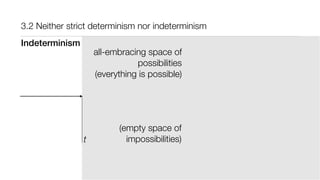
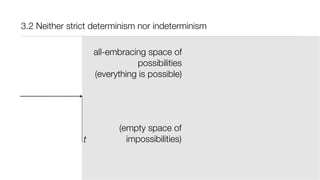
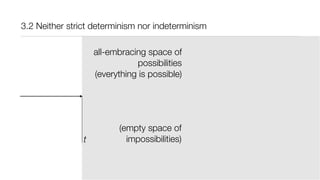
3.2 Neither strict determinism nor indeterminism
3.3 World system transition
1 A new way of thinking: thinking in complexity
1.1 Global challenges
global challenges
= challenges that
1.1 Global challenges
global challenges
= challenges that
(1) affect (the survival of) all humanity (objective factor) and
1.1 Global challenges
global challenges
= challenges that
(1) affect (the survival of) all humanity (objective factor) and
(2) can successfully be treated only by humanity as a whole
(subjective factor)
1.1 Global challenges
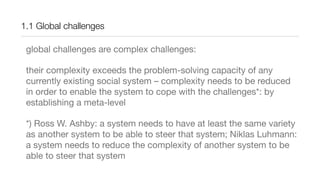
global challenges are complex challenges:
1.1 Global challenges
global challenges are complex challenges:
their complexity exceeds the problem-solving capacity of any
currently existing social system – complexity needs to be reduced
in order to enable the system to cope with the challenges*: by
establishing a meta-level
1.1 Global challenges
global challenges are complex challenges:
their complexity exceeds the problem-solving capacity of any
currently existing social system – complexity needs to be reduced
in order to enable the system to cope with the challenges*: by
establishing a meta-level
*) Ross W. Ashby: a system needs to have at least the same variety
as another system to be able to steer that system; Niklas Luhmann:
a system needs to reduce the complexity of another system to be
able to steer that system
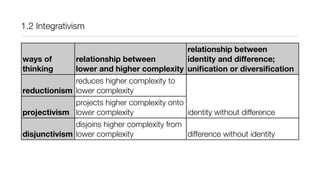
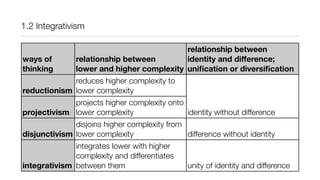
1.2 Integrativism
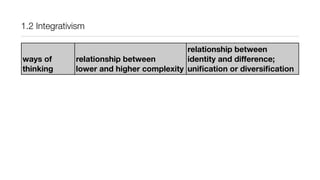
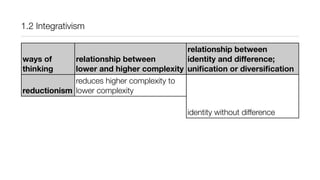
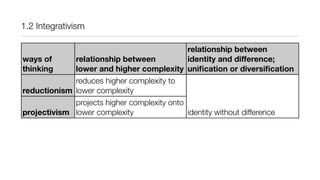
ways of
thinking
reductionism
projectivism
disjunctivism
integrativism
relationship between
lower and higher complexity
relationship between
identity and difference;
unification or diversification
reduces higher complexity to
lower complexity
identity without difference
projects higher complexity onto
lower complexity identity without difference
disjoins higher complexity from
lower complexity difference without identity
integrates lower with higher
complexity and differentiates
between them unity of identity and difference
1.2 Integrativism
ways of
thinking
reductionism
projectivism
disjunctivism
integrativism
relationship between
lower and higher complexity
relationship between
identity and difference;
unification or diversification
reduces higher complexity to
lower complexity
identity without difference
projects higher complexity onto
lower complexity identity without difference
disjoins higher complexity from
lower complexity difference without identity
integrates lower with higher
complexity and differentiates
between them unity of identity and difference
1.2 Integrativism
ways of
thinking
reductionism
projectivism
disjunctivism
integrativism
relationship between
lower and higher complexity
relationship between
identity and difference;
unification or diversification
reduces higher complexity to
lower complexity
identity without difference
projects higher complexity onto
lower complexity identity without difference
disjoins higher complexity from
lower complexity difference without identity
integrates lower with higher
complexity and differentiates
between them unity of identity and difference
1.2 Integrativism
ways of
thinking
reductionism
projectivism
disjunctivism
integrativism
relationship between
lower and higher complexity
relationship between
identity and difference;
unification or diversification
reduces higher complexity to
lower complexity
identity without difference
projects higher complexity onto
lower complexity identity without difference
disjoins higher complexity from
lower complexity difference without identity
integrates lower with higher
complexity and differentiates
between them unity of identity and difference
1.2 Integrativism
ways of
thinking
reductionism
projectivism
disjunctivism
integrativism
relationship between
lower and higher complexity
relationship between
identity and difference;
unification or diversification
reduces higher complexity to
lower complexity
identity without difference
projects higher complexity onto
lower complexity identity without difference
disjoins higher complexity from
lower complexity difference without identity
integrates lower with higher
complexity and differentiates
between them unity of identity and difference
1.2 Integrativism
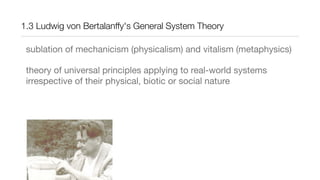
1.3 Ludwig von Bertalanffy's General System Theory
sublation of mechanicism (physicalism) and vitalism (metaphysics)
theory of universal principles applying to real-world systems
irrespective of their physical, biotic or social nature
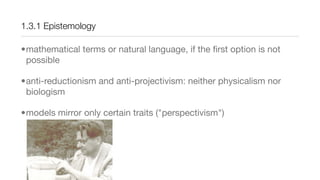
1.3.1 Epistemology
•mathematical terms or natural language, if the first option is not
possible
•anti-reductionism and anti-projectivism: neither physicalism nor
biologism
•models mirror only certain traits ("perspectivism")
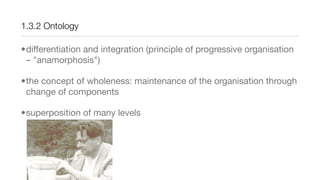
1.3.2 Ontology
•differentiation and integration (principle of progressive organisation
– "anamorphosis")
•the concept of wholeness: maintenance of the organisation through
change of components
•superposition of many levels
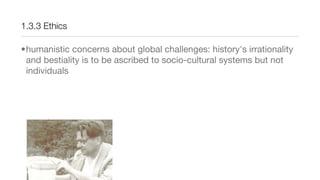
1.3.3 Ethics
•humanistic concerns about global challenges: history's irrationality
and bestiality is to be ascribed to socio-cultural systems but not
individuals
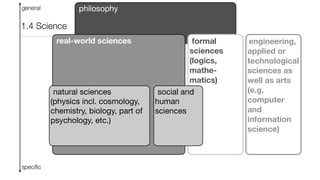
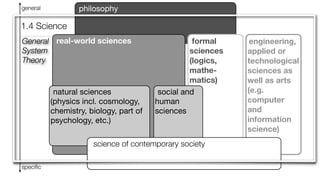
1.4 Science
philosophy
real-world sciences
natural sciences
(physics incl. cosmology,
chemistry, biology, part of
psychology, etc.)
formal
sciences
(logics,
mathe-
matics)
social and
human
sciences
general
specific
engineering,
applied or
technological
sciences as
well as arts
(e.g.
computer
and
information
science)
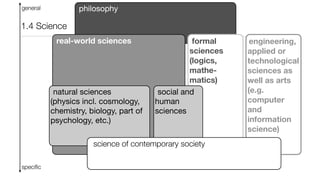
1.4 Science
philosophy
real-world sciences
natural sciences
(physics incl. cosmology,
chemistry, biology, part of
psychology, etc.)
formal
sciences
(logics,
mathe-
matics)
social and
human
sciences
general
specific
engineering,
applied or
technological
sciences as
well as arts
(e.g.
computer
and
information
science)
science of contemporary society
1.4 Science
philosophy
real-world sciences
natural sciences
(physics incl. cosmology,
chemistry, biology, part of
psychology, etc.)
formal
sciences
(logics,
mathe-
matics)
social and
human
sciences
general
specific
engineering,
applied or
technological
sciences as
well as arts
(e.g.
computer
and
information
science)
science of contemporary society
General
System
Theory
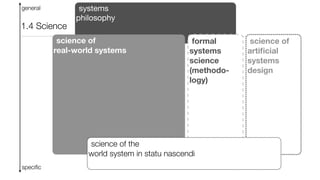
systems
philosophy
formal
systems
science
(methodo-
logy)
science of
real-world systems
general
specific
science of
artificial
systems
design
science of the
world system in statu nascendi
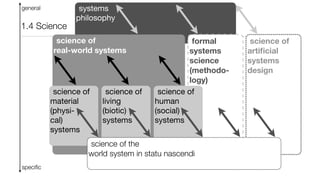
1.4 Science
systems
philosophy
formal
systems
science
(methodo-
logy)
science of
real-world systems
science of
material
(physi-
cal)
systems
science of
living
(biotic)
systems
science of
human
(social)
systems
general
specific
science of
artificial
systems
design
science of the
world system in statu nascendi
1.4 Science
2 A new conception of the world: self-organisation
self-organisation =def.
spontaneous build-up/maintenance of order in matter (in nature, in
and between real-world systems)
2 A new conception of the world: self-organisation
self-organisation =def.
spontaneous build-up/maintenance of order in matter (in nature, in
and between real-world systems)
puzzle: entropy law S>0 (growing disorder)
vs. life (growing order)?
2 A new conception of the world: self-organisation
self-organisation =def.
spontaneous build-up/maintenance of order in matter (in nature, in
and between real-world systems)
puzzle: entropy law S>0 (growing disorder)
vs. life (growing order)?
solution: open systems
(merger of systems theory and evolutionary theory)
2 A new conception of the world: self-organisation
agents
Metasystem transition 1:
individual phase
2 A new conception of the world: self-organisation
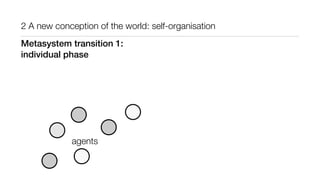
agents
Metasystem transition 1:
individual phase
2 A new conception of the world: self-organisation
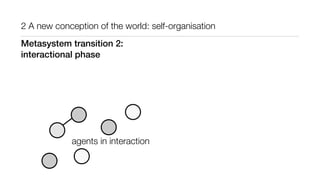
agents in interaction
Metasystem transition 2:
interactional phase
2 A new conception of the world: self-organisation
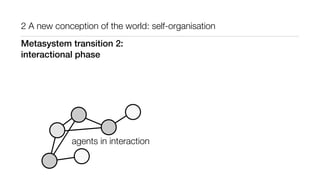
agents in interaction
Metasystem transition 2:
interactional phase
2 A new conception of the world: self-organisation
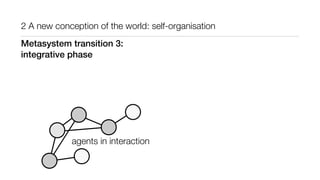
agents in interaction
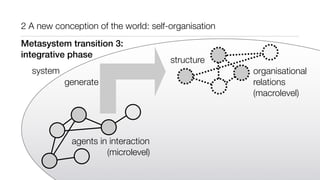
Metasystem transition 3:
integrative phase
2 A new conception of the world: self-organisation
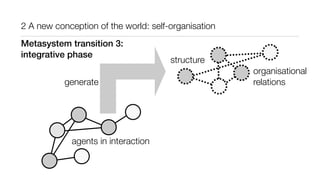
agents in interaction
generate
structure
organisational
relations
Metasystem transition 3:
integrative phase
2 A new conception of the world: self-organisation
agents in interaction
(microlevel)
system organisational
relations
(macrolevel)
generate
structure
Metasystem transition 3:
integrative phase
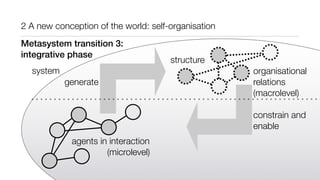
2 A new conception of the world: self-organisation
agents in interaction
(microlevel)
constrain and
enable
system organisational
relations
(macrolevel)
generate
structure
Metasystem transition 3:
integrative phase
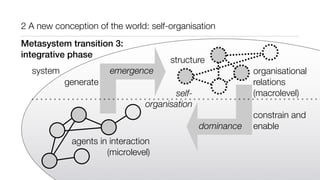
2 A new conception of the world: self-organisation
agents in interaction
(microlevel)
constrain and
enable
system organisational
relations
(macrolevel)
generate
emergence
dominance
structure
Metasystem transition 3:
integrative phase
self-
organisation
2 A new conception of the world: self-organisation
agents in interaction
(microlevel)
constrain and
enable
organisational
relations
(macrolevel)
generate
emergence
dominance
structure
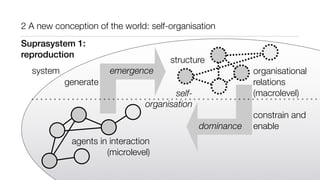
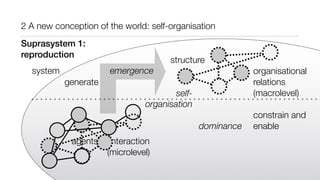
Suprasystem 1:
reproduction
system
self-
organisation
2 A new conception of the world: self-organisation
agents in interaction
(microlevel)
constrain and
enable
organisational
relations
(macrolevel)
generate
emergence
dominance
structure
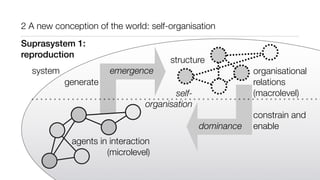
Suprasystem 1:
reproduction
system
self-
organisation
2 A new conception of the world: self-organisation
agents in interaction
(microlevel)
constrain and
enable
organisational
relations
(macrolevel)
generate
emergence
dominance
structure
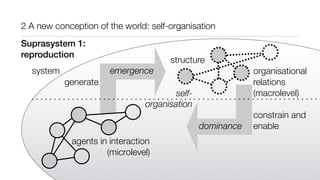
Suprasystem 1:
reproduction
system
self-
organisation
2 A new conception of the world: self-organisation
agents in interaction
(microlevel)
constrain and
enable
organisational
relations
(macrolevel)
generate
emergence
dominance
structure
system
self-
organisation
Suprasystem 1:
reproduction
2 A new conception of the world: self-organisation
agents in interaction
(microlevel)
constrain and
enable
organisational
relations
(macrolevel)
generate
emergence
dominance
structure
system
self-
organisation
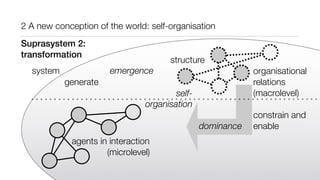
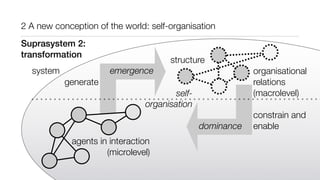
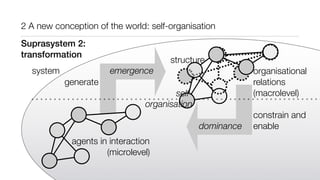
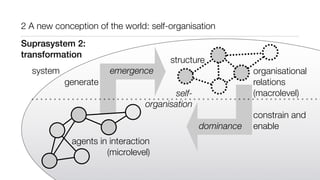
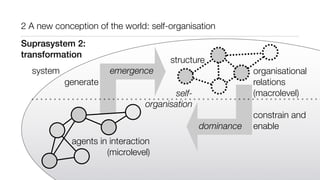
Suprasystem 2:
transformation
2 A new conception of the world: self-organisation
agents in interaction
(microlevel)
constrain and
enable
organisational
relations
(macrolevel)
generate
emergence
dominance
structure
system
self-
organisation
Suprasystem 2:
transformation
2 A new conception of the world: self-organisation
agents in interaction
(microlevel)
constrain and
enable
organisational
relations
(macrolevel)
generate
emergence
dominance
structure
system
self-
organisation
Suprasystem 2:
transformation
2 A new conception of the world: self-organisation
agents in interaction
(microlevel)
constrain and
enable
organisational
relations
(macrolevel)
generate
emergence
dominance
structure
system
self-
organisation
Suprasystem 2:
transformation
2 A new conception of the world: self-organisation
agents in interaction
(microlevel)
constrain and
enable
organisational
relations
(macrolevel)
generate
emergence
dominance
structure
system
self-
organisation
Suprasystem 2:
transformation
3 A new design for the future: humane systems design
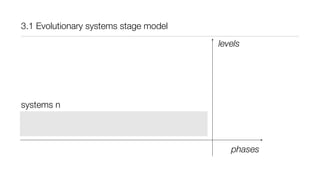
3.1 Evolutionary systems stage model
systems n
levels
phases
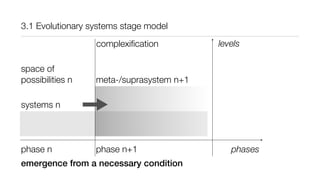
3.1 Evolutionary systems stage model
systems n
phase n phase n+1
levels
phases
meta-/suprasystem n+1
space of
possibilities n
complexification
emergence from a necessary condition
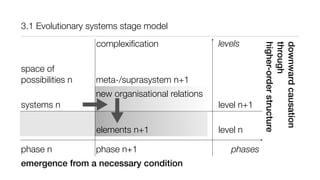
3.1 Evolutionary systems stage model
systems n
phase n phase n+1
level n+1
level n
levels
phases
meta-/suprasystem n+1
space of
possibilities n
complexification
new organisational relations
elements n+1
emergence from a necessary condition
downwardcausation
through
higher-orderstructure
3.2 Neither strict determinism nor indeterminism
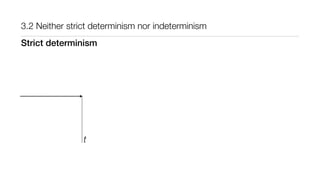
Strict determinism
t
3.2 Neither strict determinism nor indeterminism
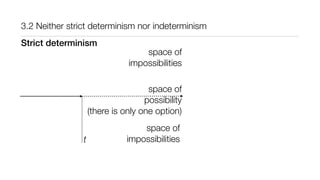
space of
possibility
(there is only one option)
space of
impossibilities
Strict determinism
space of
impossibilitiest
3.2 Neither strict determinism nor indeterminism
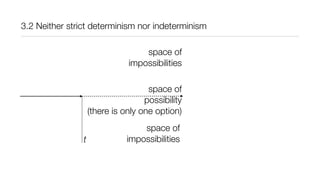
space of
possibility
(there is only one option)
space of
impossibilities
space of
impossibilitiest
3.2 Neither strict determinism nor indeterminism
t
(empty space of
impossibilities)
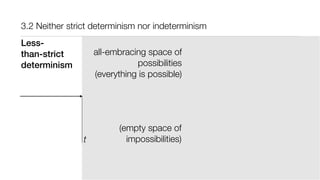
3.2 Neither strict determinism nor indeterminism
all-embracing space of
possibilities
(everything is possible)
Indeterminism
t
(empty space of
impossibilities)
3.2 Neither strict determinism nor indeterminism
all-embracing space of
possibilities
(everything is possible)
t
(empty space of
impossibilities)
3.2 Neither strict determinism nor indeterminism
all-embracing space of
possibilities
(everything is possible)
t
(empty space of
impossibilities)
3.2 Neither strict determinism nor indeterminism
all-embracing space of
possibilities
(everything is possible)
t
Less-
than-strict
determinism
3.2 Neither strict determinism nor indeterminism
Less-
than-strict
determinism
t
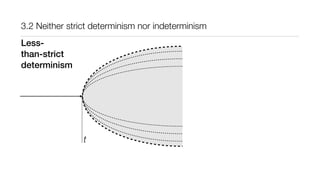
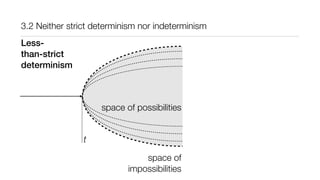
3.2 Neither strict determinism nor indeterminism
Less-
than-strict
determinism
space of possibilities
space of
impossibilities
t
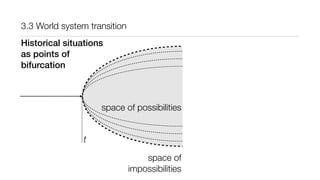
3.3 World system transition
Historical situations
as points of
bifurcation
space of possibilities
space of
impossibilities
t
3.3 World system transition
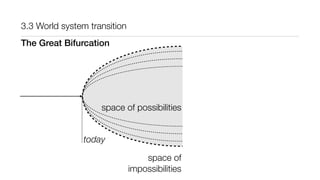
The Great Bifurcation
space of possibilities
space of
impossibilities
today
3.3 World system transition
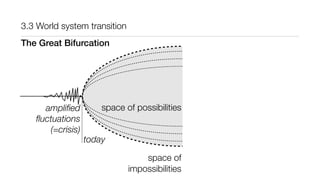
The Great Bifurcation
amplified
fluctuations
(=crisis)
space of possibilities
space of
impossibilities
today
3.3 World system transition
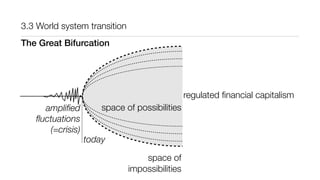
The Great Bifurcation
amplified
fluctuations
(=crisis)
regulated financial capitalism
space of possibilities
space of
impossibilities
today
3.3 World system transition
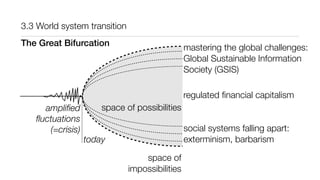
The Great Bifurcation
amplified
fluctuations
(=crisis)
mastering the global challenges:
Global Sustainable Information
Society (GSIS)
social systems falling apart:
exterminism, barbarism
regulated financial capitalism
space of possibilities
space of
impossibilities
today

Wolfgang Hofkirchner: Facing complexity - General System Theory

  • 1.
    Facing Complexity: GeneralSystem Theory 15 – 17 May 2013 Curso de Extensión: Pensamiento sistémico abierto: en la encrucijada de un mundo complejo Universidad de León Wolfgang Hofkirchner Associate Professor, Vienna University of Technology President, Bertalanffy Center for the Study of Systems Science (www.bcsss.org) President Elect, International Society for Information Studies (www.is4is.org)
  • 2.
    Contents 1 A newway of thinking: thinking in complexity 1.1 Global challenges 1.2 Integrativism 1.3 Ludwig von Bertalanffy's General System Theory (GST) 1.4 Science 2 A new conception of the world: self-organisation 3 A new design of the future: humane systems design 3.1 Evolutionary systems stage model 3.2 Neither strict determinism nor indeterminism 3.3 World system transition
  • 3.
    1 A newway of thinking: thinking in complexity
  • 4.
  • 5.
    1.1 Global challenges globalchallenges = challenges that
  • 6.
    1.1 Global challenges globalchallenges = challenges that (1) affect (the survival of) all humanity (objective factor) and
  • 7.
    1.1 Global challenges globalchallenges = challenges that (1) affect (the survival of) all humanity (objective factor) and (2) can successfully be treated only by humanity as a whole (subjective factor)
  • 8.
  • 9.
    1.1 Global challenges globalchallenges are complex challenges:
  • 10.
    1.1 Global challenges globalchallenges are complex challenges: their complexity exceeds the problem-solving capacity of any currently existing social system – complexity needs to be reduced in order to enable the system to cope with the challenges*: by establishing a meta-level
  • 11.
    1.1 Global challenges globalchallenges are complex challenges: their complexity exceeds the problem-solving capacity of any currently existing social system – complexity needs to be reduced in order to enable the system to cope with the challenges*: by establishing a meta-level *) Ross W. Ashby: a system needs to have at least the same variety as another system to be able to steer that system; Niklas Luhmann: a system needs to reduce the complexity of another system to be able to steer that system
  • 12.
  • 13.
    ways of thinking reductionism projectivism disjunctivism integrativism relationship between lowerand higher complexity relationship between identity and difference; unification or diversification reduces higher complexity to lower complexity identity without difference projects higher complexity onto lower complexity identity without difference disjoins higher complexity from lower complexity difference without identity integrates lower with higher complexity and differentiates between them unity of identity and difference 1.2 Integrativism
  • 14.
    ways of thinking reductionism projectivism disjunctivism integrativism relationship between lowerand higher complexity relationship between identity and difference; unification or diversification reduces higher complexity to lower complexity identity without difference projects higher complexity onto lower complexity identity without difference disjoins higher complexity from lower complexity difference without identity integrates lower with higher complexity and differentiates between them unity of identity and difference 1.2 Integrativism
  • 15.
    ways of thinking reductionism projectivism disjunctivism integrativism relationship between lowerand higher complexity relationship between identity and difference; unification or diversification reduces higher complexity to lower complexity identity without difference projects higher complexity onto lower complexity identity without difference disjoins higher complexity from lower complexity difference without identity integrates lower with higher complexity and differentiates between them unity of identity and difference 1.2 Integrativism
  • 16.
    ways of thinking reductionism projectivism disjunctivism integrativism relationship between lowerand higher complexity relationship between identity and difference; unification or diversification reduces higher complexity to lower complexity identity without difference projects higher complexity onto lower complexity identity without difference disjoins higher complexity from lower complexity difference without identity integrates lower with higher complexity and differentiates between them unity of identity and difference 1.2 Integrativism
  • 17.
    ways of thinking reductionism projectivism disjunctivism integrativism relationship between lowerand higher complexity relationship between identity and difference; unification or diversification reduces higher complexity to lower complexity identity without difference projects higher complexity onto lower complexity identity without difference disjoins higher complexity from lower complexity difference without identity integrates lower with higher complexity and differentiates between them unity of identity and difference 1.2 Integrativism
  • 18.
    1.3 Ludwig vonBertalanffy's General System Theory sublation of mechanicism (physicalism) and vitalism (metaphysics) theory of universal principles applying to real-world systems irrespective of their physical, biotic or social nature
  • 19.
    1.3.1 Epistemology •mathematical termsor natural language, if the first option is not possible •anti-reductionism and anti-projectivism: neither physicalism nor biologism •models mirror only certain traits ("perspectivism")
  • 20.
    1.3.2 Ontology •differentiation andintegration (principle of progressive organisation – "anamorphosis") •the concept of wholeness: maintenance of the organisation through change of components •superposition of many levels
  • 21.
    1.3.3 Ethics •humanistic concernsabout global challenges: history's irrationality and bestiality is to be ascribed to socio-cultural systems but not individuals
  • 22.
    1.4 Science philosophy real-world sciences naturalsciences (physics incl. cosmology, chemistry, biology, part of psychology, etc.) formal sciences (logics, mathe- matics) social and human sciences general specific engineering, applied or technological sciences as well as arts (e.g. computer and information science)
  • 23.
    1.4 Science philosophy real-world sciences naturalsciences (physics incl. cosmology, chemistry, biology, part of psychology, etc.) formal sciences (logics, mathe- matics) social and human sciences general specific engineering, applied or technological sciences as well as arts (e.g. computer and information science) science of contemporary society
  • 24.
    1.4 Science philosophy real-world sciences naturalsciences (physics incl. cosmology, chemistry, biology, part of psychology, etc.) formal sciences (logics, mathe- matics) social and human sciences general specific engineering, applied or technological sciences as well as arts (e.g. computer and information science) science of contemporary society General System Theory
  • 25.
    systems philosophy formal systems science (methodo- logy) science of real-world systems general specific scienceof artificial systems design science of the world system in statu nascendi 1.4 Science
  • 26.
    systems philosophy formal systems science (methodo- logy) science of real-world systems scienceof material (physi- cal) systems science of living (biotic) systems science of human (social) systems general specific science of artificial systems design science of the world system in statu nascendi 1.4 Science
  • 27.
    2 A newconception of the world: self-organisation
  • 28.
    2 A newconception of the world: self-organisation self-organisation =def. spontaneous build-up/maintenance of order in matter (in nature, in and between real-world systems)
  • 29.
    2 A newconception of the world: self-organisation self-organisation =def. spontaneous build-up/maintenance of order in matter (in nature, in and between real-world systems) puzzle: entropy law S>0 (growing disorder) vs. life (growing order)?
  • 30.
    2 A newconception of the world: self-organisation self-organisation =def. spontaneous build-up/maintenance of order in matter (in nature, in and between real-world systems) puzzle: entropy law S>0 (growing disorder) vs. life (growing order)? solution: open systems (merger of systems theory and evolutionary theory)
  • 31.
    2 A newconception of the world: self-organisation agents Metasystem transition 1: individual phase
  • 32.
    2 A newconception of the world: self-organisation agents Metasystem transition 1: individual phase
  • 33.
    2 A newconception of the world: self-organisation agents in interaction Metasystem transition 2: interactional phase
  • 34.
    2 A newconception of the world: self-organisation agents in interaction Metasystem transition 2: interactional phase
  • 35.
    2 A newconception of the world: self-organisation agents in interaction Metasystem transition 3: integrative phase
  • 36.
    2 A newconception of the world: self-organisation agents in interaction generate structure organisational relations Metasystem transition 3: integrative phase
  • 37.
    2 A newconception of the world: self-organisation agents in interaction (microlevel) system organisational relations (macrolevel) generate structure Metasystem transition 3: integrative phase
  • 38.
    2 A newconception of the world: self-organisation agents in interaction (microlevel) constrain and enable system organisational relations (macrolevel) generate structure Metasystem transition 3: integrative phase
  • 39.
    2 A newconception of the world: self-organisation agents in interaction (microlevel) constrain and enable system organisational relations (macrolevel) generate emergence dominance structure Metasystem transition 3: integrative phase self- organisation
  • 40.
    2 A newconception of the world: self-organisation agents in interaction (microlevel) constrain and enable organisational relations (macrolevel) generate emergence dominance structure Suprasystem 1: reproduction system self- organisation
  • 41.
    2 A newconception of the world: self-organisation agents in interaction (microlevel) constrain and enable organisational relations (macrolevel) generate emergence dominance structure Suprasystem 1: reproduction system self- organisation
  • 42.
    2 A newconception of the world: self-organisation agents in interaction (microlevel) constrain and enable organisational relations (macrolevel) generate emergence dominance structure Suprasystem 1: reproduction system self- organisation
  • 43.
    2 A newconception of the world: self-organisation agents in interaction (microlevel) constrain and enable organisational relations (macrolevel) generate emergence dominance structure system self- organisation Suprasystem 1: reproduction
  • 44.
    2 A newconception of the world: self-organisation agents in interaction (microlevel) constrain and enable organisational relations (macrolevel) generate emergence dominance structure system self- organisation Suprasystem 2: transformation
  • 45.
    2 A newconception of the world: self-organisation agents in interaction (microlevel) constrain and enable organisational relations (macrolevel) generate emergence dominance structure system self- organisation Suprasystem 2: transformation
  • 46.
    2 A newconception of the world: self-organisation agents in interaction (microlevel) constrain and enable organisational relations (macrolevel) generate emergence dominance structure system self- organisation Suprasystem 2: transformation
  • 47.
    2 A newconception of the world: self-organisation agents in interaction (microlevel) constrain and enable organisational relations (macrolevel) generate emergence dominance structure system self- organisation Suprasystem 2: transformation
  • 48.
    2 A newconception of the world: self-organisation agents in interaction (microlevel) constrain and enable organisational relations (macrolevel) generate emergence dominance structure system self- organisation Suprasystem 2: transformation
  • 49.
    3 A newdesign for the future: humane systems design
  • 50.
  • 51.
    3.1 Evolutionary systemsstage model systems n levels phases
  • 52.
    3.1 Evolutionary systemsstage model systems n phase n phase n+1 levels phases meta-/suprasystem n+1 space of possibilities n complexification emergence from a necessary condition
  • 53.
    3.1 Evolutionary systemsstage model systems n phase n phase n+1 level n+1 level n levels phases meta-/suprasystem n+1 space of possibilities n complexification new organisational relations elements n+1 emergence from a necessary condition downwardcausation through higher-orderstructure
  • 54.
    3.2 Neither strictdeterminism nor indeterminism
  • 55.
    3.2 Neither strictdeterminism nor indeterminism Strict determinism t
  • 56.
    3.2 Neither strictdeterminism nor indeterminism space of possibility (there is only one option) space of impossibilities Strict determinism space of impossibilitiest
  • 57.
    3.2 Neither strictdeterminism nor indeterminism space of possibility (there is only one option) space of impossibilities space of impossibilitiest
  • 58.
    3.2 Neither strictdeterminism nor indeterminism t
  • 59.
    (empty space of impossibilities) 3.2Neither strict determinism nor indeterminism all-embracing space of possibilities (everything is possible) Indeterminism t
  • 60.
    (empty space of impossibilities) 3.2Neither strict determinism nor indeterminism all-embracing space of possibilities (everything is possible) t
  • 61.
    (empty space of impossibilities) 3.2Neither strict determinism nor indeterminism all-embracing space of possibilities (everything is possible) t
  • 62.
    (empty space of impossibilities) 3.2Neither strict determinism nor indeterminism all-embracing space of possibilities (everything is possible) t Less- than-strict determinism
  • 63.
    3.2 Neither strictdeterminism nor indeterminism Less- than-strict determinism t
  • 64.
    3.2 Neither strictdeterminism nor indeterminism Less- than-strict determinism space of possibilities space of impossibilities t
  • 65.
    3.3 World systemtransition Historical situations as points of bifurcation space of possibilities space of impossibilities t
  • 66.
    3.3 World systemtransition The Great Bifurcation space of possibilities space of impossibilities today
  • 67.
    3.3 World systemtransition The Great Bifurcation amplified fluctuations (=crisis) space of possibilities space of impossibilities today
  • 68.
    3.3 World systemtransition The Great Bifurcation amplified fluctuations (=crisis) regulated financial capitalism space of possibilities space of impossibilities today
  • 69.
    3.3 World systemtransition The Great Bifurcation amplified fluctuations (=crisis) mastering the global challenges: Global Sustainable Information Society (GSIS) social systems falling apart: exterminism, barbarism regulated financial capitalism space of possibilities space of impossibilities today