WIRELESS GESTURE CONTROL
CAR
Presented by
S.M.B.P.B. Samarathunga
Science and Technology
Mechatronics
Uva Wellassa University, Sri Lanka1
ACKNOWLEDGEMENT
I would like to acknowledge my Parents, and lecturers, who
supported me both morally and technically, especially Dr. Indika
Wanniarachchi who helped me at every step in the making of my
project.
Also my special thanks to class fellows and seniors who helped me
in clarification of any issue.
2
ABOUT THE PROJECT
The objective of this project is to build a car that can be
controlled by gesture wirelessly.
User is able to control motions of the car by wearing the
controller glove and performing predefined gestures.
Can be used in many potential applications such as wireless
control car racing, etc.
3
COMPONENTS USED
Arduino Mega board (in receiver side)
Arduino Duemilanove (in transmitter side)
MPU6050 Gyro meter
nRF24L01 Transceiver Module
L298 Dual H-Bridge Motor Control
4
MPU6050 Gyro
The InvenSense MPU-6050 sensor contains a MEMS
accelerometer and a MEMS gyro in a single chip.
It is very accurate, as it contains 16-bits Analog to Digital
conversion hardware for each channel.
Therefor it captures the x, y, and z channel at the same time.
In here MPU6050 library was used.
5
nRF24L01 Transceiver Module
The nRF24L01+ is a 2.4GHz ISM band transceiver.
Includes on board support components and a 2.4GHz antenna
for easy implementation into designs without additional
hardware.
Communication range up to 329 feet (100 meters) in ideal
conditions.
In here RF24 library was used.
6
Motions which are used,
7
TRANSMITTING SIDE
8
PIN CONFIGURATION
MPU6050 Arduino Duemilanove
VCC 3.3v
GND GND
SCL 5 (Analog)
SDA 4 (Analog)
nRF24L01
Transceiver
Arduino
Duemilanove
VCC 3.3v
GND GND
CE 9 (Digital)
CSN 10 (Digital)
SCK 13 (Digital)
MISO 12 (Digital)
MOSI 11 (Digital)
9
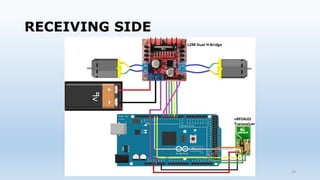
RECEIVING SIDE
10
PIN CONFIGURATION
nRF24L01 Arduino Mega
VCC 3.3v
GND GND
CE 9 (Digital)
CSN 10 (Digital)
SCK 52 (Digital)
MISO 50 (Digital)
MOSI 51 (Digital)
11
SOFT WARE USED,
Arduino
Fritzing
12
13

Gesture Control Car

  • 1.
    WIRELESS GESTURE CONTROL CAR Presentedby S.M.B.P.B. Samarathunga Science and Technology Mechatronics Uva Wellassa University, Sri Lanka1
  • 2.
    ACKNOWLEDGEMENT I would liketo acknowledge my Parents, and lecturers, who supported me both morally and technically, especially Dr. Indika Wanniarachchi who helped me at every step in the making of my project. Also my special thanks to class fellows and seniors who helped me in clarification of any issue. 2
  • 3.
    ABOUT THE PROJECT Theobjective of this project is to build a car that can be controlled by gesture wirelessly. User is able to control motions of the car by wearing the controller glove and performing predefined gestures. Can be used in many potential applications such as wireless control car racing, etc. 3
  • 4.
    COMPONENTS USED Arduino Megaboard (in receiver side) Arduino Duemilanove (in transmitter side) MPU6050 Gyro meter nRF24L01 Transceiver Module L298 Dual H-Bridge Motor Control 4
  • 5.
    MPU6050 Gyro The InvenSenseMPU-6050 sensor contains a MEMS accelerometer and a MEMS gyro in a single chip. It is very accurate, as it contains 16-bits Analog to Digital conversion hardware for each channel. Therefor it captures the x, y, and z channel at the same time. In here MPU6050 library was used. 5
  • 6.
    nRF24L01 Transceiver Module ThenRF24L01+ is a 2.4GHz ISM band transceiver. Includes on board support components and a 2.4GHz antenna for easy implementation into designs without additional hardware. Communication range up to 329 feet (100 meters) in ideal conditions. In here RF24 library was used. 6
  • 7.
  • 8.
  • 9.
    PIN CONFIGURATION MPU6050 ArduinoDuemilanove VCC 3.3v GND GND SCL 5 (Analog) SDA 4 (Analog) nRF24L01 Transceiver Arduino Duemilanove VCC 3.3v GND GND CE 9 (Digital) CSN 10 (Digital) SCK 13 (Digital) MISO 12 (Digital) MOSI 11 (Digital) 9
  • 10.
  • 11.
    PIN CONFIGURATION nRF24L01 ArduinoMega VCC 3.3v GND GND CE 9 (Digital) CSN 10 (Digital) SCK 52 (Digital) MISO 50 (Digital) MOSI 51 (Digital) 11
  • 12.
  • 13.