Windows Powershell in Action 1st Edition Bruce G. Payette
Windows Powershell in Action 1st Edition Bruce G. Payette
Windows Powershell in Action 1st Edition Bruce G. Payette
Windows Powershell in Action 1st Edition Bruce G. Payette
Windows Powershell in Action 1st Edition Bruce G. Payette
1.
Windows Powershell inAction 1st Edition Bruce
G. Payette download
https://ebookultra.com/download/windows-powershell-in-action-1st-
edition-bruce-g-payette/
Explore and download more ebooks or textbooks
at ebookultra.com
2.
We believe theseproducts will be a great fit for you. Click
the link to download now, or visit ebookultra.com
to discover even more!
Learn Windows PowerShell in a Month of Lunches Don Jones
https://ebookultra.com/download/learn-windows-powershell-in-a-month-
of-lunches-don-jones/
Windows PowerShell 2 0 Bible 1st Edition Thomas Lee
https://ebookultra.com/download/windows-powershell-2-0-bible-1st-
edition-thomas-lee/
Microsoft SQL Server 2008 Administration with Windows
PowerShell 1st Edition Ananthakumar Muthusamy
https://ebookultra.com/download/microsoft-sql-
server-2008-administration-with-windows-powershell-1st-edition-
ananthakumar-muthusamy/
Windows Phone 8 in Action 2nd Edition Timothy Binkley-
Jones
https://ebookultra.com/download/windows-phone-8-in-action-2nd-edition-
timothy-binkley-jones/
3.
SonarQube in Action1st Edition G. Ann Campbell
https://ebookultra.com/download/sonarqube-in-action-1st-edition-g-ann-
campbell/
Integrative Psychotherapy in Action Richard G Erskine
https://ebookultra.com/download/integrative-psychotherapy-in-action-
richard-g-erskine/
iOS 7 in Action 1st Edition Brendan G. Lim
https://ebookultra.com/download/ios-7-in-action-1st-edition-brendan-g-
lim/
Windows PowerShell Cookbook The Complete Guide to
Scripting Microsoft s Command Shell 3rd Edition Holmes
https://ebookultra.com/download/windows-powershell-cookbook-the-
complete-guide-to-scripting-microsoft-s-command-shell-3rd-edition-
holmes/
PowerShell in Depth 2nd Edition Don Jones
https://ebookultra.com/download/powershell-in-depth-2nd-edition-don-
jones/
5.
Windows Powershell inAction 1st Edition Bruce G.
Payette Digital Instant Download
Author(s): Bruce G. Payette
ISBN(s): 9781932394900, 1932394907
Edition: 1
File Details: PDF, 6.83 MB
Year: 2007
Language: english
vii
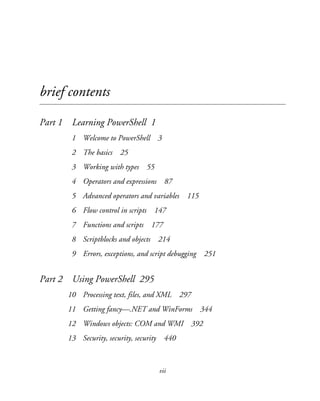
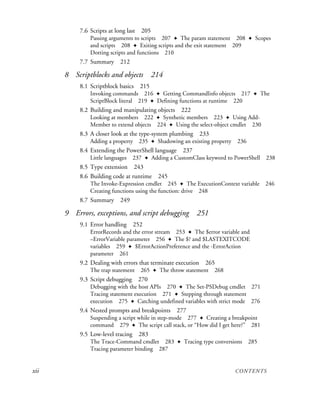
brief contents
Part 1Learning PowerShell 1
1 Welcome to PowerShell 3
2 The basics 25
3 Working with types 55
4 Operators and expressions 87
5 Advanced operators and variables 115
6 Flow control in scripts 147
7 Functions and scripts 177
8 Scriptblocks and objects 214
9 Errors, exceptions, and script debugging 251
Part 2 Using PowerShell 295
10 Processing text, files, and XML 297
11 Getting fancy—.NET and WinForms 344
12 Windows objects: COM and WMI 392
13 Security, security, security 440
15.
ix
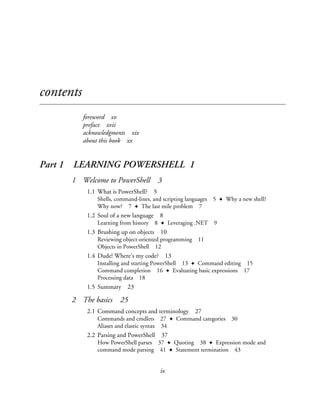
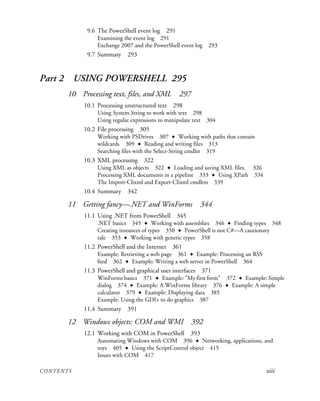
contents
foreword xv
preface xvii
acknowledgmentsxix
about this book xx
Part 1 LEARNING POWERSHELL 1
1 Welcome to PowerShell 3
1.1 What is PowerShell? 5
Shells, command-lines, and scripting languages 5 ✦ Why a new shell?
Why now? 7 ✦ The last mile problem 7
1.2 Soul of a new language 8
Learning from history 8 ✦ Leveraging .NET 9
1.3 Brushing up on objects 10
Reviewing object-oriented programming 11
Objects in PowerShell 12
1.4 Dude! Where’s my code? 13
Installing and starting PowerShell 13 ✦ Command editing 15
Command completion 16 ✦ Evaluating basic expressions 17
Processing data 18
1.5 Summary 23
2 The basics 25
2.1 Command concepts and terminology 27
Commands and cmdlets 27 ✦ Command categories 30
Aliases and elastic syntax 34
2.2 Parsing and PowerShell 37
How PowerShell parses 37 ✦ Quoting 38 ✦ Expression mode and
command mode parsing 41 ✦ Statement termination 43
16.
x CONTENTS
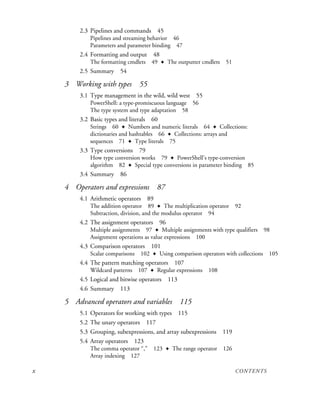
2.3 Pipelinesand commands 45
Pipelines and streaming behavior 46
Parameters and parameter binding 47
2.4 Formatting and output 48
The formatting cmdlets 49 ✦ The outputter cmdlets 51
2.5 Summary 54
3 Working with types 55
3.1 Type management in the wild, wild west 55
PowerShell: a type-promiscuous language 56
The type system and type adaptation 58
3.2 Basic types and literals 60
Strings 60 ✦ Numbers and numeric literals 64 ✦ Collections:
dictionaries and hashtables 66 ✦ Collections: arrays and
sequences 71 ✦ Type literals 75
3.3 Type conversions 79
How type conversion works 79 ✦ PowerShell’s type-conversion
algorithm 82 ✦ Special type conversions in parameter binding 85
3.4 Summary 86
4 Operators and expressions 87
4.1 Arithmetic operators 89
The addition operator 89 ✦ The multiplication operator 92
Subtraction, division, and the modulus operator 94
4.2 The assignment operators 96
Multiple assignments 97 ✦ Multiple assignments with type qualifiers 98
Assignment operations as value expressions 100
4.3 Comparison operators 101
Scalar comparisons 102 ✦ Using comparison operators with collections 105
4.4 The pattern matching operators 107
Wildcard patterns 107 ✦ Regular expressions 108
4.5 Logical and bitwise operators 113
4.6 Summary 113
5 Advanced operators and variables 115
5.1 Operators for working with types 115
5.2 The unary operators 117
5.3 Grouping, subexpressions, and array subexpressions 119
5.4 Array operators 123
The comma operator “,” 123 ✦ The range operator 126
Array indexing 127
17.
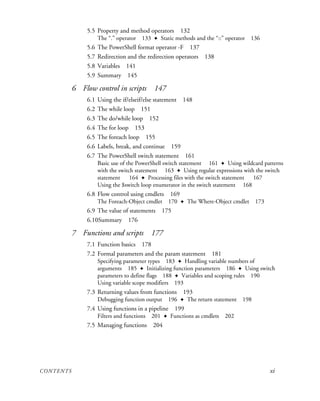
CONTENTS xi
5.5 Propertyand method operators 132
The “.” operator 133 ✦ Static methods and the “::” operator 136
5.6 The PowerShell format operator -F 137
5.7 Redirection and the redirection operators 138
5.8 Variables 141
5.9 Summary 145
6 Flow control in scripts 147
6.1 Using the if/elseif/else statement 148
6.2 The while loop 151
6.3 The do/while loop 152
6.4 The for loop 153
6.5 The foreach loop 155
6.6 Labels, break, and continue 159
6.7 The PowerShell switch statement 161
Basic use of the PowerShell switch statement 161 ✦ Using wildcard patterns
with the switch statement 163 ✦ Using regular expressions with the switch
statement 164 ✦ Processing files with the switch statement 167
Using the $switch loop enumerator in the switch statement 168
6.8 Flow control using cmdlets 169
The Foreach-Object cmdlet 170 ✦ The Where-Object cmdlet 173
6.9 The value of statements 175
6.10Summary 176
7 Functions and scripts 177
7.1 Function basics 178
7.2 Formal parameters and the param statement 181
Specifying parameter types 183 ✦ Handling variable numbers of
arguments 185 ✦ Initializing function parameters 186 ✦ Using switch
parameters to define flags 188 ✦ Variables and scoping rules 190
Using variable scope modifiers 193
7.3 Returning values from functions 193
Debugging function output 196 ✦ The return statement 198
7.4 Using functions in a pipeline 199
Filters and functions 201 ✦ Functions as cmdlets 202
7.5 Managing functions 204
18.
xii CONTENTS
7.6 Scriptsat long last 205
Passing arguments to scripts 207 ✦ The param statement 208 ✦ Scopes
and scripts 208 ✦ Exiting scripts and the exit statement 209
Dotting scripts and functions 210
7.7 Summary 212
8 Scriptblocks and objects 214
8.1 Scriptblock basics 215
Invoking commands 216 ✦ Getting CommandInfo objects 217 ✦ The
ScriptBlock literal 219 ✦ Defining functions at runtime 220
8.2 Building and manipulating objects 222
Looking at members 222 ✦ Synthetic members 223 ✦ Using Add-
Member to extend objects 224 ✦ Using the select-object cmdlet 230
8.3 A closer look at the type-system plumbing 233
Adding a property 235 ✦ Shadowing an existing property 236
8.4 Extending the PowerShell language 237
Little languages 237 ✦ Adding a CustomClass keyword to PowerShell 238
8.5 Type extension 243
8.6 Building code at runtime 245
The Invoke-Expression cmdlet 245 ✦ The ExecutionContext variable 246
Creating functions using the function: drive 248
8.7 Summary 249
9 Errors, exceptions, and script debugging 251
9.1 Error handling 252
ErrorRecords and the error stream 253 ✦ The $error variable and
–ErrorVariable parameter 256 ✦ The $? and $LASTEXITCODE
variables 259 ✦ $ErrorActionPreference and the -ErrorAction
parameter 261
9.2 Dealing with errors that terminate execution 265
The trap statement 265 ✦ The throw statement 268
9.3 Script debugging 270
Debugging with the host APIs 270 ✦ The Set-PSDebug cmdlet 271
Tracing statement execution 271 ✦ Stepping through statement
execution 275 ✦ Catching undefined variables with strict mode 276
9.4 Nested prompts and breakpoints 277
Suspending a script while in step-mode 277 ✦ Creating a breakpoint
command 279 ✦ The script call stack, or “How did I get here?” 281
9.5 Low-level tracing 283
The Trace-Command cmdlet 283 ✦ Tracing type conversions 285
Tracing parameter binding 287
19.
CONTENTS xiii
9.6 ThePowerShell event log 291
Examining the event log 291
Exchange 2007 and the PowerShell event log 293
9.7 Summary 293
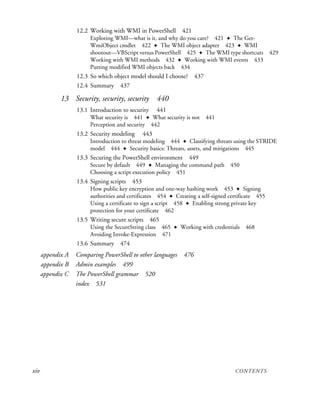
Part 2 USING POWERSHELL 295
10 Processing text, files, and XML 297
10.1 Processing unstructured text 298
Using System.String to work with text 298
Using regular expressions to manipulate text 304
10.2 File processing 305
Working with PSDrives 307 ✦ Working with paths that contain
wildcards 309 ✦ Reading and writing files 313
Searching files with the Select-String cmdlet 319
10.3 XML processing 322
Using XML as objects 322 ✦ Loading and saving XML files. 326
Processing XML documents in a pipeline 333 ✦ Using XPath 334
The Import-Clixml and Export-Clixml cmdlets 339
10.4 Summary 342
11 Getting fancy—.NET and WinForms 344
11.1 Using .NET from PowerShell 345
.NET basics 345 ✦ Working with assemblies 346 ✦ Finding types 348
Creating instances of types 350 ✦ PowerShell is not C#—A cautionary
tale 353 ✦ Working with generic types 358
11.2 PowerShell and the Internet 361
Example: Retrieving a web page 361 ✦ Example: Processing an RSS
feed 362 ✦ Example: Writing a web server in PowerShell 364
11.3 PowerShell and graphical user interfaces 371
WinForms basics 371 ✦ Example: "My first form" 372 ✦ Example: Simple
dialog 374 ✦ Example: A WinForms library 376 ✦ Example: A simple
calculator 379 ✦ Example: Displaying data 385
Example: Using the GDI+ to do graphics 387
11.4 Summary 391
12 Windows objects: COM and WMI 392
12.1 Working with COM in PowerShell 393
Automating Windows with COM 396 ✦ Networking, applications, and
toys 405 ✦ Using the ScriptControl object 415
Issues with COM 417
20.
xiv CONTENTS
12.2 Workingwith WMI in PowerShell 421
Exploring WMI—what is it, and why do you care? 421 ✦ The Get-
WmiObject cmdlet 422 ✦ The WMI object adapter 423 ✦ WMI
shootout—VBScript versus PowerShell 425 ✦ The WMI type shortcuts 429
Working with WMI methods 432 ✦ Working with WMI events 433
Putting modified WMI objects back 434
12.3 So which object model should I choose? 437
12.4 Summary 437
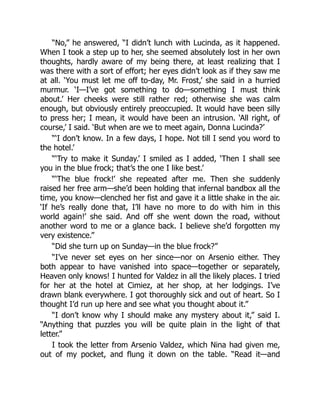
13 Security, security, security 440
13.1 Introduction to security 441
What security is 441 ✦ What security is not 441
Perception and security 442
13.2 Security modeling 443
Introduction to threat modeling 444 ✦ Classifying threats using the STRIDE
model 444 ✦ Security basics: Threats, assets, and mitigations 445
13.3 Securing the PowerShell environment 449
Secure by default 449 ✦ Managing the command path 450
Choosing a script execution policy 451
13.4 Signing scripts 453
How public key encryption and one-way hashing work 453 ✦ Signing
authorities and certificates 454 ✦ Creating a self-signed certificate 455
Using a certificate to sign a script 458 ✦ Enabling strong private key
protection for your certificate 462
13.5 Writing secure scripts 465
Using the SecureString class 465 ✦ Working with credentials 468
Avoiding Invoke-Expression 471
13.6 Summary 474
appendix A Comparing PowerShell to other languages 476
appendix B Admin examples 499
appendix C The PowerShell grammar 520
index 531
“No,” he answered,“I didn’t lunch with Lucinda, as it happened.
When I took a step up to her, she seemed absolutely lost in her own
thoughts, hardly aware of my being there, at least realizing that I
was there with a sort of effort; her eyes didn’t look as if they saw me
at all. ‘You must let me off to-day, Mr. Frost,’ she said in a hurried
murmur. ‘I—I’ve got something to do—something I must think
about.’ Her cheeks were still rather red; otherwise she was calm
enough, but obviously entirely preoccupied. It would have been silly
to press her; I mean, it would have been an intrusion. ‘All right, of
course,’ I said. ‘But when are we to meet again, Donna Lucinda?’
“‘I don’t know. In a few days, I hope. Not till I send you word to
the hotel.’
“‘Try to make it Sunday.’ I smiled as I added, ‘Then I shall see
you in the blue frock; that’s the one I like best.’
“‘The blue frock!’ she repeated after me. Then she suddenly
raised her free arm—she’d been holding that infernal bandbox all the
time, you know—clenched her fist and gave it a little shake in the air.
‘If he’s really done that, I’ll have no more to do with him in this
world again!’ she said. And off she went down the road, without
another word to me or a glance back. I believe she’d forgotten my
very existence.”
“Did she turn up on Sunday—in the blue frock?”
“I’ve never set eyes on her since—nor on Arsenio either. They
both appear to have vanished into space—together or separately,
Heaven only knows! I hunted for Valdez in all the likely places. I tried
for her at the hotel at Cimiez, at her shop, at her lodgings. I’ve
drawn blank everywhere. I got thoroughly sick and out of heart. So I
thought I’d run up here and see what you thought about it.”
“I don’t know why I should make any mystery about it,” said I.
“Anything that puzzles you will be quite plain in the light of that
letter.”
I took the letter from Arsenio Valdez, which Nina had given me,
out of my pocket, and flung it down on the table. “Read it—and
23.
you’ll understand whyshe repeated after you ‘The blue frock!’ That
was what gave her the clew to Nina’s meaning!”
24.
T
CHAPTER XVII
REBELLION
HERE wasthe situation; for Godfrey was quick enough to see
what had happened as soon as he had read Arsenio’s letter;
he finished it, which was more than I had done, and so found
more lies than I had. We discussed the situation far into the
night, Godfrey still doing most of the talking. He had come to Paris
to see me about it, to ask my advice or to put some question to me;
but he had not really got the problem clear in his mind. On
subsidiary points—or, perhaps, one should rather say, on what
seemed such to him—his view was characteristic, and to me
amusing. He thought that most of Nina’s anger was due to the fact
that she had been “done” by Arsenio, that he had got her money for
Lucinda and for himself on false pretenses; whereas Nina was really
furious with Lucinda herself for not having consciously accepted her
charity, and made comparatively little of friend Arsenio’s roguery. He
was much more full of admiration of Lucinda for not minding being
discovered carrying a bandbox—and for laughing at her encounter
with Lady Dundrannan while she was doing it—than of appreciation
of her indignation over the blue frock; he thought she made a great
deal too much of that. “Since she didn’t know, what does it come
to?” he asked. And he wasted no reprobation on Arsenio. He had
known Arsenio for a rogue before—a rogue after his money, and
willing to use his wife as a bait to catch it; that he now knew that
25.
Arsenio was morecompletely a rogue all round—towards Nina as
well as towards him—was merely a bit of confirmatory evidence; he
saw nothing in the fact that Arsenio had, after all, given Lucinda the
blue frock, though he would have been quite safe—as safe, anyhow
—if he had given her nothing. His whole analysis, so far as it
appeared in disjointed observations, of the other parties to the affair,
ran on lines of obvious shrewdness, and was baffled only where they
appeared—as in Lucinda’s case—to diverge from the lines thus
indicated. Lucinda was a puzzle. Why had she hidden herself from
him? She could “have it out” with Valdez, if she wanted to, without
doing that!
But he was not immensely perturbed at her temporary
disappearance; he could find her, if he wanted to. “It’s only a matter
of trouble and money, like anything else.” And if she were furious
with Valdez, no harm in that! Rather the reverse! Thus he gradually
approached his own position, and the questions which he was
putting to himself, and had found so difficult that he had been
impelled to come and talk them over. These really might be reduced
to one, and a very old one, though also often a very big one; it may
be variously conceived and described as that between prudence and
passion, that between morality and love, that between will and
emotion, between the head and the heart. For purposes of the
present case it could be personified as being between Nina and
Lucinda. As a gentleman, if as nothing more, he had been obliged to
own up to his engagement to lunch with Lucinda and to stand by it.
But that act settled nothing ultimately. The welcome of a returning
Prodigal would await him at Villa San Carlo, though the feast might
perhaps be rather too highly peppered with a lofty forgiveness; he
was conscious of that feature in the case, but minded it less than I
should have; Nina’s pupil was accustomed to her rebukes, and rather
hardened against her chastisement. But if arms were open to him
elsewhere—soft and seducing arms—what then? Was he to desert
Nina?
Her and what she stood for? And really, in this situation, she
stood for everything that had, up to now, governed his life. She
26.
stood (she wouldnot have felt at all inadequate to the demand on
her qualities) for prosperity, progress, propriety, and—as a climax—
for piety itself. Godfrey had been religiously brought up (the figure of
the white-haired Wesleyan Minister at Briarmount rose before my
eyes) and was not ashamed to own that the principles thus
inculcated had influenced his doings and were still a living force in
him. I respected him for the avowal; it is not one that men are very
ready to make where a woman is in question; it had been implicit in
his reason for knowing nothing of women, given to me a long time
ago—that he had not been able to afford to marry.
Piety was the highest impersonation which Nina was called upon
to undertake. Was it the most powerful, the most compelling? There
were so many others, whose images somehow blended into one
great and imposing Figure—Regularity, with her cornucopia of
worldly advantages, not necessarily lost (Godfrey was quite awake to
that) by a secret dallying with her opposite, but thereby rendered
insincere—that counted with him—uneasy, and perpetually
precarious. He was a long-headed young man; he foresaw every
chance against his passion—even the chance that, having first burnt
up all he had or hoped for, it would itself become extinct. Then it
was not true passion? I don’t know. It was strong enough. Lucinda
impersonated too; impersonated things that are very powerful.
He spoke of her seldom and evasively. In the debate which he
carried on with himself—only occasionally asking for an opinion from
me—he generally indicated her under the description of “the other
thing”—other (it was to be understood) from all that Nina
represented. Taken like that, the description, if colorless, was at least
comprehensive. And it did get Lucinda—bluntly, yet not altogether
wrongly. He saw her as an ideal—the exact opposite of the ideal to
which he had hitherto aspired, the ideal of regularity, wealth,
eminence, reputation, power, thirty per cent., and so on (including,
let us not forget, piety). So seen, she astonished him in herself, and
astonished him more by the lure that she had for him. Only he
distrusted the lure profoundly. In the end he could not understand it
in himself. I do not blame him; I myself was considerably puzzled at
27.
finding it inhim. To say that a man is in love is a summary, not an
explanation. Jonathan Frost—old Lord Dundrannan—had been a
romantic in his way; Nina too in hers, when she had sobbed in
passion on the cliffs—or even now, when she cherished disturbing
emotions about things and people whom she might, without loss of
comfort or profit, have serenely disregarded. There was a thread of
the romantic meandering through the more challenging patterns of
the family fabric.
Half a dozen times I was on the point of flying into a rage with
him—when he talked easily of “buying Valdez,” when he assumed
Lucinda’s assent to that not very pretty transaction, when he hinted
at the luxury which would reward that assent, and so on. But the
genuineness of his conflict, of his scruples on the one hand, of his
passion on the other, made anger seem cruel, while the bluntness of
his perception seemed to make it ridiculous. Perhaps on this latter
point I exaggerated a little—asking from him an insight into the
situation to which I was helped by a more intimate knowledge of the
past and of the persons; but at all events he was, as I conceived,
radically wrong in his estimate of the possibilities. At last I was
impelled to tell him so.
It was very late; in disregard of his “Don’t go yet, I haven’t
finished,” I had actually put on my coat, and taken my hat and stick
in my hand. I stood like that, opposite to where he sat, and
expounded my views to him. I imagine that to a cool spectator I
should have looked rather absurd, for by now I too was somehow
wrought up and excited; he had got me back into my pre-Paris state
of mind, the one in which I had been when I intimated to Nina that I
must hunt the Riviera for Lucinda and find out the truth about her at
all costs. The Conference on Tonnage was routed, driven pell-mell
out of my thoughts.
“You can’t buy Valdez,” I told him, “not in the sense that you
mean. He’ll sell himself, body and soul, for money—to you, or me, or
Nina, or all of us, or anybody else. But he won’t sell Lucinda. He sells
himself for money, but it’s because of her that he must have the
money—to dazzle her, to cut a figure in her eyes, to get her back to
28.
him. He usedher to tempt you with, to make you shell out—just as
he did, in another way, with Nina. But he knew he was safe; he
knew he’d never have to deliver what he was pretending to sell.
She’s not only the one woman to him, she’s the one idea in his head,
the one stake he always plays for. He’d sell his soul for her, but he
wouldn’t sell her in return for all you have. You sit here, balancing
her against this and that—now against God, now against Mammon!
He doesn’t set either of them for a moment in the scales against
her.”
If what I said sharpened his perception, it blunted his scruples.
The idea of Valdez’s passion was a spur to his own.
“Then it’s man against man,” he said in a sullen, dogged voice. “If
I find I can’t buy her, I’ll take her.”
“You can try. If she lets you, she’s a changed woman. That’s all I
can say. I need hardly add that I shall not offer you my assistance.
Why, hang it, man, if she’s to be got, why shouldn’t I have a shot at
her myself?”
He gave a short gruff laugh. “I don’t quite associate the idea with
you, but of course you’d be within your rights, as far as I’m
concerned.”
I laughed too. “There’s fair warning to you, then! And no bad
blood, I hope? Also, perhaps, enough debate on what is, after all,
rather a delicate subject—a lady’s honor—as some scrupulous people
might remind us. By way of apology to the proprieties, I’ll just add
that in my private opinion we should neither of us have the least
chance of success. She may not be Valdez’s any more—as to that I
express no opinion, though I have one—but I don’t believe she’ll be
any one else’s.”
“What makes you say that?” he grumbled out surlily.
“She herself makes me say it; she herself and what I know about
her. And, considering your condition, it seems common kindness to
tell you my view, for what it’s worth. Now, my friend, thanks for your
dinner, and—good-night!”
“Are you staying here—in Paris—much longer?”
29.
“I shall befor a week—possibly a fortnight—I expect.”
“Then good-by as well as good-night; I shall go back to-morrow.”
“To Villa San Carlo?”
“No, I don’t know where I shall go. It depends.”
“To where you can test the value of my view, perhaps?” He had
now risen, and I walked across to him, holding out my hand. He took
it, with another gruff laugh.
“This sort of thing plays hell with a man; but there’s no need for
us to quarrel, Julius?”
“Not at present, at all events. And it looks as if you had a big
enough quarrel on your hands already.”
“Nina? Yes.” It was on that name, and not on the other, that at
last we parted. And I suppose that he did “go back” the next day; for
I saw him no more during the rest of my stay in Paris.
But a week later—our “labors” being “protracted” to that extent
and longer—I had an encounter that gave me indirect news of him,
as well as direct news of other members of the Rillington-cum-
Dundrannan family. To my surprise, I met my cousin Waldo in the
Rue de la Paix. Nina and he—and Eunice—were on their way home.
In the first place, Sir Paget had written that Aunt Bertha was seedy
and moping, and wondering when they would be back. In the
second, Nina had got restless and tired of Mentone, while he himself
was so much better that there was no longer any reason to stay
there on his account.
“In fact, we got a bit bored with ourselves,” Waldo confessed as
he took my arm and we walked along together, “after we lost you
two fellows. Dull for the ladies. Oh, I know you couldn’t help
yourself, old fellow; this job here was too big to miss. But we lost
Godfrey too.” His voice fell to a confidential pitch, and he smiled slyly
as he pressed my arm. “Well, you know, dear Nina is given to
making her plans, bless her! And she’s none too pleased when they
don’t come off, is she? I rather fancy that she had a little plan on at
the Villa—Eunice Unthank, you know—and a nice girl she is—and
that Godfrey didn’t feel like coming up to the scratch. So he tactfully
30.
had business atthe works that kept him away from the Villa. Do you
see what I mean?”
“Well, I suppose he was better away if he didn’t mean to play up.
If he’d stayed, it might have put ideas in the girl’s head that——”
“Exactly, old chap. Though we were awfully sorry he went, still
that was the view Nina took about it. I think she was right.”
Facts had supplied a sufficient explanation of my disappearance
from Villa San Carlo; here plainly was the official version of
Godfrey’s. In order to cover a great defeat, Lady Dundrannan, with
her usual admirable tactics, acknowledged a minor one. It was a
quite sufficient explanation to offer to unsuspecting Waldo; and it
was certainly true, so far as it went; the Eunice-Godfrey project had
miscarried.
“I liked the girl and I’m sorry,” said Waldo. “But there’s lots of
time, and of course, the world being what it is, he can always make
a good marriage.” He laughed gently. “But I suppose women always
like to manage a man’s future for him, if they can, don’t they?”
His ignorance of the great defeat was evidently entire; his wife
had looked after that. But it was interesting to observe that—as a
concomitant, perhaps, of his returning physical vigor—his mind gave
hints of a new independence. He had not ceased to love and admire
his wife—there was no reason why he ever should—but his smile at
her foible was something new—since his marriage, I mean. The limit
thus indicated to his Dundrannanization was welcome to me, a
Rillington. What the smile pointed to was, the next moment,
confirmed by the sigh with which he added, pursuing what was to
him apparently the same train of thought, “Nina’s against our living
at Cragsfoot when I succeed.”
“Well, if you will marry thumping heiresses, with half a dozen
palaces of their own——”
“Yes, I know, old man. Still—well, I can’t expect her to share my
feeling about it, can I?” He smiled again, this time rather ruefully. “In
fact, she’s pressing me to settle the matter now.”
31.
“What do youmean? Sir Paget’s still alive! Is she asking for a
promise, or what?”
“She wants me to sell my remainder—subject to my father’s life-
interest. Nina likes things definitely settled, you see. She doesn’t like
Cragsfoot.” To my considerable surprise, he accompanied these last
words with a very definite wink. A smile, a sigh, a wink—yes, Waldo
was recovering some independence of thought, if not of action. But
in this affair it was his action that mattered, not his thoughts. Still,
the fact remained that his wink was an unmistakable reference to
the past—to Lucinda.
“Sir Paget wouldn’t like it, would he?” I suggested.
“No, I’m afraid not—not the idea of it, at first. But a man is told
to cleave to his wife. After all, if I have a son to inherit it, he
wouldn’t be Rillington of Cragsfoot, he’d be Dundrannan.”
“Of course he would. I’d forgotten. But does it make much
difference?”
“And amongst all the rest of it, Cragsfoot wouldn’t be much more
than an appendage. I love Nina, Julius, but I wish sometimes that
she wasn’t quite so damned rich! Don’t think for an instant that she
ever rams it down my throat. She never would.”
“My dear chap, I know her. I’m sure she’d be incapable of——”
“But there the fact is. And it creates—well, a certain situation. I
say, I’m not keeping you? My ladies are shopping, and I’ve an hour
off, but if you——”
“I’ve time to hear anything you want to say. And you’re not
tired?”
“Strong as a horse now. I enjoy walking. Look here, old chap. Of
course, there are lots of these ‘new rich,’ as the papers call them,
who’d pay a long price for Cragsfoot, but——”
“Thinking of anybody in particular?” I put in.
“Never mind!” He laughed—almost one of his old hearty laughs.
“Well, yes. Have you ever had any reason——? I mean, it’s funny you
should ask that.”
“Something a certain friend of ours once let fall set me thinking.”
32.
“Well, if thatidea took shape, if Nina wanted it——”
Perhaps in the end she wouldn’t! I was thinking that possibly the
course of events might cause Lady Dundrannan not to wish to see
her cousin—and his establishment—at Cragsfoot.
“If she did—and he did,” Waldo went on, “well, I should be in a
tight corner. Because, of course, he could outbid practically
everybody, if he chose—and what reason for objecting could I give?”
“You seem to have something in your mind. You’re looking—for
you—quite crafty! Out with it!”
“Well, supposing I’d promised that, if I sold, I’d give you first
offer?”
Waldo had delivered himself of his idea—and it seemed nothing
less than a proposal to put a spoke in the wheel of his wife’s plans as
he conceived them! Decidedly rebellion was abroad—open and
covert! It worked mightily in Godfrey; it was working even in Waldo.
“I don’t like your selling,” I said. “You’re the chief—I’m a cadet.
But if you’re forced—I beg your pardon, Waldo! If you decide”—he
pressed my arm again, smiling at my correction, but saying nothing
—“to go, there’s nothing I should like so much as to settle down
there myself. But I can’t outbid——”
“A man doesn’t ask his own kinsman more than a fair price, when
the deal’s part of a family arrangement,” said Waldo. “May I speak to
my father, and write you a proposal about it? And we’ll let the matter
stand where it does till we know what he thinks and till you’ve had
an opportunity of considering.”
“All right,” said I, and we walked on a little way in silence. Then I
felt again the slight pressure on my arm. “Well, here’s where we’re
staying. I promised to meet them at tea. Will you come in?”
I shook my head, murmuring something about business. He did
not press the point. “We’re off again early to-morrow, and dining
with some friends of Eunice’s to-night. See you again soon at
Cragsfoot—we’re going to Briarmount. Good-by!”
But that was not quite his last word. He gave my arm a final
squeeze; and he smiled again and again a little ruefully. “I rather
33.
think that, inhis heart, the old pater would prefer what I’ve
suggested even to our—to any other arrangement, Julius.”
It was quite as much as it was diplomatic to say about his father’s
feelings on that point. Like the one which had been discussed by
Godfrey and myself, it might be considered delicate.
34.
T
CHAPTER XVIII
THE WINNINGTICKET
HEN came the astonishing turn of fortune’s wheel—that is
almost fact, scarcely metaphor—which seemed to transform
the whole situation. It came to my knowledge on the very day
on which those protracted labors of ours reached a conclusion
at last.
We had had a long and tedious final session—for this time there
was not only business to wind up, but compliments to be exchanged
too—and I came out of it at half-past six in the evening so exhausted
that I turned into the nearest café at which I was known, and
procured a whisky-and-soda. With it the waiter brought me a copy of
Le Soir, and, as I sipped my “refresher” and smoked a cigar, I
glanced through it, hoping (to be candid) to find some
complimentary notice of the achievements of my Conference. I did
not find that—perhaps it was too soon to expect it—but I did find
something which interested me a great deal more. Among the
miscellaneous items of “intelligence” I read the following:
“The first prize in yesterday’s draw of the Reparation Lottery Loan has
been won by M. Arsenio Valdez of Nice. The amount of the prize is three
million francs. The number of the winning ticket was two hundred and
twelve thousand, one hundred and twenty-one. We understand that the
fortunate winner purchased it for a trifling sum from a chance
acquaintance at Monte Carlo.”
35.
I re-read thewinning number; indeed, I took my pencil out of my
pocket and wrote it down—in figures—on the margin of the
newspaper. I believe that I said softly, “Well, I’m damned!” The
astonishing creature had brought it off at last, and brought it off to
some tune. Three million francs! Pretty good—for anybody except
the Frosts of this world, of course!
Aye, Arsenio would buy that ticket from a chance acquaintance
(probably one of the same kidney as himself) if he had the coin, or
could beg, borrow, or steal it! Number 212, 121! There it was three
times over—21—21—21. He would have seemed to himself
absolutely mad if he had let that ticket escape him, when chance
threw it in his way. It was, indeed, as though Fortune said, “I have
teased you long enough, O faithful votary, but I give myself to you at
last!” And she had—she actually had. Arsenio’s long quest was
accomplished.
What would he do with it, I pondered, as I puffed and sipped. I
saw him resplendent again as he had been on that never forgotten
Twenty-first, and smiling in monkeyish triumph over all of us who
had mocked him for a fool. I even saw him paying back Nina and
Godfrey Frost, though possibly this was a detail which might be
omitted, as being a distasteful reminder of his days of poverty. I saw
him dazzling Lucinda with something picturesquely extravagant, a
pearl necklace or a carpet of banknotes—what you will in that line. I
heard him saying to her, “Number twenty-one! Always twenty-one.
Your number, Lucinda!” And I saw her flushing like a girl just out of
the schoolroom, as Godfrey had seen her flush at Nice.
Ah, Godfrey Frost! This event was—to put the thing vulgarly—one
in the eye for him, wasn’t it? He had lost his pull; his lever failed
him. He could no longer pose, either to himself or to anybody else,
as the chivalrous reliever of distress, the indignant friend to starving
beauty. And Nina’s gracious, though sadly unappreciated, bounty to a
fallen rival—that went by the board too.
These things were to the good; but at the back of my mind there
lurked a discontent, even a revolt. Godfrey had proposed to buy
Valdez; to buy Lucinda from Valdez, he had meant. Now Arsenio
36.
himself would buyher with his winning ticket, coating the transaction
with such veneer of romance as might still lie in magic Twenty-one,
thrice repeated. One could trust him to make the most of that,
skillfully to eke it out to cover the surface as completely as possible.
Would it be enough? His hope lay in what that flush represented, the
memories it meant, that feeling in her which she herself, long ago,
had declared to be hers because she was a primitive woman.
I did not, I fear, pay much attention to the speeches—though I
made one of them—at the farewell dinner of our Conference that
night; and next day, my first free day, was still filled with the thought
of Arsenio and his three million francs; my mind, vacant now of
pressing preoccupations, fell a prey to recollections, fancies, images.
A restlessness took possession of me; I could not stay in Paris. I was
entitled to a holiday; where should I pass it? I did not want to go to
Cragsfoot; I had had enough of the Riviera. (There was possibly a
common element, ungallant towards a certain lady and therefore not
explicitly confessed to myself, in my reluctance to turn my steps in
either of those directions.) Where should I go? Something within me
answered—Venice!
Why not? Always a pleasant place for a holiday in times of peace;
and one read that “peace conditions” were returning; the pictures,
and so on, were returning too, or being dug up, or taken out of their
sandbags. And the place was reported to be quite gay. Decidedly my
holiday should be passed at Venice.
Quite so! And a sporting gamble on my knowledge of Arsenio, of
his picturesque instinct, his eye for a situation! As a minor attraction,
there were the needy aristocrats, his father’s old set, whom he had
been wont to “touch” in days of adversity; it would be fine to flaunt
his money in their eyes; they would not sniff, Frost-like, at three
million francs. Here I felt even confident that he would speak
gracefully of repayment, though with care not to wound Castilian
pride by pressing the suggestion unduly. But the great thing would
be the association, the memory, the two floors at the top of the
palazzo. Surely she would go there with him if she would go
anywhere? Surely there, if anywhere, she would come back to him?
37.
That, beyond allothers, was the place to offer the pearl necklace, to
spread the carpet of bank notes. If the two were to be found
anywhere in the world together, it would be at Venice, at the
palazzo.
So to Venice I went—on an errand never defined to myself, urged
by an impulse, a curiosity, a longing, to which many things in the
past united to give force, which the present position sharpened. “I
must know; I must see for myself.” That feeling, which had made me
unable to rest at Villa San Carlo, now drove me to Venice. Putting
money in my pocket and giving my Paris bankers the name of my
hotel, I set out, on a road the end of which I could not see, but
which I was determined to tread, if I could, and to explore.
In spite of my “facilities”—I had them again, and certainly this
time Lady Dundrannan, if she knew my errand, would not have
offered to secure them—my journey was slow, and interrupted at
one point by a railway strike. When I arrived at my hotel on the
Grand Canal—Arsenio’s palazzo was just round the corner by water,
to be reached by land through a short but tortuous network of alleys
with a little high stone bridge to finish up the approach to its back
door—a telegram had been waiting forty-eight hours for me,
forwarded from Cragsfoot by way of Paris. In it Waldo told me of
Aunt Bertha’s death; influenza had swooped down on the weakened
old body, and after three days’ illness made an end. It was hopeless
to think of getting back in time for the funeral; I could have done it
from Paris; I could not from Venice. I despatched the proper reply,
and went out to the Piazza. My mind was for the moment switched
off from what I had come about; but I thought more about Sir Paget
than about poor old Aunt Bertha herself. He would be very lonely.
Would Briarmount allay his loneliness?
It was about eleven o’clock on a bright sunny morning. They
were clearing away the protective structures that had been erected
round the buildings—St. Mark’s, the Ducal Palace, the new
Campanile. I sat in a chair outside Florian’s and watched. There on
that fine morning the war seemed somehow just a bad dream—or,
rather, a play that had been played and was finished; a tragedy on
38.
which the curtainhad fallen. See, they were clearing away the
properties, and turning to real ordinary life again. So, for a space, it
seemed to a man seduced by beauty into forgetfulness.
They came and went, men, women and children, all on their
business and their recreations; there were soldiers too in abundance,
some draggled, dirty, almost in rags, some tidy, trim and new, but all
with a subtle air of something finished, a job done, comparative
liberty at least secured; even the prisoners—several gangs of them
were marched by—had that same air of release about them.
Hawkers plied their wares—women mostly, a few old men and young
boys; baskets were thrust under my nose; I motioned them away
impatiently. I had traveled all night, and uncomfortably, with little
sleep. Here was peace; I wanted peace; I was drowsy.
Thus, half as though in a dream, half as if it were an answer to
what my mood demanded,—beauty back into the world, that was it
—she came across the Piazza towards the place where I sat. Others
sat there too—a row of them on my left hand; I had taken a chair
rather apart, at the end of the row. She wore the little black frock—
the one she had worn at Ste. Maxime, the one Godfrey had seen her
in at Cimiez, or the fellow of it. On her left arm hung an open
basket; it was full of fine needlework. I saw her take out the pieces,
unfold them, wave them in the air. She found customers; distant
echoes of chaff and chaffering reached my ears. From chair to chair
she passed, coming nearer to me always.
I had upon me at this moment no surprise at seeing her, no
wonder why she, wife of the now opulent Don Arsenio Valdez, was
hawking fine needlework on the Piazza. The speculation as to the
state of affairs, with which my mind had been so insatiably busy, did
not now occupy it. I was just boyishly wrapped up in the anticipation
of the joke that was going to happen—that must happen unless—
horrible thought!—she sold out all her stock before she got to me.
But no! She smiled and joked, but she stood out for her price. The
basket would hold out—surely it would!—As she came near, I turned
my head away—absorbed in the contemplation of St. Mark’s—just of
St. Mark’s!
39.
I felt herby me before she spoke. Then I heard, “Julius!” and a
little gurgle of laughter. I turned my head with an answering laugh;
her eyes were looking down at my face with their old misty wonder.
“You here! I can’t sit down by you here. I’ll walk across the
Piazzetta, along to the quay. Follow me in a minute. Don’t lose sight
of me!”
“I don’t propose to do that,” I whispered back, as she swung
away from me. I paid my account, and followed her some fifty yards
behind. I did not overtake her till we were at the Danieli Hotel.
“Where shall we go to talk?” I asked.
“Once or twice I’ve done good business on the Lido. There’s a
boat just going to start. Shall we go on board, Julius?”
I agreed eagerly and followed her on to the little boat. She set
me down in the bows, went off with her basket, and presently came
back without it. “I’ve left it with the captain,” she explained; “he
knows me already, and will take care of it for me. No more work to-
day, since you’ve come! And you must give me lunch, as you used to
at Ste. Maxime. Somewhere very humble, because I’m in my working
clothes.” She indicated the black frock, and the black shawl which
she wore over her fair hair, after the fashion of the Venetian girls; I
was myself in an uncommonly shabby suit of pre-war tweeds; we
matched well enough so far as gentility was concerned. I studied her
face. It had grown older, rather sharper in outline, though not lined
or worn. And it still preserved its serenity; she still seemed to look
out on this troublesome world, with all its experiences and
vicissitudes, from somewhere else, from an inner sanctum in which
she dwelt and from which no one could wholly draw her forth.
“How long have you been here?” I asked her, as the little
steamboat sped on its short passage across to the Lido.
“Oh, about a fortnight or three weeks. I like it, and I got work at
once. I’d rather sew than sell, but they sew so well here! And they
tell me I sell so well. So selling it mainly is!”
“Then you came before the—the result of the lottery?”
40.
“Oh, you’ve heardabout the lottery, have you? From Arsenio, or
——?”
“No. I just saw it in the papers.”
The mention of the lottery seemed to afford her fresh
amusement, but she said nothing more about it at the moment. “You
see, I wanted to come away from the Riviera—never mind why!”
“I believe I know why!”
“How can you? If you’ve not heard from Arsenio!”
“I’ve been in Paris—and there I saw Godfrey Frost.”
“Oh!” The exclamation was long drawn out; it seemed to
recognize that my having seen Godfrey Frost might explain a good
deal of knowledge on my part. But she went on with her
explanation. “Since the air raids have stopped, Arsenio has managed
to let one floor of the palazzo—the piano nóbile; and I suggested to
him that I might come and live on the top floor. I’d saved enough
money for the journey, and I pay Arsenio rent. I’m entirely
independent.”
“As you were at Ste. Maxime—and at Nice—or Cimiez?”
“I believe you do know all about it!”
“Shall I mention a certain blue frock?”
She flushed—for her, quite brightly—and slowly nodded her head.
Then she sat silent till we reached the Lido, and had disembarked.
Now she seemed unwilling to talk more of her affairs; she preferred
to question me on mine. I told her of Aunt Bertha’s death.
“Ah, she liked me once. Poor Sir Paget!” was her only comment.
“I think he likes you still,” I suggested. She shook her head
doubtfully, and insisted on hearing about what I had been doing in
Paris.
It was not till after we had lunched and were sitting drinking our
coffee—just as in old days at Ste. Maxime—that I brought her back
to her own affairs—to the present position.
“And you’re alone here—on the top floor of the palazzo?” I asked.
41.
“Yes,” she answered,smiling. “Alone—alone on the top floor. I
came here alone; we had had a quarrel over—over what we’ll call
the blue frock. Arsenio promised not to follow me here unless I gave
him leave—which I told him I never should do. ‘Oh, yes, you will
some day,’ he said; but he gave me the promise. Oh, well, a promise
from him! What is it? Of course he’s broken it. He arrived here the
day before yesterday. He’s now at the palazzo—on the floor below
mine. It’s just like Arsenio, isn’t it?”
She spoke of him with a sharper bitterness than she had ever
shown at Ste. Maxime, though the old amusement at him was not
entirely obscured by it. Her tone made me—in spite of everything—
feel rather sorry for him. The dream of his life—was it to come only
half true? Was the half that had come true to have no power to bring
the other half with it? However little one might wish him success, or
he deserve it, one pang of pity for him was inevitable.
“Well, perhaps he had some excuse,” I suggested. “He was
naturally—well, elated. That wonderful piece of luck, you know!”
“Oh, that!” she murmured contemptuously—really as if winning
three million francs, on a million to one chance or something like it,
was nothing at all to make a fuss about! And that to a man who had
spent years of his life, and certainly sacrificed any decency and self-
respect that he possessed, in an apparently insane effort to do it.
Her profile was turned to me now; she was looking over the
sands towards the Adriatic. I watched her face as I went. “And he
won on his favorite number! On twenty-one, three times repeated!
That must have seemed to him——” There was no sign of emotion
on her face. “Well, he called it your number, didn’t he?”
She knew what I meant, and she turned to me. But now she did
not flush like a girl just out of the schoolroom. There was no change
of color, no softening of her face such as the flush must have
brought with it.
“You’re speaking of a dead thing,” she told me in a low calm
voice. “Of a thing that is at last quite dead.”
“It died hard, Lucinda.”
42.
“Yes, it livedthrough a great deal; it lived long enough—
obstinately enough—to do sore wrong to—to other people,—better
people than either Arsenio or me; long enough to make me do bad
things—and suffer them. But now it’s dead. He’s killed it at last.”
At the moment I found nothing to say. Of course I was glad—no
use in denying that. Yet it was grievous in its way. The thing was
dead—the thing that so long, through so much, had bound her to
Arsenio Valdez. The thing which had begun with the kiss in the
garden at Cragsfoot, years ago, was finished.
“He put me to utter shame; he made me eat dirt,” she whispered
with a sudden note of passion in her voice. She laid her arm on
mine, and rose from her chair. “It spoils my meeting with you to
think of it. Come back; I can do some work before it’s dark, and you
can go and see him—he’ll be at the palazzo. There’s no reason you
shouldn’t be friends with him still.”
“I don’t quite know about that,” I observed cautiously.
“I’m willing enough to be friendly with him, for that matter. But
that’s—that’s not enough. Come along, we shall just about catch a
boat, I think.”
We began to walk along to the quay where we were to embark.
“So he says he’s going to kill himself!” Lucinda added with a
scornful laugh.
43.
S
CHAPTER XIX
VIEWS ANDWHIMS
UCH, then, was Lucinda’s state of mind with regard to the matter.
Her encounter with Nina at Cimiez had opened her eyes; after
that, no evasions or lies from Arsenio could avail to blind her.
The keys of the fort had been sold behind her back. The one
thing that she had preserved and cherished out of the wreck of her
fortunes, out of the sordid tragedy of her relations with her husband,
had been filched from her; her proud and fastidious independence
had been bartered; Arsenio had sold it; Nina Dundrannan had bought
it. It was in effect that wearing of Nina’s cast-off frocks which, long
ago at Ste. Maxime, she had pictured, with a smile, as an
inconceivable emblem of humiliation. Arsenio had brought her to it,
tricked her into it by his “presents” out of his “winnings.”
A point of sentiment? Precisely—and entirely; of a sentiment
rooted deep in the nature of the two women, and deep in the history
of their lives, in the rivalry and clash that there had been between
them and between their destinies. The affair of the blue frock (to sum
up the offense under that nickname—there had probably been other
“presents”) might be regarded as merely the climax of the indignities
which Arsenio had brought upon her—the proverbial last straw. To her
it was different in kind from all the rest. In her midinette’s frock, in
her Venetian shawl, she could make or sell her needlework
contentedly; if on that score Nina felt exultation and dealt out scorn,
Nina was wrong; nay, Nina was vulgar, and therefore a proper object
44.
Welcome to ourwebsite – the ideal destination for book lovers and
knowledge seekers. With a mission to inspire endlessly, we offer a
vast collection of books, ranging from classic literary works to
specialized publications, self-development books, and children's
literature. Each book is a new journey of discovery, expanding
knowledge and enriching the soul of the reade
Our website is not just a platform for buying books, but a bridge
connecting readers to the timeless values of culture and wisdom. With
an elegant, user-friendly interface and an intelligent search system,
we are committed to providing a quick and convenient shopping
experience. Additionally, our special promotions and home delivery
services ensure that you save time and fully enjoy the joy of reading.
Let us accompany you on the journey of exploring knowledge and
personal growth!
ebookultra.com