Windows Powershell Step By Step 3rd Edition Wilson Ed
Windows Powershell Step By Step 3rd Edition Wilson Ed
Windows Powershell Step By Step 3rd Edition Wilson Ed
Windows Powershell Step By Step 3rd Edition Wilson Ed
Windows Powershell Step By Step 3rd Edition Wilson Ed
1.
Windows Powershell StepBy Step 3rd Edition
Wilson Ed download
https://ebookbell.com/product/windows-powershell-step-by-
step-3rd-edition-wilson-ed-34472300
Explore and download more ebooks at ebookbell.com
2.
Here are somerecommended products that we believe you will be
interested in. You can click the link to download.
Microsoft Windows Powershell Step By Step Ed Wilson
https://ebookbell.com/product/microsoft-windows-powershell-step-by-
step-ed-wilson-36253062
Microsoft Windows Powershell Step By Step Ed Wilson
https://ebookbell.com/product/microsoft-windows-powershell-step-by-
step-ed-wilson-5471566
Mastering Windows Powershell Scripting Onestop Guide To Automating
Administrative Tasks Second Edition Dent
https://ebookbell.com/product/mastering-windows-powershell-scripting-
onestop-guide-to-automating-administrative-tasks-second-edition-
dent-20640296
Windows Powershell 30 First Steps Ed Wilson
https://ebookbell.com/product/windows-powershell-30-first-steps-ed-
wilson-11382072
3.
Windows Powershell CookbookThe Complete Guide To Scripting Microsofts
Command Shell 3rd Edition Lee Holmes
https://ebookbell.com/product/windows-powershell-cookbook-the-
complete-guide-to-scripting-microsofts-command-shell-3rd-edition-lee-
holmes-49431868
Windows Powershell 20 Bible 1st Edition Thomas Lee Karl Mitschke
https://ebookbell.com/product/windows-powershell-20-bible-1st-edition-
thomas-lee-karl-mitschke-50827036
Windows Powershell In Action 2nd Ed Payette Bruce
https://ebookbell.com/product/windows-powershell-in-action-2nd-ed-
payette-bruce-22034702
Windows Powershell In Action Third Edition Payette Brucesiddaway
https://ebookbell.com/product/windows-powershell-in-action-third-
edition-payette-brucesiddaway-22034714
Windows Powershell Unleashed 2nd Edition Safari An Oreilly Media
Company Handley
https://ebookbell.com/product/windows-powershell-unleashed-2nd-
edition-safari-an-oreilly-media-company-handley-22034864
Contents at aglance
Introduction
CHAPTER 1 Overview of Windows PowerShell 5.0
CHAPTER 2 Using Windows PowerShell cmdlets
CHAPTER 3 Understanding and using Windows PowerShell providers
CHAPTER 4 Using Windows PowerShell remoting and jobs
CHAPTER 5 Using Windows PowerShell scripts
CHAPTER 6 Working with functions
CHAPTER 7 Creating advanced functions and modules
CHAPTER 8 Using the Windows PowerShell ISE
CHAPTER 9 Working with Windows PowerShell profiles
CHAPTER 10 Using WMI
CHAPTER 11 Querying WMI
CHAPTER 12 Remoting WMI
CHAPTER 13 Calling WMI methods on WMI classes
CHAPTER 14 Using the CIM cmdlets
CHAPTER 15 Working with Active Directory
CHAPTER 16 Working with the AD DS module
CHAPTER 17 Deploying Active Directory by using Windows PowerShell
CHAPTER 18 Debugging scripts
CHAPTER 19 Handling errors
CHAPTER 20 Using the Windows PowerShell workflow
11.
CHAPTER 21 ManagingWindows PowerShell DSC
CHAPTER 22 Using the PowerShell Gallery
Appendix A: Windows PowerShell scripting best practices
Appendix B: Regular expressions quick reference
Index
12.
Contents
Introduction
Chapter 1 Overviewof Windows PowerShell 5.0
Understanding Windows PowerShell
Using cmdlets
Installing Windows PowerShell
Deploying Windows PowerShell to down-level operating systems
Using command-line utilities
Security issues with Windows PowerShell
Controlling execution of Windows PowerShell cmdlets
Confirming actions
Suspending confirmation of cmdlets
Working with Windows PowerShell
Accessing Windows PowerShell
Configuring the Windows PowerShell console
Supplying options for cmdlets
Working with the help options
Exploring commands: Step-by-step exercises
Chapter 1 quick reference
Chapter 2 Using Windows PowerShell cmdlets
Understanding the basics of cmdlets
Using the Get-ChildItem cmdlet
Obtaining a directory listing
Formatting a directory listing by using the Format-List cmdlet
Using the Format-Wide cmdlet
Formatting a directory listing by using Format-Table
13.
Formatting output withOut-GridView
Taking advantage of the power of Get-Command
Searching for cmdlets by using wildcard characters
Using the Get-Member cmdlet
Using the Get-Member cmdlet to examine properties and methods
Using the New-Object cmdlet
Creating and using the wshShell object
Using the Show-Command cmdlet
Windows PowerShell cmdlet naming helps you learn
Windows PowerShell verb grouping
Windows PowerShell verb distribution
Creating a Windows PowerShell profile
Working with cmdlets: Step-by-step exercises
Chapter 2 quick reference
Chapter 3 Understanding and using Windows PowerShell providers
Understanding Windows PowerShell providers
Understanding the alias provider
Understanding the certificate provider
Understanding the environment provider
Understanding the filesystem provider
Understanding the function provider
Using the registry provider to manage the Windows registry
The two registry drives
The short way to create a new registry key
Dealing with a missing registry property
Understanding the variable provider
Exploring Windows PowerShell providers: Step-by-step exercises
14.
Chapter 3 quickreference
Chapter 4 Using Windows PowerShell remoting and jobs
Understanding Windows PowerShell remoting
Classic remoting
WinRM
Using Windows PowerShell jobs
Using Windows PowerShell remoting and jobs: Step-by-step exercises
Chapter 4 quick reference
Chapter 5 Using Windows PowerShell scripts
Why write Windows PowerShell scripts?
The fundamentals of scripting
Running Windows PowerShell scripts
Turning on Windows PowerShell scripting support
Transitioning from command line to script
Manually running Windows PowerShell scripts
Understanding variables and constants
Using the While statement
Constructing the While statement in Windows PowerShell
A practical example of using the While statement
Using special features of Windows PowerShell
Using the Do...While statement
Using the range operator
Operating over an array
Casting to ASCII values
Using the Do...Until statement
Comparing the Windows PowerShell Do...Until statement with VBScript
Using the Windows PowerShell Do statement
15.
The For statement
Usingthe For statement
Using the Foreach statement
Exiting the Foreach statement early
Using the If statement
Using assignment and comparison operators
Evaluating multiple conditions
The Switch statement
Using the Switch statement
Controlling matching behavior
Creating multiple folders: Step-by-step exercises
Chapter 5 quick reference
Chapter 6 Working with functions
Understanding functions
Using functions to provide ease of code reuse
Including functions in the Windows PowerShell environment
Using dot-sourcing
Using dot-sourced functions
Adding help for functions
Using a here-string object for help
Using two input parameters
Using a type constraint in a function
Using more than two input parameters
Using functions to encapsulate business logic
Using functions to provide ease of modification
Understanding filters
Creating a function: Step-by-step exercises
16.
Chapter 6 quickreference
Chapter 7 Creating advanced functions and modules
The [cmdletbinding] attribute
Easy verbose messages
Automatic parameter checks
Adding support for the -WhatIf switch parameter
Adding support for the -Confirm switch parameter
Specifying the default parameter set
The Parameter attribute
The Mandatory parameter property
The Position parameter property
The ParameterSetName parameter property
The ValueFromPipeline property
The HelpMessage property
Understanding modules
Locating and loading modules
Installing modules
Creating a module
Creating an advanced function and installing a module: Step-by-step
exercises
Chapter 7 quick reference
Chapter 8 Using the Windows PowerShell ISE
Running the Windows PowerShell ISE
Navigating the Windows PowerShell ISE
Working with the script pane
Using tab expansion and IntelliSense
Working with Windows PowerShell ISE snippets
17.
Using Windows PowerShellISE snippets to create code
Creating new Windows PowerShell ISE snippets
Removing user-defined Windows PowerShell ISE snippets
Using the Commands add-on and snippets: Step-by-step exercises
Chapter 8 quick reference
Chapter 9 Working with Windows PowerShell profiles
Six different Windows PowerShell profiles
Understanding the six Windows PowerShell profiles
Examining the $profile variable
Determining whether a specific profile exists
Creating a new profile
Design considerations for profiles
Using one or more profiles
Using the All Users, All Hosts profile
Using your own file
Grouping similar functionality into a module
Where to store the profile module
Creating and adding functionality to a profile: Step-by-step exercises
Chapter 9 quick reference
Chapter 10 Using WMI
Understanding the WMI model
Working with objects and namespaces
Listing WMI providers
Working with WMI classes
Querying WMI
Obtaining service information: Step-by-step exercises
Chapter 10 quick reference
18.
Chapter 11 QueryingWMI
Alternate ways to connect to WMI
Returning selective data from all instances
Selecting multiple properties
Choosing specific instances
Using an operator
Shortening the syntax
Working with software: Step-by-step exercises
Chapter 11 quick reference
Chapter 12 Remoting WMI
Using WMI against remote systems
Supplying alternate credentials for the remote connection
Using Windows PowerShell remoting to run WMI
Using CIM classes to query WMI classes
Working with remote results
Reducing data via Windows PowerShell parameters
Reducing data via WQL query
Running WMI jobs
Using Windows PowerShell remoting and WMI: Step-by-step exercises
Chapter 12 quick reference
Chapter 13 Calling WMI methods on WMI classes
Using WMI cmdlets to execute instance methods
Using the Terminate method directly
Using the Invoke-WmiMethod cmdlet
Using the [wmi] type accelerator
Using WMI cmdlets to work with static methods
Executing instance methods: Step-by-step exercises
19.
Chapter 13 quickreference
Chapter 14 Using the CIM cmdlets
Using the CIM cmdlets to explore WMI classes
Using the Get-CimClass cmdlet and the -ClassName parameter
Finding WMI class methods
Filtering classes by qualifier
Retrieving WMI instances
Reducing returned properties and instances
Cleaning up output from the command
Working with associations
Retrieving WMI instances: Step-by-step exercises
Chapter 14 quick reference
Chapter 15 Working with Active Directory
Creating objects in Active Directory
Creating an OU
ADSI providers
LDAP names
Creating users
What is user account control?
Working with users
Creating multiple OUs: Step-by-step exercises
Chapter 15 quick reference
Chapter 16 Working with the AD DS module
Understanding the Active Directory module
Installing the Active Directory module
Getting started with the Active Directory module
20.
Using the ActiveDirectory module
Finding the FSMO role holders
Discovering Active Directory
Renaming Active Directory sites
Managing users
Creating a user
Finding and unlocking Active Directory user accounts
Finding disabled users
Finding unused user accounts
Updating Active Directory objects: Step-by-step exercises
Chapter 16 quick reference
Chapter 17 Deploying Active Directory by using Windows PowerShell
Using the Active Directory module to deploy a new forest
Adding a new domain controller to an existing domain
Adding a read-only domain controller
Installing domain controller prerequisites and adding to a forest: Step-by-
step exercises
Chapter 17 quick reference
Chapter 18 Debugging scripts
Understanding debugging in Windows PowerShell
Understanding the three different types of errors
Using the Set-PSDebug cmdlet
Tracing the script
Stepping through the script
Enabling strict mode
Debugging the script
Setting breakpoints
21.
Setting a breakpointon a line number
Setting a breakpoint on a variable
Setting a breakpoint on a command
Responding to breakpoints
Listing breakpoints
Enabling and disabling breakpoints
Deleting breakpoints
Debugging a function: Step-by-step exercises
Chapter 18 quick reference
Chapter 19 Handling errors
Handling missing parameters
Creating a default value for a parameter
Making the parameter mandatory
Limiting choices
Using PromptForChoice to limit selections
Using Test-Connection to identify computer connectivity
Using the -contains operator to examine the contents of an array
Using the -contains operator to test for properties
Handling missing rights
Using an attempt-and-fail approach
Checking for rights and exiting gracefully
Handling missing WMI providers
Handling incorrect data types
Handling out-of-bounds errors
Using a boundary-checking function
Placing limits on the parameter
Using Try...Catch...Finally
22.
Catching multiple errors
UsingPromptForChoice to limit selections and using Try...Catch...Finally:
Step-by-step exercises
Chapter 19 quick reference
Chapter 20 Using the Windows PowerShell workflow
Why use workflows?
Workflow requirements
A simple workflow
Parallel PowerShell
Workflow activities
Windows PowerShell cmdlets as activities
Disallowed core cmdlets
Non-automatic cmdlet activities
Parallel activities
Checkpointing Windows PowerShell workflow
Understanding checkpoints
Placing checkpoints
Adding checkpoints
Adding a sequence activity to a workflow
Creating a workflow and adding checkpoints: Step-by-step exercises
Chapter 20 quick reference
Chapter 21 Managing Windows PowerShell DSC
Understanding Desired State Configuration
The DSC process
Configuration parameters
Setting dependencies
Controlling configuration drift
23.
Modifying environment variables
Creatinga DSC configuration and adding a dependency: Step-by-step
exercises
Chapter 21 quick reference
Chapter 22 Using the PowerShell Gallery
Exploring the PowerShell Gallery
Configuring and using PowerShell Get
Installing a module from the PowerShell Gallery
Configuring trusted installation locations
Uninstalling a module
Searching for and installing modules from the PowerShell Gallery: Step-by-
step exercises
Chapter 22 quick reference
Appendix A: Windows PowerShell scripting best practices
Appendix B: Regular expressions quick reference
Index
About the author
What do you think of this book? We want to hear from you!
Microsoft is interested in hearing your feedback so we can improve our
books and learning resources for you. To participate in a brief survey,
please visit:
http://aka.ms/tellpress
24.
Introduction
Windows PowerShell isthe de facto management standard for Windows
administrators. As part of the Microsoft Engineering Common Criteria,
Windows PowerShell management hooks are built into all server-based
products, including Microsoft SQL Server, Exchange, System Center, and
SharePoint. Knowledge of, and even expertise in, this technology is no longer
“nice to know”—it is essential, and it often appears as a required skill set in
open job notices. Windows PowerShell Step by Step, Third Edition, offers a solid
footing for the IT pro trying to come up to speed on this essential management
technology.
Who should read this book
This book exists to help IT pros come up to speed quickly on the exciting
Windows PowerShell 5.0 technology. Windows PowerShell Step by Step, Third
Edition is specifically aimed at several audiences, including:
Windows networking consultants Anyone who wants to standardize
and to automate the installation and configuration of Microsoft .NET
networking components.
Windows network administrators Anyone who wants to automate the
day-to-day management of Windows or .NET networks.
Microsoft Certified Solutions Experts (MCSEs) and Microsoft
Certified Trainers (MCTs) Windows PowerShell is a key component of
many Microsoft courses and certification exams.
General technical staff Anyone who wants to collect information or
configure settings on Windows machines.
Power users Anyone who wants to obtain maximum power and
configurability of their Windows machines, either at home or in an
unmanaged desktop workplace environment.
Assumptions
25.
Assumptions
This book expectsthat you are familiar with the Windows operating system;
therefore, basic networking terms are not explained in detail. The book does not
expect you to have any background in programming, development, or
scripting. All elements related to these topics, as they arise, are fully explained.
This book might not be for you if...
Not every book is aimed at every possible audience. This is not a Windows
PowerShell 5.0 reference book; therefore, extremely deep, esoteric topics are
not covered. Although some advanced topics are covered, in general the
discussion starts with beginner topics and proceeds through an intermediate
depth. If you have never seen a computer and have no idea what a keyboard or
a mouse is, this book definitely is not for you.
Organization of this book
This book can be divided into three parts. The first part explores the Windows
PowerShell command line. The second discusses Windows PowerShell scripting.
The third part covers more advanced Windows PowerShell techniques, in
addition to the use of Windows PowerShell in various management scenarios.
This three-part structure is somewhat artificial and is not actually delimitated by
“part” pages, but it is a useful way to approach a rather long book.
A better way to approach the book would be to think of it as a big sampler
box of chocolates. Each chapter introduces new experiences, techniques, and
skills. Though the book is not intended to be an advanced-level book on
computer programming, it is intended to provide a foundation that you could
use to progress to advanced levels of training if you find an area that you see as
especially suited to your needs. So if you fall in love with Windows PowerShell
Desired State Configuration, remember that Chapter 21, “Managing Windows
PowerShell DSC,” is only a sample of what you can do with this technology.
Indeed, some Windows PowerShell MVPs are almost completely focused on this
one aspect of Windows PowerShell.
Finding your best starting point in this book
26.
Finding your beststarting point in this book
The different sections of Windows PowerShell Step by Step, Third Edition, cover
a wide range of technologies. Depending on your needs and your existing
understanding of Microsoft tools, you might want to focus on specific areas of
the book. Use the following table to determine how best to proceed through
the book.
All of the book’s chapters include two hands-on labs that let you try out the
concepts just learned.
System requirements
You will need the following hardware and software to complete the practice
exercises in this book:
Windows 10, Windows 7, Windows Server 2012 R2, Windows Server 2012,
Windows Server 2008 R2, or Windows Server 2008 with Service Pack 2.
Computer that has a 1.6 GHz or faster processor (2 GHz recommended)
1 GB (32-bit) or 2 GB (64-bit) RAM
3.5 GB of available hard disk space
5400 RPM hard disk drive
DirectX 9 capable video card running at 1024 x 768 or higher-resolution
display
Internet connection to download software or chapter examples
27.
Depending on yourWindows configuration, you might require Local
Administrator rights to run certain commands.
Downloads: Scripts
Most of the chapters in this book include exercises that let you interactively try
out new material learned in the main text. All sample scripts can be downloaded
from the following page:
http://aka.ms/PS3E/files
Follow the instructions to download the PS3E_675117_Scripts.zip file.
Installing the scripts
Follow these steps to install the scripts on your computer so that you can use
them with the exercises in this book.
1. Unzip the PS3E_675117_Scripts.zip file that you downloaded from the
book’s website.
2. If prompted, review the displayed end user license agreement. If you
accept the terms, select the accept option, and then click Next.
Using the scripts
The folders created by unzipping the file are named for each chapter from the
book that contains scripts.
Acknowledgments
28.
Acknowledgments
I’d like tothank the following people: my editors Kathy Krause and Jaime Odell
from OTSI, for turning the book into something resembling English and steering
me through the numerous Microsoft stylisms; my technical reviewer and good
friend Brian Wilhite, Microsoft PFE, whose attention to detail kept me from
looking foolish; Jason Walker from Microsoft Consulting Services, and Gary
Siepser and Ashley McGlone, both from Microsoft PFE, who reviewed my
outline and made numerous suggestions with regard to completeness. Lastly, I
want to acknowledge my wife, Teresa Wilson, Windows PowerShell MVP (aka the
Scripting Wife), who read every page and made numerous suggestions that will
be of great benefit to beginning scripters.
Errata, updates, & book support
We’ve made every effort to ensure the accuracy of this book and its companion
content. You can access updates to this book—in the form of a list of submitted
errata and their related corrections—at:
http://aka.ms/PS3E/errata
If you discover an error that is not already listed, please submit it to us at the
same page.
If you need additional support, email Microsoft Press Book Support at:
mspinput@microsoft.com
Please note that product support for Microsoft software and hardware is not
offered through the previous addresses. For help with Microsoft software or
hardware, go to:
http://support.microsoft.com
Free ebooks from Microsoft Press
From technical overviews to in-depth information on special topics, the free
ebooks from Microsoft Press cover a wide range of topics. These ebooks are
available in PDF, EPUB, and Mobi for Kindle formats, ready for you to download
at:
29.
http://aka.ms/mspressfree
Check back oftento see what is new!
We want to hear from you
At Microsoft Press, your satisfaction is our top priority, and your feedback our
most valuable asset. Please tell us what you think of this book at:
http://aka.ms/tellpress
We know you’re busy, so we’ve kept it short with just a few questions. Your
answers go directly to the editors at Microsoft Press. (No personal information
will be requested.) Thanks in advance for your input!
Stay in touch
Let’s keep the conversation going! We’re on Twitter:
http://twitter.com/MicrosoftPress.
30.
Chapter 1. Overviewof Windows PowerShell
5.0
After completing this chapter, you will be able to
Understand the basic use and capabilities of Windows PowerShell.
Install Windows PowerShell.
Use basic command-line utilities inside Windows PowerShell.
Use Windows PowerShell help.
Run basic Windows PowerShell cmdlets.
Get help on basic Windows PowerShell cmdlets.
The release of Windows PowerShell 5.0 continues to offer real power to the
Windows network administrator. Combining the power of a full-fledged
scripting language with access to command-line utilities, Windows
Management Instrumentation (WMI), and even Microsoft Visual Basic Scripting
Edition (VBScript), Windows PowerShell provides real power and ease. The
implementation of hundreds of cmdlets and advanced functions provides a rich
ecosystem that makes sophisticated changes as simple as a single line of easy-
to-read code. As part of the Microsoft Common Engineering Criteria, Windows
PowerShell is the management solution for the Windows platform.
Understanding Windows PowerShell
Perhaps the biggest obstacle for a Windows network administrator in migrating
to Windows PowerShell 5.0 is understanding what Windows PowerShell actually
is. In some respects, it is a replacement for the venerable CMD (command) shell.
In fact, on Windows Server–based computers running Server Core, it is possible
to replace the CMD shell with Windows PowerShell so that when the server
starts up, it uses Windows PowerShell as the interface.
As shown here, after Windows PowerShell launches, you can use cd to change
the working directory, and then use dir to produce a directory listing in exactly
the same way you would perform these tasks from the CMD shell.
31.
PS C:WindowsSystem32> cd
PSC:> dir
Directory: C:
Mode LastWriteTime Length Name
---- ------------- ------ ----
d----- 7/10/2015 7:07 PM FSO
d----- 7/9/2015 5:24 AM PerfLogs
d-r--- 7/9/2015 6:59 AM Program Files
d-r--- 7/10/2015 7:27 PM Program Files (x86)
d-r--- 7/10/2015 7:18 PM Users
d----- 7/10/2015 6:00 PM Windows
PS C:>
You can also combine traditional CMD interpreter commands with other
utilities, such as fsutil. This is shown here.
PS C:> md c:test
Directory: C:
Mode LastWriteTime Length Name
---- ------------- ------ ----
d----- 7/11/2015 11:14 AM test
PS C:> fsutil file createnew c:testmyfile.txt 1000
File c:testmyfile.txt is created
PS C:> cd c:test
PS C:test> dir
Directory: C:test
Mode LastWriteTime Length Name
---- ------------- ------ ----
-a---- 7/11/2015 11:14 AM 1000 myfile.txt
PS C:test>
The preceding two examples show Windows PowerShell being used in an
interactive manner. Interactivity is one of the primary features of Windows
PowerShell, and you can begin to use Windows PowerShell interactively by
32.
opening a WindowsPowerShell prompt and entering commands. You can enter
the commands one at a time, or you can group them together like a batch file. I
will discuss this later because you will need more information to understand it.
Using cmdlets
In addition to using Windows console applications and built-in commands, you
can also use the cmdlets (pronounced commandlets) that are built into Windows
PowerShell. Cmdlets can be created by anyone. The Windows PowerShell team
creates the core cmdlets, but many other teams at Microsoft were involved in
creating the hundreds of cmdlets that were included with Windows 10. They are
like executable programs, but they take advantage of the facilities built into
Windows PowerShell, and therefore are easy to write. They are not scripts, which
are uncompiled code, because they are built using the services of a special
Microsoft .NET Framework namespace. Windows PowerShell 5.0 comes with
about 1,300 cmdlets on Windows 10, and as additional features and roles are
added, so are additional cmdlets. These cmdlets are designed to assist the
network administrator or consultant to take advantage of the power of
Windows PowerShell without having to learn a scripting language. One of the
strengths of Windows PowerShell is that cmdlets use a standard naming
convention that follows a verb-noun pattern, such as Get-Help, Get-EventLog, or
Get-Process. The cmdlets that use the get verb display information about the
item on the right side of the dash. The cmdlets that use the set verb modify or
set information about the item on the right side of the dash. An example of a
cmdlet that uses the set verb is Set-Service, which can be used to change the
start mode of a service. All cmdlets use one of the standard verbs. To find all of
the standard verbs, you can use the Get-Verb cmdlet. In Windows PowerShell
5.0, there are nearly 100 approved verbs.
Installing Windows PowerShell
33.
Installing Windows PowerShell
WindowsPowerShell 5.0 comes with Windows 10 Client. You can download the
Windows Management Framework 5.0 package, which contains updated
versions of Windows Remote Management (WinRM), WMI, and Windows
PowerShell 5.0, from the Microsoft Download Center. Because Windows 10
comes with Windows PowerShell 5.0, there is no Windows Management
Framework 5.0 package available for download—it is not needed. In order to
install Windows Management Framework 5.0 on Windows 7, Windows 8.1,
Windows Server 2008 R2, Windows Server 2012, and Windows Server 2012 R2,
they all must be running the .NET Framework 4.5.
Deploying Windows PowerShell to down-level
operating systems
After Windows PowerShell is downloaded from
http://www.microsoft.com/downloads, you can deploy it to your enterprise by
using any of the standard methods.
Here are few of the methods that you can use to accomplish Windows
PowerShell deployment:
Create a Microsoft Systems Center Configuration Manager package and
advertise it to the appropriate organizational unit (OU) or collection.
Create a Group Policy Object (GPO) in Active Directory Domain Services
(AD DS) and link it to the appropriate OU.
Approve the update in Software Update Services (SUS), when available.
Add the Windows Management Framework 5.0 packages to a central file
share or webpage for self-service.
If you are not deploying to an entire enterprise, perhaps the easiest way to
install Windows PowerShell is to download the package and step through the
wizard.
34.
Note
To use acommand-line utility in Windows PowerShell, launch Windows
PowerShell by choosing Start | Run | PowerShell. At the Windows
PowerShell prompt, enter in the command to run.
Using command-line utilities
As mentioned earlier, command-line utilities can be used directly within
Windows PowerShell. The advantages of using command-line utilities in
Windows PowerShell, as opposed to simply running them in the CMD
interpreter, are the Windows PowerShell pipelining and formatting features.
Additionally, if you have batch files or CMD files that already use existing
command-line utilities, you can easily modify them to run within the Windows
PowerShell environment. The following procedure illustrates adding ipconfig
commands to a text file.
Running ipconfig commands
1. Start Windows PowerShell by choosing Start | Run | PowerShell. The
Windows PowerShell prompt opens by default at the root of your user
folder—for example, C:UsersEd.
2. Enter the command ipconfig /all. This is shown here.
PS C:> ipconfig /all
3. Pipeline the result of ipconfig /all to a text file. This is illustrated here.
PS C:> ipconfig /all >ipconfig.txt
4. Open Notepad to view the contents of the text file, as follows.
PS C:> notepad ipconfig.txt
Entering a single command into Windows PowerShell is useful, but at times
you might need more than one command to provide troubleshooting
information or configuration details to assist with setup issues or performance
35.
problems. This iswhere Windows PowerShell really shines. In the past, you
would have either had to write a batch file or enter the commands manually.
This is shown in the TroubleShoot.bat script that follows.
TroubleShoot.bat
ipconfig /all >C:tshoot.txt
route print >>C:tshoot.txt
hostname >>C:tshoot.txt
net statistics workstation >>C:tshoot.txt
Of course, if you entered the commands manually, you had to wait for each
command to complete before entering the subsequent command. In that case,
it was always possible to lose your place in the command sequence, or to have
to wait for the result of each command. Windows PowerShell eliminates this
problem. You can now enter multiple commands on a single line, and then leave
the computer or perform other tasks while the computer produces the output.
No batch file needs to be written to achieve this capability.
Tip
Use multiple commands on a single Windows PowerShell line. Enter each
complete command, and then use a semicolon to separate the
commands.
The following exercise describes how to run multiple commands.
Running multiple commands
1. Open Windows PowerShell by choosing Start | Run | PowerShell. The
Windows PowerShell prompt opens by default at the root of your user
folder.
2. Enter the ipconfig /all command. Pipeline the output to a text file called
Tshoot.txt by using the redirection arrow (>). This is the result.
ipconfig /all >tshoot.txt
3. On the same line, use a semicolon to separate the ipconfig /all command
36.
from the routeprint command. Append the output from the command to
a text file called Tshoot.txt by using the redirect-and-append arrow (>>).
Here is the command so far.
ipconfig /all >tshoot.txt; route print >>tshoot.txt
4. On the same line, use a semicolon to separate the route print command
from the hostname command. Append the output from the command to a
text file called Tshoot.txt by using the redirect-and-append arrow. The
command up to this point is shown here.
ipconfig /all >tshoot.txt; route print >>tshoot.txt; hostname >>tshoot
.txt
5. On the same line, use a semicolon to separate the hostname command
from the net statistics workstation command. Append the output from the
command to a text file called Tshoot.txt by using the redirect-and-append
arrow. The completed command looks like the following.
ipconfig /all >tshoot.txt; route print >>tshoot.txt; hostname >>tshoot
.txt; net statistics workstation >>tshoot.txt
Security issues with Windows PowerShell
As with any tool as versatile as Windows PowerShell, there are bound to be
some security concerns. Security, however, was one of the design goals in the
development of Windows PowerShell.
When you launch Windows PowerShell, it opens in the root of your user
folder; this ensures that you are in a directory where you will have permission to
perform certain actions and activities. This is far safer than opening at the root
of the drive, or even opening in system root.
The running of scripts is disabled by default and can be easily managed
through Group Policy. It can also be managed on a per-user or per-session basis.
Controlling execution of Windows PowerShell
37.
Controlling execution ofWindows PowerShell
cmdlets
Have you ever opened a CMD interpreter prompt, entered a command, and
pressed Enter so that you could find out what it does? What if that command
happened to be Format C:? Are you sure you want to format your C drive? This
section covers some parameters that can be supplied to cmdlets that allow you
to control the way they execute. Although not all cmdlets support these
parameters, most of those included with Windows PowerShell do. The three
switch parameters you can use to control execution are -WhatIf, -Confirm, and
suspend. Suspend is not really a switch parameter that is supplied to a cmdlet,
but rather is an action you can take at a confirmation prompt, and is therefore
another method of controlling execution.
Note
To use -WhatIf at a Windows PowerShell prompt, enter the cmdlet. Type
the -WhatIf switch parameter after the cmdlet. This only works for cmdlets
that change system state. Therefore, there is no -WhatIf parameter for
cmdlets like Get-Process that only display information.
Windows PowerShell cmdlets that change system state (such as Set-Service)
support a prototype mode that you can enter by using the -WhatIf switch
parameter. The developer decides to implement -WhatIf when developing the
cmdlet; however, the Windows PowerShell team recommends that developers
implement -WhatIf. The use of the -WhatIf switch parameter is shown in the
following procedure.
Using -WhatIf to prototype a command
1. Open Windows PowerShell by choosing Start | Run | PowerShell. The
Windows PowerShell prompt opens by default at the root of your user
folder.
38.
2. Start aninstance of Notepad.exe. Do this by entering notepad and
pressing the Enter key. This is shown here.
notepad
3. Identify the Notepad process you just started by using the Get-Process
cmdlet. Type enough of the process name to identify it, and then use a
wildcard asterisk (*) to avoid typing the entire name of the process, as
follows.
Get-Process note*
4. Examine the output from the Get-Process cmdlet, and identify the process
ID. The output on my machine is shown here. Note that, in all likelihood,
the process ID used by your instance of Notepad.exe will be different from
the one on my machine.
Handles NPM(K) PM(K) WS(K) VM(M) CPU(s) Id ProcessName
------- ------ ----- ----- ----- ------ -- -----------
114 8 1544 8712 ...54 0.00 3756 notepad
5. Use -WhatIf to find out what would happen if you used Stop-Process to
stop the process ID you obtained in step 4. This process ID is found under
the Id column in your output. Use the -Id parameter to identify the
Notepad.exe process. The command is as follows.
Stop-Process -id 3756 -whatif
6. Examine the output from the command. It tells you that the command will
stop the Notepad process with the process ID that you used in your
command.
What if: Performing the operation "Stop-Process" on target "notepad
(3756)".
Confirming actions
As described in the previous section, you can use -WhatIf to prototype a cmdlet
in Windows PowerShell. This is useful for finding out what a cmdlet would do;
however, if you want to be prompted before the execution of the cmdlet, you
can use the -Confirm parameter.
39.
Confirming the executionof cmdlets
1. Open Windows PowerShell, start an instance of Notepad.exe, identify the
process, and examine the output, just as in steps 1 through 4 in the
previous exercise.
2. Use the -Confirm parameter to force a prompt when using the Stop-
Process cmdlet to stop the Notepad process identified by the Get-Process
note* command. This is shown here.
Stop-Process -id 3756 -confirm
The Stop-Process cmdlet, when used with the -Confirm parameter, displays
the following confirmation prompt.
Confirm
Are you sure you want to perform this action?
Performing operation "Stop-Process" on Target "notepad (3756)".
[Y] Yes [A] Yes to All [N] No [L] No to All [S] Suspend [?] Help
(default is "Y"):
3. Enter y and press Enter. The Notepad.exe process ends. The Windows
PowerShell prompt returns to the default, ready for new commands, as
shown here.
PS C:>
Tip
To suspend cmdlet confirmation, at the confirmation prompt from the
cmdlet, enter s and press Enter.
Suspending confirmation of cmdlets
40.
Suspending confirmation ofcmdlets
The ability to prompt for confirmation of the execution of a cmdlet is extremely
useful and at times might be vital to assisting in maintaining a high level of
system uptime. There might be times when you enter a long command and then
remember that you need to check on something else first. For example, you
might be in the middle of stopping a number of processes, but you need to
view details on the processes to ensure that you do not stop the wrong one. For
such eventualities, you can tell the confirmation that you would like to suspend
execution of the command.
Suspending execution of a cmdlet
1. Open Windows PowerShell, start an instance of Notepad.exe, identify the
process, and examine the output, just as in steps 1 through 4 in the “Using
-WhatIf to prototype a command” exercise. The output on my machine is
shown following. Note that in all likelihood, the process ID used by your
instance of Notepad.exe will be different from the one on my machine.
Handles NPM(K) PM(K) WS(K) VM(M) CPU(s) Id ProcessName
------- ------ ----- ----- ----- ------ -- -----------
39 2 944 400 29 0.05 3576 notepad
2. Use the -Confirm parameter to force a prompt when using the Stop-
Process cmdlet to stop the Notepad process identified by the Get-Process
note* command. This is illustrated here.
Stop-Process -id 3576 -confirm
The Stop-Process cmdlet, when used with the -Confirm parameter, displays
the following confirmation prompt.
Confirm
Are you sure you want to perform this action?
Performing operation "Stop-Process" on Target "notepad (3576)".
[Y] Yes [A] Yes to All [N] No [L] No to All [S] Suspend [?] Help
(default is "Y"):
3. To suspend execution of the Stop-Process cmdlet, enter s. and then a
double-arrow prompt appears, as follows.
PS C:>>
41.
4. Use theGet-Process cmdlet to obtain a list of all the running processes
that begin with the letter n. The syntax is as follows.
Get-Process n*
On my machine, two processes appear, the Notepad process I launched
earlier and another process. This is shown here.
Handles NPM(K) PM(K) WS(K) VM(M) CPU(s) Id ProcessName
------- ------ ----- ----- ----- ------ -- -----------
269 168 4076 2332 ...98 0.19 1632 NisSrv
114 8 1536 8732 ...54 0.02 3576 notepad
5. Return to the previous confirmation prompt by entering exit.
Again, the confirmation prompt appears as follows.
Confirm
Are you sure you want to perform this action?
Performing operation "Stop-Process" on Target "notepad (3576)".
[Y] Yes [A] Yes to All [N] No [L] No to All [S] Suspend [?] Help
(default is "Y"):
6. Enter y and press Enter to stop the Notepad process. There is no further
confirmation. The prompt now displays the default Windows PowerShell
prompt, as shown here.
PS C:>
Working with Windows PowerShell
This section goes into detail about how to access Windows PowerShell and
configure the Windows PowerShell console.
Accessing Windows PowerShell
42.
Accessing Windows PowerShell
AfterWindows PowerShell is installed on a down-level system, it becomes
available for immediate use. However, pressing the Windows logo key on the
keyboard and pressing R to bring up a run dialog box—or using the mouse to
choose Start | Run | PowerShell all the time—will become time-consuming and
tedious. (This is not quite as big a problem on Windows 10, where you can just
enter PowerShell on the Start screen.) On Windows 10, I pin both Windows
PowerShell and the Windows PowerShell ISE to both the Start screen and the
taskbar. On Windows Server 2012 R2 running Server Core, I replace the CMD
prompt with the Windows PowerShell console. For me and the way I work, this
is ideal, so I wrote a script to do it. This script can be called through a log-on
script to automatically deploy the shortcut on the desktop. On Windows 10, the
script adds both the Windows PowerShell ISE and the Windows PowerShell
console to both the Start screen and the taskbar. On Windows 7, it adds both to
the taskbar and to the Start menu. The script only works for US English–
language operating systems. To make it work in other languages, change the
value of $pinToStart and $pinToTaskBar to the equivalent values in the target
language.
Note
Using Windows PowerShell scripts is covered in Chapter 5, “Using
Windows PowerShell scripts.” See that chapter for information about how
the script works and how to actually run the script.
The script is called PinToStart.ps1, and is as follows.
PinToStart.ps1
$pinToStart = "Pin to Start"
$file = @((Join-Path -Path $PSHOME -childpath "PowerShell.exe"),
(Join-Path -Path $PSHOME -childpath "powershell_ise.exe") )
Foreach($f in $file)
{$path = Split-Path $f
$shell=New-Object -com "Shell.Application"
$folder=$shell.Namespace($path)
43.
$item = $folder.parsename((Split-Path$f -leaf))
$verbs = $item.verbs()
foreach($v in $verbs)
{if($v.Name.Replace("&","") -match $pinToStart){$v.DoIt()}}
Configuring the Windows PowerShell console
Many items can be configured for Windows PowerShell. These items can be
stored in a PSConsole file. To export the console configuration file, use the
Export-Console cmdlet, as shown here.
PS C:> Export-Console myconsole
The PSConsole file is saved in the current directory by default and has an
extension of .psc1. The PSConsole file is saved in XML format. A generic console
file is shown here.
<?xml version="1.0" encoding="utf-8"?>
<PSConsoleFile ConsoleSchemaVersion="1.0">
<PSVersion>5.0.10224.0</PSVersion>
<PSSnapIns />
</PSConsoleFile>
Controlling Windows PowerShell launch options
1. Launch Windows PowerShell without the banner by using the -NoLogo
argument. This is shown here.
PowerShell -nologo
2. Launch a specific version of Windows PowerShell by using the -Version
argument. This is shown here.
PowerShell -version 3
3. Launch Windows PowerShell using a specific configuration file by
specifying the -PSConsoleFile argument, as follows.
PowerShell -psconsolefile myconsole.psc1
4. Launch Windows PowerShell, execute a specific command, and then exit
by using the -Command argument. The command itself must be prefixed
by an ampersand (&) and enclosed in braces. This is shown here.
Powershell -command "& {Get-Process}"
44.
Supplying options forcmdlets
One of the useful features of Windows PowerShell is the standardization of the
syntax in working with cmdlets. This vastly simplifies the learning of Windows
PowerShell and language constructs. Table 1-1 lists the common parameters.
Keep in mind that some cmdlets cannot implement some of these parameters.
However, if these parameters are used, they will be interpreted in the same
manner for all cmdlets, because the Windows PowerShell engine itself interprets
the parameters.
TABLE 1-1 Common parameters
Note
To get help on any cmdlet, use the Get-Help <cmdletname> cmdlet. For
example, use Get-Help Get-Process to obtain help with using the Get-
Process cmdlet.
Working with the help options
One of the first commands to run when you are opening Windows PowerShell
for the first time is the Update-Help cmdlet. This is because Windows PowerShell
does not include help files with the product, as of Windows PowerShell version
3. This does not mean that no help presents itself—it does mean that help
beyond simple syntax display requires an additional download.
A default installation of Windows PowerShell 5.0 contains numerous modules
that vary from installation to installation, depending upon the operating system
45.
features and rolesselected. In fact, Windows PowerShell 5.0 installed on
Windows 7 workstations contains far fewer modules and cmdlets than are
available on a similar Windows 10 workstation. This does not mean that all is
chaos, however, because the essential Windows PowerShell cmdlets—the core
cmdlets—remain unchanged from installation to installation. The difference
between installations is because additional features and roles often install
additional Windows PowerShell modules and cmdlets.
The modular nature of Windows PowerShell requires additional consideration
when you are updating help. Simply running Update-Help does not update all
of the modules loaded on a particular system. In fact, some modules might not
support updatable help at all—these generate an error when you attempt to
update help. The easiest way to ensure that you update all possible help is to
use both the -Module parameter and the -Force switch parameter. The
command to update help for all installed modules (those that support
updatable help) is shown here.
Update-Help -Module * -Force
The result of running the Update-Help cmdlet on a typical Windows 10 client
system is shown in Figure 1-1.
46.
FIGURE 1-1 Errorsappear when you attempt to update help files that do not
support updatable help.
One way to update help and not receive a screen full of error messages is to
run the Update-Help cmdlet and suppress the errors altogether. This technique
is shown here.
Update-Help -Module * -Force -ea 0
The problem with this approach is that you can never be certain that you
have actually received updated help for everything you wanted to update. A
better approach is to hide the errors during the update process, but also to
display errors after the update completes. The advantage to this approach is the
ability to display cleaner errors. The UpdateHelpTrackErrors.ps1 script illustrates
this technique. The first thing the UpdateHelpTrackErrors.ps1 script does is
empty the error stack by calling the clear method. Next, it calls the Update-Help
module with both the -Module parameter and the -Force switch parameter. In
addition, it uses the -ErrorAction parameter (ea is an alias for this parameter)
with a value of 0 (zero). A 0 value means that errors will not be displayed when
the command runs. The script concludes by using a For loop to walk through
the errors and by displaying the error exceptions. The complete
47.
UpdateHelpTrackErrors.ps1 script isshown here.
UpdateHelpTrackErrors.ps1
$error.Clear()
Update-Help -Module * -Force -ea 0
For ($i = 0 ; $i -lt $error.Count ; $i ++)
{ "`nerror $i" ; $error[$i].exception }
Note
For information about writing Windows PowerShell scripts and about
using the For loop, see Chapter 5.
When the UpdateHelpTrackErrors script runs, a progress bar is shown,
indicating the progress as the updatable help files update. When the script is
finished, any errors appear in order. The script and associated errors are shown
in Figure 1-2.
FIGURE 1-2 Cleaner error output from updatable help is generated by the
UpdateHelpTrackErrors script.
You can also determine which modules receive updated help by running the
48.
Update-Help cmdlet withthe -Verbose switch parameter. Unfortunately, when
you do this, the output scrolls by so fast that it is hard to see what has actually
updated. To solve this problem, redirect the verbose output to a text file. In the
command that follows, all modules attempt to update help. The verbose
messages redirect to a text file named updatedhelp.txt in a folder named fso off
the root.
Update-Help -module * -force -verbose 4>>c:fsoupdatedhelp.txt
Windows PowerShell has a high level of discoverability; that is, to learn how
to use Windows PowerShell, you can simply use Windows PowerShell. Online
help serves an important role in assisting in this discoverability. The help system
in Windows PowerShell can be entered by several methods.
To learn about using Windows PowerShell, use the Get-Help cmdlet as follows.
Get-Help Get-Help
This command prints out help about the Get-Help cmdlet. The output from
this cmdlet is
illustrated here:
NAME
Get-Help
SYNOPSIS
Displays information about Windows PowerShell commands and concepts.
SYNTAX
Get-Help [[-Name] <String>] [-Category <String[]>] [-Component
<String[]>]
[-Full] [-Functionality <String[]>] [-Path <String>] [-Role
<String[]>]
[<CommonParameters>]
Get-Help [[-Name] <String>] [-Category <String[]>] [-Component
<String[]>]
[-Functionality <String[]>] [-Path <String>] [-Role <String[]>] -
Detailed
[<CommonParameters>]
Get-Help [[-Name] <String>] [-Category <String[]>] [-Component
<String[]>]
[-Functionality <String[]>] [-Path <String>] [-Role <String[]>] -
Examples
[<CommonParameters>]
Get-Help [[-Name] <String>] [-Category <String[]>] [-Component
49.
<String[]>]
[-Functionality <String[]>] [-Path<String>] [-Role <String[]>] -
Online
[<CommonParameters>]
Get-Help [[-Name] <String>] [-Category <String[]>] [-Component
<String[]>]
[-Functionality <String[]>] [-Path <String>] [-Role <String[]>] -
Parameter
<String> [<CommonParameters>]
Get-Help [[-Name] <String>] [-Category <String[]>] [-Component
<String[]>]
[-Functionality <String[]>] [-Path <String>] [-Role <String[]>] -
ShowWindow
[<CommonParameters>]
DESCRIPTION
The Get-Help cmdlet displays information about Windows PowerShell
concepts and
commands, including cmdlets, functions, CIM commands, workflows,
providers,
aliases and scripts.
To get help for a Windows PowerShell command, type "Get-Help" followed
by the
command name, such as: Get-Help Get-Process. To get a list of all help
topics
on your system, type: Get-Help *. You can display the entire help
topic or use
the parameters of the Get-Help cmdlet to get selected parts of the
topic, such
as the syntax, parameters, or examples.
Conceptual help topics in Windows PowerShell begin with "about_", such
as
"about_Comparison_Operators". To see all "about_" topics, type: Get-
Help
about_*. To see a particular topic, type: Get-Help about_<topic-name>,
such as
Get-Help about_Comparison_Operators.
To get help for a Windows PowerShell provider, type "Get-Help"
followed by the
provider name. For example, to get help for the Certificate provider,
type:
Get-Help Certificate.
In addition to "Get-Help", you can also type "help" or "man", which
displays
one screen of text at a time, or "<cmdlet-name> -?", which is
identical to
Get-Help but works only for commands.
50.
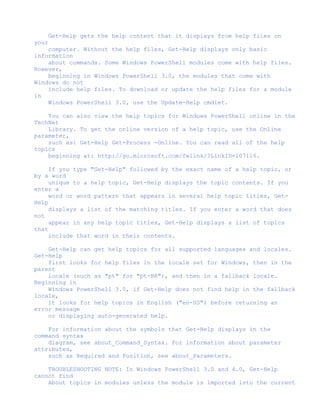
Get-Help gets thehelp content that it displays from help files on
your
computer. Without the help files, Get-Help displays only basic
information
about commands. Some Windows PowerShell modules come with help files.
However,
beginning in Windows PowerShell 3.0, the modules that come with
Windows do not
include help files. To download or update the help files for a module
in
Windows PowerShell 3.0, use the Update-Help cmdlet.
You can also view the help topics for Windows PowerShell online in the
TechNet
Library. To get the online version of a help topic, use the Online
parameter,
such as: Get-Help Get-Process -Online. You can read all of the help
topics
beginning at: http://go.microsoft.com/fwlink/?LinkID=107116.
If you type "Get-Help" followed by the exact name of a help topic, or
by a word
unique to a help topic, Get-Help displays the topic contents. If you
enter a
word or word pattern that appears in several help topic titles, Get-
Help
displays a list of the matching titles. If you enter a word that does
not
appear in any help topic titles, Get-Help displays a list of topics
that
include that word in their contents.
Get-Help can get help topics for all supported languages and locales.
Get-Help
first looks for help files in the locale set for Windows, then in the
parent
locale (such as "pt" for "pt-BR"), and then in a fallback locale.
Beginning in
Windows PowerShell 3.0, if Get-Help does not find help in the fallback
locale,
it looks for help topics in English ("en-US") before returning an
error message
or displaying auto-generated help.
For information about the symbols that Get-Help displays in the
command syntax
diagram, see about_Command_Syntax. For information about parameter
attributes,
such as Required and Position, see about_Parameters.
TROUBLESHOOTING NOTE: In Windows PowerShell 3.0 and 4.0, Get-Help
cannot find
About topics in modules unless the module is imported into the current
51.
session.
This is aknown issue. To get About topics in a module, import the
module,
either by using the Import-Module cmdlet or by running a cmdlet in the
module.
RELATED LINKS
Online Version: http://go.microsoft.com/fwlink/p/?linkid=289584
Updatable Help Status Table (http://go.microsoft.com/fwlink/?
LinkID=270007)
Get-Command
Get-Member
Get-PSDrive
about_Command_Syntax
about_Comment_Based_Help
about_Parameters
REMARKS
To see the examples, type: "get-help Get-Help -examples".
For more information, type: "get-help Get-Help -detailed".
For technical information, type: "get-help Get-Help -full".
For online help, type: "get-help Get-Help -online"
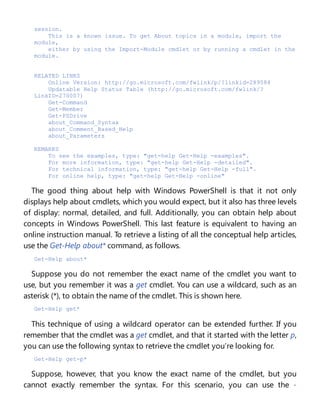
The good thing about help with Windows PowerShell is that it not only
displays help about cmdlets, which you would expect, but it also has three levels
of display: normal, detailed, and full. Additionally, you can obtain help about
concepts in Windows PowerShell. This last feature is equivalent to having an
online instruction manual. To retrieve a listing of all the conceptual help articles,
use the Get-Help about* command, as follows.
Get-Help about*
Suppose you do not remember the exact name of the cmdlet you want to
use, but you remember it was a get cmdlet. You can use a wildcard, such as an
asterisk (*), to obtain the name of the cmdlet. This is shown here.
Get-Help get*
This technique of using a wildcard operator can be extended further. If you
remember that the cmdlet was a get cmdlet, and that it started with the letter p,
you can use the following syntax to retrieve the cmdlet you’re looking for.
Get-Help get-p*
Suppose, however, that you know the exact name of the cmdlet, but you
cannot exactly remember the syntax. For this scenario, you can use the -
52.
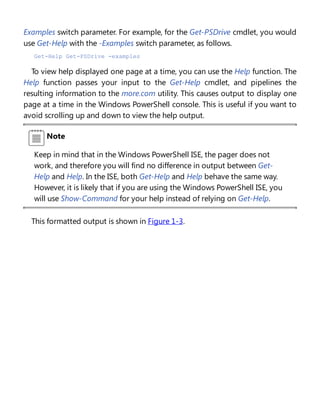
Examples switch parameter.For example, for the Get-PSDrive cmdlet, you would
use Get-Help with the -Examples switch parameter, as follows.
Get-Help Get-PSDrive -examples
To view help displayed one page at a time, you can use the Help function. The
Help function passes your input to the Get-Help cmdlet, and pipelines the
resulting information to the more.com utility. This causes output to display one
page at a time in the Windows PowerShell console. This is useful if you want to
avoid scrolling up and down to view the help output.
Note
Keep in mind that in the Windows PowerShell ISE, the pager does not
work, and therefore you will find no difference in output between Get-
Help and Help. In the ISE, both Get-Help and Help behave the same way.
However, it is likely that if you are using the Windows PowerShell ISE, you
will use Show-Command for your help instead of relying on Get-Help.
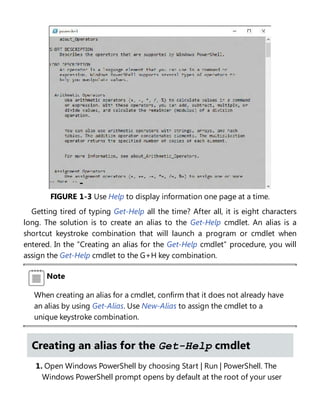
This formatted output is shown in Figure 1-3.
53.
FIGURE 1-3 UseHelp to display information one page at a time.
Getting tired of typing Get-Help all the time? After all, it is eight characters
long. The solution is to create an alias to the Get-Help cmdlet. An alias is a
shortcut keystroke combination that will launch a program or cmdlet when
entered. In the “Creating an alias for the Get-Help cmdlet” procedure, you will
assign the Get-Help cmdlet to the G+H key combination.
Note
When creating an alias for a cmdlet, confirm that it does not already have
an alias by using Get-Alias. Use New-Alias to assign the cmdlet to a
unique keystroke combination.
Creating an alias for the Get-Help cmdlet
1. Open Windows PowerShell by choosing Start | Run | PowerShell. The
Windows PowerShell prompt opens by default at the root of your user
54.
folder.
2. Retrieve analphabetic listing of all currently defined aliases, and inspect
the list for one assigned to either the Get-Help cmdlet or the keystroke
combination G+H. The command to do this is as follows.
Get-Alias | sort
3. After you have determined that there is no alias for the Get-Help cmdlet
and that none is assigned to the G+H keystroke combination, review the
syntax for the New-Alias cmdlet. Use the -Full switch parameter to the Get-
Help cmdlet. This is shown here.
Get-Help New-Alias -full
4. Use the New-Alias cmdlet to assign the G+H keystroke combination to
the Get-Help cmdlet. To do this, use the following command.
New-Alias gh Get-Help
Exploring commands: Step-by-step exercises
In the following exercises, you’ll explore the use of command-line utilities in
Windows PowerShell. You will find that it is as easy to use command-line utilities
in Windows PowerShell as in the CMD interpreter; however, by using such
commands in Windows PowerShell, you gain access to new levels of
functionality.
Using command-line utilities
1. Open Windows PowerShell by choosing Start | Run | PowerShell. The
Windows PowerShell prompt opens by default at the root of your user
folder.
2. Change to the root of C: by entering cd c: inside the Windows
PowerShell prompt.
cd c:
3. Obtain a listing of all the files in the root of C: by using the dir command.
dir
Giulia
A domani.
La signoraMirelli
(va nella camera della Ferrucci, e chiude l'uscio.)
Giulia
(inquieta, palpitando, come attirata da una forza magnetica,
lentissimamente si accosta al parapetto del finestrone. — Appena
sporta la testa, in un violento sussulto, esclama:) La signora
Marnieri! (Poi, in preda a una confusa concitazione:) Perchè
viene?!... Perchè viene?!... Che cosa accade?!...
SCENA VIII.
GIULIA, LA SIGNORA MARNIERI
La signora Marnieri
(giungendo trafelata e angosciosamente vibrante) Devo parlarvi di
urgenza. Non ho potuto fare a meno di forzare la consegna. Devo
parlarvi d'urgenza!
Giulia
Dio mio!
La signora Marnieri
Luciano è andato ad imbarcarsi sul piroscafo che parte questa sera
per l'Africa. Sono io che l'ho spinto a chiedere di voi prima che si
fosse recato a bordo. M'illudevo, m'illudevo ancora!... Ma voi non
avete voluto riceverlo, e ogni mia illusione è svanita. Al più tardi fra
un'ora, il piroscafo si distaccherà dallo sbarcatoio, e lo porterà via
per sempre!
57.
Giulia
Per sempre no!
Lasignora Marnieri
Sì, per sempre! per sempre!
Giulia
(indagando con trepidazione intensa) Io ho letto nei giornali che egli
si sarebbe unito ad alcuni scienziati che vanno in missione laggiù.
Per quanto audace quello che si propongono, non mi pare, non
credo che sia la perdizione.
La signora Marnieri
Per lui, sì. Ne ho la sicurezza.
Giulia
Ma non aveva chiesto il vostro consiglio?... Non vi aveva scritto
nulla?
La signora Marnieri
Nulla! Nulla! Me lo son visto giungere ieri l'altro da Milano,
all'impensata; e quando ho appreso il suo proposito mi sono
inginocchiata dinanzi a lui, piangendo tutte le mie lagrime per
ottenere ch'egli desistesse. Non è stato possibile. Io piangevo,
piangevo, e i suoi occhi erano asciutti, la sua voce aveva un suono
freddo di volontà irremovibile, e per sua madre nemmeno un segno
di compassione.
Giulia
Se non si è commosso, significa appunto che non dubita di rivedervi.
La signora Marnieri
No, non significa questo! Da ieri l'altro sino ad un'ora fa, io ho
centuplicato la mia anima per sorvegliare quella di mio figlio; e della
sua povera anima moribonda, oggi, io so anche più di quanto egli
58.
non sappia. Delresto, tutti gli indizi da me raccolti hanno avuto una
conferma nella raccomandazione che egli ha fatta stamane al suo
amico Manlio. Ero nascosta, appiattata, e, con le mie orecchie, l'ho
udita come una condanna! «Se non tornassi, ti raccomando di far
capire a mia madre che per me la morte sarà stata finalmente una
liberazione». Dunque, non c'è più dubbio! Egli la va a cercare laggiù,
e questa partenza non è che il principio d'un suicidio, che egli
dissimula forse perfino a sè stesso! Voi dovete aiutarmi a salvarlo.
Giulia
(tramortita, col fiato sospeso) E... che potrei fare io?
La signora Marnieri
Ah, signora Giulia! (Affannosamente incalzando) Dal giorno in cui per
la prima volta osai bussare alla vostra porta, di tanto in tanto ci sono
tornata, paurosa, come avrebbe fatto lui se non avesse avuto
l'eroismo di fuggirvi. Di lui, paurosamente, vi ho intrattenuta quando
ho avuto l'impressione d'essere stata accolta volentieri. Come
avrebbe fatto lui, ho aspettato, ho aspettato pazientemente un
vostro sorriso di benignità. Tutto questo voi lo avete inteso; e oramai
sapete che nella mia voce parla il più grande amore che sia stato
mai sentito da un uomo; e sapete, come lo so io, che mio figlio, se
non sarà trattenuto da voi, correrà disperatamente alla morte!...
Giulia
(spasimando nel dibattito terribile) Sì, trattenerlo!... trattenerlo!... Ma
poi?!...
La signora Marnieri
Voi potrete, col tempo, rinnovare la vostra esistenza....
Giulia
(mettendosi le mani aperte davanti agli occhi come per non vedere
qualche cosa che la spaventa) No!...
La signora Marnieri
59.
Voi potrete trovarenella sua gratitudine tutto un tesoro di tenerezze
che non avete mai conosciute....
Giulia
Tacete, ve ne supplico! Non capite quello che io soffro? Non vi
accorgete che l'energia con cui vi ho respinta sinora sta per
abbandonarmi?
La signora Marnieri
(irradiandosi di meraviglia e di speranza) Vergine mia cara, sarebbe
possibile?!
Giulia
(in un veemente impeto come d'imprecazione) Attraverso sua madre
questo innamorato lontano diventa inesorabile!... (Poi si lascia
cadere sopra una sedia.) Sono quattro anni che mi costringete a
intuire le lotte, la costanza, il supplizio di vostro figlio; sono quattro
anni che nella mia sepoltura mi scotete per trascinarmi alla speranza
che io possa risuscitare, e non avete il sospetto della vostra crudeltà!
La signora Marnieri
Senza questa crudeltà, non sarei riuscita ad avvicinarvi un poco a
lui....
Giulia
(con voce soffocata, ma aspra, violenta, sibilante di angoscia) Voi
v'ingannate, signora Marnieri! Ciò che avete fatto voi non è che il
compimento dell'opera cominciata dallo stesso uomo che mi proibì di
amare, dallo stesso uomo che morì fra le mie braccia come in un
rogo, con le carni bruciate dalla gelosia. E questa, questa è stata la
mia crucifissione! Voi avete compiuta l'opera spietata, sì, ma fu lui
che mi rivelò l'adorazione di vostro figlio, fu lui che me ne fece
tremare come d'una fatalità orrenda, fu lui, fu lui che ne inchiodò il
nome nella vita mia! (Breve pausa. Indi, ripiglia con accento fioco:)
E presso a spirare, ancora di vostro figlio volle parlarmi. Biascicava le
60.
parole con lelabbra bianche, ma il nome temuto lo pronunziò intero
e preciso, e nel pronunziarlo spalancò le pupille spaventosamente e
strinse come in una tanaglia arroventata nelle sue mani le mie. Poi...
a un tratto... le lasciò cadere.... Tacque, e pianse morendo. (Sulle
guance di lei scendono le lagrime del dolore antico e delle novelle
torture.) (Un silenzio.) Ora, mi potete comprendere. Nessun
giuramento mi rimorde, perchè io non giurai.... Dio m'è testimone
che rifiutai di giurare! Ma, tuttavia, quel povero geloso, dopo aver
creato egli stesso il destino del mio cuore, quanto più tempo passa
tanto più tenacemente mi tiene incatenata!
La signora Marnieri
(urgente, febbrile, compresa dal timore che ella le sfugga) No,
Giulia! La necessità suprema di fare un bene che solamente a voi è
concesso di fare non vi permetterà l'abnegazione eterna che vi siete
imposta.
Giulia
Sono perduta! Sono incatenata!
La signora Marnieri
Le spezzerò io le vostre catene per la salvezza di mio figlio! Voi
verrete con me!... Voi mi seguirete coraggiosamente come per un
dovere di carità cristiana. Basterà ch'io vi mostri a lui affinchè egli
risenta in un istante solo il bisogno di vivere!
Giulia
Come mi sapete vincere!...
La signora Marnieri
E voi come sapete ancora resistermi!...
Giulia
(con gli occhi spenti, senza fiato, abbandonandosi) Non è vero,...
non è vero,... perchè io ci verrò!
61.
La signora Marnieri
(inuna esultanza umile, rivolgendo al cielo lo sguardo luminoso di
trionfo e di riconoscenza) Dio, ti ringrazio!
Giulia
(accesa da un coraggio istantaneo e quasi temendo di perderlo, si
leva agitatissima) Andiamo.... Andiamo.... Andiamo....
La signora Marnieri
Si, andiamo finalmente!
Giulia
(pervasa, suggestionata dall'atmosfera che la circonda, parlando
senza voce, col respiro mosso e con celerità vertiginosa) Ma per
carità, che qui non si sospetti di nulla! Precedetemi di qualche
minuto.... Io, intanto, prendo il mio scialle e, uscendo sola, mi sarà
più facile evitare d'essere veduta dalle mie amiche....
La signora Marnieri
Il tempo stringe, Giulia!
Giulia
D'altronde, è anche necessario che egli oda dalla vostra bocca, prima
che io giunga, quello che non potrei dirgli io stessa....
La signora Marnieri
A ben presto, dunque!
Giulia
A ben presto.
La signora Marnieri
(velocemente esce.)
62.
SCENA ULTIMA.
GIULIA, LASIGNORA MIRELLI.
Giulia
(appena uscita la signora Marnieri, tremando dal capo ai piedi come
se si preparasse a compiere un delitto e sentendo l'urgenza di
sottrarsi a quel chiarore, col volto terreo, contratto e con gli occhi
fissi alla lampada che pende dal soffitto, rapidamente volta la
chiavetta della luce elettrica, e si precipita nella stanza sulla cui porta
è scritto: «Direzione».)
(Il camerone resta nel buio. Soltanto, dall'ampia finestra, uno scialbo
riverbero del cielo stellato, attraverso la caligine dell'afa estiva,
segna una striscia pallida sul pavimento.)
La signora Mirelli
(aprendo l'uscio, risponde con gentilezza vivace ad un ultimo saluto
della Ferrucci:) No! La parola «addio» non ve la dico. È una brutta
parola. Non ve la dico. (Richiude l'uscio. Si accosta al tavolino.
Prende il merletto della Marchesa e la scatola dei ricami e, lieve,
lenta, tranquilla, s'inoltra nell'oscurità del corridoio.)
Giulia
(tornando sùbito, con addosso e un po' sulla testa un leggero
scialletto, scorge alle spalle la signora Mirelli e si arresta. Acquattata,
con gli sguardi diritti su quell'ombra che s'inoltra nell'ombra, aspetta
che sparisca. Quando non la vede più, si dirige verso la scala. Ma nel
mezzo della camera si ferma di botto. Rabbrividisce. Ha in tutti i suoi
sensi l'impressione che un ostacolo le impedisca di andare oltre.
Nello sforzo e nel terrore mormora:) Non posso! (Con le braccia
protese in avanti, le mani aperte, ritenta. Retrocede.) Non posso!...
(Si sente soffocare. Vacilla. Cade ginocchioni. E, convulsamente,
disperatamente, si abbatte con la faccia a terra, scoppiando in
63.
singhiozzi e facendourlare la sua anima soccombente:) Non
posso!... Non posso!... Non posso!...
(Sipario.)
Fine del dramma.
64.
OPERE DI ROBERTOBRACCO
pubblicate dalla Casa Editrice REMO SANDRON
TEATRO
(Raccolta completa di tutta la produzione teatrale)
VOLUME I.
Non fare ad altri. — Commedia in un atto.
Lui, lei, lui. — Commedia in un atto.
Dopo il veglione, o viceversa. — Scenette.
Un'avventura di viaggio. — Commedia in un atto.
Le disilluse. — Fiaba in un atto.
Una donna. — Dramma in quattro atti.
in-16, pagg. VIII-348 — L. 3,50.
VOLUME II.
Maschere. — Dramma in un atto.
Infedele. — Commedia in tre atti.
Il Trionfo. — Dramma in quattro atti.
2ª edizione riveduta.
Un volume in-16, pagg. 364 — L. 4.
VOLUME III.
Don Pietro Caruso. — Dramma in un atto.
65.
La fine dell'amore.— Satira in quattro atti.
Fiori d'arancio. — Idillio in un atto.
Tragedie dell'anima. — Dramma in tre atti.
2ª edizione riveduta.
Un volume in-16, pagg. 382 — L. 4.
VOLUME IV.
Il diritto di vivere. — Dramma in tre atti.
Uno degli onesti. — Commedia in un atto.
Sperduti nel buio. — Dramma in tre atti.
3ª edizione riveduta.
Un volume in-16, pagg. 370 — L. 4.
VOLUME V.
Maternità. — Dramma in quattro atti.
Il frutto acerbo. — Commedia in tre atti.
2ª edizione riveduta.
Un volume in-16, pagg. 336 — L. 3.
VOLUME VI.
La piccola fonte. — Dramma in quattro atti.
Fotografia senza.... — Scherzetto.
Notte di neve. — Dramma in un atto.
La chiacchierina. — Monologo.
Un volume in-16, pagg. 282 — L. 4.
VOLUME VII.
I fantasmi. — Dramma in quattro atti.
Nellina. — Dramma in tre atti.
66.
Un volume in-16,pagg. 308 — L. 4.
IL PICCOLO SANTO
DRAMMA IN CINQUE ATTI
Un vol. in-16, pagg. 304, in edizione speciale — L. 3,50.
SMORFIE GAIE
(Seconda Edizione)
FALSA PARTENZA
SUL MARCIAPIEDE
UN COLPO DI RIVOLTELLA
IL PRIMO CONVEGNO
AMORE BENDATO
CONFESSORE IN IMBARAZZO
POLITICA INTERNA
UN «MODUS VIVENDI»
UN PESSIMO AFFARE
TELEFONO NAPOLI-ROMA
INTERMEZZO: IL GIGANTE
STASERA: UGONOTTI
IL SUCCESSORE
L'IDEALE DELLE FANCIULLE
UNA TAZZA DI TÈ
TUTTE E DUE
CINQUE MINUTI DI FERMATA
L'ORLO DEL BICCHIERE
IN FUMO
UN BACIO AL BUIO
UNA MANO LAVA L'ALTRA
LA PRINCIPESSA
67.
Un elegante volumein-16, di pagg. 304
L. 3,50.
SMORFIE TRISTI
(Seconda Edizione)
LA CANZONETTA DELL'ALBA
UN MURO
LA PICCOLA LADRA
LA SARTA DELLA SIGNORA «ZULIA»
IL SORTEGGIO
IL NEONATO
NELLA NEBBIA
LA RIVALE
NELL'OMBRA
LA PRIMA FINZIONE
IL FIDANZATO
PICKMANN
IL NOTTAMBULO
LEIT-MOTIV
«IN MANUS TUAS»
IL TESTIMONE
TRAMONTO
L'ARTICOLO OTTAVO
IL MOSTRO
L'ULTIMA LEZIONE
LA LOTTA
Un elegante volume in-16, di pagg. 328
L. 3,50.
SCRITTI VARII — Vol. I.
Nota del Trascrittore
Ortografiae punteggiatura originali sono state
mantenute, correggendo senza annotazione minimi errori
tipografici.
Copertina elaborata dal trascrittore e posta nel pubblico
dominio.
70.
*** END OFTHE PROJECT GUTENBERG EBOOK I FANTASMI:
DRAMMA IN QUATTRO ATTI ***
Updated editions will replace the previous one—the old editions will
be renamed.
Creating the works from print editions not protected by U.S.
copyright law means that no one owns a United States copyright in
these works, so the Foundation (and you!) can copy and distribute it
in the United States without permission and without paying
copyright royalties. Special rules, set forth in the General Terms of
Use part of this license, apply to copying and distributing Project
Gutenberg™ electronic works to protect the PROJECT GUTENBERG™
concept and trademark. Project Gutenberg is a registered trademark,
and may not be used if you charge for an eBook, except by following
the terms of the trademark license, including paying royalties for use
of the Project Gutenberg trademark. If you do not charge anything
for copies of this eBook, complying with the trademark license is
very easy. You may use this eBook for nearly any purpose such as
creation of derivative works, reports, performances and research.
Project Gutenberg eBooks may be modified and printed and given
away—you may do practically ANYTHING in the United States with
eBooks not protected by U.S. copyright law. Redistribution is subject
to the trademark license, especially commercial redistribution.
START: FULL LICENSE
PLEASE READ THISBEFORE YOU DISTRIBUTE OR USE THIS WORK
To protect the Project Gutenberg™ mission of promoting the free
distribution of electronic works, by using or distributing this work (or
any other work associated in any way with the phrase “Project
Gutenberg”), you agree to comply with all the terms of the Full
Project Gutenberg™ License available with this file or online at
www.gutenberg.org/license.
Section 1. General Terms of Use and
Redistributing Project Gutenberg™
electronic works
1.A. By reading or using any part of this Project Gutenberg™
electronic work, you indicate that you have read, understand, agree
to and accept all the terms of this license and intellectual property
(trademark/copyright) agreement. If you do not agree to abide by all
the terms of this agreement, you must cease using and return or
destroy all copies of Project Gutenberg™ electronic works in your
possession. If you paid a fee for obtaining a copy of or access to a
Project Gutenberg™ electronic work and you do not agree to be
bound by the terms of this agreement, you may obtain a refund
from the person or entity to whom you paid the fee as set forth in
paragraph 1.E.8.
1.B. “Project Gutenberg” is a registered trademark. It may only be
used on or associated in any way with an electronic work by people
who agree to be bound by the terms of this agreement. There are a
few things that you can do with most Project Gutenberg™ electronic
works even without complying with the full terms of this agreement.
See paragraph 1.C below. There are a lot of things you can do with
Project Gutenberg™ electronic works if you follow the terms of this
agreement and help preserve free future access to Project
Gutenberg™ electronic works. See paragraph 1.E below.
73.
1.C. The ProjectGutenberg Literary Archive Foundation (“the
Foundation” or PGLAF), owns a compilation copyright in the
collection of Project Gutenberg™ electronic works. Nearly all the
individual works in the collection are in the public domain in the
United States. If an individual work is unprotected by copyright law
in the United States and you are located in the United States, we do
not claim a right to prevent you from copying, distributing,
performing, displaying or creating derivative works based on the
work as long as all references to Project Gutenberg are removed. Of
course, we hope that you will support the Project Gutenberg™
mission of promoting free access to electronic works by freely
sharing Project Gutenberg™ works in compliance with the terms of
this agreement for keeping the Project Gutenberg™ name associated
with the work. You can easily comply with the terms of this
agreement by keeping this work in the same format with its attached
full Project Gutenberg™ License when you share it without charge
with others.
1.D. The copyright laws of the place where you are located also
govern what you can do with this work. Copyright laws in most
countries are in a constant state of change. If you are outside the
United States, check the laws of your country in addition to the
terms of this agreement before downloading, copying, displaying,
performing, distributing or creating derivative works based on this
work or any other Project Gutenberg™ work. The Foundation makes
no representations concerning the copyright status of any work in
any country other than the United States.
1.E. Unless you have removed all references to Project Gutenberg:
1.E.1. The following sentence, with active links to, or other
immediate access to, the full Project Gutenberg™ License must
appear prominently whenever any copy of a Project Gutenberg™
work (any work on which the phrase “Project Gutenberg” appears,
or with which the phrase “Project Gutenberg” is associated) is
accessed, displayed, performed, viewed, copied or distributed:
74.
This eBook isfor the use of anyone anywhere in the United
States and most other parts of the world at no cost and with
almost no restrictions whatsoever. You may copy it, give it away
or re-use it under the terms of the Project Gutenberg License
included with this eBook or online at www.gutenberg.org. If you
are not located in the United States, you will have to check the
laws of the country where you are located before using this
eBook.
1.E.2. If an individual Project Gutenberg™ electronic work is derived
from texts not protected by U.S. copyright law (does not contain a
notice indicating that it is posted with permission of the copyright
holder), the work can be copied and distributed to anyone in the
United States without paying any fees or charges. If you are
redistributing or providing access to a work with the phrase “Project
Gutenberg” associated with or appearing on the work, you must
comply either with the requirements of paragraphs 1.E.1 through
1.E.7 or obtain permission for the use of the work and the Project
Gutenberg™ trademark as set forth in paragraphs 1.E.8 or 1.E.9.
1.E.3. If an individual Project Gutenberg™ electronic work is posted
with the permission of the copyright holder, your use and distribution
must comply with both paragraphs 1.E.1 through 1.E.7 and any
additional terms imposed by the copyright holder. Additional terms
will be linked to the Project Gutenberg™ License for all works posted
with the permission of the copyright holder found at the beginning
of this work.
1.E.4. Do not unlink or detach or remove the full Project
Gutenberg™ License terms from this work, or any files containing a
part of this work or any other work associated with Project
Gutenberg™.
1.E.5. Do not copy, display, perform, distribute or redistribute this
electronic work, or any part of this electronic work, without
prominently displaying the sentence set forth in paragraph 1.E.1
75.
with active linksor immediate access to the full terms of the Project
Gutenberg™ License.
1.E.6. You may convert to and distribute this work in any binary,
compressed, marked up, nonproprietary or proprietary form,
including any word processing or hypertext form. However, if you
provide access to or distribute copies of a Project Gutenberg™ work
in a format other than “Plain Vanilla ASCII” or other format used in
the official version posted on the official Project Gutenberg™ website
(www.gutenberg.org), you must, at no additional cost, fee or
expense to the user, provide a copy, a means of exporting a copy, or
a means of obtaining a copy upon request, of the work in its original
“Plain Vanilla ASCII” or other form. Any alternate format must
include the full Project Gutenberg™ License as specified in
paragraph 1.E.1.
1.E.7. Do not charge a fee for access to, viewing, displaying,
performing, copying or distributing any Project Gutenberg™ works
unless you comply with paragraph 1.E.8 or 1.E.9.
1.E.8. You may charge a reasonable fee for copies of or providing
access to or distributing Project Gutenberg™ electronic works
provided that:
• You pay a royalty fee of 20% of the gross profits you derive
from the use of Project Gutenberg™ works calculated using the
method you already use to calculate your applicable taxes. The
fee is owed to the owner of the Project Gutenberg™ trademark,
but he has agreed to donate royalties under this paragraph to
the Project Gutenberg Literary Archive Foundation. Royalty
payments must be paid within 60 days following each date on
which you prepare (or are legally required to prepare) your
periodic tax returns. Royalty payments should be clearly marked
as such and sent to the Project Gutenberg Literary Archive
Foundation at the address specified in Section 4, “Information
76.
about donations tothe Project Gutenberg Literary Archive
Foundation.”
• You provide a full refund of any money paid by a user who
notifies you in writing (or by e-mail) within 30 days of receipt
that s/he does not agree to the terms of the full Project
Gutenberg™ License. You must require such a user to return or
destroy all copies of the works possessed in a physical medium
and discontinue all use of and all access to other copies of
Project Gutenberg™ works.
• You provide, in accordance with paragraph 1.F.3, a full refund of
any money paid for a work or a replacement copy, if a defect in
the electronic work is discovered and reported to you within 90
days of receipt of the work.
• You comply with all other terms of this agreement for free
distribution of Project Gutenberg™ works.
1.E.9. If you wish to charge a fee or distribute a Project Gutenberg™
electronic work or group of works on different terms than are set
forth in this agreement, you must obtain permission in writing from
the Project Gutenberg Literary Archive Foundation, the manager of
the Project Gutenberg™ trademark. Contact the Foundation as set
forth in Section 3 below.
1.F.
1.F.1. Project Gutenberg volunteers and employees expend
considerable effort to identify, do copyright research on, transcribe
and proofread works not protected by U.S. copyright law in creating
the Project Gutenberg™ collection. Despite these efforts, Project
Gutenberg™ electronic works, and the medium on which they may
be stored, may contain “Defects,” such as, but not limited to,
incomplete, inaccurate or corrupt data, transcription errors, a
copyright or other intellectual property infringement, a defective or
77.
damaged disk orother medium, a computer virus, or computer
codes that damage or cannot be read by your equipment.
1.F.2. LIMITED WARRANTY, DISCLAIMER OF DAMAGES - Except for
the “Right of Replacement or Refund” described in paragraph 1.F.3,
the Project Gutenberg Literary Archive Foundation, the owner of the
Project Gutenberg™ trademark, and any other party distributing a
Project Gutenberg™ electronic work under this agreement, disclaim
all liability to you for damages, costs and expenses, including legal
fees. YOU AGREE THAT YOU HAVE NO REMEDIES FOR
NEGLIGENCE, STRICT LIABILITY, BREACH OF WARRANTY OR
BREACH OF CONTRACT EXCEPT THOSE PROVIDED IN PARAGRAPH
1.F.3. YOU AGREE THAT THE FOUNDATION, THE TRADEMARK
OWNER, AND ANY DISTRIBUTOR UNDER THIS AGREEMENT WILL
NOT BE LIABLE TO YOU FOR ACTUAL, DIRECT, INDIRECT,
CONSEQUENTIAL, PUNITIVE OR INCIDENTAL DAMAGES EVEN IF
YOU GIVE NOTICE OF THE POSSIBILITY OF SUCH DAMAGE.
1.F.3. LIMITED RIGHT OF REPLACEMENT OR REFUND - If you
discover a defect in this electronic work within 90 days of receiving
it, you can receive a refund of the money (if any) you paid for it by
sending a written explanation to the person you received the work
from. If you received the work on a physical medium, you must
return the medium with your written explanation. The person or
entity that provided you with the defective work may elect to provide
a replacement copy in lieu of a refund. If you received the work
electronically, the person or entity providing it to you may choose to
give you a second opportunity to receive the work electronically in
lieu of a refund. If the second copy is also defective, you may
demand a refund in writing without further opportunities to fix the
problem.
1.F.4. Except for the limited right of replacement or refund set forth
in paragraph 1.F.3, this work is provided to you ‘AS-IS’, WITH NO
OTHER WARRANTIES OF ANY KIND, EXPRESS OR IMPLIED,
78.
INCLUDING BUT NOTLIMITED TO WARRANTIES OF
MERCHANTABILITY OR FITNESS FOR ANY PURPOSE.
1.F.5. Some states do not allow disclaimers of certain implied
warranties or the exclusion or limitation of certain types of damages.
If any disclaimer or limitation set forth in this agreement violates the
law of the state applicable to this agreement, the agreement shall be
interpreted to make the maximum disclaimer or limitation permitted
by the applicable state law. The invalidity or unenforceability of any
provision of this agreement shall not void the remaining provisions.
1.F.6. INDEMNITY - You agree to indemnify and hold the Foundation,
the trademark owner, any agent or employee of the Foundation,
anyone providing copies of Project Gutenberg™ electronic works in
accordance with this agreement, and any volunteers associated with
the production, promotion and distribution of Project Gutenberg™
electronic works, harmless from all liability, costs and expenses,
including legal fees, that arise directly or indirectly from any of the
following which you do or cause to occur: (a) distribution of this or
any Project Gutenberg™ work, (b) alteration, modification, or
additions or deletions to any Project Gutenberg™ work, and (c) any
Defect you cause.
Section 2. Information about the Mission
of Project Gutenberg™
Project Gutenberg™ is synonymous with the free distribution of
electronic works in formats readable by the widest variety of
computers including obsolete, old, middle-aged and new computers.
It exists because of the efforts of hundreds of volunteers and
donations from people in all walks of life.
Volunteers and financial support to provide volunteers with the
assistance they need are critical to reaching Project Gutenberg™’s
goals and ensuring that the Project Gutenberg™ collection will
79.
remain freely availablefor generations to come. In 2001, the Project
Gutenberg Literary Archive Foundation was created to provide a
secure and permanent future for Project Gutenberg™ and future
generations. To learn more about the Project Gutenberg Literary
Archive Foundation and how your efforts and donations can help,
see Sections 3 and 4 and the Foundation information page at
www.gutenberg.org.
Section 3. Information about the Project
Gutenberg Literary Archive Foundation
The Project Gutenberg Literary Archive Foundation is a non-profit
501(c)(3) educational corporation organized under the laws of the
state of Mississippi and granted tax exempt status by the Internal
Revenue Service. The Foundation’s EIN or federal tax identification
number is 64-6221541. Contributions to the Project Gutenberg
Literary Archive Foundation are tax deductible to the full extent
permitted by U.S. federal laws and your state’s laws.
The Foundation’s business office is located at 809 North 1500 West,
Salt Lake City, UT 84116, (801) 596-1887. Email contact links and up
to date contact information can be found at the Foundation’s website
and official page at www.gutenberg.org/contact
Section 4. Information about Donations to
the Project Gutenberg Literary Archive
Foundation
Project Gutenberg™ depends upon and cannot survive without
widespread public support and donations to carry out its mission of
increasing the number of public domain and licensed works that can
be freely distributed in machine-readable form accessible by the
widest array of equipment including outdated equipment. Many
80.
small donations ($1to $5,000) are particularly important to
maintaining tax exempt status with the IRS.
The Foundation is committed to complying with the laws regulating
charities and charitable donations in all 50 states of the United
States. Compliance requirements are not uniform and it takes a
considerable effort, much paperwork and many fees to meet and
keep up with these requirements. We do not solicit donations in
locations where we have not received written confirmation of
compliance. To SEND DONATIONS or determine the status of
compliance for any particular state visit www.gutenberg.org/donate.
While we cannot and do not solicit contributions from states where
we have not met the solicitation requirements, we know of no
prohibition against accepting unsolicited donations from donors in
such states who approach us with offers to donate.
International donations are gratefully accepted, but we cannot make
any statements concerning tax treatment of donations received from
outside the United States. U.S. laws alone swamp our small staff.
Please check the Project Gutenberg web pages for current donation
methods and addresses. Donations are accepted in a number of
other ways including checks, online payments and credit card
donations. To donate, please visit: www.gutenberg.org/donate.
Section 5. General Information About
Project Gutenberg™ electronic works
Professor Michael S. Hart was the originator of the Project
Gutenberg™ concept of a library of electronic works that could be
freely shared with anyone. For forty years, he produced and
distributed Project Gutenberg™ eBooks with only a loose network of
volunteer support.
81.
Project Gutenberg™ eBooksare often created from several printed
editions, all of which are confirmed as not protected by copyright in
the U.S. unless a copyright notice is included. Thus, we do not
necessarily keep eBooks in compliance with any particular paper
edition.
Most people start at our website which has the main PG search
facility: www.gutenberg.org.
This website includes information about Project Gutenberg™,
including how to make donations to the Project Gutenberg Literary
Archive Foundation, how to help produce our new eBooks, and how
to subscribe to our email newsletter to hear about new eBooks.
82.
Welcome to ourwebsite – the perfect destination for book lovers and
knowledge seekers. We believe that every book holds a new world,
offering opportunities for learning, discovery, and personal growth.
That’s why we are dedicated to bringing you a diverse collection of
books, ranging from classic literature and specialized publications to
self-development guides and children's books.
More than just a book-buying platform, we strive to be a bridge
connecting you with timeless cultural and intellectual values. With an
elegant, user-friendly interface and a smart search system, you can
quickly find the books that best suit your interests. Additionally,
our special promotions and home delivery services help you save time
and fully enjoy the joy of reading.
Join us on a journey of knowledge exploration, passion nurturing, and
personal growth every day!
ebookbell.com

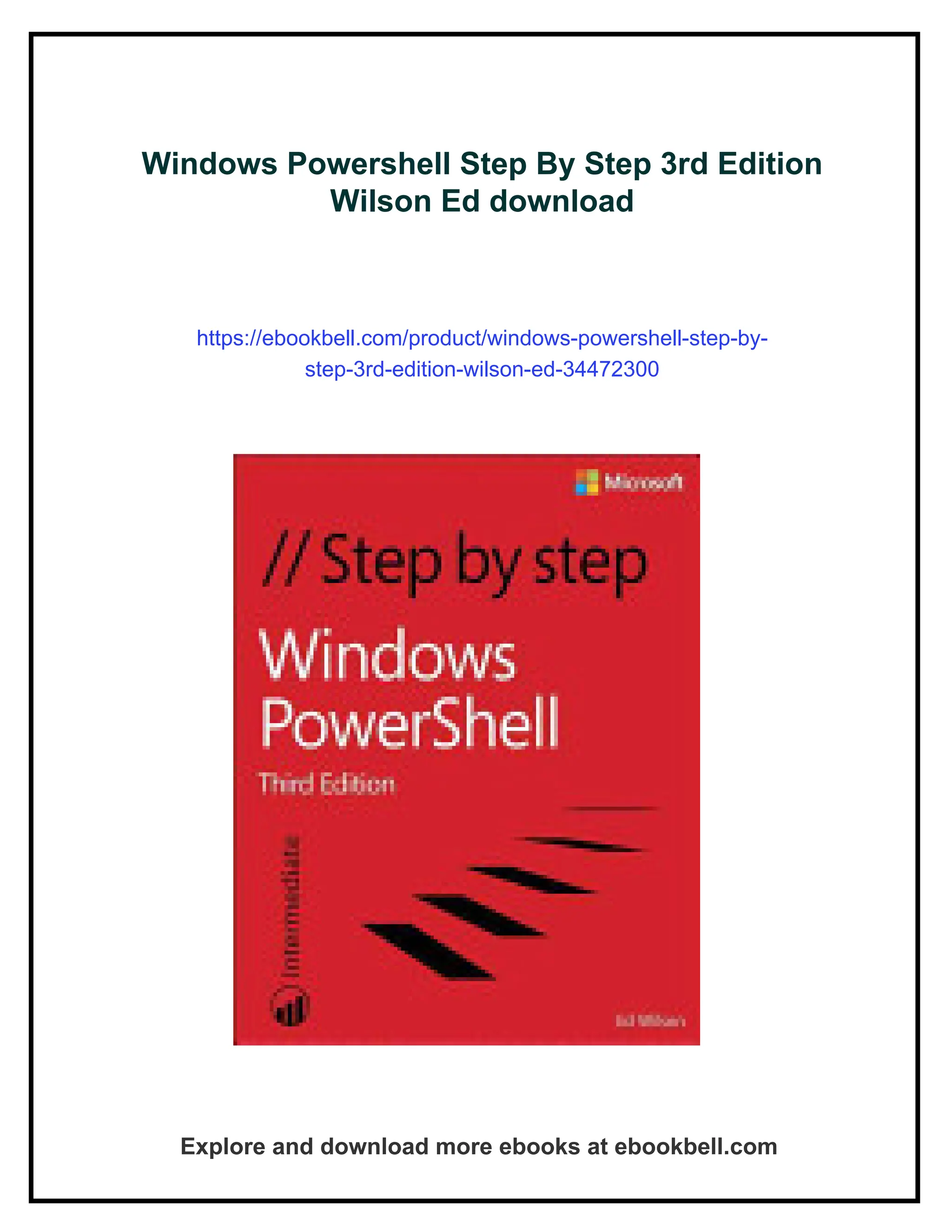

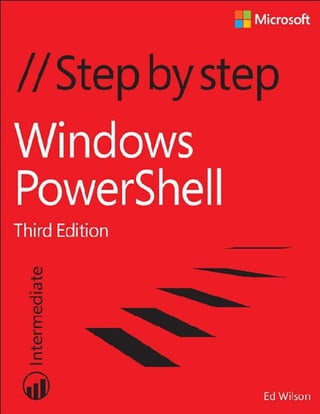


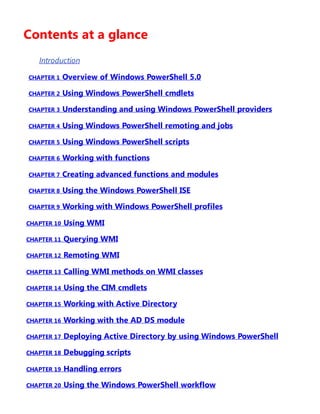
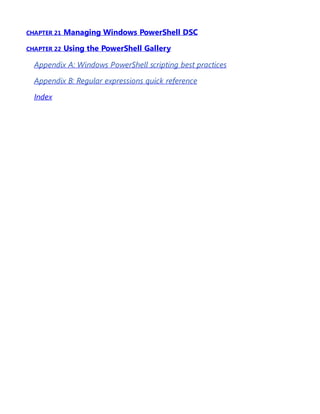
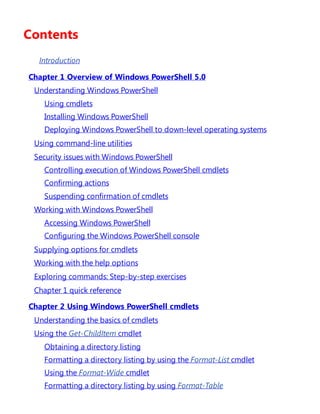
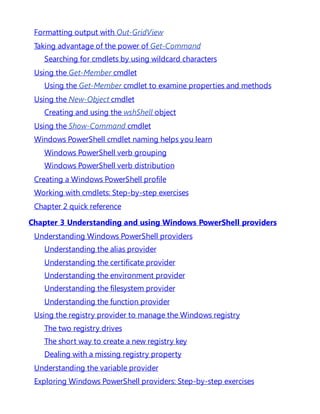
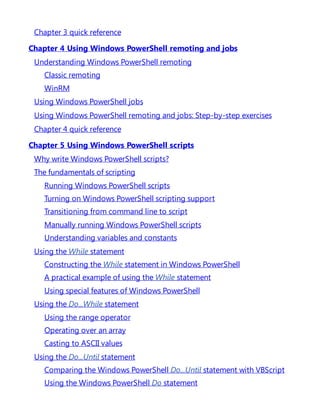
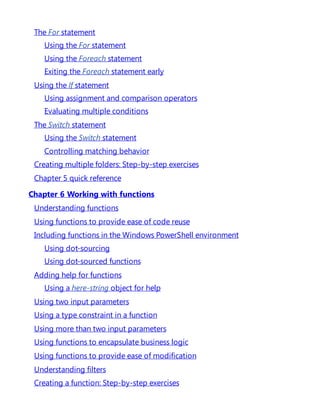
![Chapter 6 quick reference
Chapter 7 Creating advanced functions and modules
The [cmdletbinding] attribute
Easy verbose messages
Automatic parameter checks
Adding support for the -WhatIf switch parameter
Adding support for the -Confirm switch parameter
Specifying the default parameter set
The Parameter attribute
The Mandatory parameter property
The Position parameter property
The ParameterSetName parameter property
The ValueFromPipeline property
The HelpMessage property
Understanding modules
Locating and loading modules
Installing modules
Creating a module
Creating an advanced function and installing a module: Step-by-step
exercises
Chapter 7 quick reference
Chapter 8 Using the Windows PowerShell ISE
Running the Windows PowerShell ISE
Navigating the Windows PowerShell ISE
Working with the script pane
Using tab expansion and IntelliSense
Working with Windows PowerShell ISE snippets](https://image.slidesharecdn.com/17236150-250523235955-a533daa6/85/Windows-Powershell-Step-By-Step-3rd-Edition-Wilson-Ed-16-320.jpg)
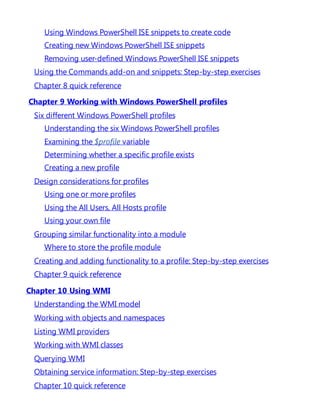
![Chapter 11 Querying WMI
Alternate ways to connect to WMI
Returning selective data from all instances
Selecting multiple properties
Choosing specific instances
Using an operator
Shortening the syntax
Working with software: Step-by-step exercises
Chapter 11 quick reference
Chapter 12 Remoting WMI
Using WMI against remote systems
Supplying alternate credentials for the remote connection
Using Windows PowerShell remoting to run WMI
Using CIM classes to query WMI classes
Working with remote results
Reducing data via Windows PowerShell parameters
Reducing data via WQL query
Running WMI jobs
Using Windows PowerShell remoting and WMI: Step-by-step exercises
Chapter 12 quick reference
Chapter 13 Calling WMI methods on WMI classes
Using WMI cmdlets to execute instance methods
Using the Terminate method directly
Using the Invoke-WmiMethod cmdlet
Using the [wmi] type accelerator
Using WMI cmdlets to work with static methods
Executing instance methods: Step-by-step exercises](https://image.slidesharecdn.com/17236150-250523235955-a533daa6/85/Windows-Powershell-Step-By-Step-3rd-Edition-Wilson-Ed-18-320.jpg)
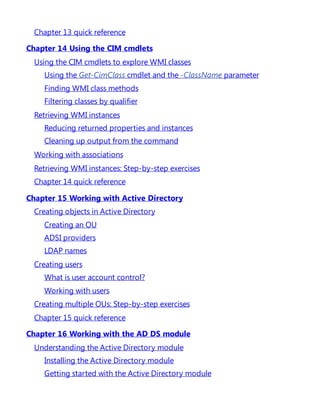
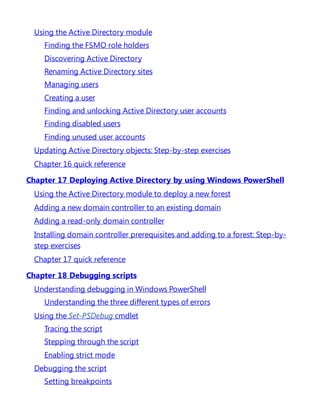
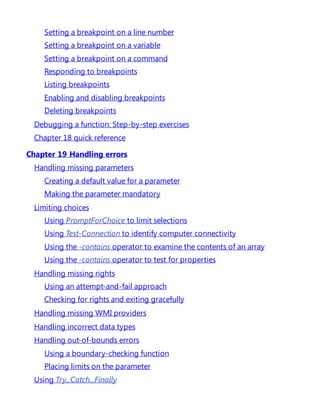
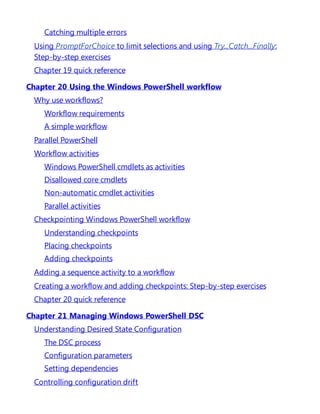
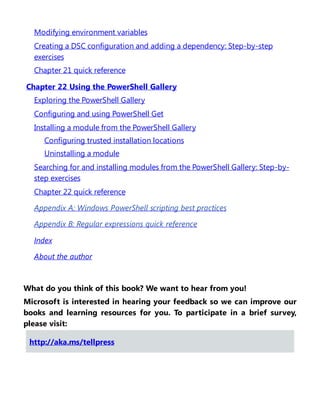
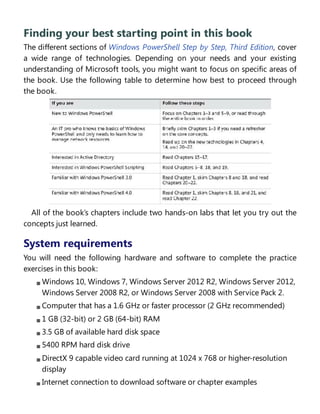
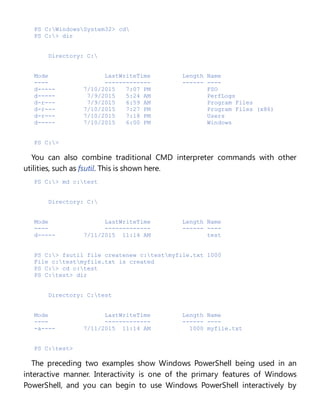
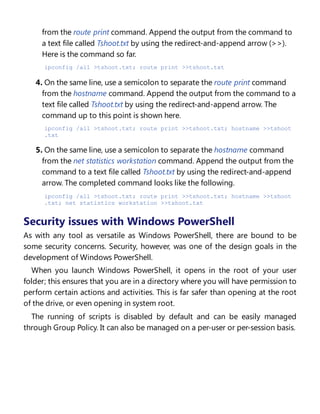
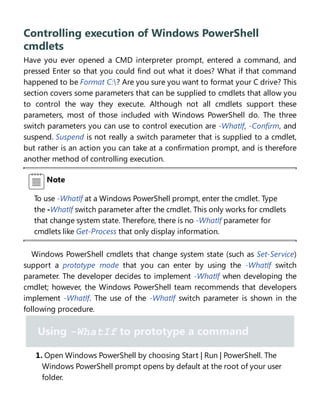
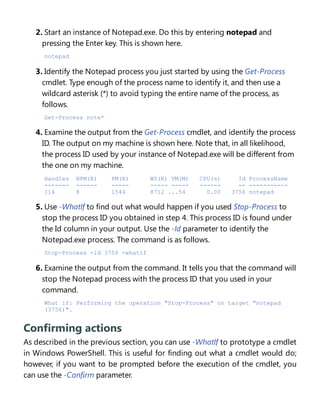
![Confirming the execution of cmdlets
1. Open Windows PowerShell, start an instance of Notepad.exe, identify the
process, and examine the output, just as in steps 1 through 4 in the
previous exercise.
2. Use the -Confirm parameter to force a prompt when using the Stop-
Process cmdlet to stop the Notepad process identified by the Get-Process
note* command. This is shown here.
Stop-Process -id 3756 -confirm
The Stop-Process cmdlet, when used with the -Confirm parameter, displays
the following confirmation prompt.
Confirm
Are you sure you want to perform this action?
Performing operation "Stop-Process" on Target "notepad (3756)".
[Y] Yes [A] Yes to All [N] No [L] No to All [S] Suspend [?] Help
(default is "Y"):
3. Enter y and press Enter. The Notepad.exe process ends. The Windows
PowerShell prompt returns to the default, ready for new commands, as
shown here.
PS C:>
Tip
To suspend cmdlet confirmation, at the confirmation prompt from the
cmdlet, enter s and press Enter.
Suspending confirmation of cmdlets](https://image.slidesharecdn.com/17236150-250523235955-a533daa6/85/Windows-Powershell-Step-By-Step-3rd-Edition-Wilson-Ed-39-320.jpg)
![Suspending confirmation of cmdlets
The ability to prompt for confirmation of the execution of a cmdlet is extremely
useful and at times might be vital to assisting in maintaining a high level of
system uptime. There might be times when you enter a long command and then
remember that you need to check on something else first. For example, you
might be in the middle of stopping a number of processes, but you need to
view details on the processes to ensure that you do not stop the wrong one. For
such eventualities, you can tell the confirmation that you would like to suspend
execution of the command.
Suspending execution of a cmdlet
1. Open Windows PowerShell, start an instance of Notepad.exe, identify the
process, and examine the output, just as in steps 1 through 4 in the “Using
-WhatIf to prototype a command” exercise. The output on my machine is
shown following. Note that in all likelihood, the process ID used by your
instance of Notepad.exe will be different from the one on my machine.
Handles NPM(K) PM(K) WS(K) VM(M) CPU(s) Id ProcessName
------- ------ ----- ----- ----- ------ -- -----------
39 2 944 400 29 0.05 3576 notepad
2. Use the -Confirm parameter to force a prompt when using the Stop-
Process cmdlet to stop the Notepad process identified by the Get-Process
note* command. This is illustrated here.
Stop-Process -id 3576 -confirm
The Stop-Process cmdlet, when used with the -Confirm parameter, displays
the following confirmation prompt.
Confirm
Are you sure you want to perform this action?
Performing operation "Stop-Process" on Target "notepad (3576)".
[Y] Yes [A] Yes to All [N] No [L] No to All [S] Suspend [?] Help
(default is "Y"):
3. To suspend execution of the Stop-Process cmdlet, enter s. and then a
double-arrow prompt appears, as follows.
PS C:>>](https://image.slidesharecdn.com/17236150-250523235955-a533daa6/85/Windows-Powershell-Step-By-Step-3rd-Edition-Wilson-Ed-40-320.jpg)
![4. Use the Get-Process cmdlet to obtain a list of all the running processes
that begin with the letter n. The syntax is as follows.
Get-Process n*
On my machine, two processes appear, the Notepad process I launched
earlier and another process. This is shown here.
Handles NPM(K) PM(K) WS(K) VM(M) CPU(s) Id ProcessName
------- ------ ----- ----- ----- ------ -- -----------
269 168 4076 2332 ...98 0.19 1632 NisSrv
114 8 1536 8732 ...54 0.02 3576 notepad
5. Return to the previous confirmation prompt by entering exit.
Again, the confirmation prompt appears as follows.
Confirm
Are you sure you want to perform this action?
Performing operation "Stop-Process" on Target "notepad (3576)".
[Y] Yes [A] Yes to All [N] No [L] No to All [S] Suspend [?] Help
(default is "Y"):
6. Enter y and press Enter to stop the Notepad process. There is no further
confirmation. The prompt now displays the default Windows PowerShell
prompt, as shown here.
PS C:>
Working with Windows PowerShell
This section goes into detail about how to access Windows PowerShell and
configure the Windows PowerShell console.
Accessing Windows PowerShell](https://image.slidesharecdn.com/17236150-250523235955-a533daa6/85/Windows-Powershell-Step-By-Step-3rd-Edition-Wilson-Ed-41-320.jpg)
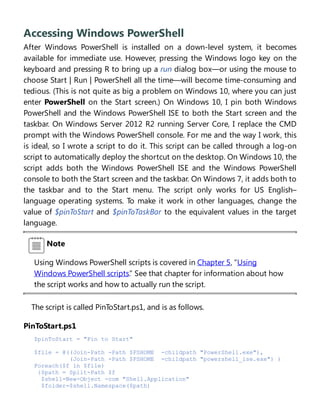
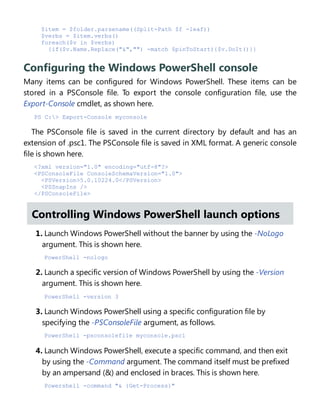
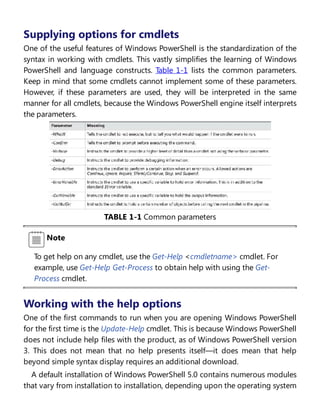
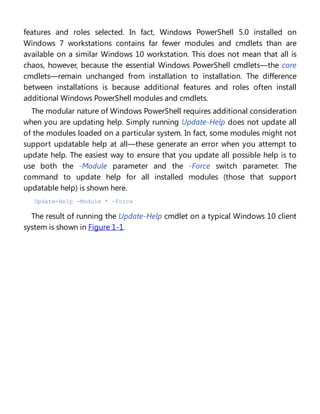
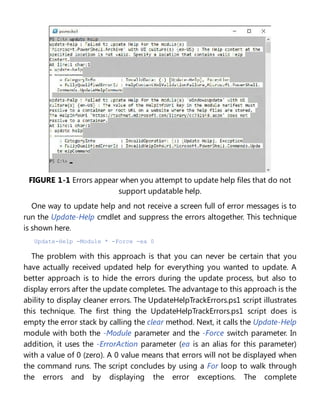
![UpdateHelpTrackErrors.ps1 script is shown here.
UpdateHelpTrackErrors.ps1
$error.Clear()
Update-Help -Module * -Force -ea 0
For ($i = 0 ; $i -lt $error.Count ; $i ++)
{ "`nerror $i" ; $error[$i].exception }
Note
For information about writing Windows PowerShell scripts and about
using the For loop, see Chapter 5.
When the UpdateHelpTrackErrors script runs, a progress bar is shown,
indicating the progress as the updatable help files update. When the script is
finished, any errors appear in order. The script and associated errors are shown
in Figure 1-2.
FIGURE 1-2 Cleaner error output from updatable help is generated by the
UpdateHelpTrackErrors script.
You can also determine which modules receive updated help by running the](https://image.slidesharecdn.com/17236150-250523235955-a533daa6/85/Windows-Powershell-Step-By-Step-3rd-Edition-Wilson-Ed-47-320.jpg)
![Update-Help cmdlet with the -Verbose switch parameter. Unfortunately, when
you do this, the output scrolls by so fast that it is hard to see what has actually
updated. To solve this problem, redirect the verbose output to a text file. In the
command that follows, all modules attempt to update help. The verbose
messages redirect to a text file named updatedhelp.txt in a folder named fso off
the root.
Update-Help -module * -force -verbose 4>>c:fsoupdatedhelp.txt
Windows PowerShell has a high level of discoverability; that is, to learn how
to use Windows PowerShell, you can simply use Windows PowerShell. Online
help serves an important role in assisting in this discoverability. The help system
in Windows PowerShell can be entered by several methods.
To learn about using Windows PowerShell, use the Get-Help cmdlet as follows.
Get-Help Get-Help
This command prints out help about the Get-Help cmdlet. The output from
this cmdlet is
illustrated here:
NAME
Get-Help
SYNOPSIS
Displays information about Windows PowerShell commands and concepts.
SYNTAX
Get-Help [[-Name] <String>] [-Category <String[]>] [-Component
<String[]>]
[-Full] [-Functionality <String[]>] [-Path <String>] [-Role
<String[]>]
[<CommonParameters>]
Get-Help [[-Name] <String>] [-Category <String[]>] [-Component
<String[]>]
[-Functionality <String[]>] [-Path <String>] [-Role <String[]>] -
Detailed
[<CommonParameters>]
Get-Help [[-Name] <String>] [-Category <String[]>] [-Component
<String[]>]
[-Functionality <String[]>] [-Path <String>] [-Role <String[]>] -
Examples
[<CommonParameters>]
Get-Help [[-Name] <String>] [-Category <String[]>] [-Component](https://image.slidesharecdn.com/17236150-250523235955-a533daa6/85/Windows-Powershell-Step-By-Step-3rd-Edition-Wilson-Ed-48-320.jpg)
![<String[]>]
[-Functionality <String[]>] [-Path <String>] [-Role <String[]>] -
Online
[<CommonParameters>]
Get-Help [[-Name] <String>] [-Category <String[]>] [-Component
<String[]>]
[-Functionality <String[]>] [-Path <String>] [-Role <String[]>] -
Parameter
<String> [<CommonParameters>]
Get-Help [[-Name] <String>] [-Category <String[]>] [-Component
<String[]>]
[-Functionality <String[]>] [-Path <String>] [-Role <String[]>] -
ShowWindow
[<CommonParameters>]
DESCRIPTION
The Get-Help cmdlet displays information about Windows PowerShell
concepts and
commands, including cmdlets, functions, CIM commands, workflows,
providers,
aliases and scripts.
To get help for a Windows PowerShell command, type "Get-Help" followed
by the
command name, such as: Get-Help Get-Process. To get a list of all help
topics
on your system, type: Get-Help *. You can display the entire help
topic or use
the parameters of the Get-Help cmdlet to get selected parts of the
topic, such
as the syntax, parameters, or examples.
Conceptual help topics in Windows PowerShell begin with "about_", such
as
"about_Comparison_Operators". To see all "about_" topics, type: Get-
Help
about_*. To see a particular topic, type: Get-Help about_<topic-name>,
such as
Get-Help about_Comparison_Operators.
To get help for a Windows PowerShell provider, type "Get-Help"
followed by the
provider name. For example, to get help for the Certificate provider,
type:
Get-Help Certificate.
In addition to "Get-Help", you can also type "help" or "man", which
displays
one screen of text at a time, or "<cmdlet-name> -?", which is
identical to
Get-Help but works only for commands.](https://image.slidesharecdn.com/17236150-250523235955-a533daa6/85/Windows-Powershell-Step-By-Step-3rd-Edition-Wilson-Ed-49-320.jpg)