   This PowerPoint aims to introduce Form Two students to
    a unit on three (3) Shakespearean plays by briefly relating
    details about Shakespeare’s life and works.
   At the end of this session, students will be able to quote
    three (3) of his famous phrases.
After the presentation, the teacher will lead a class discussion
where students will articulate what they have gleaned from the
presentation. Subsequently, they will be separated into groups
of four (4); each group will be given a paper with one (1) of the
phrases and asked to draw a picture representing it. When the
groups have finished, each will show their drawing and the
class will guess which phrase has been represented. At the end
of the exercise, they will be asked to write their three (3)
favourite phrases.
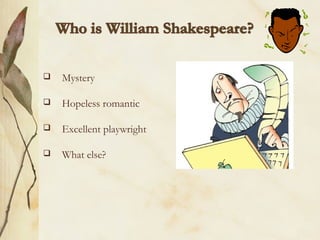
   Mystery

   Hopeless romantic

   Excellent playwright

   What else?
    Invented 2,035 English Words

    May be up to 10,000

    Invented numerous common phrases


    “All of a sudden”
                                    “Love is blind”


         “All that glitters is not gold”
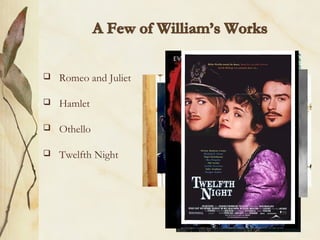
   Romeo and Juliet

   Hamlet

   Othello

   Twelfth Night
   Plays often seen as erotic and strange

   Cannot really identify with characters

    •   Overzealous

    •   Heroic

    •   Full of life and youth

    •   Self-hatred.
   November 28th, 1582

   Shakespeare: eighteen

   His wife, Anne Hathaway: twenty-six

   Seven months later: daughter, Susanna
   Susanna born in May, 1583

   Twins, Hamnet and Judith, born in February 1585

   Hamnet died in 1596
   The tombstone curse:

    Good friend, for Jesus´ sake forbeare
    To digg the dust enclosed here!
    Blest be ye man that spares thes stones
    And curst be he that moues my bones.
   Translation:


    Good friend, for Jesus’ sake, forbear
    To dig the dust enclosed here;
    Blest be the man that spares these stones
    And curst he that moves my bones.
   The second-best bed

    (not as bad as it seems)

   Most of his estate to Susanna

   Proof he was involved in theatre.

   The end of the line - 1670
   Get into groups of four (4).

   Your group will be given a paper with one of Shakespeare’s

    famous phrases.

   With your group, draw a picture representing the phrase.

   See if the class can guess which phrase you’ve drawn!

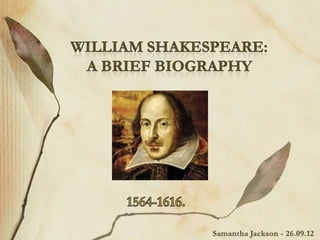
William Shakespeare: A Brief Biography

  • 1.
    This PowerPoint aims to introduce Form Two students to a unit on three (3) Shakespearean plays by briefly relating details about Shakespeare’s life and works.  At the end of this session, students will be able to quote three (3) of his famous phrases.
  • 2.
    After the presentation,the teacher will lead a class discussion where students will articulate what they have gleaned from the presentation. Subsequently, they will be separated into groups of four (4); each group will be given a paper with one (1) of the phrases and asked to draw a picture representing it. When the groups have finished, each will show their drawing and the class will guess which phrase has been represented. At the end of the exercise, they will be asked to write their three (3) favourite phrases.
  • 4.
    Mystery  Hopeless romantic  Excellent playwright  What else?
  • 5.
    Invented 2,035 English Words  May be up to 10,000  Invented numerous common phrases “All of a sudden” “Love is blind” “All that glitters is not gold”
  • 6.
    Romeo and Juliet  Hamlet  Othello  Twelfth Night
  • 7.
    Plays often seen as erotic and strange  Cannot really identify with characters • Overzealous • Heroic • Full of life and youth • Self-hatred.
  • 8.
    November 28th, 1582  Shakespeare: eighteen  His wife, Anne Hathaway: twenty-six  Seven months later: daughter, Susanna
  • 9.
    Susanna born in May, 1583  Twins, Hamnet and Judith, born in February 1585  Hamnet died in 1596
  • 10.
    The tombstone curse: Good friend, for Jesus´ sake forbeare To digg the dust enclosed here! Blest be ye man that spares thes stones And curst be he that moues my bones.
  • 11.
    Translation: Good friend, for Jesus’ sake, forbear To dig the dust enclosed here; Blest be the man that spares these stones And curst he that moves my bones.
  • 12.
    The second-best bed (not as bad as it seems)  Most of his estate to Susanna  Proof he was involved in theatre.  The end of the line - 1670
  • 14.
    Get into groups of four (4).  Your group will be given a paper with one of Shakespeare’s famous phrases.  With your group, draw a picture representing the phrase.  See if the class can guess which phrase you’ve drawn!