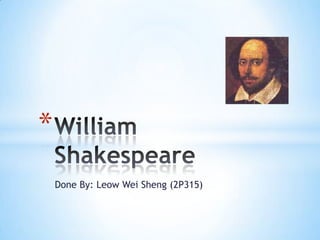

Done By: Leow Wei Sheng (2P315)William Shakespeare
Who is he?A famous playwright and actorBorn on 23rd April 1564 in Stratford-upon-AvonSon of John and Mary ShakespeareMarried to Anne Hathaway and had three childrenDied on the 23rd April 1616High social statusFather was town mayorMother was from a rich and ancient landowning family
Childhood LifeAttended the King’s New SchoolLeft school at age fifteen or sixteenBecame an apprentice in his father’s shop
How did he became a writer?He was an actor at firstThe bubonic plague closed the theatres of London, so Shakespeare turned to writingInspired by other great writers of his age
Shakespeare’s PlaysHe wrote many playsSome famous plays include “Macbeth”, “Romeo and Juliet” and “A Midsummer Night’s Dream”Plays were very well received and he grew rich, rich enough to buy the second largest house in Stratford
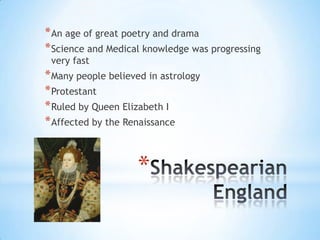
Shakespearian EnglandAn age of great poetry and dramaScience and Medical knowledge was progressing very fastMany people believed in astrologyProtestantRuled by Queen Elizabeth I Affected by the Renaissance
Social SystemEveryone at any level of society was very likely to remain thereCould not rise to a position of power through educationExample a farmer’s son was likely to remain a farmerThere was a system of hierarchy
Impact on Shakespeare’s WorksHis plays reflect the difference between the classes of peopleUsually about aristocrats or famous people
Elizabethan Theatres Theatres had no roofNo electricity and lightingCentral area contained a stage and a yardContained seats at the higher floorsExtra floors above the back of the stage which contained machineryTrapdoors going down through the stageBack stageNo scenery
Impact on Shakespeare’s PlaysHis plays include inside scenesThe backstage was used for Juliet’s tomb in “Romeo and Juliet”Sometimes, there were scenes which used the area under the stage, scenes such as tomb and prison scenesThe actors could move freelyPlays had to rely on words to show the audience where the scene was set
The RenaissanceRebirth of learningIncreased interest in the art and learning of ancient Greece and RomeMarked the end of the middle ages and the start of the modern worldBegan in Italy in the 1400s
The RenaissanceThe scholars, scientists and artists had new ideas, but also turned to the pastGreater knowledge of ancient science and beliefsScholars were inspired think again about established religious thinkingNew theories such as the theory of the Sun being the centre of the Solar System
Impact on Shakespeare’s PlaysOne of Shakespeare’s plays, “Julius Caesar”, is based on the ancient Roman general, Julius Caesar His play “Richard II” illustrated the struggle of a heirless throne, in the case of Queen Elizabeth I
Shakespeare’s Influence He greatly influenced the English LanguageBefore, the English Language was not fixedOnce his plays became popular,  they helped to standardize  the English LanguageMany Shakespearean words and phrases became embedded in the English Language
Thank You!

William Shakespeare

  • 1.
    Done By: LeowWei Sheng (2P315)William Shakespeare
  • 2.
    Who is he?Afamous playwright and actorBorn on 23rd April 1564 in Stratford-upon-AvonSon of John and Mary ShakespeareMarried to Anne Hathaway and had three childrenDied on the 23rd April 1616High social statusFather was town mayorMother was from a rich and ancient landowning family
  • 3.
    Childhood LifeAttended theKing’s New SchoolLeft school at age fifteen or sixteenBecame an apprentice in his father’s shop
  • 4.
    How did hebecame a writer?He was an actor at firstThe bubonic plague closed the theatres of London, so Shakespeare turned to writingInspired by other great writers of his age
  • 5.
    Shakespeare’s PlaysHe wrotemany playsSome famous plays include “Macbeth”, “Romeo and Juliet” and “A Midsummer Night’s Dream”Plays were very well received and he grew rich, rich enough to buy the second largest house in Stratford
  • 6.
    Shakespearian EnglandAn ageof great poetry and dramaScience and Medical knowledge was progressing very fastMany people believed in astrologyProtestantRuled by Queen Elizabeth I Affected by the Renaissance
  • 7.
    Social SystemEveryone atany level of society was very likely to remain thereCould not rise to a position of power through educationExample a farmer’s son was likely to remain a farmerThere was a system of hierarchy
  • 8.
    Impact on Shakespeare’sWorksHis plays reflect the difference between the classes of peopleUsually about aristocrats or famous people
  • 9.
    Elizabethan Theatres Theatreshad no roofNo electricity and lightingCentral area contained a stage and a yardContained seats at the higher floorsExtra floors above the back of the stage which contained machineryTrapdoors going down through the stageBack stageNo scenery
  • 10.
    Impact on Shakespeare’sPlaysHis plays include inside scenesThe backstage was used for Juliet’s tomb in “Romeo and Juliet”Sometimes, there were scenes which used the area under the stage, scenes such as tomb and prison scenesThe actors could move freelyPlays had to rely on words to show the audience where the scene was set
  • 11.
    The RenaissanceRebirth oflearningIncreased interest in the art and learning of ancient Greece and RomeMarked the end of the middle ages and the start of the modern worldBegan in Italy in the 1400s
  • 12.
    The RenaissanceThe scholars,scientists and artists had new ideas, but also turned to the pastGreater knowledge of ancient science and beliefsScholars were inspired think again about established religious thinkingNew theories such as the theory of the Sun being the centre of the Solar System
  • 13.
    Impact on Shakespeare’sPlaysOne of Shakespeare’s plays, “Julius Caesar”, is based on the ancient Roman general, Julius Caesar His play “Richard II” illustrated the struggle of a heirless throne, in the case of Queen Elizabeth I
  • 14.
    Shakespeare’s Influence Hegreatly influenced the English LanguageBefore, the English Language was not fixedOnce his plays became popular, they helped to standardize the English LanguageMany Shakespearean words and phrases became embedded in the English Language
  • 15.