Why Songs Fade Out
Have you ever wondered why popular songs tend to fade out over time?
This phenomenon has been around since the dawn of popular music, and it
continues to be a mystery to music fans everywhere. In this blog post, we
will look into what causes songs to fade out and how the popularity of
streaming services like Spotify has changed the music landscape.
Additionally, we will provide some tips on how to keep songs in rotation
and make sure they remain popular. So, if you are curious about why
songs fade out, read on to find out more.
Visit Here: Peter Yarrow, of Peter, Paul and Mary, pardoned by Carter …
What Causes Songs To Fade Out?
Most people know that songs fade out gradually over time, but what is the
science behind this effect? Why do some songs fade out abruptly while
others end suddenly? How can music be enhanced with the use of fade
outs? In this section, we will answer all these questions and more.
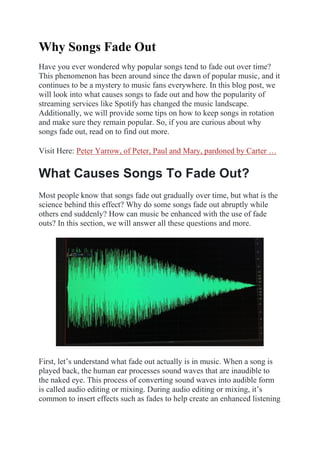
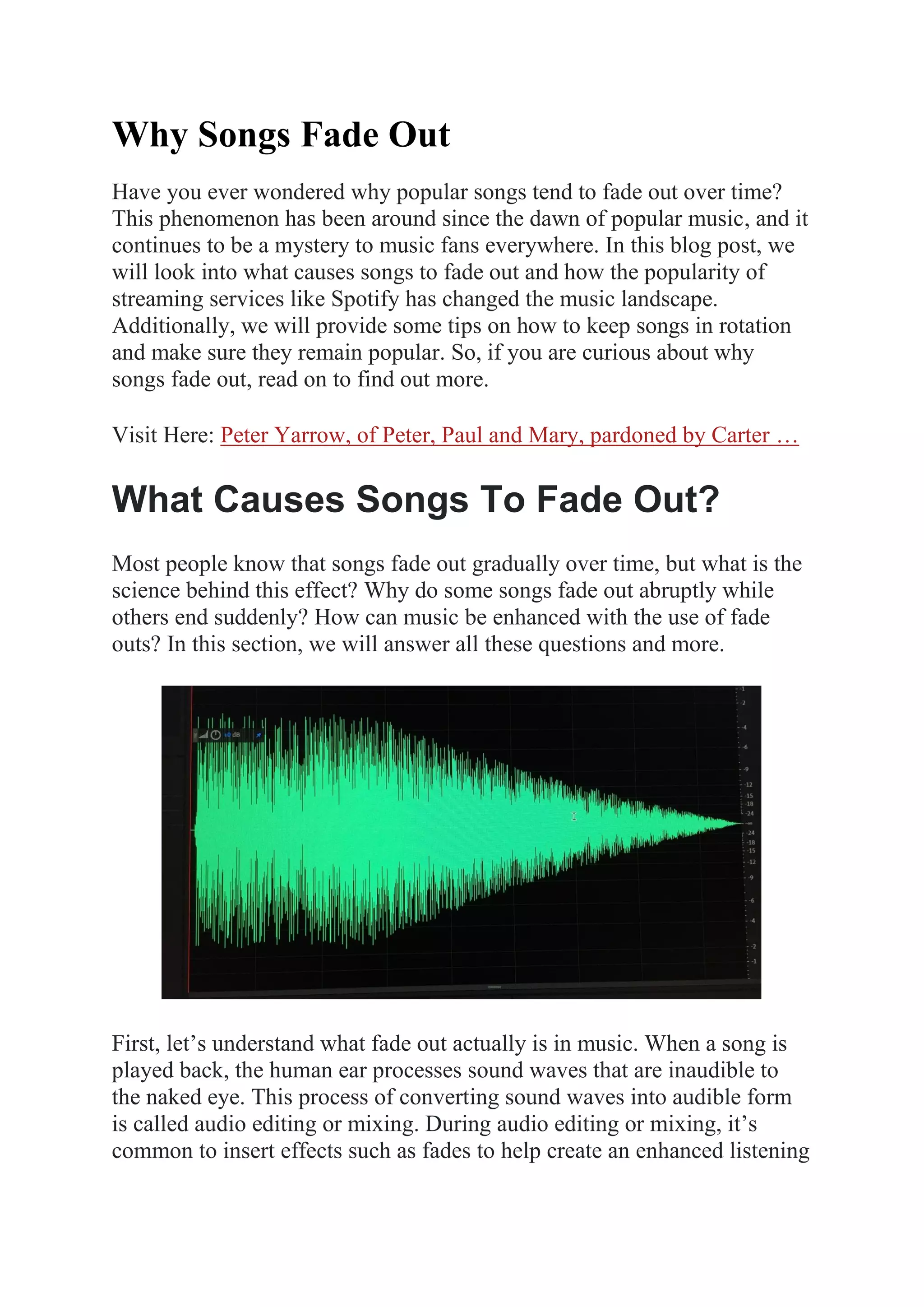
First, let’s understand what fade out actually is in music. When a song is
played back, the human ear processes sound waves that are inaudible to
the naked eye. This process of converting sound waves into audible form
is called audio editing or mixing. During audio editing or mixing, it’s
common to insert effects such as fades to help create an enhanced listening
experience for your audience. Fades are a gradual decrease in volume over
time, and they can be used to create an atmosphere or setting for a song.
Why do some songs fade out while others end abruptly? It all comes down
to timing. A good example of this is the intro and Outro of Drake’s song
One Dance. The intro fades out gradually but the Outro ends abruptly with
no fading at all – it just cuts off completely. This abrupt ending creates a
sense of surprise and excitement for listeners who were getting ready for
the gradual fade out that was supposed to happen later in the song.
Now that we know about fades in music, let’s take a look at how
musicians and producers use them to enhance their songs. For example, if
you’re playing an acoustic guitar solo in your band live, it can be
advantageous to insert a fadeout midway through your solo so that your
audience doesn’t hear any unnecessary noise from your instrument
throughout the rest of the song. By cutting off abruptly like Drake does on
One Dance, you’re leaving your listeners with a sense of anticipation until
you finally reach the final section where everything goes back into full
volume!
There are several different types of fades that you can use when creating
ambiance or scenery in your music: gradual fadingouts (such as on One
Dance), sudden fadingouts (like on Radiohead’s Creep), sound effects like
thunder or rain (used on Adele’s Hello), and even voiceovers (like on
Taylor Swift’s single I Don’t Wanna Live Forever). All these variations
create unique listening experiences for your audience, so experiment until
you find one that works best for each individual track you’re working on!
Finally, it’s important to note that not every song needs a fadeout effect –
some songs are meant to end abruptly without.
Understanding The Dynamics Behind Song
Endings
Understanding the dynamics behind song endings is an important skill for
producers and music lovers alike. In this blog, we will be discussing some
of the common mixing techniques used to create fading effects, as well as
the psychological impact of songs ending in a fade out. By understanding
these concepts, you’ll be better equipped to create unique finishes that will
emotionally resonate with your listeners.
Some songs require an abrupt end – a fade out that is sudden and jarring.
This type of ending can add excitement and energy to a song, bringing it to
a close in a powerful way. It can also be used to shock or surprise your
audience, making them feel engaged and invested in the song’s outcome.
Another common mixing technique used to create fading effects is gradual
fades. This type of ending typically eases your listener into the next track
by gradually reducing the volume of the previous track over time. This
allows for a sense of relaxation and serenity before transitioning into the
next track. Gradual fades are often used in lullaby-type songs or tracks that
are meant to induce sleepiness or relaxation.
The psychological impact of songs ending in a fade out cannot be
understated. For some listeners, it can represent closure – like finishing
one chapter in a book before starting another chapter. Other listeners might
find it reassuring or comforting to know that they won’t have to wait long
for their next dose of music after an abrupt end is played (especially if
they’re listening on headphones!).
Producers have several options when it comes to enhancing today’s fading
dynamics. They can use algorithms to automate various aspects of audio
production, such as fading effects or spatialization (the enhancement or
placement of sound within an audio environment). Alternatively,
producers might choose more traditional methods such as tape echo or
reverb for added depth and warmth. In either case, using different endings
types can help create an emotional response from your audience。.
Spotify And Music Streaming Trends
Music streaming has completely changed the way that people listen to
music. For decades, people would go out and buy physical albums or CDs.
Then, they would play the songs that they liked on their own devices or
share the songs with friends. However, this process has drastically
changed in recent years. Now, people can access music streaming services
such as Spotify at any time and from anywhere in the world. As a result,
streaming services have had a major impact on the recording industry
landscape.
One of the most important trends that streaming services have helped to
shape is the decline of long-term success for songs. Just a few years ago, it
was common for songs to have long-term success due to their popularity
on mainstream radio stations or through popular YouTube videos.
However, over time many of these songs have faded out and stopped being
enjoyed by many people. This is because streaming services are powered
by algorithms that help promote and distribute content across their
platforms.
In order to understand why some songs fade out more quickly than others,
it’s important to look at how streaming services work. Streaming services
use an algorithm known as algorithmic promotion. This algorithm helps
determine which songs will be promoted more heavily based on how well
they are performing on various metrics such as streams or likes. Songs that
are promoted heavily tend to have longer shelf lives – meaning that they
are more likely to be enjoyed by listeners for a longer period of time – than
songs that aren’t promoted as much.
Read Related Article: Why Songs Stop Playing On Spotify
Another critical factor affecting song longevity is how well an artist is
performing live and via social media channels such as Vine and Instagram
Live. If an artist is doing well live and online then their song may be able
to last longer since fans may want to see them perform again in the future
even if they don’t currently enjoy their latest album or song release.
How To Keep Popular Songs In Rotation
Keeping popular songs in rotation is a common goal for DJs and music
producers. It’s important to understand what listeners want to hear and
then provide that in a format that’s easy to listen to. This can be done
through tempo adjustments, adding additional elements, and incorporating
special effects.
To keep songs fresh, DJs and music producers often remix them. This
allows them to incorporate new lyrical content as well as new sounds or
beats. They also monitor trends in the industry so that they can make
appropriate adjustments to their songs accordingly. Finally, it’s important
for DJs and music producers to remaster older tunes for a new feel. By
doing this, they can reach a larger audience who may not have heard the
song before.
Digital platforms like Spotify have made it easier than ever for DJs and
music producers to share their work with a wider audience. They can reach
out to potential collaborators for innovative ideas or help with
creatingjingles or advertising campaigns for their songs. In addition, social
media platforms like Twitter are great ways for artists to connect with their
followers and let them know about new releases and updates on their
work.
To Wrap Things Up
Fading out songs has been a popular trend in music for many years and it
is an important part of creating a unique listening experience. It can help
create an atmosphere, set the scene for a song, or even surprise the
audience with an abrupt ending. Streaming services like Spotify have also
changed the way we listen to music and how long certain songs remain
popular. By understanding the science behind fades and understanding
how streaming services work, one can create songs that will last longer in
rotation and keep listeners engaged. Lastly, DJs and producers must
continually adjust their tracks to remain relevant in order to keep popular
songs in rotation.

Why Songs Fade Out.pdf

  • 1.
    Why Songs FadeOut Have you ever wondered why popular songs tend to fade out over time? This phenomenon has been around since the dawn of popular music, and it continues to be a mystery to music fans everywhere. In this blog post, we will look into what causes songs to fade out and how the popularity of streaming services like Spotify has changed the music landscape. Additionally, we will provide some tips on how to keep songs in rotation and make sure they remain popular. So, if you are curious about why songs fade out, read on to find out more. Visit Here: Peter Yarrow, of Peter, Paul and Mary, pardoned by Carter … What Causes Songs To Fade Out? Most people know that songs fade out gradually over time, but what is the science behind this effect? Why do some songs fade out abruptly while others end suddenly? How can music be enhanced with the use of fade outs? In this section, we will answer all these questions and more. First, let’s understand what fade out actually is in music. When a song is played back, the human ear processes sound waves that are inaudible to the naked eye. This process of converting sound waves into audible form is called audio editing or mixing. During audio editing or mixing, it’s common to insert effects such as fades to help create an enhanced listening
  • 2.
    experience for youraudience. Fades are a gradual decrease in volume over time, and they can be used to create an atmosphere or setting for a song. Why do some songs fade out while others end abruptly? It all comes down to timing. A good example of this is the intro and Outro of Drake’s song One Dance. The intro fades out gradually but the Outro ends abruptly with no fading at all – it just cuts off completely. This abrupt ending creates a sense of surprise and excitement for listeners who were getting ready for the gradual fade out that was supposed to happen later in the song. Now that we know about fades in music, let’s take a look at how musicians and producers use them to enhance their songs. For example, if you’re playing an acoustic guitar solo in your band live, it can be advantageous to insert a fadeout midway through your solo so that your audience doesn’t hear any unnecessary noise from your instrument throughout the rest of the song. By cutting off abruptly like Drake does on One Dance, you’re leaving your listeners with a sense of anticipation until you finally reach the final section where everything goes back into full volume! There are several different types of fades that you can use when creating ambiance or scenery in your music: gradual fadingouts (such as on One Dance), sudden fadingouts (like on Radiohead’s Creep), sound effects like thunder or rain (used on Adele’s Hello), and even voiceovers (like on Taylor Swift’s single I Don’t Wanna Live Forever). All these variations create unique listening experiences for your audience, so experiment until you find one that works best for each individual track you’re working on! Finally, it’s important to note that not every song needs a fadeout effect – some songs are meant to end abruptly without. Understanding The Dynamics Behind Song Endings Understanding the dynamics behind song endings is an important skill for producers and music lovers alike. In this blog, we will be discussing some of the common mixing techniques used to create fading effects, as well as the psychological impact of songs ending in a fade out. By understanding
  • 3.
    these concepts, you’llbe better equipped to create unique finishes that will emotionally resonate with your listeners. Some songs require an abrupt end – a fade out that is sudden and jarring. This type of ending can add excitement and energy to a song, bringing it to a close in a powerful way. It can also be used to shock or surprise your audience, making them feel engaged and invested in the song’s outcome. Another common mixing technique used to create fading effects is gradual fades. This type of ending typically eases your listener into the next track by gradually reducing the volume of the previous track over time. This allows for a sense of relaxation and serenity before transitioning into the next track. Gradual fades are often used in lullaby-type songs or tracks that are meant to induce sleepiness or relaxation. The psychological impact of songs ending in a fade out cannot be understated. For some listeners, it can represent closure – like finishing one chapter in a book before starting another chapter. Other listeners might find it reassuring or comforting to know that they won’t have to wait long for their next dose of music after an abrupt end is played (especially if they’re listening on headphones!). Producers have several options when it comes to enhancing today’s fading dynamics. They can use algorithms to automate various aspects of audio production, such as fading effects or spatialization (the enhancement or placement of sound within an audio environment). Alternatively, producers might choose more traditional methods such as tape echo or reverb for added depth and warmth. In either case, using different endings types can help create an emotional response from your audience。. Spotify And Music Streaming Trends Music streaming has completely changed the way that people listen to music. For decades, people would go out and buy physical albums or CDs. Then, they would play the songs that they liked on their own devices or share the songs with friends. However, this process has drastically changed in recent years. Now, people can access music streaming services such as Spotify at any time and from anywhere in the world. As a result,
  • 4.
    streaming services havehad a major impact on the recording industry landscape. One of the most important trends that streaming services have helped to shape is the decline of long-term success for songs. Just a few years ago, it was common for songs to have long-term success due to their popularity on mainstream radio stations or through popular YouTube videos. However, over time many of these songs have faded out and stopped being enjoyed by many people. This is because streaming services are powered by algorithms that help promote and distribute content across their platforms. In order to understand why some songs fade out more quickly than others, it’s important to look at how streaming services work. Streaming services use an algorithm known as algorithmic promotion. This algorithm helps determine which songs will be promoted more heavily based on how well they are performing on various metrics such as streams or likes. Songs that are promoted heavily tend to have longer shelf lives – meaning that they are more likely to be enjoyed by listeners for a longer period of time – than songs that aren’t promoted as much. Read Related Article: Why Songs Stop Playing On Spotify Another critical factor affecting song longevity is how well an artist is performing live and via social media channels such as Vine and Instagram Live. If an artist is doing well live and online then their song may be able to last longer since fans may want to see them perform again in the future even if they don’t currently enjoy their latest album or song release. How To Keep Popular Songs In Rotation Keeping popular songs in rotation is a common goal for DJs and music producers. It’s important to understand what listeners want to hear and then provide that in a format that’s easy to listen to. This can be done through tempo adjustments, adding additional elements, and incorporating special effects. To keep songs fresh, DJs and music producers often remix them. This allows them to incorporate new lyrical content as well as new sounds or
  • 5.
    beats. They alsomonitor trends in the industry so that they can make appropriate adjustments to their songs accordingly. Finally, it’s important for DJs and music producers to remaster older tunes for a new feel. By doing this, they can reach a larger audience who may not have heard the song before. Digital platforms like Spotify have made it easier than ever for DJs and music producers to share their work with a wider audience. They can reach out to potential collaborators for innovative ideas or help with creatingjingles or advertising campaigns for their songs. In addition, social media platforms like Twitter are great ways for artists to connect with their followers and let them know about new releases and updates on their work. To Wrap Things Up Fading out songs has been a popular trend in music for many years and it is an important part of creating a unique listening experience. It can help create an atmosphere, set the scene for a song, or even surprise the audience with an abrupt ending. Streaming services like Spotify have also changed the way we listen to music and how long certain songs remain popular. By understanding the science behind fades and understanding how streaming services work, one can create songs that will last longer in rotation and keep listeners engaged. Lastly, DJs and producers must continually adjust their tracks to remain relevant in order to keep popular songs in rotation.