Ruby and Security
It’s not just for Python…
About Me
• Carl Sampson
• Twitter: @chs
• Web: www.chs.us
• Product Security Engineer at Salesforce
• Former developer turned appsec guy
• OWASP Indy chapter leader
• Ruby enthusiast
Why Ruby?
• One of the easiest languages to read and
parse by anyone regardless of style
– an_object.empty?
– 3.times { puts “Hello, World” }
– list_numbers.each {|num| print num}
– [1, 2, 3].length
Why Ruby?
• Package management system that makes it
easy to share and modify tools
– Standard format for distributing Ruby programs
and libraries
– RubyGems (http://rubygems.org)
Why Ruby?
• Powerful introspection and object-oriented
capabilities
– Find out information about classes
– Dynamically create classes/methods
– Objectspace
Why Ruby?
• Platform-independent support for
multithreading
– Leverages native features of the OS
Why Ruby?
• Can be compiled and run natively on most
platforms
• Doesn’t require libraries such as cygwin to
build on windows
• Easy to embed within another application
– API for calling from within C
Why Ruby?
• Robust standard library included
– 20, 964 functions and classes
– Well-documented
• Dash
• Omniref (https://www.omniref.com/)
• Ruby-doc (http://www.ruby-doc.org/)
• Ri
Why Ruby?
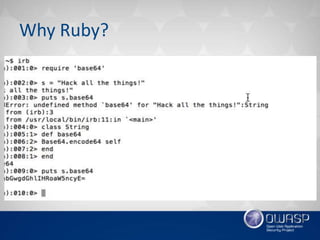
• Easy to extend existing classes to meet new
needs (open classes)
– Ruby classes are never closed
Why Ruby?
Why Ruby?
• Easy to hook native libraries
– FFI (interface with c-style libraries)
– DL (bridge to dlopen)
• Easy to extend using C
Why Ruby?
• Lends itself to Domain Specific Language (DSL)
creation
– Programming language designed specifically to
express solutions to problems in a specific domain
– Sinatra – DSL for defining how to handle HTTP
requests
– Chef – DSL for automating server management tasks
– Rspec – DSL for testing
– ActiveRecord migrations
Why Ruby?
• IRB
– REPL for programming in ruby
– Allows execution of Ruby commands with
immediate response, allowing experimenting in
real time
– Blocks, mixins and monkey patching
Why Ruby?
• Binary string processing and pattern matching
Why Ruby?
• First-class regular expressions
– Borrowed from Perl
– Built-in without needing to include extra modules
Why Ruby?
• Network protocol and file format parsing are
well supported in Ruby
– Most network protocols built in
– Most everything else available as a gem
Why Ruby?
• Cryptography, specifically comprehensive
OpenSSL bindings
– Exposes a huge portion of the API
Projects Using Ruby?
• Metasploit
– Ported from Perl in 2006
• Why?
– Platform independent support for threading
– Native interpreter for Windows
– Enjoyed by the people that contribute to the
framework
Projects Using Ruby?
• Metasm
– Assembler
– Disassembler
– Compiler
– Part of the Metasploit project
– https://github.com/jjyg/metasm
Projects Using Ruby
• Ronin
– Platform for vulnerability research and exploit
development
– Subprojects for database access, web scraping
/spidering, assembly programming and
shellcoding generation, exploit and payload
crafting, bruteforcers, SQL injection, etc.
– https://github.com/ronin-ruby/
Projects Using Ruby
• Ruckus
– DOM-inspired ruby fuzzer
– Great for network protocols
– Declare structures like you’re writing C
• Define network protocol headers
– Built in mutators for fuzzing
Projects Using Ruby
• BeEF
– Browser Exploitation Framework Project
– Pen testing tool that focuses on the browser
– http://beefproject.com/
Projects Using Ruby
• Gauntlt
– BE MEAN TO YOUR CODE AND LIKE IT
– DSL (based on Cucumber) for interfacing with
popular testing tools
– http://gauntlt.org/
Projects Using Ruby
• PEDump
– Supports MZ & PE formats
– Can dump every part of the executable
– https://github.com/zed-0xff/pedump
Projects Using Ruby
• Ruby BlackBag (rbkb)
– Based on Matasano BlackBag
– Misc Pen-testing/reversing tools
– https://github.com/emonti/rbkb
Projects Using Ruby
• Ragweed
– Scriptable Win32/Linux/OSX debugger
– https://github.com/tduehr/ragweed
Projects Using Ruby
• PacketFu
– Mid-level packet manipulation library
– https://github.com/todb/packetfu
Projects Using Ruby
• Arachni
– Web application security scanner framework
– Multiple deployment options (CLI, Web,
Distributed)
– Extensive security checks
– Automated, distributed, high-performance
JavaScript/DOM security debugger
– http://www.arachni-scanner.com/
Projects Using Ruby
• Brakeman
– Open-source vulnerability scanner specifically
designed for RoR applications
– Developed and maintained by Twitter
– http://brakemanscanner.org/
Projects Using Ruby
• WPScan
– Black box WordPress vulnerability scanner
– http://wpscan.org/
Projects Using Ruby
• RailsGoat
– Vulnerable version of the RoR framework
– OWASP project
– https://github.com/OWASP/railsgoat
References
• https://www.blackhat.com/presentations/bh-usa-
09/TRACY/BHUSA09-Tracy-RubyPentesters-PAPER.pdf
• http://matasano.com/research/ruby_for_pentesters/Ruby-
For-Pentesters.pdf
• http://rubysecurity.info/

Ruby and Security

  • 1.
    Ruby and Security It’snot just for Python…
  • 2.
    About Me • CarlSampson • Twitter: @chs • Web: www.chs.us • Product Security Engineer at Salesforce • Former developer turned appsec guy • OWASP Indy chapter leader • Ruby enthusiast
  • 3.
    Why Ruby? • Oneof the easiest languages to read and parse by anyone regardless of style – an_object.empty? – 3.times { puts “Hello, World” } – list_numbers.each {|num| print num} – [1, 2, 3].length
  • 4.
    Why Ruby? • Packagemanagement system that makes it easy to share and modify tools – Standard format for distributing Ruby programs and libraries – RubyGems (http://rubygems.org)
  • 5.
    Why Ruby? • Powerfulintrospection and object-oriented capabilities – Find out information about classes – Dynamically create classes/methods – Objectspace
  • 6.
    Why Ruby? • Platform-independentsupport for multithreading – Leverages native features of the OS
  • 7.
    Why Ruby? • Canbe compiled and run natively on most platforms • Doesn’t require libraries such as cygwin to build on windows • Easy to embed within another application – API for calling from within C
  • 8.
    Why Ruby? • Robuststandard library included – 20, 964 functions and classes – Well-documented • Dash • Omniref (https://www.omniref.com/) • Ruby-doc (http://www.ruby-doc.org/) • Ri
  • 9.
    Why Ruby? • Easyto extend existing classes to meet new needs (open classes) – Ruby classes are never closed
  • 10.
  • 11.
    Why Ruby? • Easyto hook native libraries – FFI (interface with c-style libraries) – DL (bridge to dlopen) • Easy to extend using C
  • 12.
    Why Ruby? • Lendsitself to Domain Specific Language (DSL) creation – Programming language designed specifically to express solutions to problems in a specific domain – Sinatra – DSL for defining how to handle HTTP requests – Chef – DSL for automating server management tasks – Rspec – DSL for testing – ActiveRecord migrations
  • 13.
    Why Ruby? • IRB –REPL for programming in ruby – Allows execution of Ruby commands with immediate response, allowing experimenting in real time – Blocks, mixins and monkey patching
  • 14.
    Why Ruby? • Binarystring processing and pattern matching
  • 15.
    Why Ruby? • First-classregular expressions – Borrowed from Perl – Built-in without needing to include extra modules
  • 16.
    Why Ruby? • Networkprotocol and file format parsing are well supported in Ruby – Most network protocols built in – Most everything else available as a gem
  • 17.
    Why Ruby? • Cryptography,specifically comprehensive OpenSSL bindings – Exposes a huge portion of the API
  • 18.
    Projects Using Ruby? •Metasploit – Ported from Perl in 2006 • Why? – Platform independent support for threading – Native interpreter for Windows – Enjoyed by the people that contribute to the framework
  • 19.
    Projects Using Ruby? •Metasm – Assembler – Disassembler – Compiler – Part of the Metasploit project – https://github.com/jjyg/metasm
  • 20.
    Projects Using Ruby •Ronin – Platform for vulnerability research and exploit development – Subprojects for database access, web scraping /spidering, assembly programming and shellcoding generation, exploit and payload crafting, bruteforcers, SQL injection, etc. – https://github.com/ronin-ruby/
  • 21.
    Projects Using Ruby •Ruckus – DOM-inspired ruby fuzzer – Great for network protocols – Declare structures like you’re writing C • Define network protocol headers – Built in mutators for fuzzing
  • 22.
    Projects Using Ruby •BeEF – Browser Exploitation Framework Project – Pen testing tool that focuses on the browser – http://beefproject.com/
  • 23.
    Projects Using Ruby •Gauntlt – BE MEAN TO YOUR CODE AND LIKE IT – DSL (based on Cucumber) for interfacing with popular testing tools – http://gauntlt.org/
  • 24.
    Projects Using Ruby •PEDump – Supports MZ & PE formats – Can dump every part of the executable – https://github.com/zed-0xff/pedump
  • 25.
    Projects Using Ruby •Ruby BlackBag (rbkb) – Based on Matasano BlackBag – Misc Pen-testing/reversing tools – https://github.com/emonti/rbkb
  • 26.
    Projects Using Ruby •Ragweed – Scriptable Win32/Linux/OSX debugger – https://github.com/tduehr/ragweed
  • 27.
    Projects Using Ruby •PacketFu – Mid-level packet manipulation library – https://github.com/todb/packetfu
  • 28.
    Projects Using Ruby •Arachni – Web application security scanner framework – Multiple deployment options (CLI, Web, Distributed) – Extensive security checks – Automated, distributed, high-performance JavaScript/DOM security debugger – http://www.arachni-scanner.com/
  • 29.
    Projects Using Ruby •Brakeman – Open-source vulnerability scanner specifically designed for RoR applications – Developed and maintained by Twitter – http://brakemanscanner.org/
  • 30.
    Projects Using Ruby •WPScan – Black box WordPress vulnerability scanner – http://wpscan.org/
  • 31.
    Projects Using Ruby •RailsGoat – Vulnerable version of the RoR framework – OWASP project – https://github.com/OWASP/railsgoat
  • 32.