WHITE PAPER
FS.COM White Paper | Why Recommend Fiber Over Copper in 2017?
2017 is coming in less than a month, looking back, in the communication field, the old remaining
dilemma between fiber and copper is still left behind. People are struggling about whether they
should hold on to the tried-and-tested copper cables that are sufficient so far, or make the leap into
the future, and go fiber optic. From a technical perspective, the case for switching to fiber is
growing ever stronger. Using a fiber system will lead to more bandwidth, reliability, less down time
and end up saving you money. Today’s article will make you understand the trend for switching to
fiber.
More Bandwidth, Faster and Longer
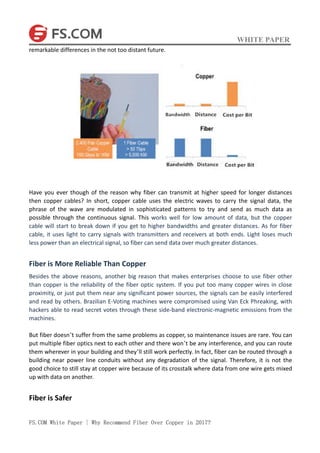
People are aware that fiber optics is winning out over copper because of its higher performance,
namely more bandwidth, faster speed and longer link distance.
Bandwidth decides how much data you can receive and send. Copper cable that can be used for 10
Gigabit cabling, and 100 Gigabit cables is at the point of topping out, but these data rates can be
sent only for very short distances between servers in data centers. While with fiber you can transmit
more data over greater distances, and if you’re preparing for fiber now, you’ll also start to see
Why Recommend Fiber
Over Copper in 2017?
WHITE PAPER
FS.COM White Paper | Why Recommend Fiber Over Copper in 2017?
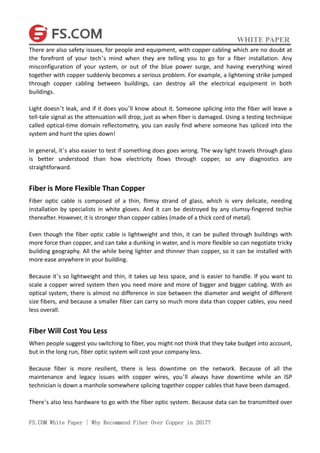
remarkable differences in the not too distant future.
Have you ever though of the reason why fiber can transmit at higher speed for longer distances
then copper cables? In short, copper cable uses the electric waves to carry the signal data, the
phrase of the wave are modulated in sophisticated patterns to try and send as much data as
possible through the continuous signal. This works well for low amount of data, but the copper
cable will start to break down if you get to higher bandwidths and greater distances. As for fiber
cable, it uses light to carry signals with transmitters and receivers at both ends. Light loses much
less power than an electrical signal, so fiber can send data over much greater distances.
Fiber is More Reliable Than Copper
Besides the above reasons, another big reason that makes enterprises choose to use fiber other
than copper is the reliability of the fiber optic system. If you put too many copper wires in close
proximity, or just put them near any significant power sources, the signals can be easily interfered
and read by others. Brazilian E-Voting machines were compromised using Van Eck Phreaking, with
hackers able to read secret votes through these side-band electronic-magnetic emissions from the
machines.
But fiber doesn’t suffer from the same problems as copper, so maintenance issues are rare. You can
put multiple fiber optics next to each other and there won’t be any interference, and you can route
them wherever in your building and they’ll still work perfectly. In fact, fiber can be routed through a
building near power line conduits without any degradation of the signal. Therefore, it is not the
good choice to still stay at copper wire because of its crosstalk where data from one wire gets mixed
up with data on another.
Fiber is Safer
WHITE PAPER
FS.COM White Paper | Why Recommend Fiber Over Copper in 2017?
There are also safety issues, for people and equipment, with copper cabling which are no doubt at
the forefront of your tech’s mind when they are telling you to go for a fiber installation. Any
misconfiguration of your system, or out of the blue power surge, and having everything wired
together with copper suddenly becomes a serious problem. For example, a lightening strike jumped
through copper cabling between buildings, can destroy all the electrical equipment in both
buildings.
Light doesn’t leak, and if it does you’ll know about it. Someone splicing into the fiber will leave a
tell-tale signal as the attenuation will drop, just as when fiber is damaged. Using a testing technique
called optical-time domain reflectometry, you can easily find where someone has spliced into the
system and hunt the spies down!
In general, it’s also easier to test if something does goes wrong. The way light travels through glass
is better understood than how electricity flows through copper, so any diagnostics are
straightforward.
Fiber is More Flexible Than Copper
Fiber optic cable is composed of a thin, flimsy strand of glass, which is very delicate, needing
installation by specialists in white gloves. And it can be destroyed by any clumsy-fingered techie
thereafter. However, it is stronger than copper cables (made of a thick cord of metal).
Even though the fiber optic cable is lightweight and thin, it can be pulled through buildings with
more force than copper, and can take a dunking in water, and is more flexible so can negotiate tricky
building geography. All the while being lighter and thinner than copper, so it can be installed with
more ease anywhere in your building.
Because it’s so lightweight and thin, it takes up less space, and is easier to handle. If you want to
scale a copper wired system then you need more and more of bigger and bigger cabling. With an
optical system, there is almost no difference in size between the diameter and weight of different
size fibers, and because a smaller fiber can carry so much more data than copper cables, you need
less overall.
Fiber Will Cost You Less
When people suggest you switching to fiber, you might not think that they take budget into account,
but in the long run, fiber optic system will cost your company less.
Because fiber is more resilient, there is less downtime on the network. Because of all the
maintenance and legacy issues with copper wires, you’ll always have downtime while an ISP
technician is down a manhole somewhere splicing together copper cables that have been damaged.
There’s also less hardware to go with the fiber optic system. Because data can be transmitted over
WHITE PAPER
FS.COM White Paper | Why Recommend Fiber Over Copper in 2017?
fiber for longer distances, you don’t need the extra power boosters, junctions, and terminals that
are needed for copper cabling. Your fiber can be brought directly to your office with no need for
multiple connections.
Fiber is new technology that is constantly evolving and a hot area of research. We believe that in
2017, fiber optic based system will be more popular among users.
WHITE PAPER
FS.COM White Paper | Why Recommend Fiber Over Copper in 2017?
Contact Us
Manufacturing R & D (China)
Eastern Side, Second Floor, Science &
Technology Park, No.6, Keyuan Road,
Nanshan District, Shenzhen 518057,
China
Tel: +86 (755) 8300 3611
Fax: +86 (755) 8326 9395
Email: sales@fs.com
APAC Office (Hong Kong)
1220 Tung Chun Commercial Centre,
438-444 Shanghai Street, Kowloon,
HongKong
Tel: +(852) 817 636 06
Fax: +(852) 817 636 06
Email: sales@fs.com
North America (United States)
331 Andover Park East Ste330, Tukwila,
WA 98188,United States
Tel: +1 (253) 277 3058
Fax: +1 (253) 246-7881
Email: sales@fs.com
London Office (United Kingdom)
Third Floor 207 Regent Street, London,
W1B 3HH, United Kingdom
Tel: +44 (020) 3287 6810
Notice: This document is for informational purposes only and does not set forth any warranty, expressed or
implied, concerning any equipment, equipment features, or service offered or to be offered by FS.COM.
FS.COM reserves the right to make changes to this document at any time, without notice, and assumes no
responsibility for its use. This information document describes features that may not be currently available.
Contact a FS.COM sales team for information on feature and product availability.
Follow us
LinkedIn
Twitter
Facebook
G+
Pinterest
Youtube
Blog

Why recommend fiber over copper in 2017

  • 1.
    WHITE PAPER FS.COM WhitePaper | Why Recommend Fiber Over Copper in 2017? 2017 is coming in less than a month, looking back, in the communication field, the old remaining dilemma between fiber and copper is still left behind. People are struggling about whether they should hold on to the tried-and-tested copper cables that are sufficient so far, or make the leap into the future, and go fiber optic. From a technical perspective, the case for switching to fiber is growing ever stronger. Using a fiber system will lead to more bandwidth, reliability, less down time and end up saving you money. Today’s article will make you understand the trend for switching to fiber. More Bandwidth, Faster and Longer People are aware that fiber optics is winning out over copper because of its higher performance, namely more bandwidth, faster speed and longer link distance. Bandwidth decides how much data you can receive and send. Copper cable that can be used for 10 Gigabit cabling, and 100 Gigabit cables is at the point of topping out, but these data rates can be sent only for very short distances between servers in data centers. While with fiber you can transmit more data over greater distances, and if you’re preparing for fiber now, you’ll also start to see Why Recommend Fiber Over Copper in 2017?
  • 2.
    WHITE PAPER FS.COM WhitePaper | Why Recommend Fiber Over Copper in 2017? remarkable differences in the not too distant future. Have you ever though of the reason why fiber can transmit at higher speed for longer distances then copper cables? In short, copper cable uses the electric waves to carry the signal data, the phrase of the wave are modulated in sophisticated patterns to try and send as much data as possible through the continuous signal. This works well for low amount of data, but the copper cable will start to break down if you get to higher bandwidths and greater distances. As for fiber cable, it uses light to carry signals with transmitters and receivers at both ends. Light loses much less power than an electrical signal, so fiber can send data over much greater distances. Fiber is More Reliable Than Copper Besides the above reasons, another big reason that makes enterprises choose to use fiber other than copper is the reliability of the fiber optic system. If you put too many copper wires in close proximity, or just put them near any significant power sources, the signals can be easily interfered and read by others. Brazilian E-Voting machines were compromised using Van Eck Phreaking, with hackers able to read secret votes through these side-band electronic-magnetic emissions from the machines. But fiber doesn’t suffer from the same problems as copper, so maintenance issues are rare. You can put multiple fiber optics next to each other and there won’t be any interference, and you can route them wherever in your building and they’ll still work perfectly. In fact, fiber can be routed through a building near power line conduits without any degradation of the signal. Therefore, it is not the good choice to still stay at copper wire because of its crosstalk where data from one wire gets mixed up with data on another. Fiber is Safer
  • 3.
    WHITE PAPER FS.COM WhitePaper | Why Recommend Fiber Over Copper in 2017? There are also safety issues, for people and equipment, with copper cabling which are no doubt at the forefront of your tech’s mind when they are telling you to go for a fiber installation. Any misconfiguration of your system, or out of the blue power surge, and having everything wired together with copper suddenly becomes a serious problem. For example, a lightening strike jumped through copper cabling between buildings, can destroy all the electrical equipment in both buildings. Light doesn’t leak, and if it does you’ll know about it. Someone splicing into the fiber will leave a tell-tale signal as the attenuation will drop, just as when fiber is damaged. Using a testing technique called optical-time domain reflectometry, you can easily find where someone has spliced into the system and hunt the spies down! In general, it’s also easier to test if something does goes wrong. The way light travels through glass is better understood than how electricity flows through copper, so any diagnostics are straightforward. Fiber is More Flexible Than Copper Fiber optic cable is composed of a thin, flimsy strand of glass, which is very delicate, needing installation by specialists in white gloves. And it can be destroyed by any clumsy-fingered techie thereafter. However, it is stronger than copper cables (made of a thick cord of metal). Even though the fiber optic cable is lightweight and thin, it can be pulled through buildings with more force than copper, and can take a dunking in water, and is more flexible so can negotiate tricky building geography. All the while being lighter and thinner than copper, so it can be installed with more ease anywhere in your building. Because it’s so lightweight and thin, it takes up less space, and is easier to handle. If you want to scale a copper wired system then you need more and more of bigger and bigger cabling. With an optical system, there is almost no difference in size between the diameter and weight of different size fibers, and because a smaller fiber can carry so much more data than copper cables, you need less overall. Fiber Will Cost You Less When people suggest you switching to fiber, you might not think that they take budget into account, but in the long run, fiber optic system will cost your company less. Because fiber is more resilient, there is less downtime on the network. Because of all the maintenance and legacy issues with copper wires, you’ll always have downtime while an ISP technician is down a manhole somewhere splicing together copper cables that have been damaged. There’s also less hardware to go with the fiber optic system. Because data can be transmitted over
  • 4.
    WHITE PAPER FS.COM WhitePaper | Why Recommend Fiber Over Copper in 2017? fiber for longer distances, you don’t need the extra power boosters, junctions, and terminals that are needed for copper cabling. Your fiber can be brought directly to your office with no need for multiple connections. Fiber is new technology that is constantly evolving and a hot area of research. We believe that in 2017, fiber optic based system will be more popular among users.
  • 5.
    WHITE PAPER FS.COM WhitePaper | Why Recommend Fiber Over Copper in 2017? Contact Us Manufacturing R & D (China) Eastern Side, Second Floor, Science & Technology Park, No.6, Keyuan Road, Nanshan District, Shenzhen 518057, China Tel: +86 (755) 8300 3611 Fax: +86 (755) 8326 9395 Email: sales@fs.com APAC Office (Hong Kong) 1220 Tung Chun Commercial Centre, 438-444 Shanghai Street, Kowloon, HongKong Tel: +(852) 817 636 06 Fax: +(852) 817 636 06 Email: sales@fs.com North America (United States) 331 Andover Park East Ste330, Tukwila, WA 98188,United States Tel: +1 (253) 277 3058 Fax: +1 (253) 246-7881 Email: sales@fs.com London Office (United Kingdom) Third Floor 207 Regent Street, London, W1B 3HH, United Kingdom Tel: +44 (020) 3287 6810 Notice: This document is for informational purposes only and does not set forth any warranty, expressed or implied, concerning any equipment, equipment features, or service offered or to be offered by FS.COM. FS.COM reserves the right to make changes to this document at any time, without notice, and assumes no responsibility for its use. This information document describes features that may not be currently available. Contact a FS.COM sales team for information on feature and product availability. Follow us LinkedIn Twitter Facebook G+ Pinterest Youtube Blog