FIBER OPTICS VS COPPER CABLE
c a b l e s fi n d e r. c o m
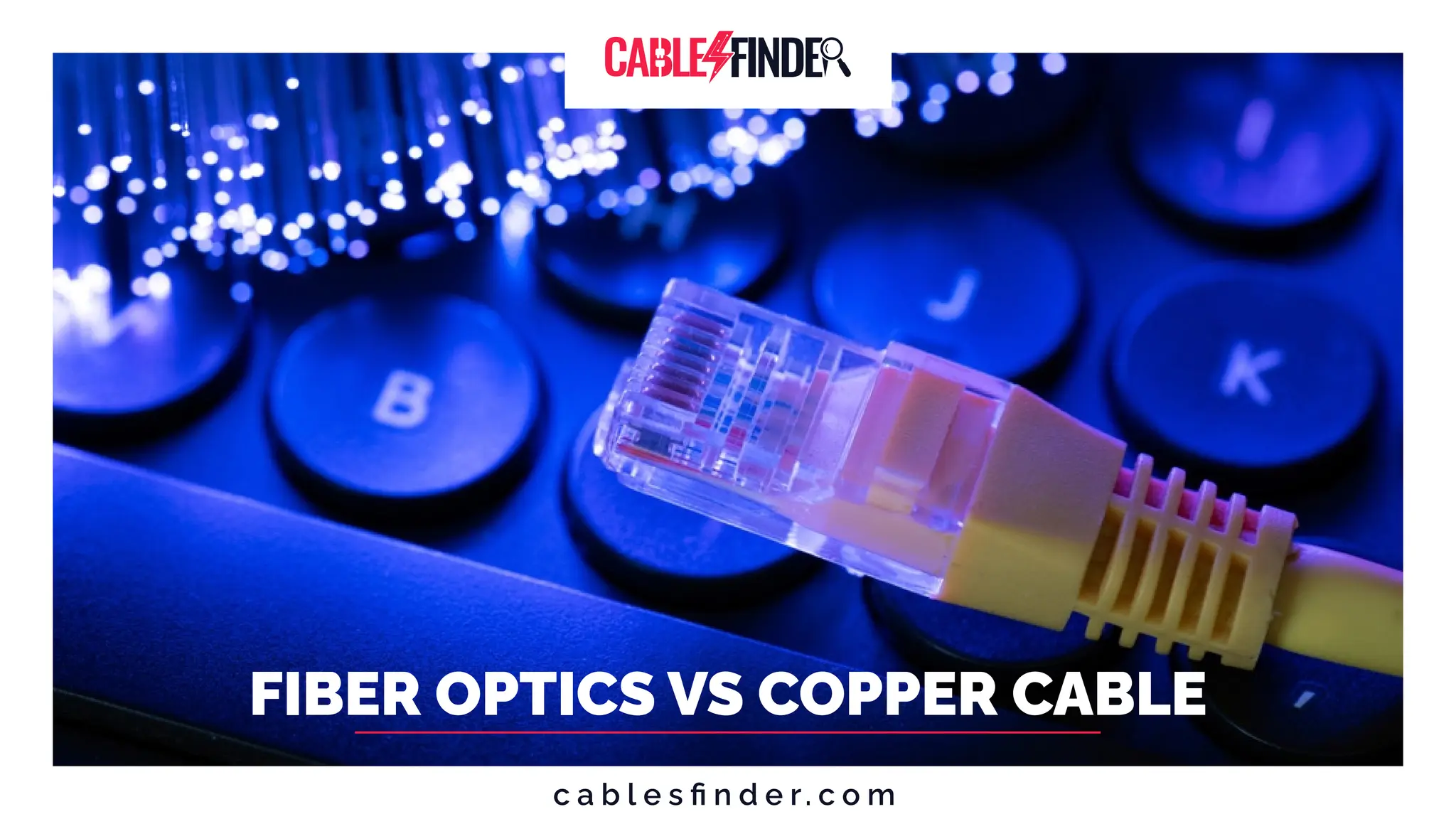
FIBER OPTICS VS COPPER CABLE
Copper cable and fiber optic cable are popular types of cable used for networking. Copper cable
are available form several years. Over the last few years, Fiber Optic cables are introduced in the
market and gained the momentum. As per market researcher, Fiber Optic market is growing
steadily for the next five to ten years.
Fiber Optic cables offer many advantages such as improved bandwidth and extended
geographical distances in a network. There are various reason of fiber optic gaining traction
despite expensive. While copper cabling is used in many places.
Fiber optic cable and copper cables are used synchronously with each other especially in existing
network. Also, copper cabling still useful for small networks restricted for one building or so. Here
we will discuss the differences, pros and cons of fiber optic cable and copper cable.
c a b l e s fi n d e r. c o m
COPPER CABLE
c a b l e s fi n d e r. c o m
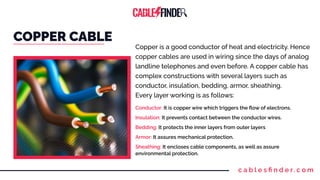
Copper is a good conductor of heat and electricity. Hence
copper cables are used in wiring since the days of analog
landline telephones and even before. A copper cable has
complex constructions with several layers such as
conductor, insulation, bedding, armor, sheathing.
Every layer working is as follows:
Conductor: It is copper wire which triggers the flow of electrons.
Insulation: It prevents contact between the conductor wires.
Bedding: It protects the inner layers from outer layers
Armor: It assures mechanical protection.
Sheathing: It encloses cable components, as well as assure
environmental protection.
c a b l e s fi n d e r. c o m
COPPER CABLES TYPES & USAGE:
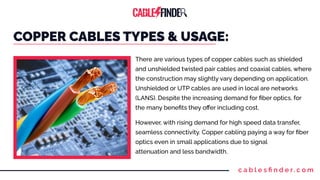
There are various types of copper cables such as shielded
and unshielded twisted pair cables and coaxial cables, where
the construction may slightly vary depending on application.
Unshielded or UTP cables are used in local are networks
(LANS). Despite the increasing demand for fiber optics, for
the many benefits they offer including cost.
However, with rising demand for high speed data transfer,
seamless connectivity. Copper cabling paying a way for fiber
optics even in small applications due to signal
attenuation and less bandwidth.
c a b l e s fi n d e r. c o m
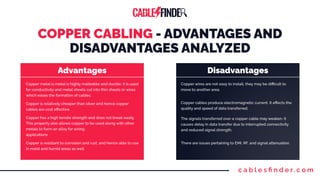
COPPER CABLING - ADVANTAGES AND
DISADVANTAGES ANALYZED
Advantages Disadvantages
Copper metal is metal is highly malleable and ductile. It is used
for conductivity and metal sheets cut into thin sheets or wires
which eases the formation of cables.
Copper is relatively cheaper than silver and hence copper
cables are cost effective.
Copper is resistant to corrosion and rust, and hence able to use
in moist and humid areas as well
Copper has a high tensile strength and does not break easily.
This property also allows copper to be used along with other
metals to form an alloy for wiring
applications
Copper wires are not easy to install, they may be difficult to
move to another area.
Copper cables produce electromagnetic current. It effects the
quality and speed of data transferred.
There are issues pertaining to EMI, RF, and signal attenuation.
The signals transferred over a copper cable may weaken. It
causes delay in data transfer due to interrupted connectivity
and reduced signal strength.
c a b l e s fi n d e r. c o m
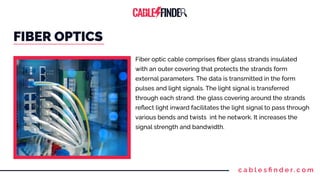
FIBER OPTICS
Fiber optic cable comprises fiber glass strands insulated
with an outer covering that protects the strands form
external parameters. The data is transmitted in the form
pulses and light signals. The light signal is transferred
through each strand. the glass covering around the strands
reflect light inward facilitates the light signal to pass through
various bends and twists int he network. It increases the
signal strength and bandwidth.
c a b l e s fi n d e r. c o m
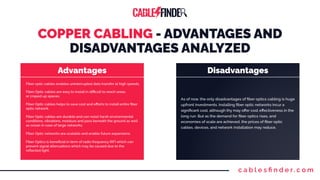
COPPER CABLING - ADVANTAGES AND
DISADVANTAGES ANALYZED
Advantages Disadvantages
Fiber optic cables enables uninterrupted data transfer at high speeds.
Fiber Optic cables are easy to install in difficult to reach areas
or craped up spaces.
Fiber Optic networks are scalable and enable future expansions.
Fiber Optic cables helps to save cost and efforts to install entire fiber
optic network.
Fiber Optic cables are durable and can resist harsh environmental
conditions, vibrations, moisture and pass beneath the ground as well
as ocean in case of large networks.
Fiber Optics is beneficial in term of radio frequency (RF) which can
prevent signal attenuations which may be caused due to the
reflected light.
As of now, the only disadvantages of fiber optics cabling is huge
upfront investments. Installing fiber optic networks incur a
significant cost, although thy may offer cost effectiveness in the
long run. But as the demand for fiber optics rises, and
economies of scale are achieved, the prices of fiber optic
cables, devices, and network installation may reduce.
c a b l e s fi n d e r. c o m
CONCLUSION
Copper cabling or legacy network is still exist and function, It is good for very small businesses
restricted to not more than a couple of floors and not spread in other cities or countries, However,
installing fiber optics s ideal for big players and especially mission critical applications where
speed and accuracy are key.
Mid-sized businesses may opt for network expansion through fiber optic extended networks.
This helps limit your budget and makes your network fast, robust, secure, and scalable. All in
set to grow and stay for a long time till another equally or more disruptive technology enters
the market.
Cable vs Fiber Internet: Key Differences and Benefits - CablesFinder

Cable vs Fiber Internet: Key Differences and Benefits - CablesFinder

  • 1.
    FIBER OPTICS VSCOPPER CABLE c a b l e s fi n d e r. c o m
  • 2.
    FIBER OPTICS VSCOPPER CABLE Copper cable and fiber optic cable are popular types of cable used for networking. Copper cable are available form several years. Over the last few years, Fiber Optic cables are introduced in the market and gained the momentum. As per market researcher, Fiber Optic market is growing steadily for the next five to ten years. Fiber Optic cables offer many advantages such as improved bandwidth and extended geographical distances in a network. There are various reason of fiber optic gaining traction despite expensive. While copper cabling is used in many places. Fiber optic cable and copper cables are used synchronously with each other especially in existing network. Also, copper cabling still useful for small networks restricted for one building or so. Here we will discuss the differences, pros and cons of fiber optic cable and copper cable. c a b l e s fi n d e r. c o m
  • 3.
    COPPER CABLE c ab l e s fi n d e r. c o m Copper is a good conductor of heat and electricity. Hence copper cables are used in wiring since the days of analog landline telephones and even before. A copper cable has complex constructions with several layers such as conductor, insulation, bedding, armor, sheathing. Every layer working is as follows: Conductor: It is copper wire which triggers the flow of electrons. Insulation: It prevents contact between the conductor wires. Bedding: It protects the inner layers from outer layers Armor: It assures mechanical protection. Sheathing: It encloses cable components, as well as assure environmental protection.
  • 4.
    c a bl e s fi n d e r. c o m COPPER CABLES TYPES & USAGE: There are various types of copper cables such as shielded and unshielded twisted pair cables and coaxial cables, where the construction may slightly vary depending on application. Unshielded or UTP cables are used in local are networks (LANS). Despite the increasing demand for fiber optics, for the many benefits they offer including cost. However, with rising demand for high speed data transfer, seamless connectivity. Copper cabling paying a way for fiber optics even in small applications due to signal attenuation and less bandwidth.
  • 5.
    c a bl e s fi n d e r. c o m COPPER CABLING - ADVANTAGES AND DISADVANTAGES ANALYZED Advantages Disadvantages Copper metal is metal is highly malleable and ductile. It is used for conductivity and metal sheets cut into thin sheets or wires which eases the formation of cables. Copper is relatively cheaper than silver and hence copper cables are cost effective. Copper is resistant to corrosion and rust, and hence able to use in moist and humid areas as well Copper has a high tensile strength and does not break easily. This property also allows copper to be used along with other metals to form an alloy for wiring applications Copper wires are not easy to install, they may be difficult to move to another area. Copper cables produce electromagnetic current. It effects the quality and speed of data transferred. There are issues pertaining to EMI, RF, and signal attenuation. The signals transferred over a copper cable may weaken. It causes delay in data transfer due to interrupted connectivity and reduced signal strength.
  • 6.
    c a bl e s fi n d e r. c o m FIBER OPTICS Fiber optic cable comprises fiber glass strands insulated with an outer covering that protects the strands form external parameters. The data is transmitted in the form pulses and light signals. The light signal is transferred through each strand. the glass covering around the strands reflect light inward facilitates the light signal to pass through various bends and twists int he network. It increases the signal strength and bandwidth.
  • 7.
    c a bl e s fi n d e r. c o m COPPER CABLING - ADVANTAGES AND DISADVANTAGES ANALYZED Advantages Disadvantages Fiber optic cables enables uninterrupted data transfer at high speeds. Fiber Optic cables are easy to install in difficult to reach areas or craped up spaces. Fiber Optic networks are scalable and enable future expansions. Fiber Optic cables helps to save cost and efforts to install entire fiber optic network. Fiber Optic cables are durable and can resist harsh environmental conditions, vibrations, moisture and pass beneath the ground as well as ocean in case of large networks. Fiber Optics is beneficial in term of radio frequency (RF) which can prevent signal attenuations which may be caused due to the reflected light. As of now, the only disadvantages of fiber optics cabling is huge upfront investments. Installing fiber optic networks incur a significant cost, although thy may offer cost effectiveness in the long run. But as the demand for fiber optics rises, and economies of scale are achieved, the prices of fiber optic cables, devices, and network installation may reduce.
  • 8.
    c a bl e s fi n d e r. c o m CONCLUSION Copper cabling or legacy network is still exist and function, It is good for very small businesses restricted to not more than a couple of floors and not spread in other cities or countries, However, installing fiber optics s ideal for big players and especially mission critical applications where speed and accuracy are key. Mid-sized businesses may opt for network expansion through fiber optic extended networks. This helps limit your budget and makes your network fast, robust, secure, and scalable. All in set to grow and stay for a long time till another equally or more disruptive technology enters the market.