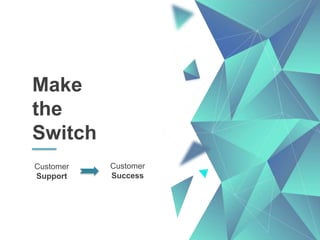
Make
the
Switch
Customer
Support
Customer
Success
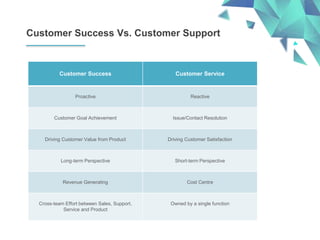
Customer Success Vs. Customer Support
Customer Success Customer Service
Proactive Reactive
Customer Goal Achievement Issue/Contact Resolution
Driving Customer Value from Product Driving Customer Satisfaction
Long-term Perspective Short-term Perspective
Revenue Generating Cost Centre
Cross-team Effort between Sales, Support,
Service and Product
Owned by a single function
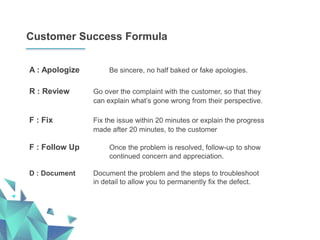
Customer Success Formula
A : Apologize Be sincere, no half baked or fake apologies.
R : Review Go over the complaint with the customer, so that they
can explain what’s gone wrong from their perspective.
F : Fix Fix the issue within 20 minutes or explain the progress
made after 20 minutes, to the customer
F : Follow Up Once the problem is resolved, follow-up to show
continued concern and appreciation.
D : Document Document the problem and the steps to troubleshoot
in detail to allow you to permanently fix the defect.
Customer Success at any organisation is driven by 3
driving mottos
The underlying principle is simple:
“Empowerment is the key!”
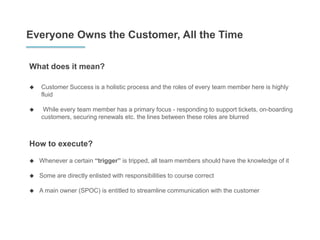
Everyone Owns the Customer, All the Time
What does it mean?
 Customer Success is a holistic process and the roles of every team member here is highly
fluid
 While every team member has a primary focus - responding to support tickets, on-boarding
customers, securing renewals etc. the lines between these roles are blurred
How to execute?
 Whenever a certain “trigger” is tripped, all team members should have the knowledge of it
 Some are directly enlisted with responsibilities to course correct
 A main owner (SPOC) is entitled to streamline communication with the customer
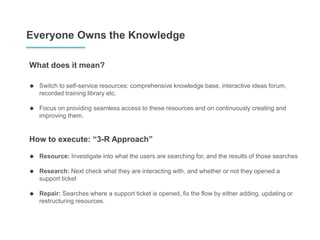
Everyone Owns the Knowledge
What does it mean?
 Switch to self-service resources: comprehensive knowledge base, interactive ideas forum,
recorded training library etc.
 Focus on providing seamless access to these resources and on continuously creating and
improving them.
How to execute: “3-R Approach”
 Resource: Investigate into what the users are searching for, and the results of those searches
 Research: Next check what they are interacting with, and whether or not they opened a
support ticket
 Repair: Searches where a support ticket is opened, fix the flow by either adding, updating or
restructuring resources.
Everyone Owns the Metrics
What does it mean?
 All team member are directly responsible for the customer success metrics, not just the ones
apparently responsible by virtue of their primary roles.
 Customer Success Metrics: MRR/Customer Churn, Ticket Deflection rate, NPS Score etc..
[More Here..]
How to execute?
 Record all metrics on a real-time dashboard, along with targets and trends for weekly
reporting
 Feedback loop: How operational changes are affecting the KPIs and how it can be improved
upon
Steps to transition:
“Customer Support Customer Success”
The Many Hats of Customer Success
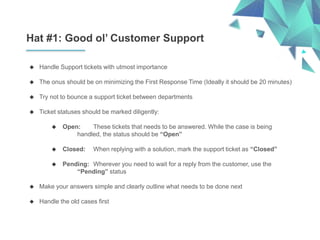
Hat #1: Good ol’ Customer Support
 Handle Support tickets with utmost importance
 The onus should be on minimizing the First Response Time (Ideally it should be 20 minutes)
 Try not to bounce a support ticket between departments
 Ticket statuses should be marked diligently:
 Open: These tickets that needs to be answered. While the case is being
handled, the status should be “Open”
 Closed: When replying with a solution, mark the support ticket as “Closed”
 Pending: Wherever you need to wait for a reply from the customer, use the
“Pending” status
 Make your answers simple and clearly outline what needs to be done next
 Handle the old cases first
Hat #2: Invest in great documentation
 Carefully curate customer queries to build a Self-Help section, containing Help
Articles.
 In the future, whenever customers write-in questions, you can send them the
appropriate help article, which saves you time and shows the customer where to find
help next time.
 In the future customers will find answers on their own, thereby saving you time
 Gives you an opportunity to improve your SEO by including new long tailed
keywords.
Hat #3: Conversion Optimisation to narrow the
funnel
 Identify the right folks who will drive the maximum value from your product and onboard them
as customers
 Steps to ensure that you only onboard the right customers:
1 Offer a free trial
2 Add a Product Demo Video
3 Add a FAQ section on your website
 This will improve your churn rate and also keep your refunds mostly flat
 The right customer has the tendency to find their own way through, thus reducing support
overhead
 They offer valuable feedback for product improvement
Hat #4: Demos for proactive customer
education
 Investing 15 minutes on a demo during Onboarding, can save a lot of time down the
road
 Address the following during the demo:
 Answer common questions
 Show off the most popular features
 Show them where to seek help if they have questions
 This will create more independent customers
 Stats suggest folks attending a demo, have a higher probability of becoming a paying
customer
Hat #5: Automated User Onboarding
 Customers finding their way by themselves is good, but don’t expect everyone to do
that
 Set-up an educational email and in-app message series to educate and increase
engagement
 This will allow customers to discover your product and decide if it is a worthwhile
investment
Hat #6: QA & Product Development
 Constructive Criticism: Analyze Support Tickets, Help Centre’s Search History to
understand your customer’s pain points
 Start addressing the most common issues faced by the customer by either fixing the product
or improving on-boarding
 A good stat to measure this is: Most Common Issue
 This will help you to orient your product team on how to prioritise their project
 Also will help you to find out what’s eating up your support team’s time
% of interactions with [tag] =
Number of interactions with [tag]
Total Number of interactions
Customer Success is more than delivering
service or support.
It is the
Power to delight your customers.

Why is customer success important?

  • 1.
  • 2.
    Customer Success Vs.Customer Support Customer Success Customer Service Proactive Reactive Customer Goal Achievement Issue/Contact Resolution Driving Customer Value from Product Driving Customer Satisfaction Long-term Perspective Short-term Perspective Revenue Generating Cost Centre Cross-team Effort between Sales, Support, Service and Product Owned by a single function
  • 3.
    Customer Success Formula A: Apologize Be sincere, no half baked or fake apologies. R : Review Go over the complaint with the customer, so that they can explain what’s gone wrong from their perspective. F : Fix Fix the issue within 20 minutes or explain the progress made after 20 minutes, to the customer F : Follow Up Once the problem is resolved, follow-up to show continued concern and appreciation. D : Document Document the problem and the steps to troubleshoot in detail to allow you to permanently fix the defect.
  • 4.
    Customer Success atany organisation is driven by 3 driving mottos The underlying principle is simple: “Empowerment is the key!”
  • 5.
    Everyone Owns theCustomer, All the Time What does it mean?  Customer Success is a holistic process and the roles of every team member here is highly fluid  While every team member has a primary focus - responding to support tickets, on-boarding customers, securing renewals etc. the lines between these roles are blurred How to execute?  Whenever a certain “trigger” is tripped, all team members should have the knowledge of it  Some are directly enlisted with responsibilities to course correct  A main owner (SPOC) is entitled to streamline communication with the customer
  • 6.
    Everyone Owns theKnowledge What does it mean?  Switch to self-service resources: comprehensive knowledge base, interactive ideas forum, recorded training library etc.  Focus on providing seamless access to these resources and on continuously creating and improving them. How to execute: “3-R Approach”  Resource: Investigate into what the users are searching for, and the results of those searches  Research: Next check what they are interacting with, and whether or not they opened a support ticket  Repair: Searches where a support ticket is opened, fix the flow by either adding, updating or restructuring resources.
  • 7.
    Everyone Owns theMetrics What does it mean?  All team member are directly responsible for the customer success metrics, not just the ones apparently responsible by virtue of their primary roles.  Customer Success Metrics: MRR/Customer Churn, Ticket Deflection rate, NPS Score etc.. [More Here..] How to execute?  Record all metrics on a real-time dashboard, along with targets and trends for weekly reporting  Feedback loop: How operational changes are affecting the KPIs and how it can be improved upon
  • 8.
    Steps to transition: “CustomerSupport Customer Success” The Many Hats of Customer Success
  • 9.
    Hat #1: Goodol’ Customer Support  Handle Support tickets with utmost importance  The onus should be on minimizing the First Response Time (Ideally it should be 20 minutes)  Try not to bounce a support ticket between departments  Ticket statuses should be marked diligently:  Open: These tickets that needs to be answered. While the case is being handled, the status should be “Open”  Closed: When replying with a solution, mark the support ticket as “Closed”  Pending: Wherever you need to wait for a reply from the customer, use the “Pending” status  Make your answers simple and clearly outline what needs to be done next  Handle the old cases first
  • 10.
    Hat #2: Investin great documentation  Carefully curate customer queries to build a Self-Help section, containing Help Articles.  In the future, whenever customers write-in questions, you can send them the appropriate help article, which saves you time and shows the customer where to find help next time.  In the future customers will find answers on their own, thereby saving you time  Gives you an opportunity to improve your SEO by including new long tailed keywords.
  • 11.
    Hat #3: ConversionOptimisation to narrow the funnel  Identify the right folks who will drive the maximum value from your product and onboard them as customers  Steps to ensure that you only onboard the right customers: 1 Offer a free trial 2 Add a Product Demo Video 3 Add a FAQ section on your website  This will improve your churn rate and also keep your refunds mostly flat  The right customer has the tendency to find their own way through, thus reducing support overhead  They offer valuable feedback for product improvement
  • 12.
    Hat #4: Demosfor proactive customer education  Investing 15 minutes on a demo during Onboarding, can save a lot of time down the road  Address the following during the demo:  Answer common questions  Show off the most popular features  Show them where to seek help if they have questions  This will create more independent customers  Stats suggest folks attending a demo, have a higher probability of becoming a paying customer
  • 13.
    Hat #5: AutomatedUser Onboarding  Customers finding their way by themselves is good, but don’t expect everyone to do that  Set-up an educational email and in-app message series to educate and increase engagement  This will allow customers to discover your product and decide if it is a worthwhile investment
  • 14.
    Hat #6: QA& Product Development  Constructive Criticism: Analyze Support Tickets, Help Centre’s Search History to understand your customer’s pain points  Start addressing the most common issues faced by the customer by either fixing the product or improving on-boarding  A good stat to measure this is: Most Common Issue  This will help you to orient your product team on how to prioritise their project  Also will help you to find out what’s eating up your support team’s time % of interactions with [tag] = Number of interactions with [tag] Total Number of interactions
  • 15.
    Customer Success ismore than delivering service or support. It is the Power to delight your customers.