A Comprehensive Guide to
Building a Customer
Success Business Unit
Richard Lawson
A Comprehensive Guide to Building a
Customer Success Business Unit
A Comprehensive Guide to Building a Customer Success Business Unit: From Talent to Tools and Metrics
A Customer Success program aims to provide exceptional customer support and service throughout their entire
journey with a company, from the initial onboarding process to ongoing usage and engagement. By helping
customers achieve their desired outcomes, companies can increase customer satisfaction, retention, and loyalty,
driving revenue growth and improving brand reputation.
Customer Success is signi cant in today's business landscape, where customers have more choices than ever and
can easily switch to a competitor if they are unsatis ed with their experience. By focusing on the success of their
customers, companies can differentiate themselves from competitors and build a loyal customer base that provides
long-term value.
However, building a successful Customer Success program requires a strategic approach with clear goals,
processes, and metrics. This guide will provide a step-by-step framework for starting a Customer Success business
unit and tips and best practices for delivering a successful program and scaling it as the company grows. By
following these guidelines, companies can build a strong Customer Success program that drives business growth
and helps customers achieve their desired outcomes.
Why Companies Could Bene t from a Customer Success Business Unit
Increase Customer Retention
A Customer Success Business Unit can help increase customer retention by ensuring customers achieve their
desired outcomes and addressing any issues or concerns. In addition, by regularly engaging with customers and
providing them with ongoing support, the Customer Success team can build strong relationships with customers
and increase their loyalty to the company.
Additionally, by identifying at-risk customers early on, the Customer Success team can take proactive steps to retain
those customers before they churn. This can include providing additional resources or support to help the customer
achieve their desired outcomes or addressing any issues or concerns they may have.
Drive Revenue
A Customer Success Business Unit can help drive revenue growth by identifying upsell and cross-sell opportunities.
By understanding the customer's goals and needs, the Customer Success team can recommend additional products
or services to help the customer achieve even greater success. This can lead to increased revenue for the company
and a higher customer lifetime value.
A Comprehensive Guide to Building a
Customer Success Business Unit
Additionally, by providing exceptional customer service and support, the Customer Success team can create brand
advocates more likely to recommend the company's product or service to others. This can lead to new customer
acquisition and further revenue growth.
Improve Product Development
A Customer Success Business Unit can provide valuable feedback to the product development team. By collecting
customer feedback on their experiences with the product or service, the Customer Success team can identify areas
for improvement and make recommendations to the product development team. This can lead to a better product
or service that meets customers' needs more effectively, leading to increased customer satisfaction and loyalty.
Enhance Brand Reputation
A robust Customer Success program can help build a positive reputation for the company and increase brand
loyalty. By providing exceptional customer service and support, the Customer Success team can create a positive
customer experience that customers will associate with the brand. This can increase customer loyalty and advocacy,
enhancing the company's brand reputation.
Additionally, by regularly engaging with customers and addressing any issues or concerns, the Customer Success
team can demonstrate that the company cares about its customers and is committed to their success. This can
create a positive company perception and increase customer brand loyalty.
What Kind of Talent You Need
Customer Success Manager (CSM)
The CSM manages the overall relationship between the company and its customers. They work closely with
customers to understand their goals and desired outcomes and then develop a Customer Success plan to help them
achieve them. Therefore, the CSM should have strong communication and project management skills and a deep
understanding of the company's product or service.
A Comprehensive Guide to Building a
Customer Success Business Unit
1. Develop and maintain strong relationships with customers
2. Understand the customer's goals and desired outcomes
3. Develop and implement a Customer Success plan
4. Monitor the customer's progress toward their desired outcomes
5. Identify and address any issues or concerns the customer may have
6. Provide regular updates to the customer and internal stakeholders
7. Identify upsell and cross-sell opportunities
Technical Account Manager (TAM)
The TAM ensures customers can use the company's product or service effectively. They should have a solid technical
background and be able to troubleshoot technical issues. The TAM works closely with the CSM to ensure the
customer achieves their desired outcomes.
Key Responsibilities:
1. Provide technical support to customers
2. Troubleshoot technical issues
3. Ensure that the customer is using the product or service effectively
4. Provide training and education to customers
5. Identify opportunities for product or service improvement
6. Work with the product development team to address technical issues
Customer Support Specialist
The Support Specialist is responsible for handling customer inquiries and providing support. They should have
strong communication skills and be able to solve problems quickly. The Support Specialist is often the rst point of
contact for customers who need assistance.
Key Responsibilities:
A Comprehensive Guide to Building a
Customer Success Business Unit
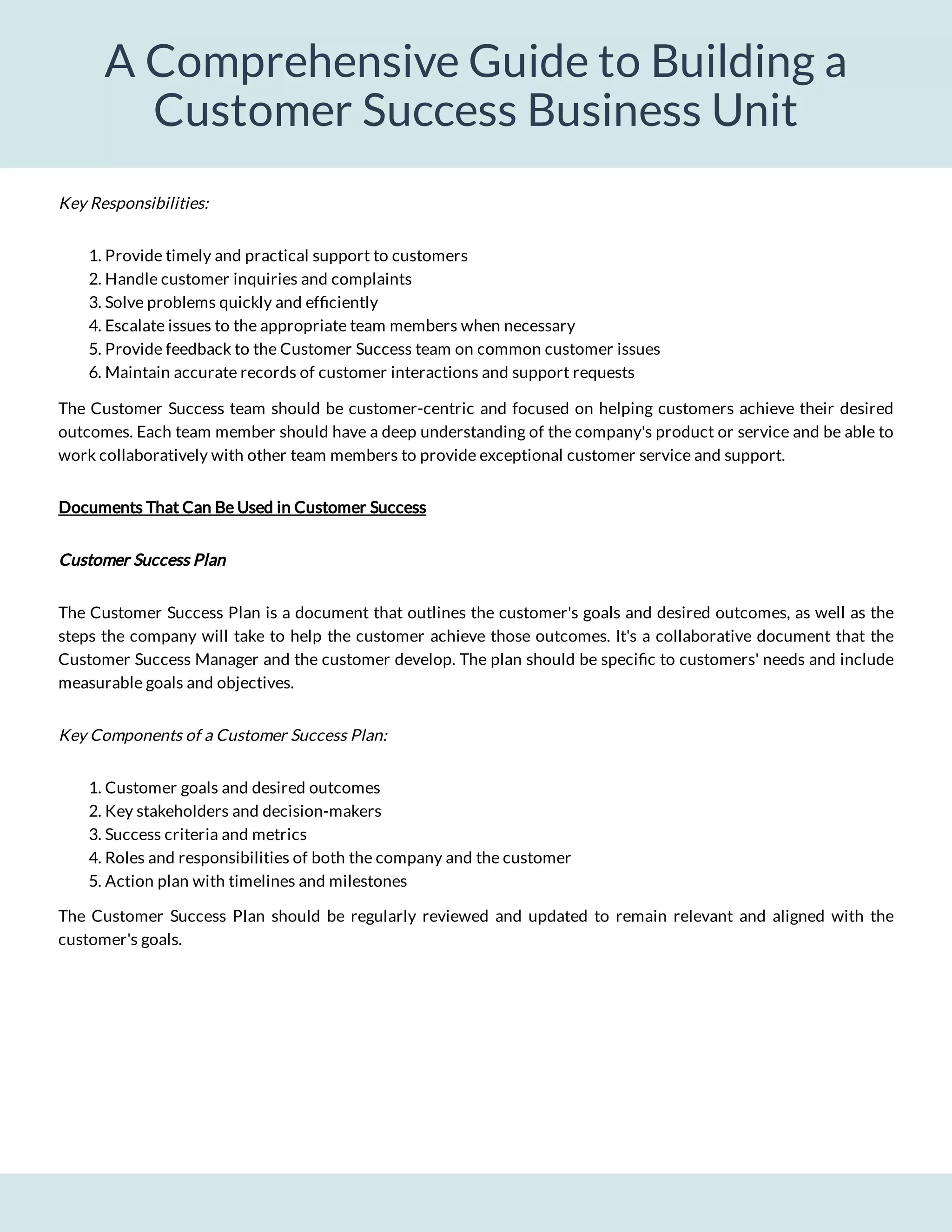
1. Provide timely and practical support to customers
2. Handle customer inquiries and complaints
3. Solve problems quickly and ef ciently
4. Escalate issues to the appropriate team members when necessary
5. Provide feedback to the Customer Success team on common customer issues
6. Maintain accurate records of customer interactions and support requests
The Customer Success team should be customer-centric and focused on helping customers achieve their desired
outcomes. Each team member should have a deep understanding of the company's product or service and be able to
work collaboratively with other team members to provide exceptional customer service and support.
Documents That Can Be Used in Customer Success
Customer Success Plan
The Customer Success Plan is a document that outlines the customer's goals and desired outcomes, as well as the
steps the company will take to help the customer achieve those outcomes. It's a collaborative document that the
Customer Success Manager and the customer develop. The plan should be speci c to customers' needs and include
measurable goals and objectives.
Key Components of a Customer Success Plan:
1. Customer goals and desired outcomes
2. Key stakeholders and decision-makers
3. Success criteria and metrics
4. Roles and responsibilities of both the company and the customer
5. Action plan with timelines and milestones
The Customer Success Plan should be regularly reviewed and updated to remain relevant and aligned with the
customer's goals.
Key Responsibilities:
A Comprehensive Guide to Building a
Customer Success Business Unit
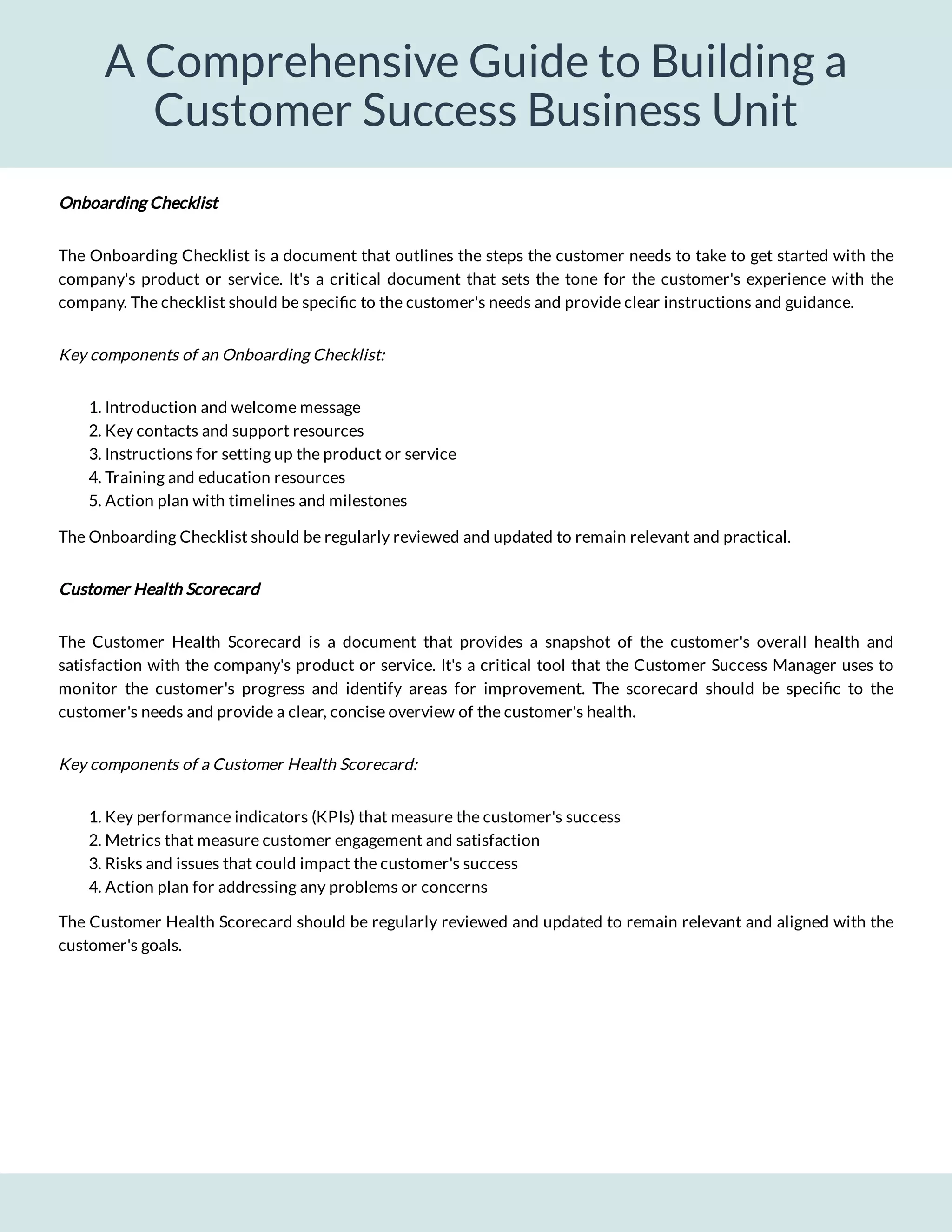
The Onboarding Checklist is a document that outlines the steps the customer needs to take to get started with the
company's product or service. It's a critical document that sets the tone for the customer's experience with the
company. The checklist should be speci c to the customer's needs and provide clear instructions and guidance.
Key components of an Onboarding Checklist:
1. Introduction and welcome message
2. Key contacts and support resources
3. Instructions for setting up the product or service
4. Training and education resources
5. Action plan with timelines and milestones
The Onboarding Checklist should be regularly reviewed and updated to remain relevant and practical.
Customer Health Scorecard
The Customer Health Scorecard is a document that provides a snapshot of the customer's overall health and
satisfaction with the company's product or service. It's a critical tool that the Customer Success Manager uses to
monitor the customer's progress and identify areas for improvement. The scorecard should be speci c to the
customer's needs and provide a clear, concise overview of the customer's health.
Key components of a Customer Health Scorecard:
1. Key performance indicators (KPIs) that measure the customer's success
2. Metrics that measure customer engagement and satisfaction
3. Risks and issues that could impact the customer's success
4. Action plan for addressing any problems or concerns
The Customer Health Scorecard should be regularly reviewed and updated to remain relevant and aligned with the
customer's goals.
Onboarding Checklist
A Comprehensive Guide to Building a
Customer Success Business Unit
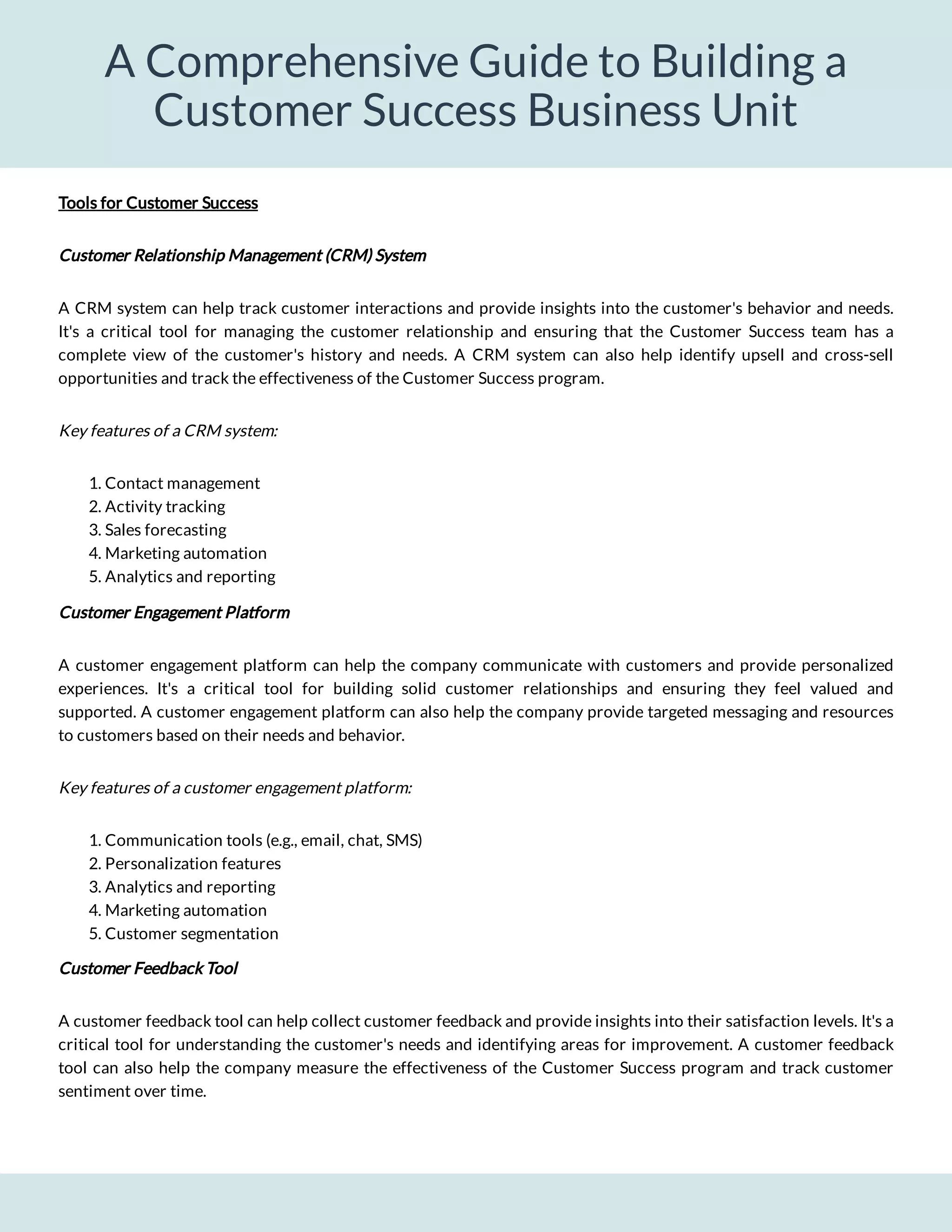
A CRM system can help track customer interactions and provide insights into the customer's behavior and needs.
It's a critical tool for managing the customer relationship and ensuring that the Customer Success team has a
complete view of the customer's history and needs. A CRM system can also help identify upsell and cross-sell
opportunities and track the effectiveness of the Customer Success program.
Key features of a CRM system:
1. Contact management
2. Activity tracking
3. Sales forecasting
4. Marketing automation
5. Analytics and reporting
Customer Engagement Platform
A customer engagement platform can help the company communicate with customers and provide personalized
experiences. It's a critical tool for building solid customer relationships and ensuring they feel valued and
supported. A customer engagement platform can also help the company provide targeted messaging and resources
to customers based on their needs and behavior.
Key features of a customer engagement platform:
1. Communication tools (e.g., email, chat, SMS)
2. Personalization features
3. Analytics and reporting
4. Marketing automation
5. Customer segmentation
Customer Feedback Tool
A customer feedback tool can help collect customer feedback and provide insights into their satisfaction levels. It's a
critical tool for understanding the customer's needs and identifying areas for improvement. A customer feedback
tool can also help the company measure the effectiveness of the Customer Success program and track customer
sentiment over time.
Customer Relationship Management (CRM) System
Tools for Customer Success
A Comprehensive Guide to Building a
Customer Success Business Unit
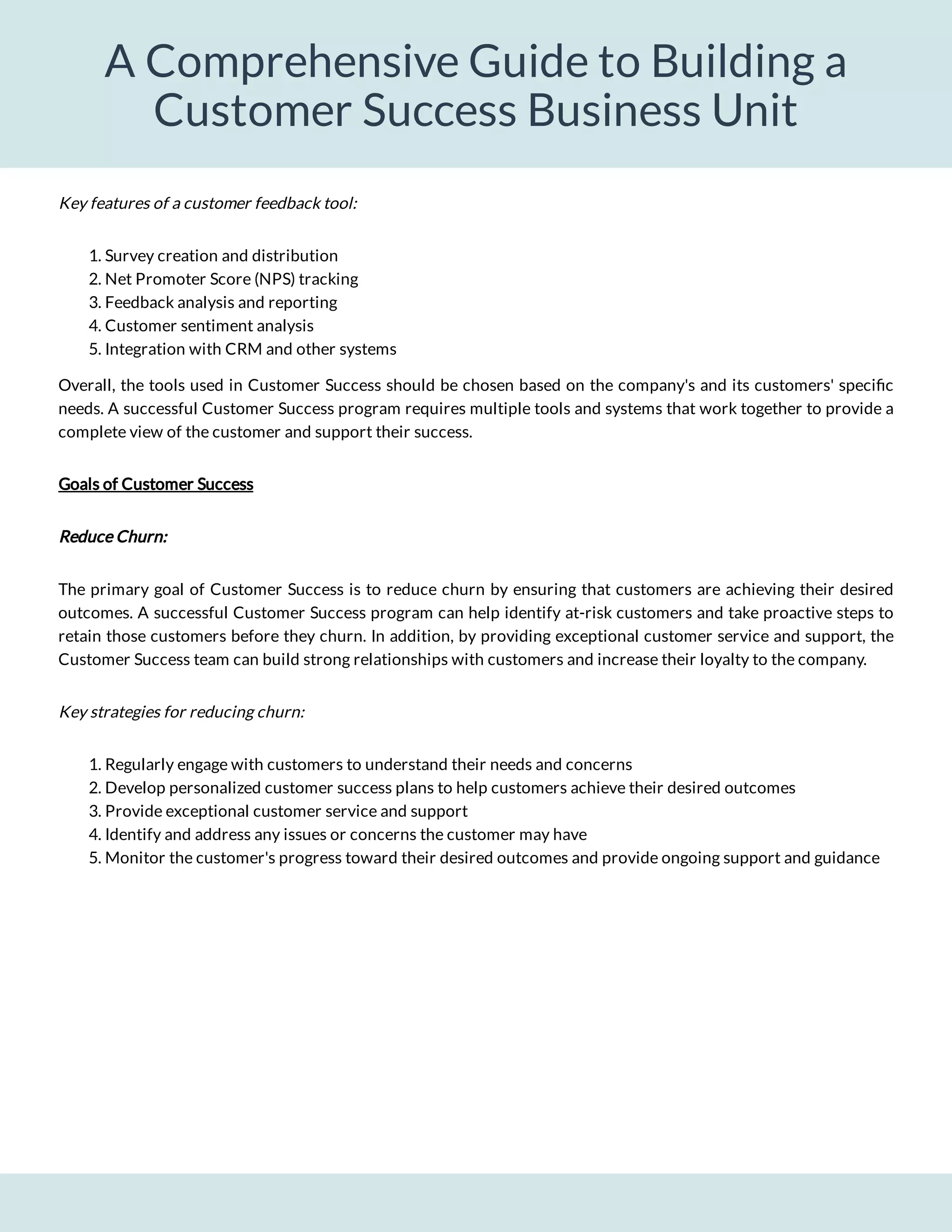
1. Survey creation and distribution
2. Net Promoter Score (NPS) tracking
3. Feedback analysis and reporting
4. Customer sentiment analysis
5. Integration with CRM and other systems
Overall, the tools used in Customer Success should be chosen based on the company's and its customers' speci c
needs. A successful Customer Success program requires multiple tools and systems that work together to provide a
complete view of the customer and support their success.
Goals of Customer Success
Reduce Churn:
The primary goal of Customer Success is to reduce churn by ensuring that customers are achieving their desired
outcomes. A successful Customer Success program can help identify at-risk customers and take proactive steps to
retain those customers before they churn. In addition, by providing exceptional customer service and support, the
Customer Success team can build strong relationships with customers and increase their loyalty to the company.
Key strategies for reducing churn:
1. Regularly engage with customers to understand their needs and concerns
2. Develop personalized customer success plans to help customers achieve their desired outcomes
3. Provide exceptional customer service and support
4. Identify and address any issues or concerns the customer may have
5. Monitor the customer's progress toward their desired outcomes and provide ongoing support and guidance
Key features of a customer feedback tool:
A Comprehensive Guide to Building a
Customer Success Business Unit
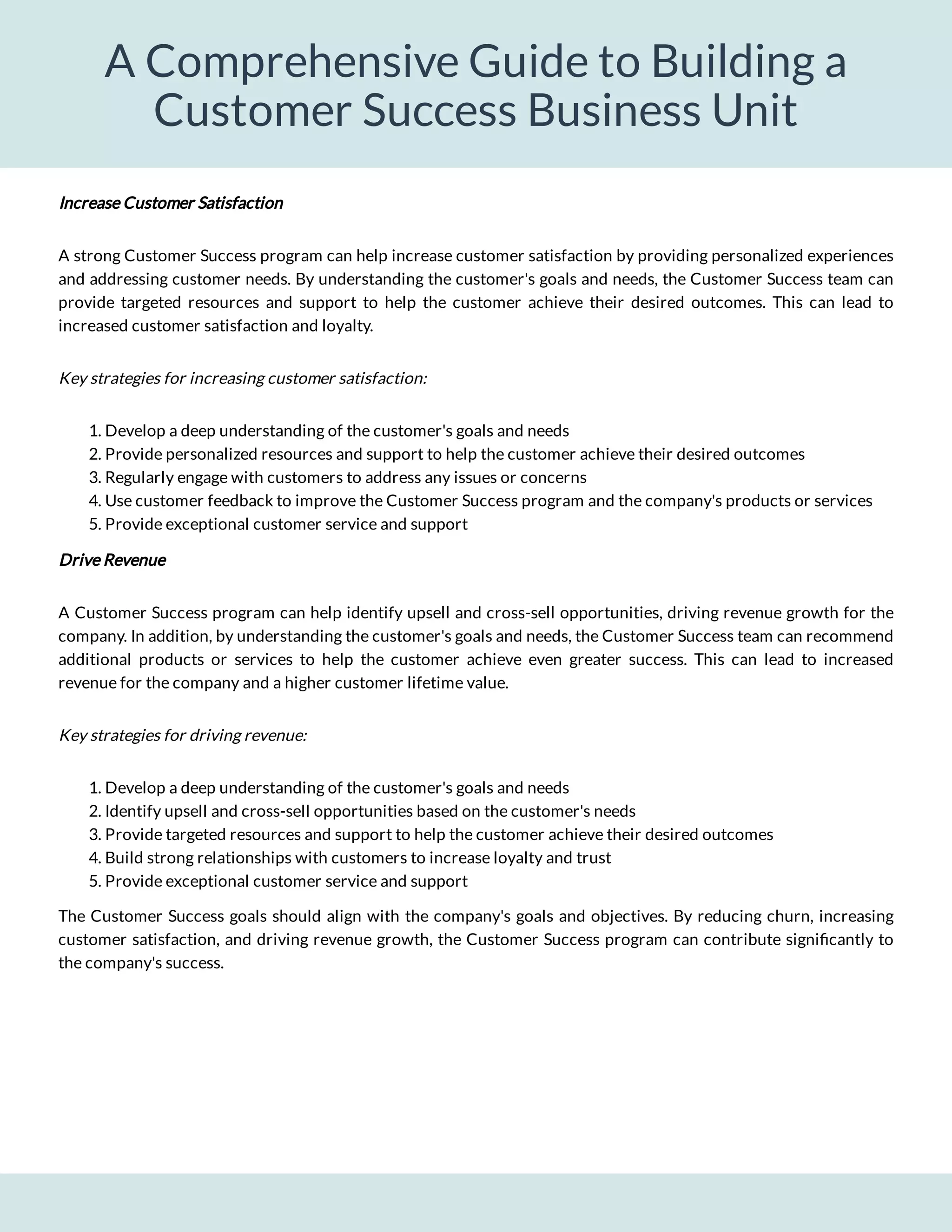
Key strategies for increasing customer satisfaction:
1. Develop a deep understanding of the customer's goals and needs
2. Provide personalized resources and support to help the customer achieve their desired outcomes
3. Regularly engage with customers to address any issues or concerns
4. Use customer feedback to improve the Customer Success program and the company's products or services
5. Provide exceptional customer service and support
Drive Revenue
A Customer Success program can help identify upsell and cross-sell opportunities, driving revenue growth for the
company. In addition, by understanding the customer's goals and needs, the Customer Success team can recommend
additional products or services to help the customer achieve even greater success. This can lead to increased
revenue for the company and a higher customer lifetime value.
Key strategies for driving revenue:
1. Develop a deep understanding of the customer's goals and needs
2. Identify upsell and cross-sell opportunities based on the customer's needs
3. Provide targeted resources and support to help the customer achieve their desired outcomes
4. Build strong relationships with customers to increase loyalty and trust
5. Provide exceptional customer service and support
The Customer Success goals should align with the company's goals and objectives. By reducing churn, increasing
customer satisfaction, and driving revenue growth, the Customer Success program can contribute signi cantly to
the company's success.
A strong Customer Success program can help increase customer satisfaction by providing personalized experiences
and addressing customer needs. By understanding the customer's goals and needs, the Customer Success team can
provide targeted resources and support to help the customer achieve their desired outcomes. This can lead to
increased customer satisfaction and loyalty.
Increase Customer Satisfaction
A Comprehensive Guide to Building a
Customer Success Business Unit
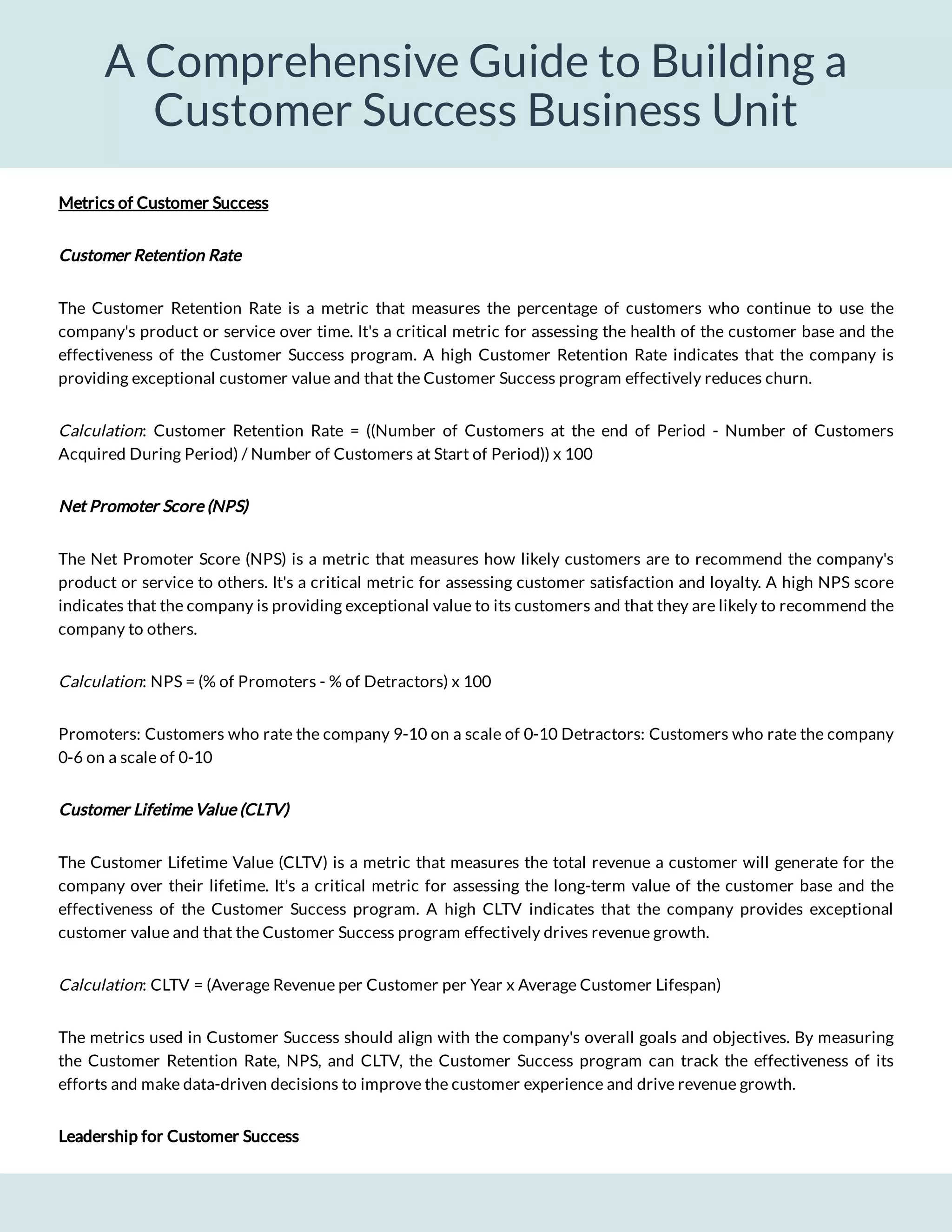
The Customer Retention Rate is a metric that measures the percentage of customers who continue to use the
company's product or service over time. It's a critical metric for assessing the health of the customer base and the
effectiveness of the Customer Success program. A high Customer Retention Rate indicates that the company is
providing exceptional customer value and that the Customer Success program effectively reduces churn.
: Customer Retention Rate = ((Number of Customers at the end of Period - Number of Customers
Acquired During Period) / Number of Customers at Start of Period)) x 100
Calculation
Net Promoter Score (NPS)
The Net Promoter Score (NPS) is a metric that measures how likely customers are to recommend the company's
product or service to others. It's a critical metric for assessing customer satisfaction and loyalty. A high NPS score
indicates that the company is providing exceptional value to its customers and that they are likely to recommend the
company to others.
: NPS = (% of Promoters - % of Detractors) x 100
Calculation
Promoters: Customers who rate the company 9-10 on a scale of 0-10 Detractors: Customers who rate the company
0-6 on a scale of 0-10
Customer Lifetime Value (CLTV)
The Customer Lifetime Value (CLTV) is a metric that measures the total revenue a customer will generate for the
company over their lifetime. It's a critical metric for assessing the long-term value of the customer base and the
effectiveness of the Customer Success program. A high CLTV indicates that the company provides exceptional
customer value and that the Customer Success program effectively drives revenue growth.
: CLTV = (Average Revenue per Customer per Year x Average Customer Lifespan)
Calculation
The metrics used in Customer Success should align with the company's overall goals and objectives. By measuring
the Customer Retention Rate, NPS, and CLTV, the Customer Success program can track the effectiveness of its
efforts and make data-driven decisions to improve the customer experience and drive revenue growth.
Leadership for Customer Success
Customer Retention Rate
Metrics of Customer Success
A Comprehensive Guide to Building a
Customer Success Business Unit
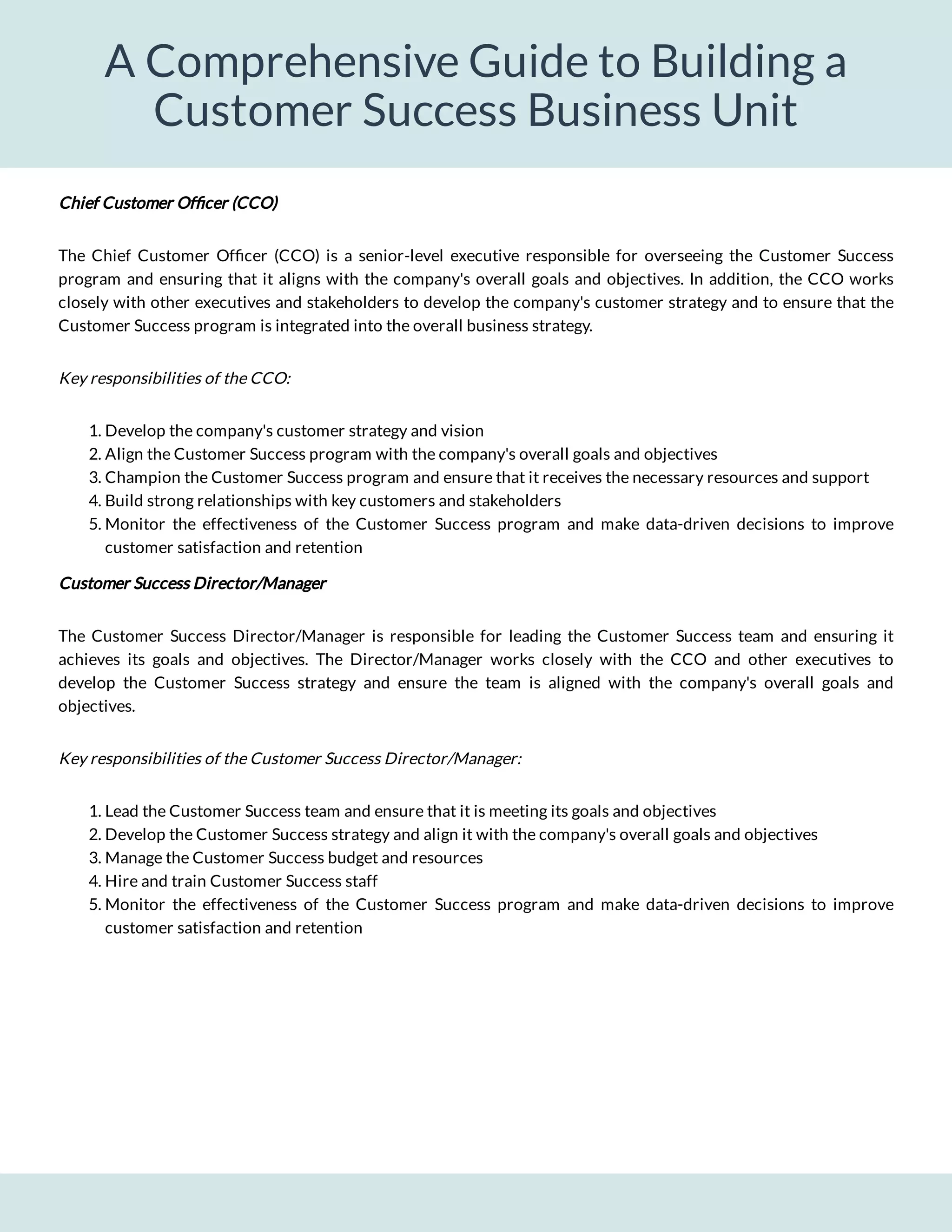
Chief Customer Of cer (CCO)
The Chief Customer Of cer (CCO) is a senior-level executive responsible for overseeing the Customer Success
program and ensuring that it aligns with the company's overall goals and objectives. In addition, the CCO works
closely with other executives and stakeholders to develop the company's customer strategy and to ensure that the
Customer Success program is integrated into the overall business strategy.
Key responsibilities of the CCO:
1. Develop the company's customer strategy and vision
2. Align the Customer Success program with the company's overall goals and objectives
3. Champion the Customer Success program and ensure that it receives the necessary resources and support
4. Build strong relationships with key customers and stakeholders
5. Monitor the effectiveness of the Customer Success program and make data-driven decisions to improve
customer satisfaction and retention
Customer Success Director/Manager
The Customer Success Director/Manager is responsible for leading the Customer Success team and ensuring it
achieves its goals and objectives. The Director/Manager works closely with the CCO and other executives to
develop the Customer Success strategy and ensure the team is aligned with the company's overall goals and
objectives.
Key responsibilities of the Customer Success Director/Manager:
1. Lead the Customer Success team and ensure that it is meeting its goals and objectives
2. Develop the Customer Success strategy and align it with the company's overall goals and objectives
3. Manage the Customer Success budget and resources
4. Hire and train Customer Success staff
5. Monitor the effectiveness of the Customer Success program and make data-driven decisions to improve
customer satisfaction and retention
A Comprehensive Guide to Building a
Customer Success Business Unit
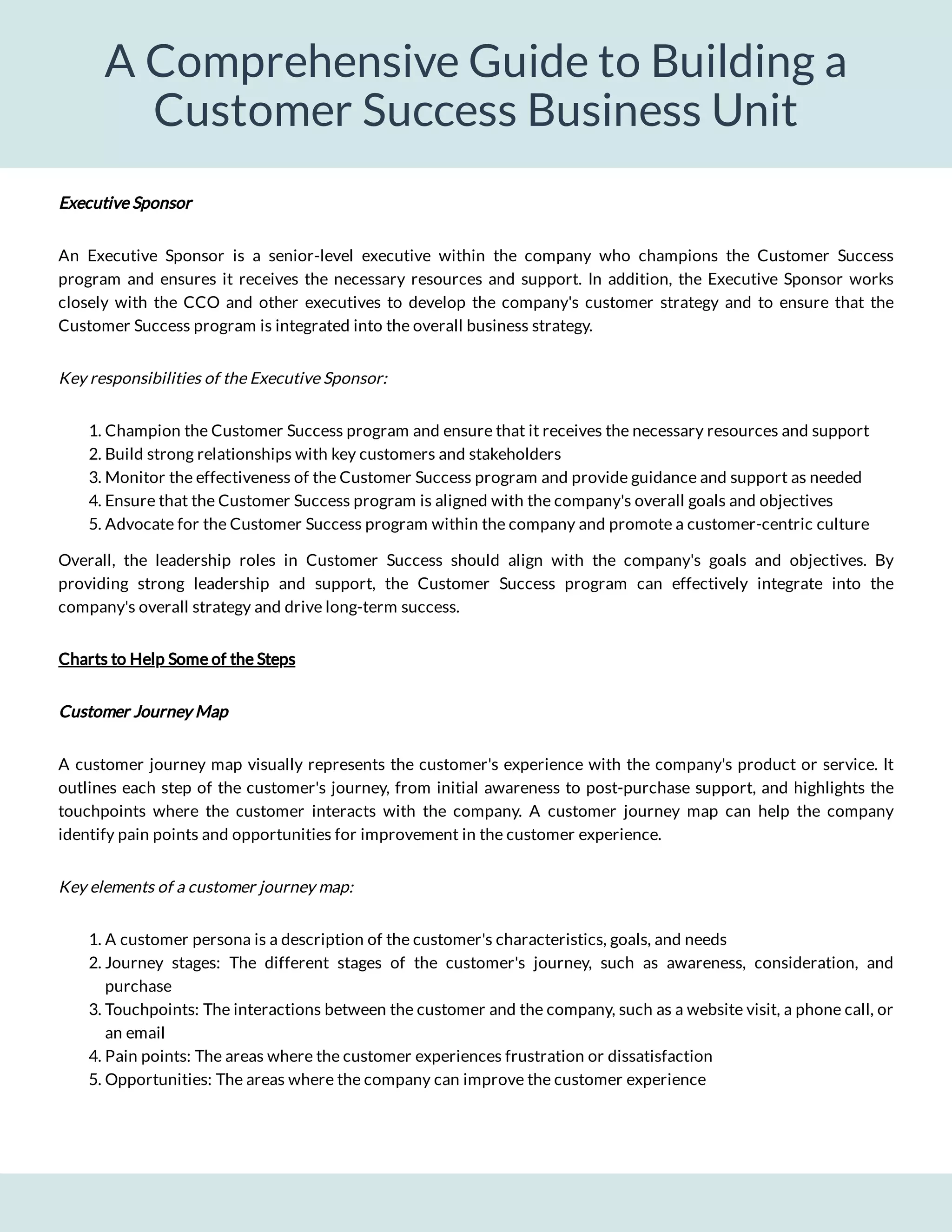
Executive Sponsor
An Executive Sponsor is a senior-level executive within the company who champions the Customer Success
program and ensures it receives the necessary resources and support. In addition, the Executive Sponsor works
closely with the CCO and other executives to develop the company's customer strategy and to ensure that the
Customer Success program is integrated into the overall business strategy.
Key responsibilities of the Executive Sponsor:
1. Champion the Customer Success program and ensure that it receives the necessary resources and support
2. Build strong relationships with key customers and stakeholders
3. Monitor the effectiveness of the Customer Success program and provide guidance and support as needed
4. Ensure that the Customer Success program is aligned with the company's overall goals and objectives
5. Advocate for the Customer Success program within the company and promote a customer-centric culture
Overall, the leadership roles in Customer Success should align with the company's goals and objectives. By
providing strong leadership and support, the Customer Success program can effectively integrate into the
company's overall strategy and drive long-term success.
Charts to Help Some of the Steps
Customer Journey Map
A customer journey map visually represents the customer's experience with the company's product or service. It
outlines each step of the customer's journey, from initial awareness to post-purchase support, and highlights the
touchpoints where the customer interacts with the company. A customer journey map can help the company
identify pain points and opportunities for improvement in the customer experience.
Key elements of a customer journey map:
1. A customer persona is a description of the customer's characteristics, goals, and needs
2. Journey stages: The different stages of the customer's journey, such as awareness, consideration, and
purchase
3. Touchpoints: The interactions between the customer and the company, such as a website visit, a phone call, or
an email
4. Pain points: The areas where the customer experiences frustration or dissatisfaction
5. Opportunities: The areas where the company can improve the customer experience
A Comprehensive Guide to Building a
Customer Success Business Unit
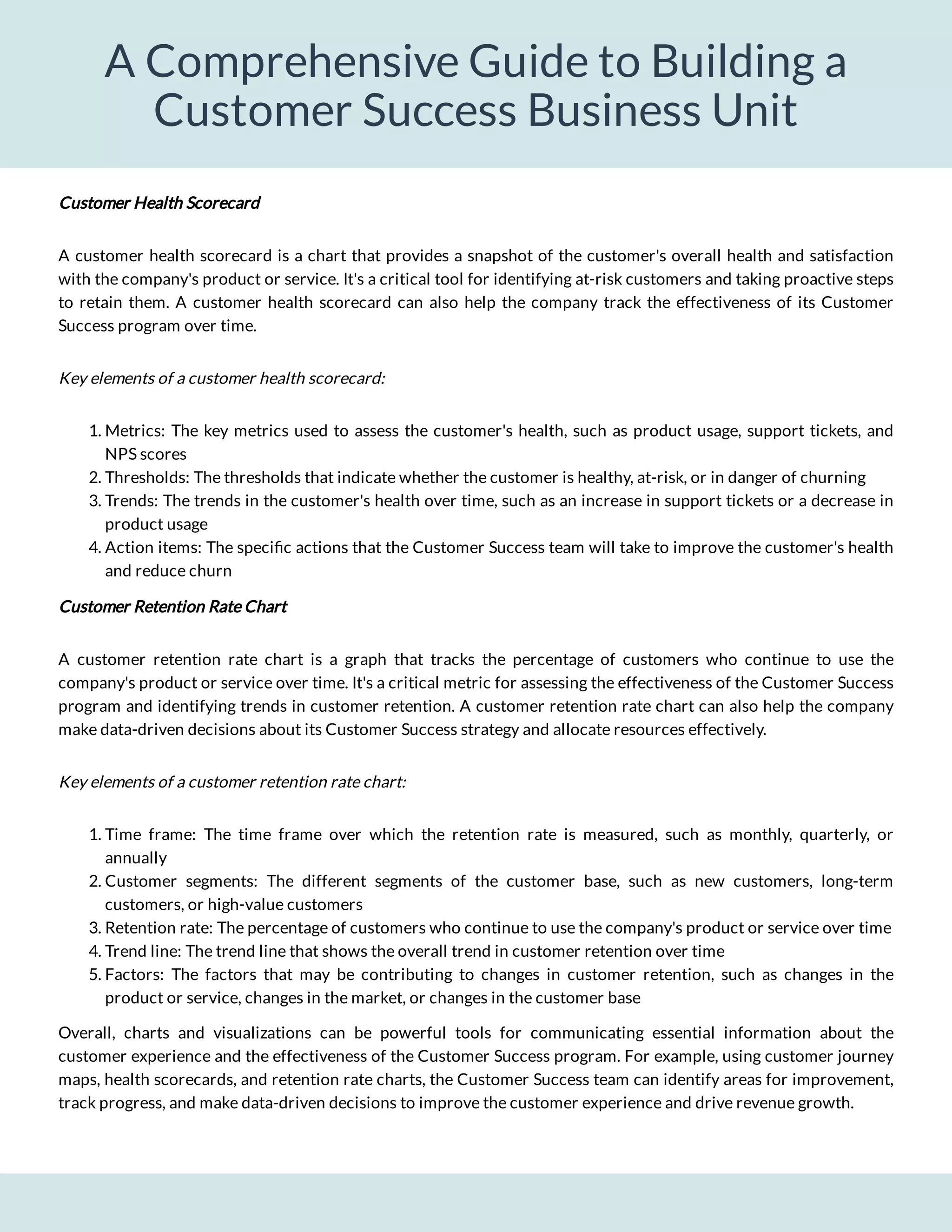
Customer Health Scorecard
A customer health scorecard is a chart that provides a snapshot of the customer's overall health and satisfaction
with the company's product or service. It's a critical tool for identifying at-risk customers and taking proactive steps
to retain them. A customer health scorecard can also help the company track the effectiveness of its Customer
Success program over time.
Key elements of a customer health scorecard:
1. Metrics: The key metrics used to assess the customer's health, such as product usage, support tickets, and
NPS scores
2. Thresholds: The thresholds that indicate whether the customer is healthy, at-risk, or in danger of churning
3. Trends: The trends in the customer's health over time, such as an increase in support tickets or a decrease in
product usage
4. Action items: The speci c actions that the Customer Success team will take to improve the customer's health
and reduce churn
Customer Retention Rate Chart
A customer retention rate chart is a graph that tracks the percentage of customers who continue to use the
company's product or service over time. It's a critical metric for assessing the effectiveness of the Customer Success
program and identifying trends in customer retention. A customer retention rate chart can also help the company
make data-driven decisions about its Customer Success strategy and allocate resources effectively.
Key elements of a customer retention rate chart:
1. Time frame: The time frame over which the retention rate is measured, such as monthly, quarterly, or
annually
2. Customer segments: The different segments of the customer base, such as new customers, long-term
customers, or high-value customers
3. Retention rate: The percentage of customers who continue to use the company's product or service over time
4. Trend line: The trend line that shows the overall trend in customer retention over time
5. Factors: The factors that may be contributing to changes in customer retention, such as changes in the
product or service, changes in the market, or changes in the customer base
Overall, charts and visualizations can be powerful tools for communicating essential information about the
customer experience and the effectiveness of the Customer Success program. For example, using customer journey
maps, health scorecards, and retention rate charts, the Customer Success team can identify areas for improvement,
track progress, and make data-driven decisions to improve the customer experience and drive revenue growth.
A Comprehensive Guide to Building a
Customer Success Business Unit
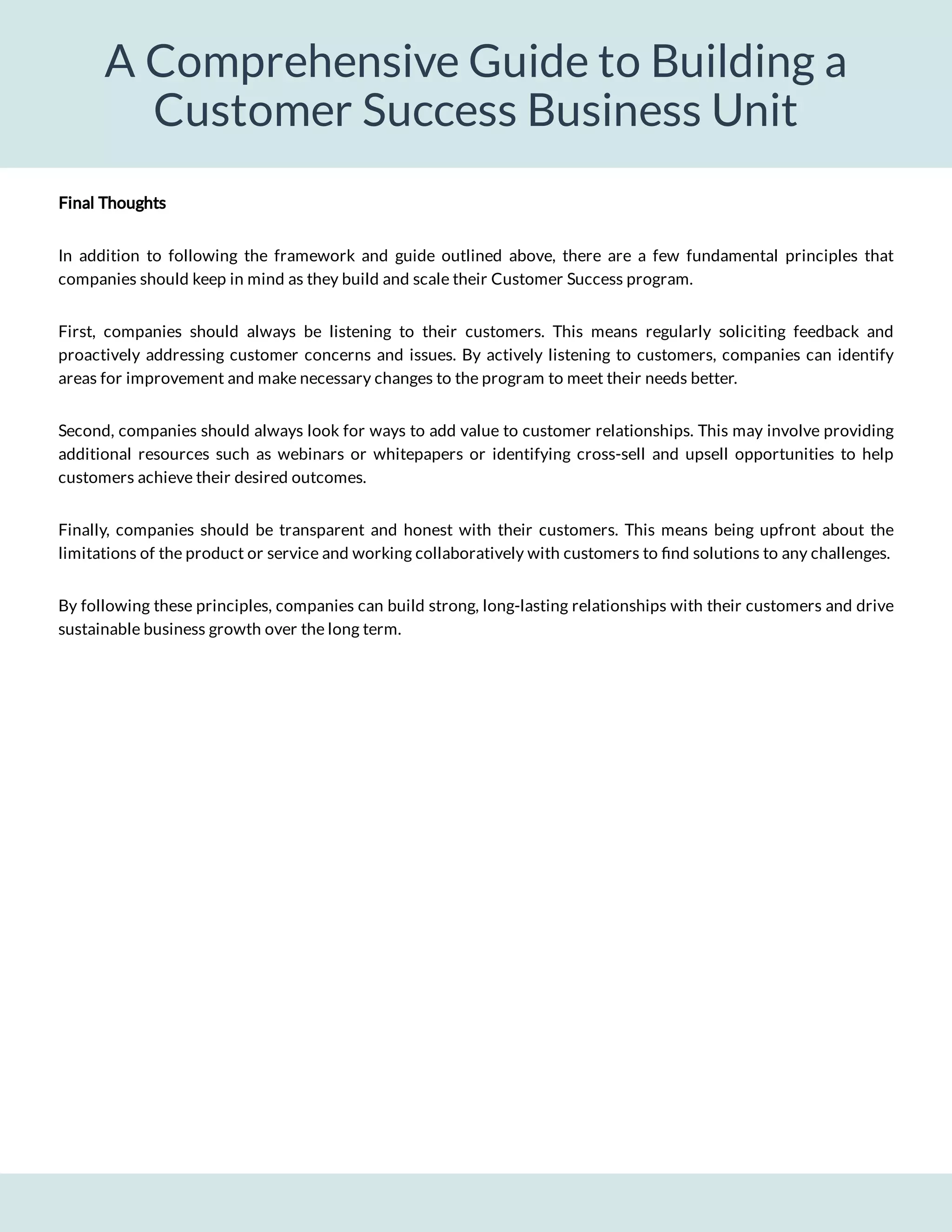
Final Thoughts
In addition to following the framework and guide outlined above, there are a few fundamental principles that
companies should keep in mind as they build and scale their Customer Success program.
First, companies should always be listening to their customers. This means regularly soliciting feedback and
proactively addressing customer concerns and issues. By actively listening to customers, companies can identify
areas for improvement and make necessary changes to the program to meet their needs better.
Second, companies should always look for ways to add value to customer relationships. This may involve providing
additional resources such as webinars or whitepapers or identifying cross-sell and upsell opportunities to help
customers achieve their desired outcomes.
Finally, companies should be transparent and honest with their customers. This means being upfront about the
limitations of the product or service and working collaboratively with customers to nd solutions to any challenges.
By following these principles, companies can build strong, long-lasting relationships with their customers and drive
sustainable business growth over the long term.

A Comprehensive Guide to Building a Customer Success Business Unit: From Talent to Tools and Metrics

  • 1.
    A Comprehensive Guideto Building a Customer Success Business Unit Richard Lawson
  • 2.
    A Comprehensive Guideto Building a Customer Success Business Unit A Comprehensive Guide to Building a Customer Success Business Unit: From Talent to Tools and Metrics A Customer Success program aims to provide exceptional customer support and service throughout their entire journey with a company, from the initial onboarding process to ongoing usage and engagement. By helping customers achieve their desired outcomes, companies can increase customer satisfaction, retention, and loyalty, driving revenue growth and improving brand reputation. Customer Success is signi cant in today's business landscape, where customers have more choices than ever and can easily switch to a competitor if they are unsatis ed with their experience. By focusing on the success of their customers, companies can differentiate themselves from competitors and build a loyal customer base that provides long-term value. However, building a successful Customer Success program requires a strategic approach with clear goals, processes, and metrics. This guide will provide a step-by-step framework for starting a Customer Success business unit and tips and best practices for delivering a successful program and scaling it as the company grows. By following these guidelines, companies can build a strong Customer Success program that drives business growth and helps customers achieve their desired outcomes. Why Companies Could Bene t from a Customer Success Business Unit Increase Customer Retention A Customer Success Business Unit can help increase customer retention by ensuring customers achieve their desired outcomes and addressing any issues or concerns. In addition, by regularly engaging with customers and providing them with ongoing support, the Customer Success team can build strong relationships with customers and increase their loyalty to the company. Additionally, by identifying at-risk customers early on, the Customer Success team can take proactive steps to retain those customers before they churn. This can include providing additional resources or support to help the customer achieve their desired outcomes or addressing any issues or concerns they may have. Drive Revenue A Customer Success Business Unit can help drive revenue growth by identifying upsell and cross-sell opportunities. By understanding the customer's goals and needs, the Customer Success team can recommend additional products or services to help the customer achieve even greater success. This can lead to increased revenue for the company and a higher customer lifetime value.
  • 3.
    A Comprehensive Guideto Building a Customer Success Business Unit Additionally, by providing exceptional customer service and support, the Customer Success team can create brand advocates more likely to recommend the company's product or service to others. This can lead to new customer acquisition and further revenue growth. Improve Product Development A Customer Success Business Unit can provide valuable feedback to the product development team. By collecting customer feedback on their experiences with the product or service, the Customer Success team can identify areas for improvement and make recommendations to the product development team. This can lead to a better product or service that meets customers' needs more effectively, leading to increased customer satisfaction and loyalty. Enhance Brand Reputation A robust Customer Success program can help build a positive reputation for the company and increase brand loyalty. By providing exceptional customer service and support, the Customer Success team can create a positive customer experience that customers will associate with the brand. This can increase customer loyalty and advocacy, enhancing the company's brand reputation. Additionally, by regularly engaging with customers and addressing any issues or concerns, the Customer Success team can demonstrate that the company cares about its customers and is committed to their success. This can create a positive company perception and increase customer brand loyalty. What Kind of Talent You Need Customer Success Manager (CSM) The CSM manages the overall relationship between the company and its customers. They work closely with customers to understand their goals and desired outcomes and then develop a Customer Success plan to help them achieve them. Therefore, the CSM should have strong communication and project management skills and a deep understanding of the company's product or service.
  • 4.
    A Comprehensive Guideto Building a Customer Success Business Unit 1. Develop and maintain strong relationships with customers 2. Understand the customer's goals and desired outcomes 3. Develop and implement a Customer Success plan 4. Monitor the customer's progress toward their desired outcomes 5. Identify and address any issues or concerns the customer may have 6. Provide regular updates to the customer and internal stakeholders 7. Identify upsell and cross-sell opportunities Technical Account Manager (TAM) The TAM ensures customers can use the company's product or service effectively. They should have a solid technical background and be able to troubleshoot technical issues. The TAM works closely with the CSM to ensure the customer achieves their desired outcomes. Key Responsibilities: 1. Provide technical support to customers 2. Troubleshoot technical issues 3. Ensure that the customer is using the product or service effectively 4. Provide training and education to customers 5. Identify opportunities for product or service improvement 6. Work with the product development team to address technical issues Customer Support Specialist The Support Specialist is responsible for handling customer inquiries and providing support. They should have strong communication skills and be able to solve problems quickly. The Support Specialist is often the rst point of contact for customers who need assistance. Key Responsibilities:
  • 5.
    A Comprehensive Guideto Building a Customer Success Business Unit 1. Provide timely and practical support to customers 2. Handle customer inquiries and complaints 3. Solve problems quickly and ef ciently 4. Escalate issues to the appropriate team members when necessary 5. Provide feedback to the Customer Success team on common customer issues 6. Maintain accurate records of customer interactions and support requests The Customer Success team should be customer-centric and focused on helping customers achieve their desired outcomes. Each team member should have a deep understanding of the company's product or service and be able to work collaboratively with other team members to provide exceptional customer service and support. Documents That Can Be Used in Customer Success Customer Success Plan The Customer Success Plan is a document that outlines the customer's goals and desired outcomes, as well as the steps the company will take to help the customer achieve those outcomes. It's a collaborative document that the Customer Success Manager and the customer develop. The plan should be speci c to customers' needs and include measurable goals and objectives. Key Components of a Customer Success Plan: 1. Customer goals and desired outcomes 2. Key stakeholders and decision-makers 3. Success criteria and metrics 4. Roles and responsibilities of both the company and the customer 5. Action plan with timelines and milestones The Customer Success Plan should be regularly reviewed and updated to remain relevant and aligned with the customer's goals. Key Responsibilities:
  • 6.
    A Comprehensive Guideto Building a Customer Success Business Unit The Onboarding Checklist is a document that outlines the steps the customer needs to take to get started with the company's product or service. It's a critical document that sets the tone for the customer's experience with the company. The checklist should be speci c to the customer's needs and provide clear instructions and guidance. Key components of an Onboarding Checklist: 1. Introduction and welcome message 2. Key contacts and support resources 3. Instructions for setting up the product or service 4. Training and education resources 5. Action plan with timelines and milestones The Onboarding Checklist should be regularly reviewed and updated to remain relevant and practical. Customer Health Scorecard The Customer Health Scorecard is a document that provides a snapshot of the customer's overall health and satisfaction with the company's product or service. It's a critical tool that the Customer Success Manager uses to monitor the customer's progress and identify areas for improvement. The scorecard should be speci c to the customer's needs and provide a clear, concise overview of the customer's health. Key components of a Customer Health Scorecard: 1. Key performance indicators (KPIs) that measure the customer's success 2. Metrics that measure customer engagement and satisfaction 3. Risks and issues that could impact the customer's success 4. Action plan for addressing any problems or concerns The Customer Health Scorecard should be regularly reviewed and updated to remain relevant and aligned with the customer's goals. Onboarding Checklist
  • 7.
    A Comprehensive Guideto Building a Customer Success Business Unit A CRM system can help track customer interactions and provide insights into the customer's behavior and needs. It's a critical tool for managing the customer relationship and ensuring that the Customer Success team has a complete view of the customer's history and needs. A CRM system can also help identify upsell and cross-sell opportunities and track the effectiveness of the Customer Success program. Key features of a CRM system: 1. Contact management 2. Activity tracking 3. Sales forecasting 4. Marketing automation 5. Analytics and reporting Customer Engagement Platform A customer engagement platform can help the company communicate with customers and provide personalized experiences. It's a critical tool for building solid customer relationships and ensuring they feel valued and supported. A customer engagement platform can also help the company provide targeted messaging and resources to customers based on their needs and behavior. Key features of a customer engagement platform: 1. Communication tools (e.g., email, chat, SMS) 2. Personalization features 3. Analytics and reporting 4. Marketing automation 5. Customer segmentation Customer Feedback Tool A customer feedback tool can help collect customer feedback and provide insights into their satisfaction levels. It's a critical tool for understanding the customer's needs and identifying areas for improvement. A customer feedback tool can also help the company measure the effectiveness of the Customer Success program and track customer sentiment over time. Customer Relationship Management (CRM) System Tools for Customer Success
  • 8.
    A Comprehensive Guideto Building a Customer Success Business Unit 1. Survey creation and distribution 2. Net Promoter Score (NPS) tracking 3. Feedback analysis and reporting 4. Customer sentiment analysis 5. Integration with CRM and other systems Overall, the tools used in Customer Success should be chosen based on the company's and its customers' speci c needs. A successful Customer Success program requires multiple tools and systems that work together to provide a complete view of the customer and support their success. Goals of Customer Success Reduce Churn: The primary goal of Customer Success is to reduce churn by ensuring that customers are achieving their desired outcomes. A successful Customer Success program can help identify at-risk customers and take proactive steps to retain those customers before they churn. In addition, by providing exceptional customer service and support, the Customer Success team can build strong relationships with customers and increase their loyalty to the company. Key strategies for reducing churn: 1. Regularly engage with customers to understand their needs and concerns 2. Develop personalized customer success plans to help customers achieve their desired outcomes 3. Provide exceptional customer service and support 4. Identify and address any issues or concerns the customer may have 5. Monitor the customer's progress toward their desired outcomes and provide ongoing support and guidance Key features of a customer feedback tool:
  • 9.
    A Comprehensive Guideto Building a Customer Success Business Unit Key strategies for increasing customer satisfaction: 1. Develop a deep understanding of the customer's goals and needs 2. Provide personalized resources and support to help the customer achieve their desired outcomes 3. Regularly engage with customers to address any issues or concerns 4. Use customer feedback to improve the Customer Success program and the company's products or services 5. Provide exceptional customer service and support Drive Revenue A Customer Success program can help identify upsell and cross-sell opportunities, driving revenue growth for the company. In addition, by understanding the customer's goals and needs, the Customer Success team can recommend additional products or services to help the customer achieve even greater success. This can lead to increased revenue for the company and a higher customer lifetime value. Key strategies for driving revenue: 1. Develop a deep understanding of the customer's goals and needs 2. Identify upsell and cross-sell opportunities based on the customer's needs 3. Provide targeted resources and support to help the customer achieve their desired outcomes 4. Build strong relationships with customers to increase loyalty and trust 5. Provide exceptional customer service and support The Customer Success goals should align with the company's goals and objectives. By reducing churn, increasing customer satisfaction, and driving revenue growth, the Customer Success program can contribute signi cantly to the company's success. A strong Customer Success program can help increase customer satisfaction by providing personalized experiences and addressing customer needs. By understanding the customer's goals and needs, the Customer Success team can provide targeted resources and support to help the customer achieve their desired outcomes. This can lead to increased customer satisfaction and loyalty. Increase Customer Satisfaction
  • 10.
    A Comprehensive Guideto Building a Customer Success Business Unit The Customer Retention Rate is a metric that measures the percentage of customers who continue to use the company's product or service over time. It's a critical metric for assessing the health of the customer base and the effectiveness of the Customer Success program. A high Customer Retention Rate indicates that the company is providing exceptional customer value and that the Customer Success program effectively reduces churn. : Customer Retention Rate = ((Number of Customers at the end of Period - Number of Customers Acquired During Period) / Number of Customers at Start of Period)) x 100 Calculation Net Promoter Score (NPS) The Net Promoter Score (NPS) is a metric that measures how likely customers are to recommend the company's product or service to others. It's a critical metric for assessing customer satisfaction and loyalty. A high NPS score indicates that the company is providing exceptional value to its customers and that they are likely to recommend the company to others. : NPS = (% of Promoters - % of Detractors) x 100 Calculation Promoters: Customers who rate the company 9-10 on a scale of 0-10 Detractors: Customers who rate the company 0-6 on a scale of 0-10 Customer Lifetime Value (CLTV) The Customer Lifetime Value (CLTV) is a metric that measures the total revenue a customer will generate for the company over their lifetime. It's a critical metric for assessing the long-term value of the customer base and the effectiveness of the Customer Success program. A high CLTV indicates that the company provides exceptional customer value and that the Customer Success program effectively drives revenue growth. : CLTV = (Average Revenue per Customer per Year x Average Customer Lifespan) Calculation The metrics used in Customer Success should align with the company's overall goals and objectives. By measuring the Customer Retention Rate, NPS, and CLTV, the Customer Success program can track the effectiveness of its efforts and make data-driven decisions to improve the customer experience and drive revenue growth. Leadership for Customer Success Customer Retention Rate Metrics of Customer Success
  • 11.
    A Comprehensive Guideto Building a Customer Success Business Unit Chief Customer Of cer (CCO) The Chief Customer Of cer (CCO) is a senior-level executive responsible for overseeing the Customer Success program and ensuring that it aligns with the company's overall goals and objectives. In addition, the CCO works closely with other executives and stakeholders to develop the company's customer strategy and to ensure that the Customer Success program is integrated into the overall business strategy. Key responsibilities of the CCO: 1. Develop the company's customer strategy and vision 2. Align the Customer Success program with the company's overall goals and objectives 3. Champion the Customer Success program and ensure that it receives the necessary resources and support 4. Build strong relationships with key customers and stakeholders 5. Monitor the effectiveness of the Customer Success program and make data-driven decisions to improve customer satisfaction and retention Customer Success Director/Manager The Customer Success Director/Manager is responsible for leading the Customer Success team and ensuring it achieves its goals and objectives. The Director/Manager works closely with the CCO and other executives to develop the Customer Success strategy and ensure the team is aligned with the company's overall goals and objectives. Key responsibilities of the Customer Success Director/Manager: 1. Lead the Customer Success team and ensure that it is meeting its goals and objectives 2. Develop the Customer Success strategy and align it with the company's overall goals and objectives 3. Manage the Customer Success budget and resources 4. Hire and train Customer Success staff 5. Monitor the effectiveness of the Customer Success program and make data-driven decisions to improve customer satisfaction and retention
  • 12.
    A Comprehensive Guideto Building a Customer Success Business Unit Executive Sponsor An Executive Sponsor is a senior-level executive within the company who champions the Customer Success program and ensures it receives the necessary resources and support. In addition, the Executive Sponsor works closely with the CCO and other executives to develop the company's customer strategy and to ensure that the Customer Success program is integrated into the overall business strategy. Key responsibilities of the Executive Sponsor: 1. Champion the Customer Success program and ensure that it receives the necessary resources and support 2. Build strong relationships with key customers and stakeholders 3. Monitor the effectiveness of the Customer Success program and provide guidance and support as needed 4. Ensure that the Customer Success program is aligned with the company's overall goals and objectives 5. Advocate for the Customer Success program within the company and promote a customer-centric culture Overall, the leadership roles in Customer Success should align with the company's goals and objectives. By providing strong leadership and support, the Customer Success program can effectively integrate into the company's overall strategy and drive long-term success. Charts to Help Some of the Steps Customer Journey Map A customer journey map visually represents the customer's experience with the company's product or service. It outlines each step of the customer's journey, from initial awareness to post-purchase support, and highlights the touchpoints where the customer interacts with the company. A customer journey map can help the company identify pain points and opportunities for improvement in the customer experience. Key elements of a customer journey map: 1. A customer persona is a description of the customer's characteristics, goals, and needs 2. Journey stages: The different stages of the customer's journey, such as awareness, consideration, and purchase 3. Touchpoints: The interactions between the customer and the company, such as a website visit, a phone call, or an email 4. Pain points: The areas where the customer experiences frustration or dissatisfaction 5. Opportunities: The areas where the company can improve the customer experience
  • 13.
    A Comprehensive Guideto Building a Customer Success Business Unit Customer Health Scorecard A customer health scorecard is a chart that provides a snapshot of the customer's overall health and satisfaction with the company's product or service. It's a critical tool for identifying at-risk customers and taking proactive steps to retain them. A customer health scorecard can also help the company track the effectiveness of its Customer Success program over time. Key elements of a customer health scorecard: 1. Metrics: The key metrics used to assess the customer's health, such as product usage, support tickets, and NPS scores 2. Thresholds: The thresholds that indicate whether the customer is healthy, at-risk, or in danger of churning 3. Trends: The trends in the customer's health over time, such as an increase in support tickets or a decrease in product usage 4. Action items: The speci c actions that the Customer Success team will take to improve the customer's health and reduce churn Customer Retention Rate Chart A customer retention rate chart is a graph that tracks the percentage of customers who continue to use the company's product or service over time. It's a critical metric for assessing the effectiveness of the Customer Success program and identifying trends in customer retention. A customer retention rate chart can also help the company make data-driven decisions about its Customer Success strategy and allocate resources effectively. Key elements of a customer retention rate chart: 1. Time frame: The time frame over which the retention rate is measured, such as monthly, quarterly, or annually 2. Customer segments: The different segments of the customer base, such as new customers, long-term customers, or high-value customers 3. Retention rate: The percentage of customers who continue to use the company's product or service over time 4. Trend line: The trend line that shows the overall trend in customer retention over time 5. Factors: The factors that may be contributing to changes in customer retention, such as changes in the product or service, changes in the market, or changes in the customer base Overall, charts and visualizations can be powerful tools for communicating essential information about the customer experience and the effectiveness of the Customer Success program. For example, using customer journey maps, health scorecards, and retention rate charts, the Customer Success team can identify areas for improvement, track progress, and make data-driven decisions to improve the customer experience and drive revenue growth.
  • 14.
    A Comprehensive Guideto Building a Customer Success Business Unit Final Thoughts In addition to following the framework and guide outlined above, there are a few fundamental principles that companies should keep in mind as they build and scale their Customer Success program. First, companies should always be listening to their customers. This means regularly soliciting feedback and proactively addressing customer concerns and issues. By actively listening to customers, companies can identify areas for improvement and make necessary changes to the program to meet their needs better. Second, companies should always look for ways to add value to customer relationships. This may involve providing additional resources such as webinars or whitepapers or identifying cross-sell and upsell opportunities to help customers achieve their desired outcomes. Finally, companies should be transparent and honest with their customers. This means being upfront about the limitations of the product or service and working collaboratively with customers to nd solutions to any challenges. By following these principles, companies can build strong, long-lasting relationships with their customers and drive sustainable business growth over the long term.