Introducing Health-
Climate-Economics
Optimising for the demand chain
Climate change is intrinsically linked to public
health, food and water security, migration, peace,
and security. It is a moral issue. It is an issue of
social justice, human rights and fundamental ethics.
We have a profound responsibility to the fragile web
of life on this Earth, and to this generation and
those that will follow.”
– former United Nations Secretary-General Ban Ki-moon
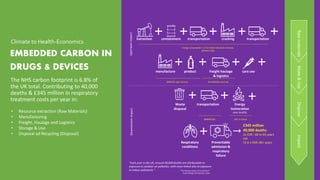
The NHS carbon footprint is 6.8% of
the UK total. Contributing to 40,000
deaths & £345 million in respiratory
treatment costs per year in:
EMBEDDED CARBON IN
DRUGS & DEVICES
• Resource extraction (Raw Materials)
• Manufacturing
• Freight, Haulage and Logistics
• Storage & Use
• Disposal ad Recycling (Disposal)
Extraction containment transportation cracking transportation
manufacture product freight haulage
& logistics
care use
Waste
disposal
transportation Energy
incineration
(else landfill)
Respiratory
conditions
Preventable
admission &
respiratory
failure
Raw
materials
Make
&
Use
Dispose
Impact
“The lifelong impact of air pollution”
Royal College of Physicians, 2016
“Each year in the UK, around 40,000 deaths are attributable to
exposure to outdoor air pollution, with more linked also to exposure
to indoor pollutants.”
Climate to Health-Economics
Energy consumption 1.27 Gt CO2e industrial emissions
(plastics only)
2MtCO2e (per factory) 20.1MtCO2e (annual)
800MtCO2e 365.75 tCO2e
£345 million
40,000 deaths
2x EDR : 60 to 69 years
old
11.6 x EDR: 80+ years
Downstream
Impact
Upstream
Impact
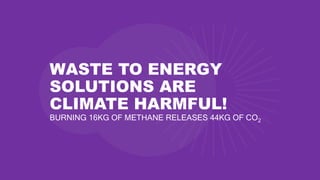
WASTE TO ENERGY
SOLUTIONS ARE
CLIMATE HARMFUL!
BURNING 16KG OF METHANE RELEASES 44KG OF CO2
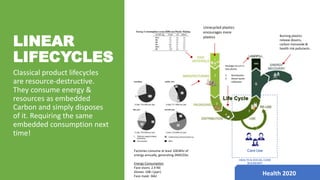
Classical product lifecycles
are resource-destructive.
They consume energy &
resources as embedded
Carbon and simply disposes
of it. Requiring the same
embedded consumption next
time!
LINEAR
LIFECYCLES
Burning plastics
release dioxins,
carbon monoxide &
health risk pollutants.
Unrecycled plastics
encourages more
plastics
Factories consume at least 10GWhr of
energy annually, generating 2MtCO2e.
Energy Consumption
Face visors: 2.4 MJ
Gloves: 108 J (pair)
Face mask: 36kJ
Haulage occurs in
two places.
1. Distribution
2. Diesel waste
collection
Care Use
HEALTH & SOCIAL CARE
BOUNDARY
Health 2020
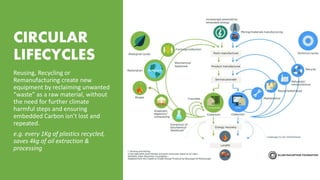
Reusing, Recycling or
Remanufacturing create new
equipment by reclaiming unwanted
“waste” as a raw material, without
the need for further climate
harmful steps and ensuring
embedded Carbon isn’t lost and
repeated.
e.g. every 1Kg of plastics recycled,
saves 4kg of oil extraction &
processing
CIRCULAR
LIFECYCLES
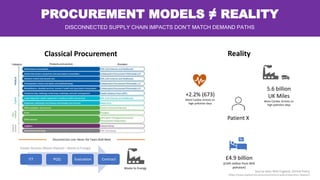
Source data: NHS England, Clinical Policy
(https://www.england.nhs.uk/ourwork/clinical-policy/respiratory-disease/)
PROCUREMENT MODELS ≠ REALITY
DISCONNECTED SUPPLY CHAIN IMPACTS DON’T MATCH DEMAND PATHS
Patient X
£4.9 billion
(£345 million from NHS
pollution)
+2.2% (673)
More Cardiac Arrests on
high pollution days
5.6 billion
UK Miles
More Cardiac Arrests on
high pollution days
Reality
ITT PQQ Evaluation Contract
Classical Procurement
Estates Services (Waste Disposal – Waste to Energy)
Disconnection Line: Never the Twain Shall Meet
Waste to Energy
WHY HEALTH-CLIMATE-
ECONOMICS?
HEALTH-
ECONOMICS: A
STAPLE FRIEND
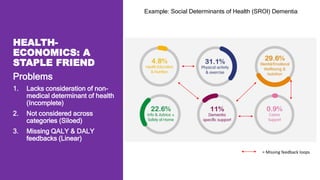
Problems
1. Lacks consideration of non-
medical determinant of health
(Incomplete)
2. Not considered across
categories (Siloed)
3. Missing QALY & DALY
feedbacks (Linear)
Example: Social Determinants of Health (SROI) Dementia
= Missing feedback loops
HEALTH-CLIMATE-
ECONOMICS IS
HOLISTIC
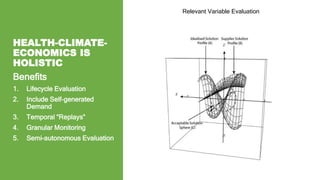
Benefits
1. Lifecycle Evaluation
2. Include Self-generated
Demand
3. Temporal “Replays”
4. Granular Monitoring
5. Semi-autonomous Evaluation
Relevant Variable Evaluation
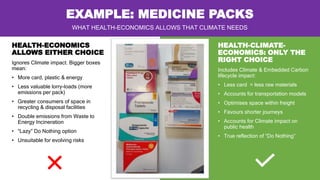
EXAMPLE: MEDICINE PACKS
WHAT HEALTH-ECONOMICS ALLOWS THAT CLIMATE NEEDS
HEALTH-ECONOMICS
ALLOWS EITHER CHOICE
Ignores Climate impact. Bigger boxes
mean:
• More card, plastic & energy
• Less valuable lorry-loads (more
emissions per pack)
• Greater consumers of space in
recycling & disposal facilities
• Double emissions from Waste to
Energy Incineration
• “Lazy” Do Nothing option
• Unsuitable for evolving risks
HEALTH-CLIMATE-
ECONOMICS: ONLY THE
RIGHT CHOICE
Includes Climate & Embedded Carbon
lifecycle impact:
• Less card = less raw materials
• Accounts for transportation models
• Optimises space within freight
• Favours shorter journeys
• Accounts for Climate impact on
public health
• True reflection of “Do Nothing”
ACCESSIBLE TO CROSS-CUTTING INNOVATION
3D Volumetric
Optimisation
Renewable Power
Design
Decentralised Desktop
Manufacturing
Distributed Fleet
Intelligence
Novel Polymers & Effective
PP Mask Recycling
Risk Appropriated
Material Aging
Every manufacturing & supply reimagined for healthcare supplies from the ground up.
Systemically optimised for effectiveness, risk, health and climate
Cloud & Co-located
Monitoring & Management
Globally effective Health-
Climate-Economic models
Circular & Donut Micro-
economics
 www.automedi.co.uk @automedi
Accreditations & Associations
Ethar Alali @automedi
Owner, Founder, EA & Inventor
Polymath-MathMo. TOGAF 9
Certified, change agent.
Any Questions?
Contact hello@automedi.co.uk
Business Advisors
Academic Health
Sciences Networks
Subject Matter
Experts
Technology
Consultants

Why Health-Climate-Economics

  • 1.
  • 2.
    Climate change isintrinsically linked to public health, food and water security, migration, peace, and security. It is a moral issue. It is an issue of social justice, human rights and fundamental ethics. We have a profound responsibility to the fragile web of life on this Earth, and to this generation and those that will follow.” – former United Nations Secretary-General Ban Ki-moon
  • 3.
    The NHS carbonfootprint is 6.8% of the UK total. Contributing to 40,000 deaths & £345 million in respiratory treatment costs per year in: EMBEDDED CARBON IN DRUGS & DEVICES • Resource extraction (Raw Materials) • Manufacturing • Freight, Haulage and Logistics • Storage & Use • Disposal ad Recycling (Disposal) Extraction containment transportation cracking transportation manufacture product freight haulage & logistics care use Waste disposal transportation Energy incineration (else landfill) Respiratory conditions Preventable admission & respiratory failure Raw materials Make & Use Dispose Impact “The lifelong impact of air pollution” Royal College of Physicians, 2016 “Each year in the UK, around 40,000 deaths are attributable to exposure to outdoor air pollution, with more linked also to exposure to indoor pollutants.” Climate to Health-Economics Energy consumption 1.27 Gt CO2e industrial emissions (plastics only) 2MtCO2e (per factory) 20.1MtCO2e (annual) 800MtCO2e 365.75 tCO2e £345 million 40,000 deaths 2x EDR : 60 to 69 years old 11.6 x EDR: 80+ years Downstream Impact Upstream Impact
  • 4.
    WASTE TO ENERGY SOLUTIONSARE CLIMATE HARMFUL! BURNING 16KG OF METHANE RELEASES 44KG OF CO2
  • 5.
    Classical product lifecycles areresource-destructive. They consume energy & resources as embedded Carbon and simply disposes of it. Requiring the same embedded consumption next time! LINEAR LIFECYCLES Burning plastics release dioxins, carbon monoxide & health risk pollutants. Unrecycled plastics encourages more plastics Factories consume at least 10GWhr of energy annually, generating 2MtCO2e. Energy Consumption Face visors: 2.4 MJ Gloves: 108 J (pair) Face mask: 36kJ Haulage occurs in two places. 1. Distribution 2. Diesel waste collection Care Use HEALTH & SOCIAL CARE BOUNDARY Health 2020
  • 6.
    Reusing, Recycling or Remanufacturingcreate new equipment by reclaiming unwanted “waste” as a raw material, without the need for further climate harmful steps and ensuring embedded Carbon isn’t lost and repeated. e.g. every 1Kg of plastics recycled, saves 4kg of oil extraction & processing CIRCULAR LIFECYCLES
  • 7.
    Source data: NHSEngland, Clinical Policy (https://www.england.nhs.uk/ourwork/clinical-policy/respiratory-disease/) PROCUREMENT MODELS ≠ REALITY DISCONNECTED SUPPLY CHAIN IMPACTS DON’T MATCH DEMAND PATHS Patient X £4.9 billion (£345 million from NHS pollution) +2.2% (673) More Cardiac Arrests on high pollution days 5.6 billion UK Miles More Cardiac Arrests on high pollution days Reality ITT PQQ Evaluation Contract Classical Procurement Estates Services (Waste Disposal – Waste to Energy) Disconnection Line: Never the Twain Shall Meet Waste to Energy
  • 8.
  • 9.
    HEALTH- ECONOMICS: A STAPLE FRIEND Problems 1.Lacks consideration of non- medical determinant of health (Incomplete) 2. Not considered across categories (Siloed) 3. Missing QALY & DALY feedbacks (Linear) Example: Social Determinants of Health (SROI) Dementia = Missing feedback loops
  • 10.
    HEALTH-CLIMATE- ECONOMICS IS HOLISTIC Benefits 1. LifecycleEvaluation 2. Include Self-generated Demand 3. Temporal “Replays” 4. Granular Monitoring 5. Semi-autonomous Evaluation Relevant Variable Evaluation
  • 11.
    EXAMPLE: MEDICINE PACKS WHATHEALTH-ECONOMICS ALLOWS THAT CLIMATE NEEDS HEALTH-ECONOMICS ALLOWS EITHER CHOICE Ignores Climate impact. Bigger boxes mean: • More card, plastic & energy • Less valuable lorry-loads (more emissions per pack) • Greater consumers of space in recycling & disposal facilities • Double emissions from Waste to Energy Incineration • “Lazy” Do Nothing option • Unsuitable for evolving risks HEALTH-CLIMATE- ECONOMICS: ONLY THE RIGHT CHOICE Includes Climate & Embedded Carbon lifecycle impact: • Less card = less raw materials • Accounts for transportation models • Optimises space within freight • Favours shorter journeys • Accounts for Climate impact on public health • True reflection of “Do Nothing”
  • 12.
    ACCESSIBLE TO CROSS-CUTTINGINNOVATION 3D Volumetric Optimisation Renewable Power Design Decentralised Desktop Manufacturing Distributed Fleet Intelligence Novel Polymers & Effective PP Mask Recycling Risk Appropriated Material Aging Every manufacturing & supply reimagined for healthcare supplies from the ground up. Systemically optimised for effectiveness, risk, health and climate Cloud & Co-located Monitoring & Management Globally effective Health- Climate-Economic models Circular & Donut Micro- economics
  • 13.
     www.automedi.co.uk @automedi Accreditations& Associations Ethar Alali @automedi Owner, Founder, EA & Inventor Polymath-MathMo. TOGAF 9 Certified, change agent. Any Questions? Contact hello@automedi.co.uk Business Advisors Academic Health Sciences Networks Subject Matter Experts Technology Consultants

Editor's Notes

  • #4 The NHS is also has the UK’s biggest single carbon footprint. A figure bigger than the whole of Leeds and Manchester combined. £345 million treating respiratory conditions caused by equivalent procurement delivery emissions
  • #6 The NHS is also has the UK’s biggest single carbon footprint. A figure bigger than the whole of Leeds and Manchester combined. £345 million treating respiratory conditions caused by equivalent procurement delivery emissions
  • #7 The NHS is also has the UK’s biggest single carbon footprint. A figure bigger than the whole of Leeds and Manchester combined. £345 million treating respiratory conditions caused by equivalent procurement delivery emissions
  • #10 The NHS is also has the UK’s biggest single carbon footprint. A figure bigger than the whole of Leeds and Manchester combined. £345 million treating respiratory conditions caused by equivalent procurement delivery emissions
  • #11 The NHS is also has the UK’s biggest single carbon footprint. A figure bigger than the whole of Leeds and Manchester combined. £345 million treating respiratory conditions caused by equivalent procurement delivery emissions