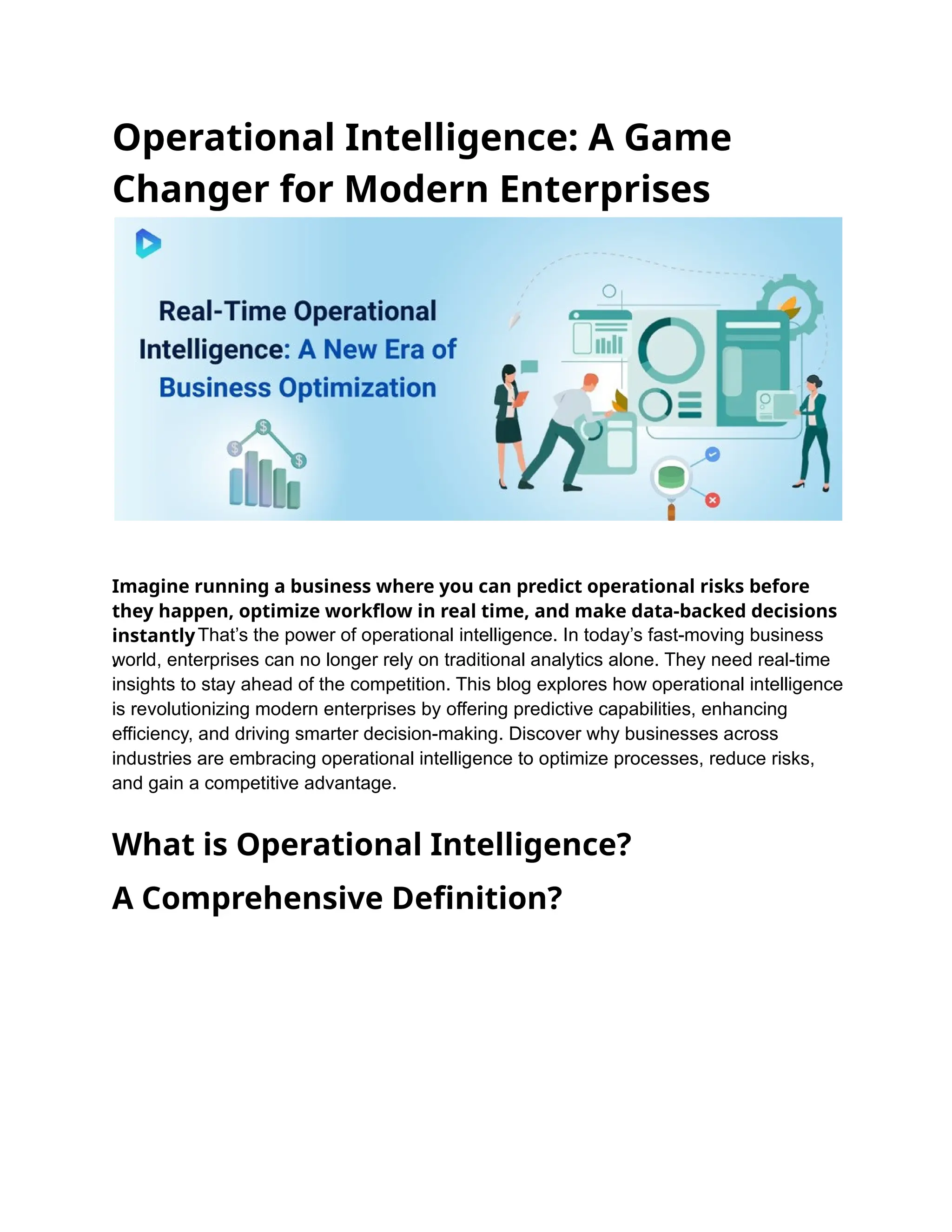
Operational Intelligence: A Game
Changer for Modern Enterprises
Imagine running a business where you can predict operational risks before
they happen, optimize workflow in real time, and make data-backed decisions
instantly
.
That’s the power of operational intelligence. In today’s fast-moving business
world, enterprises can no longer rely on traditional analytics alone. They need real-time
insights to stay ahead of the competition. This blog explores how operational intelligence
is revolutionizing modern enterprises by offering predictive capabilities, enhancing
efficiency, and driving smarter decision-making. Discover why businesses across
industries are embracing operational intelligence to optimize processes, reduce risks,
and gain a competitive advantage.
What is Operational Intelligence?
A Comprehensive Definition?
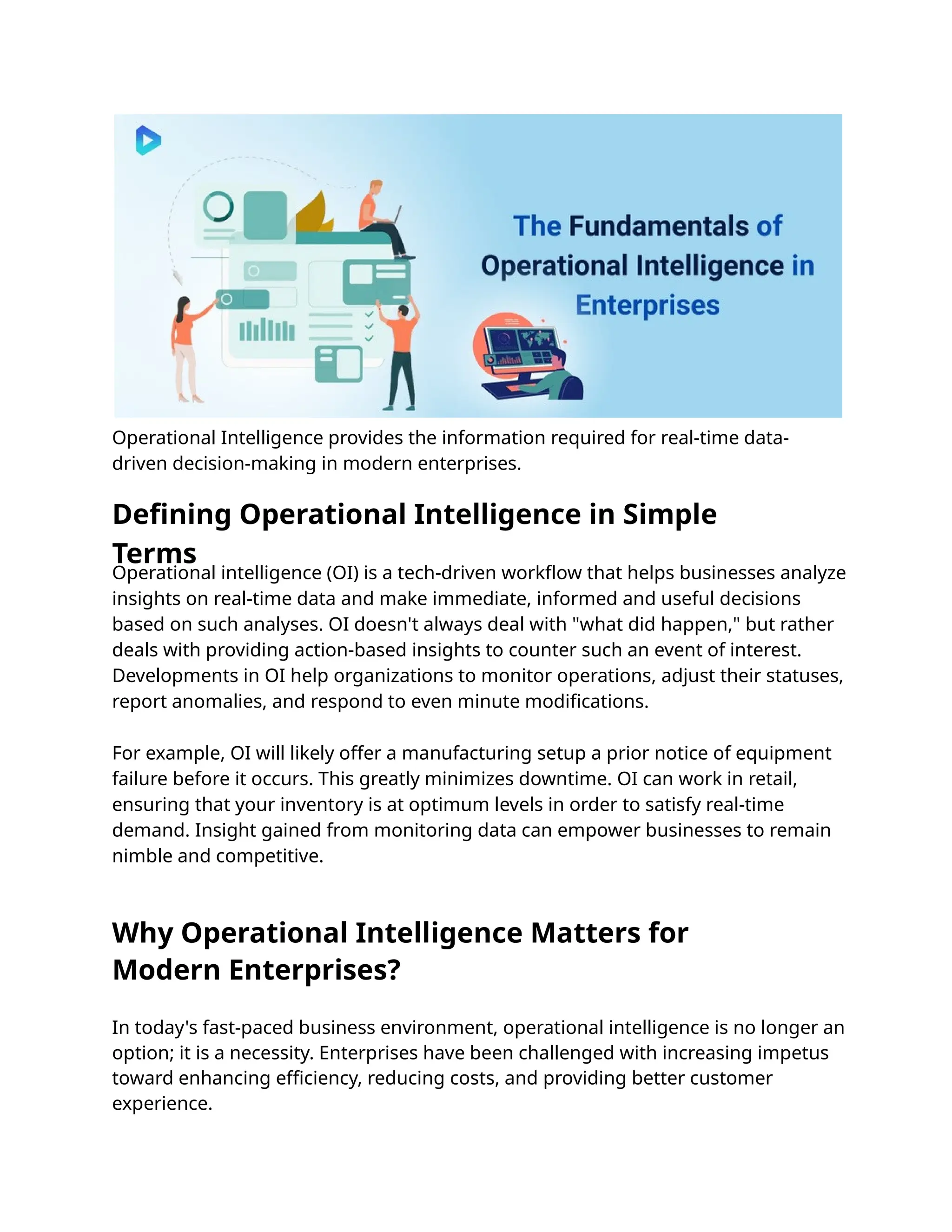
Operational Intelligence provides the information required for real-time data-
driven decision-making in modern enterprises.
In today's fast-paced business environment, operational intelligence is no longer an
option; it is a necessity. Enterprises have been challenged with increasing impetus
toward enhancing efficiency, reducing costs, and providing better customer
experience.
Operational intelligence (OI) is a tech-driven workflow that helps businesses analyze
insights on real-time data and make immediate, informed and useful decisions
based on such analyses. OI doesn't always deal with "what did happen," but rather
deals with providing action-based insights to counter such an event of interest.
Developments in OI help organizations to monitor operations, adjust their statuses,
report anomalies, and respond to even minute modifications.
For example, OI will likely offer a manufacturing setup a prior notice of equipment
failure before it occurs. This greatly minimizes downtime. OI can work in retail,
ensuring that your inventory is at optimum levels in order to satisfy real-time
demand. Insight gained from monitoring data can empower businesses to remain
nimble and competitive.
Why Operational Intelligence Matters for
Modern Enterprises?
Defining Operational Intelligence in Simple
Terms
Operational intelligence provides a huge toolset that lets you achieve this
with unparalleled visibility into your operations in real time.
For instance, OI can help logistics providers decide on and determine the best
delivery route, saving them time as well as fuel. OI also allows banks a chance to
detect possible fraudulent transactions in an instant. OI supports intelligent
decision-making, risk management, and growth.
An effective operational intelligence system relies on several critical
components:
● Real-Time Data Collection: Is done by fetching data through multiple
channels
(IoT devices, sensors, available
applications).
● Advanced Analytics: AI and machine learning process the relevant data
and
simulate the components for online
analytics.
● Visualization Tools: Presents data in easy-to-understand dashboards
and
reports.
● Automation: Automating the responses, decisions and offers of alerts
or adjustments to processes based on
insights.
For example, OI could be used in the healthcare establishment to monitor patient
vitals in real-time so that one can intervene timely. These components work together
to create a seamless flow of information, empowering businesses to act quickly and
effectively.
Key Components of an Effective
Operational Intelligence System
Working of Operational Intelligence: How
It Powers Real-Time Decisions?
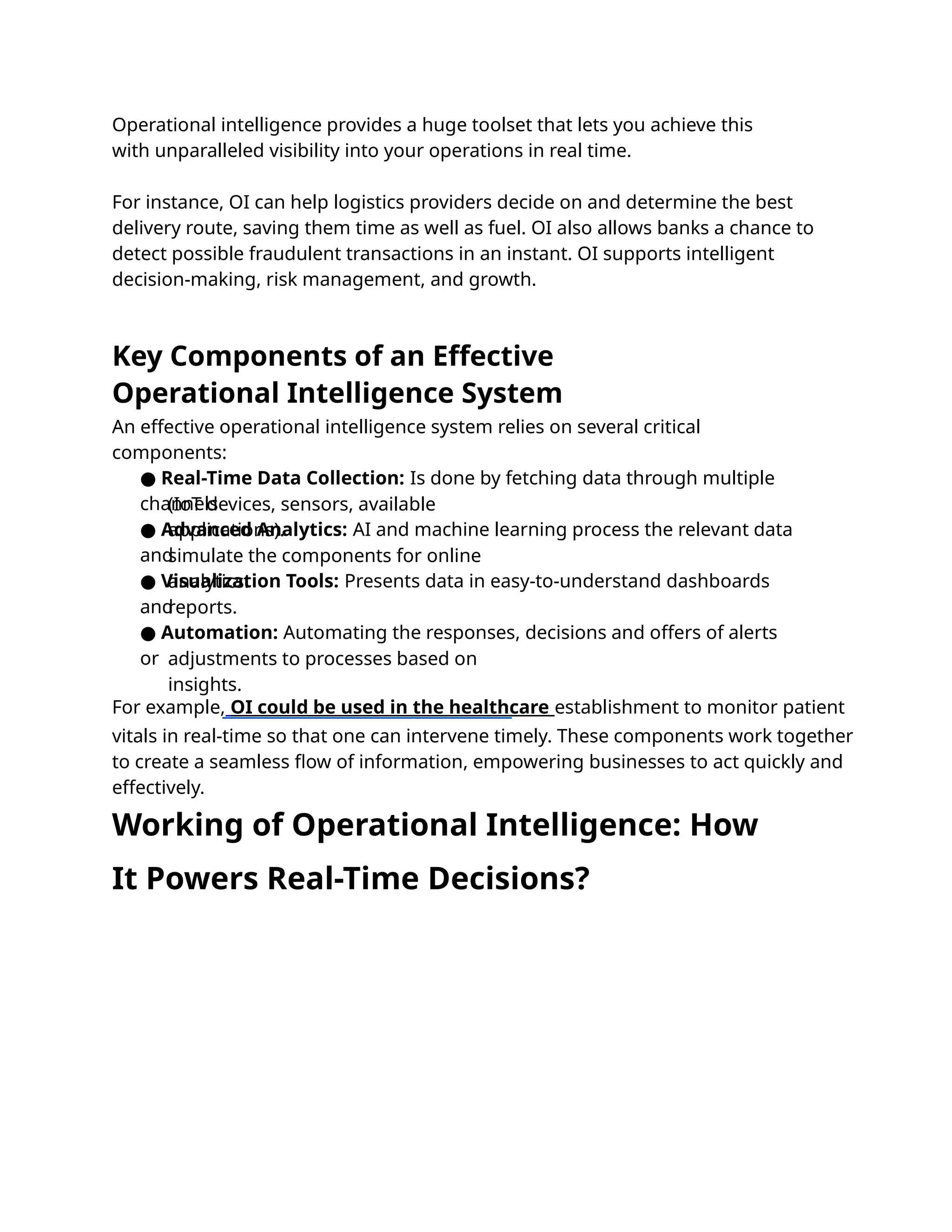
Operational intelligence transforms real-time data into actionable insights for
smarter decisions.
Operational Intelligence works by collecting, analyzing, and acting upon data in
real-time. The process begins from the ingestion of raw data from multiple sources
like IoT devices, sensors, and enterprise software. Thereafter, this data is processed
using advanced analytics to identify patterns, trends, and anomalies.
For example, in supply chain management, for instance, operational intelligence
tracks shipments and predicts delays, triggering alerts or automated actions to
resolve issues before they escalate. Operational intelligence keeps organizations
nimble and efficient in dynamic environments by enabling speedy responses.
Real-time data is the backbone of operational intelligence. It provides up-to-the-
minute information, allowing businesses to make informed decisions instantly. For
example, OI can monitor the traffic on the e-commerce website and adjust its server
capacity to prevent crashes during peak hours.
Key benefits of real-time data in
OI:● Immediate detection of operational issues. ●
Faster response times to changing conditions. ●
Better decision-making is based on better accuracy.
How Does Real-Time Data Power
Operational Intelligence?
The Process of Operational Intelligence in
Action
A complete absence of real-time data renders a vigilant decisions on the part of
the user not just outdated but also ineffective.
Operational Intelligence unveils real-time insights empowering speedier, more
accurate business decisions.
Several cutting-edge technologies enable operational intelligence to function
effectively:
● IoT Devices: Collect real-time data from physical assets like machinery
or vehicles.
● AI and Machine Learning: Analyze data to predict trends and automate
actions. ● Cloud Computing: Provides scalable infrastructure for data storage
and
processing.
● Data Visualization Tools: Present insights in easy-to-understand
dashboards.
For example, in healthcare, IoT devices monitor patient vitals, while AI analyzes the
data
to alert doctors about critical changes. These technologies work together to make OI
a
powerful tool for modern enterprises.
Technologies Driving Operational
Intelligence
Benefits of Operational Intelligence
for Enterprises
Driving Competitive Advantage Through Proactive
Strategies
Operational intelligence enables businesses to stay ahead of the competition by
adopting proactive strategies. For example, e-commerce platforms can use OI to
predict
Enhancing Decision-Making with Real-Time Business
Insights
The operational intelligence is the real-time decision-making process based on
accurate data collection from an enterprise. It allows the organization to identify
trends and other areas of cruciacy by observing and verifying real-time data. For
example, for a retailer, this could be done to rethink pricing while analyzing live sales
data, and for a manufacturer, that means maximizing production schedules and
making changes based on demand.
Improving Efficiency and Reducing Operational
Risks
Operational intelligence makes the proper blend of the process-oriented workflow
with reducing operational risks through its provision of real-time visibility into
operations. Example: Logistics companies use OI to monitor fleets and reroute
deliveries to avoid delays. For instance, banks can block suspicious activity
promptly, therefore reducing fraudulent losses.
Key
advantages:
● Optimized resource allocation and reduced
waste.
● Early detection of potential issues before they
escalate.
● Enhanced compliance with industry
regulations.
Operating efficiencies and reduced risks contribute to saving the time, money,
and
smooth performance of businesses owing to OI.
Key benefits:
● Faster, more accurate decision-making.
● Reduced dependency on outmoded or incomplete data.
● Improved ability to smoothen opportunities and diminish
risks.
With operational intelligence, businesses have greater clarity toward their
operations,
and it equips them to act with confidence and precision.
Operational Intelligence (OI) guides modern businesses toward success: see
what transformation it brings.
customer demand and adjust inventory levels accordingly. This ensures they
meet customer needs without overstocking.
Key
outcomes:
● More rapid response to the changes in market demand and
consumer
preferences.
● Enhanced customer satisfaction and loyalty.
● Increase in innovation and agility of business
operations.
WitEnterprises will realize their capacity to convert actionable strategies from
fingerprints-minds with the operational intelligence obtaining a greater
competitive
advantage within their business.
It's no longer optional for businesses that wish to grow and thrive. By yielding real-
time insights into operations, OI empowers companies to reach data-driven
decisions more quickly. Identify inefficiencies in the workflows while spotting
hidden opportunities, ensuring that all resources are being used to optimum effect.
OIs level the playing field for small start-ups, providing bigger businesses with the
opportunity to get
Importance of Operational Intelligence in
Modern Enterprises
Why Enterprises Need Operational Intelligence
for Growth?
Happy customers are at the core of every organization, and OI plays a crucial role in
ensuring customer satisfaction. OI watches customer interactions in real time—
whether through support tickets, social media, or sales data—to determine pain
points before they reach crisis stage.
For example, an
e-commerce platform using OI can track order delays and notify customers
instantly, reducing frustration
. Hospitality businesses can adjust pricing dynamically based on demand,
offering competitive rates.
Key impacts
include:
Operational intelligence is the backbone of digital transformation. OI integrates
data from IoT devices, CRM systems, and supply chains to give a unified view of
operations. This provides the kind of visibility that is critical for innovation:
businesses can now experiment with procedurals, test ideas in real time, and scale
successful strategies a lot quicker.
For example, Operational Intelligence allows retailers to analyze consumer behavior
and adjust their marketing campaigns on the fly. A cloud-based OI platform also
supports remote work and international collaboration while breaking down the silos
between teams. Coupled with artificial intelligence and machine learning, OI turns
raw data into actionable insights, facilitating smarter investments in technology and
talent.
enterprise-grade analytics at scale. Competitive markets require agility; OI equips
teams to respond swiftly when there are changes in customer demand or
disruptions in the supply chain. With OI, businesses can:
● Predict risks and stave them off proactively.
● Track performance metrics in real time.
● Align operations with strategic business
goals.
A lag behind the operational intelligence of a competitor could stand out in the
digital
economy.
The Role of OI in Digital Transformation
and Innovation
How does Operational Intelligence Improve
Customer Experience?
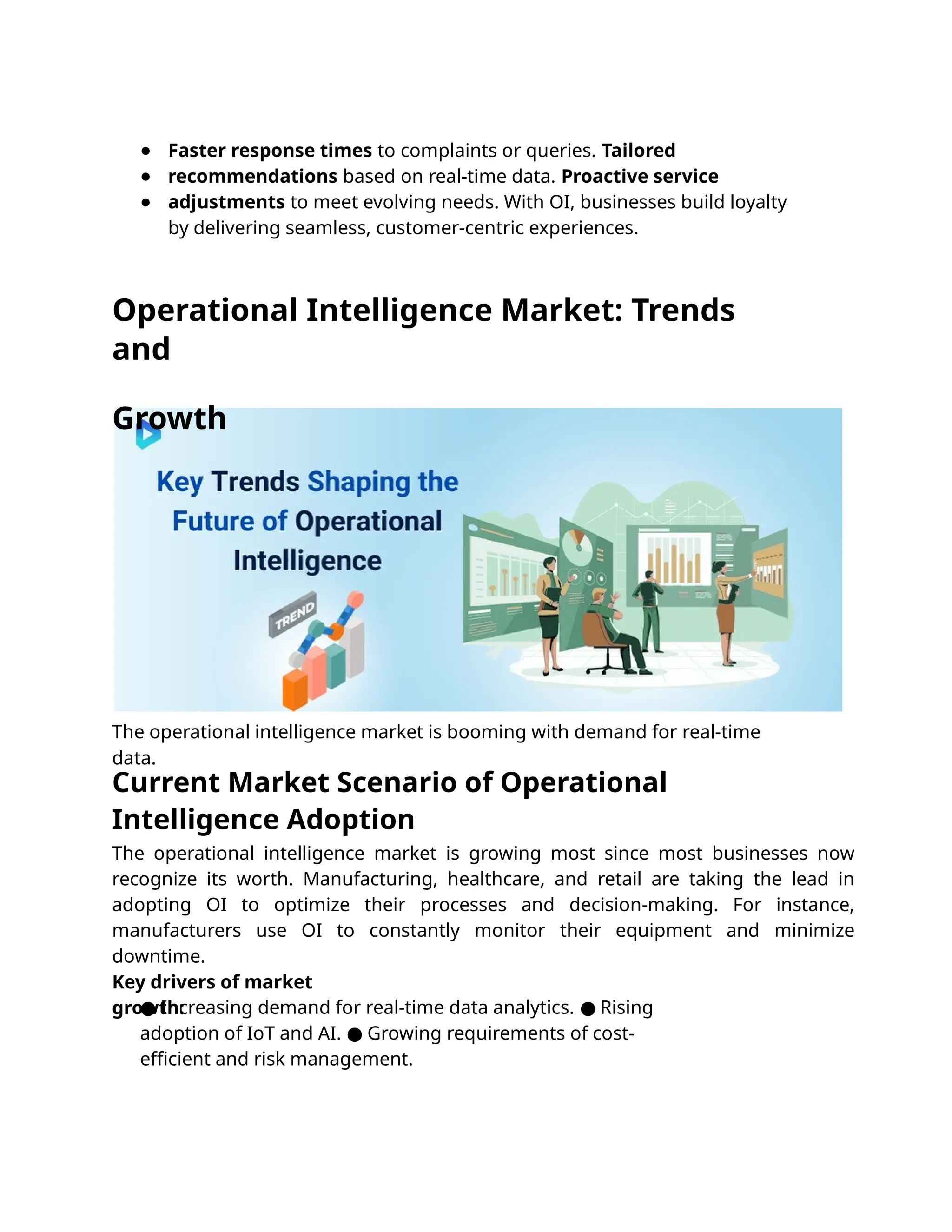
The operational intelligence market is booming with demand for real-time
data.
Faster response times to complaints or queries. Tailored
recommendations based on real-time data. Proactive service
adjustments to meet evolving needs. With OI, businesses build loyalty
by delivering seamless, customer-centric experiences.
The operational intelligence market is growing most since most businesses now
recognize its worth. Manufacturing, healthcare, and retail are taking the lead in
adopting OI to optimize their processes and decision-making. For instance,
manufacturers use OI to constantly monitor their equipment and minimize
downtime.
Key drivers of market
growth:
● Increasing demand for real-time data analytics. Rising
●
adoption of IoT and AI. Growing requirements of cost-
●
efficient and risk management.
●
●
●
Operational Intelligence Market: Trends
and
Growth
Current Market Scenario of Operational
Intelligence Adoption
As moAs more organizations embrace digital transformation, the
adoption of operational intelligence is likely to accelerate.
Emerging technologies are revolutionizing the operational intelligence landscape.
Artificial intelligence (AI) and machine learning (ML) are enhancing OI systems by
enabling predictive analytics and automation. The Internet of Things (IoT) is
providing vast amounts of real-time data from connected devices.
Yet advancing cloud computing has made OI available to more and more business
sizes. It is a technology that not only enhances the precision of insights but also
trumps OI solutions as cost-effective and user-friendly.
The global operational intelligence market is poised for significant growth in the
coming years. Analysts predict a compound annual growth rate (CAGR) of over 20%
through 2030. Key factors driving this growth include the increasing adoption of
Industry 4.0 and the need for real-time decision-making in competitive markets.
Regions like North America and Europe are expected to lead, while Asia-Pacific is
emerging as a high-growth market due to rapid industrialization. As businesses
continue to prioritize efficiency and innovation, operational intelligence will play a
pivotal role in shaping the future of enterprise operations.
Emerging Technologies Shaping the Future of
OI
Predictions for the Global Operational
Intelligence Market
Difference Between Business Intelligence
and Operational Intelligence
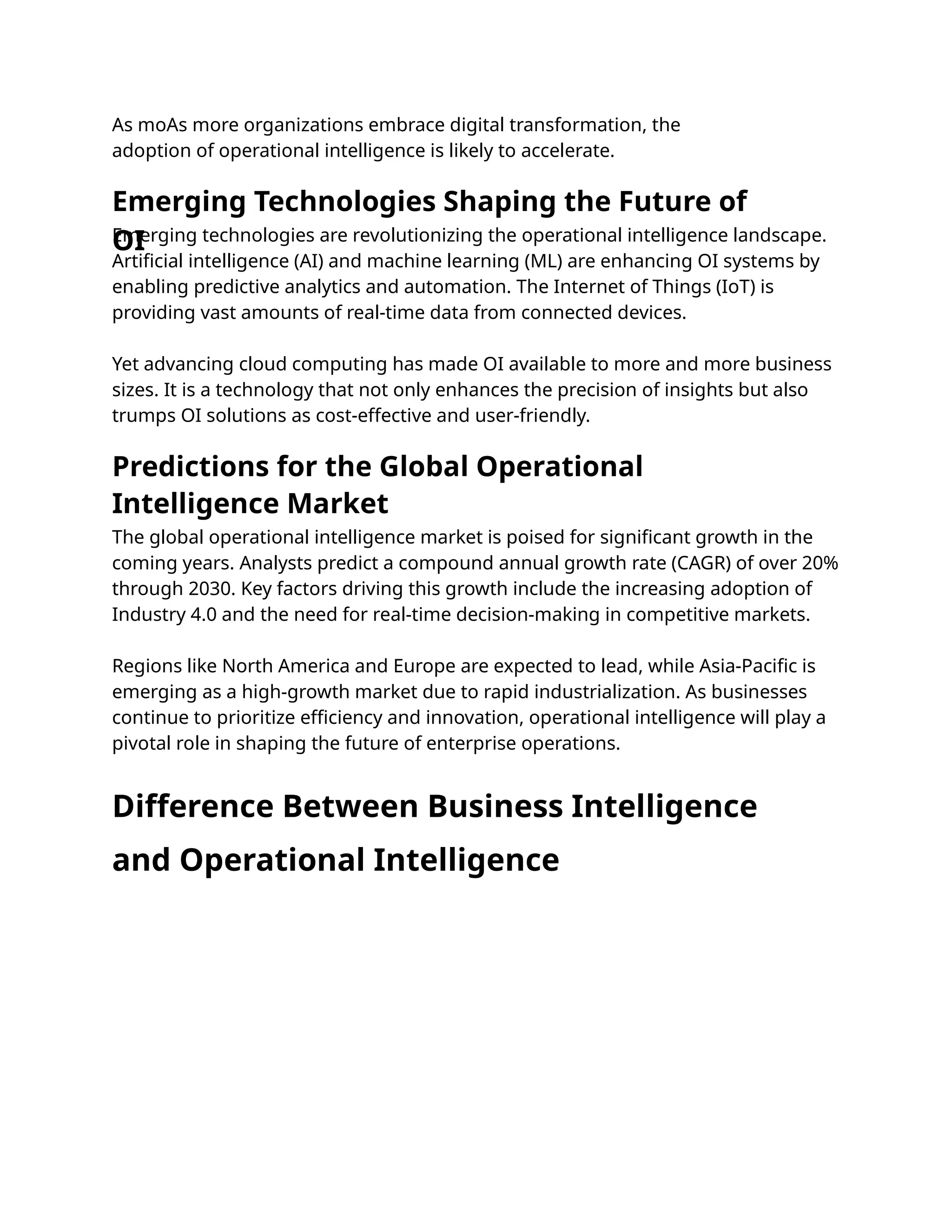
Business intelligence and operational intelligence operate distinctly but
in a complementary way.
BI and OI provide a well-rounded decision-making approach for enterprises. BI
offers insights on what transpired, for instance, to enable businesses to map their
direction for the same. Could include reflecting on what products performed ideally
last quarter.
On the other hand, OI enables day-to-day actions in business. E.g., It can obtain and
diagnose a line fault during production that can call for immediate tracking.
Together, BI and OI furnish a panoramic maze of operations for such businesses
where a long-range strategy and instantaneous action synergistically intertwine.
Business intelligence (BI) and operational intelligence (OI) are often confused, but
they serve different purposes. BI focuses on analyzing historical data to identify
trends and support long-term strategic decisions. For example, BI helps businesses
understand annual sales performance.
On the other hand, OI deals with real-time data to enable immediate actions. For
instance, OI can alert a retailer about a sudden stock shortage. While BI looks
backward, OI looks forward, ensuring businesses can respond to current operational
challenges effectively.
Why Enterprises Need Both BI and
OI
BI vs OI: Understanding the Core
Differences
How Does Operational Intelligence
Complement Business Intelligence?
Adopting operational intelligence is not easy for many organizations. Integration
of OI systems with existing IT infrastructure is the biggest concern. The legacy
systems are often incompatible, leading to delays and cost overruns. Employees,
in turn, tend to resist the change because of lack of understanding and fears of job
loss.
Operational Intelligence complements Business Intelligence by connecting th
e gap between strategic and operational execution
. While BI first establishes goals from historical data, OI is appointed to meet these
goals through the real-time monitoring of operations.
For example, a logistics service might use BI to set their delivery route using
previous patterns. OI, however, can adjust those routes in real time due to traffic
or weather conditions. This way, the two can ensure that the businesses are
actively compos preparing for them and able to adjust to circumstances.
The implementation of operational intelligence may present its challenges, but fruits
will bear for efforts.
Overcoming Challenges in
Implementing Operational Intelligence
Common Obstacles in Operational
Intelligence Adoption
Data privacy and data security issues are some of the major concerns faced while
implementing operational intelligence. OI has to employ real-time data that are
often sensitive in nature, such as customer transactions or operational
processes. Such cases could lead to compression in growth or even obliterate
reputations for many organizations.
Organizations must address the risk
by:● Implement robust encryption and access controls. Complying with data
●
protection directives like GDPR and CCPA. Consistently taking into
●
account periodic audits to check for weaknesses in
systems.
By making data security a priority, organizations earn stakeholder trust and secure
the safe usage of operational intelligence.
Another challenge involves the intricate nature of managing and analyzing different
quantities of real-time data. Such a venture is overwhelming without the right tools
and expertise. To solve these challenges, create an operational strategy as a point
of reference, provide the necessary training on the new operating scheme and get
management buy-in so the project rolls out smoothly.
Successful deployment of operational intelligence requires careful planning and
execution. Start by defining clear objectives and identifying key performance
indicators (KPIs) to measure success. Ensure seamless integration with existing
systems by choosing scalable, compatible solutions.
Equally important is training the employees. Such training should consider a
hands-on approach and equip teams with the skills they need to work with new
tools. Lastly, organizations should consider tracking progress and seeking
feedback to develop the system. Following these best practices, organizations can
lay off challenges and leverage the full potential of operational intelligence.
Addressing Data Privacy and Security Concerns
Best Practices for Successful Operational
Intelligence Deployment
LET’S DISCUSS YOUR IDEA
Call Us: +1 (347) 9739732, +91-90399-28143 Email Us:
inquiry@digiprima.com, ashesh@digiprima.com

Operational Intelligence A Game Changer for Modern Enterprises.pdf.pptx

  • 1.
    Operational Intelligence: AGame Changer for Modern Enterprises Imagine running a business where you can predict operational risks before they happen, optimize workflow in real time, and make data-backed decisions instantly . That’s the power of operational intelligence. In today’s fast-moving business world, enterprises can no longer rely on traditional analytics alone. They need real-time insights to stay ahead of the competition. This blog explores how operational intelligence is revolutionizing modern enterprises by offering predictive capabilities, enhancing efficiency, and driving smarter decision-making. Discover why businesses across industries are embracing operational intelligence to optimize processes, reduce risks, and gain a competitive advantage. What is Operational Intelligence? A Comprehensive Definition?
  • 2.
    Operational Intelligence providesthe information required for real-time data- driven decision-making in modern enterprises. In today's fast-paced business environment, operational intelligence is no longer an option; it is a necessity. Enterprises have been challenged with increasing impetus toward enhancing efficiency, reducing costs, and providing better customer experience. Operational intelligence (OI) is a tech-driven workflow that helps businesses analyze insights on real-time data and make immediate, informed and useful decisions based on such analyses. OI doesn't always deal with "what did happen," but rather deals with providing action-based insights to counter such an event of interest. Developments in OI help organizations to monitor operations, adjust their statuses, report anomalies, and respond to even minute modifications. For example, OI will likely offer a manufacturing setup a prior notice of equipment failure before it occurs. This greatly minimizes downtime. OI can work in retail, ensuring that your inventory is at optimum levels in order to satisfy real-time demand. Insight gained from monitoring data can empower businesses to remain nimble and competitive. Why Operational Intelligence Matters for Modern Enterprises? Defining Operational Intelligence in Simple Terms
  • 3.
    Operational intelligence providesa huge toolset that lets you achieve this with unparalleled visibility into your operations in real time. For instance, OI can help logistics providers decide on and determine the best delivery route, saving them time as well as fuel. OI also allows banks a chance to detect possible fraudulent transactions in an instant. OI supports intelligent decision-making, risk management, and growth. An effective operational intelligence system relies on several critical components: ● Real-Time Data Collection: Is done by fetching data through multiple channels (IoT devices, sensors, available applications). ● Advanced Analytics: AI and machine learning process the relevant data and simulate the components for online analytics. ● Visualization Tools: Presents data in easy-to-understand dashboards and reports. ● Automation: Automating the responses, decisions and offers of alerts or adjustments to processes based on insights. For example, OI could be used in the healthcare establishment to monitor patient vitals in real-time so that one can intervene timely. These components work together to create a seamless flow of information, empowering businesses to act quickly and effectively. Key Components of an Effective Operational Intelligence System Working of Operational Intelligence: How It Powers Real-Time Decisions?
  • 4.
    Operational intelligence transformsreal-time data into actionable insights for smarter decisions. Operational Intelligence works by collecting, analyzing, and acting upon data in real-time. The process begins from the ingestion of raw data from multiple sources like IoT devices, sensors, and enterprise software. Thereafter, this data is processed using advanced analytics to identify patterns, trends, and anomalies. For example, in supply chain management, for instance, operational intelligence tracks shipments and predicts delays, triggering alerts or automated actions to resolve issues before they escalate. Operational intelligence keeps organizations nimble and efficient in dynamic environments by enabling speedy responses. Real-time data is the backbone of operational intelligence. It provides up-to-the- minute information, allowing businesses to make informed decisions instantly. For example, OI can monitor the traffic on the e-commerce website and adjust its server capacity to prevent crashes during peak hours. Key benefits of real-time data in OI:● Immediate detection of operational issues. ● Faster response times to changing conditions. ● Better decision-making is based on better accuracy. How Does Real-Time Data Power Operational Intelligence? The Process of Operational Intelligence in Action
  • 5.
    A complete absenceof real-time data renders a vigilant decisions on the part of the user not just outdated but also ineffective. Operational Intelligence unveils real-time insights empowering speedier, more accurate business decisions. Several cutting-edge technologies enable operational intelligence to function effectively: ● IoT Devices: Collect real-time data from physical assets like machinery or vehicles. ● AI and Machine Learning: Analyze data to predict trends and automate actions. ● Cloud Computing: Provides scalable infrastructure for data storage and processing. ● Data Visualization Tools: Present insights in easy-to-understand dashboards. For example, in healthcare, IoT devices monitor patient vitals, while AI analyzes the data to alert doctors about critical changes. These technologies work together to make OI a powerful tool for modern enterprises. Technologies Driving Operational Intelligence Benefits of Operational Intelligence for Enterprises
  • 6.
    Driving Competitive AdvantageThrough Proactive Strategies Operational intelligence enables businesses to stay ahead of the competition by adopting proactive strategies. For example, e-commerce platforms can use OI to predict Enhancing Decision-Making with Real-Time Business Insights The operational intelligence is the real-time decision-making process based on accurate data collection from an enterprise. It allows the organization to identify trends and other areas of cruciacy by observing and verifying real-time data. For example, for a retailer, this could be done to rethink pricing while analyzing live sales data, and for a manufacturer, that means maximizing production schedules and making changes based on demand. Improving Efficiency and Reducing Operational Risks Operational intelligence makes the proper blend of the process-oriented workflow with reducing operational risks through its provision of real-time visibility into operations. Example: Logistics companies use OI to monitor fleets and reroute deliveries to avoid delays. For instance, banks can block suspicious activity promptly, therefore reducing fraudulent losses. Key advantages: ● Optimized resource allocation and reduced waste. ● Early detection of potential issues before they escalate. ● Enhanced compliance with industry regulations. Operating efficiencies and reduced risks contribute to saving the time, money, and smooth performance of businesses owing to OI. Key benefits: ● Faster, more accurate decision-making. ● Reduced dependency on outmoded or incomplete data. ● Improved ability to smoothen opportunities and diminish risks. With operational intelligence, businesses have greater clarity toward their operations, and it equips them to act with confidence and precision.
  • 7.
    Operational Intelligence (OI)guides modern businesses toward success: see what transformation it brings. customer demand and adjust inventory levels accordingly. This ensures they meet customer needs without overstocking. Key outcomes: ● More rapid response to the changes in market demand and consumer preferences. ● Enhanced customer satisfaction and loyalty. ● Increase in innovation and agility of business operations. WitEnterprises will realize their capacity to convert actionable strategies from fingerprints-minds with the operational intelligence obtaining a greater competitive advantage within their business. It's no longer optional for businesses that wish to grow and thrive. By yielding real- time insights into operations, OI empowers companies to reach data-driven decisions more quickly. Identify inefficiencies in the workflows while spotting hidden opportunities, ensuring that all resources are being used to optimum effect. OIs level the playing field for small start-ups, providing bigger businesses with the opportunity to get Importance of Operational Intelligence in Modern Enterprises Why Enterprises Need Operational Intelligence for Growth?
  • 8.
    Happy customers areat the core of every organization, and OI plays a crucial role in ensuring customer satisfaction. OI watches customer interactions in real time— whether through support tickets, social media, or sales data—to determine pain points before they reach crisis stage. For example, an e-commerce platform using OI can track order delays and notify customers instantly, reducing frustration . Hospitality businesses can adjust pricing dynamically based on demand, offering competitive rates. Key impacts include: Operational intelligence is the backbone of digital transformation. OI integrates data from IoT devices, CRM systems, and supply chains to give a unified view of operations. This provides the kind of visibility that is critical for innovation: businesses can now experiment with procedurals, test ideas in real time, and scale successful strategies a lot quicker. For example, Operational Intelligence allows retailers to analyze consumer behavior and adjust their marketing campaigns on the fly. A cloud-based OI platform also supports remote work and international collaboration while breaking down the silos between teams. Coupled with artificial intelligence and machine learning, OI turns raw data into actionable insights, facilitating smarter investments in technology and talent. enterprise-grade analytics at scale. Competitive markets require agility; OI equips teams to respond swiftly when there are changes in customer demand or disruptions in the supply chain. With OI, businesses can: ● Predict risks and stave them off proactively. ● Track performance metrics in real time. ● Align operations with strategic business goals. A lag behind the operational intelligence of a competitor could stand out in the digital economy. The Role of OI in Digital Transformation and Innovation How does Operational Intelligence Improve Customer Experience?
  • 9.
    The operational intelligencemarket is booming with demand for real-time data. Faster response times to complaints or queries. Tailored recommendations based on real-time data. Proactive service adjustments to meet evolving needs. With OI, businesses build loyalty by delivering seamless, customer-centric experiences. The operational intelligence market is growing most since most businesses now recognize its worth. Manufacturing, healthcare, and retail are taking the lead in adopting OI to optimize their processes and decision-making. For instance, manufacturers use OI to constantly monitor their equipment and minimize downtime. Key drivers of market growth: ● Increasing demand for real-time data analytics. Rising ● adoption of IoT and AI. Growing requirements of cost- ● efficient and risk management. ● ● ● Operational Intelligence Market: Trends and Growth Current Market Scenario of Operational Intelligence Adoption
  • 10.
    As moAs moreorganizations embrace digital transformation, the adoption of operational intelligence is likely to accelerate. Emerging technologies are revolutionizing the operational intelligence landscape. Artificial intelligence (AI) and machine learning (ML) are enhancing OI systems by enabling predictive analytics and automation. The Internet of Things (IoT) is providing vast amounts of real-time data from connected devices. Yet advancing cloud computing has made OI available to more and more business sizes. It is a technology that not only enhances the precision of insights but also trumps OI solutions as cost-effective and user-friendly. The global operational intelligence market is poised for significant growth in the coming years. Analysts predict a compound annual growth rate (CAGR) of over 20% through 2030. Key factors driving this growth include the increasing adoption of Industry 4.0 and the need for real-time decision-making in competitive markets. Regions like North America and Europe are expected to lead, while Asia-Pacific is emerging as a high-growth market due to rapid industrialization. As businesses continue to prioritize efficiency and innovation, operational intelligence will play a pivotal role in shaping the future of enterprise operations. Emerging Technologies Shaping the Future of OI Predictions for the Global Operational Intelligence Market Difference Between Business Intelligence and Operational Intelligence
  • 11.
    Business intelligence andoperational intelligence operate distinctly but in a complementary way. BI and OI provide a well-rounded decision-making approach for enterprises. BI offers insights on what transpired, for instance, to enable businesses to map their direction for the same. Could include reflecting on what products performed ideally last quarter. On the other hand, OI enables day-to-day actions in business. E.g., It can obtain and diagnose a line fault during production that can call for immediate tracking. Together, BI and OI furnish a panoramic maze of operations for such businesses where a long-range strategy and instantaneous action synergistically intertwine. Business intelligence (BI) and operational intelligence (OI) are often confused, but they serve different purposes. BI focuses on analyzing historical data to identify trends and support long-term strategic decisions. For example, BI helps businesses understand annual sales performance. On the other hand, OI deals with real-time data to enable immediate actions. For instance, OI can alert a retailer about a sudden stock shortage. While BI looks backward, OI looks forward, ensuring businesses can respond to current operational challenges effectively. Why Enterprises Need Both BI and OI BI vs OI: Understanding the Core Differences How Does Operational Intelligence Complement Business Intelligence?
  • 12.
    Adopting operational intelligenceis not easy for many organizations. Integration of OI systems with existing IT infrastructure is the biggest concern. The legacy systems are often incompatible, leading to delays and cost overruns. Employees, in turn, tend to resist the change because of lack of understanding and fears of job loss. Operational Intelligence complements Business Intelligence by connecting th e gap between strategic and operational execution . While BI first establishes goals from historical data, OI is appointed to meet these goals through the real-time monitoring of operations. For example, a logistics service might use BI to set their delivery route using previous patterns. OI, however, can adjust those routes in real time due to traffic or weather conditions. This way, the two can ensure that the businesses are actively compos preparing for them and able to adjust to circumstances. The implementation of operational intelligence may present its challenges, but fruits will bear for efforts. Overcoming Challenges in Implementing Operational Intelligence Common Obstacles in Operational Intelligence Adoption
  • 13.
    Data privacy anddata security issues are some of the major concerns faced while implementing operational intelligence. OI has to employ real-time data that are often sensitive in nature, such as customer transactions or operational processes. Such cases could lead to compression in growth or even obliterate reputations for many organizations. Organizations must address the risk by:● Implement robust encryption and access controls. Complying with data ● protection directives like GDPR and CCPA. Consistently taking into ● account periodic audits to check for weaknesses in systems. By making data security a priority, organizations earn stakeholder trust and secure the safe usage of operational intelligence. Another challenge involves the intricate nature of managing and analyzing different quantities of real-time data. Such a venture is overwhelming without the right tools and expertise. To solve these challenges, create an operational strategy as a point of reference, provide the necessary training on the new operating scheme and get management buy-in so the project rolls out smoothly. Successful deployment of operational intelligence requires careful planning and execution. Start by defining clear objectives and identifying key performance indicators (KPIs) to measure success. Ensure seamless integration with existing systems by choosing scalable, compatible solutions. Equally important is training the employees. Such training should consider a hands-on approach and equip teams with the skills they need to work with new tools. Lastly, organizations should consider tracking progress and seeking feedback to develop the system. Following these best practices, organizations can lay off challenges and leverage the full potential of operational intelligence. Addressing Data Privacy and Security Concerns Best Practices for Successful Operational Intelligence Deployment
  • 14.
    LET’S DISCUSS YOURIDEA Call Us: +1 (347) 9739732, +91-90399-28143 Email Us: inquiry@digiprima.com, ashesh@digiprima.com