中国                                   中国


     為什麼中國的產品更便
         宜嗎?
中国                                              中国
     Why Chinese Products
      are so     Cheap?
                          阿米特·喬希 (Amit Joshi)


中国      (c) www.aj-learningplus.blogspot.in     中国
THE LABOUR COST IS
       CHEAP IN CHINA
Cheap labour force is the main reason for
economic products in China, you know,
many people are competing ,so the factory
can employ a worker in a really low price.
The vast and easy availability of unskilled
workforce is making uneducated Chinese
workers very cheap .


         (c) www.aj-learningplus.blogspot.in
The labor in China is so cheap. Some people
work all day to get only 5 dollars. In contrast,
U.S. workers get minimum wages which may
be 7-8 dollars per hour, and this is telling that
the cost of producing the product is so
different.


           (c) www.aj-learningplus.blogspot.in
The average pay for a Chinese blue collar
worker is around 20 thousand Yuan.
The average for an American worker is around
40 thousand USD.
So, the Chinese worker only gets 2 thousand
USD.


         (c) www.aj-learningplus.blogspot.in
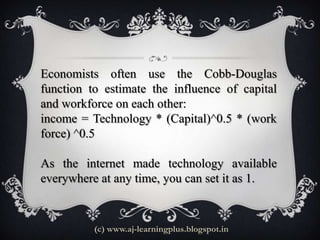
Economists often use the Cobb-Douglas
function to estimate the influence of capital
and workforce on each other:
income = Technology * (Capital)^0.5 * (work
force) ^0.5

As the internet made technology available
everywhere at any time, you can set it as 1.


          (c) www.aj-learningplus.blogspot.in
SELF RELIANT
China produce products itself and all the raw
material are not imported.


          (c) www.aj-learningplus.blogspot.in
MASS PRODUCTIVITY
The components going into production really
  are mass produced at an aggregate cost


         (c) www.aj-learningplus.blogspot.in
YUAN IS MANIPULATED
It happens because the Yuan is manipulated
and pegged undervalued to the US dollar. The
price quoted in US dollar will be cheaper than
normal. The manipulation has affected on
domestic price and wage level. It has been kept
lower that it should have been.


          (c) www.aj-learningplus.blogspot.in
LOW QUALITY
 They manufacture goods which are cheap as
opposed to expensive Western goods that make
              a killing in profit


         (c) www.aj-learningplus.blogspot.in
CHINESE COMMERCE
China, like the United States, is becoming an
indispensable partner, wants to buy raw materials with no
value added and to export consumer goods. Chinese
exports are one of the major factors of the outstanding
economical growth. The reason for this success is the
relatively easiness in which their products enter the
markets. Many Chinese emigrants when settling in a new
country open stores or restaurants and start selling
Chinese products and their way of living. This is in many
cases the tip of the spear of their entrance in a specific
market.

             (c) www.aj-learningplus.blogspot.in
It is not only this privileged access to the markets that
makes it work, the products are much more cheaper than
those produced locally even though the quality might in
some cases be inferior. Nevertheless a great deal of these
price advantages are blamed to the social dumping as the
social conditions of the workers producing the goods in
China are inferior to those in the other countries,
therefore making labor costs inferior. Their currency,
which according to analysts is at an artificial low value,
also helps making their goods more appealing.


             (c) www.aj-learningplus.blogspot.in
CHINESE EXPORTS
As seen before there was a great change in the products that China
currently exports from agricultural and raw products to machines,
transport equipment, and miscellaneous manufacturing goods, and
today the most rapidly growing Chinese exports are middle-tech - and
increasingly high-tech - manufactured goods. But basic manufactures
and chemicals still account for the vast majority of exports. China
runs a huge and growing bilateral trade surplus with the United
States, and the position of Japan has changed radically from being a
net exporter to China in the 1980s and most of 1990s to being a net
importer today. China’s smaller East Asian industrial competitors
such as Taiwan, Korea, and Singapore face fairly difficult
readjustment problems as they try to follow the path laid down by
China. Recently China replaced Japan and Mexico as the largest
single source of U.S. imports of consumer electronic products and
information technology hardware such as computers.


                (c) www.aj-learningplus.blogspot.in
IMPORTS
Also in the imports scenario there were
changes but they were in the opposite direction
as Chinese imports of primary products and
industrial raw materials faced a sudden
increase. Basic manufactured products have
seen a significant downturn in demand as
Chinese industry started to replace that sort of
imports. Today China reports large import
surpluses with the ASEAN group and other
rich natural resources countries.

          (c) www.aj-learningplus.blogspot.in
T R A N S P O RTAT I O N S I T U AT I O N
 Currently, about a quarter of the world’s exports are Chinese, and
China wants this stuff carried in Chinese built and controlled ships. The
same with oil. China imports over 50 percent of what it uses, most of it is
carried in Chinese tankers. As Chinese growth caught everyone
unexpected so were the transportation companies caught. It’s growth,
demands more raw products to be imported and finished or semi-finished
products to be exported. The amount and speed in which this happened
resulted in a under capacity by mainly the shipping industry to cope with
demand. This because the location of both the raw materials and the
exporting markets is such that shipping is normally the most appropriate
method to dispatch the products. Therefore such a demand pressure
resulted in a rise in the costs of transportation, not only through fuel costs
increase but mainly through an increase in power of shipping industries.
As ships are of lengthier building and demand continues to grow it will
take a few years before the prices return to their previous range.


                 (c) www.aj-learningplus.blogspot.in
 For a few years now China has encouraged its own shipping industry
to build the needed boats. Not only the most common and simple cargo
containers but also those who demand more skillful techniques. They are
developing complex ship building know-how. In ten years, China has
gone from a minor ship builder, to the third largest on the planet. In 2004,
Japanese shipyards got 35 % of new orders (by weight) for merchant
ships, South Korea 34 % and China 17 %. That’s 86 % of the world’s
shipbuilding concentrated in East Asia. Chinese growth has been
spectacular, averaging 26 % a year over the last five years. China did this
not just with cheap labor, but also by developing technical expertise.
China can now build ships up to 300,000 tons. This effort is driven by
China’s growing export trade. China uses the profits, and technical
capabilities, gained from all this activity, to build warships. In China,
commercial and military ships are often built at the same facilities, or
adjoining ones. With a growing merchant marine, China wants to build a
navy powerful enough to protect it.


                 (c) www.aj-learningplus.blogspot.in

Why chinese products are so cheaper

  • 1.
    中国 中国 為什麼中國的產品更便 宜嗎? 中国 中国 Why Chinese Products are so Cheap? 阿米特·喬希 (Amit Joshi) 中国 (c) www.aj-learningplus.blogspot.in 中国
  • 2.
    THE LABOUR COSTIS CHEAP IN CHINA Cheap labour force is the main reason for economic products in China, you know, many people are competing ,so the factory can employ a worker in a really low price. The vast and easy availability of unskilled workforce is making uneducated Chinese workers very cheap . (c) www.aj-learningplus.blogspot.in
  • 3.
    The labor inChina is so cheap. Some people work all day to get only 5 dollars. In contrast, U.S. workers get minimum wages which may be 7-8 dollars per hour, and this is telling that the cost of producing the product is so different. (c) www.aj-learningplus.blogspot.in
  • 4.
    The average payfor a Chinese blue collar worker is around 20 thousand Yuan. The average for an American worker is around 40 thousand USD. So, the Chinese worker only gets 2 thousand USD. (c) www.aj-learningplus.blogspot.in
  • 5.
    Economists often usethe Cobb-Douglas function to estimate the influence of capital and workforce on each other: income = Technology * (Capital)^0.5 * (work force) ^0.5 As the internet made technology available everywhere at any time, you can set it as 1. (c) www.aj-learningplus.blogspot.in
  • 6.
    SELF RELIANT China produceproducts itself and all the raw material are not imported. (c) www.aj-learningplus.blogspot.in
  • 7.
    MASS PRODUCTIVITY The componentsgoing into production really are mass produced at an aggregate cost (c) www.aj-learningplus.blogspot.in
  • 8.
    YUAN IS MANIPULATED Ithappens because the Yuan is manipulated and pegged undervalued to the US dollar. The price quoted in US dollar will be cheaper than normal. The manipulation has affected on domestic price and wage level. It has been kept lower that it should have been. (c) www.aj-learningplus.blogspot.in
  • 9.
    LOW QUALITY Theymanufacture goods which are cheap as opposed to expensive Western goods that make a killing in profit (c) www.aj-learningplus.blogspot.in
  • 10.
    CHINESE COMMERCE China, likethe United States, is becoming an indispensable partner, wants to buy raw materials with no value added and to export consumer goods. Chinese exports are one of the major factors of the outstanding economical growth. The reason for this success is the relatively easiness in which their products enter the markets. Many Chinese emigrants when settling in a new country open stores or restaurants and start selling Chinese products and their way of living. This is in many cases the tip of the spear of their entrance in a specific market. (c) www.aj-learningplus.blogspot.in
  • 11.
    It is notonly this privileged access to the markets that makes it work, the products are much more cheaper than those produced locally even though the quality might in some cases be inferior. Nevertheless a great deal of these price advantages are blamed to the social dumping as the social conditions of the workers producing the goods in China are inferior to those in the other countries, therefore making labor costs inferior. Their currency, which according to analysts is at an artificial low value, also helps making their goods more appealing. (c) www.aj-learningplus.blogspot.in
  • 12.
    CHINESE EXPORTS As seenbefore there was a great change in the products that China currently exports from agricultural and raw products to machines, transport equipment, and miscellaneous manufacturing goods, and today the most rapidly growing Chinese exports are middle-tech - and increasingly high-tech - manufactured goods. But basic manufactures and chemicals still account for the vast majority of exports. China runs a huge and growing bilateral trade surplus with the United States, and the position of Japan has changed radically from being a net exporter to China in the 1980s and most of 1990s to being a net importer today. China’s smaller East Asian industrial competitors such as Taiwan, Korea, and Singapore face fairly difficult readjustment problems as they try to follow the path laid down by China. Recently China replaced Japan and Mexico as the largest single source of U.S. imports of consumer electronic products and information technology hardware such as computers. (c) www.aj-learningplus.blogspot.in
  • 13.
    IMPORTS Also in theimports scenario there were changes but they were in the opposite direction as Chinese imports of primary products and industrial raw materials faced a sudden increase. Basic manufactured products have seen a significant downturn in demand as Chinese industry started to replace that sort of imports. Today China reports large import surpluses with the ASEAN group and other rich natural resources countries. (c) www.aj-learningplus.blogspot.in
  • 14.
    T R AN S P O RTAT I O N S I T U AT I O N  Currently, about a quarter of the world’s exports are Chinese, and China wants this stuff carried in Chinese built and controlled ships. The same with oil. China imports over 50 percent of what it uses, most of it is carried in Chinese tankers. As Chinese growth caught everyone unexpected so were the transportation companies caught. It’s growth, demands more raw products to be imported and finished or semi-finished products to be exported. The amount and speed in which this happened resulted in a under capacity by mainly the shipping industry to cope with demand. This because the location of both the raw materials and the exporting markets is such that shipping is normally the most appropriate method to dispatch the products. Therefore such a demand pressure resulted in a rise in the costs of transportation, not only through fuel costs increase but mainly through an increase in power of shipping industries. As ships are of lengthier building and demand continues to grow it will take a few years before the prices return to their previous range. (c) www.aj-learningplus.blogspot.in
  • 15.
     For afew years now China has encouraged its own shipping industry to build the needed boats. Not only the most common and simple cargo containers but also those who demand more skillful techniques. They are developing complex ship building know-how. In ten years, China has gone from a minor ship builder, to the third largest on the planet. In 2004, Japanese shipyards got 35 % of new orders (by weight) for merchant ships, South Korea 34 % and China 17 %. That’s 86 % of the world’s shipbuilding concentrated in East Asia. Chinese growth has been spectacular, averaging 26 % a year over the last five years. China did this not just with cheap labor, but also by developing technical expertise. China can now build ships up to 300,000 tons. This effort is driven by China’s growing export trade. China uses the profits, and technical capabilities, gained from all this activity, to build warships. In China, commercial and military ships are often built at the same facilities, or adjoining ones. With a growing merchant marine, China wants to build a navy powerful enough to protect it. (c) www.aj-learningplus.blogspot.in