A Discussion Sponsored by the
Social Justice Committee of
Good Shepherd Catholic
Church
WHO IS POOR?
WHO IS POOR?
WHO IS POOR?
— If you believe that this is an important question, why?
—
WHO IS POOR?
—What is your definition of poverty? —
A BRIEF HISTORY
OF POVERTY
Before the 20th century…
■ Poverty was not a government problem.The issue was left to private charities, local
governments, and families.
■ The poor were always with us.They just became more conspicuous as populations
concentrated in cities.
■ The English Poor Law of 1601 established a right for public assistance for:
– Poor children, who received skills training
– Able-bodied adults, who received employment
– Elderly or disabled (considered the “worthy poor”), who received “relief.”
Involvement
of federal
government
Federal Emergency ReliefAct of 1933
— public assistance to the most
“deserving poor”
Social SecurityAct of 1935 — covered a
wide range of contingencies that
predispose poverty: old age, physical
disabilities, unemployment,
widowhood, and dependent children.
Involvement
of federal
government
Federal Emergency ReliefAct of 1933
— public assistance to the most
“deserving poor”
Social SecurityAct of 1935 — covered a
wide range of contingencies that
predispose poverty: old age, physical
disabilities, unemployment,
widowhood, and dependent children.
Introduced relief programs
and services for unemployed
adults such as public work
schemes, vocational training,
and food coupons.
War on
Poverty
Expansion of government-
supported program and services
focusing on education, health,
housing, and employment-related
measure, including work training
and work incentives.
Rolling back in
the U.S.
Triggered in part by rise of
neoconservative socioeconomic
thought and partly by increasing
welfare expenditures amid
economic problems.
Rolling back in
the U.S.
Triggered in part by rise of
neoconservative socioeconomic
thought and partly by increasing
welfare expenditures amid
economic problems.
Strategic withdrawal of federal
government from direct provision of
welfare services through devolution
of responsibilities to the states,
increasing reliance on private markets
and the family as primary
mechanisms for poverty alleviation,
and negation of the principle of
welfare entitlement for unemployed,
able-bodied adults and parents with
dependent children.
Personal Responsibility andWork
Opportunity Reconciliation Act (1996)
■ Considered a cornerstone of Republican Contract with America.
■ Signed into law by BillClinton to fulfill a campaign promise to "end welfare as we have
come to know it".
■ Policy now anchored on labor force participation and designs to reduce dependency on
public assistance by promoting self-sufficiency.
■ EstablishedTemporary Assistance for Needy Families (TANF) for assistance to needy
families:
– Assistance limited to 5 years
– Conditional on fulfillment of prescribed job training activities
– Established Earned IncomeTax Credit, which is a refundable tax credit for low- to moderate-
income working individuals and couples, particularly those with children
Personal Responsibility andWork
Opportunity Reconciliation Act (1996)
■ Considered a cornerstone of Republican Contract with America.
■ Signed into law by BillClinton to fulfill a campaign promise to "end welfare as we have
come to know it".
■ Policy now anchored on labor force participation and designs to reduce dependency on
public assistance by promoting self-sufficiency.
■ EstablishedTemporary Assistance for Needy Families (TANF) for assistance to needy
families:
– Assistance limited to 5 years
– Conditional on fulfillment of prescribed job training activities
– Established Earned IncomeTax Credit, which is a refundable tax credit for low- to moderate-
income working individuals and couples, particularly those with children
Skepticism is widespread, however, regarding
the capacity of private markets to generate
living wage jobs for the poor.
“Asset-based” approaches are emerging for
individual development accounts and
microenterprises. But, the effectiveness of
these poverty alleviation strategies is yet to be
documented.
MEASURING POVERTY
Mollie
Orshansky
(January 9, 1915 – December 18, 2006)
An American economist and
statistician who, in 1963–65,
developed the Orshansky Poverty
Thresholds, which are used in the
United States as a measure of the
income that a household must not
exceed to be counted as poor.
Mollie
Orshansky
(January 9, 1915 – December 18, 2006)
An American economist and
statistician who, in 1963–65,
developed the Orshansky Poverty
Thresholds, which are used in the
United States as a measure of the
income that a household must not
exceed to be counted as poor.
Assumption is poverty exists if
access to financial resources is
insufficient to acquire enough
commodities to meet basic
materials needs to ensure life.
Orshansky PovertyThresholds
■ Involves estimating an income threshold that is required to obtain a minimum
standard of living.
■ A household with income below the threshold is considered poor.
■ Orshansky’s measure was adopted in 1968 by the U.S. Bureau of the Budget as the
official U.S. definition of poverty.
Creating the thresholds
■ Based on the cost of predetermined food items by the U.S. Department ofAgriculture as
essential to provide necessary calories to ensure normal functioning.
■ The cost of the basket of food items was multiplied by three to cover the costs of basic
nonfood items such as housing, clothing, and transportation.
■ Income threshold were built that accounted for households with different family sizes and
compositions.
■ Farm and nonfarm thresholds were established separately, as they were for various regions
of the U.S.
■ The incidence of poverty is the percentage of households below the thresholds.
■ The depth of poverty is the extent to which average income in poor households differes
from the thresholds.
In Centre
County
18.3% forWhite Non-Hispanic
residents, 39.7% for Black residents,
33.4% for Hispanic or Latino
residents, 17.5% for American Indian
residents, 16.7% for Native Hawaiian
and other Pacific Islander residents,
28.1% for other race residents,
29.7% for two or more races
residents.
In Centre
County
18.3% forWhite Non-Hispanic
residents, 39.7% for Black residents,
33.4% for Hispanic or Latino
residents, 17.5% for American Indian
residents, 16.7% for Native Hawaiian
and other Pacific Islander residents,
28.1% for other race residents,
29.7% for two or more races
residents.
The official poverty measure is used to
count the poor and to estimate the depth
of their poverty. It also is used to
determine financial eligibility for income-
tested federal programs and for other
administrative purposes.
Many believe that the
official measure is flawed
■ Official measure assumes about 1/3 of income is spent on food. Now, food comprises
about 1/7 of family expenses, while costs for housing, child care, health care and
transportation have soared.
■ Measure does not count assets.
■ Measure does not consider the Earned IncomeTax Credit as well as in-kind
government benefits that assist low-income families – food stamps, Medicaid, and
housing and child care assistance.
■ Measure uses before-deduction income.
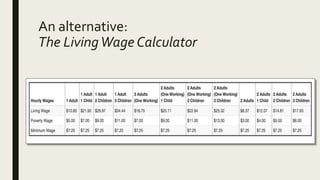
An alternative:
The LivingWage Calculator
Typical expenses in Centre County
Typical salaries in Centre County
http://davidpassmore.wix.com/poverty

Who Is Poor?

  • 1.
    A Discussion Sponsoredby the Social Justice Committee of Good Shepherd Catholic Church WHO IS POOR?
  • 2.
  • 3.
    WHO IS POOR? —If you believe that this is an important question, why? —
  • 4.
    WHO IS POOR? —Whatis your definition of poverty? —
  • 5.
  • 6.
    Before the 20thcentury… ■ Poverty was not a government problem.The issue was left to private charities, local governments, and families. ■ The poor were always with us.They just became more conspicuous as populations concentrated in cities. ■ The English Poor Law of 1601 established a right for public assistance for: – Poor children, who received skills training – Able-bodied adults, who received employment – Elderly or disabled (considered the “worthy poor”), who received “relief.”
  • 7.
    Involvement of federal government Federal EmergencyReliefAct of 1933 — public assistance to the most “deserving poor” Social SecurityAct of 1935 — covered a wide range of contingencies that predispose poverty: old age, physical disabilities, unemployment, widowhood, and dependent children.
  • 8.
    Involvement of federal government Federal EmergencyReliefAct of 1933 — public assistance to the most “deserving poor” Social SecurityAct of 1935 — covered a wide range of contingencies that predispose poverty: old age, physical disabilities, unemployment, widowhood, and dependent children. Introduced relief programs and services for unemployed adults such as public work schemes, vocational training, and food coupons.
  • 9.
    War on Poverty Expansion ofgovernment- supported program and services focusing on education, health, housing, and employment-related measure, including work training and work incentives.
  • 10.
    Rolling back in theU.S. Triggered in part by rise of neoconservative socioeconomic thought and partly by increasing welfare expenditures amid economic problems.
  • 11.
    Rolling back in theU.S. Triggered in part by rise of neoconservative socioeconomic thought and partly by increasing welfare expenditures amid economic problems. Strategic withdrawal of federal government from direct provision of welfare services through devolution of responsibilities to the states, increasing reliance on private markets and the family as primary mechanisms for poverty alleviation, and negation of the principle of welfare entitlement for unemployed, able-bodied adults and parents with dependent children.
  • 12.
    Personal Responsibility andWork OpportunityReconciliation Act (1996) ■ Considered a cornerstone of Republican Contract with America. ■ Signed into law by BillClinton to fulfill a campaign promise to "end welfare as we have come to know it". ■ Policy now anchored on labor force participation and designs to reduce dependency on public assistance by promoting self-sufficiency. ■ EstablishedTemporary Assistance for Needy Families (TANF) for assistance to needy families: – Assistance limited to 5 years – Conditional on fulfillment of prescribed job training activities – Established Earned IncomeTax Credit, which is a refundable tax credit for low- to moderate- income working individuals and couples, particularly those with children
  • 13.
    Personal Responsibility andWork OpportunityReconciliation Act (1996) ■ Considered a cornerstone of Republican Contract with America. ■ Signed into law by BillClinton to fulfill a campaign promise to "end welfare as we have come to know it". ■ Policy now anchored on labor force participation and designs to reduce dependency on public assistance by promoting self-sufficiency. ■ EstablishedTemporary Assistance for Needy Families (TANF) for assistance to needy families: – Assistance limited to 5 years – Conditional on fulfillment of prescribed job training activities – Established Earned IncomeTax Credit, which is a refundable tax credit for low- to moderate- income working individuals and couples, particularly those with children Skepticism is widespread, however, regarding the capacity of private markets to generate living wage jobs for the poor. “Asset-based” approaches are emerging for individual development accounts and microenterprises. But, the effectiveness of these poverty alleviation strategies is yet to be documented.
  • 14.
  • 15.
    Mollie Orshansky (January 9, 1915– December 18, 2006) An American economist and statistician who, in 1963–65, developed the Orshansky Poverty Thresholds, which are used in the United States as a measure of the income that a household must not exceed to be counted as poor.
  • 16.
    Mollie Orshansky (January 9, 1915– December 18, 2006) An American economist and statistician who, in 1963–65, developed the Orshansky Poverty Thresholds, which are used in the United States as a measure of the income that a household must not exceed to be counted as poor. Assumption is poverty exists if access to financial resources is insufficient to acquire enough commodities to meet basic materials needs to ensure life.
  • 17.
    Orshansky PovertyThresholds ■ Involvesestimating an income threshold that is required to obtain a minimum standard of living. ■ A household with income below the threshold is considered poor. ■ Orshansky’s measure was adopted in 1968 by the U.S. Bureau of the Budget as the official U.S. definition of poverty.
  • 18.
    Creating the thresholds ■Based on the cost of predetermined food items by the U.S. Department ofAgriculture as essential to provide necessary calories to ensure normal functioning. ■ The cost of the basket of food items was multiplied by three to cover the costs of basic nonfood items such as housing, clothing, and transportation. ■ Income threshold were built that accounted for households with different family sizes and compositions. ■ Farm and nonfarm thresholds were established separately, as they were for various regions of the U.S. ■ The incidence of poverty is the percentage of households below the thresholds. ■ The depth of poverty is the extent to which average income in poor households differes from the thresholds.
  • 19.
    In Centre County 18.3% forWhiteNon-Hispanic residents, 39.7% for Black residents, 33.4% for Hispanic or Latino residents, 17.5% for American Indian residents, 16.7% for Native Hawaiian and other Pacific Islander residents, 28.1% for other race residents, 29.7% for two or more races residents.
  • 20.
    In Centre County 18.3% forWhiteNon-Hispanic residents, 39.7% for Black residents, 33.4% for Hispanic or Latino residents, 17.5% for American Indian residents, 16.7% for Native Hawaiian and other Pacific Islander residents, 28.1% for other race residents, 29.7% for two or more races residents. The official poverty measure is used to count the poor and to estimate the depth of their poverty. It also is used to determine financial eligibility for income- tested federal programs and for other administrative purposes.
  • 21.
    Many believe thatthe official measure is flawed ■ Official measure assumes about 1/3 of income is spent on food. Now, food comprises about 1/7 of family expenses, while costs for housing, child care, health care and transportation have soared. ■ Measure does not count assets. ■ Measure does not consider the Earned IncomeTax Credit as well as in-kind government benefits that assist low-income families – food stamps, Medicaid, and housing and child care assistance. ■ Measure uses before-deduction income.
  • 22.
  • 23.
    Typical expenses inCentre County
  • 24.
    Typical salaries inCentre County
  • 25.