Profitability Utilizing a Balanced
Scorecard
WHITEPAPER
©Copyright RK Fischer & Associates, 2010-2019. All Rights Reserved
6/18/2019
Profitability Utilizing a Balanced Scorecard
©Copyright RK Fischer & Associates, 2010-2019. All Rights Reserved
1
Contents
RK Fischer & Associates Overview....................................................................................2
Our Partners....................................................................................................................3
RUDY FISCHER .............................................................................................................3
KAREN FISCHER ...........................................................................................................4
Overview .............................................................................................................................6
Self –Assessment................................................................................................................8
Balanced Scorecard Process.............................................................................................9
Strategic Thinking.............................................................................................................11
Conclusion ........................................................................................................................15
6/18/2019
Profitability Utilizing a Balanced Scorecard
©Copyright RK Fischer & Associates, 2010-2019. All Rights Reserved
2
RK Fischer & Associates Overview
RK Fischer & Associates is a business consulting and coaching firm that helps
business owners increase value in their business by improving their operational
and bottom-line financial performance which enables them to achieve profitable
growth. All of the services we provide are focused on meeting those goals for every
stage of a business.
We offer and deliver our services in multiple formats to meet the needs of our
clients and how they choose to learn through a combination of facilitation,
coaching, consulting, coaching with consulting, and training. Our services assist you,
so you can focus on working more "on your business." Though we are located
within Southwestern Ontario, we can provide many of our services to businesses
remotely across Canada.
As business advisors, our primary focus is on owner-operated businesses who are
under 150 employees. Our two partners have significant managerial and executive
experience in complex businesses, such as manufacturing, hi-technology (Fintech,
SaaS), business services, as well as financial services. We have worked with clients
in a variety of industries from retail, construction, transportation, manufacturing,
professional services, healthcare, recreation, and food & beverage, to name a few.
We work directly with the business owner to understand their specific business
goals and challenges, so we can implement the right solutions ensuring you have
continued long-term success.
We have associations and affiliations with other professionals such as lawyers,
financial accountants, business brokers, business valuators, lenders, and other
service providers who help us in providing you with one-stop-shopping for your
business requirements.
Our goal is to bring clarity and focus to your business.
Visit us at www.rkfischer.com, to find out more about all of our offerings and how
we may help you with your business, or contact us at info@rkfischer.com.
6/18/2019
Profitability Utilizing a Balanced Scorecard
©Copyright RK Fischer & Associates, 2010-2019. All Rights Reserved
3
Our Partners
RUDY FISCHER
Rudy Fischer is a management accountant with a CPA, CMA designation who works
closely with our clients to help them improve the financial health of their business.
Management accountants focus on your financials going forward and create value
for your business by combining strategic planning, performance management
(financial & non-financial), and expertise in providing owners with the intelligence
they need to grow their business. He will work closely with your financial
accountant in understanding the financial history of your business, which is their
focus.
Rudy has over 25 years' experience in the hi-technology sector in finance,
manufacturing, engineering, product management and marketing disciplines. He
has held executive management positions with Everlink Payment Services, Rogers
Communications, Sprint Canada, Nortel Networks, Newbridge Networks and Mitel,
where he was responsible for various business units.
Rudy has expertise in planning, managing, and marketing products through all
stages of the product life-cycle, including setting strategic direction along with the
building and directing of the teams who will accomplish the necessary goals. Rudy
has launched and been responsible for taking many new products to market
including small business voice systems, wireless solutions, data centres, enhanced
voice services, fixed-mobile convergence, card payment solutions, and financial
transaction acquiring solutions.
Rudy was a Board Member, Member of Audit Committee, and past Chair of the
Audit Committee for the Education Credit Union in Kitchener, Ontario from 2013 to
2017. He currently is a Board Member of Southwest Regional Credit Union. He
holds a designation of an Accredited Canadian Credit Union Director (ACCUD).
He volunteered before moving from the GTA for the BACD in Durham Region
where he acted as a mentor for their clients and provided training as needed. He is
a mentor for Futurepreneur.
6/18/2019
Profitability Utilizing a Balanced Scorecard
©Copyright RK Fischer & Associates, 2010-2019. All Rights Reserved
4
KAREN FISCHER
Karen started RK Fischer & Associates in January of 2010 after 25 years of success in
marketing, sales, channel development and general management with the hi-tech,
business services and manufacturing sectors. She held management or executive
management roles for companies such as Cognos, Entrust, Mitel, Siemens, and
Pitney Bowes. In the last six years of her career before starting RK Fischer &
Associates with her business partner, she held start-up Executive roles that
included help with plans for financing and acquisition. Based on this experience,
Karen felt the small & medium business market was underserved by the consulting
industry. She found most firms focus on larger businesses and if they do acquire a
smaller client they try to implement large business methodologies in the small
business, which is not a fit for most businesses under $25M in revenues.
Karen is passionate about having the chance to help business owners whether that
is through growth, increased profitability, or obtaining financing. She is happy to
share her expertise and experience that she gained from her prior career with
business owners to help them and their businesses flourish. Since the time she
started RK Fischer & Associates, she has built strong partnerships in the GTA with
other professionals that offer complementary services.
Karen is a past Member of the Board of Directors for the Business Advisory Centre
of Durham Region where she held the position of Secretary/Treasurer. This is the
small business centre that serves the region of Durham.
She served on the Membership, Marketing and Event Committees for the Ajax-
Pickering Board of Trade and was responsible for the development of their
Professional Development Series. She filled in for a semester at Durham College for
a professor on leave and developed and delivered a Digital Marketing course to the
Entrepreneurship Program. She also volunteered as a mentor for BACD and
provides training as required.
6/18/2019
Profitability Utilizing a Balanced Scorecard
©Copyright RK Fischer & Associates, 2010-2019. All Rights Reserved
5
Upon moving to Southwestern Ontario, Karen has become a Board Member for the
Sarnia Lambton Chamber of Commerce and she volunteers for the Chamber on the
Business After 5 Committee.
6/18/2019
Profitability Utilizing a Balanced Scorecard
©Copyright RK Fischer & Associates, 2010-2019. All Rights Reserved
6
Overview
I do not know who said it, but I always liked it – “Revenue is the reward you reap for
satisfying customer requirements; Profit is the reward you reap by doing things
well”. This is so true when it comes to business. The only objective of a business is
to make money. As an owner and/or a partner you are obligated to grow the
business beyond the rate of inflation or else you will see declining returns. If you
cannot grow beyond inflation, you may as well keep your money in bonds.
There are a few components to consider when assessing profitability:
1) Revenue – the reward you reap for satisfying customer requirements,
2) Costs – things you need to do to support the revenue line. I once worked for
a person who claimed all expenses were controllable and variable except for
his salary, and
3) Capital - not an expense per se, however it will show back up on your
income statement later on – in most cases.
Once a quarter we need to review how we have been selling and spending money
to determine if we have made a profit. Once a year we need to enter a planning
cycle to weave all revenues, cost types, and capital items to develop our budget. At
this point, it is all academic. We have planned, we have done, we have made profit
or we have made money.
Life happens. Economies change, people change, the market changes, competitors
come and go, customers come and go and other external forces act on us to make
our business life miserable. The only thing that is constant is change. We find
ourselves always fighting fires – fires which keep us from doing what we really want
to do yet we must continuously review our business to determine what we want to
be when we grow up. Some would say that a balanced score card (BSC) will help
you achieve that goal. I submit that although the BSC is important; there is
something more important that must be done before you go down the BSC path.
There is a very strong self-assessment and capability analysis that must be
undertaken first.
Without taking the proper path to the BSC, the BSC will become meaningless. The
analogy is: it is not the destination that is important, but the path we seek. Make no
6/18/2019
Profitability Utilizing a Balanced Scorecard
©Copyright RK Fischer & Associates, 2010-2019. All Rights Reserved
7
mistake about it, the goal is to make money; there is no need to plan a trip if you
don’t know where you are going, but there are many paths to a destination. Some
paths are fast and expensive, some paths are smooth and long, and other paths
may be filled with roadblock and detours, but eventually you will wind up getting to
where you want to go. We need to assess in ourselves and determine which path
suits us best for the position we are in. This is kind of like planning your next family
vacation.
6/18/2019
Profitability Utilizing a Balanced Scorecard
©Copyright RK Fischer & Associates, 2010-2019. All Rights Reserved
8
Self –Assessment
The self-assessment will require many questions to be asked and answered. The
answers you provide will impact your short term, medium term and longer term
plans and requirements. These answers could also significantly impact you cash
requirements over the foreseeable future. Very important; your cash requirements
will determine what you can afford to do. You should never under-estimate what
you can afford to do.
A good thing to keep in mind is what activities consume resources and resources
consume costs. Activities keep us busy – activities also cost us money – keeping too
busy can drive you bankrupt. This is a bit dramatic, however if you do not keep an
eye on the things that are 1) going on in your organization, or 2) things that you
expect to get done. If you don’t, you risk losing control of your profitability. You
may not always be able to control your revenue line, but you will always be able to
control your expense line over the long term – it’s the only profit leaver you really
have 100% control over.
When planning for your next growth spurt or even making yourself more attractive
for acquisition, you need to set your books up correctly. You need to have a
healthy growth plan with the confidence to pull it off. Taking control is the first
thing. If you want to improve your business then you need to control it, if you want
to control it, you need to measure it, if you want to measure it, then you need to
understand it. This understanding is the basis of a strong well thought out balanced
scorecard that has a chance of succeeding in our continuously changing world we
operate in. Just how do you keep your business going while preparing for growth,
acquisition or toughing it out in recessionary times?
6/18/2019
Profitability Utilizing a Balanced Scorecard
©Copyright RK Fischer & Associates, 2010-2019. All Rights Reserved
9
Balanced Scorecard Process
A BSC will help you out here, it is not the answer; rather the process you need to
follow in developing the BSC is what is key.
The process should start with the end in mind.
1. What do you need to have accomplished in the next 3-5 years? (sell
business, double business or diversification)
2. Financially what do you need to look like in 3-5 years from now?
3. From a customer perspective, what do you need to look like?
4. From a company and operations perspective what do you need to look
like?
5. Is this a doable or sustainable model that you can rely on?
Now that you know where you want to be, you need to know where you are now in
terms of the same questions asked above.
1. What do you have on your plate to accomplish now? (meet sales, launch
product)
2. Financially what do you look like now? (Debt free? Lots of cash?)
3. From a customer perspective, what do you look like? (100% satisfaction?)
4. From a company and operations perspective what do you look like?
5. Is this a doable or sustainable model that you can rely on today?
There are many sub-questions to each of these perspectives. It will take you days if
not weeks to properly collect all of the data to support your assertions from a ‘what
are you today’ perspective. (Larger companies will likely take longer due to the fact
that there are more people
6/18/2019
Profitability Utilizing a Balanced Scorecard
©Copyright RK Fischer & Associates, 2010-2019. All Rights Reserved
10
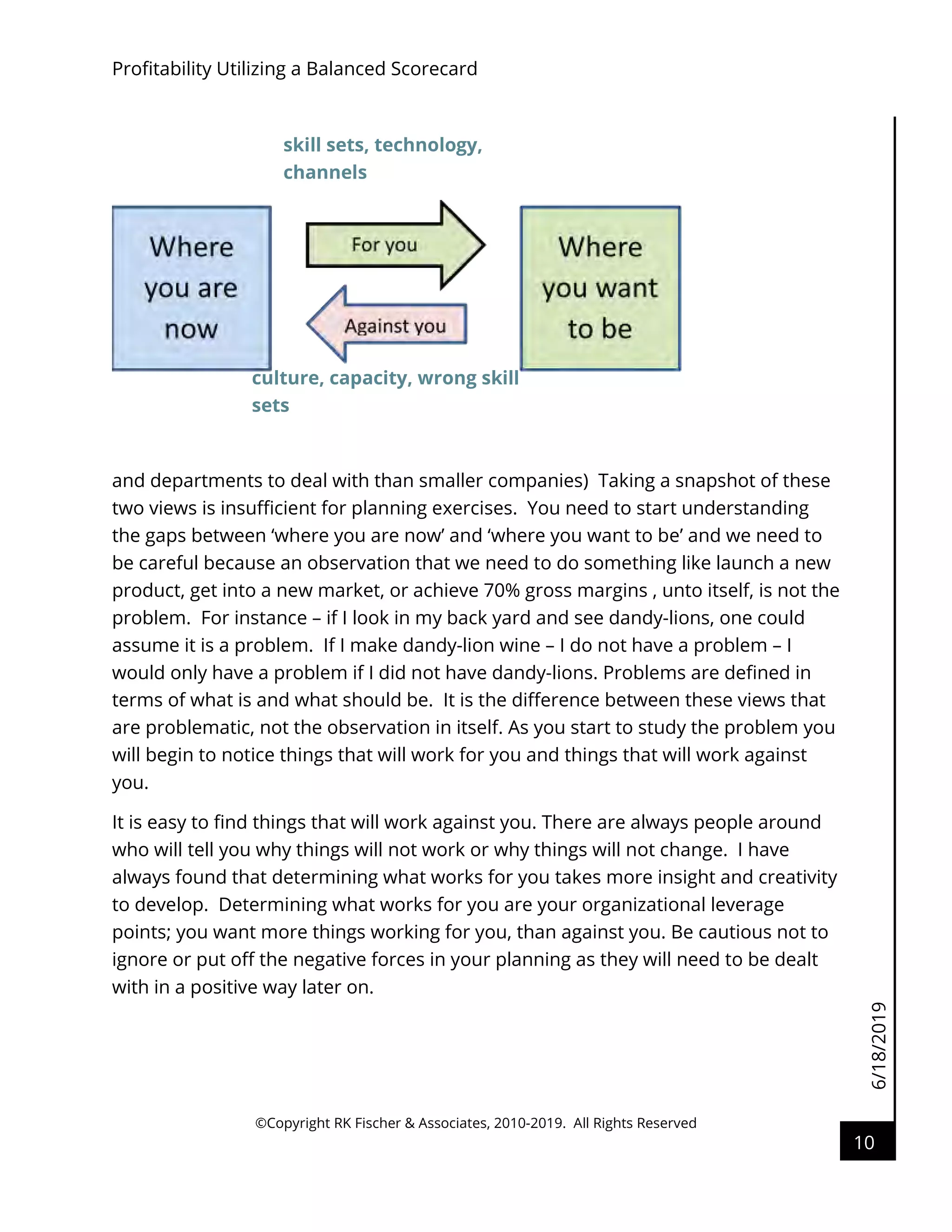
and departments to deal with than smaller companies) Taking a snapshot of these
two views is insufficient for planning exercises. You need to start understanding
the gaps between ‘where you are now’ and ‘where you want to be’ and we need to
be careful because an observation that we need to do something like launch a new
product, get into a new market, or achieve 70% gross margins , unto itself, is not the
problem. For instance – if I look in my back yard and see dandy-lions, one could
assume it is a problem. If I make dandy-lion wine – I do not have a problem – I
would only have a problem if I did not have dandy-lions. Problems are defined in
terms of what is and what should be. It is the difference between these views that
are problematic, not the observation in itself. As you start to study the problem you
will begin to notice things that will work for you and things that will work against
you.
It is easy to find things that will work against you. There are always people around
who will tell you why things will not work or why things will not change. I have
always found that determining what works for you takes more insight and creativity
to develop. Determining what works for you are your organizational leverage
points; you want more things working for you, than against you. Be cautious not to
ignore or put off the negative forces in your planning as they will need to be dealt
with in a positive way later on.
culture, capacity, wrong skill
sets
skill sets, technology,
channels
6/18/2019
Profitability Utilizing a Balanced Scorecard
©Copyright RK Fischer & Associates, 2010-2019. All Rights Reserved
11
Strategic Thinking
The next step involves some strategic thinking; you must now develop the major
themes that are required to enhance the performance of the company in terms of
meeting your 3-5 year goals. Are you going to become more customer intimate, will
you seek operational excellence, or strive for technical leadership in your industry?
You cannot do them all – so pick one – or use a modification of two items;
companies that succeed are focused – that is an industry accepted fact. This choice
will drive answers to what and how you will shape your company for the future.
Translating strategy to execution is a more complex process than most people are
willing to admit. Some think drawing the strategy map will do this translation for
you – it will not – you need to do it. You can get help to do this, but as owners and
operators, this is a responsibility you cannot delegate to a strategy map, balanced
scorecard or a consultant – you own it.
Once you have an idea that you want to grow 15-20%/year for the next 3-5 years
utilizing a customer intimacy strategy, how are you going to accomplish this? Do
you think your competitors will idly stand by and let you take their customers? Do
you believe your employees (front line) know exactly what they need to do to
achieve success? How do your employees job descriptions, goals and objectives
and the daily tasks they perform map against “customer intimacy”? What does
complete look like to your call center agents, or your engineers or accounting staff?
I will use a simple example to illustrate the complexity of the situation. In the
number of companies I have worked for; they all seemed to have fallen into this
trap at one time or another; some with negative implications, others with
annoyance factors which crept into their plans resulting in a plan as you go
strategy.
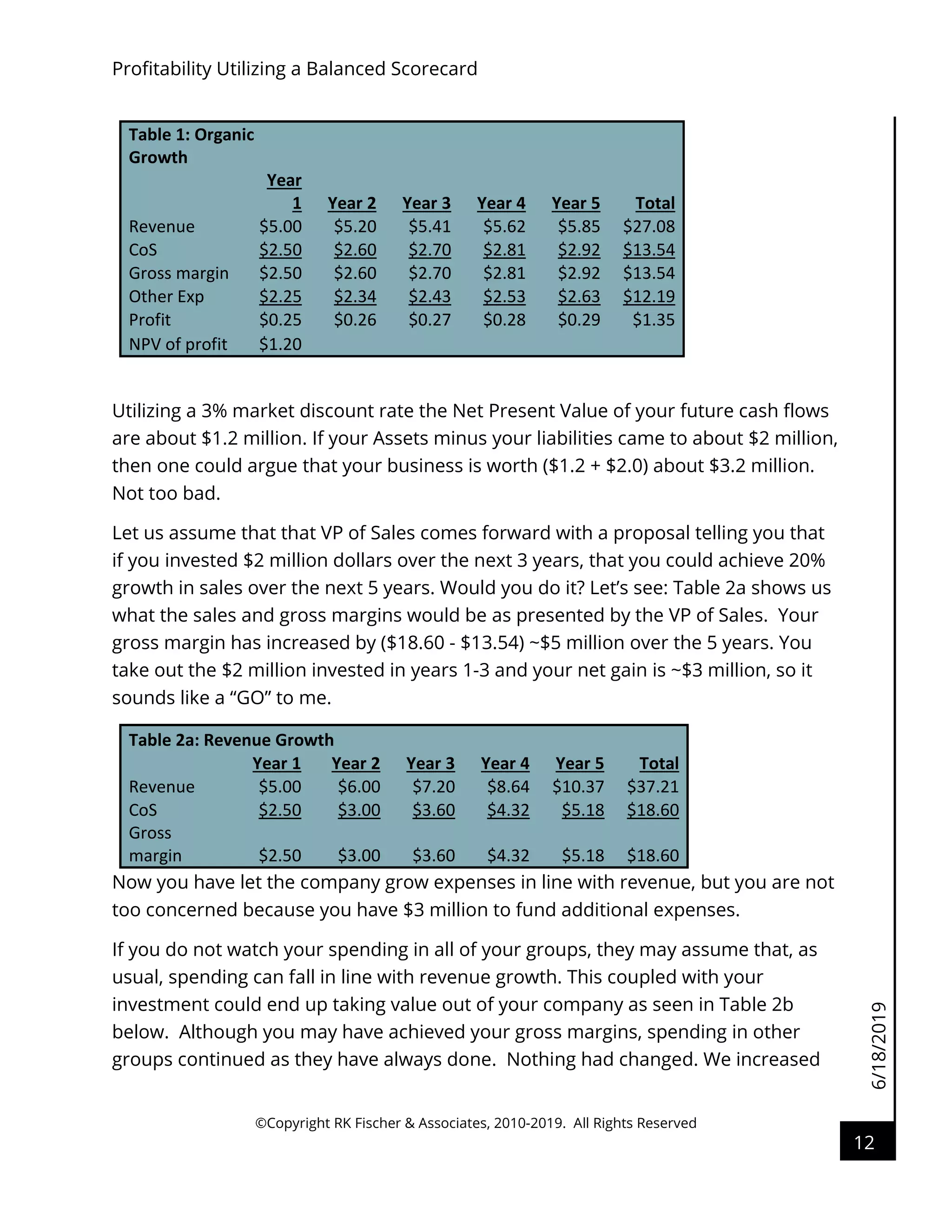
Say you are a $20 Million company that is experiencing around 4% Compounded
Annual Growth Rate (CAGR). Assume that the market is growing at a CAGR of about
3%. Assume you allow you expenses to keep in line with your revenues but you
expect earnings growth to follow track as well. Your simplified income statement
could probably look like that seen in Table1.
6/18/2019
Profitability Utilizing a Balanced Scorecard
©Copyright RK Fischer & Associates, 2010-2019. All Rights Reserved
12
Table 1: Organic
Growth
Year
1 Year 2 Year 3 Year 4 Year 5 Total
Revenue $5.00 $5.20 $5.41 $5.62 $5.85 $27.08
CoS $2.50 $2.60 $2.70 $2.81 $2.92 $13.54
Gross margin $2.50 $2.60 $2.70 $2.81 $2.92 $13.54
Other Exp $2.25 $2.34 $2.43 $2.53 $2.63 $12.19
Profit $0.25 $0.26 $0.27 $0.28 $0.29 $1.35
NPV of profit $1.20
Utilizing a 3% market discount rate the Net Present Value of your future cash flows
are about $1.2 million. If your Assets minus your liabilities came to about $2 million,
then one could argue that your business is worth ($1.2 + $2.0) about $3.2 million.
Not too bad.
Let us assume that that VP of Sales comes forward with a proposal telling you that
if you invested $2 million dollars over the next 3 years, that you could achieve 20%
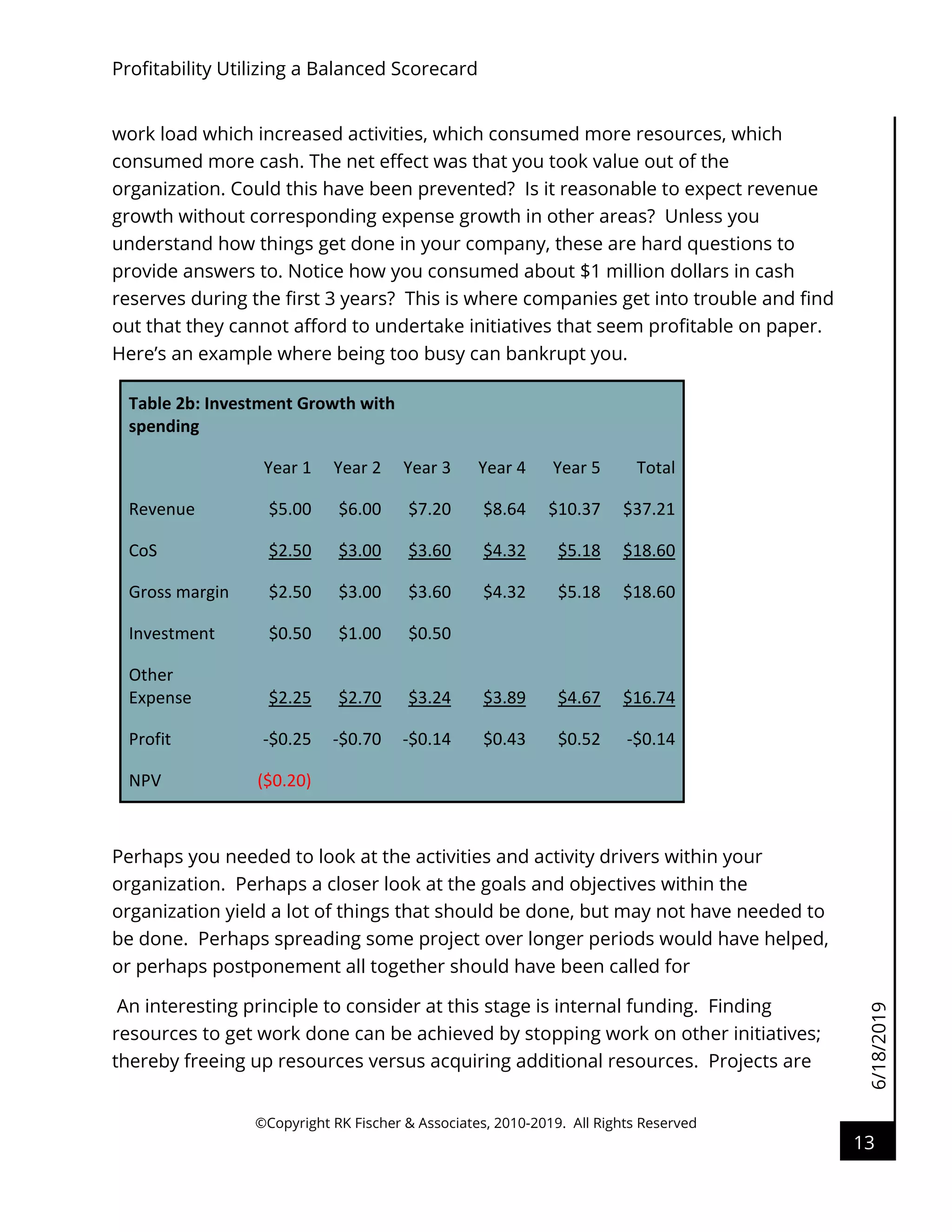
growth in sales over the next 5 years. Would you do it? Let’s see: Table 2a shows us
what the sales and gross margins would be as presented by the VP of Sales. Your
gross margin has increased by ($18.60 - $13.54) ~$5 million over the 5 years. You
take out the $2 million invested in years 1-3 and your net gain is ~$3 million, so it
sounds like a “GO” to me.
Table 2a: Revenue Growth
Year 1 Year 2 Year 3 Year 4 Year 5 Total
Revenue $5.00 $6.00 $7.20 $8.64 $10.37 $37.21
CoS $2.50 $3.00 $3.60 $4.32 $5.18 $18.60
Gross
margin $2.50 $3.00 $3.60 $4.32 $5.18 $18.60
Now you have let the company grow expenses in line with revenue, but you are not
too concerned because you have $3 million to fund additional expenses.
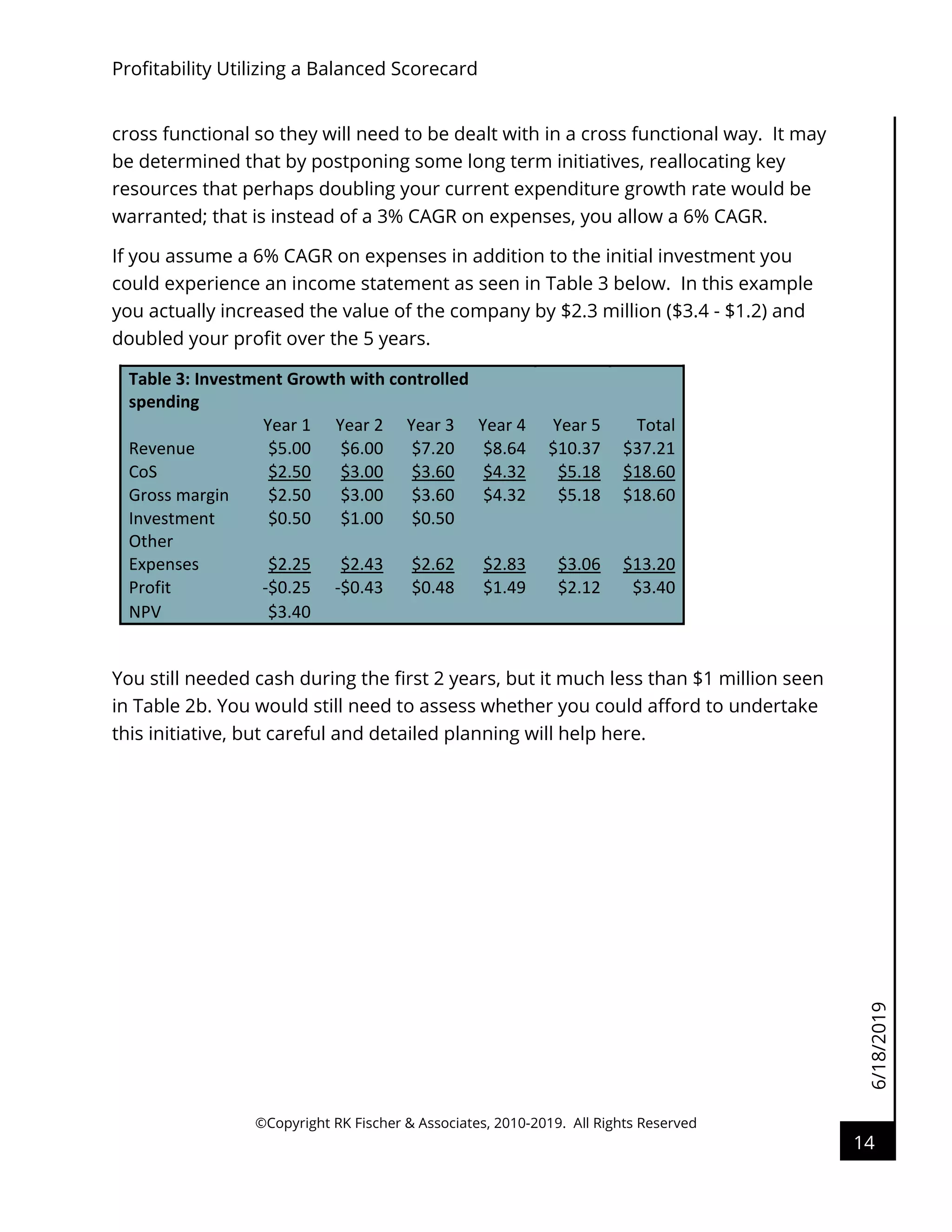
If you do not watch your spending in all of your groups, they may assume that, as
usual, spending can fall in line with revenue growth. This coupled with your
investment could end up taking value out of your company as seen in Table 2b
below. Although you may have achieved your gross margins, spending in other
groups continued as they have always done. Nothing had changed. We increased
6/18/2019
Profitability Utilizing a Balanced Scorecard
©Copyright RK Fischer & Associates, 2010-2019. All Rights Reserved
13
work load which increased activities, which consumed more resources, which
consumed more cash. The net effect was that you took value out of the
organization. Could this have been prevented? Is it reasonable to expect revenue
growth without corresponding expense growth in other areas? Unless you
understand how things get done in your company, these are hard questions to
provide answers to. Notice how you consumed about $1 million dollars in cash
reserves during the first 3 years? This is where companies get into trouble and find
out that they cannot afford to undertake initiatives that seem profitable on paper.
Here’s an example where being too busy can bankrupt you.
Table 2b: Investment Growth with
spending
Year 1 Year 2 Year 3 Year 4 Year 5 Total
Revenue $5.00 $6.00 $7.20 $8.64 $10.37 $37.21
CoS $2.50 $3.00 $3.60 $4.32 $5.18 $18.60
Gross margin $2.50 $3.00 $3.60 $4.32 $5.18 $18.60
Investment $0.50 $1.00 $0.50
Other
Expense $2.25 $2.70 $3.24 $3.89 $4.67 $16.74
Profit -$0.25 -$0.70 -$0.14 $0.43 $0.52 -$0.14
NPV ($0.20)
Perhaps you needed to look at the activities and activity drivers within your
organization. Perhaps a closer look at the goals and objectives within the
organization yield a lot of things that should be done, but may not have needed to
be done. Perhaps spreading some project over longer periods would have helped,
or perhaps postponement all together should have been called for
An interesting principle to consider at this stage is internal funding. Finding
resources to get work done can be achieved by stopping work on other initiatives;
thereby freeing up resources versus acquiring additional resources. Projects are
6/18/2019
Profitability Utilizing a Balanced Scorecard
©Copyright RK Fischer & Associates, 2010-2019. All Rights Reserved
14
cross functional so they will need to be dealt with in a cross functional way. It may
be determined that by postponing some long term initiatives, reallocating key
resources that perhaps doubling your current expenditure growth rate would be
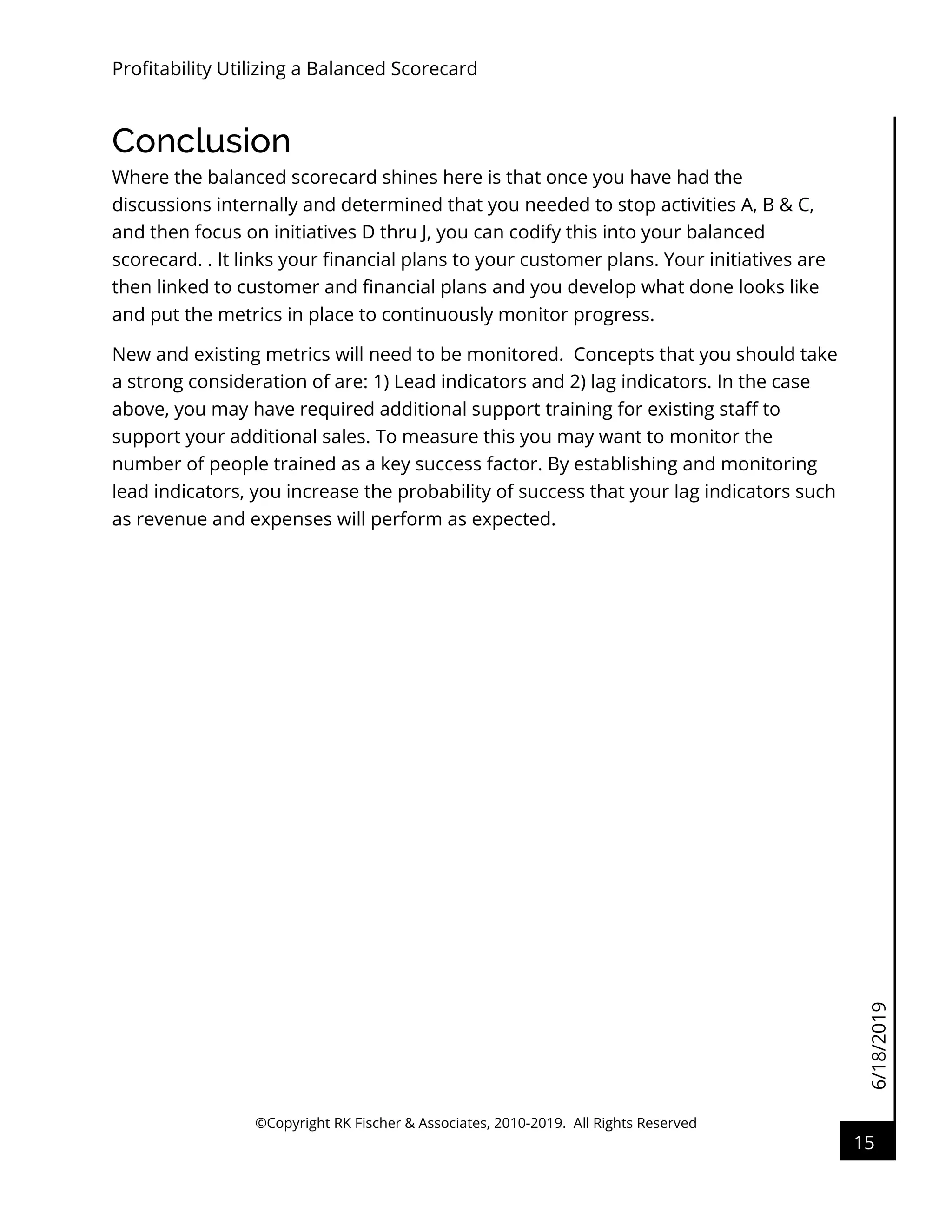
warranted; that is instead of a 3% CAGR on expenses, you allow a 6% CAGR.
If you assume a 6% CAGR on expenses in addition to the initial investment you
could experience an income statement as seen in Table 3 below. In this example
you actually increased the value of the company by $2.3 million ($3.4 - $1.2) and
doubled your profit over the 5 years.
Table 3: Investment Growth with controlled
spending
Year 1 Year 2 Year 3 Year 4 Year 5 Total
Revenue $5.00 $6.00 $7.20 $8.64 $10.37 $37.21
CoS $2.50 $3.00 $3.60 $4.32 $5.18 $18.60
Gross margin $2.50 $3.00 $3.60 $4.32 $5.18 $18.60
Investment $0.50 $1.00 $0.50
Other
Expenses $2.25 $2.43 $2.62 $2.83 $3.06 $13.20
Profit -$0.25 -$0.43 $0.48 $1.49 $2.12 $3.40
NPV $3.40
You still needed cash during the first 2 years, but it much less than $1 million seen
in Table 2b. You would still need to assess whether you could afford to undertake
this initiative, but careful and detailed planning will help here.
6/18/2019
Profitability Utilizing a Balanced Scorecard
©Copyright RK Fischer & Associates, 2010-2019. All Rights Reserved
15
Conclusion
Where the balanced scorecard shines here is that once you have had the
discussions internally and determined that you needed to stop activities A, B & C,
and then focus on initiatives D thru J, you can codify this into your balanced
scorecard. . It links your financial plans to your customer plans. Your initiatives are
then linked to customer and financial plans and you develop what done looks like
and put the metrics in place to continuously monitor progress.
New and existing metrics will need to be monitored. Concepts that you should take
a strong consideration of are: 1) Lead indicators and 2) lag indicators. In the case
above, you may have required additional support training for existing staff to
support your additional sales. To measure this you may want to monitor the
number of people trained as a key success factor. By establishing and monitoring
lead indicators, you increase the probability of success that your lag indicators such
as revenue and expenses will perform as expected.

Whitepaper: Profitability Utilizing a Balanced Scorecard

  • 1.
    Profitability Utilizing aBalanced Scorecard WHITEPAPER ©Copyright RK Fischer & Associates, 2010-2019. All Rights Reserved
  • 2.
    6/18/2019 Profitability Utilizing aBalanced Scorecard ©Copyright RK Fischer & Associates, 2010-2019. All Rights Reserved 1 Contents RK Fischer & Associates Overview....................................................................................2 Our Partners....................................................................................................................3 RUDY FISCHER .............................................................................................................3 KAREN FISCHER ...........................................................................................................4 Overview .............................................................................................................................6 Self –Assessment................................................................................................................8 Balanced Scorecard Process.............................................................................................9 Strategic Thinking.............................................................................................................11 Conclusion ........................................................................................................................15
  • 3.
    6/18/2019 Profitability Utilizing aBalanced Scorecard ©Copyright RK Fischer & Associates, 2010-2019. All Rights Reserved 2 RK Fischer & Associates Overview RK Fischer & Associates is a business consulting and coaching firm that helps business owners increase value in their business by improving their operational and bottom-line financial performance which enables them to achieve profitable growth. All of the services we provide are focused on meeting those goals for every stage of a business. We offer and deliver our services in multiple formats to meet the needs of our clients and how they choose to learn through a combination of facilitation, coaching, consulting, coaching with consulting, and training. Our services assist you, so you can focus on working more "on your business." Though we are located within Southwestern Ontario, we can provide many of our services to businesses remotely across Canada. As business advisors, our primary focus is on owner-operated businesses who are under 150 employees. Our two partners have significant managerial and executive experience in complex businesses, such as manufacturing, hi-technology (Fintech, SaaS), business services, as well as financial services. We have worked with clients in a variety of industries from retail, construction, transportation, manufacturing, professional services, healthcare, recreation, and food & beverage, to name a few. We work directly with the business owner to understand their specific business goals and challenges, so we can implement the right solutions ensuring you have continued long-term success. We have associations and affiliations with other professionals such as lawyers, financial accountants, business brokers, business valuators, lenders, and other service providers who help us in providing you with one-stop-shopping for your business requirements. Our goal is to bring clarity and focus to your business. Visit us at www.rkfischer.com, to find out more about all of our offerings and how we may help you with your business, or contact us at info@rkfischer.com.
  • 4.
    6/18/2019 Profitability Utilizing aBalanced Scorecard ©Copyright RK Fischer & Associates, 2010-2019. All Rights Reserved 3 Our Partners RUDY FISCHER Rudy Fischer is a management accountant with a CPA, CMA designation who works closely with our clients to help them improve the financial health of their business. Management accountants focus on your financials going forward and create value for your business by combining strategic planning, performance management (financial & non-financial), and expertise in providing owners with the intelligence they need to grow their business. He will work closely with your financial accountant in understanding the financial history of your business, which is their focus. Rudy has over 25 years' experience in the hi-technology sector in finance, manufacturing, engineering, product management and marketing disciplines. He has held executive management positions with Everlink Payment Services, Rogers Communications, Sprint Canada, Nortel Networks, Newbridge Networks and Mitel, where he was responsible for various business units. Rudy has expertise in planning, managing, and marketing products through all stages of the product life-cycle, including setting strategic direction along with the building and directing of the teams who will accomplish the necessary goals. Rudy has launched and been responsible for taking many new products to market including small business voice systems, wireless solutions, data centres, enhanced voice services, fixed-mobile convergence, card payment solutions, and financial transaction acquiring solutions. Rudy was a Board Member, Member of Audit Committee, and past Chair of the Audit Committee for the Education Credit Union in Kitchener, Ontario from 2013 to 2017. He currently is a Board Member of Southwest Regional Credit Union. He holds a designation of an Accredited Canadian Credit Union Director (ACCUD). He volunteered before moving from the GTA for the BACD in Durham Region where he acted as a mentor for their clients and provided training as needed. He is a mentor for Futurepreneur.
  • 5.
    6/18/2019 Profitability Utilizing aBalanced Scorecard ©Copyright RK Fischer & Associates, 2010-2019. All Rights Reserved 4 KAREN FISCHER Karen started RK Fischer & Associates in January of 2010 after 25 years of success in marketing, sales, channel development and general management with the hi-tech, business services and manufacturing sectors. She held management or executive management roles for companies such as Cognos, Entrust, Mitel, Siemens, and Pitney Bowes. In the last six years of her career before starting RK Fischer & Associates with her business partner, she held start-up Executive roles that included help with plans for financing and acquisition. Based on this experience, Karen felt the small & medium business market was underserved by the consulting industry. She found most firms focus on larger businesses and if they do acquire a smaller client they try to implement large business methodologies in the small business, which is not a fit for most businesses under $25M in revenues. Karen is passionate about having the chance to help business owners whether that is through growth, increased profitability, or obtaining financing. She is happy to share her expertise and experience that she gained from her prior career with business owners to help them and their businesses flourish. Since the time she started RK Fischer & Associates, she has built strong partnerships in the GTA with other professionals that offer complementary services. Karen is a past Member of the Board of Directors for the Business Advisory Centre of Durham Region where she held the position of Secretary/Treasurer. This is the small business centre that serves the region of Durham. She served on the Membership, Marketing and Event Committees for the Ajax- Pickering Board of Trade and was responsible for the development of their Professional Development Series. She filled in for a semester at Durham College for a professor on leave and developed and delivered a Digital Marketing course to the Entrepreneurship Program. She also volunteered as a mentor for BACD and provides training as required.
  • 6.
    6/18/2019 Profitability Utilizing aBalanced Scorecard ©Copyright RK Fischer & Associates, 2010-2019. All Rights Reserved 5 Upon moving to Southwestern Ontario, Karen has become a Board Member for the Sarnia Lambton Chamber of Commerce and she volunteers for the Chamber on the Business After 5 Committee.
  • 7.
    6/18/2019 Profitability Utilizing aBalanced Scorecard ©Copyright RK Fischer & Associates, 2010-2019. All Rights Reserved 6 Overview I do not know who said it, but I always liked it – “Revenue is the reward you reap for satisfying customer requirements; Profit is the reward you reap by doing things well”. This is so true when it comes to business. The only objective of a business is to make money. As an owner and/or a partner you are obligated to grow the business beyond the rate of inflation or else you will see declining returns. If you cannot grow beyond inflation, you may as well keep your money in bonds. There are a few components to consider when assessing profitability: 1) Revenue – the reward you reap for satisfying customer requirements, 2) Costs – things you need to do to support the revenue line. I once worked for a person who claimed all expenses were controllable and variable except for his salary, and 3) Capital - not an expense per se, however it will show back up on your income statement later on – in most cases. Once a quarter we need to review how we have been selling and spending money to determine if we have made a profit. Once a year we need to enter a planning cycle to weave all revenues, cost types, and capital items to develop our budget. At this point, it is all academic. We have planned, we have done, we have made profit or we have made money. Life happens. Economies change, people change, the market changes, competitors come and go, customers come and go and other external forces act on us to make our business life miserable. The only thing that is constant is change. We find ourselves always fighting fires – fires which keep us from doing what we really want to do yet we must continuously review our business to determine what we want to be when we grow up. Some would say that a balanced score card (BSC) will help you achieve that goal. I submit that although the BSC is important; there is something more important that must be done before you go down the BSC path. There is a very strong self-assessment and capability analysis that must be undertaken first. Without taking the proper path to the BSC, the BSC will become meaningless. The analogy is: it is not the destination that is important, but the path we seek. Make no
  • 8.
    6/18/2019 Profitability Utilizing aBalanced Scorecard ©Copyright RK Fischer & Associates, 2010-2019. All Rights Reserved 7 mistake about it, the goal is to make money; there is no need to plan a trip if you don’t know where you are going, but there are many paths to a destination. Some paths are fast and expensive, some paths are smooth and long, and other paths may be filled with roadblock and detours, but eventually you will wind up getting to where you want to go. We need to assess in ourselves and determine which path suits us best for the position we are in. This is kind of like planning your next family vacation.
  • 9.
    6/18/2019 Profitability Utilizing aBalanced Scorecard ©Copyright RK Fischer & Associates, 2010-2019. All Rights Reserved 8 Self –Assessment The self-assessment will require many questions to be asked and answered. The answers you provide will impact your short term, medium term and longer term plans and requirements. These answers could also significantly impact you cash requirements over the foreseeable future. Very important; your cash requirements will determine what you can afford to do. You should never under-estimate what you can afford to do. A good thing to keep in mind is what activities consume resources and resources consume costs. Activities keep us busy – activities also cost us money – keeping too busy can drive you bankrupt. This is a bit dramatic, however if you do not keep an eye on the things that are 1) going on in your organization, or 2) things that you expect to get done. If you don’t, you risk losing control of your profitability. You may not always be able to control your revenue line, but you will always be able to control your expense line over the long term – it’s the only profit leaver you really have 100% control over. When planning for your next growth spurt or even making yourself more attractive for acquisition, you need to set your books up correctly. You need to have a healthy growth plan with the confidence to pull it off. Taking control is the first thing. If you want to improve your business then you need to control it, if you want to control it, you need to measure it, if you want to measure it, then you need to understand it. This understanding is the basis of a strong well thought out balanced scorecard that has a chance of succeeding in our continuously changing world we operate in. Just how do you keep your business going while preparing for growth, acquisition or toughing it out in recessionary times?
  • 10.
    6/18/2019 Profitability Utilizing aBalanced Scorecard ©Copyright RK Fischer & Associates, 2010-2019. All Rights Reserved 9 Balanced Scorecard Process A BSC will help you out here, it is not the answer; rather the process you need to follow in developing the BSC is what is key. The process should start with the end in mind. 1. What do you need to have accomplished in the next 3-5 years? (sell business, double business or diversification) 2. Financially what do you need to look like in 3-5 years from now? 3. From a customer perspective, what do you need to look like? 4. From a company and operations perspective what do you need to look like? 5. Is this a doable or sustainable model that you can rely on? Now that you know where you want to be, you need to know where you are now in terms of the same questions asked above. 1. What do you have on your plate to accomplish now? (meet sales, launch product) 2. Financially what do you look like now? (Debt free? Lots of cash?) 3. From a customer perspective, what do you look like? (100% satisfaction?) 4. From a company and operations perspective what do you look like? 5. Is this a doable or sustainable model that you can rely on today? There are many sub-questions to each of these perspectives. It will take you days if not weeks to properly collect all of the data to support your assertions from a ‘what are you today’ perspective. (Larger companies will likely take longer due to the fact that there are more people
  • 11.
    6/18/2019 Profitability Utilizing aBalanced Scorecard ©Copyright RK Fischer & Associates, 2010-2019. All Rights Reserved 10 and departments to deal with than smaller companies) Taking a snapshot of these two views is insufficient for planning exercises. You need to start understanding the gaps between ‘where you are now’ and ‘where you want to be’ and we need to be careful because an observation that we need to do something like launch a new product, get into a new market, or achieve 70% gross margins , unto itself, is not the problem. For instance – if I look in my back yard and see dandy-lions, one could assume it is a problem. If I make dandy-lion wine – I do not have a problem – I would only have a problem if I did not have dandy-lions. Problems are defined in terms of what is and what should be. It is the difference between these views that are problematic, not the observation in itself. As you start to study the problem you will begin to notice things that will work for you and things that will work against you. It is easy to find things that will work against you. There are always people around who will tell you why things will not work or why things will not change. I have always found that determining what works for you takes more insight and creativity to develop. Determining what works for you are your organizational leverage points; you want more things working for you, than against you. Be cautious not to ignore or put off the negative forces in your planning as they will need to be dealt with in a positive way later on. culture, capacity, wrong skill sets skill sets, technology, channels
  • 12.
    6/18/2019 Profitability Utilizing aBalanced Scorecard ©Copyright RK Fischer & Associates, 2010-2019. All Rights Reserved 11 Strategic Thinking The next step involves some strategic thinking; you must now develop the major themes that are required to enhance the performance of the company in terms of meeting your 3-5 year goals. Are you going to become more customer intimate, will you seek operational excellence, or strive for technical leadership in your industry? You cannot do them all – so pick one – or use a modification of two items; companies that succeed are focused – that is an industry accepted fact. This choice will drive answers to what and how you will shape your company for the future. Translating strategy to execution is a more complex process than most people are willing to admit. Some think drawing the strategy map will do this translation for you – it will not – you need to do it. You can get help to do this, but as owners and operators, this is a responsibility you cannot delegate to a strategy map, balanced scorecard or a consultant – you own it. Once you have an idea that you want to grow 15-20%/year for the next 3-5 years utilizing a customer intimacy strategy, how are you going to accomplish this? Do you think your competitors will idly stand by and let you take their customers? Do you believe your employees (front line) know exactly what they need to do to achieve success? How do your employees job descriptions, goals and objectives and the daily tasks they perform map against “customer intimacy”? What does complete look like to your call center agents, or your engineers or accounting staff? I will use a simple example to illustrate the complexity of the situation. In the number of companies I have worked for; they all seemed to have fallen into this trap at one time or another; some with negative implications, others with annoyance factors which crept into their plans resulting in a plan as you go strategy. Say you are a $20 Million company that is experiencing around 4% Compounded Annual Growth Rate (CAGR). Assume that the market is growing at a CAGR of about 3%. Assume you allow you expenses to keep in line with your revenues but you expect earnings growth to follow track as well. Your simplified income statement could probably look like that seen in Table1.
  • 13.
    6/18/2019 Profitability Utilizing aBalanced Scorecard ©Copyright RK Fischer & Associates, 2010-2019. All Rights Reserved 12 Table 1: Organic Growth Year 1 Year 2 Year 3 Year 4 Year 5 Total Revenue $5.00 $5.20 $5.41 $5.62 $5.85 $27.08 CoS $2.50 $2.60 $2.70 $2.81 $2.92 $13.54 Gross margin $2.50 $2.60 $2.70 $2.81 $2.92 $13.54 Other Exp $2.25 $2.34 $2.43 $2.53 $2.63 $12.19 Profit $0.25 $0.26 $0.27 $0.28 $0.29 $1.35 NPV of profit $1.20 Utilizing a 3% market discount rate the Net Present Value of your future cash flows are about $1.2 million. If your Assets minus your liabilities came to about $2 million, then one could argue that your business is worth ($1.2 + $2.0) about $3.2 million. Not too bad. Let us assume that that VP of Sales comes forward with a proposal telling you that if you invested $2 million dollars over the next 3 years, that you could achieve 20% growth in sales over the next 5 years. Would you do it? Let’s see: Table 2a shows us what the sales and gross margins would be as presented by the VP of Sales. Your gross margin has increased by ($18.60 - $13.54) ~$5 million over the 5 years. You take out the $2 million invested in years 1-3 and your net gain is ~$3 million, so it sounds like a “GO” to me. Table 2a: Revenue Growth Year 1 Year 2 Year 3 Year 4 Year 5 Total Revenue $5.00 $6.00 $7.20 $8.64 $10.37 $37.21 CoS $2.50 $3.00 $3.60 $4.32 $5.18 $18.60 Gross margin $2.50 $3.00 $3.60 $4.32 $5.18 $18.60 Now you have let the company grow expenses in line with revenue, but you are not too concerned because you have $3 million to fund additional expenses. If you do not watch your spending in all of your groups, they may assume that, as usual, spending can fall in line with revenue growth. This coupled with your investment could end up taking value out of your company as seen in Table 2b below. Although you may have achieved your gross margins, spending in other groups continued as they have always done. Nothing had changed. We increased
  • 14.
    6/18/2019 Profitability Utilizing aBalanced Scorecard ©Copyright RK Fischer & Associates, 2010-2019. All Rights Reserved 13 work load which increased activities, which consumed more resources, which consumed more cash. The net effect was that you took value out of the organization. Could this have been prevented? Is it reasonable to expect revenue growth without corresponding expense growth in other areas? Unless you understand how things get done in your company, these are hard questions to provide answers to. Notice how you consumed about $1 million dollars in cash reserves during the first 3 years? This is where companies get into trouble and find out that they cannot afford to undertake initiatives that seem profitable on paper. Here’s an example where being too busy can bankrupt you. Table 2b: Investment Growth with spending Year 1 Year 2 Year 3 Year 4 Year 5 Total Revenue $5.00 $6.00 $7.20 $8.64 $10.37 $37.21 CoS $2.50 $3.00 $3.60 $4.32 $5.18 $18.60 Gross margin $2.50 $3.00 $3.60 $4.32 $5.18 $18.60 Investment $0.50 $1.00 $0.50 Other Expense $2.25 $2.70 $3.24 $3.89 $4.67 $16.74 Profit -$0.25 -$0.70 -$0.14 $0.43 $0.52 -$0.14 NPV ($0.20) Perhaps you needed to look at the activities and activity drivers within your organization. Perhaps a closer look at the goals and objectives within the organization yield a lot of things that should be done, but may not have needed to be done. Perhaps spreading some project over longer periods would have helped, or perhaps postponement all together should have been called for An interesting principle to consider at this stage is internal funding. Finding resources to get work done can be achieved by stopping work on other initiatives; thereby freeing up resources versus acquiring additional resources. Projects are
  • 15.
    6/18/2019 Profitability Utilizing aBalanced Scorecard ©Copyright RK Fischer & Associates, 2010-2019. All Rights Reserved 14 cross functional so they will need to be dealt with in a cross functional way. It may be determined that by postponing some long term initiatives, reallocating key resources that perhaps doubling your current expenditure growth rate would be warranted; that is instead of a 3% CAGR on expenses, you allow a 6% CAGR. If you assume a 6% CAGR on expenses in addition to the initial investment you could experience an income statement as seen in Table 3 below. In this example you actually increased the value of the company by $2.3 million ($3.4 - $1.2) and doubled your profit over the 5 years. Table 3: Investment Growth with controlled spending Year 1 Year 2 Year 3 Year 4 Year 5 Total Revenue $5.00 $6.00 $7.20 $8.64 $10.37 $37.21 CoS $2.50 $3.00 $3.60 $4.32 $5.18 $18.60 Gross margin $2.50 $3.00 $3.60 $4.32 $5.18 $18.60 Investment $0.50 $1.00 $0.50 Other Expenses $2.25 $2.43 $2.62 $2.83 $3.06 $13.20 Profit -$0.25 -$0.43 $0.48 $1.49 $2.12 $3.40 NPV $3.40 You still needed cash during the first 2 years, but it much less than $1 million seen in Table 2b. You would still need to assess whether you could afford to undertake this initiative, but careful and detailed planning will help here.
  • 16.
    6/18/2019 Profitability Utilizing aBalanced Scorecard ©Copyright RK Fischer & Associates, 2010-2019. All Rights Reserved 15 Conclusion Where the balanced scorecard shines here is that once you have had the discussions internally and determined that you needed to stop activities A, B & C, and then focus on initiatives D thru J, you can codify this into your balanced scorecard. . It links your financial plans to your customer plans. Your initiatives are then linked to customer and financial plans and you develop what done looks like and put the metrics in place to continuously monitor progress. New and existing metrics will need to be monitored. Concepts that you should take a strong consideration of are: 1) Lead indicators and 2) lag indicators. In the case above, you may have required additional support training for existing staff to support your additional sales. To measure this you may want to monitor the number of people trained as a key success factor. By establishing and monitoring lead indicators, you increase the probability of success that your lag indicators such as revenue and expenses will perform as expected.