Happiest People Happiest Customers
Evolution of the
Software Defined
Data Center
© Happiest Minds Technologies Pvt. Ltd. All Rights Reserved2
Contents
Abstract....................................................................................................................................................3
The big promise of SDDC........................................................................................................................3
Moving towards SDDC – the adoption roadmap......................................................................................4
• Points to keep in mind..........................................................................................................................5
• Challenges...........................................................................................................................................5
The Vision of Future-State Data Centers – development of the SDDC...................................................5
• Conceptual View of the Solution..........................................................................................................5
• Typical Data Center Infrastructure Architecture...................................................................................6
• Infrastructure Architecture in SDDC.....................................................................................................6
SDDC in the Future.................................................................................................................................7
• Power and Cooling...............................................................................................................................7
Management and Monitoring...................................................................................................................8
© Happiest Minds Technologies Pvt. Ltd. All Rights Reserved
SDDC – a term that still dwells in the futuristic sense of things, is perhaps the next major milestone in a cloud-centric world that can entirely
change the way data is stored and managed. A fully software defined and software led data center can radically change the way IT
infrastructure works today.
Software-Defined Data Center (SDDC) is one of the newest, yet most talked about term among enterprises today. Coined in 2012, the idea
may have seemed far-fetched initially placing software at the forefront of the data center against hardware, However, it has become ‘the
reality’ and from what we have learned from other apparently bizarre technological ideas of the past, this new reality is going to decide the
future of data centers.
While programmatically automating resource allocation and consumption based on business requirements is futuristic, this evolution of IT
infrastructure and architecture represents a complete paradigm shift from today’s standard operating procedures for architecting and provi-
sioning IT services. This future of the data center is still in the debate stages.
But enterprises in their pursuit to be future-ready can be seen gradually treading towards adopting SDDC. For them it is absolutely neces-
sary to understand its impact, potential risks and expected benefits before they embark on their journey of implementing it. This paper gives
an oversight of future scenarios and probable implications on today’s legacy infrastructure, tools, and facilities.
3
Abstract
The big promise of SDDC
The concept of SDDC paves the way for better efficiency and effectiveness for IT in meeting business demands. The hypothesis of a
software-defined network implementation, a company can access a virtual port that can be programmatically controlled to work as a router
or firewall or load balancer. This eliminates the need for physical devices for each IT function. That being said, hardware cannot be
eliminated in an SDDC. The hardware restrictions and storage IOPS capabilities will depend on the physical hardware deployed.
With SDDC, virtualized data can be separated from physical locations for efficient data retrieval and updates. There are more such
benefits that we can look forward to from an SDDC:
• Single view of skills can administer the entire IT existence, instead of managing and administering individual IT functions
• Standardization across processes and systems will be easy with increased utilization of resources within a data center
• Scope for more just-in-time environments instead of infrastructure procurement process for every business application
• Enterprises can become more fungible and agile to meet business demands in a challenging and dynamic business environment
• Potential to achieve self-service IT in enterprises in place of multiple touch points for resolving issues or request fulfillments
© Happiest Minds Technologies Pvt. Ltd. All Rights Reserved4
Moving towards SDDC – the adoption roadmap
Enterprises need to draw the adoption path for SDDC based on the level of infrastructure maturity. SDDC is still evolving; enterprises there-
fore need to be very proactive and consider the futuristic angle of this data center. It involves them to be agile and nimble enough to adapt
to change quickly.
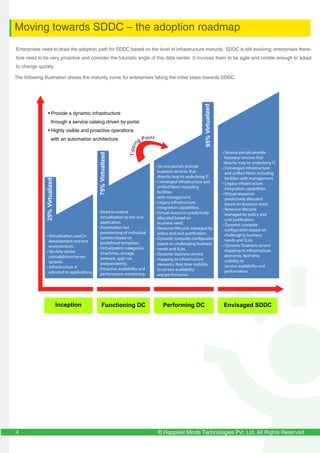
The following illustration shows the maturity curve for enterprises taking the initial steps towards SDDC.
25%Virtualized
75%Virtualized
• Provide a dynamic infrastructure
through a service catalog driven by portal
• Highly visible and proactive operations
with an automation architecture
Inception
• Need to extend
virtualization to tier-one
application.
• Automation-led
provisioning of individual
systems based on
predefined templates.
• Virtualization categories
(machines, storage,
network, app) run
independently.
• Proactive availability and
performance monitoring.
Functioning DC
• Service portals provide
business services that
directly map to underlying IT.
• Converged infrastructure
and unified fabric including
facilities with management.
• Legacy infrastructure
integration capabilities.
• Virtual resources
predictively allocated
based on business need.
• Resource lifecycle
managed by policy and
cost justification.
• Dynamic compute
configuration based on
challenging business
needs and SLAs.
• Dynamic business service
mapping to infrastructure
elements, Real time
visibility to
service availability and
performance
• Service portals provide
business services that
directly map to underlying IT.
• Converged infrastructure and
unified fabric including
facilities
with management.
• Legacy infrastructure
integration capabilities.
• Virtual resources predictively
allocated based on
business need.
• Resource lifecycle managed by
policy and cost justification.
• Dynamic compute configuration
based on challenging business
needs and SLAs.
• Dynamic business service
mapping to infrastructure
elements, Real time visibility
to service availability
and performance
Performing DC Envisaged SDDC
95%Virtualized
• Virtualization used in
development and test
environments.
• No data center
consolidation/server
sprawls.
• Infrastructure d
edicated to applications.
Tippin
g Point
© Happiest Minds Technologies Pvt. Ltd. All Rights Reserved5
Points to keep in mind
To move into an SDDC environment, enterprises need to:
• Have a sustained and long term vision for SDDC and overcome all resistance to change
• Get formal and proper training on the technology and concept
• Refine and validate functionality, licensing policies and support from OEM partners for business applications
and commercial-off-the-shelf (COTS) products to be used
• Run impact assessment and implementation plan to align SDDC with server build architects, network and
security architects and storage architects
• Hire a data center facilities operator for converged infrastructure implementation and an IT security officer
to revisit standards and align as per security-based goals for the organization
• Hold a pilot run before roll out
Challenges
There are several challenges in mainstream adoption of SDDC that the industry needs to overcome. Some of the primary ones include:
• The SDDC stack needs a mechanism to identify legacy infrastructure, physical infrastructure and intuitively create a controlled environ
ment to integrate them. Usually, an enterprise data center has different infrastructure maturity standards which makes it all the more
difficult.
• Common open standards-based framework for software defined networking (SDN) and software defined storage (SDS) is needed to
leverage and implement SDDC and interoperability among OEM partners.
• There is a possibility of vendor lock-in due to converged infrastructure and products from OEM vendors.
• SDDC needs an all-inclusive management and monitoring tools as well as building management systems, a tightly-coupled automation
and orchestration solution.
Above all this, enterprises need to overcome inertia and be completely agile to operate in SDDC environment.
TheVisionofFuture-StateDataCenters–developmentoftheSDDC
Software-defined data center can be defined as using software to control hardware that brings infinite scalability of resources and services
to meet a defined level of service assurance. This is achieved by abstracting the hardware layer to provide compute services as virtual
resources to applications demanding them. This abstraction is achieved through:
• Server virtualization
• Storage virtualization or software-defined storage
• Network virtualization or software-defined networking
Server virtualization enabled by hypervisors has attained popular adoption. R&D to bring storage and network virtualization to the same
state is also in place. A multitude of niche products exists in this domain. This, coupled with the numerous acquisitions by large Original
Equipment Manufacturers (OEMs) add SDDC capabilities to their hardware products.
A promising development in this space is the Open Daylight Project where a set of companies have defined a common goal of establishing
an open-source framework for software-defined networking (SDN).
Conceptual View of the Solution
SDDCs are an extension to the cloud delivery model of Infrastructure as a Service (IaaS) and the basic principles of cloud delivery model
will continue to be the building blocks. The other key factors of SDDC are the additional integration layers between data center facilities,
its legacy hardware and the monitoring and management stack.
© Happiest Minds Technologies Pvt. Ltd. All Rights Reserved6
Typical Data Center Infrastructure Architecture
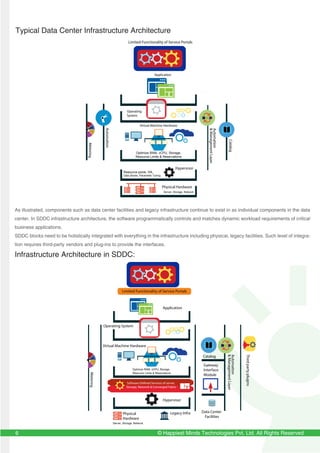
As illustrated, components such as data center facilities and legacy infrastructure continue to exist in as individual components in the data
center. In SDDC infrastructure architecture, the software programmatically controls and matches dynamic workload requirements of critical
business applications.
SDDC blocks need to be holistically integrated with everything in the infrastructure including physical, legacy facilities. Such level of integra-
tion requires third-party vendors and plug-ins to provide the interfaces.
Infrastructure Architecture in SDDC:
Limited Functionality of Service Portals
Application
Operating
System
Virtual Machine Hardware
Hypervisor
Physical Hardware
Catalog
Automation
&ManagementLayer
Automation
Metering
Optimize RAM, vCPU, Storage,
Resource Limits & Reservations
Resource pools, HA,
Data Stores, Parameter Tuning
Server, Storage, Network
Operating System
Application
Virtual Machine Hardware
Limited Functionality of Service Portals
Hypervisor
Physical
Hardware
Catalog
Automation
&ManagementLayer
Metering
Legacy Infra
Gateway
Interface
Module
Thirdpartyplugins
Data Center
Facilities
Software Defined Services of server,
Storage, Network & Converged Fabric
Optimize RAM, vCPU, Storage,
Resource Limits & Reservations
Server, Storage, Network
© Happiest Minds Technologies Pvt. Ltd. All Rights Reserved7
• Physical hardware and legacy infrastructure: Bare metal hardware and data centers form this layer that can be
virtualized across physical or legacy systems. The evolution of technology or business needs determine the ability of
these to be programmatically controlled by software. It depends on the abstraction of server, storage, network compo
nents and legacy integration requirements. The key influencers here are OEMs and converged infrastructure vendors
as they design, fabricate and integrate to make this happen
• Management layer: This comprises a suite of management and monitoring solutions that are integrate for the data center
estate, with operations and performance engineering capabilities
• Gateway interface module: SDDCs have to be integrated with existing data center components. The gateway module
consists of multi-vendor OEM plug-ins connecting with the existing data center, along with OEM partners and service
system integrators
• Data center facilities: In case of an increase in dynamic resource shifts, enhanced power and cooling components are
needed to control and meet the scale and demands effectively. Plug-ins and application programming interfaces (APIs)
also need to be scaled up and coupled tightly with converged infrastructure
• Consumption and service design: A customized service partner portal, along with integrated solutions from OEM
players are need to build the ability to consume hardware controlled by software
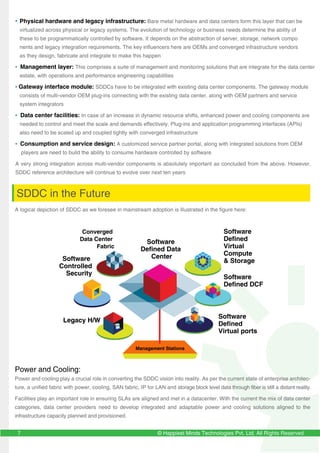
A very strong integration across multi-vendor components is absolutely important as concluded from the above. However,
SDDC reference architecture will continue to evolve over next ten years
SDDC in the Future
A logical depiction of SDDC as we foresee in mainstream adoption is illustrated in the figure here:
Software
Defined Data
Center
Converged
Data Center
Fabric
Software
Defined
Virtual ports
Software
Controlled
Security
Software
Defined DCF
Software
Defined
Virtual
Compute
& Storage
Legacy H/W
Power and Cooling:
Power and cooling play a crucial role in converting the SDDC vision into reality. As per the current state of enterprise architec-
ture, a unified fabric with power, cooling, SAN fabric, IP for LAN and storage block level data through fiber is still a distant reality.
Facilities play an important role in ensuring SLAs are aligned and met in a datacenter. With the current the mix of data center
categories, data center providers need to develop integrated and adaptable power and cooling solutions aligned to the
infrastructure capacity planned and provisioned.
Management Stations
© Happiest Minds Technologies Pvt. Ltd. All Rights Reserved8
SDDC implies the entire controlling of the data center through software. Therefore, a holistic and upper view is of utmost
importance for proper management and monitoring of the data center, along with the ability to quickly identify, diagnose, corre-
late, isolate and resolve issues. Current management and monitoring stack for siloed components is not effective or respon-
sive enough and can result in excessive lead times for problem resolution.
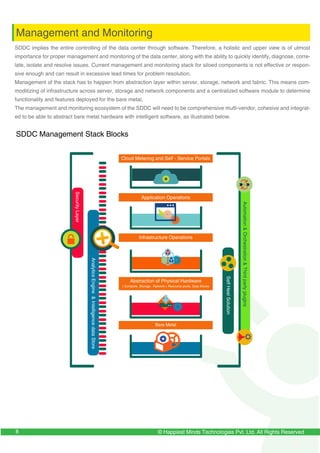
Management of the stack has to happen from abstraction layer within server, storage, network and fabric. This means com-
moditizing of infrastructure across server, storage and network components and a centralized software module to determine
functionality and features deployed for the bare metal.
The management and monitoring ecosystem of the SDDC will need to be comprehensive multi-vendor, cohesive and integrat-
ed to be able to abstract bare metal hardware with intelligent software, as illustrated below.
Management and Monitoring
Cloud Metering and Self - Service Portals
Application Operations
Infrastructure Operations
Abstraction of Physical Hardware
Bare Metal
( Compute, Storage , Network ) Resource pools, Data Stores
SecurityLayer
Automation&Orchestration&Thirdpartyplugins
SelfHeelSolution
SDDC Management Stack Blocks
AnalyticsEngine&IntelligencedataStore
© Happiest Minds Technologies Pvt. Ltd. All Rights Reserved
© 2014 Happiest Minds. All Rights Reserved.
E-mail: Business@happiestminds.com
Visit us: www.happiestminds.com
Follow us on
About the Author
Happiest Minds
Jagadeesh CV
Strategic, focused, and business oriented enterprise, Solution architect, Pre-sales, Post-sales and Prac-
titioner with 15 years of experience in information technologies. Master of establishing productive
relationships with partners and customers. Data Center Enterprise Technology Roadmaps, Transforma-
tion Strategies, Private Cloud Implementation, Public, Private Cloud Integration, Cloud Computing adop-
tion Roadmap for Enterprises, ROI models, Performance Engineering, Infrastructure Consolidation and
Optimization, Enterprise Social Collaboration, Vendor Management, Evangelism.
Happiest Minds is focused on helping customers build Smart Secure and Connected experience by leveraging disruptive
technologies like mobility, analytics, security, cloud computing, social computing and unified communications. Enterprises are
embracing these technologies to implement Omni-channel strategies, manage structured & unstructured data and make real
time decisions based on actionable insights, while ensuring security for data and infrastructure. Happiest Minds also offers
high degree of skills, IPs and domain expertise across a set of focused areas that include IT Services, Product Engineering
Services, Infrastructure Management, Security, Testing and Consulting.
Headquartered in Bangalore, India, Happiest Minds has operations in the US, UK, Singapore and Australia. It secured a $45
million Series-A funding led by Canaan Partners, Intel Capital and Ashok Soota.
This Document is an exclusive property of Happiest Minds Technologies Pvt. Ltd
9

Whitepaper: Evolution of the Software Defined Data Center - Happiest Minds

  • 1.
    Happiest People HappiestCustomers Evolution of the Software Defined Data Center
  • 2.
    © Happiest MindsTechnologies Pvt. Ltd. All Rights Reserved2 Contents Abstract....................................................................................................................................................3 The big promise of SDDC........................................................................................................................3 Moving towards SDDC – the adoption roadmap......................................................................................4 • Points to keep in mind..........................................................................................................................5 • Challenges...........................................................................................................................................5 The Vision of Future-State Data Centers – development of the SDDC...................................................5 • Conceptual View of the Solution..........................................................................................................5 • Typical Data Center Infrastructure Architecture...................................................................................6 • Infrastructure Architecture in SDDC.....................................................................................................6 SDDC in the Future.................................................................................................................................7 • Power and Cooling...............................................................................................................................7 Management and Monitoring...................................................................................................................8
  • 3.
    © Happiest MindsTechnologies Pvt. Ltd. All Rights Reserved SDDC – a term that still dwells in the futuristic sense of things, is perhaps the next major milestone in a cloud-centric world that can entirely change the way data is stored and managed. A fully software defined and software led data center can radically change the way IT infrastructure works today. Software-Defined Data Center (SDDC) is one of the newest, yet most talked about term among enterprises today. Coined in 2012, the idea may have seemed far-fetched initially placing software at the forefront of the data center against hardware, However, it has become ‘the reality’ and from what we have learned from other apparently bizarre technological ideas of the past, this new reality is going to decide the future of data centers. While programmatically automating resource allocation and consumption based on business requirements is futuristic, this evolution of IT infrastructure and architecture represents a complete paradigm shift from today’s standard operating procedures for architecting and provi- sioning IT services. This future of the data center is still in the debate stages. But enterprises in their pursuit to be future-ready can be seen gradually treading towards adopting SDDC. For them it is absolutely neces- sary to understand its impact, potential risks and expected benefits before they embark on their journey of implementing it. This paper gives an oversight of future scenarios and probable implications on today’s legacy infrastructure, tools, and facilities. 3 Abstract The big promise of SDDC The concept of SDDC paves the way for better efficiency and effectiveness for IT in meeting business demands. The hypothesis of a software-defined network implementation, a company can access a virtual port that can be programmatically controlled to work as a router or firewall or load balancer. This eliminates the need for physical devices for each IT function. That being said, hardware cannot be eliminated in an SDDC. The hardware restrictions and storage IOPS capabilities will depend on the physical hardware deployed. With SDDC, virtualized data can be separated from physical locations for efficient data retrieval and updates. There are more such benefits that we can look forward to from an SDDC: • Single view of skills can administer the entire IT existence, instead of managing and administering individual IT functions • Standardization across processes and systems will be easy with increased utilization of resources within a data center • Scope for more just-in-time environments instead of infrastructure procurement process for every business application • Enterprises can become more fungible and agile to meet business demands in a challenging and dynamic business environment • Potential to achieve self-service IT in enterprises in place of multiple touch points for resolving issues or request fulfillments
  • 4.
    © Happiest MindsTechnologies Pvt. Ltd. All Rights Reserved4 Moving towards SDDC – the adoption roadmap Enterprises need to draw the adoption path for SDDC based on the level of infrastructure maturity. SDDC is still evolving; enterprises there- fore need to be very proactive and consider the futuristic angle of this data center. It involves them to be agile and nimble enough to adapt to change quickly. The following illustration shows the maturity curve for enterprises taking the initial steps towards SDDC. 25%Virtualized 75%Virtualized • Provide a dynamic infrastructure through a service catalog driven by portal • Highly visible and proactive operations with an automation architecture Inception • Need to extend virtualization to tier-one application. • Automation-led provisioning of individual systems based on predefined templates. • Virtualization categories (machines, storage, network, app) run independently. • Proactive availability and performance monitoring. Functioning DC • Service portals provide business services that directly map to underlying IT. • Converged infrastructure and unified fabric including facilities with management. • Legacy infrastructure integration capabilities. • Virtual resources predictively allocated based on business need. • Resource lifecycle managed by policy and cost justification. • Dynamic compute configuration based on challenging business needs and SLAs. • Dynamic business service mapping to infrastructure elements, Real time visibility to service availability and performance • Service portals provide business services that directly map to underlying IT. • Converged infrastructure and unified fabric including facilities with management. • Legacy infrastructure integration capabilities. • Virtual resources predictively allocated based on business need. • Resource lifecycle managed by policy and cost justification. • Dynamic compute configuration based on challenging business needs and SLAs. • Dynamic business service mapping to infrastructure elements, Real time visibility to service availability and performance Performing DC Envisaged SDDC 95%Virtualized • Virtualization used in development and test environments. • No data center consolidation/server sprawls. • Infrastructure d edicated to applications. Tippin g Point
  • 5.
    © Happiest MindsTechnologies Pvt. Ltd. All Rights Reserved5 Points to keep in mind To move into an SDDC environment, enterprises need to: • Have a sustained and long term vision for SDDC and overcome all resistance to change • Get formal and proper training on the technology and concept • Refine and validate functionality, licensing policies and support from OEM partners for business applications and commercial-off-the-shelf (COTS) products to be used • Run impact assessment and implementation plan to align SDDC with server build architects, network and security architects and storage architects • Hire a data center facilities operator for converged infrastructure implementation and an IT security officer to revisit standards and align as per security-based goals for the organization • Hold a pilot run before roll out Challenges There are several challenges in mainstream adoption of SDDC that the industry needs to overcome. Some of the primary ones include: • The SDDC stack needs a mechanism to identify legacy infrastructure, physical infrastructure and intuitively create a controlled environ ment to integrate them. Usually, an enterprise data center has different infrastructure maturity standards which makes it all the more difficult. • Common open standards-based framework for software defined networking (SDN) and software defined storage (SDS) is needed to leverage and implement SDDC and interoperability among OEM partners. • There is a possibility of vendor lock-in due to converged infrastructure and products from OEM vendors. • SDDC needs an all-inclusive management and monitoring tools as well as building management systems, a tightly-coupled automation and orchestration solution. Above all this, enterprises need to overcome inertia and be completely agile to operate in SDDC environment. TheVisionofFuture-StateDataCenters–developmentoftheSDDC Software-defined data center can be defined as using software to control hardware that brings infinite scalability of resources and services to meet a defined level of service assurance. This is achieved by abstracting the hardware layer to provide compute services as virtual resources to applications demanding them. This abstraction is achieved through: • Server virtualization • Storage virtualization or software-defined storage • Network virtualization or software-defined networking Server virtualization enabled by hypervisors has attained popular adoption. R&D to bring storage and network virtualization to the same state is also in place. A multitude of niche products exists in this domain. This, coupled with the numerous acquisitions by large Original Equipment Manufacturers (OEMs) add SDDC capabilities to their hardware products. A promising development in this space is the Open Daylight Project where a set of companies have defined a common goal of establishing an open-source framework for software-defined networking (SDN). Conceptual View of the Solution SDDCs are an extension to the cloud delivery model of Infrastructure as a Service (IaaS) and the basic principles of cloud delivery model will continue to be the building blocks. The other key factors of SDDC are the additional integration layers between data center facilities, its legacy hardware and the monitoring and management stack.
  • 6.
    © Happiest MindsTechnologies Pvt. Ltd. All Rights Reserved6 Typical Data Center Infrastructure Architecture As illustrated, components such as data center facilities and legacy infrastructure continue to exist in as individual components in the data center. In SDDC infrastructure architecture, the software programmatically controls and matches dynamic workload requirements of critical business applications. SDDC blocks need to be holistically integrated with everything in the infrastructure including physical, legacy facilities. Such level of integra- tion requires third-party vendors and plug-ins to provide the interfaces. Infrastructure Architecture in SDDC: Limited Functionality of Service Portals Application Operating System Virtual Machine Hardware Hypervisor Physical Hardware Catalog Automation &ManagementLayer Automation Metering Optimize RAM, vCPU, Storage, Resource Limits & Reservations Resource pools, HA, Data Stores, Parameter Tuning Server, Storage, Network Operating System Application Virtual Machine Hardware Limited Functionality of Service Portals Hypervisor Physical Hardware Catalog Automation &ManagementLayer Metering Legacy Infra Gateway Interface Module Thirdpartyplugins Data Center Facilities Software Defined Services of server, Storage, Network & Converged Fabric Optimize RAM, vCPU, Storage, Resource Limits & Reservations Server, Storage, Network
  • 7.
    © Happiest MindsTechnologies Pvt. Ltd. All Rights Reserved7 • Physical hardware and legacy infrastructure: Bare metal hardware and data centers form this layer that can be virtualized across physical or legacy systems. The evolution of technology or business needs determine the ability of these to be programmatically controlled by software. It depends on the abstraction of server, storage, network compo nents and legacy integration requirements. The key influencers here are OEMs and converged infrastructure vendors as they design, fabricate and integrate to make this happen • Management layer: This comprises a suite of management and monitoring solutions that are integrate for the data center estate, with operations and performance engineering capabilities • Gateway interface module: SDDCs have to be integrated with existing data center components. The gateway module consists of multi-vendor OEM plug-ins connecting with the existing data center, along with OEM partners and service system integrators • Data center facilities: In case of an increase in dynamic resource shifts, enhanced power and cooling components are needed to control and meet the scale and demands effectively. Plug-ins and application programming interfaces (APIs) also need to be scaled up and coupled tightly with converged infrastructure • Consumption and service design: A customized service partner portal, along with integrated solutions from OEM players are need to build the ability to consume hardware controlled by software A very strong integration across multi-vendor components is absolutely important as concluded from the above. However, SDDC reference architecture will continue to evolve over next ten years SDDC in the Future A logical depiction of SDDC as we foresee in mainstream adoption is illustrated in the figure here: Software Defined Data Center Converged Data Center Fabric Software Defined Virtual ports Software Controlled Security Software Defined DCF Software Defined Virtual Compute & Storage Legacy H/W Power and Cooling: Power and cooling play a crucial role in converting the SDDC vision into reality. As per the current state of enterprise architec- ture, a unified fabric with power, cooling, SAN fabric, IP for LAN and storage block level data through fiber is still a distant reality. Facilities play an important role in ensuring SLAs are aligned and met in a datacenter. With the current the mix of data center categories, data center providers need to develop integrated and adaptable power and cooling solutions aligned to the infrastructure capacity planned and provisioned. Management Stations
  • 8.
    © Happiest MindsTechnologies Pvt. Ltd. All Rights Reserved8 SDDC implies the entire controlling of the data center through software. Therefore, a holistic and upper view is of utmost importance for proper management and monitoring of the data center, along with the ability to quickly identify, diagnose, corre- late, isolate and resolve issues. Current management and monitoring stack for siloed components is not effective or respon- sive enough and can result in excessive lead times for problem resolution. Management of the stack has to happen from abstraction layer within server, storage, network and fabric. This means com- moditizing of infrastructure across server, storage and network components and a centralized software module to determine functionality and features deployed for the bare metal. The management and monitoring ecosystem of the SDDC will need to be comprehensive multi-vendor, cohesive and integrat- ed to be able to abstract bare metal hardware with intelligent software, as illustrated below. Management and Monitoring Cloud Metering and Self - Service Portals Application Operations Infrastructure Operations Abstraction of Physical Hardware Bare Metal ( Compute, Storage , Network ) Resource pools, Data Stores SecurityLayer Automation&Orchestration&Thirdpartyplugins SelfHeelSolution SDDC Management Stack Blocks AnalyticsEngine&IntelligencedataStore
  • 9.
    © Happiest MindsTechnologies Pvt. Ltd. All Rights Reserved © 2014 Happiest Minds. All Rights Reserved. E-mail: Business@happiestminds.com Visit us: www.happiestminds.com Follow us on About the Author Happiest Minds Jagadeesh CV Strategic, focused, and business oriented enterprise, Solution architect, Pre-sales, Post-sales and Prac- titioner with 15 years of experience in information technologies. Master of establishing productive relationships with partners and customers. Data Center Enterprise Technology Roadmaps, Transforma- tion Strategies, Private Cloud Implementation, Public, Private Cloud Integration, Cloud Computing adop- tion Roadmap for Enterprises, ROI models, Performance Engineering, Infrastructure Consolidation and Optimization, Enterprise Social Collaboration, Vendor Management, Evangelism. Happiest Minds is focused on helping customers build Smart Secure and Connected experience by leveraging disruptive technologies like mobility, analytics, security, cloud computing, social computing and unified communications. Enterprises are embracing these technologies to implement Omni-channel strategies, manage structured & unstructured data and make real time decisions based on actionable insights, while ensuring security for data and infrastructure. Happiest Minds also offers high degree of skills, IPs and domain expertise across a set of focused areas that include IT Services, Product Engineering Services, Infrastructure Management, Security, Testing and Consulting. Headquartered in Bangalore, India, Happiest Minds has operations in the US, UK, Singapore and Australia. It secured a $45 million Series-A funding led by Canaan Partners, Intel Capital and Ashok Soota. This Document is an exclusive property of Happiest Minds Technologies Pvt. Ltd 9