What Is Cubing??
• Cubing is an instructional strategy that asks
students to consider a concept from a variety of
different perspectives.
• The cubes are six-sided figures that have a
different activity on each side of the cube.
• A student rolls the cube and does the activity
that comes up.
• Cubes can also be used for group tasks as well
as individual tasks.
How Cubing Works
• Students can work alone, in pairs, or in small groups
with the appropriate cube.
• In pairs or small groups, each student takes a turn
rolling the cube and doing the activity that comes up.
Students have the choice to roll again once if they
don’t like the activity that turns up.
• Students each roll the cube 2 – 4 times, depending
on the magnitude of the assignments.
• When working in groups, and option is to have the
student who roles lead the discussion and/or activity
rolled. Have another student serve as the scribe to
take notes on the group discussion. After the group
reaches consensus that the task is complete, the
roller and scribe change.
How Cubing is Differentiated
• Not all students receive the same cube.
• You can differentiate the tasks n cubes
according to readiness, interest or learning
profile (See examples).
• One cubing activity might group gifted
learners for more challenging, higher-level
activities; another cubing activity might group
students with different readiness levels
according to their interests; another might
group students according to one of the
learning profile categories.
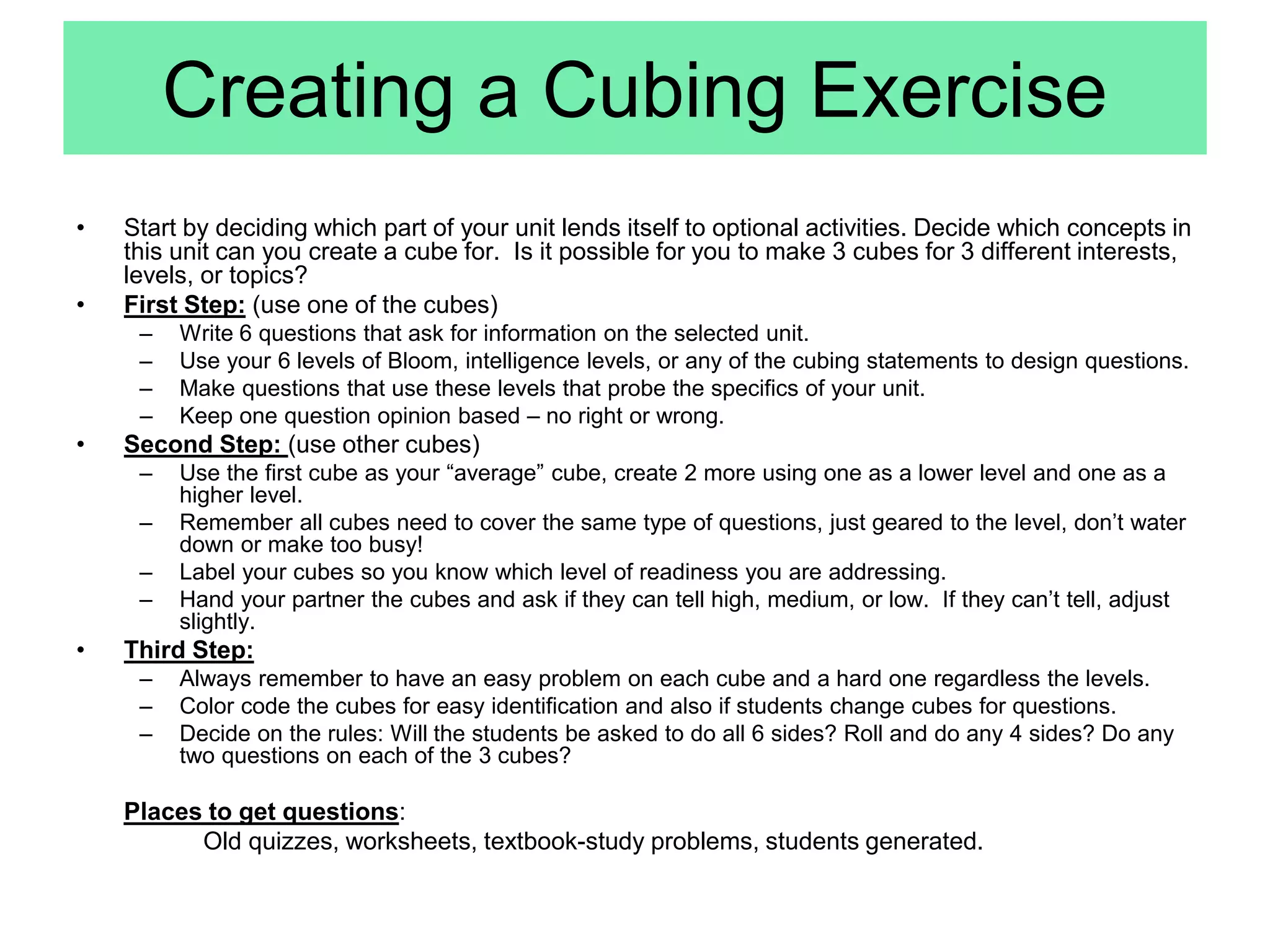
Creating a Cubing Exercise
• Start by deciding which part of your unit lends itself to optional activities. Decide which concepts in
this unit can you create a cube for. Is it possible for you to make 3 cubes for 3 different interests,
levels, or topics?
• First Step: (use one of the cubes)
– Write 6 questions that ask for information on the selected unit.
– Use your 6 levels of Bloom, intelligence levels, or any of the cubing statements to design questions.
– Make questions that use these levels that probe the specifics of your unit.
– Keep one question opinion based – no right or wrong.
• Second Step: (use other cubes)
– Use the first cube as your “average” cube, create 2 more using one as a lower level and one as a
higher level.
– Remember all cubes need to cover the same type of questions, just geared to the level, don’t water
down or make too busy!
– Label your cubes so you know which level of readiness you are addressing.
– Hand your partner the cubes and ask if they can tell high, medium, or low. If they can’t tell, adjust
slightly.
• Third Step:
– Always remember to have an easy problem on each cube and a hard one regardless the levels.
– Color code the cubes for easy identification and also if students change cubes for questions.
– Decide on the rules: Will the students be asked to do all 6 sides? Roll and do any 4 sides? Do any
two questions on each of the 3 cubes?
Places to get questions:
Old quizzes, worksheets, textbook-study problems, students generated.
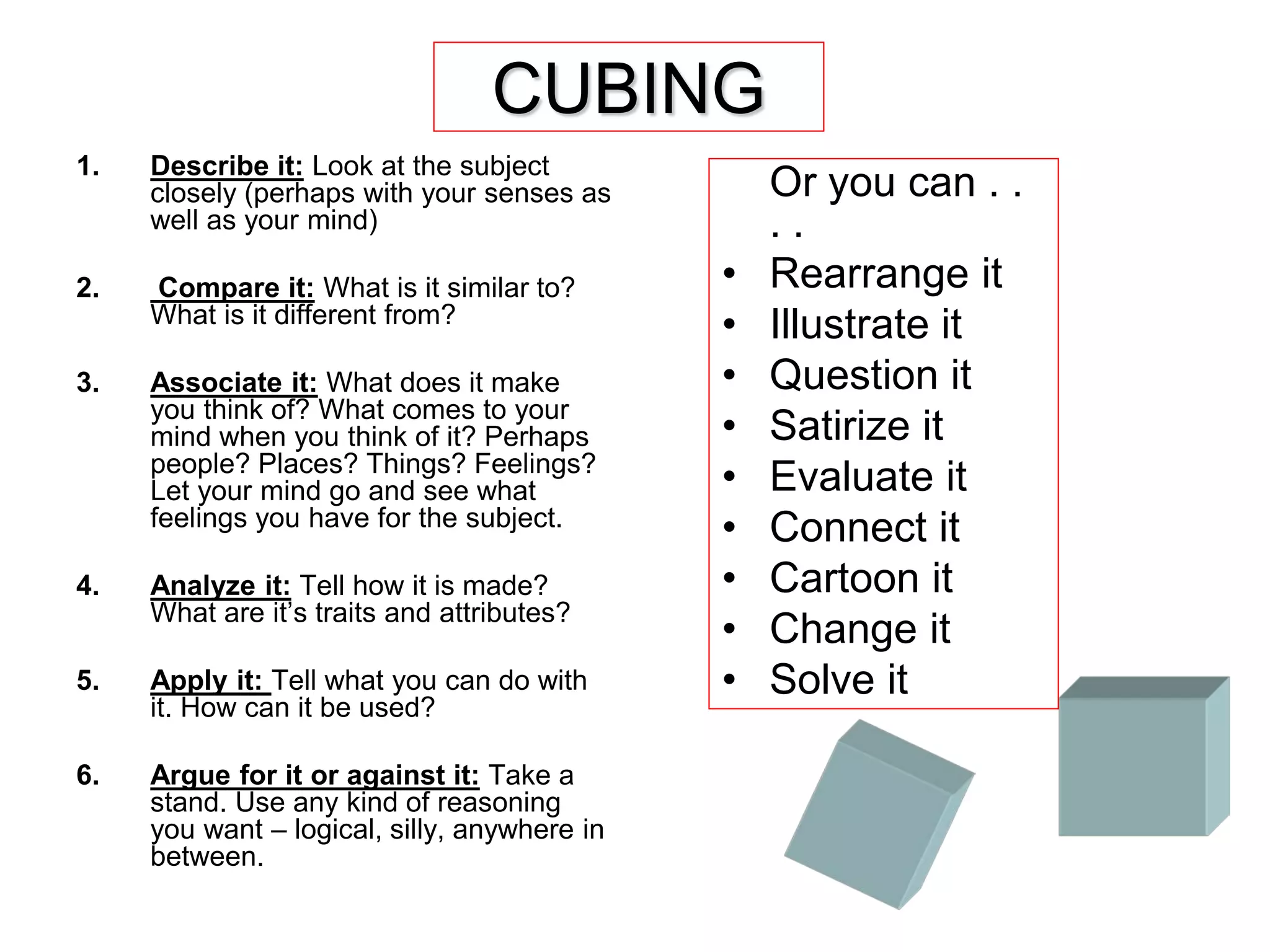
CUBING
1. Describe it: Look at the subject
closely (perhaps with your senses as
well as your mind)
2. Compare it: What is it similar to?
What is it different from?
3. Associate it: What does it make
you think of? What comes to your
mind when you think of it? Perhaps
people? Places? Things? Feelings?
Let your mind go and see what
feelings you have for the subject.
4. Analyze it: Tell how it is made?
What are it’s traits and attributes?
5. Apply it: Tell what you can do with
it. How can it be used?
6. Argue for it or against it: Take a
stand. Use any kind of reasoning
you want – logical, silly, anywhere in
between.
Or you can . .
. .
• Rearrange it
• Illustrate it
• Question it
• Satirize it
• Evaluate it
• Connect it
• Cartoon it
• Change it
• Solve it
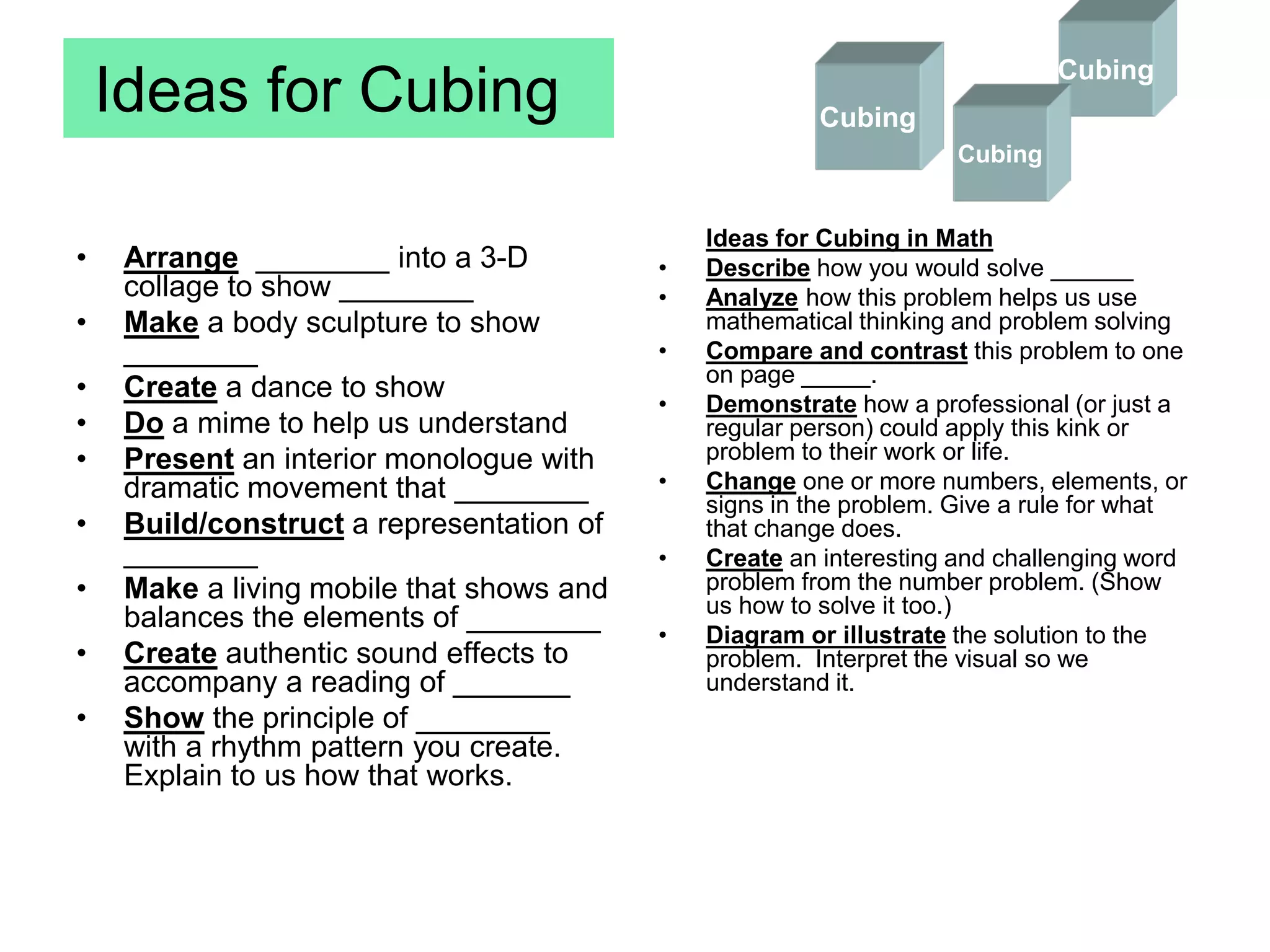
Ideas for Cubing
• Arrange ________ into a 3-D
collage to show ________
• Make a body sculpture to show
________
• Create a dance to show
• Do a mime to help us understand
• Present an interior monologue with
dramatic movement that ________
• Build/construct a representation of
________
• Make a living mobile that shows and
balances the elements of ________
• Create authentic sound effects to
accompany a reading of _______
• Show the principle of ________
with a rhythm pattern you create.
Explain to us how that works.
Ideas for Cubing in Math
• Describe how you would solve ______
• Analyze how this problem helps us use
mathematical thinking and problem solving
• Compare and contrast this problem to one
on page _____.
• Demonstrate how a professional (or just a
regular person) could apply this kink or
problem to their work or life.
• Change one or more numbers, elements, or
signs in the problem. Give a rule for what
that change does.
• Create an interesting and challenging word
problem from the number problem. (Show
us how to solve it too.)
• Diagram or illustrate the solution to the
problem. Interpret the visual so we
understand it.
Cubing
Cubing
Cubing
What is the Point?
• Cubing gives students who like to use their hands and
move around a chance to feel like they are “playing”
while learning.
• Cubing gives students a chance to look at a concept
from a series of different perspectives.
• Cubing is very flexible and encourages depth and
complexity.
• Cubing allows the teacher to differentiate for readiness in
a very un-obvious way. Since all students are working
with cubes, students are not aware that their neighbors
might be doing something a little different.
Describe Pretend Create Dance
Critique
Compare
General Cube Template
Concerns?
Here is one – you may have more!
• Cubes can turn into glorified worksheets –
but not if all activities are purposeful and
focused on getting students to understand
a concept in a multitude of ways!
What_Is_Cubing.pdf

What_Is_Cubing.pdf

  • 1.
    What Is Cubing?? •Cubing is an instructional strategy that asks students to consider a concept from a variety of different perspectives. • The cubes are six-sided figures that have a different activity on each side of the cube. • A student rolls the cube and does the activity that comes up. • Cubes can also be used for group tasks as well as individual tasks.
  • 2.
    How Cubing Works •Students can work alone, in pairs, or in small groups with the appropriate cube. • In pairs or small groups, each student takes a turn rolling the cube and doing the activity that comes up. Students have the choice to roll again once if they don’t like the activity that turns up. • Students each roll the cube 2 – 4 times, depending on the magnitude of the assignments. • When working in groups, and option is to have the student who roles lead the discussion and/or activity rolled. Have another student serve as the scribe to take notes on the group discussion. After the group reaches consensus that the task is complete, the roller and scribe change.
  • 3.
    How Cubing isDifferentiated • Not all students receive the same cube. • You can differentiate the tasks n cubes according to readiness, interest or learning profile (See examples). • One cubing activity might group gifted learners for more challenging, higher-level activities; another cubing activity might group students with different readiness levels according to their interests; another might group students according to one of the learning profile categories.
  • 4.
    Creating a CubingExercise • Start by deciding which part of your unit lends itself to optional activities. Decide which concepts in this unit can you create a cube for. Is it possible for you to make 3 cubes for 3 different interests, levels, or topics? • First Step: (use one of the cubes) – Write 6 questions that ask for information on the selected unit. – Use your 6 levels of Bloom, intelligence levels, or any of the cubing statements to design questions. – Make questions that use these levels that probe the specifics of your unit. – Keep one question opinion based – no right or wrong. • Second Step: (use other cubes) – Use the first cube as your “average” cube, create 2 more using one as a lower level and one as a higher level. – Remember all cubes need to cover the same type of questions, just geared to the level, don’t water down or make too busy! – Label your cubes so you know which level of readiness you are addressing. – Hand your partner the cubes and ask if they can tell high, medium, or low. If they can’t tell, adjust slightly. • Third Step: – Always remember to have an easy problem on each cube and a hard one regardless the levels. – Color code the cubes for easy identification and also if students change cubes for questions. – Decide on the rules: Will the students be asked to do all 6 sides? Roll and do any 4 sides? Do any two questions on each of the 3 cubes? Places to get questions: Old quizzes, worksheets, textbook-study problems, students generated.
  • 5.
    CUBING 1. Describe it:Look at the subject closely (perhaps with your senses as well as your mind) 2. Compare it: What is it similar to? What is it different from? 3. Associate it: What does it make you think of? What comes to your mind when you think of it? Perhaps people? Places? Things? Feelings? Let your mind go and see what feelings you have for the subject. 4. Analyze it: Tell how it is made? What are it’s traits and attributes? 5. Apply it: Tell what you can do with it. How can it be used? 6. Argue for it or against it: Take a stand. Use any kind of reasoning you want – logical, silly, anywhere in between. Or you can . . . . • Rearrange it • Illustrate it • Question it • Satirize it • Evaluate it • Connect it • Cartoon it • Change it • Solve it
  • 6.
    Ideas for Cubing •Arrange ________ into a 3-D collage to show ________ • Make a body sculpture to show ________ • Create a dance to show • Do a mime to help us understand • Present an interior monologue with dramatic movement that ________ • Build/construct a representation of ________ • Make a living mobile that shows and balances the elements of ________ • Create authentic sound effects to accompany a reading of _______ • Show the principle of ________ with a rhythm pattern you create. Explain to us how that works. Ideas for Cubing in Math • Describe how you would solve ______ • Analyze how this problem helps us use mathematical thinking and problem solving • Compare and contrast this problem to one on page _____. • Demonstrate how a professional (or just a regular person) could apply this kink or problem to their work or life. • Change one or more numbers, elements, or signs in the problem. Give a rule for what that change does. • Create an interesting and challenging word problem from the number problem. (Show us how to solve it too.) • Diagram or illustrate the solution to the problem. Interpret the visual so we understand it. Cubing Cubing Cubing
  • 7.
    What is thePoint? • Cubing gives students who like to use their hands and move around a chance to feel like they are “playing” while learning. • Cubing gives students a chance to look at a concept from a series of different perspectives. • Cubing is very flexible and encourages depth and complexity. • Cubing allows the teacher to differentiate for readiness in a very un-obvious way. Since all students are working with cubes, students are not aware that their neighbors might be doing something a little different.
  • 8.
    Describe Pretend CreateDance Critique Compare General Cube Template
  • 9.
    Concerns? Here is one– you may have more! • Cubes can turn into glorified worksheets – but not if all activities are purposeful and focused on getting students to understand a concept in a multitude of ways!