Clinical Data Migration: Functional & Technical Considerations
A SSM Integrated Health Technologies Case Study
Confidential © 2017 Galen Healthcare Solutions
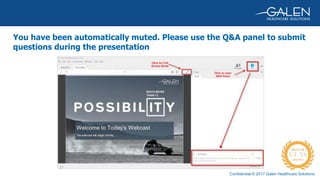
You have been automatically muted. Please use the Q&A panel to submit
questions during the presentation
Confidential © 2017 Galen Healthcare Solutions
Roles & Organizations
SSM Case Study Overview
Migration Decisions
Functional Considerations
Technical Considerations
Considerations Relating to SSM
Panelist Questions
TODAY’S AGENDA
Confidential © 2016 Galen Healthcare Solutions
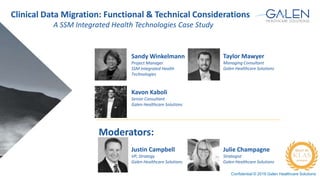
Taylor Mawyer
Managing Consultant
Galen Healthcare Solutions
Moderators:
Justin Campbell
VP, Strategy
Galen Healthcare Solutions
Sandy Winkelmann
Project Manager
SSM Integrated Health
Technologies
Julie Champagne
Strategist
Galen Healthcare Solutions
Kavon Kaboli
Senior Consultant
Galen Healthcare Solutions
Clinical Data Migration: Functional & Technical Considerations
A SSM Integrated Health Technologies Case Study
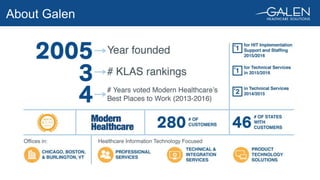
About Galen
Confidential © 2017 Galen Healthcare Solutions
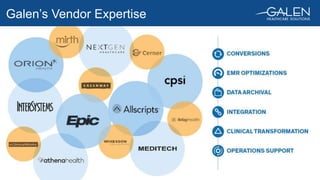
Galen’s Vendor Expertise
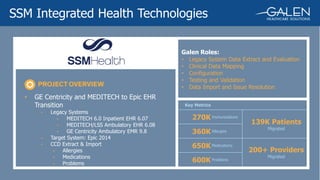
Galen Roles:
• Legacy System Data Extract and Evaluation
• Clinical Data Mapping
• Configuration
• Testing and Validation
• Data Import and Issue Resolution
• GE Centricity and MEDITECH to Epic EHR
Transition
⁃ Legacy Systems
⁃ MEDITECH 6.0 Inpatient EHR 6.07
⁃ MEDITECH/LSS Ambulatory EHR 6.08
⁃ GE Centricity Ambulatory EMR 9.8
⁃ Target System: Epic 2014
⁃ CCD Extract & Import
⁃ Allergies
⁃ Medications
⁃ Problems
Key Metrics
Immunizations270K
Allergies360K
Medications650K
Problems600K
139K Patients
Migrated
200+ Providers
Migrated
SSM Integrated Health Technologies
Confidential © 2017 Galen Healthcare Solutions
SSM Case Study Overview
Our panelists will share:
• An overview of the role they played in SSM’s data
migration
• What challenges they faced as it related to the
SSM EHR data migration
• Lessons learned from the EHR data migration
Confidential © 2017 Galen Healthcare Solutions
SSM Case Study: Sandy’s Role
• Facilitated discussions with physicians, hospital
administration and clinic leaders regarding data elements for
migration and amount of data to migrate.
• Coordinated IT technical plans with System IT leaders and
local IT staff.
• Completed data mappings and coordinated System IT
resources for data loads.
• Completed necessary paperwork and project request forms
(internal change control process).
• Validated data loads, CCDs, and data reconciliation process.
Confidential © 2017 Galen Healthcare Solutions
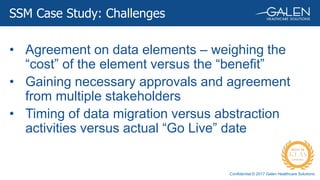
SSM Case Study: Challenges
• Agreement on data elements – weighing the
“cost” of the element versus the “benefit”
• Gaining necessary approvals and agreement
from multiple stakeholders
• Timing of data migration versus abstraction
activities versus actual “Go Live” date
Confidential © 2017 Galen Healthcare Solutions
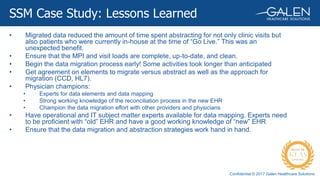
SSM Case Study: Lessons Learned
• Migrated data reduced the amount of time spent abstracting for not only clinic visits but
also patients who were currently in-house at the time of “Go Live.” This was an
unexpected benefit.
• Ensure that the MPI and visit loads are complete, up-to-date, and clean.
• Begin the data migration process early! Some activities took longer than anticipated
• Get agreement on elements to migrate versus abstract as well as the approach for
migration (CCD, HL7).
• Physician champions:
• Experts for data elements and data mapping
• Strong working knowledge of the reconciliation process in the new EHR
• Champion the data migration effort with other providers and physicians
• Have operational and IT subject matter experts available for data mapping. Experts need
to be proficient with “old” EHR and have a good working knowledge of “new” EHR
• Ensure that the data migration and abstraction strategies work hand in hand.
Confidential © 2017 Galen Healthcare Solutions
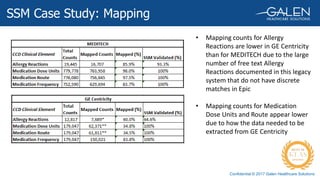
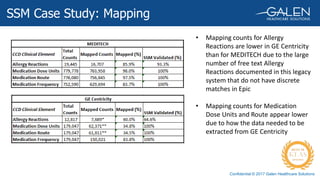
SSM Case Study: Mapping
• Mapping counts for Allergy
Reactions are lower in GE Centricity
than for MEDITECH due to the large
number of free text Allergy
Reactions documented in this legacy
system that do not have discrete
matches in Epic
• Mapping counts for Medication
Dose Units and Route appear lower
due to how the data needed to be
extracted from GE Centricity
Confidential © 2017 Galen Healthcare Solutions
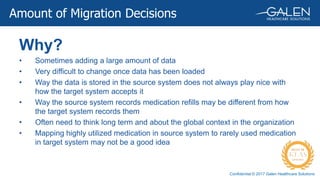
Why?
• Sometimes adding a large amount of data
• Very difficult to change once data has been loaded
• Way the data is stored in the source system does not always play nice with
how the target system accepts it
• Way the source system records medication refills may be different from how
the target system records them
• Often need to think long term and about the global context in the organization
• Mapping highly utilized medication in source system to rarely used medication
in target system may not be a good idea
Amount of Migration Decisions
Confidential © 2017 Galen Healthcare Solutions
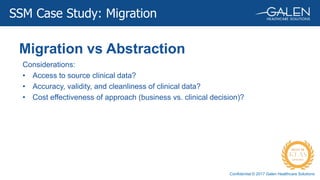
Migration vs Abstraction
SSM Case Study: Migration
Considerations:
• Access to source clinical data?
• Accuracy, validity, and cleanliness of clinical data?
• Cost effectiveness of approach (business vs. clinical decision)?
Confidential © 2017 Galen Healthcare Solutions
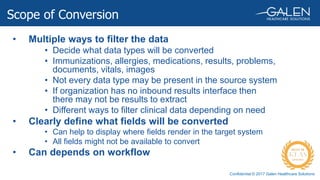
• Multiple ways to filter the data
• Decide what data types will be converted
• Immunizations, allergies, medications, results, problems,
documents, vitals, images
• Not every data type may be present in the source system
• If organization has no inbound results interface then
there may not be results to extract
• Different ways to filter clinical data depending on need
• Clearly define what fields will be converted
• Can help to display where fields render in the target system
• All fields might not be available to convert
• Can depends on workflow
Scope of Conversion
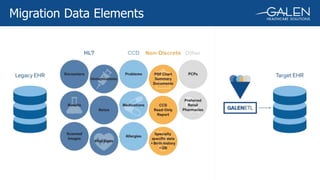
Migration Data Elements
Confidential © 2017 Galen Healthcare Solutions
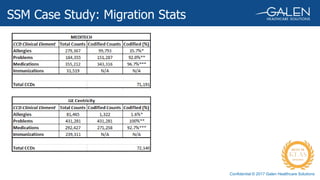
SSM Case Study: Migration Stats
Confidential © 2017 Galen Healthcare Solutions
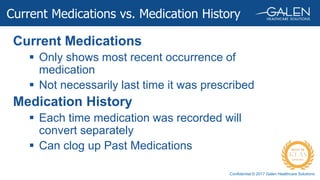
Current Medications
 Only shows most recent occurrence of
medication
 Not necessarily last time it was prescribed
Medication History
 Each time medication was recorded will
convert separately
 Can clog up Past Medications
Current Medications vs. Medication History
Confidential © 2017 Galen Healthcare Solutions
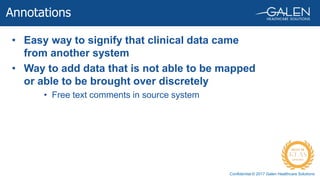
• Easy way to signify that clinical data came
from another system
• Way to add data that is not able to be mapped
or able to be brought over discretely
• Free text comments in source system
Annotations
Confidential © 2017 Galen Healthcare Solutions
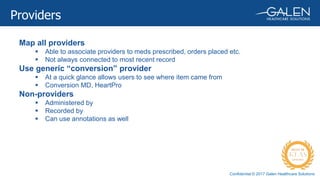
Map all providers
 Able to associate providers to meds prescribed, orders placed etc.
 Not always connected to most recent record
Use generic “conversion” provider
 At a quick glance allows users to see where item came from
 Conversion MD, HeartPro
Non-providers
 Administered by
 Recorded by
 Can use annotations as well
Providers
Confidential © 2017 Galen Healthcare Solutions
SSM Case Study: Mapping
• Mapping counts for Allergy
Reactions are lower in GE Centricity
than for MEDITECH due to the large
number of free text Allergy
Reactions documented in this legacy
system that do not have discrete
matches in Epic
• Mapping counts for Medication
Dose Units and Route appear lower
due to how the data needed to be
extracted from GE Centricity
Confidential © 2017 Galen Healthcare Solutions
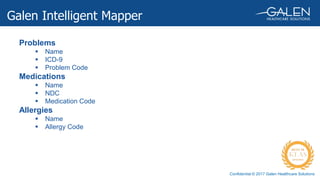
Problems
 Name
 ICD-9
 Problem Code
Medications
 Name
 NDC
 Medication Code
Allergies
 Name
 Allergy Code
Galen Intelligent Mapper
Confidential © 2017 Galen Healthcare Solutions
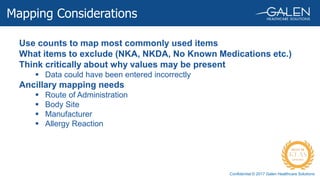
Use counts to map most commonly used items
What items to exclude (NKA, NKDA, No Known Medications etc.)
Think critically about why values may be present
 Data could have been entered incorrectly
Ancillary mapping needs
 Route of Administration
 Body Site
 Manufacturer
 Allergy Reaction
Mapping Considerations
Confidential © 2017 Galen Healthcare Solutions
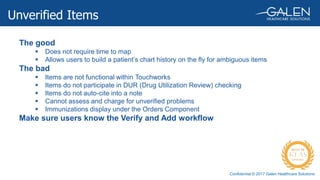
The good
 Does not require time to map
 Allows users to build a patient’s chart history on the fly for ambiguous items
The bad
 Items are not functional within Touchworks
 Items do not participate in DUR (Drug Utilization Review) checking
 Items do not auto-cite into a note
 Cannot assess and charge for unverified problems
 Immunizations display under the Orders Component
Make sure users know the Verify and Add workflow
Unverified Items
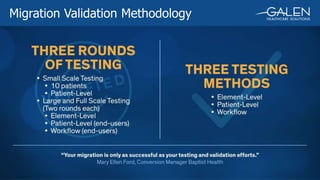
Migration Validation Methodology
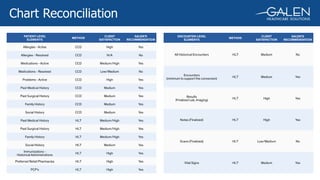
Chart Reconciliation
Confidential © 2017 Galen Healthcare Solutions
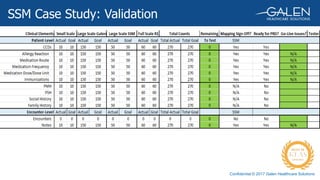
SSM Case Study: Validation
Confidential © 2017 Galen Healthcare Solutions
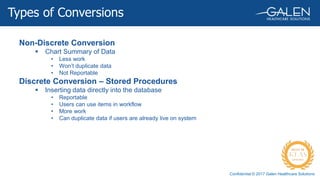
Non-Discrete Conversion
 Chart Summary of Data
• Less work
• Won’t duplicate data
• Not Reportable
Discrete Conversion – Stored Procedures
 Inserting data directly into the database
• Reportable
• Users can use items in workflow
• More work
• Can duplicate data if users are already live on system
Types of Conversions
Confidential © 2017 Galen Healthcare Solutions
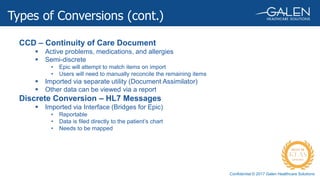
CCD – Continuity of Care Document
 Active problems, medications, and allergies
 Semi-discrete
• Epic will attempt to match items on import
• Users will need to manually reconcile the remaining items
 Imported via separate utility (Document Assimilator)
 Other data can be viewed via a report
Discrete Conversion – HL7 Messages
 Imported via Interface (Bridges for Epic)
• Reportable
• Data is filed directly to the patient’s chart
• Needs to be mapped
Types of Conversions (cont.)
Confidential © 2017 Galen Healthcare Solutions
Different options for matching
 Standard matching vs. Extended matching criteria
When would patient matching fail?
 Name misspelled
 Name change
 Info lacking in legacy system
 Patients don’t exist
Other Considerations
 Multi-org environment
• Use of Internal Organization number in Patient table
• eMPI Enterprise Master Patient Index
 Merged and Deactivated Patients
Patient Matching
Confidential © 2017 Galen Healthcare Solutions
Epic
 Matched by Identity ID and ID type
 Some interfaces can create patients
 Identity Duplicate Configuration (IDC)
• Weights
• “Sounds Like”
Meditech
 MRN needed prior to clinical data import for matching
Patient Matching (cont.)
Confidential © 2017 Galen Healthcare Solutions
Ways to Access Data:
 Direct network access
 Access to legacy system
• Galen Securelink
 Linked server
• Copy of legacy system to test database of new system
Scanned Images
 Options:
• Direct network access
• Removable device
• FTP
Getting Access to the Data
Confidential © 2017 Galen Healthcare Solutions
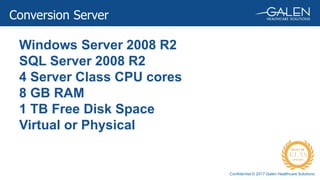
Windows Server 2008 R2
SQL Server 2008 R2
4 Server Class CPU cores
8 GB RAM
1 TB Free Disk Space
Virtual or Physical
Conversion Server
Confidential © 2017 Galen Healthcare Solutions
Space needed in Works for discrete item conversion
 No easy way to estimate this:
• Test with % of patients and extrapolate
 Also take into account scanned images
Space needed in Scan warehouse for image
conversion
 PDFs loaded into scan warehouse
 900KB per Chart Summary
Space Needed for Conversion
Confidential © 2017 Galen Healthcare Solutions
Panel Questions
Q1 - Sandy: How did you decide on the # of years
of data to migrate?
Q2 – Sandy: Knowing what you know now, would
you have chose to migrate?
Q3 – Sandy: What was one of the unexpected
benefits of data migration? Any downsides?
Confidential © 2017 Galen Healthcare Solutions
Sandy’s Key Insight
Message to audience: Assess data needs
before you actually jump into the
project
Confidential © 2016 Galen Healthcare Solutions
OUR PHILOSOPHY
Confidential © 2017 Galen Healthcare Solutions
Thank you for joining us today. To access the slides from today’s
presentation, please visit:
http://wiki.galenhealthcare.com/Category:Webcasts
For additional assistance or to request information about our many
services and products, please contact us through our website:
www.galenhealthcare.com
MUCH MORE THAN
I.T.
GALENHEALTHCARE.COM

What to Expect When Migrating: A Walk Through a Clinical Data Migration (2017)

  • 1.
    Clinical Data Migration:Functional & Technical Considerations A SSM Integrated Health Technologies Case Study
  • 2.
    Confidential © 2017Galen Healthcare Solutions You have been automatically muted. Please use the Q&A panel to submit questions during the presentation
  • 3.
    Confidential © 2017Galen Healthcare Solutions Roles & Organizations SSM Case Study Overview Migration Decisions Functional Considerations Technical Considerations Considerations Relating to SSM Panelist Questions TODAY’S AGENDA Confidential © 2016 Galen Healthcare Solutions
  • 4.
    Confidential © 2016Galen Healthcare Solutions Taylor Mawyer Managing Consultant Galen Healthcare Solutions Moderators: Justin Campbell VP, Strategy Galen Healthcare Solutions Sandy Winkelmann Project Manager SSM Integrated Health Technologies Julie Champagne Strategist Galen Healthcare Solutions Kavon Kaboli Senior Consultant Galen Healthcare Solutions Clinical Data Migration: Functional & Technical Considerations A SSM Integrated Health Technologies Case Study
  • 5.
  • 6.
    Confidential © 2017Galen Healthcare Solutions Galen’s Vendor Expertise
  • 7.
    Galen Roles: • LegacySystem Data Extract and Evaluation • Clinical Data Mapping • Configuration • Testing and Validation • Data Import and Issue Resolution • GE Centricity and MEDITECH to Epic EHR Transition ⁃ Legacy Systems ⁃ MEDITECH 6.0 Inpatient EHR 6.07 ⁃ MEDITECH/LSS Ambulatory EHR 6.08 ⁃ GE Centricity Ambulatory EMR 9.8 ⁃ Target System: Epic 2014 ⁃ CCD Extract & Import ⁃ Allergies ⁃ Medications ⁃ Problems Key Metrics Immunizations270K Allergies360K Medications650K Problems600K 139K Patients Migrated 200+ Providers Migrated SSM Integrated Health Technologies
  • 8.
    Confidential © 2017Galen Healthcare Solutions SSM Case Study Overview Our panelists will share: • An overview of the role they played in SSM’s data migration • What challenges they faced as it related to the SSM EHR data migration • Lessons learned from the EHR data migration
  • 9.
    Confidential © 2017Galen Healthcare Solutions SSM Case Study: Sandy’s Role • Facilitated discussions with physicians, hospital administration and clinic leaders regarding data elements for migration and amount of data to migrate. • Coordinated IT technical plans with System IT leaders and local IT staff. • Completed data mappings and coordinated System IT resources for data loads. • Completed necessary paperwork and project request forms (internal change control process). • Validated data loads, CCDs, and data reconciliation process.
  • 10.
    Confidential © 2017Galen Healthcare Solutions SSM Case Study: Challenges • Agreement on data elements – weighing the “cost” of the element versus the “benefit” • Gaining necessary approvals and agreement from multiple stakeholders • Timing of data migration versus abstraction activities versus actual “Go Live” date
  • 11.
    Confidential © 2017Galen Healthcare Solutions SSM Case Study: Lessons Learned • Migrated data reduced the amount of time spent abstracting for not only clinic visits but also patients who were currently in-house at the time of “Go Live.” This was an unexpected benefit. • Ensure that the MPI and visit loads are complete, up-to-date, and clean. • Begin the data migration process early! Some activities took longer than anticipated • Get agreement on elements to migrate versus abstract as well as the approach for migration (CCD, HL7). • Physician champions: • Experts for data elements and data mapping • Strong working knowledge of the reconciliation process in the new EHR • Champion the data migration effort with other providers and physicians • Have operational and IT subject matter experts available for data mapping. Experts need to be proficient with “old” EHR and have a good working knowledge of “new” EHR • Ensure that the data migration and abstraction strategies work hand in hand.
  • 12.
    Confidential © 2017Galen Healthcare Solutions SSM Case Study: Mapping • Mapping counts for Allergy Reactions are lower in GE Centricity than for MEDITECH due to the large number of free text Allergy Reactions documented in this legacy system that do not have discrete matches in Epic • Mapping counts for Medication Dose Units and Route appear lower due to how the data needed to be extracted from GE Centricity
  • 13.
    Confidential © 2017Galen Healthcare Solutions Why? • Sometimes adding a large amount of data • Very difficult to change once data has been loaded • Way the data is stored in the source system does not always play nice with how the target system accepts it • Way the source system records medication refills may be different from how the target system records them • Often need to think long term and about the global context in the organization • Mapping highly utilized medication in source system to rarely used medication in target system may not be a good idea Amount of Migration Decisions
  • 14.
    Confidential © 2017Galen Healthcare Solutions Migration vs Abstraction SSM Case Study: Migration Considerations: • Access to source clinical data? • Accuracy, validity, and cleanliness of clinical data? • Cost effectiveness of approach (business vs. clinical decision)?
  • 15.
    Confidential © 2017Galen Healthcare Solutions • Multiple ways to filter the data • Decide what data types will be converted • Immunizations, allergies, medications, results, problems, documents, vitals, images • Not every data type may be present in the source system • If organization has no inbound results interface then there may not be results to extract • Different ways to filter clinical data depending on need • Clearly define what fields will be converted • Can help to display where fields render in the target system • All fields might not be available to convert • Can depends on workflow Scope of Conversion
  • 16.
  • 17.
    Confidential © 2017Galen Healthcare Solutions SSM Case Study: Migration Stats
  • 18.
    Confidential © 2017Galen Healthcare Solutions Current Medications  Only shows most recent occurrence of medication  Not necessarily last time it was prescribed Medication History  Each time medication was recorded will convert separately  Can clog up Past Medications Current Medications vs. Medication History
  • 19.
    Confidential © 2017Galen Healthcare Solutions • Easy way to signify that clinical data came from another system • Way to add data that is not able to be mapped or able to be brought over discretely • Free text comments in source system Annotations
  • 20.
    Confidential © 2017Galen Healthcare Solutions Map all providers  Able to associate providers to meds prescribed, orders placed etc.  Not always connected to most recent record Use generic “conversion” provider  At a quick glance allows users to see where item came from  Conversion MD, HeartPro Non-providers  Administered by  Recorded by  Can use annotations as well Providers
  • 21.
    Confidential © 2017Galen Healthcare Solutions SSM Case Study: Mapping • Mapping counts for Allergy Reactions are lower in GE Centricity than for MEDITECH due to the large number of free text Allergy Reactions documented in this legacy system that do not have discrete matches in Epic • Mapping counts for Medication Dose Units and Route appear lower due to how the data needed to be extracted from GE Centricity
  • 22.
    Confidential © 2017Galen Healthcare Solutions Problems  Name  ICD-9  Problem Code Medications  Name  NDC  Medication Code Allergies  Name  Allergy Code Galen Intelligent Mapper
  • 23.
    Confidential © 2017Galen Healthcare Solutions Use counts to map most commonly used items What items to exclude (NKA, NKDA, No Known Medications etc.) Think critically about why values may be present  Data could have been entered incorrectly Ancillary mapping needs  Route of Administration  Body Site  Manufacturer  Allergy Reaction Mapping Considerations
  • 24.
    Confidential © 2017Galen Healthcare Solutions The good  Does not require time to map  Allows users to build a patient’s chart history on the fly for ambiguous items The bad  Items are not functional within Touchworks  Items do not participate in DUR (Drug Utilization Review) checking  Items do not auto-cite into a note  Cannot assess and charge for unverified problems  Immunizations display under the Orders Component Make sure users know the Verify and Add workflow Unverified Items
  • 25.
  • 26.
  • 27.
    Confidential © 2017Galen Healthcare Solutions SSM Case Study: Validation
  • 28.
    Confidential © 2017Galen Healthcare Solutions Non-Discrete Conversion  Chart Summary of Data • Less work • Won’t duplicate data • Not Reportable Discrete Conversion – Stored Procedures  Inserting data directly into the database • Reportable • Users can use items in workflow • More work • Can duplicate data if users are already live on system Types of Conversions
  • 29.
    Confidential © 2017Galen Healthcare Solutions CCD – Continuity of Care Document  Active problems, medications, and allergies  Semi-discrete • Epic will attempt to match items on import • Users will need to manually reconcile the remaining items  Imported via separate utility (Document Assimilator)  Other data can be viewed via a report Discrete Conversion – HL7 Messages  Imported via Interface (Bridges for Epic) • Reportable • Data is filed directly to the patient’s chart • Needs to be mapped Types of Conversions (cont.)
  • 30.
    Confidential © 2017Galen Healthcare Solutions Different options for matching  Standard matching vs. Extended matching criteria When would patient matching fail?  Name misspelled  Name change  Info lacking in legacy system  Patients don’t exist Other Considerations  Multi-org environment • Use of Internal Organization number in Patient table • eMPI Enterprise Master Patient Index  Merged and Deactivated Patients Patient Matching
  • 31.
    Confidential © 2017Galen Healthcare Solutions Epic  Matched by Identity ID and ID type  Some interfaces can create patients  Identity Duplicate Configuration (IDC) • Weights • “Sounds Like” Meditech  MRN needed prior to clinical data import for matching Patient Matching (cont.)
  • 32.
    Confidential © 2017Galen Healthcare Solutions Ways to Access Data:  Direct network access  Access to legacy system • Galen Securelink  Linked server • Copy of legacy system to test database of new system Scanned Images  Options: • Direct network access • Removable device • FTP Getting Access to the Data
  • 33.
    Confidential © 2017Galen Healthcare Solutions Windows Server 2008 R2 SQL Server 2008 R2 4 Server Class CPU cores 8 GB RAM 1 TB Free Disk Space Virtual or Physical Conversion Server
  • 34.
    Confidential © 2017Galen Healthcare Solutions Space needed in Works for discrete item conversion  No easy way to estimate this: • Test with % of patients and extrapolate  Also take into account scanned images Space needed in Scan warehouse for image conversion  PDFs loaded into scan warehouse  900KB per Chart Summary Space Needed for Conversion
  • 35.
    Confidential © 2017Galen Healthcare Solutions Panel Questions Q1 - Sandy: How did you decide on the # of years of data to migrate? Q2 – Sandy: Knowing what you know now, would you have chose to migrate? Q3 – Sandy: What was one of the unexpected benefits of data migration? Any downsides?
  • 36.
    Confidential © 2017Galen Healthcare Solutions Sandy’s Key Insight Message to audience: Assess data needs before you actually jump into the project
  • 37.
    Confidential © 2016Galen Healthcare Solutions OUR PHILOSOPHY
  • 38.
    Confidential © 2017Galen Healthcare Solutions Thank you for joining us today. To access the slides from today’s presentation, please visit: http://wiki.galenhealthcare.com/Category:Webcasts For additional assistance or to request information about our many services and products, please contact us through our website: www.galenhealthcare.com
  • 39.

Editor's Notes

  • #6 Our Team Best in KLAS – HIT Implementation Staffing and Support Clinical workflow and operations experts Average Staff HIT Experience: 12 Years Our company culture - Strive for success, you get the entire Galen team behind every project Cross-section of clinical and non-clinical healthcare application expertise 2.0MM Hours Healthcare Experience 280 Customers served in the last 2 years Boutique, healthcare-focused services & solutions company For over a decade, Galen has built a solid reputation of providing high-quality, expert level IT consulting services to health systems, hospitals and physician practices. The foundation of our growth and success can be attributed to our people. It’s what we care about as a company that makes us unique.
  • #7 Our Value Proposition: We transform data into actionable, profitable information Provide world-class Technical & Professional Services to healthcare organizations that interoperate, aggregate, convert, harvest and optimize clinical patient information within their multi-vendor systems portfolio including Practice Management, Electronic Health Record & Health Information Exchange. Deliver a suite of fully-integrated Products that enhance, automate, and simplify the access and use of clinical patient data within those systems to improve cost-efficiency and quality outcomes.
  • #8 Talking points: Consider all inbound data feed options – like re-purposing an inbound point of care lab interface to import lab results. Consider how the bulk import of results and data will affect downstream systems (portal notifications, provider tasking, etc.) Don’t underestimate the importance or time required for mapping.   In addition to nomenclature and code mapping – there are the nuances between systems (i.e. format required, blanks, comments, units of measure, etc.) Have a dedicated clinical and technical team and don’t lose momentum.
  • #13 Taken from Kavon’s SSM Migration Stats *The mapping counts for Allergy Reactions are lower in GE Centricity than for MEDITECH due to the large number of free text Allergy Reactions documented in this legacy system that do not have discrete matches in Epic. **The mapping counts for Medication Dose Units and Route appear lower due to how the data needed to be extracted from GE Centricity. To map Dose Units and Route discretely, complete medication instructions were extracted from GE Centricity and Dose Unit, Route, and Frequency were mapped when appropriate. If a medication instruction did not contain a Dose Unit or Route (e.g. Take 1 Daily), no Dose Unit or route could be mapped. Thus, there were simply a large number of medication instructions where mapping certain elements was not appropriate.
  • #14 Copied from Clinical Data Conversions: Functional and Technical Considerations
  • #15 We considered hiring temp help (clinical students) to manually abstract the data from source to target system. We evaluated the tradeoffs and talked through options. The med & nursing students didn’t know systems – that was a major factor Another was the potential for human error and lack of audit trail that comes with manual data abstraction. The systems are constantly changing, and as such the fidelity of the data could come into question.
  • #16 Copied from Clinical Data Conversions: Functional and Technical Considerations
  • #17 Slide 14 shows example Graphically show how different clinical items are manifested. Show all the clinical items (with icons) for those grouped under HL7 and those grouped under CCD, etc. – See example on following slide
  • #18 Taken from Kavon’s SSM Migration Stats *When importing data, Epic matches allergies based on the RxNorm codification. When Epic cannot match allergies based on RxNorm, it still has the ability to match allergies based on exact spelling. Despite the low percentage of allergies in MEDITECH and GE Centricity with associated RxNorm codes, a large percentage of allergies are still expected to be matched based on spelling. The percentages in these columns represent a worst case scenario. **When importing data, Epic matches problems based on ICD-9, ICD-10, and SNOMED codes. Due to the high percentage match with these standardized codifications, a minimal amount of effort will be required to manually abstract unmapped problems during reconciliation workflows. ***When importing, data, Epic matches Medications based on the RxNorm and NDC codifications. Due to the high percentage match with these standardized codifications a minimal amount of effort will be required to manually abstract unmapped medications during reconciliation workflows.
  • #19 Copied from Clinical Data Conversions: Functional and Technical Considerations
  • #20 Copied from Clinical Data Conversions: Functional and Technical Considerations
  • #21 Copied from Clinical Data Conversions: Functional and Technical Considerations
  • #22 Taken from Kavon’s SSM Migration Stats *The mapping counts for Allergy Reactions are lower in GE Centricity than for MEDITECH due to the large number of free text Allergy Reactions documented in this legacy system that do not have discrete matches in Epic. **The mapping counts for Medication Dose Units and Route appear lower due to how the data needed to be extracted from GE Centricity. To map Dose Units and Route discretely, complete medication instructions were extracted from GE Centricity and Dose Unit, Route, and Frequency were mapped when appropriate. If a medication instruction did not contain a Dose Unit or Route (e.g. Take 1 Daily), no Dose Unit or route could be mapped. Thus, there were simply a large number of medication instructions where mapping certain elements was not appropriate.
  • #23 Copied from Clinical Data Conversions: Functional and Technical Considerations
  • #24 Copied from Clinical Data Conversions: Functional and Technical Considerations
  • #25 Copied from Clinical Data Conversions: Functional and Technical Considerations
  • #26 Visually represent clinical validation; rounds of testing (subsets of data) – at patient-level. Ensure only data that is in-scope is pulled. Full-scale – essentially a dry-run. Benchmark duration of production load; identify exceptions that would need to be addressed before production Reconcile CCD; adding medication; trying to reduce as many hard-stop as necessary; Validation Methodology Overview: While Galen's validation methodology consists of several phases of testing (Unit, Small Scale, Large Scale, and Full Scale) that culminates in a total of at least 270 patients and 270 instances of each in-scope clinical element being tested, we also deploy other testing methodologies to ensure the appropriate and safe migration of data. One of the methodologies not captured in the validation tracking above is focused testing. Focused Testing: Throughout the validation process, Galen performs data testing where specific scenarios that could cause or result in issues are identified and tested. Examples of focused testing include testing multiple examples of every mapped allergy reaction, medication dose/dose unit, route, and frequency. Similarly, other scenarios include: •Testing patients that have matched vs. unmatched allergies/problems/medications •Testing patients that have mapped and unmapped allergy reactions •Testing patients that have an allergy with more than one mapped allergy reaction •Testing patients that have no documented allergies, medications, or problems Gap Testing: Generally during a migration there is a need to perform more than one data load into the target system. Subsequent data loads are referred to as gap loads. The goal of a gap load is to capture in-scope clinical elements that have either been updated, changed, or removed from the legacy system since the initial data load. To accomodate gap loads, Galen also performs gap testing. During gap testing, Galen validates that any changes that have occurred in the legacy system are reflected appropriately in subsequent data loads into the target system. Some gap testing scenarios include: •Testing to ensure that removed allergies, medications, and problems no longer show on subsequent CCDs •Testing to ensure that updated allergies, medications, and problems show on subsequent CCDs and replace the previous version of the allergy, medication, or problem that was updated •Testing to ensure that allergies, medications, and problems that have not been updated, but that are included in subsequent CCDs do not duplicate in the target system •Testing to ensure that previously reconciled allergies, medications, and problems do not duplicate in Epic and cannot be reconciled again
  • #28 Taken from Kavon’s SSM Migration Stats
  • #29 Copied from Clinical Data Conversions: Functional and Technical Considerations
  • #30 Copied from Clinical Data Conversions: Functional and Technical Considerations
  • #31 Copied from Clinical Data Conversions: Functional and Technical Considerations
  • #32 Copied from Clinical Data Conversions: Functional and Technical Considerations
  • #33  Copied from Clinical Data Conversions: Functional and Technical Considerations
  • #34 Copied from Clinical Data Conversions: Functional and Technical Considerations
  • #35 Copied from Clinical Data Conversions: Functional and Technical Considerations
  • #36 A1 – Providers familiarity with the EHR played a part. They wanted everything, but it was important to show them that everything has a price tag. We delved into filtering and ultimately came up with 2 years of data. We had to weigh every category of data and get buy-in from providers on the approach. I would say it does take time to get folks on the same page: “What I would like to have” vs. “What I really need. This underscored the importance of the work on the front end: scoping of data via assessment? A2 – Yes, but I wish we had more time so there weren’t multiple loads of problem history. A3 – A big benefit was going live with the data migration at the same time for the go-live of the hospital. Lots of patients already had demographics, meds – specifically clinic patients who were hospital patients. Also reconciliation of the data allowed our staff to become gain familiarity with Epic – how to look up certain pieces of info. Physicians became more familiar through the reconciliation process Downside was weird stuff that existed in source record – namely data variability and integrity issues. How old the information was made it more challenging.
  • #37 A1 – Providers familiarity with the EHR played a part. They wanted everything, but it was important to show them that everything has a price tag. We delved into filtering and ultimately came up with 2 years of data. We had to weigh every category of data and get buy-in from providers on the approach. I would say it does take time to get folks on the same page: “What I would like to have” vs. “What I really need. This underscored the importance of the work on the front end: scoping of data via assessment? A2 – Yes, but I wish we had more time so there weren’t multiple loads of problem history
  • #38 Community Support Knowledge center with whitepapers, playbooks, guides. Our contribution to move healthcare IT forward Freely sharing our unique perspectives, our knowledge and our experience Over 622 blog posts Over 213 complimentary webinars delivered Visit our knowledge center - galenhealthcare.com/knowledge-center/ Visit our wiki – wiki.galenhealthcare.com Visit our Blog – blog.galenhealthcare.com