What is Web 2.0?  Discovering the Participatory Web Martha Hardy & Nicole Theis-Mahon Bio-Medical Library,  University of Minnesota October 16, 2008
Class Objectives Definition of Web 2.0 Evolution & defining characteristics Pros and Cons of Participatory Web Applications Web 2.0 in the health sciences
Definitions “ Web 2.0 is a term describing the trend in the use of the World Wide Web technology and web design that aims to enhance creativity, information sharing, and, most notably collaboration among users.”  Web 2.0  Wikipedia
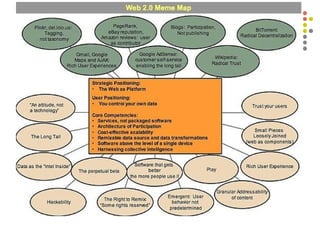
Defining Characteristics The Web as platform Harnesses collective intelligence Remixes and shares data End of the software release cycle Software above the level of a single device Rich user experiences Tim O’Reilly
 
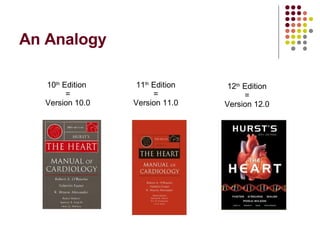
An Analogy 10 th  Edition  = Version 10.0 11 th  Edition = Version 11.0 12 th  Edition = Version 12.0
What Does 2.0 Mean? Upgrade New/Better program Movement New version of the Web
Evolution Product of the post dotcom bust Using the Web as a platform Power to the people! Consumers are creators and creators are consumers
The Web as a Platform Web as platform + Rich Internet Applications = Success Why? Easy to use Cheap (relatively) Perpetual Beta Sharing and collaboration
Examples of Web 2.0 Applications Wikis Blogs RSS feeds Podcasts Social networking Social bookmarking Photo sharing Videos Personalized pages Communication Collaborative document creation
Pros and Cons of Web 2.0 Applications Pros Easy to Use Cheap (relatively) Accessible from anywhere Perpetual Beta Sharing Collaboration Cons Privacy Cost Technical Requirements Training Intellectual Property Credibility & Accuracy
Web 2.0 in the Health Sciences “How Web 2.0 is Changing Medicine” Dean Giustini (medical librarian) Editorial published in  BMJ  in December of 2006. Highlights how Web 2.0 applications such as podcasts, RSS, blogs and social bookmarking can benefit health care professionals in their practices.  “ rather than intrinsic benefits of the platform itself,   it's the spirit of open sharing and collaboration that is paramount.”
Health 2.0 “ Health 2.0 is participatory healthcare. Enabled by information, software, and community that we collect or create, we the patients can be effective partners in our own healthcare, and we the people can participate in reshaping the health system itself.” Ted Eytan, MD “ The main point of the Web 2.0 movement in health care is the use of social software and its ability to promote collaboration between patients, their caregivers, and medical professionals.”  Laura O’Grady
Medicine 2.0 “ Medicine 2.0 applications, services and tools are Web-based services for health care consumers, caregivers, patients, health professionals, and biomedical researchers, that use Web 2.0 technologies as well as semantic web and virtual reality tools, to enable and facilitate specifically social networking, participation, apomediation, collaboration, and openness within and between these user groups..”  Gunther Eschenbach
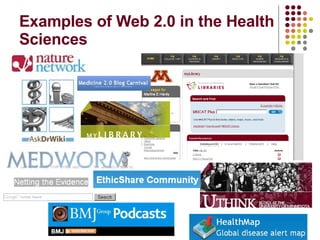
Examples of Web 2.0 in the Health Sciences
References Castilla, Victor. “Web 2.0 and Medicine: Medicine 2.0.”  Web 2.0 and Medicine.  6 May 2007.  http://web2097.blogspot.com/2007/05/web-20-and-medicine-medicine-20.html   Eysenbach, Gunther. “Medicine 2.0 Congress Launched (and: Definition of Medicine 2.0/Health 2.0).” Gunther Eysenbach’s Research Rants [blog]. 6 Mar 2008.  http://gunther-eysenbach.blogspot.com/2008/03/medicine-20-congress-website-launched.html   Eytan, Ted. “The Health 2.0 Definition: Not just the Latest, The Greatest!”  Ted Eytan, MD . 13 June 2008.  http://www.tedeytan.com/2008/06/13/1089 Giles, Jim. “Internet Encyclopedias Go Head to Head.”  Nature . 15 Dec. 2005. 438: 900-901.  Giustini, Dean. “How Web 2.0 is Changing Medicine.”  BMJ.  23 Dec. 2006. 333: 1283-1284.  http://www.bmj.com/cgi/content/full/333/7582/1283   Health 2.0 Wiki. “Health 2.0 Definition.” Viewed 30 July 2008.  http://health20.org/wiki/Health_2.0_Definition
References, continued Hughes, Benjamin & Joanthan Wareham. “Health 2.0 and Medicine 2.0: Tensions and Controversies in the Field.”  Journal of Medical Internet Research.  2008. 10(3). Viewed on 14 Oct 2008.  http://www.pubmedcentral.nih.gov/articlerender.fcgi?artid=2553249   O’Relly, Tim. “What is Web 2.0 : Design Patterns and Business Models for the Next Generation of Software”  Viewed on 26 July 2008.  http://www.oreillynet.com/pub/a/oreilly/tim/news/2005/09/30/what-is-web-20.html Rothman, David. “Web 2.0: Plenary Session.” Medical Library Association Annual Meeting, Chicago, Illinois. May 2008. Viewed on 28 July 2008.  http://www.slideshare.net/davidlrothman/mla-plenary-session-iv-rothman20080513-static  &  http://www.visualwebcaster.com/stratosphere/48592/event.html   Wikipedia. “Health 2.0,” Viewed on 29 July 2008.  http://en.wikipedia.org/wiki/Health_2.0   Wikipedia. “Web 2.0.” Viewed on 28 July 2008  http://en.wikipedia.org/wiki/Web2.0
Questions? Contact us Nicole Theis-Mahon  [email_address] Martha Hardy  [email_address]   Bio-Medical Library Reference Desk (612) 626-3260 [email_address]

What Is Web 2.0? Discovering the Participatory Web

  • 1.
    What is Web2.0? Discovering the Participatory Web Martha Hardy & Nicole Theis-Mahon Bio-Medical Library, University of Minnesota October 16, 2008
  • 2.
    Class Objectives Definitionof Web 2.0 Evolution & defining characteristics Pros and Cons of Participatory Web Applications Web 2.0 in the health sciences
  • 3.
    Definitions “ Web2.0 is a term describing the trend in the use of the World Wide Web technology and web design that aims to enhance creativity, information sharing, and, most notably collaboration among users.” Web 2.0 Wikipedia
  • 4.
    Defining Characteristics TheWeb as platform Harnesses collective intelligence Remixes and shares data End of the software release cycle Software above the level of a single device Rich user experiences Tim O’Reilly
  • 5.
  • 6.
    An Analogy 10th Edition = Version 10.0 11 th Edition = Version 11.0 12 th Edition = Version 12.0
  • 7.
    What Does 2.0Mean? Upgrade New/Better program Movement New version of the Web
  • 8.
    Evolution Product ofthe post dotcom bust Using the Web as a platform Power to the people! Consumers are creators and creators are consumers
  • 9.
    The Web asa Platform Web as platform + Rich Internet Applications = Success Why? Easy to use Cheap (relatively) Perpetual Beta Sharing and collaboration
  • 10.
    Examples of Web2.0 Applications Wikis Blogs RSS feeds Podcasts Social networking Social bookmarking Photo sharing Videos Personalized pages Communication Collaborative document creation
  • 11.
    Pros and Consof Web 2.0 Applications Pros Easy to Use Cheap (relatively) Accessible from anywhere Perpetual Beta Sharing Collaboration Cons Privacy Cost Technical Requirements Training Intellectual Property Credibility & Accuracy
  • 12.
    Web 2.0 inthe Health Sciences “How Web 2.0 is Changing Medicine” Dean Giustini (medical librarian) Editorial published in BMJ in December of 2006. Highlights how Web 2.0 applications such as podcasts, RSS, blogs and social bookmarking can benefit health care professionals in their practices. “ rather than intrinsic benefits of the platform itself, it's the spirit of open sharing and collaboration that is paramount.”
  • 13.
    Health 2.0 “Health 2.0 is participatory healthcare. Enabled by information, software, and community that we collect or create, we the patients can be effective partners in our own healthcare, and we the people can participate in reshaping the health system itself.” Ted Eytan, MD “ The main point of the Web 2.0 movement in health care is the use of social software and its ability to promote collaboration between patients, their caregivers, and medical professionals.” Laura O’Grady
  • 14.
    Medicine 2.0 “Medicine 2.0 applications, services and tools are Web-based services for health care consumers, caregivers, patients, health professionals, and biomedical researchers, that use Web 2.0 technologies as well as semantic web and virtual reality tools, to enable and facilitate specifically social networking, participation, apomediation, collaboration, and openness within and between these user groups..” Gunther Eschenbach
  • 15.
    Examples of Web2.0 in the Health Sciences
  • 16.
    References Castilla, Victor.“Web 2.0 and Medicine: Medicine 2.0.” Web 2.0 and Medicine. 6 May 2007. http://web2097.blogspot.com/2007/05/web-20-and-medicine-medicine-20.html Eysenbach, Gunther. “Medicine 2.0 Congress Launched (and: Definition of Medicine 2.0/Health 2.0).” Gunther Eysenbach’s Research Rants [blog]. 6 Mar 2008. http://gunther-eysenbach.blogspot.com/2008/03/medicine-20-congress-website-launched.html Eytan, Ted. “The Health 2.0 Definition: Not just the Latest, The Greatest!” Ted Eytan, MD . 13 June 2008. http://www.tedeytan.com/2008/06/13/1089 Giles, Jim. “Internet Encyclopedias Go Head to Head.” Nature . 15 Dec. 2005. 438: 900-901. Giustini, Dean. “How Web 2.0 is Changing Medicine.” BMJ. 23 Dec. 2006. 333: 1283-1284. http://www.bmj.com/cgi/content/full/333/7582/1283 Health 2.0 Wiki. “Health 2.0 Definition.” Viewed 30 July 2008. http://health20.org/wiki/Health_2.0_Definition
  • 17.
    References, continued Hughes,Benjamin & Joanthan Wareham. “Health 2.0 and Medicine 2.0: Tensions and Controversies in the Field.” Journal of Medical Internet Research. 2008. 10(3). Viewed on 14 Oct 2008. http://www.pubmedcentral.nih.gov/articlerender.fcgi?artid=2553249 O’Relly, Tim. “What is Web 2.0 : Design Patterns and Business Models for the Next Generation of Software” Viewed on 26 July 2008. http://www.oreillynet.com/pub/a/oreilly/tim/news/2005/09/30/what-is-web-20.html Rothman, David. “Web 2.0: Plenary Session.” Medical Library Association Annual Meeting, Chicago, Illinois. May 2008. Viewed on 28 July 2008. http://www.slideshare.net/davidlrothman/mla-plenary-session-iv-rothman20080513-static & http://www.visualwebcaster.com/stratosphere/48592/event.html Wikipedia. “Health 2.0,” Viewed on 29 July 2008. http://en.wikipedia.org/wiki/Health_2.0 Wikipedia. “Web 2.0.” Viewed on 28 July 2008 http://en.wikipedia.org/wiki/Web2.0
  • 18.
    Questions? Contact usNicole Theis-Mahon [email_address] Martha Hardy [email_address] Bio-Medical Library Reference Desk (612) 626-3260 [email_address]