What is Virtual DOM in ReactJS?
• DOM stands for ‘Document Object Model’. In simple terms, it is a
structured representation of the HTML elements. So, in this article,
we will see what is Virtual DOM in ReactJS.
• DOM represents the entire UI of your application. The DOM is
represented as a tree data structure. It contains a node for each UI
element present in the web document. It is very useful as it allows
web developers to modify content through JavaScript, also it being in
structured format helps a lot as we can choose specific targets and all
the code becomes much easier to work with.
Updating DOM:
• If you know a little about JavaScript then you might have seen people
making use of the ‘getElementById()’ or ‘getElementByClass()’
method to modify the content of DOM. Every time there is a change
in the state of your application, the DOM gets updated to reflect that
change in the UI. Though doing things like this is not a problem and it
works fine, but consider a case where we have a DOM that contains
nodes in a large number, and also all these web elements have
different styling and attributes.
• As DOM is represented as a tree itself, updating the tree here is not a
costly operation indeed we have a lot of algorithms on trees to make
the updates fast. What’s proving to be costly is every time the DOM
gets updated, the updated element and its children have to be
rendered again to update the UI of our page. Like this each time there
is a component update, the DOM needs to be updated. Also, the UI
components have to be re-rendered.
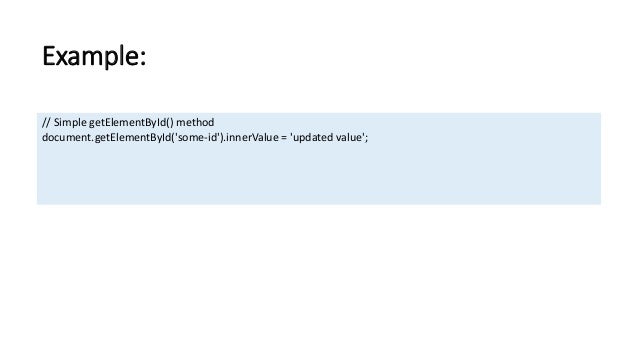
Example:
// Simple getElementById() method
document.getElementById('some-id').innerValue = 'updated value';
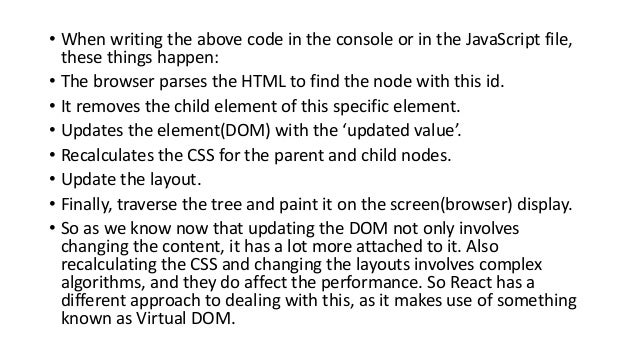
• When writing the above code in the console or in the JavaScript file,
these things happen:
• The browser parses the HTML to find the node with this id.
• It removes the child element of this specific element.
• Updates the element(DOM) with the ‘updated value’.
• Recalculates the CSS for the parent and child nodes.
• Update the layout.
• Finally, traverse the tree and paint it on the screen(browser) display.
• So as we know now that updating the DOM not only involves
changing the content, it has a lot more attached to it. Also
recalculating the CSS and changing the layouts involves complex
algorithms, and they do affect the performance. So React has a
different approach to dealing with this, as it makes use of something
known as Virtual DOM.
Virtual DOM:
• React uses Virtual DOM exists which is like a lightweight copy of the
actual DOM(a virtual representation of the DOM). So for every object
that exists in the original DOM, there is an object for that in React
Virtual DOM. It is exactly the same, but it does not have the power to
directly change the layout of the document. Manipulating DOM is
slow, but manipulating Virtual DOM is fast as nothing gets drawn on
the screen. So each time there is a change in the state of our
application, virtual DOM gets updated first instead of the real DOM.
You may still wonder, “Aren’t we doing the same thing again and
doubling our work? How can this be faster?” Read below to
understand how things will be faster using virtual DOM.
How Virtual DOM actually makes things faster:
• When anything new is added to the application, a virtual DOM is
created and it is represented as a tree. Each element in the
application is a node in this tree. So, whenever there is a change in
the state of any element, a new Virtual DOM tree is created. This new
Virtual DOM tree is then compared with the previous Virtual DOM
tree and make a note of the changes. After this, it finds the best
possible ways to make these changes to the real DOM. Now only the
updated elements will get rendered on the page again.
How Virtual DOM helps React:
• n react, everything is treated as a component be it a functional
component or class component. A component can contain a state.
Whenever the state of component is changed react updates its Virtual
DOM tree. It may sound ineffective but the cost is not much
significant as updating the virtual DOM doesn’t take much time. React
maintains two Virtual DOM at each time. One contains the updated
Virtual DOM and one which is just the pre-update version of this
updated Virtual DOM. Now it compares the pre-update version with
the updated Virtual DOM and figures out what exactly has changed in
the DOM like which components have been changed. This process of
comparing the current Virtual DOM tree with the previous one is
known as ‘diffing’.
• Once React finds out what exactly has changed then it updated those
objects only, on real DOM. React uses something called batch updates
to update the real DOM. It means that the changes to the real DOM
are sent in batches instead of sending any update for a single change
in the state of a component. We have seen that the re-rendering of
the UI is the most expensive part. React manages to do this most
efficiently by ensuring that the Real DOM receives batch updates to
re-render the UI. This entire process of transforming changes to the
real DOM is called Reconciliation. This improves the performance and
is the main reason why React & its Virtual DOM are preferred by
developers all around.
Conclusion:
• So, in this article, we have been through what is Virtual DOM in
ReactJS. Also, feel free to comment with your suggestions and
feedback. As a Premium react development company, we have a team
of highly experienced React JS developers. They can assist you in
developing your customized web app. So contact us to hire
experienced React JS developers.
Article Source: https://bosctechlabs.com/virtual-dom-in-reactjs/

What is virtual dom in react js

  • 2.
    What is VirtualDOM in ReactJS? • DOM stands for ‘Document Object Model’. In simple terms, it is a structured representation of the HTML elements. So, in this article, we will see what is Virtual DOM in ReactJS. • DOM represents the entire UI of your application. The DOM is represented as a tree data structure. It contains a node for each UI element present in the web document. It is very useful as it allows web developers to modify content through JavaScript, also it being in structured format helps a lot as we can choose specific targets and all the code becomes much easier to work with.
  • 3.
    Updating DOM: • Ifyou know a little about JavaScript then you might have seen people making use of the ‘getElementById()’ or ‘getElementByClass()’ method to modify the content of DOM. Every time there is a change in the state of your application, the DOM gets updated to reflect that change in the UI. Though doing things like this is not a problem and it works fine, but consider a case where we have a DOM that contains nodes in a large number, and also all these web elements have different styling and attributes.
  • 4.
    • As DOMis represented as a tree itself, updating the tree here is not a costly operation indeed we have a lot of algorithms on trees to make the updates fast. What’s proving to be costly is every time the DOM gets updated, the updated element and its children have to be rendered again to update the UI of our page. Like this each time there is a component update, the DOM needs to be updated. Also, the UI components have to be re-rendered.
  • 5.
    Example: // Simple getElementById()method document.getElementById('some-id').innerValue = 'updated value';
  • 6.
    • When writingthe above code in the console or in the JavaScript file, these things happen: • The browser parses the HTML to find the node with this id. • It removes the child element of this specific element. • Updates the element(DOM) with the ‘updated value’. • Recalculates the CSS for the parent and child nodes. • Update the layout. • Finally, traverse the tree and paint it on the screen(browser) display. • So as we know now that updating the DOM not only involves changing the content, it has a lot more attached to it. Also recalculating the CSS and changing the layouts involves complex algorithms, and they do affect the performance. So React has a different approach to dealing with this, as it makes use of something known as Virtual DOM.
  • 7.
    Virtual DOM: • Reactuses Virtual DOM exists which is like a lightweight copy of the actual DOM(a virtual representation of the DOM). So for every object that exists in the original DOM, there is an object for that in React Virtual DOM. It is exactly the same, but it does not have the power to directly change the layout of the document. Manipulating DOM is slow, but manipulating Virtual DOM is fast as nothing gets drawn on the screen. So each time there is a change in the state of our application, virtual DOM gets updated first instead of the real DOM. You may still wonder, “Aren’t we doing the same thing again and doubling our work? How can this be faster?” Read below to understand how things will be faster using virtual DOM.
  • 8.
    How Virtual DOMactually makes things faster: • When anything new is added to the application, a virtual DOM is created and it is represented as a tree. Each element in the application is a node in this tree. So, whenever there is a change in the state of any element, a new Virtual DOM tree is created. This new Virtual DOM tree is then compared with the previous Virtual DOM tree and make a note of the changes. After this, it finds the best possible ways to make these changes to the real DOM. Now only the updated elements will get rendered on the page again.
  • 9.
    How Virtual DOMhelps React: • n react, everything is treated as a component be it a functional component or class component. A component can contain a state. Whenever the state of component is changed react updates its Virtual DOM tree. It may sound ineffective but the cost is not much significant as updating the virtual DOM doesn’t take much time. React maintains two Virtual DOM at each time. One contains the updated Virtual DOM and one which is just the pre-update version of this updated Virtual DOM. Now it compares the pre-update version with the updated Virtual DOM and figures out what exactly has changed in the DOM like which components have been changed. This process of comparing the current Virtual DOM tree with the previous one is known as ‘diffing’.
  • 10.
    • Once Reactfinds out what exactly has changed then it updated those objects only, on real DOM. React uses something called batch updates to update the real DOM. It means that the changes to the real DOM are sent in batches instead of sending any update for a single change in the state of a component. We have seen that the re-rendering of the UI is the most expensive part. React manages to do this most efficiently by ensuring that the Real DOM receives batch updates to re-render the UI. This entire process of transforming changes to the real DOM is called Reconciliation. This improves the performance and is the main reason why React & its Virtual DOM are preferred by developers all around.
  • 11.
    Conclusion: • So, inthis article, we have been through what is Virtual DOM in ReactJS. Also, feel free to comment with your suggestions and feedback. As a Premium react development company, we have a team of highly experienced React JS developers. They can assist you in developing your customized web app. So contact us to hire experienced React JS developers. Article Source: https://bosctechlabs.com/virtual-dom-in-reactjs/