ReactJS
Re-rendering pages in the age of the mutable DOM
React re-renders entire component
whenever data changes
• 80s/90s — user input caused re-render of entire
web page. Why is this best?
• Immutable vs Mutable — mutations can cause
complexity to a point where an app is no longer
maintainable
“React components are idempotent functions.
They describe your UI at any point in time, just
like a server-rendered application.”
What does React do about
Mutable vs Immutable state?
• React isolates mutable state as much as possible.
• Re-rendering on every change makes things simple -
data is guaranteed to be up-to-date
• This is w/out magical data-binding, w/out model dirty
checking, and w/out explicit DOM operations
• Extra note: Why is dirty checking bad? It’s expensive
and as your application grows in complexity, it can
cause your code to get out of hand quickly
Everything is
declarative!
But how can you re-render every
time data changes?
Isn’t this too expensive?
… Enter the Virtual
DOM
What is the v-DOM and how
does it work?
• The v-DOM is a virtualized representation of the
DOM at different points in time (before and after
state change)
• This virtualization is made up of lightweight
JavaScript objects that represent the DOM tree.
As such - it is inexpensive to store in memory and
allows the diffing algorithm to execute in
milliseconds
On every update…
• React builds a new v-DOM subtree
• diffs it with the old one
• computes the minimal set of DOM mutations and
puts them in queue
• and batch executes all updates
It does this in
milliseconds
• React is fast because it computes minimal DOM
operations — the DOM is slow, JavaScript is
actually very, very fast
• React batches read/writes for optimal
performance automatically. It does this through
use of the v-DOM which is inherently faster than
the actual DOM.
Some other points of interest
• Automatic top-level event delegation with cross-
browser HTML5 events
• React also has a virtual event system in addition
to the v-DOM system
What else matters?
Web crawlers!
• One of the big drawbacks to single-page
applications that rely on user input is that web
crawlers can’t index them the same way they can
static pages
• React can generate a static HTML page and send
it down to the client, and then when render
component is called, it looks at the DOM - checks
with what was rendered on server... fast initial page
load experience and Google web-bots can crawl
What does that mean…
the long paragraph there?
“React can generate a static HTML page and
send it down to the client, and then when render
component is called, it looks at the DOM -
checks with what was rendered on server... fast
initial page load experience and Google web-
bots can crawl.”
What this means…
• You can generate a static html page and send it
down — something that can be crawled and
indexed
• Then, when JS boots up, it will replace DOM
elements as needed to boot up the UI
• Resulting in an indexable page that is fully built
on JavaScript
Let’s pause for a minute to note
some key takeaways so far
• Build components, not templates
• Re-render, don’t mutate
• V-DOM is simple and fast
So where does Flux come
in? … also, Relay is
coming soon
As you build apps on React,
you will remove models
• In most MV* JS frameworks, model is just a JS object
that allows you to know when something changes —
when data changes (enter two-way data-binding)
• Example:
• You have a model with Title and Subtitle. When something changes you manually
wire up the views to have a node change when the Title changes.
• You change the inner text on some node when the Title changes
• You have to wire this up yourself completely — in Backbone, you have to
wire both ways. In some other frameworks, you only have to wire one way,
but this is still a lot of code.
How is React different
in this example?
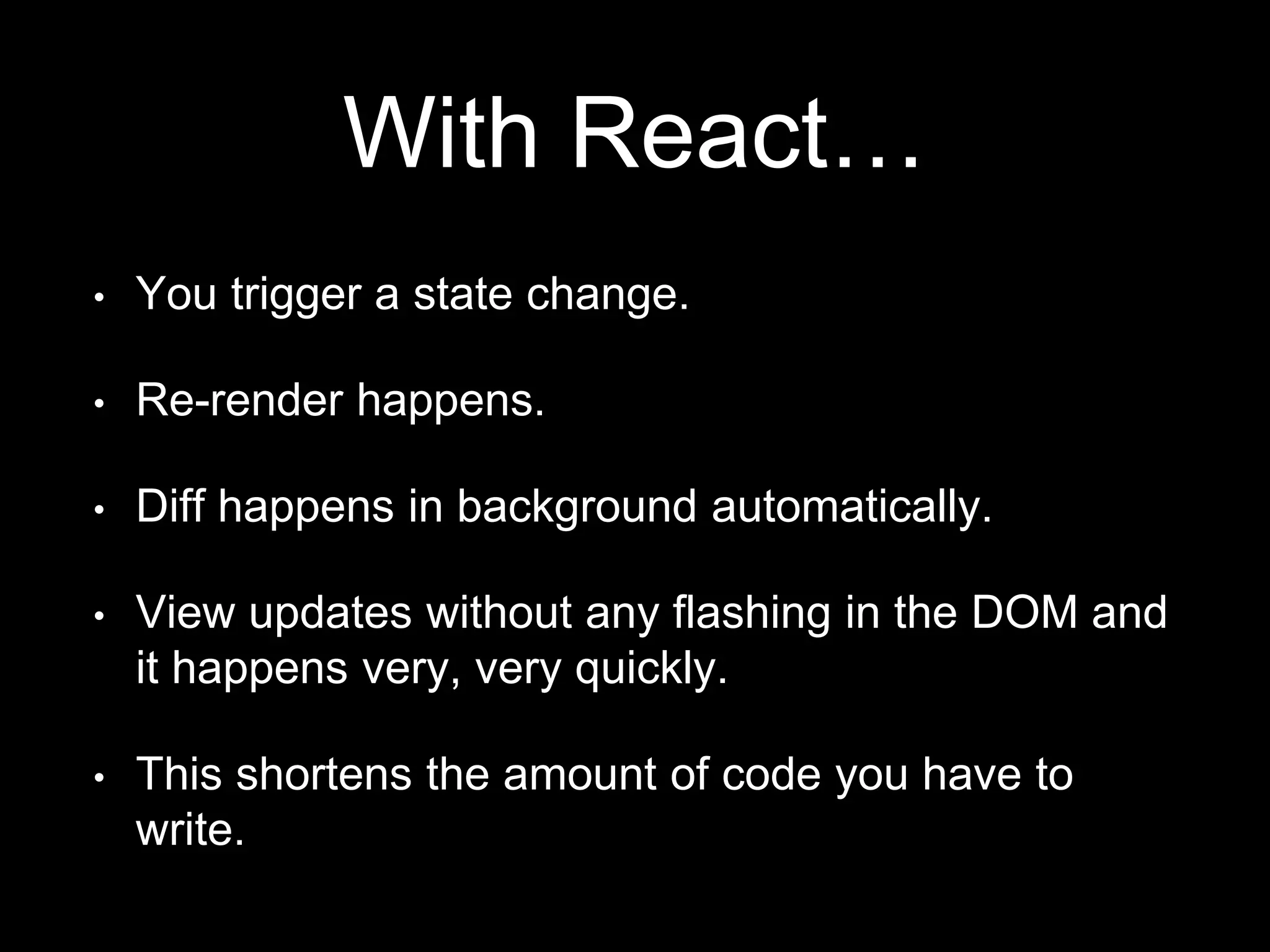
With React…
• You trigger a state change.
• Re-render happens.
• Diff happens in background automatically.
• View updates without any flashing in the DOM and
it happens very, very quickly.
• This shortens the amount of code you have to
write.
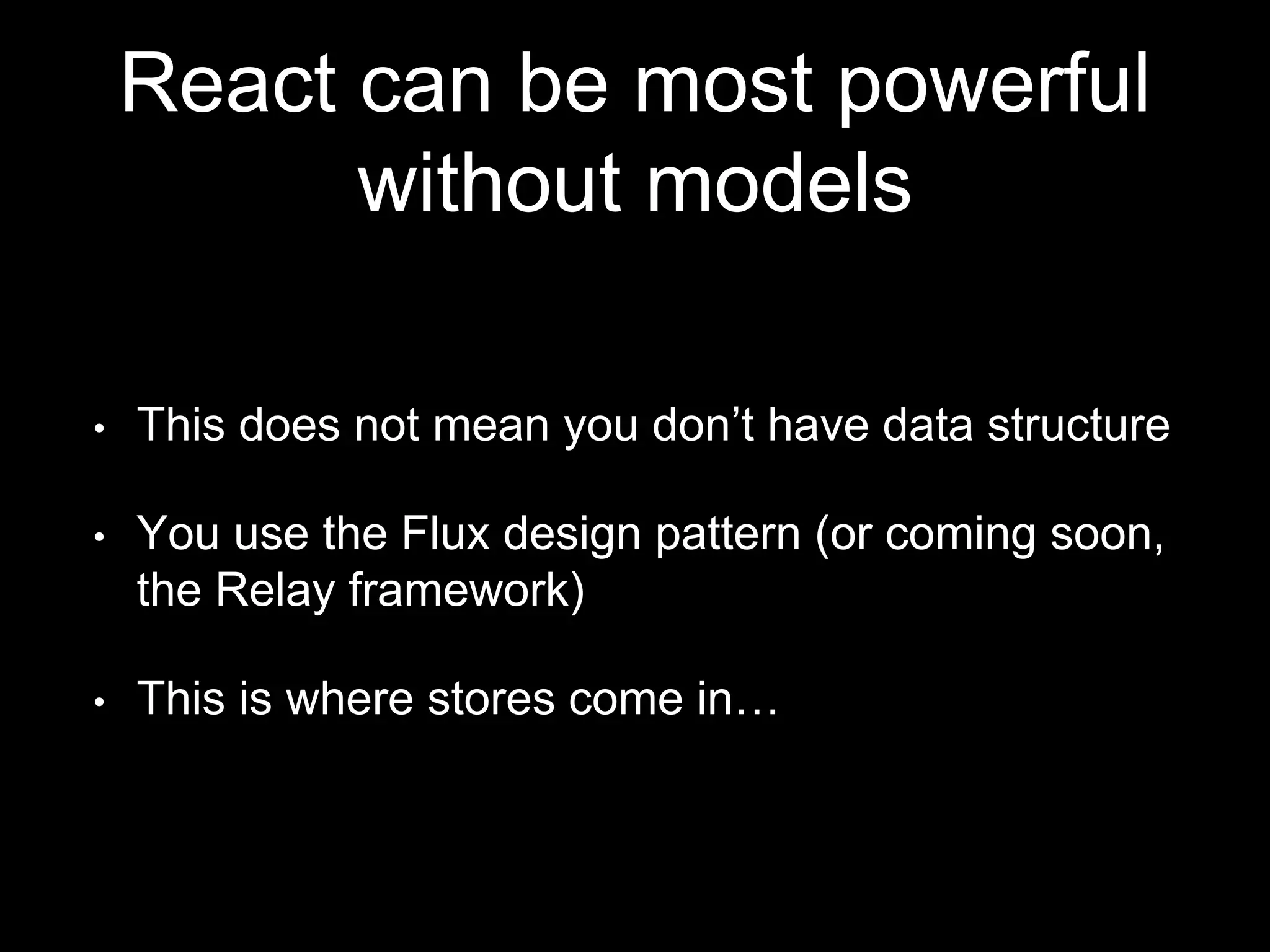
React can be most powerful
without models
• This does not mean you don’t have data structure
• You use the Flux design pattern (or coming soon,
the Relay framework)
• This is where stores come in…
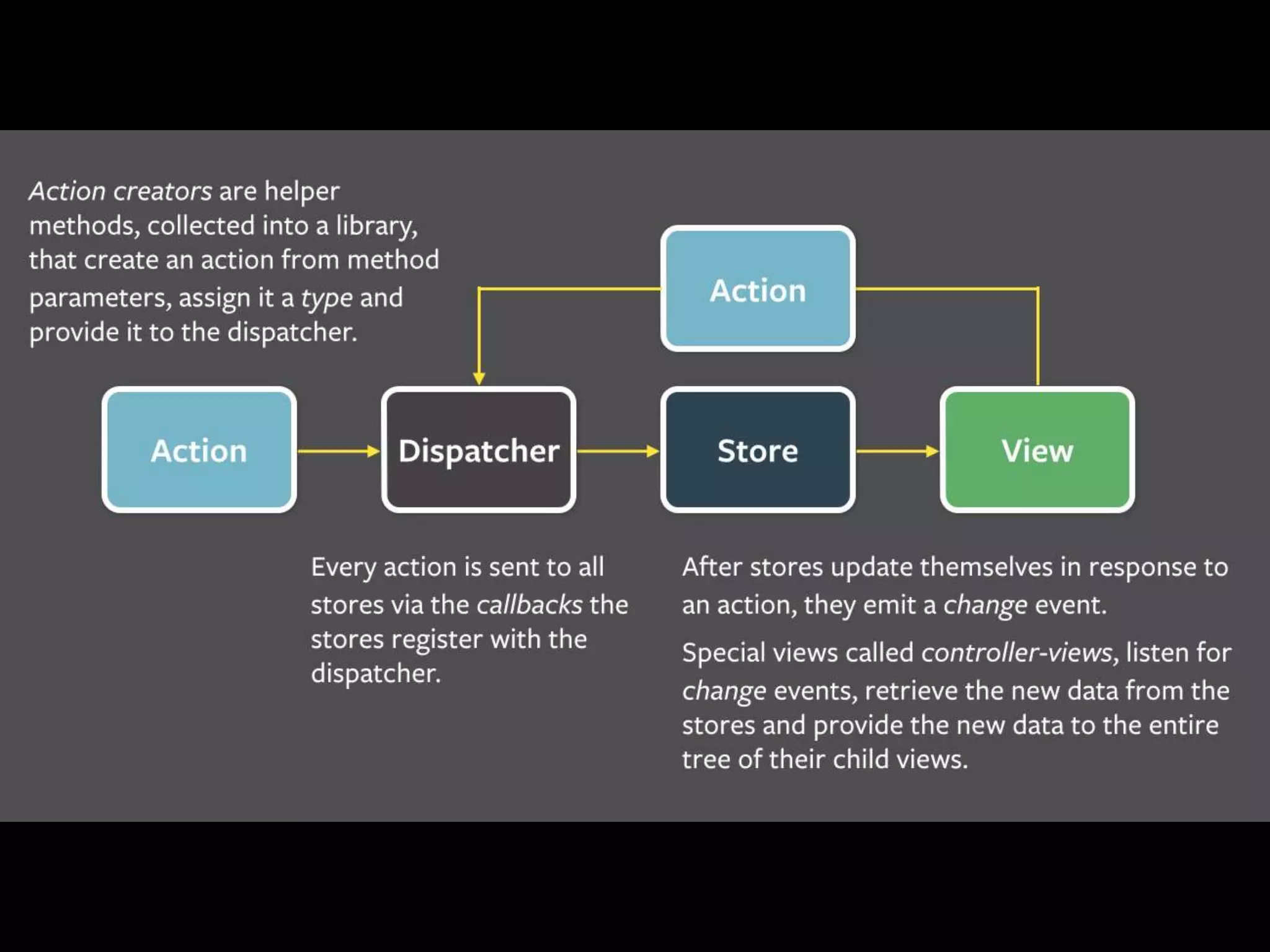
What is a Store?
Everything’s in Flux
• Centralized stores represent UI components
• The store is your source of truth for the data of
your application
• When you ask a store for data, if it doesn’t have
it, it fetches it and invokes your callback after it
gets it
This centralizes validation
and update logic in one
place.
Think about it.. mutation
all over the place is not
ideal.
More on Relay when it
becomes available to the
public as open-source

ReactJS - Re-rendering pages in the age of the mutable DOM

  • 1.
    ReactJS Re-rendering pages inthe age of the mutable DOM
  • 2.
    React re-renders entirecomponent whenever data changes • 80s/90s — user input caused re-render of entire web page. Why is this best? • Immutable vs Mutable — mutations can cause complexity to a point where an app is no longer maintainable
  • 3.
    “React components areidempotent functions. They describe your UI at any point in time, just like a server-rendered application.”
  • 4.
    What does Reactdo about Mutable vs Immutable state? • React isolates mutable state as much as possible. • Re-rendering on every change makes things simple - data is guaranteed to be up-to-date • This is w/out magical data-binding, w/out model dirty checking, and w/out explicit DOM operations • Extra note: Why is dirty checking bad? It’s expensive and as your application grows in complexity, it can cause your code to get out of hand quickly
  • 5.
  • 6.
    But how canyou re-render every time data changes? Isn’t this too expensive?
  • 7.
    … Enter theVirtual DOM
  • 8.
    What is thev-DOM and how does it work? • The v-DOM is a virtualized representation of the DOM at different points in time (before and after state change) • This virtualization is made up of lightweight JavaScript objects that represent the DOM tree. As such - it is inexpensive to store in memory and allows the diffing algorithm to execute in milliseconds
  • 9.
    On every update… •React builds a new v-DOM subtree • diffs it with the old one • computes the minimal set of DOM mutations and puts them in queue • and batch executes all updates
  • 10.
    It does thisin milliseconds
  • 11.
    • React isfast because it computes minimal DOM operations — the DOM is slow, JavaScript is actually very, very fast • React batches read/writes for optimal performance automatically. It does this through use of the v-DOM which is inherently faster than the actual DOM.
  • 12.
    Some other pointsof interest • Automatic top-level event delegation with cross- browser HTML5 events • React also has a virtual event system in addition to the v-DOM system
  • 13.
  • 14.
    Web crawlers! • Oneof the big drawbacks to single-page applications that rely on user input is that web crawlers can’t index them the same way they can static pages • React can generate a static HTML page and send it down to the client, and then when render component is called, it looks at the DOM - checks with what was rendered on server... fast initial page load experience and Google web-bots can crawl
  • 15.
    What does thatmean… the long paragraph there?
  • 16.
    “React can generatea static HTML page and send it down to the client, and then when render component is called, it looks at the DOM - checks with what was rendered on server... fast initial page load experience and Google web- bots can crawl.”
  • 17.
    What this means… •You can generate a static html page and send it down — something that can be crawled and indexed • Then, when JS boots up, it will replace DOM elements as needed to boot up the UI • Resulting in an indexable page that is fully built on JavaScript
  • 18.
    Let’s pause fora minute to note some key takeaways so far • Build components, not templates • Re-render, don’t mutate • V-DOM is simple and fast
  • 19.
    So where doesFlux come in? … also, Relay is coming soon
  • 20.
    As you buildapps on React, you will remove models • In most MV* JS frameworks, model is just a JS object that allows you to know when something changes — when data changes (enter two-way data-binding) • Example: • You have a model with Title and Subtitle. When something changes you manually wire up the views to have a node change when the Title changes. • You change the inner text on some node when the Title changes • You have to wire this up yourself completely — in Backbone, you have to wire both ways. In some other frameworks, you only have to wire one way, but this is still a lot of code.
  • 21.
    How is Reactdifferent in this example?
  • 22.
    With React… • Youtrigger a state change. • Re-render happens. • Diff happens in background automatically. • View updates without any flashing in the DOM and it happens very, very quickly. • This shortens the amount of code you have to write.
  • 23.
    React can bemost powerful without models • This does not mean you don’t have data structure • You use the Flux design pattern (or coming soon, the Relay framework) • This is where stores come in…
  • 24.
    What is aStore?
  • 25.
    Everything’s in Flux •Centralized stores represent UI components • The store is your source of truth for the data of your application • When you ask a store for data, if it doesn’t have it, it fetches it and invokes your callback after it gets it
  • 26.
    This centralizes validation andupdate logic in one place.
  • 27.
    Think about it..mutation all over the place is not ideal.
  • 29.
    More on Relaywhen it becomes available to the public as open-source