




3 Reasons to Love React
A JavaScript library for building User Interfaces
“The art of programming is
the art of organizing
complexity”
- Edsger W. Dijkstra
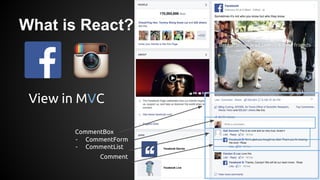
What is React?
View in MVC
CommentBox
- CommentForm
- CommentList
Comment
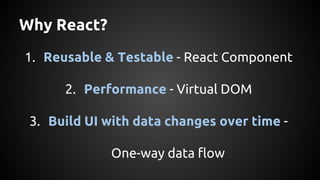
Why React?
1. Reuseable & Testable - React Component
2. Performance - Virtual DOM
3. Build UI with data changes over time -
One-way data flow
1. Reuseable & Testable
React Component
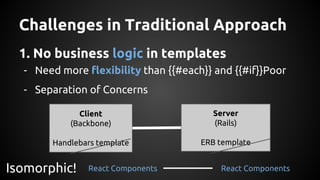
Challenges in Traditional Approach
1. No business logic in templates
- Need more flexibility than {{#each}} and {{#if}}Poor
- Separation of Concerns
Server
(Rails)
ERB template
Client
(Backbone)
Handlebars template
React Components React ComponentsIsomorphic!
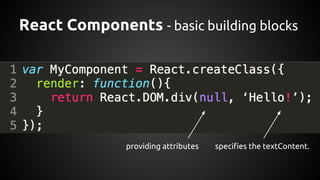
React Components - basic building blocks
providing attributes specifies the textContent.
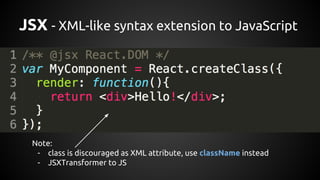
JSX - XML-like syntax extension to JavaScript
Note:
- class is discouraged as XML attribute, use className instead
- JSXTransformer to JS
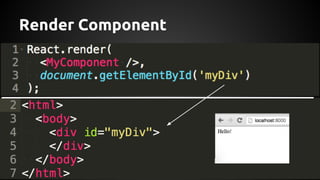
Render Component
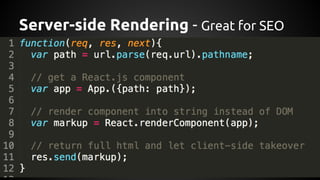
Server-side Rendering - Great for SEO
2. Performance
Virtual DOM
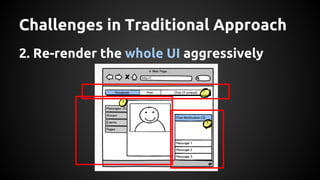
Challenges in Traditional Approach
2. Re-render the whole UI aggressively
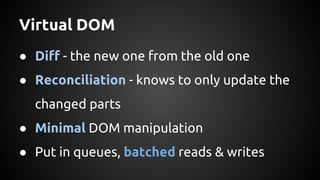
Virtual DOM
● Diff - the new one from the old one
● Reconciliation - knows to only update the
changed parts
● Minimal DOM manipulation
● Put in queues, batched reads & writes
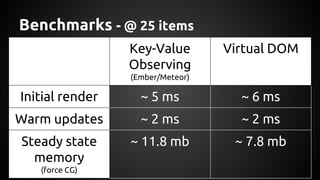
Benchmarks - @ 25 items
Key-Value
Observing
(Ember/Meteor)
Virtual DOM
Initial render ~ 5 ms ~ 6 ms
Warm updates ~ 2 ms ~ 2 ms
Steady state
memory
(force CG)
~ 11.8 mb ~ 7.8 mb
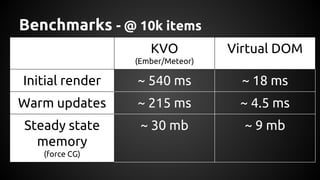
Benchmarks - @ 10k items
KVO
(Ember/Meteor)
Virtual DOM
Initial render ~ 540 ms ~ 18 ms
Warm updates ~ 215 ms ~ 4.5 ms
Steady state
memory
(force CG)
~ 30 mb ~ 9 mb
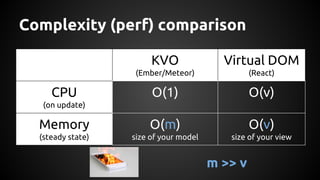
Complexity (perf) comparison
KVO
(Ember/Meteor)
Virtual DOM
(React)
CPU
(on update)
O(1) O(v)
Memory
(steady state)
O(m)
size of your model
O(v)
size of your view
m >> v
3. Build UI with data
changes over time
One-way data flow
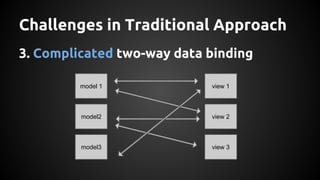
3. Complicated two-way data binding
Challenges in Traditional Approach
model 1
model2
model3
view 2
view 3
view 1
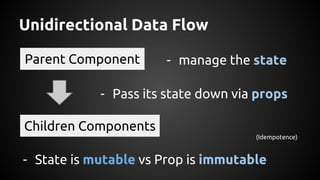
Unidirectional Data Flow
- State is mutable vs Prop is immutable
(Idempotence)
Parent Component
Children Components
- manage the state
- Pass its state down via props
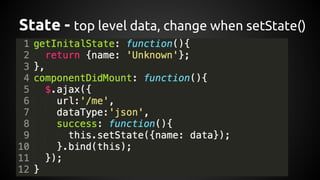
State - top level data, change when setState()
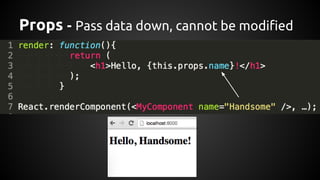
Props - Pass data down, cannot be modified
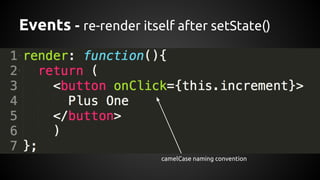
Events - re-render itself after setState()
camelCase naming convention
Why React?
1. Reusable & Testable - React Component
2. Performance - Virtual DOM
3. Build UI with data changes over time -
One-way data flow
@victorleungtw
Don’t call me, I’ll callback you. I promise!

3 Reasons to Love React

  • 1.
    3 Reasons toLove React A JavaScript library for building User Interfaces
  • 3.
    “The art ofprogramming is the art of organizing complexity” - Edsger W. Dijkstra
  • 4.
    What is React? Viewin MVC CommentBox - CommentForm - CommentList Comment
  • 5.
    Why React? 1. Reuseable& Testable - React Component 2. Performance - Virtual DOM 3. Build UI with data changes over time - One-way data flow
  • 6.
    1. Reuseable &Testable React Component
  • 7.
    Challenges in TraditionalApproach 1. No business logic in templates - Need more flexibility than {{#each}} and {{#if}}Poor - Separation of Concerns Server (Rails) ERB template Client (Backbone) Handlebars template React Components React ComponentsIsomorphic!
  • 8.
    React Components -basic building blocks providing attributes specifies the textContent.
  • 9.
    JSX - XML-likesyntax extension to JavaScript Note: - class is discouraged as XML attribute, use className instead - JSXTransformer to JS
  • 10.
  • 11.
  • 12.
  • 13.
    Challenges in TraditionalApproach 2. Re-render the whole UI aggressively
  • 14.
    Virtual DOM ● Diff- the new one from the old one ● Reconciliation - knows to only update the changed parts ● Minimal DOM manipulation ● Put in queues, batched reads & writes
  • 15.
    Benchmarks - @25 items Key-Value Observing (Ember/Meteor) Virtual DOM Initial render ~ 5 ms ~ 6 ms Warm updates ~ 2 ms ~ 2 ms Steady state memory (force CG) ~ 11.8 mb ~ 7.8 mb
  • 16.
    Benchmarks - @10k items KVO (Ember/Meteor) Virtual DOM Initial render ~ 540 ms ~ 18 ms Warm updates ~ 215 ms ~ 4.5 ms Steady state memory (force CG) ~ 30 mb ~ 9 mb
  • 17.
    Complexity (perf) comparison KVO (Ember/Meteor) VirtualDOM (React) CPU (on update) O(1) O(v) Memory (steady state) O(m) size of your model O(v) size of your view m >> v
  • 18.
    3. Build UIwith data changes over time One-way data flow
  • 20.
    3. Complicated two-waydata binding Challenges in Traditional Approach model 1 model2 model3 view 2 view 3 view 1
  • 21.
    Unidirectional Data Flow -State is mutable vs Prop is immutable (Idempotence) Parent Component Children Components - manage the state - Pass its state down via props
  • 22.
    State - toplevel data, change when setState()
  • 23.
    Props - Passdata down, cannot be modified
  • 24.
    Events - re-renderitself after setState() camelCase naming convention
  • 25.
    Why React? 1. Reusable& Testable - React Component 2. Performance - Virtual DOM 3. Build UI with data changes over time - One-way data flow
  • 26.
    @victorleungtw Don’t call me,I’ll callback you. I promise!