WHAT IS SPOILAGE?
 The action or process of spoiling, especially the deterioration
of food and other perishable goods.
 Any change which renders a product unacceptable for human
consumption.
 Complex event in which a combination of microbial and
biochemical activities may interact.
 One of the major reason that led to preservation.
 MICROBIAL SPOILAGE: This refers to damage to food,
pharmaceutical products that is caused by micro organisms
(bacteria, moulds and yeasts). Micro organisms can grow in
almost all kinds of food products. As micro-organisms occur
everywhere around us, there is always a risk of microbial
spoilage.
TYPES OF SPOILAGE
 MICROBIAL SPOILAGE
 NON-MICROBIAL SPOILAGE
 Based on rate of spoilage: There are three types-
Highly perishable: Meat, Fish, Egg, Milk, Most fruits and
Vegetables.
Semi perishable: Potatoes, Some Apple Varities, Nut meats.
Non-perishable or stable: Sugar, Flour, Dry Beans.
 PHARMACEUTICAL SPOILAGE
PHARMACEUTICAL SPOILAGE
 Spoilage of pharmaceutical products and drugs are
referred as the changes in the physical and chemical
properties in such a way that the formulation or
therapeutic agent gets deteriorate and become not suitable
for use.
 Pharmaceutical product is a combination of two things:
1.Active drug 2. Formulation additives
If there is any change in their efficacy, action, etc. it is said
to be spoiled product which can not be used.
PHARMACEUTICAL SPOILAGE
 There are several factors that cause pharmaceutical
spoilage:
 Mainly, we study about microbial spoilage of
pharmaceutical products.
PHYSICAL CHEMICAL MICROBIAL
Deterioration of
pharmaceuticals due
to physical factors like,
heat, temperature,
evaporation, etc.
Deterioration of
pharmaceuticals due
to chemical reactions
like oxidation,
reduction, hydrolysis,
photolysis, ionization,
etc.
Deterioration of
pharmaceuticals due
to contamination of
any microbial cell like
bacteria, fungi,
moulds, etc.
MICROBIAL SPOILAGE OF
PHARMACEUTICALS
 Microbial spoilage includes the microbial contamination
of pharmaceutical products with the microbes which lead
to spoilage of product affecting the drug safety and quality
and is not intended for use.
 Shortly, microbial spoilage of pharmaceutical products is
the deterioration of pharmaceuticals with contaminant
microbes.
 It decreases the stability and intensity of the product.
TYPES OF MICROBIAL SPOILAGE
PHYSIO-CHEMICAL CHEMICAL BIOLOGICAL
 VIABLE GROWTH
 GAS PRODUCTION
 PHYSICAL SPOILAGE
 OLFACTORY
 COLORATION
 HYDROLYSIS
 ACETYLATION
 DEPOLYMERIZATION
 DEGRADATION/
METABOLISATION
 RELEASE OF TOXINS
 MICROBIAL
METABOLITES
TYPES OF MICROBIAL SPOILAGE
 PHYSICO-CHEMICAL: In this kind of spoilage, there
are some chemical changes are caused by microbial
species and due to these changes the physical properties
are also gets altered or deteriorate, thus it is called the
physico-chemical spoilage.
1.VIABLE GROWTH: In this kind of spoilage, microbial
cells form a visible layer over the surface of pharmaceutical
formulations. This layer or the presence of microbial cell
can be clearly seen by naked eyes.
Example: layer of moulds over syrups or sugar containing
products, creams, ointments.
TYPES OF MICROBIAL SPOILAGE
 PHYSICO-CHEMICAL:
2.COLORATION: Color change occurs due to the
alteration in components of chemical nature, and these
changes are caused by change in pH of the formulation,
redox of the product, production of some other metabolites
by microorganisms.
Example: Pseudomonas species microorganism metabolize
wide range of metabolites that cause coloration of blue-
green, brown.
Surface decoloration of tablets containing biological
products by some moulds.
TYPES OF MICROBIAL SPOILAGE
 PHYSICO-CHEMICAL:
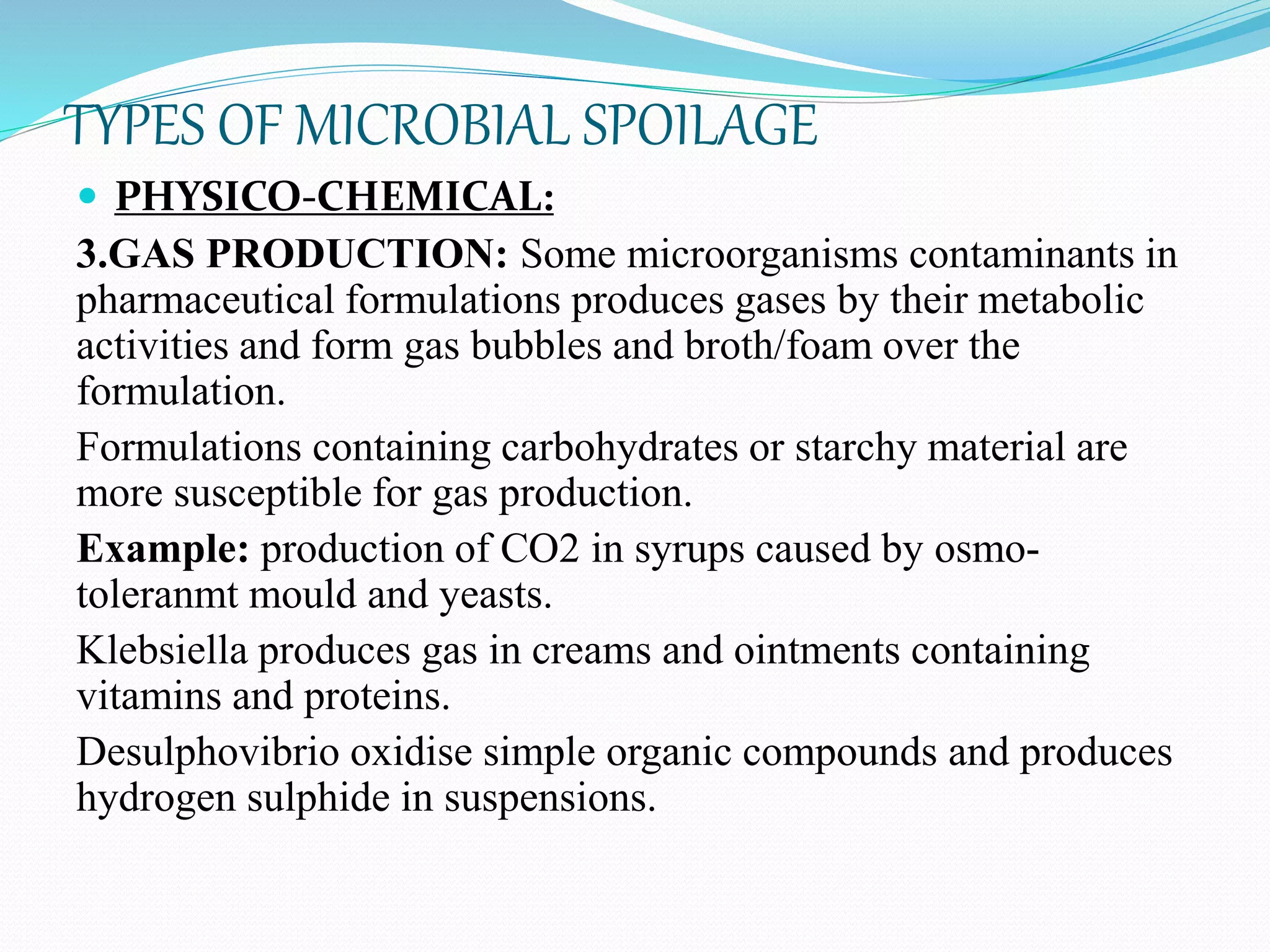
3.GAS PRODUCTION: Some microorganisms contaminants in
pharmaceutical formulations produces gases by their metabolic
activities and form gas bubbles and broth/foam over the
formulation.
Formulations containing carbohydrates or starchy material are
more susceptible for gas production.
Example: production of CO2 in syrups caused by osmo-
toleranmt mould and yeasts.
Klebsiella produces gas in creams and ointments containing
vitamins and proteins.
Desulphovibrio oxidise simple organic compounds and produces
hydrogen sulphide in suspensions.
TYPES OF MICROBIAL SPOILAGE
 PHYSICO-CHEMICAL:
4.PHYSICAL SPOILAGE: These are some changes in
physical appearance caused by microbial cell activities.
Example: In emulsions, some microbial cells cause
hydrolysis of oil phase, cause change in oil-water
equillibrium and make emulsion unstable.Hydrolysis of oils
also affect pH of formulation and alter the stability of
emulsions.
In syrups, microbial cells metabolise sugar molecules, and
due to which the concentration of syrup change and product
become unstable.
TYPES OF MICROBIAL SPOILAGE
5.Olfactory spoilage: spoilage by some organisms and
moulds generates unpleasant smell from the product. This
kind of spoilage mainly caused by microbial cella that
produces sulphur containing gases[SO2, H2S] and fishy
smell due to formation of fatty acids along with odour
generates by amines and alcohol production.
Example: Contamination in syrup of Tolu by penicilin spp.
Produces toluene like smell.
Actinomycetes produces smell of geosmine in water phase
used for formulations.
TYPES OF MICROBIAL SPOILAGE
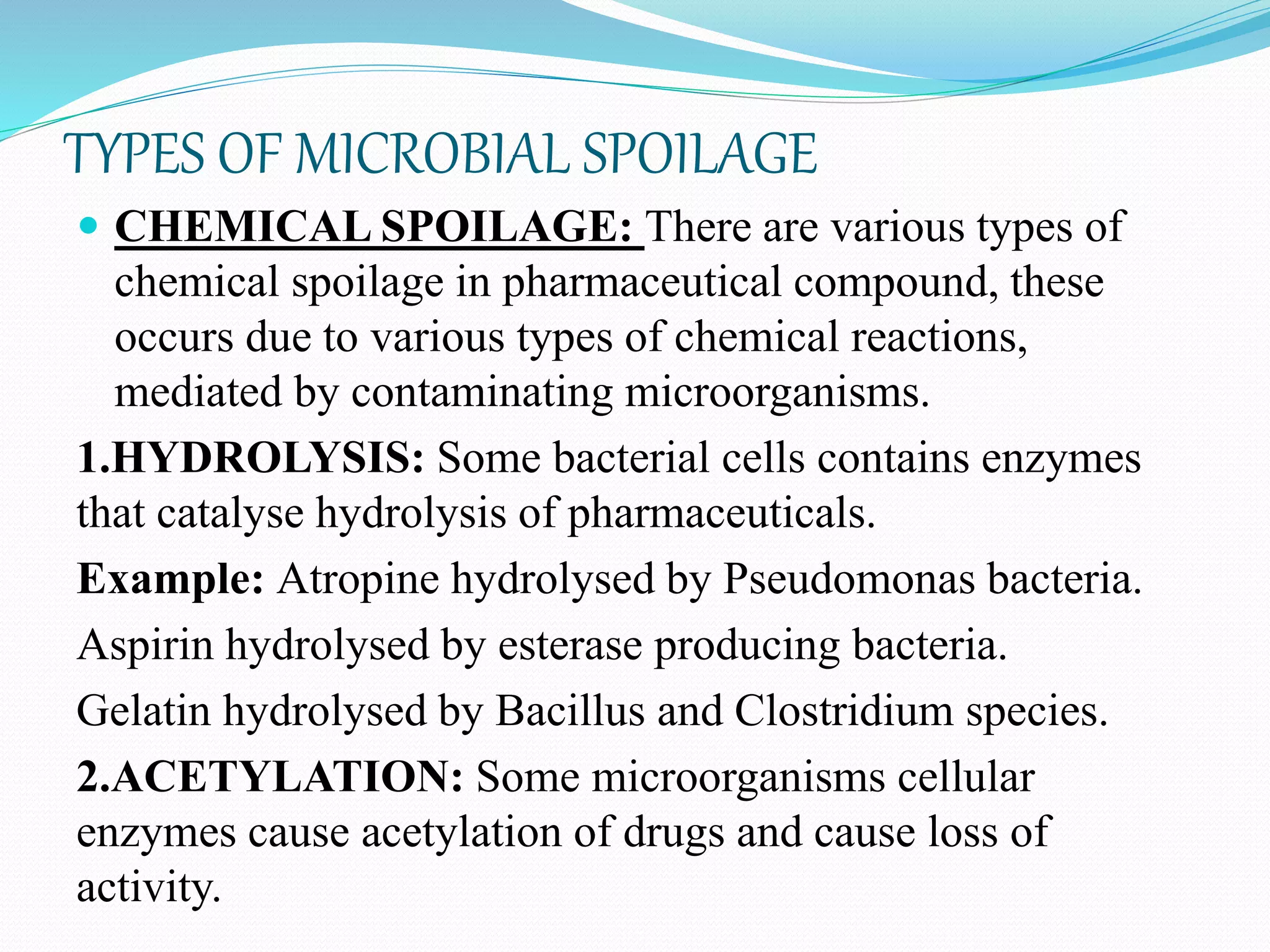
 CHEMICAL SPOILAGE: There are various types of
chemical spoilage in pharmaceutical compound, these
occurs due to various types of chemical reactions,
mediated by contaminating microorganisms.
1.HYDROLYSIS: Some bacterial cells contains enzymes
that catalyse hydrolysis of pharmaceuticals.
Example: Atropine hydrolysed by Pseudomonas bacteria.
Aspirin hydrolysed by esterase producing bacteria.
Gelatin hydrolysed by Bacillus and Clostridium species.
2.ACETYLATION: Some microorganisms cellular
enzymes cause acetylation of drugs and cause loss of
activity.
TYPES OF MICROBIAL SPOILAGE
Example: Chloramphenicol acetylation caused by
staphylococci and streptococci gram +ve bacteria by the
enzyme chloramphenicol acetyl-transferase.
3.DEPOLYMERISATION: It is a process in which the
polymers are degraded to their monomers. A lots of
polymers are used in formulation of many type of
pharmaceutical preparations as diluents, binders, thickening,
suspending agents, etc.
Example: Starch- depolymerize by bacterial amylase
Pectin- depolymerize by bacterial pectinase
Dextran- depolymerize by bacterial dextranase
Cellulase- depolymerize by bacterial cellulase.
CONT….
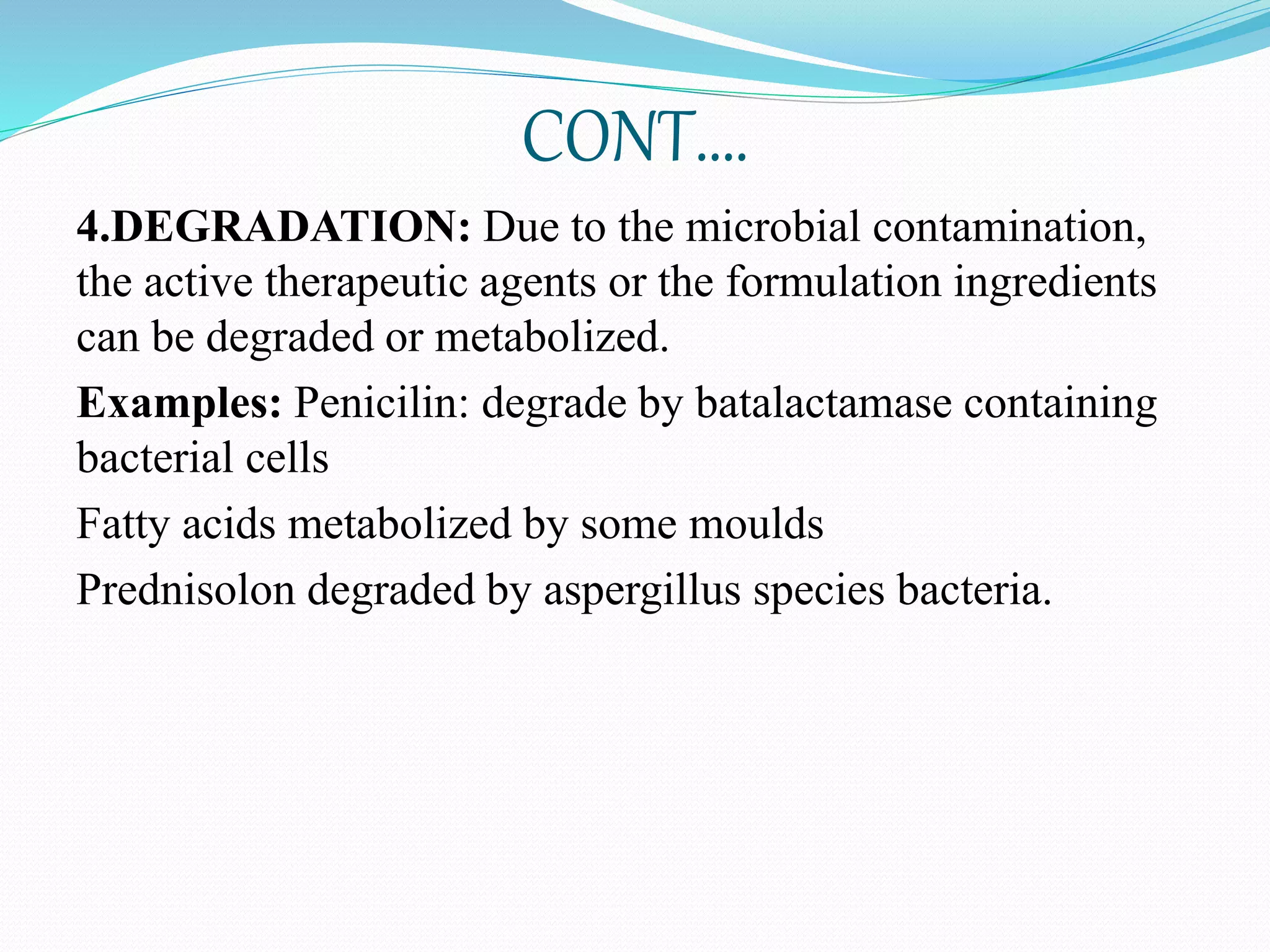
4.DEGRADATION: Due to the microbial contamination,
the active therapeutic agents or the formulation ingredients
can be degraded or metabolized.
Examples: Penicilin: degrade by batalactamase containing
bacterial cells
Fatty acids metabolized by some moulds
Prednisolon degraded by aspergillus species bacteria.
CONT….
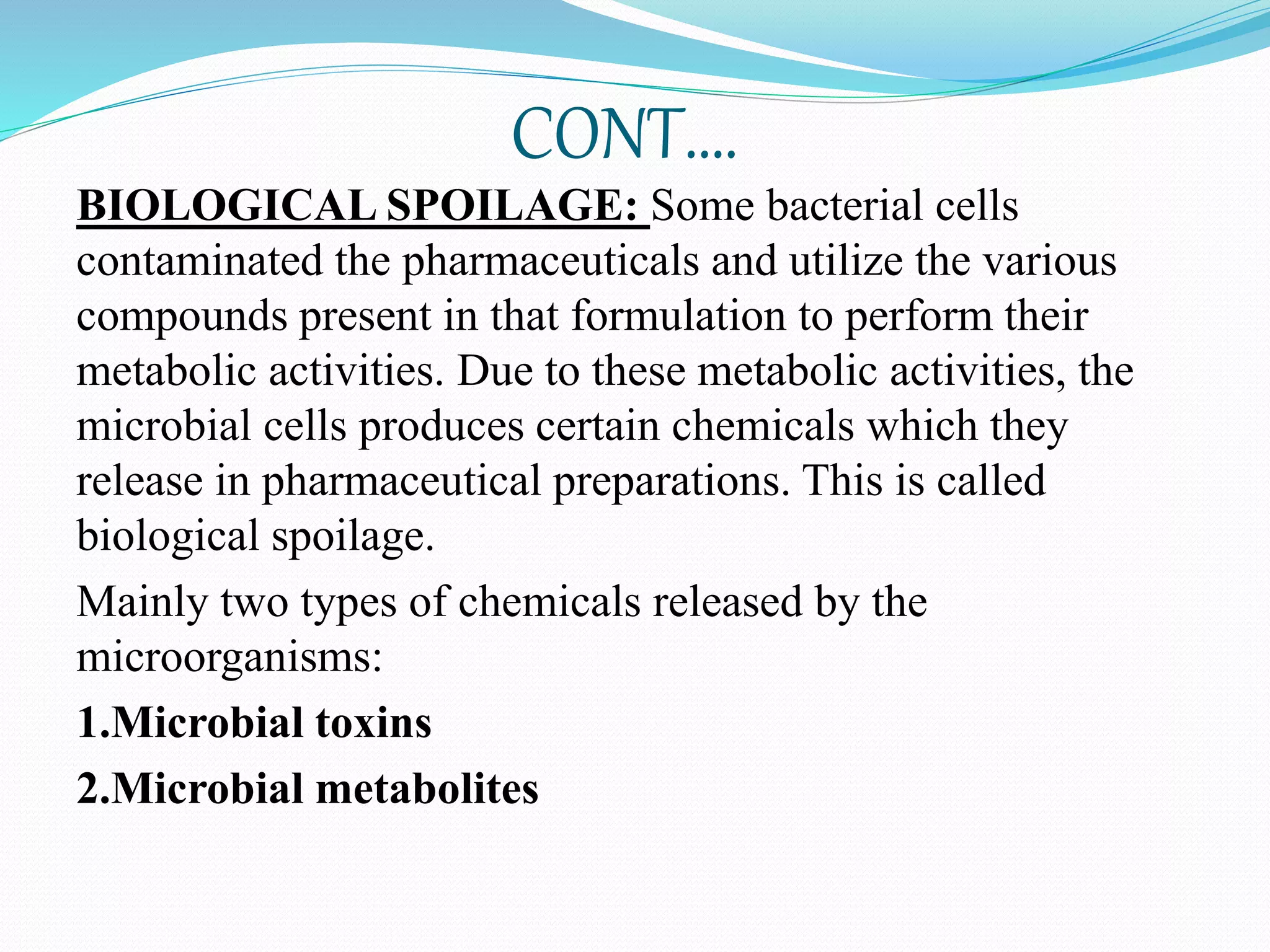
BIOLOGICAL SPOILAGE: Some bacterial cells
contaminated the pharmaceuticals and utilize the various
compounds present in that formulation to perform their
metabolic activities. Due to these metabolic activities, the
microbial cells produces certain chemicals which they
release in pharmaceutical preparations. This is called
biological spoilage.
Mainly two types of chemicals released by the
microorganisms:
1.Microbial toxins
2.Microbial metabolites
CONT….
MICROBIAL TOXINS: Several microorganisms produce
toxic molecules that may cause spoilage of pharmaceutical
fomulations. Such as endotoxins produced by some gram –ve
bacterias like E.coli.
Exotoxins by clostridium botulinum.
MICROBIAL METABOLITES: Bacterial metabolites are
the biosynthetic products from microbial cells. Bacterial cells
produces various metabolites which cause product spoilage
bcoz these metabolites are toxic to humans.
Examples are different amines and organic acids from bacterial
cells. Metabolites from fungi and moulds.
Fungi and moulds are more specifically grow on the
formulations having Talc, kaolin, and starch.
REASON OF CONTAMINATION
 The product gets contaminate due to various reasons like
Accidentally exposure to the environment
Improper storage conditions
Inadequate preparation of formulation
Improper sterilization
FACTORS AFFECTING SPOILAGE OF
PHARMACEUTICAL PRODUCTS
 By understanding the influence of environmental parameters on
microorganisms, it may be possible to manipulate formulations to create
conditions which are as unfavorable as possible for growth and spoilage,
within the limitations of patient acceptability and therapeutic efficacy.
 The factors that affects the spoilage of spoilage:
 NUTRITIONAL FACTOR
 MOISTURE CONTENT
 REDOX POTENTIAL
 STORAGE TEMPERATURE
 pH
 PACKAGING DESIGN AND DESIGN
FACTORS AFFECTING SPOILAGE OF
PHARMACEUTICAL PRODUCTS
 NUTRITIONAL FACTOR:
Presence of nutritional material enable or favours
microorganisms to utilize these nutritional material as energy
source and proliferate over pharmaceutical products.
In any formulation the presence of vegetable/herbal extract or
animal tissue or tissue extract provides nutritional support to
microbial cells.
Demineralized water[prepared by ion exchange method] also
contain some nutritional material which support the growth of
Pseudomonas bacteria.
More complex formulation are more supportive for microbial
growth.
FACTORS AFFECTING SPOILAGE OF
PHARMACEUTICAL PRODUCTS
 MOISTURE CONTENT[Water Activity: Aw]
Microorganisms readily need water or moisture to grow. The
presence of uncomplexed water in any formulation supports
microbial growth. Greater the solute concentration,the activity.
When solutes dissolved in water they form hydrogen and other
bonds with water and form complexed water, the free or
unbounded water molecules are termed as uncomplexed water, and
this uncomplexed water supports microbial growth.
Condensed water film sometime accumulate over some dry
pharmaceutical formulation like tablets or oils due to the storage in
humid atmosphere, supports fungal i.e. A.glaucus and yeast
growth.
CONT…
Moisture films over viscous syrups can also increase water
activity and support growth of fungi and yeast.
Some halophilic bacterial grows in high salt conditions.
Minimal water activity for some microbial cells for growth.
MICROORGANISM WATER ACTIVITY
CLOSTRIDIUM BOTULINIUM 0.94
ESCHERICHIA COLI 0.93
SALMONELLA SPP. 0.94
SHIGELLA SPP. 0.96
CONT…
 REDOX POTENTIAL: The oxidation-reduction or the
Redox potential is defined as the ratio of the total oxidizing
[electron accepting] power to the total reduction [electron
donating power of substance], or in more easy way it’s a
property of any chemical to give or accept electrons.
 Microbial growth in any environment is influenced by its
oxidation reduction balance i.e. redox reaction. Electron
transfer is major factor for energy production. If the oxygen
is present in any formulation, then this condition favours
microbial growth, if any product gets infected by microbial
cell.
CONT…
 PACKAGING MATERIALAND DESIGN:
 Packaging can have major influence on microbial
contamination and spoilage of pharmaceuticals. Multi dose
containers are more affected by microbial contamination
because they are again and again exposed to environment
when the drug is withdrawn from container.
 Wide opening mouth containers that contain formulations
of vegetable oils, protein, vitamin, animal extracts, are
readily contaminated as they provide large surface area
exposure to the environment.
CONT…
 STORAGE TEMPERATURE:
 The pharmaceutical formulation can affected by microbial
cell between the temperature range of -20℃ − 60℃.
 Below -20℃ almost no microbial contamination is observed
and the same as above 60℃ , microbial growth supressed.
The reason for that is inactivation and denaturation of
cellular enzymes, which responsible for cell metabolic
activities.
 Water for injection is stored at 80℃ before preparation to
minimize bacterial growth and to prevent bacterial activity
to produce and release pyrogens to the water.
CONT…
 pH of Pharmaceutical formulations:
 pH is represent as the potential of hydrogen ions. Some
bacterial cells are grown better in Acidic medium and some
are in basic medium, this happens because in their
favourable pH the enzymes of bacterial cells are more active
to perform their metabolic activities.
 Some preparations of pH around 5-6 favours growth of
moulds but inhibit bacterial growth.
 Some preparations having pH of 3-4 favours growth of
moulds and yeast, i.e. fruit juice flavoured syrups.
 Some preparations of neutral pH like mouthwashes, distilled
water, antacid preparations are contaminated by bacterial
cells i.e. pseudomonas spp.
CONT…
 Basic pH formulations inhibit bacterial growth, i.e.
magnesium and aluminium hydroxide gel, etc.
 Sometime primary fungal growth occurs in any product,
these fungal cell metabolize the chemical andproduce
acids and raise the pH of formulations and favours
secondary bacterial growth.

What is spoilage.final (1)

  • 1.
    WHAT IS SPOILAGE? The action or process of spoiling, especially the deterioration of food and other perishable goods.  Any change which renders a product unacceptable for human consumption.  Complex event in which a combination of microbial and biochemical activities may interact.  One of the major reason that led to preservation.  MICROBIAL SPOILAGE: This refers to damage to food, pharmaceutical products that is caused by micro organisms (bacteria, moulds and yeasts). Micro organisms can grow in almost all kinds of food products. As micro-organisms occur everywhere around us, there is always a risk of microbial spoilage.
  • 2.
    TYPES OF SPOILAGE MICROBIAL SPOILAGE  NON-MICROBIAL SPOILAGE  Based on rate of spoilage: There are three types- Highly perishable: Meat, Fish, Egg, Milk, Most fruits and Vegetables. Semi perishable: Potatoes, Some Apple Varities, Nut meats. Non-perishable or stable: Sugar, Flour, Dry Beans.  PHARMACEUTICAL SPOILAGE
  • 3.
    PHARMACEUTICAL SPOILAGE  Spoilageof pharmaceutical products and drugs are referred as the changes in the physical and chemical properties in such a way that the formulation or therapeutic agent gets deteriorate and become not suitable for use.  Pharmaceutical product is a combination of two things: 1.Active drug 2. Formulation additives If there is any change in their efficacy, action, etc. it is said to be spoiled product which can not be used.
  • 4.
    PHARMACEUTICAL SPOILAGE  Thereare several factors that cause pharmaceutical spoilage:  Mainly, we study about microbial spoilage of pharmaceutical products. PHYSICAL CHEMICAL MICROBIAL Deterioration of pharmaceuticals due to physical factors like, heat, temperature, evaporation, etc. Deterioration of pharmaceuticals due to chemical reactions like oxidation, reduction, hydrolysis, photolysis, ionization, etc. Deterioration of pharmaceuticals due to contamination of any microbial cell like bacteria, fungi, moulds, etc.
  • 5.
    MICROBIAL SPOILAGE OF PHARMACEUTICALS Microbial spoilage includes the microbial contamination of pharmaceutical products with the microbes which lead to spoilage of product affecting the drug safety and quality and is not intended for use.  Shortly, microbial spoilage of pharmaceutical products is the deterioration of pharmaceuticals with contaminant microbes.  It decreases the stability and intensity of the product.
  • 6.
    TYPES OF MICROBIALSPOILAGE PHYSIO-CHEMICAL CHEMICAL BIOLOGICAL  VIABLE GROWTH  GAS PRODUCTION  PHYSICAL SPOILAGE  OLFACTORY  COLORATION  HYDROLYSIS  ACETYLATION  DEPOLYMERIZATION  DEGRADATION/ METABOLISATION  RELEASE OF TOXINS  MICROBIAL METABOLITES
  • 7.
    TYPES OF MICROBIALSPOILAGE  PHYSICO-CHEMICAL: In this kind of spoilage, there are some chemical changes are caused by microbial species and due to these changes the physical properties are also gets altered or deteriorate, thus it is called the physico-chemical spoilage. 1.VIABLE GROWTH: In this kind of spoilage, microbial cells form a visible layer over the surface of pharmaceutical formulations. This layer or the presence of microbial cell can be clearly seen by naked eyes. Example: layer of moulds over syrups or sugar containing products, creams, ointments.
  • 8.
    TYPES OF MICROBIALSPOILAGE  PHYSICO-CHEMICAL: 2.COLORATION: Color change occurs due to the alteration in components of chemical nature, and these changes are caused by change in pH of the formulation, redox of the product, production of some other metabolites by microorganisms. Example: Pseudomonas species microorganism metabolize wide range of metabolites that cause coloration of blue- green, brown. Surface decoloration of tablets containing biological products by some moulds.
  • 9.
    TYPES OF MICROBIALSPOILAGE  PHYSICO-CHEMICAL: 3.GAS PRODUCTION: Some microorganisms contaminants in pharmaceutical formulations produces gases by their metabolic activities and form gas bubbles and broth/foam over the formulation. Formulations containing carbohydrates or starchy material are more susceptible for gas production. Example: production of CO2 in syrups caused by osmo- toleranmt mould and yeasts. Klebsiella produces gas in creams and ointments containing vitamins and proteins. Desulphovibrio oxidise simple organic compounds and produces hydrogen sulphide in suspensions.
  • 10.
    TYPES OF MICROBIALSPOILAGE  PHYSICO-CHEMICAL: 4.PHYSICAL SPOILAGE: These are some changes in physical appearance caused by microbial cell activities. Example: In emulsions, some microbial cells cause hydrolysis of oil phase, cause change in oil-water equillibrium and make emulsion unstable.Hydrolysis of oils also affect pH of formulation and alter the stability of emulsions. In syrups, microbial cells metabolise sugar molecules, and due to which the concentration of syrup change and product become unstable.
  • 11.
    TYPES OF MICROBIALSPOILAGE 5.Olfactory spoilage: spoilage by some organisms and moulds generates unpleasant smell from the product. This kind of spoilage mainly caused by microbial cella that produces sulphur containing gases[SO2, H2S] and fishy smell due to formation of fatty acids along with odour generates by amines and alcohol production. Example: Contamination in syrup of Tolu by penicilin spp. Produces toluene like smell. Actinomycetes produces smell of geosmine in water phase used for formulations.
  • 12.
    TYPES OF MICROBIALSPOILAGE  CHEMICAL SPOILAGE: There are various types of chemical spoilage in pharmaceutical compound, these occurs due to various types of chemical reactions, mediated by contaminating microorganisms. 1.HYDROLYSIS: Some bacterial cells contains enzymes that catalyse hydrolysis of pharmaceuticals. Example: Atropine hydrolysed by Pseudomonas bacteria. Aspirin hydrolysed by esterase producing bacteria. Gelatin hydrolysed by Bacillus and Clostridium species. 2.ACETYLATION: Some microorganisms cellular enzymes cause acetylation of drugs and cause loss of activity.
  • 13.
    TYPES OF MICROBIALSPOILAGE Example: Chloramphenicol acetylation caused by staphylococci and streptococci gram +ve bacteria by the enzyme chloramphenicol acetyl-transferase. 3.DEPOLYMERISATION: It is a process in which the polymers are degraded to their monomers. A lots of polymers are used in formulation of many type of pharmaceutical preparations as diluents, binders, thickening, suspending agents, etc. Example: Starch- depolymerize by bacterial amylase Pectin- depolymerize by bacterial pectinase Dextran- depolymerize by bacterial dextranase Cellulase- depolymerize by bacterial cellulase.
  • 14.
    CONT…. 4.DEGRADATION: Due tothe microbial contamination, the active therapeutic agents or the formulation ingredients can be degraded or metabolized. Examples: Penicilin: degrade by batalactamase containing bacterial cells Fatty acids metabolized by some moulds Prednisolon degraded by aspergillus species bacteria.
  • 15.
    CONT…. BIOLOGICAL SPOILAGE: Somebacterial cells contaminated the pharmaceuticals and utilize the various compounds present in that formulation to perform their metabolic activities. Due to these metabolic activities, the microbial cells produces certain chemicals which they release in pharmaceutical preparations. This is called biological spoilage. Mainly two types of chemicals released by the microorganisms: 1.Microbial toxins 2.Microbial metabolites
  • 16.
    CONT…. MICROBIAL TOXINS: Severalmicroorganisms produce toxic molecules that may cause spoilage of pharmaceutical fomulations. Such as endotoxins produced by some gram –ve bacterias like E.coli. Exotoxins by clostridium botulinum. MICROBIAL METABOLITES: Bacterial metabolites are the biosynthetic products from microbial cells. Bacterial cells produces various metabolites which cause product spoilage bcoz these metabolites are toxic to humans. Examples are different amines and organic acids from bacterial cells. Metabolites from fungi and moulds. Fungi and moulds are more specifically grow on the formulations having Talc, kaolin, and starch.
  • 17.
    REASON OF CONTAMINATION The product gets contaminate due to various reasons like Accidentally exposure to the environment Improper storage conditions Inadequate preparation of formulation Improper sterilization
  • 18.
    FACTORS AFFECTING SPOILAGEOF PHARMACEUTICAL PRODUCTS  By understanding the influence of environmental parameters on microorganisms, it may be possible to manipulate formulations to create conditions which are as unfavorable as possible for growth and spoilage, within the limitations of patient acceptability and therapeutic efficacy.  The factors that affects the spoilage of spoilage:  NUTRITIONAL FACTOR  MOISTURE CONTENT  REDOX POTENTIAL  STORAGE TEMPERATURE  pH  PACKAGING DESIGN AND DESIGN
  • 19.
    FACTORS AFFECTING SPOILAGEOF PHARMACEUTICAL PRODUCTS  NUTRITIONAL FACTOR: Presence of nutritional material enable or favours microorganisms to utilize these nutritional material as energy source and proliferate over pharmaceutical products. In any formulation the presence of vegetable/herbal extract or animal tissue or tissue extract provides nutritional support to microbial cells. Demineralized water[prepared by ion exchange method] also contain some nutritional material which support the growth of Pseudomonas bacteria. More complex formulation are more supportive for microbial growth.
  • 20.
    FACTORS AFFECTING SPOILAGEOF PHARMACEUTICAL PRODUCTS  MOISTURE CONTENT[Water Activity: Aw] Microorganisms readily need water or moisture to grow. The presence of uncomplexed water in any formulation supports microbial growth. Greater the solute concentration,the activity. When solutes dissolved in water they form hydrogen and other bonds with water and form complexed water, the free or unbounded water molecules are termed as uncomplexed water, and this uncomplexed water supports microbial growth. Condensed water film sometime accumulate over some dry pharmaceutical formulation like tablets or oils due to the storage in humid atmosphere, supports fungal i.e. A.glaucus and yeast growth.
  • 21.
    CONT… Moisture films overviscous syrups can also increase water activity and support growth of fungi and yeast. Some halophilic bacterial grows in high salt conditions. Minimal water activity for some microbial cells for growth. MICROORGANISM WATER ACTIVITY CLOSTRIDIUM BOTULINIUM 0.94 ESCHERICHIA COLI 0.93 SALMONELLA SPP. 0.94 SHIGELLA SPP. 0.96
  • 22.
    CONT…  REDOX POTENTIAL:The oxidation-reduction or the Redox potential is defined as the ratio of the total oxidizing [electron accepting] power to the total reduction [electron donating power of substance], or in more easy way it’s a property of any chemical to give or accept electrons.  Microbial growth in any environment is influenced by its oxidation reduction balance i.e. redox reaction. Electron transfer is major factor for energy production. If the oxygen is present in any formulation, then this condition favours microbial growth, if any product gets infected by microbial cell.
  • 23.
    CONT…  PACKAGING MATERIALANDDESIGN:  Packaging can have major influence on microbial contamination and spoilage of pharmaceuticals. Multi dose containers are more affected by microbial contamination because they are again and again exposed to environment when the drug is withdrawn from container.  Wide opening mouth containers that contain formulations of vegetable oils, protein, vitamin, animal extracts, are readily contaminated as they provide large surface area exposure to the environment.
  • 24.
    CONT…  STORAGE TEMPERATURE: The pharmaceutical formulation can affected by microbial cell between the temperature range of -20℃ − 60℃.  Below -20℃ almost no microbial contamination is observed and the same as above 60℃ , microbial growth supressed. The reason for that is inactivation and denaturation of cellular enzymes, which responsible for cell metabolic activities.  Water for injection is stored at 80℃ before preparation to minimize bacterial growth and to prevent bacterial activity to produce and release pyrogens to the water.
  • 25.
    CONT…  pH ofPharmaceutical formulations:  pH is represent as the potential of hydrogen ions. Some bacterial cells are grown better in Acidic medium and some are in basic medium, this happens because in their favourable pH the enzymes of bacterial cells are more active to perform their metabolic activities.  Some preparations of pH around 5-6 favours growth of moulds but inhibit bacterial growth.  Some preparations having pH of 3-4 favours growth of moulds and yeast, i.e. fruit juice flavoured syrups.  Some preparations of neutral pH like mouthwashes, distilled water, antacid preparations are contaminated by bacterial cells i.e. pseudomonas spp.
  • 26.
    CONT…  Basic pHformulations inhibit bacterial growth, i.e. magnesium and aluminium hydroxide gel, etc.  Sometime primary fungal growth occurs in any product, these fungal cell metabolize the chemical andproduce acids and raise the pH of formulations and favours secondary bacterial growth.