What is Python ?
It is powerful, general-purpose,
high level, object oriented
programming language.
It is developed by Guido van
Rossum .
It is released in 1991.
Features of Python ?
Platform Independent(Window os,Linux
os etc.)
Object Oriented
Flexible
Structure Oriented
Portable
Simple
Application of Python ?
Web Application
Software development
Database GUI Application
Scientific and Numeric Computing
Business Applications
Console Based Application
Why Use Python ?
It is very simple and easy to learn.
It powerful,fast and secure.
It has very simple syntax.
It is powerful scripting language.
It can be run on different kind of
platform for example
Window,Mac,Linux etc.
Variable in Python
• It is a name of storage space which is used to
store data.
• It's value may be changed.
• It always contains last value stored to it.
• There is no need to declare a variable in
python.
• Variable is created by assigning a value to it.
Variable
There are two types
• Local Variable
• Global Variable
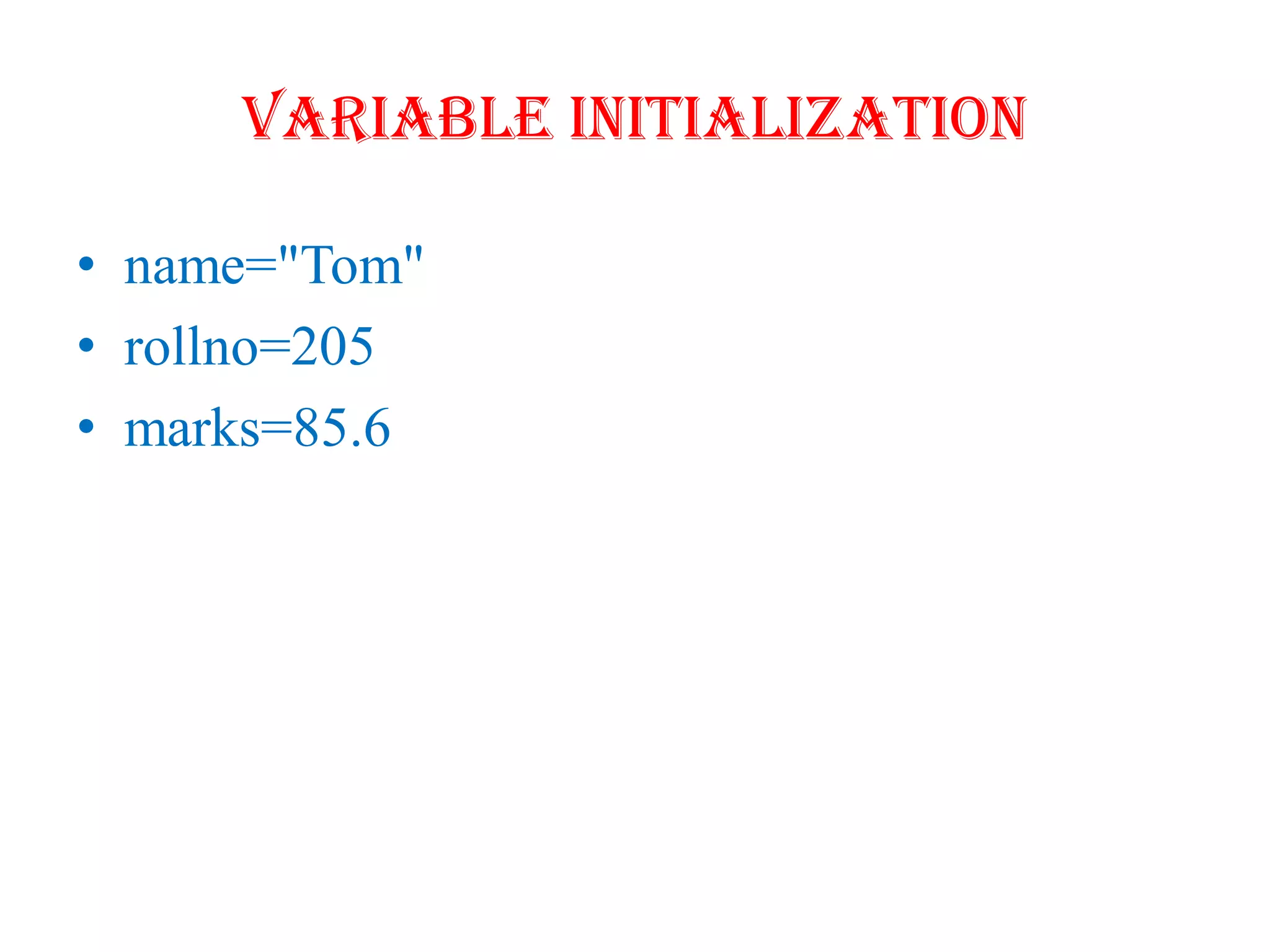
Variable Initialization
• name="Tom"
• rollno=205
• marks=85.6
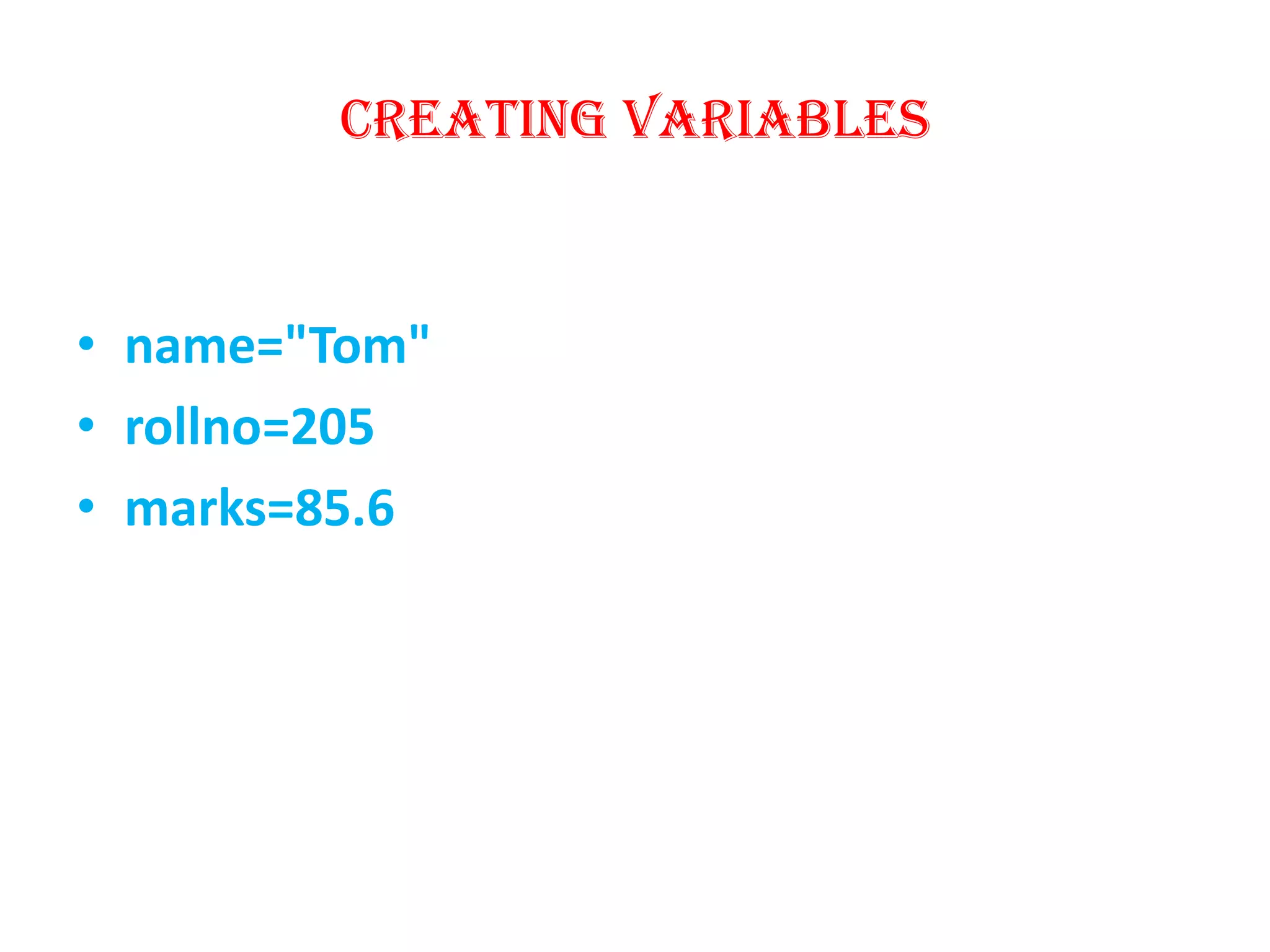
creating variables
• name="Tom"
• rollno=205
• marks=85.6
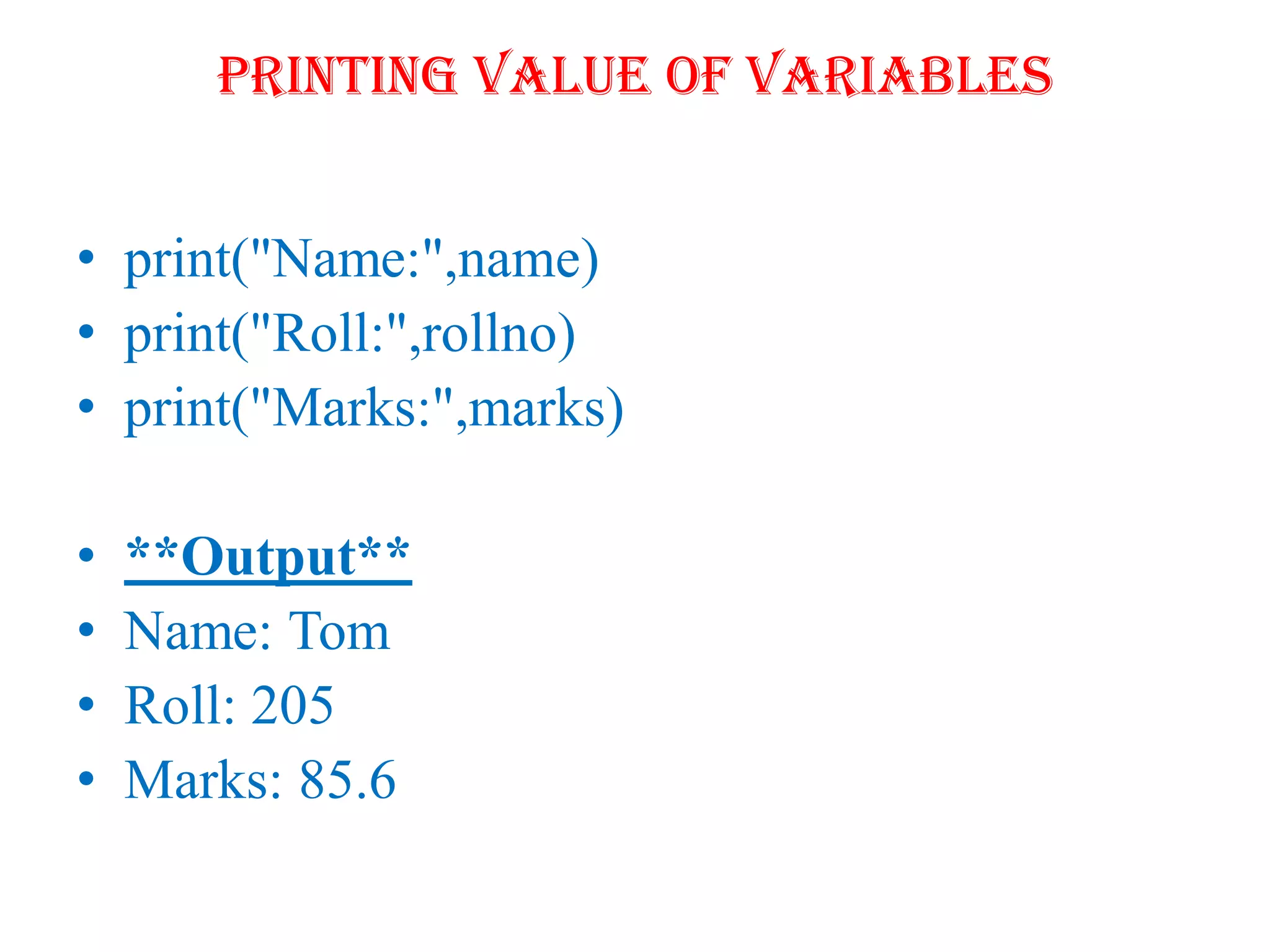
printing value of variables
• print("Name:",name)
• print("Roll:",rollno)
• print("Marks:",marks)
• **Output**
• Name: Tom
• Roll: 205
• Marks: 85.6
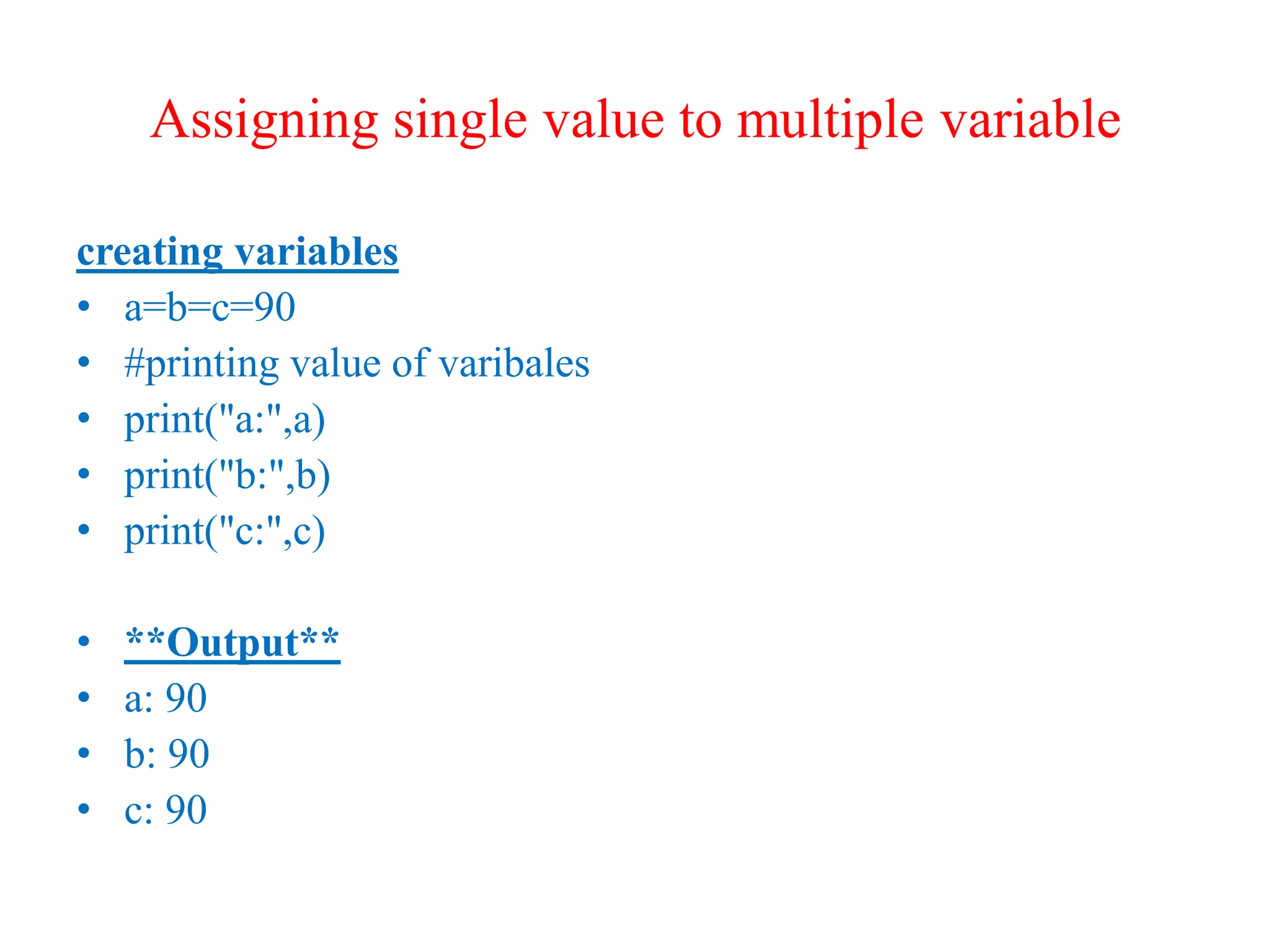
Assigning single value to multiple variable
creating variables
• a=b=c=90
• #printing value of varibales
• print("a:",a)
• print("b:",b)
• print("c:",c)
• **Output**
• a: 90
• b: 90
• c: 90
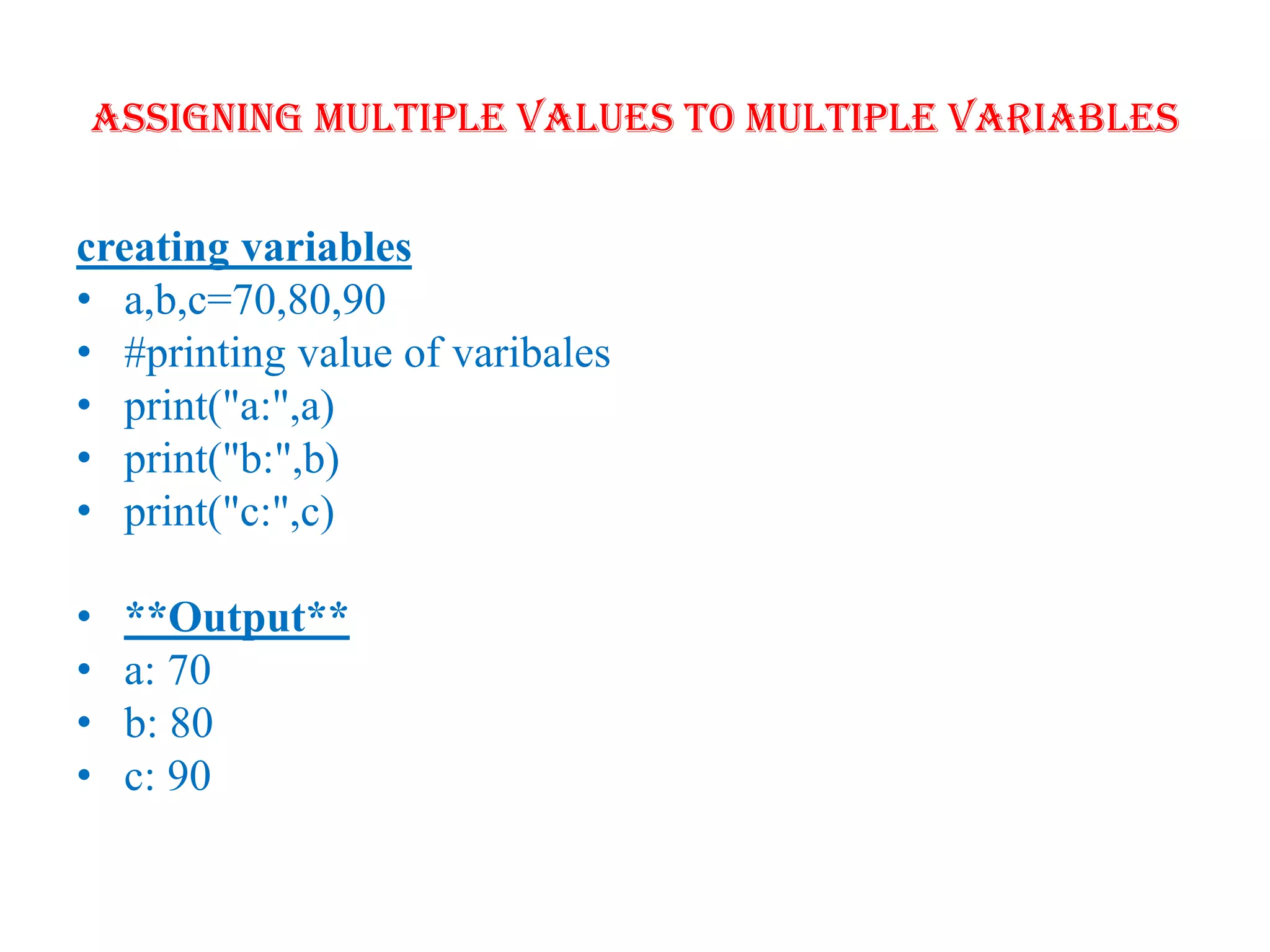
Assigning multiple values to multiple variables
creating variables
• a,b,c=70,80,90
• #printing value of varibales
• print("a:",a)
• print("b:",b)
• print("c:",c)
• **Output**
• a: 70
• b: 80
• c: 90
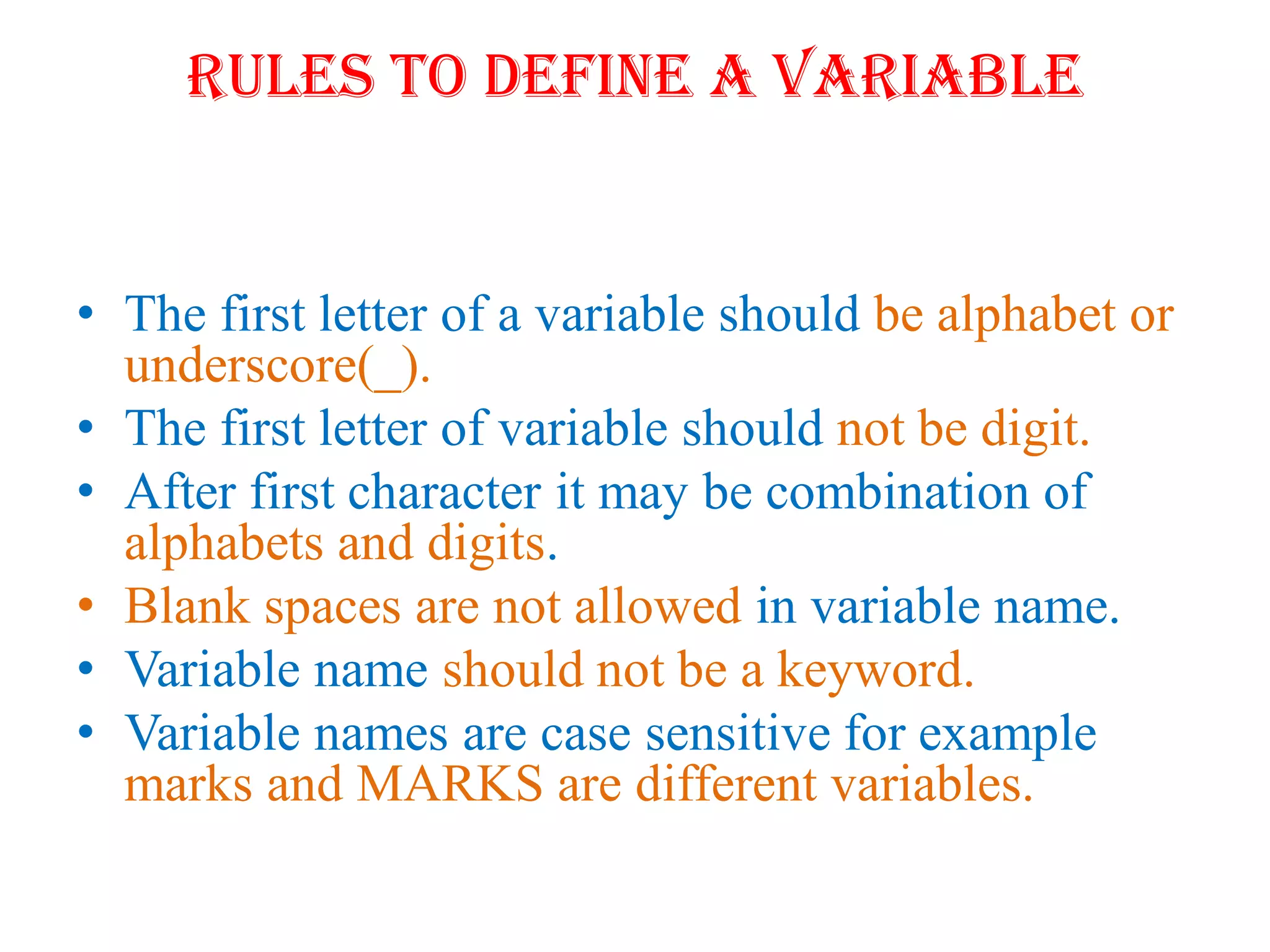
Rules to define a variable
• The first letter of a variable should be alphabet or
underscore(_).
• The first letter of variable should not be digit.
• After first character it may be combination of
alphabets and digits.
• Blank spaces are not allowed in variable name.
• Variable name should not be a keyword.
• Variable names are case sensitive for example
marks and MARKS are different variables.
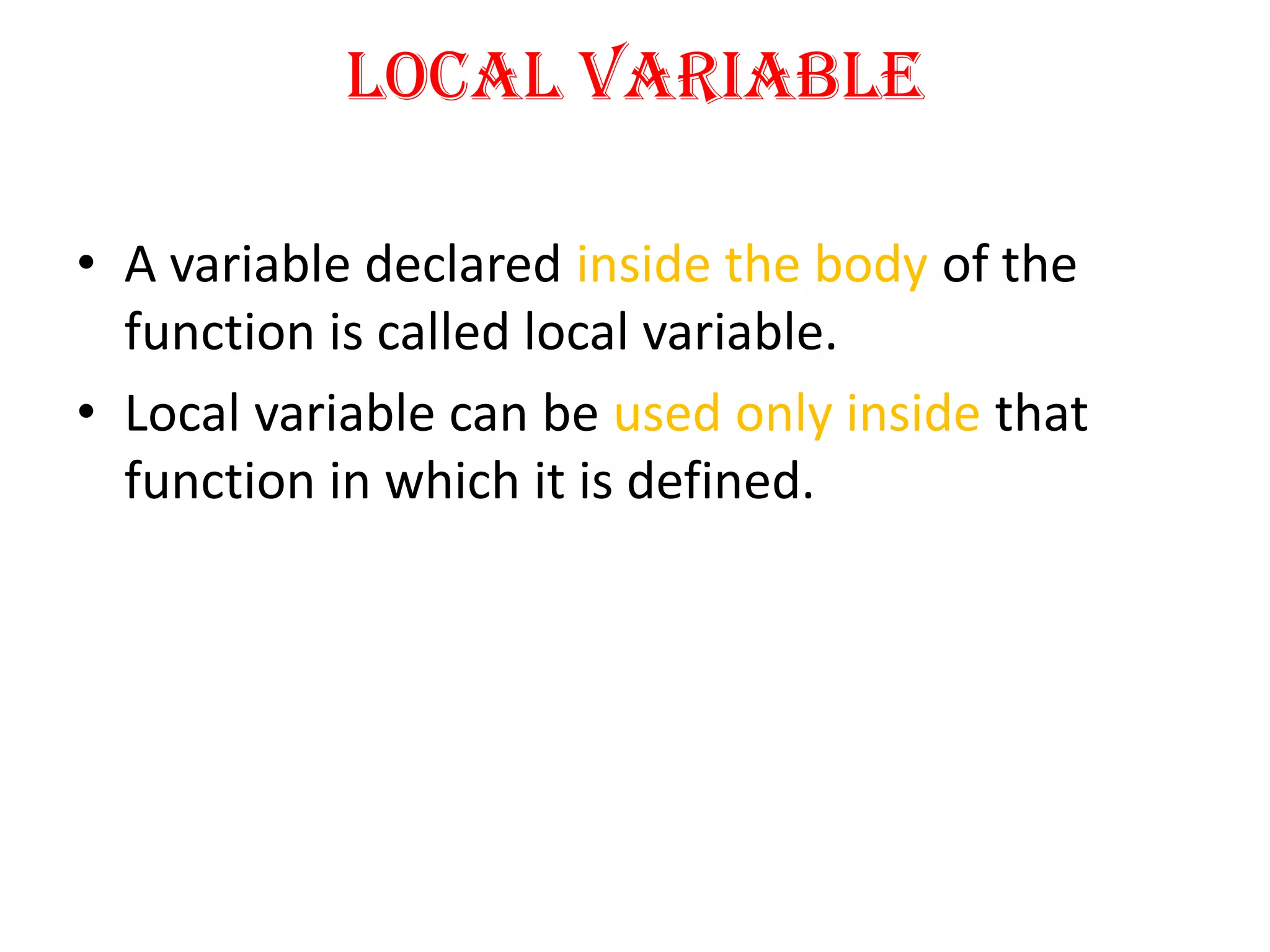
Local Variable
• A variable declared inside the body of the
function is called local variable.
• Local variable can be used only inside that
function in which it is defined.
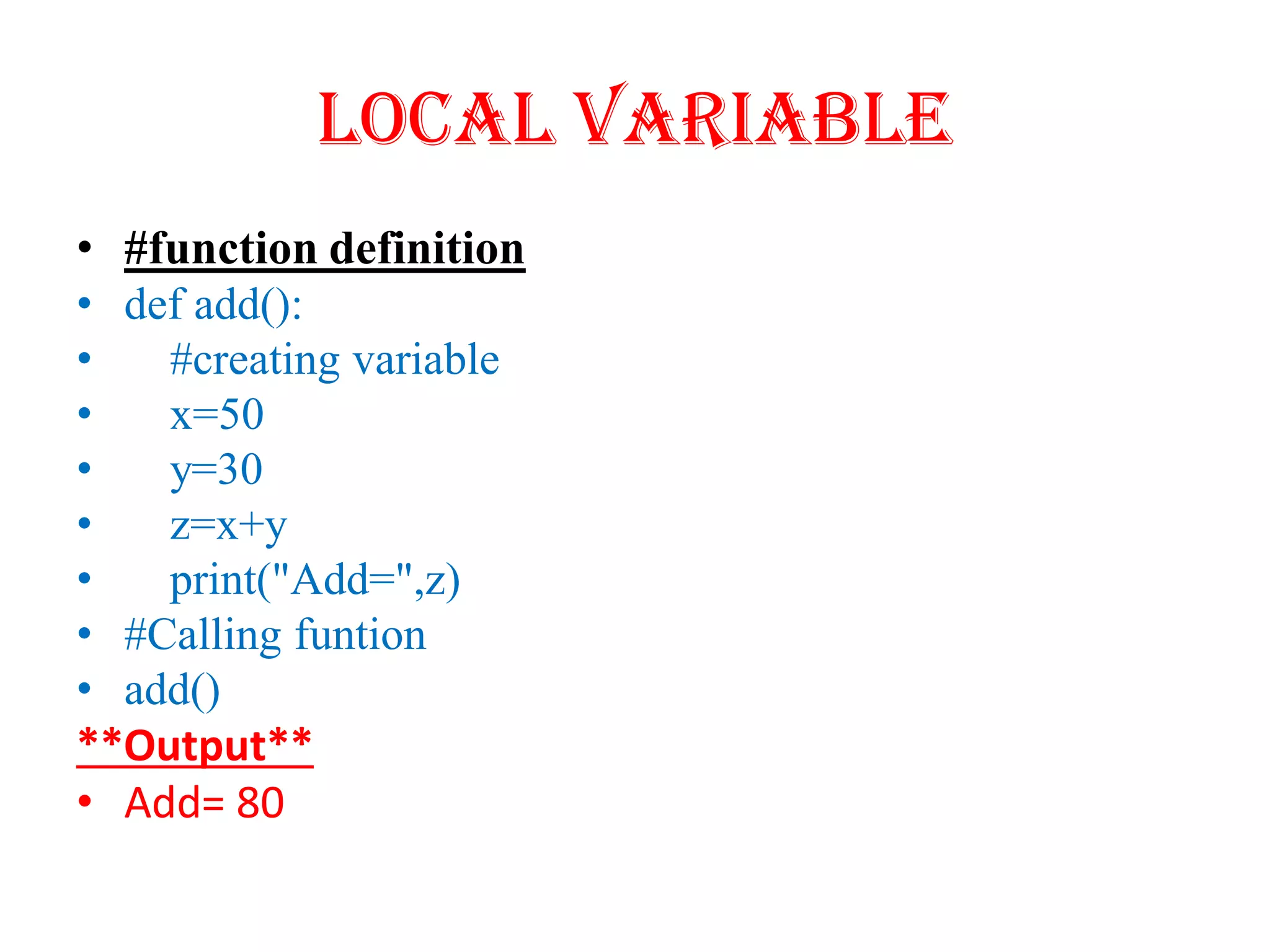
Local Variable
• #function definition
• def add():
• #creating variable
• x=50
• y=30
• z=x+y
• print("Add=",z)
• #Calling funtion
• add()
**Output**
• Add= 80
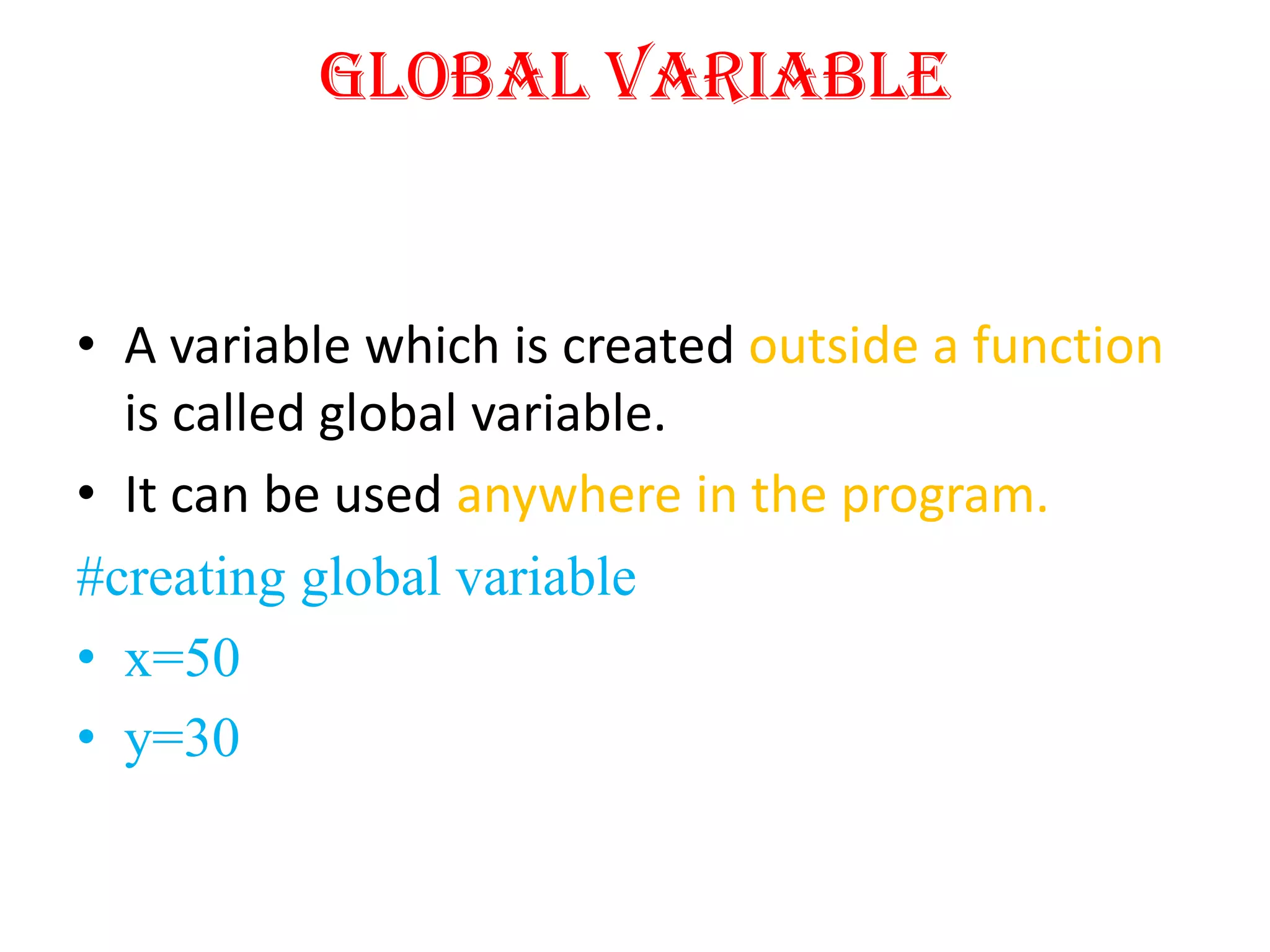
Global Variable
• A variable which is created outside a function
is called global variable.
• It can be used anywhere in the program.
#creating global variable
• x=50
• y=30
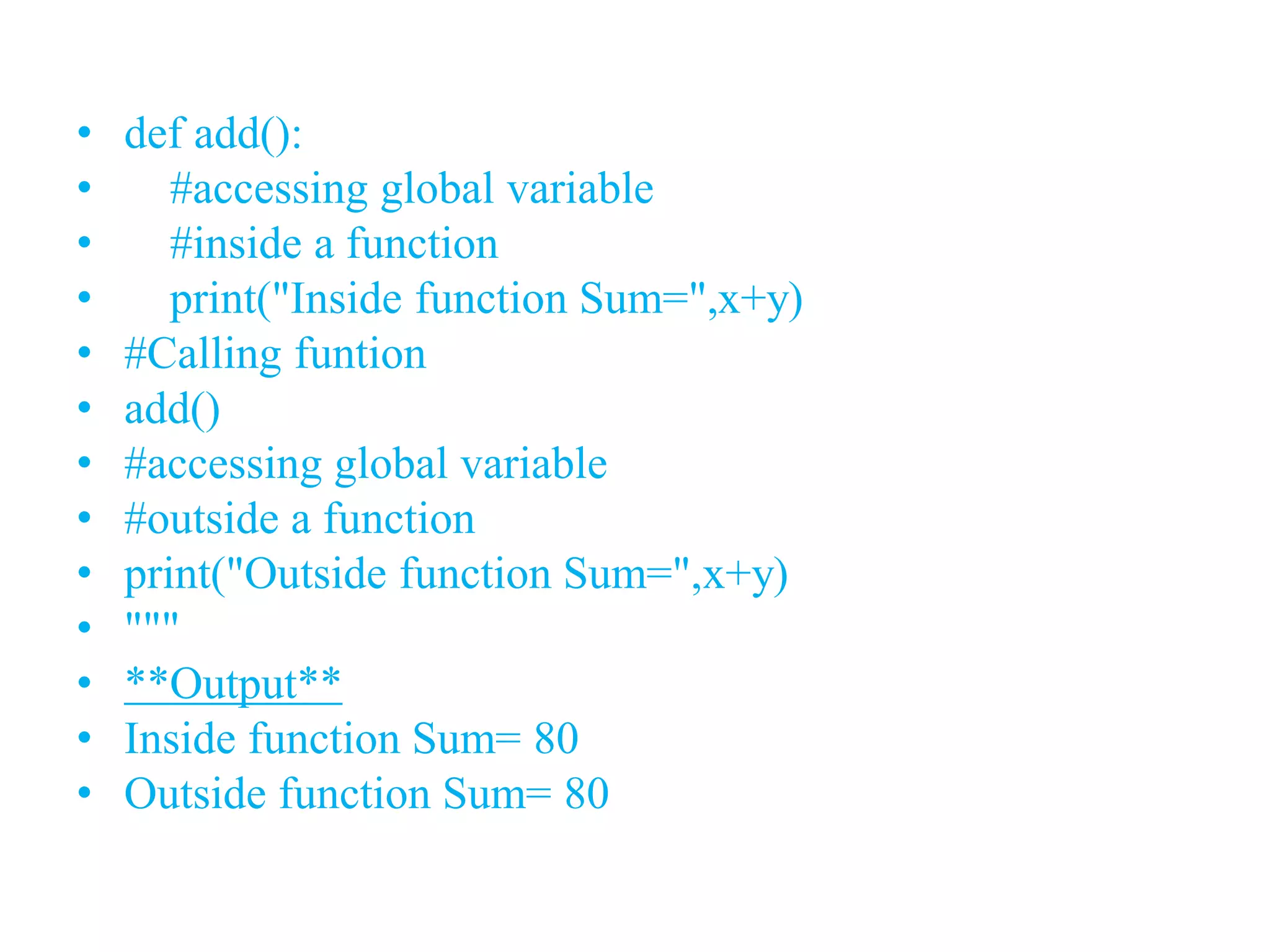
• def add():
• #accessing global variable
• #inside a function
• print("Inside function Sum=",x+y)
• #Calling funtion
• add()
• #accessing global variable
• #outside a function
• print("Outside function Sum=",x+y)
• """
• **Output**
• Inside function Sum= 80
• Outside function Sum= 80
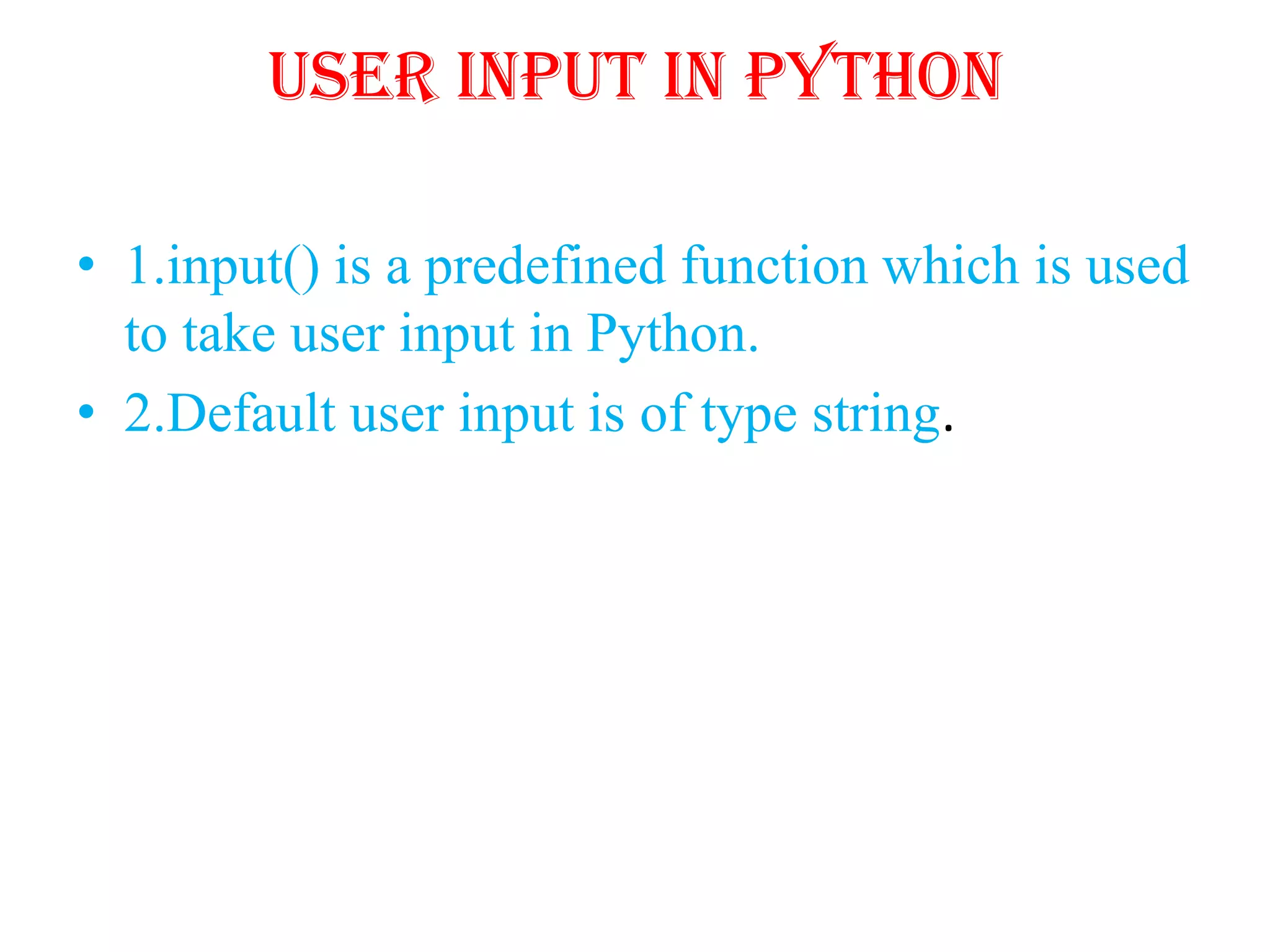
User input in Python
• 1.input() is a predefined function which is used
to take user input in Python.
• 2.Default user input is of type string.
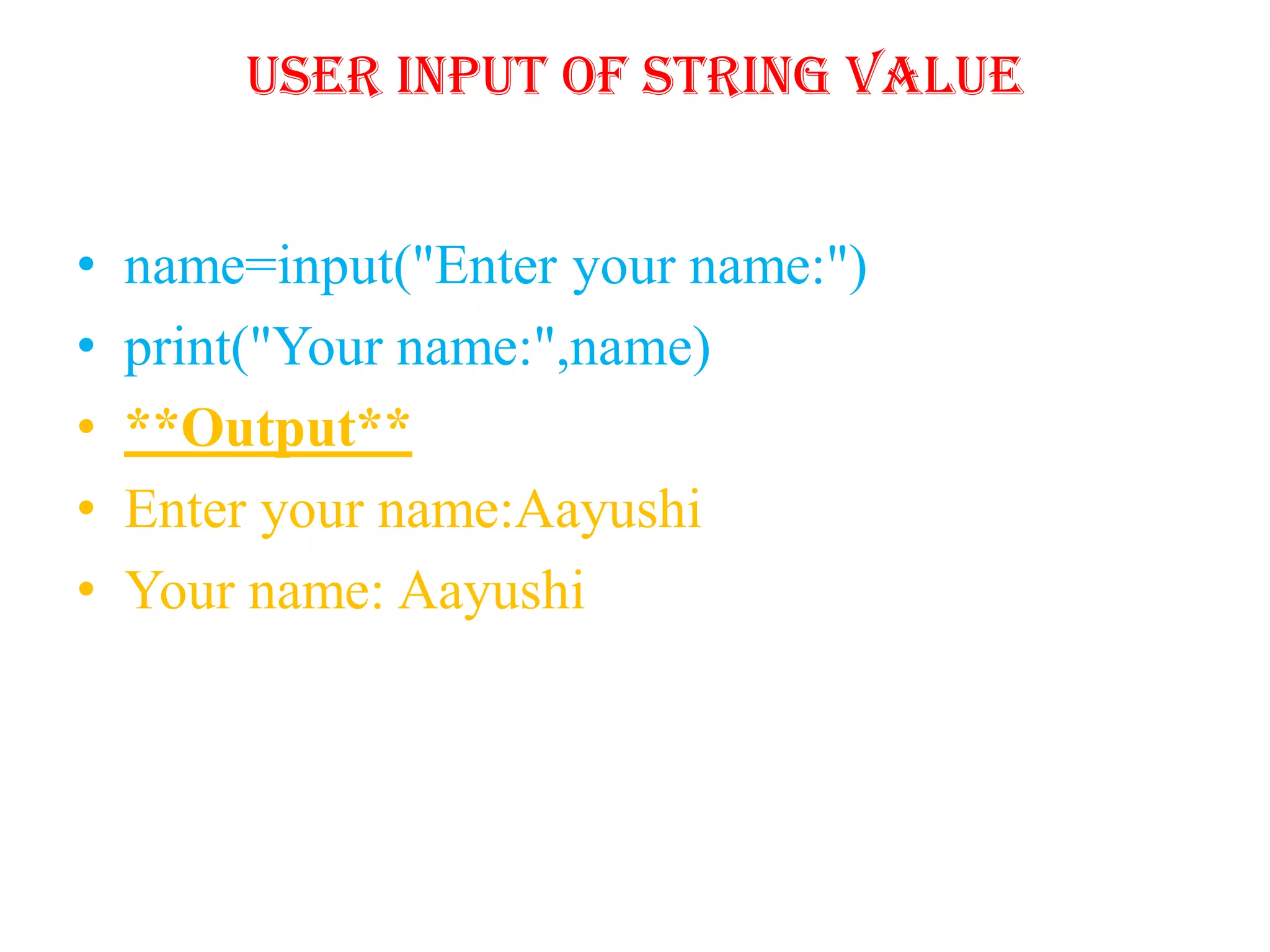
User input of String Value
• name=input("Enter your name:")
• print("Your name:",name)
• **Output**
• Enter your name:Aayushi
• Your name: Aayushi
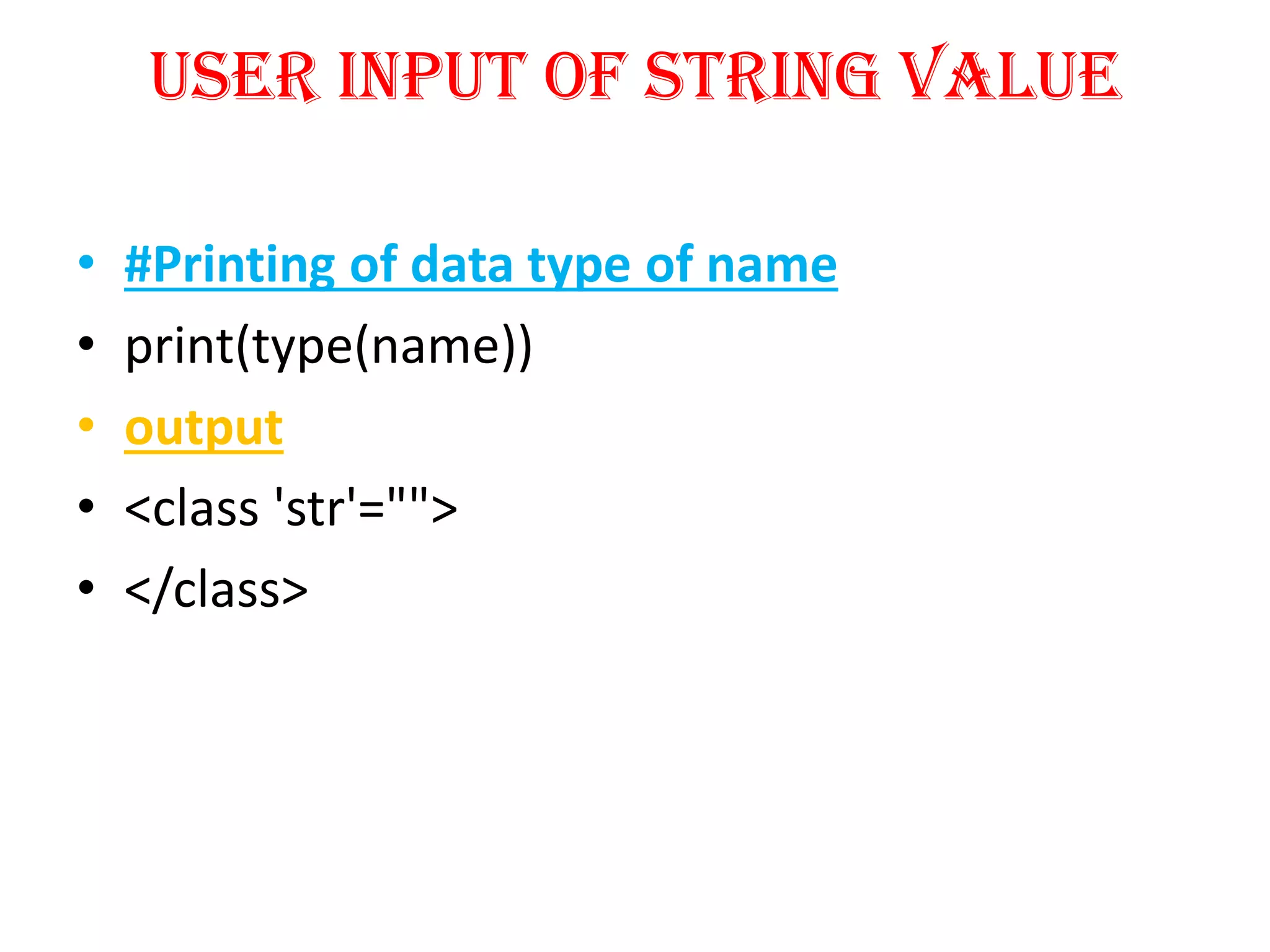
User input of String Value
• #Printing of data type of name
• print(type(name))
• output
• <class 'str'="">
• </class>
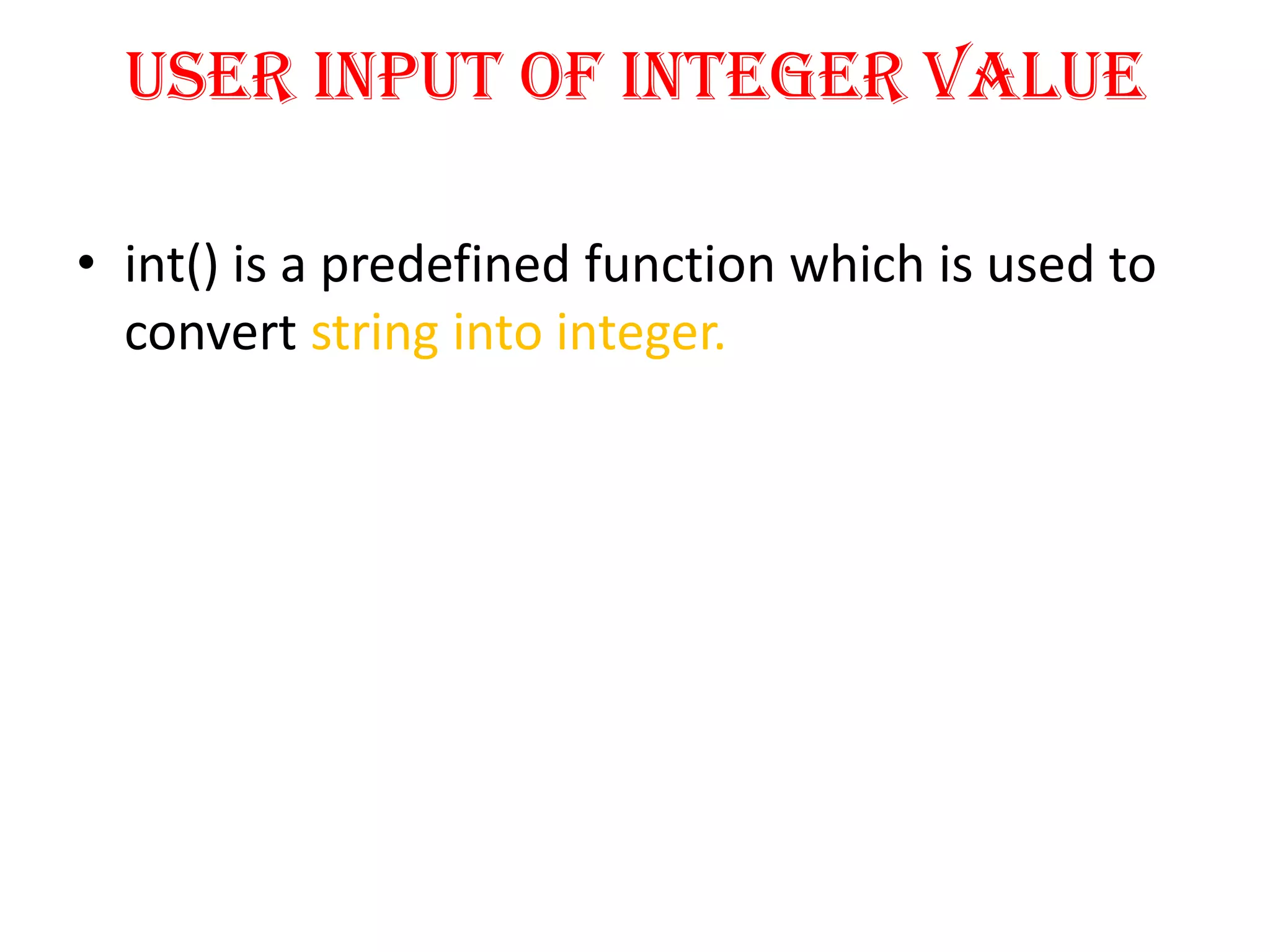
User input of Integer Value
• int() is a predefined function which is used to
convert string into integer.
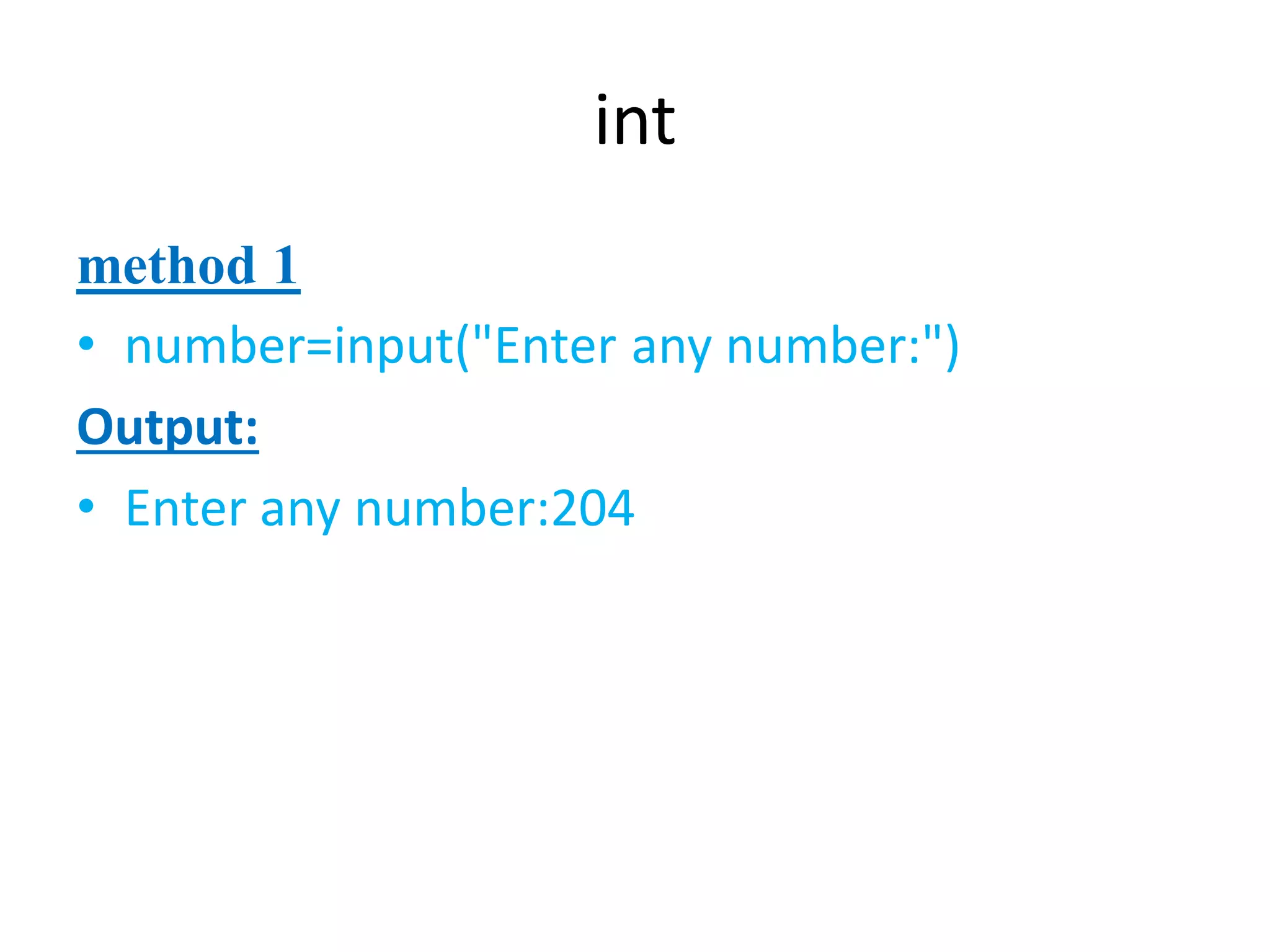
int
method 1
• number=input("Enter any number:")
Output:
• Enter any number:204
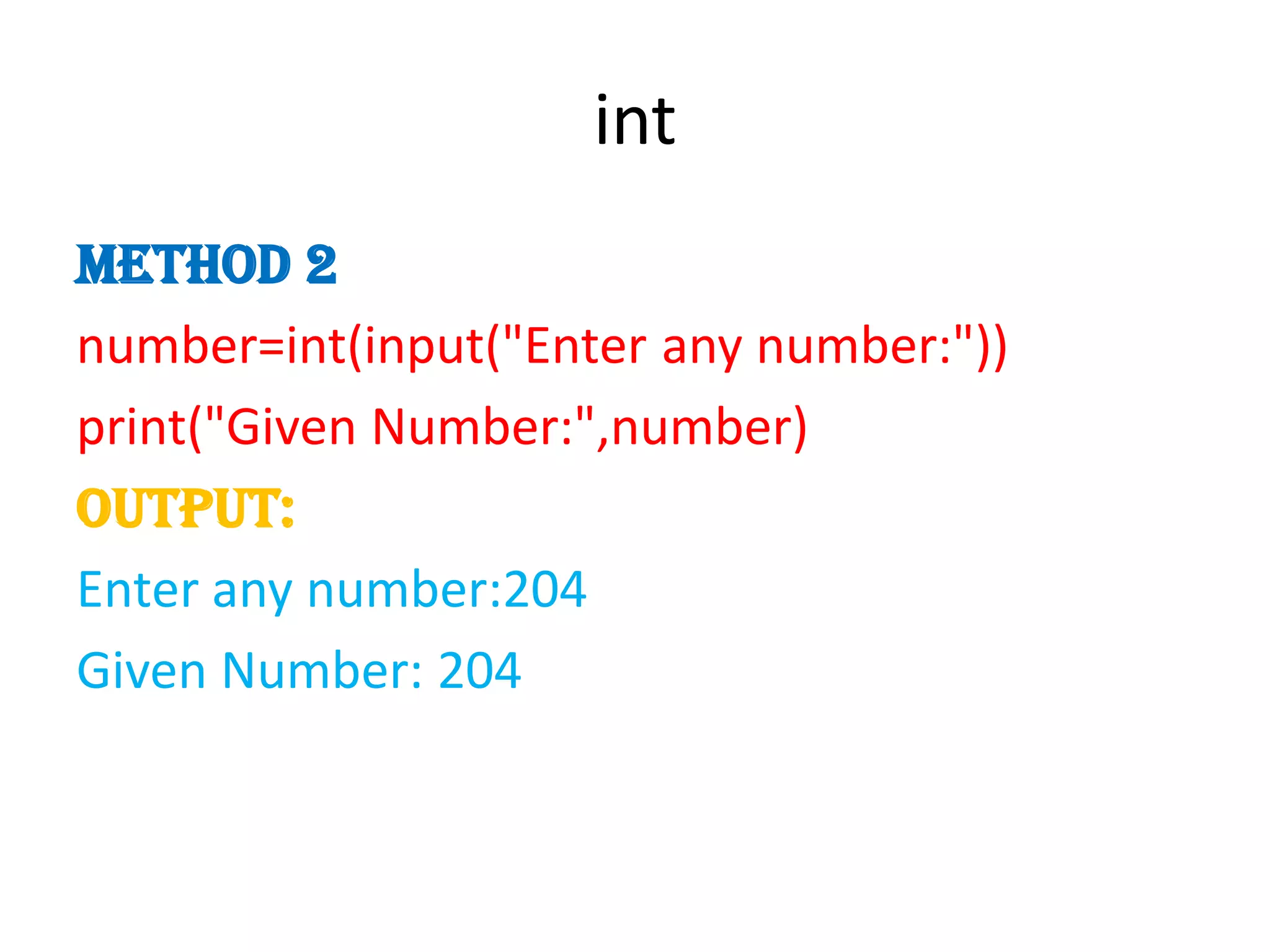
int
method 2
number=int(input("Enter any number:"))
print("Given Number:",number)
Output:
Enter any number:204
Given Number: 204
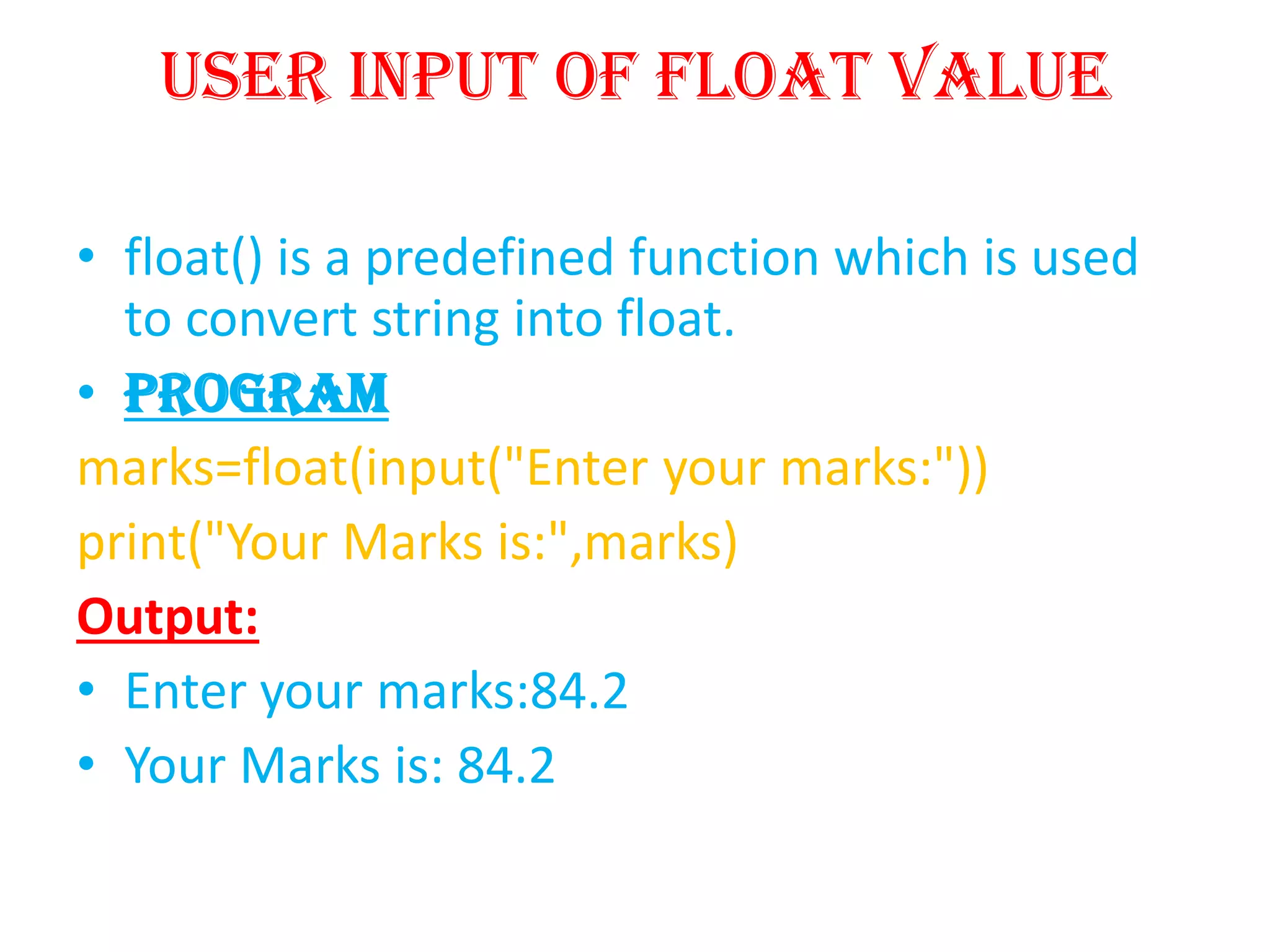
User input of Float Value
• float() is a predefined function which is used
to convert string into float.
• program
marks=float(input("Enter your marks:"))
print("Your Marks is:",marks)
Output:
• Enter your marks:84.2
• Your Marks is: 84.2
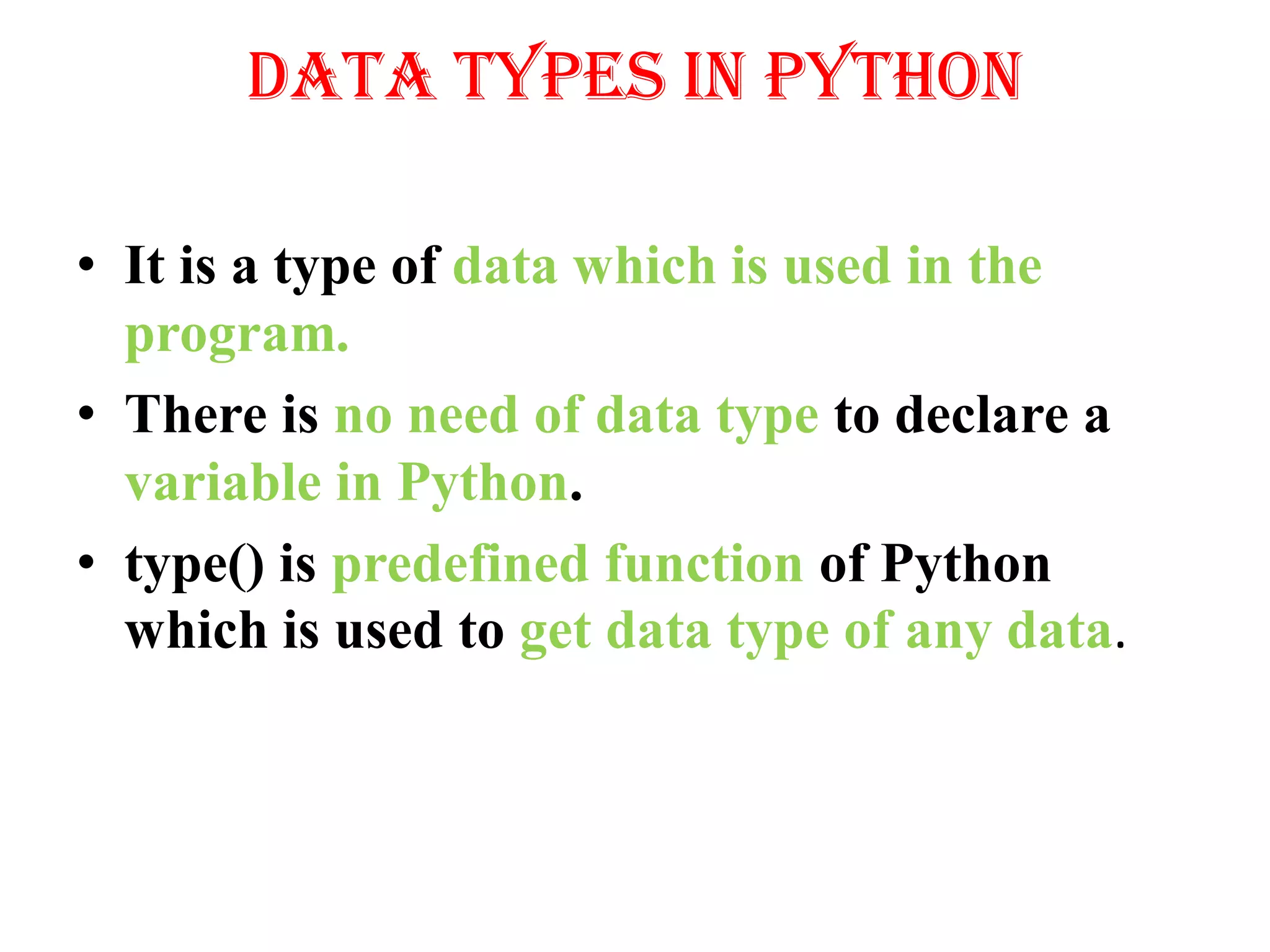
Data Types in Python
• It is a type of data which is used in the
program.
• There is no need of data type to declare a
variable in Python.
• type() is predefined function of Python
which is used to get data type of any data.
Type of Data Type
• Python contains following data types:
• Numbers
• String
• List
• Tuple
• Dictionary

What is Python.pdf

  • 1.
    What is Python? It is powerful, general-purpose, high level, object oriented programming language. It is developed by Guido van Rossum . It is released in 1991.
  • 2.
    Features of Python? Platform Independent(Window os,Linux os etc.) Object Oriented Flexible Structure Oriented Portable Simple
  • 3.
    Application of Python? Web Application Software development Database GUI Application Scientific and Numeric Computing Business Applications Console Based Application
  • 4.
    Why Use Python? It is very simple and easy to learn. It powerful,fast and secure. It has very simple syntax. It is powerful scripting language. It can be run on different kind of platform for example Window,Mac,Linux etc.
  • 9.
    Variable in Python •It is a name of storage space which is used to store data. • It's value may be changed. • It always contains last value stored to it. • There is no need to declare a variable in python. • Variable is created by assigning a value to it.
  • 10.
    Variable There are twotypes • Local Variable • Global Variable
  • 11.
  • 12.
    creating variables • name="Tom" •rollno=205 • marks=85.6
  • 13.
    printing value ofvariables • print("Name:",name) • print("Roll:",rollno) • print("Marks:",marks) • **Output** • Name: Tom • Roll: 205 • Marks: 85.6
  • 14.
    Assigning single valueto multiple variable creating variables • a=b=c=90 • #printing value of varibales • print("a:",a) • print("b:",b) • print("c:",c) • **Output** • a: 90 • b: 90 • c: 90
  • 15.
    Assigning multiple valuesto multiple variables creating variables • a,b,c=70,80,90 • #printing value of varibales • print("a:",a) • print("b:",b) • print("c:",c) • **Output** • a: 70 • b: 80 • c: 90
  • 16.
    Rules to definea variable • The first letter of a variable should be alphabet or underscore(_). • The first letter of variable should not be digit. • After first character it may be combination of alphabets and digits. • Blank spaces are not allowed in variable name. • Variable name should not be a keyword. • Variable names are case sensitive for example marks and MARKS are different variables.
  • 17.
    Local Variable • Avariable declared inside the body of the function is called local variable. • Local variable can be used only inside that function in which it is defined.
  • 18.
    Local Variable • #functiondefinition • def add(): • #creating variable • x=50 • y=30 • z=x+y • print("Add=",z) • #Calling funtion • add() **Output** • Add= 80
  • 19.
    Global Variable • Avariable which is created outside a function is called global variable. • It can be used anywhere in the program. #creating global variable • x=50 • y=30
  • 20.
    • def add(): •#accessing global variable • #inside a function • print("Inside function Sum=",x+y) • #Calling funtion • add() • #accessing global variable • #outside a function • print("Outside function Sum=",x+y) • """ • **Output** • Inside function Sum= 80 • Outside function Sum= 80
  • 21.
    User input inPython • 1.input() is a predefined function which is used to take user input in Python. • 2.Default user input is of type string.
  • 22.
    User input ofString Value • name=input("Enter your name:") • print("Your name:",name) • **Output** • Enter your name:Aayushi • Your name: Aayushi
  • 23.
    User input ofString Value • #Printing of data type of name • print(type(name)) • output • <class 'str'=""> • </class>
  • 24.
    User input ofInteger Value • int() is a predefined function which is used to convert string into integer.
  • 25.
    int method 1 • number=input("Enterany number:") Output: • Enter any number:204
  • 26.
    int method 2 number=int(input("Enter anynumber:")) print("Given Number:",number) Output: Enter any number:204 Given Number: 204
  • 27.
    User input ofFloat Value • float() is a predefined function which is used to convert string into float. • program marks=float(input("Enter your marks:")) print("Your Marks is:",marks) Output: • Enter your marks:84.2 • Your Marks is: 84.2
  • 28.
    Data Types inPython • It is a type of data which is used in the program. • There is no need of data type to declare a variable in Python. • type() is predefined function of Python which is used to get data type of any data.
  • 29.
    Type of DataType • Python contains following data types: • Numbers • String • List • Tuple • Dictionary