What is Lunar eclipse?
A Lunar eclipse is occur when the moon is moving in the earth’s
shadow. This can occur only when the Sun, Moon, and Earth are
exactly or very closely aligned.
Which Time is the lunar eclipse Start?
The total time of a lunar eclipse is determined by what is known as its
“contacts” moment of contact with Earth’s shadow.
● P1 (First contact): Beginning of the penumbral eclipse. Earth’s penumbra touches the
Moon’s outer layer.
● U1 (Second contact): Beginning of the partial eclipse. Earth’s umbra touches the Moon’s
outer layer.
● U2 (Third contact): Beginning of the total eclipse. The Moon’s surface is entirely within
Earth’s umbra.
● Greatest eclipse: The peak stage of the total eclipse. The Moon is very closest to the
center of Earth’s umbra.
● U3 (Fourth contact): End of the total eclipse. The Moon’s outer limb is an exit to the
Earth’s umbra.
● U4 (Fifth contact): End of the partial eclipse. Earth’s umbra leaves the Moon’s surface.
● P4 (Sixth contact): End of the penumbral eclipse. Earth’s penumbra no longer makes
contact with the Moon.
What is a Blood Moon?
The first and simple meaning is related to the red color a
totally eclipsed Moon takes on to observe on Earth. As
sunlight from the sun is passed through the earth’s
atmosphere the gaseous layer filter and refracts the rays in
such a way. That the green-to-violet wavelength on the visible
spectrum scatters is more powerful than the red thus giving
the Moon a reddish cast is called Blood moon.
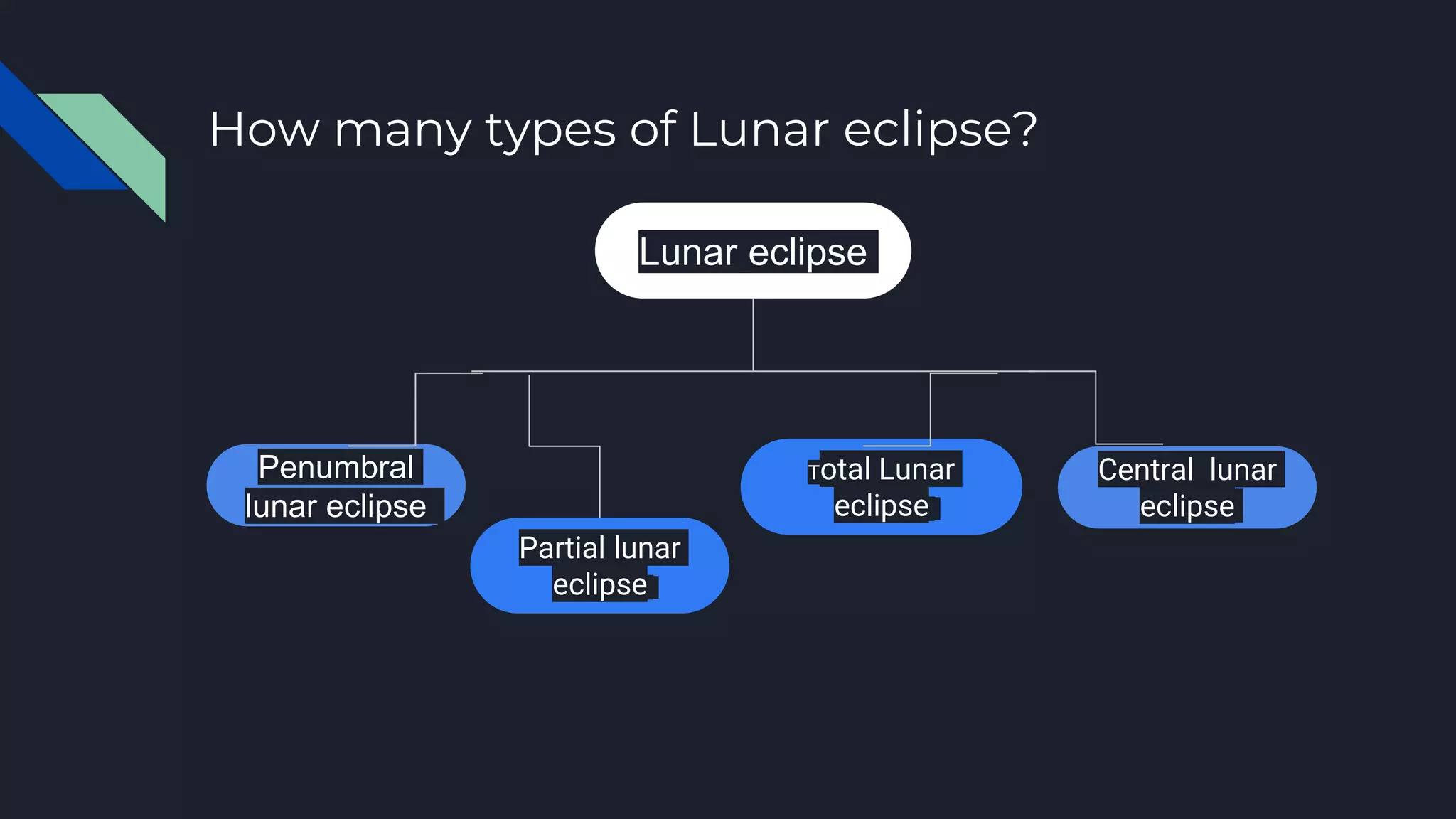
How many types of Lunar eclipse?
Lunar eclipse
Penumbral
lunar eclipse
Partial lunar
eclipse
Total Lunar
eclipse
Central lunar
eclipse

What is lunar eclipse & how they occur | Timings, Types and All about

  • 1.
    What is Lunareclipse? A Lunar eclipse is occur when the moon is moving in the earth’s shadow. This can occur only when the Sun, Moon, and Earth are exactly or very closely aligned.
  • 2.
    Which Time isthe lunar eclipse Start? The total time of a lunar eclipse is determined by what is known as its “contacts” moment of contact with Earth’s shadow. ● P1 (First contact): Beginning of the penumbral eclipse. Earth’s penumbra touches the Moon’s outer layer. ● U1 (Second contact): Beginning of the partial eclipse. Earth’s umbra touches the Moon’s outer layer. ● U2 (Third contact): Beginning of the total eclipse. The Moon’s surface is entirely within Earth’s umbra. ● Greatest eclipse: The peak stage of the total eclipse. The Moon is very closest to the center of Earth’s umbra. ● U3 (Fourth contact): End of the total eclipse. The Moon’s outer limb is an exit to the Earth’s umbra. ● U4 (Fifth contact): End of the partial eclipse. Earth’s umbra leaves the Moon’s surface. ● P4 (Sixth contact): End of the penumbral eclipse. Earth’s penumbra no longer makes contact with the Moon.
  • 3.
    What is aBlood Moon? The first and simple meaning is related to the red color a totally eclipsed Moon takes on to observe on Earth. As sunlight from the sun is passed through the earth’s atmosphere the gaseous layer filter and refracts the rays in such a way. That the green-to-violet wavelength on the visible spectrum scatters is more powerful than the red thus giving the Moon a reddish cast is called Blood moon.
  • 4.
    How many typesof Lunar eclipse? Lunar eclipse Penumbral lunar eclipse Partial lunar eclipse Total Lunar eclipse Central lunar eclipse